Executive  Functioning Alan Babcock, M.Ed. School Psychologist Disability Services Coordinator Penn State Harrisburg [email_address]
Executive  Functioning “ I don’t think of myself as a poor deprived ghetto girl who made good.  I think of myself as someone who, from an early age, knew I was responsible for myself and I had to make good.” Oprah Winfrey
Executive  Functioning “ My will shall shape my future.  Whether I fail or succeed shall be no man’s doing but my own.  I am the force; I can clear any obstacle before me or I can be lost in the maze.  My choice; my responsibility; win or lose, only I hold the key to my destiny.” Elaine Maxwell
Executive  Functioning It matters not how straight the gate,    How charged with punishments the scroll,  I am the master of my fate: I am the captain of my soul. William Ernest Henley
Executive  Functioning “ You can be anything you want to be, if you want it badly enough and if you are willing to work for it.” Charles Babcock
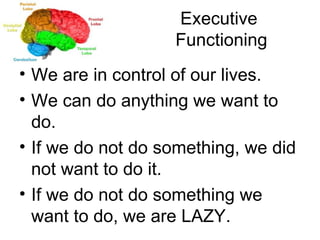
Executive  Functioning We are in control of our lives. We can do anything we want to do. If we do not do something, we did not want to do it. If we do not do something we want to do, we are LAZY.
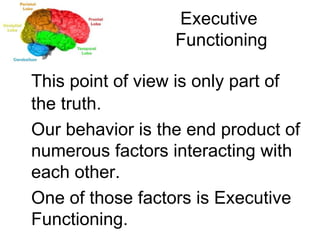
Executive  Functioning This point of view is only part of the truth. Our behavior is the end product of numerous factors interacting with each other. One of those factors is Executive Functioning.
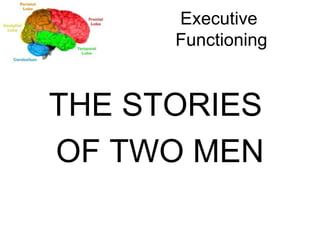
Executive  Functioning THE STORIES  OF TWO MEN
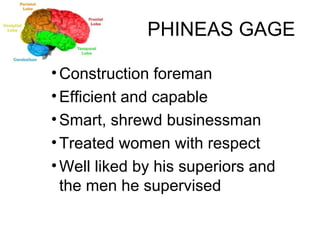
PHINEAS GAGE Construction foreman Efficient and capable Smart, shrewd businessman Treated women with respect Well liked by his superiors and the men he supervised
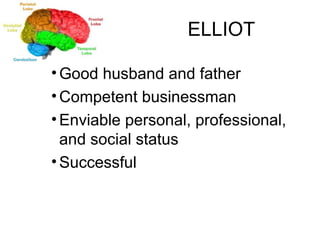
ELLIOT Good husband and father Competent businessman Enviable personal, professional, and social status Successful
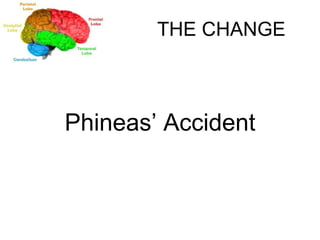
THE CHANGE Phineas’ Accident
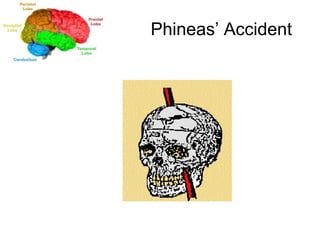
Phineas’ Accident
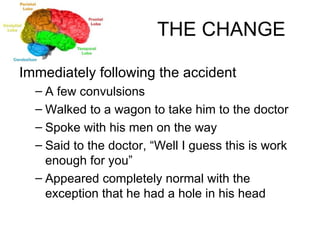
THE CHANGE Immediately following the accident A few convulsions Walked to a wagon to take him to the doctor Spoke with his men on the way Said to the doctor, “Well I guess this is work enough for you” Appeared completely normal with the exception that he had a hole in his head
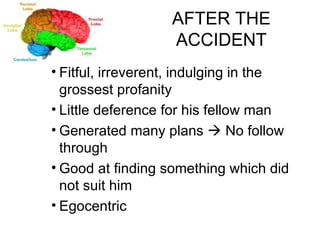
AFTER THE ACCIDENT Fitful, irreverent, indulging in the grossest profanity Little deference for his fellow man Generated many plans    No follow through Good at finding something which did not suit him Egocentric
Gage was no longer Gage
THE CHANGE Elliot’s tumor  and operation
AFTER THE OPERATION Needed prompting to get up Distracted and did not return to the task at hand Focused on unimportant details Poor business decisions Two divorces Disregarded good advice from friends
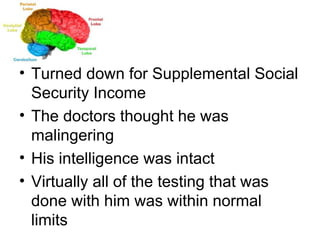
Turned down for Supplemental Social Security Income The doctors thought he was malingering His intelligence was intact Virtually all of the testing that was done with him was within normal limits
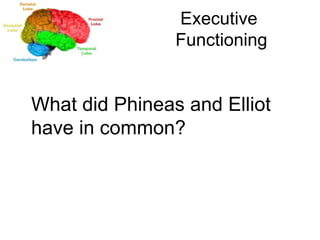
Executive  Functioning What did Phineas and Elliot have in common?
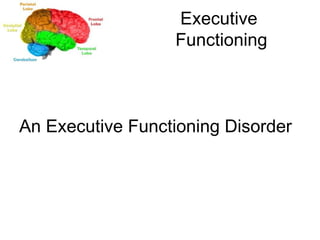
Executive  Functioning An Executive Functioning Disorder
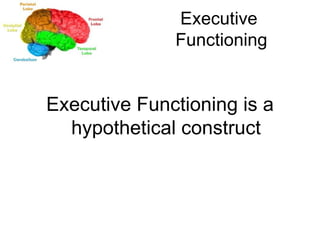
Executive  Functioning Executive Functioning is a hypothetical construct
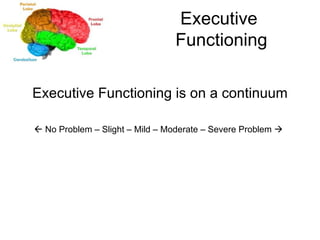
Executive  Functioning Executive Functioning is on a continuum    No Problem – Slight – Mild – Moderate – Severe Problem  
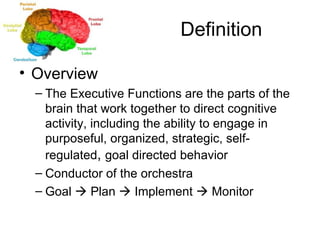
Definition Overview The Executive Functions are the parts of the brain that work together to direct cognitive activity, including the ability to engage in purposeful, organized, strategic, self-regulated ,  goal directed behavior Conductor of the orchestra  Goal    Plan    Implement    Monitor
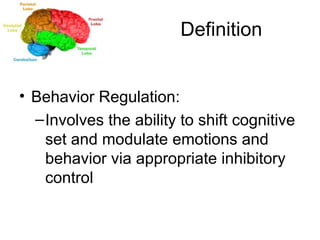
Definition Behavior Regulation: Involves the ability to shift cognitive set and modulate emotions and behavior via appropriate inhibitory control
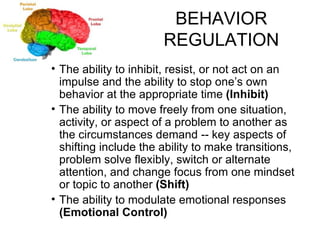
BEHAVIOR REGULATION The ability to inhibit, resist, or not act on an impulse and the ability to stop one’s own behavior at the appropriate time  (Inhibit) The ability to move freely from one situation, activity, or aspect of a problem to another as the circumstances demand -- key aspects of shifting include the ability to make transitions, problem solve flexibly, switch or alternate attention, and change focus from one mindset or topic to another  (Shift) The ability to modulate emotional responses  (Emotional Control)
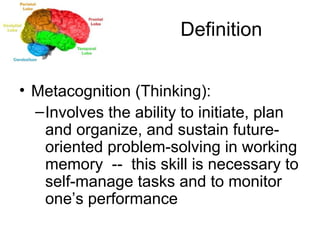
Definition Metacognition (Thinking): Involves the ability to initiate, plan and organize, and sustain future-oriented problem-solving in working memory  --  this skill is necessary to self-manage tasks and to monitor one’s performance
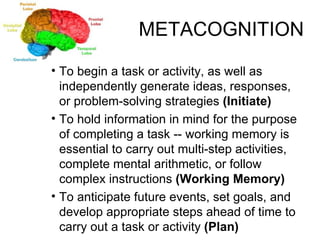
METACOGNITION To begin a task or activity, as well as independently generate ideas, responses, or problem-solving strategies  (Initiate) To hold information in mind for the purpose of completing a task -- working memory is essential to carry out multi-step activities, complete mental arithmetic, or follow complex instructions  (Working Memory) To anticipate future events, set goals, and develop appropriate steps ahead of time to carry out a task or activity  (Plan)
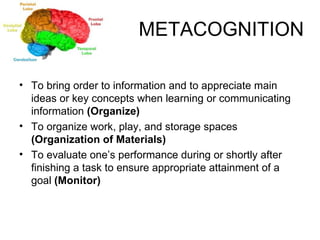
METACOGNITION To bring order to information and to appreciate main ideas or key concepts when learning or communicating information  (Organize) To organize work, play, and storage spaces  (Organization of Materials) To evaluate one’s performance during or shortly after finishing a task to ensure appropriate attainment of a goal  (Monitor)
ASSESSMENT
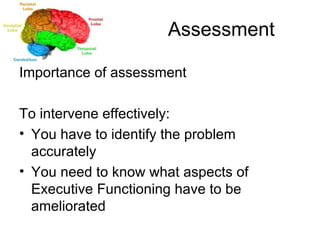
Assessment Importance of assessment To intervene effectively: You have to identify the problem accurately You need to know what aspects of Executive Functioning have to be ameliorated
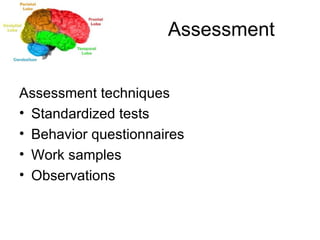
Assessment Assessment techniques Standardized tests Behavior questionnaires Work samples Observations
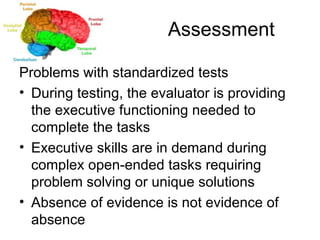
Assessment Problems with standardized tests During testing, the evaluator is providing the executive functioning needed to complete the tasks Executive skills are in demand during complex open-ended tasks requiring problem solving or unique solutions Absence of evidence is not evidence of absence
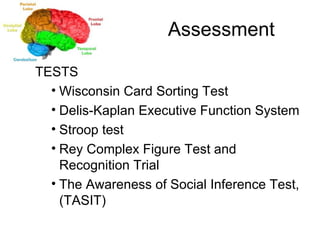
Assessment TESTS Wisconsin Card Sorting Test Delis-Kaplan Executive Function System Stroop test Rey Complex Figure Test and Recognition Trial The Awareness of Social Inference Test, (TASIT)
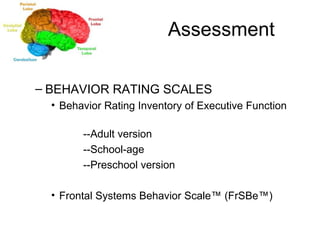
Assessment BEHAVIOR RATING SCALES Behavior Rating Inventory of Executive Function  --Adult version --School-age --Preschool version Frontal Systems Behavior Scale™ (FrSBe™)
IMPLICATIONS OF  DYSFUNCTION
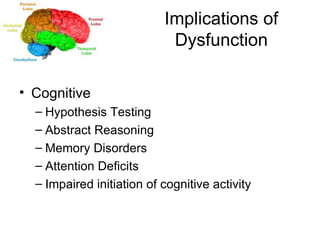
Implications of Dysfunction Cognitive Hypothesis Testing Abstract Reasoning Memory Disorders Attention Deficits Impaired initiation of cognitive activity
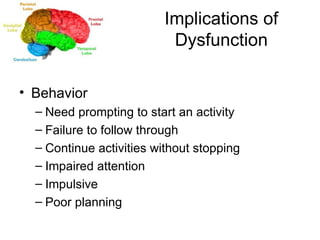
Implications of Dysfunction Behavior Need prompting to start an activity Failure to follow through Continue activities without stopping Impaired attention Impulsive Poor planning
Implications of Dysfunction Language Reduction of language production Difficulty initiating speech Struggle to maintain a complex, spontaneous conversation Indifferent to communication Trouble ending a conversation
Implications of Dysfunction Social Behavior Social misperceptions Simplistic thinking Behavior based on concrete, simple motivations Cannot handle the complexity of social interaction Underdeveloped “Theory of Mind”
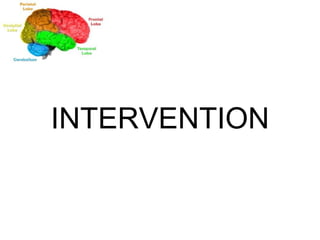
INTERVENTION
Intervention Individual  Support System Therapist Friends Parents Family members
Intervention The Process: Awareness  Acceptance  Instruction  Practice  Accountability
Awareness Individual Executive functioning Strengths and challenges How the intervention process works Benefits of intervention
Awareness Support system Executive functioning Specific problems with which the individual is dealing
Acceptance Individual “ I'm not perfect.” “ I have strengths and weaknesses.” “ I need outside help.” “ I am not to blame for my challenges; I am responsible for managing them.” “ I have work to do.”
Acceptance Support system “ I cannot expect the person to change without some outside help.” “ The person is not to blame for his or her struggles.” “ I may have to make changes.” “ I have work to do.”
Action Individual Making a commitment to make changes Providing support personnel with honest feedback about his or her difficulties  Taking direction from support personnel Making an honest attempt to use strategies Explaining what works and what does not work
Action Support system Make a connection with the person Be willing to monitor the individual Teach specific management strategies Help the individual to implement management strategies Evaluate effectiveness of management strategies
GENERAL Name the problematic behavior Become aware of the problematic behavior When does the behavior occur? Where does the behavior occur? With whom does the behavior occur?
GENERAL Set a goal Develop specific strategies to manage the behavior Generate external supports to help you manage the behavior Monitor progress Fade external supports
SPECIFIC INTERVENTIONS
INHIBITION Practice monitoring behavior Ask others to point out your impulsivity Before engaging in a new, exciting behavior, “STOP” and consider the consequences When engaging in a new, exciting behavior, ask yourself if you could tell someone who cares about you what you are going to do After stopping and thinking, make a conscious decision about engaging in the behavior
SHIFTING Become aware of getting stuck When you notice that you are stuck, engage in relaxation techniques Practice coming up with multiple solutions to specific problems Generate a specific problem-solving strategy that considers your needs and the needs of other people involved
EMOTIONAL CONTROL Learn specific relaxation techniques and practice those techniques Identify when you are beginning to feel intensely Apply your relaxation techniques Identify problems that precipitate strong feelings Deal with that problem
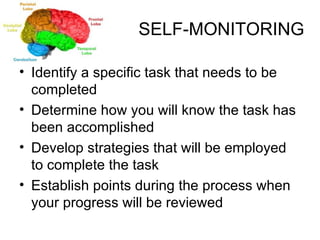
SELF-MONITORING Identify a specific task that needs to be completed Determine how you will know the task has been accomplished Develop strategies that will be employed to complete the task Establish points during the process when your progress will be reviewed
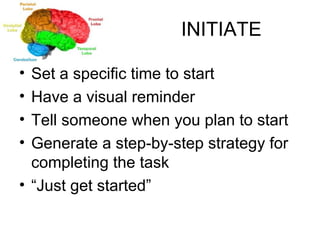
INITIATE Set a specific time to start Have a visual reminder Tell someone when you plan to start Generate a step-by-step strategy for completing the task “ Just get started”
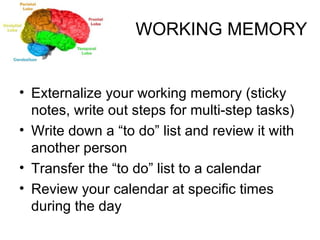
WORKING MEMORY Externalize your working memory (sticky notes, write out steps for multi-step tasks) Write down a “to do” list and review it with another person Transfer the “to do” list to a calendar Review your calendar at specific times during the day
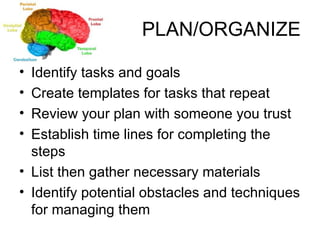
PLAN/ORGANIZE Identify tasks and goals Create templates for tasks that repeat Review your plan with someone you trust  Establish time lines for completing the steps List then gather necessary materials Identify potential obstacles and techniques for managing them
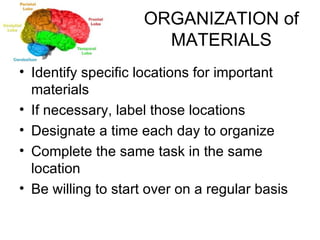
ORGANIZATION of MATERIALS Identify specific locations for important materials If necessary, label those locations Designate a time each day to organize Complete the same task in the same location Be willing to start over on a regular basis
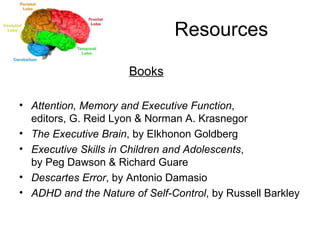
Resources   Books Attention, Memory and Executive Function ,  editors, G. Reid Lyon & Norman A. Krasnegor  The Executive Brain , by Elkhonon Goldberg Executive Skills in Children and Adolescents ,  by Peg Dawson & Richard Guare Descartes Error , by Antonio Damasio ADHD and the Nature of Self-Control , by Russell Barkley
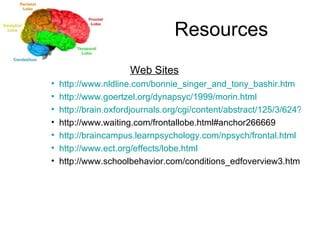
Resources   Web Sites http://www.nldline.com/bonnie_singer_and_tony_bashir.htm http://www.goertzel.org/dynapsyc/1999/morin.html http://brain.oxfordjournals.org/cgi/content/abstract/125/3/624?ijkey=8ccb9bde475d0cdc92b613e04e848b278429da7f&keytype2=tf_ipsecsha http://www.waiting.com/frontallobe.html#anchor266669 http://braincampus.learnpsychology.com/npsych/frontal.html http://www.ect.org/effects/lobe.html http://www.schoolbehavior.com/conditions_edfoverview3.htm

Executive functioning for students

  • 1.
    Executive FunctioningAlan Babcock, M.Ed. School Psychologist Disability Services Coordinator Penn State Harrisburg [email_address]
  • 2.
    Executive Functioning“ I don’t think of myself as a poor deprived ghetto girl who made good. I think of myself as someone who, from an early age, knew I was responsible for myself and I had to make good.” Oprah Winfrey
  • 3.
    Executive Functioning“ My will shall shape my future. Whether I fail or succeed shall be no man’s doing but my own. I am the force; I can clear any obstacle before me or I can be lost in the maze. My choice; my responsibility; win or lose, only I hold the key to my destiny.” Elaine Maxwell
  • 4.
    Executive FunctioningIt matters not how straight the gate,    How charged with punishments the scroll,  I am the master of my fate: I am the captain of my soul. William Ernest Henley
  • 5.
    Executive Functioning“ You can be anything you want to be, if you want it badly enough and if you are willing to work for it.” Charles Babcock
  • 6.
    Executive FunctioningWe are in control of our lives. We can do anything we want to do. If we do not do something, we did not want to do it. If we do not do something we want to do, we are LAZY.
  • 7.
    Executive FunctioningThis point of view is only part of the truth. Our behavior is the end product of numerous factors interacting with each other. One of those factors is Executive Functioning.
  • 8.
    Executive FunctioningTHE STORIES OF TWO MEN
  • 9.
    PHINEAS GAGE Constructionforeman Efficient and capable Smart, shrewd businessman Treated women with respect Well liked by his superiors and the men he supervised
  • 10.
    ELLIOT Good husbandand father Competent businessman Enviable personal, professional, and social status Successful
  • 11.
  • 12.
  • 13.
    THE CHANGE Immediatelyfollowing the accident A few convulsions Walked to a wagon to take him to the doctor Spoke with his men on the way Said to the doctor, “Well I guess this is work enough for you” Appeared completely normal with the exception that he had a hole in his head
  • 14.
    AFTER THE ACCIDENTFitful, irreverent, indulging in the grossest profanity Little deference for his fellow man Generated many plans  No follow through Good at finding something which did not suit him Egocentric
  • 15.
    Gage was nolonger Gage
  • 16.
    THE CHANGE Elliot’stumor and operation
  • 17.
    AFTER THE OPERATIONNeeded prompting to get up Distracted and did not return to the task at hand Focused on unimportant details Poor business decisions Two divorces Disregarded good advice from friends
  • 18.
    Turned down forSupplemental Social Security Income The doctors thought he was malingering His intelligence was intact Virtually all of the testing that was done with him was within normal limits
  • 19.
    Executive FunctioningWhat did Phineas and Elliot have in common?
  • 20.
    Executive FunctioningAn Executive Functioning Disorder
  • 21.
    Executive FunctioningExecutive Functioning is a hypothetical construct
  • 22.
    Executive FunctioningExecutive Functioning is on a continuum  No Problem – Slight – Mild – Moderate – Severe Problem 
  • 23.
    Definition Overview TheExecutive Functions are the parts of the brain that work together to direct cognitive activity, including the ability to engage in purposeful, organized, strategic, self-regulated , goal directed behavior Conductor of the orchestra Goal  Plan  Implement  Monitor
  • 24.
    Definition Behavior Regulation:Involves the ability to shift cognitive set and modulate emotions and behavior via appropriate inhibitory control
  • 25.
    BEHAVIOR REGULATION Theability to inhibit, resist, or not act on an impulse and the ability to stop one’s own behavior at the appropriate time (Inhibit) The ability to move freely from one situation, activity, or aspect of a problem to another as the circumstances demand -- key aspects of shifting include the ability to make transitions, problem solve flexibly, switch or alternate attention, and change focus from one mindset or topic to another (Shift) The ability to modulate emotional responses (Emotional Control)
  • 26.
    Definition Metacognition (Thinking):Involves the ability to initiate, plan and organize, and sustain future-oriented problem-solving in working memory -- this skill is necessary to self-manage tasks and to monitor one’s performance
  • 27.
    METACOGNITION To begina task or activity, as well as independently generate ideas, responses, or problem-solving strategies (Initiate) To hold information in mind for the purpose of completing a task -- working memory is essential to carry out multi-step activities, complete mental arithmetic, or follow complex instructions (Working Memory) To anticipate future events, set goals, and develop appropriate steps ahead of time to carry out a task or activity (Plan)
  • 28.
    METACOGNITION To bringorder to information and to appreciate main ideas or key concepts when learning or communicating information (Organize) To organize work, play, and storage spaces (Organization of Materials) To evaluate one’s performance during or shortly after finishing a task to ensure appropriate attainment of a goal (Monitor)
  • 29.
  • 30.
    Assessment Importance ofassessment To intervene effectively: You have to identify the problem accurately You need to know what aspects of Executive Functioning have to be ameliorated
  • 31.
    Assessment Assessment techniquesStandardized tests Behavior questionnaires Work samples Observations
  • 32.
    Assessment Problems withstandardized tests During testing, the evaluator is providing the executive functioning needed to complete the tasks Executive skills are in demand during complex open-ended tasks requiring problem solving or unique solutions Absence of evidence is not evidence of absence
  • 33.
    Assessment TESTS WisconsinCard Sorting Test Delis-Kaplan Executive Function System Stroop test Rey Complex Figure Test and Recognition Trial The Awareness of Social Inference Test, (TASIT)
  • 34.
    Assessment BEHAVIOR RATINGSCALES Behavior Rating Inventory of Executive Function --Adult version --School-age --Preschool version Frontal Systems Behavior Scale™ (FrSBe™)
  • 35.
    IMPLICATIONS OF DYSFUNCTION
  • 36.
    Implications of DysfunctionCognitive Hypothesis Testing Abstract Reasoning Memory Disorders Attention Deficits Impaired initiation of cognitive activity
  • 37.
    Implications of DysfunctionBehavior Need prompting to start an activity Failure to follow through Continue activities without stopping Impaired attention Impulsive Poor planning
  • 38.
    Implications of DysfunctionLanguage Reduction of language production Difficulty initiating speech Struggle to maintain a complex, spontaneous conversation Indifferent to communication Trouble ending a conversation
  • 39.
    Implications of DysfunctionSocial Behavior Social misperceptions Simplistic thinking Behavior based on concrete, simple motivations Cannot handle the complexity of social interaction Underdeveloped “Theory of Mind”
  • 40.
  • 41.
    Intervention Individual Support System Therapist Friends Parents Family members
  • 42.
    Intervention The Process:Awareness  Acceptance  Instruction  Practice  Accountability
  • 43.
    Awareness Individual Executivefunctioning Strengths and challenges How the intervention process works Benefits of intervention
  • 44.
    Awareness Support systemExecutive functioning Specific problems with which the individual is dealing
  • 45.
    Acceptance Individual “I'm not perfect.” “ I have strengths and weaknesses.” “ I need outside help.” “ I am not to blame for my challenges; I am responsible for managing them.” “ I have work to do.”
  • 46.
    Acceptance Support system“ I cannot expect the person to change without some outside help.” “ The person is not to blame for his or her struggles.” “ I may have to make changes.” “ I have work to do.”
  • 47.
    Action Individual Makinga commitment to make changes Providing support personnel with honest feedback about his or her difficulties Taking direction from support personnel Making an honest attempt to use strategies Explaining what works and what does not work
  • 48.
    Action Support systemMake a connection with the person Be willing to monitor the individual Teach specific management strategies Help the individual to implement management strategies Evaluate effectiveness of management strategies
  • 49.
    GENERAL Name theproblematic behavior Become aware of the problematic behavior When does the behavior occur? Where does the behavior occur? With whom does the behavior occur?
  • 50.
    GENERAL Set agoal Develop specific strategies to manage the behavior Generate external supports to help you manage the behavior Monitor progress Fade external supports
  • 51.
  • 52.
    INHIBITION Practice monitoringbehavior Ask others to point out your impulsivity Before engaging in a new, exciting behavior, “STOP” and consider the consequences When engaging in a new, exciting behavior, ask yourself if you could tell someone who cares about you what you are going to do After stopping and thinking, make a conscious decision about engaging in the behavior
  • 53.
    SHIFTING Become awareof getting stuck When you notice that you are stuck, engage in relaxation techniques Practice coming up with multiple solutions to specific problems Generate a specific problem-solving strategy that considers your needs and the needs of other people involved
  • 54.
    EMOTIONAL CONTROL Learnspecific relaxation techniques and practice those techniques Identify when you are beginning to feel intensely Apply your relaxation techniques Identify problems that precipitate strong feelings Deal with that problem
  • 55.
    SELF-MONITORING Identify aspecific task that needs to be completed Determine how you will know the task has been accomplished Develop strategies that will be employed to complete the task Establish points during the process when your progress will be reviewed
  • 56.
    INITIATE Set aspecific time to start Have a visual reminder Tell someone when you plan to start Generate a step-by-step strategy for completing the task “ Just get started”
  • 57.
    WORKING MEMORY Externalizeyour working memory (sticky notes, write out steps for multi-step tasks) Write down a “to do” list and review it with another person Transfer the “to do” list to a calendar Review your calendar at specific times during the day
  • 58.
    PLAN/ORGANIZE Identify tasksand goals Create templates for tasks that repeat Review your plan with someone you trust Establish time lines for completing the steps List then gather necessary materials Identify potential obstacles and techniques for managing them
  • 59.
    ORGANIZATION of MATERIALSIdentify specific locations for important materials If necessary, label those locations Designate a time each day to organize Complete the same task in the same location Be willing to start over on a regular basis
  • 60.
    Resources Books Attention, Memory and Executive Function , editors, G. Reid Lyon & Norman A. Krasnegor The Executive Brain , by Elkhonon Goldberg Executive Skills in Children and Adolescents , by Peg Dawson & Richard Guare Descartes Error , by Antonio Damasio ADHD and the Nature of Self-Control , by Russell Barkley
  • 61.
    Resources Web Sites http://www.nldline.com/bonnie_singer_and_tony_bashir.htm http://www.goertzel.org/dynapsyc/1999/morin.html http://brain.oxfordjournals.org/cgi/content/abstract/125/3/624?ijkey=8ccb9bde475d0cdc92b613e04e848b278429da7f&keytype2=tf_ipsecsha http://www.waiting.com/frontallobe.html#anchor266669 http://braincampus.learnpsychology.com/npsych/frontal.html http://www.ect.org/effects/lobe.html http://www.schoolbehavior.com/conditions_edfoverview3.htm

Editor's Notes

  • #7 These quotes only represent part of the truth Today another piece of the puzzle
  • #37 Development of rules that guide future behavior Application of rules taught Actions are motivated by concrete, superficial goals such as immediate gratification