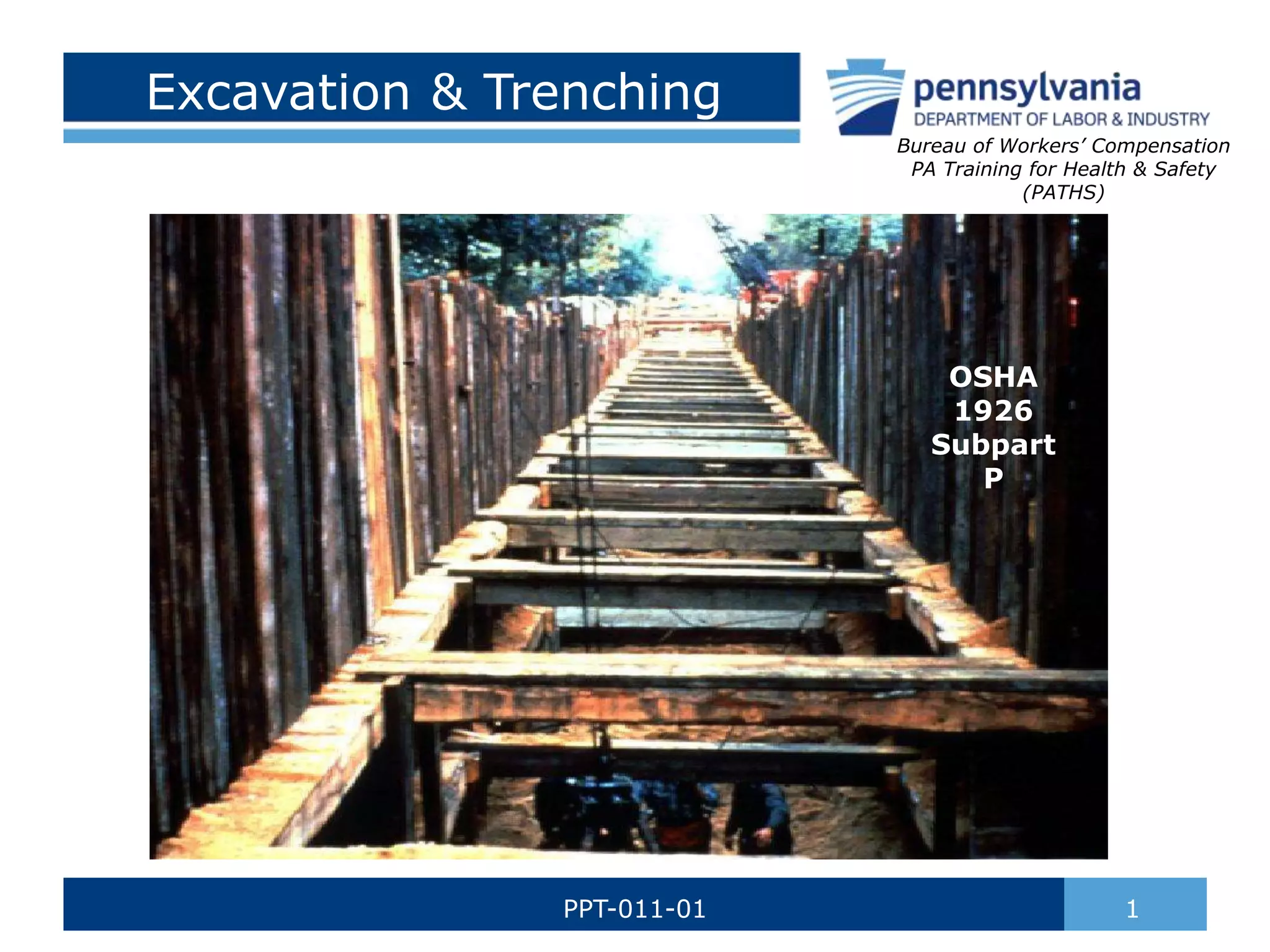
Excavation & Trenching
1
PPT-011-01
Bureau of Workers’ Compensation
PA Training for Health & Safety
(PATHS)
OSHA
1926
Subpart
P
Topics
 Excavation and Trenching Hazards
 Protection of Employees
 Protective Systems Design
 Cave-in Hazards
 Competent Person
 Inspection of Excavations
 Site Evaluation Planning
2
PPT-011-01
Focus on Training
• The greatest risk at an excavation
• How to protect employees from cave-ins
• Factors that pose a hazard to employees
working in excavations
• The role of a competent person at an
excavation site
3
PPT-011-01
Definitions
 Excavation – a man-made cut, cavity, trench,
or depression formed by earth removal.
 Trench – a narrow excavation. The depth is
greater than the width, but not wider than 15
feet.
 Shield - a structure able to withstand a cave-in
and protect employees (also called box).
 Shoring - a structure that supports the sides of
an excavation and protects against cave-ins.
 Sloping - a technique that employs a specific
angle of incline on the sides of the excavation.
The angle varies based on assessment of
impacting site factors.
4
PPT-011-01
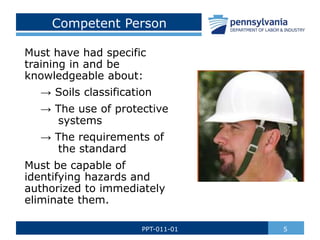
Competent Person
Must have had specific
training in and be
knowledgeable about:
→ Soils classification
→ The use of protective
systems
→ The requirements of
the standard
Must be capable of
identifying hazards and
authorized to immediately
eliminate them.
5
PPT-011-01
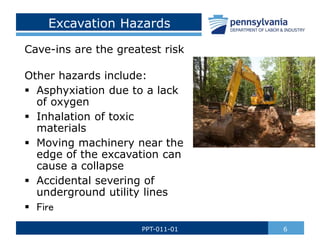
Excavation Hazards
Cave-ins are the greatest risk
Other hazards include:
 Asphyxiation due to a lack
of oxygen
 Inhalation of toxic
materials
 Moving machinery near the
edge of the excavation can
cause a collapse
 Accidental severing of
underground utility lines
 Fire
6
PPT-011-01
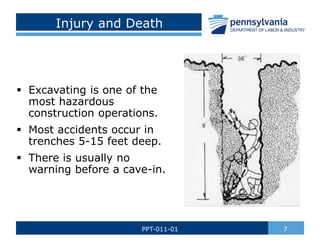
Injury and Death
 Excavating is one of the
most hazardous
construction operations.
 Most accidents occur in
trenches 5-15 feet deep.
 There is usually no
warning before a cave-in.
7
PPT-011-01
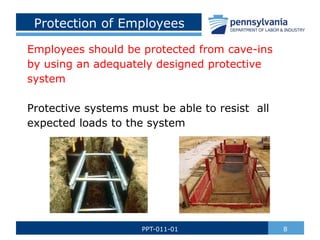
Protection of Employees
Employees should be protected from cave-ins
by using an adequately designed protective
system
Protective systems must be able to resist all
expected loads to the system
8
PPT-011-01
Protective Systems Requirements
A well-designed protective system
Correct design of:
- sloping and benching systems
- support systems
- shield systems
- other protective systems
+
Appropriate handling of materials and equipment
+
Attention to correct installation and removal
=
Protection of employees at excavations
9
PPT-011-01
Design of Protective Systems
The employer shall select and construct :
→ Slopes and configurations of sloping and
benching systems
→ Support systems, shield systems, and other
protective systems
 Shield - can be permanent or portable. Also
known as trench box or trench shield.
 Shoring - such as metal hydraulic, mechanical
or timber shoring system that supports the
sides
 Sloping - form sides of an excavation that are
inclined away from the excavation
10
PPT-011-01
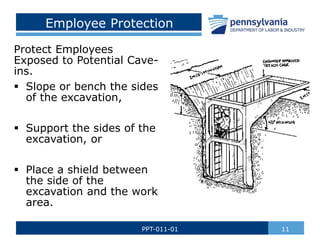
Employee Protection
Protect Employees
Exposed to Potential Cave-
ins.
 Slope or bench the sides
of the excavation,
 Support the sides of the
excavation, or
 Place a shield between
the side of the
excavation and the work
area.
11
PPT-011-01
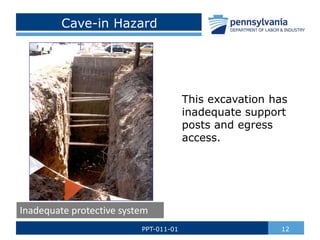
Cave-in Hazard
This excavation has
inadequate support
posts and egress
access.
12
PPT-011-01
Inadequate protective system
Inadequate Protective System
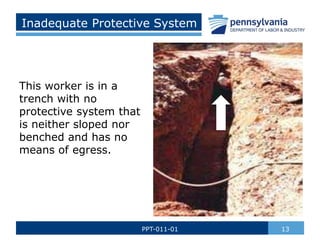
This worker is in a
trench with no
protective system that
is neither sloped nor
benched and has no
means of egress.
13
PPT-011-01
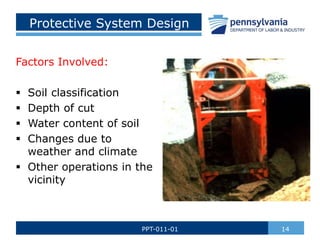
Protective System Design
Factors Involved:
 Soil classification
 Depth of cut
 Water content of soil
 Changes due to
weather and climate
 Other operations in the
vicinity
14
PPT-011-01
Shoring
General
▪ Provides a framework to work in
▪ Uses wales, cross braces and uprights
▪ Supports excavation walls
OSHA tables provide shoring data
▪ Must know soil type
▪ Must know depth and width of excavation
▪ Must be familiar with the OSHA Tables
15
PPT-011-01
Trench Shield
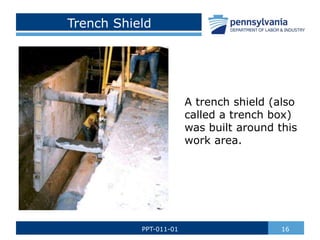
A trench shield (also
called a trench box)
was built around this
work area.
16
PPT-011-01
Hydraulic Trench Support
 Using hydraulic jacks
the operator can
easily drop the
system into the hole
 Once in place,
hydraulic pressure is
increased to keep the
forms in place
 Trench pins are
installed in case of
hydraulic failure
17
PPT-011-01
Materials and Equipment
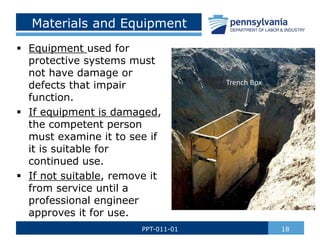
 Equipment used for
protective systems must
not have damage or
defects that impair
function.
 If equipment is damaged,
the competent person
must examine it to see if
it is suitable for
continued use.
 If not suitable, remove it
from service until a
professional engineer
approves it for use.
18
PPT-011-01
Trench Box
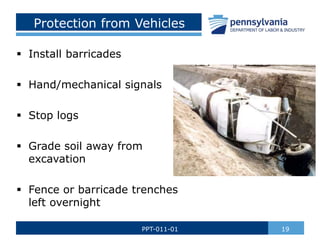
Protection from Vehicles
 Install barricades
 Hand/mechanical signals
 Stop logs
 Grade soil away from
excavation
 Fence or barricade trenches
left overnight
19
PPT-011-01
Hazardous Conditions
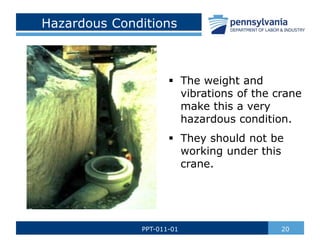
 The weight and
vibrations of the crane
make this a very
hazardous condition.
 They should not be
working under this
crane.
20
PPT-011-01
Spoil Piles
 Don’t place spoils within
2 feet from edge of
excavation
 Measure from nearest
part of the spoil to the
excavation edge
 Place spoils so rainwater
runs away from the
excavation
 Place spoil well away
from the excavation
21
PPT-011-01
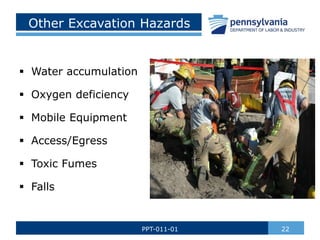
Other Excavation Hazards
 Water accumulation
 Oxygen deficiency
 Mobile Equipment
 Access/Egress
 Toxic Fumes
 Falls
22
PPT-011-01
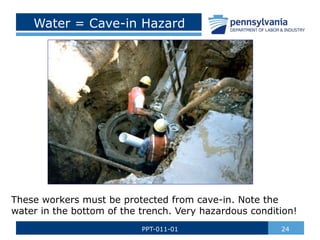
Water is Hazardous
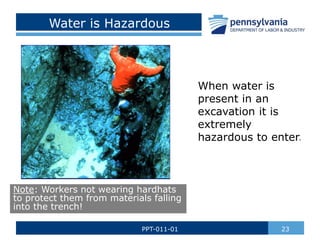
When water is
present in an
excavation it is
extremely
hazardous to enter.
23
PPT-011-01
Note: Workers not wearing hardhats
to protect them from materials falling
into the trench!
Water = Cave-in Hazard
These workers must be protected from cave-in. Note the
water in the bottom of the trench. Very hazardous condition!
24
PPT-011-01
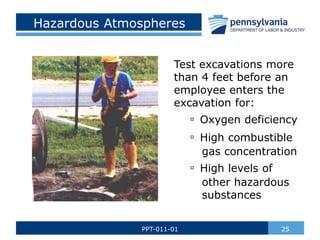
Hazardous Atmospheres
Test excavations more
than 4 feet before an
employee enters the
excavation for:
▫ Oxygen deficiency
▫ High combustible
gas concentration
▫ High levels of
other hazardous
substances
25
PPT-011-01
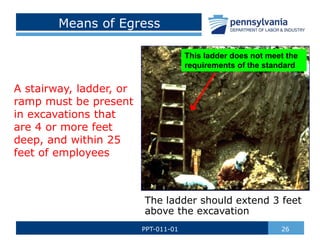
Means of Egress
A stairway, ladder, or
ramp must be present
in excavations that
are 4 or more feet
deep, and within 25
feet of employees
26
PPT-011-01
This ladder does not meet the
requirements of the standard
The ladder should extend 3 feet
above the excavation
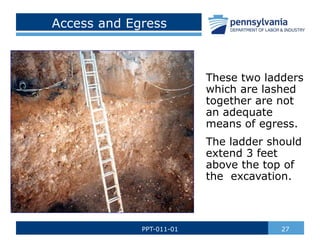
Access and Egress
These two ladders
which are lashed
together are not
an adequate
means of egress.
The ladder should
extend 3 feet
above the top of
the excavation.
27
PPT-011-01
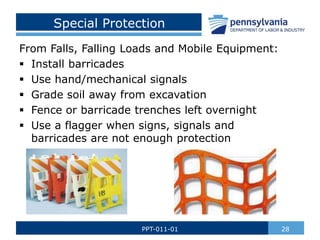
Special Protection
From Falls, Falling Loads and Mobile Equipment:
 Install barricades
 Use hand/mechanical signals
 Grade soil away from excavation
 Fence or barricade trenches left overnight
 Use a flagger when signs, signals and
barricades are not enough protection
28
PPT-011-01
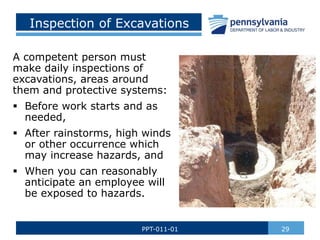
Inspection of Excavations
A competent person must
make daily inspections of
excavations, areas around
them and protective systems:
 Before work starts and as
needed,
 After rainstorms, high winds
or other occurrence which
may increase hazards, and
 When you can reasonably
anticipate an employee will
be exposed to hazards.
29
PPT-011-01
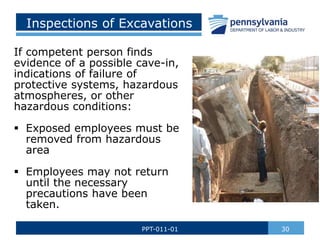
Inspections of Excavations
If competent person finds
evidence of a possible cave-in,
indications of failure of
protective systems, hazardous
atmospheres, or other
hazardous conditions:
 Exposed employees must be
removed from hazardous
area
 Employees may not return
until the necessary
precautions have been
taken.
30
PPT-011-01
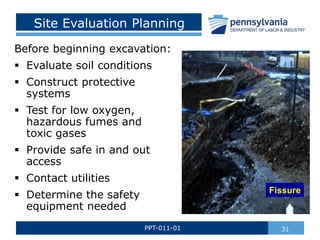
Site Evaluation Planning
Before beginning excavation:
 Evaluate soil conditions
 Construct protective
systems
 Test for low oxygen,
hazardous fumes and
toxic gases
 Provide safe in and out
access
 Contact utilities
 Determine the safety
equipment needed
31
PPT-011-01
Fissure
Summary
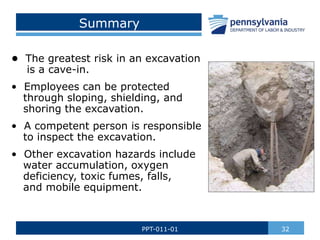
• The greatest risk in an excavation
is a cave-in.
• Employees can be protected
through sloping, shielding, and
shoring the excavation.
• A competent person is responsible
to inspect the excavation.
• Other excavation hazards include
water accumulation, oxygen
deficiency, toxic fumes, falls,
and mobile equipment.
32
PPT-011-01
Contact Information
Health & Safety Training Specialists
1171 South Cameron Street, Room 324
Harrisburg, PA 17104-2501
(717) 772-1635
RA-LI-BWC-PATHS@pa.gov
33
PPT-011-01
Like us on Facebook! -
https://www.facebook.com/BWCPATHS
Questions
34
PPT-011-01

Excavation and Trenching.pptx

  • 1.
    Excavation & Trenching 1 PPT-011-01 Bureauof Workers’ Compensation PA Training for Health & Safety (PATHS) OSHA 1926 Subpart P
  • 2.
    Topics  Excavation andTrenching Hazards  Protection of Employees  Protective Systems Design  Cave-in Hazards  Competent Person  Inspection of Excavations  Site Evaluation Planning 2 PPT-011-01
  • 3.
    Focus on Training •The greatest risk at an excavation • How to protect employees from cave-ins • Factors that pose a hazard to employees working in excavations • The role of a competent person at an excavation site 3 PPT-011-01
  • 4.
    Definitions  Excavation –a man-made cut, cavity, trench, or depression formed by earth removal.  Trench – a narrow excavation. The depth is greater than the width, but not wider than 15 feet.  Shield - a structure able to withstand a cave-in and protect employees (also called box).  Shoring - a structure that supports the sides of an excavation and protects against cave-ins.  Sloping - a technique that employs a specific angle of incline on the sides of the excavation. The angle varies based on assessment of impacting site factors. 4 PPT-011-01
  • 5.
    Competent Person Must havehad specific training in and be knowledgeable about: → Soils classification → The use of protective systems → The requirements of the standard Must be capable of identifying hazards and authorized to immediately eliminate them. 5 PPT-011-01
  • 6.
    Excavation Hazards Cave-ins arethe greatest risk Other hazards include:  Asphyxiation due to a lack of oxygen  Inhalation of toxic materials  Moving machinery near the edge of the excavation can cause a collapse  Accidental severing of underground utility lines  Fire 6 PPT-011-01
  • 7.
    Injury and Death Excavating is one of the most hazardous construction operations.  Most accidents occur in trenches 5-15 feet deep.  There is usually no warning before a cave-in. 7 PPT-011-01
  • 8.
    Protection of Employees Employeesshould be protected from cave-ins by using an adequately designed protective system Protective systems must be able to resist all expected loads to the system 8 PPT-011-01
  • 9.
    Protective Systems Requirements Awell-designed protective system Correct design of: - sloping and benching systems - support systems - shield systems - other protective systems + Appropriate handling of materials and equipment + Attention to correct installation and removal = Protection of employees at excavations 9 PPT-011-01
  • 10.
    Design of ProtectiveSystems The employer shall select and construct : → Slopes and configurations of sloping and benching systems → Support systems, shield systems, and other protective systems  Shield - can be permanent or portable. Also known as trench box or trench shield.  Shoring - such as metal hydraulic, mechanical or timber shoring system that supports the sides  Sloping - form sides of an excavation that are inclined away from the excavation 10 PPT-011-01
  • 11.
    Employee Protection Protect Employees Exposedto Potential Cave- ins.  Slope or bench the sides of the excavation,  Support the sides of the excavation, or  Place a shield between the side of the excavation and the work area. 11 PPT-011-01
  • 12.
    Cave-in Hazard This excavationhas inadequate support posts and egress access. 12 PPT-011-01 Inadequate protective system
  • 13.
    Inadequate Protective System Thisworker is in a trench with no protective system that is neither sloped nor benched and has no means of egress. 13 PPT-011-01
  • 14.
    Protective System Design FactorsInvolved:  Soil classification  Depth of cut  Water content of soil  Changes due to weather and climate  Other operations in the vicinity 14 PPT-011-01
  • 15.
    Shoring General ▪ Provides aframework to work in ▪ Uses wales, cross braces and uprights ▪ Supports excavation walls OSHA tables provide shoring data ▪ Must know soil type ▪ Must know depth and width of excavation ▪ Must be familiar with the OSHA Tables 15 PPT-011-01
  • 16.
    Trench Shield A trenchshield (also called a trench box) was built around this work area. 16 PPT-011-01
  • 17.
    Hydraulic Trench Support Using hydraulic jacks the operator can easily drop the system into the hole  Once in place, hydraulic pressure is increased to keep the forms in place  Trench pins are installed in case of hydraulic failure 17 PPT-011-01
  • 18.
    Materials and Equipment Equipment used for protective systems must not have damage or defects that impair function.  If equipment is damaged, the competent person must examine it to see if it is suitable for continued use.  If not suitable, remove it from service until a professional engineer approves it for use. 18 PPT-011-01 Trench Box
  • 19.
    Protection from Vehicles Install barricades  Hand/mechanical signals  Stop logs  Grade soil away from excavation  Fence or barricade trenches left overnight 19 PPT-011-01
  • 20.
    Hazardous Conditions  Theweight and vibrations of the crane make this a very hazardous condition.  They should not be working under this crane. 20 PPT-011-01
  • 21.
    Spoil Piles  Don’tplace spoils within 2 feet from edge of excavation  Measure from nearest part of the spoil to the excavation edge  Place spoils so rainwater runs away from the excavation  Place spoil well away from the excavation 21 PPT-011-01
  • 22.
    Other Excavation Hazards Water accumulation  Oxygen deficiency  Mobile Equipment  Access/Egress  Toxic Fumes  Falls 22 PPT-011-01
  • 23.
    Water is Hazardous Whenwater is present in an excavation it is extremely hazardous to enter. 23 PPT-011-01 Note: Workers not wearing hardhats to protect them from materials falling into the trench!
  • 24.
    Water = Cave-inHazard These workers must be protected from cave-in. Note the water in the bottom of the trench. Very hazardous condition! 24 PPT-011-01
  • 25.
    Hazardous Atmospheres Test excavationsmore than 4 feet before an employee enters the excavation for: ▫ Oxygen deficiency ▫ High combustible gas concentration ▫ High levels of other hazardous substances 25 PPT-011-01
  • 26.
    Means of Egress Astairway, ladder, or ramp must be present in excavations that are 4 or more feet deep, and within 25 feet of employees 26 PPT-011-01 This ladder does not meet the requirements of the standard The ladder should extend 3 feet above the excavation
  • 27.
    Access and Egress Thesetwo ladders which are lashed together are not an adequate means of egress. The ladder should extend 3 feet above the top of the excavation. 27 PPT-011-01
  • 28.
    Special Protection From Falls,Falling Loads and Mobile Equipment:  Install barricades  Use hand/mechanical signals  Grade soil away from excavation  Fence or barricade trenches left overnight  Use a flagger when signs, signals and barricades are not enough protection 28 PPT-011-01
  • 29.
    Inspection of Excavations Acompetent person must make daily inspections of excavations, areas around them and protective systems:  Before work starts and as needed,  After rainstorms, high winds or other occurrence which may increase hazards, and  When you can reasonably anticipate an employee will be exposed to hazards. 29 PPT-011-01
  • 30.
    Inspections of Excavations Ifcompetent person finds evidence of a possible cave-in, indications of failure of protective systems, hazardous atmospheres, or other hazardous conditions:  Exposed employees must be removed from hazardous area  Employees may not return until the necessary precautions have been taken. 30 PPT-011-01
  • 31.
    Site Evaluation Planning Beforebeginning excavation:  Evaluate soil conditions  Construct protective systems  Test for low oxygen, hazardous fumes and toxic gases  Provide safe in and out access  Contact utilities  Determine the safety equipment needed 31 PPT-011-01 Fissure
  • 32.
    Summary • The greatestrisk in an excavation is a cave-in. • Employees can be protected through sloping, shielding, and shoring the excavation. • A competent person is responsible to inspect the excavation. • Other excavation hazards include water accumulation, oxygen deficiency, toxic fumes, falls, and mobile equipment. 32 PPT-011-01
  • 33.
    Contact Information Health &Safety Training Specialists 1171 South Cameron Street, Room 324 Harrisburg, PA 17104-2501 (717) 772-1635 RA-LI-BWC-PATHS@pa.gov 33 PPT-011-01 Like us on Facebook! - https://www.facebook.com/BWCPATHS
  • 34.

Editor's Notes

  • #2 1926 Subpart P ‑ Excavations BEFORE DOING ANY DIGGING CALL 811! Each year employees are killed while working in and around excavations and trenches. Cave-ins are the leading hazard when working within a trench therefore employers should take the appropriate protective measures to provide for the safety of those employees required to work in and around excavations and trenches. This presentation is designed to provide individuals with information on related OSHA regulations as well as methods to ensure the safety of those who may enter or work around excavations and trenches. This presentation is not a substitute for any of the provisions of the Occupational Safety and Health Act of 1970 or for any standards issued by the U.S. Department of Labor.
  • #3 The following topics will be addressed in this program: Excavation and Trenching Hazards Protection of Employees Protective Systems Design Cave-in Hazards Competent Person Inspection of Excavations Site Evaluation Planning
  • #4 The discussion of this topic covers four main points. At the conclusion of the training, you should be able to: 1. State the greatest risk that is present at an excavation. 2. Briefly describe the three main methods for protecting employees from cave-ins. 3. Name at least three factors that pose a hazard to employees working in excavations, and at least one way to eliminate or reduce each of the hazards. 4. Describe the role of a competent person at an excavation site.
  • #5 Reference 1926.650 Excavation – a man-made cut, cavity, trench, or depression formed by earth removal. Trench – a narrow excavation. The depth is greater than the width, but not wider than 15 feet. Shield (shield system) -- a structure able to withstand a cave-in and protect employees with the structure. Shields can be permanent structure or can be designed to be portable and moved along as work progresses. Also known as a trench box or trench shield. Shoring (shoring system) -- a structure such as a metal hydraulic, mechanical or timber shoring system that supports the sides of an excavation and which is designed to prevent cave-ins. Sloping (sloping system) -- protects employees from cave-ins by excavating to form sides of an excavation that are inclined away from the excavation to prevent cave-ins. The angle of incline varies with differences in such factors as the soil type, environmental conditions of exposure, and application of surcharge loads.
  • #6 The “Competent Person” Must have had specific training in and be knowledgeable about: → Soils classification → The use of protective systems → The requirements of the standard Must be capable of identifying hazards and authorized to immediately eliminate them.
  • #7 OSHA Standard Exemptions: House foundation/basement excavations (including those that become trenches by definition when formwork, foundations, or walls are constructed) are exempt from the OSHA standard. The specific information regarding the interpretation of this exemption may be found on the OSHA public web site. Reference 29 CFR 1926.652. The exemption specifies height and width for the excavation, impact of water and environmental conditions, soil and equipment factors, and operation of heavy equipment in the vicinity.
  • #8 Excavating is one of the most hazardous construction operations. Most accidents occur in trenches 5-15 feet deep. There is usually no warning before a cave-in.
  • #9 Reference 1926.652(a) Protective system – a method of protecting employees from cave-ins, from material that could fall or roll from an excavation face or into an excavation, or from the collapse of adjacent structures. Protective systems include support systems, sloping and benching systems, shield systems, and other systems that provide the necessary protection. Spoil pile (surcharge) – material (soil or rock) removed from the cut which, after completing the underground work, will be returned to cover-up the excavation.
  • #10 Several factors come into play when developing a total “protective system”. The design of the system itself, how materials and equipment are handled in and around the excavation, and installation and removal of protective system components.
  • #11 Reference 1926.652, 1926.652(b), 1926.652(c) Added means of protection include: Benching -- excavating the sides of an excavation to form one or a series of horizontal levels or steps, usually with vertical or near-vertical surfaces between levels. Shoring or shielding is used when the location or depth of the cut makes sloping back to the maximum allowable slope impractical. There are two basic types of shoring, timber and aluminum hydraulic. Trench boxes (shielding) are different from shoring because instead of supporting the trench face, they are mostly serve to protect workers from cave-ins. The excavated area between the outside of the trench box and the face of the trench should be as small as possible. The space between the trench box and the excavation side may be backfilled (or other means may be used) to prevent lateral movement of the box. Shields may not be subjected to loads exceeding those which the system was designed to withstand. Trench boxes may be used in combination with sloping and benching.
  • #12 Reference 1926.652(a) Each employee in an excavation shall be protected from cave-ins by an adequate protective system except when: Excavations are made entirely in stable rock; or Excavations are less than 5 feet in depth and examination of the ground by a competent person provides no indication of a potential cave-in. Protective systems shall have the capacity to resist without failure all loads that are intended or could reasonably be expected to be applied or transmitted to the system. Reference 1926.652(b) Design of sloping and benching systems.
  • #13 Reference 1926.652(a) and 1926.652(c)(1) Designs for aluminum hydraulic shoring shall be in accordance with paragraph (c)(2), but if manufacturer's tabulated data cannot be utilized, designs shall be in accordance with appendix D. Employees exposed to potential cave-ins must be protected by sloping or benching the sides of the excavation, by supporting the sides of the excavation, or by placing a shield between the side of the excavation and the work area. 1926 Subpart P Appendix D Aluminum Hydraulic Shoring for Trenches Contains information that can be used when aluminum hydraulic shoring is provided as a method of protection against cave-ins in trenches that are not more than 20 feet deep.
  • #14 Reference 1926.652(a) and (b) and (c) This worker is in a trench with no protective system. It is neither sloped nor benched and has no means of egress.
  • #15 1926.652(c) The employer or his designee must select and construct designs of support systems, shield systems and other protective systems Trenches more than 5 feet require shoring or must have a stabilized slope Trenches less than 5 feet - a competent person must inspect to determine that a protective system is not necessary in soils where there is no indication of a potential cave-in In hazardous soil conditions, trenches under 5 feet need protection
  • #16 Shoring General ▪ Provides a framework to work in ▪ Uses wales, cross braces and uprights ▪ Supports excavation walls OSHA tables provide shoring data. The competent person: ▪ Must know soil type ▪ Must know depth and width of excavation ▪ Must be familiar with the OSHA Tables
  • #17 A trench shield (also called a trench box) was built around this work area. The individual working within this trench is now considered protected against ground cave-ins.
  • #18 Hydraulic Trench Support Using hydraulic jacks the operator can easily drop the system into the hole Once in place, hydraulic pressure is increased to keep the forms in place Trench pins are installed in case of hydraulic failure; these keep the jacks in place
  • #19 Reference 1926.652 (d) Materials and equipment used for protective systems shall be free from damage or defects that might impair their proper function. Manufactured materials and equipment used for protective systems shall be used and maintained in a manner that is consistent with the recommendations of the manufacturer, and in a manner that will prevent employee exposure to hazards. When material or equipment that is used for protective systems is damaged, a competent person shall examine the material or equipment and evaluate its suitability for continued use. If the competent person cannot assure the material or equipment is able to support the intended loads or is otherwise suitable for safe use, then such material or equipment shall be removed from service, and shall be evaluated and approved by a registered professional engineer before being returned to service.
  • #20 Reference 1926.651(f) Warning system for mobile equipment When mobile equipment is operated adjacent to an excavation, or when such equipment is required to approach the edge of an excavation, and the operator does not have a clear and direct view of the edge of the excavation, a warning system shall be utilized such as barricades, hand or mechanical signals, or stop logs. If possible, the grade should be away from the excavation.
  • #21 In addition to the unprotected trench, a cave-in hazard is increased by machinery which gets too close. Even normal vehicular traffic, such as that along an adjacent interstate or road through an industrial park may impact an excavation. The vibrations from continuous or heavy traffic may undermine the soil and cause a cave-in.
  • #22 Reference 1926.651(j)(2) Protect employees from materials or equipment that could fall or roll into excavations. You may also use retaining devices that are sufficient to prevent materials or equipment from falling or rolling into excavations Spoil Piles: Don’t place spoils within 2 feet from edge of excavation Measure from the nearest part of the spoil to the excavation edge Place spoils so rainwater runs away from the excavation Place spoil well away from the excavation
  • #23 Other excavation hazards may result due to: Water accumulation Oxygen deficiency Mobile Equipment Access/Egress Toxic Fumes Falls
  • #24 1926.651(h) Employees shall not work in excavations in which there is accumulated water, or in excavations in which water is accumulating, unless adequate precautions have been taken to protect employees against the hazards posed by water accumulation. The precautions necessary to protect employees adequately vary with each situation, but could include special support or shield systems to protect from cave-ins, water removal to control the level of accumulating water, or use of a safety harness and lifeline. If water is controlled or prevented from accumulating by the use of water removal equipment, the water removal equipment and operations shall be monitored by a competent person to ensure proper operation. If excavation work interrupts the natural drainage of surface water (such as streams), diversion ditches, dikes, or other suitable means shall be used to prevent surface water from entering the excavation and to provide adequate drainage of the area adjacent to the excavation.
  • #25 The presence of water in an excavation should always be suspect. Not only may it erode side walls but the presence of water in the soil will increase the weight per cubic foot of soil which, in itself, may cause a cave-in of side walls.
  • #26 The Competent Person must also test where oxygen deficiency or a hazardous atmosphere could reasonably be expected to exist, before an employee enters the excavation. If hazardous conditions exist, controls such as proper respiratory protection or ventilation must be provided. Also, controls used to reduce atmospheric contaminants to acceptable levels must be tested regularly. Where adverse atmospheric conditions may exist or develop in an excavation, the employer must also provide and ensure that emergency rescue equipment, (e.g., breathing apparatus, a safety harness and line, basket stretcher, etc.) is readily available. This equipment must be attended when used. Employees shall not be permitted to work in hazardous and/or toxic atmospheres. Such atmospheres include those with: -- Less than 19.5% oxygen, -- A combustible gas concentration greater than 20% of the lower flammable limit, and, -- Concentrations of hazardous substance that exceed those specified in the Threshold Limit Values for airborne contaminants established by the ACGIH.
  • #27 Reference 1926.651(c(1) Means of Egress - Structural ramps - Structural ramps that are used solely by employees as a means of access or egress from excavations shall be designed by a competent person. Structural ramps used for access or egress of equipment shall be designed by a competent person qualified in structural design, and shall be constructed in accordance with the design. - Ramps and runways constructed of two or more structural members shall have the structural members connected together to prevent displacement. - Structural members used for ramps and runways shall be of uniform thickness. - Cleats or other appropriate means used to connect runway structural members shall be attached to the bottom of the runway or shall be attached in a manner to prevent tripping. - Structural ramps used in lieu of steps shall be provided with cleats or other surface treatments to the top surface to prevent slipping.
  • #28 Reference 1926.651(c) and 1926.1053 (ladder) These two ladders which are lashed together are not an adequate means of egress. The ladder should extend 3 feet above the top of the excavation.
  • #29 Special Protection from Falls, Falling Loads and Mobile Equipment. To protect employees from these hazards, OSHA requires the employer to take the following precautions: • Keep materials or equipment that might fall or roll into an excavation at least 2 feet from the edge of excavations, or have retaining devices, or both. • Provide warning systems such as mobile equipment, barricades, hand or mechanical signals, or stop logs, to alert operators of the edge of an excavation. If possible, keep the grade away from the excavation. • Provide scaling to remove loose rock or soil or install protective barricades and other equivalent protection to protect employees against falling rock, soil, or materials. • Prohibit employees from working on faces of sloped or benched excavations at levels above other employees unless employees at lower levels are adequately protected from the hazard of falling, rolling, or sliding material or equipment. • Prohibit employees under loads that are handled by lifting or digging equipment. To avoid being struck by any spillage or falling materials, require employees to stand away from vehicles being loaded or unloaded. If cabs of vehicles provide adequate protection from falling loads during loading and unloading operations, the operators may remain in them.
  • #30 Reference 1926.651(k) Daily inspections of excavations, the adjacent areas, and protective systems shall be made by a competent person for evidence of a situation that could result in possible cave-ins, indications of failure of protective systems, hazardous atmospheres, or other hazardous conditions. An inspection shall be conducted by the competent person prior to the start of work and as needed throughout the shift. Inspections shall also be made after every rainstorm or other hazard increasing occurrence. These inspections are only required when employee exposure can be reasonably anticipated.
  • #31 Reference 1926.651(k) (2) Where the competent person finds evidence of a situation that could result in a possible cave-in, indications of failure of protective systems, hazardous atmospheres, or other hazardous conditions, exposed employees shall be removed from the hazardous area until the necessary precautions have been taken to ensure their safety.
  • #32 The following concerns must be addressed by the Competent Person: Evaluate soil conditions [1926 Subpart P Appendix A] and select appropriate protective systems [1926 Subpart P Appendix F]. Construct protective systems in accordance with the standard requirements [1926.652]. Preplan; contact utilities (gas, electric) to locate underground lines, plan for traffic control if necessary, determine proximity to structures that could affect choice of protective system. Test for low oxygen, hazardous fumes and toxic gases, especially when gasoline engine-driven equipment is running, or the dirt has been contaminated by leaking lines or storage tanks. Insure adequate ventilation or respiratory protection if necessary. Provide safe access into and out of the excavation. Provide appropriate protections if water accumulation is a problem. Inspect the site daily at the start of each shift, following a rainstorm or after any other hazard-increasing event. Keep excavations open the minimum amount of time needed to complete operations. Surface crossing of trenches should not be made unless absolutely necessary. However, if necessary, they are only permitted under the following conditions: -- Vehicle crossings must be designed by and installed under the supervision of a registered professional engineer. -- Walkways or bridges must: -- Have a minimum clear width of 20 inches, -- Be fitted with standard rails, and -- Extend a minimum of 24 inches past the surface edge of the trench.
  • #33 In Summary: The greatest risk in an excavation is a cave-in. • Employees can be protected through sloping, shielding, and shoring the excavation. • A Competent Person is responsible to inspect the excavation. • Other excavation hazards include water accumulation, oxygen deficiency, toxic fumes, falls and mobile equipment.
  • #34 We invite you to contact us concerning additional free training programs, PowerPoint and toolbox presentations.