DOMAIN: SAFETY
MANAGEMENT SYSTEMS
Topic: Safety Programs
(Part Two)
Created by: Mervin Brown
Risk Control Consultant
December 2015
ASP Study Group Session 8
DISCLAIMER/USAGE NOTES
 It is not the intent of the content developer to provide ALL possible
content related to ASP Examination in this presentation for the Safety
Programs topic. The intent is more to address briefly the knowledge areas
outlined for the exam in a group study forum.
 It should NOT be assumed that the suggestions, comments, or suggestions
contained herein constitute a thorough review of the applicable areas
that needs to be understood before taking the ASP Examination, nor
should discussion of specific points be construed as a final. Where
opinions have been expressed, it is important to remember that it is
everyone’s responsibility to check for correctness and clarity before their
examination.
 It is assumed that individuals using this presentation, or content to study
have or will do their own preparation for the ASP exam and NOT rely
solely on information provided herein. Feel free to modify and/or update
the information that has been outlined. Remember I am in the
preparation phase as well and I do not claim to be an expert in this area.
KNOWLEDGE AREAS
1. Hazard Communication and Globally
Harmonized System
2. Control of hazardous energy
3. Fall protection
4. Excavation, trenching, and shoring
5. Confined space
6. Physical security
I. Workplace Violence
7. Wellness programs
I. Substance abuse
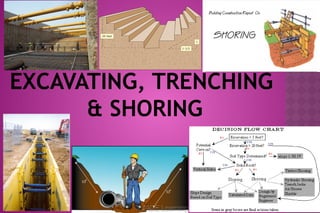
EXCAVATING, TRENCHING
& SHORING
PRE - TEST
 Cave – ins can happen without warning
 True or False
 Ans. TRUE
 A hazardous atmosphere can be found in a
trench
 True or False
Ans. TRUE
PRE - TEST
 A protective system is a method of protecting
employees from cave-ins
 True or False
 Ans. TRUE
 A ladder shall be used for access and egress
in trenches ___ ft or greater in depth
 10, 25, 4, 16
 Ans. 4 FT
PRE - TEST
 A competent person must be aware of:
A. Access and egress
B. Water accumulating
C. Hazardous atmosphere
D. All the above
Ans. D
PRE - TEST
 Soil classifications are;
A. A, B, C, Stable rock
B. 1, 2, 3, 4
C. Rocky or Smooth
D. Hard or Soft
ANS. A
PRE - TEST
 The testing of soil consists of a ___ and a ___
test.
A. Day, Night
B. Summer, winter
C. Visual, manual
D. Hot, cold
 Ans. C
PRE - TEST
 If water is added to soil it brings;
A. Lunch
B. Additional weight
C. Strength
D. Flood
Ans. B
PRE - TEST
 What effects on the body can a cave-in
cause;
A. Respiratory distress
B. Crush syndrome
C. Total body impact
D. All the above
Ans. D
PRE - TEST
 Soil can weigh about ___ lbs a cubic foot;
A. 125
B. 400
C. 600
D. 50
 Ans. A
PRE - TEST
 Factors that influence cave-ins are;
A. Intersecting trenches
B. Previously disturbed soil
C. Vibration
D. All the above
Ans. D
PRE - TEST
 The excavation standard also applies to
trenches
 True or False
 Ans. TRUE
 Benching is a method of protecting
employees from cave-ins;
 True or False
Ans. TRUE
PRE - TEST
 A trench box could be used sometimes to
protect employees;
 True or False
 Ans. False
 Employee can sometimes be permitted
underneath loads handled by lifting or
digging equipment
 True or False
Ans. False
OVERVIEW / MAIN POINTS
 Excavation laws, regulations, standards
 Soil classification
 Soil testing
 Competent person responsibilities
 Hazards associated with trenches
 Protective systems
TRAGIC FACTS
 Excavating is recognized as one of the most
hazardous construction operations
 271 Workers were killed on Excavation/Trenching
jobs from 2000-2006
 184 (68%) occurred in companies with fewer then
50 workers
 124 (46%) worked for companies employing less
than 10 people
TRAGIC FACTS
 60% are would be rescuers
 Civilians
 Fire dept personnel
 Co-workers
 Cave-ins can happen without warning
 All of the fatalities and injuries could have
been prevented
COLLAPSE FORCES
 24 inches of soil on a person’s chest weighs
 750-1000 lb.
 18 inches of soil covering a body weighs
 1800-3000 lb.
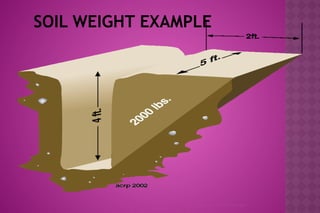
SOIL WEIGHT EXAMPLE
© ACR Publications Used By Permission
COLLAPSE FORCES
 Shear wall collapse speed
 45 mph
 1 cubic foot of soil can weigh from
 100 to 125 lb.
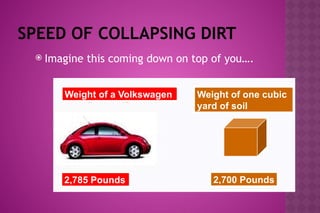
SPEED OF COLLAPSING DIRT
 Imagine this coming down on top of you….
Weight of a Volkswagen
2,785 Pounds
Weight of one cubic
yard of soil
2,700 Pounds
EFFECTS ON THE BODY
 Respiratory distress
 Crush syndrome
 Total body impact
QUESTIONS? COMMENTS?
THE TOP FIVE TRENCHING
HAZARDS
1. Cave – ins
2. Overhead Electric Line Contact
3. Falls into Excavations
4. Equipment Falling into
Excavations
5. Explosion / Fire / Electrocution
UNSAFE ATTITUDES
“I Know what I’m doing.”
“It can’t happen to me.”
“I’ve been doing it that way for
years.”
“I’d sleep in that hole!”
“Don’t worry, we’ll watch the walls
and tell you if you need to get out.”
MOST COMMON CAUSES OF CAVE-
INS:
 Poor Planning
 Misjudgment of soil type.
 Inadequate, or incorrect installation of
protective devices.
 Defective protective devices.
 Failure to adjust for changing conditions
LEGAL ASPECTS
 OSHA [29 CFR 1926.650 - 652]
 Excavation standard applies to all open
excavations made in the earth’s surfaces
including trenches, all surface encumbrances
that would create a hazard, and protective
systems
WHAT’S IN THE STANDARD?
 scope, application and definitions
 Job Site Hazard Listing
 Requirements for Protective Systems
 Appendixes that detail:
 Soil Classification
 Sloping and Benching
 Timber and Aluminum Hydraulic Shoring
 Protective System Selection Decision Tree
DEFINITIONS
1926.650
 Accepted engineering
practices
 Aluminum hydraulic
shoring
 Bell-bottom pier hole
 Benching
 Cave-in
 Cross braces
 Excavation
 Faces or Sides
 Failure
 Hazardous Atmosphere
 Kickout
 Protective system
 Ramp
 Registered Professional
Engineer
 Sheeting
 Shield
DEFINITIONS
 Shoring
 Sloping
 Stable rock
 Structural ramp
 Support systems
 Tabulated data
 Trench
 Uprights
 Wales
QUESTIONS? COMMENTS?
GENERAL REQUIREMENTS
 1926.651
 (a) Surface encumbrances
 (b) Underground installations
 (c) Access & egress
 (d) Exposure to vehicle traffic
 (e) Exposure to falling loads
 (f) Warning systems for mobile equipment
GENERAL REQUIREMENTS
 1926.651
 (g) Hazardous atmospheres
 (h) Protection from hazards associated
with water accumulation
 (i) Stability of adjacent structures
 (j) Protection from loose rock or soil
 (k) Inspections
 (l) Fall protection
https://www.osha.gov/Publications/osha2226.pdf
SURFACE ENCUMBRANCES
 All surfaces encumbrances that are located
so as to create a hazard to employees shall
be removed or supported as necessary to
safeguard employees
UNDERGROUND INSTALLATIONS
 Utility companies shall be contacted with in
established local response times
 Advised of proposed work
 Asked to establish location of utility
 When request cannot be met, employer may
proceed with caution with detection equipment
of an acceptable means to locate utility
UNDERGROUND INSTALLATIONS
While the excavation is open,
underground installations shall be
protected, supported or removed as
necessary to safeguard employees
ACCESS & EGRESS
 Structural ramps
 Used by employees shall be designed by a competent
person
 When used for equipment shall be designed
competent person qualified in structural design
 Stairway, ladder, ramp or other safe means of egress
require no more than 25 ft of lateral travel for
employees in excavations that are 4 feet or more in
depth
 Ladders must be secured and extend a minimum of
36 inches above the landing
EXPOSURE TO VEHICLE TRAFFIC
 Employees exposed to public vehicle traffic
shall be provided with and wear warning
vests or other suitable garments
 Marked or made with reflectorized or highly
visible material
 Requiring a designated, trained flag person along
with signs, signals, and barricades when
necessary
EXPOSURE TO FALLING LOADS
No employee shall be permitted underneath loads
handled by digging or lifting equipment
Stand away from vehicle being loaded or unloaded
to avoid being struck
Operators may remain in cabs when vehicles are
equipped in accordance with 1926.601
WARNING SYSTEMS FOR MOBILE
EQUIPMENT
 When operator does not have clear view of
edge of excavation
 Warning system shall be utilized
 Barricades
 Hand or mechanical signals
 Stop logs
HAZARDOUS ATMOSPHERES
 Testing and controls
 To prevent harmful levels of atmospheric
contaminants
 Less than 19.5% or more than 23.5% oxygen
 Atmosphere tested before entry
 Adequate precautions shall be taken
 Ventilation
 Proper respiratory protection
 Testing done often as necessary
EMERGENCY RESCUE EQUIPMENT
 Rescue equipment
 Breathing equipment
 Safety harness and line or basket stretcher
 Must be readily available
 Must be attended
 Bell-bottom pier holes, deep and confined
footing excavation shall wear a harness with a
lifeline securely attached to it
WATER ACCUMULATION
 Employees shall not work in excavations
where there is accumulated water, or where
water is accumulating, unless adequate
precautions have been taken, to protect
employees.
WATER ACCUMULATION
 Must take adequate precautions to protect
employees
 Accumulating water
 Varies with each situation
 Removal monitored by competent person
 Run off from heavy rains requires inspection by
competent person
STABILITY OF ADJACENT
STRUCTURES
 Where stability is endangered by excavation
operations
 Support systems such as shoring, bracing or
underpinning shall be provided
 Sidewalks, pavement and appurtenant
structures shall not be undermined unless
support systems are used to protect employees
PROTECTION FROM LOOSE ROCK
AND SOIL
 Hazard from falling or rolling from excavation
face
 Scaling to remove loose materials
 Installation of protective barricades
 Other means (retaining devices)
 2 feet from edge of excavation
COMPETENT PERSON
 One who is capable of identifying existing or
predictable hazards in the surroundings
which are unsanitary, hazardous or dangerous
to employees & who has authorization to
take prompt corrective measures
COMPETENT PERSON
 Has specific training in and be
knowledgeable about soil analysis, use of
protective systems and the requirements of
the standard
COMPETENT PERSON MUST BE
AWARE OF:
Falling loads or
equipment
Hazardous atmospheres
Weather conditions and
forecast
Stability of adjacent
structures.
THE COMPETENT PERSON MUST
BE AWARE OF:
Surface and overhead
encumbrances
Underground utilities
Access and egress
Vehicular traffic
Continuation of trade
activity
INSPECTIONS
 Daily and before start of work
 As needed throughout the shift
 After snowstorms,windstorms,thaw,
earthquake
 Soil classification
 Any hazard increasing occurrence
 Employees shall be removed until
precautions have been taken
INSPECTIONS
 When fissures, tension cracks, sloughing
undercutting, water seepage, bulging at the
bottom
 Change in size, location or placement of the
spoil pile
 Indication of movement in adjacent
structures
FALL PROTECTION
 If walkway provided
 Where employees permitted to cross, guard rails
provided where 6 feet or more above lower
levels
 Fall protection standard
REQUIREMENTS OF
PROTECTIVE SYSTEMS
1926.652
 Employees shall be protected from cave-in by
an adequate protective system except;
 Entirely in stable rock
 Less than 5 feet in depth with no indication of
cave-in
QUESTIONS? COMMENTS?
STOPPED HERE!

ASP Study Group_Safety Programs Part Two Revised dec 13 2015.pptx

  • 1.
    DOMAIN: SAFETY MANAGEMENT SYSTEMS Topic:Safety Programs (Part Two) Created by: Mervin Brown Risk Control Consultant December 2015 ASP Study Group Session 8
  • 2.
    DISCLAIMER/USAGE NOTES  Itis not the intent of the content developer to provide ALL possible content related to ASP Examination in this presentation for the Safety Programs topic. The intent is more to address briefly the knowledge areas outlined for the exam in a group study forum.  It should NOT be assumed that the suggestions, comments, or suggestions contained herein constitute a thorough review of the applicable areas that needs to be understood before taking the ASP Examination, nor should discussion of specific points be construed as a final. Where opinions have been expressed, it is important to remember that it is everyone’s responsibility to check for correctness and clarity before their examination.  It is assumed that individuals using this presentation, or content to study have or will do their own preparation for the ASP exam and NOT rely solely on information provided herein. Feel free to modify and/or update the information that has been outlined. Remember I am in the preparation phase as well and I do not claim to be an expert in this area.
  • 3.
    KNOWLEDGE AREAS 1. HazardCommunication and Globally Harmonized System 2. Control of hazardous energy 3. Fall protection 4. Excavation, trenching, and shoring 5. Confined space 6. Physical security I. Workplace Violence 7. Wellness programs I. Substance abuse
  • 4.
  • 5.
    PRE - TEST Cave – ins can happen without warning  True or False  Ans. TRUE  A hazardous atmosphere can be found in a trench  True or False Ans. TRUE
  • 6.
    PRE - TEST A protective system is a method of protecting employees from cave-ins  True or False  Ans. TRUE  A ladder shall be used for access and egress in trenches ___ ft or greater in depth  10, 25, 4, 16  Ans. 4 FT
  • 7.
    PRE - TEST A competent person must be aware of: A. Access and egress B. Water accumulating C. Hazardous atmosphere D. All the above Ans. D
  • 8.
    PRE - TEST Soil classifications are; A. A, B, C, Stable rock B. 1, 2, 3, 4 C. Rocky or Smooth D. Hard or Soft ANS. A
  • 9.
    PRE - TEST The testing of soil consists of a ___ and a ___ test. A. Day, Night B. Summer, winter C. Visual, manual D. Hot, cold  Ans. C
  • 10.
    PRE - TEST If water is added to soil it brings; A. Lunch B. Additional weight C. Strength D. Flood Ans. B
  • 11.
    PRE - TEST What effects on the body can a cave-in cause; A. Respiratory distress B. Crush syndrome C. Total body impact D. All the above Ans. D
  • 12.
    PRE - TEST Soil can weigh about ___ lbs a cubic foot; A. 125 B. 400 C. 600 D. 50  Ans. A
  • 13.
    PRE - TEST Factors that influence cave-ins are; A. Intersecting trenches B. Previously disturbed soil C. Vibration D. All the above Ans. D
  • 14.
    PRE - TEST The excavation standard also applies to trenches  True or False  Ans. TRUE  Benching is a method of protecting employees from cave-ins;  True or False Ans. TRUE
  • 15.
    PRE - TEST A trench box could be used sometimes to protect employees;  True or False  Ans. False  Employee can sometimes be permitted underneath loads handled by lifting or digging equipment  True or False Ans. False
  • 16.
    OVERVIEW / MAINPOINTS  Excavation laws, regulations, standards  Soil classification  Soil testing  Competent person responsibilities  Hazards associated with trenches  Protective systems
  • 17.
    TRAGIC FACTS  Excavatingis recognized as one of the most hazardous construction operations  271 Workers were killed on Excavation/Trenching jobs from 2000-2006  184 (68%) occurred in companies with fewer then 50 workers  124 (46%) worked for companies employing less than 10 people
  • 18.
    TRAGIC FACTS  60%are would be rescuers  Civilians  Fire dept personnel  Co-workers  Cave-ins can happen without warning  All of the fatalities and injuries could have been prevented
  • 19.
    COLLAPSE FORCES  24inches of soil on a person’s chest weighs  750-1000 lb.  18 inches of soil covering a body weighs  1800-3000 lb.
  • 20.
    SOIL WEIGHT EXAMPLE ©ACR Publications Used By Permission
  • 21.
    COLLAPSE FORCES  Shearwall collapse speed  45 mph  1 cubic foot of soil can weigh from  100 to 125 lb.
  • 22.
    SPEED OF COLLAPSINGDIRT  Imagine this coming down on top of you…. Weight of a Volkswagen 2,785 Pounds Weight of one cubic yard of soil 2,700 Pounds
  • 23.
    EFFECTS ON THEBODY  Respiratory distress  Crush syndrome  Total body impact
  • 24.
  • 25.
    THE TOP FIVETRENCHING HAZARDS 1. Cave – ins 2. Overhead Electric Line Contact 3. Falls into Excavations 4. Equipment Falling into Excavations 5. Explosion / Fire / Electrocution
  • 26.
    UNSAFE ATTITUDES “I Knowwhat I’m doing.” “It can’t happen to me.” “I’ve been doing it that way for years.” “I’d sleep in that hole!” “Don’t worry, we’ll watch the walls and tell you if you need to get out.”
  • 27.
    MOST COMMON CAUSESOF CAVE- INS:  Poor Planning  Misjudgment of soil type.  Inadequate, or incorrect installation of protective devices.  Defective protective devices.  Failure to adjust for changing conditions
  • 28.
    LEGAL ASPECTS  OSHA[29 CFR 1926.650 - 652]  Excavation standard applies to all open excavations made in the earth’s surfaces including trenches, all surface encumbrances that would create a hazard, and protective systems
  • 29.
    WHAT’S IN THESTANDARD?  scope, application and definitions  Job Site Hazard Listing  Requirements for Protective Systems  Appendixes that detail:  Soil Classification  Sloping and Benching  Timber and Aluminum Hydraulic Shoring  Protective System Selection Decision Tree
  • 30.
    DEFINITIONS 1926.650  Accepted engineering practices Aluminum hydraulic shoring  Bell-bottom pier hole  Benching  Cave-in  Cross braces  Excavation  Faces or Sides  Failure  Hazardous Atmosphere  Kickout  Protective system  Ramp  Registered Professional Engineer  Sheeting  Shield
  • 31.
    DEFINITIONS  Shoring  Sloping Stable rock  Structural ramp  Support systems  Tabulated data  Trench  Uprights  Wales
  • 32.
  • 33.
    GENERAL REQUIREMENTS  1926.651 (a) Surface encumbrances  (b) Underground installations  (c) Access & egress  (d) Exposure to vehicle traffic  (e) Exposure to falling loads  (f) Warning systems for mobile equipment
  • 34.
    GENERAL REQUIREMENTS  1926.651 (g) Hazardous atmospheres  (h) Protection from hazards associated with water accumulation  (i) Stability of adjacent structures  (j) Protection from loose rock or soil  (k) Inspections  (l) Fall protection https://www.osha.gov/Publications/osha2226.pdf
  • 35.
    SURFACE ENCUMBRANCES  Allsurfaces encumbrances that are located so as to create a hazard to employees shall be removed or supported as necessary to safeguard employees
  • 36.
    UNDERGROUND INSTALLATIONS  Utilitycompanies shall be contacted with in established local response times  Advised of proposed work  Asked to establish location of utility  When request cannot be met, employer may proceed with caution with detection equipment of an acceptable means to locate utility
  • 37.
    UNDERGROUND INSTALLATIONS While theexcavation is open, underground installations shall be protected, supported or removed as necessary to safeguard employees
  • 38.
    ACCESS & EGRESS Structural ramps  Used by employees shall be designed by a competent person  When used for equipment shall be designed competent person qualified in structural design  Stairway, ladder, ramp or other safe means of egress require no more than 25 ft of lateral travel for employees in excavations that are 4 feet or more in depth  Ladders must be secured and extend a minimum of 36 inches above the landing
  • 39.
    EXPOSURE TO VEHICLETRAFFIC  Employees exposed to public vehicle traffic shall be provided with and wear warning vests or other suitable garments  Marked or made with reflectorized or highly visible material  Requiring a designated, trained flag person along with signs, signals, and barricades when necessary
  • 40.
    EXPOSURE TO FALLINGLOADS No employee shall be permitted underneath loads handled by digging or lifting equipment Stand away from vehicle being loaded or unloaded to avoid being struck Operators may remain in cabs when vehicles are equipped in accordance with 1926.601
  • 41.
    WARNING SYSTEMS FORMOBILE EQUIPMENT  When operator does not have clear view of edge of excavation  Warning system shall be utilized  Barricades  Hand or mechanical signals  Stop logs
  • 42.
    HAZARDOUS ATMOSPHERES  Testingand controls  To prevent harmful levels of atmospheric contaminants  Less than 19.5% or more than 23.5% oxygen  Atmosphere tested before entry  Adequate precautions shall be taken  Ventilation  Proper respiratory protection  Testing done often as necessary
  • 43.
    EMERGENCY RESCUE EQUIPMENT Rescue equipment  Breathing equipment  Safety harness and line or basket stretcher  Must be readily available  Must be attended  Bell-bottom pier holes, deep and confined footing excavation shall wear a harness with a lifeline securely attached to it
  • 44.
    WATER ACCUMULATION  Employeesshall not work in excavations where there is accumulated water, or where water is accumulating, unless adequate precautions have been taken, to protect employees.
  • 45.
    WATER ACCUMULATION  Musttake adequate precautions to protect employees  Accumulating water  Varies with each situation  Removal monitored by competent person  Run off from heavy rains requires inspection by competent person
  • 46.
    STABILITY OF ADJACENT STRUCTURES Where stability is endangered by excavation operations  Support systems such as shoring, bracing or underpinning shall be provided  Sidewalks, pavement and appurtenant structures shall not be undermined unless support systems are used to protect employees
  • 47.
    PROTECTION FROM LOOSEROCK AND SOIL  Hazard from falling or rolling from excavation face  Scaling to remove loose materials  Installation of protective barricades  Other means (retaining devices)  2 feet from edge of excavation
  • 48.
    COMPETENT PERSON  Onewho is capable of identifying existing or predictable hazards in the surroundings which are unsanitary, hazardous or dangerous to employees & who has authorization to take prompt corrective measures
  • 49.
    COMPETENT PERSON  Hasspecific training in and be knowledgeable about soil analysis, use of protective systems and the requirements of the standard
  • 50.
    COMPETENT PERSON MUSTBE AWARE OF: Falling loads or equipment Hazardous atmospheres Weather conditions and forecast Stability of adjacent structures.
  • 51.
    THE COMPETENT PERSONMUST BE AWARE OF: Surface and overhead encumbrances Underground utilities Access and egress Vehicular traffic Continuation of trade activity
  • 52.
    INSPECTIONS  Daily andbefore start of work  As needed throughout the shift  After snowstorms,windstorms,thaw, earthquake  Soil classification  Any hazard increasing occurrence  Employees shall be removed until precautions have been taken
  • 53.
    INSPECTIONS  When fissures,tension cracks, sloughing undercutting, water seepage, bulging at the bottom  Change in size, location or placement of the spoil pile  Indication of movement in adjacent structures
  • 54.
    FALL PROTECTION  Ifwalkway provided  Where employees permitted to cross, guard rails provided where 6 feet or more above lower levels  Fall protection standard
  • 55.
    REQUIREMENTS OF PROTECTIVE SYSTEMS 1926.652 Employees shall be protected from cave-in by an adequate protective system except;  Entirely in stable rock  Less than 5 feet in depth with no indication of cave-in
  • 56.

Editor's Notes

  • #5 TRUE TRUE
  • #6 TRUE 4 FT
  • #7 Ans. D
  • #8 Ans. A
  • #9 Ans. C
  • #10 Ans. B
  • #11 Ans. D
  • #12 Ans. A. One cubic Foot of Soil can weigh about 100 to 125 lbs.
  • #13 Ans. D
  • #14 Ans. True Ans. TRUE
  • #15 Ans. False A trench box should be used to protect employees who have to enter trenches Ans. False No Employee shall be permitted underneath loads handled by lifting or digging equipment
  • #17 Why is an Excavation program important? U.S. Bureau of Labor Statistics (BLS) data show that 271 workers died in trenching or excavation cave-ins from 2000 through 2006 A review of multiple national databases by NIOSH researchers found that trenching and excavation hazards during construction activities resulted in 488 deaths between 1992 and 2000 - an average of 54 fatalities each year. Sixty-eight percent of those fatalities occurred in companies with fewer than 50 workers. Forty-six percent of the deaths occurred in small companies with 10 or fewer workers. Hazards associated with trench work and excavation are recognized and preventable, yet injuries and fatalities associated with these hazards continue to occur. Regulations and consensus standards describe engineering controls, protective equipment, and safe work practices to minimize hazards for workers during trench work and excavations. See CDC website for details: http://www.cdc.gov/niosh/topics/trenching/ In a previous study it was found that: 541 Workers were killed on Excavation/Trenching jobs from 1992-2001 411 (76%) were killed by cave-ins 257 (47%) worked for companies employing less than 10 people
  • #19 HOW MUCH CAN YOU LIFT, how well can you breathe HOW MANY BREATHS CAN YOU TAKE LOCK OUT/ TAG OUT 8” WATER MAIN CAN FLOW 19,000 GPM AT 100 PSI CAN FILL A TRENCH 4X12X25 IN 24 SECONDS
  • #21 THINK YOU CAN OUT RUN IT VW HITTING YOU AT 45MPH PAST PRACTICES JUMP INTO TRENCH F/F ARE ACTION ORIENTED COMPASSION KILLS INADEQUATE SHORING CHEAPER TO PAY DEATH BENEFITS
  • #23 How many breaths can you take with this much weight on your body, explain crush syndrome
  • #24 Any further questions or comments?
  • #30 OSHA defines an excavation as any man-made cut, cavity, trench, or depression in the Earth’s surface formed by earth removal. A trench is defined as a narrow excavation (in relation to its length) made below the surface of the ground. In general, the depth of a trench is greater than its width, but the width of a trench (measured at the bottom) is not greater than 15 feet (4.6 m).
  • #32 Any further questions or comments?
  • #33 There are specifics for General Requirements as outlined in part 1926.651 of the standard.
  • #34 OSHA has produced a new publication this year (2015) that Covers Trenching and Excavation Safety in accordance with the Excavation standards, 29 Code of Federal Regulations (CFR) Part 1926, Subpart P Best practices can include the following: ■ Know where underground utilities are located before digging. ■ Keep excavated soil (spoils) and other materials at least 2 feet (0.61 meters) from trench edges. ■ Keep heavy equipment away from trench edges. ■ Identify any equipment or activities that could affect trench stability. ■ Test for atmospheric hazards such as low oxygen, hazardous fumes, and toxic gases when workers are more than 4 feet deep. ■ Inspect trenches at the start of each shift. ■ Inspect trenches following a rainstorm or other water intrusion. ■ Inspect trenches after any occurrence that could have changed conditions in the trench. ■ Do not work under suspended or raised loads and materials. ■ Ensure that personnel wear high-visibility or other suitable clothing when exposed to vehicular traffic. Employers should consider establishing and maintaining safety and health management systems that provide systematic policies, procedures, and practices for protecting workers from job-related safety and health hazards.
  • #42 TEST IN MULTIPLE LEVELS – TOP/MIDDLE/BOTTOM ( SAME AS CONFINED SPACE)
  • #54 This refers to guard rails (1926.502(b)
  • #56 Any further questions or comments?