SCALABLE VIDEO CODING IN
   CONTENT-AWARE NETWORKS
                                                                 Michael Grafl
                            Institute of Information Technology
                     Alpen-Adria Universität Klagenfurt, Austria


         COMET-ENVISION workshop on Future Media Distribution Networks
                                          Nov. 10-11 2011, Slough, UK

Michael Grafl            Scalable Video Coding in Content-Aware Networks         1
OUTLINE
 Introduction
 ALICANTE
     Project Overview
     Conceptual Architecture
     Comparison to ICN
 Use Cases for SVC in CAN (Analysis wrt. ICN research
  challenges)
        Unicast
        Multicast
        P2P Streaming
        Web/HTTP Streaming
 Step-by-Step Walkthrough
 Conclusions

  Michael Grafl       Scalable Video Coding in Content-Aware Networks   2
INTRODUCTION
 Information-Centric Networking (ICN)
     Revolutionary approach
 Content-Aware Networking (CAN)
     Evolutionary approach
     ALICANTE project
 Scalable Video Coding (SVC)
        Extension of H.264/MPEG-4 AVC
        Spatial, temporal and quality (SNR) scalability
        Base layer + multiple enhancement layers
        Coding overhead: ~ 10% wrt. H.264

  Michael Grafl       Scalable Video Coding in Content-Aware Networks   3
ALICANTE
 Project Info:
     EU FP7-ICT project
     Duration: March 2010 – Aug 2013
     20 partners
 "Media Ecosystem Deployment through Ubiquitous
  Content-Aware Network Environments"
 Goal: New Home-Box layer and CAN layer with
  distributed cross-layer adaptation and universal
  multimedia access enabling cooperation between
  providers, operators, and end-users
                                                                    http://ict-alicante.eu
  Michael Grafl   Scalable Video Coding in Content-Aware Networks               4
ALICANTE CONCEPTUAL ARCHITECTURE
                                                                                            User Environment:
                                                                                            devices and end user
                                User Environment
            Context-
             aware
                                                                                            Service Environment:
                                                                                            content and services

                             Service Environment
                        HB
HB                                                    HB                              HB    HB Layer: networked
Content-                           Home-Box Layer                                           components as overlay
                             HB                                Network-
 aware
                                                                aware


                         MANE                                              MANE             CAN Layer: in-network
   CAN                             CAN                                                CAN
  MANE                            MANE                                                      components as overlay
                  CAN                      CAN                          CAN


                                                                                            Physical Layer:
           AS                            AS                                   AS            autonomous systems

                             Network Environment
      Michael Grafl                 Scalable Video Coding in Content-Aware Networks                   5
ALICANTE VS. FULL ICN APPROACH
                                                                        Evolutionary approach for FI
                                                                         (Mid-way to full ICN)
Approaches:
                                                                        Caching and storage
 Best effort                                                               In Home-Boxes (network edge)
 QoS-based virtual splitting                                                and Content Servers
 Content-aware networks                                                Scalable and Cost-Efficient
    Content-type awareness                                              Content Distribution
                                             ALICANTE
 Service-aware networking                                                  Name/location resolution –
                                             approach
 Full ICN                                                                   at Service level (not in routers)
    Content/object awareness                                           Content-awareness
    Name/location                                                          aggregated CA and associated
     resolution, routing of                                                  processing at network level
     requests, caching at
     network nodes                                                      Deployment
                           Degree of awareness on upper
                         layer information at network level                 Seamless/incremental deployment


        Michael Grafl                Scalable Video Coding in Content-Aware Networks                 6
USE CASES FOR SVC IN CAN
 Role of scalable media formats for enabling
  content-aware networking

 Unicast, Multicast, Peer-to-Peer Streaming,
  Web/HTTP Streaming
 Analysis wrt. ICN research challenges:
     Routing & Forwarding
     Caching & Buffering
     Quality of Service/Experience (QoS/QoE)

  Michael Grafl   Scalable Video Coding in Content-Aware Networks   7
SYSTEM OVERVIEW FOR USE CASES

                                                                                               S1
          Mobile     R1
U1

                                        ICNN2                         ICNN1
                     R2
U2    HD-Ready TV
                                       Buffer                               Buffer
                                                                                               S2
                     R3

                                                                              SVC-Base Layer
U3     Full-HD TV                                                                  Enhancement Layer 1
                                                                                         Enhancement Layer 2

     Michael Grafl        Scalable Video Coding in Content-Aware Networks                       8
USE CASES: UNICAST
 Example: Video on Demand (VoD)
 RTP (with SST of SVC) and RTSP
 Routing & Forwarding:
     ICN node can react to network fluctuations
            • In-network adaptation of SVC at ICN node (for short-term fluctuations)
            • Signal to sender for dropping SVC layers (for long-term fluctuations)
 Caching & Buffering:
     ICN node can perform prefix caching
            • Reduce start-up delay
            • Selective caching of SVC layers
 QoS/QoE: (applies to all use cases)
     Consider terminal capabilities when requesting SVC layers
     Monitor network conditions at ICN nodes (cf. ALICANTE)
     Smooth, undistorted playout


  Michael Grafl              Scalable Video Coding in Content-Aware Networks   9
USE CASES: MULTICAST
 Receiver-Driven Layered Multicast (RDLM) of SVC
 RTP in MST mode (each SVC layer in own session)
 Routing & Forwarding:
     ICN nodes adapt to network conditions through subscription
      to SVC layers
     ICN nodes as bridges between native and overlay multicast
      (ALICANTE: virtual content-aware network of ICN nodes)
     Selective treatment of SVC layers (MPLS, DiffServ)
 Caching & Buffering:
     Prefix caching to reduce start-up delay in non-live scenarios

  Michael Grafl       Scalable Video Coding in Content-Aware Networks   10
USE CASES: P2P STREAMING
 Receivers request pieces from multiple senders
 P2P network as overlay
 Receiver only requests SVC layers supported by
  end-user terminal
 Routing & Forwarding:
     ICN nodes can act as peers, forming an in-network
      overlay
 Caching & Buffering:
     Aggregate requests and perform information-centric
      buffering (during sliding window) at ICN nodes

  Michael Grafl    Scalable Video Coding in Content-Aware Networks   11
USE CASES: WEB/HTTP STREAMING
 Download via HTTP (partial) GET requests
       Content fragmented into segments (e.g., per SVC layer and GOP)
       Manifest file describes structure of segments and available
        representations
       Standard: Dynamic Adaptive Streaming over HTTP (DASH)
   Overcome NAT traversal & firewall issues
   Stateless sender
   Unicast, multicast, and multisource (P2P-like) scenarios
   Routing & Forwarding:
       ICN node signals network condition to receiver (implicit adaptation)
 Caching & Buffering:
       SVC-based prefix caching using HTTP-based CDN infrastructure
       Buffering during sliding window creates multicast tree
       Information-centric buffering in multisource scenario

    Michael Grafl        Scalable Video Coding in Content-Aware Networks   12
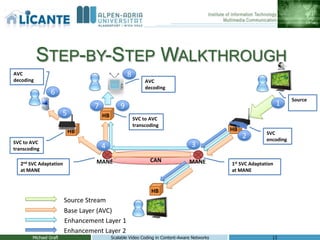
STEP-BY-STEP WALKTHROUGH
AVC                                               8
decoding                                                   AVC
                                                           decoding
                 6
                                                                                                                      Source
                                 7            9                                                                  1
                        5            HB               SVC to AVC
                                                      transcoding
                            HB                                                              HB
                                                                                                           SVC
                                                                                                 2         encoding
SVC to AVC
transcoding                          4                                          3

                                 MANE                        CAN               MANE
   2nd SVC Adaptation                                                                       1st SVC Adaptation
   at MANE                                                                                  at MANE


                                                             HB
                        Source Stream
                        Base Layer (AVC)
                        Enhancement Layer 1
                        Enhancement Layer 2
        Michael Grafl                     Scalable Video Coding in Content-Aware Networks                    13
CONCLUSIONS
 Towards ICN: Scalable media coding formats (e.g.,
  SVC) in combination with in-network adaptation
     Routing & Forwarding
     Caching & Buffering
     QoS/QoE
 Enabling content-awareness within the (core)
  network
 Context-awareness at receiver & sender (& ICN
  node)
 ALICANTE
     Towards deployment of a networked "Media Ecosystem"
     Collaboration of CAN layer and Home-Box layer

  Michael Grafl    Scalable Video Coding in Content-Aware Networks   14
LITERATURE
[1] J. Pan, S. Paul, R. Jain, “A survey of the research on future internet
    architectures”, IEEE Communications Magazine, vol.49, no.7, pp.26-36, July
    2011.
[2] V. Jacobson, D. Smetters, J. Thornton, M. Plass, N. Briggs, R. Braynard,
    “Networking named content”, Proc. of ACM CoNEXT 2009, Rome, Italy,
    December 2009.
[3] H. Koumaras et al., “Media Ecosystems: A Novel Approach for Content-
    Awareness in Future Networks,” Future Internet: Achievements and Promising
    Technology, Springer Verlag, pp. 369-380, May 2011.
[4] ALICANTE Web site, http://ict-alicante.eu/.
[5] M. Wien et al., “Performance Analysis of SVC,” Circuits and Systems for Video
    Technology, IEEE Transactions on, vol. 17, no. 9, pp. 1194-1203, 2007.
[6] T. Stockhammer, “Dynamic adaptive streaming over HTTP – standards and
    design principles,” in Proceedings of the Second Annual ACM Conference on
    Multimedia Systems, New York, NY, USA, pp. 133–144, February 2011.
[7] M. Grafl, et al., “Scalable Video Coding in Content-Aware Networks: Research
    Challenges and Open Issues,” in: N. Blefari-Melazzi, G. Bianchi, and L.
    Salgarelli (eds.), Trustworthy Internet, Springer, pp. 349-358, June 2011.


   Michael Grafl          Scalable Video Coding in Content-Aware Networks   15
THANK YOU
                FOR YOUR ATTENTION!
                            Questions?


Michael Grafl       Scalable Video Coding in Content-Aware Networks   16

Scalable Video Coding in Content-Aware Networks

  • 1.
    SCALABLE VIDEO CODINGIN CONTENT-AWARE NETWORKS Michael Grafl Institute of Information Technology Alpen-Adria Universität Klagenfurt, Austria COMET-ENVISION workshop on Future Media Distribution Networks Nov. 10-11 2011, Slough, UK Michael Grafl Scalable Video Coding in Content-Aware Networks 1
  • 2.
    OUTLINE  Introduction  ALICANTE  Project Overview  Conceptual Architecture  Comparison to ICN  Use Cases for SVC in CAN (Analysis wrt. ICN research challenges)  Unicast  Multicast  P2P Streaming  Web/HTTP Streaming  Step-by-Step Walkthrough  Conclusions Michael Grafl Scalable Video Coding in Content-Aware Networks 2
  • 3.
    INTRODUCTION  Information-Centric Networking(ICN)  Revolutionary approach  Content-Aware Networking (CAN)  Evolutionary approach  ALICANTE project  Scalable Video Coding (SVC)  Extension of H.264/MPEG-4 AVC  Spatial, temporal and quality (SNR) scalability  Base layer + multiple enhancement layers  Coding overhead: ~ 10% wrt. H.264 Michael Grafl Scalable Video Coding in Content-Aware Networks 3
  • 4.
    ALICANTE  Project Info:  EU FP7-ICT project  Duration: March 2010 – Aug 2013  20 partners  "Media Ecosystem Deployment through Ubiquitous Content-Aware Network Environments"  Goal: New Home-Box layer and CAN layer with distributed cross-layer adaptation and universal multimedia access enabling cooperation between providers, operators, and end-users http://ict-alicante.eu Michael Grafl Scalable Video Coding in Content-Aware Networks 4
  • 5.
    ALICANTE CONCEPTUAL ARCHITECTURE User Environment: devices and end user User Environment Context- aware Service Environment: content and services Service Environment HB HB HB HB HB Layer: networked Content- Home-Box Layer components as overlay HB Network- aware aware MANE MANE CAN Layer: in-network CAN CAN CAN MANE MANE components as overlay CAN CAN CAN Physical Layer: AS AS AS autonomous systems Network Environment Michael Grafl Scalable Video Coding in Content-Aware Networks 5
  • 6.
    ALICANTE VS. FULLICN APPROACH  Evolutionary approach for FI (Mid-way to full ICN) Approaches:  Caching and storage  Best effort  In Home-Boxes (network edge)  QoS-based virtual splitting and Content Servers  Content-aware networks  Scalable and Cost-Efficient  Content-type awareness Content Distribution ALICANTE  Service-aware networking  Name/location resolution – approach  Full ICN at Service level (not in routers)  Content/object awareness  Content-awareness  Name/location  aggregated CA and associated resolution, routing of processing at network level requests, caching at network nodes  Deployment Degree of awareness on upper layer information at network level  Seamless/incremental deployment Michael Grafl Scalable Video Coding in Content-Aware Networks 6
  • 7.
    USE CASES FORSVC IN CAN  Role of scalable media formats for enabling content-aware networking  Unicast, Multicast, Peer-to-Peer Streaming, Web/HTTP Streaming  Analysis wrt. ICN research challenges:  Routing & Forwarding  Caching & Buffering  Quality of Service/Experience (QoS/QoE) Michael Grafl Scalable Video Coding in Content-Aware Networks 7
  • 8.
    SYSTEM OVERVIEW FORUSE CASES S1 Mobile R1 U1 ICNN2 ICNN1 R2 U2 HD-Ready TV Buffer Buffer S2 R3 SVC-Base Layer U3 Full-HD TV Enhancement Layer 1 Enhancement Layer 2 Michael Grafl Scalable Video Coding in Content-Aware Networks 8
  • 9.
    USE CASES: UNICAST Example: Video on Demand (VoD)  RTP (with SST of SVC) and RTSP  Routing & Forwarding:  ICN node can react to network fluctuations • In-network adaptation of SVC at ICN node (for short-term fluctuations) • Signal to sender for dropping SVC layers (for long-term fluctuations)  Caching & Buffering:  ICN node can perform prefix caching • Reduce start-up delay • Selective caching of SVC layers  QoS/QoE: (applies to all use cases)  Consider terminal capabilities when requesting SVC layers  Monitor network conditions at ICN nodes (cf. ALICANTE)  Smooth, undistorted playout Michael Grafl Scalable Video Coding in Content-Aware Networks 9
  • 10.
    USE CASES: MULTICAST Receiver-Driven Layered Multicast (RDLM) of SVC  RTP in MST mode (each SVC layer in own session)  Routing & Forwarding:  ICN nodes adapt to network conditions through subscription to SVC layers  ICN nodes as bridges between native and overlay multicast (ALICANTE: virtual content-aware network of ICN nodes)  Selective treatment of SVC layers (MPLS, DiffServ)  Caching & Buffering:  Prefix caching to reduce start-up delay in non-live scenarios Michael Grafl Scalable Video Coding in Content-Aware Networks 10
  • 11.
    USE CASES: P2PSTREAMING  Receivers request pieces from multiple senders  P2P network as overlay  Receiver only requests SVC layers supported by end-user terminal  Routing & Forwarding:  ICN nodes can act as peers, forming an in-network overlay  Caching & Buffering:  Aggregate requests and perform information-centric buffering (during sliding window) at ICN nodes Michael Grafl Scalable Video Coding in Content-Aware Networks 11
  • 12.
    USE CASES: WEB/HTTPSTREAMING  Download via HTTP (partial) GET requests  Content fragmented into segments (e.g., per SVC layer and GOP)  Manifest file describes structure of segments and available representations  Standard: Dynamic Adaptive Streaming over HTTP (DASH)  Overcome NAT traversal & firewall issues  Stateless sender  Unicast, multicast, and multisource (P2P-like) scenarios  Routing & Forwarding:  ICN node signals network condition to receiver (implicit adaptation)  Caching & Buffering:  SVC-based prefix caching using HTTP-based CDN infrastructure  Buffering during sliding window creates multicast tree  Information-centric buffering in multisource scenario Michael Grafl Scalable Video Coding in Content-Aware Networks 12
  • 13.
    STEP-BY-STEP WALKTHROUGH AVC 8 decoding AVC decoding 6 Source 7 9 1 5 HB SVC to AVC transcoding HB HB SVC 2 encoding SVC to AVC transcoding 4 3 MANE CAN MANE 2nd SVC Adaptation 1st SVC Adaptation at MANE at MANE HB Source Stream Base Layer (AVC) Enhancement Layer 1 Enhancement Layer 2 Michael Grafl Scalable Video Coding in Content-Aware Networks 13
  • 14.
    CONCLUSIONS  Towards ICN:Scalable media coding formats (e.g., SVC) in combination with in-network adaptation  Routing & Forwarding  Caching & Buffering  QoS/QoE  Enabling content-awareness within the (core) network  Context-awareness at receiver & sender (& ICN node)  ALICANTE  Towards deployment of a networked "Media Ecosystem"  Collaboration of CAN layer and Home-Box layer Michael Grafl Scalable Video Coding in Content-Aware Networks 14
  • 15.
    LITERATURE [1] J. Pan,S. Paul, R. Jain, “A survey of the research on future internet architectures”, IEEE Communications Magazine, vol.49, no.7, pp.26-36, July 2011. [2] V. Jacobson, D. Smetters, J. Thornton, M. Plass, N. Briggs, R. Braynard, “Networking named content”, Proc. of ACM CoNEXT 2009, Rome, Italy, December 2009. [3] H. Koumaras et al., “Media Ecosystems: A Novel Approach for Content- Awareness in Future Networks,” Future Internet: Achievements and Promising Technology, Springer Verlag, pp. 369-380, May 2011. [4] ALICANTE Web site, http://ict-alicante.eu/. [5] M. Wien et al., “Performance Analysis of SVC,” Circuits and Systems for Video Technology, IEEE Transactions on, vol. 17, no. 9, pp. 1194-1203, 2007. [6] T. Stockhammer, “Dynamic adaptive streaming over HTTP – standards and design principles,” in Proceedings of the Second Annual ACM Conference on Multimedia Systems, New York, NY, USA, pp. 133–144, February 2011. [7] M. Grafl, et al., “Scalable Video Coding in Content-Aware Networks: Research Challenges and Open Issues,” in: N. Blefari-Melazzi, G. Bianchi, and L. Salgarelli (eds.), Trustworthy Internet, Springer, pp. 349-358, June 2011. Michael Grafl Scalable Video Coding in Content-Aware Networks 15
  • 16.
    THANK YOU FOR YOUR ATTENTION! Questions? Michael Grafl Scalable Video Coding in Content-Aware Networks 16