Evolution of
the iPhone
And its market share.
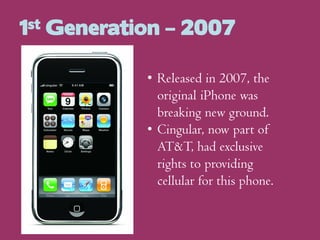
1st Generation – 2007
• Released in 2007, the
original iPhone was
breaking new ground.
• Cingular, now part of
AT&T, had exclusive
rights to providing
cellular for this phone.
iOS Dominates Market
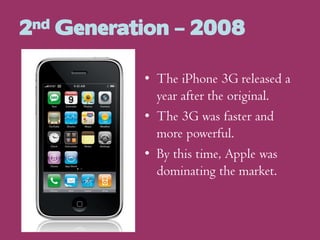
2nd Generation – 2008
• The iPhone 3G released a
year after the original.
• The 3G was faster and
more powerful.
• By this time, Apple was
dominating the market.
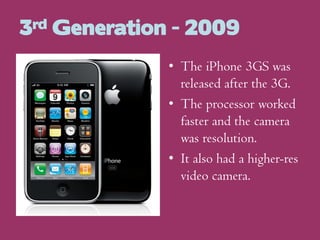
3rd Generation - 2009
• The iPhone 3GS was
released after the 3G.
• The processor worked
faster and the camera
was resolution.
• It also had a higher-res
video camera.
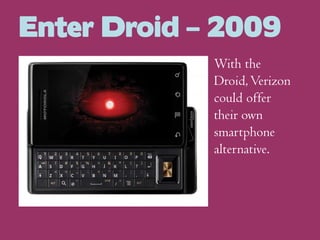
Enter Droid – 2009
With the
Droid, Verizon
could offer
their own
smartphone
alternative.
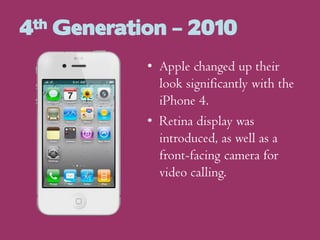
4th Generation – 2010
• Apple changed up their
look significantly with the
iPhone 4.
• Retina display was
introduced, as well as a
front-facing camera for
video calling.
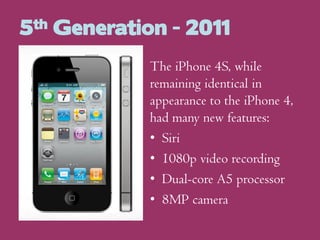
5th Generation - 2011
The iPhone 4S, while
remaining identical in
appearance to the iPhone 4,
had many new features:
• Siri
• 1080p video recording
• Dual-core A5 processor
• 8MP camera
Apple Begins to
Lose Ground to
Android
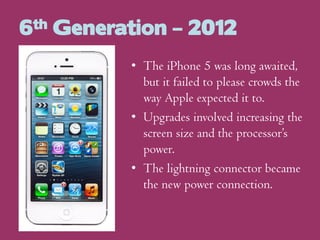
6th Generation – 2012
• The iPhone 5 was long awaited,
but it failed to please crowds the
way Apple expected it to.
• Upgrades involved increasing the
screen size and the processor’s
power.
• The lightning connector became
the new power connection.
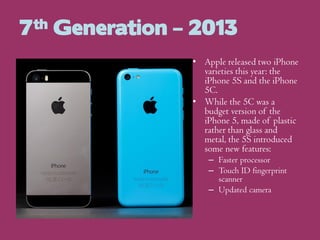
7th Generation – 2013
• Apple released two iPhone
varieties this year: the
iPhone 5S and the iPhone
5C.
• While the 5C was a
budget version of the
iPhone 5, made of plastic
rather than glass and
metal, the 5S introduced
some new features:
– Faster processor
– Touch ID fingerprint
scanner
– Updated camera
Android Dominates
World Market with
almost 80% of the
smartphone market.
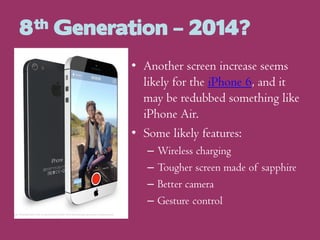
8th Generation – 2014?
• Another screen increase seems
likely for the iPhone 6, and it
may be redubbed something like
iPhone Air.
• Some likely features:
–
–
–
–

Wireless charging
Tougher screen made of sapphire
Better camera
Gesture control
Could Apple Come Back?
• Some market analysts think that Apple will regain
the majority of the market share by 2017, but it’s
almost impossible to predict.
• It depends on Apple’s ability to put together
another iPhone that will break some new ground,
which we have seen them do in the past.

Evolution of the iPhone

  • 1.
    Evolution of the iPhone Andits market share.
  • 2.
    1st Generation –2007 • Released in 2007, the original iPhone was breaking new ground. • Cingular, now part of AT&T, had exclusive rights to providing cellular for this phone.
  • 3.
  • 4.
    2nd Generation –2008 • The iPhone 3G released a year after the original. • The 3G was faster and more powerful. • By this time, Apple was dominating the market.
  • 5.
    3rd Generation -2009 • The iPhone 3GS was released after the 3G. • The processor worked faster and the camera was resolution. • It also had a higher-res video camera.
  • 6.
    Enter Droid –2009 With the Droid, Verizon could offer their own smartphone alternative.
  • 7.
    4th Generation –2010 • Apple changed up their look significantly with the iPhone 4. • Retina display was introduced, as well as a front-facing camera for video calling.
  • 8.
    5th Generation -2011 The iPhone 4S, while remaining identical in appearance to the iPhone 4, had many new features: • Siri • 1080p video recording • Dual-core A5 processor • 8MP camera
  • 9.
    Apple Begins to LoseGround to Android
  • 10.
    6th Generation –2012 • The iPhone 5 was long awaited, but it failed to please crowds the way Apple expected it to. • Upgrades involved increasing the screen size and the processor’s power. • The lightning connector became the new power connection.
  • 11.
    7th Generation –2013 • Apple released two iPhone varieties this year: the iPhone 5S and the iPhone 5C. • While the 5C was a budget version of the iPhone 5, made of plastic rather than glass and metal, the 5S introduced some new features: – Faster processor – Touch ID fingerprint scanner – Updated camera
  • 12.
    Android Dominates World Marketwith almost 80% of the smartphone market.
  • 13.
    8th Generation –2014? • Another screen increase seems likely for the iPhone 6, and it may be redubbed something like iPhone Air. • Some likely features: – – – – Wireless charging Tougher screen made of sapphire Better camera Gesture control
  • 14.
    Could Apple ComeBack? • Some market analysts think that Apple will regain the majority of the market share by 2017, but it’s almost impossible to predict. • It depends on Apple’s ability to put together another iPhone that will break some new ground, which we have seen them do in the past.