"Is there a Philippine Public Administration"
By Prof. Alex Brillantes and Prof. Maricel Fernandez
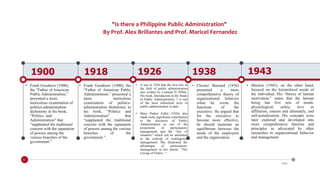
1900
• Frank Goodnow (1900),
the “Father of American
Public Administration,”
presented a more
meticulous examination of
politics-administration
dichotomy in his book,
“Politics and
Administration” that
“supplanted the traditional
concern with the separation
of powers among the
various branches of the
government.”
1918
• Frank Goodnow (1900), the
“Father of American Public
Administration,” presented a
more meticulous
examination of politics-
administration dichotomy in
his book, “Politics and
Administration” that
“supplanted the traditional
concern with the separation
of powers among the various
branches of the
government.”.
1926
• It was in 1926 that the first text in
the field of public administration
was written by Leonard D. White.
His book, Introduction to the Study
of Public Administration, 7 is one
of the most influential texts in
public administration to date
• Mary Parker Follet (1926) also
made some significant contribution
to the discourse of Public
Administration as one of the
proponents of participatory
management and the “law of
situation” which can be attributed
to the concept of contingency
management. She illustrated the
advantages of participatory
management in her article, “The
Giving of Orders. “
1938
• Chester Barnard (1938)
presented a more
comprehensive theory of
organizational behavior
when he wrote the
functions of the
executive. He argued that
for the executive to
become more effective,
he should maintain an
equilibrium between the
needs of the employees
and the organization.
1943
• Maslow (1943), on the other hand,
focused on the hierarchical needs of
the individual. His “theory of human
motivation,” states that the human
being has five sets of needs:
physiological, safety, love or
affiliation, esteem and ultimately, and
self-actualization. His concepts were
later explored and developed into
more comprehensive theories and
principles as advocated by other
researches in organizational behavior
and management
01
Date
"Is there a Philippine Public Administration"
By Prof. Alex Brillantes and Prof. Maricel Fernandez
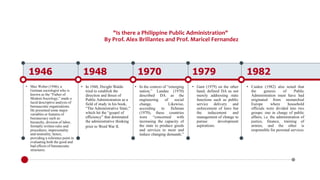
1946
• Max Weber (1946), a
German sociologist who is
known as the “Father of
Modern Sociology,” made a
lucid descriptive analysis of
bureaucratic organizations.
He presented some major
variables or features of
bureaucracy such as:
hierarchy, division of labor,
formally written rules and
procedures, impersonality
and neutrality; hence,
providing a reference point in
evaluating both the good and
bad effects of bureaucratic
structures.
1948
• In 1948, Dwight Waldo
tried to establish the
direction and thrust of
Public Administration as a
field of study in his book,
“The Administrative State,”
which hit the “gospel of
efficiency” that dominated
the administrative thinking
prior to Word War II.
1970
• In the context of “emerging
nation,” Landau (1970)
described DA as the
engineering of social
change. Likewise,
according to Ilchman
(1970), these countries
were “concerned with
increasing the capacity of
the state to produce goods
and services to meet and
induce changing demands.”
1979
• Gant (1979) on the other
hand, defined DA as not
merely addressing state
functions such as public
service delivery and
enforcement of laws but
the inducement and
management of change to
pursue development
aspirations.
1982
• Caiden (1982) also noted that
the genesis of Public
Administration must have had
originated from monarchial
Europe where household
officials were divided into two
groups: one in charge of public
affairs, i.e. the administration of
justice, finance, training of
armies, and the other is
responsible for personal services
"Is there a Philippine Public Administration"
By Prof. Alex Brillantes and Prof. Maricel Fernandez
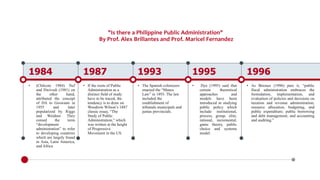
1984
• (Chilcote 1984) Nef
and Dwivedi (1981) on
the other hand,
attributed the concept
of DA to Goswami in
1955 and later
popularized by Riggs
and Weidner. They
coined the term
“development
administration” to refer
to developing countries
which are largely found
in Asia, Latin America,
and Africa
1987
• If the roots of Public
Administration as a
distinct field of study
have to be traced, the
tendency is to draw on
Woodrow Wilson’s 1887
classic essay, “The
Study of Public
Administration,” which
was written at the height
of Progressive
Movement in the US.
1993
• The Spanish colonizers
enacted the “Maura
Law” in 1893. The law
included the
establishment of
tribunals municipals and
juntas provincials.
1995
• Dye (1995) said that
certain theoretical
approaches and
models have been
introduced in studying
public policy which
include institutional,
process, group, elite,
rational, incremental,
game theory, public
choice and systems
model.
1996
• As Briones (1996) puts it, “public
fiscal administration embraces the
formulation, implementation, and
evaluation of policies and decisions on
taxation and revenue administration;
resource allocation, budgeting, and
public expenditure; public borrowing
and debt management; and accounting
and auditing.”
"Is there a Philippine Public Administration"
By Prof. Alex Brillantes and Prof. Maricel Fernandez
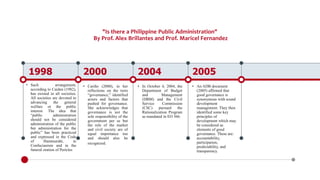
1998
• Such arrangement,
according to Caiden (1982),
has existed in all societies.
All societies are devoted to
advancing the general
welfare or the public
interest. The idea that
“public administration
should not be considered
administration of the public
but administration for the
public” has been practiced
and expressed in the Code
of Hammurabi, in
Confucianism and in the
funeral oration of Pericles
2000
• Cariño (2000), in her
reflections on the term
“governance,” identified
actors and factors that
pushed for governance.
She acknowledges that
governance is not the
sole responsibility of the
government per se but
the role of the market
and civil society are of
equal importance too
and should also be
recognized.
2004
• In October 4, 2004, the
Department of Budget
and Management
(DBM) and the Civil
Service Commission
(CSC) pursued the
Rationalization Program
as mandated in EO 366.
2005
• An ADB document
(2005) affirmed that
good governance is
synonymous with sound
development
management. They then
identified some key
principles of
development which may
be considered as
elements of good
governance. These are:
accountability,
participation,
predictability, and
transparency.

Timeline-Introduction to Public Administration.pptx

  • 1.
    "Is there aPhilippine Public Administration" By Prof. Alex Brillantes and Prof. Maricel Fernandez 1900 • Frank Goodnow (1900), the “Father of American Public Administration,” presented a more meticulous examination of politics-administration dichotomy in his book, “Politics and Administration” that “supplanted the traditional concern with the separation of powers among the various branches of the government.” 1918 • Frank Goodnow (1900), the “Father of American Public Administration,” presented a more meticulous examination of politics- administration dichotomy in his book, “Politics and Administration” that “supplanted the traditional concern with the separation of powers among the various branches of the government.”. 1926 • It was in 1926 that the first text in the field of public administration was written by Leonard D. White. His book, Introduction to the Study of Public Administration, 7 is one of the most influential texts in public administration to date • Mary Parker Follet (1926) also made some significant contribution to the discourse of Public Administration as one of the proponents of participatory management and the “law of situation” which can be attributed to the concept of contingency management. She illustrated the advantages of participatory management in her article, “The Giving of Orders. “ 1938 • Chester Barnard (1938) presented a more comprehensive theory of organizational behavior when he wrote the functions of the executive. He argued that for the executive to become more effective, he should maintain an equilibrium between the needs of the employees and the organization. 1943 • Maslow (1943), on the other hand, focused on the hierarchical needs of the individual. His “theory of human motivation,” states that the human being has five sets of needs: physiological, safety, love or affiliation, esteem and ultimately, and self-actualization. His concepts were later explored and developed into more comprehensive theories and principles as advocated by other researches in organizational behavior and management 01 Date
  • 2.
    "Is there aPhilippine Public Administration" By Prof. Alex Brillantes and Prof. Maricel Fernandez 1946 • Max Weber (1946), a German sociologist who is known as the “Father of Modern Sociology,” made a lucid descriptive analysis of bureaucratic organizations. He presented some major variables or features of bureaucracy such as: hierarchy, division of labor, formally written rules and procedures, impersonality and neutrality; hence, providing a reference point in evaluating both the good and bad effects of bureaucratic structures. 1948 • In 1948, Dwight Waldo tried to establish the direction and thrust of Public Administration as a field of study in his book, “The Administrative State,” which hit the “gospel of efficiency” that dominated the administrative thinking prior to Word War II. 1970 • In the context of “emerging nation,” Landau (1970) described DA as the engineering of social change. Likewise, according to Ilchman (1970), these countries were “concerned with increasing the capacity of the state to produce goods and services to meet and induce changing demands.” 1979 • Gant (1979) on the other hand, defined DA as not merely addressing state functions such as public service delivery and enforcement of laws but the inducement and management of change to pursue development aspirations. 1982 • Caiden (1982) also noted that the genesis of Public Administration must have had originated from monarchial Europe where household officials were divided into two groups: one in charge of public affairs, i.e. the administration of justice, finance, training of armies, and the other is responsible for personal services
  • 3.
    "Is there aPhilippine Public Administration" By Prof. Alex Brillantes and Prof. Maricel Fernandez 1984 • (Chilcote 1984) Nef and Dwivedi (1981) on the other hand, attributed the concept of DA to Goswami in 1955 and later popularized by Riggs and Weidner. They coined the term “development administration” to refer to developing countries which are largely found in Asia, Latin America, and Africa 1987 • If the roots of Public Administration as a distinct field of study have to be traced, the tendency is to draw on Woodrow Wilson’s 1887 classic essay, “The Study of Public Administration,” which was written at the height of Progressive Movement in the US. 1993 • The Spanish colonizers enacted the “Maura Law” in 1893. The law included the establishment of tribunals municipals and juntas provincials. 1995 • Dye (1995) said that certain theoretical approaches and models have been introduced in studying public policy which include institutional, process, group, elite, rational, incremental, game theory, public choice and systems model. 1996 • As Briones (1996) puts it, “public fiscal administration embraces the formulation, implementation, and evaluation of policies and decisions on taxation and revenue administration; resource allocation, budgeting, and public expenditure; public borrowing and debt management; and accounting and auditing.”
  • 4.
    "Is there aPhilippine Public Administration" By Prof. Alex Brillantes and Prof. Maricel Fernandez 1998 • Such arrangement, according to Caiden (1982), has existed in all societies. All societies are devoted to advancing the general welfare or the public interest. The idea that “public administration should not be considered administration of the public but administration for the public” has been practiced and expressed in the Code of Hammurabi, in Confucianism and in the funeral oration of Pericles 2000 • Cariño (2000), in her reflections on the term “governance,” identified actors and factors that pushed for governance. She acknowledges that governance is not the sole responsibility of the government per se but the role of the market and civil society are of equal importance too and should also be recognized. 2004 • In October 4, 2004, the Department of Budget and Management (DBM) and the Civil Service Commission (CSC) pursued the Rationalization Program as mandated in EO 366. 2005 • An ADB document (2005) affirmed that good governance is synonymous with sound development management. They then identified some key principles of development which may be considered as elements of good governance. These are: accountability, participation, predictability, and transparency.