Evolution of Public Administration
By Rizwan Akram Sherwani
11 Sept. 2019
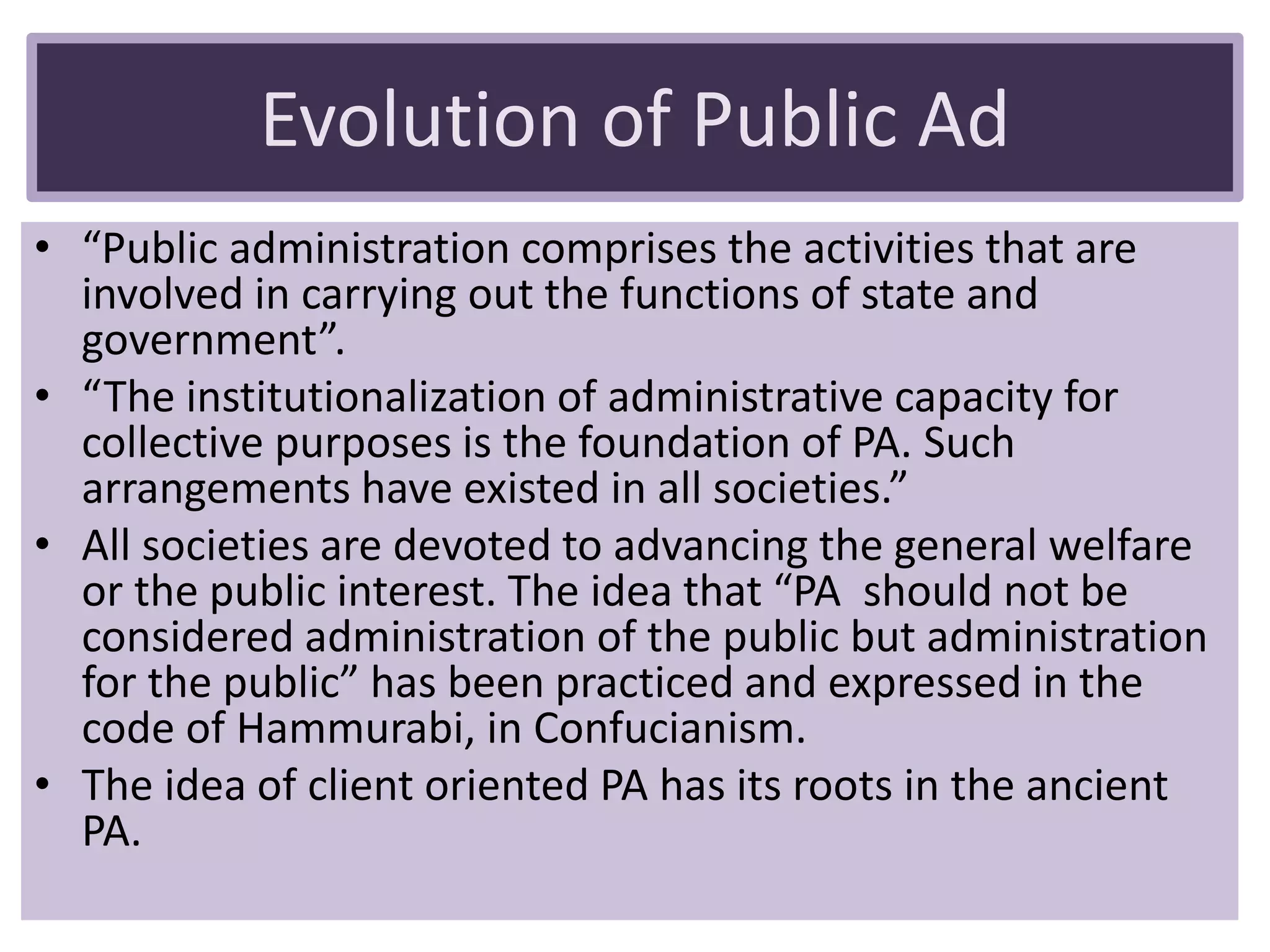
Evolution of Public Ad
• “Public administration comprises the activities that are
involved in carrying out the functions of state and
government”.
• “The institutionalization of administrative capacity for
collective purposes is the foundation of PA. Such
arrangements have existed in all societies.”
• All societies are devoted to advancing the general welfare
or the public interest. The idea that “PA should not be
considered administration of the public but administration
for the public” has been practiced and expressed in the
code of Hammurabi, in Confucianism.
• The idea of client oriented PA has its roots in the ancient
PA.
Evolution of Public Ad
• The philosophical & theoretical themes on the subject of
statecraft, practical administration, in the great civilizations,
dynasties, monarchies and city states, the idea of PA had
been fundamentally ingrained and reflected in a wide
variety of compositions and shades.
• It focused upon taxation, financial management, welfare,
administration justice, managing armies, controlling affairs
of a society and much more.
Evolution of Public Ad
• In the practical field of PA, Chinese may be considered
pioneer on account of following innovations:
• The first highly centralized bureaucratic state in the second
century BC.
• Merit Based recruitment for the governmental
administration through competitive exam much better than
the one in Europe and rest of the world till 18th Century
termed as the "birth certificate of modern bureaucracy"
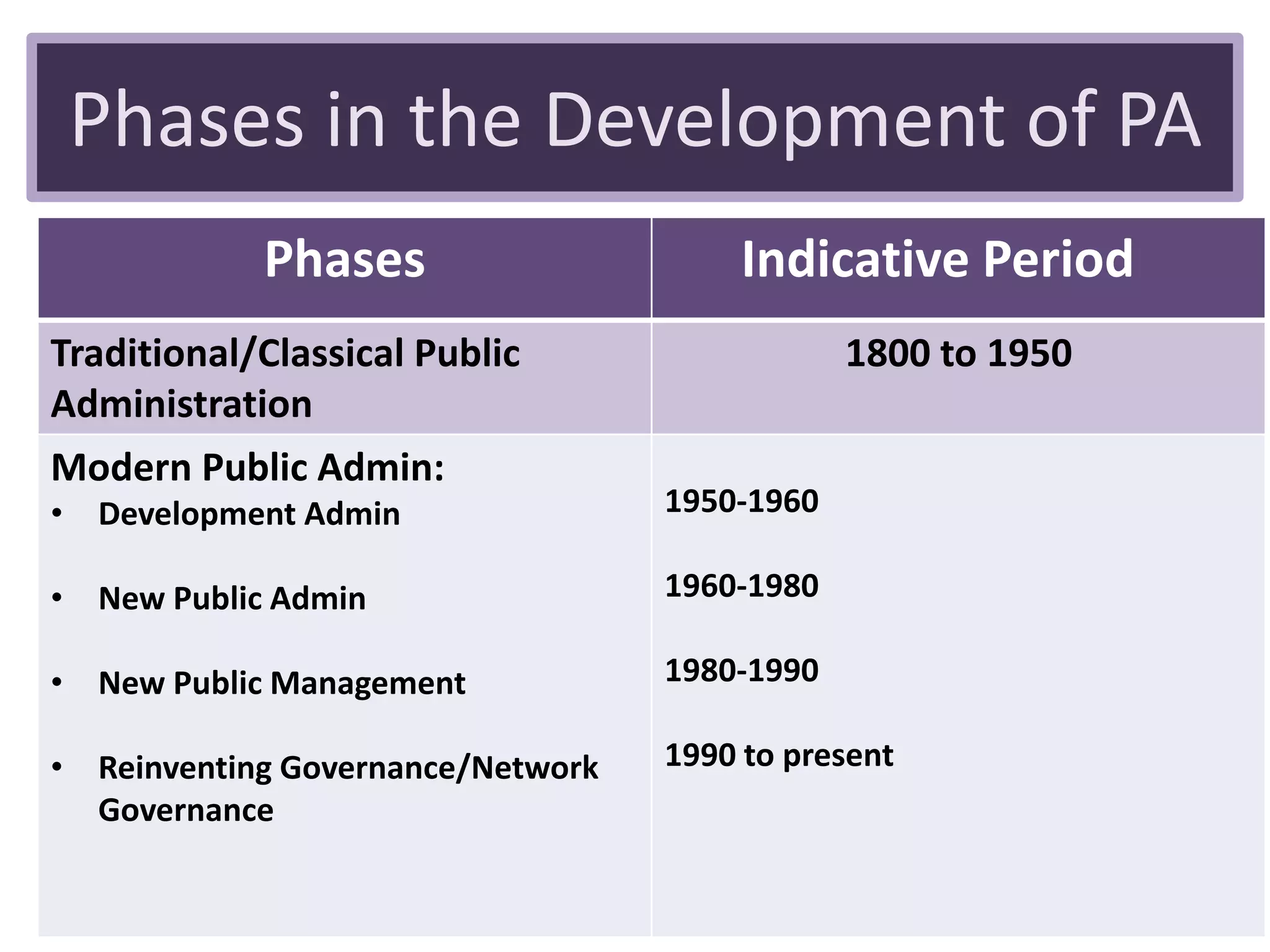
Phases in the Development of PA
Phases Indicative Period
Traditional/Classical Public
Administration
1800 to 1950
Modern Public Admin:
• Development Admin
• New Public Admin
• New Public Management
• Reinventing Governance/Network
Governance
1950-1960
1960-1980
1980-1990
1990 to present
Phases in the Development of PA
Phases Developments
1887-1826 Period of Dichotomy
1827-1937 • Developed as an Independent
Discipline
• POSDCORB View
• Principles of Administration
• Public Ad as a Science
1938-47 Behavioral Challenge
1948-1970 Crisis of Identity
1971 to onward New Public Administration
Public Policy Perspective
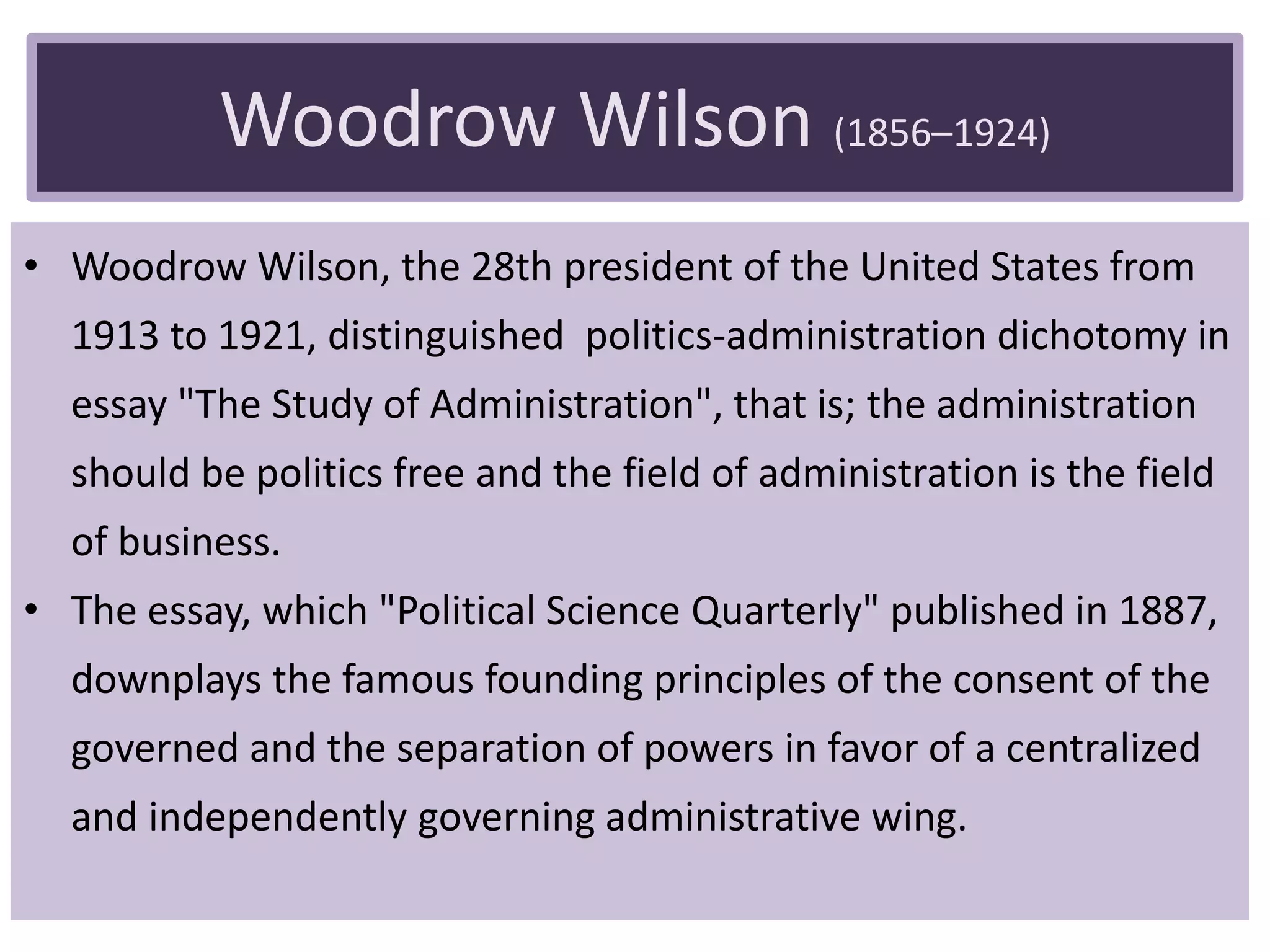
Woodrow Wilson (1856–1924)
• Woodrow Wilson, the 28th president of the United States from
1913 to 1921, distinguished politics-administration dichotomy in
essay "The Study of Administration", that is; the administration
should be politics free and the field of administration is the field
of business.
• The essay, which "Political Science Quarterly" published in 1887,
downplays the famous founding principles of the consent of the
governed and the separation of powers in favor of a centralized
and independently governing administrative wing.
Woodrow Wilson
• He believed that most voters are not philosophical or sophisticated
enough to make good choices. He suggests that a large number of non-
elected experts are more qualified to run a government than elected
individuals. He calls typical voters “selfish, ignorant, timid, stubborn, or
foolish.”
• He believes that Americans are too historically ingrained in the concept of
electing representatives by popular vote. Wilson offers the example of an
electorate preferring amateur cooks for meal preparation instead of
trained professional chefs.
• He advocates that a small number of wise experts, not subject to re-
election, improve society by opposing popular viewpoints that harm
society.
Woodrow Wilson
• Administrative questions are not political questions rather
look at administering public affairs.
• PA is detailed and systematic application of law. Every
particular application of law is an act of administration.
Frank Goodnow (1859-1939)
• FG the first president of the American Political Science Association in
1903 and an important early scholar in the field of public
administration and administrative law.
• He presented the concept of Politics-Admin dichotomy in his book
“Politics and Administration”. Presented the concept of separation of
powers among the various branches of government.
• Politics as the sphere that “as to do with the guiding or influencing of
governmental policy” and administration as the sphere that “has to do
with the execution of that policy”
• He made a technical distinction between politics & administration.
• Leonard D. White (1891-
1958) was an American
historian who specialized
in public administration
in the United States.
• Wanted to develop Public
Admin from an art to
science and enter it into a
managerial phase of
administration.
• William F. Willoughby
(1867–1960) was an
author of “Principles of
Public administration”.
• The title of the book
indicates the new thrust
in thinking and
established the subject as
an independent science.
11
Leonard D. White and William F. Willoughby
Max Weber (1864-1920)
• A German sociologist, philosopher, jurist, and political economist
and one of the founder of social theory and social research.
• Presented a descriptive analysis of bureaucratic organizations and
key features of bureaucracy such as hierarchical structure, division
of labor, formally written rules and procedure, bureaucratic
neutrality, hence given a reference point for evaluating their
performance and role.
• Weber defined the state as an entity to claim monopoly of the
legitimate use of physical force within a given territory based on
rational-legal authority.
Max Weber’s Bureaucratic Model
1. Specialized roles
2. Recruitment based on merit (e.g., tested through open
competition)
3. Uniform principles of placement, promotion, and transfer in an
administrative system
4. Careerism with systematic salary structure
5. Hierarchy, responsibility and accountability
6. Subjection of official conduct to strict rules of discipline and control
7. Supremacy of abstract rules
8. Impersonal authority (e.g., office bearer does not bring the office
with him)
9. Political neutrality.
Cameralism
• King Frederick William I of Prussia, created professorates in Cameralism in
an effort to train a new class of public administrators.
• In 17th Cen Europe, the idea of “Cameralism” was for preparing potential
public officials for the government service.
• Subsequently, it developed into an economic theory prevalent in 18th-
cent. Germany, which advocated a strong public administration managing
a centralized economy primarily for the benefit of the state.
• The Classic, Medieval, and Enlightenment-era scholars of Europe formed
the foundation of the discipline that has come to be called public
administration.
Luther Gulick (1892-1993)
• American political scientist, Professor at Columbia University.
• He believed that administration consists of seven elements
POSDCORB stands for -
1) P - Planning
2) O-Organizing
3) S - Staffing
4) D - Directing
5) CO - Coordinating
6) R - Reporting
7) B - Budgeting
Behavioral Challenges (1938-47)
• C. I. Barnard, Simon and Robat Dahl challenged the claim of Public
Administration as a science of administration. These thinkers
disagrees with the stand taken by Gullick.
• Simon, in 1947 published his book “Administrative Behaviour”
wherein he argued that there is no such thing as principles of
administration. The so called ‘Principles’ are in fact general truth or
rule of conduct.
• There is lack of scientific validity and universal relevancy in Public
Administration.
Behavioral Challenges
• Robert Dahl emphasizes the need to take into account
normative considerations, human behavior and
sociological factors while defining the parameters of
public administration. He brought behaviouralism in
Public Administration. He emphasized the environmental
effects on administrative behavior.
Crises of Identity (1948-1970)
• The Behaviouralist posed a challenge to the discipline of
Public Administration termed by writers as “the crisis of
identity”
• Pfiffner stated that politics and administration are so
intermingled and confused that a clear distinction is difficult.
• Many political scientists began to argue that the true objective
of Public Administration was “intellectualized understanding”
of the executive. There was also a talk of continued ‘dominion
of political science over Public Administration
WE ENTER ERA OF NEW PUBLIC
ADMINISTRATION
NEW PUBLIC MANAGEMENT
NETWORK GOVERNANCE
19
THANK YOU

Evolution of Public Administration

  • 1.
    Evolution of PublicAdministration By Rizwan Akram Sherwani 11 Sept. 2019
  • 2.
    Evolution of PublicAd • “Public administration comprises the activities that are involved in carrying out the functions of state and government”. • “The institutionalization of administrative capacity for collective purposes is the foundation of PA. Such arrangements have existed in all societies.” • All societies are devoted to advancing the general welfare or the public interest. The idea that “PA should not be considered administration of the public but administration for the public” has been practiced and expressed in the code of Hammurabi, in Confucianism. • The idea of client oriented PA has its roots in the ancient PA.
  • 3.
    Evolution of PublicAd • The philosophical & theoretical themes on the subject of statecraft, practical administration, in the great civilizations, dynasties, monarchies and city states, the idea of PA had been fundamentally ingrained and reflected in a wide variety of compositions and shades. • It focused upon taxation, financial management, welfare, administration justice, managing armies, controlling affairs of a society and much more.
  • 4.
    Evolution of PublicAd • In the practical field of PA, Chinese may be considered pioneer on account of following innovations: • The first highly centralized bureaucratic state in the second century BC. • Merit Based recruitment for the governmental administration through competitive exam much better than the one in Europe and rest of the world till 18th Century termed as the "birth certificate of modern bureaucracy"
  • 5.
    Phases in theDevelopment of PA Phases Indicative Period Traditional/Classical Public Administration 1800 to 1950 Modern Public Admin: • Development Admin • New Public Admin • New Public Management • Reinventing Governance/Network Governance 1950-1960 1960-1980 1980-1990 1990 to present
  • 6.
    Phases in theDevelopment of PA Phases Developments 1887-1826 Period of Dichotomy 1827-1937 • Developed as an Independent Discipline • POSDCORB View • Principles of Administration • Public Ad as a Science 1938-47 Behavioral Challenge 1948-1970 Crisis of Identity 1971 to onward New Public Administration Public Policy Perspective
  • 7.
    Woodrow Wilson (1856–1924) •Woodrow Wilson, the 28th president of the United States from 1913 to 1921, distinguished politics-administration dichotomy in essay "The Study of Administration", that is; the administration should be politics free and the field of administration is the field of business. • The essay, which "Political Science Quarterly" published in 1887, downplays the famous founding principles of the consent of the governed and the separation of powers in favor of a centralized and independently governing administrative wing.
  • 8.
    Woodrow Wilson • Hebelieved that most voters are not philosophical or sophisticated enough to make good choices. He suggests that a large number of non- elected experts are more qualified to run a government than elected individuals. He calls typical voters “selfish, ignorant, timid, stubborn, or foolish.” • He believes that Americans are too historically ingrained in the concept of electing representatives by popular vote. Wilson offers the example of an electorate preferring amateur cooks for meal preparation instead of trained professional chefs. • He advocates that a small number of wise experts, not subject to re- election, improve society by opposing popular viewpoints that harm society.
  • 9.
    Woodrow Wilson • Administrativequestions are not political questions rather look at administering public affairs. • PA is detailed and systematic application of law. Every particular application of law is an act of administration.
  • 10.
    Frank Goodnow (1859-1939) •FG the first president of the American Political Science Association in 1903 and an important early scholar in the field of public administration and administrative law. • He presented the concept of Politics-Admin dichotomy in his book “Politics and Administration”. Presented the concept of separation of powers among the various branches of government. • Politics as the sphere that “as to do with the guiding or influencing of governmental policy” and administration as the sphere that “has to do with the execution of that policy” • He made a technical distinction between politics & administration.
  • 11.
    • Leonard D.White (1891- 1958) was an American historian who specialized in public administration in the United States. • Wanted to develop Public Admin from an art to science and enter it into a managerial phase of administration. • William F. Willoughby (1867–1960) was an author of “Principles of Public administration”. • The title of the book indicates the new thrust in thinking and established the subject as an independent science. 11 Leonard D. White and William F. Willoughby
  • 12.
    Max Weber (1864-1920) •A German sociologist, philosopher, jurist, and political economist and one of the founder of social theory and social research. • Presented a descriptive analysis of bureaucratic organizations and key features of bureaucracy such as hierarchical structure, division of labor, formally written rules and procedure, bureaucratic neutrality, hence given a reference point for evaluating their performance and role. • Weber defined the state as an entity to claim monopoly of the legitimate use of physical force within a given territory based on rational-legal authority.
  • 13.
    Max Weber’s BureaucraticModel 1. Specialized roles 2. Recruitment based on merit (e.g., tested through open competition) 3. Uniform principles of placement, promotion, and transfer in an administrative system 4. Careerism with systematic salary structure 5. Hierarchy, responsibility and accountability 6. Subjection of official conduct to strict rules of discipline and control 7. Supremacy of abstract rules 8. Impersonal authority (e.g., office bearer does not bring the office with him) 9. Political neutrality.
  • 14.
    Cameralism • King FrederickWilliam I of Prussia, created professorates in Cameralism in an effort to train a new class of public administrators. • In 17th Cen Europe, the idea of “Cameralism” was for preparing potential public officials for the government service. • Subsequently, it developed into an economic theory prevalent in 18th- cent. Germany, which advocated a strong public administration managing a centralized economy primarily for the benefit of the state. • The Classic, Medieval, and Enlightenment-era scholars of Europe formed the foundation of the discipline that has come to be called public administration.
  • 15.
    Luther Gulick (1892-1993) •American political scientist, Professor at Columbia University. • He believed that administration consists of seven elements POSDCORB stands for - 1) P - Planning 2) O-Organizing 3) S - Staffing 4) D - Directing 5) CO - Coordinating 6) R - Reporting 7) B - Budgeting
  • 16.
    Behavioral Challenges (1938-47) •C. I. Barnard, Simon and Robat Dahl challenged the claim of Public Administration as a science of administration. These thinkers disagrees with the stand taken by Gullick. • Simon, in 1947 published his book “Administrative Behaviour” wherein he argued that there is no such thing as principles of administration. The so called ‘Principles’ are in fact general truth or rule of conduct. • There is lack of scientific validity and universal relevancy in Public Administration.
  • 17.
    Behavioral Challenges • RobertDahl emphasizes the need to take into account normative considerations, human behavior and sociological factors while defining the parameters of public administration. He brought behaviouralism in Public Administration. He emphasized the environmental effects on administrative behavior.
  • 18.
    Crises of Identity(1948-1970) • The Behaviouralist posed a challenge to the discipline of Public Administration termed by writers as “the crisis of identity” • Pfiffner stated that politics and administration are so intermingled and confused that a clear distinction is difficult. • Many political scientists began to argue that the true objective of Public Administration was “intellectualized understanding” of the executive. There was also a talk of continued ‘dominion of political science over Public Administration
  • 19.
    WE ENTER ERAOF NEW PUBLIC ADMINISTRATION NEW PUBLIC MANAGEMENT NETWORK GOVERNANCE 19
  • 20.