‘Environment’
Need for Environmental
Management
“Spaceship Earth”
• The catchphrase ‘spaceship Earth’ was coined –
implying a vulnerable, unique and shared life-
support system, with a wayward set of
passengers who tend to forget that what one
does affects all.
• On any ship the hope is that it can be safely
steered, that the crew know what they are doing,
act responsibly, and manage to control the
passengers.
• (Barrow, C.J. 2005)
Passengers’ Categories
• First Class
– Few, living in luxury, mainly citizens of rich nations
• Second Class
– Numerous, living in semicomfortable conditions,
mainly citizens of developing countries
• Stowage Class
– Countless, unemployed, landless and marginalized
communities of urban slums/rural area exposed to
unrelenting environment
Adlai Ewing Stevenson II (1965 at UN)
• “We travel together, passengers on a little space
ship, dependent on its vulnerable reserves of air
and soil; all committed for our safety to its
security and peace; preserved from annihilation
only by the care, the work, and, I will say, the love
we give our fragile craft. We cannot maintain it
half fortunate, half miserable, half confident, half
despairing, half slave—to the ancient enemies of
man—half free in a liberation of resources
undreamed of until this day. No craft, no crew
can travel safely with such vast contradictions. On
their resolution depends the survival of us all.”
Earth
• A self-contained, perpetually moving vessel that never
stops in space and time. Each year it travels 940 million
km around the sun @ 108,000 km/hour.
• No stopovers for refueling or stock replenishment from
external sources dependent only on native resources.
• It houses 8.7 million (±1.3) species including 7.6 billion
homo sapians, all of whom are in competition for basic
needs of life i.e. air, water, food, energy, and habitable
place or shelter in order to survive and interbreed.
• Some of its resources are finite and some are infinite
albeit the quality of resources may worsen.
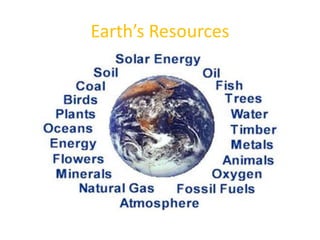
Earth’s Resources
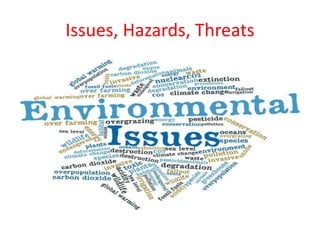
Issues, Hazards, Threats
Earth’s Environment
• Atmosphere
– Structure/composition/dynamics of air, weather
systems
• Hydrosphere
– Oceans, seas, lakes, wetlands, rivers, groundwater,
springs, glaciers (Cryosphere)
• Lithosphere
– Rocks, minerals, soil (Pedosphere)
• Biosphere
– Animals, plants, microorganisms
Environment defined by Law
• Section 2 (x) of PEPA 1997 include given factors:
– Air, water and land
– All layers of the Atmosphere
– All organic/inorganic matter and living organisms
– The Ecosystem and ecological relationships
– Buildings, structures, roads, facilities and works
– All social and economic conditions affecting
community life
– Interrelationship between any of the above factors
Objectives of Environmental
Management
• Prevent and solve environmental problems;
• Establish limits and standards;
• Develop monitoring system through research;
• Warn against threats & identify opportunities;
• Suggest measures for resource conservation;
• Develop strategy for improving quality of life;
• Propose long & short term policies for S.D;
• Identify new technologies for S.D.
Characteristics of Environmental
Management
• It deals with a world affected by humans;
• It supports sustainable development;
• It demands multidisciplinary approach;
• It integrates different development views;
• It concerns with short and long term planning
from local to global scale;
• It integrates natural and social science, policy
making and planning.
Sectors of Governance Requiring
Environmental Management
• Water supply
• Forests and Wildlife,
• Fisheries and Livestock
• Agriculture/Horticulture
• Irrigation and Dams
• Minerals, Oil & Gas
• Solid Waste/Sanitation
• Transport and Traffic
• Roads and Highways
• Industries & Manufacturing
• Tourism and Hoteling
• Disaster management
• Development Authorities
• Coastal zone management
Sustainable Development
• The idea of sustainable development was first put forth
in the 1987 WCED report “Our Common Future” often
referred to as the Brundtland Commission. It says “the
development that meets needs of the present without
compromising the ability of future generations to meet
their own needs”.
• Two key concepts
– the needs, particularly essential needs of the world's poor,
should be given overriding priority; and
– limitations imposed by the state of technology and social
organization on the environment's ability to meet present
and future needs should be a key consideration in
development
UNCED 1992, Rio de Janeiro
• The WCED report had proposed ‘sustainable
development’ as key solution to problems of
environmental degradation.
• The Commission was mandated to identify common
environmental worries - population growth, pollution,
global warming, deforestation, species loss, toxic
wastes etc - and develop an action plan to link
development with environmental protection
• This report formed the basis for organizing the UNCED
1992 or Rio Earth Summit and its outcome ‘Agenda 21’
• https://sustainabledevelopment.un.org/outcomedocuments/agenda21
Organizational Hierarchy of Life
• Organism → Species Population → Community → Ecosystem → Biome →
Biosphere
• Biomes are natural broad biotic zones of the biosphere characterized by
uniform life forms of vegetation
– Terrestrial biome: Tundra, forest, deserts, grassland
– Aquatic biomes: Freshwater (lentic & lotic), Marine (Reef, estuary, ocean)
• Ecosystem is a self sustaining unit of nature, defined as a functionally
independent unit where living organisms interact among themselves as
well as with their physical environment
• Two major categories of ecosystems exist i.e. terrestrial and aquatic
– Forests, deserts and grasslands are examples of terrestrial ecosystem
– Lakes, rivers, wet lands and salt water are some example of aquatic ecosystem
• Trophic levels in an ecosystem
– Primary producers (plants), Primary consumers (herbivores), Secondary
consumers (carnivores), Tertiary consumers (man)
Biodiversity
• Variance among living organisms from all sources,
including terrestrial, marine, and other aquatic
ecosystems; this includes diversity within species,
between species, and of ecosystems.
• Biodiversity forms the foundation of a vast array
of ecosystem services that critically contribute to
human well-being.
• Human decisions that influence biodiversity
affect the well-being of themselves and others.
• Pakistan is a signatory of Convention on Biological
Diversity having ratified it in 1994.
Environmental Pollution
• Pollution occurs when undesirable substances
contaminate the natural surroundings, which
brings about changes that affect our normal
lifestyles adversely.
• Forms of pollution: air pollution, water pollution,
soil pollution, noise pollution, heat/thermal and
light
• Pollution must be taken seriously for its
hazardous negative effects on natural elements
that are an absolute need for life to exist on
earth, such as water, air and food
Natural Resource Management
• NRM refers to organized and prudent handling of
resources such as land, water, soil, plants, animals,
fossil fuels, minerals and materials.
• Resources can be categorized as Renewable and Non-
Renewable
• Increasing population, better standards of living,
industrialization, urbanization and economic interest
put extra pressure on Earth’s depleting resources and
become a cause for unsustainable practices.
• Environmental managers closely observe resource
exploitation from the viewpoint of environmental
sustainability.
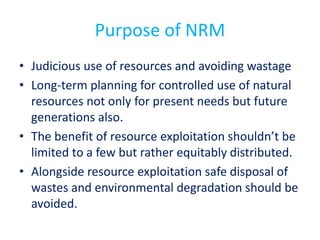
Purpose of NRM
• Judicious use of resources and avoiding wastage
• Long-term planning for controlled use of natural
resources not only for present needs but future
generations also.
• The benefit of resource exploitation shouldn’t be
limited to a few but rather equitably distributed.
• Alongside resource exploitation safe disposal of
wastes and environmental degradation should be
avoided.
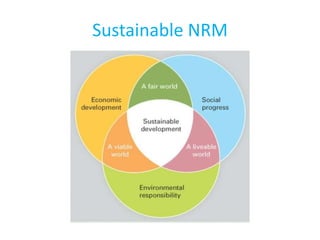
Sustainable NRM
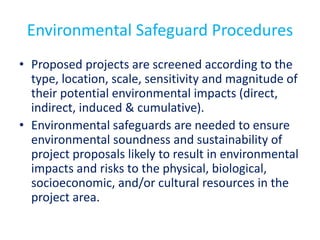
Environmental Safeguard Procedures
• Proposed projects are screened according to the
type, location, scale, sensitivity and magnitude of
their potential environmental impacts (direct,
indirect, induced & cumulative).
• Environmental safeguards are needed to ensure
environmental soundness and sustainability of
project proposals likely to result in environmental
impacts and risks to the physical, biological,
socioeconomic, and/or cultural resources in the
project area.
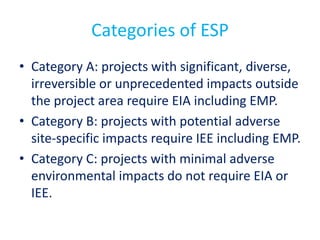
Categories of ESP
• Category A: projects with significant, diverse,
irreversible or unprecedented impacts outside
the project area require EIA including EMP.
• Category B: projects with potential adverse
site-specific impacts require IEE including EMP.
• Category C: projects with minimal adverse
environmental impacts do not require EIA or
IEE.
Environmental Impact Assessment
• EIA refers to the study undertaken, prior to the
start of physical work on a development project,
to predict its effects on the environment.
• It integrates environmental and socio-political
concerns in the developmental activities right at
the time of preparing their feasibility report and
suggest mitigation measures to overcome issues.
• It considers various alternatives for a project to
identify the best combination of socioeconomic
and environmental costs and benefits.
Core Values and Benefits of EIA
• Core values
– It should be fair, objective, unbiased and balanced
– It should provide balanced & credible information for
decision making
– It should result in Environmental Safeguards
• Benefits
– Protection of environment
– Optimum utilization of resources
– Promotes community participation
– Informed decision making
EIA Cycle and Procedure
• Screening
• Scoping and consideration of alternatives
• Baseline data collection
• Impact analysis
• Mitigation & Environmental Impact Statement
• Public hearing
• Environmental Management Plan
• Review by independent experts
• Decision making
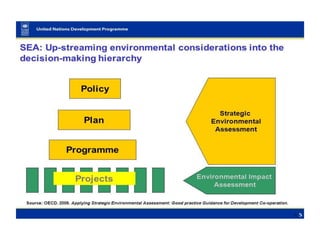
Strategic Environmental Assessment
• SEA is a development planning tool aimed at
ensuring environmental, social and economic
aspects of sustainability in policies and plans.
• It promotes social and economic equity and
ecological sustainability in development
decisions.
– Exercised to address broad strategic issues
– Relates to more than one projects, large areas,
affecting many people and communities
– Issues need to be resolved and decided prior to
making decisions.
Environment

Environment

  • 1.
  • 2.
    “Spaceship Earth” • Thecatchphrase ‘spaceship Earth’ was coined – implying a vulnerable, unique and shared life- support system, with a wayward set of passengers who tend to forget that what one does affects all. • On any ship the hope is that it can be safely steered, that the crew know what they are doing, act responsibly, and manage to control the passengers. • (Barrow, C.J. 2005)
  • 3.
    Passengers’ Categories • FirstClass – Few, living in luxury, mainly citizens of rich nations • Second Class – Numerous, living in semicomfortable conditions, mainly citizens of developing countries • Stowage Class – Countless, unemployed, landless and marginalized communities of urban slums/rural area exposed to unrelenting environment
  • 4.
    Adlai Ewing StevensonII (1965 at UN) • “We travel together, passengers on a little space ship, dependent on its vulnerable reserves of air and soil; all committed for our safety to its security and peace; preserved from annihilation only by the care, the work, and, I will say, the love we give our fragile craft. We cannot maintain it half fortunate, half miserable, half confident, half despairing, half slave—to the ancient enemies of man—half free in a liberation of resources undreamed of until this day. No craft, no crew can travel safely with such vast contradictions. On their resolution depends the survival of us all.”
  • 5.
    Earth • A self-contained,perpetually moving vessel that never stops in space and time. Each year it travels 940 million km around the sun @ 108,000 km/hour. • No stopovers for refueling or stock replenishment from external sources dependent only on native resources. • It houses 8.7 million (±1.3) species including 7.6 billion homo sapians, all of whom are in competition for basic needs of life i.e. air, water, food, energy, and habitable place or shelter in order to survive and interbreed. • Some of its resources are finite and some are infinite albeit the quality of resources may worsen.
  • 6.
  • 7.
  • 8.
    Earth’s Environment • Atmosphere –Structure/composition/dynamics of air, weather systems • Hydrosphere – Oceans, seas, lakes, wetlands, rivers, groundwater, springs, glaciers (Cryosphere) • Lithosphere – Rocks, minerals, soil (Pedosphere) • Biosphere – Animals, plants, microorganisms
  • 9.
    Environment defined byLaw • Section 2 (x) of PEPA 1997 include given factors: – Air, water and land – All layers of the Atmosphere – All organic/inorganic matter and living organisms – The Ecosystem and ecological relationships – Buildings, structures, roads, facilities and works – All social and economic conditions affecting community life – Interrelationship between any of the above factors
  • 10.
    Objectives of Environmental Management •Prevent and solve environmental problems; • Establish limits and standards; • Develop monitoring system through research; • Warn against threats & identify opportunities; • Suggest measures for resource conservation; • Develop strategy for improving quality of life; • Propose long & short term policies for S.D; • Identify new technologies for S.D.
  • 11.
    Characteristics of Environmental Management •It deals with a world affected by humans; • It supports sustainable development; • It demands multidisciplinary approach; • It integrates different development views; • It concerns with short and long term planning from local to global scale; • It integrates natural and social science, policy making and planning.
  • 12.
    Sectors of GovernanceRequiring Environmental Management • Water supply • Forests and Wildlife, • Fisheries and Livestock • Agriculture/Horticulture • Irrigation and Dams • Minerals, Oil & Gas • Solid Waste/Sanitation • Transport and Traffic • Roads and Highways • Industries & Manufacturing • Tourism and Hoteling • Disaster management • Development Authorities • Coastal zone management
  • 13.
    Sustainable Development • Theidea of sustainable development was first put forth in the 1987 WCED report “Our Common Future” often referred to as the Brundtland Commission. It says “the development that meets needs of the present without compromising the ability of future generations to meet their own needs”. • Two key concepts – the needs, particularly essential needs of the world's poor, should be given overriding priority; and – limitations imposed by the state of technology and social organization on the environment's ability to meet present and future needs should be a key consideration in development
  • 14.
    UNCED 1992, Riode Janeiro • The WCED report had proposed ‘sustainable development’ as key solution to problems of environmental degradation. • The Commission was mandated to identify common environmental worries - population growth, pollution, global warming, deforestation, species loss, toxic wastes etc - and develop an action plan to link development with environmental protection • This report formed the basis for organizing the UNCED 1992 or Rio Earth Summit and its outcome ‘Agenda 21’ • https://sustainabledevelopment.un.org/outcomedocuments/agenda21
  • 16.
    Organizational Hierarchy ofLife • Organism → Species Population → Community → Ecosystem → Biome → Biosphere • Biomes are natural broad biotic zones of the biosphere characterized by uniform life forms of vegetation – Terrestrial biome: Tundra, forest, deserts, grassland – Aquatic biomes: Freshwater (lentic & lotic), Marine (Reef, estuary, ocean) • Ecosystem is a self sustaining unit of nature, defined as a functionally independent unit where living organisms interact among themselves as well as with their physical environment • Two major categories of ecosystems exist i.e. terrestrial and aquatic – Forests, deserts and grasslands are examples of terrestrial ecosystem – Lakes, rivers, wet lands and salt water are some example of aquatic ecosystem • Trophic levels in an ecosystem – Primary producers (plants), Primary consumers (herbivores), Secondary consumers (carnivores), Tertiary consumers (man)
  • 17.
    Biodiversity • Variance amongliving organisms from all sources, including terrestrial, marine, and other aquatic ecosystems; this includes diversity within species, between species, and of ecosystems. • Biodiversity forms the foundation of a vast array of ecosystem services that critically contribute to human well-being. • Human decisions that influence biodiversity affect the well-being of themselves and others. • Pakistan is a signatory of Convention on Biological Diversity having ratified it in 1994.
  • 18.
    Environmental Pollution • Pollutionoccurs when undesirable substances contaminate the natural surroundings, which brings about changes that affect our normal lifestyles adversely. • Forms of pollution: air pollution, water pollution, soil pollution, noise pollution, heat/thermal and light • Pollution must be taken seriously for its hazardous negative effects on natural elements that are an absolute need for life to exist on earth, such as water, air and food
  • 19.
    Natural Resource Management •NRM refers to organized and prudent handling of resources such as land, water, soil, plants, animals, fossil fuels, minerals and materials. • Resources can be categorized as Renewable and Non- Renewable • Increasing population, better standards of living, industrialization, urbanization and economic interest put extra pressure on Earth’s depleting resources and become a cause for unsustainable practices. • Environmental managers closely observe resource exploitation from the viewpoint of environmental sustainability.
  • 20.
    Purpose of NRM •Judicious use of resources and avoiding wastage • Long-term planning for controlled use of natural resources not only for present needs but future generations also. • The benefit of resource exploitation shouldn’t be limited to a few but rather equitably distributed. • Alongside resource exploitation safe disposal of wastes and environmental degradation should be avoided.
  • 21.
  • 22.
    Environmental Safeguard Procedures •Proposed projects are screened according to the type, location, scale, sensitivity and magnitude of their potential environmental impacts (direct, indirect, induced & cumulative). • Environmental safeguards are needed to ensure environmental soundness and sustainability of project proposals likely to result in environmental impacts and risks to the physical, biological, socioeconomic, and/or cultural resources in the project area.
  • 23.
    Categories of ESP •Category A: projects with significant, diverse, irreversible or unprecedented impacts outside the project area require EIA including EMP. • Category B: projects with potential adverse site-specific impacts require IEE including EMP. • Category C: projects with minimal adverse environmental impacts do not require EIA or IEE.
  • 25.
    Environmental Impact Assessment •EIA refers to the study undertaken, prior to the start of physical work on a development project, to predict its effects on the environment. • It integrates environmental and socio-political concerns in the developmental activities right at the time of preparing their feasibility report and suggest mitigation measures to overcome issues. • It considers various alternatives for a project to identify the best combination of socioeconomic and environmental costs and benefits.
  • 26.
    Core Values andBenefits of EIA • Core values – It should be fair, objective, unbiased and balanced – It should provide balanced & credible information for decision making – It should result in Environmental Safeguards • Benefits – Protection of environment – Optimum utilization of resources – Promotes community participation – Informed decision making
  • 27.
    EIA Cycle andProcedure • Screening • Scoping and consideration of alternatives • Baseline data collection • Impact analysis • Mitigation & Environmental Impact Statement • Public hearing • Environmental Management Plan • Review by independent experts • Decision making
  • 28.
    Strategic Environmental Assessment •SEA is a development planning tool aimed at ensuring environmental, social and economic aspects of sustainability in policies and plans. • It promotes social and economic equity and ecological sustainability in development decisions. – Exercised to address broad strategic issues – Relates to more than one projects, large areas, affecting many people and communities – Issues need to be resolved and decided prior to making decisions.