Earth's Place In Space
Earth's Place In Space Origin Of The Universe Big Bang Theory  How our solar system formed Earth's Early Atmosphere Evolution
Origin Of The Universe Big Bang Theory Scientists believe that there was a giant explosion around 12-14 billion years ago. Atomic particles from the explosion later formed galaxies, stars, and planets.
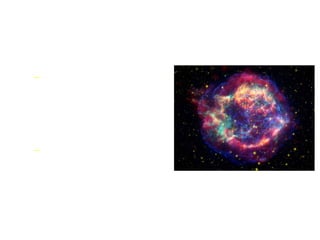
Supernova 7 Billion years ago, a supernova occurred from one of the first generations of giant stars exploding. A supernova occurs at the end of a stars life, releasing huge amounts of energy.
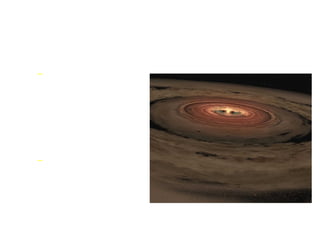
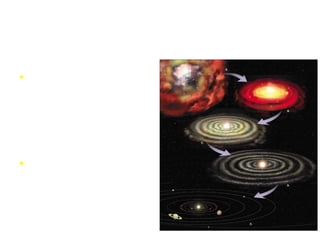
Solar Nebula The energy released from the first generation of stars exploding, produced a solar nebula. A solar nebula is thought to be a spinning cloud of dust and gas.
Solar Nebula Gravity caused the spinning could of dust and gas to collapse and condense forming our Sun in the center. The other lumps of matter that formed from the contracting dust and gas became the planets.
Earth's Early Atmosphere 4.6 billion years ago, Earth was nothing more than a molten ball of rock surrounded by an atmosphere of hydrogen and helium.  As the Earth cooled  enough to form a  solid crust, it was  covered with active  volcanoes.
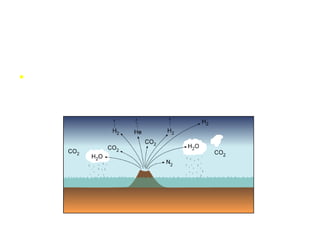
Earth's Early Atmosphere These volcanoes spewed out gasses, like water vapor, carbon dioxide, and ammonia forming Earth's early atmosphere.
Earth's Early Atmosphere Very little oxygen  No ozone layer Early life could only survive in the ocean (UV radiation) Early organisms used energy from the Sun for photosynthesis. Conversion of the suns energy into chemical energy by living organisms. Oxygen was released as a byproduct.
Earth's Early Atmosphere As oxygen increased, the ozone layer was formed protecting Earth from harmful radiation.  This allowed for plant life to evolve and made it possible for the evolution of animal life on land.
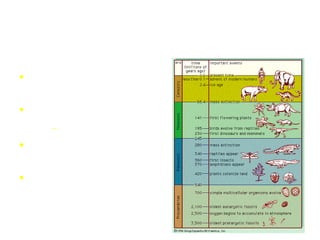
Evolution Precambrian: Multicelled organisms Paleozoic: Reptiles Ice Age Mesozoic: Dinosaurs/Mammals Cenozoic: Early humans/Modern Humans

Presssfsfsffghdfghfdgh

  • 1.
  • 2.
    Earth's Place InSpace Origin Of The Universe Big Bang Theory How our solar system formed Earth's Early Atmosphere Evolution
  • 3.
    Origin Of TheUniverse Big Bang Theory Scientists believe that there was a giant explosion around 12-14 billion years ago. Atomic particles from the explosion later formed galaxies, stars, and planets.
  • 4.
    Supernova 7 Billionyears ago, a supernova occurred from one of the first generations of giant stars exploding. A supernova occurs at the end of a stars life, releasing huge amounts of energy.
  • 5.
    Solar Nebula Theenergy released from the first generation of stars exploding, produced a solar nebula. A solar nebula is thought to be a spinning cloud of dust and gas.
  • 6.
    Solar Nebula Gravitycaused the spinning could of dust and gas to collapse and condense forming our Sun in the center. The other lumps of matter that formed from the contracting dust and gas became the planets.
  • 7.
    Earth's Early Atmosphere4.6 billion years ago, Earth was nothing more than a molten ball of rock surrounded by an atmosphere of hydrogen and helium. As the Earth cooled enough to form a solid crust, it was covered with active volcanoes.
  • 8.
    Earth's Early AtmosphereThese volcanoes spewed out gasses, like water vapor, carbon dioxide, and ammonia forming Earth's early atmosphere.
  • 9.
    Earth's Early AtmosphereVery little oxygen No ozone layer Early life could only survive in the ocean (UV radiation) Early organisms used energy from the Sun for photosynthesis. Conversion of the suns energy into chemical energy by living organisms. Oxygen was released as a byproduct.
  • 10.
    Earth's Early AtmosphereAs oxygen increased, the ozone layer was formed protecting Earth from harmful radiation. This allowed for plant life to evolve and made it possible for the evolution of animal life on land.
  • 11.
    Evolution Precambrian: Multicelledorganisms Paleozoic: Reptiles Ice Age Mesozoic: Dinosaurs/Mammals Cenozoic: Early humans/Modern Humans