Presented by
ADNAN KHAN
Introduction
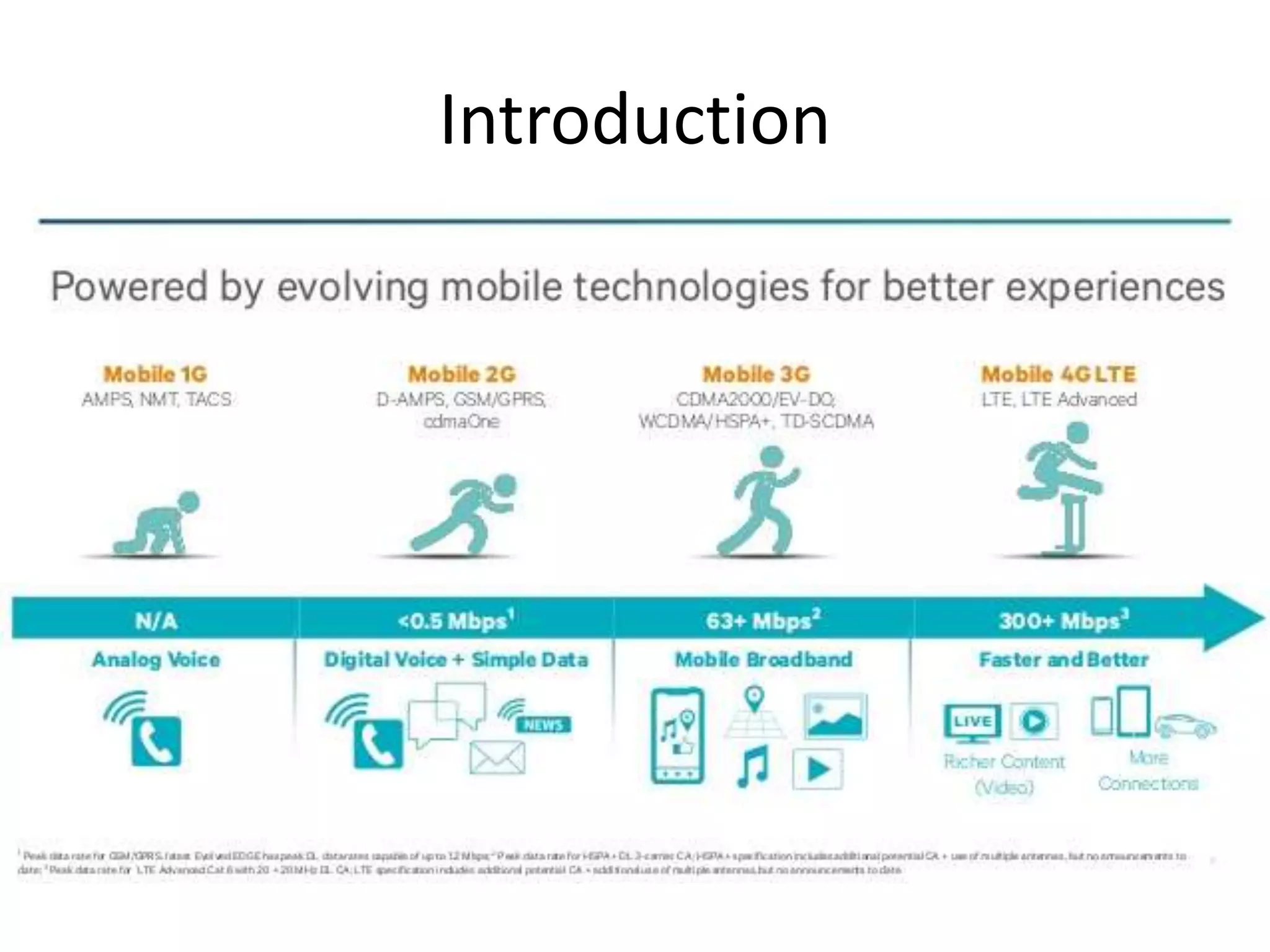
2G
• 2G digital wireless technologies increased
voice capacity delivering mobile to the
masses.
• One of the modes of communication, the
cellular phone earlier used 2nd Generation
connectivity to help create effective means to
exchange ideas and information over the cell
phone.
3G
• 3G is loosely defined, but generally includes
high data speeds, always-on data access, and
greater voice capacity.
• The high data speeds are possibly the most
prominent feature, and certainly the most
hyped. They enable such advanced features as
live, streaming video.
4G LTE
• 4G is the short name for fourth-generation
wireless, the stage of broadband mobile
communications that will supersede the third
generation (3G ).
• LTE stands for Long Term Evolution. A
technology used to implement 4G.
• Clearly faster and more accessible than 3G,it
has taken the world by storm.
5G
• 5G simply stands for fifth generation and refers to the
next and newest mobile wireless standard based on
the IEEE 802.11ac standard of broadband technology,
although a formal standard for 5G is yet to be set.
• While 5G isn't expected until 2020, an increasing
number of companies are investing now to prepare for
the new mobile wireless standard.
• We explore 5G, how it works and its impact on future
wireless systems.
Points of Difference
Technology 2G 3G 4G
Deployment 1980/1999 1990/2002 2000/2010
Bandwidth 14-64 KBPS 2 MBPS 200 MBPS
Technology Digital Cellular CDMA LAN/WAN/WLAN
Service Digital voice, short
messaging
Integrated high
quality audio and
data
Dynamic info
access. Variable
devices
Multiplexing TDMA/CDMA CDMA CDMA
Possible shift in market with advent of
newer technology
Features of 5G
Hand sets
Evolution of mobile technology

Evolution of mobile technology

  • 1.
  • 2.
  • 3.
    2G • 2G digitalwireless technologies increased voice capacity delivering mobile to the masses. • One of the modes of communication, the cellular phone earlier used 2nd Generation connectivity to help create effective means to exchange ideas and information over the cell phone.
  • 4.
    3G • 3G isloosely defined, but generally includes high data speeds, always-on data access, and greater voice capacity. • The high data speeds are possibly the most prominent feature, and certainly the most hyped. They enable such advanced features as live, streaming video.
  • 5.
    4G LTE • 4Gis the short name for fourth-generation wireless, the stage of broadband mobile communications that will supersede the third generation (3G ). • LTE stands for Long Term Evolution. A technology used to implement 4G. • Clearly faster and more accessible than 3G,it has taken the world by storm.
  • 6.
    5G • 5G simplystands for fifth generation and refers to the next and newest mobile wireless standard based on the IEEE 802.11ac standard of broadband technology, although a formal standard for 5G is yet to be set. • While 5G isn't expected until 2020, an increasing number of companies are investing now to prepare for the new mobile wireless standard. • We explore 5G, how it works and its impact on future wireless systems.
  • 7.
    Points of Difference Technology2G 3G 4G Deployment 1980/1999 1990/2002 2000/2010 Bandwidth 14-64 KBPS 2 MBPS 200 MBPS Technology Digital Cellular CDMA LAN/WAN/WLAN Service Digital voice, short messaging Integrated high quality audio and data Dynamic info access. Variable devices Multiplexing TDMA/CDMA CDMA CDMA
  • 9.
    Possible shift inmarket with advent of newer technology
  • 10.
  • 12.