What is international business
International business consists of transactions

that are devised and carried out across national
borders to satisfy the objectives of individuals,
companies, and organizations.
History and Evolution of
International Business
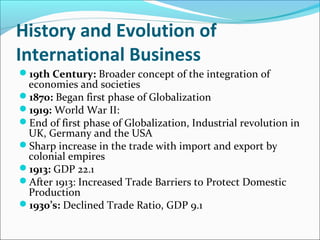
19th Century: Broader concept of the integration of 

economies and societies
1870: Began first phase of Globalization
1919: World War II: 
End of first phase of Globalization, Industrial revolution in 
UK, Germany and the USA
Sharp increase in the trade with import and export by 
colonial empires
1913: GDP 22.1
After 1913: Increased Trade Barriers to Protect Domestic 
Production
1930’s: Declined Trade Ratio, GDP 9.1
After 1930’s: World Nations felt the need for

International Co-operation in global trade and
balance of payments affairs
Establishment of IMF and IBRD (World Bank)
IMF: International Monetary Fund
IBRD: International Bank for Reconstruction and
Development
1947: 23 countries conducted negotiations in order to
prevent the protectionist policies and to revive the
economies from recession aiming at establishment of
World Trade organization
1947: Establishment of GATT (General Agreement on
Trade and Tariffs)
1980s: efforts to convert GATT into WTO
1st Jan 1995: GATT was replaced by WTO (World

Trade Organization)
Trade Liberalization
1990 – 2000: The Term IB (International Business)
has emerged from the term International Marketing.
There are two Phases of the evolution of the term
International Business
1. International Trade to International Marketing
2. International Marketing to International Business
After 1990: Rapid Internationalization ad
globalization
International trade to international
marketing
• Originally, the producers used to export their products to the

nearby countries and gradually extended the exports to far-off
countries. Gradually, the companies extended the operations
beyond trade. For example, India used to export raw cotton, raw
jute and iron ore during the early 1900s. The massive
industrialization in the country enabled us to export jute
products, cotton garments and steel during 1960s.
• India, during 1980s could create markets for its products, in
addition to mere exporting. The export marketing efforts
include creation of demand for Indian products like textiles,
electronics, leather products, tea, coffee etc., arranging for
appropriate distribution channels, attractive package, product
development, pricing etc. This process is true not only with
India, but also with almost all developed and developing
economies.
International marketing to
international business
• The multinational companies which were producing the

products in their home countries and marketing them in
various foreign countries before 1980s, started locating
their plants and other manufacturing facilities in
foreign/host countries. Later, they started producing in
one foreign country and marketing in other foreign
countries. For example, Uni Lever established its
subsidiary company in India, i.e., Hindustan Liver
Limited(HLL), HLL produces its products in India and
markets them in Bangladesh, Sri Lanka, Nepal etc. Thus,
the scope of the international trade is expanded into
international marketing and international marketing is
expanded into international business.
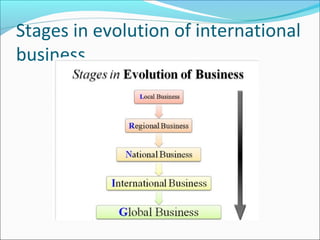
Stages in evolution of international
business
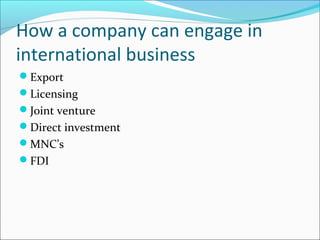
How a company can engage in
international business
Export
Licensing
Joint venture
Direct investment
MNC’s
FDI
Reasons for Recent Evolution or
Growth in International Business
Expansion of technology


Business is becoming more global because
 Transportation is quicker
 Communications enable control from afar
 Transportation and communications costs are more
conducive for international operations

Liberalization of cross-border movements


Lower governmental barriers to the movement of goods,
services, and resources enable companies to take better
advantage of international opportunities
– Development of supporting institutional arrangements
•

Institutional arrangements
– Are made by business and government
– Ease flow of goods
– Reduce risk

– Increase in global competition
•

More companies operate internationally because
– New products quickly become global
– Companies can produce in different countries
– Domestic companies’ competitors, suppliers, and customers
become international
Thank you

Presentation1

  • 2.
    What is internationalbusiness International business consists of transactions that are devised and carried out across national borders to satisfy the objectives of individuals, companies, and organizations.
  • 3.
    History and Evolutionof International Business 19th Century: Broader concept of the integration of  economies and societies 1870: Began first phase of Globalization 1919: World War II:  End of first phase of Globalization, Industrial revolution in  UK, Germany and the USA Sharp increase in the trade with import and export by  colonial empires 1913: GDP 22.1 After 1913: Increased Trade Barriers to Protect Domestic  Production 1930’s: Declined Trade Ratio, GDP 9.1
  • 4.
    After 1930’s: WorldNations felt the need for International Co-operation in global trade and balance of payments affairs Establishment of IMF and IBRD (World Bank) IMF: International Monetary Fund IBRD: International Bank for Reconstruction and Development 1947: 23 countries conducted negotiations in order to prevent the protectionist policies and to revive the economies from recession aiming at establishment of World Trade organization 1947: Establishment of GATT (General Agreement on Trade and Tariffs) 1980s: efforts to convert GATT into WTO
  • 5.
    1st Jan 1995:GATT was replaced by WTO (World Trade Organization) Trade Liberalization 1990 – 2000: The Term IB (International Business) has emerged from the term International Marketing. There are two Phases of the evolution of the term International Business 1. International Trade to International Marketing 2. International Marketing to International Business After 1990: Rapid Internationalization ad globalization
  • 6.
    International trade tointernational marketing • Originally, the producers used to export their products to the nearby countries and gradually extended the exports to far-off countries. Gradually, the companies extended the operations beyond trade. For example, India used to export raw cotton, raw jute and iron ore during the early 1900s. The massive industrialization in the country enabled us to export jute products, cotton garments and steel during 1960s. • India, during 1980s could create markets for its products, in addition to mere exporting. The export marketing efforts include creation of demand for Indian products like textiles, electronics, leather products, tea, coffee etc., arranging for appropriate distribution channels, attractive package, product development, pricing etc. This process is true not only with India, but also with almost all developed and developing economies.
  • 7.
    International marketing to internationalbusiness • The multinational companies which were producing the products in their home countries and marketing them in various foreign countries before 1980s, started locating their plants and other manufacturing facilities in foreign/host countries. Later, they started producing in one foreign country and marketing in other foreign countries. For example, Uni Lever established its subsidiary company in India, i.e., Hindustan Liver Limited(HLL), HLL produces its products in India and markets them in Bangladesh, Sri Lanka, Nepal etc. Thus, the scope of the international trade is expanded into international marketing and international marketing is expanded into international business.
  • 8.
    Stages in evolutionof international business
  • 9.
    How a companycan engage in international business Export Licensing Joint venture Direct investment MNC’s FDI
  • 10.
    Reasons for RecentEvolution or Growth in International Business Expansion of technology  Business is becoming more global because  Transportation is quicker  Communications enable control from afar  Transportation and communications costs are more conducive for international operations Liberalization of cross-border movements  Lower governmental barriers to the movement of goods, services, and resources enable companies to take better advantage of international opportunities
  • 11.
    – Development ofsupporting institutional arrangements • Institutional arrangements – Are made by business and government – Ease flow of goods – Reduce risk – Increase in global competition • More companies operate internationally because – New products quickly become global – Companies can produce in different countries – Domestic companies’ competitors, suppliers, and customers become international
  • 12.