Dr. Nisreen A. Jastaniah
Assist Prof KSAU-HS
Consultant Geriatric Medicine KAMC-J
Problem solving methods
other …
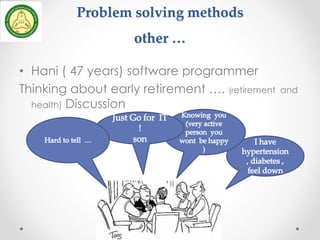
• Hani ( 47 years) software programmer
Thinking about early retirement …. (retirement and
health) Discussion
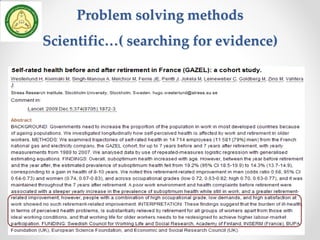
Problem solving methods
Scientific…( searching for evidence)
• HANI ( 47 years) software programmer
Thinking about early retirement ….
Discussion , retirement and health
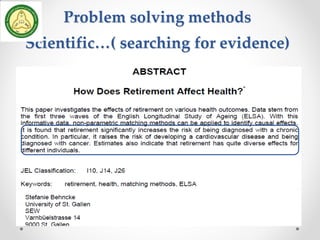
Problem solving methods
Scientific…( searching for evidence)
Problem solving methods
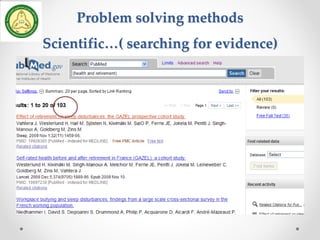
Scientific…( searching for evidence)
Problem solving methods
Scientific…( searching for evidence)
Problem solving methods
Scientific…
Needs
• We need evidence (about the accuracy of diagnostic
tests, the power of prognostic markers, the
comparative efficacy and safety of interventions,
etc.)
• about 5 times for every in-patient (and twice for
every 3 out-patients).
• We get less than a third of it
9
Why Evidence Based Health Care?
• Too many patients
• Too many problems
• Too many journals
• Information overload
• No time to read
• Read what I am familiar with
• Avoid difficult issues
10
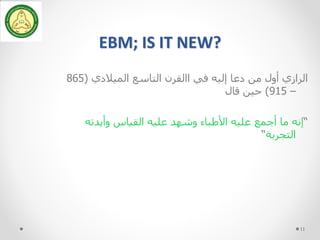
EBM; IS IT NEW?
‫الميالدي‬ ‫التاسع‬ ‫االقرن‬ ‫في‬ ‫إليه‬ ‫دعا‬ ‫من‬ ‫أول‬ ‫الرازي‬(865
–915)‫قال‬ ‫حين‬
“‫وأيدته‬ ‫القياس‬ ‫عليه‬ ‫وشهد‬ ‫األطباء‬ ‫عليه‬ ‫أجمع‬ ‫ما‬ ‫إنه‬
‫التجربة‬“
11
April 2006 12
..‫المقدمات‬ ‫انتقاد‬ ‫مع‬,‫في‬ ‫والتحفظ‬
‫النتائج‬,‫ما‬ ‫جميع‬ ‫في‬ ‫نتحرى‬ ‫و‬
‫ال‬ ‫الحق‬ ‫طلب‬ ‫ننتقده‬ ‫و‬ ‫نميزه‬
‫اآلراء‬ ‫مع‬ ‫الميل‬......
Requirements of new
treatment
• The drug must have a defined mode of action
• It must be tested on a well defined disease
• The time of action must be observed
• The effect of the drug must be seen to occur
constantly in many cases
• The experimentation must be done with the
human body for testing a drug on a lion or a
horse might not prove anything about its effect
on man
Ibn Sina 981-1037
13
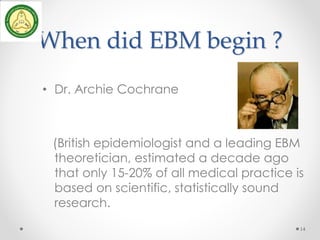
When did EBM begin ?
• Dr. Archie Cochrane
(British epidemiologist and a leading EBM
theoretician, estimated a decade ago
that only 15-20% of all medical practice is
based on scientific, statistically sound
research.
14
Evidence-based
medicine
Evidence-based medicine (EBM) is the
integration of best research evidence with
clinical expertise and patient values.
16
Steps of evidence based
medicine
1)Ask a question
2)Acquire some articles
3)Appraise the evidence
4)Apply the findings
5)Assess our performance
17
Steps of evidence based medicine
Step 1: formulating an answerable question
 Patient or Problem
 Intervention
 Comparison Intervention
 Outcome.
18
Steps of evidence based medicine
Step 2: Tracking down the best available evidence
Tracking down the best evidence with which to
answer that question.( diagnosis, therapy
,prognosis…)
19
Steps of evidence based medicine
Step 2: Tracking down the best available evidence
study design
 Primary studies (therapy ,diagnosis ,harm &prognosis
).
 Integrative studies (overview ,practice guidelines..).
20
.
Steps of evidence based medicine
Step3: Critically appraising that evidence
 validity (closeness to the truth),
 impact (size of the effect) the results, and
 applicability.
21
Steps of evidence based medicine
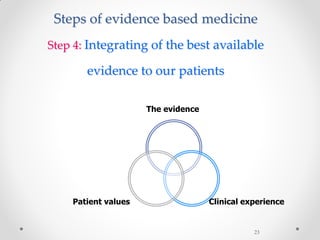
Step4: Integrating of the best available
evidence to our patients
 our patient's unique biology, values and
circumstances.
22
Steps of evidence based medicine
Step 4: Integrating of the best available
evidence to our patients
The evidence
Clinical experiencePatient values
23
Steps of evidence based medicine
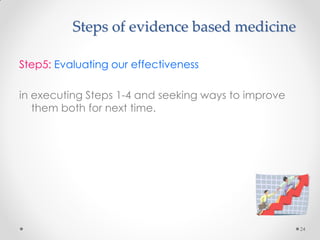
Step5: Evaluating our effectiveness
in executing Steps 1-4 and seeking ways to improve
them both for next time.
24
Steps of evidence based medicine
• Do We need always carry out all 5 steps to provide E-
B Care ?
Searching & appraising”
o provides E B care, but is expensive in time and
resources
“Searching only”
o much, quicker, and if carried out among E B
resources, can provide E B care.
25
POEMs & DOEs
POEM
Patient
Oriented
Evidence that
Matters
26
DOE
Disease
Oriented
Evidence
HRQL (Health Related Quality of life) for
example, mobility, self-care, and physical,
emotional, and social function).
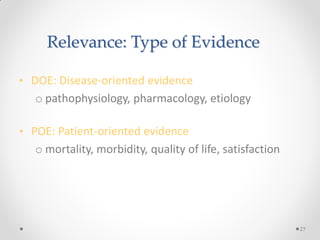
Relevance: Type of Evidence
• DOE: Disease-oriented evidence
o pathophysiology, pharmacology, etiology
• POE: Patient-oriented evidence
o mortality, morbidity, quality of life, satisfaction
27
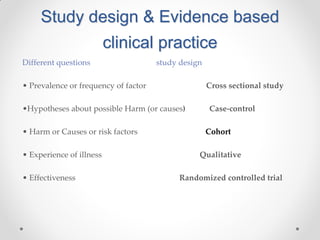
Study design & Evidence based
clinical practice
Different questions study design
• Prevalence or frequency of factor Cross sectional study
•Hypotheses about possible Harm (or causes) Case-control
• Harm or Causes or risk factors Cohort
• Experience of illness Qualitative
• Effectiveness Randomized controlled trial
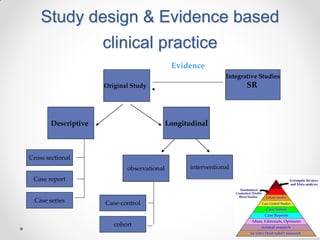
Original Study
LongitudinalDescriptive
Cross sectional
Case report
Case series
interventionalobservational
Case-control
cohort
Integrative Studies
SR
Evidence
Study design & Evidence based
clinical practice
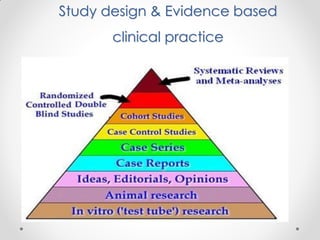
Study design & Evidence based
clinical practice
31
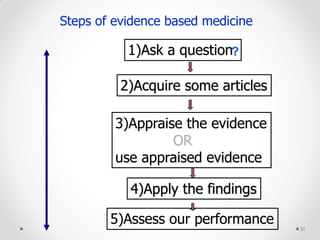
1)Ask a question
2)Acquire some articles
3)Appraise the evidence
OR
use appraised evidence
4)Apply the findings
5)Assess our performance
?
Steps of evidence based medicine
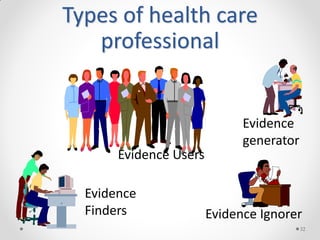
Types of health care
professional
32
Evidence
Finders
Evidence Users
Evidence
generator
Evidence Ignorer
Questions?
34
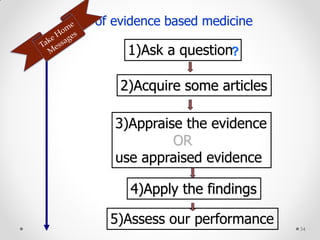
1)Ask a question
2)Acquire some articles
3)Appraise the evidence
OR
use appraised evidence
4)Apply the findings
5)Assess our performance
?
Steps of evidence based medicine
THANK YOU
36

Evidence Based Medicine

  • 1.
    Dr. Nisreen A.Jastaniah Assist Prof KSAU-HS Consultant Geriatric Medicine KAMC-J
  • 2.
    Problem solving methods other… • Hani ( 47 years) software programmer Thinking about early retirement …. (retirement and health) Discussion
  • 3.
    Problem solving methods Scientific…(searching for evidence) • HANI ( 47 years) software programmer Thinking about early retirement …. Discussion , retirement and health
  • 4.
  • 5.
  • 6.
  • 7.
  • 9.
    Needs • We needevidence (about the accuracy of diagnostic tests, the power of prognostic markers, the comparative efficacy and safety of interventions, etc.) • about 5 times for every in-patient (and twice for every 3 out-patients). • We get less than a third of it 9
  • 10.
    Why Evidence BasedHealth Care? • Too many patients • Too many problems • Too many journals • Information overload • No time to read • Read what I am familiar with • Avoid difficult issues 10
  • 11.
    EBM; IS ITNEW? ‫الميالدي‬ ‫التاسع‬ ‫االقرن‬ ‫في‬ ‫إليه‬ ‫دعا‬ ‫من‬ ‫أول‬ ‫الرازي‬(865 –915)‫قال‬ ‫حين‬ “‫وأيدته‬ ‫القياس‬ ‫عليه‬ ‫وشهد‬ ‫األطباء‬ ‫عليه‬ ‫أجمع‬ ‫ما‬ ‫إنه‬ ‫التجربة‬“ 11
  • 12.
    April 2006 12 ..‫المقدمات‬‫انتقاد‬ ‫مع‬,‫في‬ ‫والتحفظ‬ ‫النتائج‬,‫ما‬ ‫جميع‬ ‫في‬ ‫نتحرى‬ ‫و‬ ‫ال‬ ‫الحق‬ ‫طلب‬ ‫ننتقده‬ ‫و‬ ‫نميزه‬ ‫اآلراء‬ ‫مع‬ ‫الميل‬......
  • 13.
    Requirements of new treatment •The drug must have a defined mode of action • It must be tested on a well defined disease • The time of action must be observed • The effect of the drug must be seen to occur constantly in many cases • The experimentation must be done with the human body for testing a drug on a lion or a horse might not prove anything about its effect on man Ibn Sina 981-1037 13
  • 14.
    When did EBMbegin ? • Dr. Archie Cochrane (British epidemiologist and a leading EBM theoretician, estimated a decade ago that only 15-20% of all medical practice is based on scientific, statistically sound research. 14
  • 15.
    Evidence-based medicine Evidence-based medicine (EBM)is the integration of best research evidence with clinical expertise and patient values. 16
  • 16.
    Steps of evidencebased medicine 1)Ask a question 2)Acquire some articles 3)Appraise the evidence 4)Apply the findings 5)Assess our performance 17
  • 17.
    Steps of evidencebased medicine Step 1: formulating an answerable question  Patient or Problem  Intervention  Comparison Intervention  Outcome. 18
  • 18.
    Steps of evidencebased medicine Step 2: Tracking down the best available evidence Tracking down the best evidence with which to answer that question.( diagnosis, therapy ,prognosis…) 19
  • 19.
    Steps of evidencebased medicine Step 2: Tracking down the best available evidence study design  Primary studies (therapy ,diagnosis ,harm &prognosis ).  Integrative studies (overview ,practice guidelines..). 20 .
  • 20.
    Steps of evidencebased medicine Step3: Critically appraising that evidence  validity (closeness to the truth),  impact (size of the effect) the results, and  applicability. 21
  • 21.
    Steps of evidencebased medicine Step4: Integrating of the best available evidence to our patients  our patient's unique biology, values and circumstances. 22
  • 22.
    Steps of evidencebased medicine Step 4: Integrating of the best available evidence to our patients The evidence Clinical experiencePatient values 23
  • 23.
    Steps of evidencebased medicine Step5: Evaluating our effectiveness in executing Steps 1-4 and seeking ways to improve them both for next time. 24
  • 24.
    Steps of evidencebased medicine • Do We need always carry out all 5 steps to provide E- B Care ? Searching & appraising” o provides E B care, but is expensive in time and resources “Searching only” o much, quicker, and if carried out among E B resources, can provide E B care. 25
  • 25.
    POEMs & DOEs POEM Patient Oriented Evidencethat Matters 26 DOE Disease Oriented Evidence HRQL (Health Related Quality of life) for example, mobility, self-care, and physical, emotional, and social function).
  • 26.
    Relevance: Type ofEvidence • DOE: Disease-oriented evidence o pathophysiology, pharmacology, etiology • POE: Patient-oriented evidence o mortality, morbidity, quality of life, satisfaction 27
  • 27.
    Study design &Evidence based clinical practice Different questions study design • Prevalence or frequency of factor Cross sectional study •Hypotheses about possible Harm (or causes) Case-control • Harm or Causes or risk factors Cohort • Experience of illness Qualitative • Effectiveness Randomized controlled trial
  • 28.
    Original Study LongitudinalDescriptive Cross sectional Casereport Case series interventionalobservational Case-control cohort Integrative Studies SR Evidence Study design & Evidence based clinical practice
  • 29.
    Study design &Evidence based clinical practice
  • 30.
    31 1)Ask a question 2)Acquiresome articles 3)Appraise the evidence OR use appraised evidence 4)Apply the findings 5)Assess our performance ? Steps of evidence based medicine
  • 31.
    Types of healthcare professional 32 Evidence Finders Evidence Users Evidence generator Evidence Ignorer
  • 32.
  • 33.
    34 1)Ask a question 2)Acquiresome articles 3)Appraise the evidence OR use appraised evidence 4)Apply the findings 5)Assess our performance ? Steps of evidence based medicine
  • 35.