Problemas Necesitamos evidencia (sobre la presición de métodos diagnósticos, el poder de los marcadores pronósticos, la eficacia y la seguridad de las intervenciones, etc.) alrededor de 5 veces por cada paciente internado y tres veces por cada dos pacientes ambulatorios. Sólo un tercio de las veces acudimos a la evidencia.
Problemas : Para mantenerse actualizado, sólo en Medicina interna, necesitamos leer 17 articulos diarios, los 365 días del año.
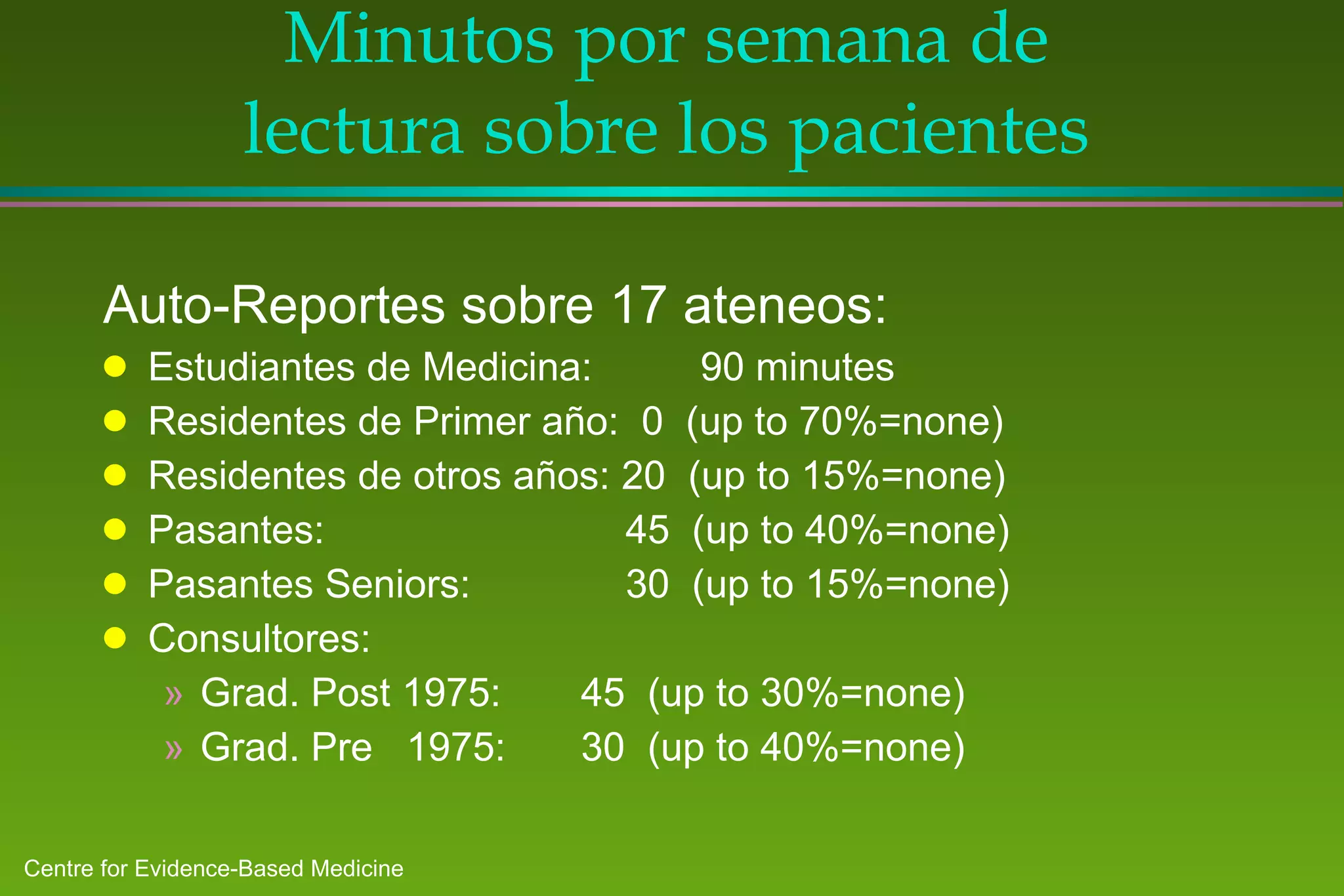
Minutos por semana de lectura sobre los pacientes Auto-Reportes sobre 17 ateneos : Estudiantes de Medicina :  90 minutes Residentes de Primer año:   0  (up to 70%=none) Residentes de otros años:  20  (up to 15%=none) Pasantes :     45  (up to 40%=none) Pasantes Seniors:   30  (up to 15%=none) Cons ultores : Grad. Post 1975: 45  (up to 30%=none) Grad. Pre  1975: 30  (up to 40%=none)
Deterioro de la performance también Determinantes más importantes para tratar, o no, pacientes hipertensos:  Nivel de Tensión Arterial Edad del Paciente Año de Graduación del Médico Grado de deterioro de órgano blanco
Medicina Basada en la Evidencia es: La práctica de la MBE es la integración de: Experiencia clínica individual con La mejor evidencia clinica disponible de investaciones sistemáticas y Valores de los pacientes y expectativas individuales
I. Experiencia Clínica Individual Habilidades clínicas y juicios clínicos Determinar si la evidencia (o guía) aplica al paciente individual en su totalidad, y si es así, cómo
II.  Mejor Evidencia Externa : De investigaciones clínicas en pacientes sanos Tienen un tiempo de aplicación (10 años aproximadamente) Reemplaza test diagnósticos aceptados y nuevos tratamientos con mayor poder, eficacia, efectividad y seguridad.
III.  Valores y Expectativas de los Pacientes Siempre han jugado un rol central en determinar si, y cuáles, intervenciones tendrán lugar. Mejoras en la integración de las preferencias y cuantificación de las mismas.
Que no es la MBE : La MBE no es una receta de cocina La evidencia necesita  extrapola r los hallazgos a mis pacientes con sus particularidades biologicas únicas.   La MBE no es medicina de costo minimización o de recorte Cuando la eficacia para mis pacientes es el objetivo los costos pueden incluso aumentar, mas que disminuir.
Medicina Basada en la Evidencia: la práctica.  Cuando el cuidado de pacientes crea la necesidad para la búsqueda de información: Tr a ducir la pregunta a una pregunta que pueda ser contexada (paciente-procedimiento-resultado) . Búsqueda eficiente de la mejor evidencia disponible   Literatura secundaria ( , Cochrane; E-B Journals ) Literatura primaria
Medicina Basada en la Evidencia: la práctica Critical appraisal of the evidence for its validity and clinical applicability    generation of a 1-page summary. Integration of that critical appraisal with clinical expertise and the patient’s unique biology and beliefs    action. Evaluation of one’s performance.
We needn’t always carry out all 5 steps to provide E-B Care Asking an answerable question. Searching  for the best evidence. Critically- appraising  the evidence. Integrating the evidence with our expertise and our patient’s unique biology and values evaluating our performance
We’ve identified 3 different modes of practice “ Searching & appraising” provides E-B care, but is expensive in time and resources “ Searching only” much, quicker, and if carried out among E-B resources, can provide E-B care “ Replicating” the practice of experts quickest, but may not distinguish evidence-based from ego-based recommendations
Even fully EB-trained clinicians work in all 3 modes “ Searching & appraising” mode for the problems I encounter daily. “ Searching only” mode among E-B resources for problems I encounter once a month. “ Replicating” the practice of experts mode for problems I encounter once a decade(and crossing my fingers!).
Patients can benefit Even if <10% of clinicians are capable of practicing in the “searching & appraising” mode (5% of GPs)  As long as most of them practice in a “searching” mode within high-quality evidence sources (70-80% of GPs): Cochrane Library, E-B Journals, E-B Guidelines, etc
Three solutions  Clinical performance can keep up to date: by learning how to practice evidence-based medicine ourselves. by seeking and applying evidence-based medical summaries generated by others. by applying evidence-based strategies for changing our clinical behaviour.
Information required  within seconds Systematic reviews, periodically updated, of randomised trials of the effects of health care (from all sources, and in all languages):    The Cochrane Collaboration.
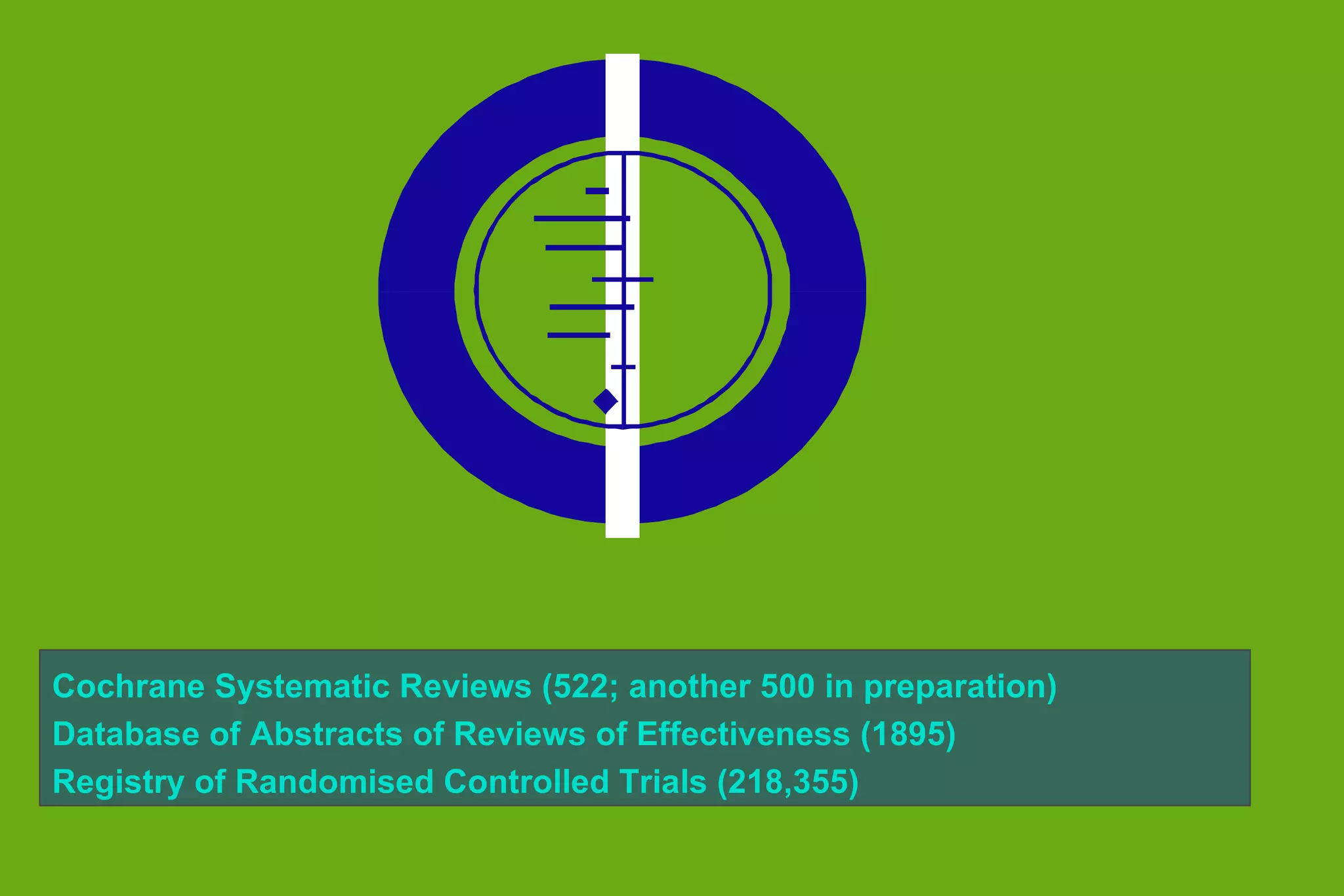
Cochrane Systematic Reviews (522; another 500 in preparation) Database of Abstracts of Reviews of Effectiveness (1895) Registry of Randomised Controlled Trials (218,355)
Information required  within seconds  CD-Evidence-based journals of 2º  publication:    screen 50-70 clinical journals per week for clinical articles that pass critical appraisal quality filters    conclusions likely to be true.    select the subset that are clinically relevant.    summarise as “more-informative” abstracts.    add commentaries from clinical experts.    introduce with declarative titles.
 
2. Seeking and Applying EBM generated by others MBE esta publicado en:  Inglés Fr ancés Alemán Italian o Portugués Español
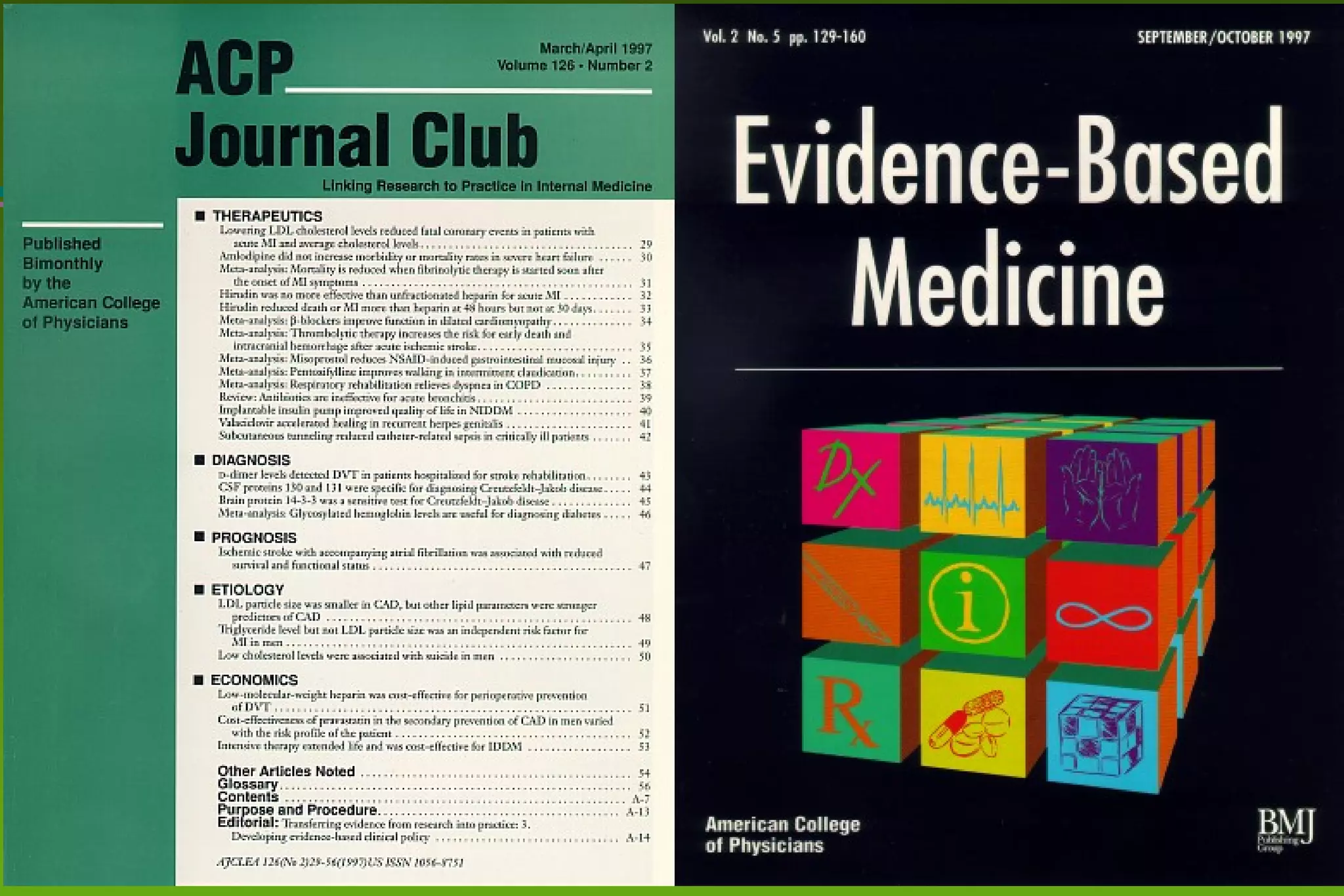
2. Seeking and Applying EBM generated by others New Evidence-based journals of 2º  publication : E-B Cardiovascular Medicine E-B Health Policy & Management E-B Nursing E-B Mental Health And as new departments in 1º journals .
2. Seeking and Applying EBM generated by others E-B Textbooks : E-B Pain Relief E-B Cardiology includes icons for levels of evidence “ E-B On-Call” includes > 1300 CATs
Can you really practice EBM? Is there any “E” for EBM ?
Conventional Wisdom “ only about 15% of medical interventions are supported by solid scientific evidence” (BMJ Editorial)
Even on the U.S. Talk-Shows:  (“Health Outrage of the Week”) “ ..... this would put 80 to 90 per cent of accepted medical procedures in this country under the heading of quackery!”
Problems with  Conventional Wisdom uses clinical manoeuvres, rather than patients, as the denominator. tends to focus on high-technology, “big ticket” items. relies on simple literature searches that miss over half of the most rigorous types of evaluations. conducted from armchairs.
Performed an empirical study on a busy in-patient service on the general medicine in-patient service of the Nuffield Department of Medicine at the Oxford-Radcliffe NHS Hospital Trust (“The John Radcliffe”) all our admissions arise from urgent referral from local GPs or via the Emergency Room
The Protocol At the time of discharge, death, or month’s end, each patient was reviewed and consensus reached on:  The primary diagnosis: the disease, syndrome or condition most responsible for the patient’s admission to hospital
The Protocol (cont.)  The Primary Intervention the treatment or other manoeuvre that constituted our most important attempt to cure, alleviate, or care for the primary diagnosis traced into the literature to determine its basis in evidence the Consultant’s “Instant Resource Book” bibliographic data base searches
Primary Interventions were Classified by Level: Evidence from Randomised Control Trials (better yet: systematic reviews of all relevant, high-quality RCTs) Convincing non-experimental evidence (unnecessary & unethical to randomise) Interventions without substantial evidence
Conclusions from  E-B oriented General Medicine: 82% of our patients received evidence-based care. treatments for 53% were justified by RCTs or systematic reviews of RCTs. Of 28 relevant RCTs and SRs, 21 were accessible within seconds. treatments for 29% were justified by convincing non-experimental evidence
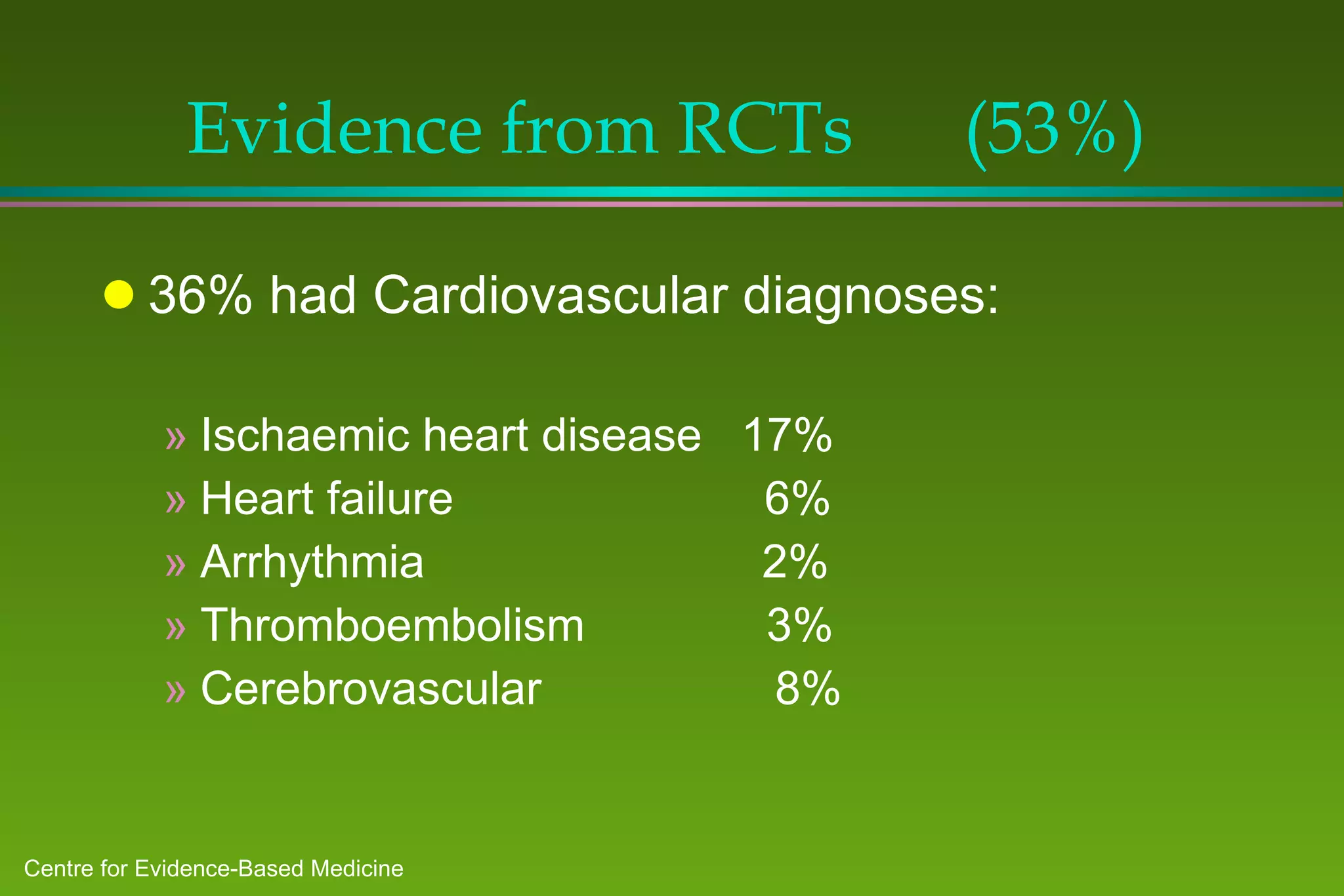
Evidence from RCTs  (53%) 36% had Cardiovascular diagnoses: Ischaemic heart disease  17% Heart failure  6% Arrhythmia  2% Thromboembolism  3% Cerebrovascular  8%
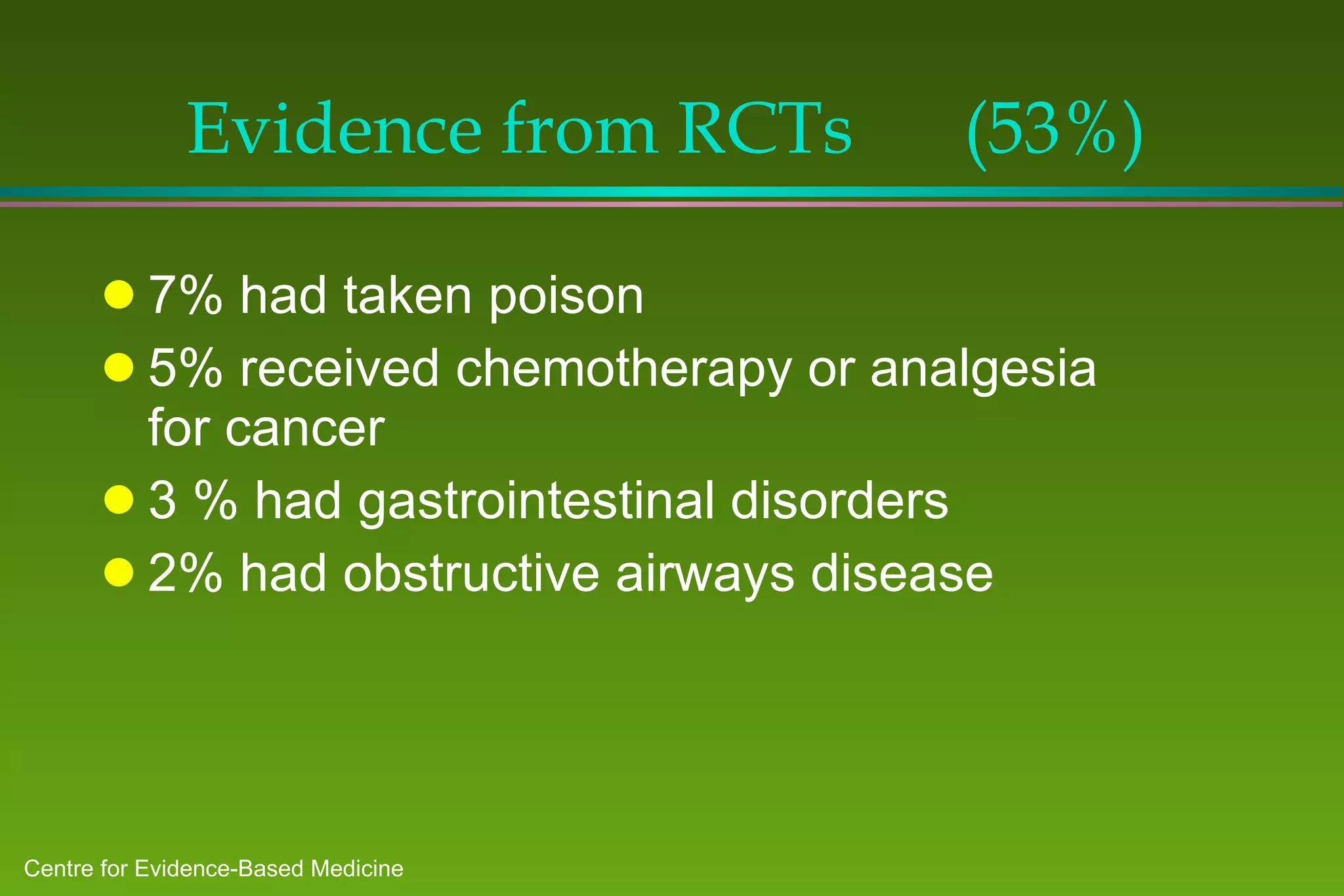
Evidence from RCTs  (53%) 7% had taken poison 5% received chemotherapy or analgesia for cancer 3 % had gastrointestinal disorders 2% had obstructive airways disease
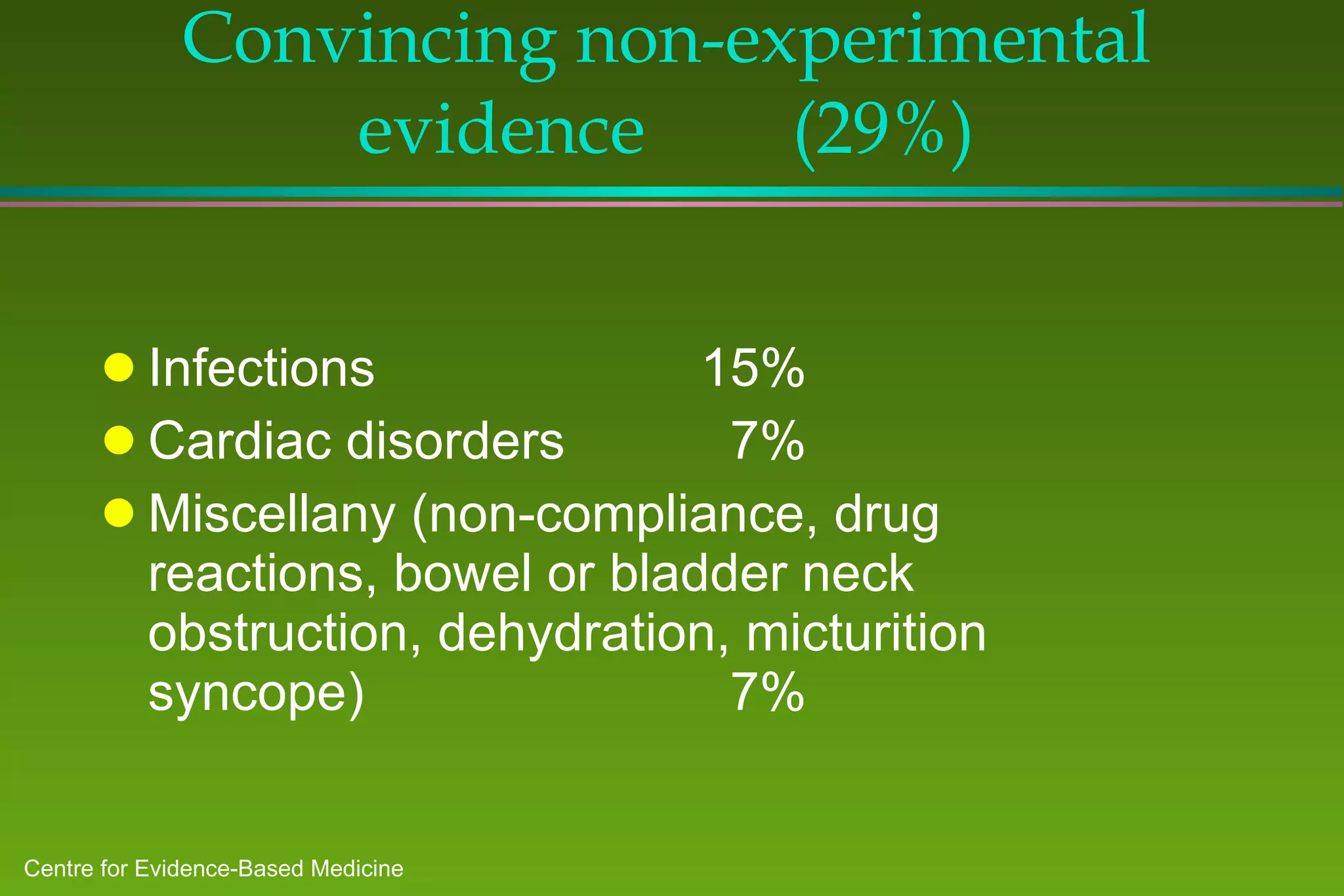
Convincing non-experimental evidence  (29%) Infections 15% Cardiac disorders   7% Miscellany (non-compliance, drug reactions, bowel or bladder neck obstruction, dehydration, micturition syncope)   7%
Interventions without substantial evidence  (18%) Specific symptomatic and supportive care for mild poisoning, non-cardiac chest pain, viral (non-herpetic) meningitis, terminal CNS disease, confusion, and food poisoning.
Better Outcomes for Patients When EBM Is Practised E-B practise vs. Outcome in stroke (US): When cared for by E-B neurologists, patients were 44% more likely to receive warfarin, and much more likely to be placed in a stroke care unit,  And were 22% less likely to die in the next 90 days.  (Mitchell et al: stroke 1996;27:1937-43)
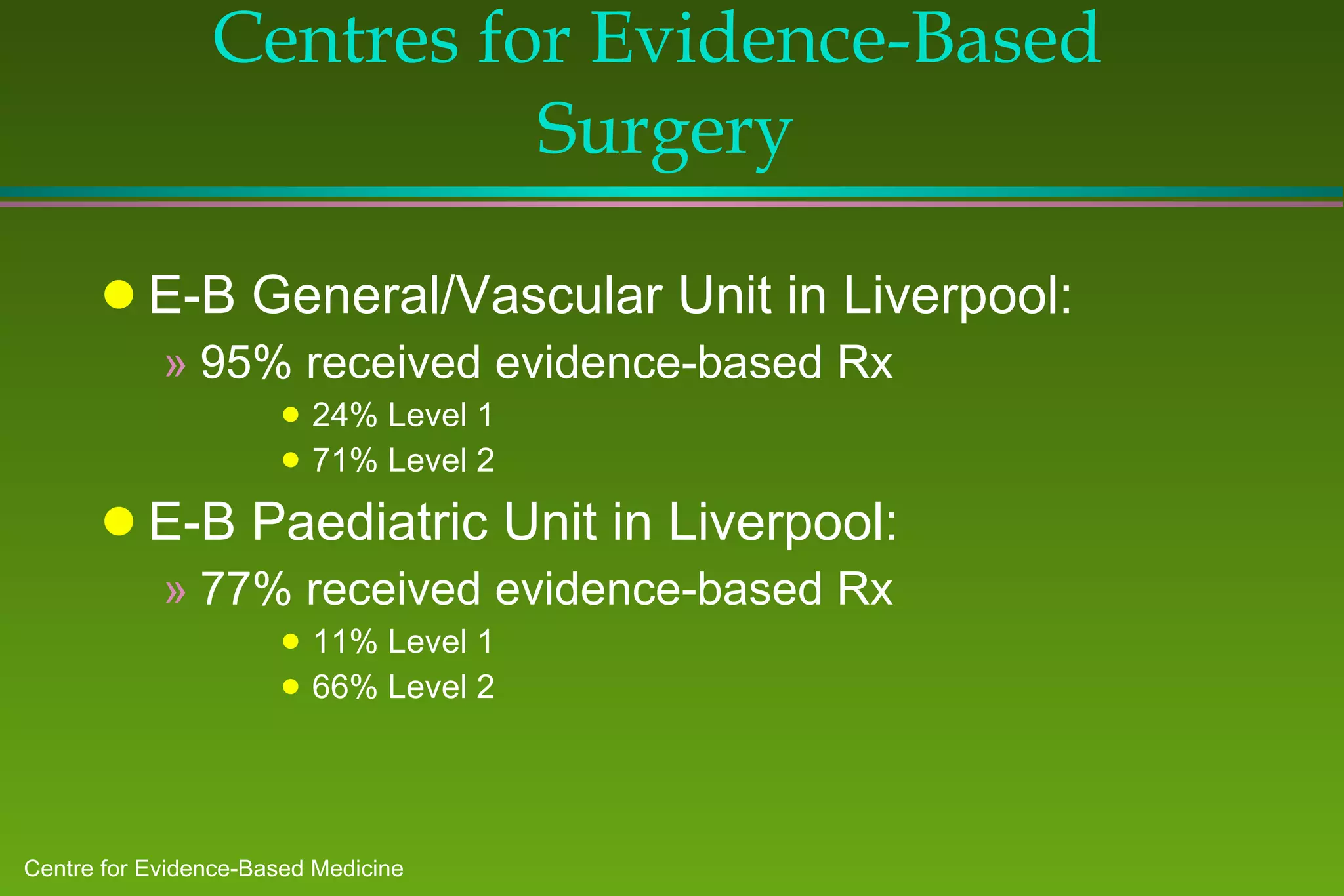
Centres for Evidence-Based  Surgery E-B General/Vascular Unit in Liverpool: 95% received evidence-based Rx 24% Level 1 71% Level 2 E-B Paediatric Unit in Liverpool: 77% received evidence-based Rx 11% Level 1 66% Level 2
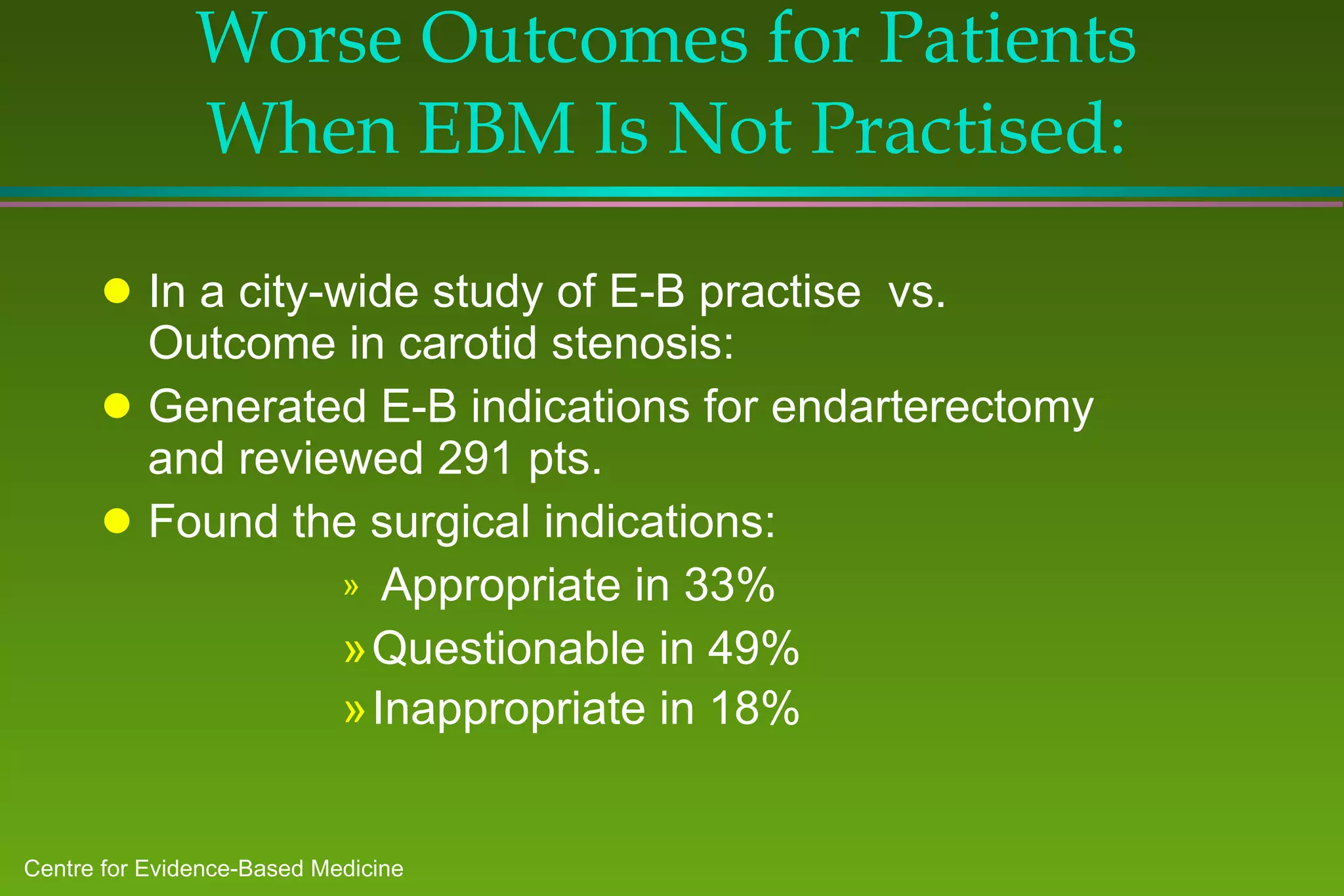
Worse Outcomes for Patients When EBM Is Not Practised: In a city-wide study of E-B practise  vs. Outcome in carotid stenosis: Generated E-B indications for endarterectomy and reviewed 291 pts.  Found the surgical indications: Appropriate in 33% Questionable in 49% Inappropriate in 18%
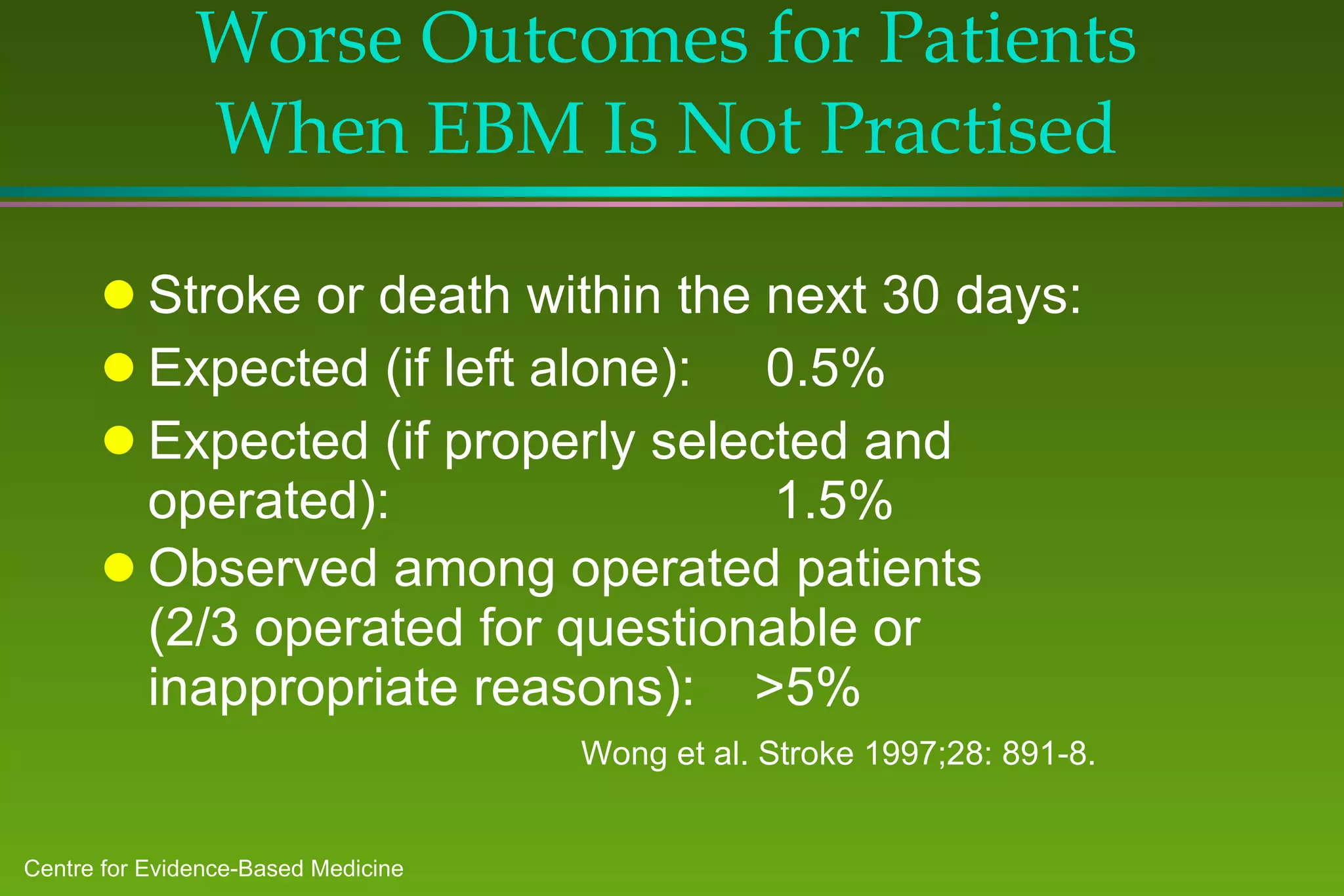
Worse Outcomes for Patients When EBM Is Not Practised Stroke or death within the next 30 days: Expected (if left alone):  0.5% Expected (if properly selected and operated):  1.5% Observed among operated patients  (2/3 operated for questionable or inappropriate reasons):  >5%  Wong et al. Stroke 1997;28: 891-8.
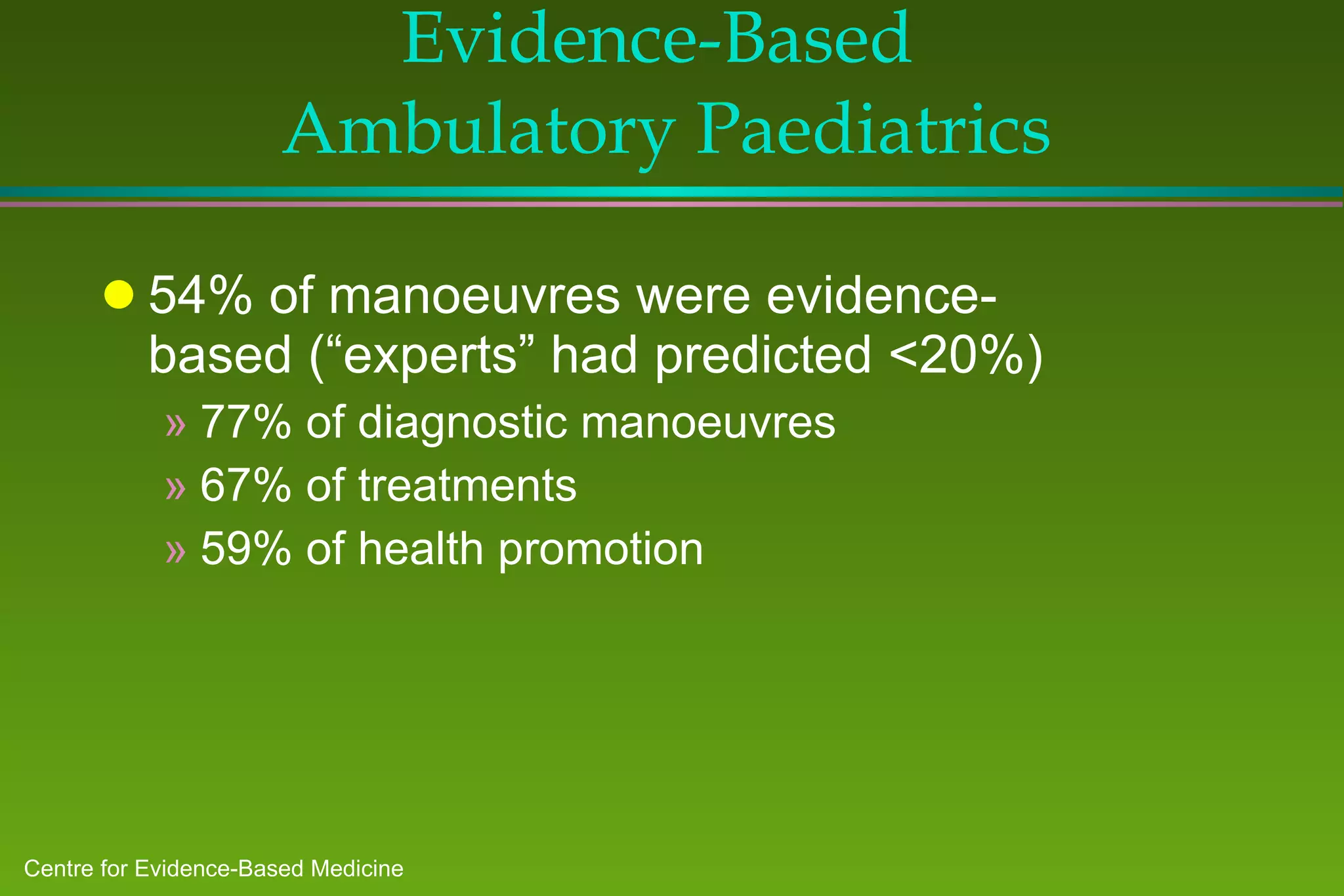
Evidence-Based  Ambulatory Paediatrics 54% of manoeuvres were evidence-based (“experts” had predicted <20%) 77% of diagnostic manoeuvres 67% of treatments 59% of health promotion
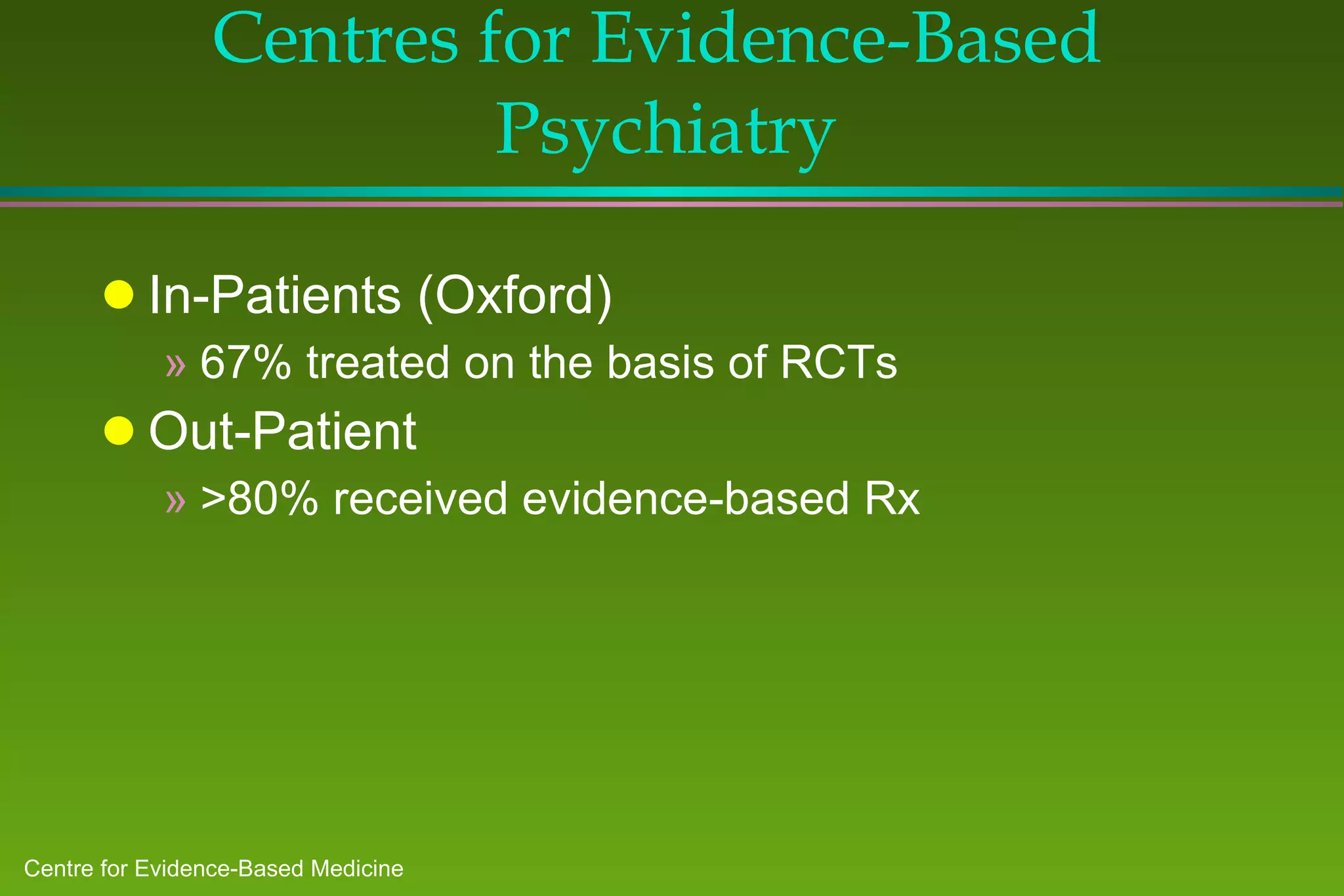
Centres for Evidence-Based  Psychiatry In-Patients (Oxford) 67% treated on the basis of RCTs Out-Patient >80% received evidence-based Rx
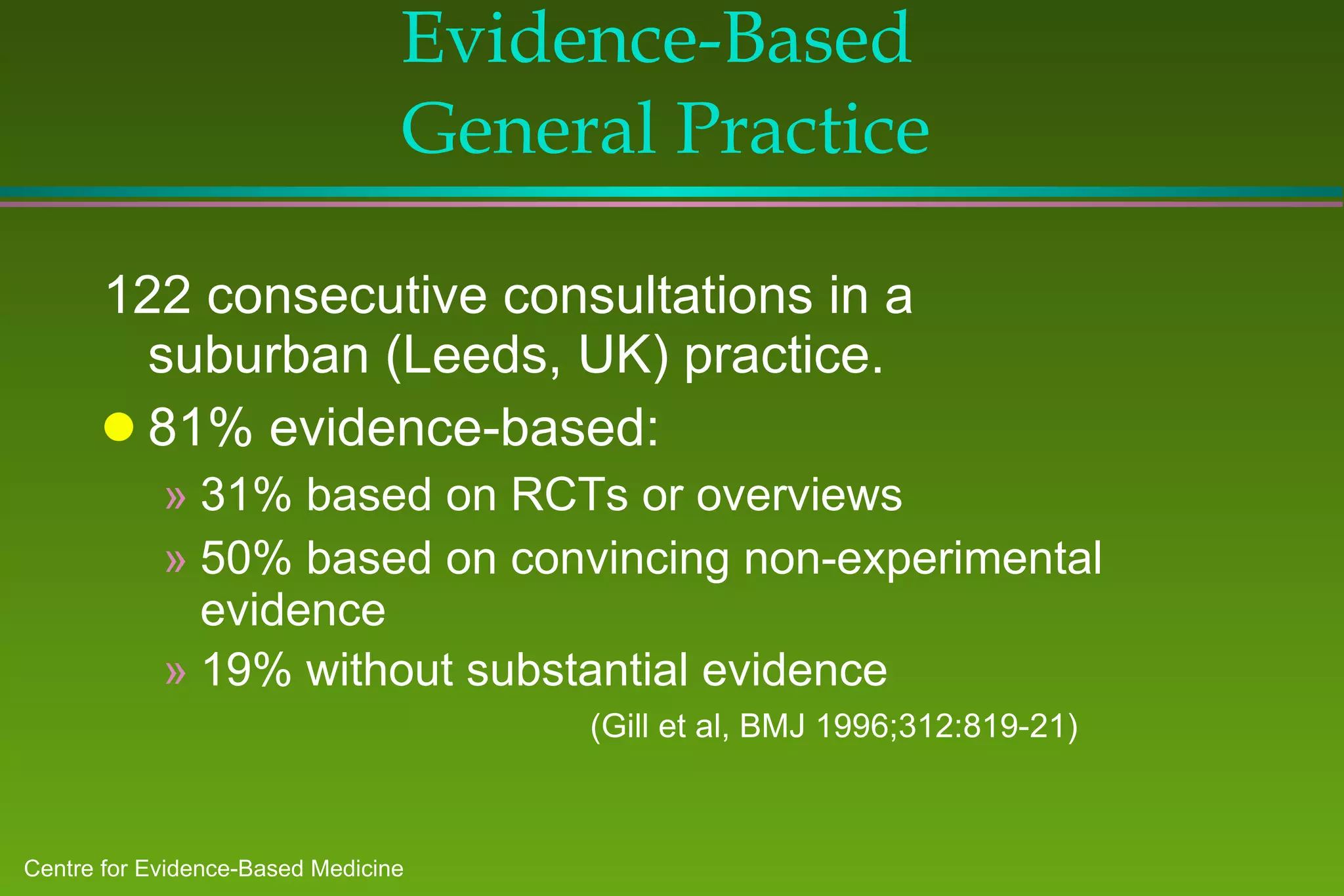
Evidence-Based  General Practice 122 consecutive consultations in a suburban (Leeds, UK) practice. 81% evidence-based: 31% based on RCTs or overviews 50% based on convincing non-experimental evidence 19% without substantial evidence  (Gill et al, BMJ 1996;312:819-21)
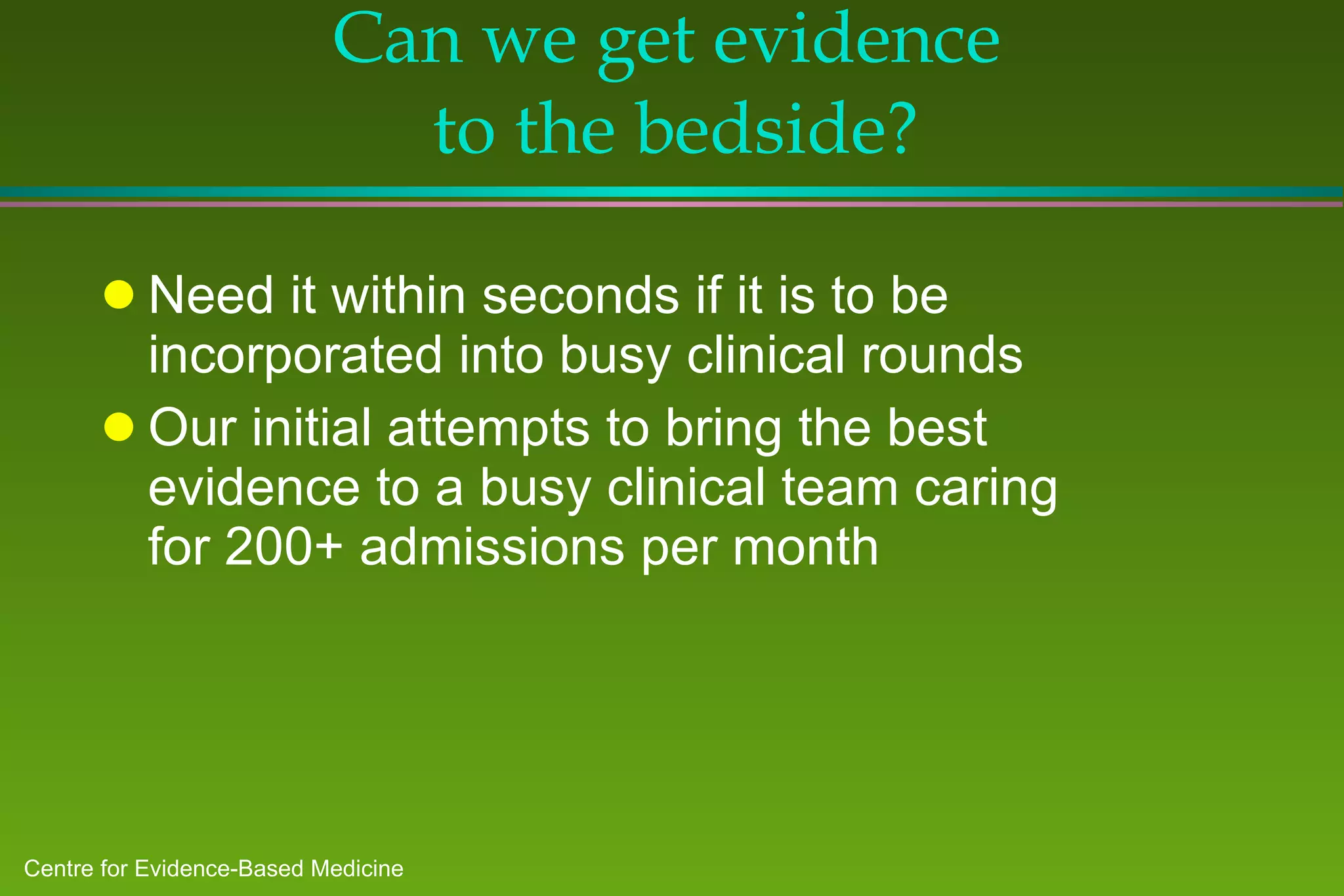
Can we get evidence  to the bedside? Need it within seconds if it is to be incorporated into busy clinical rounds Our initial attempts to bring the best evidence to a busy clinical team caring for 200+ admissions per month
Searching for Evidence in the Month Before the Cart : Expected searches = 98 Identified searching needs = 72 Only 19 searches (26%) carried out.
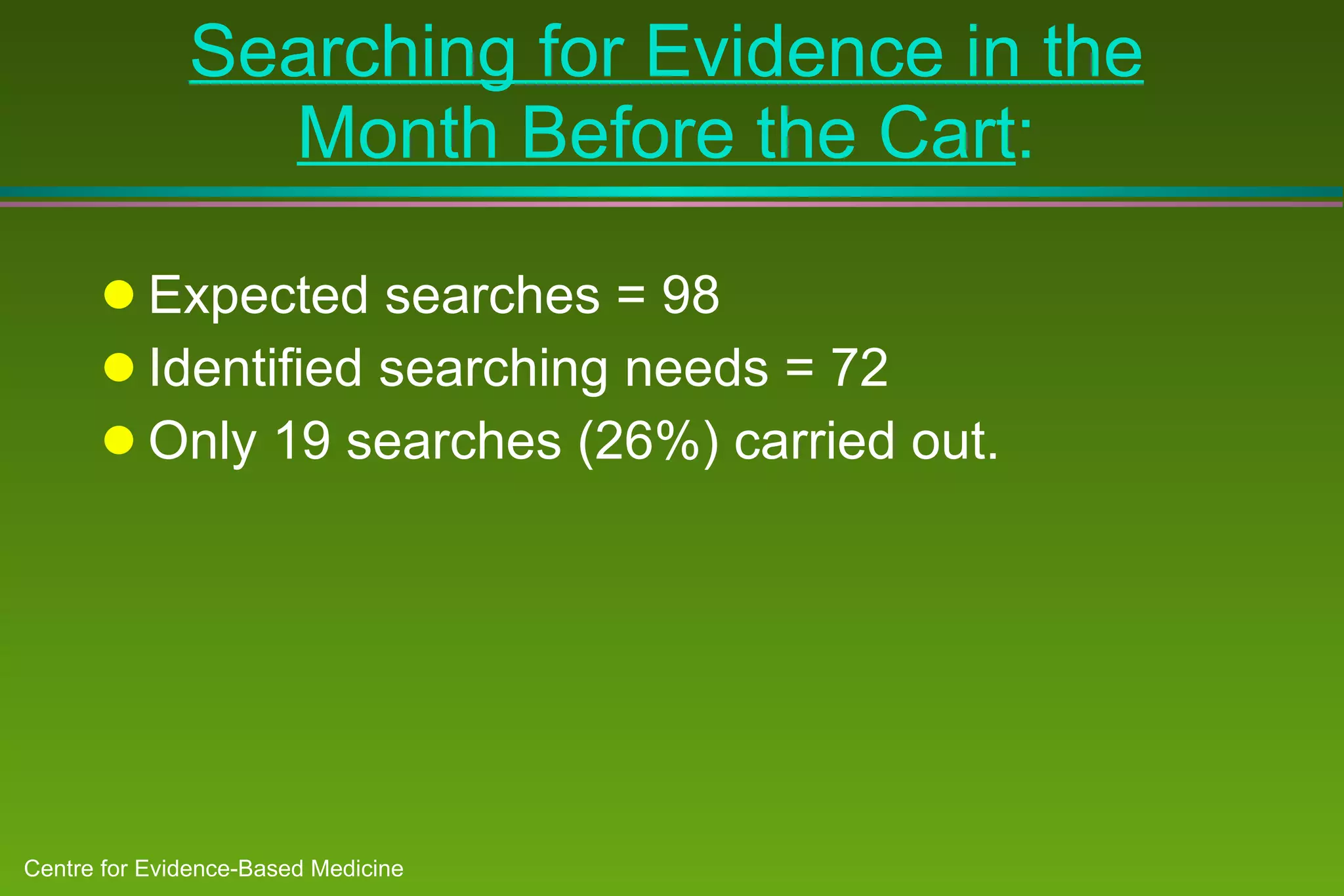
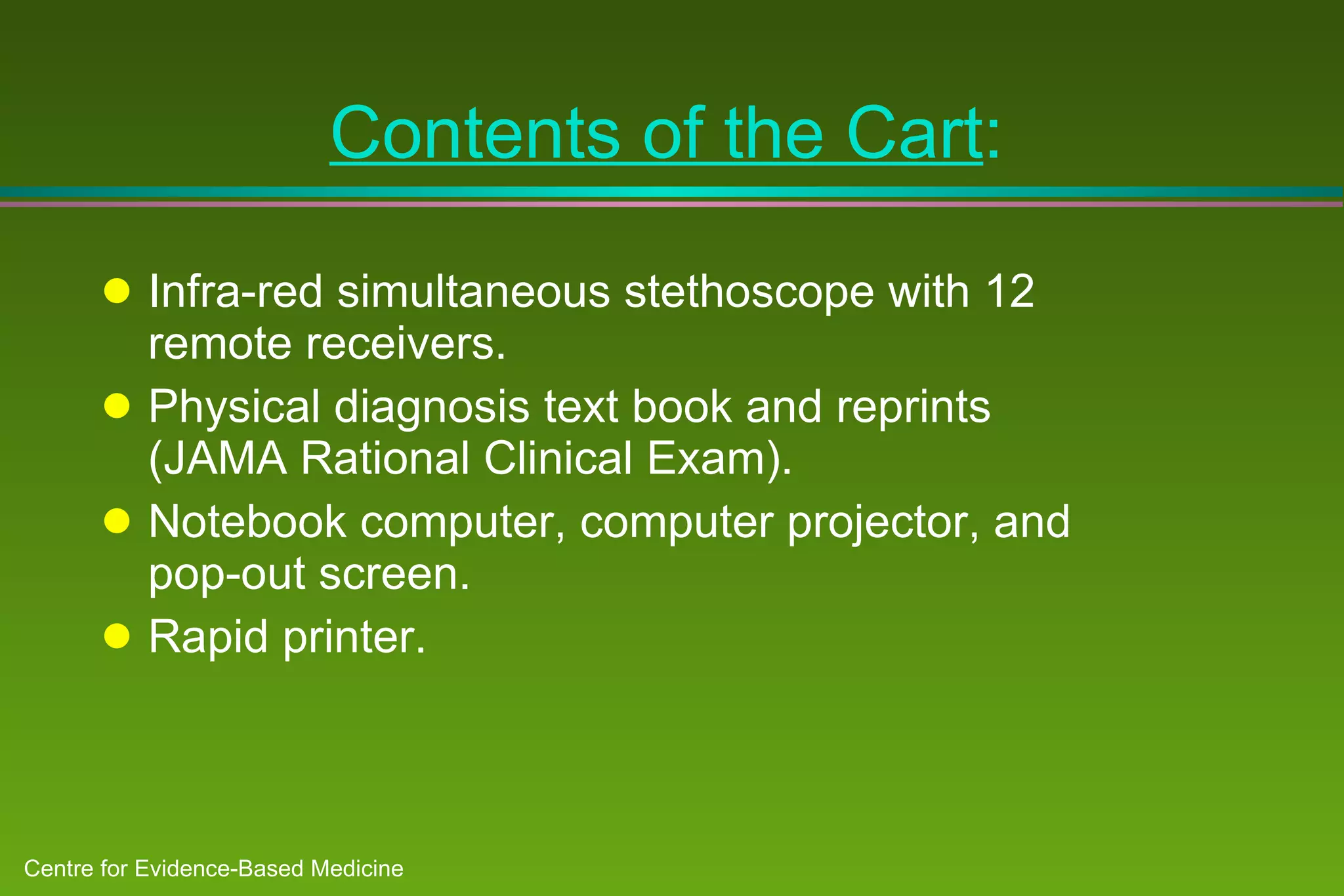
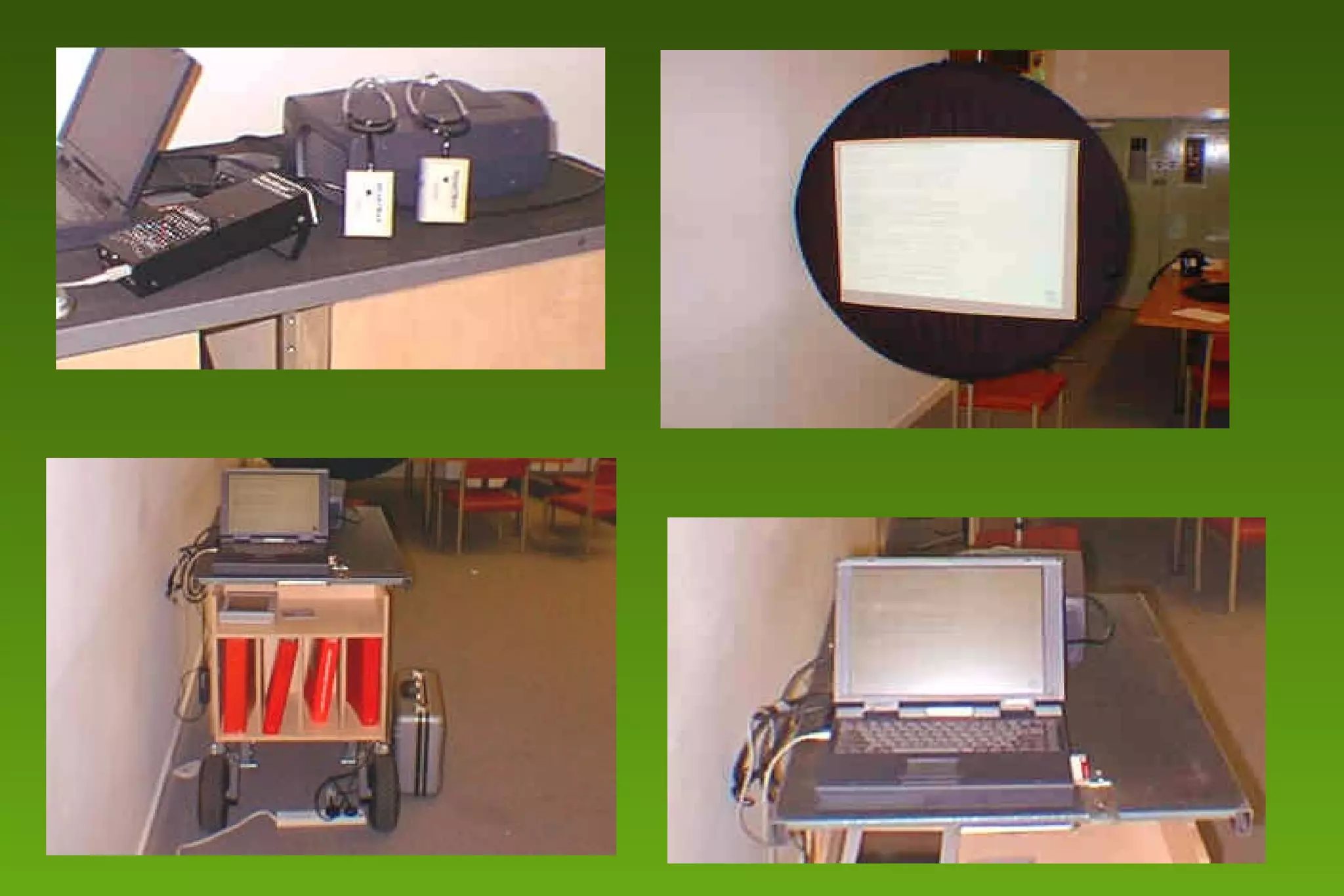
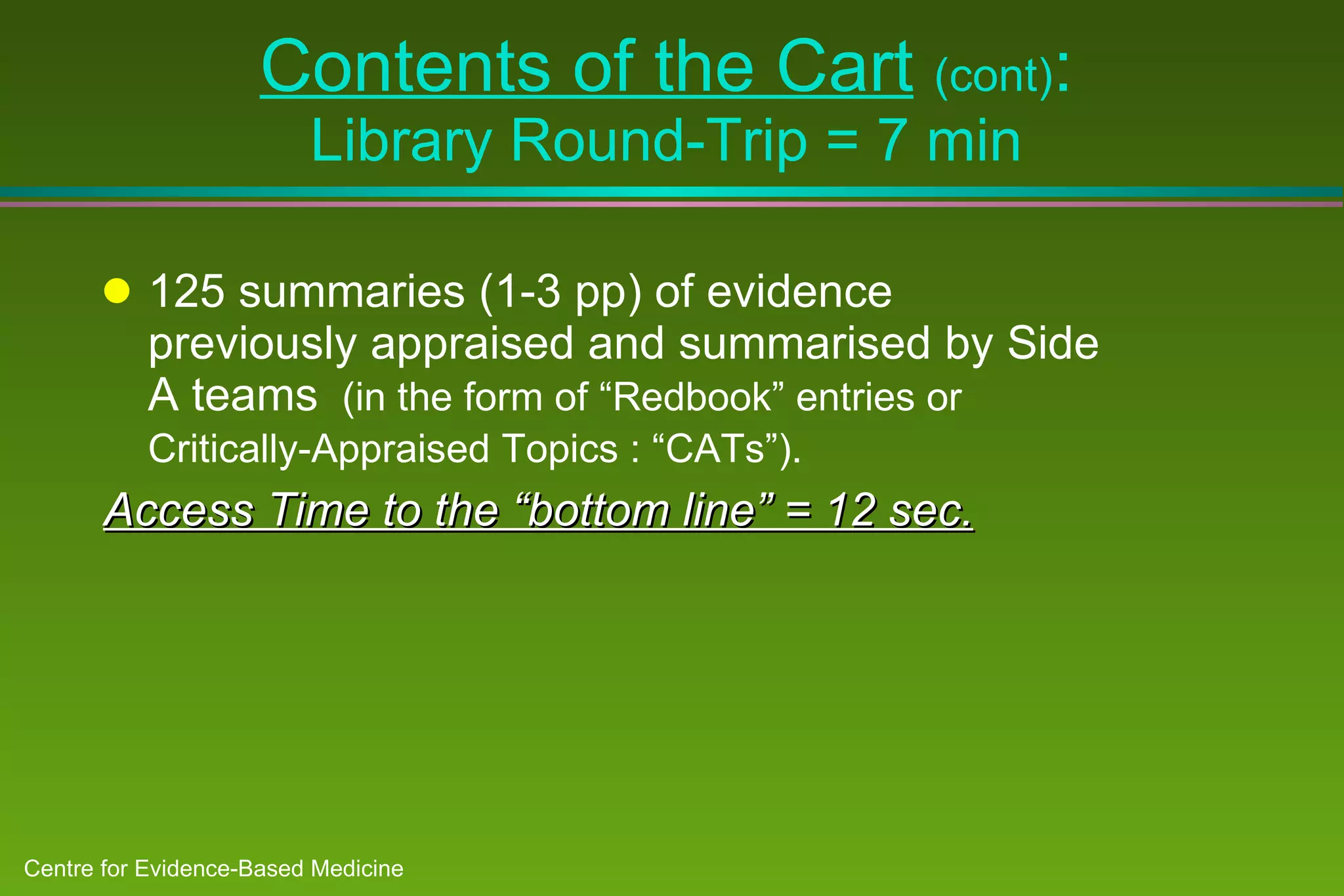
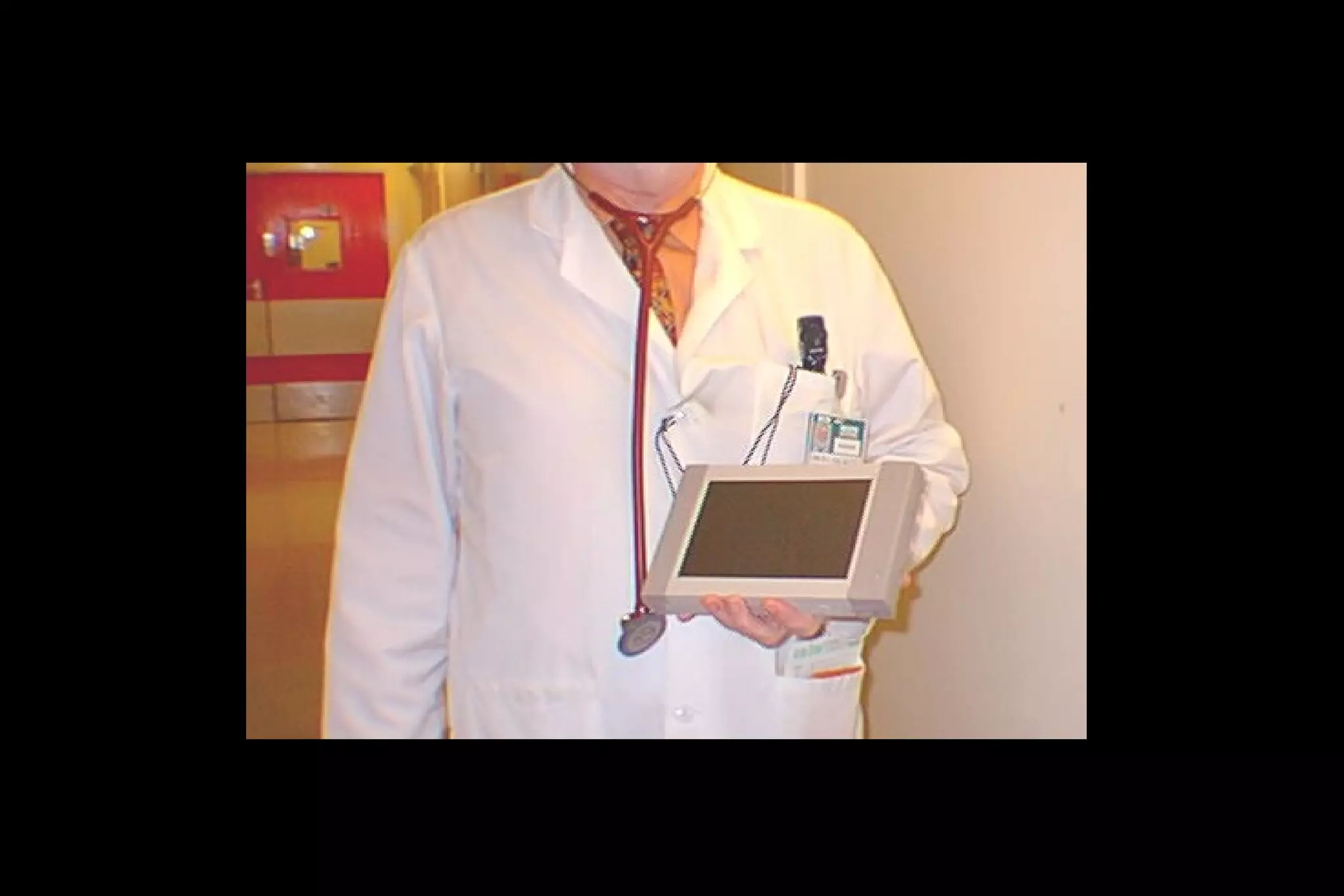
Contents of the Cart : Infra-red simultaneous stethoscope with 12 remote receivers. Physical diagnosis text book and reprints (JAMA Rational Clinical Exam). Notebook computer, computer projector, and pop-out screen. Rapid printer.
 
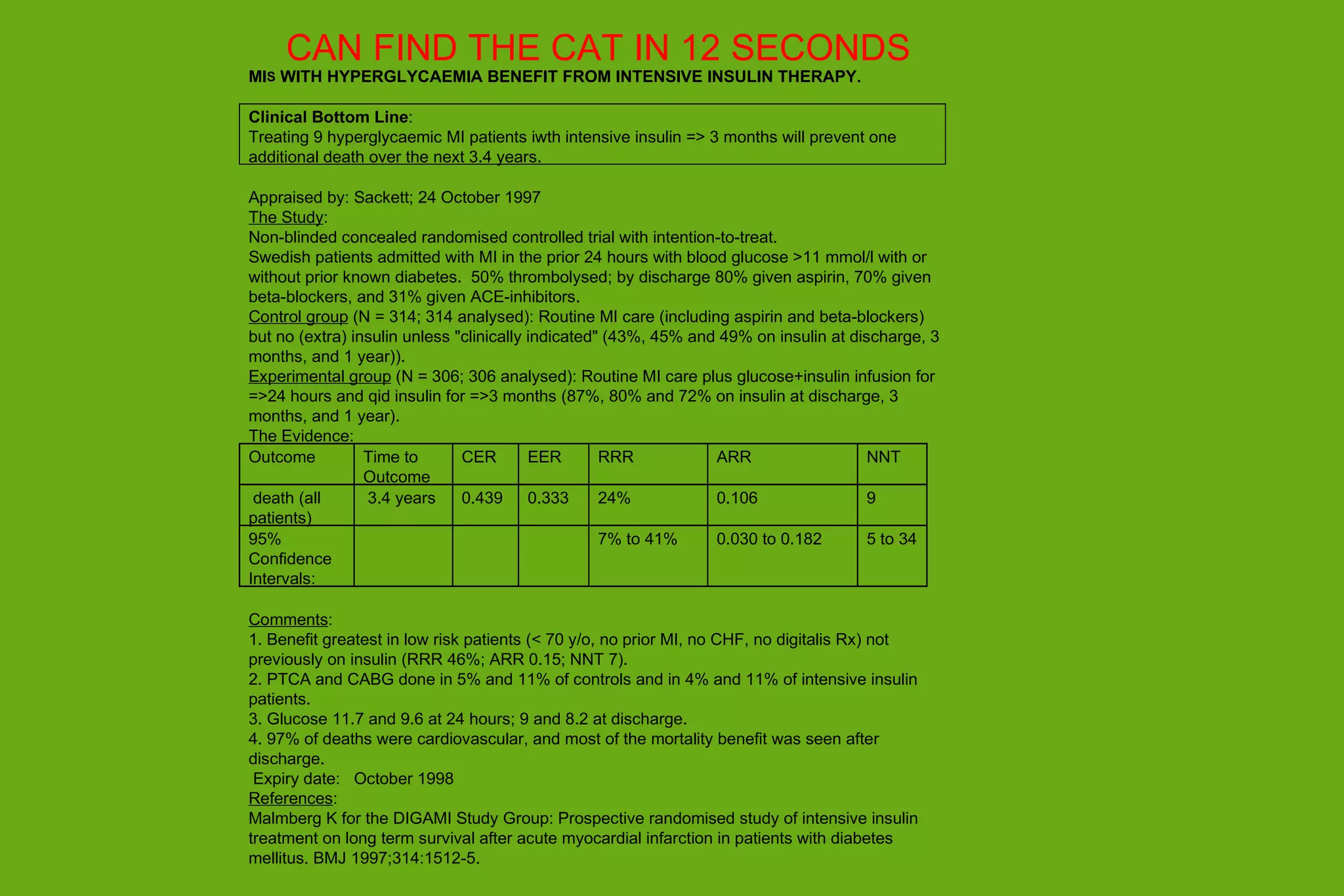
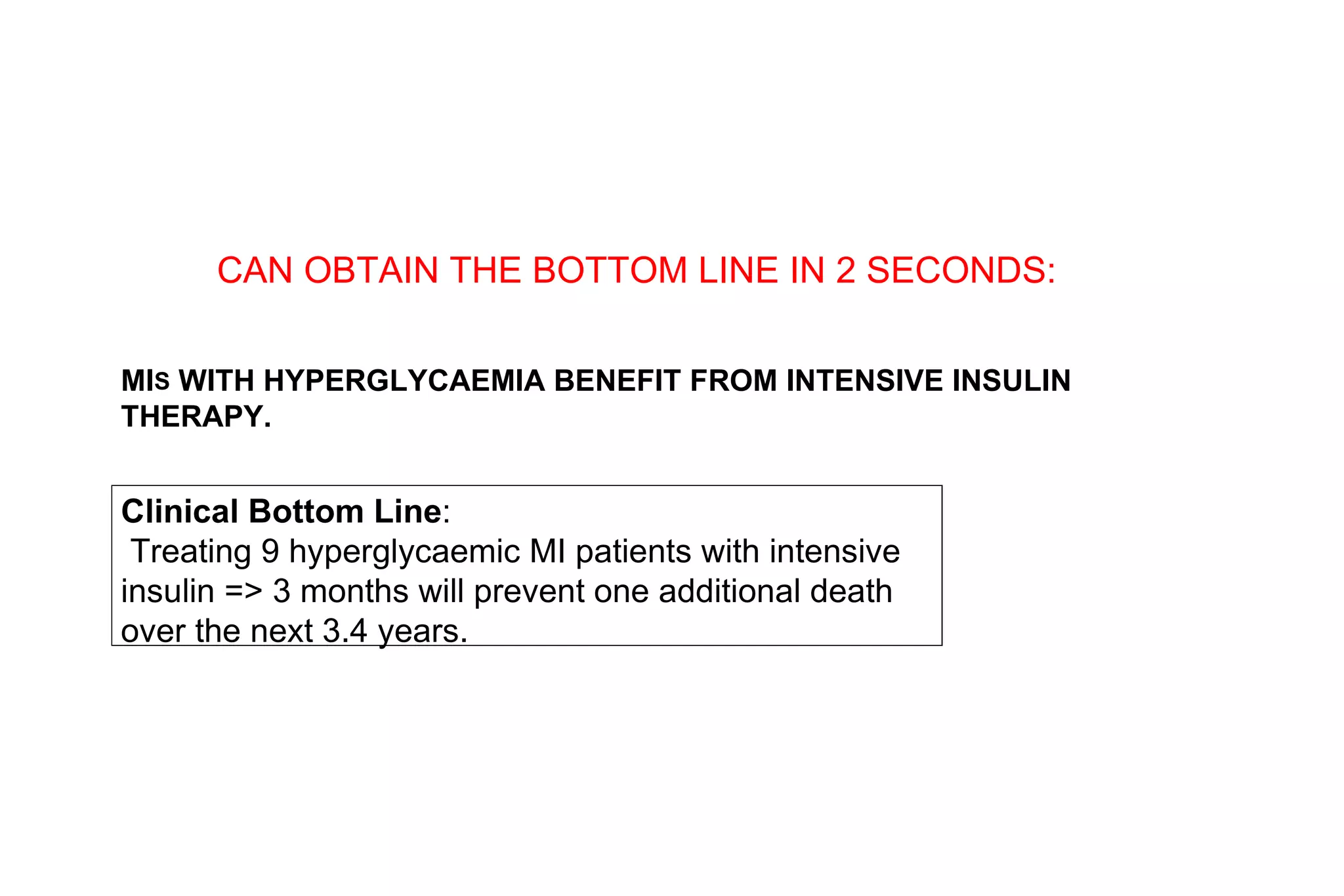
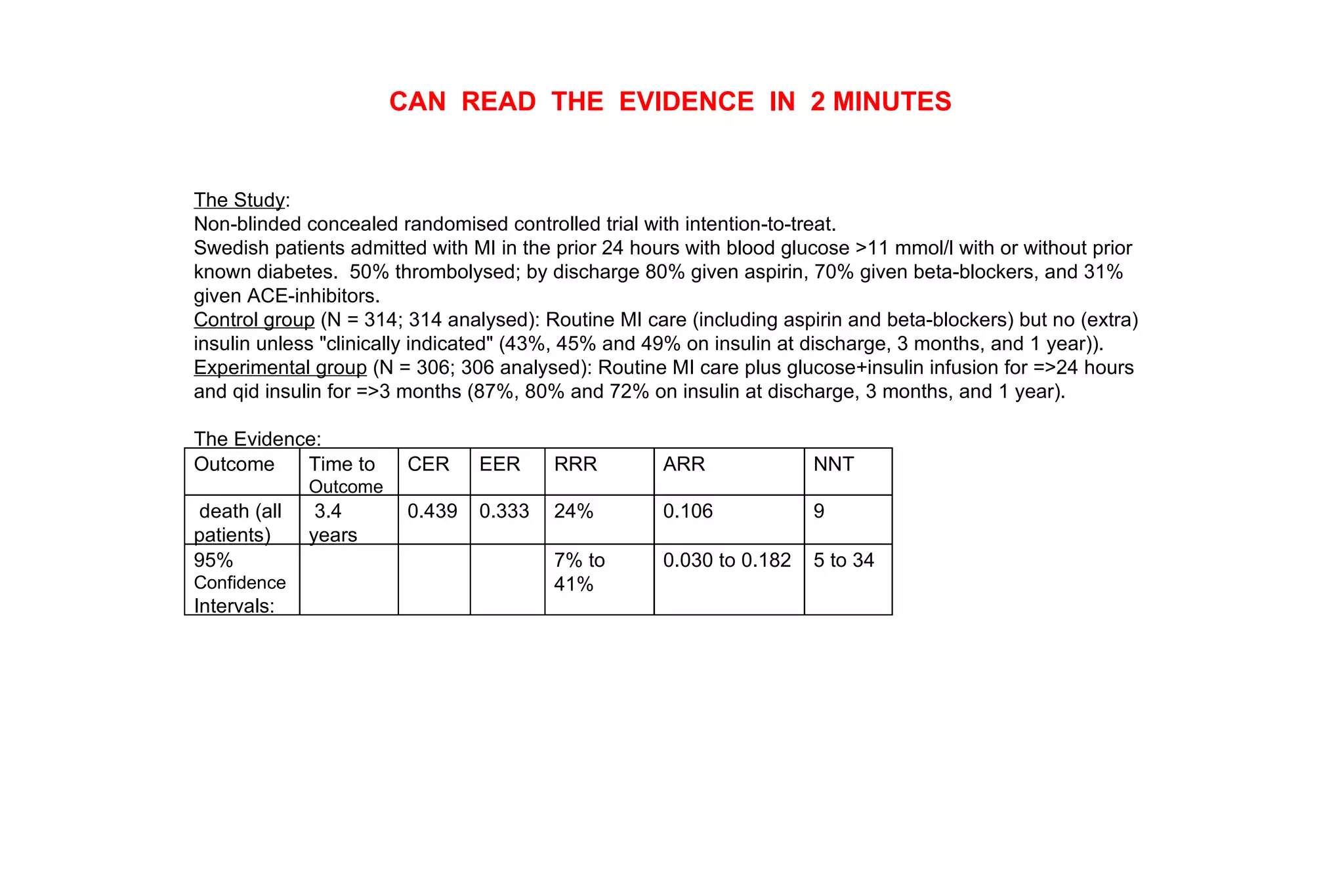
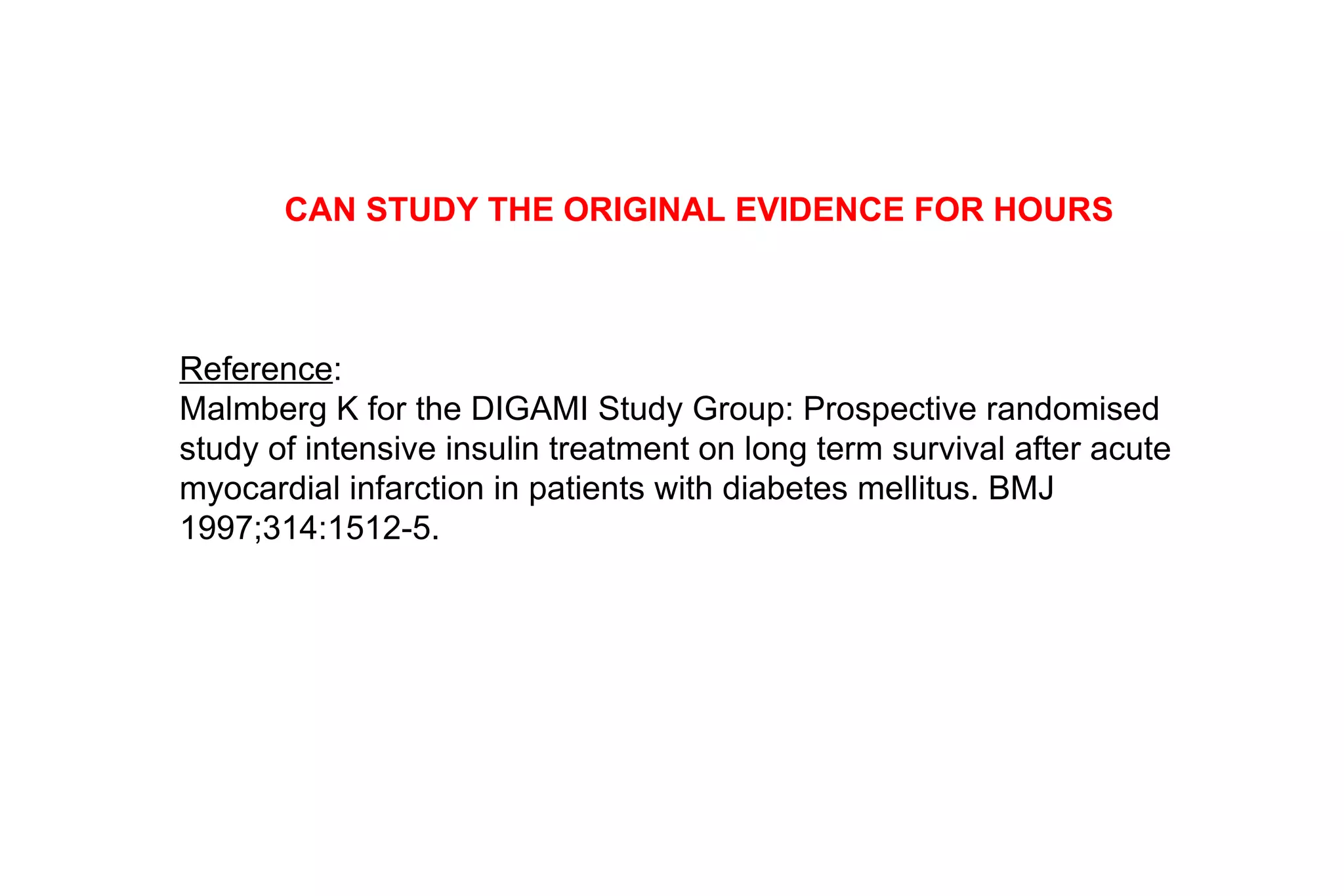
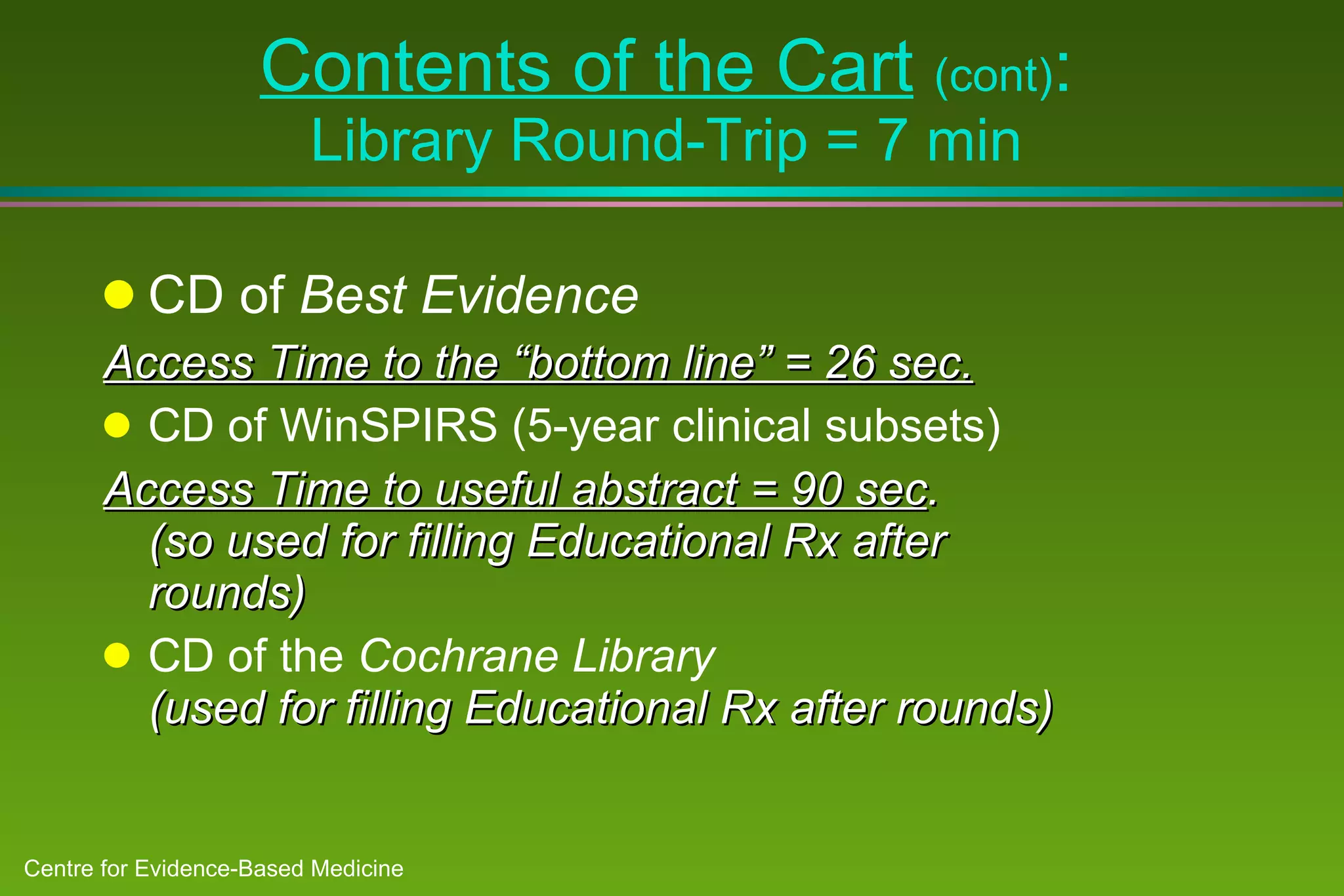
Contents of the Cart   (cont) : Library Round-Trip = 7 min 125 summaries (1-3 pp) of evidence previously appraised and summarised by Side A teams  (in the form of “Redbook” entries or Critically-Appraised Topics : “CATs”).   Access Time to the “bottom line” = 12 sec.


Contents of the Cart   (cont) : Library Round-Trip = 7 min CD of  Best Evidence Access Time to the “bottom line” = 26 sec. CD of WinSPIRS (5-year clinical subsets) Access Time to useful abstract = 90 sec .  (so used for filling Educational Rx after rounds) CD of the  Cochrane Library  (used for filling Educational Rx after rounds)
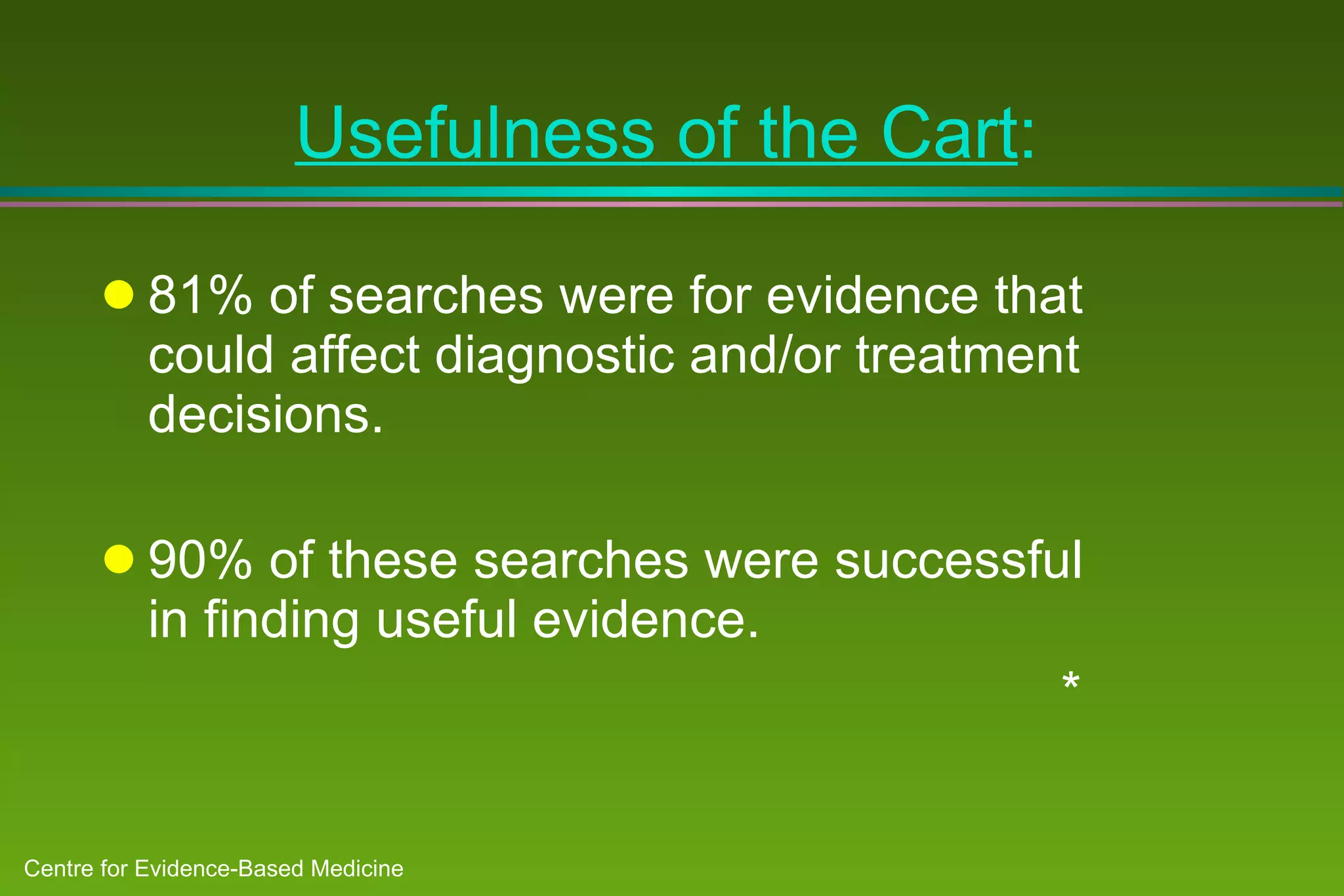
Usefulness of the Cart : 81% of searches were for evidence that could affect diagnostic and/or treatment decisions. 90% of these searches were successful in finding useful evidence. *
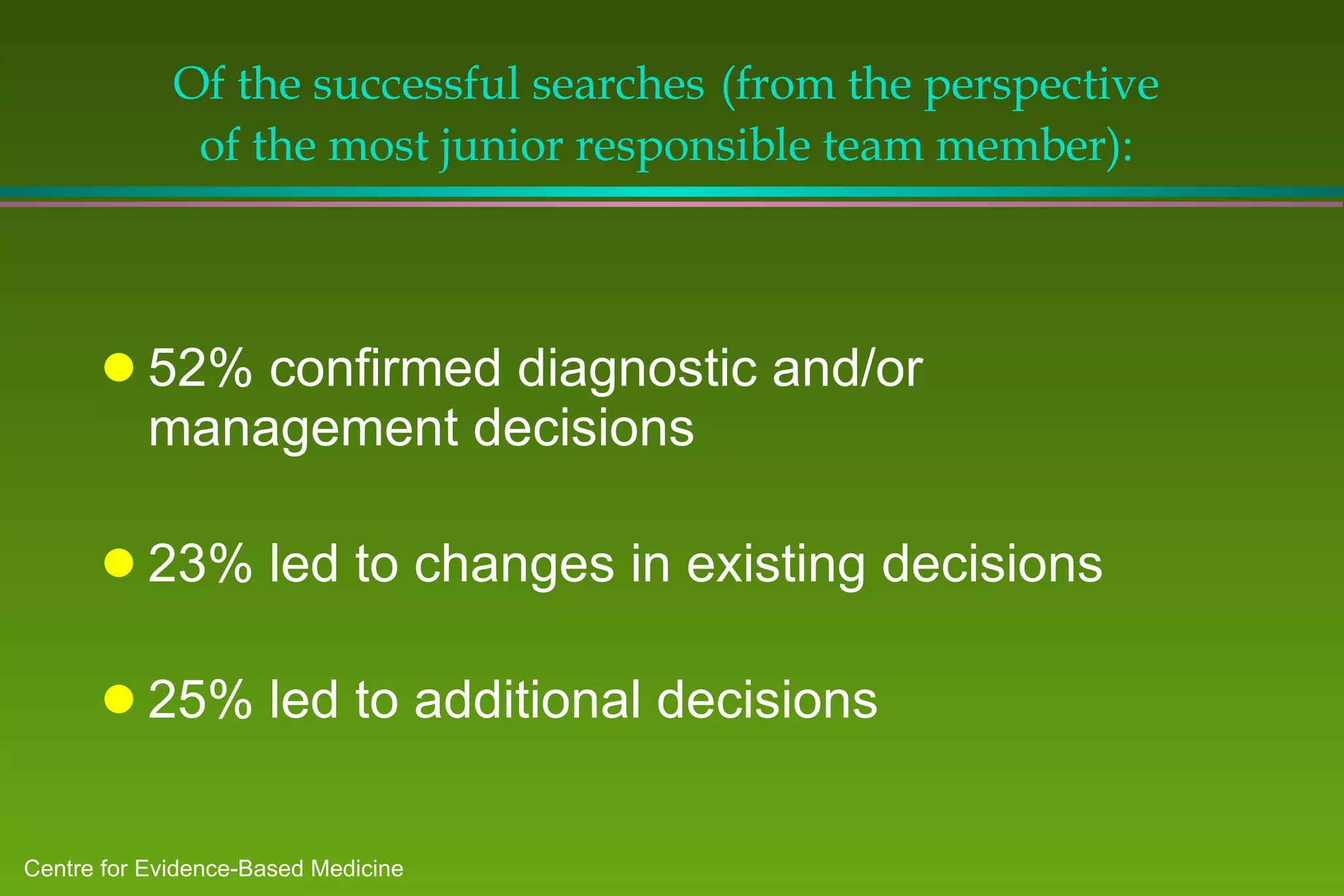
Of the successful searches   (from the perspective of the most junior responsible team member): 52% confirmed diagnostic and/or management decisions 23% led to changes in existing decisions 25% led to additional decisions
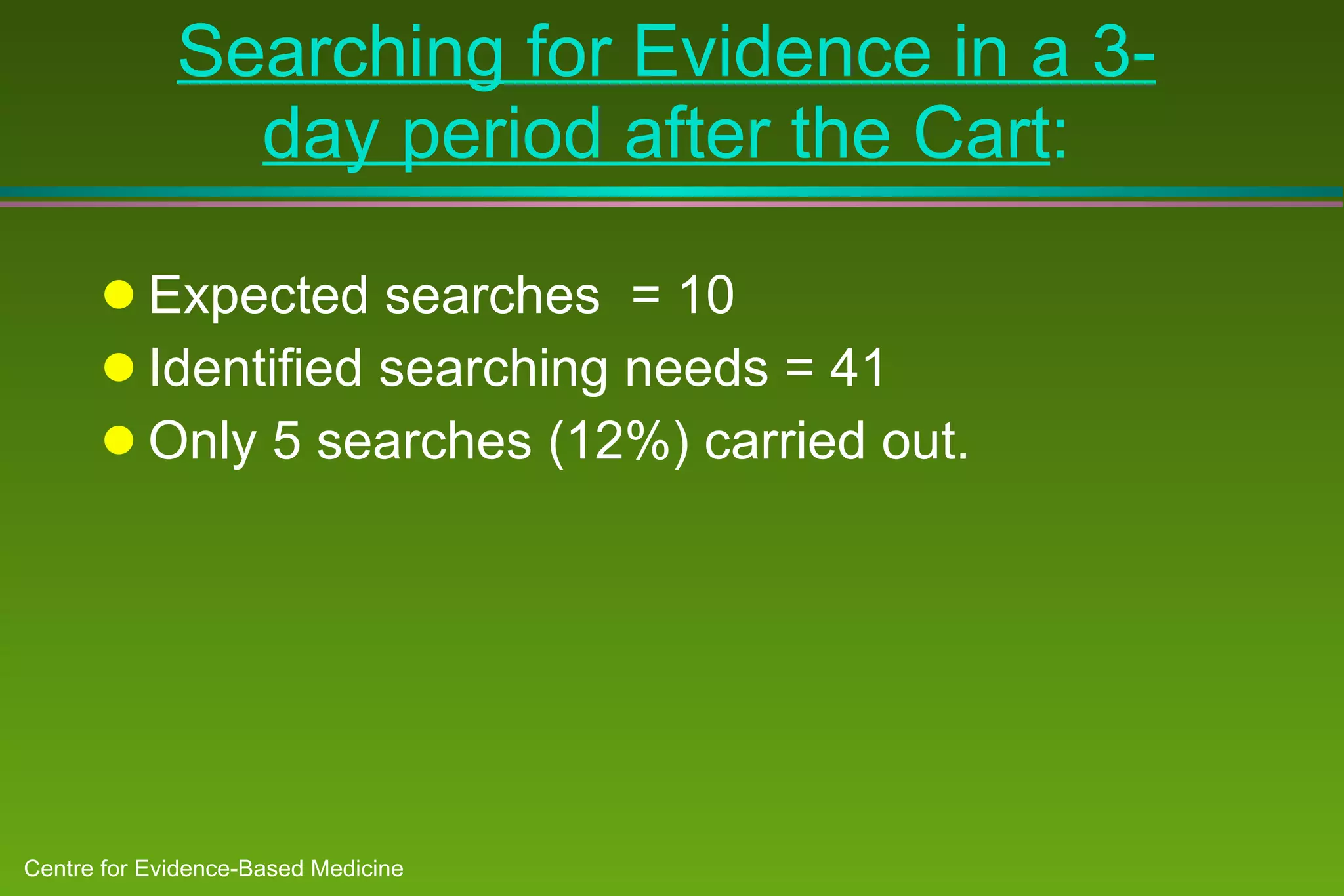
Searching for Evidence in a 3-day period after the Cart : Expected searches  = 10  Identified searching needs = 41  Only 5 searches (12%) carried out.
Can we get evidence  to the bedside? Yes, and it will improve patient care. But can we provide it in a less cumbersome form?
 
EBM and Purchasing In harmony :    When we clinicians stop doing things that are useless or harmful  When we use just-as-good but less expensive treatments, carers, and sites for care.
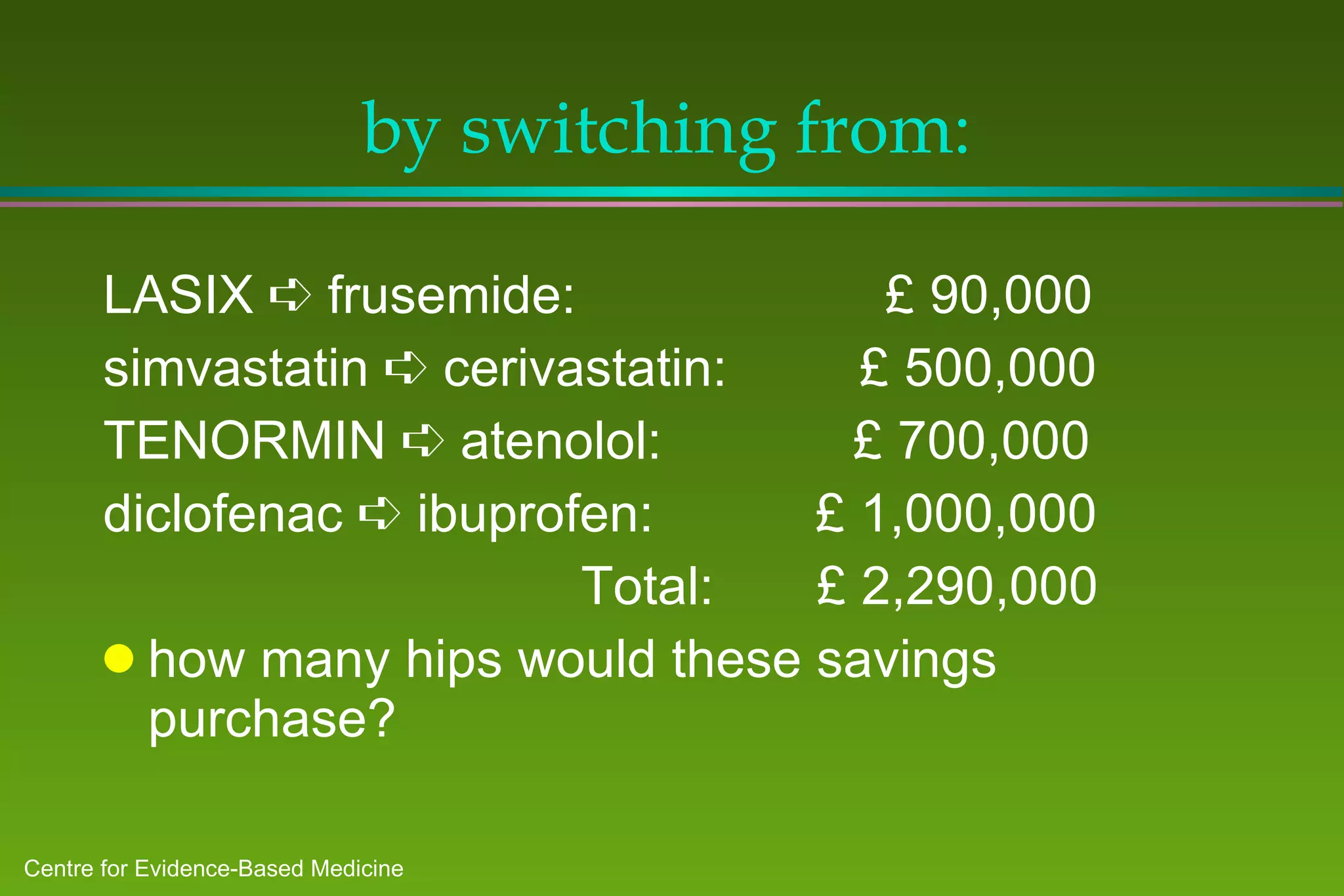
What we could save in Oxford  by switching from: LASIX    frusemide:  £ 90,000 simvastatin    cerivastatin:  £ 500,000 TENORMIN    atenolol:  £ 700,000 diclofenac    ibuprofen:  £ 1,000,000 Total:  £ 2,290,000 how many hips would these savings purchase?
EBM and Purchasing Still in harmony :     When we spend now to save later.
EBM and Purchasing In grudging collaboration :    Waiting lists, once we understand the opportunity costs of shortening them: it’s not about money it’s about what else we won’t be able to do if we shorten them
EBM and Purchasing In conflict :    When we identify so strongly with a dying patient’s short-term goals that we use resources that we know would “add more QALYs” if used for other patients.
EBM and E-B Guidelines EBM integrates evidence, expertise, and the unique biology and values of individual patients.   Local EB Provision ought to integrate evidence, expertise, and the unique biology and values of the local scene.
EBM and E-B Guidelines La mejor evidencia proviene de revisiones sistemáticas (como Cochrane) y/o revistas secundarias. Much more likely (than personal search and critical appraisal) to be true  Saves the clinician’s precious (scarce!) time Avoids error and duplication of effort
EBM and E-B Guidelines But NO systematic review can (or should try to) identify the “4 B’s: Burden Barriers Behaviours Balance Ello SOLO puede ser determinado a nivel local (o aún a nivel del paciente).
1. Burden - Peso La carga de enfermedad, discapacidad y mortalidad que pudiera ocurrir si la evidencia no fuera aplicada. Las consecuencias de no hacer nada
2. Barriers - Barreras Valores y preferencias de los pacientes Geográficas Economicas Administrativas/Organización Usos y Costumbres Opinión de “Expertos”
3. Behaviours - Comportamientos Reacción al cambio de paradigmas. Costo personal del cambio. Igual para los pacientes
4. Balance El costo de oportunidad de aplicación de la guia en lugar de seguir actuando como antes.
Killer B’s Burden : too small to warrant action. Barriers : ultimately down to patients’ values. Behaviours : may not be achievable. Balance : may favour another guideline over this one.
Two monumental wastes  of time and energy First, national/international evidence-summarising groups prescribing how patients everywhere should be treated. Their  expertise : predicting the health consequences if you do treat. Their  ignorance : the local B’s, and whether killer B’s are operating.
Two monumental wastes  of time and energy Second, local groups attempting to systematically review the evidence. Their  expertise : identifying the local B’s and eliminating the killer B’s Their  ignorance : searching for all relevant evidence; Chinese; performing  tests for heterogeneity.
Applying a study result  to my patient Never  interested in “generalising” Am  interested in a special form of extrapolation:  particularising
Extrapolating (particularising) to my individual patient: First and foremost : Is my patient so different from those in the trial that its results can make  no  contribution to my treatment decision? if no contribution, I restart my search if it could help, I need to integrate the evidence with my clinical expertise and my patient’s unique biology and values...
To add Clinical Expertise and Patient’s Biology & Values : What is my patient’s RISK ? of the event the treatment strives to prevent? of the side-effect of treatment? What is my pt’s RESPONSIVENESS? What is the treatment’s FEASIBILITY in my practice/setting? What are my patient’s VALUES ?
To add Clinical Expertise and Patient’s Biology & Values : I begin by considering Risk and Responsiveness for the event I hope to prevent with the treatment: The report gives me (or I can calculate) an Absolute Risk Reduction [ARR] for the average patient in the trial.  ARR = probability that Rx will help the  average  patient.
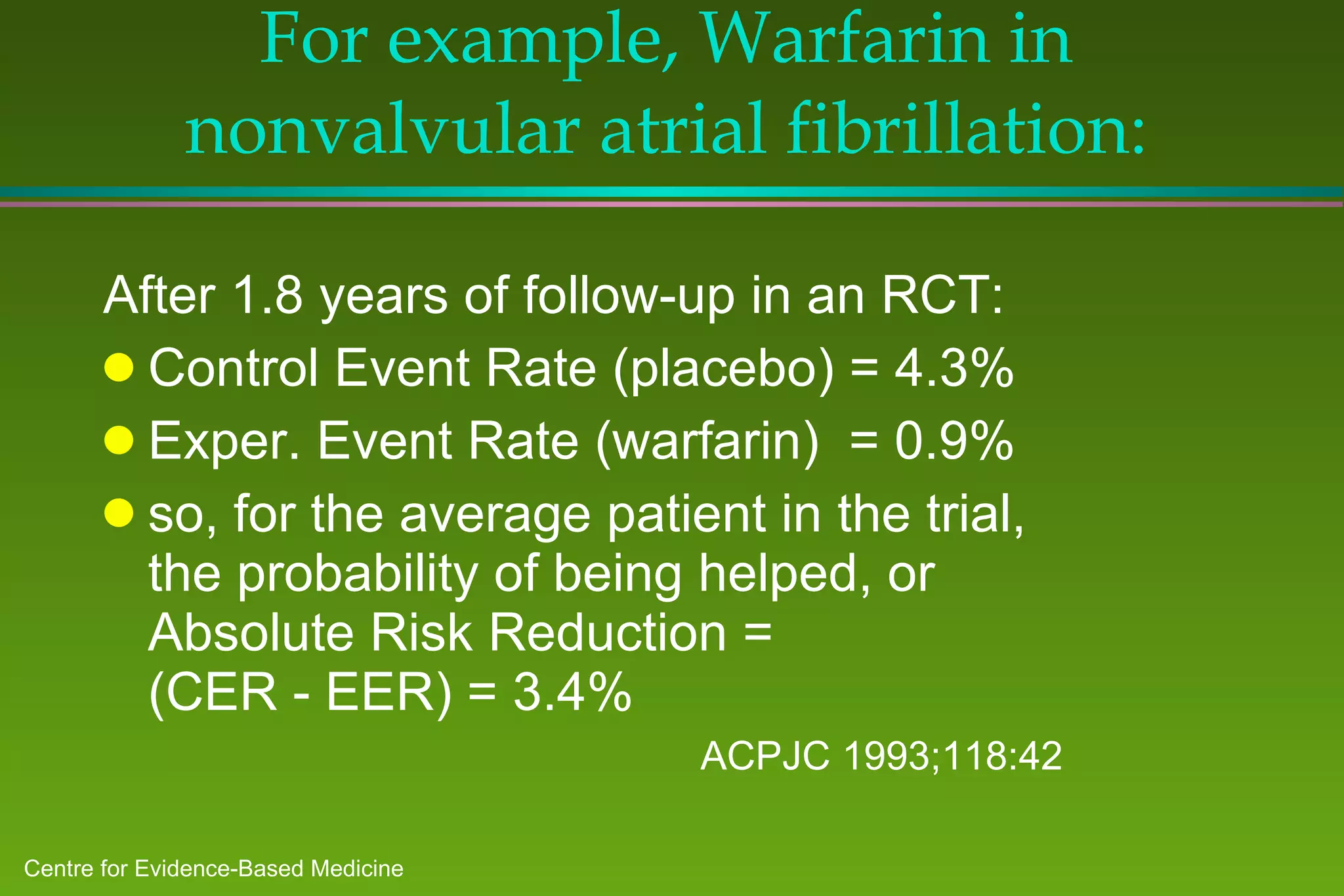
For example, Warfarin in nonvalvular atrial fibrillation: After 1.8 years of follow-up in an RCT: Control Event Rate (placebo) = 4.3% Exper. Event Rate (warfarin)  = 0.9% so, for the average patient in the trial,  the probability of being helped, or  Absolute Risk Reduction =  (CER - EER) = 3.4% ACPJC 1993;118:42
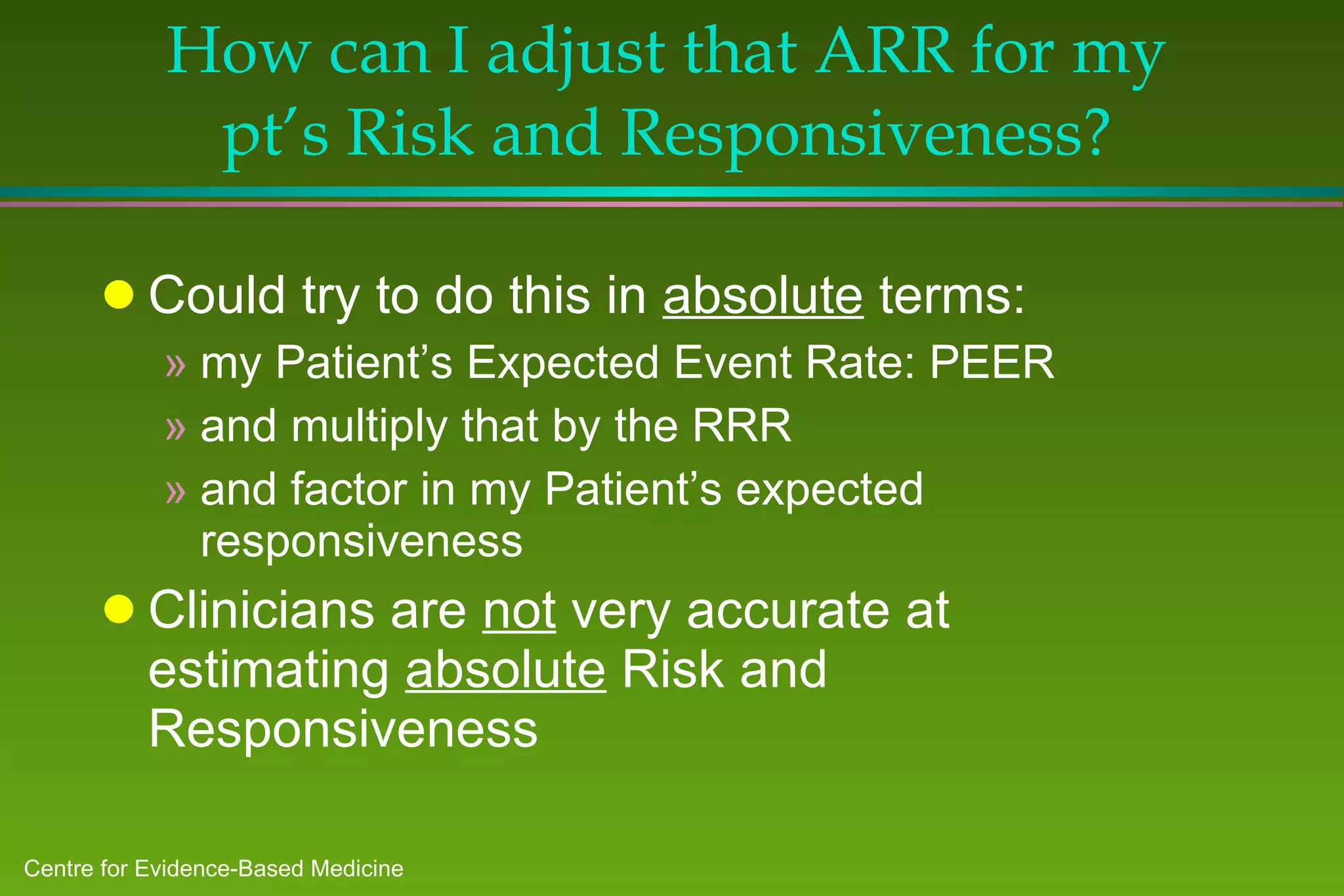
How can I adjust that ARR for my pt’s Risk and Responsiveness? Could try to do this in  absolute  terms: my Patient’s Expected Event Rate: PEER and multiply that by the RRR and factor in my Patient’s expected responsiveness Clinicians are  not  very accurate at estimating  absolute  Risk and Responsiveness
How can I adjust that ARR for my pt’s Risk and Responsiveness? Clinicians  are  pretty good at estimating their patient’s  relative  Risk and Responsiveness So, I express them as decimal fractions: f~risk  (if at three times the risk, f~risk = 3) f~resp (if only half as responsive [e.g., low compliance], f~resp = 0.5)
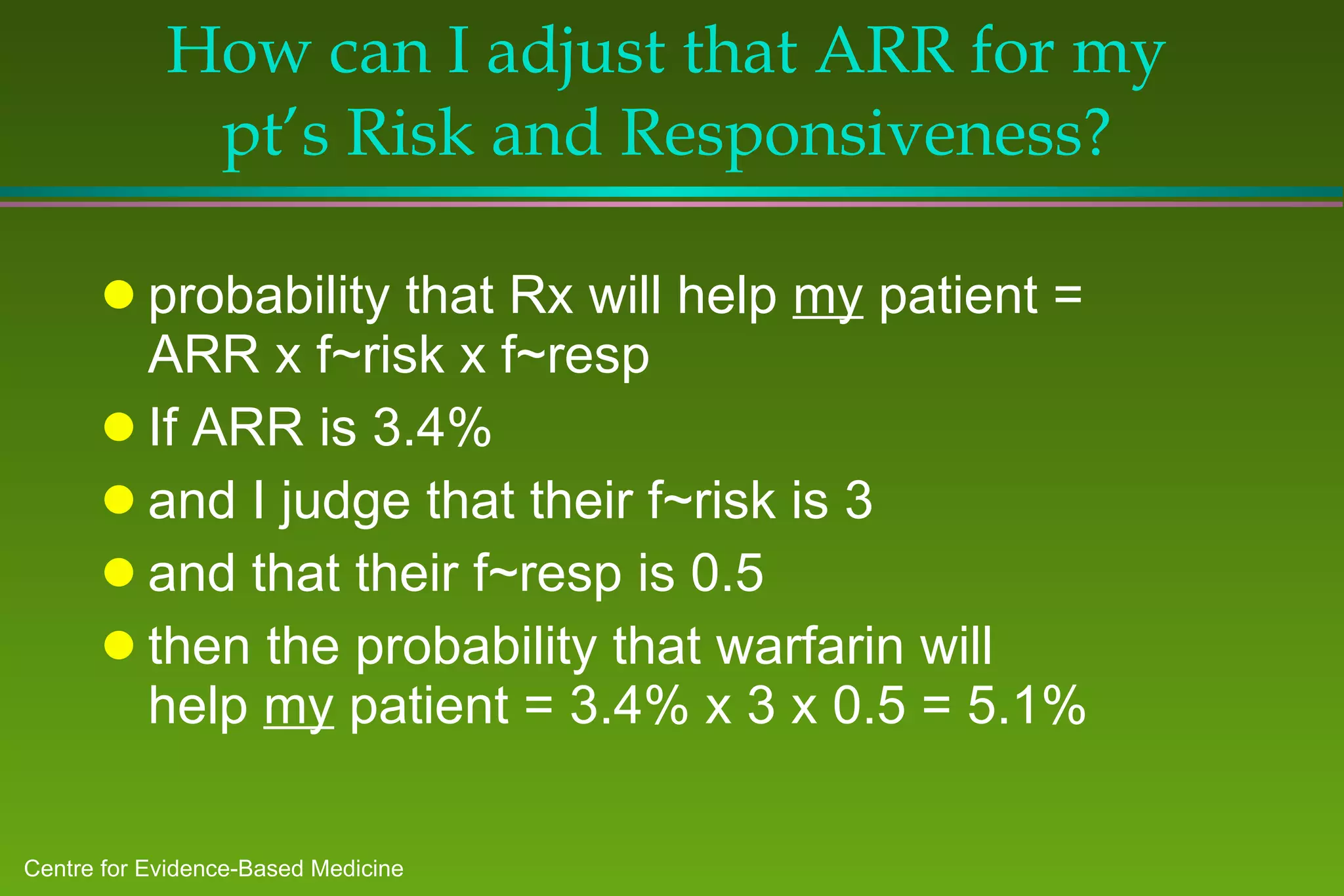
How can I adjust that ARR for my pt’s Risk and Responsiveness? probability that Rx will help  my  patient = ARR x f~risk x f~resp  If ARR is 3.4%  and I judge that their f~risk is 3 and that their f~resp is 0.5 then the probability that warfarin will help  my  patient = 3.4% x 3 x 0.5 = 5.1%
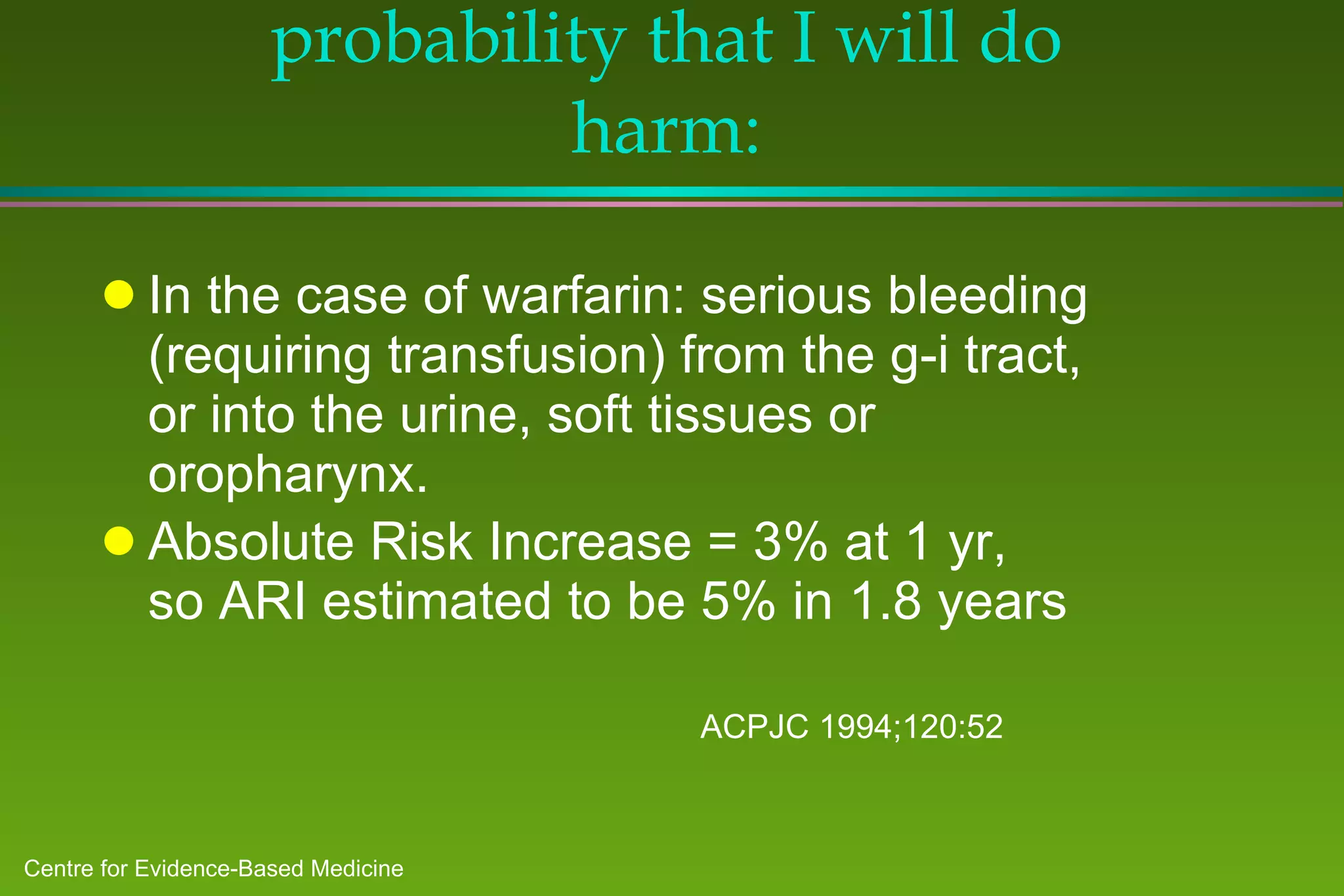
Must also consider the probability that I will do harm: In the case of warfarin: serious bleeding (requiring transfusion) from the g-i tract, or into the urine, soft tissues or oropharynx. Absolute Risk Increase = 3% at 1 yr,  so ARI estimated to be 5% in 1.8 years  ACPJC 1994;120:52
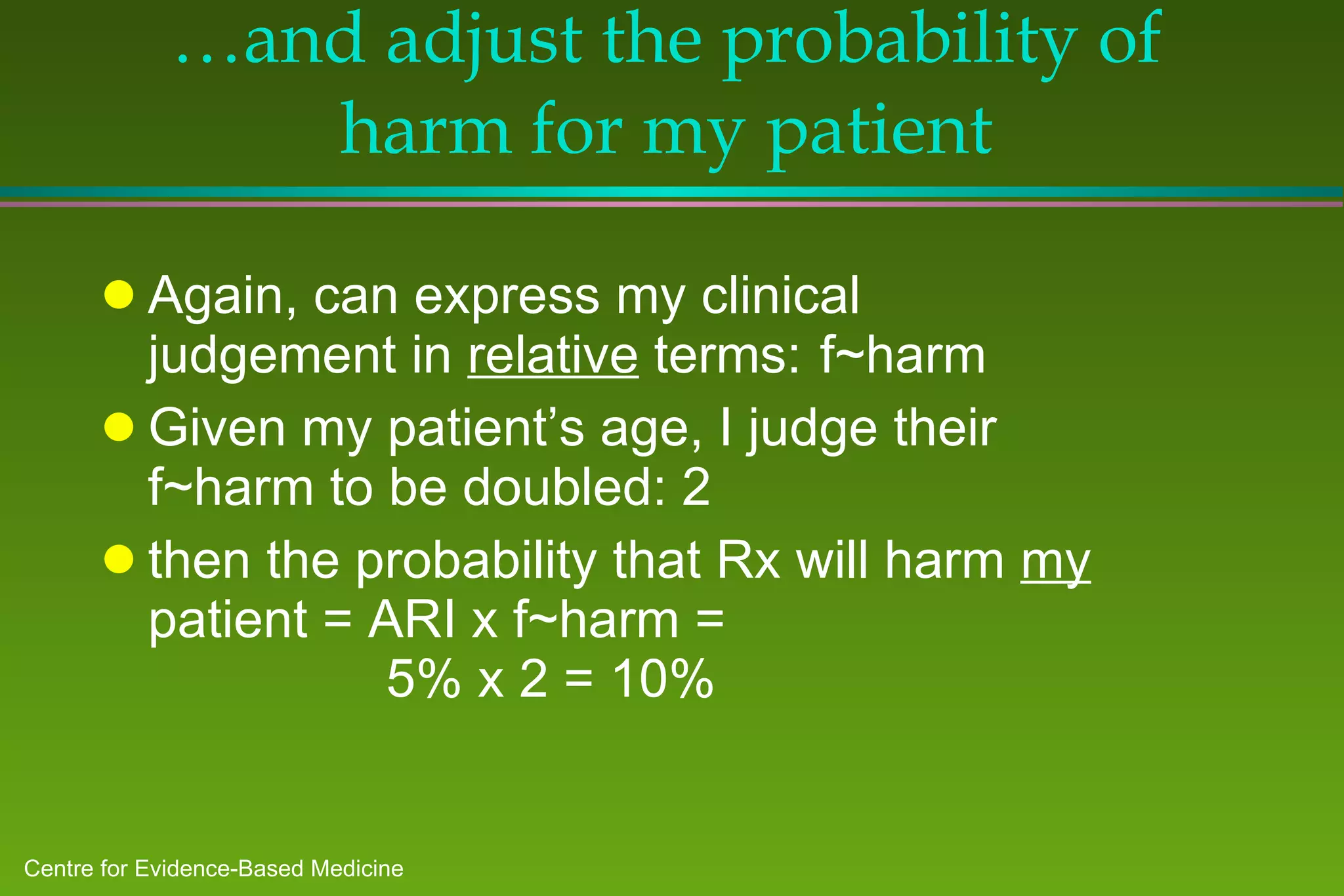
… and adjust the probability of harm for my patient Again, can express my clinical judgement in  relative  terms: f~harm Given my patient’s age, I judge their f~harm to be doubled: 2 then the probability that Rx will harm  my  patient = ARI x f~harm =   5% x 2 = 10%
Can now begin to estimate the Likelihood of Help vs. Harm Probability of help:  ARR (embolus) x f~risk x f~resp = 5.1% Probability of harm:  ARI (haemorrhage) x f~harm = 10% My patient’s Likelihood of Being Helped vs. Harmed [LHH] is:  (5.1% to 10%)  or 2 to 1  against  warfarin! … or is it ?
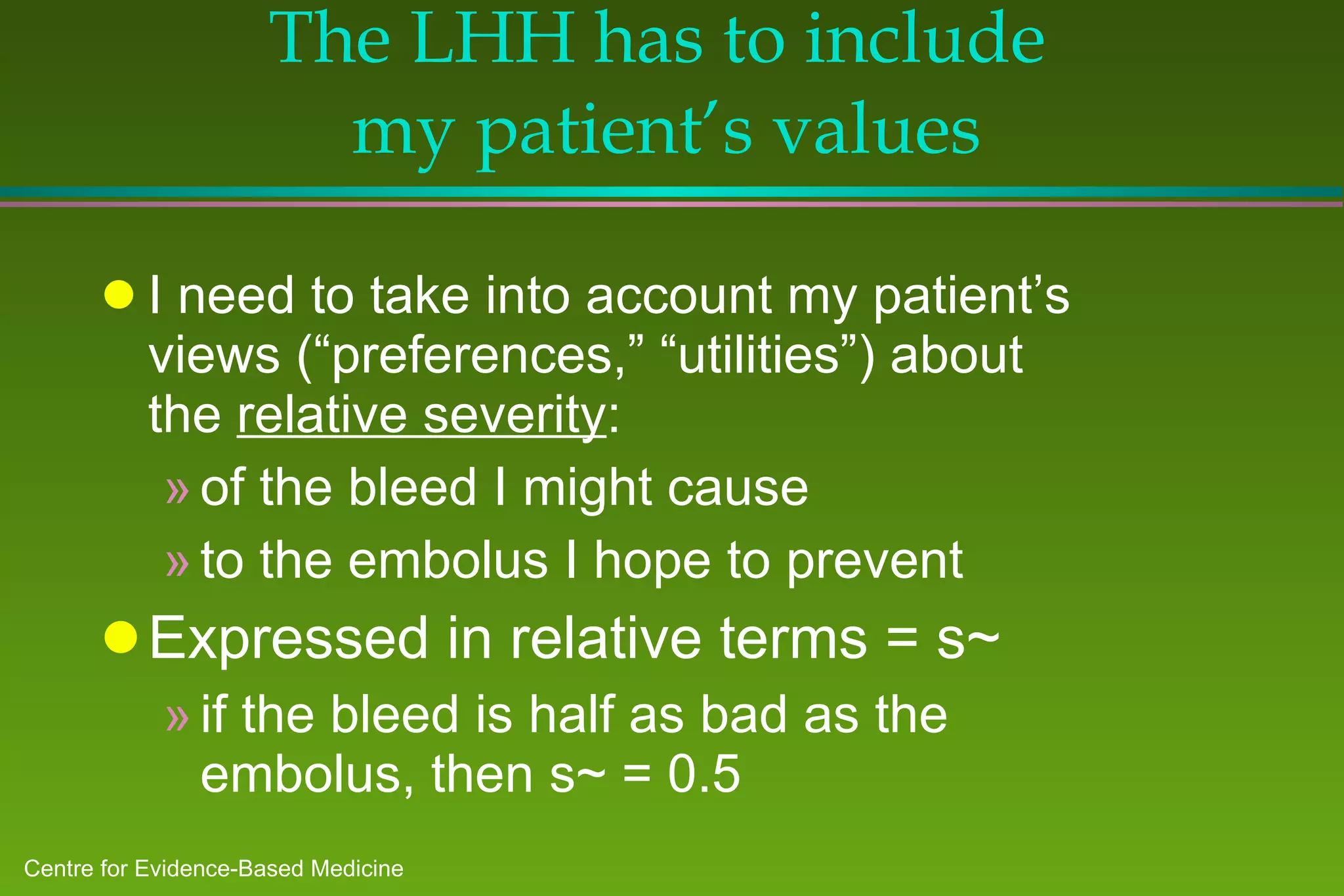
The LHH has to include  my patient’s values I need to take into account my patient’s views (“preferences,” “utilities”) about the  relative severity : of the bleed I might cause  to the embolus I hope to prevent Expressed in relative terms = s~ if the bleed is half as bad as the embolus, then s~ = 0.5
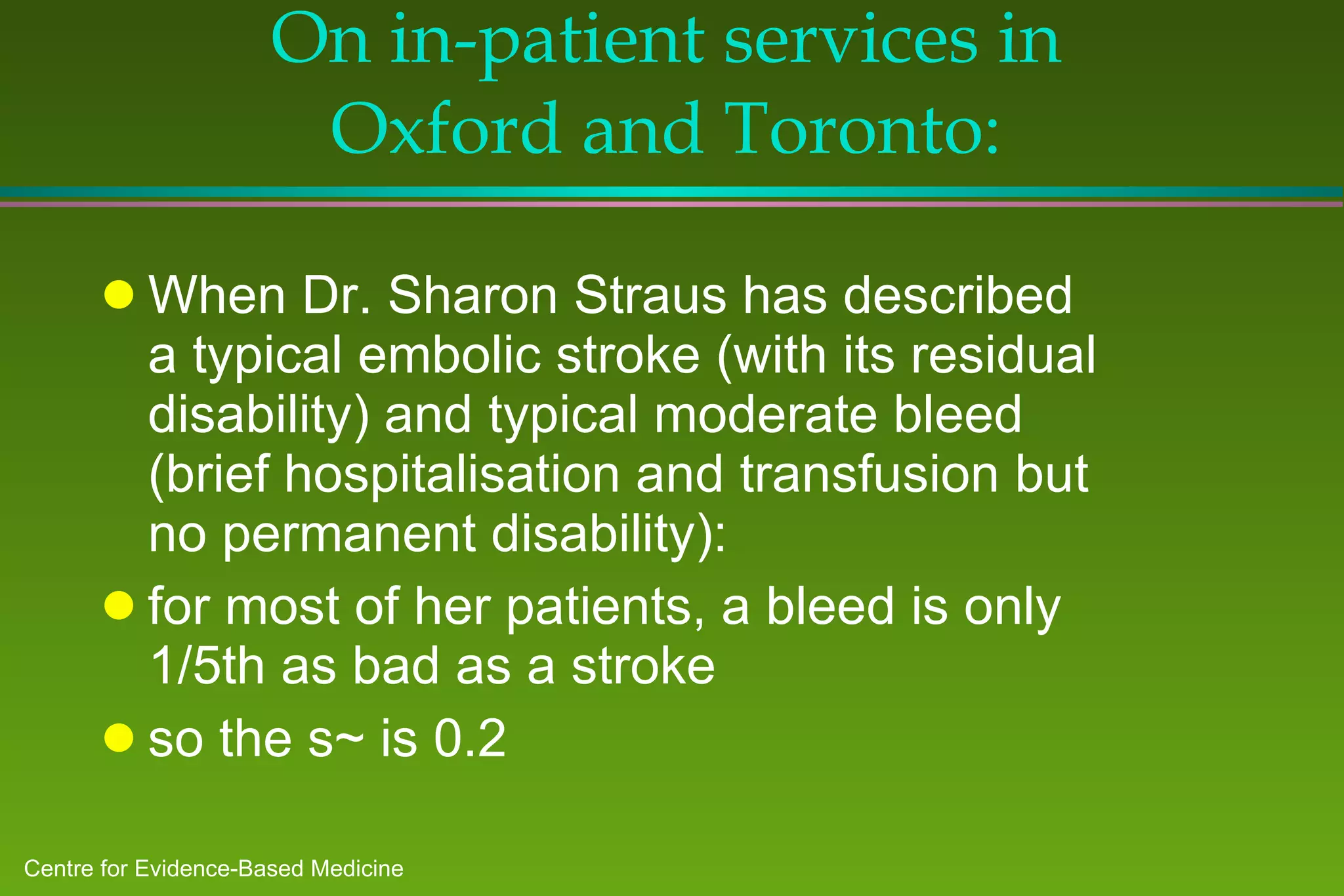
On in-patient services in Oxford and Toronto: When Dr. Sharon Straus has described a typical embolic stroke (with its residual disability) and typical moderate bleed (brief hospitalisation and transfusion but no permanent disability): for most of her patients, a bleed is only 1/5th as bad as a stroke  so the s~ is 0.2
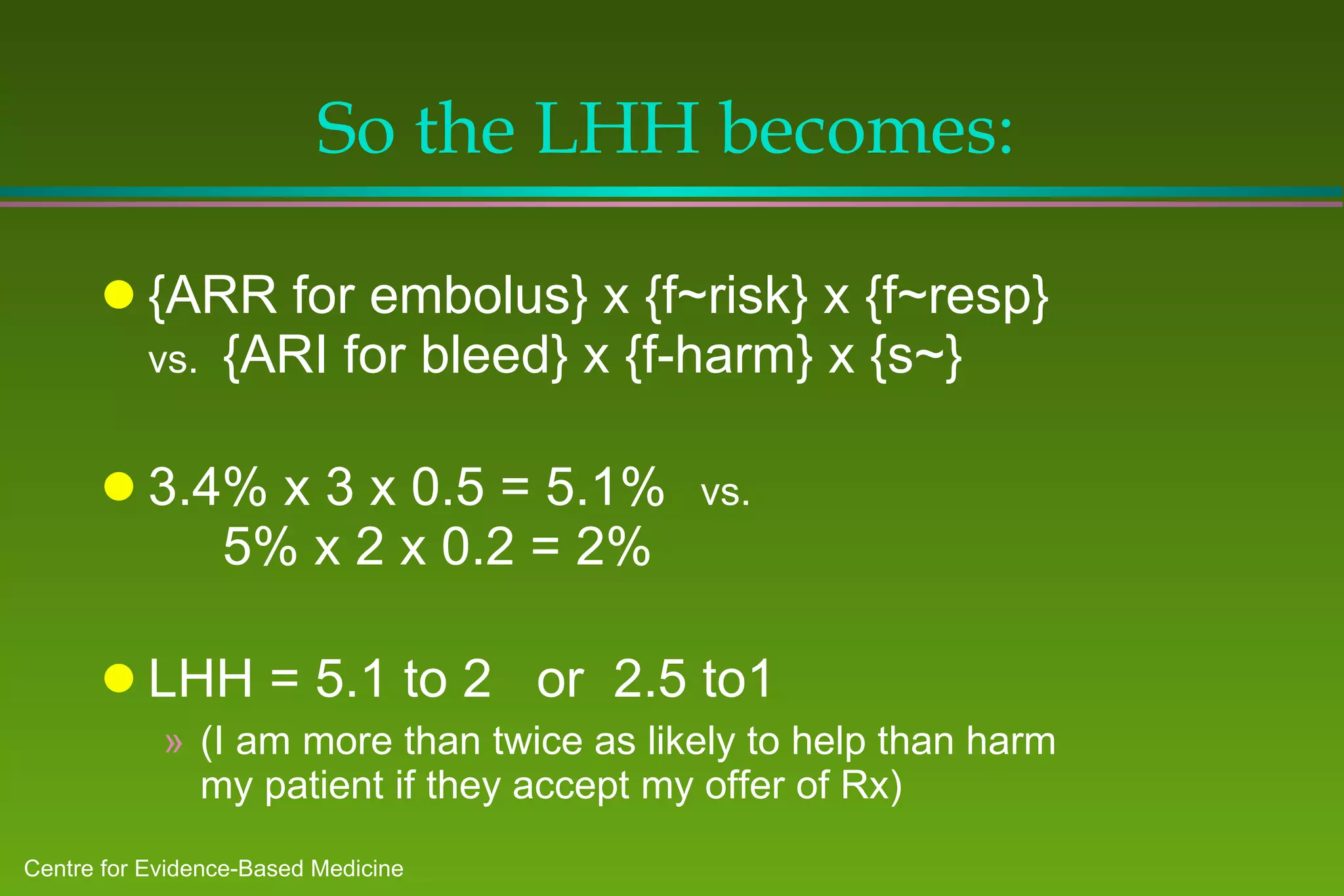
So the LHH becomes: {ARR for embolus} x {f~risk} x {f~resp} vs. {ARI for bleed} x {f-harm} x {s~} 3.4% x 3 x 0.5 = 5.1% vs.   5% x 2 x 0.2 = 2% LHH = 5.1 to 2  or  2.5 to1  (I am more than twice as likely to help than harm my patient if they accept my offer of Rx)
We can work out the LHH for most patients <6 minutes To be feasible on our service:  has to be “do-able” in 3 minutes.
Reactions from our patients All are grateful that their values/opinions are being sought  1/3 want to see the calculations, perhaps change their value for s~, and make up their own minds.  1/3 adopt the LHH as presented.  1/3 say “Whatever you tell me, doctor!”

Ebm talk-general-mar99-ppt95

  • 1.
    Problemas Necesitamos evidencia(sobre la presición de métodos diagnósticos, el poder de los marcadores pronósticos, la eficacia y la seguridad de las intervenciones, etc.) alrededor de 5 veces por cada paciente internado y tres veces por cada dos pacientes ambulatorios. Sólo un tercio de las veces acudimos a la evidencia.
  • 2.
    Problemas : Paramantenerse actualizado, sólo en Medicina interna, necesitamos leer 17 articulos diarios, los 365 días del año.
  • 3.
    Minutos por semanade lectura sobre los pacientes Auto-Reportes sobre 17 ateneos : Estudiantes de Medicina : 90 minutes Residentes de Primer año: 0 (up to 70%=none) Residentes de otros años: 20 (up to 15%=none) Pasantes : 45 (up to 40%=none) Pasantes Seniors: 30 (up to 15%=none) Cons ultores : Grad. Post 1975: 45 (up to 30%=none) Grad. Pre 1975: 30 (up to 40%=none)
  • 4.
    Deterioro de laperformance también Determinantes más importantes para tratar, o no, pacientes hipertensos: Nivel de Tensión Arterial Edad del Paciente Año de Graduación del Médico Grado de deterioro de órgano blanco
  • 5.
    Medicina Basada enla Evidencia es: La práctica de la MBE es la integración de: Experiencia clínica individual con La mejor evidencia clinica disponible de investaciones sistemáticas y Valores de los pacientes y expectativas individuales
  • 6.
    I. Experiencia ClínicaIndividual Habilidades clínicas y juicios clínicos Determinar si la evidencia (o guía) aplica al paciente individual en su totalidad, y si es así, cómo
  • 7.
    II. MejorEvidencia Externa : De investigaciones clínicas en pacientes sanos Tienen un tiempo de aplicación (10 años aproximadamente) Reemplaza test diagnósticos aceptados y nuevos tratamientos con mayor poder, eficacia, efectividad y seguridad.
  • 8.
    III. Valoresy Expectativas de los Pacientes Siempre han jugado un rol central en determinar si, y cuáles, intervenciones tendrán lugar. Mejoras en la integración de las preferencias y cuantificación de las mismas.
  • 9.
    Que no esla MBE : La MBE no es una receta de cocina La evidencia necesita extrapola r los hallazgos a mis pacientes con sus particularidades biologicas únicas. La MBE no es medicina de costo minimización o de recorte Cuando la eficacia para mis pacientes es el objetivo los costos pueden incluso aumentar, mas que disminuir.
  • 10.
    Medicina Basada enla Evidencia: la práctica. Cuando el cuidado de pacientes crea la necesidad para la búsqueda de información: Tr a ducir la pregunta a una pregunta que pueda ser contexada (paciente-procedimiento-resultado) . Búsqueda eficiente de la mejor evidencia disponible Literatura secundaria ( , Cochrane; E-B Journals ) Literatura primaria
  • 11.
    Medicina Basada enla Evidencia: la práctica Critical appraisal of the evidence for its validity and clinical applicability  generation of a 1-page summary. Integration of that critical appraisal with clinical expertise and the patient’s unique biology and beliefs  action. Evaluation of one’s performance.
  • 12.
    We needn’t alwayscarry out all 5 steps to provide E-B Care Asking an answerable question. Searching for the best evidence. Critically- appraising the evidence. Integrating the evidence with our expertise and our patient’s unique biology and values evaluating our performance
  • 13.
    We’ve identified 3different modes of practice “ Searching & appraising” provides E-B care, but is expensive in time and resources “ Searching only” much, quicker, and if carried out among E-B resources, can provide E-B care “ Replicating” the practice of experts quickest, but may not distinguish evidence-based from ego-based recommendations
  • 14.
    Even fully EB-trainedclinicians work in all 3 modes “ Searching & appraising” mode for the problems I encounter daily. “ Searching only” mode among E-B resources for problems I encounter once a month. “ Replicating” the practice of experts mode for problems I encounter once a decade(and crossing my fingers!).
  • 15.
    Patients can benefitEven if <10% of clinicians are capable of practicing in the “searching & appraising” mode (5% of GPs) As long as most of them practice in a “searching” mode within high-quality evidence sources (70-80% of GPs): Cochrane Library, E-B Journals, E-B Guidelines, etc
  • 16.
    Three solutions Clinical performance can keep up to date: by learning how to practice evidence-based medicine ourselves. by seeking and applying evidence-based medical summaries generated by others. by applying evidence-based strategies for changing our clinical behaviour.
  • 17.
    Information required within seconds Systematic reviews, periodically updated, of randomised trials of the effects of health care (from all sources, and in all languages): The Cochrane Collaboration.
  • 18.
    Cochrane Systematic Reviews(522; another 500 in preparation) Database of Abstracts of Reviews of Effectiveness (1895) Registry of Randomised Controlled Trials (218,355)
  • 19.
    Information required within seconds CD-Evidence-based journals of 2º publication:  screen 50-70 clinical journals per week for clinical articles that pass critical appraisal quality filters  conclusions likely to be true.  select the subset that are clinically relevant.  summarise as “more-informative” abstracts.  add commentaries from clinical experts.  introduce with declarative titles.
  • 20.
  • 21.
    2. Seeking andApplying EBM generated by others MBE esta publicado en: Inglés Fr ancés Alemán Italian o Portugués Español
  • 22.
    2. Seeking andApplying EBM generated by others New Evidence-based journals of 2º publication : E-B Cardiovascular Medicine E-B Health Policy & Management E-B Nursing E-B Mental Health And as new departments in 1º journals .
  • 23.
    2. Seeking andApplying EBM generated by others E-B Textbooks : E-B Pain Relief E-B Cardiology includes icons for levels of evidence “ E-B On-Call” includes > 1300 CATs
  • 24.
    Can you reallypractice EBM? Is there any “E” for EBM ?
  • 25.
    Conventional Wisdom “only about 15% of medical interventions are supported by solid scientific evidence” (BMJ Editorial)
  • 26.
    Even on theU.S. Talk-Shows: (“Health Outrage of the Week”) “ ..... this would put 80 to 90 per cent of accepted medical procedures in this country under the heading of quackery!”
  • 27.
    Problems with Conventional Wisdom uses clinical manoeuvres, rather than patients, as the denominator. tends to focus on high-technology, “big ticket” items. relies on simple literature searches that miss over half of the most rigorous types of evaluations. conducted from armchairs.
  • 28.
    Performed an empiricalstudy on a busy in-patient service on the general medicine in-patient service of the Nuffield Department of Medicine at the Oxford-Radcliffe NHS Hospital Trust (“The John Radcliffe”) all our admissions arise from urgent referral from local GPs or via the Emergency Room
  • 29.
    The Protocol Atthe time of discharge, death, or month’s end, each patient was reviewed and consensus reached on:  The primary diagnosis: the disease, syndrome or condition most responsible for the patient’s admission to hospital
  • 30.
    The Protocol (cont.) The Primary Intervention the treatment or other manoeuvre that constituted our most important attempt to cure, alleviate, or care for the primary diagnosis traced into the literature to determine its basis in evidence the Consultant’s “Instant Resource Book” bibliographic data base searches
  • 31.
    Primary Interventions wereClassified by Level: Evidence from Randomised Control Trials (better yet: systematic reviews of all relevant, high-quality RCTs) Convincing non-experimental evidence (unnecessary & unethical to randomise) Interventions without substantial evidence
  • 32.
    Conclusions from E-B oriented General Medicine: 82% of our patients received evidence-based care. treatments for 53% were justified by RCTs or systematic reviews of RCTs. Of 28 relevant RCTs and SRs, 21 were accessible within seconds. treatments for 29% were justified by convincing non-experimental evidence
  • 33.
    Evidence from RCTs (53%) 36% had Cardiovascular diagnoses: Ischaemic heart disease 17% Heart failure 6% Arrhythmia 2% Thromboembolism 3% Cerebrovascular 8%
  • 34.
    Evidence from RCTs (53%) 7% had taken poison 5% received chemotherapy or analgesia for cancer 3 % had gastrointestinal disorders 2% had obstructive airways disease
  • 35.
    Convincing non-experimental evidence (29%) Infections 15% Cardiac disorders 7% Miscellany (non-compliance, drug reactions, bowel or bladder neck obstruction, dehydration, micturition syncope) 7%
  • 36.
    Interventions without substantialevidence (18%) Specific symptomatic and supportive care for mild poisoning, non-cardiac chest pain, viral (non-herpetic) meningitis, terminal CNS disease, confusion, and food poisoning.
  • 37.
    Better Outcomes forPatients When EBM Is Practised E-B practise vs. Outcome in stroke (US): When cared for by E-B neurologists, patients were 44% more likely to receive warfarin, and much more likely to be placed in a stroke care unit, And were 22% less likely to die in the next 90 days. (Mitchell et al: stroke 1996;27:1937-43)
  • 38.
    Centres for Evidence-Based Surgery E-B General/Vascular Unit in Liverpool: 95% received evidence-based Rx 24% Level 1 71% Level 2 E-B Paediatric Unit in Liverpool: 77% received evidence-based Rx 11% Level 1 66% Level 2
  • 39.
    Worse Outcomes forPatients When EBM Is Not Practised: In a city-wide study of E-B practise vs. Outcome in carotid stenosis: Generated E-B indications for endarterectomy and reviewed 291 pts. Found the surgical indications: Appropriate in 33% Questionable in 49% Inappropriate in 18%
  • 40.
    Worse Outcomes forPatients When EBM Is Not Practised Stroke or death within the next 30 days: Expected (if left alone): 0.5% Expected (if properly selected and operated): 1.5% Observed among operated patients (2/3 operated for questionable or inappropriate reasons): >5% Wong et al. Stroke 1997;28: 891-8.
  • 41.
    Evidence-Based AmbulatoryPaediatrics 54% of manoeuvres were evidence-based (“experts” had predicted <20%) 77% of diagnostic manoeuvres 67% of treatments 59% of health promotion
  • 42.
    Centres for Evidence-Based Psychiatry In-Patients (Oxford) 67% treated on the basis of RCTs Out-Patient >80% received evidence-based Rx
  • 43.
    Evidence-Based GeneralPractice 122 consecutive consultations in a suburban (Leeds, UK) practice. 81% evidence-based: 31% based on RCTs or overviews 50% based on convincing non-experimental evidence 19% without substantial evidence (Gill et al, BMJ 1996;312:819-21)
  • 44.
    Can we getevidence to the bedside? Need it within seconds if it is to be incorporated into busy clinical rounds Our initial attempts to bring the best evidence to a busy clinical team caring for 200+ admissions per month
  • 45.
    Searching for Evidencein the Month Before the Cart : Expected searches = 98 Identified searching needs = 72 Only 19 searches (26%) carried out.
  • 46.
    Contents of theCart : Infra-red simultaneous stethoscope with 12 remote receivers. Physical diagnosis text book and reprints (JAMA Rational Clinical Exam). Notebook computer, computer projector, and pop-out screen. Rapid printer.
  • 47.
  • 48.
    Contents of theCart (cont) : Library Round-Trip = 7 min 125 summaries (1-3 pp) of evidence previously appraised and summarised by Side A teams (in the form of “Redbook” entries or Critically-Appraised Topics : “CATs”). Access Time to the “bottom line” = 12 sec.
  • 49.
  • 50.
  • 51.
  • 52.
  • 53.
    Contents of theCart (cont) : Library Round-Trip = 7 min CD of Best Evidence Access Time to the “bottom line” = 26 sec. CD of WinSPIRS (5-year clinical subsets) Access Time to useful abstract = 90 sec . (so used for filling Educational Rx after rounds) CD of the Cochrane Library (used for filling Educational Rx after rounds)
  • 54.
    Usefulness of theCart : 81% of searches were for evidence that could affect diagnostic and/or treatment decisions. 90% of these searches were successful in finding useful evidence. *
  • 55.
    Of the successfulsearches (from the perspective of the most junior responsible team member): 52% confirmed diagnostic and/or management decisions 23% led to changes in existing decisions 25% led to additional decisions
  • 56.
    Searching for Evidencein a 3-day period after the Cart : Expected searches = 10 Identified searching needs = 41 Only 5 searches (12%) carried out.
  • 57.
    Can we getevidence to the bedside? Yes, and it will improve patient care. But can we provide it in a less cumbersome form?
  • 58.
  • 59.
    EBM and PurchasingIn harmony :  When we clinicians stop doing things that are useless or harmful  When we use just-as-good but less expensive treatments, carers, and sites for care.
  • 60.
    What we couldsave in Oxford by switching from: LASIX  frusemide: £ 90,000 simvastatin  cerivastatin: £ 500,000 TENORMIN  atenolol: £ 700,000 diclofenac  ibuprofen: £ 1,000,000 Total: £ 2,290,000 how many hips would these savings purchase?
  • 61.
    EBM and PurchasingStill in harmony :  When we spend now to save later.
  • 62.
    EBM and PurchasingIn grudging collaboration :  Waiting lists, once we understand the opportunity costs of shortening them: it’s not about money it’s about what else we won’t be able to do if we shorten them
  • 63.
    EBM and PurchasingIn conflict :  When we identify so strongly with a dying patient’s short-term goals that we use resources that we know would “add more QALYs” if used for other patients.
  • 64.
    EBM and E-BGuidelines EBM integrates evidence, expertise, and the unique biology and values of individual patients. Local EB Provision ought to integrate evidence, expertise, and the unique biology and values of the local scene.
  • 65.
    EBM and E-BGuidelines La mejor evidencia proviene de revisiones sistemáticas (como Cochrane) y/o revistas secundarias. Much more likely (than personal search and critical appraisal) to be true Saves the clinician’s precious (scarce!) time Avoids error and duplication of effort
  • 66.
    EBM and E-BGuidelines But NO systematic review can (or should try to) identify the “4 B’s: Burden Barriers Behaviours Balance Ello SOLO puede ser determinado a nivel local (o aún a nivel del paciente).
  • 67.
    1. Burden -Peso La carga de enfermedad, discapacidad y mortalidad que pudiera ocurrir si la evidencia no fuera aplicada. Las consecuencias de no hacer nada
  • 68.
    2. Barriers -Barreras Valores y preferencias de los pacientes Geográficas Economicas Administrativas/Organización Usos y Costumbres Opinión de “Expertos”
  • 69.
    3. Behaviours -Comportamientos Reacción al cambio de paradigmas. Costo personal del cambio. Igual para los pacientes
  • 70.
    4. Balance Elcosto de oportunidad de aplicación de la guia en lugar de seguir actuando como antes.
  • 71.
    Killer B’s Burden: too small to warrant action. Barriers : ultimately down to patients’ values. Behaviours : may not be achievable. Balance : may favour another guideline over this one.
  • 72.
    Two monumental wastes of time and energy First, national/international evidence-summarising groups prescribing how patients everywhere should be treated. Their expertise : predicting the health consequences if you do treat. Their ignorance : the local B’s, and whether killer B’s are operating.
  • 73.
    Two monumental wastes of time and energy Second, local groups attempting to systematically review the evidence. Their expertise : identifying the local B’s and eliminating the killer B’s Their ignorance : searching for all relevant evidence; Chinese; performing tests for heterogeneity.
  • 74.
    Applying a studyresult to my patient Never interested in “generalising” Am interested in a special form of extrapolation: particularising
  • 75.
    Extrapolating (particularising) tomy individual patient: First and foremost : Is my patient so different from those in the trial that its results can make no contribution to my treatment decision? if no contribution, I restart my search if it could help, I need to integrate the evidence with my clinical expertise and my patient’s unique biology and values...
  • 76.
    To add ClinicalExpertise and Patient’s Biology & Values : What is my patient’s RISK ? of the event the treatment strives to prevent? of the side-effect of treatment? What is my pt’s RESPONSIVENESS? What is the treatment’s FEASIBILITY in my practice/setting? What are my patient’s VALUES ?
  • 77.
    To add ClinicalExpertise and Patient’s Biology & Values : I begin by considering Risk and Responsiveness for the event I hope to prevent with the treatment: The report gives me (or I can calculate) an Absolute Risk Reduction [ARR] for the average patient in the trial. ARR = probability that Rx will help the average patient.
  • 78.
    For example, Warfarinin nonvalvular atrial fibrillation: After 1.8 years of follow-up in an RCT: Control Event Rate (placebo) = 4.3% Exper. Event Rate (warfarin) = 0.9% so, for the average patient in the trial, the probability of being helped, or Absolute Risk Reduction = (CER - EER) = 3.4% ACPJC 1993;118:42
  • 79.
    How can Iadjust that ARR for my pt’s Risk and Responsiveness? Could try to do this in absolute terms: my Patient’s Expected Event Rate: PEER and multiply that by the RRR and factor in my Patient’s expected responsiveness Clinicians are not very accurate at estimating absolute Risk and Responsiveness
  • 80.
    How can Iadjust that ARR for my pt’s Risk and Responsiveness? Clinicians are pretty good at estimating their patient’s relative Risk and Responsiveness So, I express them as decimal fractions: f~risk (if at three times the risk, f~risk = 3) f~resp (if only half as responsive [e.g., low compliance], f~resp = 0.5)
  • 81.
    How can Iadjust that ARR for my pt’s Risk and Responsiveness? probability that Rx will help my patient = ARR x f~risk x f~resp If ARR is 3.4% and I judge that their f~risk is 3 and that their f~resp is 0.5 then the probability that warfarin will help my patient = 3.4% x 3 x 0.5 = 5.1%
  • 82.
    Must also considerthe probability that I will do harm: In the case of warfarin: serious bleeding (requiring transfusion) from the g-i tract, or into the urine, soft tissues or oropharynx. Absolute Risk Increase = 3% at 1 yr, so ARI estimated to be 5% in 1.8 years ACPJC 1994;120:52
  • 83.
    … and adjustthe probability of harm for my patient Again, can express my clinical judgement in relative terms: f~harm Given my patient’s age, I judge their f~harm to be doubled: 2 then the probability that Rx will harm my patient = ARI x f~harm = 5% x 2 = 10%
  • 84.
    Can now beginto estimate the Likelihood of Help vs. Harm Probability of help: ARR (embolus) x f~risk x f~resp = 5.1% Probability of harm: ARI (haemorrhage) x f~harm = 10% My patient’s Likelihood of Being Helped vs. Harmed [LHH] is: (5.1% to 10%) or 2 to 1 against warfarin! … or is it ?
  • 85.
    The LHH hasto include my patient’s values I need to take into account my patient’s views (“preferences,” “utilities”) about the relative severity : of the bleed I might cause to the embolus I hope to prevent Expressed in relative terms = s~ if the bleed is half as bad as the embolus, then s~ = 0.5
  • 86.
    On in-patient servicesin Oxford and Toronto: When Dr. Sharon Straus has described a typical embolic stroke (with its residual disability) and typical moderate bleed (brief hospitalisation and transfusion but no permanent disability): for most of her patients, a bleed is only 1/5th as bad as a stroke so the s~ is 0.2
  • 87.
    So the LHHbecomes: {ARR for embolus} x {f~risk} x {f~resp} vs. {ARI for bleed} x {f-harm} x {s~} 3.4% x 3 x 0.5 = 5.1% vs. 5% x 2 x 0.2 = 2% LHH = 5.1 to 2 or 2.5 to1 (I am more than twice as likely to help than harm my patient if they accept my offer of Rx)
  • 88.
    We can workout the LHH for most patients <6 minutes To be feasible on our service: has to be “do-able” in 3 minutes.
  • 89.
    Reactions from ourpatients All are grateful that their values/opinions are being sought  1/3 want to see the calculations, perhaps change their value for s~, and make up their own minds.  1/3 adopt the LHH as presented.  1/3 say “Whatever you tell me, doctor!”

Editor's Notes

  • #4 This summarises the data from about 12 DGH’s around the England and Scotland. In summary, HO’s (who don’t read at all) are being taught by old farts (who read 30 minutes a week).
  • #18 Cochrane symbol CDSR display of options Stroke graphical display
  • #20 covers of ACPJC and EBM
  • #22 covers of ACPJC and EBM
  • #23 covers of ACPJC and EBM
  • #26 top quote: Smith R: Where is the wisdom...? The poverty of medical evidence. BMJ 1991;303:798-9. bottom quote: Office of Technology Assessment of the Congress of the United States: Assessing the Efficacy and Safety of Medical Technologies. Washington, D.C.: US Government Printing Office, 1978. Office of Technology Assessment of the Congress of the United States: The Impact of Randomised Clinical; Trials on Health Policy and Medical Practice. Washington, D.C.: US Government Printing Office, 1983. Williamson JW, Goldschmidt PG, Jillson IA: Medical Practice Information Demonstration Project: Final Report. Office of the Assistant Secretary of Health, Department of Health Education and Welfare Contract #282-77-0068GS. Baltimore, Maryland. Policy Research Inc 1979. Dubinsky M, Ferguson JH: Analysis of the National Institutes of Health Medicare Coverage Assessment. Internat J Technology Assessment in Health Care 1990;6:480-8.
  • #27 Health outrage of the week” reported by Burrelle’s Radio Clips, 75 East Northfield Road, Livingston, New Jersey, 17 October 1993.