L U C Y C L A R K E
EVALUATION QUESTION
2
QUESTION
How effective is the combination of
your main product and ancillary tasks?
ANCILLARY TASKS
POSTER IMAGE
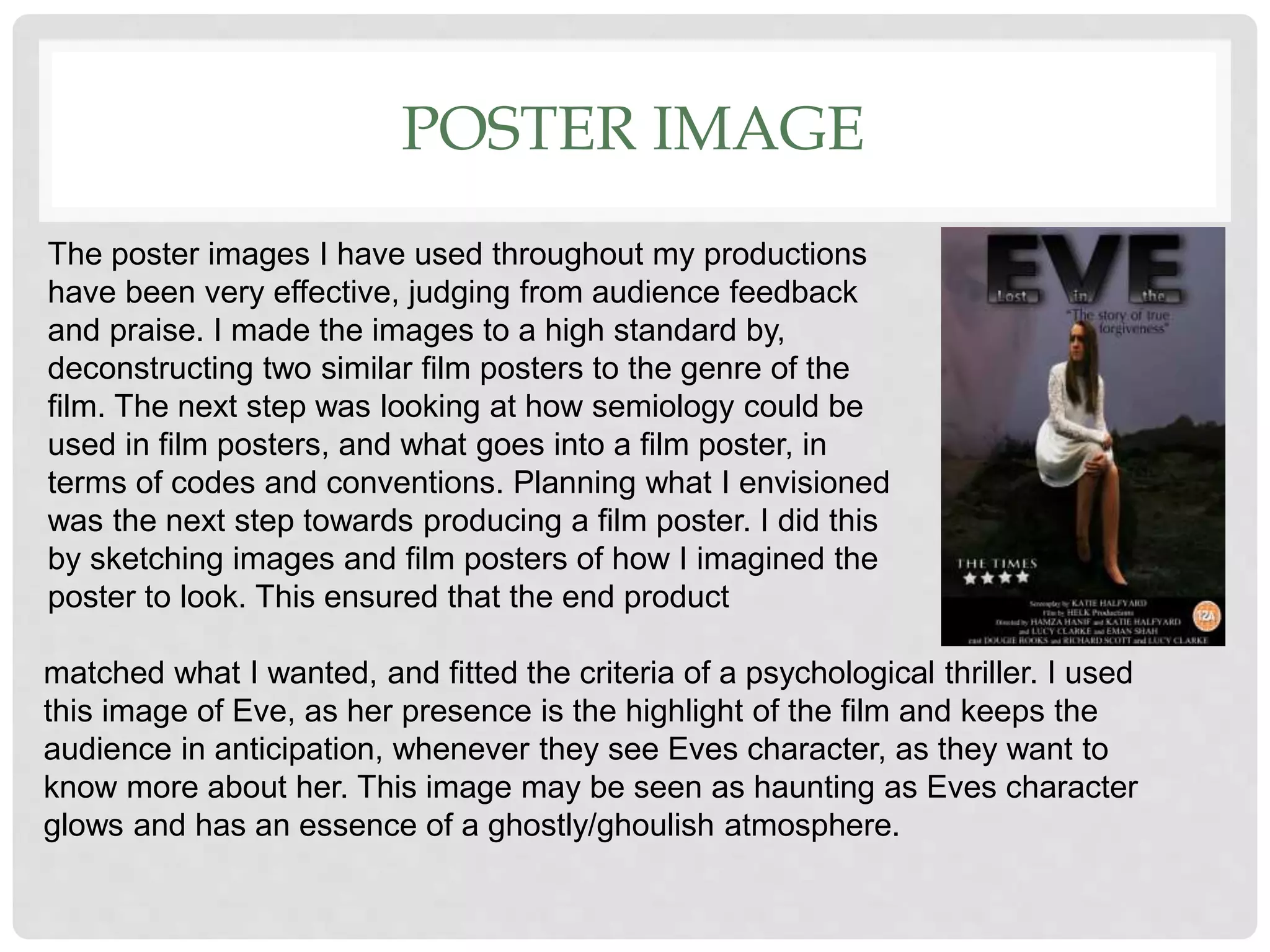
matched what I wanted, and fitted the criteria of a psychological thriller. I used
this image of Eve, as her presence is the highlight of the film and keeps the
audience in anticipation, whenever they see Eves character, as they want to
know more about her. This image may be seen as haunting as Eves character
glows and has an essence of a ghostly/ghoulish atmosphere.
The poster images I have used throughout my productions
have been very effective, judging from audience feedback
and praise. I made the images to a high standard by,
deconstructing two similar film posters to the genre of the
film. The next step was looking at how semiology could be
used in film posters, and what goes into a film poster, in
terms of codes and conventions. Planning what I envisioned
was the next step towards producing a film poster. I did this
by sketching images and film posters of how I imagined the
poster to look. This ensured that the end product
MISE EN SCENE
I added an era of Mise en Scene to the film poster by having
Eve sat on the moors. The moors may be a connotation of
being lost, as it is a big surrounding, which she is seen too
reflect from as she is only young. This is not a natural setting
for her to be in, resulting in being lost and further implies the
desolation of Eve and the genre projected into the film
poster. Also the secondary protagonist is introduced through
the use of mise en scene. Richards face is faded into the
poster. I lowered the opacity of his face in Photoshop, to
ensure that the audience isn’t distracted away from the main
image of Eve. This represents that he is the secondary
protagonists
PARADIGM/SYNTAGM
I used the semiology to represent the purity and youth of Eve by her costume being a white
dress. This further shows the paradigm were the choices that I could have made such as
having her is a red dress or black dress to portray danger or morbidity, but this was not the
message we wanted to connote, and didn’t fit the flow of the film. Also by having her in a
different colour, we loose the simplicity, purity and innocence, derived from Eve’s character.
This is why we made the syntagm (choice to have her is a white dress) as this brought back
the element of innocence and a ghostly image.
We then applied this to the costumes of the other two characters, as we wanted Richards
character to look laid back in what he was wearing, to imply that he was retired, and
comfortable and happy with the life he was leading.
We then applied this to David, as he had a scruffy appearance, which we asked if he could
keep his beard stubbly and not to shave. This connoted that he could not take care of
himself, as he was still grieving for the loss of his daughter and wife. This also indicated the
absence of a female role to support David's character. As there was no one left for him to
impress.
MAGAZINE IMAGE
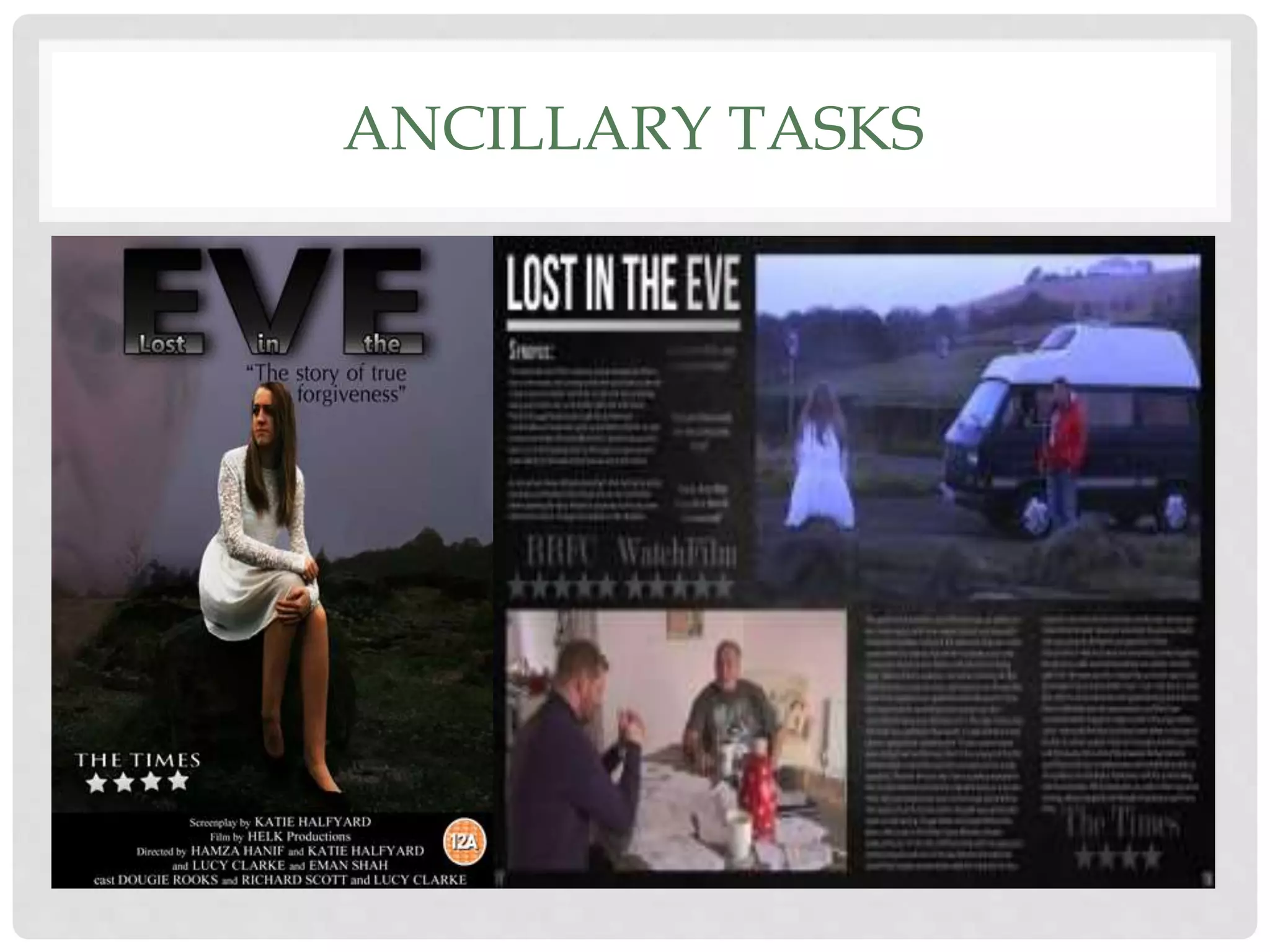
The images within the ancillary tasks portray the genre and
narrative of the film as I have inserted still images, taken directly
from the film onto the review. Myself and the group felt this was
important as it gives the audience a glimpse of what s to be
expected within the film, but doesn’t give too much of the
“thriller” aspect away. The images we used, were also subtle
hints to the narrative, as it shows Richard giving Eve his coat,
which highlights the importance of the coat and could further
represent the link between Eve and her father. I then used
another image of David(Eves father) and Richard on the
magazine review, to introduce David and to represent that
Richard could signify the link between Eve and her father. In
this scenario, we have related Richards character to being the
messenger, in terms of the Vladimir Propp film theory, as he is
the solid link in the film and carries the message that Eve loved
her father and wanted to reconcile with her father.
TEXTS
The text to my film poster, made the poster more effective as it ties everything in
together well and completes the overall theme. With the text, I tried to make the overall
layout fit together with the other aspects of the film poster, such as the colour scheme
and placement. The text looked effective as it followed the codes and conventions,
mainly in the placement, which meant that when the audience views the poster, they will
feel comfortable as the layout follows the conventions of any film poster. The genre is
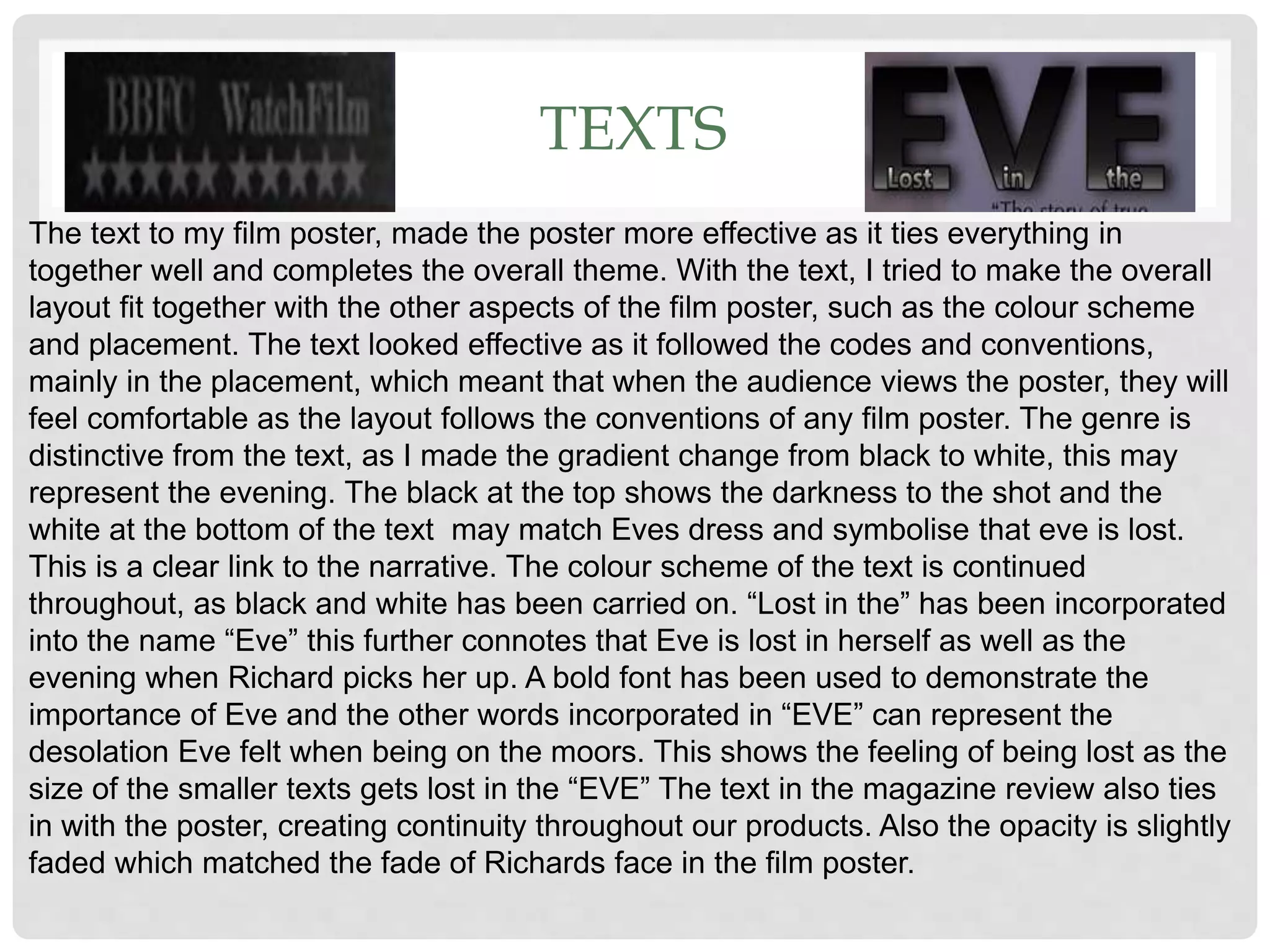
distinctive from the text, as I made the gradient change from black to white, this may
represent the evening. The black at the top shows the darkness to the shot and the
white at the bottom of the text may match Eves dress and symbolise that eve is lost.
This is a clear link to the narrative. The colour scheme of the text is continued
throughout, as black and white has been carried on. “Lost in the” has been incorporated
into the name “Eve” this further connotes that Eve is lost in herself as well as the
evening when Richard picks her up. A bold font has been used to demonstrate the
importance of Eve and the other words incorporated in “EVE” can represent the
desolation Eve felt when being on the moors. This shows the feeling of being lost as the
size of the smaller texts gets lost in the “EVE” The text in the magazine review also ties
in with the poster, creating continuity throughout our products. Also the opacity is slightly
faded which matched the fade of Richards face in the film poster.
COLOUR
The colour scheme of our film poster was effective, as it looks
professional and ties in well together. The colour scheme consisted of
dark colours, which represents the gloomy narrative and the morbidity
in our film. This consists of the colours, black, white and dark blue.
The white dress matches the white text, making the text pleasing to
the audiences eye, as it all ties in well together. This makes the genre
of the film more specific and clear to the audience. The colour scheme
shows continuity throughout the film poster and the magazine review.
The use of simplistic colours within the ancillary tasks also represent
the storyline in our short film production, as there are no bold colours
that distract the audience from the shot. This interprets the form of
style we have used in both the ancillary tasks and in the film. However,
the posters colours also signify the darkness of the film.
TYPE OF SHOT
The types of shots and camera angles have been used to
combine the ancillary tasks effectively with the film. I have
achieved this by planning the shot of Eve to be an eye
level, medium to long shot. By making it eye level, the
audience may feel they can relate to Eve, as they are on
the same level as her. This may encourage empathy from
the audience, towards Eve, as she looks cold and
vulnerable. This is also done within the film , when the
audience is introduced to Eve.
CONCLUSION
In conclusion, the ancillary tasks are an effective combination in terms
of representing our film, as the theme of psychological thriller, has
been continued throughout. A key part to combing our ancillary tasks
was the genre of the film. This worked effectively as the review quotes
the film as “unexpected” and “surprising” which can be expected from
a psychological thriller. We have represented Eve as scared and
vulnerable, which in the film, the audience find out that she is
because, the moors were a dangerous place for her, as she was killed
there. This again also references the film, making the poster tie into
the short film effectively. Richard looks worried in the film poster and
magazine review stills, this represents his character in the short film
effectively as, he is seen in a positive light and joyful, until he see’s
Eve. He then begins to worry and then is devastated when hearing the
news of Eve’s death. This is represented throughout the ancillary
tasks in the facial expressions of Richard.

Evaluation question 2

  • 1.
    L U CY C L A R K E EVALUATION QUESTION 2
  • 2.
    QUESTION How effective isthe combination of your main product and ancillary tasks?
  • 3.
  • 4.
    POSTER IMAGE matched whatI wanted, and fitted the criteria of a psychological thriller. I used this image of Eve, as her presence is the highlight of the film and keeps the audience in anticipation, whenever they see Eves character, as they want to know more about her. This image may be seen as haunting as Eves character glows and has an essence of a ghostly/ghoulish atmosphere. The poster images I have used throughout my productions have been very effective, judging from audience feedback and praise. I made the images to a high standard by, deconstructing two similar film posters to the genre of the film. The next step was looking at how semiology could be used in film posters, and what goes into a film poster, in terms of codes and conventions. Planning what I envisioned was the next step towards producing a film poster. I did this by sketching images and film posters of how I imagined the poster to look. This ensured that the end product
  • 5.
    MISE EN SCENE Iadded an era of Mise en Scene to the film poster by having Eve sat on the moors. The moors may be a connotation of being lost, as it is a big surrounding, which she is seen too reflect from as she is only young. This is not a natural setting for her to be in, resulting in being lost and further implies the desolation of Eve and the genre projected into the film poster. Also the secondary protagonist is introduced through the use of mise en scene. Richards face is faded into the poster. I lowered the opacity of his face in Photoshop, to ensure that the audience isn’t distracted away from the main image of Eve. This represents that he is the secondary protagonists
  • 6.
    PARADIGM/SYNTAGM I used thesemiology to represent the purity and youth of Eve by her costume being a white dress. This further shows the paradigm were the choices that I could have made such as having her is a red dress or black dress to portray danger or morbidity, but this was not the message we wanted to connote, and didn’t fit the flow of the film. Also by having her in a different colour, we loose the simplicity, purity and innocence, derived from Eve’s character. This is why we made the syntagm (choice to have her is a white dress) as this brought back the element of innocence and a ghostly image. We then applied this to the costumes of the other two characters, as we wanted Richards character to look laid back in what he was wearing, to imply that he was retired, and comfortable and happy with the life he was leading. We then applied this to David, as he had a scruffy appearance, which we asked if he could keep his beard stubbly and not to shave. This connoted that he could not take care of himself, as he was still grieving for the loss of his daughter and wife. This also indicated the absence of a female role to support David's character. As there was no one left for him to impress.
  • 7.
    MAGAZINE IMAGE The imageswithin the ancillary tasks portray the genre and narrative of the film as I have inserted still images, taken directly from the film onto the review. Myself and the group felt this was important as it gives the audience a glimpse of what s to be expected within the film, but doesn’t give too much of the “thriller” aspect away. The images we used, were also subtle hints to the narrative, as it shows Richard giving Eve his coat, which highlights the importance of the coat and could further represent the link between Eve and her father. I then used another image of David(Eves father) and Richard on the magazine review, to introduce David and to represent that Richard could signify the link between Eve and her father. In this scenario, we have related Richards character to being the messenger, in terms of the Vladimir Propp film theory, as he is the solid link in the film and carries the message that Eve loved her father and wanted to reconcile with her father.
  • 8.
    TEXTS The text tomy film poster, made the poster more effective as it ties everything in together well and completes the overall theme. With the text, I tried to make the overall layout fit together with the other aspects of the film poster, such as the colour scheme and placement. The text looked effective as it followed the codes and conventions, mainly in the placement, which meant that when the audience views the poster, they will feel comfortable as the layout follows the conventions of any film poster. The genre is distinctive from the text, as I made the gradient change from black to white, this may represent the evening. The black at the top shows the darkness to the shot and the white at the bottom of the text may match Eves dress and symbolise that eve is lost. This is a clear link to the narrative. The colour scheme of the text is continued throughout, as black and white has been carried on. “Lost in the” has been incorporated into the name “Eve” this further connotes that Eve is lost in herself as well as the evening when Richard picks her up. A bold font has been used to demonstrate the importance of Eve and the other words incorporated in “EVE” can represent the desolation Eve felt when being on the moors. This shows the feeling of being lost as the size of the smaller texts gets lost in the “EVE” The text in the magazine review also ties in with the poster, creating continuity throughout our products. Also the opacity is slightly faded which matched the fade of Richards face in the film poster.
  • 9.
    COLOUR The colour schemeof our film poster was effective, as it looks professional and ties in well together. The colour scheme consisted of dark colours, which represents the gloomy narrative and the morbidity in our film. This consists of the colours, black, white and dark blue. The white dress matches the white text, making the text pleasing to the audiences eye, as it all ties in well together. This makes the genre of the film more specific and clear to the audience. The colour scheme shows continuity throughout the film poster and the magazine review. The use of simplistic colours within the ancillary tasks also represent the storyline in our short film production, as there are no bold colours that distract the audience from the shot. This interprets the form of style we have used in both the ancillary tasks and in the film. However, the posters colours also signify the darkness of the film.
  • 10.
    TYPE OF SHOT Thetypes of shots and camera angles have been used to combine the ancillary tasks effectively with the film. I have achieved this by planning the shot of Eve to be an eye level, medium to long shot. By making it eye level, the audience may feel they can relate to Eve, as they are on the same level as her. This may encourage empathy from the audience, towards Eve, as she looks cold and vulnerable. This is also done within the film , when the audience is introduced to Eve.
  • 11.
    CONCLUSION In conclusion, theancillary tasks are an effective combination in terms of representing our film, as the theme of psychological thriller, has been continued throughout. A key part to combing our ancillary tasks was the genre of the film. This worked effectively as the review quotes the film as “unexpected” and “surprising” which can be expected from a psychological thriller. We have represented Eve as scared and vulnerable, which in the film, the audience find out that she is because, the moors were a dangerous place for her, as she was killed there. This again also references the film, making the poster tie into the short film effectively. Richard looks worried in the film poster and magazine review stills, this represents his character in the short film effectively as, he is seen in a positive light and joyful, until he see’s Eve. He then begins to worry and then is devastated when hearing the news of Eve’s death. This is represented throughout the ancillary tasks in the facial expressions of Richard.