Evaluation question 1
In what ways does your media product use, develop and
challenge forms and conventions of a real media product.
Throughout this essay, I will go into detail about what I have
done to ensure that I have conformed and at certain pints
challenged the conventions for a rock music magazine I order
to invoke a feeling in the reader so that they are likely to buy it.
Front cover
Masthead:
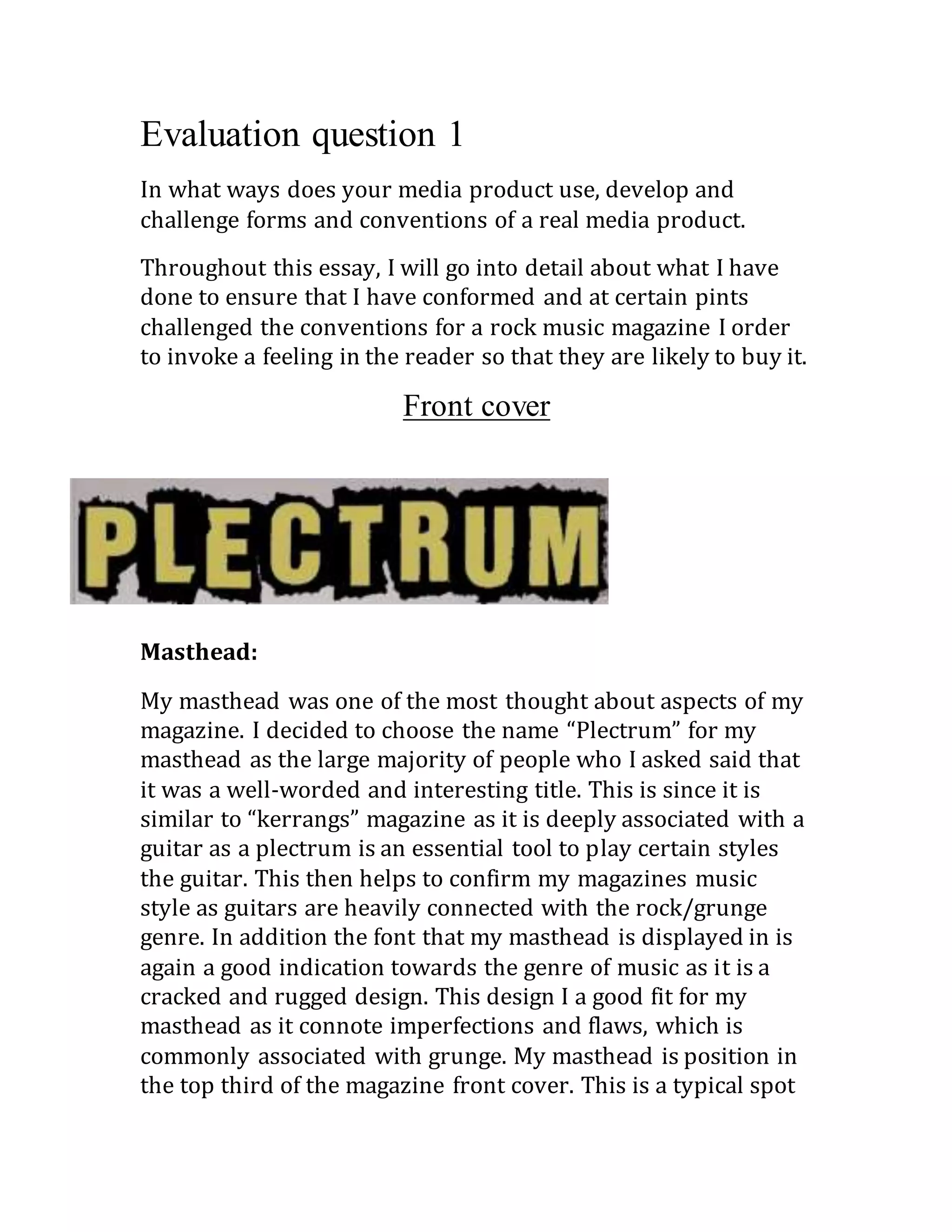
My masthead was one of the most thought about aspects of my
magazine. I decided to choose the name “Plectrum” for my
masthead as the large majority of people who I asked said that
it was a well-worded and interesting title. This is since it is
similar to “kerrangs” magazine as it is deeply associated with a
guitar as a plectrum is an essential tool to play certain styles
the guitar. This then helps to confirm my magazines music
style as guitars are heavily connected with the rock/grunge
genre. In addition the font that my masthead is displayed in is
again a good indication towards the genre of music as it is a
cracked and rugged design. This design I a good fit for my
masthead as it connote imperfections and flaws, which is
commonly associated with grunge. My masthead is position in
the top third of the magazine front cover. This is a typical spot
for mastheads to be placed, as it is clearly visible on the shelves
at shops. It also allows for a large space on the rest of the page
for other features such as th e main image and the cover lines.
Colour scheme:

The colour scheme that I originally chose had a large amount of
red in it and did not really do much for the magazine in the
terms of catching the eyes of the target audience However,
after testing other colours that went well with the dark red, I
found that gold complemented it nicely. This adds a sense of
classic rock as well as the modern rock and adds a sense of
prestige and royalty to the magazine further emphasizing the
great rock and roll artists. This will be especially useful in the
double page spread as the article inside talks about how that
min artist was influenced by the rock legends from the 70’s and
80’s. There is also a touch of black in the front cover so that it
will make the other colours and text stand out on the page
instead of blending into one.
Model:

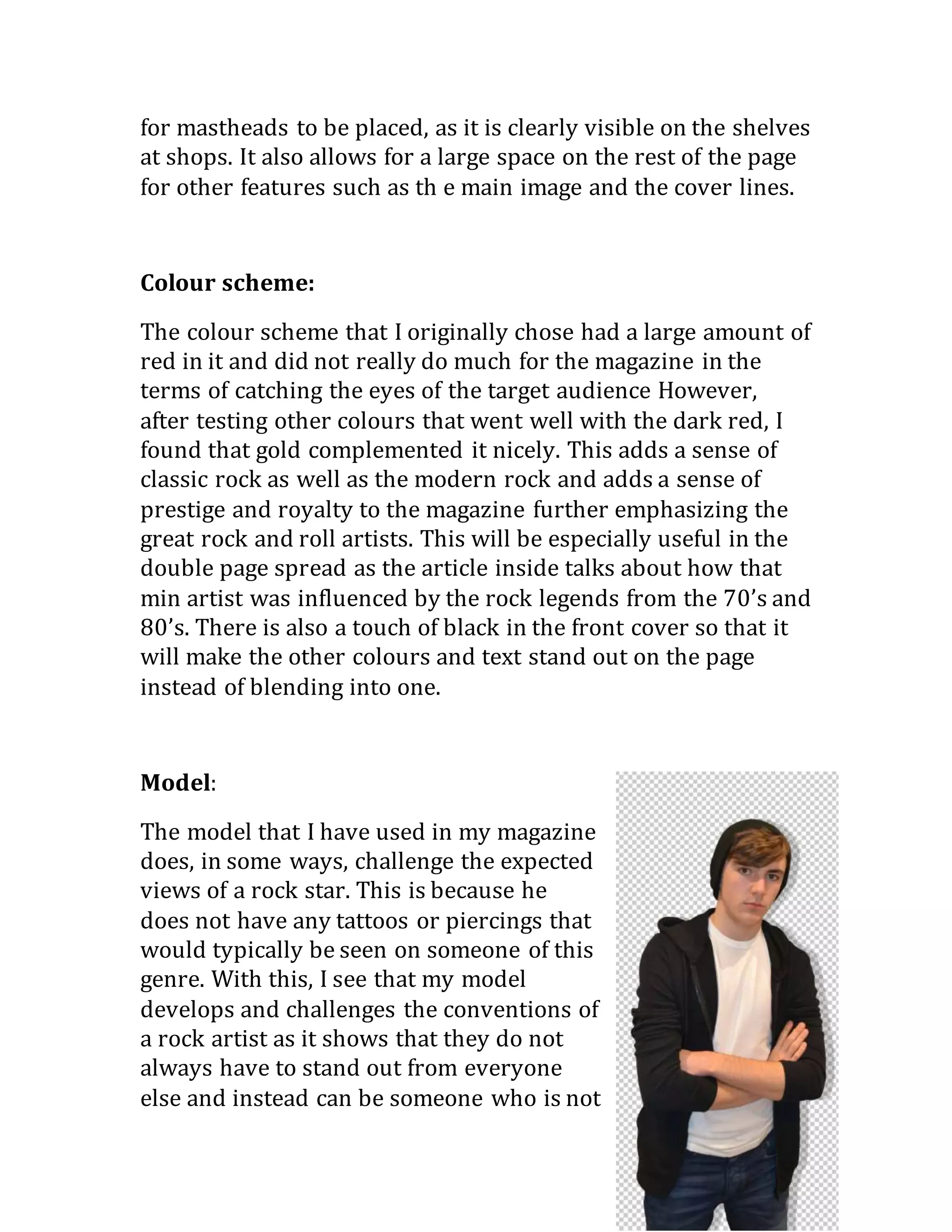
The model that I have used in my magazine
does, in some ways, challenge the expected
views of a rock star. This is because he
does not have any tattoos or piercings that
would typically be seen on someone of this
genre. With this, I see that my model
develops and challenges the conventions of
a rock artist as it shows that they do not
always have to stand out from everyone
else and instead can be someone who is not
likely to cause chaos. However, his clothing says otherwise as it
is excepted from a rock artist as he is wearing a simple white t
shirt and a black hoodie which shows that he still dresses the
appropriate way to be considered a rock star. In addition, I
have purposefully created a shadow on the min image to create
the feeling of a light source and give the magazine a greater
depth of field.
Skyline:
The skyline that I have created for my magazine cover uses the
conventions of a typical rock magazine as it is used to promote
the content, which can be found in the magazine. This also
allows me to attract the buyer’s attention, as they want to
receive a free poster so that they can get more out of the
magazine.
Main cover line:
My main cover line reads “Joe Torreno past, present and
future” this cover line is directly linked to he double page
spread which I have created as it references how his career
started. Where he is at and what we expect him to be like in the
future and what his new music will bring. Furthermore, the
masthead brings context to the main image and why that
person is found on the front cover.
Cover lines:
The cover lines on my magazine are located on the right hand
side of the page. This is typically where cover lines are found
on a magazine and therefore conform to the conventions of a
rock magazine. Furthermore, the cover lines have a consistent
font and all link to articles in the magazine with all of them
listing big name artists to attract the attention of any potential
readers. In addition, the cover lines also give a greater insight
into what is to expect in the magazine through the use of a
description of the article a pull quite which is linked to the
artist.
Contents page
Masthead:

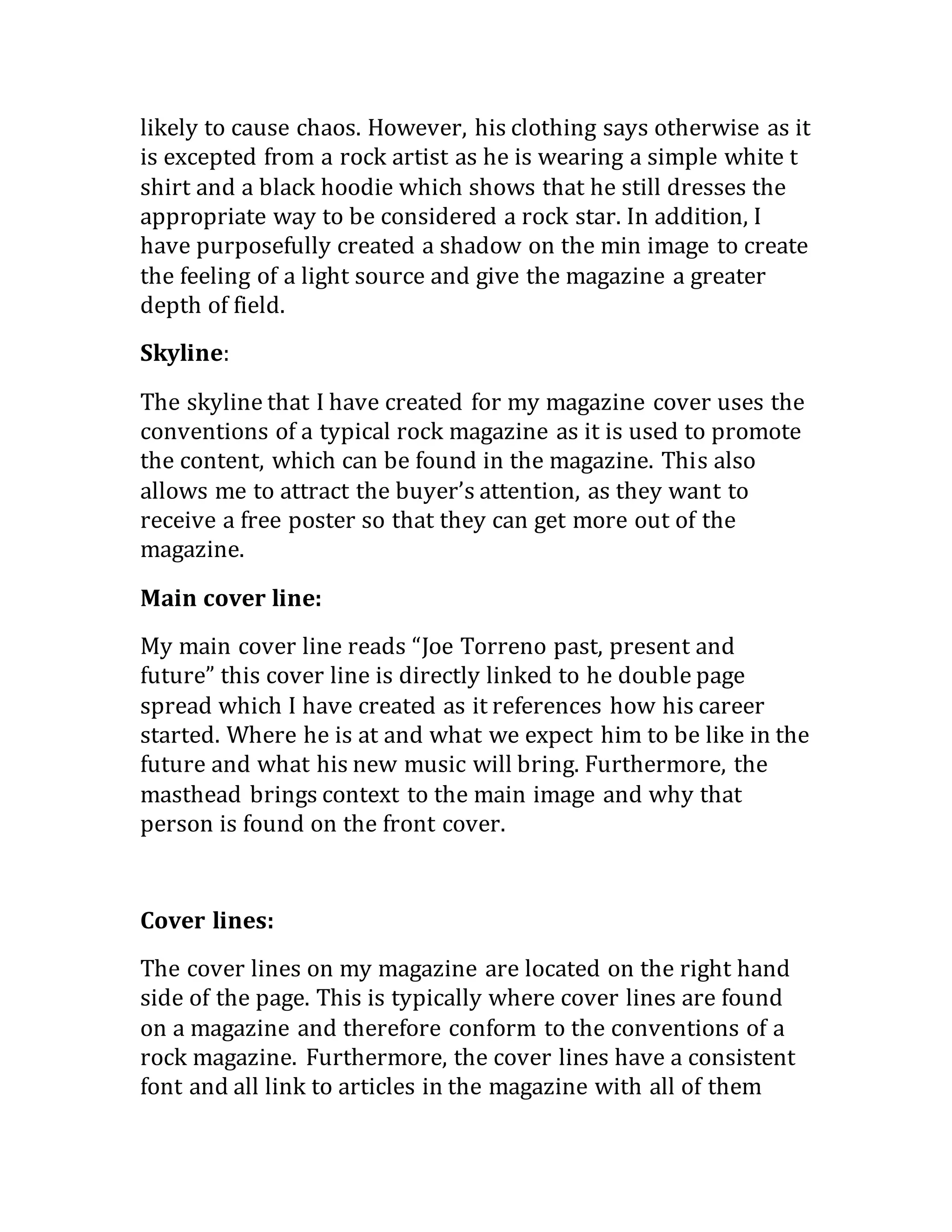
The masthead of my contents page is the same one that is
found in my cover page. However, I have added in the word
“contents” and used the colour red so that it is clear hat I have
a house style colour scheme of red and gold throughout my
magazine. In addition, the masthead is located in the top third
of the page where it would be expected to appear. This makes
it so that it is easy for the reader to clearly see what page they
are on and what it includes. The use of the masthead in this
way therefore means that the contents page is starting to
conform to the conventions of a magazine.
Page numbers and titles:

The actual contents aspect of this page is found on the left hand
side of the page. This is so that there is room on the page for
the reader to find what they re looking for but also space to put
in the main image. This way of laying out the contents practices
the conventions of a rock magazine as many contents pages
have all of their contents grouped together on one side of the
page so that they are easy for the reader to see and read.
However, the page numbers and titles also go against some
conventions, as many of them are located all around the page
whereas mine are just set to the left hand side of it.
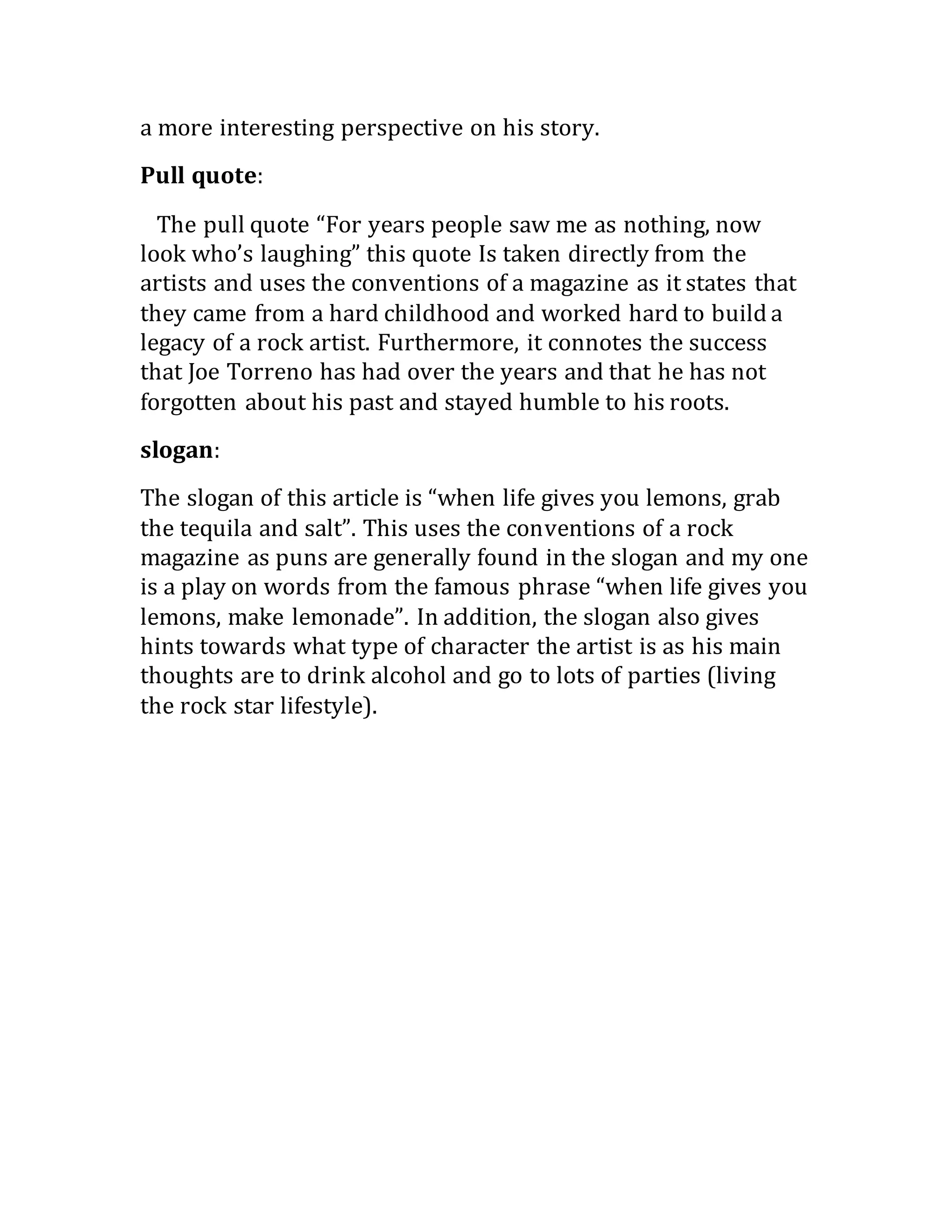
Main image:
The main image found on the contents page is similar to the
one found on the cover page in that
it is the same model which is being
used. This is so that the reader can
see a theme with this specific
magazine issue and notice that it is
based around his one artist and the
stories which he wants to tell.
Furthermore, this image uses the
conventions for a music magazine
more than the previous one as it
incudes a prop, an electric guitar.
This is generally found in a
magazine as the guitar is an iconic
symbol for rock and is instantly
associated with the genre.
Side images:

The smaller images on the contents page can be found towards
the right hand side of the page. Here they add more detail and
make the contents page seem more interesting to look at as the
reader can see a sneak peek at what the article is about. The
images are in side border, these are designed to look like old
Polaroid’s which have been burnt and roughed up over time.
This adds to the feel of the magazine making it feel more
rebellious and darker. Moreover, it helps the magazine show
that they include the older artists such as “Deff Leppard” who
have aged over the years.
Double page spread
Mise en scene of photo:
The main image on my double page spread is different to the
previous two images that have been shown in the magazine. It
still has the same model but the background has even kept and
the model is seen standing in front of a graffiti wall. This
challenges the conventions of a typical rock magazine, as they
are not usually seen in front of graffiti. However, the graffiti in
this image brings a feeling of punk rock. The models costume
has also changed to a button up shirt that has it sleeves rolled
up and a black t-shirt underneath. Even though the costume
has changed, it still uses the conventions of a rock artist as rock
stars are generally seen wearing dark clothing. The way that
my model is standing and his body language also shows that
this is a serious article and follows the conventions of many
other rock stars that have appeared in similar magazines.
Article:

The article is not a typical Q and A which would be seen in a
general rock magazine. Instead, my article is more of a coming
of age story where it tells the tale of how the artist featured on
the page came to be a rock god. This way the article develops
on the traditional ways of telling a story of the artist as it gives
a more interesting perspective on his story.
Pull quote:

 The pull quote “For years people saw me as nothing, now
look who’s laughing” this quote Is taken directly from the
artists and uses the conventions of a magazine as it states that
they came from a hard childhood and worked hard to build a
legacy of a rock artist. Furthermore, it connotes the success
that Joe Torreno has had over the years and that he has not
forgotten about his past and stayed humble to his roots.
slogan:

The slogan of this article is “when life gives you lemons, grab
the tequila and salt”. This uses the conventions of a rock
magazine as puns are generally found in the slogan and my one
is a play on words from the famous phrase “when life gives you
lemons, make lemonade”. In addition, the slogan also gives
hints towards what type of character the artist is as his main
thoughts are to drink alcohol and go to lots of parties (living
the rock star lifestyle).

Evaluation question 1

  • 1.
    Evaluation question 1 Inwhat ways does your media product use, develop and challenge forms and conventions of a real media product. Throughout this essay, I will go into detail about what I have done to ensure that I have conformed and at certain pints challenged the conventions for a rock music magazine I order to invoke a feeling in the reader so that they are likely to buy it. Front cover Masthead: My masthead was one of the most thought about aspects of my magazine. I decided to choose the name “Plectrum” for my masthead as the large majority of people who I asked said that it was a well-worded and interesting title. This is since it is similar to “kerrangs” magazine as it is deeply associated with a guitar as a plectrum is an essential tool to play certain styles the guitar. This then helps to confirm my magazines music style as guitars are heavily connected with the rock/grunge genre. In addition the font that my masthead is displayed in is again a good indication towards the genre of music as it is a cracked and rugged design. This design I a good fit for my masthead as it connote imperfections and flaws, which is commonly associated with grunge. My masthead is position in the top third of the magazine front cover. This is a typical spot
  • 2.
    for mastheads tobe placed, as it is clearly visible on the shelves at shops. It also allows for a large space on the rest of the page for other features such as th e main image and the cover lines. Colour scheme:
 The colour scheme that I originally chose had a large amount of red in it and did not really do much for the magazine in the terms of catching the eyes of the target audience However, after testing other colours that went well with the dark red, I found that gold complemented it nicely. This adds a sense of classic rock as well as the modern rock and adds a sense of prestige and royalty to the magazine further emphasizing the great rock and roll artists. This will be especially useful in the double page spread as the article inside talks about how that min artist was influenced by the rock legends from the 70’s and 80’s. There is also a touch of black in the front cover so that it will make the other colours and text stand out on the page instead of blending into one. Model:
 The model that I have used in my magazine does, in some ways, challenge the expected views of a rock star. This is because he does not have any tattoos or piercings that would typically be seen on someone of this genre. With this, I see that my model develops and challenges the conventions of a rock artist as it shows that they do not always have to stand out from everyone else and instead can be someone who is not
  • 3.
    likely to causechaos. However, his clothing says otherwise as it is excepted from a rock artist as he is wearing a simple white t shirt and a black hoodie which shows that he still dresses the appropriate way to be considered a rock star. In addition, I have purposefully created a shadow on the min image to create the feeling of a light source and give the magazine a greater depth of field. Skyline: The skyline that I have created for my magazine cover uses the conventions of a typical rock magazine as it is used to promote the content, which can be found in the magazine. This also allows me to attract the buyer’s attention, as they want to receive a free poster so that they can get more out of the magazine. Main cover line: My main cover line reads “Joe Torreno past, present and future” this cover line is directly linked to he double page spread which I have created as it references how his career started. Where he is at and what we expect him to be like in the future and what his new music will bring. Furthermore, the masthead brings context to the main image and why that person is found on the front cover. Cover lines: The cover lines on my magazine are located on the right hand side of the page. This is typically where cover lines are found on a magazine and therefore conform to the conventions of a rock magazine. Furthermore, the cover lines have a consistent font and all link to articles in the magazine with all of them
  • 4.
    listing big nameartists to attract the attention of any potential readers. In addition, the cover lines also give a greater insight into what is to expect in the magazine through the use of a description of the article a pull quite which is linked to the artist. Contents page Masthead:
 The masthead of my contents page is the same one that is found in my cover page. However, I have added in the word “contents” and used the colour red so that it is clear hat I have a house style colour scheme of red and gold throughout my magazine. In addition, the masthead is located in the top third of the page where it would be expected to appear. This makes it so that it is easy for the reader to clearly see what page they are on and what it includes. The use of the masthead in this way therefore means that the contents page is starting to conform to the conventions of a magazine. Page numbers and titles:
 The actual contents aspect of this page is found on the left hand side of the page. This is so that there is room on the page for the reader to find what they re looking for but also space to put in the main image. This way of laying out the contents practices
  • 5.
    the conventions ofa rock magazine as many contents pages have all of their contents grouped together on one side of the page so that they are easy for the reader to see and read. However, the page numbers and titles also go against some conventions, as many of them are located all around the page whereas mine are just set to the left hand side of it. Main image: The main image found on the contents page is similar to the one found on the cover page in that it is the same model which is being used. This is so that the reader can see a theme with this specific magazine issue and notice that it is based around his one artist and the stories which he wants to tell. Furthermore, this image uses the conventions for a music magazine more than the previous one as it incudes a prop, an electric guitar. This is generally found in a magazine as the guitar is an iconic symbol for rock and is instantly associated with the genre. Side images:
 The smaller images on the contents page can be found towards the right hand side of the page. Here they add more detail and make the contents page seem more interesting to look at as the reader can see a sneak peek at what the article is about. The
  • 6.
    images are inside border, these are designed to look like old Polaroid’s which have been burnt and roughed up over time. This adds to the feel of the magazine making it feel more rebellious and darker. Moreover, it helps the magazine show that they include the older artists such as “Deff Leppard” who have aged over the years. Double page spread Mise en scene of photo: The main image on my double page spread is different to the previous two images that have been shown in the magazine. It still has the same model but the background has even kept and the model is seen standing in front of a graffiti wall. This challenges the conventions of a typical rock magazine, as they are not usually seen in front of graffiti. However, the graffiti in this image brings a feeling of punk rock. The models costume has also changed to a button up shirt that has it sleeves rolled up and a black t-shirt underneath. Even though the costume has changed, it still uses the conventions of a rock artist as rock stars are generally seen wearing dark clothing. The way that my model is standing and his body language also shows that this is a serious article and follows the conventions of many other rock stars that have appeared in similar magazines. Article:
 The article is not a typical Q and A which would be seen in a general rock magazine. Instead, my article is more of a coming of age story where it tells the tale of how the artist featured on the page came to be a rock god. This way the article develops on the traditional ways of telling a story of the artist as it gives
  • 7.
    a more interestingperspective on his story. Pull quote: 
 The pull quote “For years people saw me as nothing, now look who’s laughing” this quote Is taken directly from the artists and uses the conventions of a magazine as it states that they came from a hard childhood and worked hard to build a legacy of a rock artist. Furthermore, it connotes the success that Joe Torreno has had over the years and that he has not forgotten about his past and stayed humble to his roots. slogan:
 The slogan of this article is “when life gives you lemons, grab the tequila and salt”. This uses the conventions of a rock magazine as puns are generally found in the slogan and my one is a play on words from the famous phrase “when life gives you lemons, make lemonade”. In addition, the slogan also gives hints towards what type of character the artist is as his main thoughts are to drink alcohol and go to lots of parties (living the rock star lifestyle).