Evaluation
Question 1
In what ways does your media product use,
develop or challenge forms and conventions
of real media products?
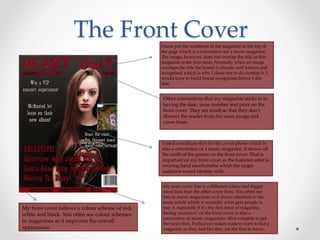
The Front CoverI have put the masthead of the magazine at the top of
the page which is a convention for a music magazine.
The image, however, does not overlap the title as this
magazine is the first issue. Normally when an image
overlaps the title the brand is already well known and
recognised which is why I chose not to do overlap it. I
would have to build brand recognition before I did
that.
Other conventions that my magazine sticks to is
having the date, issue number and price on the
front cover. They are small so that they don’t
distract the reader from the main image and
cover lines.
I used a medium shot for the cover photo which is
also a convention of a music magazine. It shows off
the outfit of the person on the front cover. That is
important on my front cover as the featured artist is
wearing band merchandise which the target
audience would identify with.
My main cover line is a different colour and bigger
sized font than the other cover lines. You often see
this in music magazines as it draws attention to the
main article which is normally what gets people to
buy it, especially if it’s the first issue of magazine.
Seeing ‘exclusive’ on the front cover is also a
convention as music magazines often compete to get
the news first. Exclusives makes readers want to but a
magazine as they feel like they are the first to know.
My front cover follows a colour scheme of red,
white and black. You often see colour schemes
in magazines as it improves the overall
appearance.
The Front Cover (2)
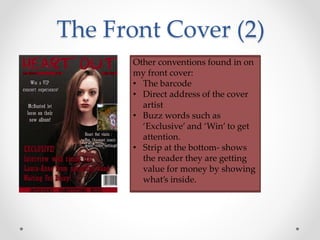
Other conventions found in on
my front cover:
• The barcode
• Direct address of the cover
artist
• Buzz words such as
‘Exclusive’ and ‘Win’ to get
attention.
• Strip at the bottom- shows
the reader they are getting
value for money by showing
what’s inside.
Contents Page
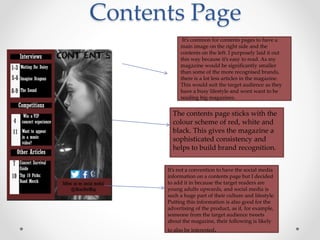
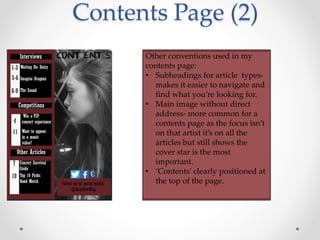
It’s common for contents pages to have a
main image on the right side and the
contents on the left. I purposely laid it out
this way because it’s easy to read. As my
magazine would be significantly smaller
than some of the more recognised brands,
there is a lot less articles in the magazine.
This would suit the target audience as they
have a busy lifestyle and wont want to be
reading big magazines.
It’s not a convention to have the social media
information on a contents page but I decided
to add it in because the target readers are
young adults upwards, and social media is
such a huge part of their culture and lifestyle.
Putting this information is also good for the
advertising of the product, as if, for example,
someone from the target audience tweets
about the magazine, their following is likely
to also be interested.
The contents page sticks with the
colour scheme of red, white and
black. This gives the magazine a
sophisticated consistency and
helps to build brand recognition.
Contents Page (2)
Other conventions used in my
contents page:
• Subheadings for article types-
makes it easier to navigate and
find what you’re looking for.
• Main image without direct
address- more common for a
contents page as the focus isn’t
on that artist it’s on all the
articles but still shows the
cover star is the most
important.
• ‘Contents’ clearly positioned at
the top of the page.
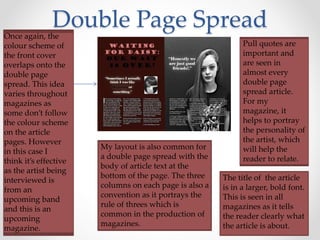
Double Page SpreadOnce again, the
colour scheme of
the front cover
overlaps onto the
double page
spread. This idea
varies throughout
magazines as
some don’t follow
the colour scheme
on the article
pages. However
in this case I
think it’s effective
as the artist being
interviewed is
from an
upcoming band
and this is an
upcoming
magazine.
Pull quotes are
important and
are seen in
almost every
double page
spread article.
For my
magazine, it
helps to portray
the personality of
the artist, which
will help the
reader to relate.
My layout is also common for
a double page spread with the
body of article text at the
bottom of the page. The three
columns on each page is also a
convention as it portrays the
rule of threes which is
common in the production of
magazines.
The title of the article
is in a larger, bold font.
This is seen in all
magazines as it tells
the reader clearly what
the article is about.
Double Page Spread (2)
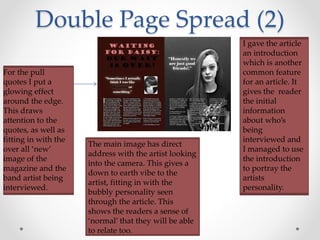
For the pull
quotes I put a
glowing effect
around the edge.
This draws
attention to the
quotes, as well as
fitting in with the
over all ‘new’
image of the
magazine and the
band artist being
interviewed.
I gave the article
an introduction
which is another
common feature
for an article. It
gives the reader
the initial
information
about who’s
being
interviewed and
I managed to use
the introduction
to portray the
artists
personality.
The main image has direct
address with the artist looking
into the camera. This gives a
down to earth vibe to the
artist, fitting in with the
bubbly personality seen
through the article. This
shows the readers a sense of
‘normal’ that they will be able
to relate too.

Evaluation question 1

  • 1.
    Evaluation Question 1 In whatways does your media product use, develop or challenge forms and conventions of real media products?
  • 2.
    The Front CoverIhave put the masthead of the magazine at the top of the page which is a convention for a music magazine. The image, however, does not overlap the title as this magazine is the first issue. Normally when an image overlaps the title the brand is already well known and recognised which is why I chose not to do overlap it. I would have to build brand recognition before I did that. Other conventions that my magazine sticks to is having the date, issue number and price on the front cover. They are small so that they don’t distract the reader from the main image and cover lines. I used a medium shot for the cover photo which is also a convention of a music magazine. It shows off the outfit of the person on the front cover. That is important on my front cover as the featured artist is wearing band merchandise which the target audience would identify with. My main cover line is a different colour and bigger sized font than the other cover lines. You often see this in music magazines as it draws attention to the main article which is normally what gets people to buy it, especially if it’s the first issue of magazine. Seeing ‘exclusive’ on the front cover is also a convention as music magazines often compete to get the news first. Exclusives makes readers want to but a magazine as they feel like they are the first to know. My front cover follows a colour scheme of red, white and black. You often see colour schemes in magazines as it improves the overall appearance.
  • 3.
    The Front Cover(2) Other conventions found in on my front cover: • The barcode • Direct address of the cover artist • Buzz words such as ‘Exclusive’ and ‘Win’ to get attention. • Strip at the bottom- shows the reader they are getting value for money by showing what’s inside.
  • 4.
    Contents Page It’s commonfor contents pages to have a main image on the right side and the contents on the left. I purposely laid it out this way because it’s easy to read. As my magazine would be significantly smaller than some of the more recognised brands, there is a lot less articles in the magazine. This would suit the target audience as they have a busy lifestyle and wont want to be reading big magazines. It’s not a convention to have the social media information on a contents page but I decided to add it in because the target readers are young adults upwards, and social media is such a huge part of their culture and lifestyle. Putting this information is also good for the advertising of the product, as if, for example, someone from the target audience tweets about the magazine, their following is likely to also be interested. The contents page sticks with the colour scheme of red, white and black. This gives the magazine a sophisticated consistency and helps to build brand recognition.
  • 5.
    Contents Page (2) Otherconventions used in my contents page: • Subheadings for article types- makes it easier to navigate and find what you’re looking for. • Main image without direct address- more common for a contents page as the focus isn’t on that artist it’s on all the articles but still shows the cover star is the most important. • ‘Contents’ clearly positioned at the top of the page.
  • 6.
    Double Page SpreadOnceagain, the colour scheme of the front cover overlaps onto the double page spread. This idea varies throughout magazines as some don’t follow the colour scheme on the article pages. However in this case I think it’s effective as the artist being interviewed is from an upcoming band and this is an upcoming magazine. Pull quotes are important and are seen in almost every double page spread article. For my magazine, it helps to portray the personality of the artist, which will help the reader to relate. My layout is also common for a double page spread with the body of article text at the bottom of the page. The three columns on each page is also a convention as it portrays the rule of threes which is common in the production of magazines. The title of the article is in a larger, bold font. This is seen in all magazines as it tells the reader clearly what the article is about.
  • 7.
    Double Page Spread(2) For the pull quotes I put a glowing effect around the edge. This draws attention to the quotes, as well as fitting in with the over all ‘new’ image of the magazine and the band artist being interviewed. I gave the article an introduction which is another common feature for an article. It gives the reader the initial information about who’s being interviewed and I managed to use the introduction to portray the artists personality. The main image has direct address with the artist looking into the camera. This gives a down to earth vibe to the artist, fitting in with the bubbly personality seen through the article. This shows the readers a sense of ‘normal’ that they will be able to relate too.