Task 2
Analyse the front cover of NME September 2009
The front cover
2a - Analyse the front cover of NME
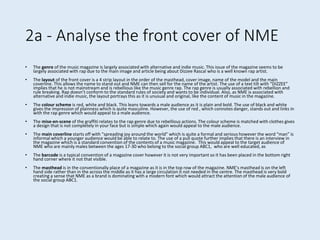
• The genre of the music magazine is largely associated with alternative and indie music. This issue of the magazine seems to be
largely associated with rap due to the main image and article being about Dizzee Rascal who is a well known rap artist.
• The layout of the front cover is a 4 strip layout in the order of the masthead, cover image, name of the model and the main
coverline. This allows the name to stand out and NME can then sell for the name of the artist. The use of a text tilt with “DIZZEE”
implies that he is not mainstream and is rebellious like the music genre rap. The rap genre is usually associated with rebellion and
rule breaking. Rap doesn’t conform to the standard rules of society and wants to be individual. Also, as NME is associated with
alternative and indie music, the layout portrays this as it is unusual and original, like the content of music in the magazine.
• The colour scheme is red, white and black. This leans towards a male audience as it is plain and bold. The use of black and white
gives the impression of plainness which is quite masculine. However, the use of red , which connotes danger, stands out and links in
with the rap genre which would appeal to a male audience.
• The mise-en-scene of the graffiti relates to the rap genre due to rebellious actions. The colour scheme is matched with clothes gives
a design that is not completely in your face but is simple which again would appeal to the male audience.
• The main coverline starts off with “spreading joy around the world” which is quite a formal and serious however the word “man” is
informal which a younger audience would be able to relate to. The use of a pull quote further implies that there is an interview in
the magazine which is a standard convention of the contents of a music magazine. This would appeal to the target audience of
NME who are mainly males between the ages 17-30 who belong to the social group ABC1, who are well educated, as
• The barcode is a typical convention of a magazine cover however it is not very important so it has been placed in the bottom right
hand corner where it not that visible.
• The masthead is in the conventionally place of a magazine as it is in the top row of the magazine. NME's masthead is on the left
hand side rather than in the across the middle as it has a large circulation it not needed in the centre. The masthead is very bold
creating a sense that NME as a brand is dominating with a modern font which would attract the attention of the male audience of
the social group ABC1.
2a continued
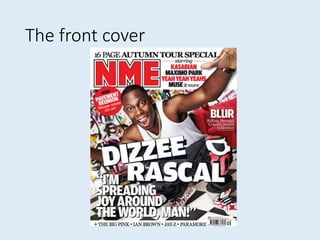
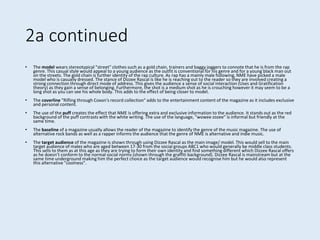
• The model wears stereotypical "street" clothes such as a gold chain, trainers and baggy joggers to connote that he is from the rap
genre. This casual style would appeal to a young audience as the outfit is conventional for his genre and for a young black man out
on the streets. The gold chain is further identity of the rap culture. As rap has a mainly male following, NME have picked a male
model who is casually dressed. The stance of Dizzee Rascal is like he is reaching out to the reader so they are involved creating a
strong connection through direct mode of address. This gives the audience a sense of social interaction (Uses and Gratification
theory) as they gain a sense of belonging. Furthermore, the shot is a medium shot as he is crouching however it may seem to be a
long shot as you can see his whole body. This adds to the effect of being closer to model.
• The coverline "Rifling through Coxon's record collection" adds to the entertainment content of the magazine as it includes exclusive
and personal content.
• The use of the puff creates the effect that NME is offering extra and exclusive information to the audience. It stands out as the red
background of the puff contrasts with the white writing. The use of the language, "wowee zozee" is informal but friendly at the
same time.
• The baseline of a magazine usually allows the reader of the magazine to identify the genre of the music magazine. The use of
alternative rock bands as well as a rapper informs the audience that the genre of NME is alternative and indie music.
• The target audience of the magazine is shown through using Dizzee Rascal as the main image/ model. This would sell to the main
target audience of males who are aged between 17-30 from the social groups ABC1 who would generally be middle class students.
This sells to them as at this age as they are trying to form their own identity and find something different which Dizzee Rascal offers
as he doesn’t conform to the normal social norms (shown through the graffiti background). Dizzee Rascal is mainstream but at the
same time underground making him the perfect choice as the target audience would recognise him but he would also represent
this alternative "coolness".
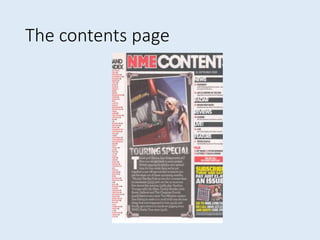
The contents page
Task 2b - The contents page
• Font : The contents page has used both sans serif for the headings and sub-headings which is typical for headings and also
used serif for the main body text. Sans serif has been used for the column on the right. This is plain but also looks bold and
chunky which gives a clean and clear design with the colours. This modern look would appeal to the target audience of males
in there 20’s. Throughout the whole of the contents page too, there are different font sizes and colours to vary the importance
of some of the writing and to create a more professional and neater look. By this I mean that the subheadings are all in
capitals, are in a white font and that contrasts with the black background strip. The font sizes and colours therefore show the
variety of topics that the magazine has included in its articles.
• Borders : The border around the photograph is a thin white border making it look old fashioned and like a physical photo
which has been stuck to the black background. This makes the photo seem like it is a real photo that they have collected in the
behind the scenes part of the tour.This is effective as it suggests that NME has behind the scenes access to share with the
reader. The black background is a flight case. This is an iconic object for music as it connotes tours and is therefore
metaphorical for the text on the flight case which is about tours.
• Language : Humour and irony are used to talk about British weather : “Thank god the sun has disappeared, eh?”. The
alliteration of “masterclass in messiness” adds to the fun of the language and gives an informal effect. Colloquial language of
“eh” gives off an informal, chatty and friendly effect showing that NME is not too serious. Also, the verbs "play" and "listen"
give a sense of action and dynamic interest. This gives the magazine energy and momentum. The collective pronoun of "we"
gives the magazine a semi-personal tone which allows the reader to feel connected to the writers. Finally, there is a use of
semantic field of the music business such as "touring", "tour bus" and "gigging" to fully create a concert like atmosphere.
• Main image : The main image seems to be the focal point of the contents page as it is the largest image and is in the
middle.The medium shot allows the reader to see the lady's expression which signifies how the magazine is trying to create
social interaction. As the subject of the text below is about touring, this signifies that NME will give the reader important
touring information. Also, the body language of the lady in the image create the impression that NME gives the reader behind
the stage access to touring information.
• Layout :It follows the rule of thirds to fit the conventional aspects of a music magazines contents page. The layout of the
contents page is neat and simple. This allows the reader to navigate easily through the magazine as it is a clear cut layout
which doesn’t look messy. This is shown through the columns of sub-headings and page numbers creating a sense of
professionalism because of the tidy layout.
2b continued
• Heading : The heading of "NME CONTENT" creates a brand identity due to the consistent colour scheme of
red, black and white. The heading would be consistently used with the same font, which is modern and bold,
giving the magazine a simple but effective design which would appeal to the male audience.
• Colour scheme : Like the front cover, the contents page uses black, red and white for its colour scheme. I think
this is an important aspect of the magazine as it creates what is known as a house style, making these colours
for the audience to be a colour scheme which they would often identify with the "NME" brand.
• Page numbers : Under the subheadings the enigmatic sentences are accompanied by page numbers. The main
function of the contents page is to provide the reader with information to where certain articles are located in
the magazine and what kind of topics are in the magazine. This is therefore an important convention for a
contents page.
• Issue and date: The date and issue number of a magazine is normally located at the top of the magazine near
the masthead so that the reader can notice it. This is a conventionally aspect of a magazine's contents page
and is important in informing the reader of how recent this magazine is.
• Subheadings : The subheadings are in a white block font against a black background which splits the page into
clear and neat sections for the reader. Below is a brief sentence with a page number which acts as an enigma
code (Barthas) as it only provides the reader with a small amount of information which will create curiosity and
they would want to find out the rest of the information.
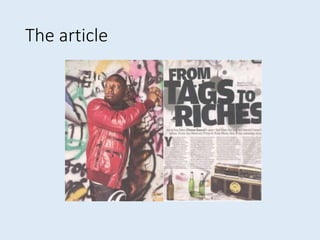
The article
Task 2c - The article
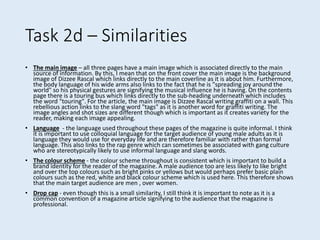
• The layout on the right hand page is separated into three different rows. The first is taken up by the title, the middle
section is the text of the article and the bottom row is of the background/setting of the main image. This is a very simple
and neat layout which shows the sophistication of the magazine. This would therefore appeal to the audience of high
education males.
• Additionally, the background and use of bottles as props would appeal to the target audience of males who are aged
between 17-30 as they can personally identify (Uses and Gratification theory) with the party atmosphere. Also, the use
of a retro stereo which is an old fashioned piece of equipment implies that the audience are going to be able to learn
information from Dizzie Rascal's past as this type of equipment is likely to be something from his childhood years.
• The main image is a medium shot of Dizzee Rascal spraying graffiti on the wall. This relates the rap genre as it is
stereotypically associated with people who are rebellious and graffiti on the street walls. Furthermore, the fact that he is
looking behind his shoulder suggests that he is up to no good. This links in with the appeal of Dizzee Rascal, as
mentioned before, the audience , who are trying to find their identity, would think that this is a quite dauntless action for
Rascal to do and may want to break social norms too. Another way to look at the main image is to link it with the
heading of the article : "From tags to riches". "From tags" may link to the graffiti which connotes a street lifestyle and
not being rich. However, "to riches" could be expressed through the props at the bottom on the right hand page as now
has a speaker and empty bear bottles, connoting his popularity due to his successful career. (This links in with his
egotistical rhetorical question from the article , "Where’s my f***ing name then?"). Therefore, there is no direct mode
of address which could represent Rascal is facing away from the graffiti life of his past.
• The language used is very simple which creates the impression that there is more focus on the main image Dizzee Rascal
which is further supported through the fact that the text writing is really small. The language used isn't over the top or
too sophisticated making it a simple read for the target audience. It is quite formal whilst using language that would be
used for males between 17-30.
• Page numbers are a typical and important convention of a magazine in order for the reader to understand where they
are in the magazine therefore adding to the professionalism of the brand effectively. The page numbers include the issue
date and "NME". This reminds the reader of NME all the time and creates brand loyalty to NME.
2c continued
• The article – the article itself gives the audience an insight into Dizzee Rascals life whilst also addressing
rumours that have been associated with him. The type of article is free flowing and is quite easy to read.
• Columns - a common convention for a magazine article to have is to arrange the copy of the article into neat
columns that are the same height and width. This is present in this double page spread. One way it does break
this convention though is through the fact that there are four columns. However, I still believe the columns
look neat and professional so this is not a major issue or problem.
• Credits - near the top of the page on the right hand corner, next to the heading, there are credits for the writer
of the article and the photographer. This is a common feature of an article in any magazine as it gives them
credit for the work they have produced.
• NME logo - near the bottom of the page on the left hand corner the NME logo is located next to the page
numbers. Even though it is barely visible and a reader may not notice it, it is an important aspect that runs
throughout the magazine. The reason why this is important is so that when the audience reads an article they
will recognize that it is by NME throughout the whole magazine as the logo is located on every page. Therefore,
when they read an article and they see the NME logo they are then likely to buy the magazine again if they see
the logo on a magazine in the shop as they recognize it.
• Heading - the font size of the heading is usually the biggest font size on the whole page to emphasize the
importance of it is. The heading is meant to short and snappy sentence in order to convince to the reader to
carry on reading the article. Therefore, by making the heading this big of a size which contrasts with the
article's small font size, the audience have no choice but to read the heading.
Task 2d – Similarities
• The main image – all three pages have a main image which is associated directly to the main
source of information. By this, I mean that on the front cover the main image is the background
image of Dizzee Rascal which links directly to the main coverline as it is about him. Furthermore,
the body language of his wide arms also links to the fact that he is "spreading joy around the
world" so his physical gestures are signifying the musical influence he is having. On the contents
page there is a touring bus which links directly to the sub-heading underneath which includes
the word "touring". For the article, the main image is Dizzee Rascal writing graffiti on a wall. This
rebellious action links to the slang word "tags" as it is another word for graffiti writing. The
image angles and shot sizes are different though which is important as it creates variety for the
reader, making each image appealing.
• Language - the language used throughout these pages of the magazine is quite informal. I think
it is important to use colloquial language for the target audience of young male adults as it is
language they would use for everyday life and are therefore familiar with rather than formal
language. This also links to the rap genre which can sometimes be associated with gang culture
who are stereotypically likely to use informal language and slang words.
• The colour scheme - the colour scheme throughout is consistent which is important to build a
brand identity for the reader of the magazine. A male audience too are less likely to like bright
and over the top colours such as bright pinks or yellows but would perhaps prefer basic plain
colours such as the red, white and black colour scheme which is used here. This therefore shows
that the main target audience are men , over women.
• Drop cap - even though this is a small similarity, I still think it is important to note as it is a
common convention of a magazine article signifying to the audience that the magazine is
professional.

Task 2a1

  • 1.
    Task 2 Analyse thefront cover of NME September 2009
  • 2.
  • 3.
    2a - Analysethe front cover of NME • The genre of the music magazine is largely associated with alternative and indie music. This issue of the magazine seems to be largely associated with rap due to the main image and article being about Dizzee Rascal who is a well known rap artist. • The layout of the front cover is a 4 strip layout in the order of the masthead, cover image, name of the model and the main coverline. This allows the name to stand out and NME can then sell for the name of the artist. The use of a text tilt with “DIZZEE” implies that he is not mainstream and is rebellious like the music genre rap. The rap genre is usually associated with rebellion and rule breaking. Rap doesn’t conform to the standard rules of society and wants to be individual. Also, as NME is associated with alternative and indie music, the layout portrays this as it is unusual and original, like the content of music in the magazine. • The colour scheme is red, white and black. This leans towards a male audience as it is plain and bold. The use of black and white gives the impression of plainness which is quite masculine. However, the use of red , which connotes danger, stands out and links in with the rap genre which would appeal to a male audience. • The mise-en-scene of the graffiti relates to the rap genre due to rebellious actions. The colour scheme is matched with clothes gives a design that is not completely in your face but is simple which again would appeal to the male audience. • The main coverline starts off with “spreading joy around the world” which is quite a formal and serious however the word “man” is informal which a younger audience would be able to relate to. The use of a pull quote further implies that there is an interview in the magazine which is a standard convention of the contents of a music magazine. This would appeal to the target audience of NME who are mainly males between the ages 17-30 who belong to the social group ABC1, who are well educated, as • The barcode is a typical convention of a magazine cover however it is not very important so it has been placed in the bottom right hand corner where it not that visible. • The masthead is in the conventionally place of a magazine as it is in the top row of the magazine. NME's masthead is on the left hand side rather than in the across the middle as it has a large circulation it not needed in the centre. The masthead is very bold creating a sense that NME as a brand is dominating with a modern font which would attract the attention of the male audience of the social group ABC1.
  • 4.
    2a continued • Themodel wears stereotypical "street" clothes such as a gold chain, trainers and baggy joggers to connote that he is from the rap genre. This casual style would appeal to a young audience as the outfit is conventional for his genre and for a young black man out on the streets. The gold chain is further identity of the rap culture. As rap has a mainly male following, NME have picked a male model who is casually dressed. The stance of Dizzee Rascal is like he is reaching out to the reader so they are involved creating a strong connection through direct mode of address. This gives the audience a sense of social interaction (Uses and Gratification theory) as they gain a sense of belonging. Furthermore, the shot is a medium shot as he is crouching however it may seem to be a long shot as you can see his whole body. This adds to the effect of being closer to model. • The coverline "Rifling through Coxon's record collection" adds to the entertainment content of the magazine as it includes exclusive and personal content. • The use of the puff creates the effect that NME is offering extra and exclusive information to the audience. It stands out as the red background of the puff contrasts with the white writing. The use of the language, "wowee zozee" is informal but friendly at the same time. • The baseline of a magazine usually allows the reader of the magazine to identify the genre of the music magazine. The use of alternative rock bands as well as a rapper informs the audience that the genre of NME is alternative and indie music. • The target audience of the magazine is shown through using Dizzee Rascal as the main image/ model. This would sell to the main target audience of males who are aged between 17-30 from the social groups ABC1 who would generally be middle class students. This sells to them as at this age as they are trying to form their own identity and find something different which Dizzee Rascal offers as he doesn’t conform to the normal social norms (shown through the graffiti background). Dizzee Rascal is mainstream but at the same time underground making him the perfect choice as the target audience would recognise him but he would also represent this alternative "coolness".
  • 5.
  • 6.
    Task 2b -The contents page • Font : The contents page has used both sans serif for the headings and sub-headings which is typical for headings and also used serif for the main body text. Sans serif has been used for the column on the right. This is plain but also looks bold and chunky which gives a clean and clear design with the colours. This modern look would appeal to the target audience of males in there 20’s. Throughout the whole of the contents page too, there are different font sizes and colours to vary the importance of some of the writing and to create a more professional and neater look. By this I mean that the subheadings are all in capitals, are in a white font and that contrasts with the black background strip. The font sizes and colours therefore show the variety of topics that the magazine has included in its articles. • Borders : The border around the photograph is a thin white border making it look old fashioned and like a physical photo which has been stuck to the black background. This makes the photo seem like it is a real photo that they have collected in the behind the scenes part of the tour.This is effective as it suggests that NME has behind the scenes access to share with the reader. The black background is a flight case. This is an iconic object for music as it connotes tours and is therefore metaphorical for the text on the flight case which is about tours. • Language : Humour and irony are used to talk about British weather : “Thank god the sun has disappeared, eh?”. The alliteration of “masterclass in messiness” adds to the fun of the language and gives an informal effect. Colloquial language of “eh” gives off an informal, chatty and friendly effect showing that NME is not too serious. Also, the verbs "play" and "listen" give a sense of action and dynamic interest. This gives the magazine energy and momentum. The collective pronoun of "we" gives the magazine a semi-personal tone which allows the reader to feel connected to the writers. Finally, there is a use of semantic field of the music business such as "touring", "tour bus" and "gigging" to fully create a concert like atmosphere. • Main image : The main image seems to be the focal point of the contents page as it is the largest image and is in the middle.The medium shot allows the reader to see the lady's expression which signifies how the magazine is trying to create social interaction. As the subject of the text below is about touring, this signifies that NME will give the reader important touring information. Also, the body language of the lady in the image create the impression that NME gives the reader behind the stage access to touring information. • Layout :It follows the rule of thirds to fit the conventional aspects of a music magazines contents page. The layout of the contents page is neat and simple. This allows the reader to navigate easily through the magazine as it is a clear cut layout which doesn’t look messy. This is shown through the columns of sub-headings and page numbers creating a sense of professionalism because of the tidy layout.
  • 7.
    2b continued • Heading: The heading of "NME CONTENT" creates a brand identity due to the consistent colour scheme of red, black and white. The heading would be consistently used with the same font, which is modern and bold, giving the magazine a simple but effective design which would appeal to the male audience. • Colour scheme : Like the front cover, the contents page uses black, red and white for its colour scheme. I think this is an important aspect of the magazine as it creates what is known as a house style, making these colours for the audience to be a colour scheme which they would often identify with the "NME" brand. • Page numbers : Under the subheadings the enigmatic sentences are accompanied by page numbers. The main function of the contents page is to provide the reader with information to where certain articles are located in the magazine and what kind of topics are in the magazine. This is therefore an important convention for a contents page. • Issue and date: The date and issue number of a magazine is normally located at the top of the magazine near the masthead so that the reader can notice it. This is a conventionally aspect of a magazine's contents page and is important in informing the reader of how recent this magazine is. • Subheadings : The subheadings are in a white block font against a black background which splits the page into clear and neat sections for the reader. Below is a brief sentence with a page number which acts as an enigma code (Barthas) as it only provides the reader with a small amount of information which will create curiosity and they would want to find out the rest of the information.
  • 8.
  • 9.
    Task 2c -The article • The layout on the right hand page is separated into three different rows. The first is taken up by the title, the middle section is the text of the article and the bottom row is of the background/setting of the main image. This is a very simple and neat layout which shows the sophistication of the magazine. This would therefore appeal to the audience of high education males. • Additionally, the background and use of bottles as props would appeal to the target audience of males who are aged between 17-30 as they can personally identify (Uses and Gratification theory) with the party atmosphere. Also, the use of a retro stereo which is an old fashioned piece of equipment implies that the audience are going to be able to learn information from Dizzie Rascal's past as this type of equipment is likely to be something from his childhood years. • The main image is a medium shot of Dizzee Rascal spraying graffiti on the wall. This relates the rap genre as it is stereotypically associated with people who are rebellious and graffiti on the street walls. Furthermore, the fact that he is looking behind his shoulder suggests that he is up to no good. This links in with the appeal of Dizzee Rascal, as mentioned before, the audience , who are trying to find their identity, would think that this is a quite dauntless action for Rascal to do and may want to break social norms too. Another way to look at the main image is to link it with the heading of the article : "From tags to riches". "From tags" may link to the graffiti which connotes a street lifestyle and not being rich. However, "to riches" could be expressed through the props at the bottom on the right hand page as now has a speaker and empty bear bottles, connoting his popularity due to his successful career. (This links in with his egotistical rhetorical question from the article , "Where’s my f***ing name then?"). Therefore, there is no direct mode of address which could represent Rascal is facing away from the graffiti life of his past. • The language used is very simple which creates the impression that there is more focus on the main image Dizzee Rascal which is further supported through the fact that the text writing is really small. The language used isn't over the top or too sophisticated making it a simple read for the target audience. It is quite formal whilst using language that would be used for males between 17-30. • Page numbers are a typical and important convention of a magazine in order for the reader to understand where they are in the magazine therefore adding to the professionalism of the brand effectively. The page numbers include the issue date and "NME". This reminds the reader of NME all the time and creates brand loyalty to NME.
  • 10.
    2c continued • Thearticle – the article itself gives the audience an insight into Dizzee Rascals life whilst also addressing rumours that have been associated with him. The type of article is free flowing and is quite easy to read. • Columns - a common convention for a magazine article to have is to arrange the copy of the article into neat columns that are the same height and width. This is present in this double page spread. One way it does break this convention though is through the fact that there are four columns. However, I still believe the columns look neat and professional so this is not a major issue or problem. • Credits - near the top of the page on the right hand corner, next to the heading, there are credits for the writer of the article and the photographer. This is a common feature of an article in any magazine as it gives them credit for the work they have produced. • NME logo - near the bottom of the page on the left hand corner the NME logo is located next to the page numbers. Even though it is barely visible and a reader may not notice it, it is an important aspect that runs throughout the magazine. The reason why this is important is so that when the audience reads an article they will recognize that it is by NME throughout the whole magazine as the logo is located on every page. Therefore, when they read an article and they see the NME logo they are then likely to buy the magazine again if they see the logo on a magazine in the shop as they recognize it. • Heading - the font size of the heading is usually the biggest font size on the whole page to emphasize the importance of it is. The heading is meant to short and snappy sentence in order to convince to the reader to carry on reading the article. Therefore, by making the heading this big of a size which contrasts with the article's small font size, the audience have no choice but to read the heading.
  • 11.
    Task 2d –Similarities • The main image – all three pages have a main image which is associated directly to the main source of information. By this, I mean that on the front cover the main image is the background image of Dizzee Rascal which links directly to the main coverline as it is about him. Furthermore, the body language of his wide arms also links to the fact that he is "spreading joy around the world" so his physical gestures are signifying the musical influence he is having. On the contents page there is a touring bus which links directly to the sub-heading underneath which includes the word "touring". For the article, the main image is Dizzee Rascal writing graffiti on a wall. This rebellious action links to the slang word "tags" as it is another word for graffiti writing. The image angles and shot sizes are different though which is important as it creates variety for the reader, making each image appealing. • Language - the language used throughout these pages of the magazine is quite informal. I think it is important to use colloquial language for the target audience of young male adults as it is language they would use for everyday life and are therefore familiar with rather than formal language. This also links to the rap genre which can sometimes be associated with gang culture who are stereotypically likely to use informal language and slang words. • The colour scheme - the colour scheme throughout is consistent which is important to build a brand identity for the reader of the magazine. A male audience too are less likely to like bright and over the top colours such as bright pinks or yellows but would perhaps prefer basic plain colours such as the red, white and black colour scheme which is used here. This therefore shows that the main target audience are men , over women. • Drop cap - even though this is a small similarity, I still think it is important to note as it is a common convention of a magazine article signifying to the audience that the magazine is professional.