By Beth Ivison
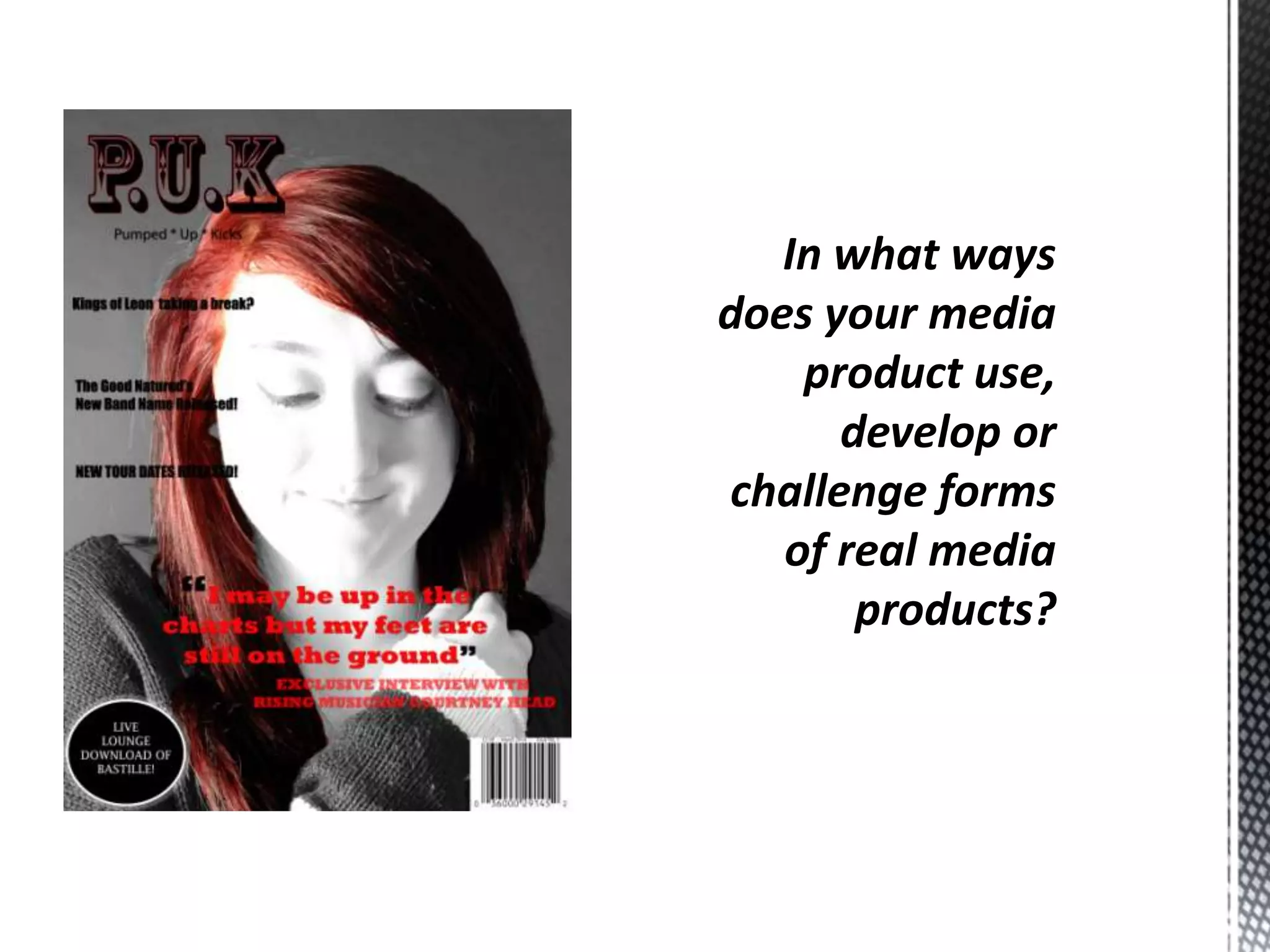
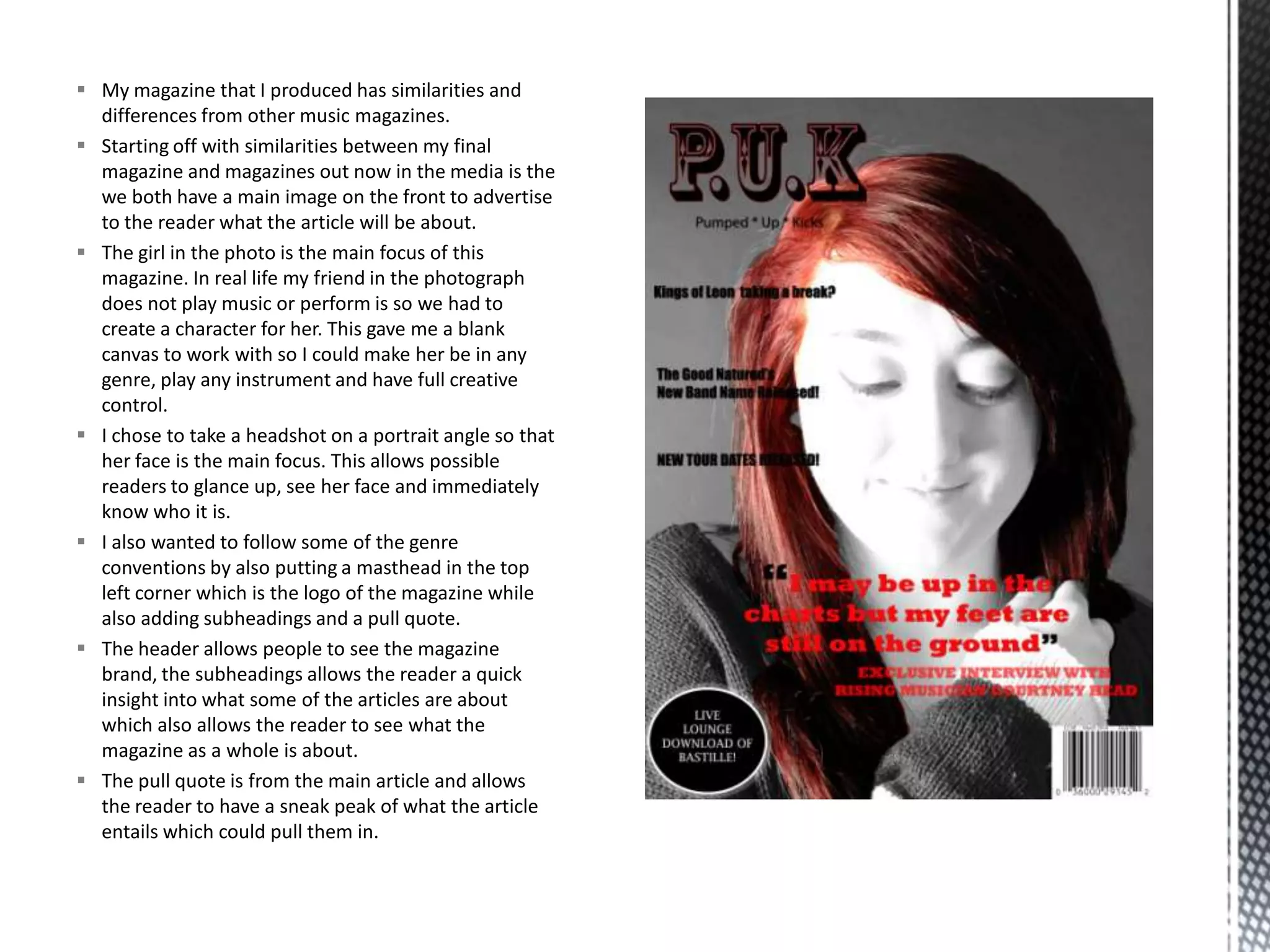
 My magazine that I produced has similarities and
differences from other music magazines.
 Starting off with similarities between my final
magazine and magazines out now in the media is the
we both have a main image on the front to advertise
to the reader what the article will be about.
 The girl in the photo is the main focus of this
magazine. In real life my friend in the photograph
does not play music or perform is so we had to
create a character for her. This gave me a blank
canvas to work with so I could make her be in any
genre, play any instrument and have full creative
control.
 I chose to take a headshot on a portrait angle so that
her face is the main focus. This allows possible
readers to glance up, see her face and immediately
know who it is.
 I also wanted to follow some of the genre
conventions by also putting a masthead in the top
left corner which is the logo of the magazine while
also adding subheadings and a pull quote.
 The header allows people to see the magazine
brand, the subheadings allows the reader a quick
insight into what some of the articles are about
which also allows the reader to see what the
magazine as a whole is about.
 The pull quote is from the main article and allows
the reader to have a sneak peak of what the article
entails which could pull them in.
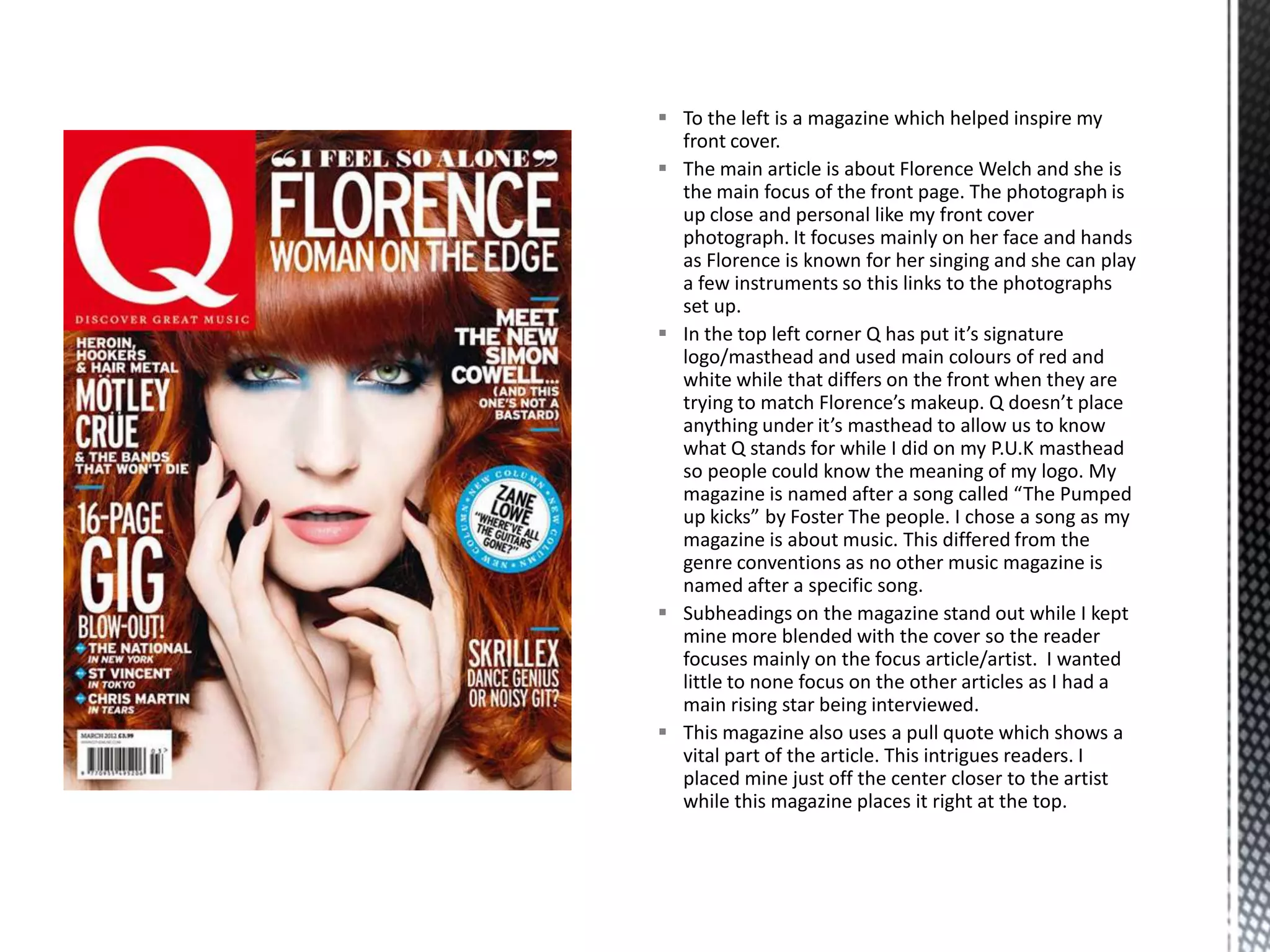
 To the left is a magazine which helped inspire my
front cover.
 The main article is about Florence Welch and she is
the main focus of the front page. The photograph is
up close and personal like my front cover
photograph. It focuses mainly on her face and hands
as Florence is known for her singing and she can play
a few instruments so this links to the photographs
set up.
 In the top left corner Q has put it’s signature
logo/masthead and used main colours of red and
white while that differs on the front when they are
trying to match Florence’s makeup. Q doesn’t place
anything under it’s masthead to allow us to know
what Q stands for while I did on my P.U.K masthead
so people could know the meaning of my logo. My
magazine is named after a song called “The Pumped
up kicks” by Foster The people. I chose a song as my
magazine is about music. This differed from the
genre conventions as no other music magazine is
named after a specific song.
 Subheadings on the magazine stand out while I kept
mine more blended with the cover so the reader
focuses mainly on the focus article/artist. I wanted
little to none focus on the other articles as I had a
main rising star being interviewed.
 This magazine also uses a pull quote which shows a
vital part of the article. This intrigues readers. I
placed mine just off the center closer to the artist
while this magazine places it right at the top.
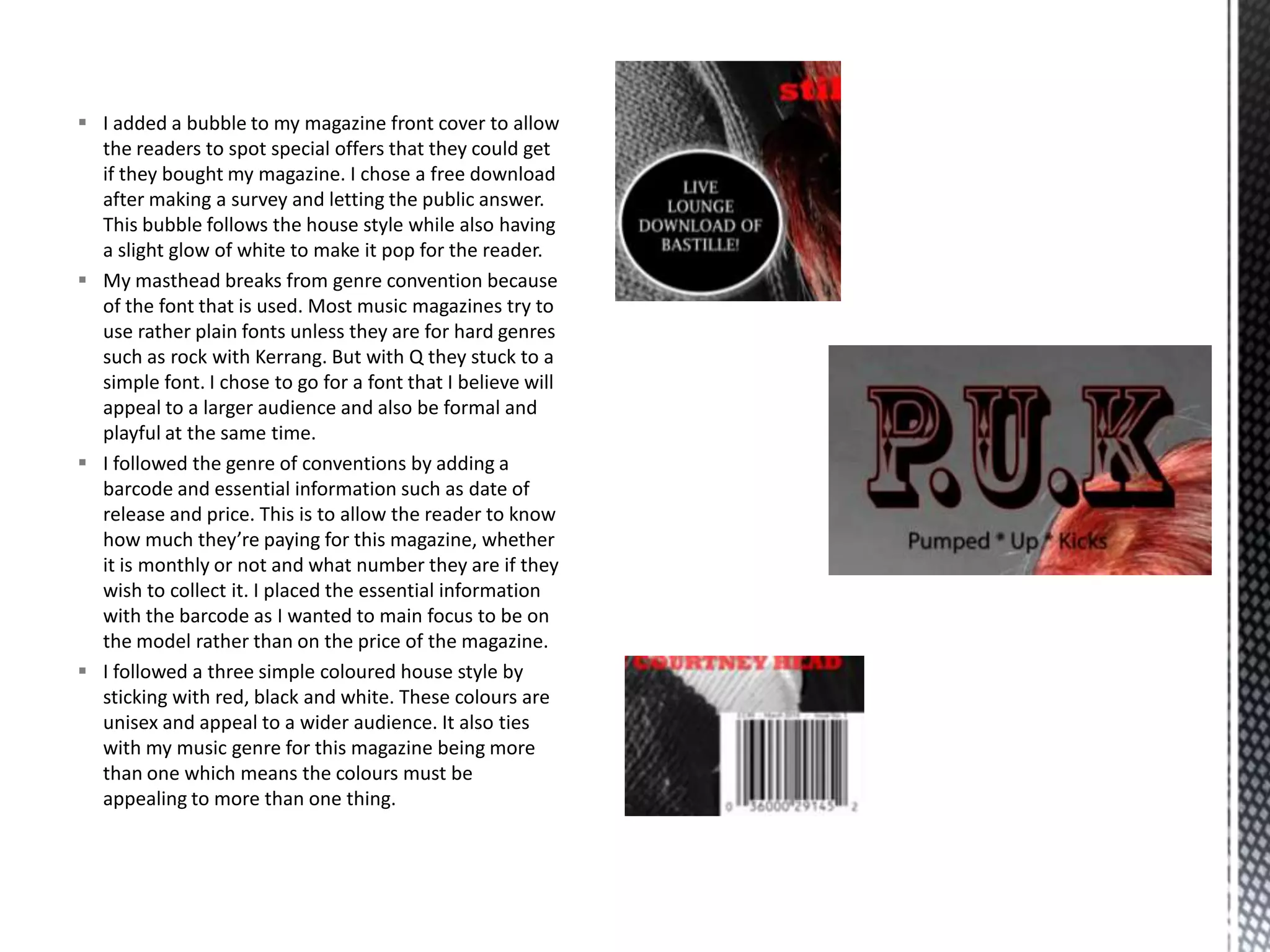
 I added a bubble to my magazine front cover to allow
the readers to spot special offers that they could get
if they bought my magazine. I chose a free download
after making a survey and letting the public answer.
This bubble follows the house style while also having
a slight glow of white to make it pop for the reader.
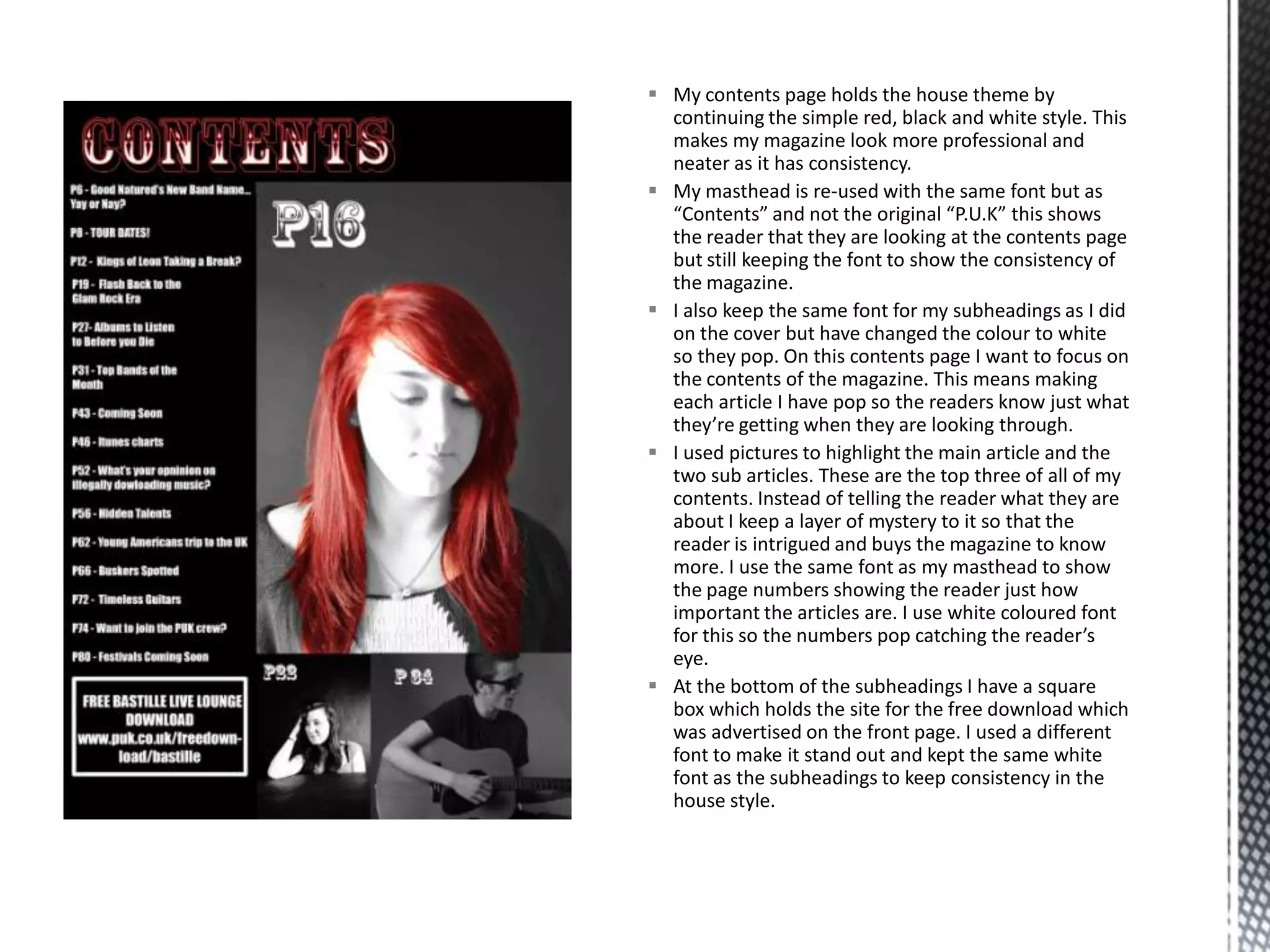
 My masthead breaks from genre convention because
of the font that is used. Most music magazines try to
use rather plain fonts unless they are for hard genres
such as rock with Kerrang. But with Q they stuck to a
simple font. I chose to go for a font that I believe will
appeal to a larger audience and also be formal and
playful at the same time.
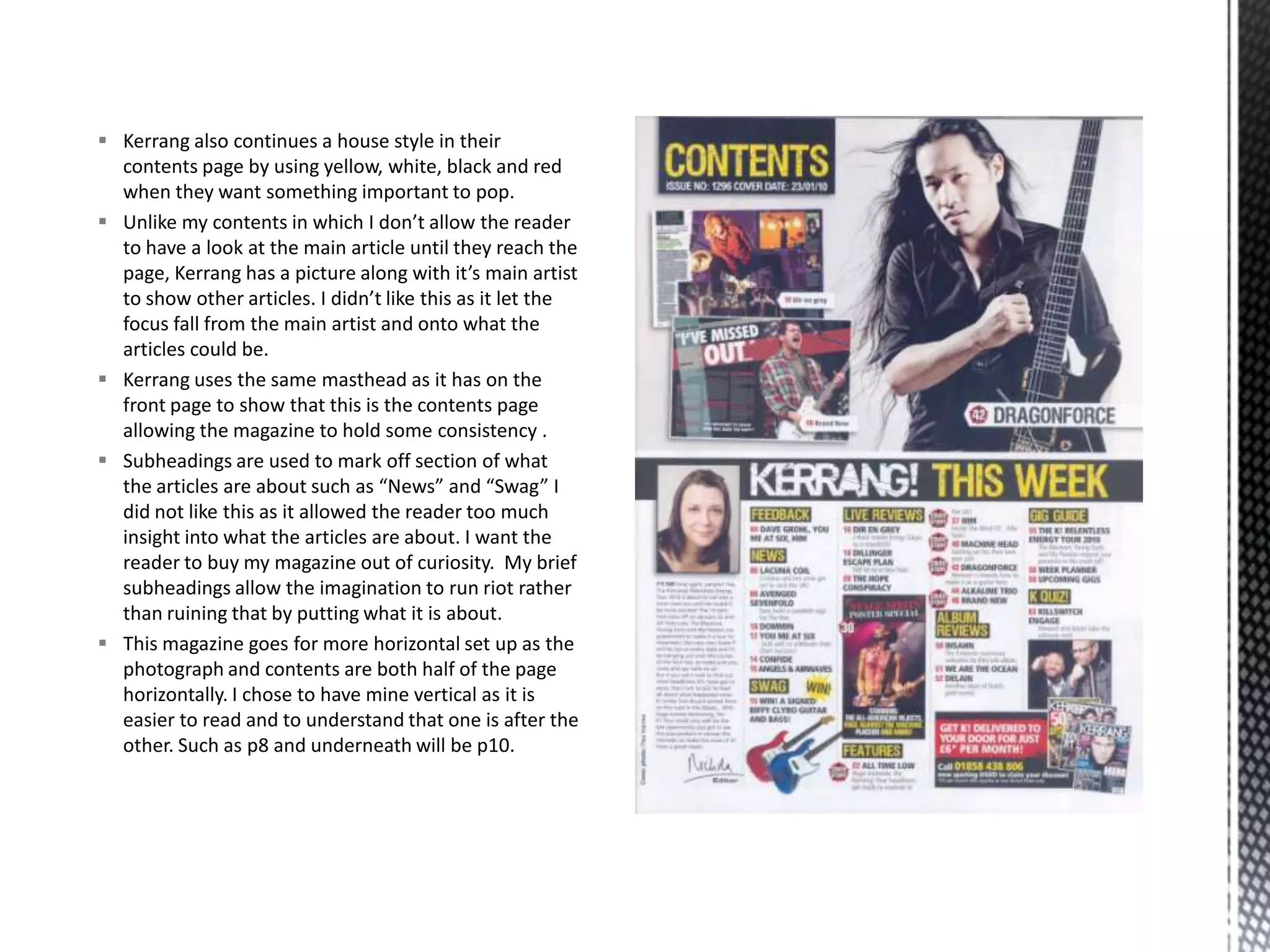
 I followed the genre of conventions by adding a
barcode and essential information such as date of
release and price. This is to allow the reader to know
how much they’re paying for this magazine, whether
it is monthly or not and what number they are if they
wish to collect it. I placed the essential information
with the barcode as I wanted to main focus to be on
the model rather than on the price of the magazine.
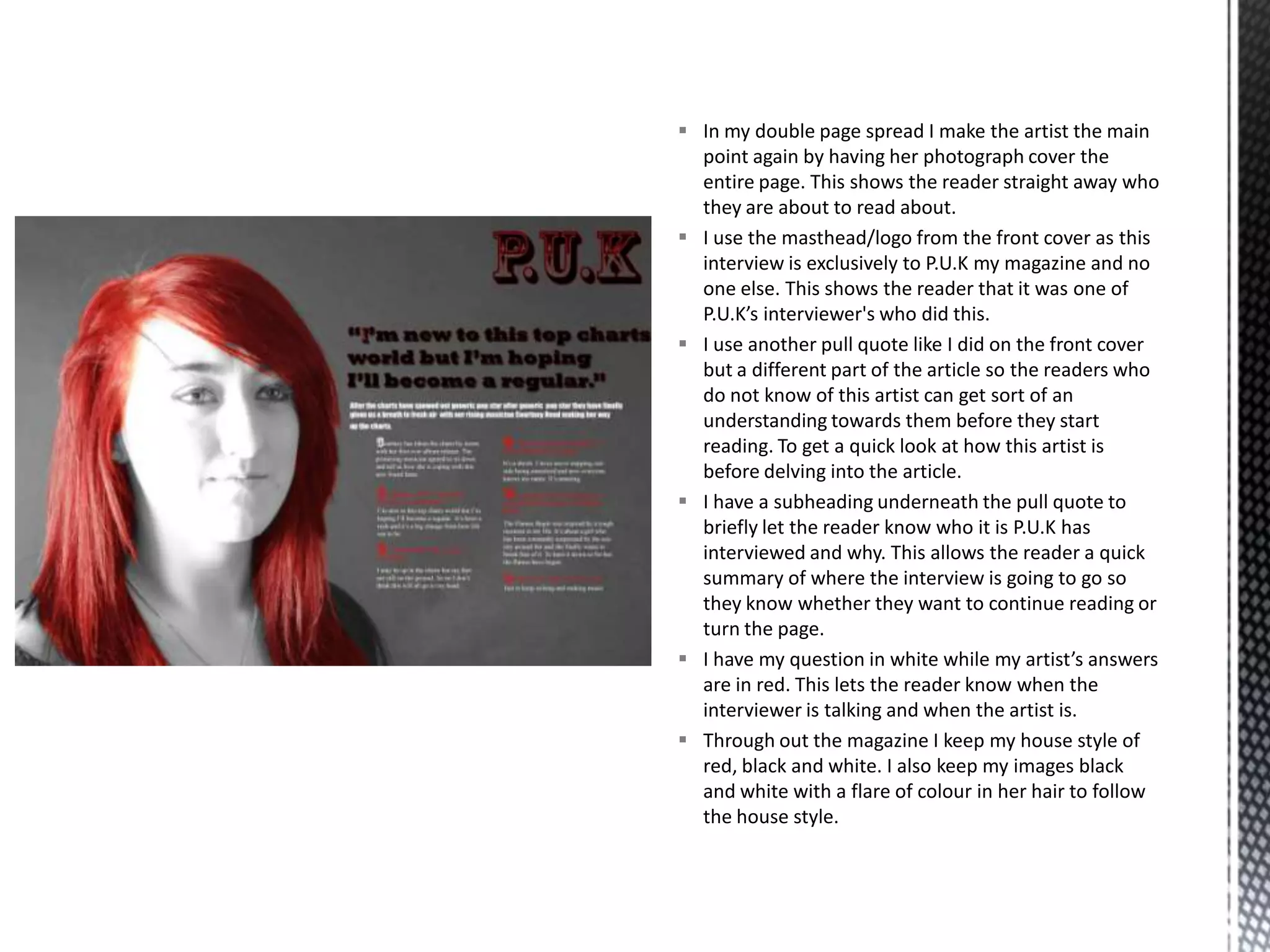
 I followed a three simple coloured house style by
sticking with red, black and white. These colours are
unisex and appeal to a wider audience. It also ties
with my music genre for this magazine being more
than one which means the colours must be
appealing to more than one thing.
 My contents page holds the house theme by
continuing the simple red, black and white style. This
makes my magazine look more professional and
neater as it has consistency.
 My masthead is re-used with the same font but as
“Contents” and not the original “P.U.K” this shows
the reader that they are looking at the contents page
but still keeping the font to show the consistency of
the magazine.
 I also keep the same font for my subheadings as I did
on the cover but have changed the colour to white
so they pop. On this contents page I want to focus on
the contents of the magazine. This means making
each article I have pop so the readers know just what
they’re getting when they are looking through.
 I used pictures to highlight the main article and the
two sub articles. These are the top three of all of my
contents. Instead of telling the reader what they are
about I keep a layer of mystery to it so that the
reader is intrigued and buys the magazine to know
more. I use the same font as my masthead to show
the page numbers showing the reader just how
important the articles are. I use white coloured font
for this so the numbers pop catching the reader’s
eye.
 At the bottom of the subheadings I have a square
box which holds the site for the free download which
was advertised on the front page. I used a different
font to make it stand out and kept the same white
font as the subheadings to keep consistency in the
house style.
 Kerrang also continues a house style in their
contents page by using yellow, white, black and red
when they want something important to pop.
 Unlike my contents in which I don’t allow the reader
to have a look at the main article until they reach the
page, Kerrang has a picture along with it’s main artist
to show other articles. I didn’t like this as it let the
focus fall from the main artist and onto what the
articles could be.
 Kerrang uses the same masthead as it has on the
front page to show that this is the contents page
allowing the magazine to hold some consistency .
 Subheadings are used to mark off section of what
the articles are about such as “News” and “Swag” I
did not like this as it allowed the reader too much
insight into what the articles are about. I want the
reader to buy my magazine out of curiosity. My brief
subheadings allow the imagination to run riot rather
than ruining that by putting what it is about.
 This magazine goes for more horizontal set up as the
photograph and contents are both half of the page
horizontally. I chose to have mine vertical as it is
easier to read and to understand that one is after the
other. Such as p8 and underneath will be p10.
 In my double page spread I make the artist the main
point again by having her photograph cover the
entire page. This shows the reader straight away who
they are about to read about.
 I use the masthead/logo from the front cover as this
interview is exclusively to P.U.K my magazine and no
one else. This shows the reader that it was one of
P.U.K’s interviewer's who did this.
 I use another pull quote like I did on the front cover
but a different part of the article so the readers who
do not know of this artist can get sort of an
understanding towards them before they start
reading. To get a quick look at how this artist is
before delving into the article.
 I have a subheading underneath the pull quote to
briefly let the reader know who it is P.U.K has
interviewed and why. This allows the reader a quick
summary of where the interview is going to go so
they know whether they want to continue reading or
turn the page.
 I have my question in white while my artist’s answers
are in red. This lets the reader know when the
interviewer is talking and when the artist is.
 Through out the magazine I keep my house style of
red, black and white. I also keep my images black
and white with a flare of colour in her hair to follow
the house style.
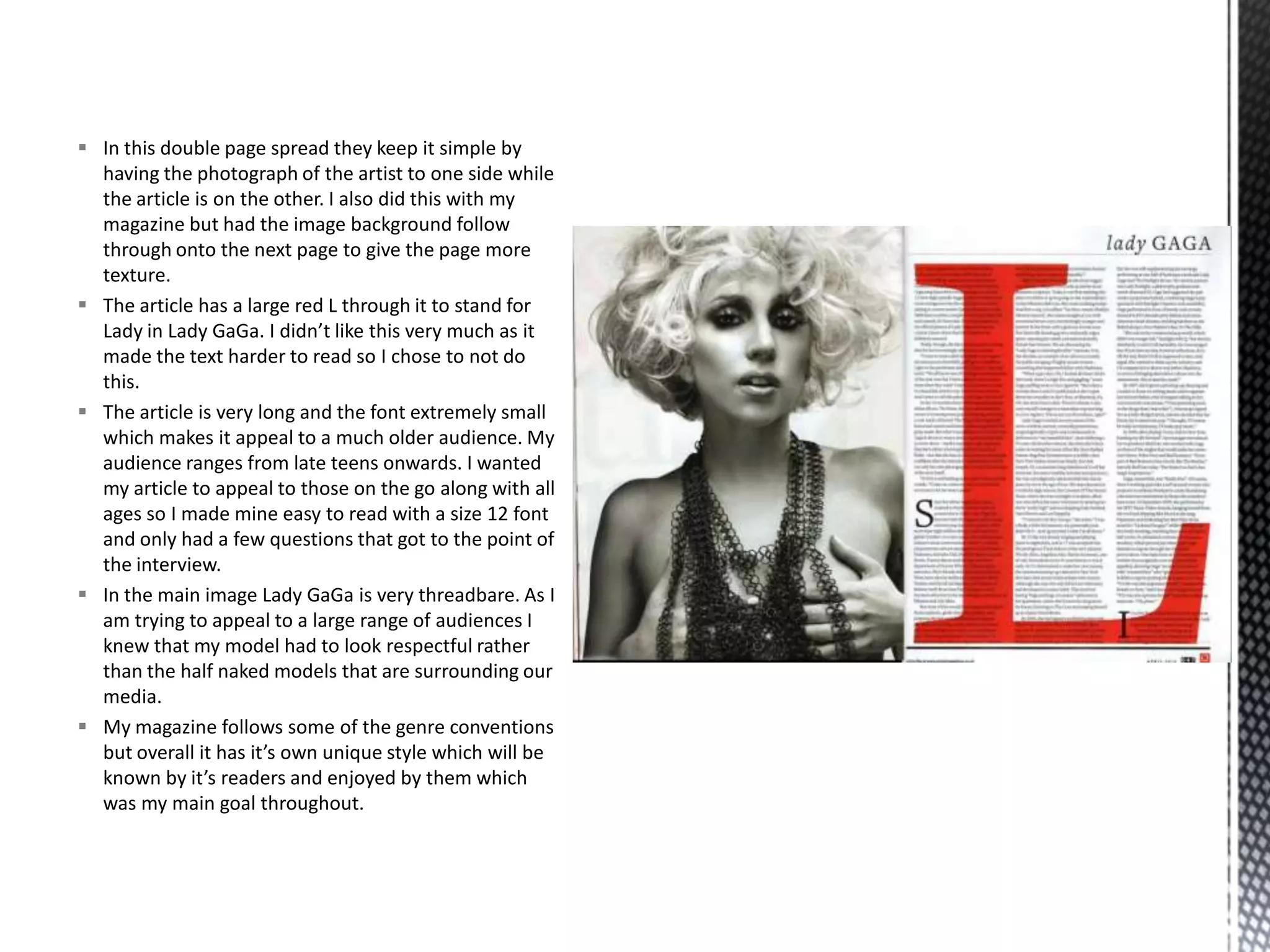
 In this double page spread they keep it simple by
having the photograph of the artist to one side while
the article is on the other. I also did this with my
magazine but had the image background follow
through onto the next page to give the page more
texture.
 The article has a large red L through it to stand for
Lady in Lady GaGa. I didn’t like this very much as it
made the text harder to read so I chose to not do
this.
 The article is very long and the font extremely small
which makes it appeal to a much older audience. My
audience ranges from late teens onwards. I wanted
my article to appeal to those on the go along with all
ages so I made mine easy to read with a size 12 font
and only had a few questions that got to the point of
the interview.
 In the main image Lady GaGa is very threadbare. As I
am trying to appeal to a large range of audiences I
knew that my model had to look respectful rather
than the half naked models that are surrounding our
media.
 My magazine follows some of the genre conventions
but overall it has it’s own unique style which will be
known by it’s readers and enjoyed by them which
was my main goal throughout.

Evaluation question 1

  • 1.
  • 3.
     My magazinethat I produced has similarities and differences from other music magazines.  Starting off with similarities between my final magazine and magazines out now in the media is the we both have a main image on the front to advertise to the reader what the article will be about.  The girl in the photo is the main focus of this magazine. In real life my friend in the photograph does not play music or perform is so we had to create a character for her. This gave me a blank canvas to work with so I could make her be in any genre, play any instrument and have full creative control.  I chose to take a headshot on a portrait angle so that her face is the main focus. This allows possible readers to glance up, see her face and immediately know who it is.  I also wanted to follow some of the genre conventions by also putting a masthead in the top left corner which is the logo of the magazine while also adding subheadings and a pull quote.  The header allows people to see the magazine brand, the subheadings allows the reader a quick insight into what some of the articles are about which also allows the reader to see what the magazine as a whole is about.  The pull quote is from the main article and allows the reader to have a sneak peak of what the article entails which could pull them in.
  • 4.
     To theleft is a magazine which helped inspire my front cover.  The main article is about Florence Welch and she is the main focus of the front page. The photograph is up close and personal like my front cover photograph. It focuses mainly on her face and hands as Florence is known for her singing and she can play a few instruments so this links to the photographs set up.  In the top left corner Q has put it’s signature logo/masthead and used main colours of red and white while that differs on the front when they are trying to match Florence’s makeup. Q doesn’t place anything under it’s masthead to allow us to know what Q stands for while I did on my P.U.K masthead so people could know the meaning of my logo. My magazine is named after a song called “The Pumped up kicks” by Foster The people. I chose a song as my magazine is about music. This differed from the genre conventions as no other music magazine is named after a specific song.  Subheadings on the magazine stand out while I kept mine more blended with the cover so the reader focuses mainly on the focus article/artist. I wanted little to none focus on the other articles as I had a main rising star being interviewed.  This magazine also uses a pull quote which shows a vital part of the article. This intrigues readers. I placed mine just off the center closer to the artist while this magazine places it right at the top.
  • 5.
     I addeda bubble to my magazine front cover to allow the readers to spot special offers that they could get if they bought my magazine. I chose a free download after making a survey and letting the public answer. This bubble follows the house style while also having a slight glow of white to make it pop for the reader.  My masthead breaks from genre convention because of the font that is used. Most music magazines try to use rather plain fonts unless they are for hard genres such as rock with Kerrang. But with Q they stuck to a simple font. I chose to go for a font that I believe will appeal to a larger audience and also be formal and playful at the same time.  I followed the genre of conventions by adding a barcode and essential information such as date of release and price. This is to allow the reader to know how much they’re paying for this magazine, whether it is monthly or not and what number they are if they wish to collect it. I placed the essential information with the barcode as I wanted to main focus to be on the model rather than on the price of the magazine.  I followed a three simple coloured house style by sticking with red, black and white. These colours are unisex and appeal to a wider audience. It also ties with my music genre for this magazine being more than one which means the colours must be appealing to more than one thing.
  • 6.
     My contentspage holds the house theme by continuing the simple red, black and white style. This makes my magazine look more professional and neater as it has consistency.  My masthead is re-used with the same font but as “Contents” and not the original “P.U.K” this shows the reader that they are looking at the contents page but still keeping the font to show the consistency of the magazine.  I also keep the same font for my subheadings as I did on the cover but have changed the colour to white so they pop. On this contents page I want to focus on the contents of the magazine. This means making each article I have pop so the readers know just what they’re getting when they are looking through.  I used pictures to highlight the main article and the two sub articles. These are the top three of all of my contents. Instead of telling the reader what they are about I keep a layer of mystery to it so that the reader is intrigued and buys the magazine to know more. I use the same font as my masthead to show the page numbers showing the reader just how important the articles are. I use white coloured font for this so the numbers pop catching the reader’s eye.  At the bottom of the subheadings I have a square box which holds the site for the free download which was advertised on the front page. I used a different font to make it stand out and kept the same white font as the subheadings to keep consistency in the house style.
  • 7.
     Kerrang alsocontinues a house style in their contents page by using yellow, white, black and red when they want something important to pop.  Unlike my contents in which I don’t allow the reader to have a look at the main article until they reach the page, Kerrang has a picture along with it’s main artist to show other articles. I didn’t like this as it let the focus fall from the main artist and onto what the articles could be.  Kerrang uses the same masthead as it has on the front page to show that this is the contents page allowing the magazine to hold some consistency .  Subheadings are used to mark off section of what the articles are about such as “News” and “Swag” I did not like this as it allowed the reader too much insight into what the articles are about. I want the reader to buy my magazine out of curiosity. My brief subheadings allow the imagination to run riot rather than ruining that by putting what it is about.  This magazine goes for more horizontal set up as the photograph and contents are both half of the page horizontally. I chose to have mine vertical as it is easier to read and to understand that one is after the other. Such as p8 and underneath will be p10.
  • 8.
     In mydouble page spread I make the artist the main point again by having her photograph cover the entire page. This shows the reader straight away who they are about to read about.  I use the masthead/logo from the front cover as this interview is exclusively to P.U.K my magazine and no one else. This shows the reader that it was one of P.U.K’s interviewer's who did this.  I use another pull quote like I did on the front cover but a different part of the article so the readers who do not know of this artist can get sort of an understanding towards them before they start reading. To get a quick look at how this artist is before delving into the article.  I have a subheading underneath the pull quote to briefly let the reader know who it is P.U.K has interviewed and why. This allows the reader a quick summary of where the interview is going to go so they know whether they want to continue reading or turn the page.  I have my question in white while my artist’s answers are in red. This lets the reader know when the interviewer is talking and when the artist is.  Through out the magazine I keep my house style of red, black and white. I also keep my images black and white with a flare of colour in her hair to follow the house style.
  • 9.
     In thisdouble page spread they keep it simple by having the photograph of the artist to one side while the article is on the other. I also did this with my magazine but had the image background follow through onto the next page to give the page more texture.  The article has a large red L through it to stand for Lady in Lady GaGa. I didn’t like this very much as it made the text harder to read so I chose to not do this.  The article is very long and the font extremely small which makes it appeal to a much older audience. My audience ranges from late teens onwards. I wanted my article to appeal to those on the go along with all ages so I made mine easy to read with a size 12 font and only had a few questions that got to the point of the interview.  In the main image Lady GaGa is very threadbare. As I am trying to appeal to a large range of audiences I knew that my model had to look respectful rather than the half naked models that are surrounding our media.  My magazine follows some of the genre conventions but overall it has it’s own unique style which will be known by it’s readers and enjoyed by them which was my main goal throughout.