What is ‘Evaluation’?

    Nathan Loynes
In this presentation:
1. Definitions and disagreements about
   evaluation.
2. Logic Models.
3. Outcomes, Indicators and Targets
4. Measuring Outcomes
5. Mark Friedman : Outcome Based
   Accountability
Working Definition of
        Programme Evaluation


The practice of evaluation involves
thoughtful, systematic collection and
analysis of information about the activities,
characteristics, and outcomes of
programmes, for use by specific people, to
reduce uncertainties, improve effectiveness,
and make decisions.

                                           2
Scott & Morrison (2005)
        Evaluation Focuses on:
•   Value & Worth
•   Education or Social Programmes
•   Activities, Characteristics and Outcomes
•   Policy Implications (What should happen
    next?)
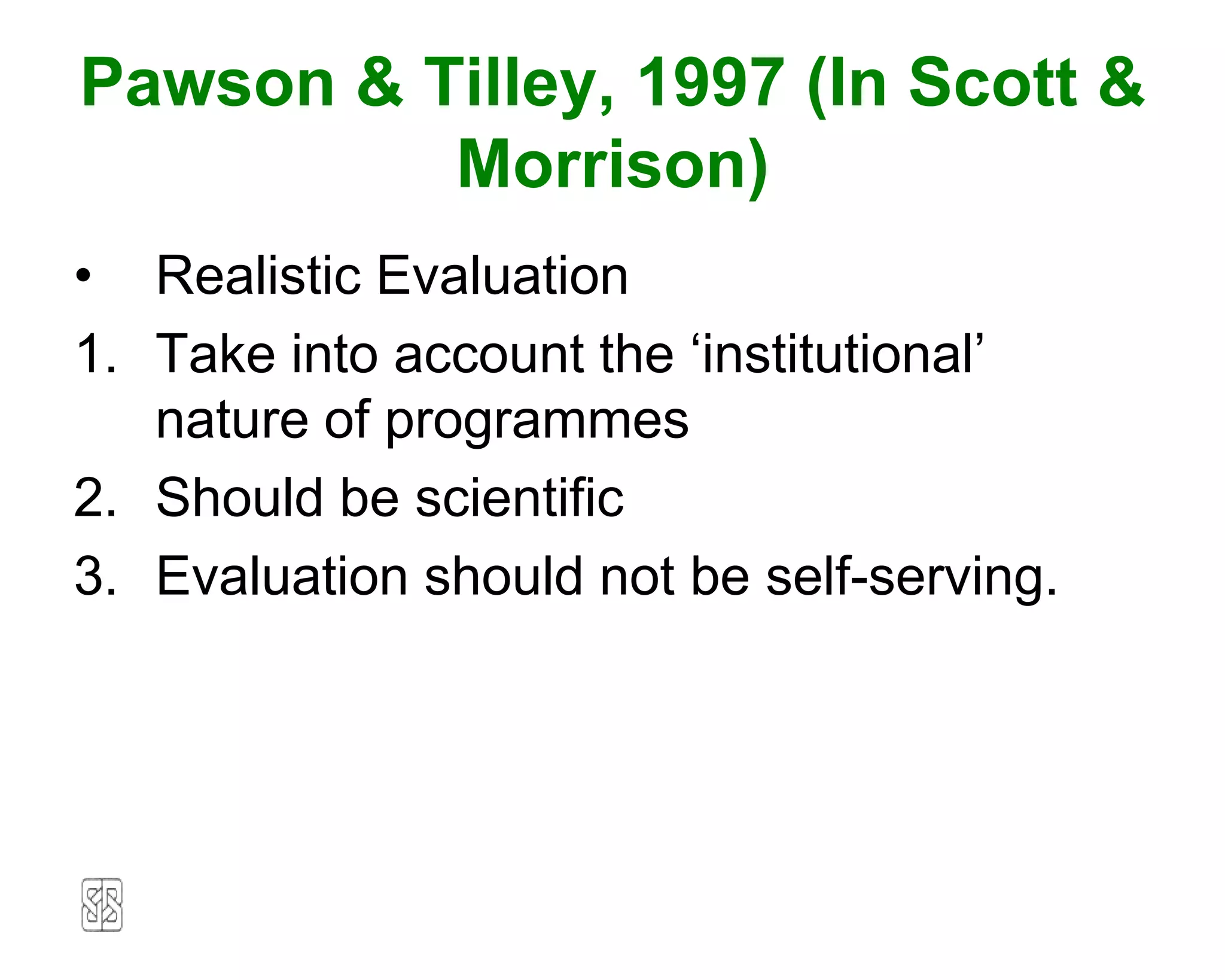
Pawson & Tilley, 1997 (In Scott &
          Morrison)
• Realistic Evaluation
1. Take into account the ‘institutional’
   nature of programmes
2. Should be scientific
3. Evaluation should not be self-serving.
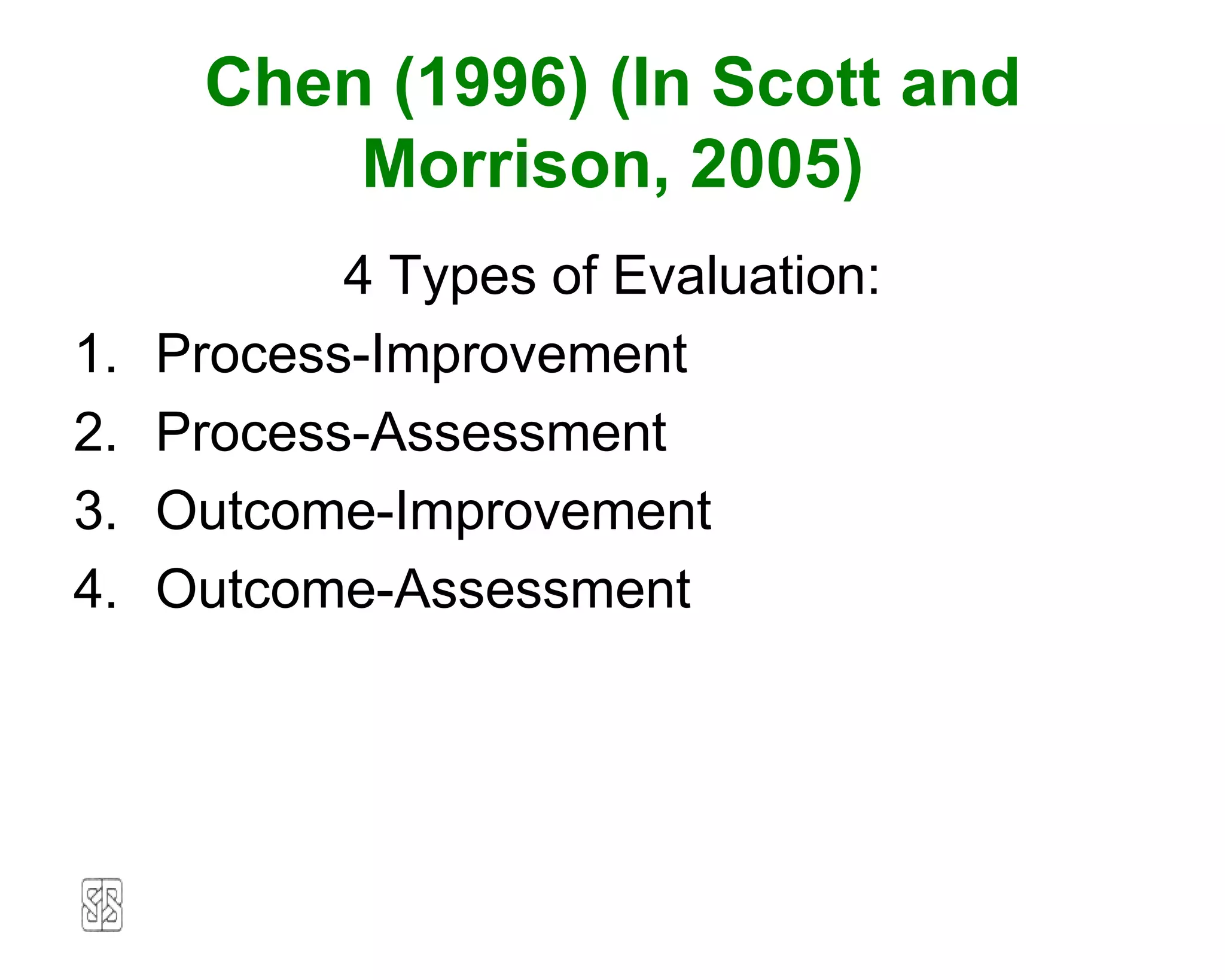
Chen (1996) (In Scott and
          Morrison, 2005)
            4 Types of Evaluation:
1.   Process-Improvement
2.   Process-Assessment
3.   Outcome-Improvement
4.   Outcome-Assessment
Working Definition of
        Programme Evaluation


The practice of evaluation involves
thoughtful, systematic collection and
analysis of information about the activities,
characteristics, and outcomes of
programmes, for use by specific people, to
reduce uncertainties, improve effectiveness,
and make decisions.

                                           6
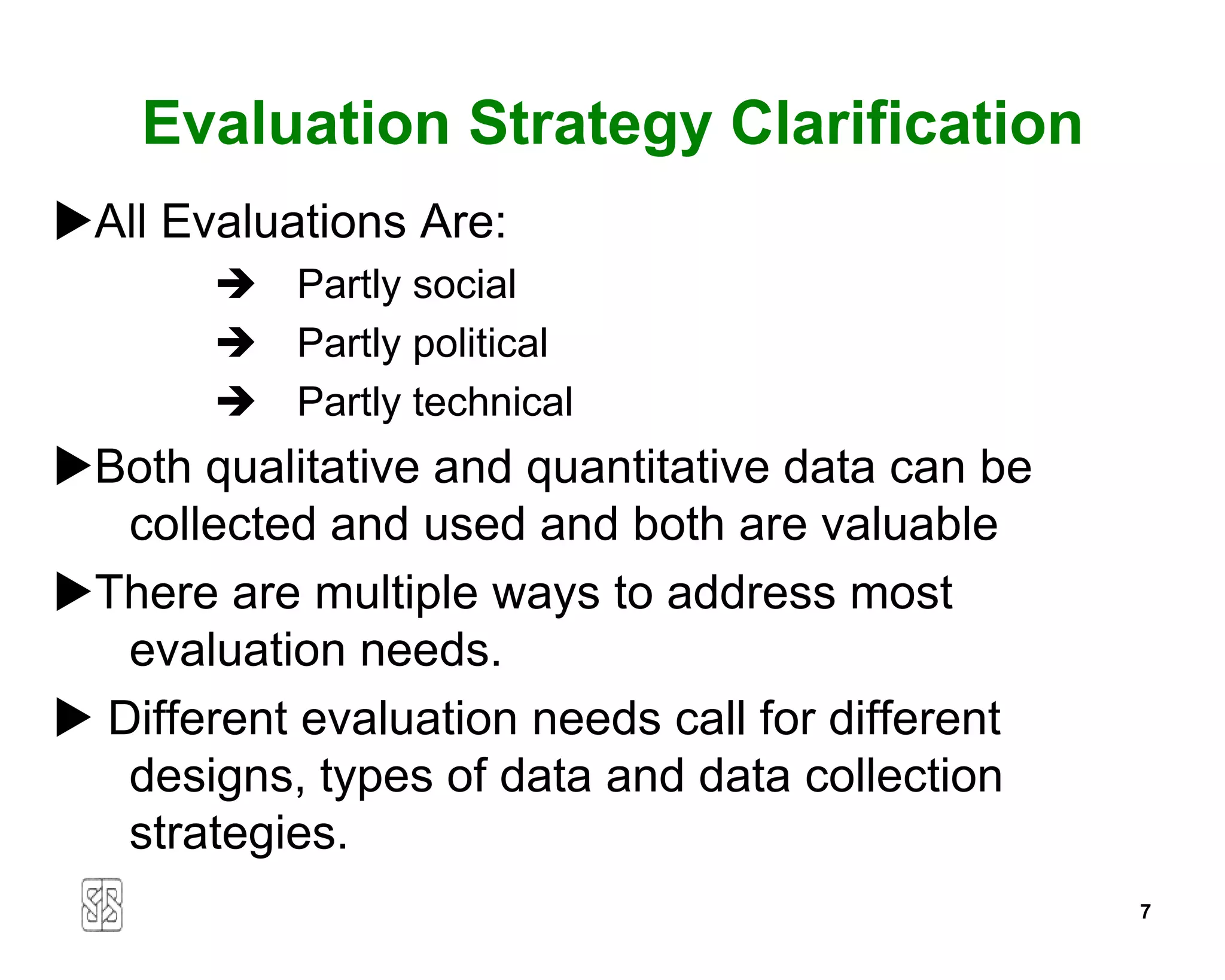
Evaluation Strategy Clarification
All Evaluations Are:
        Partly social
        Partly political
        Partly technical
Both qualitative and quantitative data can be
   collected and used and both are valuable
There are multiple ways to address most
   evaluation needs.
 Different evaluation needs call for different
   designs, types of data and data collection
   strategies.
                                                  7
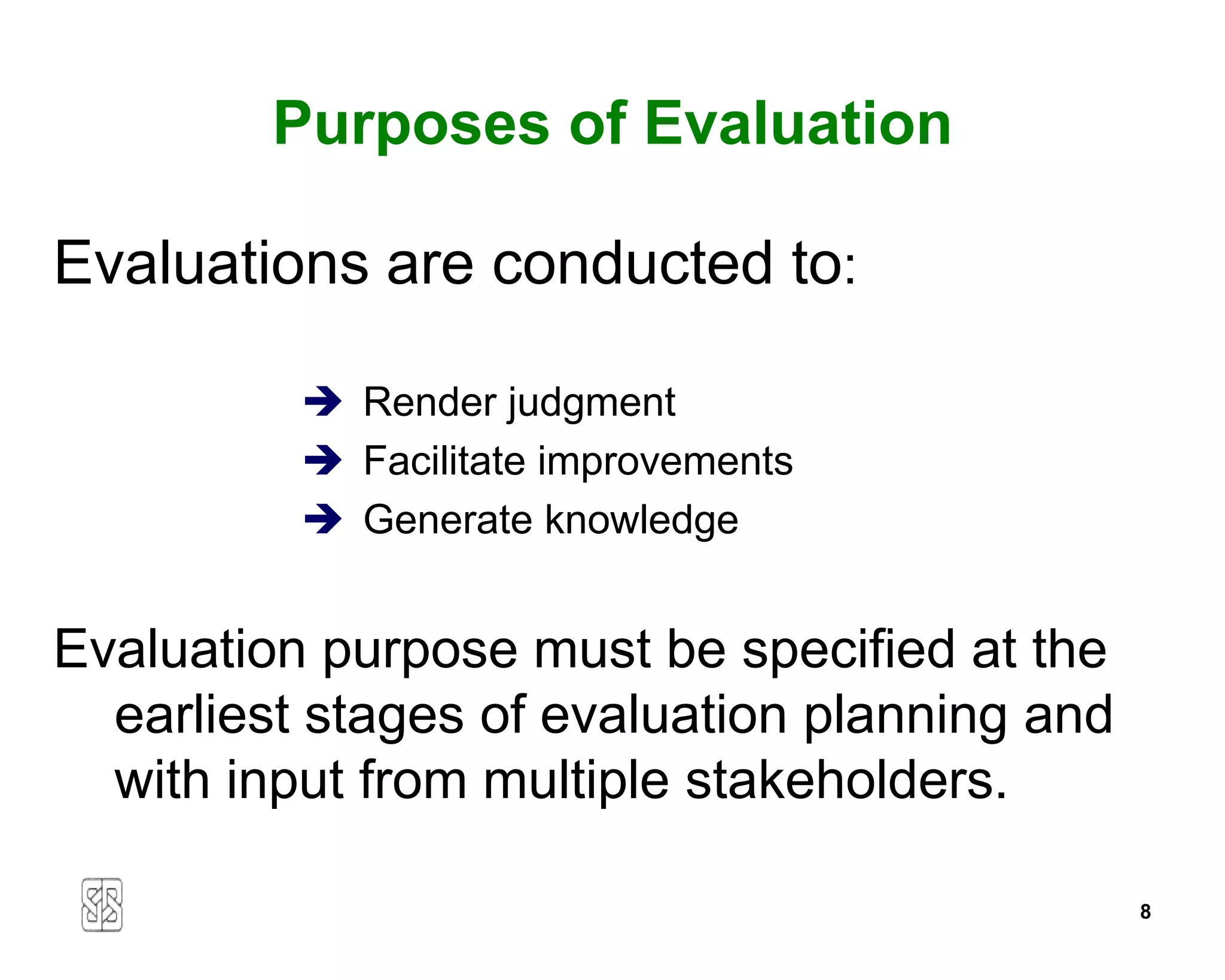
Purposes of Evaluation

Evaluations are conducted to:

           Render judgment
           Facilitate improvements
           Generate knowledge


Evaluation purpose must be specified at the
  earliest stages of evaluation planning and
  with input from multiple stakeholders.

                                               8
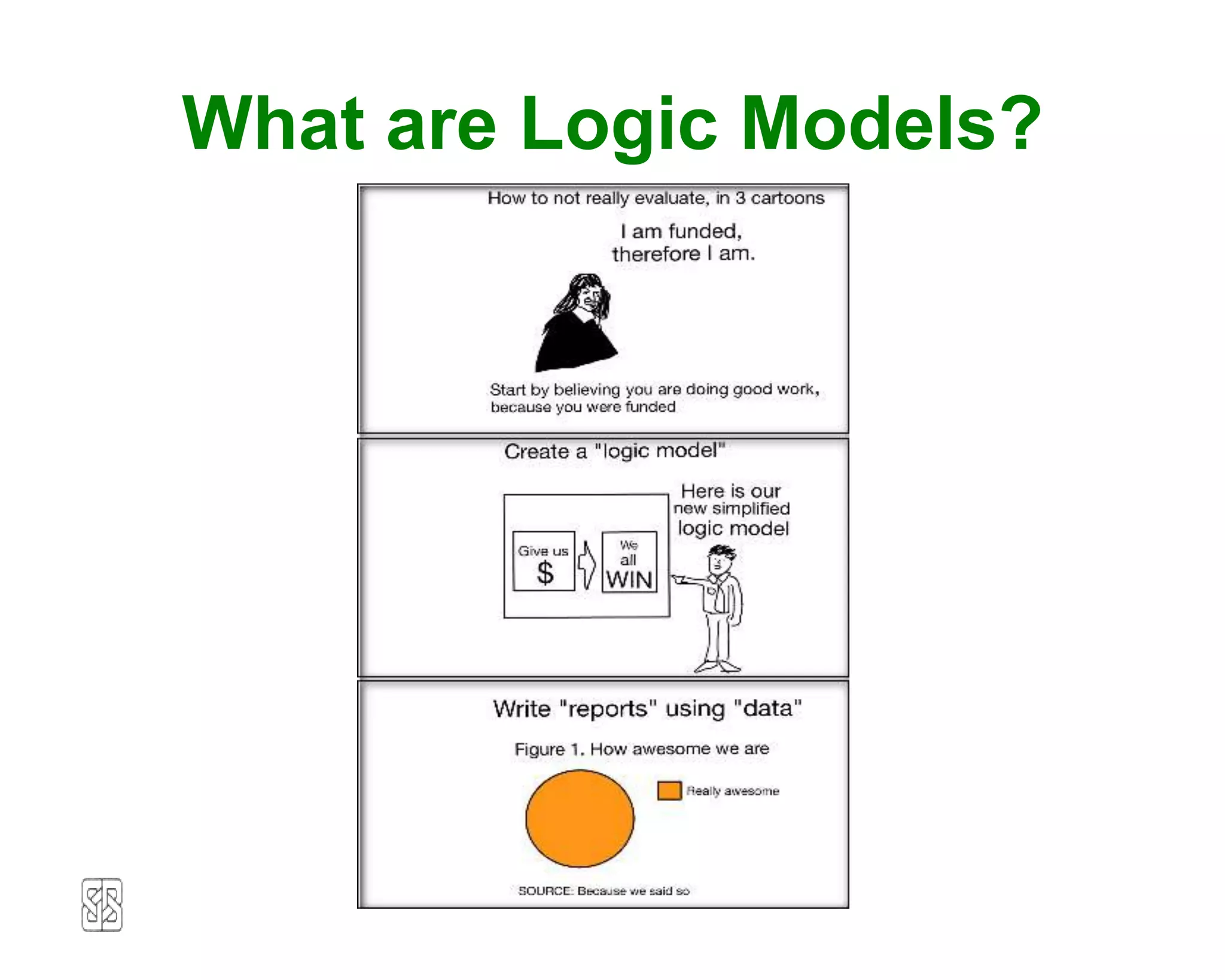
What are Logic Models?
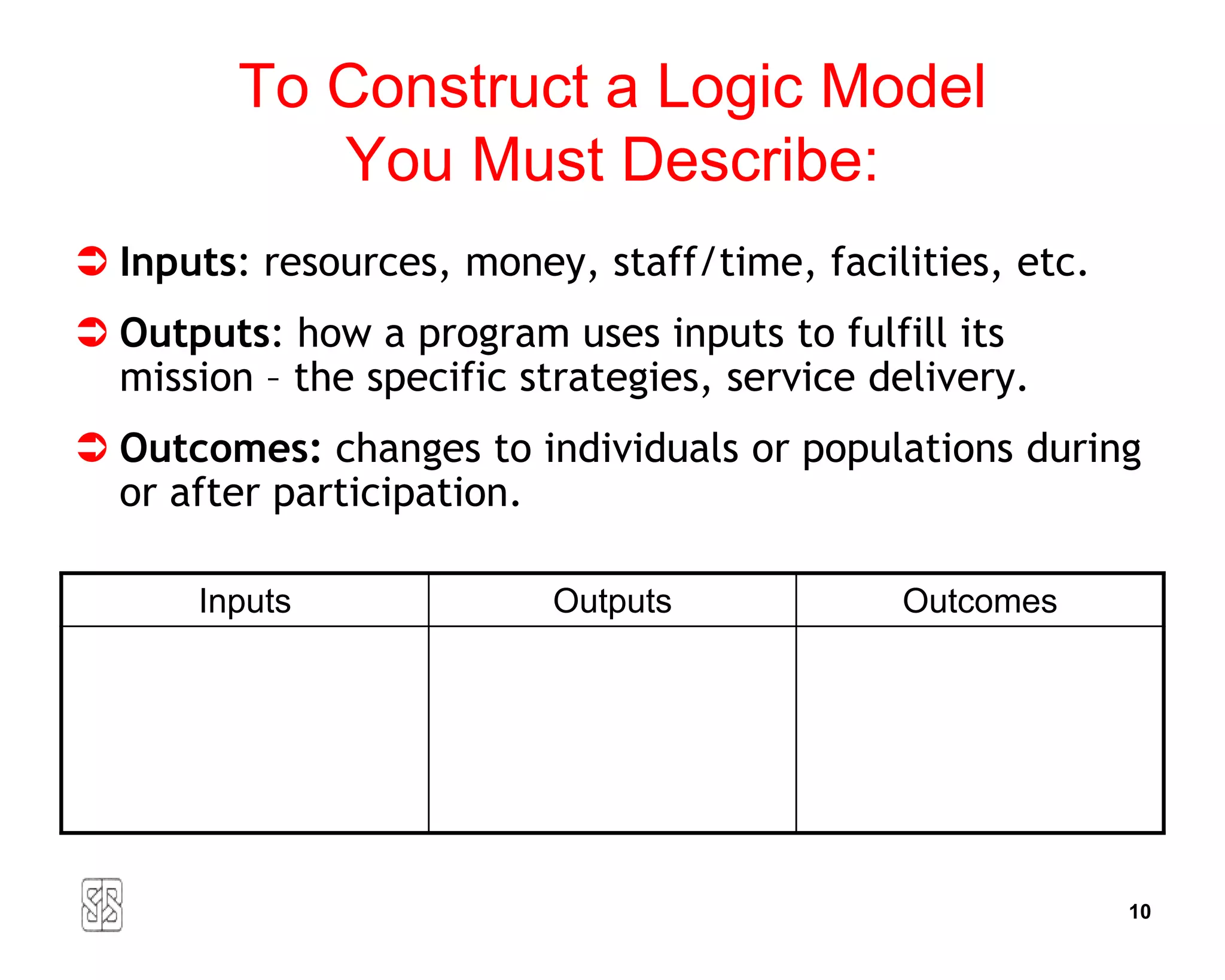
To Construct a Logic Model
            You Must Describe:
 Inputs: resources, money, staff/time, facilities, etc.
 Outputs: how a program uses inputs to fulfill its
  mission – the specific strategies, service delivery.
 Outcomes: changes to individuals or populations during
  or after participation.

       Inputs              Outputs            Outcomes


                                                           10
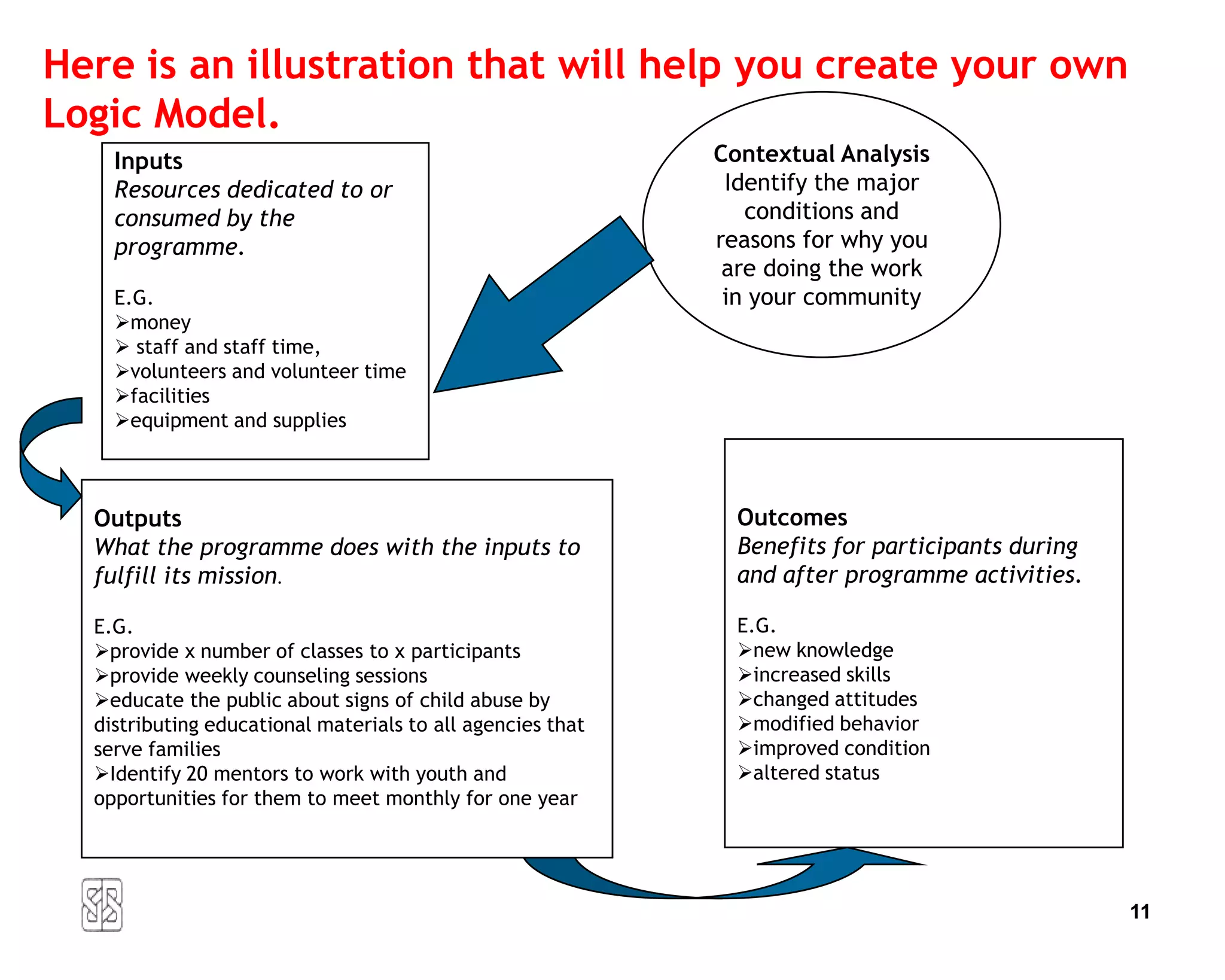
Here is an illustration that will help you create your own
Logic Model.
    Inputs                                                  Contextual Analysis
    Resources dedicated to or                                Identify the major
    consumed by the                                            conditions and
    programme.                                              reasons for why you
                                                             are doing the work
    E.G.                                                     in your community
    money
     staff and staff time,
    volunteers and volunteer time
    facilities
    equipment and supplies


  Outputs                                                     Outcomes
  What the programme does with the inputs to                  Benefits for participants during
  fulfill its mission.                                        and after programme activities.

  E.G.                                                        E.G.
  provide x number of classes to x participants              new knowledge
  provide weekly counseling sessions                         increased skills
  educate the public about signs of child abuse by           changed attitudes
  distributing educational materials to all agencies that     modified behavior
  serve families                                              improved condition
  Identify 20 mentors to work with youth and                 altered status
  opportunities for them to meet monthly for one year


                                                                                                 11
Outcomes, Indicators, Targets


                                12
What is the difference between
  outcomes, indicators, and
            targets?
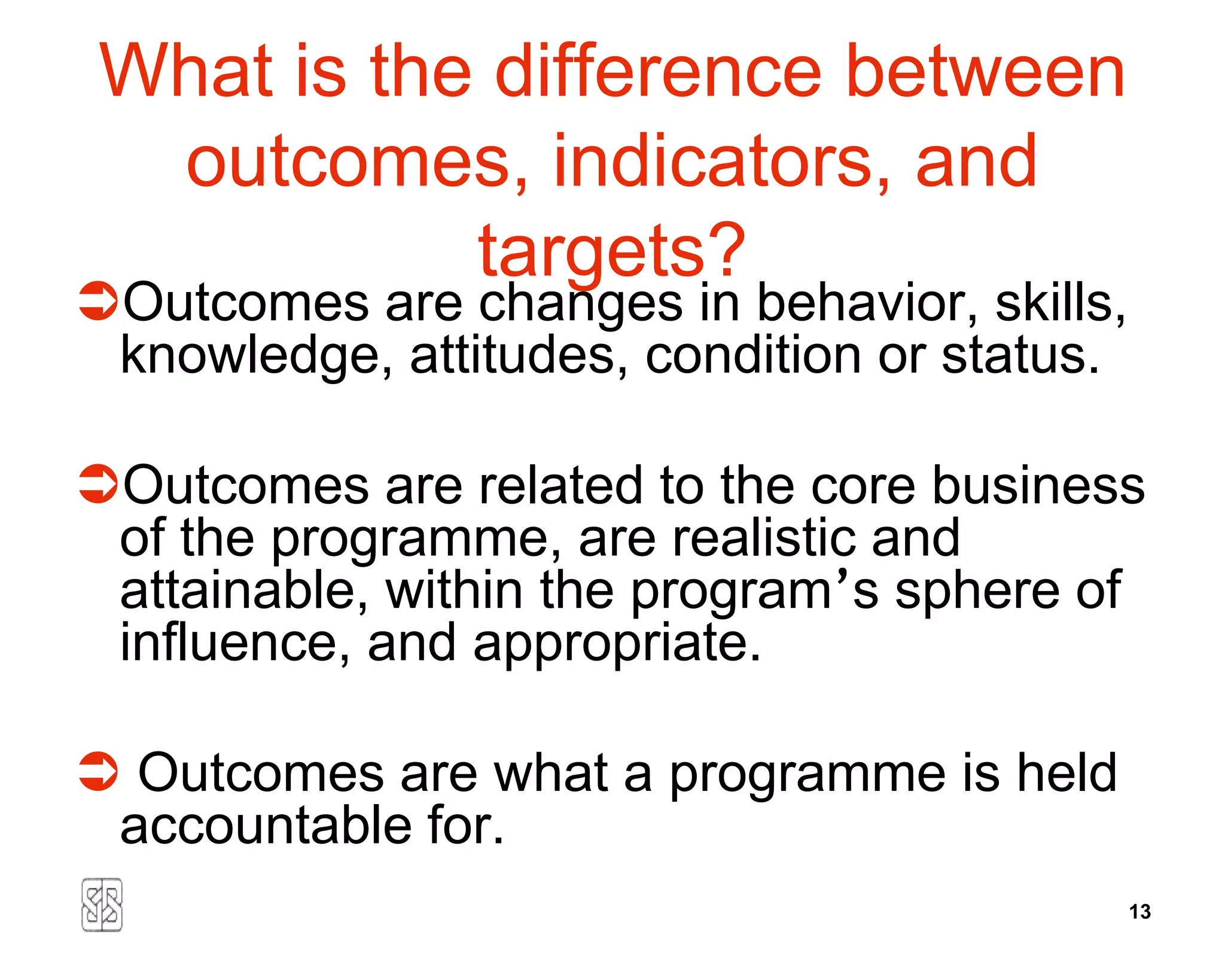
Outcomes are changes in behavior, skills,
 knowledge, attitudes, condition or status.

Outcomes are related to the core business
 of the programme, are realistic and
 attainable, within the program’s sphere of
 influence, and appropriate.

 Outcomes are what a programme is held
 accountable for.
                                              13
What is the difference between
  outcomes, indicators, and
            targets?
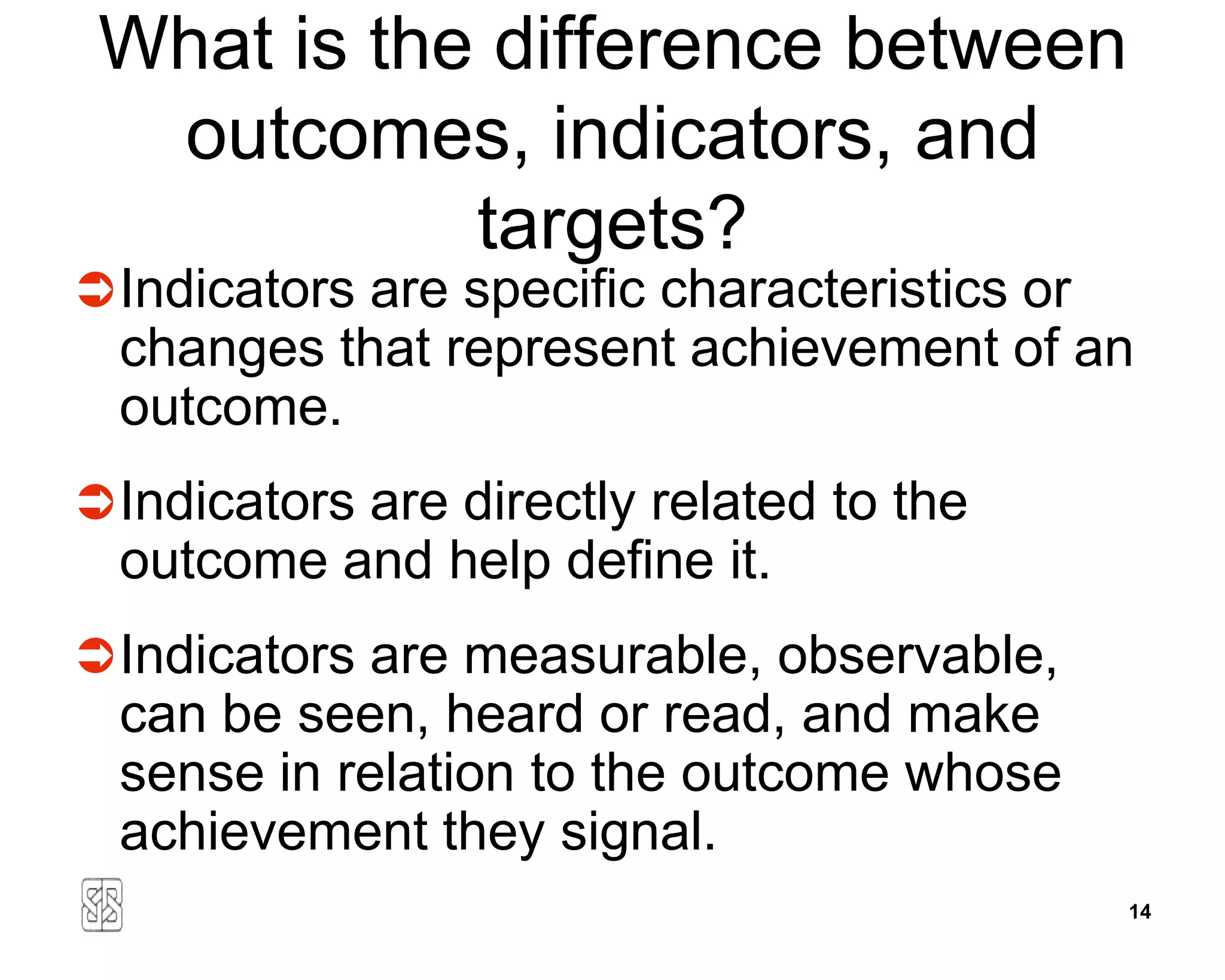
 Indicators are specific characteristics or
  changes that represent achievement of an
  outcome.
 Indicators are directly related to the
  outcome and help define it.
 Indicators are measurable, observable,
  can be seen, heard or read, and make
  sense in relation to the outcome whose
  achievement they signal.
                                               14
What is the difference between
 outcomes, indicators, and
           targets?


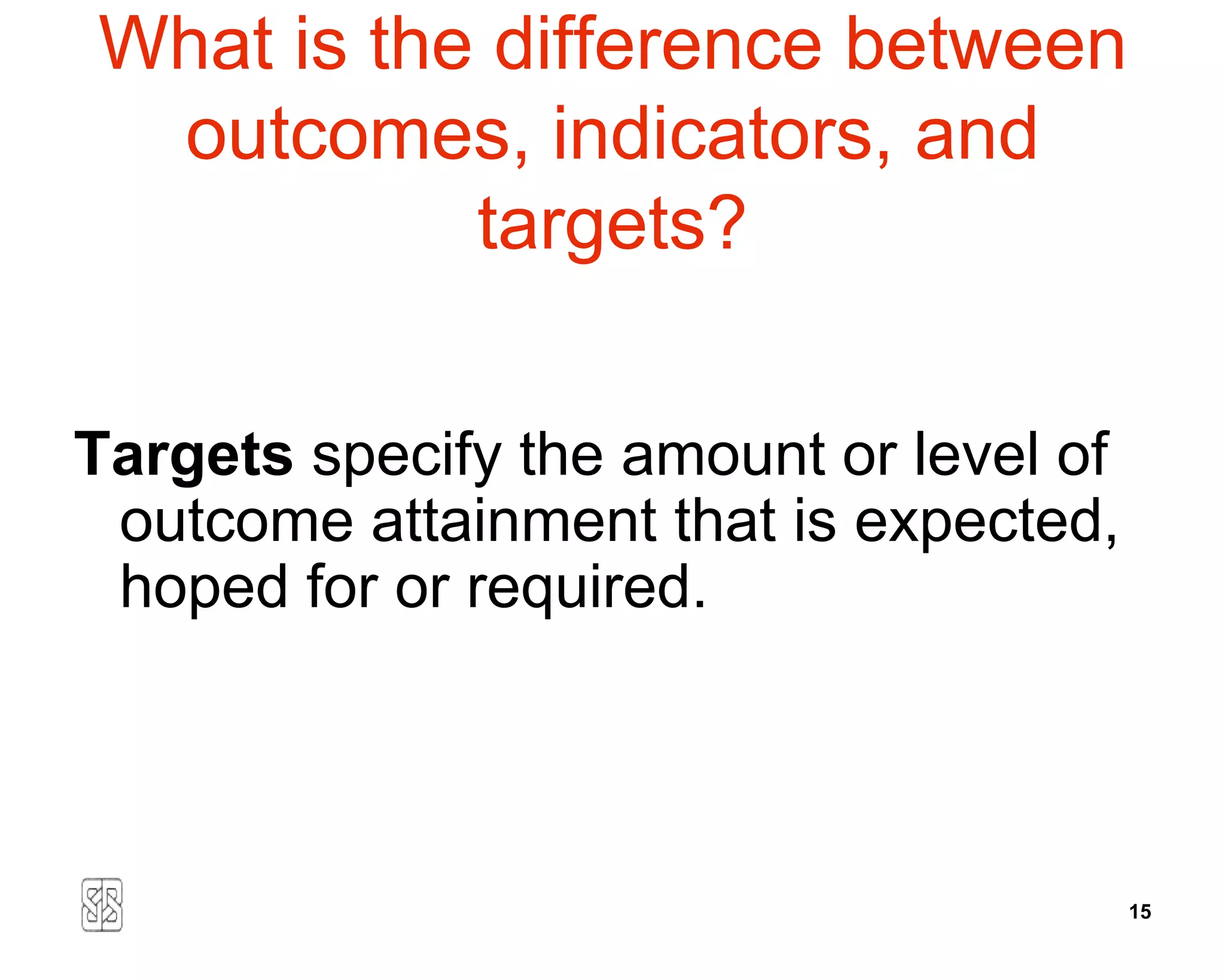
Targets specify the amount or level of
 outcome attainment that is expected,
 hoped for or required.


                                         15
Why measure outcomes?
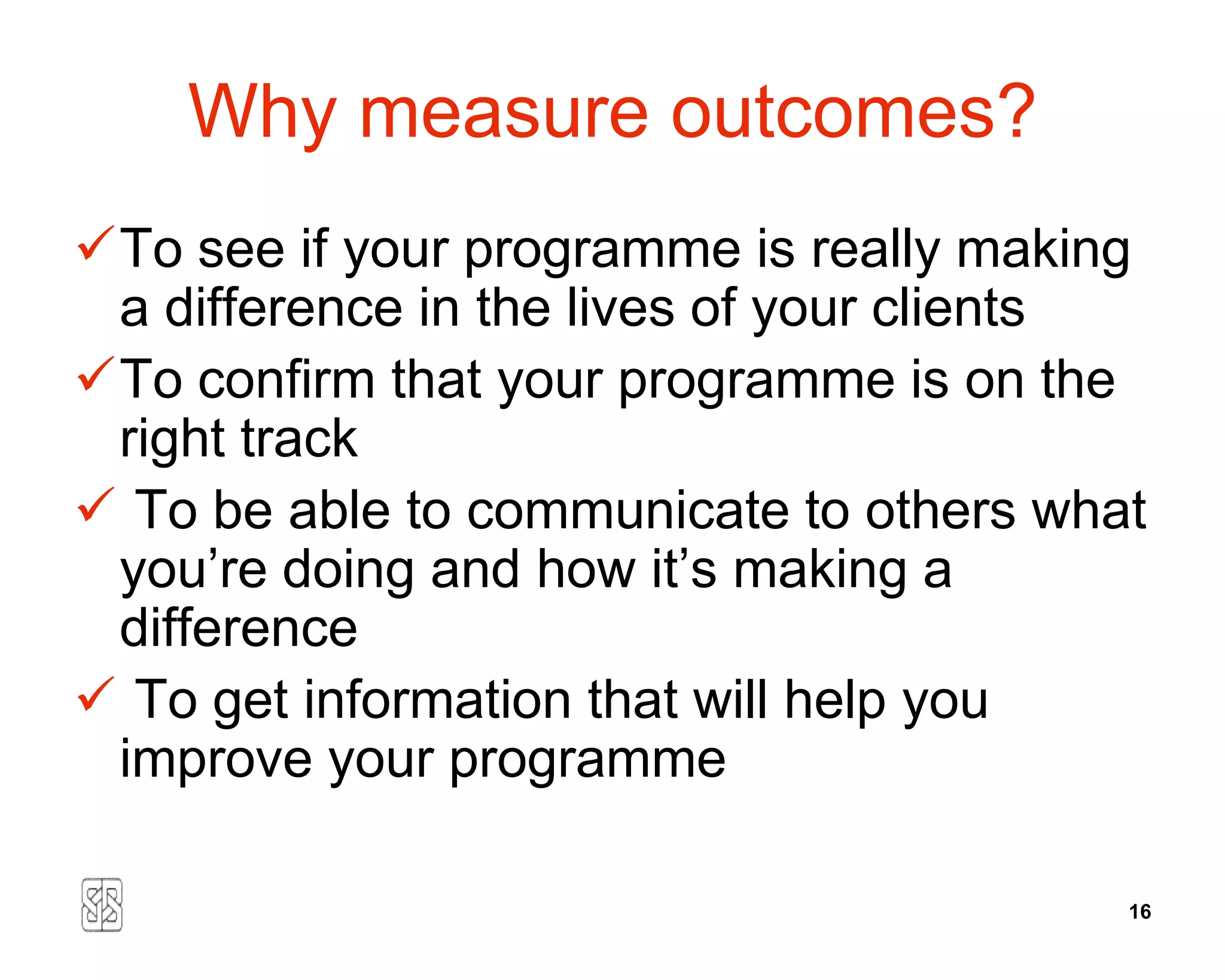
To see if your programme is really making
 a difference in the lives of your clients
To confirm that your programme is on the
 right track
 To be able to communicate to others what
 you’re doing and how it’s making a
 difference
 To get information that will help you
 improve your programme

                                         16
Use Caution
   When Identifying Outcomes
There is No right number of outcomes.
Be sure to think about when to expect
 outcomes.
  1)Initial Outcomes
     First benefits/changes participants experience
  2)Intermediate Outcomes
     Link initial outcomes to longer-term outcomes
  3)Longer-term Outcomes
     Ultimate outcomes desired for program
      participants
                                                       17
How do you identify indicators?
 Indicators are specific characteristics or changes
  that represent achievement of an outcome.
 Indicators are directly related to the outcome
  and help define it.
 Indicators are measurable, observable, can be
  seen, heard or read, and make sense in relation
  to the outcome whose achievement they signal.
 Ask the questions shown on the following slide.


                                                    18
Questions to Ask
    When Identifying Indicators
1. What does this outcome look like when it
   occurs?
2. What would tell us it has happened?
3. What could we count, measure or weigh?
4. Can you observe it?
5. Does it tell you whether the outcome has been
   achieved?


                                                   19
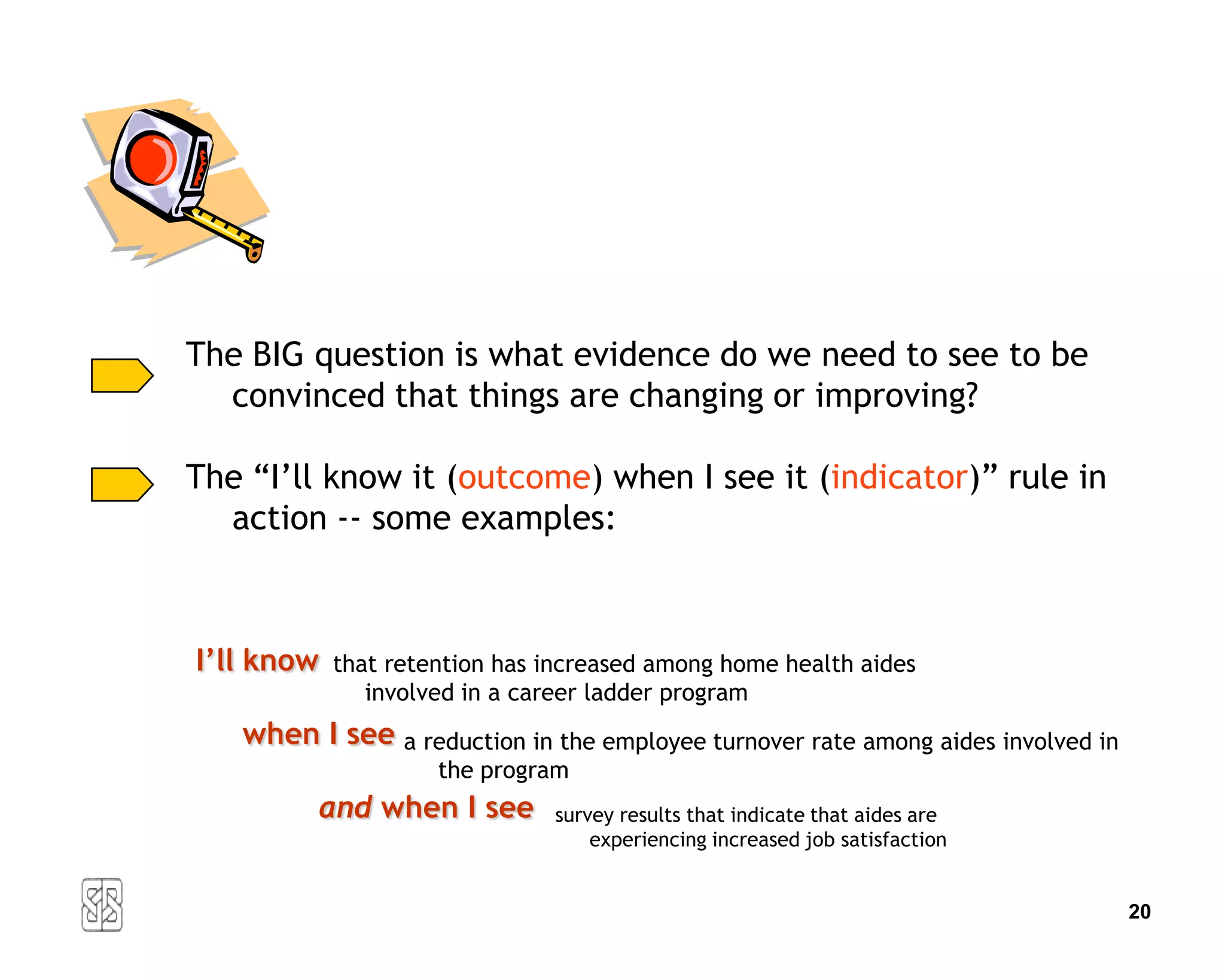
The BIG question is what evidence do we need to see to be
  convinced that things are changing or improving?

The “I’ll know it (outcome) when I see it (indicator)” rule in
  action -- some examples:


I’ll know   that retention has increased among home health aides
               involved in a career ladder program
   when I see a reduction in the employee turnover rate among aides involved in
                     the program
         and when I see        survey results that indicate that aides are
                                   experiencing increased job satisfaction


                                                                                  20
Mark Friedman (2005)
• Outcomes Based Accountability
• Frustrated by social programmes ‘all talk;
  no action’
• Need for a ‘Common Language’.
• Need for accurate data
• Need for baselines.
• Differentiate between Inputs, Outcomes,
  Outputs
Summary
• Evaluation is a systematic process.
• Evaluation considers inputs, outputs, and
  outcomes.
• Evaluation involves making qualitative and
  quantitative judgements.
• Effective evaluation requires that you are
  clear about what it is that you are
  measuring/judging.

                                           22

Evaluation introduction

  • 1.
  • 2.
    In this presentation: 1.Definitions and disagreements about evaluation. 2. Logic Models. 3. Outcomes, Indicators and Targets 4. Measuring Outcomes 5. Mark Friedman : Outcome Based Accountability
  • 3.
    Working Definition of Programme Evaluation The practice of evaluation involves thoughtful, systematic collection and analysis of information about the activities, characteristics, and outcomes of programmes, for use by specific people, to reduce uncertainties, improve effectiveness, and make decisions. 2
  • 4.
    Scott & Morrison(2005) Evaluation Focuses on: • Value & Worth • Education or Social Programmes • Activities, Characteristics and Outcomes • Policy Implications (What should happen next?)
  • 5.
    Pawson & Tilley,1997 (In Scott & Morrison) • Realistic Evaluation 1. Take into account the ‘institutional’ nature of programmes 2. Should be scientific 3. Evaluation should not be self-serving.
  • 6.
    Chen (1996) (InScott and Morrison, 2005) 4 Types of Evaluation: 1. Process-Improvement 2. Process-Assessment 3. Outcome-Improvement 4. Outcome-Assessment
  • 7.
    Working Definition of Programme Evaluation The practice of evaluation involves thoughtful, systematic collection and analysis of information about the activities, characteristics, and outcomes of programmes, for use by specific people, to reduce uncertainties, improve effectiveness, and make decisions. 6
  • 8.
    Evaluation Strategy Clarification AllEvaluations Are:  Partly social  Partly political  Partly technical Both qualitative and quantitative data can be collected and used and both are valuable There are multiple ways to address most evaluation needs.  Different evaluation needs call for different designs, types of data and data collection strategies. 7
  • 9.
    Purposes of Evaluation Evaluationsare conducted to:  Render judgment  Facilitate improvements  Generate knowledge Evaluation purpose must be specified at the earliest stages of evaluation planning and with input from multiple stakeholders. 8
  • 10.
  • 11.
    To Construct aLogic Model You Must Describe:  Inputs: resources, money, staff/time, facilities, etc.  Outputs: how a program uses inputs to fulfill its mission – the specific strategies, service delivery.  Outcomes: changes to individuals or populations during or after participation. Inputs Outputs Outcomes 10
  • 12.
    Here is anillustration that will help you create your own Logic Model. Inputs Contextual Analysis Resources dedicated to or Identify the major consumed by the conditions and programme. reasons for why you are doing the work E.G. in your community money  staff and staff time, volunteers and volunteer time facilities equipment and supplies Outputs Outcomes What the programme does with the inputs to Benefits for participants during fulfill its mission. and after programme activities. E.G. E.G. provide x number of classes to x participants new knowledge provide weekly counseling sessions increased skills educate the public about signs of child abuse by changed attitudes distributing educational materials to all agencies that modified behavior serve families improved condition Identify 20 mentors to work with youth and altered status opportunities for them to meet monthly for one year 11
  • 13.
  • 14.
    What is thedifference between outcomes, indicators, and targets? Outcomes are changes in behavior, skills, knowledge, attitudes, condition or status. Outcomes are related to the core business of the programme, are realistic and attainable, within the program’s sphere of influence, and appropriate.  Outcomes are what a programme is held accountable for. 13
  • 15.
    What is thedifference between outcomes, indicators, and targets?  Indicators are specific characteristics or changes that represent achievement of an outcome.  Indicators are directly related to the outcome and help define it.  Indicators are measurable, observable, can be seen, heard or read, and make sense in relation to the outcome whose achievement they signal. 14
  • 16.
    What is thedifference between outcomes, indicators, and targets? Targets specify the amount or level of outcome attainment that is expected, hoped for or required. 15
  • 17.
    Why measure outcomes? Tosee if your programme is really making a difference in the lives of your clients To confirm that your programme is on the right track  To be able to communicate to others what you’re doing and how it’s making a difference  To get information that will help you improve your programme 16
  • 18.
    Use Caution When Identifying Outcomes There is No right number of outcomes. Be sure to think about when to expect outcomes. 1)Initial Outcomes  First benefits/changes participants experience 2)Intermediate Outcomes  Link initial outcomes to longer-term outcomes 3)Longer-term Outcomes  Ultimate outcomes desired for program participants 17
  • 19.
    How do youidentify indicators?  Indicators are specific characteristics or changes that represent achievement of an outcome.  Indicators are directly related to the outcome and help define it.  Indicators are measurable, observable, can be seen, heard or read, and make sense in relation to the outcome whose achievement they signal.  Ask the questions shown on the following slide. 18
  • 20.
    Questions to Ask When Identifying Indicators 1. What does this outcome look like when it occurs? 2. What would tell us it has happened? 3. What could we count, measure or weigh? 4. Can you observe it? 5. Does it tell you whether the outcome has been achieved? 19
  • 21.
    The BIG questionis what evidence do we need to see to be convinced that things are changing or improving? The “I’ll know it (outcome) when I see it (indicator)” rule in action -- some examples: I’ll know that retention has increased among home health aides involved in a career ladder program when I see a reduction in the employee turnover rate among aides involved in the program and when I see survey results that indicate that aides are experiencing increased job satisfaction 20
  • 22.
    Mark Friedman (2005) •Outcomes Based Accountability • Frustrated by social programmes ‘all talk; no action’ • Need for a ‘Common Language’. • Need for accurate data • Need for baselines. • Differentiate between Inputs, Outcomes, Outputs
  • 23.
    Summary • Evaluation isa systematic process. • Evaluation considers inputs, outputs, and outcomes. • Evaluation involves making qualitative and quantitative judgements. • Effective evaluation requires that you are clear about what it is that you are measuring/judging. 22