Homelessness assistance sector, Australia, November 2010


                                   Mark Planigale
                           Research & Consultancy
                                      results by design
2


 Performance measurement
 Compliance reporting
 Program logic
3


Performance measurement
 Bigger picture of organisational performance
  measurement
   Compliance reporting currently focuses on effort
   Many organisations monitor inputs and client satisfaction
   But are we making a difference?

 National frameworks: National Affordable Housing
  Agreement, National Partnership Agreement on
  Homelessness
 ‘Manufacturing-based’ performance models need to be
  enhanced
4


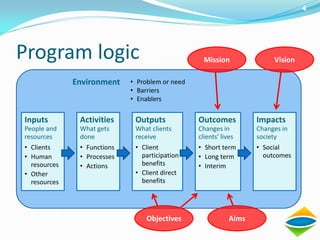
Program logic                                      Mission               Vision

              Environment    • Problem or need
                             • Barriers
                             • Enablers

Inputs         Activities     Outputs            Outcomes           Impacts
People and     What gets      What clients       Changes in         Changes in
resources      done           receive            clients’ lives     society
• Clients      • Functions    • Client           • Short term       • Social
• Human        • Processes      participation    • Long term          outcomes
  resources    • Actions        benefits         • Interim
• Other                       • Client direct
  resources                     benefits


                                  Objectives                 Aims
5


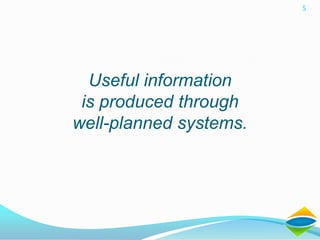
  Useful information
 is produced through
well-planned systems.
6


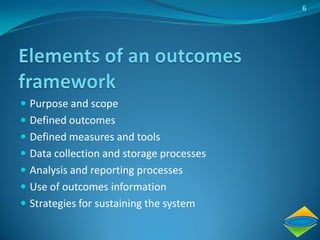
 Purpose and scope
 Defined outcomes
 Defined measures and tools
 Data collection and storage processes
 Analysis and reporting processes
 Use of outcomes information
 Strategies for sustaining the system
7


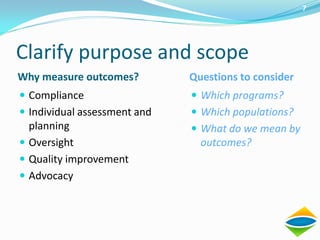
Clarify purpose and scope
Why measure outcomes?         Questions to consider
 Compliance                   Which programs?
 Individual assessment and    Which populations?
  planning                     What do we mean by
 Oversight                     outcomes?
 Quality improvement
 Advocacy
8


Define key outcome areas
Outcome:                              Questions to consider
“... a change or absence of            If the program works
   change that results (at least in     really well, how are
   part) from actions of staff of       clients’ lives better?
   the organisation”                   If things go wrong
 Desired vs. undesired                 for our clients, where
                                        do we see this in
 Short term, long term, interim
                                        their lives?
 Domains vs. locus of change
                                       What is our core
                                        business?
9


Example outcomes
1. Person obtains appropriate, affordable long-term
     housing
2.   Person takes medication more regularly
3.   Person has a better understanding of tenancy rights and
     responsibilities
4.   Person is placed on the OOH Early Housing waiting list
5.   Person gains part-time employment
6.   Person becomes homeless
10


Select measures and tools
Measure:                              Questions to consider
“...an observable, measurable          If our key outcomes
   characteristic of a person or        occurred, how would
   their situation, which is linked     we know?
   with a state or condition of
   interest to us”                     Which measures
                                        have the greatest
 Base measures, derived                communicative
  measures and KPIs                     power?
 Varied vantage points
                                       What data do we
 Use modules for flexibility and       already have?
  consistency
11


Example measures
Status change/maintenance scale:
1. % of clients who were homeless at the end of the
    period
Level of functioning scale:
2. % of clients who rate their parenting skills better at exit
   than they did at entry
Goal attainment scaling:
3. % of clients who achieved better than expected
   outcomes in majority of goals reviewed this period
12


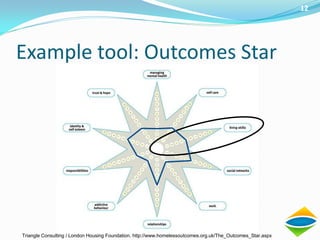
Example tool: Outcomes Star


Triangle Consulting / London Housing Foundation. http://www.homelessoutcomes.org.uk/The_Outcomes_Star.aspx
13


Collect data
Data collection and entry:         Questions to consider:
 Has a huge impact on data         Who will collect the
  quality                            data? What training
                                     will they require?
 Should be integrated as far as
                                    All clients or a sub-
  possible with service delivery
                                     sample?
 Requires client consent
                                    How and when will
 May need to respond flexibly       data be collected?
  to circumstances of client        How will data be
                                     stored?
14


Analyse and report
Outcomes reporting enablers:   Questions to consider:
 A knowledge of stakeholder    Who will use the
  requirements                   reports?
 Data analysis skills          What levels of
 Standardised:                  aggregation are
    calculation procedures      useful?
    report templates           How can complexity
    database queries
                                 be acknowledged?
 Access to data!
15


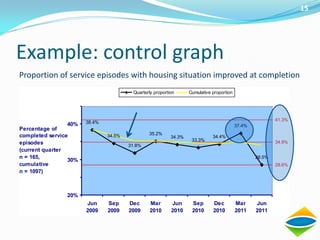
Example: control graph
Proportion of service episodes with housing situation improved at completion
                                        Quarterly proportion      Cumulative proportion


                                                                                                          41.3%
                40%    38.4%
                                                                                          37.4%
Percentage of
completed service              34.5%           35.2%
                                                          34.3%              34.4%
                                                                   33.3%                                  34.9%
episodes                               31.8%
(current quarter
n = 165,                                                                                          28.5%
                 30%
cumulative                                                                                                28.6%
n = 1097)


                20%
                       Jun     Sep     Dec      Mar       Jun      Sep       Dec          Mar     Jun
                       2009    2009    2009     2010      2010     2010      2010         2011    2011
16


Use outcomes information
Contexts for use:                    Questions to consider:
 Individual casework:                How can outcomes
  assessment, planning and             information be
  review                               shared with clients?
 Service review and reflection       How can staff play a
 Strategic planning: “turning the     part in “giving
  curve”                               meaning” to
 Advocacy
                                       outcomes
                                       information?
17


Caution!
 Outcomes monitoring data by itself cannot “prove”
  service effectiveness
 To build your case, triangulate with other evidence
18


Sustain the system
What helps?
 Using the information – complete the loop
 Strong commitment to and endorsement of outcomes
  measurement by senior management
 Performance expectations – staff to collect outcomes
  data
 Ongoing resourcing
 Regular review of framework
19


 Risks
 Implementation process
 The bottom line
20


Risks
 Poor value for money
    Outcome measurement can be resource-intensive and
     time-consuming
    Information produced may not be high quality

 Distortion of service delivery
 Staff opposition
    Data collection burden
    Feeling scrutinised

 Negative results
21


Process tips
 Involve stakeholders early and ongoingly
    Board, Executive, management, service delivery staff,
     clients
 Combine top-down and bottom-up elements
 Pilot locally, implement sequentially
 Typically 6 – 24 months to end of pilots
    Varies with size of organisation, complexity of services, and
     level of resourcing
22


The bottom line
 Client wellbeing comes first
 Client rights are respected
 Information produced is useful
    Relevant
    Reliable
    Valid
 System is affordable
    Data collection burden on staff is minimised
23


Useful resources
Results-Based Accountability
    www.raguide.org
    Friedman (2009) Trying Hard Isn’t Good Enough

UK Approaches (incl. Outcomes Star)
    www.homelessoutcomes.org.uk
    Burns & Cupitt (2003) Managing Outcomes: A Guide for Homelessness Organisations

US: National Alliance to End Homelessness
    Spellman & Abbenante (2008) What Gets Measured, Gets Done: A Toolkit on
      Performance Measurement for Ending Homelessness

Reference – technical and implementation issues
    Planigale (2010) Literature Review: Measurement of Client Outcomes in Homelessness
      Services. http://www.homeground.org.au/assets/literature-review-measurement-of-
      client-outcomes-in-homelessness-services.pdf
Mark Planigale
Research & Consultancy
results by design

Phone:   0429 136 596
Mail:    PO Box 754, Macleod VIC 3085
Email:   results@planigale.com
Web:     www.planigale.com

Creating an outcomes framework for your organisation

  • 1.
    Homelessness assistance sector,Australia, November 2010 Mark Planigale Research & Consultancy results by design
  • 2.
    2  Performance measurement Compliance reporting  Program logic
  • 3.
    3 Performance measurement  Biggerpicture of organisational performance measurement  Compliance reporting currently focuses on effort  Many organisations monitor inputs and client satisfaction  But are we making a difference?  National frameworks: National Affordable Housing Agreement, National Partnership Agreement on Homelessness  ‘Manufacturing-based’ performance models need to be enhanced
  • 4.
    4 Program logic Mission Vision Environment • Problem or need • Barriers • Enablers Inputs Activities Outputs Outcomes Impacts People and What gets What clients Changes in Changes in resources done receive clients’ lives society • Clients • Functions • Client • Short term • Social • Human • Processes participation • Long term outcomes resources • Actions benefits • Interim • Other • Client direct resources benefits Objectives Aims
  • 5.
    5 Usefulinformation is produced through well-planned systems.
  • 6.
    6  Purpose andscope  Defined outcomes  Defined measures and tools  Data collection and storage processes  Analysis and reporting processes  Use of outcomes information  Strategies for sustaining the system
  • 7.
    7 Clarify purpose andscope Why measure outcomes? Questions to consider  Compliance  Which programs?  Individual assessment and  Which populations? planning  What do we mean by  Oversight outcomes?  Quality improvement  Advocacy
  • 8.
    8 Define key outcomeareas Outcome: Questions to consider “... a change or absence of  If the program works change that results (at least in really well, how are part) from actions of staff of clients’ lives better? the organisation”  If things go wrong  Desired vs. undesired for our clients, where do we see this in  Short term, long term, interim their lives?  Domains vs. locus of change  What is our core business?
  • 9.
    9 Example outcomes 1. Personobtains appropriate, affordable long-term housing 2. Person takes medication more regularly 3. Person has a better understanding of tenancy rights and responsibilities 4. Person is placed on the OOH Early Housing waiting list 5. Person gains part-time employment 6. Person becomes homeless
  • 10.
    10 Select measures andtools Measure: Questions to consider “...an observable, measurable  If our key outcomes characteristic of a person or occurred, how would their situation, which is linked we know? with a state or condition of interest to us”  Which measures have the greatest  Base measures, derived communicative measures and KPIs power?  Varied vantage points  What data do we  Use modules for flexibility and already have? consistency
  • 11.
    11 Example measures Status change/maintenancescale: 1. % of clients who were homeless at the end of the period Level of functioning scale: 2. % of clients who rate their parenting skills better at exit than they did at entry Goal attainment scaling: 3. % of clients who achieved better than expected outcomes in majority of goals reviewed this period
  • 12.
    12 Example tool: OutcomesStar Triangle Consulting / London Housing Foundation. http://www.homelessoutcomes.org.uk/The_Outcomes_Star.aspx
  • 13.
    13 Collect data Data collectionand entry: Questions to consider:  Has a huge impact on data  Who will collect the quality data? What training will they require?  Should be integrated as far as  All clients or a sub- possible with service delivery sample?  Requires client consent  How and when will  May need to respond flexibly data be collected? to circumstances of client  How will data be stored?
  • 14.
    14 Analyse and report Outcomesreporting enablers: Questions to consider:  A knowledge of stakeholder  Who will use the requirements reports?  Data analysis skills  What levels of  Standardised: aggregation are  calculation procedures useful?  report templates  How can complexity  database queries be acknowledged?  Access to data!
  • 15.
    15 Example: control graph Proportionof service episodes with housing situation improved at completion Quarterly proportion Cumulative proportion 41.3% 40% 38.4% 37.4% Percentage of completed service 34.5% 35.2% 34.3% 34.4% 33.3% 34.9% episodes 31.8% (current quarter n = 165, 28.5% 30% cumulative 28.6% n = 1097) 20% Jun Sep Dec Mar Jun Sep Dec Mar Jun 2009 2009 2009 2010 2010 2010 2010 2011 2011
  • 16.
    16 Use outcomes information Contextsfor use: Questions to consider:  Individual casework:  How can outcomes assessment, planning and information be review shared with clients?  Service review and reflection  How can staff play a  Strategic planning: “turning the part in “giving curve” meaning” to  Advocacy outcomes information?
  • 17.
    17 Caution!  Outcomes monitoringdata by itself cannot “prove” service effectiveness  To build your case, triangulate with other evidence
  • 18.
    18 Sustain the system Whathelps?  Using the information – complete the loop  Strong commitment to and endorsement of outcomes measurement by senior management  Performance expectations – staff to collect outcomes data  Ongoing resourcing  Regular review of framework
  • 19.
    19  Risks  Implementationprocess  The bottom line
  • 20.
    20 Risks  Poor valuefor money  Outcome measurement can be resource-intensive and time-consuming  Information produced may not be high quality  Distortion of service delivery  Staff opposition  Data collection burden  Feeling scrutinised  Negative results
  • 21.
    21 Process tips  Involvestakeholders early and ongoingly  Board, Executive, management, service delivery staff, clients  Combine top-down and bottom-up elements  Pilot locally, implement sequentially  Typically 6 – 24 months to end of pilots  Varies with size of organisation, complexity of services, and level of resourcing
  • 22.
    22 The bottom line Client wellbeing comes first  Client rights are respected  Information produced is useful  Relevant  Reliable  Valid  System is affordable  Data collection burden on staff is minimised
  • 23.
    23 Useful resources Results-Based Accountability  www.raguide.org  Friedman (2009) Trying Hard Isn’t Good Enough UK Approaches (incl. Outcomes Star)  www.homelessoutcomes.org.uk  Burns & Cupitt (2003) Managing Outcomes: A Guide for Homelessness Organisations US: National Alliance to End Homelessness  Spellman & Abbenante (2008) What Gets Measured, Gets Done: A Toolkit on Performance Measurement for Ending Homelessness Reference – technical and implementation issues  Planigale (2010) Literature Review: Measurement of Client Outcomes in Homelessness Services. http://www.homeground.org.au/assets/literature-review-measurement-of- client-outcomes-in-homelessness-services.pdf
  • 24.
    Mark Planigale Research &Consultancy results by design Phone: 0429 136 596 Mail: PO Box 754, Macleod VIC 3085 Email: results@planigale.com Web: www.planigale.com