Presented By: 
Pragya Arya 
Btech(cs) 3rd year 
Banasthali University
INTRODUCTION 
Energy power efficient real time systems 
are systems which are power efficient i.e. 
uses less energy for computation and 
processing in the specified time which 
basically lead to light weighted devices 
having longer battery life.
REAL TIME SYSTEMS 
 A real-time system is any information processing 
system which has to respond to externally 
generated input stimuli within a finite and 
specified period. 
 Mainly Real time systems are divided in two 
categories 
 Hard real time Systems 
 Soft real time systems
HARD REAL TIME SYSTEMS 
 An overrun in response time leads to potential 
loss of life and/or big financial damage 
 Many of these systems are considered to be 
safety critical. 
 Examples: Pacemakers , Airplane 
control systems.
SOFT REAL TIME SYSTEMS 
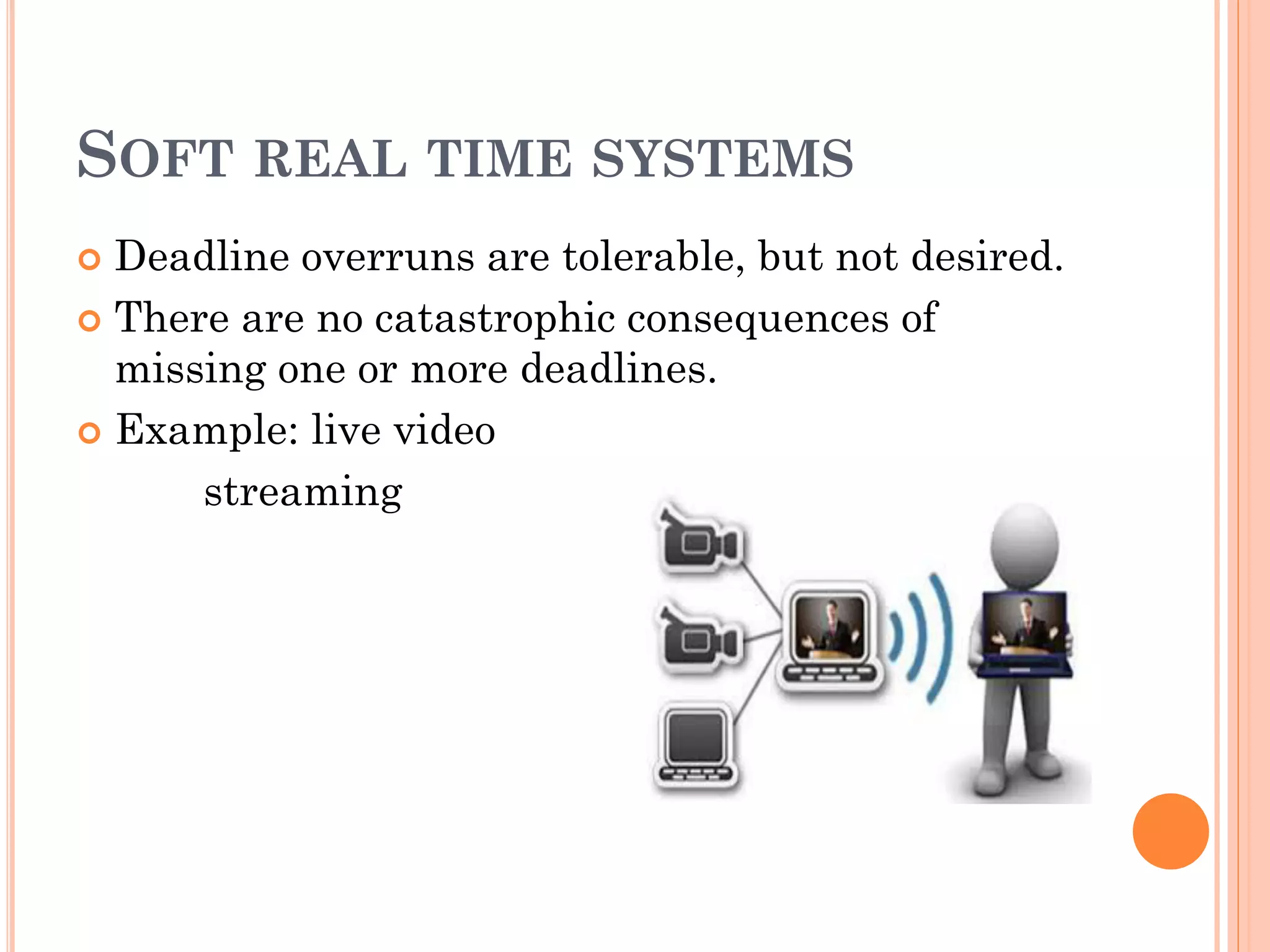
 Deadline overruns are tolerable, but not desired. 
 There are no catastrophic consequences of 
missing one or more deadlines. 
 Example: live video 
streaming
EMBEDDED SYSTEMS 
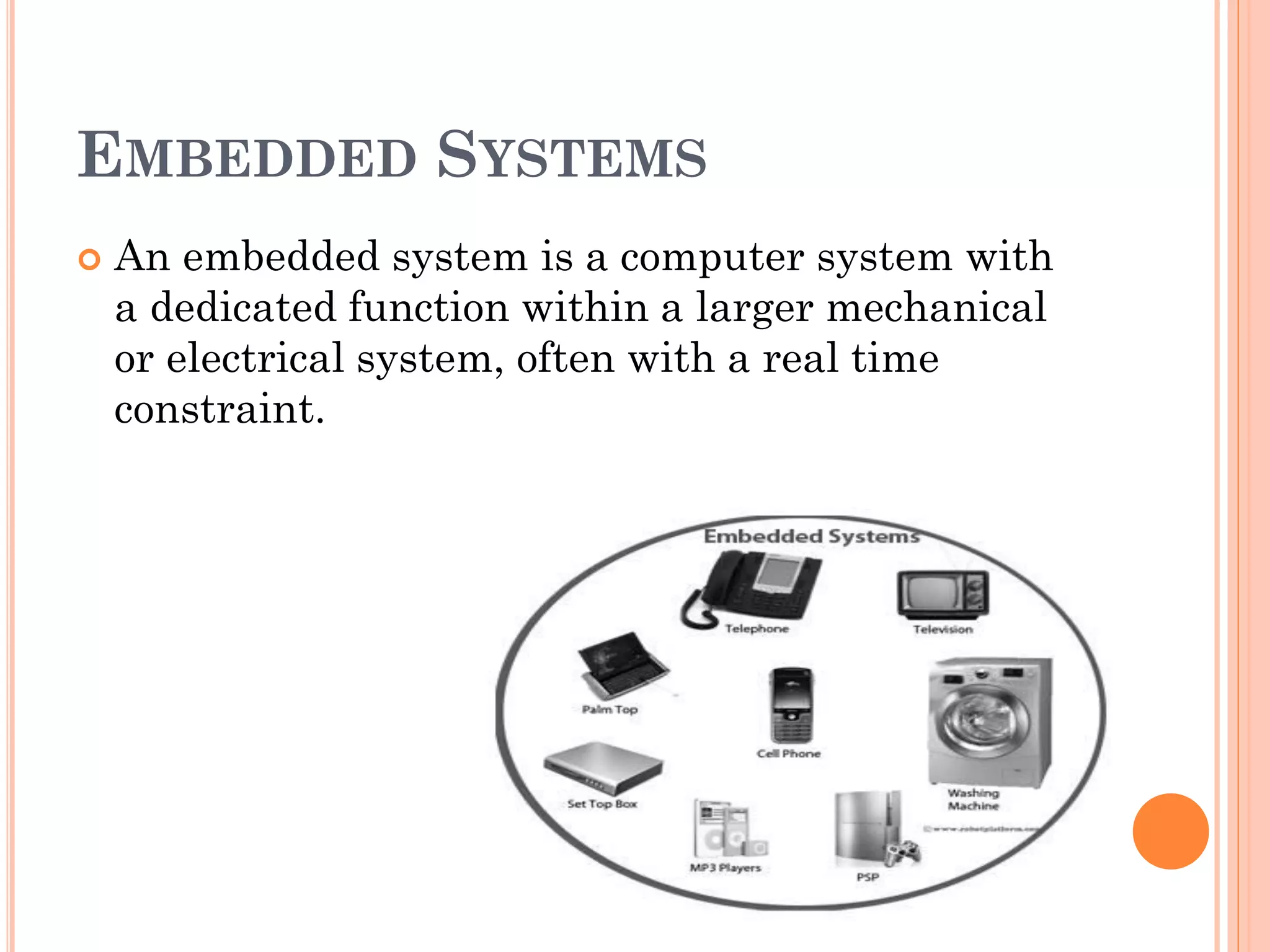
 An embedded system is a computer system with 
a dedicated function within a larger mechanical 
or electrical system, often with a real time 
constraint.
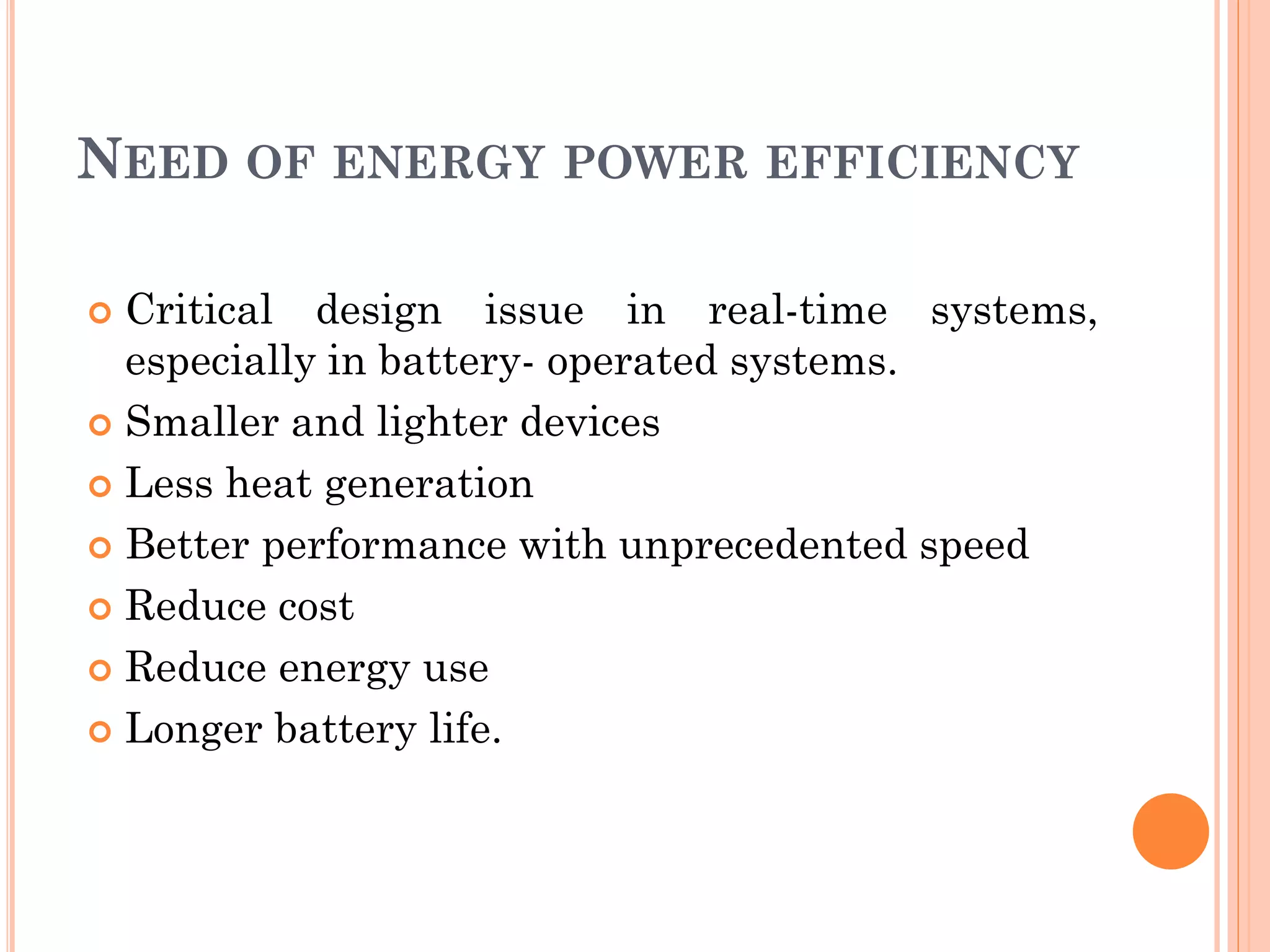
NEED OF ENERGY POWER EFFICIENCY 
 Critical design issue in real-time systems, 
especially in battery- operated systems. 
 Smaller and lighter devices 
 Less heat generation 
 Better performance with unprecedented speed 
 Reduce cost 
 Reduce energy use 
 Longer battery life.
POWER ISSUE CAN BE ADDRESSED IN 
 Architecture Level 
 System Level 
 Application Level
SCHEDULING 
 Scheduling is method by which threads , process, 
or data flow are given access to system resources. 
 This is usually done to load balance and share 
system resources effectively. 
 There are various energy efficient scheduling 
algorithms.
DYNAMIC VOLTAGE SCALING 
 Dynamic voltage scaling is a power 
management technique in computer architecture. 
 In which the voltage used in a component is 
increased or decreased, depending upon 
circumstances. 
 Dynamic voltage scaling to decrease voltage is 
known as undervolting. It is done in order to 
conserve power. 
 Dynamic voltage scaling to increase voltage is 
known as overvolting. It is done in order to 
increase computer performance.
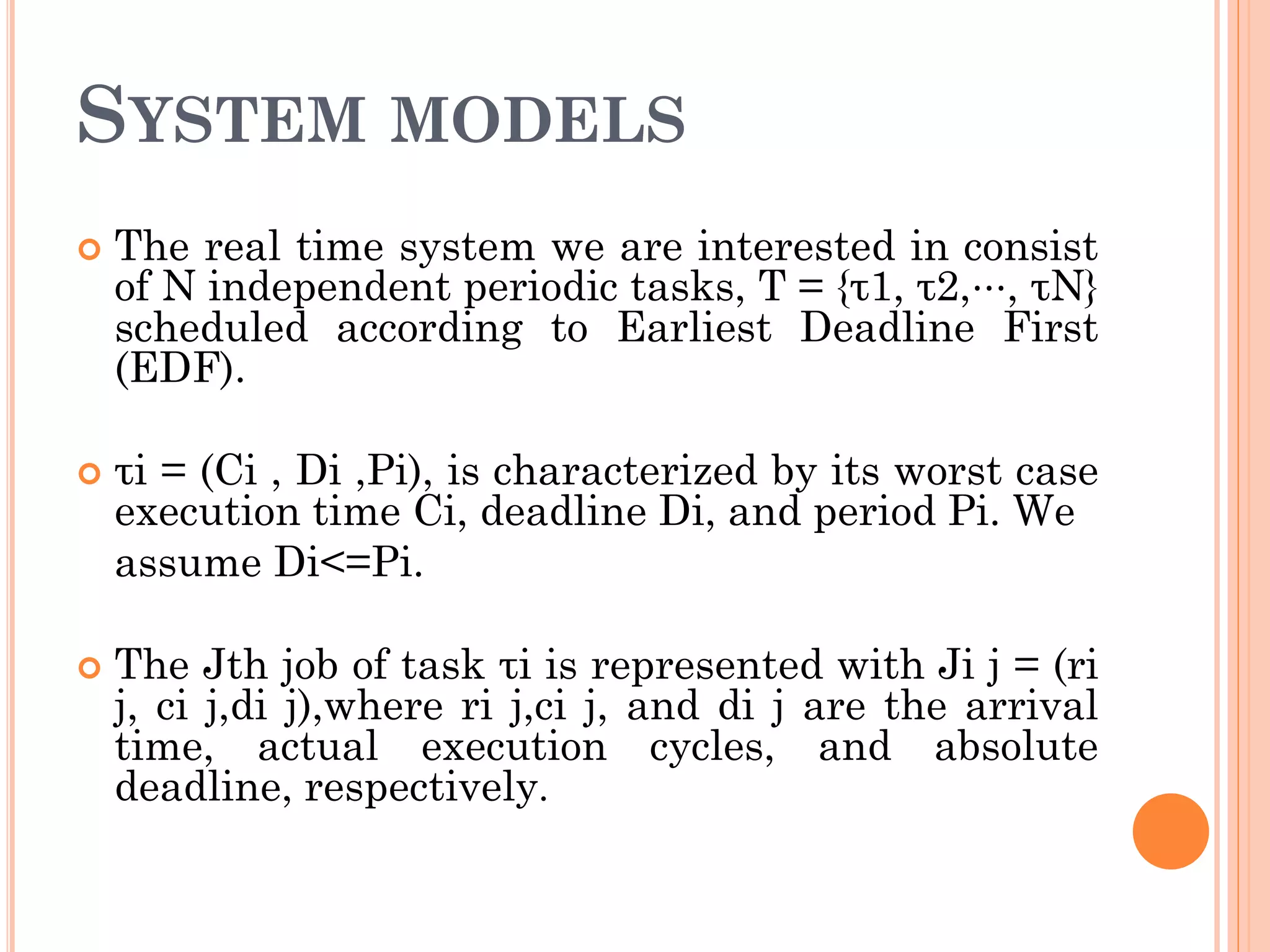
SYSTEM MODELS 
 The real time system we are interested in consist 
of N independent periodic tasks, T = {τ1, τ2,⋅⋅⋅, τN} 
scheduled according to Earliest Deadline First 
(EDF). 
 τi = (Ci , Di ,Pi), is characterized by its worst case 
execution time Ci, deadline Di, and period Pi. We 
assume Di<=Pi. 
 The Jth job of task τi is represented with Ji j = (ri 
j, ci j,di j),where ri j,ci j, and di j are the arrival 
time, actual execution cycles, and absolute 
deadline, respectively.
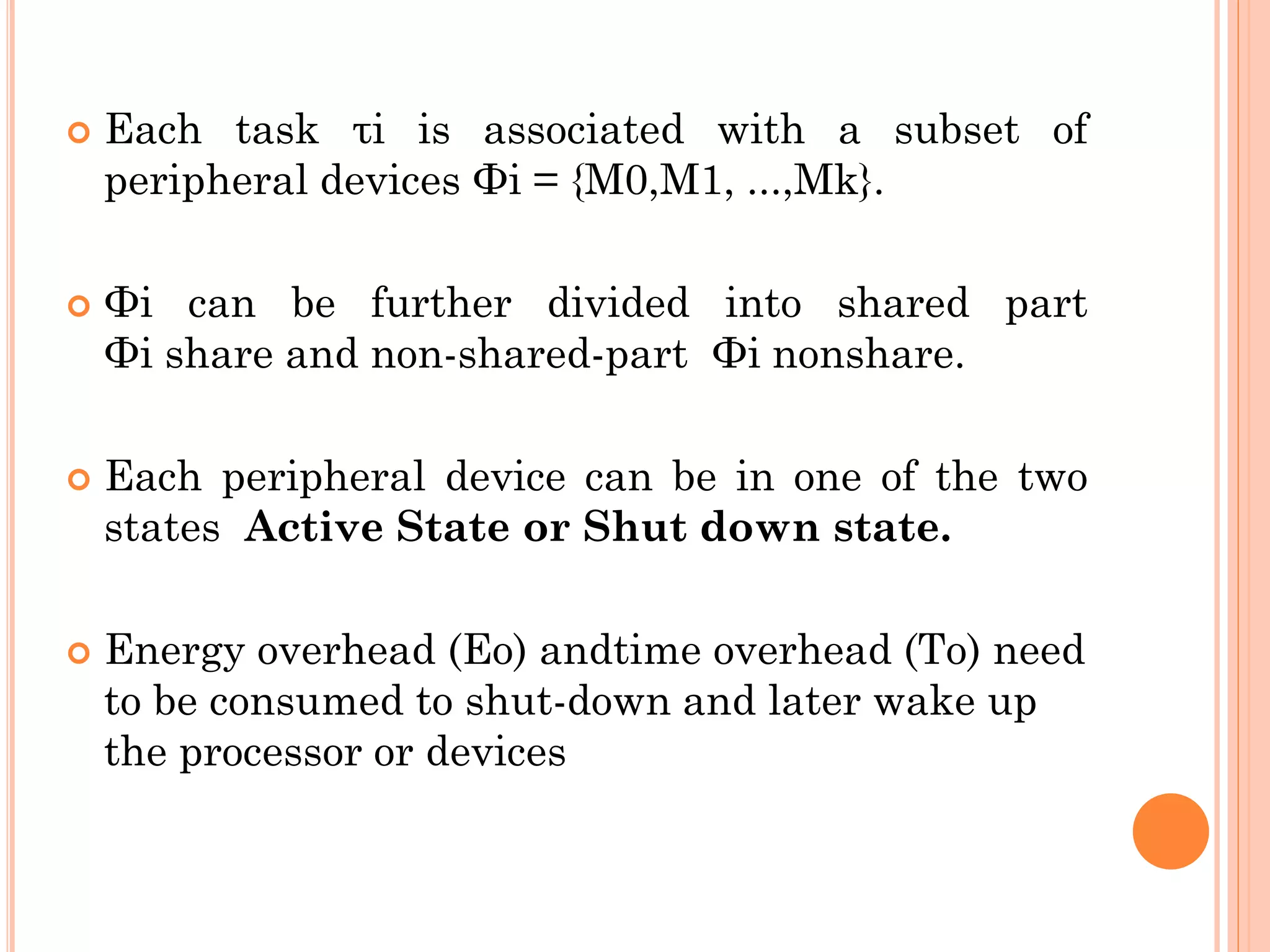
 Each task τi is associated with a subset of 
peripheral devices Φi = {M0,M1, ...,Mk}. 
 Φi can be further divided into shared part 
Φi share and non-shared-part Φi nonshare. 
 Each peripheral device can be in one of the two 
states Active State or Shut down state. 
 Energy overhead (Eo) andtime overhead (To) need 
to be consumed to shut-down and later wake up 
the processor or devices
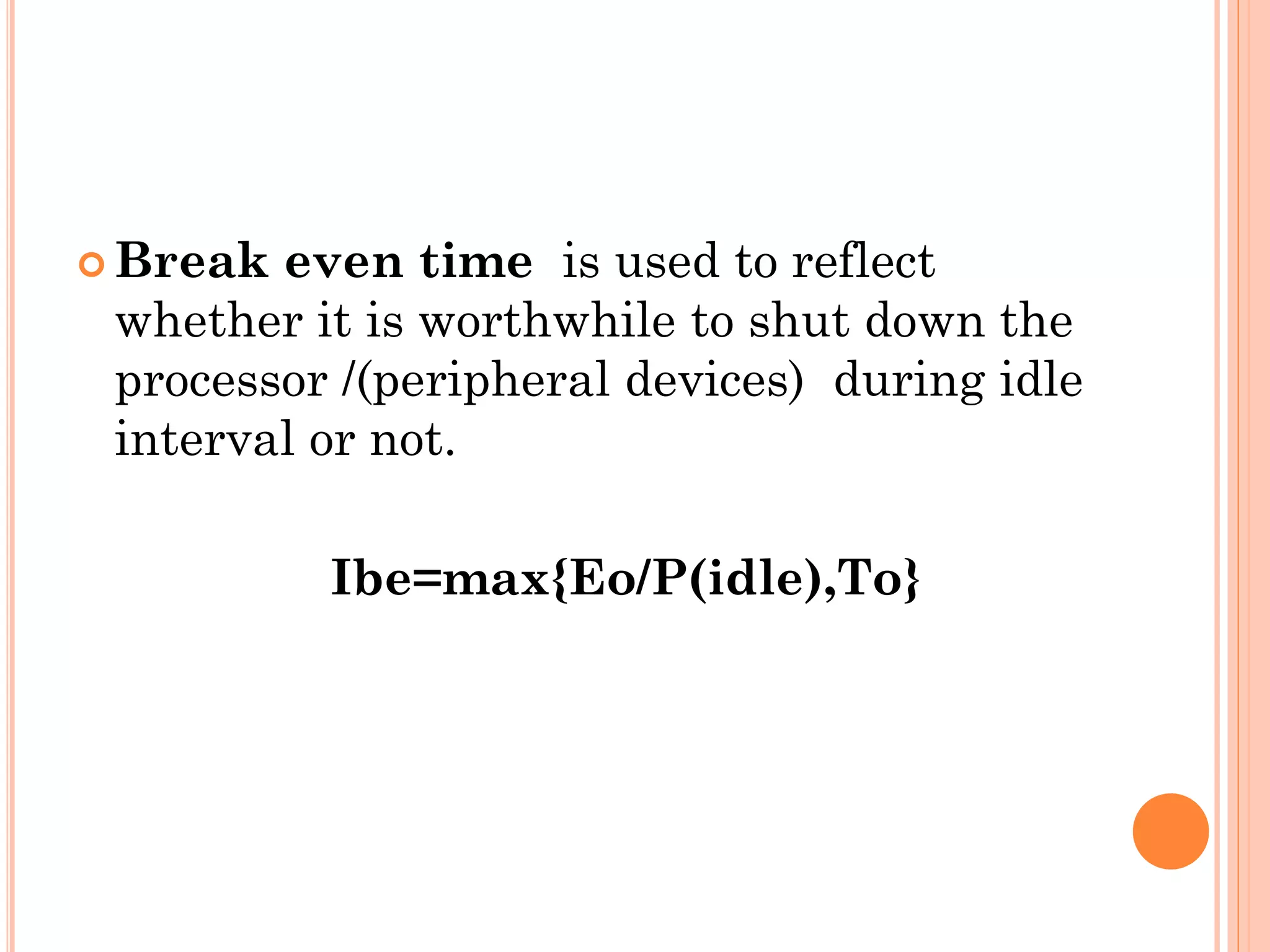
Break even time is used to reflect 
whether it is worthwhile to shut down the 
processor /(peripheral devices) during idle 
interval or not. 
Ibe=max{Eo/P(idle),To}
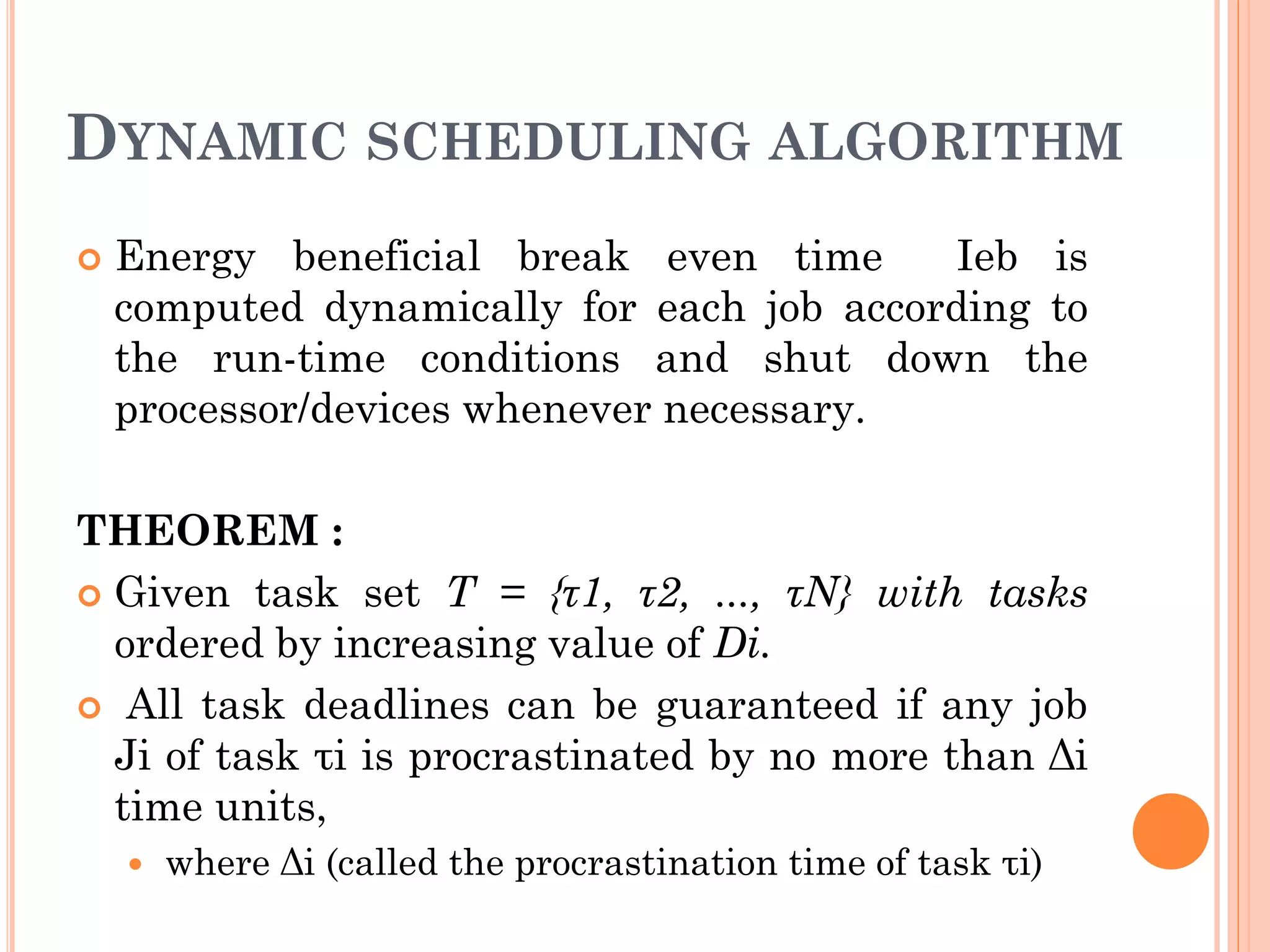
DYNAMIC SCHEDULING ALGORITHM 
 Energy beneficial break even time Ieb is 
computed dynamically for each job according to 
the run-time conditions and shut down the 
processor/devices whenever necessary. 
THEOREM : 
 Given task set T = {τ1, τ2, ..., τN} with tasks 
ordered by increasing value of Di. 
 All task deadlines can be guaranteed if any job 
Ji of task τi is procrastinated by no more than Δi 
time units, 
 where Δi (called the procrastination time of task τi)
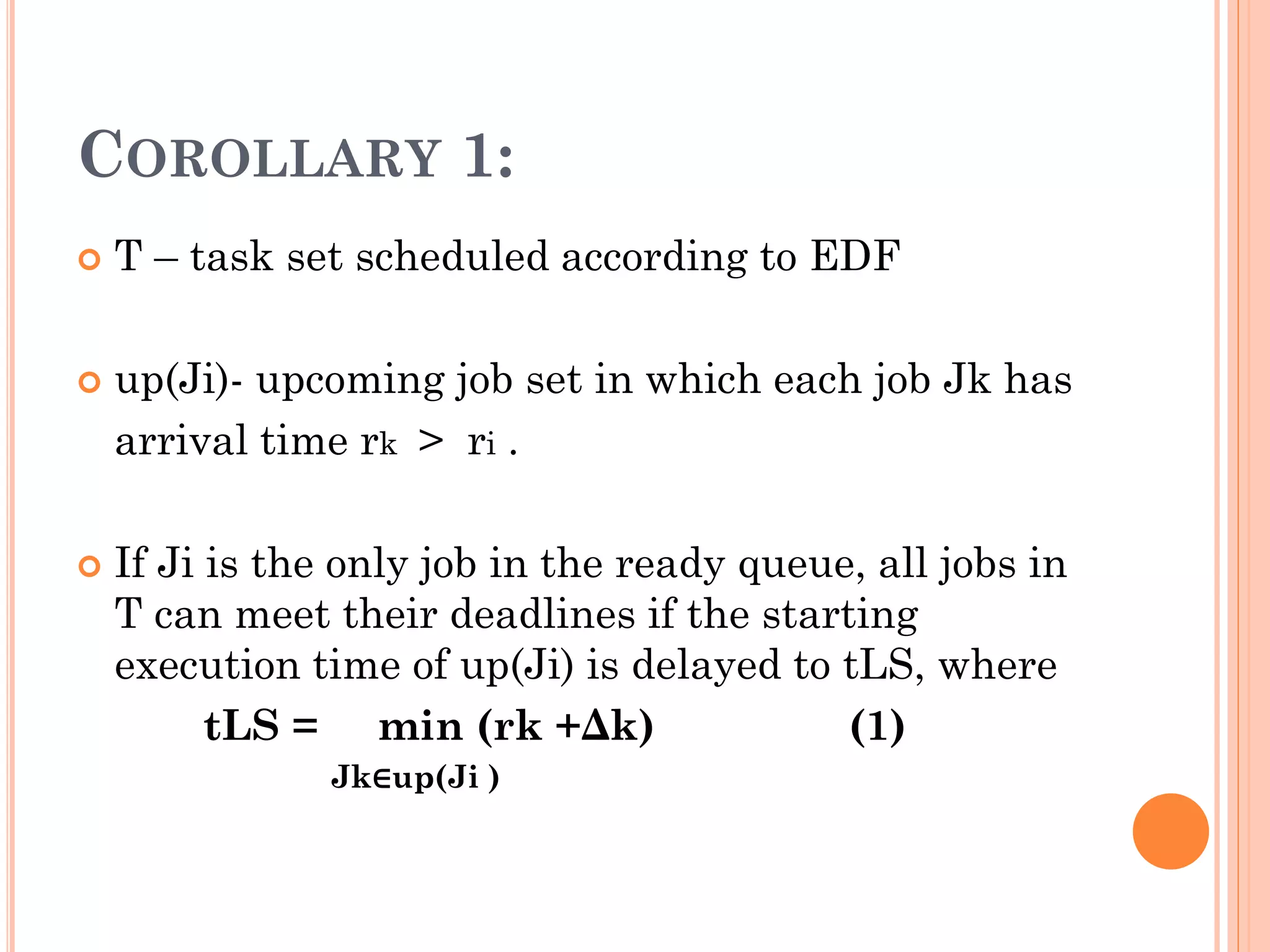
COROLLARY 1: 
 T – task set scheduled according to EDF 
 up(Ji)- upcoming job set in which each job Jk has 
arrival time rk > ri . 
 If Ji is the only job in the ready queue, all jobs in 
T can meet their deadlines if the starting 
execution time of up(Ji) is delayed to tLS, where 
tLS = min (rk +Δk) (1) 
Jk∈up(Ji )
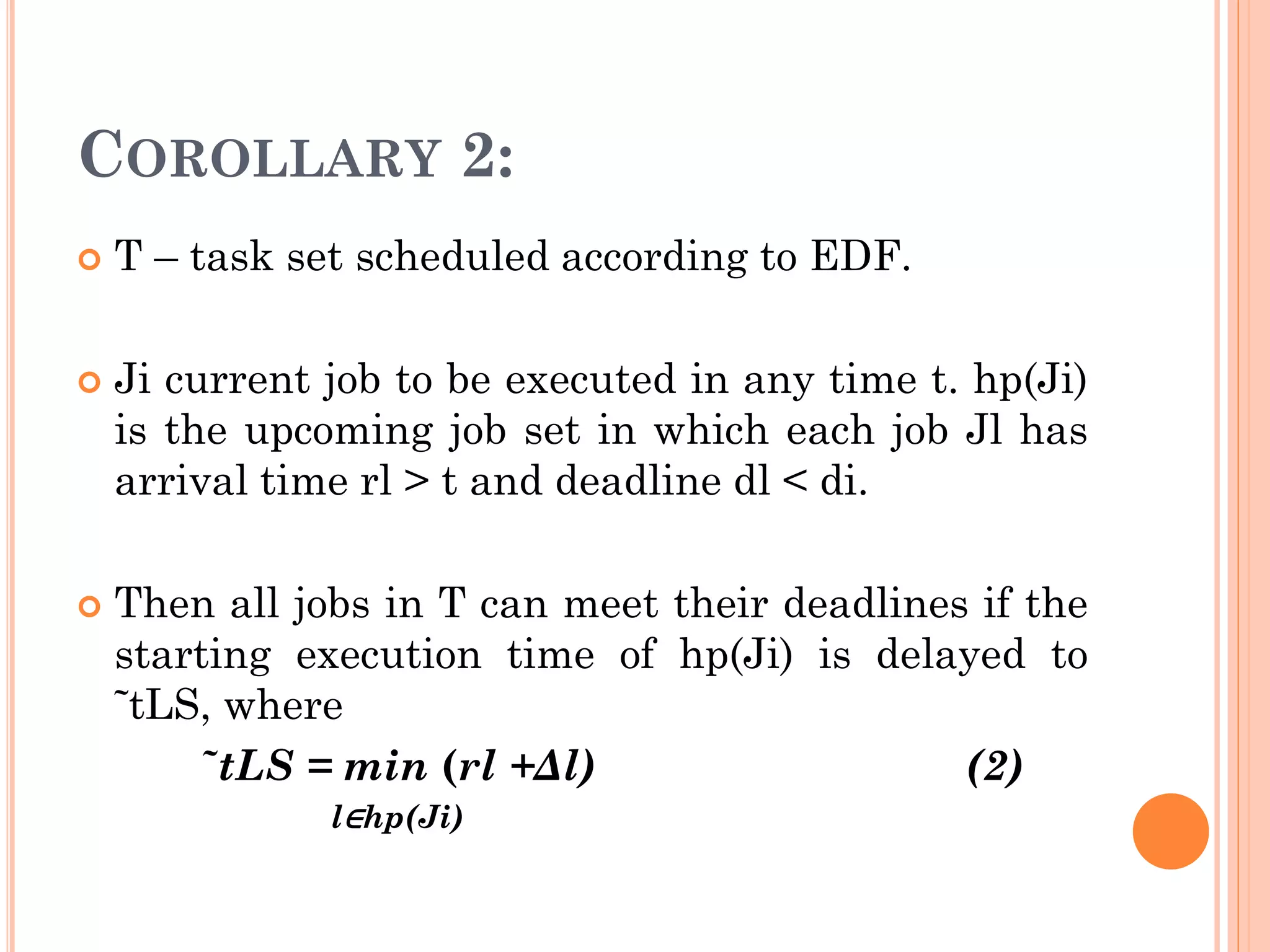
COROLLARY 2: 
 T – task set scheduled according to EDF. 
 Ji current job to be executed in any time t. hp(Ji) 
is the upcoming job set in which each job Jl has 
arrival time rl > t and deadline dl < di. 
 Then all jobs in T can meet their deadlines if the 
starting execution time of hp(Ji) is delayed to 
˜tLS, where 
˜tLS = min (rl +Δl) (2) 
l∈hp(Ji)
SCHEDULING ALGORITHM 
1: Input: The current job Ji and the current 
time t(cur); 
2: if Ji is the only job in the ready queue then 
3:Let edi = min{di, tLS}; 
//tLS is computed with 1 
4: Compute Ii(eb) based on Ji’s current feasible 
interval [t(cur),edi]; 
5: let fi be the expected completion time of Ji under 
S(crit) ; 
6: if (edi − fi) ≥ Ii(eb) then
CONT.. 
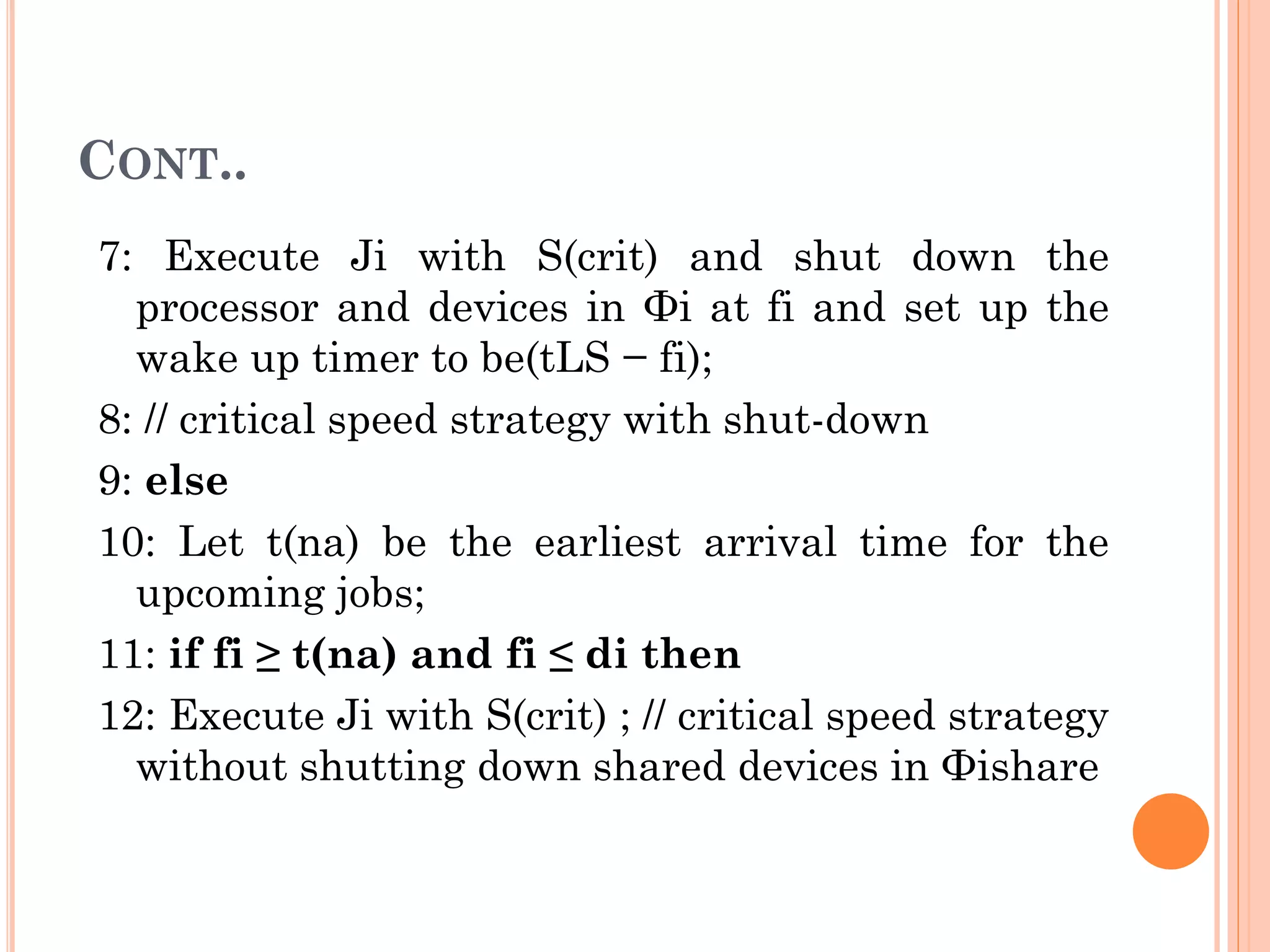
7: Execute Ji with S(crit) and shut down the 
processor and devices in Φi at fi and set up the 
wake up timer to be(tLS − fi); 
8: // critical speed strategy with shut-down 
9: else 
10: Let t(na) be the earliest arrival time for the 
upcoming jobs; 
11: if fi ≥ t(na) and fi ≤ di then 
12: Execute Ji with S(crit) ; // critical speed strategy 
without shutting down shared devices in Φishare
13: else 
14: Execute Ji with s′i = (ci×si)/(edi−(tcur)) non-preemptively 
within [t(cur),edi]; // DVS strategy 
stretching to edi; 
Start Deadline Start Deadline 
μProc.Speed Time 
Idle time 
represent 
s wasted 
energy 
Lower speed, 
Lower voltage, 
Lower energy 
Energy ~ Work • Speed 
Work 
Work
CONT.. 
15: end if 
16: end if 
17: else 
18: Compute ˜tLS based on equation (2); 
19: Execute Ji with max{si, S(crit)} non-preemptively 
within [t(cur),˜tLS] and shut down 
its non-shared devices Φi nonshare upon its 
completion; 
20: end if
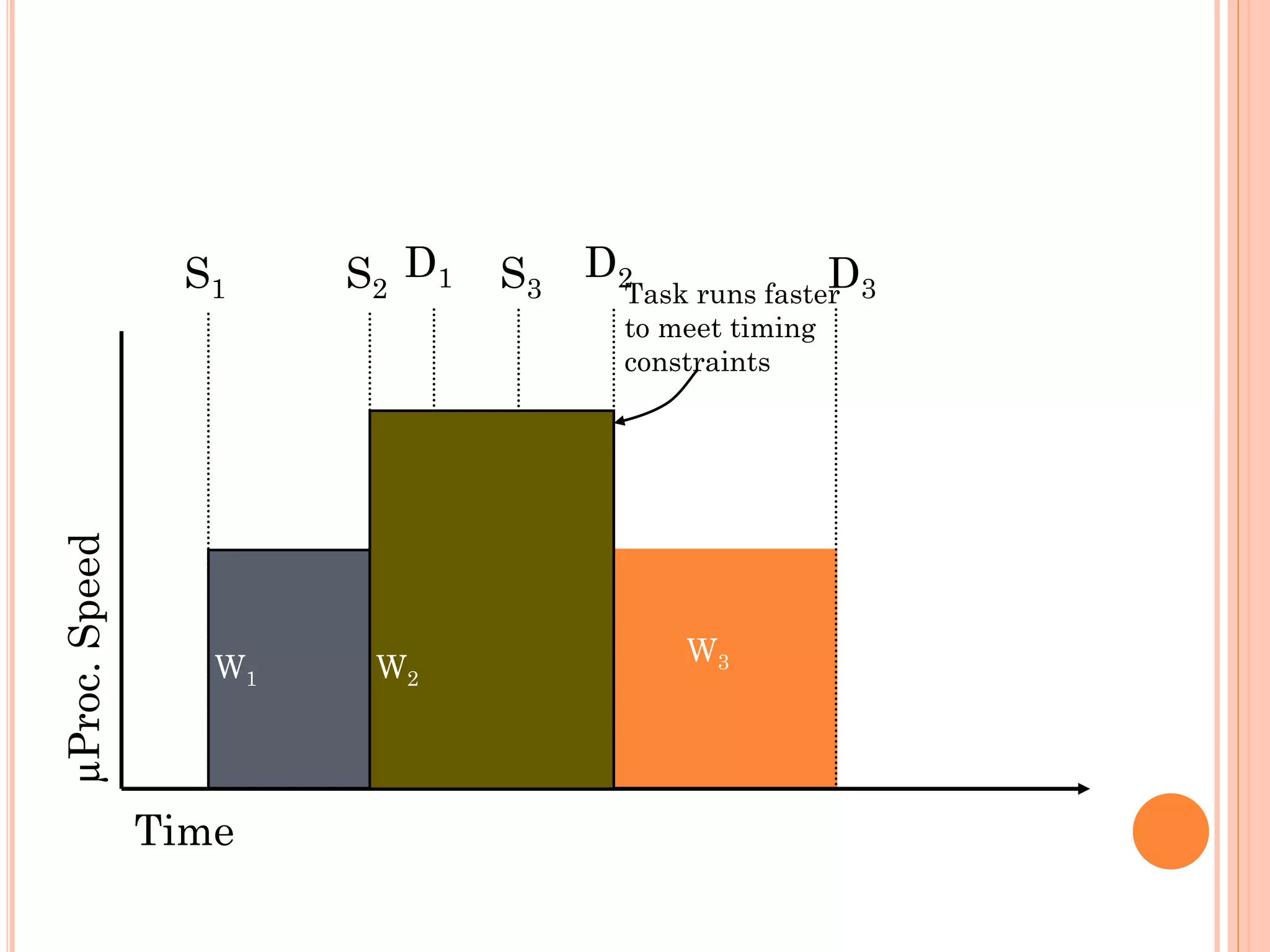
μProc. Speed 
S1 S2 S3 D2 D3 D 1 
W1 W2 
Time 
Task runs faster 
to meet timing 
constraints 
W3
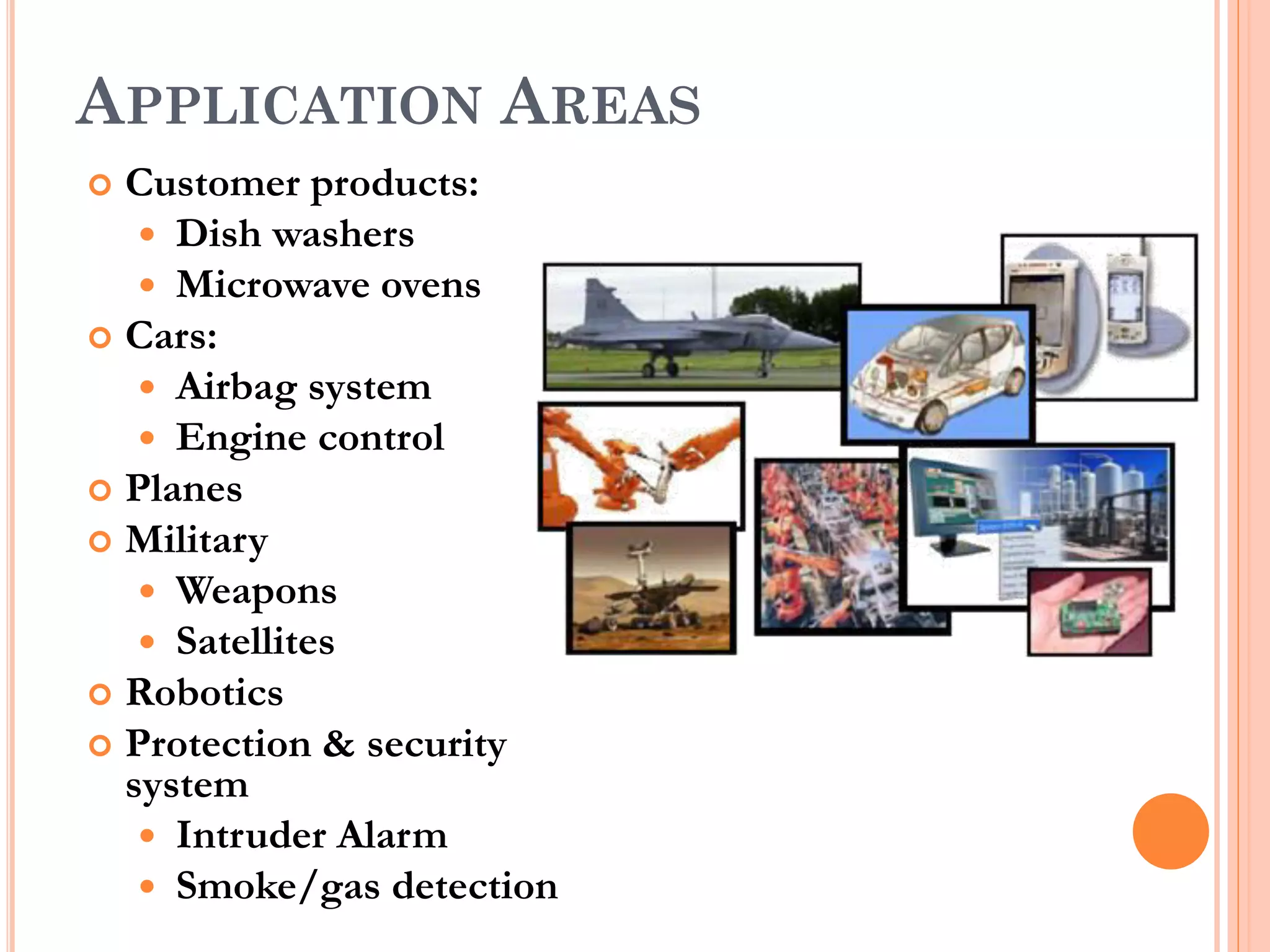
APPLICATION AREAS 
 Customer products: 
 Dish washers 
 Microwave ovens 
 Cars: 
 Airbag system 
 Engine control 
 Planes 
 Military 
 Weapons 
 Satellites 
 Robotics 
 Protection & security 
system 
 Intruder Alarm 
 Smoke/gas detection
LIMITATIONS 
 In DVS systems however, the performance level 
is reduced during periods of low utilization such 
that the processor finishes each task “just in 
time,” stretching each task to its deadline, 
 The primary caveat of overvolting is increased 
heat: the power dissipated by a circuit increases 
with the square of the voltage applied, so even 
small voltage increases significantly affect power.
CONCLUSION 
 Dynamic Scheduling Algorithm is used to 
minimize the system level energy consumption. 
 Approach of energy beneficial break even time is 
is used to enhance the computation. 
 This approach can reduce energy consumption for 
processor/devices significantly when compared 
with other approaches.
REFERENCES 
 http://www.cse.unsw.edu.au/~cs9242/08/lectures/ 
09-realtimex2.pdf - last seen 21/9/14 
 http://airccse.org/journal/ijcsea/papers/2212ijcsea 
16.pdf - last seen 24/9/14 
 http://www.dateconference.com/proceedings/PAP 
ERS/2011/DATE11/PDFFILES/IP1_08.PDF - last 
seen 21/9/14 
 http://www.ecs.umass.edu/ece/koren/architecture/ 
RtDVS/intro.htm - last seen 28/9/14.
Energy power efficient real time systems

Energy power efficient real time systems

  • 1.
    Presented By: PragyaArya Btech(cs) 3rd year Banasthali University
  • 2.
    INTRODUCTION Energy powerefficient real time systems are systems which are power efficient i.e. uses less energy for computation and processing in the specified time which basically lead to light weighted devices having longer battery life.
  • 3.
    REAL TIME SYSTEMS  A real-time system is any information processing system which has to respond to externally generated input stimuli within a finite and specified period.  Mainly Real time systems are divided in two categories  Hard real time Systems  Soft real time systems
  • 4.
    HARD REAL TIMESYSTEMS  An overrun in response time leads to potential loss of life and/or big financial damage  Many of these systems are considered to be safety critical.  Examples: Pacemakers , Airplane control systems.
  • 5.
    SOFT REAL TIMESYSTEMS  Deadline overruns are tolerable, but not desired.  There are no catastrophic consequences of missing one or more deadlines.  Example: live video streaming
  • 6.
    EMBEDDED SYSTEMS An embedded system is a computer system with a dedicated function within a larger mechanical or electrical system, often with a real time constraint.
  • 7.
    NEED OF ENERGYPOWER EFFICIENCY  Critical design issue in real-time systems, especially in battery- operated systems.  Smaller and lighter devices  Less heat generation  Better performance with unprecedented speed  Reduce cost  Reduce energy use  Longer battery life.
  • 8.
    POWER ISSUE CANBE ADDRESSED IN  Architecture Level  System Level  Application Level
  • 9.
    SCHEDULING  Schedulingis method by which threads , process, or data flow are given access to system resources.  This is usually done to load balance and share system resources effectively.  There are various energy efficient scheduling algorithms.
  • 10.
    DYNAMIC VOLTAGE SCALING  Dynamic voltage scaling is a power management technique in computer architecture.  In which the voltage used in a component is increased or decreased, depending upon circumstances.  Dynamic voltage scaling to decrease voltage is known as undervolting. It is done in order to conserve power.  Dynamic voltage scaling to increase voltage is known as overvolting. It is done in order to increase computer performance.
  • 11.
    SYSTEM MODELS The real time system we are interested in consist of N independent periodic tasks, T = {τ1, τ2,⋅⋅⋅, τN} scheduled according to Earliest Deadline First (EDF).  τi = (Ci , Di ,Pi), is characterized by its worst case execution time Ci, deadline Di, and period Pi. We assume Di<=Pi.  The Jth job of task τi is represented with Ji j = (ri j, ci j,di j),where ri j,ci j, and di j are the arrival time, actual execution cycles, and absolute deadline, respectively.
  • 12.
     Each taskτi is associated with a subset of peripheral devices Φi = {M0,M1, ...,Mk}.  Φi can be further divided into shared part Φi share and non-shared-part Φi nonshare.  Each peripheral device can be in one of the two states Active State or Shut down state.  Energy overhead (Eo) andtime overhead (To) need to be consumed to shut-down and later wake up the processor or devices
  • 13.
    Break even timeis used to reflect whether it is worthwhile to shut down the processor /(peripheral devices) during idle interval or not. Ibe=max{Eo/P(idle),To}
  • 14.
    DYNAMIC SCHEDULING ALGORITHM  Energy beneficial break even time Ieb is computed dynamically for each job according to the run-time conditions and shut down the processor/devices whenever necessary. THEOREM :  Given task set T = {τ1, τ2, ..., τN} with tasks ordered by increasing value of Di.  All task deadlines can be guaranteed if any job Ji of task τi is procrastinated by no more than Δi time units,  where Δi (called the procrastination time of task τi)
  • 15.
    COROLLARY 1: T – task set scheduled according to EDF  up(Ji)- upcoming job set in which each job Jk has arrival time rk > ri .  If Ji is the only job in the ready queue, all jobs in T can meet their deadlines if the starting execution time of up(Ji) is delayed to tLS, where tLS = min (rk +Δk) (1) Jk∈up(Ji )
  • 16.
    COROLLARY 2: T – task set scheduled according to EDF.  Ji current job to be executed in any time t. hp(Ji) is the upcoming job set in which each job Jl has arrival time rl > t and deadline dl < di.  Then all jobs in T can meet their deadlines if the starting execution time of hp(Ji) is delayed to ˜tLS, where ˜tLS = min (rl +Δl) (2) l∈hp(Ji)
  • 17.
    SCHEDULING ALGORITHM 1:Input: The current job Ji and the current time t(cur); 2: if Ji is the only job in the ready queue then 3:Let edi = min{di, tLS}; //tLS is computed with 1 4: Compute Ii(eb) based on Ji’s current feasible interval [t(cur),edi]; 5: let fi be the expected completion time of Ji under S(crit) ; 6: if (edi − fi) ≥ Ii(eb) then
  • 18.
    CONT.. 7: ExecuteJi with S(crit) and shut down the processor and devices in Φi at fi and set up the wake up timer to be(tLS − fi); 8: // critical speed strategy with shut-down 9: else 10: Let t(na) be the earliest arrival time for the upcoming jobs; 11: if fi ≥ t(na) and fi ≤ di then 12: Execute Ji with S(crit) ; // critical speed strategy without shutting down shared devices in Φishare
  • 19.
    13: else 14:Execute Ji with s′i = (ci×si)/(edi−(tcur)) non-preemptively within [t(cur),edi]; // DVS strategy stretching to edi; Start Deadline Start Deadline μProc.Speed Time Idle time represent s wasted energy Lower speed, Lower voltage, Lower energy Energy ~ Work • Speed Work Work
  • 20.
    CONT.. 15: endif 16: end if 17: else 18: Compute ˜tLS based on equation (2); 19: Execute Ji with max{si, S(crit)} non-preemptively within [t(cur),˜tLS] and shut down its non-shared devices Φi nonshare upon its completion; 20: end if
  • 21.
    μProc. Speed S1S2 S3 D2 D3 D 1 W1 W2 Time Task runs faster to meet timing constraints W3
  • 22.
    APPLICATION AREAS Customer products:  Dish washers  Microwave ovens  Cars:  Airbag system  Engine control  Planes  Military  Weapons  Satellites  Robotics  Protection & security system  Intruder Alarm  Smoke/gas detection
  • 23.
    LIMITATIONS  InDVS systems however, the performance level is reduced during periods of low utilization such that the processor finishes each task “just in time,” stretching each task to its deadline,  The primary caveat of overvolting is increased heat: the power dissipated by a circuit increases with the square of the voltage applied, so even small voltage increases significantly affect power.
  • 24.
    CONCLUSION  DynamicScheduling Algorithm is used to minimize the system level energy consumption.  Approach of energy beneficial break even time is is used to enhance the computation.  This approach can reduce energy consumption for processor/devices significantly when compared with other approaches.
  • 25.
    REFERENCES  http://www.cse.unsw.edu.au/~cs9242/08/lectures/ 09-realtimex2.pdf - last seen 21/9/14  http://airccse.org/journal/ijcsea/papers/2212ijcsea 16.pdf - last seen 24/9/14  http://www.dateconference.com/proceedings/PAP ERS/2011/DATE11/PDFFILES/IP1_08.PDF - last seen 21/9/14  http://www.ecs.umass.edu/ece/koren/architecture/ RtDVS/intro.htm - last seen 28/9/14.