CONTENTS 
 Introduction 
 Mobile Computing 
 Cloud computing 
 Mobile Cloud Computing 
 Concept 
 Architecture 
 Challenges and solution 
 Limitations of mobile devices 
 Quality of communication 
 Division of application services 
 Application 
 Conclusion
INTRODUCTION 
• Increased capability of mobile devices 
• Accessing internet using mobile devices. 
• Growth in emerging mobile devices and in cloud 
computing has lead to a new field called mobile 
cloud computing.

MOBILE COMPUTING 
• Mobile Computing is a technology that allows 
transmission of data, via a computer, without 
having to be connected to a fixed physical link. 
• Mobile computing is based on a three concepts: 
i. Hardware - mobile devices 
ii. software - mobile applications and 
iii. Communication-infrastructure of mobile networks, 
protocols and data delivery.
CLOUD COMPUTING 
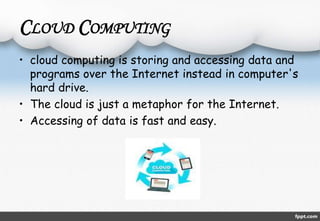
• cloud computing is storing and accessing data and 
programs over the Internet instead in computer's 
hard drive. 
• The cloud is just a metaphor for the Internet. 
• Accessing of data is fast and easy.
MOBILE COULD COMPUTING 
• The mobile cloud computing is a development 
of mobile computing and an extension to cloud 
computing. 
• The mobile device based computing, data 
storage and mass information processing have 
been transferred to ’cloud’ . 
• Thus the requirements of mobile devices in 
computing have been reduced. 
• Cloud services are suitable for mobile devices 
like smartphone, PDA, Tablet, and iPad. 
• Even non-smartphones can achieve mobile cloud 
computing.
CONCEPT 
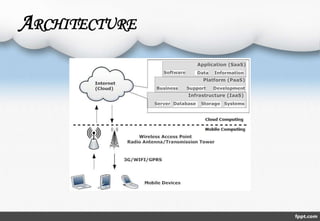
• Those mobile devices connects with a hotspot or 
base station by 3G, WIFI, or GPRS. 
• Mobile users send service requests to the cloud 
through a web browser or desktop application. 
• Then the management component of cloud 
allocates resources to the request to establish 
connection. 
• Major data processing is migrated to ’cloud’ thus 
the capability requirement of mobile devices is 
limited.
ARCHITECTURE
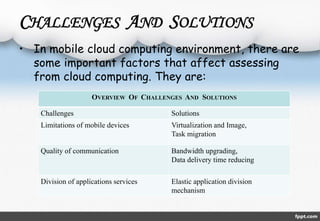
CHALLENGES AND SOLUTIONS 
• In mobile cloud computing environment, there are 
some important factors that affect assessing 
from cloud computing. They are: 
OVERVIEW OF CHALLENGES AND SOLUTIONS 
Challenges Solutions 
Limitations of mobile devices Virtualization and Image, 
Task migration 
Quality of communication Bandwidth upgrading, 
Data delivery time reducing 
Division of applications services Elastic application division 
mechanism
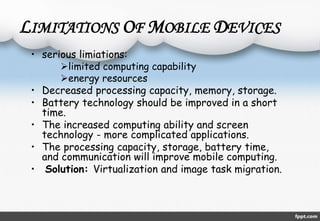
LIMITATIONS OF MOBILE DEVICES 
• serious limiations: 
limited computing capability 
energy resources 
• Decreased processing capacity, memory, storage. 
• Battery technology should be improved in a short 
time. 
• The increased computing ability and screen 
technology - more complicated applications. 
• The processing capacity, storage, battery time, 
and communication will improve mobile computing. 
• Solution: Virtualization and image task migration.
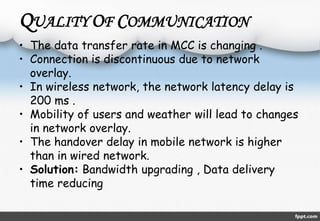
QUALITY OF COMMUNICATION 
• The data transfer rate in MCC is changing . 
• Connection is discontinuous due to network 
overlay. 
• In wireless network, the network latency delay is 
200 ms . 
• Mobility of users and weather will lead to changes 
in network overlay. 
• The handover delay in mobile network is higher 
than in wired network. 
• Solution: Bandwidth upgrading , Data delivery 
time reducing
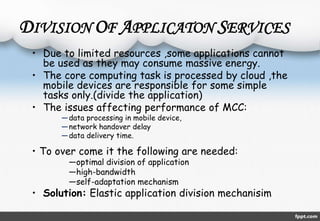
DIVISION OF APPLICATON SERVICES 
• Due to limited resources ,some applications cannot 
be used as they may consume massive energy. 
• The core computing task is processed by cloud ,the 
mobile devices are responsible for some simple 
tasks only.(divide the application) 
• The issues affecting performance of MCC: 
—data processing in mobile device, 
—network handover delay 
—data delivery time. 
• To over come it the following are needed: 
―optimal division of application 
―high-bandwidth 
―self-adaptation mechanism 
• Solution: Elastic application division mechanisim
APPLICATIONS 
• Mobile Commerce: 
» allows business models for commerce using mobile devices. 
» Examples: Mobile financial, mobile advertising, mobile shopping 
• Mobile Learning: 
» M-learning combines e-learning and mobility. 
» Traditional m-learning has limitations on high cost of devices, 
low transmission rate, limited educational resources. 
• Mobile Healthcare: 
» M-healthcare offers hospitals and healthcare organizations a 
variety of on-demand services on clouds. 
• Mobile Gaming: 
» M-game is a high potential market generating revenues for 
service providers. 
• Other applications: 
» Sharing photos/videos 
» Keyword-based, voice-based, tag-based searching 
» Monitoring a house, smart home systems
Conclusion 
• Gives the high mobility and scalability. 
• Became a research topic in recent years. 
• Mobile cloud computing is a highly promising trend 
for the future of mobile computing. 
• According to a recent study by ABI Research, 
more than 240 million business will use cloud 
services through mobile devices by 2015
REFERENCES 
• Le Guan, Xu Ke, Meina Song, and Junde Song, “A Survey of 
Research on Mobile Cloud Computing”, IEEE/ACIS 10th 
International Conference on Computer and Information 
Science (ICIS), 2010, pp. 387-392. 
• Xiaopeng Fan, Jiannong Cao, and Haixia Mao. “A Survey of 
Mobile Cloud Computing,” ZTE Communications, 9(1):4-8, 
Mar 2011. 
• http://www.csie.ndhu.edu.tw/~showyang/MCloud2012/04Mobi 
leCloudSurvey.pdf 
• Chetan S., Gautam Kumar, K. Dinesh, Mathew K. and 
Abhimanyu M.A., “Cloud Computing for Mobile World,” 2010. 
(http://chetan.ueuo.com/projects/CCMW.pdf)

Details About Mobile Cloud Computing

  • 2.
    CONTENTS  Introduction  Mobile Computing  Cloud computing  Mobile Cloud Computing  Concept  Architecture  Challenges and solution  Limitations of mobile devices  Quality of communication  Division of application services  Application  Conclusion
  • 3.
    INTRODUCTION • Increasedcapability of mobile devices • Accessing internet using mobile devices. • Growth in emerging mobile devices and in cloud computing has lead to a new field called mobile cloud computing.
  • 4.
    MOBILE COMPUTING •Mobile Computing is a technology that allows transmission of data, via a computer, without having to be connected to a fixed physical link. • Mobile computing is based on a three concepts: i. Hardware - mobile devices ii. software - mobile applications and iii. Communication-infrastructure of mobile networks, protocols and data delivery.
  • 5.
    CLOUD COMPUTING •cloud computing is storing and accessing data and programs over the Internet instead in computer's hard drive. • The cloud is just a metaphor for the Internet. • Accessing of data is fast and easy.
  • 6.
    MOBILE COULD COMPUTING • The mobile cloud computing is a development of mobile computing and an extension to cloud computing. • The mobile device based computing, data storage and mass information processing have been transferred to ’cloud’ . • Thus the requirements of mobile devices in computing have been reduced. • Cloud services are suitable for mobile devices like smartphone, PDA, Tablet, and iPad. • Even non-smartphones can achieve mobile cloud computing.
  • 7.
    CONCEPT • Thosemobile devices connects with a hotspot or base station by 3G, WIFI, or GPRS. • Mobile users send service requests to the cloud through a web browser or desktop application. • Then the management component of cloud allocates resources to the request to establish connection. • Major data processing is migrated to ’cloud’ thus the capability requirement of mobile devices is limited.
  • 8.
  • 9.
    CHALLENGES AND SOLUTIONS • In mobile cloud computing environment, there are some important factors that affect assessing from cloud computing. They are: OVERVIEW OF CHALLENGES AND SOLUTIONS Challenges Solutions Limitations of mobile devices Virtualization and Image, Task migration Quality of communication Bandwidth upgrading, Data delivery time reducing Division of applications services Elastic application division mechanism
  • 10.
    LIMITATIONS OF MOBILEDEVICES • serious limiations: limited computing capability energy resources • Decreased processing capacity, memory, storage. • Battery technology should be improved in a short time. • The increased computing ability and screen technology - more complicated applications. • The processing capacity, storage, battery time, and communication will improve mobile computing. • Solution: Virtualization and image task migration.
  • 11.
    QUALITY OF COMMUNICATION • The data transfer rate in MCC is changing . • Connection is discontinuous due to network overlay. • In wireless network, the network latency delay is 200 ms . • Mobility of users and weather will lead to changes in network overlay. • The handover delay in mobile network is higher than in wired network. • Solution: Bandwidth upgrading , Data delivery time reducing
  • 12.
    DIVISION OF APPLICATONSERVICES • Due to limited resources ,some applications cannot be used as they may consume massive energy. • The core computing task is processed by cloud ,the mobile devices are responsible for some simple tasks only.(divide the application) • The issues affecting performance of MCC: —data processing in mobile device, —network handover delay —data delivery time. • To over come it the following are needed: ―optimal division of application ―high-bandwidth ―self-adaptation mechanism • Solution: Elastic application division mechanisim
  • 13.
    APPLICATIONS • MobileCommerce: » allows business models for commerce using mobile devices. » Examples: Mobile financial, mobile advertising, mobile shopping • Mobile Learning: » M-learning combines e-learning and mobility. » Traditional m-learning has limitations on high cost of devices, low transmission rate, limited educational resources. • Mobile Healthcare: » M-healthcare offers hospitals and healthcare organizations a variety of on-demand services on clouds. • Mobile Gaming: » M-game is a high potential market generating revenues for service providers. • Other applications: » Sharing photos/videos » Keyword-based, voice-based, tag-based searching » Monitoring a house, smart home systems
  • 14.
    Conclusion • Givesthe high mobility and scalability. • Became a research topic in recent years. • Mobile cloud computing is a highly promising trend for the future of mobile computing. • According to a recent study by ABI Research, more than 240 million business will use cloud services through mobile devices by 2015
  • 15.
    REFERENCES • LeGuan, Xu Ke, Meina Song, and Junde Song, “A Survey of Research on Mobile Cloud Computing”, IEEE/ACIS 10th International Conference on Computer and Information Science (ICIS), 2010, pp. 387-392. • Xiaopeng Fan, Jiannong Cao, and Haixia Mao. “A Survey of Mobile Cloud Computing,” ZTE Communications, 9(1):4-8, Mar 2011. • http://www.csie.ndhu.edu.tw/~showyang/MCloud2012/04Mobi leCloudSurvey.pdf • Chetan S., Gautam Kumar, K. Dinesh, Mathew K. and Abhimanyu M.A., “Cloud Computing for Mobile World,” 2010. (http://chetan.ueuo.com/projects/CCMW.pdf)