Harshit Gupta
IUU15BBA027
B.B.A 5(A)
Ms Shalini Singh
European Union
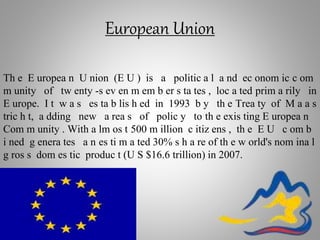
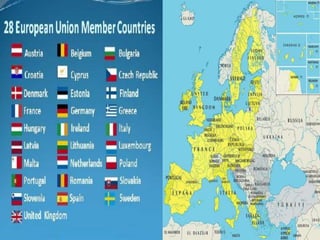
Th e E uropea n U nion (E U ) is a politic a l a nd ec onom ic c om
m unity of tw enty -s ev en m em b er s ta tes , loc a ted prim a rily in
E urope. I t w a s es ta b lis h ed in 1993 b y th e Trea ty of M a a s
tric h t, a dding new a rea s of polic y to th e exis ting E uropea n
Com m unity . With a lm os t 500 m illion c itiz ens , th e E U c om b
i ned g enera tes a n es ti m a ted 30% s h a re of th e w orld's nom ina l
g ros s dom es tic produc t (U S $16.6 trillion) in 2007.
Founding Members
1. F ra n c e
2. We s t G e rm a n y
3. I ta l y
4. B e l g i u m
5. N e th e rl a n d s
6. L u x e m b o u rg
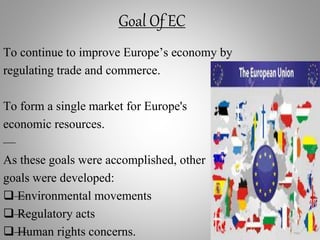
Goal Of EC
To continue to improve Europe’s economy by
regulating trade and commerce.
To form a single market for Europe's
economic resources.
—
As these goals were accomplished, other
goals were developed:
—Environmental movements
—Regulatory acts
—Human rights concerns.
Principal Objectives Of EC
—Establish European Citizenship Ensure freedom, security ,
and justice
—Promote economic and social progress
—Assert Europe’s role in the world
The Single MarketThe Single
Market
Based on Four Freedoms:
– Free movement of goods;
– Free movement of capital;
– Free movement of persons;
– Free movement of services.
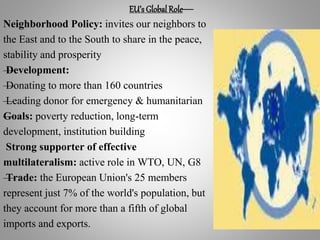
EU’s Global Role—
Neighborhood Policy: invites our neighbors to
the East and to the South to share in the peace,
stability and prosperity
—Development:
—Donating to more than 160 countries
—Leading donor for emergency & humanitarian
—Goals: poverty reduction, long-term
development, institution building
Strong supporter of effective
multilateralism: active role in WTO, UN, G8
—Trade: the European Union's 25 members
represent just 7% of the world's population, but
they account for more than a fifth of global
imports and exports.
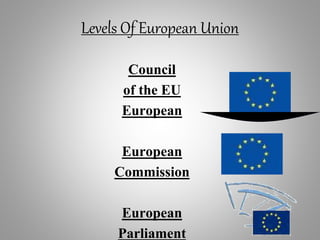
Levels Of European Union
Council
of the EU
European
European
Commission
European
Parliament
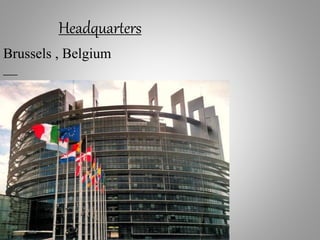
Headquarters
Brussels , Belgium
—
Current EU Issues
1. Enlargement:
*Ten countries joined the EU in 2004, making 27 countries total.
2. The Euro:
*The Common Currency for the EU Countries.
3. Multilingualism:
*20 official languages (as of 2004) for 27 countries.
4. Openness, Access and Transparency:
*How to get the documents to the people?
5. Safety & security of Europe:
*Against terrorism.
6. BREXIT
BREXIT
BREXIT” refers to the possibility of Britain’s exit from European
Union
On 23 June 2016 citizens of the United Kingdom (UK) voted to leave the
European Union (EU).
On 29 March 2017 the UK formally notified the European Council of its
intention to leave the EU by triggering of Article 50 of the Lisbon
Treaty.
For the time being, the United Kingdom remains a full member of the
EU and rights and obligations continue to fully apply in and to the UK
Reasons Behind Brexit
Interference of EU
The UK taxpayers money directly goes to 14.5 billion
Euros per year
The EU regulations cost UK businesses over 600 million
Euros every week
EU bounded the trade rules of UK
Immigration issues
Losing sovereignty and cultural values
Thank You

European union

  • 1.
  • 2.
    European Union Th eE uropea n U nion (E U ) is a politic a l a nd ec onom ic c om m unity of tw enty -s ev en m em b er s ta tes , loc a ted prim a rily in E urope. I t w a s es ta b lis h ed in 1993 b y th e Trea ty of M a a s tric h t, a dding new a rea s of polic y to th e exis ting E uropea n Com m unity . With a lm os t 500 m illion c itiz ens , th e E U c om b i ned g enera tes a n es ti m a ted 30% s h a re of th e w orld's nom ina l g ros s dom es tic produc t (U S $16.6 trillion) in 2007.
  • 3.
    Founding Members 1. Fra n c e 2. We s t G e rm a n y 3. I ta l y 4. B e l g i u m 5. N e th e rl a n d s 6. L u x e m b o u rg
  • 4.
    Goal Of EC Tocontinue to improve Europe’s economy by regulating trade and commerce. To form a single market for Europe's economic resources. — As these goals were accomplished, other goals were developed: —Environmental movements —Regulatory acts —Human rights concerns.
  • 5.
    Principal Objectives OfEC —Establish European Citizenship Ensure freedom, security , and justice —Promote economic and social progress —Assert Europe’s role in the world
  • 6.
    The Single MarketTheSingle Market Based on Four Freedoms: – Free movement of goods; – Free movement of capital; – Free movement of persons; – Free movement of services.
  • 7.
    EU’s Global Role— NeighborhoodPolicy: invites our neighbors to the East and to the South to share in the peace, stability and prosperity —Development: —Donating to more than 160 countries —Leading donor for emergency & humanitarian —Goals: poverty reduction, long-term development, institution building Strong supporter of effective multilateralism: active role in WTO, UN, G8 —Trade: the European Union's 25 members represent just 7% of the world's population, but they account for more than a fifth of global imports and exports.
  • 8.
    Levels Of EuropeanUnion Council of the EU European European Commission European Parliament
  • 9.
  • 11.
    Current EU Issues 1.Enlargement: *Ten countries joined the EU in 2004, making 27 countries total. 2. The Euro: *The Common Currency for the EU Countries. 3. Multilingualism: *20 official languages (as of 2004) for 27 countries. 4. Openness, Access and Transparency: *How to get the documents to the people? 5. Safety & security of Europe: *Against terrorism. 6. BREXIT
  • 12.
    BREXIT BREXIT” refers tothe possibility of Britain’s exit from European Union On 23 June 2016 citizens of the United Kingdom (UK) voted to leave the European Union (EU). On 29 March 2017 the UK formally notified the European Council of its intention to leave the EU by triggering of Article 50 of the Lisbon Treaty. For the time being, the United Kingdom remains a full member of the EU and rights and obligations continue to fully apply in and to the UK
  • 13.
    Reasons Behind Brexit Interferenceof EU The UK taxpayers money directly goes to 14.5 billion Euros per year The EU regulations cost UK businesses over 600 million Euros every week EU bounded the trade rules of UK Immigration issues Losing sovereignty and cultural values
  • 14.