“Learning as they go”: In-service Teachers
Learning to Telecollaborate
Robert O’Dowd
University of León, Spain
@Robodowd
www.uni-collaboration.eu
What is Telecollaboration?
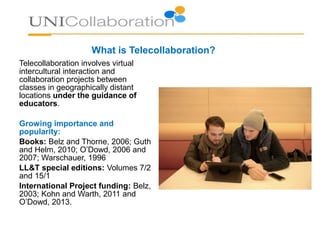
Telecollaboration involves virtual
intercultural interaction and
collaboration projects between
classes in geographically distant
locations under the guidance of
educators.
Growing importance and
popularity:
Books: Belz and Thorne, 2006; Guth
and Helm, 2010; O’Dowd, 2006 and
2007; Warschauer, 1996
LL&T special editions: Volumes 7/2
and 15/1
International Project funding: Belz,
2003; Kohn and Warth, 2011 and
O’Dowd, 2013.
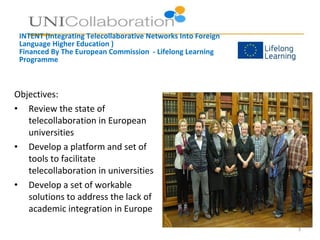
INTENT (Integrating Telecollaborative Networks Into Foreign
Language Higher Education )
Financed By The European Commission - Lifelong Learning
Programme
Objectives:
• Review the state of
telecollaboration in European
universities
• Develop a platform and set of
tools to facilitate
telecollaboration in universities
• Develop a set of workable
solutions to address the lack of
academic integration in Europe
3
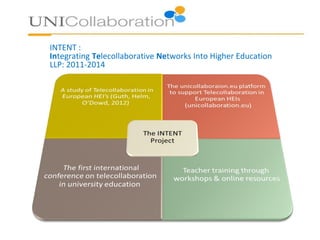
INTENT :
Integrating Telecollaborative Networks Into Higher Education
LLP: 2011-2014
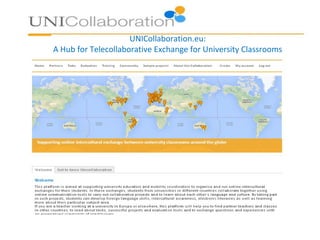
UNICollaboration.eu:
A Hub for Telecollaborative Exchange for University Classrooms
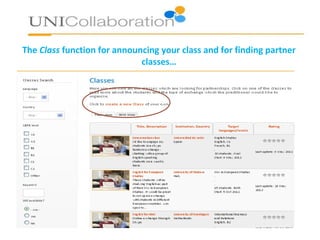
The Class function for announcing your class and for finding partner
classes…
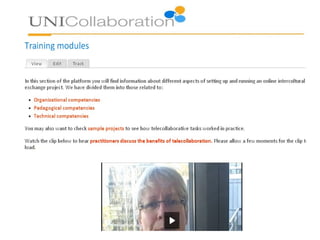
The Sample Projects database provide information on previous
projects, the tasks used and how educators evaluated the project…
9
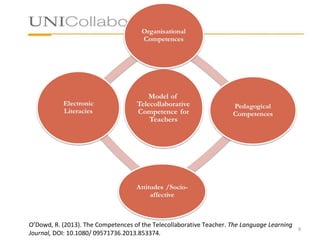
O’Dowd, R. (2013). The Competences of the Telecollaborative Teacher. The Language Learning
Journal, DOI: 10.1080/ 09571736.2013.853374.
The Telecollaborative Teacher…
• …can integrate appropriate
assessment procedures and
rubrics which accurately reflect
the activities which students
carried out during their
exchange.
• …can choose the appropriate
online communication tools (e.g.
email, blogs, wikis, skype) to fit
both the everyday online
practices of the students as well
as the project’s aims.
• …can use online networks and
his/her own professional contacts
to locate possible partner-
teachers in distant locations.
• …can apply his/her knowledge of
the educational context in which
the partner class is working in
order to structure the exchange
and avoid problems.
What are the main challenges for novice telecollaborators?
Are there certain competences harder to develop than
others?
• Qualitative interviews via
email with 4 novice
telecollaborators (10 per
informant)
• Informants teaching
languages at universities in
Argentina, USA and Italy (*2)
• Identified in the
unicollaboration.eu database
of practitioners
Main problems experienced by Novice
Telecollaborators
• Barbara: that “…[telecollaboration] can be difficult if the
teacher is not completely familiar with the culture/educational
system of the partner country. …it was very helpful for me to
know the French educational system and the fact, for example,
that French students and teachers take their weekends and
vacation time seriously, and don’t work 24/7 like the
Americans.” [organisational competence A10]
• Francesca: [difficulty of] “…finding partner institutions in English
speaking countries that have classes of Italian as a Foreign
Language. Then, once the partner institution is found, it is not
always easy to find time slots which fit the timetables of both
institutions.” [A1] and [A4]]
Main problems experienced by Novice
Telecollaborators (2)
• Marta: “My questions and doubts have to do with
technology at this point. I am still debating what platform is
best for the asynchronous exchange. I am not familiar with
blogs so I am nervous about using it.” [C2]
• Melina: “The other difficulty for me is to keep track of the
synchronous communication since there is no log. My
students get an oral participation grade for this part of the
exchange and I am still trying to figure out how to do that.
[A13 and C2]
The Next Step…
• How best to train teachers in such a complex activity?
• “…it [a training course] does not prepare educators to integrate technology
into everyday teaching and learning in ways that are supportive of learning. …
What educators need to know when it comes to effective integration is in large
part developed experientially in real institutional contexts (Meskill, Anthony,
Hilliker-Van Strander, Tseng and You; 2006: 283)”
Sociocultural approaches
“…learning to teach is a long-term, complex developmental process
that operates through participation in the social practices and contexts
associated with learning and teaching (Freeman and Johnson, 1998).
• transmission models of teacher training
are ineffective
• teachers learn by being actively
engaged in educational activity
• teachers need to form part of
communities of practice - ‘critical
friends groups’ , ‘peer coaching’
• they need to have opportunities to
reflect and theorize based on their own
learning
Informants also highlight importance of learning from
experience and from peers
• Melina: “….we (the teachers involved) have learned many
things [after her first exchange]. For instance, that it is hard
for students to get familiar with the wiki, skype and
Elluminate Live!; that they need some extra time to become
familiar (so now we will allow an extra week before we ask
them to communicate online)…”
• Francesca: “…my partner teacher for the exchange has been
a great resource for technology. She has set up the blog for
our classes and I’ve been learning how to use it. So
technology has become a lesser issue for me… It would have
been a big issue had my teacher not been familiar with
blogs”.
• How should these case
studies and sociocultural
approaches to teacher
education shape
UNICollaboration and our
proposed future teacher
training project INTENT-
PRO?
STRUCTURING TRAINING FOR NOVICE TELECOLLABORATORS
• Informants refer to:
• the importance of experienced
peers who have carried out
exchanges in the past and who
are willing to pass on insights to
colleagues
• Future Training courses should:
• Invite experienced colleagues to
make ‘virtual guest
appearances’ via videochat
interview sessions
• Incorporate video recordings of
interviews with experienced
telecollaborators on UNI-
Collaboration
STRUCTURING TRAINING FOR NOVICE TELECOLLABORATORS (2)
• Sociocultural approaches refer
to:
…the need to engage novices in
online exchange projects and
the inherent issues of tasks,
assessment procedures,
language use etc.
• Future Training courses should:
• …engage trainees in simulations
of TC exchanges or mentor
trainees through their first
exchanges
• Informants refer to:
how teachers need to learn how to
react quickly to unexpected
problems and issues which
emerge in TC exchanges
• Future Training courses should:
giving trainees the opportunity to
read or hear about previous
exchanges in the form of detailed
case studies
Read more about telecollaboration…
• Contact:
– robert.odowd@unileon.es
– Publications: http://unileon.academia.edu/RobertODowd
– See this presentation again: http://www.slideshare.net/dfmro
• Read our Report on Telecollaboration in Europe:
– http://www.scoop.it/t/intent-project-news
– INTENT Project news: http://www.scoop.it/t/intent-project-
news
• The INTENT project was funded with support from the European Commission. This project
reflects the views only of the authors, and the Commission cannot be held responsible for
any use which may be made of the information contained therein.

Eurocall 2014 O'Dowd

  • 1.
    “Learning as theygo”: In-service Teachers Learning to Telecollaborate Robert O’Dowd University of León, Spain @Robodowd www.uni-collaboration.eu
  • 2.
    What is Telecollaboration? Telecollaborationinvolves virtual intercultural interaction and collaboration projects between classes in geographically distant locations under the guidance of educators. Growing importance and popularity: Books: Belz and Thorne, 2006; Guth and Helm, 2010; O’Dowd, 2006 and 2007; Warschauer, 1996 LL&T special editions: Volumes 7/2 and 15/1 International Project funding: Belz, 2003; Kohn and Warth, 2011 and O’Dowd, 2013.
  • 3.
    INTENT (Integrating TelecollaborativeNetworks Into Foreign Language Higher Education ) Financed By The European Commission - Lifelong Learning Programme Objectives: • Review the state of telecollaboration in European universities • Develop a platform and set of tools to facilitate telecollaboration in universities • Develop a set of workable solutions to address the lack of academic integration in Europe 3
  • 4.
    INTENT : Integrating TelecollaborativeNetworks Into Higher Education LLP: 2011-2014
  • 5.
    UNICollaboration.eu: A Hub forTelecollaborative Exchange for University Classrooms
  • 6.
    The Class functionfor announcing your class and for finding partner classes…
  • 8.
    The Sample Projectsdatabase provide information on previous projects, the tasks used and how educators evaluated the project…
  • 9.
    9 O’Dowd, R. (2013).The Competences of the Telecollaborative Teacher. The Language Learning Journal, DOI: 10.1080/ 09571736.2013.853374.
  • 10.
    The Telecollaborative Teacher… •…can integrate appropriate assessment procedures and rubrics which accurately reflect the activities which students carried out during their exchange. • …can choose the appropriate online communication tools (e.g. email, blogs, wikis, skype) to fit both the everyday online practices of the students as well as the project’s aims. • …can use online networks and his/her own professional contacts to locate possible partner- teachers in distant locations. • …can apply his/her knowledge of the educational context in which the partner class is working in order to structure the exchange and avoid problems.
  • 11.
    What are themain challenges for novice telecollaborators? Are there certain competences harder to develop than others? • Qualitative interviews via email with 4 novice telecollaborators (10 per informant) • Informants teaching languages at universities in Argentina, USA and Italy (*2) • Identified in the unicollaboration.eu database of practitioners
  • 12.
    Main problems experiencedby Novice Telecollaborators • Barbara: that “…[telecollaboration] can be difficult if the teacher is not completely familiar with the culture/educational system of the partner country. …it was very helpful for me to know the French educational system and the fact, for example, that French students and teachers take their weekends and vacation time seriously, and don’t work 24/7 like the Americans.” [organisational competence A10] • Francesca: [difficulty of] “…finding partner institutions in English speaking countries that have classes of Italian as a Foreign Language. Then, once the partner institution is found, it is not always easy to find time slots which fit the timetables of both institutions.” [A1] and [A4]]
  • 13.
    Main problems experiencedby Novice Telecollaborators (2) • Marta: “My questions and doubts have to do with technology at this point. I am still debating what platform is best for the asynchronous exchange. I am not familiar with blogs so I am nervous about using it.” [C2] • Melina: “The other difficulty for me is to keep track of the synchronous communication since there is no log. My students get an oral participation grade for this part of the exchange and I am still trying to figure out how to do that. [A13 and C2]
  • 14.
    The Next Step… •How best to train teachers in such a complex activity? • “…it [a training course] does not prepare educators to integrate technology into everyday teaching and learning in ways that are supportive of learning. … What educators need to know when it comes to effective integration is in large part developed experientially in real institutional contexts (Meskill, Anthony, Hilliker-Van Strander, Tseng and You; 2006: 283)”
  • 15.
    Sociocultural approaches “…learning toteach is a long-term, complex developmental process that operates through participation in the social practices and contexts associated with learning and teaching (Freeman and Johnson, 1998). • transmission models of teacher training are ineffective • teachers learn by being actively engaged in educational activity • teachers need to form part of communities of practice - ‘critical friends groups’ , ‘peer coaching’ • they need to have opportunities to reflect and theorize based on their own learning
  • 16.
    Informants also highlightimportance of learning from experience and from peers • Melina: “….we (the teachers involved) have learned many things [after her first exchange]. For instance, that it is hard for students to get familiar with the wiki, skype and Elluminate Live!; that they need some extra time to become familiar (so now we will allow an extra week before we ask them to communicate online)…” • Francesca: “…my partner teacher for the exchange has been a great resource for technology. She has set up the blog for our classes and I’ve been learning how to use it. So technology has become a lesser issue for me… It would have been a big issue had my teacher not been familiar with blogs”.
  • 17.
    • How shouldthese case studies and sociocultural approaches to teacher education shape UNICollaboration and our proposed future teacher training project INTENT- PRO?
  • 18.
    STRUCTURING TRAINING FORNOVICE TELECOLLABORATORS • Informants refer to: • the importance of experienced peers who have carried out exchanges in the past and who are willing to pass on insights to colleagues • Future Training courses should: • Invite experienced colleagues to make ‘virtual guest appearances’ via videochat interview sessions • Incorporate video recordings of interviews with experienced telecollaborators on UNI- Collaboration
  • 19.
    STRUCTURING TRAINING FORNOVICE TELECOLLABORATORS (2) • Sociocultural approaches refer to: …the need to engage novices in online exchange projects and the inherent issues of tasks, assessment procedures, language use etc. • Future Training courses should: • …engage trainees in simulations of TC exchanges or mentor trainees through their first exchanges • Informants refer to: how teachers need to learn how to react quickly to unexpected problems and issues which emerge in TC exchanges • Future Training courses should: giving trainees the opportunity to read or hear about previous exchanges in the form of detailed case studies
  • 20.
    Read more abouttelecollaboration… • Contact: – robert.odowd@unileon.es – Publications: http://unileon.academia.edu/RobertODowd – See this presentation again: http://www.slideshare.net/dfmro • Read our Report on Telecollaboration in Europe: – http://www.scoop.it/t/intent-project-news – INTENT Project news: http://www.scoop.it/t/intent-project- news • The INTENT project was funded with support from the European Commission. This project reflects the views only of the authors, and the Commission cannot be held responsible for any use which may be made of the information contained therein.

Editor's Notes

  • #15 Mention advantages of TC: For Students: Development of FL competence, intercultural awareness, electronic literacies; For University Educators: Opening up of classroom / Authentic communication and project work / Developing international network of collaborators; For Mobility Officers: Preparation for physical mobility/ Alternative to physical mobility; For University Management: ‘Low cost’ internationalisation strategy / Opening up new university partnerships