Integrating Telecollaborative Networks
into Foreign Language Higher Education:
                       The INTENT project
 Financed By The European Commission - Lifelong
                Learning Programme
      Coord: Robert O’Dowd Uni. Leon, Spain
  8 European partners (PH Heidelberg, Grenoble III,
   Padova, Czestochowa, Groningen, UA Barcelona,
                  Open University)
             October 2011-March 2014


   Melinda Dooly, U, Autònoma de Barcelona
Why Telecollaboration?
          ‘Tele’ (distance) & collaboration

Competences expected in ‘knowledge society’:
Flexibility & adaptablity to geographically distanced
  team work

  Focusing on FL: Means of bringing together
  language learners through tools for computer-
  mediated communication (CMC), social
  networking platforms, etc. Provides opportunities
  for development of language(s) and intercultural
  competences
Why Integration?
Push for reform of EU universities: Must adapt to
     needs of society of today and tomorrow

Bologna Treaty (Lisbon 1997); enhance the
  employability and mobility of EU citizens
  (finance, commerce, education, research etc.)
Launching of EHEA (European Higher Education
  Area): comparable, compatible and coherent
  systems of higher education in EU
Why Network?
    Consolidation of innovative (but isolated)
   telecollaborative practices & foment expansion


“Telecollaboration has received little support in
  university contexts to date, whilst primary and
  secondary school teachers interested in running
  OIE projects have been supported by major
  networks and virtual platforms such as ePals
  and the European Union’s Etwinning platform”

(Guth, Helm & O’Dowd, 2012, Intent Exec. Report)
Why Foreign Languages?
Opportunities for immediate access to authentic
   use of target language with other learners


     For Students: Development of FL competence,
     For Students: Development of FL competence,
      intercultural awareness, electronic literacies
       intercultural awareness, electronic literacies


 For University Educators: Opening up of classroom //
 For University Educators: Opening up of classroom
     Authentic communication and project work //
     Authentic communication and project work
  Developing international network of collaborators
   Developing international network of collaborators
Why isn’t everyone on board?
2012 Report on the Integration of Telecollaborative
     Networks in European Universities found:

• lack of pedagogical training for educators
• fear of extra work-load (lack of support and
  resources)
• no long-term stability in partnership with other
  universities
• lack of academic credit

                (Guth, Helm & O’Dowd)
Expected Output (i)
• Survey of HE teachers (practitioners and non-
  practitioners of telecollaboration) and learners.
• Project Website/Virtual Platform, supporting
  telecollaborative practice, for teachers, learner,
  administrators and educational policy makers.
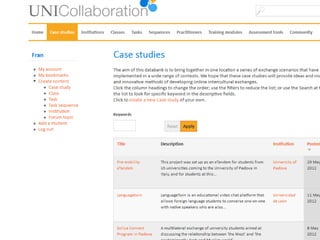
• Practitioner Databank, containing case studies
  of telecollaborative exchanges.
• E-Portfolio of learner competences developed in
  telecollaborative exchanges.
Expected Output (ii)
• Databank of telecollaborative tasks, with
  user guidelines
• Dissemination strategy and programme,
  including training workshops for tutors,
  presentations at conferences and
  academic publications.
• International Conference (Leon, 2014)
• Project evaluation and testing.
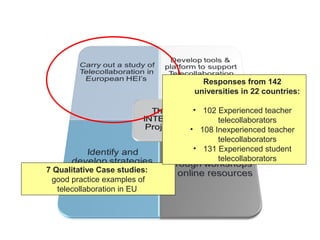
Responses from 142
                               universities in 22 countries:

                               • 102 Experienced teacher
                                     telecollaborators
                              • 108 Inexperienced teacher
                                     telecollaborators
                               • 131 Experienced student
                                     telecollaborators
7 Qualitative Case studies:
 good practice examples of
   telecollaboration in EU
Findings
• Most exchanges are between EU and US universities
• Partners mostly found ‘informally’ (other colleagues,
  conferences, etc.).
• Believing in its potential does not necessarily translate
  into doing anything about it
• Generally carried out by highly motivated and dedicated
  educators who may have experienced OIE as part of
  their training.
• Experience leads to repetition.
• Mostly emails & VLEs, audio/video conferencing and rise
  of social networks
• Students feel that become more ‘open’ to other views
• Adds to educator’s opportunities (contacts, staff mobility,
  etc.)
• Contributes to prep for physical exchanges and/or
  substitution when no opportunity for physical mobility
12


10


8


                                     Column 1
6                                    Column 2
                                     Column 3


4


2


0
     Row 1   Row 2   Row 3   Row 4
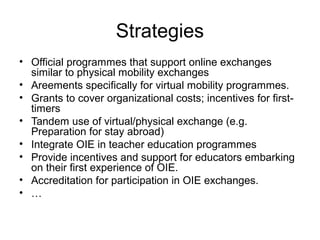
Strategies
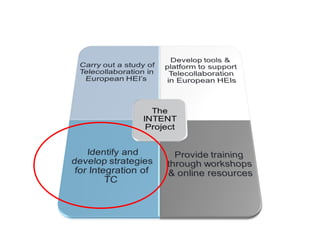
• Official programmes that support online exchanges
  similar to physical mobility exchanges
• Areements specifically for virtual mobility programmes.
• Grants to cover organizational costs; incentives for first-
  timers
• Tandem use of virtual/physical exchange (e.g.
  Preparation for stay abroad)
• Integrate OIE in teacher education programmes
• Provide incentives and support for educators embarking
  on their first experience of OIE.
• Accreditation for participation in OIE exchanges.
• …
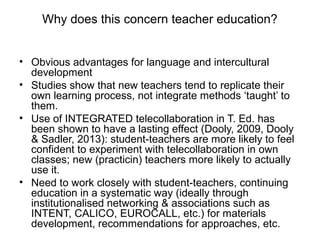
Why does this concern teacher education?


• Obvious advantages for language and intercultural
  development
• Studies show that new teachers tend to replicate their
  own learning process, not integrate methods ‘taught’ to
  them.
• Use of INTEGRATED telecollaboration in T. Ed. has
  been shown to have a lasting effect (Dooly, 2009, Dooly
  & Sadler, 2013): student-teachers are more likely to feel
  confident to experiment with telecollaboration in own
  classes; new (practicin) teachers more likely to actually
  use it.
• Need to work closely with student-teachers, continuing
  education in a systematic way (ideally through
  institutionalised networking & associations such as
  INTENT, CALICO, EUROCALL, etc.) for materials
  development, recommendations for approaches, etc.
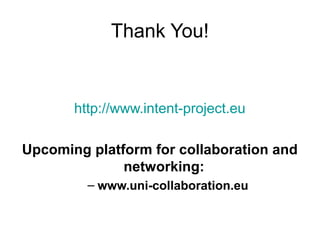
Thank You!


       http://www.intent-project.eu

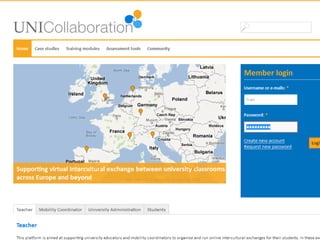
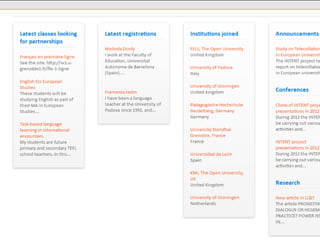
Upcoming platform for collaboration and
              networking:
         – www.uni-collaboration.eu

INTENT_Calico 2012

  • 1.
    Integrating Telecollaborative Networks intoForeign Language Higher Education: The INTENT project Financed By The European Commission - Lifelong Learning Programme Coord: Robert O’Dowd Uni. Leon, Spain 8 European partners (PH Heidelberg, Grenoble III, Padova, Czestochowa, Groningen, UA Barcelona, Open University) October 2011-March 2014 Melinda Dooly, U, Autònoma de Barcelona
  • 2.
    Why Telecollaboration? ‘Tele’ (distance) & collaboration Competences expected in ‘knowledge society’: Flexibility & adaptablity to geographically distanced team work Focusing on FL: Means of bringing together language learners through tools for computer- mediated communication (CMC), social networking platforms, etc. Provides opportunities for development of language(s) and intercultural competences
  • 3.
    Why Integration? Push forreform of EU universities: Must adapt to needs of society of today and tomorrow Bologna Treaty (Lisbon 1997); enhance the employability and mobility of EU citizens (finance, commerce, education, research etc.) Launching of EHEA (European Higher Education Area): comparable, compatible and coherent systems of higher education in EU
  • 4.
    Why Network? Consolidation of innovative (but isolated) telecollaborative practices & foment expansion “Telecollaboration has received little support in university contexts to date, whilst primary and secondary school teachers interested in running OIE projects have been supported by major networks and virtual platforms such as ePals and the European Union’s Etwinning platform” (Guth, Helm & O’Dowd, 2012, Intent Exec. Report)
  • 5.
    Why Foreign Languages? Opportunitiesfor immediate access to authentic use of target language with other learners For Students: Development of FL competence, For Students: Development of FL competence, intercultural awareness, electronic literacies intercultural awareness, electronic literacies For University Educators: Opening up of classroom // For University Educators: Opening up of classroom Authentic communication and project work // Authentic communication and project work Developing international network of collaborators Developing international network of collaborators
  • 6.
    Why isn’t everyoneon board? 2012 Report on the Integration of Telecollaborative Networks in European Universities found: • lack of pedagogical training for educators • fear of extra work-load (lack of support and resources) • no long-term stability in partnership with other universities • lack of academic credit (Guth, Helm & O’Dowd)
  • 8.
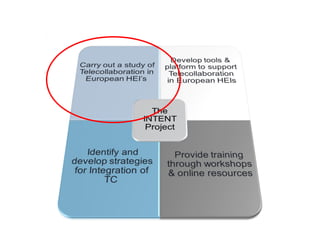
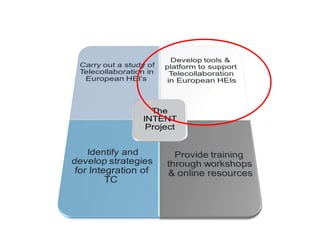
    Expected Output (i) •Survey of HE teachers (practitioners and non- practitioners of telecollaboration) and learners. • Project Website/Virtual Platform, supporting telecollaborative practice, for teachers, learner, administrators and educational policy makers. • Practitioner Databank, containing case studies of telecollaborative exchanges. • E-Portfolio of learner competences developed in telecollaborative exchanges.
  • 9.
    Expected Output (ii) •Databank of telecollaborative tasks, with user guidelines • Dissemination strategy and programme, including training workshops for tutors, presentations at conferences and academic publications. • International Conference (Leon, 2014) • Project evaluation and testing.
  • 11.
    Responses from 142 universities in 22 countries: • 102 Experienced teacher telecollaborators • 108 Inexperienced teacher telecollaborators • 131 Experienced student telecollaborators 7 Qualitative Case studies: good practice examples of telecollaboration in EU
  • 12.
    Findings • Most exchangesare between EU and US universities • Partners mostly found ‘informally’ (other colleagues, conferences, etc.). • Believing in its potential does not necessarily translate into doing anything about it • Generally carried out by highly motivated and dedicated educators who may have experienced OIE as part of their training. • Experience leads to repetition. • Mostly emails & VLEs, audio/video conferencing and rise of social networks • Students feel that become more ‘open’ to other views • Adds to educator’s opportunities (contacts, staff mobility, etc.) • Contributes to prep for physical exchanges and/or substitution when no opportunity for physical mobility
  • 16.
    12 10 8 Column 1 6 Column 2 Column 3 4 2 0 Row 1 Row 2 Row 3 Row 4
  • 18.
    Strategies • Official programmesthat support online exchanges similar to physical mobility exchanges • Areements specifically for virtual mobility programmes. • Grants to cover organizational costs; incentives for first- timers • Tandem use of virtual/physical exchange (e.g. Preparation for stay abroad) • Integrate OIE in teacher education programmes • Provide incentives and support for educators embarking on their first experience of OIE. • Accreditation for participation in OIE exchanges. • …
  • 19.
    Why does thisconcern teacher education? • Obvious advantages for language and intercultural development • Studies show that new teachers tend to replicate their own learning process, not integrate methods ‘taught’ to them. • Use of INTEGRATED telecollaboration in T. Ed. has been shown to have a lasting effect (Dooly, 2009, Dooly & Sadler, 2013): student-teachers are more likely to feel confident to experiment with telecollaboration in own classes; new (practicin) teachers more likely to actually use it. • Need to work closely with student-teachers, continuing education in a systematic way (ideally through institutionalised networking & associations such as INTENT, CALICO, EUROCALL, etc.) for materials development, recommendations for approaches, etc.
  • 20.
    Thank You! http://www.intent-project.eu Upcoming platform for collaboration and networking: – www.uni-collaboration.eu

Editor's Notes

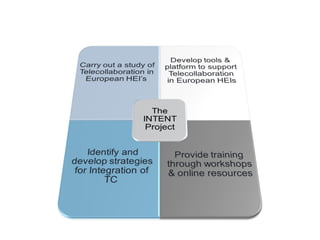
  • #8 Objectives: Establish a clear overview of the use of telecollaboration in European HE and identify practical barriers to the take-up of telecollaboration. Develop a set of tools, telecollaborative models and partner networks to overcome barriers and facilitate telecollaboration practice. Develop a set of workable solutions to address the lack of academic integration in Europe
  • #11 Objectives: Establish a clear overview of the use of telecollaboration in European HE and identify practical barriers to the take-up of telecollaboration. Develop a set of tools, telecollaborative models and partner networks to overcome barriers and facilitate telecollaboration practice. Develop a set of workable solutions to address the lack of academic integration in Europe
  • #12 Objectives: Establish a clear overview of the use of telecollaboration in European HE and identify practical barriers to the take-up of telecollaboration. Develop a set of tools, telecollaborative models and partner networks to overcome barriers and facilitate telecollaboration practice. Develop a set of workable solutions to address the lack of academic integration in Europe
  • #13 Few between European universities or connecting Europe and the so-called ‘developing world’ or emerging countries/economies. by engaging learners with students in their future host institution before departure, and also by supporting learners during their period abroad. who believe strongly in the outcomes of these exchanges. They have often had experience of OIE as part of their training and may also have a research interest in OIE. Educators who have had experience of OIE are more likely to repeat it
  • #14 Objectives: Establish a clear overview of the use of telecollaboration in European HE and identify practical barriers to the take-up of telecollaboration. Develop a set of tools, telecollaborative models and partner networks to overcome barriers and facilitate telecollaboration practice. Develop a set of workable solutions to address the lack of academic integration in Europe
  • #18 Objectives: Establish a clear overview of the use of telecollaboration in European HE and identify practical barriers to the take-up of telecollaboration. Develop a set of tools, telecollaborative models and partner networks to overcome barriers and facilitate telecollaboration practice. Develop a set of workable solutions to address the lack of academic integration in Europe