TELECOLLABORATION:
TECHNIQUES FOR INTEGRATING EXCHANGES AT
INSTITUTIONAL LEVEL

Robert O'Dowd,
Universidad de León,
Spain
Why isn’t everyone doing it?
 In our survey, we asked European telecollaborating teachers what
were the reasons why telecollaborative exchange was not more
popular in university education:
 __________________________________
 (Mentioned by 49/ 98 practitioners)
 __________________________________
 (Mentioned by 28 / 98 practitioners)
 __________________________________
 (Mentioned by 20/ 98 practitioners)
 __________________________________
 (Mentioned by 19 / 98 practitioners)
 __________________________________
 (Mentioned by 9/ 98 practitioners)
So why isn’t everyone doing it?
 In your opinion, what are the reasons why telecollaborative exchange is not
more popular in university education?
 Time necessary to set up and run exchanges
 (Mentioned 49/ 98 practitioners)
 Difficulties in integration & assessment due to institutional requirements
 (Mentioned by 28 / 98 practitioners)
 Lack of pedagogical knowledge about how to run and integrate exchanges
 (Mentioned by 20/ 98 practitioners)
 Teachers lack e-literacies/ required technological knowledge
 (Mentioned by 19 / 98 practitioners)

 Difficulty in finding appropriate partners
 (Mentioned by 9/ 98 practitioners)
Teachers’ voices…
• “... institutions are not aware of its potential and needs. Those teachers
carrying out innovative teaching practice are not in a position of power
and cannot make decisions which impact on their institution”.
• “… the idea sounds interesting, but the teachers involved need to
dedicate much time and energy to the exchange, so finally they won't do
it. The student's motivation won't last long if it is not a credited course“.
•
• “It is essential to find a partner with similar aims, able to adapt programs
to different institutional expectations (amount of homework done by
students for example), willing to adapt to technical disturbances (network
disturbances, computer crashes), and to some extent lose or share control
of class dynamics. The partners must build a program that satisfies
needs, levels and interests of both classes.”
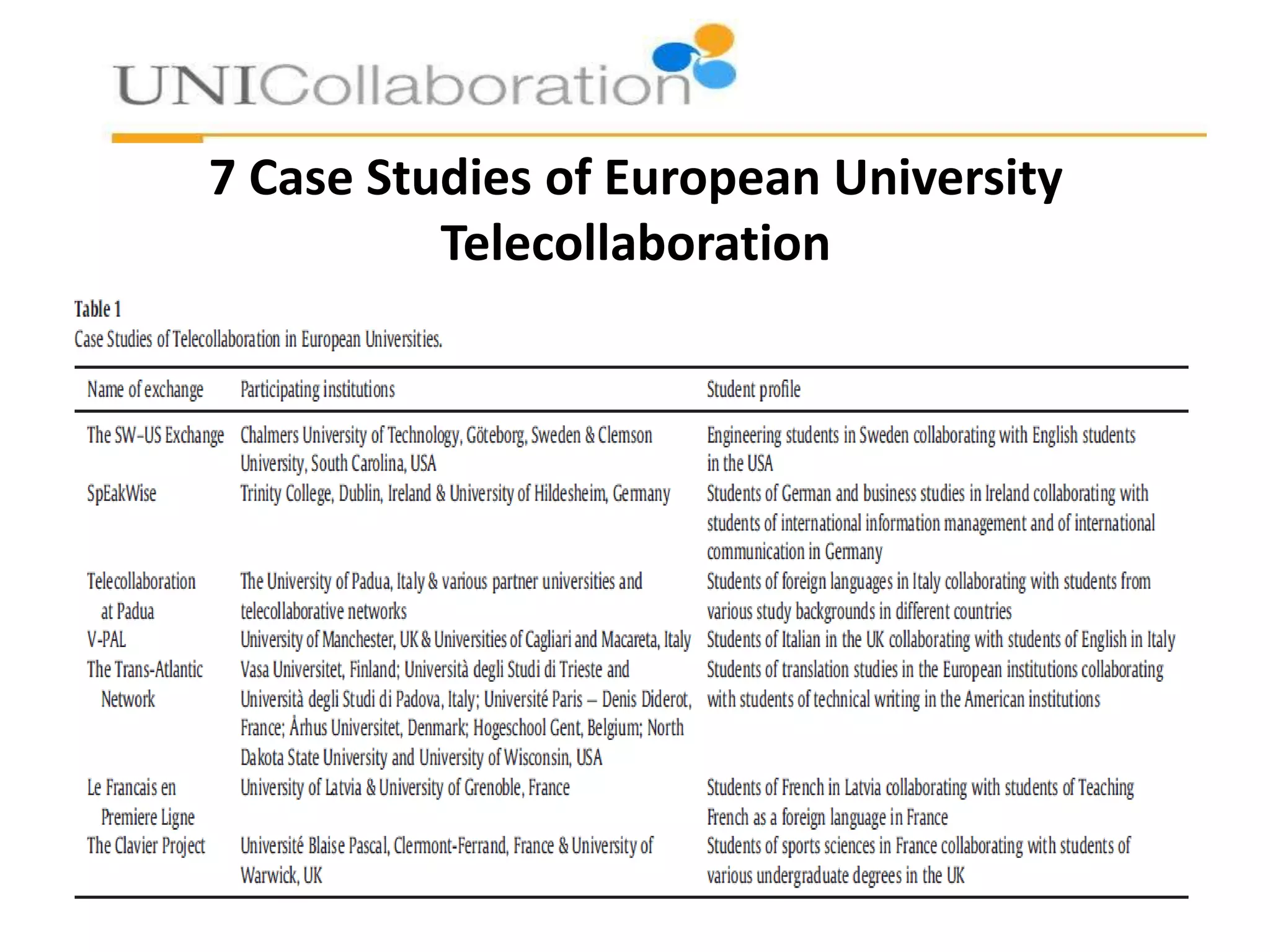
7 Case Studies of European University
Telecollaboration
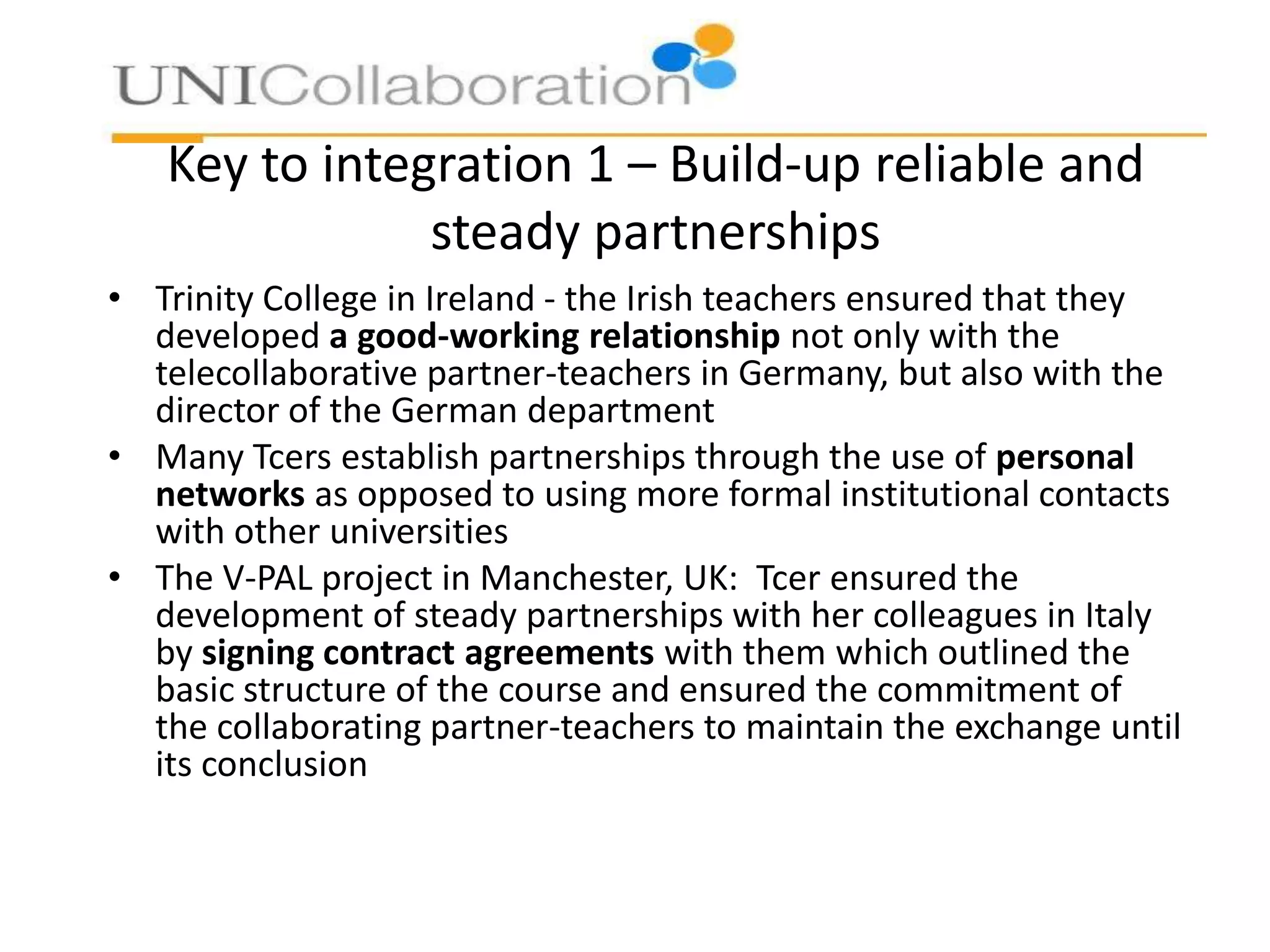
Key to integration 1 – Build-up reliable and
steady partnerships
• Trinity College in Ireland - the Irish teachers ensured that they
developed a good-working relationship not only with the
telecollaborative partner-teachers in Germany, but also with the
director of the German department
• Many Tcers establish partnerships through the use of personal
networks as opposed to using more formal institutional contacts
with other universities
• The V-PAL project in Manchester, UK: Tcer ensured the
development of steady partnerships with her colleagues in Italy
by signing contract agreements with them which outlined the
basic structure of the course and ensured the commitment of
the collaborating partner-teachers to maintain the exchange until
its conclusion
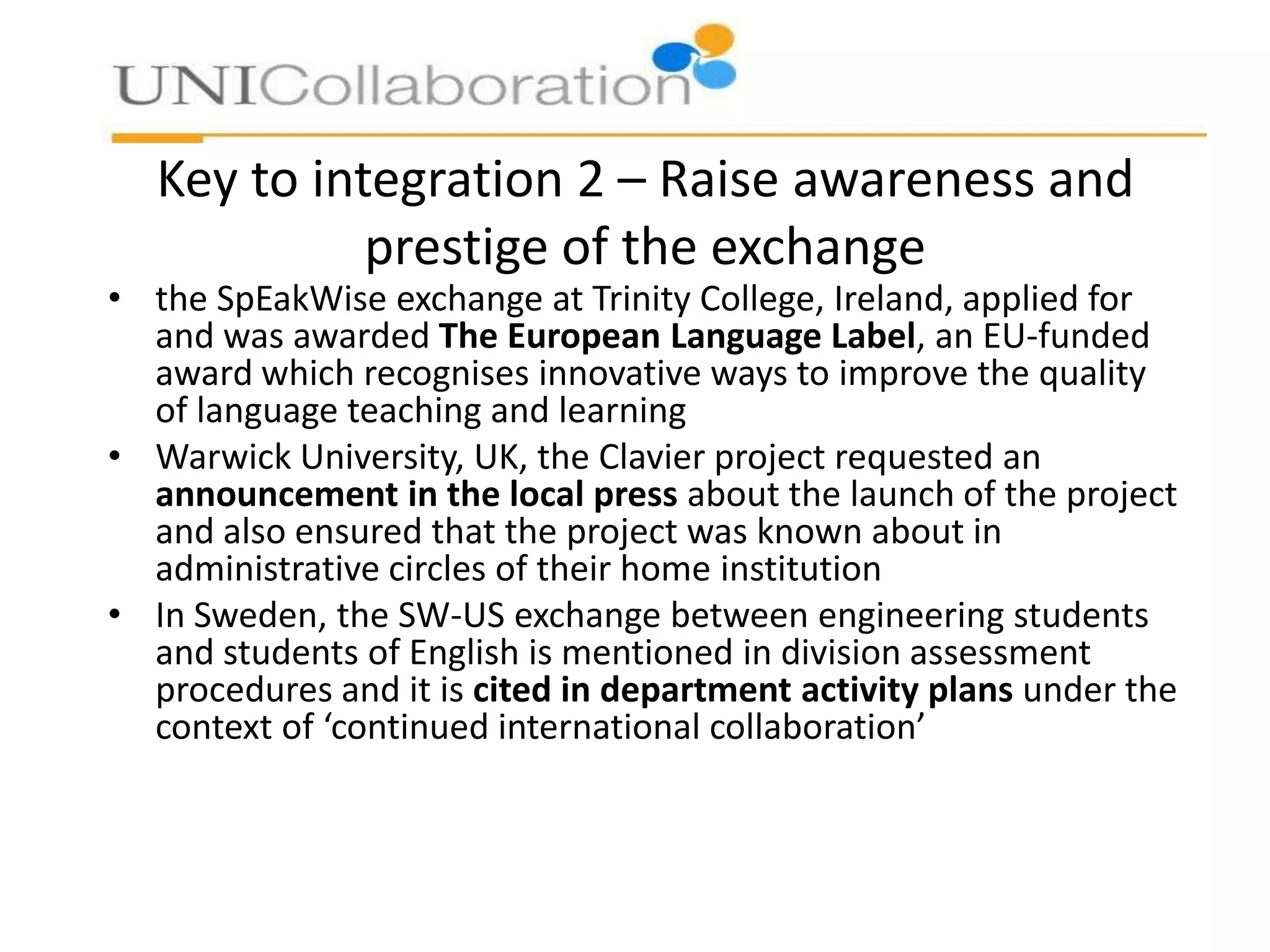
Key to integration 2 – Raise awareness and
prestige of the exchange

• the SpEakWise exchange at Trinity College, Ireland, applied for
and was awarded The European Language Label, an EU-funded
award which recognises innovative ways to improve the quality
of language teaching and learning
• Warwick University, UK, the Clavier project requested an
announcement in the local press about the launch of the project
and also ensured that the project was known about in
administrative circles of their home institution
• In Sweden, the SW-US exchange between engineering students
and students of English is mentioned in division assessment
procedures and it is cited in department activity plans under the
context of ‘continued international collaboration’
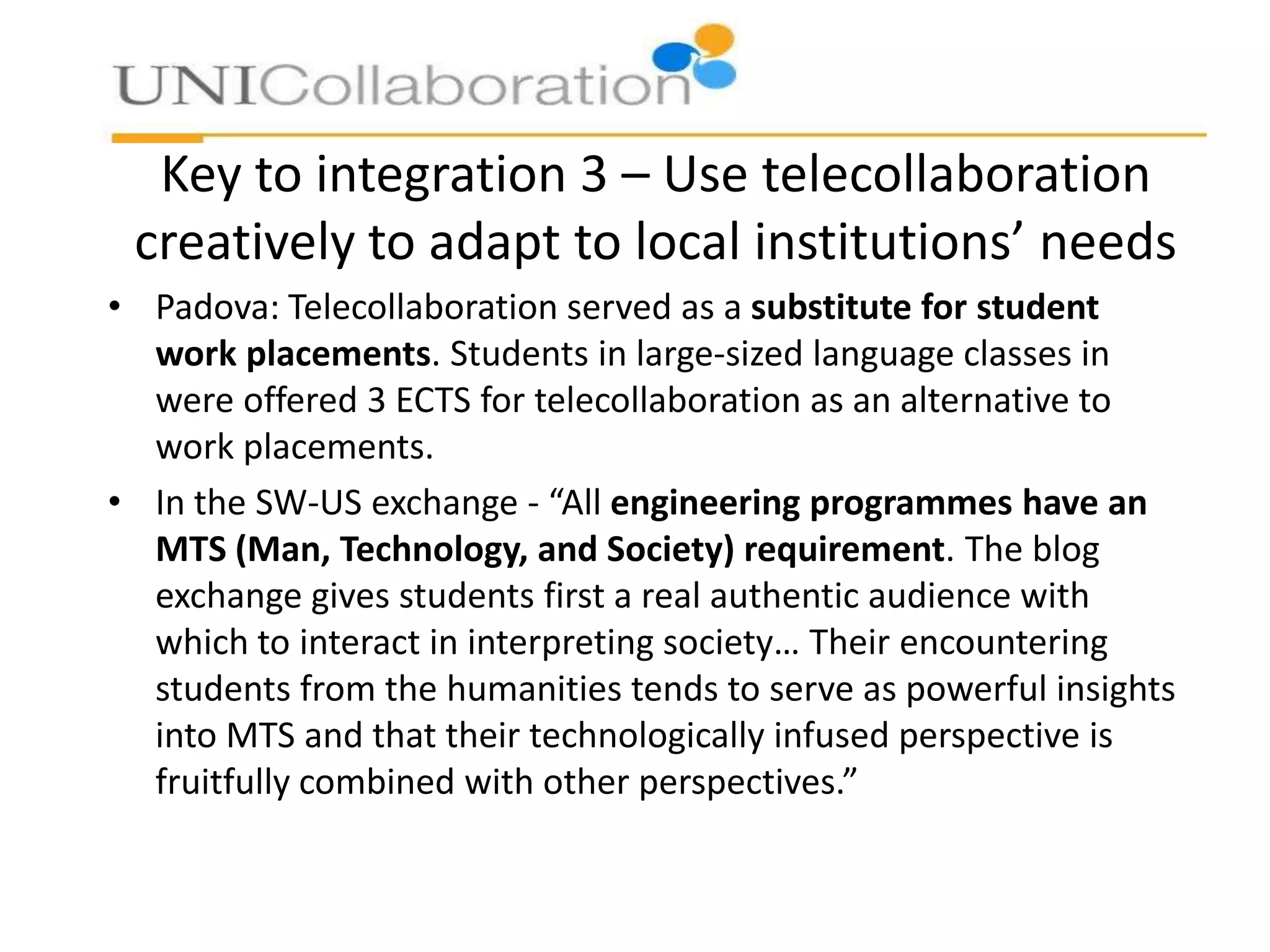
Key to integration 3 – Use telecollaboration
creatively to adapt to local institutions’ needs
• Padova: Telecollaboration served as a substitute for student
work placements. Students in large-sized language classes in
were offered 3 ECTS for telecollaboration as an alternative to
work placements.
• In the SW-US exchange - “All engineering programmes have an
MTS (Man, Technology, and Society) requirement. The blog
exchange gives students first a real authentic audience with
which to interact in interpreting society… Their encountering
students from the humanities tends to serve as powerful insights
into MTS and that their technologically infused perspective is
fruitfully combined with other perspectives.”
Key to integration 4 – Achieve credit or recognition for the
students’ telecollaborative work
• V-PAL project at Manchester - optional courses which are offered along
with the core language courses. Each course lasts one semester and is
worth 10 UK credits.
• University of Latvia: a fully recognised course (6 ECTS) which is entirely
based around her students’ online interaction with the partner class of
trainee French teachers in Grenoble, France
• The TransAtlantic network ensures that students receive a percentage
of the total course credit for their work
• Tcer at Manchester University: “To be honest, unless it becomes a
credit-bearing module, staff will have to do it above their day-to-day
workload, which could become unfeasible (and it did exactly that for
me, which is why – partly – I wanted to get formal recognition for
them).”
Key to integration 5 – Link telecollaboration to broader
international activity
Telecollaboration can be more effectively integrated into a university if it is
linked in some ways to the local institutions’ other international activities:
• Senior management at Manchester: “...this kind of project can play a part
in raising the institution’s international profile. It is conceivable, for
instance, that links established via V-PAL could develop into full-blown
ERASMUS exchange agreements...”.
• The universities of Riga and Grenoble - a ‘Memorandum of
Understanding’ for staff and student mobility thanks to their
telecollaborative partnerships.
• Chalmers University in Sweden: their exchange with Clemson University,
South Carolina had served to enhance academic links between educators
at their two institutions. For example, they had received several visits
from these partner faculties in the USA .
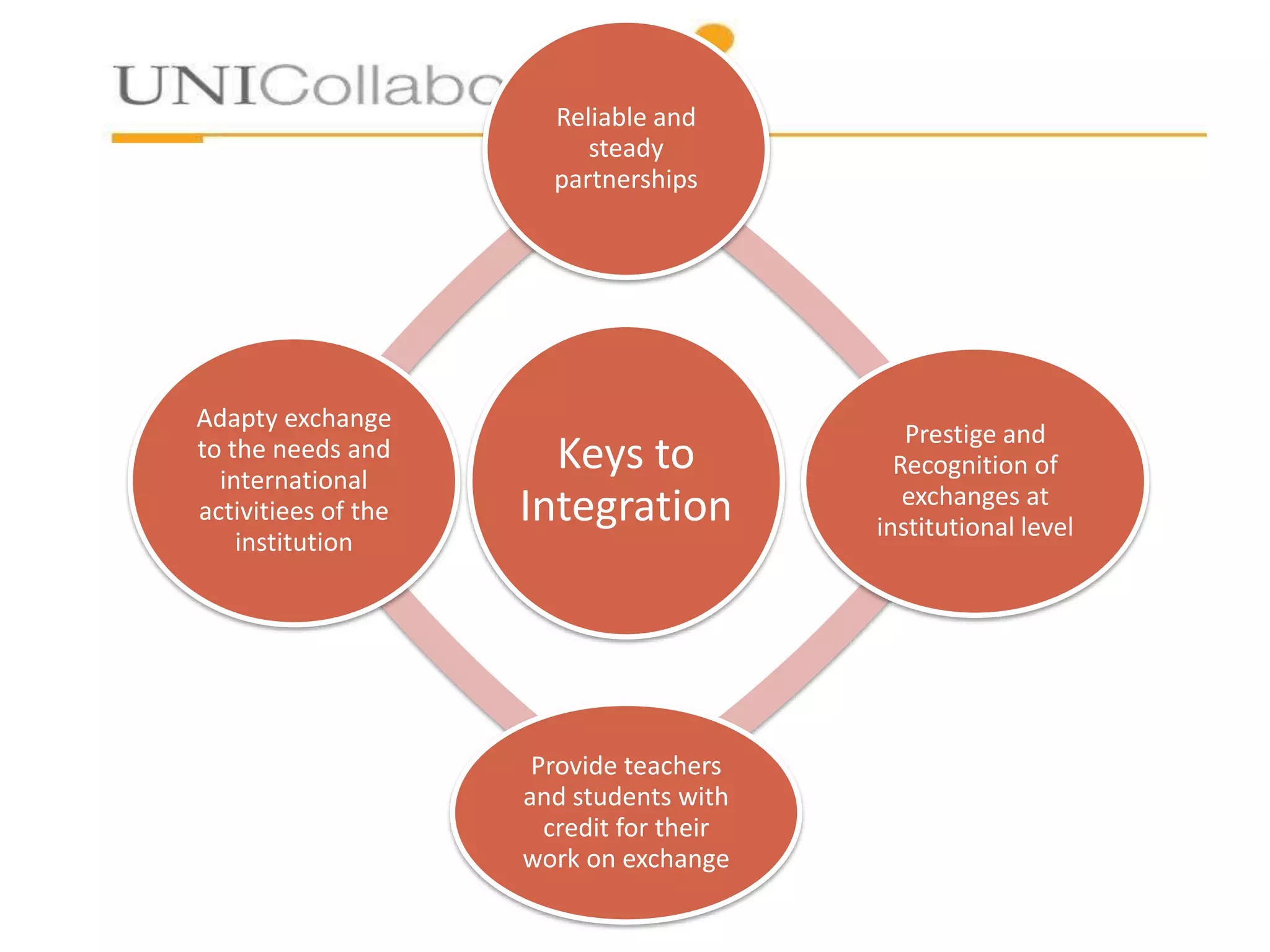
Reliable and
steady
partnerships

Adapty exchange
to the needs and
international
activitiees of the
institution

Keys to
Integration

Provide teachers
and students with
credit for their
work on exchange

Prestige and
Recognition of
exchanges at
institutional level
Read more…
• http://unileon.academia.edu/RobertODowd
• O'Dowd, R., Telecollaborative networks in
university higher education: Overcoming
barriers to integration, Internet and
• Higher Education (2013),
http://dx.doi.org/10.1016/j.iheduc.2013.02.
001

Integrating Telecollaborative Exchange at University Level

  • 1.
    TELECOLLABORATION: TECHNIQUES FOR INTEGRATINGEXCHANGES AT INSTITUTIONAL LEVEL Robert O'Dowd, Universidad de León, Spain
  • 2.
    Why isn’t everyonedoing it?  In our survey, we asked European telecollaborating teachers what were the reasons why telecollaborative exchange was not more popular in university education:  __________________________________  (Mentioned by 49/ 98 practitioners)  __________________________________  (Mentioned by 28 / 98 practitioners)  __________________________________  (Mentioned by 20/ 98 practitioners)  __________________________________  (Mentioned by 19 / 98 practitioners)  __________________________________  (Mentioned by 9/ 98 practitioners)
  • 3.
    So why isn’teveryone doing it?  In your opinion, what are the reasons why telecollaborative exchange is not more popular in university education?  Time necessary to set up and run exchanges  (Mentioned 49/ 98 practitioners)  Difficulties in integration & assessment due to institutional requirements  (Mentioned by 28 / 98 practitioners)  Lack of pedagogical knowledge about how to run and integrate exchanges  (Mentioned by 20/ 98 practitioners)  Teachers lack e-literacies/ required technological knowledge  (Mentioned by 19 / 98 practitioners)  Difficulty in finding appropriate partners  (Mentioned by 9/ 98 practitioners)
  • 4.
    Teachers’ voices… • “...institutions are not aware of its potential and needs. Those teachers carrying out innovative teaching practice are not in a position of power and cannot make decisions which impact on their institution”. • “… the idea sounds interesting, but the teachers involved need to dedicate much time and energy to the exchange, so finally they won't do it. The student's motivation won't last long if it is not a credited course“. • • “It is essential to find a partner with similar aims, able to adapt programs to different institutional expectations (amount of homework done by students for example), willing to adapt to technical disturbances (network disturbances, computer crashes), and to some extent lose or share control of class dynamics. The partners must build a program that satisfies needs, levels and interests of both classes.”
  • 5.
    7 Case Studiesof European University Telecollaboration
  • 6.
    Key to integration1 – Build-up reliable and steady partnerships • Trinity College in Ireland - the Irish teachers ensured that they developed a good-working relationship not only with the telecollaborative partner-teachers in Germany, but also with the director of the German department • Many Tcers establish partnerships through the use of personal networks as opposed to using more formal institutional contacts with other universities • The V-PAL project in Manchester, UK: Tcer ensured the development of steady partnerships with her colleagues in Italy by signing contract agreements with them which outlined the basic structure of the course and ensured the commitment of the collaborating partner-teachers to maintain the exchange until its conclusion
  • 7.
    Key to integration2 – Raise awareness and prestige of the exchange • the SpEakWise exchange at Trinity College, Ireland, applied for and was awarded The European Language Label, an EU-funded award which recognises innovative ways to improve the quality of language teaching and learning • Warwick University, UK, the Clavier project requested an announcement in the local press about the launch of the project and also ensured that the project was known about in administrative circles of their home institution • In Sweden, the SW-US exchange between engineering students and students of English is mentioned in division assessment procedures and it is cited in department activity plans under the context of ‘continued international collaboration’
  • 8.
    Key to integration3 – Use telecollaboration creatively to adapt to local institutions’ needs • Padova: Telecollaboration served as a substitute for student work placements. Students in large-sized language classes in were offered 3 ECTS for telecollaboration as an alternative to work placements. • In the SW-US exchange - “All engineering programmes have an MTS (Man, Technology, and Society) requirement. The blog exchange gives students first a real authentic audience with which to interact in interpreting society… Their encountering students from the humanities tends to serve as powerful insights into MTS and that their technologically infused perspective is fruitfully combined with other perspectives.”
  • 9.
    Key to integration4 – Achieve credit or recognition for the students’ telecollaborative work • V-PAL project at Manchester - optional courses which are offered along with the core language courses. Each course lasts one semester and is worth 10 UK credits. • University of Latvia: a fully recognised course (6 ECTS) which is entirely based around her students’ online interaction with the partner class of trainee French teachers in Grenoble, France • The TransAtlantic network ensures that students receive a percentage of the total course credit for their work • Tcer at Manchester University: “To be honest, unless it becomes a credit-bearing module, staff will have to do it above their day-to-day workload, which could become unfeasible (and it did exactly that for me, which is why – partly – I wanted to get formal recognition for them).”
  • 10.
    Key to integration5 – Link telecollaboration to broader international activity Telecollaboration can be more effectively integrated into a university if it is linked in some ways to the local institutions’ other international activities: • Senior management at Manchester: “...this kind of project can play a part in raising the institution’s international profile. It is conceivable, for instance, that links established via V-PAL could develop into full-blown ERASMUS exchange agreements...”. • The universities of Riga and Grenoble - a ‘Memorandum of Understanding’ for staff and student mobility thanks to their telecollaborative partnerships. • Chalmers University in Sweden: their exchange with Clemson University, South Carolina had served to enhance academic links between educators at their two institutions. For example, they had received several visits from these partner faculties in the USA .
  • 11.
    Reliable and steady partnerships Adapty exchange tothe needs and international activitiees of the institution Keys to Integration Provide teachers and students with credit for their work on exchange Prestige and Recognition of exchanges at institutional level
  • 12.
    Read more… • http://unileon.academia.edu/RobertODowd •O'Dowd, R., Telecollaborative networks in university higher education: Overcoming barriers to integration, Internet and • Higher Education (2013), http://dx.doi.org/10.1016/j.iheduc.2013.02. 001