Reflections on cross-institutional and cross-collaborative research and pedagogy in teacher education      “Cross –institutional research is an important and often undervalued and overlooked means of extending the reach and capacities of any given institution” (wikia.com)Lara Lomicka, The University of South Carolinalomicka@sc.edu
Goals for the TalkDiscuss and reflect on cross-institutional researchBackgroundDefinitionsResearchGainsToolsChallengesImplementationNext step
BackgroundAmerican Educational Research Association (AERA) Panel on Research and Teacher Education recommendation for more cross-institutional studies (Cochran-Smith, 2005)
BackgroundStandards for Teacher Educators from the Association of Teacher Educators Standard 5  -  CollaborationCollaborate regularly and in significant ways with representatives of schools, universities, state education agencies, professional associations, and communities to improve teaching, learning, and teacher education. http://www.ate1.org/pubs/Standard_5.cfm
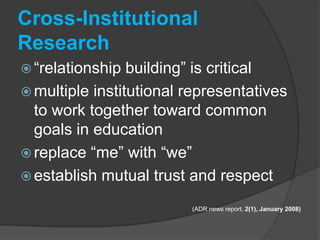
Cross-Institutional Research“Cross –institutional research is an important and often undervalued and overlooked means of extending the reach and capacities of any given institution” (wikia.com)Cross-Institutional Research“relationship building” is criticalmultiple institutional representatives to work together toward common goals in educationreplace “me” with “we”establish mutual trust and respect(ADR news report, 2(1), January 2008)
ResearchCross-institutional and cross-collaborative projectsIn language learning contextsIn language teacher education
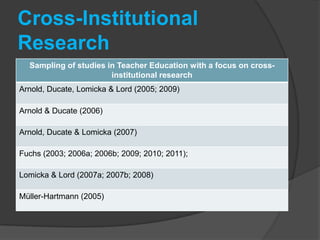
Cross-Institutional ResearchAdd chart
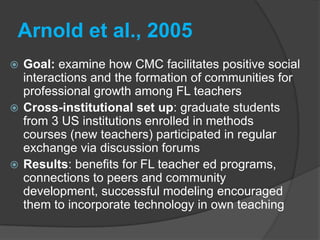
Arnold et al., 2005Goal: examine how CMC facilitates positive social interactions and the formation of communities for professional growth among FL teachersCross-institutional set up: graduate students from 3 US institutions enrolled in methods courses (new teachers) participated in regular exchange via discussion forumsResults: benefits for FL teacher ed programs, connections to peers and community development, successful modeling encouraged them to incorporate technology in own teaching
Müller-Hartmann (2005) Goal: to look at the development of both intercultural communicative competence and critical media literacy in foreign language teachersCross-institutional set up:  pre- and in-service student-teachers in two upper-level courses in Germany and in the US, both novice and experienced; collaboration on tasks and regular exchangeResults: development of ICC; wanted to develop more technical skills
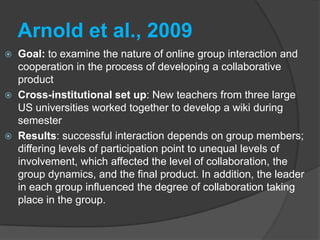
Arnold et al., 2009Goal: to examine the nature of online group interaction and cooperation in the process of developing a collaborative productCross-institutional set up: New teachers from three large US universities worked together to develop a wiki during semesterResults: successful interaction depends on group members; differing levels of participation point to unequal levels of involvement, which affected the level of collaboration, the group dynamics, and the final product. In addition, the leader in each group influenced the degree of collaboration taking place in the group.
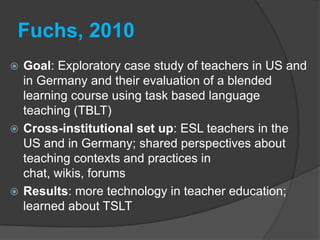
Fuchs, 2010Goal: Exploratory case study of teachers in US and in Germany and their evaluation of a blended learning course using task based language teaching (TBLT)Cross-institutional set up: ESL teachers in the US and in Germany; shared perspectives about teaching contexts and practices in chat, wikis, forumsResults: more technology in teacher education; learned about TSLT
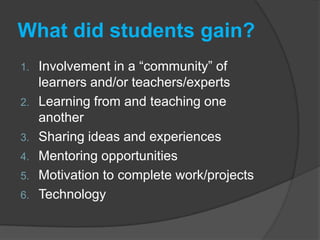
What did students gain?Involvement in a “community” of learners and/or teachers/expertsLearning from and teaching one anotherSharing ideas and experiencesMentoring opportunitiesMotivation to complete work/projectsTechnology
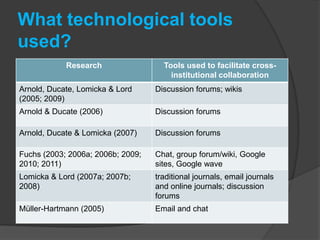
What technological tools used?
Tool TrendsVariety of toolsUse of model teaching (Fuchs,2010; Hubbard & Levy, 2006; Muller-Hartmann, 2005; Willis, 2001) Importance of innovative uses of technologyFuture?
ChallengesTechnology can be a hindranceA suitable partner to work withCareful planning, sometimes a great deal of time in advanceFrequent and regular communication between teachers involvedResolving issues that relate to a colleague’s students or your own studentsPreparing for and dealing with cultural misunderstanding, miscommunication, frustrationsKeeping up to date on the best tools for each project
ImplementationLocate possible partnersProject development (what and how it might be achieved) and possible tools Clear and realistic expectations for each partner Realistic timeframe for communication/ feedback
The next step?Think big, think collaborativeExperiment with new technologies – microblogging, social networking, social media, iPads, etc.Involve different groupsUse collaboration to lead to another project, if possible
Selected ReferencesArnold, N., Ducate, L., Lomicka, L., & Lord, G. (2005). Using Computer-mediated Communication to Establish Social and Supportive Environments in Teacher Education. CALICO Journal, 22(3): 537-566.Arnold, N., Ducate, L., Lomicka, L., Lord, G. (2009). Assessing online collaboration among language teachers: A cross-institutional case study. Journal of Interactive Online Learning, 8(2): 121-139.Arnold, N., & Ducate, L. (2006). Connecting universities, constructing meaning: An analysis of beginning and future FL teachers ‘meeting’ online. Language Learning and Technology, 10(1), 42-66. Arnold, N., Ducate, L., and Lomicka, L. (2007). Virtual communities of practice in teacher education. In M. Kassen, R. Lavine, K. Murphy-Judy, & M. Peters (Eds.). Preparing and Developing Technology-proficient L2 Teachers (pp. 103-132). San Marcos, TX: Computer Assisted Language Instruction Consortium. Cochran-Smith, M. (2005). Studying teacher education: What we know and need to know. The Journal of Teacher Education 56: 301. DOI: 10.1177/0022487105280116.Egbert, J., Paulus, T., & Nakamichi, Y. (2002). The impact of CALL instruction on classroom computer use: A foundation for rethinking technology in teacher education. Language Learning & Technology, 6(3), 108-126. Available: http://llt.msu.edu/vol6num3/egbert.default.htmlHubbard, P. & Levy, M. (Eds.). (2006). Teacher education in CALL. Philadelphia, PA: John Benjamins Publishing Company.Fuchs, C. (2003). Negotiating over a distance: The challenges of computer-mediated communication (CMC) in foreign language teacher education. In M.K. Legutke, & D. Rsler (Eds.), Fremdsprachenlernen mit digitalen Medien.  Beitrge des Giessener Forschungskolloquiums. [Foreign language learning with computer technologies. Articles by the Giessen research colloquium.] (pp. 179-208). Tbingen: Narr. Fuchs, C. (2006a). Exploring German pre-service teachers' electronic and professional literacies. ReCALL, 18(2), 174-192.
Selected ReferencesFuchs, C. (2006b). Computer-mediated negotiation across borders: German-American collaboration in language teacher education. Frankfurt: Peter Lang EuropischerVerlagderWissenschaften.Fuchs, C. (2009). Computer-mediated task design: Language student teachers' expectations and realizations. Letras & Letras. 37-64.Fuchs, C. (2010). Cross-institutional blended learning in teacher education:  A case study. International Journal of Mobile and Blended Learning, 2(2), 30-49Fuchs, C. (2011). Methodological Implications of Using Google Applications (Google Sites and Google Wave) for Cross-Institutional Collaboration in Language Teacher Education. Paper presented at American Association for Applied Linguistics Conference, Chicago.Lord, G., & Lomicka, L. (2008). Blended learning in teacher education: An investigation of classroom community across media. Contemporary Issues in Technology and Teacher Education, 8(2). Lord, G., & Lomicka, L. (2007a). Social presence in virtual communities of FL teachers. System 35: 208-228. Lord, G., & Lomicka, L. (2007b). Foreign Language Teacher Preparation and Asynchronous CMC: Promoting Reflective Teaching. Journal of Technology and Teacher Education. 15 (4):  513-532. Chesapeake, VA: AACE.Muller-Hartmann, A. (2005). Learning how to teach intercultural communicative competence via telecollaboration: A model for language teacher education. In J. A. Belz & S. L. Thorne (eds.), Internet-Mediated Intercultural Foreign Language Education (p. 63-83). Boston, MA: Heinle & Heinle.Willis, J. (2001). Foundational assumptions for information technology and teacher education.  Contemporary Issues in Technology and Teacher Education, 1(3), 305-320.
CMC Teacher Education SIG Presentation; Lomicka

CMC Teacher Education SIG Presentation; Lomicka

  • 1.
    Reflections on cross-institutionaland cross-collaborative research and pedagogy in teacher education “Cross –institutional research is an important and often undervalued and overlooked means of extending the reach and capacities of any given institution” (wikia.com)Lara Lomicka, The University of South Carolinalomicka@sc.edu
  • 2.
    Goals for theTalkDiscuss and reflect on cross-institutional researchBackgroundDefinitionsResearchGainsToolsChallengesImplementationNext step
  • 3.
    BackgroundAmerican Educational ResearchAssociation (AERA) Panel on Research and Teacher Education recommendation for more cross-institutional studies (Cochran-Smith, 2005)
  • 4.
    BackgroundStandards for TeacherEducators from the Association of Teacher Educators Standard 5 - CollaborationCollaborate regularly and in significant ways with representatives of schools, universities, state education agencies, professional associations, and communities to improve teaching, learning, and teacher education. http://www.ate1.org/pubs/Standard_5.cfm
  • 5.
    Cross-Institutional Research“Cross –institutionalresearch is an important and often undervalued and overlooked means of extending the reach and capacities of any given institution” (wikia.com)Cross-Institutional Research“relationship building” is criticalmultiple institutional representatives to work together toward common goals in educationreplace “me” with “we”establish mutual trust and respect(ADR news report, 2(1), January 2008)
  • 6.
    ResearchCross-institutional and cross-collaborativeprojectsIn language learning contextsIn language teacher education
  • 7.
  • 8.
    Arnold et al.,2005Goal: examine how CMC facilitates positive social interactions and the formation of communities for professional growth among FL teachersCross-institutional set up: graduate students from 3 US institutions enrolled in methods courses (new teachers) participated in regular exchange via discussion forumsResults: benefits for FL teacher ed programs, connections to peers and community development, successful modeling encouraged them to incorporate technology in own teaching
  • 9.
    Müller-Hartmann (2005) Goal:to look at the development of both intercultural communicative competence and critical media literacy in foreign language teachersCross-institutional set up: pre- and in-service student-teachers in two upper-level courses in Germany and in the US, both novice and experienced; collaboration on tasks and regular exchangeResults: development of ICC; wanted to develop more technical skills
  • 10.
    Arnold et al.,2009Goal: to examine the nature of online group interaction and cooperation in the process of developing a collaborative productCross-institutional set up: New teachers from three large US universities worked together to develop a wiki during semesterResults: successful interaction depends on group members; differing levels of participation point to unequal levels of involvement, which affected the level of collaboration, the group dynamics, and the final product. In addition, the leader in each group influenced the degree of collaboration taking place in the group.
  • 11.
    Fuchs, 2010Goal: Exploratorycase study of teachers in US and in Germany and their evaluation of a blended learning course using task based language teaching (TBLT)Cross-institutional set up: ESL teachers in the US and in Germany; shared perspectives about teaching contexts and practices in chat, wikis, forumsResults: more technology in teacher education; learned about TSLT
  • 12.
    What did studentsgain?Involvement in a “community” of learners and/or teachers/expertsLearning from and teaching one anotherSharing ideas and experiencesMentoring opportunitiesMotivation to complete work/projectsTechnology
  • 13.
  • 14.
    Tool TrendsVariety oftoolsUse of model teaching (Fuchs,2010; Hubbard & Levy, 2006; Muller-Hartmann, 2005; Willis, 2001) Importance of innovative uses of technologyFuture?
  • 15.
    ChallengesTechnology can bea hindranceA suitable partner to work withCareful planning, sometimes a great deal of time in advanceFrequent and regular communication between teachers involvedResolving issues that relate to a colleague’s students or your own studentsPreparing for and dealing with cultural misunderstanding, miscommunication, frustrationsKeeping up to date on the best tools for each project
  • 16.
    ImplementationLocate possible partnersProjectdevelopment (what and how it might be achieved) and possible tools Clear and realistic expectations for each partner Realistic timeframe for communication/ feedback
  • 17.
    The next step?Thinkbig, think collaborativeExperiment with new technologies – microblogging, social networking, social media, iPads, etc.Involve different groupsUse collaboration to lead to another project, if possible
  • 18.
    Selected ReferencesArnold, N.,Ducate, L., Lomicka, L., & Lord, G. (2005). Using Computer-mediated Communication to Establish Social and Supportive Environments in Teacher Education. CALICO Journal, 22(3): 537-566.Arnold, N., Ducate, L., Lomicka, L., Lord, G. (2009). Assessing online collaboration among language teachers: A cross-institutional case study. Journal of Interactive Online Learning, 8(2): 121-139.Arnold, N., & Ducate, L. (2006). Connecting universities, constructing meaning: An analysis of beginning and future FL teachers ‘meeting’ online. Language Learning and Technology, 10(1), 42-66. Arnold, N., Ducate, L., and Lomicka, L. (2007). Virtual communities of practice in teacher education. In M. Kassen, R. Lavine, K. Murphy-Judy, & M. Peters (Eds.). Preparing and Developing Technology-proficient L2 Teachers (pp. 103-132). San Marcos, TX: Computer Assisted Language Instruction Consortium. Cochran-Smith, M. (2005). Studying teacher education: What we know and need to know. The Journal of Teacher Education 56: 301. DOI: 10.1177/0022487105280116.Egbert, J., Paulus, T., & Nakamichi, Y. (2002). The impact of CALL instruction on classroom computer use: A foundation for rethinking technology in teacher education. Language Learning & Technology, 6(3), 108-126. Available: http://llt.msu.edu/vol6num3/egbert.default.htmlHubbard, P. & Levy, M. (Eds.). (2006). Teacher education in CALL. Philadelphia, PA: John Benjamins Publishing Company.Fuchs, C. (2003). Negotiating over a distance: The challenges of computer-mediated communication (CMC) in foreign language teacher education. In M.K. Legutke, & D. Rsler (Eds.), Fremdsprachenlernen mit digitalen Medien.  Beitrge des Giessener Forschungskolloquiums. [Foreign language learning with computer technologies. Articles by the Giessen research colloquium.] (pp. 179-208). Tbingen: Narr. Fuchs, C. (2006a). Exploring German pre-service teachers' electronic and professional literacies. ReCALL, 18(2), 174-192.
  • 19.
    Selected ReferencesFuchs, C.(2006b). Computer-mediated negotiation across borders: German-American collaboration in language teacher education. Frankfurt: Peter Lang EuropischerVerlagderWissenschaften.Fuchs, C. (2009). Computer-mediated task design: Language student teachers' expectations and realizations. Letras & Letras. 37-64.Fuchs, C. (2010). Cross-institutional blended learning in teacher education: A case study. International Journal of Mobile and Blended Learning, 2(2), 30-49Fuchs, C. (2011). Methodological Implications of Using Google Applications (Google Sites and Google Wave) for Cross-Institutional Collaboration in Language Teacher Education. Paper presented at American Association for Applied Linguistics Conference, Chicago.Lord, G., & Lomicka, L. (2008). Blended learning in teacher education: An investigation of classroom community across media. Contemporary Issues in Technology and Teacher Education, 8(2). Lord, G., & Lomicka, L. (2007a). Social presence in virtual communities of FL teachers. System 35: 208-228. Lord, G., & Lomicka, L. (2007b). Foreign Language Teacher Preparation and Asynchronous CMC: Promoting Reflective Teaching. Journal of Technology and Teacher Education. 15 (4): 513-532. Chesapeake, VA: AACE.Muller-Hartmann, A. (2005). Learning how to teach intercultural communicative competence via telecollaboration: A model for language teacher education. In J. A. Belz & S. L. Thorne (eds.), Internet-Mediated Intercultural Foreign Language Education (p. 63-83). Boston, MA: Heinle & Heinle.Willis, J. (2001). Foundational assumptions for information technology and teacher education.  Contemporary Issues in Technology and Teacher Education, 1(3), 305-320.

Editor's Notes