EUBra-BIGSEA:	cloud services
with QoS guarantees for Big	
Data	Analytics
Ignacio	Blanquer	on Behalf of	the
EUBRA-BIGSEA	Consortium
www.eubra-bigsea.eu		|			@bigsea_eubr
EUBra-BIGSEA
www.eubra-bigsea.eu |			@bigsea_eubr
• A	European-Brazilian	Consortium	aiming	at
― The	development	of	QoS and	secure	cloud	services	to	support	Big	
Data.
― The	development	of	Big	Data	services	for	capturing,	federating	and	
annotating	large	volumes	of	data.
― The	use	of	efficient technologies for	guaranteeing	the	fulfilment	of	
the	security and	privacy policies.
― The	transfer of	this	technology	to	a	real user scenario with	high	
social	and	business	impact,	and	of	high	interest	for	both	EU	and	BR.
BIGSEA	in	a	NutShell
www.eubra-bigsea.eu |			@bigsea_eubr
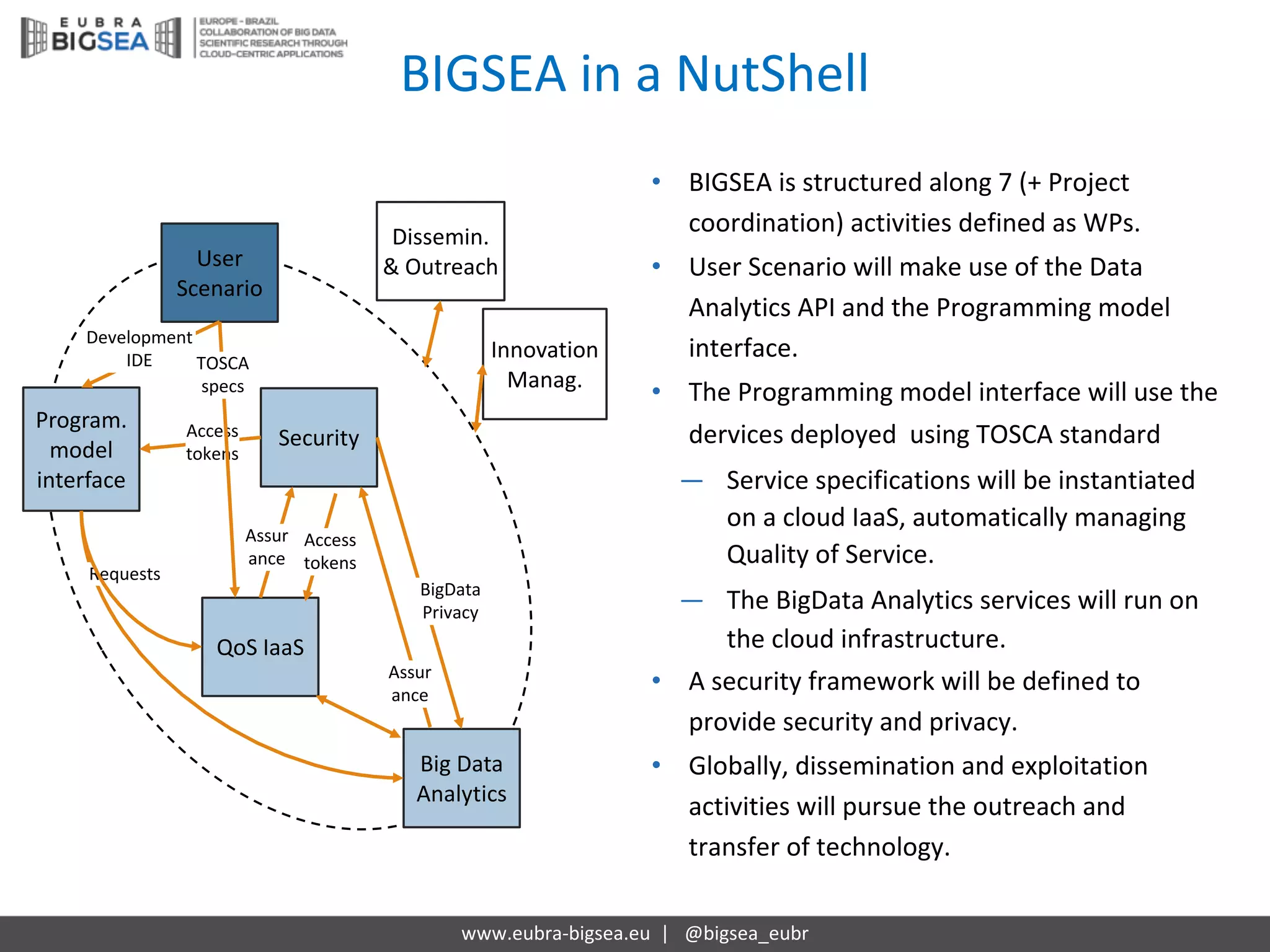
• BIGSEA	is structured along 7	(+	Project	
coordination)	activities defined as	WPs.
• User Scenario will make use	of	the Data	
Analytics API	and	the Programming model
interface.
• The Programming model interface	will use	the
dervices deployed using TOSCA	standard
― Service specifications will be	instantiated
on a	cloud IaaS,	automatically managing
Quality of	Service.
― The BigData Analytics services will run	on
the cloud infrastructure.
• A	security framework will be	defined to	
provide security and	privacy.
• Globally,	dissemination and	exploitation
activities will pursue the outreach and	
transfer	of	technology.
QoS IaaS
Big	Data	
Analytics
Program.	
model
interface	
Security
User	
Scenario
Dissemin.	
&	Outreach
Innovation
Manag.
Access	
tokens
Assur
ance
BigData
Privacy
Assur
ance
Access	
tokens
TOSCA	
specs
Requests
Development
IDE
BIGSEA	Architecture
www.eubra-bigsea.eu |			@bigsea_eubr
Mesos
Scheduler
Resources
Cloud	
Manag.	
Framew.
EC3	/	IM
CLOUDVA
MP
Monitor
Proactive
Policies
Program.	
Model
(COMPSs)
IDE	
(Lemonad
e)
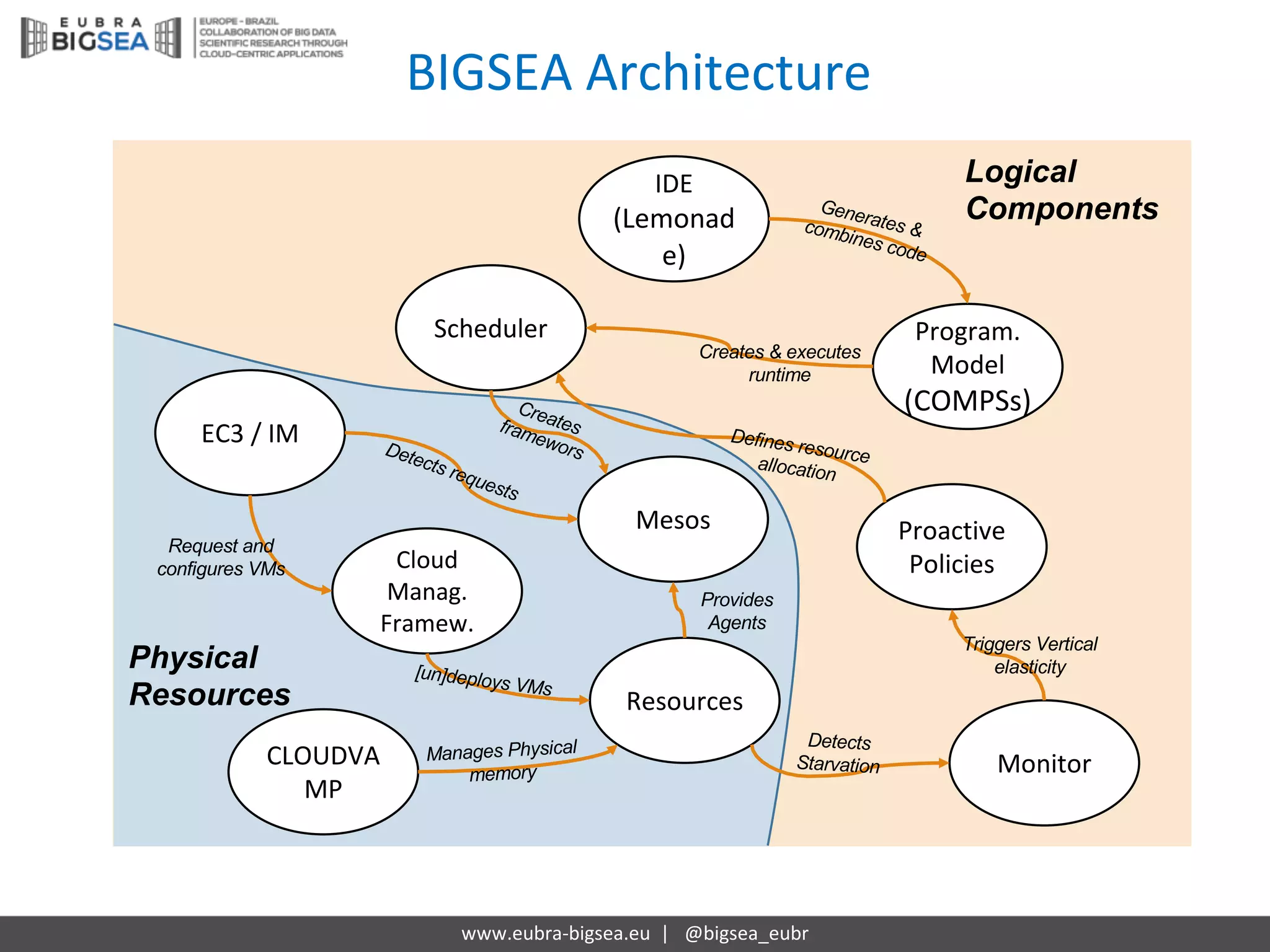
Creates & executes
runtime
Triggers Vertical
elasticity
Request and
configures VMs
Provides
Agents
Physical
Resources
Logical
Components
Management	of	Physical
Resources
Physical Resources
www.eubra-bigsea.eu |			@bigsea_eubr
• Resources are	provisioned by a	Mesos Cluster to	the
execution frameworks
- COMPSs,	Marathon,	Spark,	Chronos.
• Mesos Cluster is composed of	a	set	of	VMs provisioned
from a	CMF
- Automated Deployment
- Platform-agnosticism
- Vanilla VMIs
• Horizontal	Elasticity at	the level of	the resources
- The registration of	new	frameworks will check for the availability of	
the needed resources.
- New	requests will trigger booting up	new	resources if needed.
- Idle	pure computing resources will be	powered off.
• Vertical	Elasticity at	the level of	the VMs
- Higher flexibility in	the allocation of	physical resources.
VMRC
Infrastructure	Manager
Cloud
Selector
VMRC
Cloud	Connector
Conf.
Manager
Ficheros	
Conf	&	CTX
XML-RPC	API REST	API
Web	Interface CLI	Interface
MV
MV
MV
...
RADL
VM	Master
Cntxt.
Agent
Ansible
OpenNebula OpenStack EC2 ...
Ansible
VMRC
...
Infrastructure Manager	(IM)
www.grycap.upv.es/im
www.eubra-bigsea.eu |			@bigsea_eubr
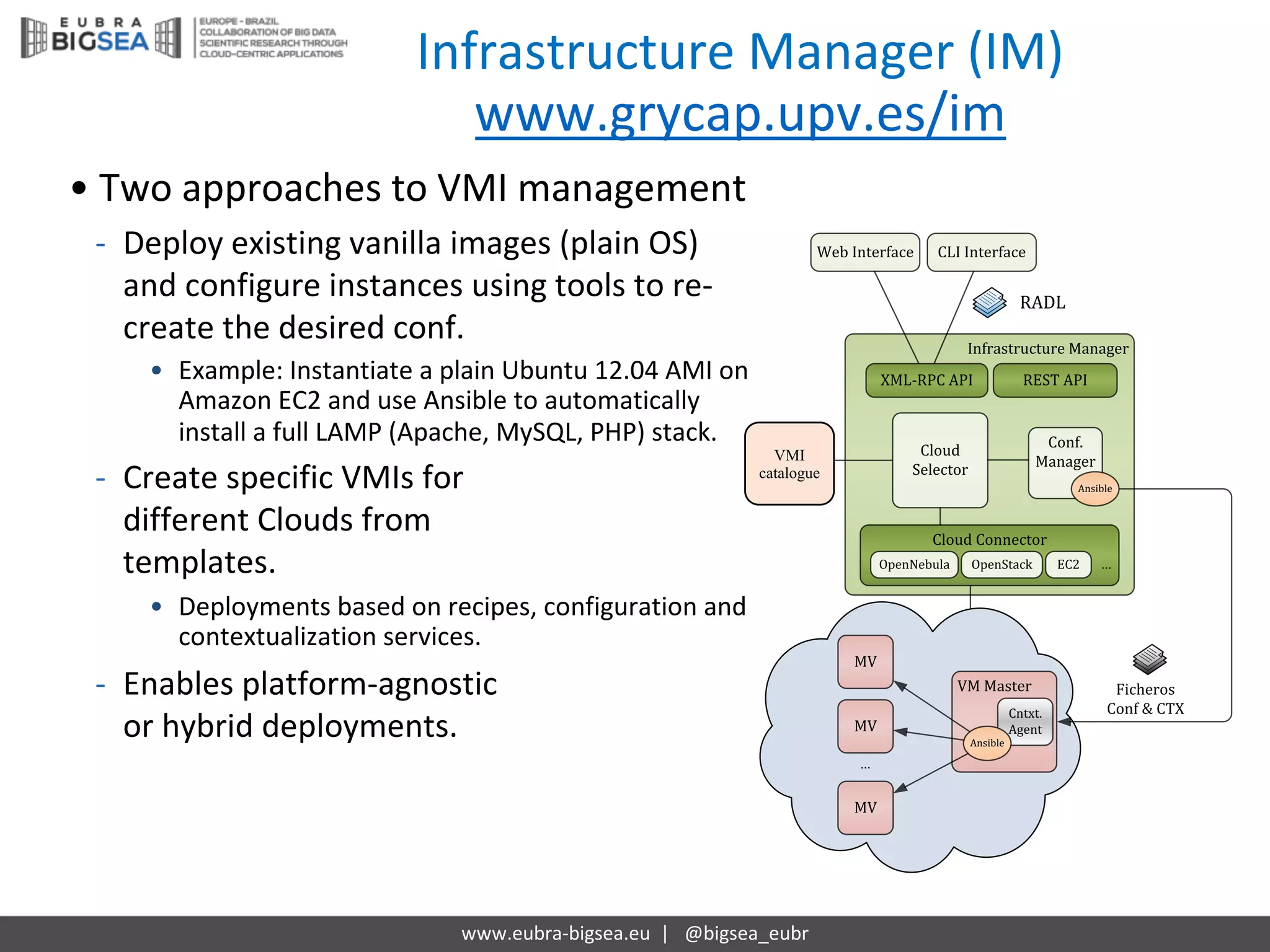
• Two	approaches	to	VMI	management
- Deploy	existing	vanilla	images	(plain	OS)	
and	configure	instances	using	tools	to	re-
create	the	desired	conf.
• Example:	Instantiate	a	plain	Ubuntu	12.04	AMI	on	
Amazon	EC2	and	use	Ansible to	automatically	
install	a	full	LAMP	(Apache,	MySQL,	PHP)	stack.
- Create	specific	VMIs	for	
different	Clouds	from	
templates.
• Deployments	based	on	recipes,	configuration	and	
contextualization	services.
- Enables	platform-agnostic	
or	hybrid	deployments.
VMI
catalogue
Platform-agonstic Deployment
www.eubra-bigsea.eu |			@bigsea_eubr
Local	Computer
IM	server
EC3	client
RADL
crede
ntials
$ docker pull eubrabigsea/ec3client
$ docker pull grycap/im
Mesos
master
Hadoop
DN
Hadoop
DN
Hadoop
DN
Mesos
slave
Mesos
slave
Mesos
slave
Mesos
slave
$ ./ec3 launch myMesosHadClus ubuntu-one mesos docker spark nfs hadoop
-a /root/auth.dat -u http://localhost:8899
Bound to ONE, but easy to extend by:
• Changing base image
• Providing credentials
Address of the IM
server
Credentials
Platform-agnostic Deployment
www.eubra-bigsea.eu		|			@bigsea_eubr
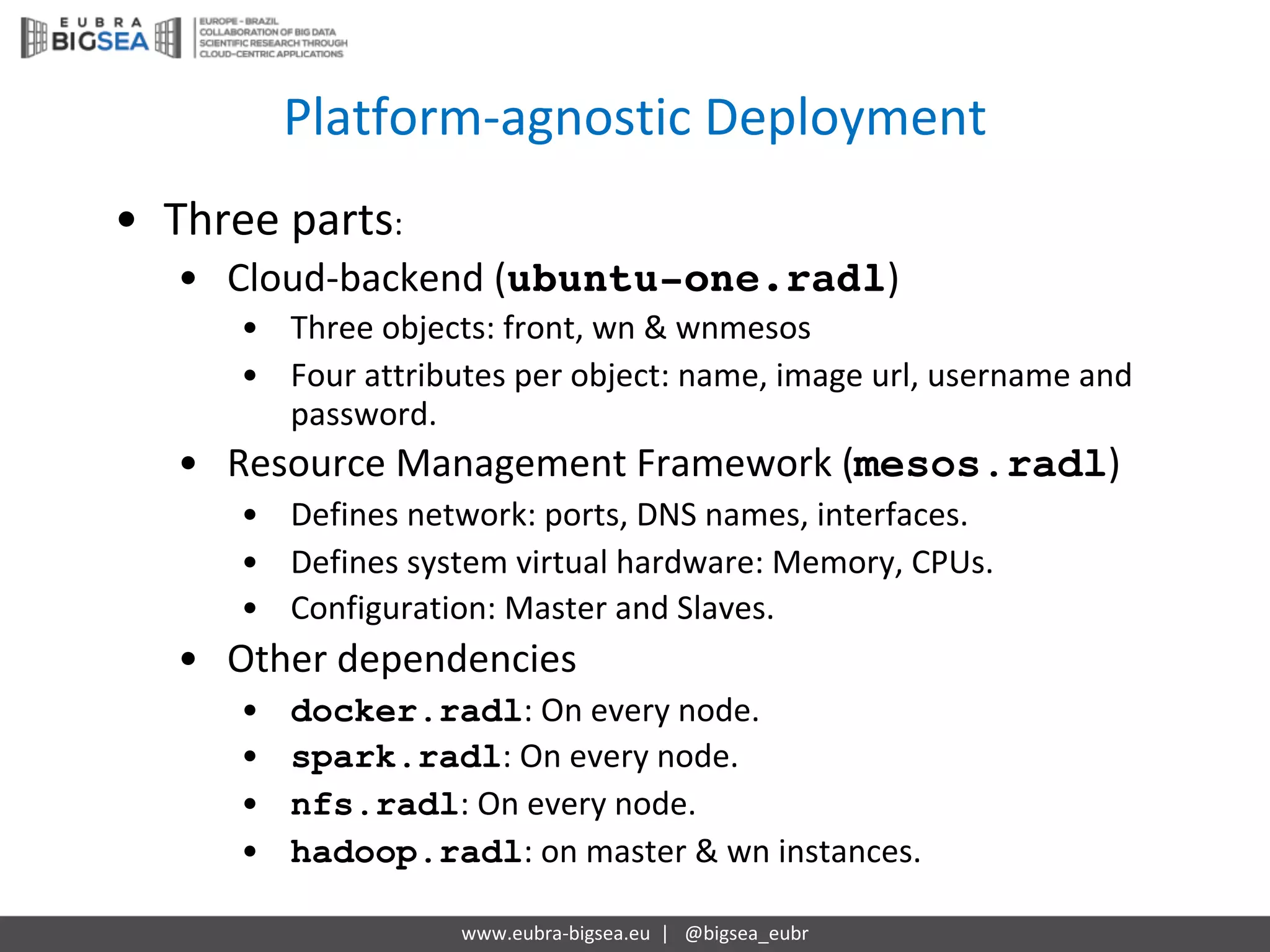
• Three	parts:
• Cloud-backend	(ubuntu-one.radl)
• Three	objects:	front,	wn &	wnmesos
• Four	attributes	per	object:	name,	image	url,	username	and	
password.
• Resource	Management	Framework	(mesos.radl)
• Defines	network:	ports,	DNS	names,	interfaces.
• Defines	system	virtual	hardware:	Memory,	CPUs.
• Configuration:	Master	and	Slaves.
• Other	dependencies
• docker.radl:	On every node.
• spark.radl:	On every node.
• nfs.radl:	On every node.
• hadoop.radl:	on master	&	wn instances.
Elastic Compute	Clusters on the Cloud	
(EC3)
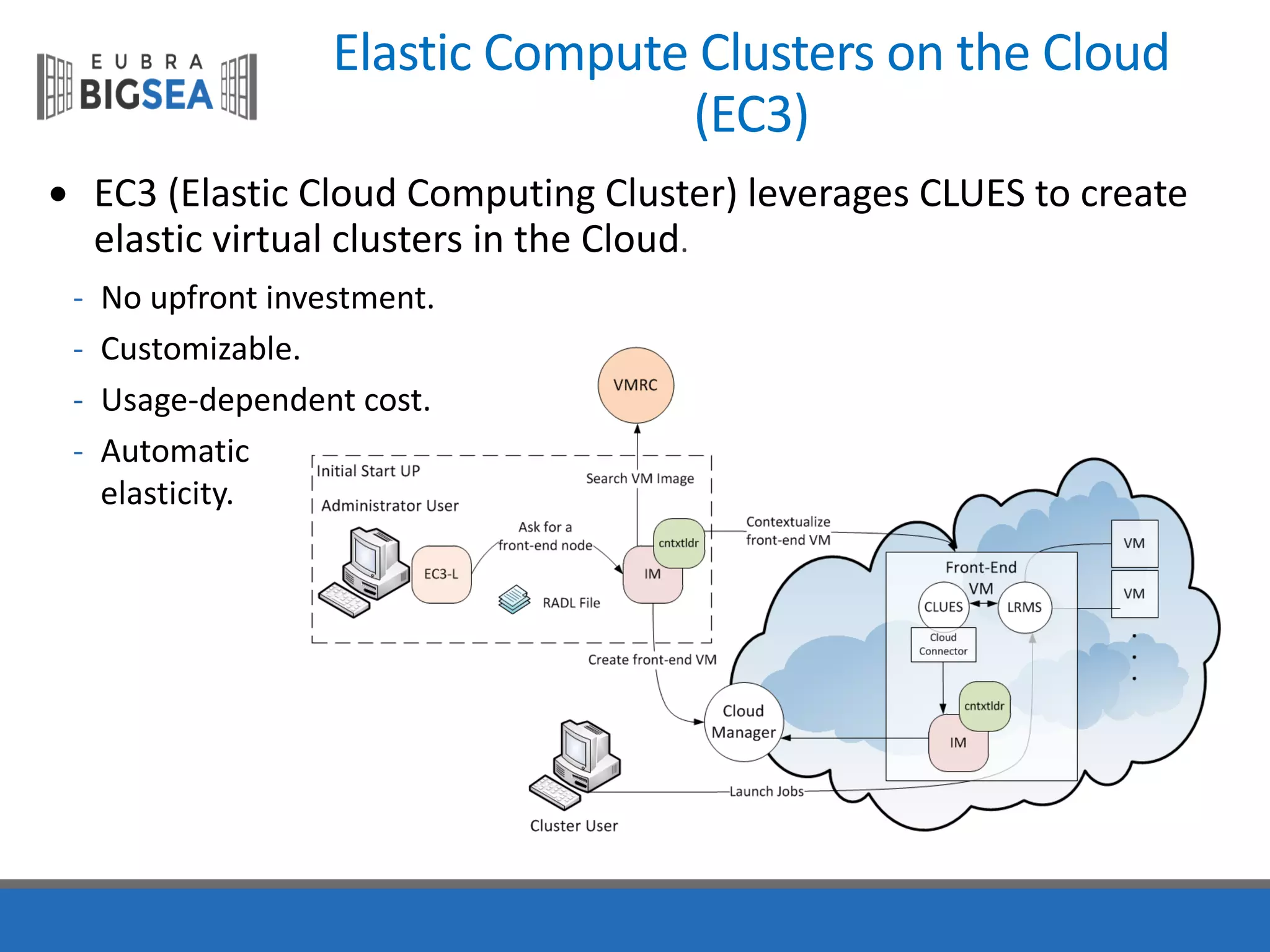
• EC3	(Elastic Cloud	Computing	Cluster)	leverages CLUES	to	create
elastic virtual	clusters in	the Cloud.
- No	upfront investment.
- Customizable.
- Usage-dependent cost.
- Automatic
elasticity.
Resource-level elasticity
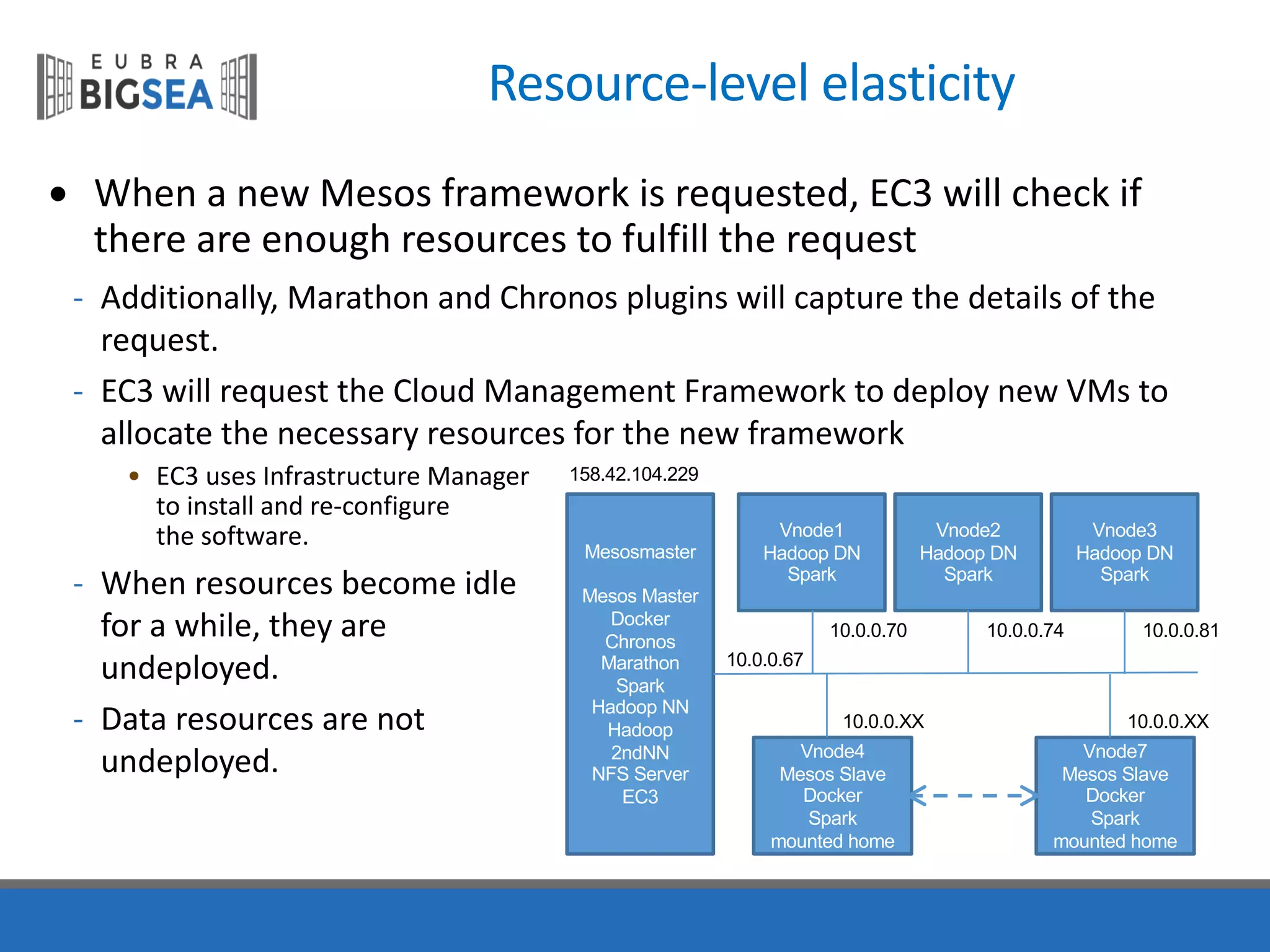
• When a	new	Mesos framework is requested,	EC3	will check if
there are	enough resources to	fulfill the request
- Additionally,	Marathon and	Chronos plugins will capture	the details of	the
request.
- EC3	will request the Cloud	Management	Framework	to	deploy new	VMs to	
allocate the necessary resources for the new	framework
• EC3	uses	Infrastructure Manager	
to	install and	re-configure	
the software.
- When resources become idle	
for a	while,	they are	
undeployed.
- Data	resources are	not
undeployed.
Mesosmaster
Mesos Master
Docker
Chronos
Marathon
Spark
Hadoop NN
Hadoop
2ndNN
NFS Server
EC3
Vnode1
Hadoop DN
Spark
Vnode2
Hadoop DN
Spark
Vnode3
Hadoop DN
Spark
Vnode4
Mesos Slave
Docker
Spark
mounted home
Vnode7
Mesos Slave
Docker
Spark
mounted home
158.42.104.229
10.0.0.67
10.0.0.70 10.0.0.74 10.0.0.81
10.0.0.XX10.0.0.XX
Vertical	elasticity at	the
resource level
•VMs are	allocated from a	CMF	that manages a	
general-purpose on-premise cloud
• Physical limitations are	normally at	the memory size
rather than at	the CPU	share.
• A	physical machine	can	be	shared among different
deployments
• Both BIGSEA	stack or other one.
• Or due to	increased isolation.
• Oversubscribing memory can	enable reaching higher
number of	VMs per	physical node,	not bounding to	a	
specific partitioning.
• A	VM	from one deployment can	”release”	the free	memory to	
other VMs in	the node.
Infrastructure management
• Interaction with the CLUES	client to	get information about the
resources powered on /	off	and	to	force them to	be	powered on /	off.
• Mainly intended for administration,	it can	be	used to	anticipate
powering on a	resource .
/v1/resource/slaves GET method, lists all the resources registered in the master or
cluster of masters.
/v1/resource/slaves/slaveid GET method, provides the status information of a specific slave.
/v1/resource/up PUT method, boots up a new resource.
/v1/resource/slaves/slaveid DELETE method, powers down a specific resource.
/v1/resource/slaves/slaveid/enable POST method, enables a disabled resource.
/v1/resource/slaves/slaveid/disable POST method, disables an active resource – it is not considered any
longer to be powered off by the system.
Automated Oversubscription for
Cloud	Platforms (CLOUDVAMP)
http://www.grycap.upv.es/cloudvamp
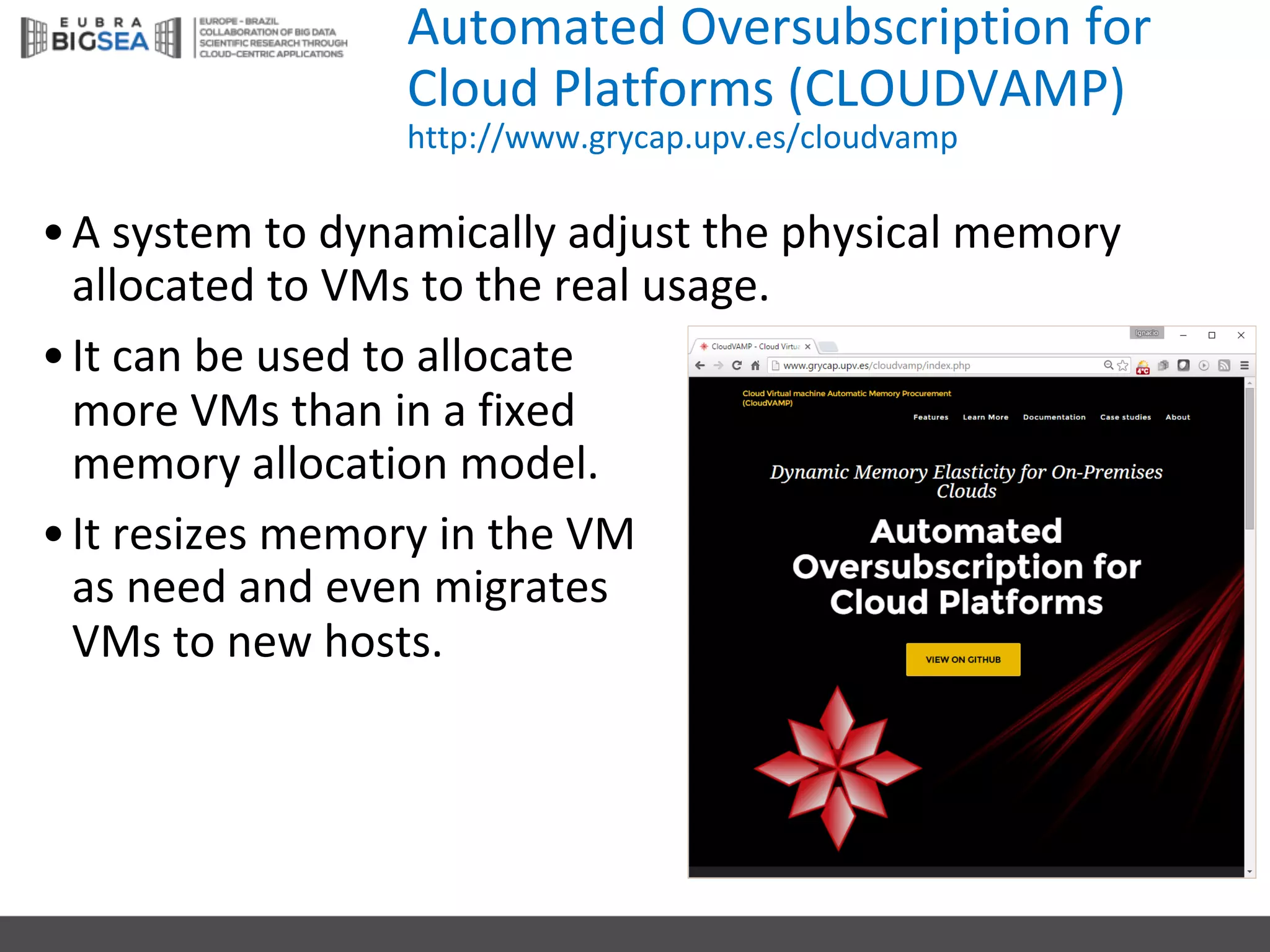
•A	system to	dynamically adjust the physical memory
allocated to	VMs to	the real	usage.
•It can	be	used to	allocate
more	VMs than in	a	fixed
memory allocation model.
•It resizes memory in	the VM	
as	need and	even migrates
VMs to	new	hosts.
Logical Components
User-level interaction
User’s
Comp
uter
github
Docker Hub BIGSEA end-point
BIGSEA Lemonade
IDE
Resources
app
Spark /
COMPSs
Generated
code
Docker commit
& push (3)
Dockerfile
commit &
push (3) Automated
build (3)
Docker pull
(5) Framework
(5)
Submit
(incl QoS)
(4)
BIGSEA QoS
proactive
Resource
request (4)
Docker pull (1)
Characteriz
ation (4)
User-level interaction
User’s
Comp
uter
github
Docker Hub
BIGSEA end-point
BIGSEA Lemonade
IDE
Resourcesapp
COMPSs /
Spark User
Code (2)
GUI (2)
Spark / COMPSs Generated
code (3)
Docker commit
& push (3)
Dockerfile commit & push (3)
Automated
build (3)
Docker run
(5)
Framework
(5)
Submit
(incl QoS)
(4)
BIGSEA QoS
proactive
Resource
request (4)
Docker pull (1)
Characteriz
ation (4)
Programm
Writing
QoS characterization
Customizing
Depend.
Proactive
Resource
Character.
Submission
• Combining Spark and general code in an IDE.
• Using COMPSs for DAG parallelilsation.
• Use of pre-characterized building-blocks and algorithms.
• Container images with BIGSEA dependencies (preferred), also
supporting direct execution (e.g. Spark).
• Automated build or container push.
• Run-time policies optimize resource allocation at initial deployment.
• Performance models recalculate QoS metrics (execution time) and
trigger optimization module (if necessary).
• API provides system parameter reconfiguration.
• Submission from a single end-point.
• Frameworks interacting with the Mesos cluster.
• Adding QoS constraints (deadlines, execution time,…) and
previous proactive resources demand characterization.
Single	Submission end-point
• JSON	document with the information on the
execution container,	framework resources and	
QoS.
/v1/scheduler POST method, submits a job
request in JSON.
/v1/scheduler/jobs GET method, lists all the jobs in
the scheduler (a JSON with all the
job). It can accept a JSON with a
deadline that defines the date
limit.
/v1/scheduler/job/jobid GET method, gets all the
information from a specific job;
DELETE method, kills the specific
job; POST method, reallocates
resources.
/v1/scheduler/job/jobid/scale PUT method, changes the
resource allocation of a
framework.
{ "type": "CMD",
"name": "my_job_name",
"deadline": "2016-06-10T17:22:00Z+2",
"periodic": "R24P60M",
"expectedduration": "10M"
"container" : [
"type": "DOCKER",
"image": "eubrabigsea/ubuntu",
"forcePullImage": true
"volumes": [
{ "containerPath": "/var/log/",
"hostPath": "/logs/",
"mode": "RW"}],
"portMappings": [
{ "containerPort": 8080,
"hostPort": 0,
"protocol": "tcp" }]],
"environmentVariables": [
{ "name": "value" } ],
"cpu" : "1.5", "mem" : "512M", "disk" : "1G",
"command" : "python -m SimpleHTTPServer 8000"
}
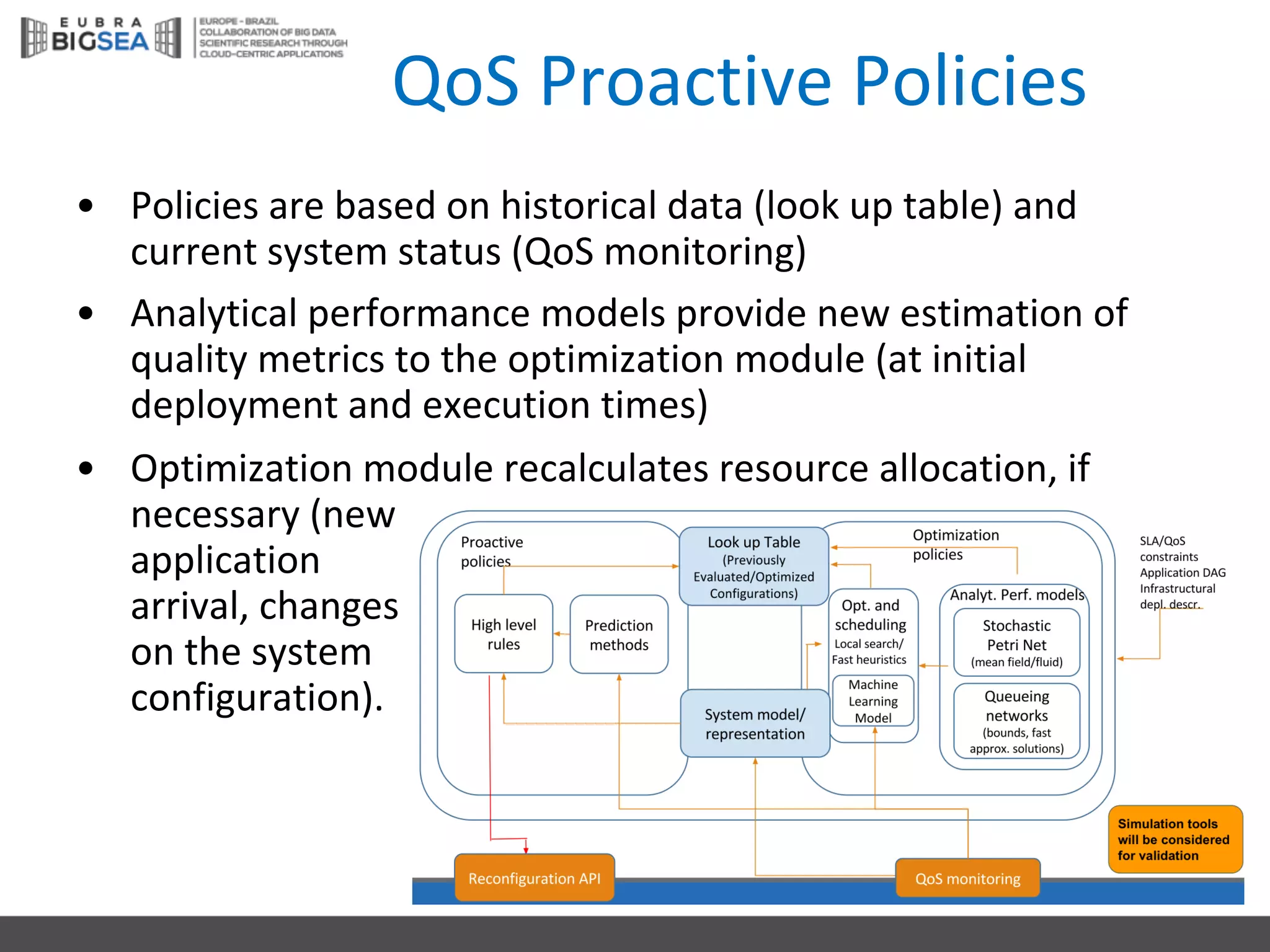
QoS Proactive Policies
• Policies are	based on historical data	(look	up	table)	and	
current system status	(QoS monitoring)
• Analytical performance	models provide new	estimation of	
quality metrics to	the optimization module	(at	initial
deployment and	execution times)
• Optimization module	recalculates resource allocation,	if
necessary (new
application
arrival,	changes
on the system
configuration).
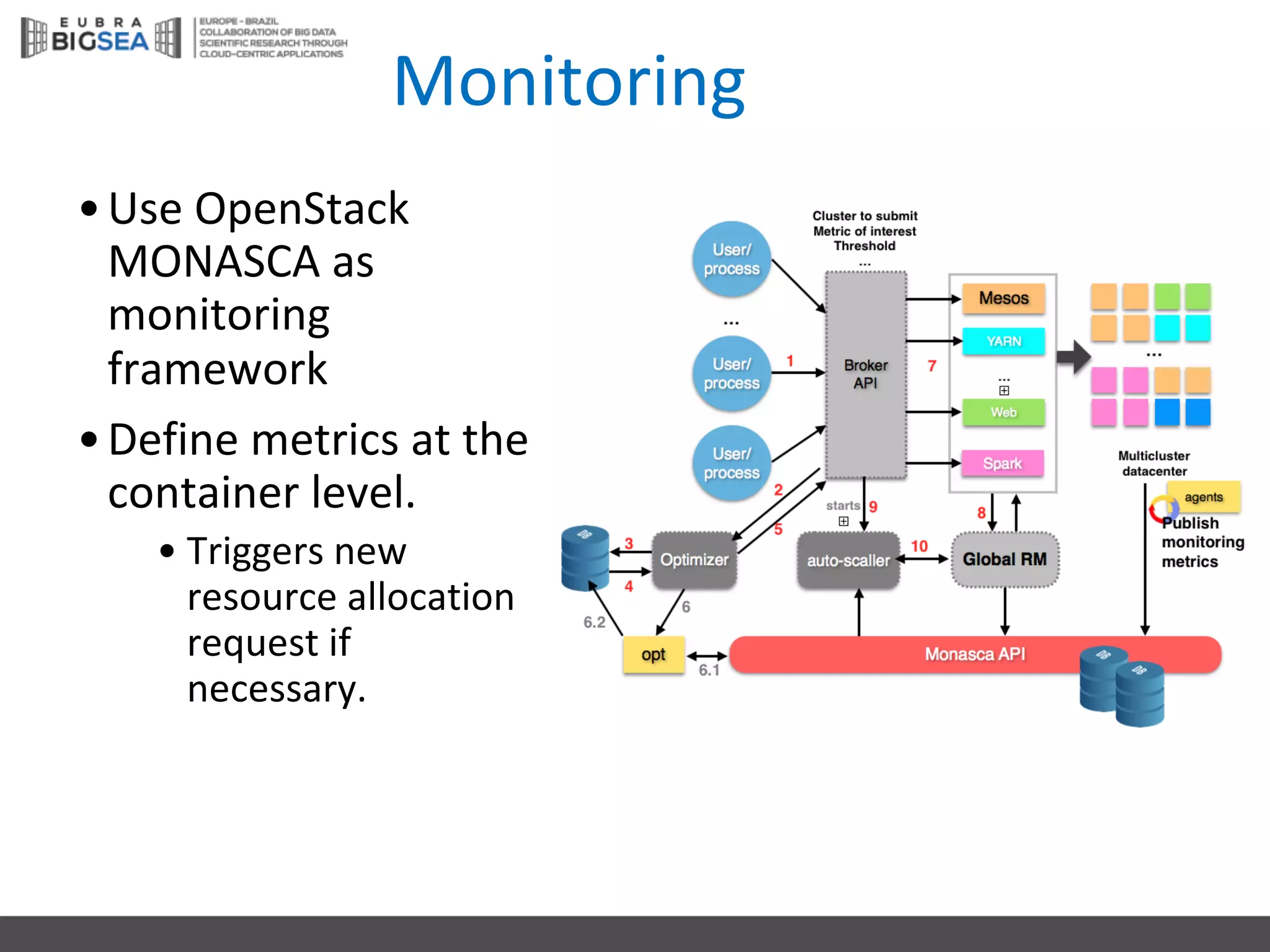
Monitoring
•Use	OpenStack
MONASCA	as	
monitoring
framework
•Define	metrics at	the
container level.
• Triggers new	
resource allocation
request if
necessary.
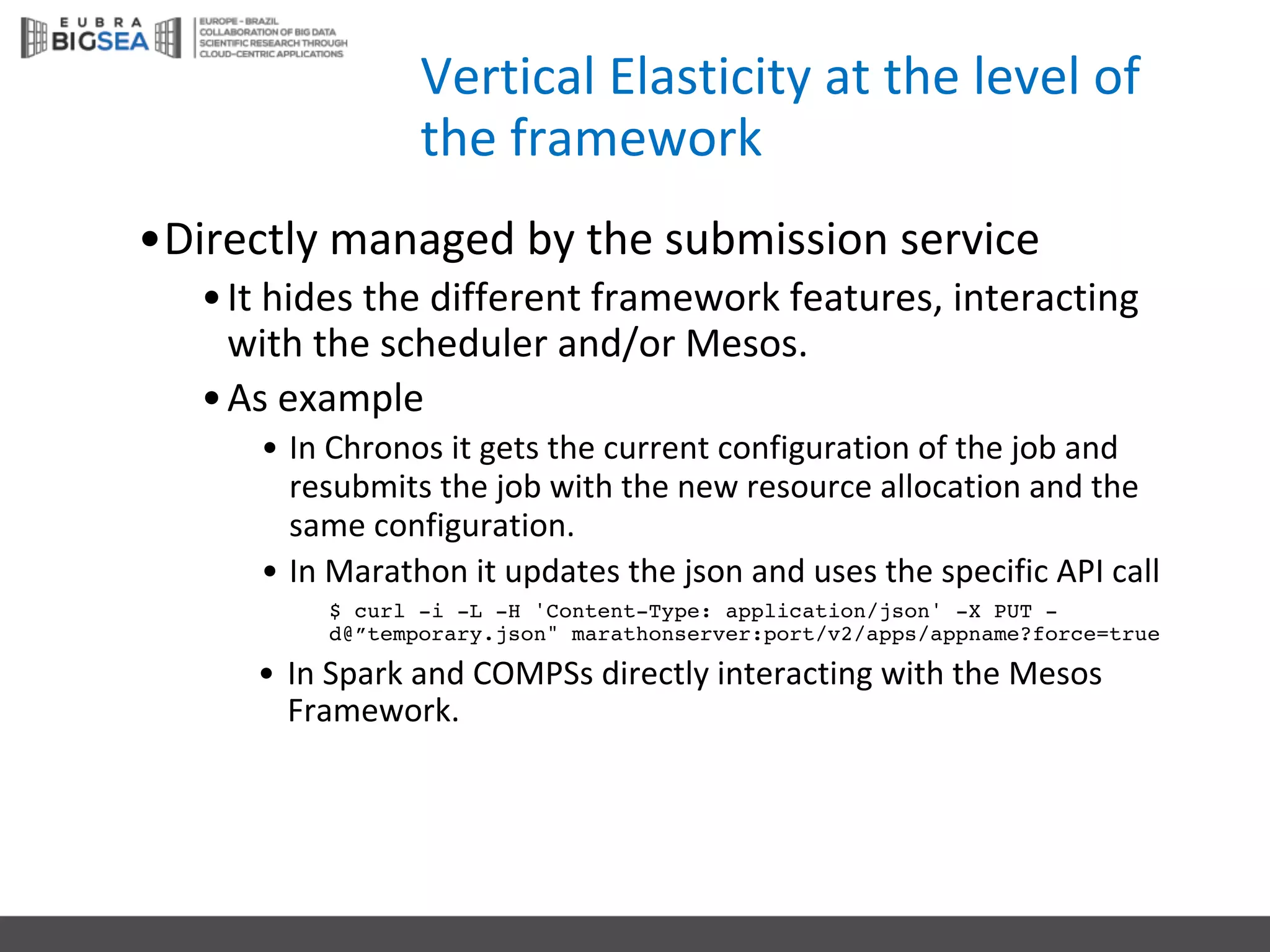
Vertical	Elasticity	at	the	level	of	
the	framework
•Directly managed by the submission service
•It hides the different framework features,	interacting
with the scheduler and/or Mesos.
•As	example
• In	Chronos it gets the current configuration of	the job and	
resubmits the job with the new	resource allocation and	the
same configuration.
• In	Marathon it updates the json and	uses	the specific API	call
$ curl -i -L -H 'Content-Type: application/json' -X PUT -
d@”temporary.json" marathonserver:port/v2/apps/appname?force=true
• In	Spark and	COMPSs directly interacting with the Mesos
Framework.
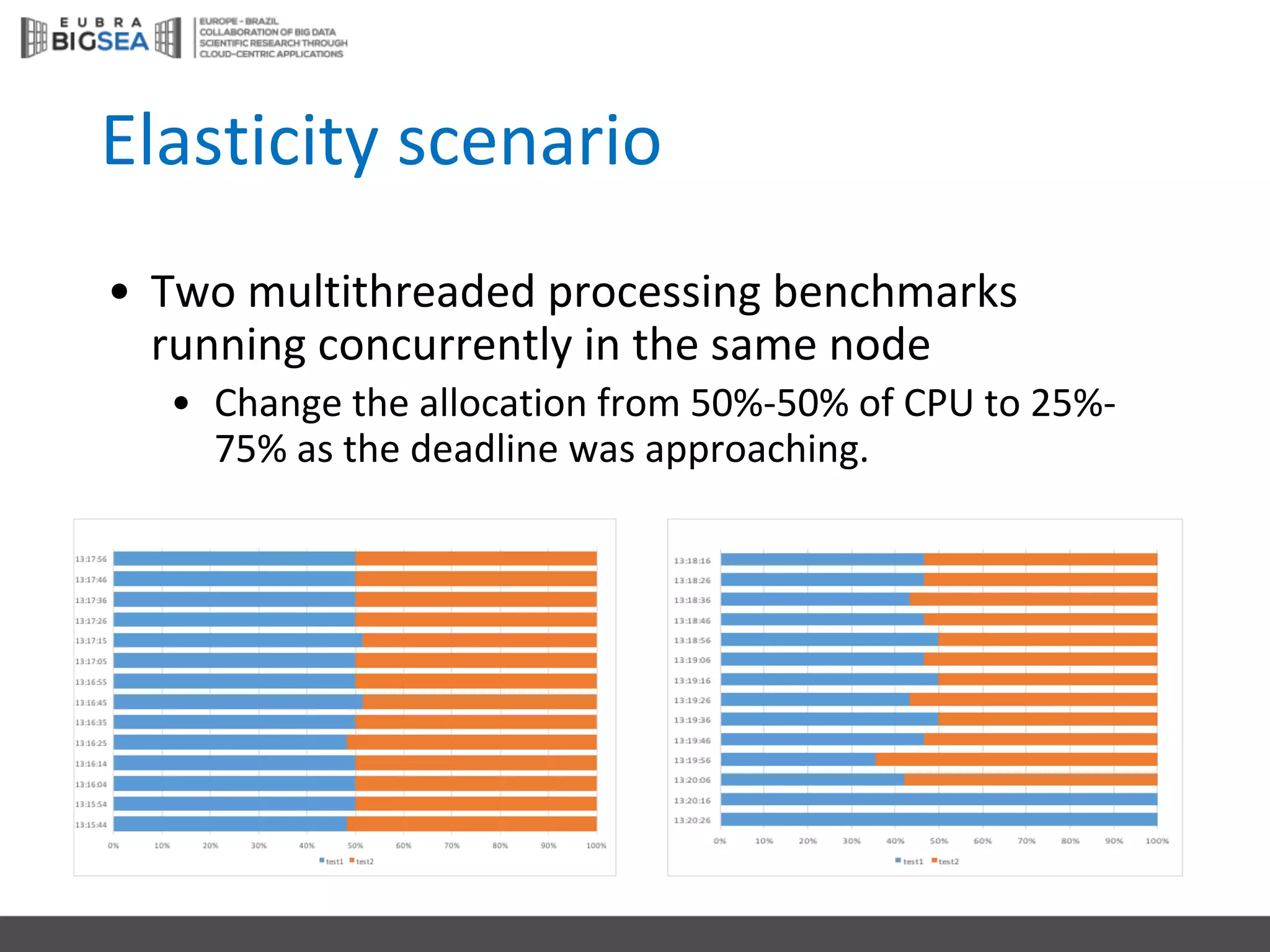
Elasticity scenario
• Two multithreaded processing benchmarks
running	concurrently in	the same node
• Change the allocation from 50%-50%	of	CPU	to	25%-
75%	as	the deadline was approaching.
Conclusions
•EUBra-BIGSEA	aims at	providing a	set	of	cloud
services to	
• Facilitate the deployment of	complex multi-framework
Big	Data	infrastructures.
• Provide elasticity at	the level of	the physical resources
and	frameworks.
• Include QoS Constraints.
• Facilitate the use	of	customized environments.
•Those cloud services are	directly used by higher-
level programming models hiding the platform
particularities.

EUBra-BIGSEA: Cloud services with QoS guarantees for Big Data analytics

  • 1.
    EUBra-BIGSEA: cloud services with QoSguarantees for Big Data Analytics Ignacio Blanquer on Behalf of the EUBRA-BIGSEA Consortium www.eubra-bigsea.eu | @bigsea_eubr
  • 2.
    EUBra-BIGSEA www.eubra-bigsea.eu | @bigsea_eubr • A European-Brazilian Consortium aiming at ―The development of QoS and secure cloud services to support Big Data. ― The development of Big Data services for capturing, federating and annotating large volumes of data. ― The use of efficient technologies for guaranteeing the fulfilment of the security and privacy policies. ― The transfer of this technology to a real user scenario with high social and business impact, and of high interest for both EU and BR.
  • 3.
    BIGSEA in a NutShell www.eubra-bigsea.eu | @bigsea_eubr • BIGSEA isstructured along 7 (+ Project coordination) activities defined as WPs. • User Scenario will make use of the Data Analytics API and the Programming model interface. • The Programming model interface will use the dervices deployed using TOSCA standard ― Service specifications will be instantiated on a cloud IaaS, automatically managing Quality of Service. ― The BigData Analytics services will run on the cloud infrastructure. • A security framework will be defined to provide security and privacy. • Globally, dissemination and exploitation activities will pursue the outreach and transfer of technology. QoS IaaS Big Data Analytics Program. model interface Security User Scenario Dissemin. & Outreach Innovation Manag. Access tokens Assur ance BigData Privacy Assur ance Access tokens TOSCA specs Requests Development IDE
  • 4.
  • 5.
  • 6.
    Physical Resources www.eubra-bigsea.eu | @bigsea_eubr •Resources are provisioned by a Mesos Cluster to the execution frameworks - COMPSs, Marathon, Spark, Chronos. • Mesos Cluster is composed of a set of VMs provisioned from a CMF - Automated Deployment - Platform-agnosticism - Vanilla VMIs • Horizontal Elasticity at the level of the resources - The registration of new frameworks will check for the availability of the needed resources. - New requests will trigger booting up new resources if needed. - Idle pure computing resources will be powered off. • Vertical Elasticity at the level of the VMs - Higher flexibility in the allocation of physical resources.
  • 7.
    VMRC Infrastructure Manager Cloud Selector VMRC Cloud Connector Conf. Manager Ficheros Conf & CTX XML-RPC API REST API Web Interface CLI Interface MV MV MV ... RADL VM Master Cntxt. Agent Ansible OpenNebulaOpenStack EC2 ... Ansible VMRC ... Infrastructure Manager (IM) www.grycap.upv.es/im www.eubra-bigsea.eu | @bigsea_eubr • Two approaches to VMI management - Deploy existing vanilla images (plain OS) and configure instances using tools to re- create the desired conf. • Example: Instantiate a plain Ubuntu 12.04 AMI on Amazon EC2 and use Ansible to automatically install a full LAMP (Apache, MySQL, PHP) stack. - Create specific VMIs for different Clouds from templates. • Deployments based on recipes, configuration and contextualization services. - Enables platform-agnostic or hybrid deployments. VMI catalogue
  • 8.
    Platform-agonstic Deployment www.eubra-bigsea.eu | @bigsea_eubr Local Computer IM server EC3 client RADL crede ntials $docker pull eubrabigsea/ec3client $ docker pull grycap/im Mesos master Hadoop DN Hadoop DN Hadoop DN Mesos slave Mesos slave Mesos slave Mesos slave $ ./ec3 launch myMesosHadClus ubuntu-one mesos docker spark nfs hadoop -a /root/auth.dat -u http://localhost:8899 Bound to ONE, but easy to extend by: • Changing base image • Providing credentials Address of the IM server Credentials
  • 9.
    Platform-agnostic Deployment www.eubra-bigsea.eu | @bigsea_eubr • Three parts: •Cloud-backend (ubuntu-one.radl) • Three objects: front, wn & wnmesos • Four attributes per object: name, image url, username and password. • Resource Management Framework (mesos.radl) • Defines network: ports, DNS names, interfaces. • Defines system virtual hardware: Memory, CPUs. • Configuration: Master and Slaves. • Other dependencies • docker.radl: On every node. • spark.radl: On every node. • nfs.radl: On every node. • hadoop.radl: on master & wn instances.
  • 10.
    Elastic Compute Clusters onthe Cloud (EC3) • EC3 (Elastic Cloud Computing Cluster) leverages CLUES to create elastic virtual clusters in the Cloud. - No upfront investment. - Customizable. - Usage-dependent cost. - Automatic elasticity.
  • 11.
    Resource-level elasticity • Whena new Mesos framework is requested, EC3 will check if there are enough resources to fulfill the request - Additionally, Marathon and Chronos plugins will capture the details of the request. - EC3 will request the Cloud Management Framework to deploy new VMs to allocate the necessary resources for the new framework • EC3 uses Infrastructure Manager to install and re-configure the software. - When resources become idle for a while, they are undeployed. - Data resources are not undeployed. Mesosmaster Mesos Master Docker Chronos Marathon Spark Hadoop NN Hadoop 2ndNN NFS Server EC3 Vnode1 Hadoop DN Spark Vnode2 Hadoop DN Spark Vnode3 Hadoop DN Spark Vnode4 Mesos Slave Docker Spark mounted home Vnode7 Mesos Slave Docker Spark mounted home 158.42.104.229 10.0.0.67 10.0.0.70 10.0.0.74 10.0.0.81 10.0.0.XX10.0.0.XX
  • 12.
    Vertical elasticity at the resource level •VMsare allocated from a CMF that manages a general-purpose on-premise cloud • Physical limitations are normally at the memory size rather than at the CPU share. • A physical machine can be shared among different deployments • Both BIGSEA stack or other one. • Or due to increased isolation. • Oversubscribing memory can enable reaching higher number of VMs per physical node, not bounding to a specific partitioning. • A VM from one deployment can ”release” the free memory to other VMs in the node.
  • 13.
    Infrastructure management • Interactionwith the CLUES client to get information about the resources powered on / off and to force them to be powered on / off. • Mainly intended for administration, it can be used to anticipate powering on a resource . /v1/resource/slaves GET method, lists all the resources registered in the master or cluster of masters. /v1/resource/slaves/slaveid GET method, provides the status information of a specific slave. /v1/resource/up PUT method, boots up a new resource. /v1/resource/slaves/slaveid DELETE method, powers down a specific resource. /v1/resource/slaves/slaveid/enable POST method, enables a disabled resource. /v1/resource/slaves/slaveid/disable POST method, disables an active resource – it is not considered any longer to be powered off by the system.
  • 14.
    Automated Oversubscription for Cloud Platforms(CLOUDVAMP) http://www.grycap.upv.es/cloudvamp •A system to dynamically adjust the physical memory allocated to VMs to the real usage. •It can be used to allocate more VMs than in a fixed memory allocation model. •It resizes memory in the VM as need and even migrates VMs to new hosts.
  • 15.
  • 16.
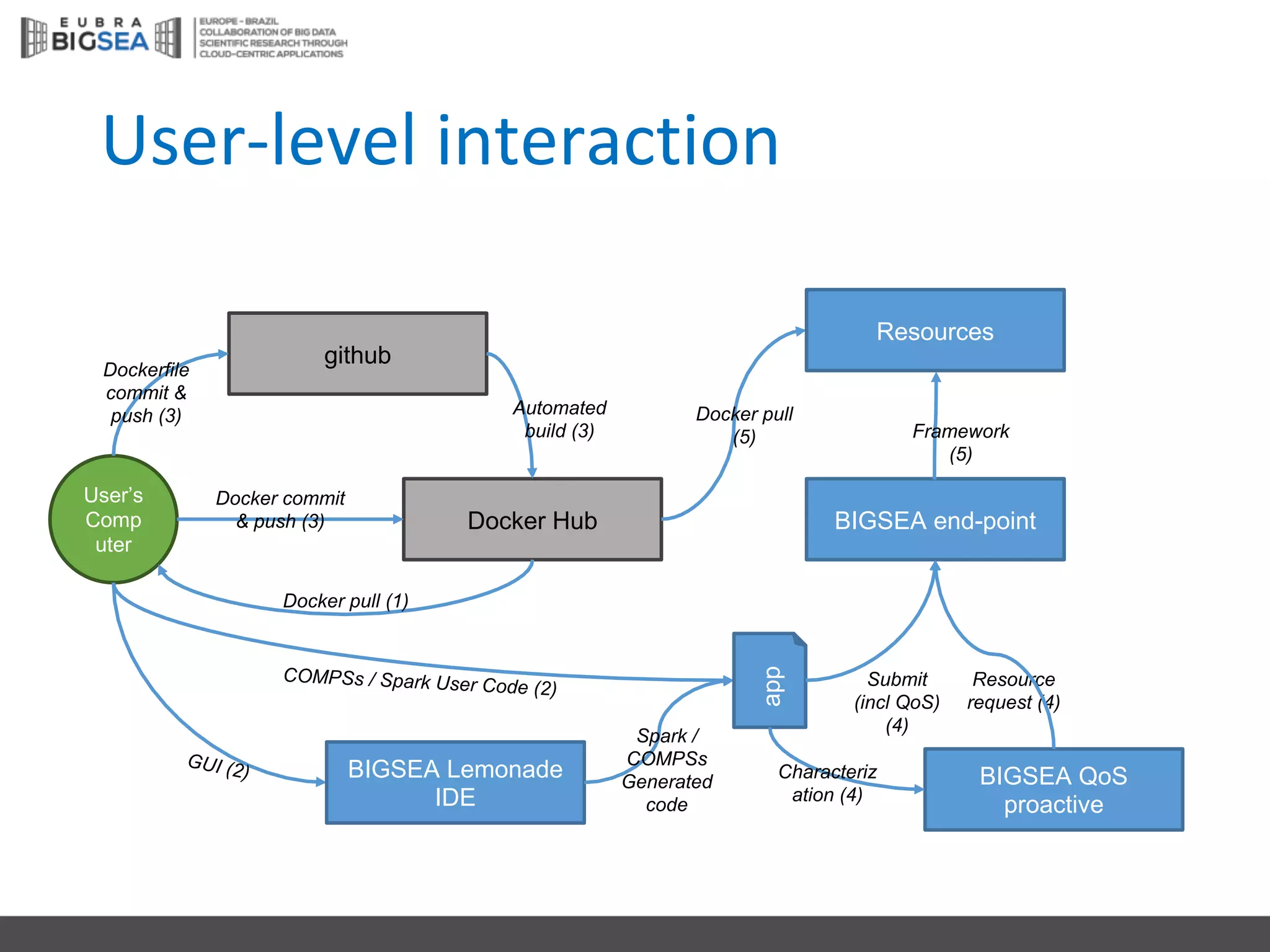
    User-level interaction User’s Comp uter github Docker HubBIGSEA end-point BIGSEA Lemonade IDE Resources app Spark / COMPSs Generated code Docker commit & push (3) Dockerfile commit & push (3) Automated build (3) Docker pull (5) Framework (5) Submit (incl QoS) (4) BIGSEA QoS proactive Resource request (4) Docker pull (1) Characteriz ation (4)
  • 17.
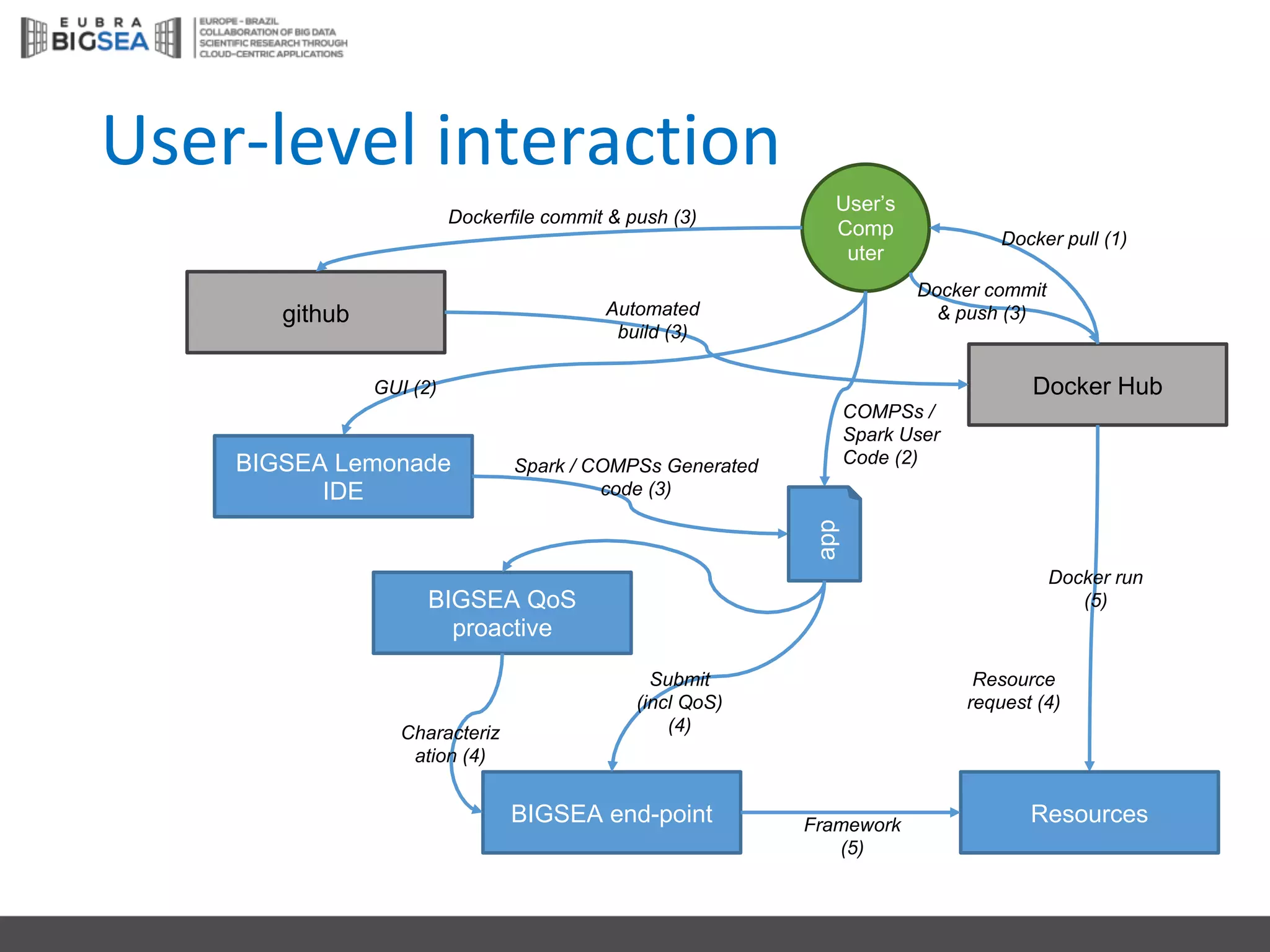
    User-level interaction User’s Comp uter github Docker Hub BIGSEAend-point BIGSEA Lemonade IDE Resourcesapp COMPSs / Spark User Code (2) GUI (2) Spark / COMPSs Generated code (3) Docker commit & push (3) Dockerfile commit & push (3) Automated build (3) Docker run (5) Framework (5) Submit (incl QoS) (4) BIGSEA QoS proactive Resource request (4) Docker pull (1) Characteriz ation (4)
  • 18.
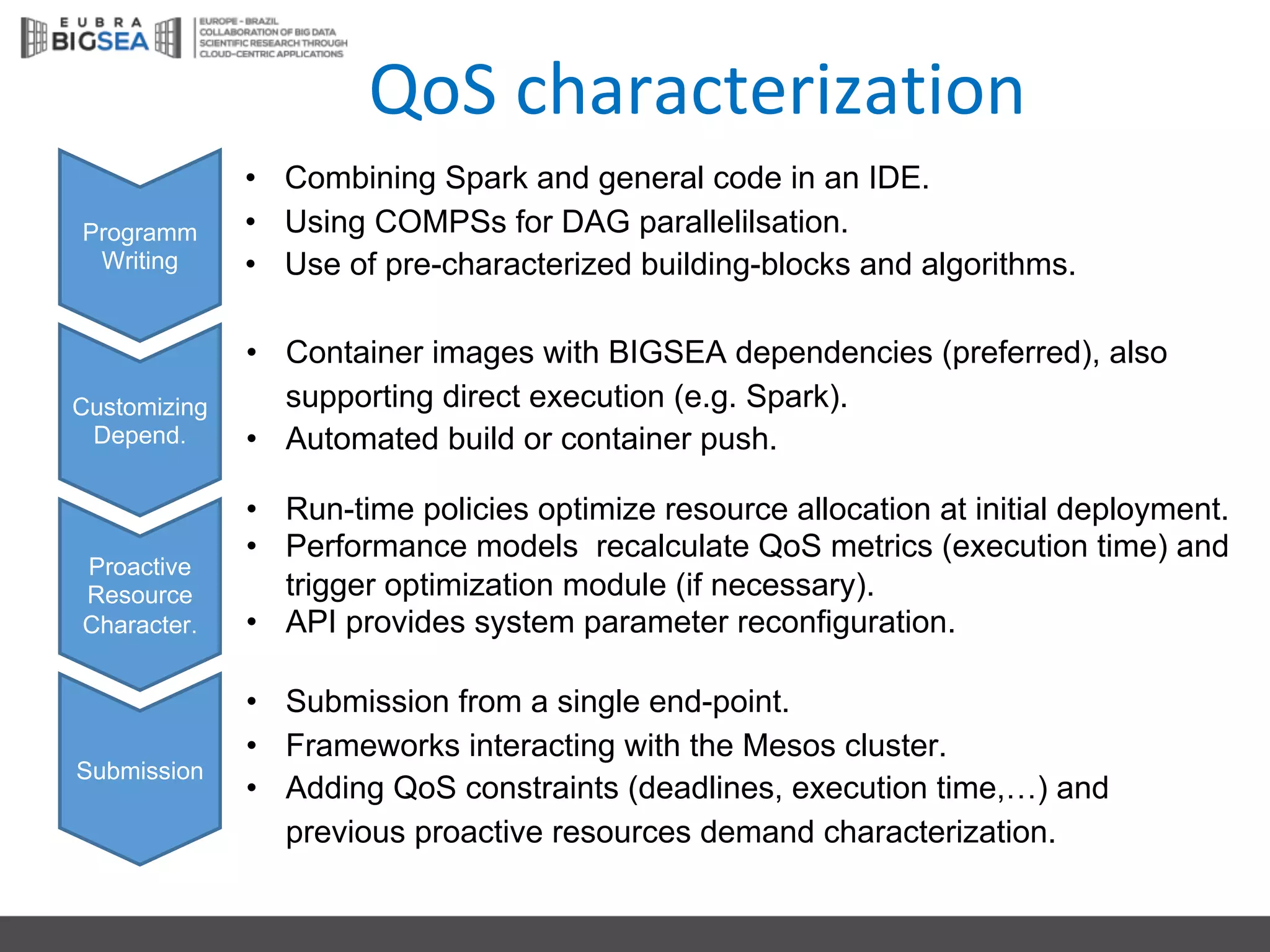
    Programm Writing QoS characterization Customizing Depend. Proactive Resource Character. Submission • CombiningSpark and general code in an IDE. • Using COMPSs for DAG parallelilsation. • Use of pre-characterized building-blocks and algorithms. • Container images with BIGSEA dependencies (preferred), also supporting direct execution (e.g. Spark). • Automated build or container push. • Run-time policies optimize resource allocation at initial deployment. • Performance models recalculate QoS metrics (execution time) and trigger optimization module (if necessary). • API provides system parameter reconfiguration. • Submission from a single end-point. • Frameworks interacting with the Mesos cluster. • Adding QoS constraints (deadlines, execution time,…) and previous proactive resources demand characterization.
  • 19.
    Single Submission end-point • JSON documentwith the information on the execution container, framework resources and QoS. /v1/scheduler POST method, submits a job request in JSON. /v1/scheduler/jobs GET method, lists all the jobs in the scheduler (a JSON with all the job). It can accept a JSON with a deadline that defines the date limit. /v1/scheduler/job/jobid GET method, gets all the information from a specific job; DELETE method, kills the specific job; POST method, reallocates resources. /v1/scheduler/job/jobid/scale PUT method, changes the resource allocation of a framework. { "type": "CMD", "name": "my_job_name", "deadline": "2016-06-10T17:22:00Z+2", "periodic": "R24P60M", "expectedduration": "10M" "container" : [ "type": "DOCKER", "image": "eubrabigsea/ubuntu", "forcePullImage": true "volumes": [ { "containerPath": "/var/log/", "hostPath": "/logs/", "mode": "RW"}], "portMappings": [ { "containerPort": 8080, "hostPort": 0, "protocol": "tcp" }]], "environmentVariables": [ { "name": "value" } ], "cpu" : "1.5", "mem" : "512M", "disk" : "1G", "command" : "python -m SimpleHTTPServer 8000" }
  • 20.
    QoS Proactive Policies •Policies are based on historical data (look up table) and current system status (QoS monitoring) • Analytical performance models provide new estimation of quality metrics to the optimization module (at initial deployment and execution times) • Optimization module recalculates resource allocation, if necessary (new application arrival, changes on the system configuration).
  • 21.
  • 22.
    Vertical Elasticity at the level of the framework •Directly managed bythe submission service •It hides the different framework features, interacting with the scheduler and/or Mesos. •As example • In Chronos it gets the current configuration of the job and resubmits the job with the new resource allocation and the same configuration. • In Marathon it updates the json and uses the specific API call $ curl -i -L -H 'Content-Type: application/json' -X PUT - d@”temporary.json" marathonserver:port/v2/apps/appname?force=true • In Spark and COMPSs directly interacting with the Mesos Framework.
  • 23.
    Elasticity scenario • Twomultithreaded processing benchmarks running concurrently in the same node • Change the allocation from 50%-50% of CPU to 25%- 75% as the deadline was approaching.
  • 24.
    Conclusions •EUBra-BIGSEA aims at providing a set of cloud servicesto • Facilitate the deployment of complex multi-framework Big Data infrastructures. • Provide elasticity at the level of the physical resources and frameworks. • Include QoS Constraints. • Facilitate the use of customized environments. •Those cloud services are directly used by higher- level programming models hiding the platform particularities.