Operating Mesos-powered Infrastructures
Pierre Cheynier
@pierrecdn
Operations Engineer, SRE Division
October 27, 2017
Operating 600+ servers on 7 DCs @ Criteo : sharing some insights
Company
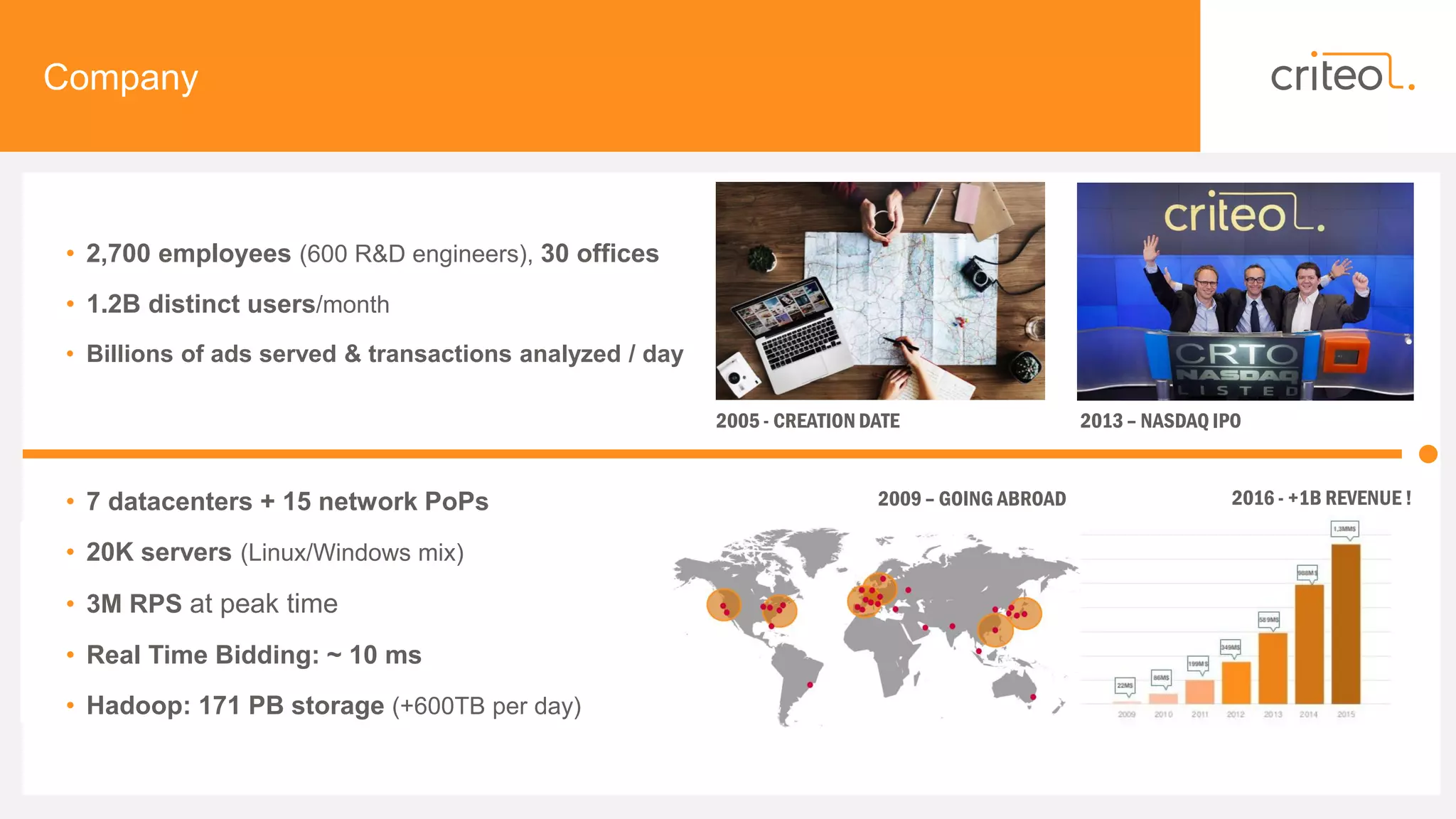
2009 – GOING ABROAD
2005 - CREATION DATE 2013 – NASDAQ IPO
2016 - +1B REVENUE !
• 2,700 employees (600 R&D engineers), 30 offices
• 1.2B distinct users/month
• Billions of ads served & transactions analyzed / day
• 7 datacenters + 15 network PoPs
• 20K servers (Linux/Windows mix)
• 3M RPS at peak time
• Real Time Bidding: ~ 10 ms
• Hadoop: 171 PB storage (+600TB per day)
Transitioning…
• Hardware : reducing the Total Cost of Ownership
• Filling racks on premises  fully populated cabinets, repeatable process
• Fully secured (RAID, 2 x power, ...) COTS  commodity hardware
• O/S : maintainability
• Windows  Linux
• Runtime : diversity
• .NET Framework  CoreCLR (.NET Core Runtime) & JVM
• Platform deployment : flexibility, self-service
• IT automation  Tasks/Job Orchestration
Transitioning…
• Stable & Maintainable system => Simple & Modular
Why Mesos ?
• Small and Extensible project
• A highly-available distributed system kernel, abstracting and isolating
resources in less than 250k LoC
• Concrete primitives and interfaces, extensibility through Modules
• Implementing industry standards (such as CNI, CSI & OCI soon)
• Self-sufficient
• Mesos Containerizer
• UCR
• Where are we ?
• Started a small PoC during 2015 S2
• 1.5 year later: 600 agents, 150+ production apps, 250K QPS
• 2 generalist frameworks, ML-oriented & GPU-based workloads coming.
The long journey of setting up production-grade infrastructures
• 1 - Automate everything
• 2 - Configure defensively
• 3 - Discovering services and more
• 4 - Provide visibility to the end-users
• 5 - Networking is hard
1 - Automate everything
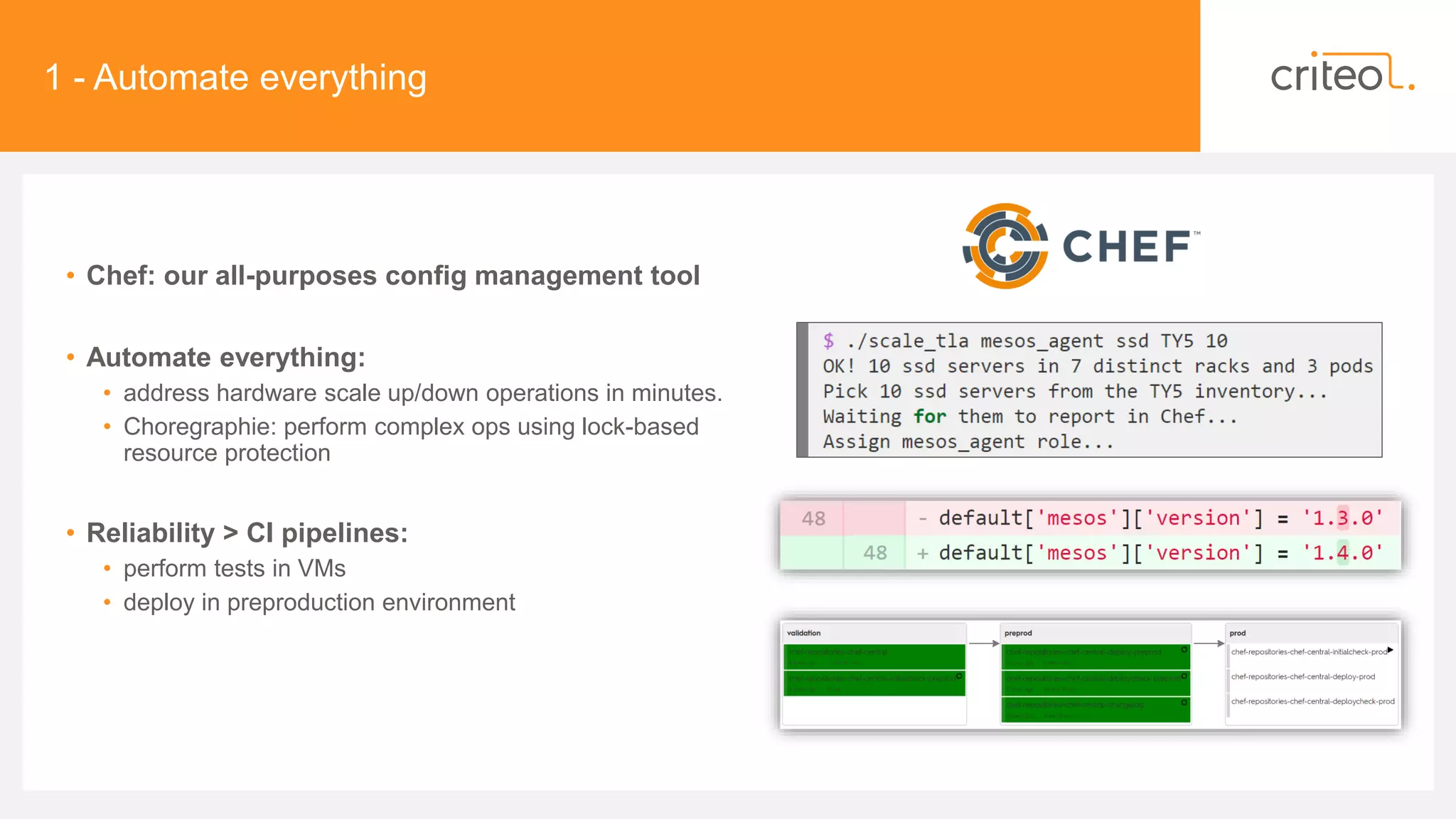
• Chef: our all-purposes config management tool
• Automate everything:
• address hardware scale up/down operations in minutes.
• Choregraphie: perform complex ops using lock-based
resource protection
• Reliability > CI pipelines:
• perform tests in VMs
• deploy in preproduction environment
2 - Configure defensively
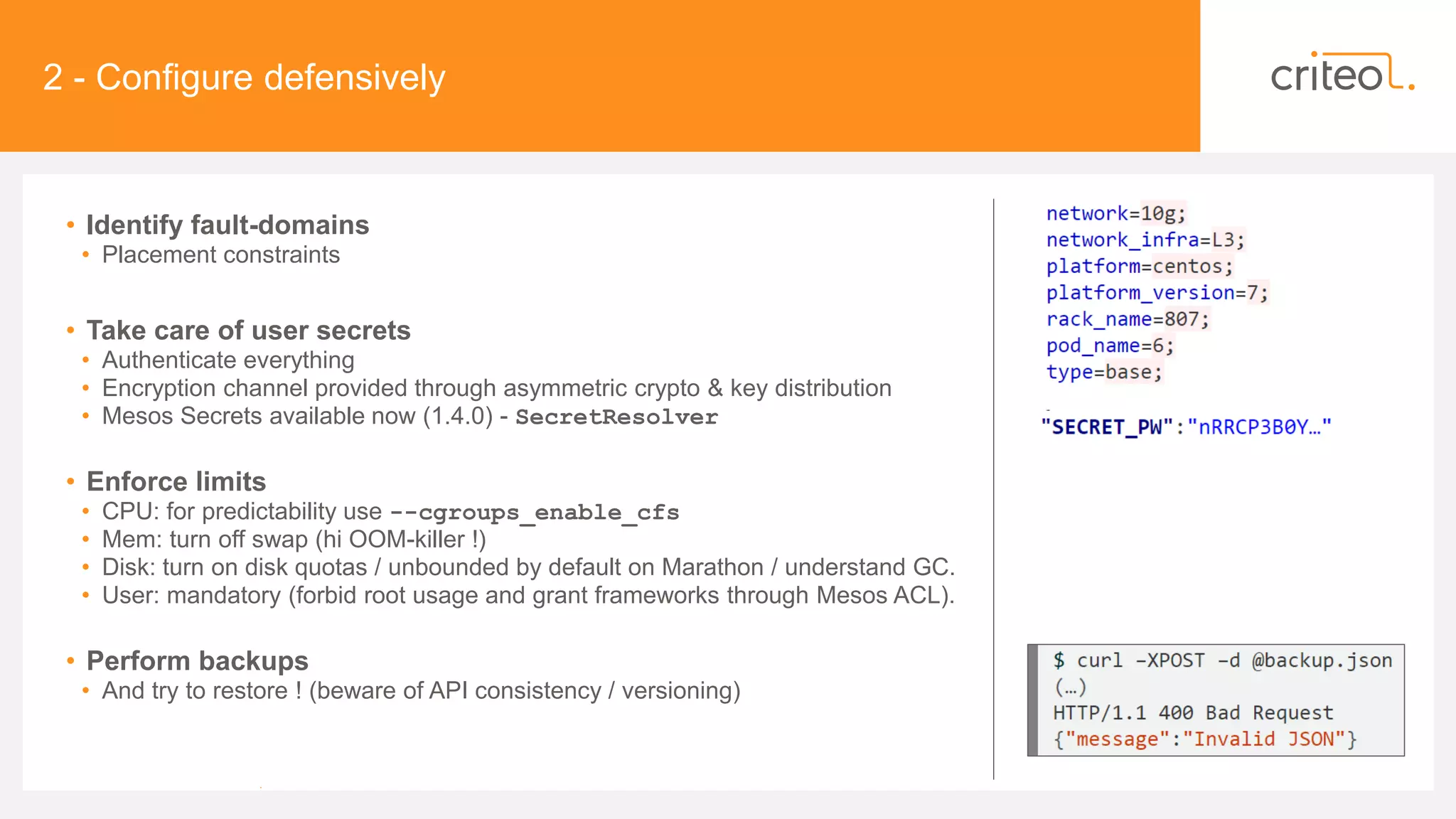
• Identify fault-domains
• Placement constraints
• Take care of user secrets
• Authenticate everything
• Encryption channel provided through asymmetric crypto & key distribution
• Mesos Secrets available now (1.4.0) - SecretResolver
• Enforce limits
• CPU: for predictability use --cgroups_enable_cfs
• Mem: turn off swap (hi OOM-killer !)
• Disk: turn on disk quotas / unbounded by default on Marathon / understand GC.
• User: mandatory (forbid root usage and grant frameworks through Mesos ACL).
• Perform backups
• And try to restore ! (beware of API consistency / versioning)
•
3 - Discovering services and more
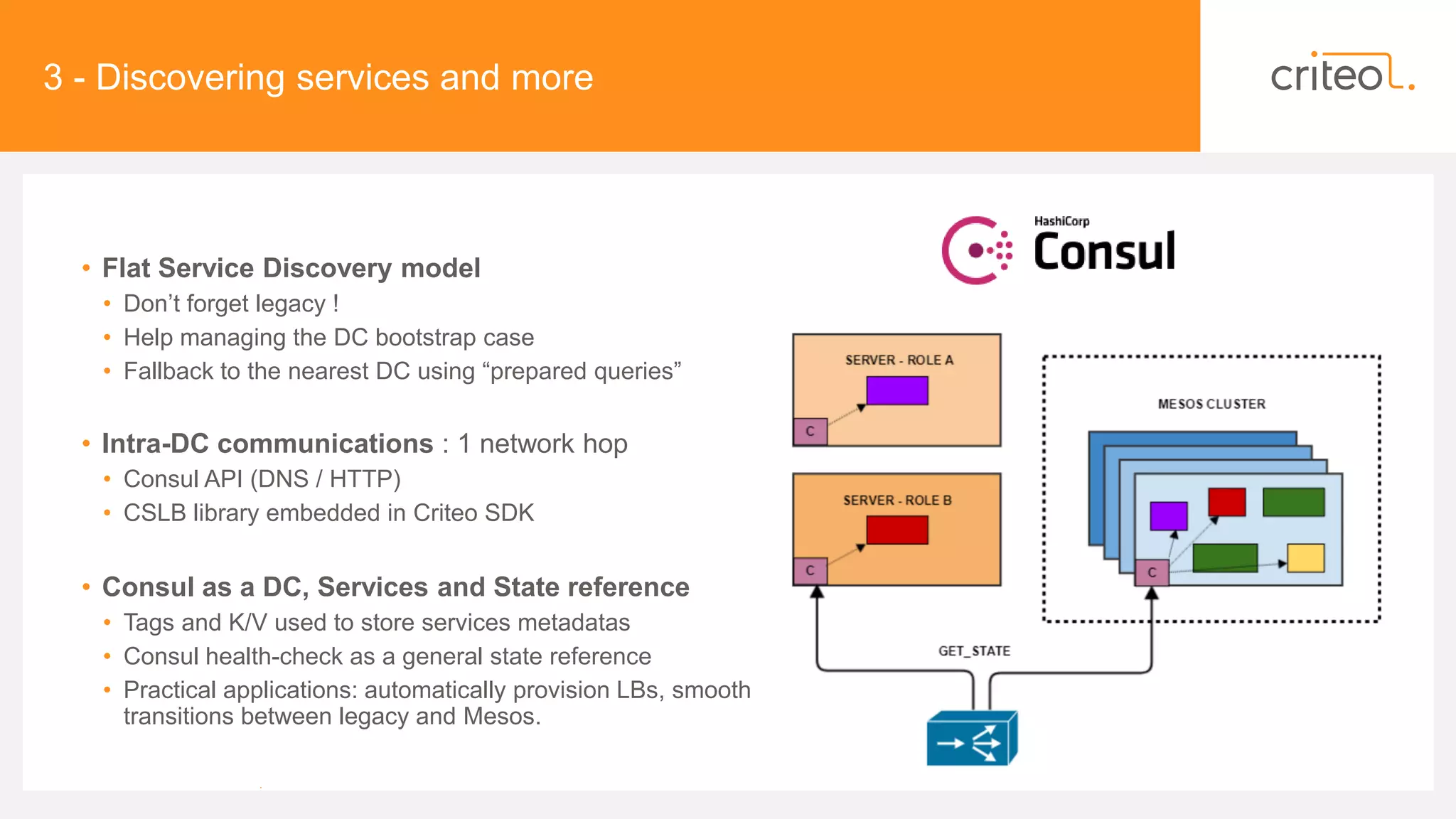
• Flat Service Discovery model
• Don’t forget legacy !
• Help managing the DC bootstrap case
• Fallback to the nearest DC using “prepared queries”
• Intra-DC communications : 1 network hop
• Consul API (DNS / HTTP)
• CSLB library embedded in Criteo SDK
• Consul as a DC, Services and State reference
• Tags and K/V used to store services metadatas
• Consul health-check as a general state reference
• Practical applications: automatically provision LBs, smooth
transitions between legacy and Mesos.
•
4 - Provide visibility to the end-users
• Cultural changes
• App instances move continuously !
• Metrology & Alerting
• Collectd, prometheus_exporter, etc.
• Not well-known metrics, from mesos.proto :
• Networking: net_[rx|tx|tcp]*,
[TrafficControl|Ip|Tcp|Udp]Statistics,
• Disk I/O: CgroupInfo.Blkio.CFQ.Statistics
• Tracing: PerfStatistics (costly!)
• SLAs
• Transparency about platform footprint
• Report your ability to schedule – chaos monkey involved !
• Debugging / Tracing
• The Mesos I/O Switchboard: remotely attach/exec
• Introducing system tracing components such as LTTng
5 - Networking is hard
• “The network is reliable”
• The 8 fallacies of distributed computing (L. Peter Deutsch - 1994)
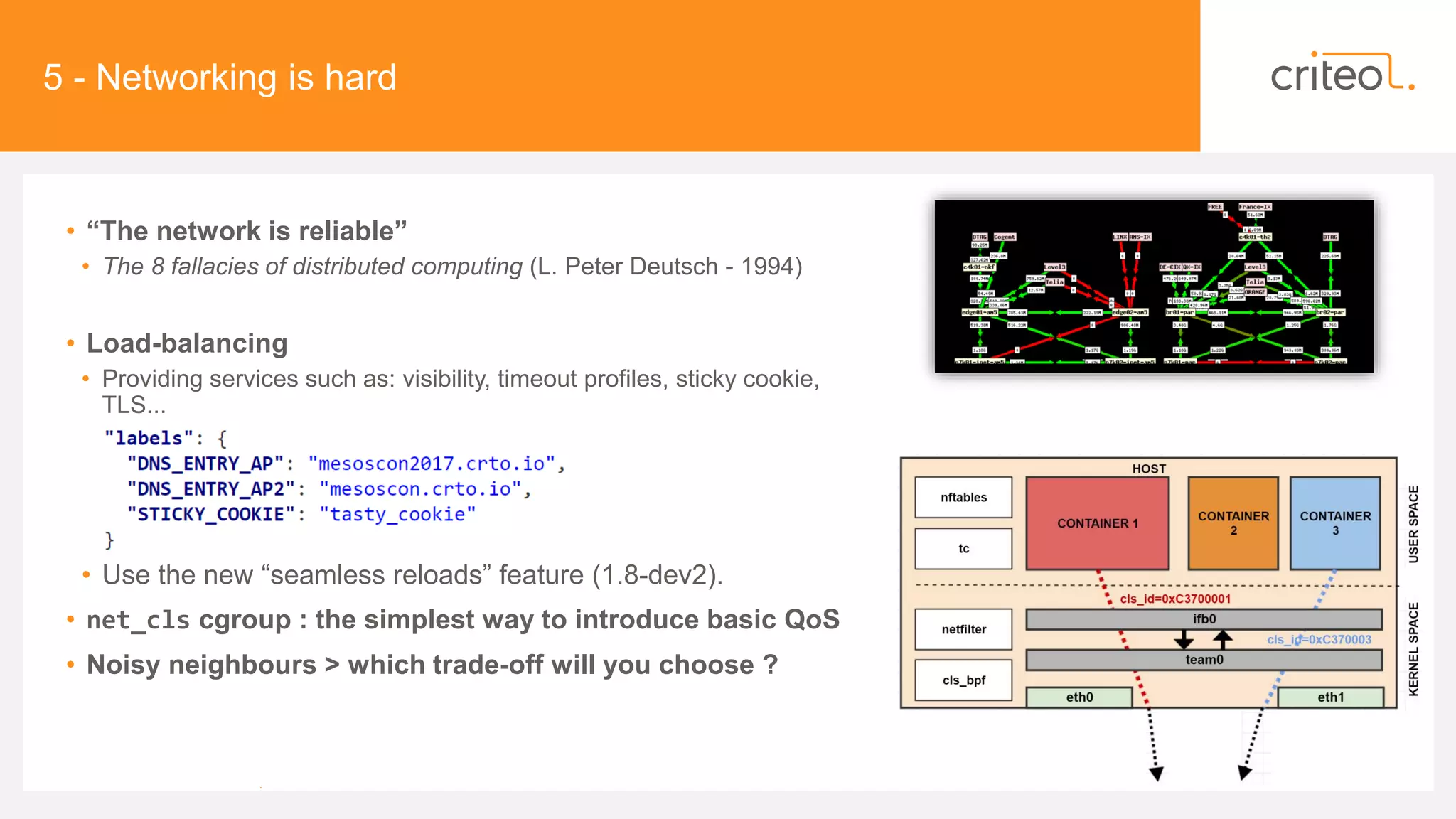
• Load-balancing
• Providing services such as: visibility, timeout profiles, sticky cookie,
TLS...
• Use the new “seamless reloads” feature (1.8-dev2).
• net_cls cgroup : the simplest way to introduce basic QoS
• Noisy neighbours > which trade-off will you choose ?
•
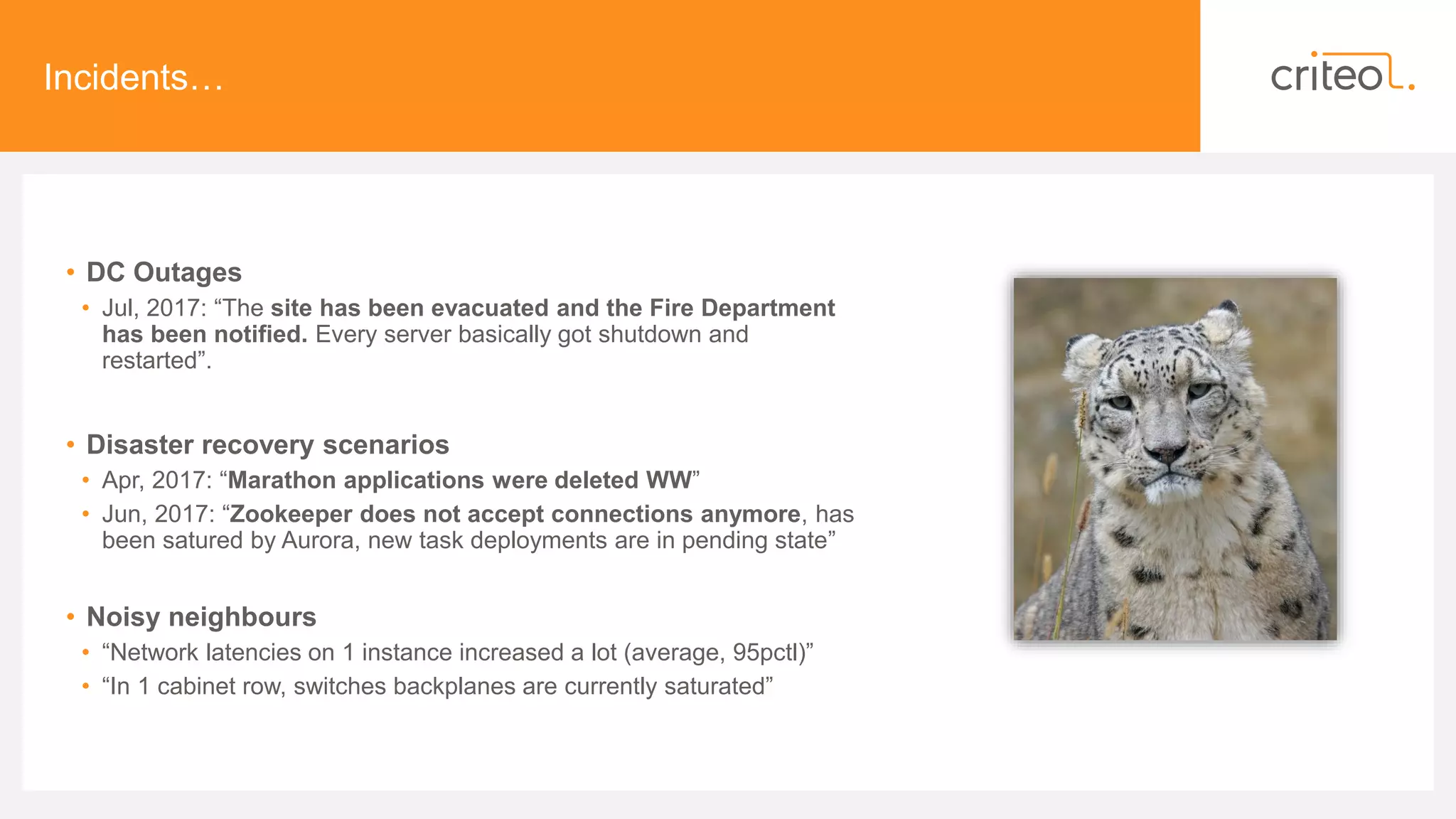
Incidents…
• DC Outages
• Jul, 2017: “The site has been evacuated and the Fire Department
has been notified. Every server basically got shutdown and
restarted”.
• Disaster recovery scenarios
• Apr, 2017: “Marathon applications were deleted WW”
• Jun, 2017: “Zookeeper does not accept connections anymore, has
been satured by Aurora, new task deployments are in pending state”
• Noisy neighbours
• “Network latencies on 1 instance increased a lot (average, 95pctl)”
• “In 1 cabinet row, switches backplanes are currently saturated”
What’s left to answer ?
• Isolation, isolation, isolation
• Network and I/O bandwidth as a first-class resource ?
• Latency critical apps: combine with cpu_set ?
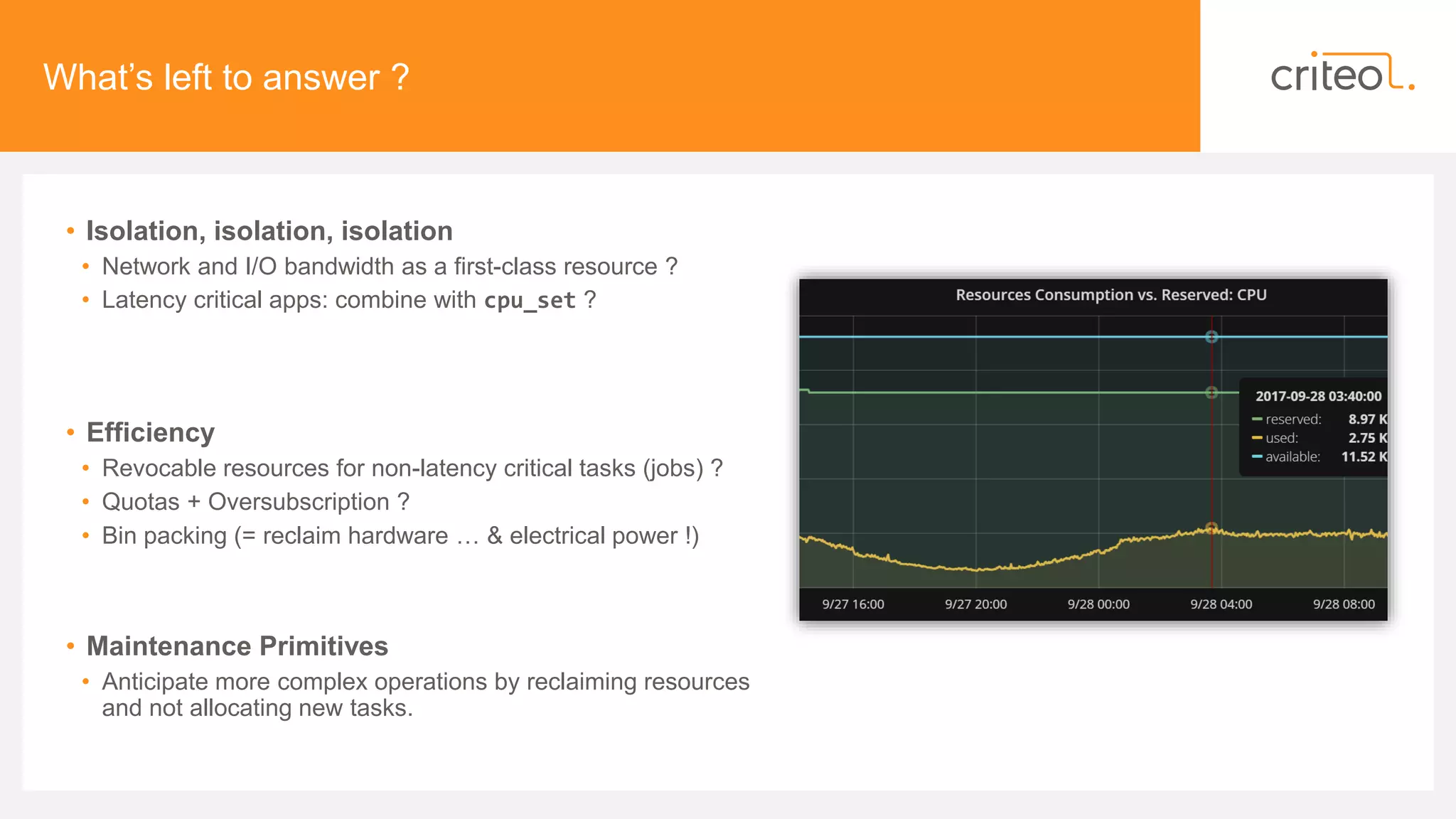
• Efficiency
• Revocable resources for non-latency critical tasks (jobs) ?
• Quotas + Oversubscription ?
• Bin packing (= reclaim hardware … & electrical power !)
• Maintenance Primitives
• Anticipate more complex operations by reclaiming resources
and not allocating new tasks.
Happy users !
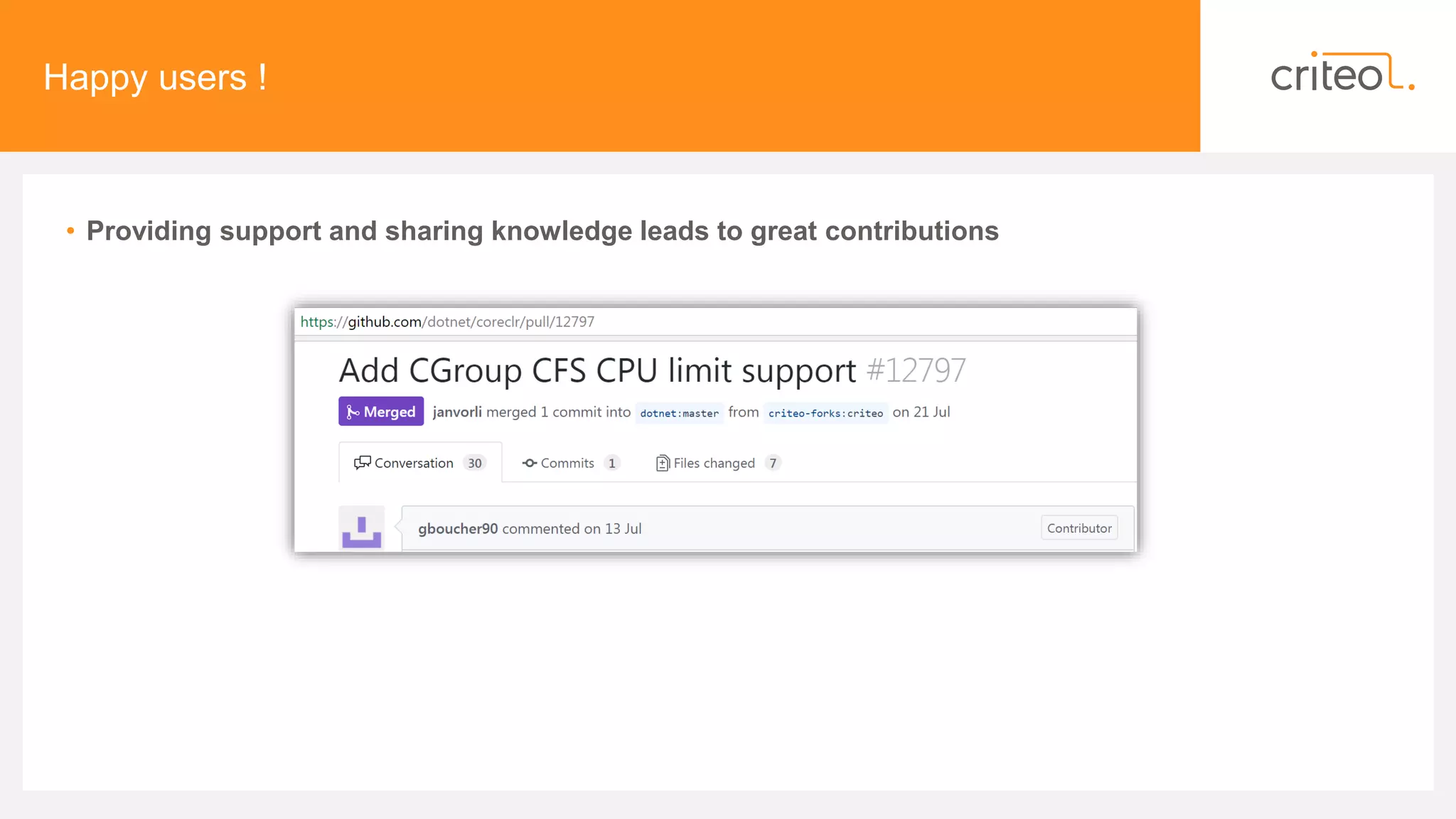
• Providing support and sharing knowledge leads to great contributions
Do you want to know more ?
We’re hiring !
Thank you.

MesosCon EU 2017 - Criteo - Operating Mesos-based Infrastructures

  • 1.
    Operating Mesos-powered Infrastructures PierreCheynier @pierrecdn Operations Engineer, SRE Division October 27, 2017 Operating 600+ servers on 7 DCs @ Criteo : sharing some insights
  • 2.
    Company 2009 – GOINGABROAD 2005 - CREATION DATE 2013 – NASDAQ IPO 2016 - +1B REVENUE ! • 2,700 employees (600 R&D engineers), 30 offices • 1.2B distinct users/month • Billions of ads served & transactions analyzed / day • 7 datacenters + 15 network PoPs • 20K servers (Linux/Windows mix) • 3M RPS at peak time • Real Time Bidding: ~ 10 ms • Hadoop: 171 PB storage (+600TB per day)
  • 3.
    Transitioning… • Hardware :reducing the Total Cost of Ownership • Filling racks on premises  fully populated cabinets, repeatable process • Fully secured (RAID, 2 x power, ...) COTS  commodity hardware • O/S : maintainability • Windows  Linux • Runtime : diversity • .NET Framework  CoreCLR (.NET Core Runtime) & JVM • Platform deployment : flexibility, self-service • IT automation  Tasks/Job Orchestration
  • 4.
    Transitioning… • Stable &Maintainable system => Simple & Modular
  • 5.
    Why Mesos ? •Small and Extensible project • A highly-available distributed system kernel, abstracting and isolating resources in less than 250k LoC • Concrete primitives and interfaces, extensibility through Modules • Implementing industry standards (such as CNI, CSI & OCI soon) • Self-sufficient • Mesos Containerizer • UCR • Where are we ? • Started a small PoC during 2015 S2 • 1.5 year later: 600 agents, 150+ production apps, 250K QPS • 2 generalist frameworks, ML-oriented & GPU-based workloads coming.
  • 6.
    The long journeyof setting up production-grade infrastructures • 1 - Automate everything • 2 - Configure defensively • 3 - Discovering services and more • 4 - Provide visibility to the end-users • 5 - Networking is hard
  • 7.
    1 - Automateeverything • Chef: our all-purposes config management tool • Automate everything: • address hardware scale up/down operations in minutes. • Choregraphie: perform complex ops using lock-based resource protection • Reliability > CI pipelines: • perform tests in VMs • deploy in preproduction environment
  • 8.
    2 - Configuredefensively • Identify fault-domains • Placement constraints • Take care of user secrets • Authenticate everything • Encryption channel provided through asymmetric crypto & key distribution • Mesos Secrets available now (1.4.0) - SecretResolver • Enforce limits • CPU: for predictability use --cgroups_enable_cfs • Mem: turn off swap (hi OOM-killer !) • Disk: turn on disk quotas / unbounded by default on Marathon / understand GC. • User: mandatory (forbid root usage and grant frameworks through Mesos ACL). • Perform backups • And try to restore ! (beware of API consistency / versioning) •
  • 9.
    3 - Discoveringservices and more • Flat Service Discovery model • Don’t forget legacy ! • Help managing the DC bootstrap case • Fallback to the nearest DC using “prepared queries” • Intra-DC communications : 1 network hop • Consul API (DNS / HTTP) • CSLB library embedded in Criteo SDK • Consul as a DC, Services and State reference • Tags and K/V used to store services metadatas • Consul health-check as a general state reference • Practical applications: automatically provision LBs, smooth transitions between legacy and Mesos. •
  • 10.
    4 - Providevisibility to the end-users • Cultural changes • App instances move continuously ! • Metrology & Alerting • Collectd, prometheus_exporter, etc. • Not well-known metrics, from mesos.proto : • Networking: net_[rx|tx|tcp]*, [TrafficControl|Ip|Tcp|Udp]Statistics, • Disk I/O: CgroupInfo.Blkio.CFQ.Statistics • Tracing: PerfStatistics (costly!) • SLAs • Transparency about platform footprint • Report your ability to schedule – chaos monkey involved ! • Debugging / Tracing • The Mesos I/O Switchboard: remotely attach/exec • Introducing system tracing components such as LTTng
  • 11.
    5 - Networkingis hard • “The network is reliable” • The 8 fallacies of distributed computing (L. Peter Deutsch - 1994) • Load-balancing • Providing services such as: visibility, timeout profiles, sticky cookie, TLS... • Use the new “seamless reloads” feature (1.8-dev2). • net_cls cgroup : the simplest way to introduce basic QoS • Noisy neighbours > which trade-off will you choose ? •
  • 12.
    Incidents… • DC Outages •Jul, 2017: “The site has been evacuated and the Fire Department has been notified. Every server basically got shutdown and restarted”. • Disaster recovery scenarios • Apr, 2017: “Marathon applications were deleted WW” • Jun, 2017: “Zookeeper does not accept connections anymore, has been satured by Aurora, new task deployments are in pending state” • Noisy neighbours • “Network latencies on 1 instance increased a lot (average, 95pctl)” • “In 1 cabinet row, switches backplanes are currently saturated”
  • 13.
    What’s left toanswer ? • Isolation, isolation, isolation • Network and I/O bandwidth as a first-class resource ? • Latency critical apps: combine with cpu_set ? • Efficiency • Revocable resources for non-latency critical tasks (jobs) ? • Quotas + Oversubscription ? • Bin packing (= reclaim hardware … & electrical power !) • Maintenance Primitives • Anticipate more complex operations by reclaiming resources and not allocating new tasks.
  • 14.
    Happy users ! •Providing support and sharing knowledge leads to great contributions
  • 15.
    Do you wantto know more ? We’re hiring ! Thank you.