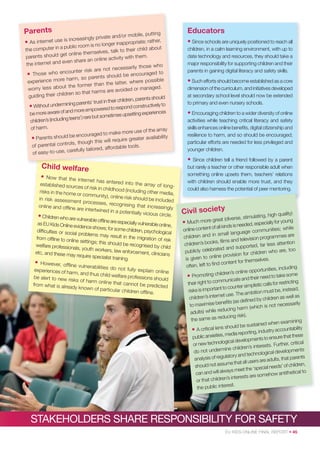
So

ni
a
EU d K Liv
Ki jar ing
ds ta
s
O n Ó ton
nl
e
in laf , L
s
e
e
N son sli
et
e
w , w Ha
or it
h dd
k
m on
em ,
be Ank
rs
e
of Gö
th rz
ig
e

an
EU Kids Online aims to enhance knowledge of the
experiences and practices of European children and parents
regarding risky and safer use of the internet and new online
technologies, in order to inform the promotion of a safer
online environment for children.

CONTENTS
Knowledge enhancement 1

Newer risks 28

Executive summary 2

Comparing risk and harm 30

Project director’s introduction 4

How children cope with harm 32

The European Commission’s safer internet programme 6

What parents do when children go online 34

EU Kids Online news 8

Who supports children– parents, teachers and peers 36

Europe and beyond 10

Inequalities in risk and resources to cope 38

How children go online 12

Similarities and differences in online experiences 40

What children do online 14

Top 10 myths about children’s online risks 42

Risky opportunities 16

Recommendations 44

Social networking 18

The survey 46

What upsets children online 20

Partners in Russia and Australia 48

Sexual content 22

The network 50

Online bullying 24

Network members 52

Meeting new contacts online 26
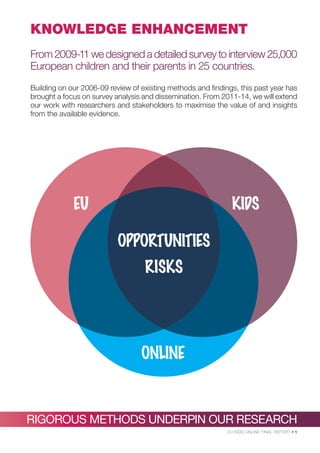
KNOWLEDGE ENHANCEMENT
From 2009-11 we designed a detailed survey to interview 25,000
European children and their parents in 25 countries.
Building on our 2006-09 review of existing methods and findings, this past year has
brought a focus on survey analysis and dissemination. From 2011-14, we will extend
our work with researchers and stakeholders to maximise the value of and insights
from the available evidence.

EU

KIDS
OPPORTUNITIES
RISKS

ONLINE

RIGOROUS METHODS UNDERPIN OUR RESEARCH
EU KIDS ONLINE FINAL REPORT • 1
EXECUTIVE SUMMARY
survey
Kids Online
The EU
a unique,
s conducted

ha
ar
nline network
with 9-16 ye
rvey in homes
ildren
-to-face su
ch
detailed, face
tries; 25,142
om 25 coun
g 2010.
rnet users fr
old inte
rviewed durin
nts were inte
nd their pare
a
ce base
orous eviden
to provide a rig
ise
as
• The purpose w lders in their efforts to maxim
akeho
risk of harm
to support st
inimising the
ities while m
rtun
online oppo
se.
ith internet u
associated w

• The EU Kids O

Going onlin
e is thorou
ghly
embedded
in children’s
lives
• Internet use is

increasingly
individualised
and mobile:
, privatised
9-16 year o
ld internet u
minutes per
sers spend
day online,
88
on average.
• 49 per cent g
o online in th
eir bedroom
go online vi
, 33 per cen
a a mobile
t
phone or h
and most use
andheld de
the internet
vice,
at home (87
school (63 p
per cent) an
er cent).
d

Opportunities and risks online
go hand in hand
• Efforts to increase opportunities may also increase
risks, while efforts to reduce risks may restrict children’s
opportunities. A careful balancing act, which recognises
children’s online experiences “in the round”, is vital.

•

Risky opportunities allow children to experiment
o
online with relationships, intimacy and identity. This
is vital for growing up if children are to learn to cope
w
with the adult world.

• But risky opportunities are linked to vulnerability as well
as resilience, depending on both the design of the online
a
environment, and on the child and their circumstances.
e
• Social networking sites (SNSs) enable children to
c
communicate and have fun with their friends, but not
e
everyone has the digital skills to manage privacy and
p
personal disclosure and many 9-12 year olds use
S
SNSs underage, including 20 per cent on Facebook
a
and 38 per cent using SNSs overall.

e benefits
ll gain all th
Not a
earliest and
they take up

ities
in which activ
y practise,
activities the
bination of
quarter,
the com
which only a
they vary in
portunities in
ladder of op
vanced and
resulting in a
h the most ad
children, reac
nger
and few you
.
creative step
’ that ‘there
y it is ‘very true
6 year olds sa
9-1
for children
at are good
• 44 per cent of
e internet th
with
ings on th
less satisfied
are lots of th
children are
gh younger
say this.
s
ou
9-10 year old
of my age’, th
4 per cent of
vision: only 3
e
online pro
s of SES, ag
persist in term
rcome
digital skills
efforts to ove
• Inequalities in
e, gender, so
proved
lesser degre
lies in the im
and, to a
f the solution
ded; part o
these are nee
rfaces.
tools and inte
of end-user
design

• Children vary

2 • EU KIDS ONLINE FINAL REPORT

Parental m
ediation c
an help
• Pa

rents recog
nise that it is
valuable for
with their c
them to en
hild’s intern
gage
et use, and
range of str
they emplo
ategies, de
y a wide
pending pa
child. But s
rtly on the
ome paren
age of the
ts do not d
young child
o very muc
ren, and th
h, even for
ere are so
not want th
me childre
eir parents
n who do
to take mo
re interest.
• Children are
generally p
ositive abo
actions, alt
ut their pa
hough a th
rents’
ird says th
what their
ey sometim
parents s
es ignore
ay about
Parents w
using the
ho practis
internet.
e more re
have child
strictive re
ren who e
gulation
ncounter
harm – bu
fewer risk
t also few
s and less
er online o
pportunitie
s.
Children en
counter a r
ange of on
• 12 per cent o
line risks
f European 9
-16 year o
been

bothered or up
lds say that
they have
set by somet
• 50 per cent o
hing on the in
children do n
ternet – but m
ot report bein
f 11-16 year
ost the inte
olds “find it ea
g bothered o
rnet”, helpin
r upset by go
sier to be mys
• Exposure to se
g to explain
ing online. o
elf on
why 30 per ce
xual images
nline with so
occurs offline
nt have conta
meone they
for some ch
as well as onl
ct
haven’t met
ildren and in
ine, but 9 per cent have m
face-to-face.
some countr
more childre
et an online
But only
ies it is spread
n who go on
contact offlin
ing online; found this a pro
line via a per
e, and very
blematic exp
sexual images
sonal device
few
erience.
or received se
have seen • P
xual messag
ublic anxiety
es.
often focuses
• Half of online
on pornograp
and meeting
bullies say th
hy, “sexting”,
strangers, es
ey have also
to-face, and
bullying
pecially for yo
bullied peop
half of online
ung children
le face- are other risks that w
bullying victim
. But there
orry children
face-to-face;
s have been
, including m
also, among
bullied especially those associ
any teenager
those who ha
nearly half hav
ated with use
s,
ve bullied oth
e themselves
r-generated
ers online,
content.
been bullied
online.

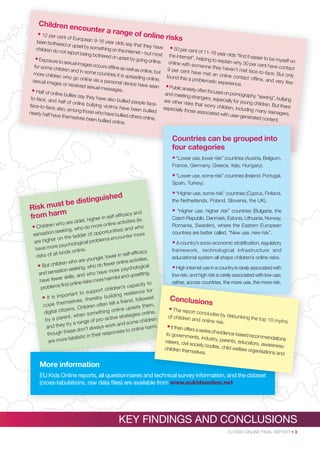
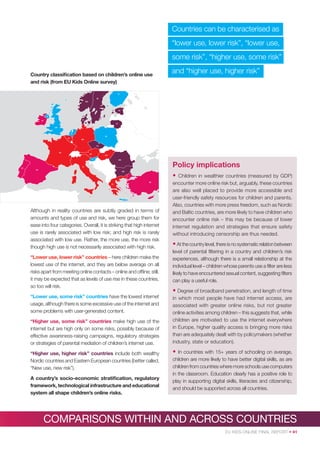
Countries can be grouped into
four categories
• “Lower use, lower risk” countries (Austria, Belgium,
France, Germany, Greece, Italy, Hungary).

• “Lower use, some risk” countries (Ireland, Portugal,
Sp
Spain, Turkey).

ed
tinguish
st be dis
Risk mu
m
cy and
self-effica
from har
higher in
(ie,
r,

ities
olde
line activ
who are
• Children king, who do more on ies) and who
unit
see
of opport
sensation
r more
e ladder
th
encounte
higher on
problems
are
ological
re psych
have mo
nline.
fficacy
ll kinds o
er in self-e
risks of a
nger, low
ou
ities,
who are y
nline activ
t children
o fewer o
d
• Bu
ological
king, who
ore psych
ation see
o have m
and sens
wh
setting.
skills, and
ful and up
ore harm
ve fewer
ha
risks m
o
acity to
find online
ren’s cap
problems
o
for
port child
up
ce
rtant to s
g resilien
• It is impo lves, thereby buildin nd, followed
a frie
mse
often tell
cope the
them,
Children
e upsets
ens.
igital citiz
thing onlin
n
d
line,
me
tegies on
when so
ctive stra
a parent,
by
d
of pro-a
hildren
c
e
nd some
try a rang
.
ys work a
and they
nline harm
on’t alwa
se d
s to o
ough the
response
th
in their
fatalistic
are more

• “Higher use, some risk” countries (Cyprus, Finland,
th
the Netherlands, Poland, Slovenia, the UK).

• “Higher use, higher risk” countries (Bulgaria, the
Cz
Czech Republic, Denmark, Estonia, Lithuania, Norway,
Ro
Romania, Sweden), where the Eastern European
co
countries are better called, “New use, new risk”.

• A country’s socio-economic stratification, regulatory
fra
framework, technological infrastructure and
ed
educational system all shape children’s online risks.

• High internet use in a country is rarely associated with
low risk; and high risk is rarely associated with low use;
ra
rather, across countries, the more use, the more risk.
ather,

Conclusion
s
• The report co
ncludes by
debunking th
of children a
e top 10 myt
nd online ris
hs
k.
• It then offers a
series of evid
ence-based
to governmen
recommend
ts, industry,
ations
parents, edu
raisers, civil so
cators, awar
ciety bodies,
enesschild welfare
children them
organisation
selves.
s and

More information
EU Kids Online reports, all questionnaires and technical survey information, and the dataset
nd
dataset
t
bl from www.eukidsonline.net
kid
li
t
(cross-tabulations, raw data files) are available f

KEY FINDINGS AND CONCLUSIONS
EU KIDS ONLINE FINAL REPORT • 3
PROJECT DIRECTOR’S
INTRODUCTION
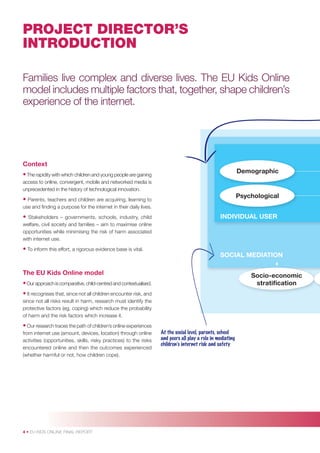
Families live complex and diverse lives. The EU Kids Online
model includes multiple factors that, together, shape children’s
experience of the internet.

Context
Demographic

• The rapidity with which children and young people are gaining
access to online, convergent, mobile and networked media is
unprecedented in the history of technological innovation.

Psychological

• Parents, teachers and children are acquiring, learning to
use and finding a purpose for the internet in their daily lives.

•

Stakeholders – governments, schools, industry, child
welfare, civil society and families – aim to maximise online
opportunities while minimising the risk of harm associated
with internet use.

INDIVIDUAL USER

• To inform this effort, a rigorous evidence base is vital.
SOCIAL MEDIATION
The EU Kids Online model

Socio-economic
stratification

• Our approach is comparative, child-centred and contextualised.
• It recognises that, since not all children encounter risk, and
since not all risks result in harm, research must identify the
protective factors (eg, coping) which reduce the probability
of harm and the risk factors which increase it.

• Our research traces the path of children’s online experiences
from internet use (amount, devices, location) through online
activities (opportunities, skills, risky practices) to the risks
encountered online and then the outcomes experienced
(whether harmful or not, how children cope).

4 • EU KIDS ONLINE FINAL REPORT

At the social level, parents, school
and peers all play a role in mediating
children’s internet risk and safety
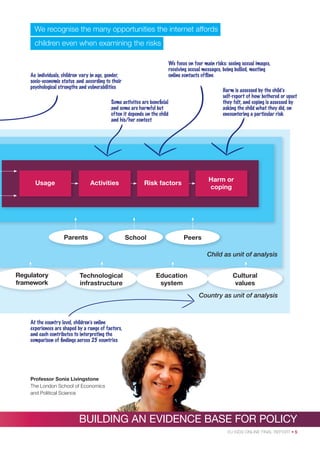
We recognise the many opportunities the internet affords
children even when examining the risks
We focus on four main risks: seeing sexual images,
receiving sexual messages, being bullied, meeting
online contacts offline

As individuals, children vary in age, gender,
socio-economic status and according to their
psychological strengths and vulnerabilities

Harm is assessed by the child’s
self-report of how bothered or upset
they felt, and coping is assessed by
asking the child what they did, on
encountering a particular risk

Some activites are beneficial
and some are harmful but
often it depends on the child
and his/her context

Usage

Activities

Parents

Harm or
coping

Risk factors

School

Peers
Child as unit of analysis

Regulatory
framework

Technological
infrastructure

Education
system

Cultural
values
Country as unit of analysis

At the country level, children’s online
experiences are shaped by a range of factors,
and each contributes to interpreting the
comparison of findings across 25 countries

Professor Sonia Livingstone
The London School of Economics
and Political Science

BUILDING AN EVIDENCE BASE FOR POLICY
EU KIDS ONLINE FINAL REPORT • 5
THE EUROPEAN COMMISSION’S
SAFER INTERNET PROGRAMME
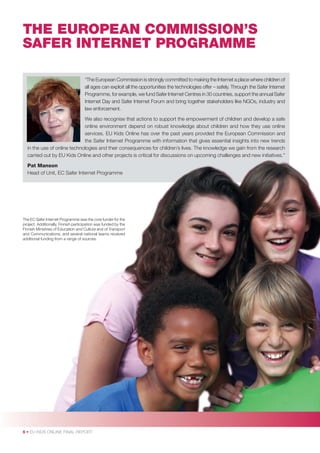
“The European Commission is strongly committed to making the Internet a place where children of
all ages can exploit all the opportunities the technologies offer – safely. Through the Safer Internet
Programme, for example, we fund Safer Internet Centres in 30 countries, support the annual Safer
Internet Day and Safer Internet Forum and bring together stakeholders like NGOs, industry and
law enforcement.
We also recognise that actions to support the empowerment of children and develop a safe
online environment depend on robust knowledge about children and how they use online
services. EU Kids Online has over the past years provided the European Commission and
the Safer Internet Programme with information that gives essential insights into new trends
in the use of online technologies and their consequences for children’s lives. The knowledge we gain from the research
y
p
g
g
carried out by EU Kids Online and other p j
projects is critical for discussions on upcoming challenges and new initiatives.”
on
Pat Manson
t,
Head of Unit, EC Safer Internet Programme

The EC Safer Internet Programme was the core funder for the
project. Additionally, Finnish participation was funded by the
Finnish Ministries of Education and Culture and of Transport
and Communications, and several national teams received
additional funding from a range of sources.

6 • EU KIDS ONLINE FINAL REPORT
The European Commission is strongly committed to making the Internet a place
where children of all ages can exploit all the opportunities the technologies offer – safely

EU Kids Online has been delighted to work with many other
partners, colleagues and stakeholders around Europe and
beyond. We thank the several hundred stakeholders who
responded to our consultations during the EU Kids Online
project, guiding its design and the use of its findings.

“Awareness-raising is a complex process, dependent on
the quality of research data available. For this reason,
the Insafe network of safer internet awareness raising
centres works closely with the EU Kids Online project.
Their survey findings have refined our knowledge of what
young people are doing online, their parents’ perception
of this, and the skills they lack in dealing with the risks
they encounter. Through the project we have gained
insight into the cultural differences between the countries
we are dealing with, and how these impact on online
risk-handling.
Without a project such as EU Kids Online, the awareness
raisers in the Insafe network could not target their audience
as accurately or measure the potential impact of their
campaigns. EU Kids Online has proven an invaluable partner
over the past years, a partnership we hope will continue for
the years to come.”
Janice Richardson
Insafe and European Schoolnet

EMPOWERING AND PROTECTING CHILDREN ONLINE
EU KIDS ONLINE FINAL REPORT • 7
EU KIDS ONLINE NEWS

Before we take a closer look at our project findings, here’s
some recent highlights from the network.

01

Our research cited by the
EC Vice President

“Research shows that children are going online younger and
younger, and that age restrictions on social networking sites are
often ignored. Younger children may not be aware of the risks
they face, nor of how they can change their privacy settings,”
said Neelie Kroes, Vice President of the European Commission
and European Digital Agenda Commissioner, in her keynote to
the 2011 Digital Agenda Assembly. Given this, she argued for
industry self-regulation as part of a comprehensive framework
“to empower children and parents with tools… that are simple,
universally recognisable and effective”.

8 • EU KIDS ONLINE FINAL REPORT

02

Internet Governance
Forum

In “A grand coalition on child internet safety”, a pre-meeting
organised by the European NGO Alliance for Child Safety
Online, eNACSO, at the IGF 2010 Forum in Vilnius, Sonia
Livingstone chaired a lively discussion about the evidence
base to support international efforts to further child internet
safety. At the 2011 Forum in Nairobi, Brian O’Neill and
Gitte Stald from EU Kids Online will present in the panel,
“Challenging myths about young people and the internet”,
with the Dynamic Youth Coalition on
Internet Governance.
All our reports, materials and data are online at www.eukidsonline.net

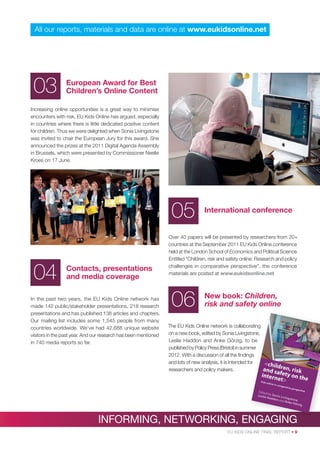
03

European Award for Best
Children’s Online Content

Increasing online opportunities is a great way to minimise
encounters with risk, EU Kids Online has argued, especially
in countries where there is little dedicated positive content
for children. Thus we were delighted when Sonia Livingstone
was invited to chair the European Jury for this award. She
announced the prizes at the 2011 Digital Agenda Assembly
in Brussels, which were presented by Commissioner Neelie
Kroes on 17 June.

05
04

Contacts, presentations
and media coverage

In the past two years, the EU Kids Online network has
made 142 public/stakeholder presentations, 218 research
presentations and has published 138 articles and chapters.
Our mailing list includes some 1,545 people from many
countries worldwide. We’ve had 42,688 unique website
visitors in the past year. And our research has been mentioned
in 740 media reports so far.

International conference

Over 40 papers will be presented by researchers from 20+
countries at the September 2011 EU Kids Online conference
held at the London School of Economics and Political Science.
Entitled “Children, risk and safety online: Research and policy
challenges in comparative perspective”, the conference
materials are posted at www.eukidsonline.net

06

New book: Children,
risk and safety online

The EU Kids Online network is collaborating
on a new book, edited by Sonia Livingstone,
Leslie Haddon and Anke Görzig, to be
published by Policy Press (Bristol) in summer
2012. With a discussion of all the findings
and lots of new analysis, it is intended for
researchers and policy makers.

INFORMING, NETWORKING, ENGAGING
NGAGING
EU KIDS ONLINE FINAL REPORT • 9
EUROPE AND BEYOND

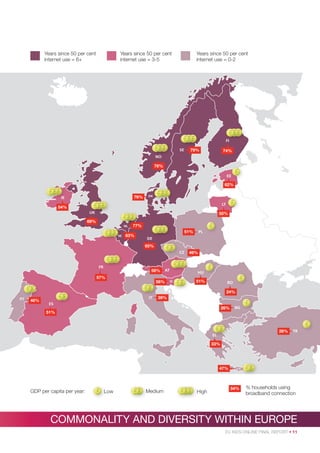
The “Europe” of EU Kids Online is not the EU27. The map shows
our 25 participating countries, encompassing Europe’s diversity.
In the next phase of work we will include Croatia, Iceland, Latvia,
Luxembourg, Malta, Russia, Slovakia and Switzerland.
To gain a wider perspective, and to see Europe
from the outside as well as from within, we
collaborate with researchers from:

USA
We work with The Pew Research
Center’s Internet and American
Life Project and The Crimes Against Children Research
Center, University of New Hampshire to keep in touch with
their parallel projects.

“The Pew Research Center has looked to the EU Kids Online
safety work for rigorously tested questions for us to repeat
in our surveys to assess the American experience. We look
forward to comparing the trends in the US and European
contexts in online safety experiences and behaviors. EU Kids
Online is an enormously valuable resource, to its European
constituents and to those of us concerned with rigorously
researching kids safety in other countries as well.”

Russia
The EU Kids Online survey has
been applied by colleagues from
the Moscow State University; see page 48 for findings.

Australia
The EU Kids Online survey has
been applied by colleagues from
the Centre of Excellence for Creative Industries and Innovation;
see page 48 for findings.

Brazil
We are working with the Brazilian
Network Information Center to
pilot the possibility of conducting the EU Kids Online survey.

Amanda Lenhart
Senior Research Specialist, Pew

“The EU Kids Online study is an impressive example of
cross-national comparative research, conducted in a very
collaborative but methodologically sound and sophisticated
way. It will serve as a model for future social science. The
fruits of this effort are only just beginning to be harvested,
and there will be much more coming out of it in the future.”
Professor David Finkelhor
Crimes against Children Research Center,
University of New Hampshire

10 • EU KIDS ONLINE FINAL REPORT

In comparative research, it is important
to recognise similarities across countries
as well as differences within countries
Years since 50 per cent
internet use = 6+

Years since 50 per cent
internet use = 3-5

Years since 50 per cent
internet use = 0-2

FI
I
SE

79%

74%

NO

78%
EE
E

62%
76%

IE
IE

DK
K

LT

54%
K
UK

50%

69%
NL
BE
BE

77
77%
7%

63%

51%

PL

E
DE

65%
CZ

R
FR

58%

AT
T

HU

57%
56%

49%

SI
I

51%

RO

24%
PT

46%

IT

39%

ES

26%

BG

51%

26%

TR

EL
L

33%

47%

GDP per capita per year:

Low

Medium

High

CY

54%

% households using
broadband connection

COMMONALITY AND DIVERSITY WITHIN EUROPE
EU KIDS ONLINE FINAL REPORT • 11
HOW CHILDREN GO ONLINE

Going online is now thoroughly embedded in children’s daily lives.
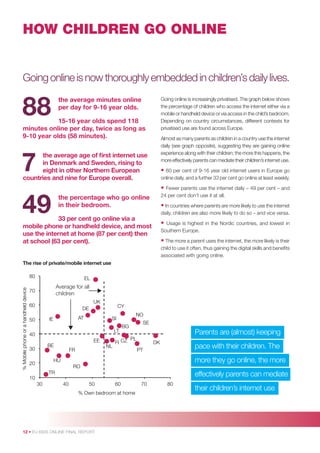
Going online is increasingly privatised. The graph below shows
the percentage of children who access the internet either via a
mobile or handheld device or via access in the child’s bedroom.
Depending on country circumstances, different contexts for
privatised use are found across Europe.

the average minutes online
per day for 9-16 year olds.
15-16 year olds spend 118
minutes online per day, twice as long as
9-10 year olds (58 minutes).

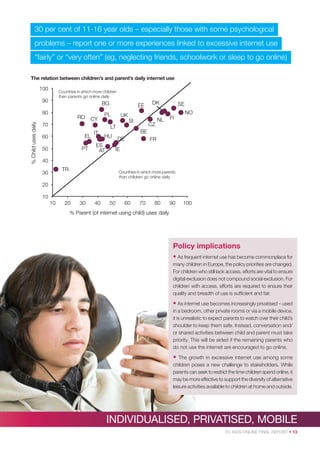
Almost as many parents as children in a country use the internet
daily (see graph opposite), suggesting they are gaining online
experience along with their children; the more this happens, the
more effectively parents can mediate their children’s internet use.

the average age of first internet use
in Denmark and Sweden, rising to
eight in other Northern European
countries and nine for Europe overall.

•

60 per cent of 9-16 year old internet users in Europe go
online daily, and a further 33 per cent go online at least weekly.

• Fewer parents use the internet daily – 49 per cent – and
24 per cent don’t use it at all.

the percentage who go online
in their bedroom.

• In countries where parents are more likely to use the internet
daily, children are also more likely to do so – and vice versa.

33 per cent go online via a
mobile phone or handheld device, and most
use the internet at home (87 per cent) then
at school (63 per cent).

• Usage is highest in the Nordic countries, and lowest in
Southern Europe.
• The more a parent uses the internet, the more likely is their
child to use it often, thus gaining the digital skills and benefits
associated with going online.

The rise of private/mobile internet use

% Mobile phone or a handheld device

80

EL

70

Average for all
children
UK

60

CY

DE
AT

IE

50

LT

40
EE
BE

30

NO

SI

NL

FR

BG

SE

Parents are (almost) keeping

PL
FI CZ

DK

pace with their children. The

PT

more they go online, the more

HU

20

RO
TR

effectively parents can mediate

10
30

40

50

60

% Own bedroom at home

12 • EU KIDS ONLINE FINAL REPORT

70

80

their children’s internet use
30 per cent of 11-16 year olds – especially those with some psychological
problems – report one or more experiences linked to excessive internet use
“fairly” or “very often” (eg, neglecting friends, schoolwork or sleep to go online)
The relation between children’s and parent’s daily internet use

100

Countries in which more children
than parents go online daily

90

BG

% Child uses daily

80

RO

CY

EE

PL
LT

EL

60

PT

50

IT

HU

ES
AT

SE
NO

UK
SI

70

DK

CZ

NL

FI

BE
DE

FR

IE

40

TR

30

Countries in which more parents
than children go online daily

20
10
10

20

30

40

50

60

70

80

90

100

% Parent (of internet using child) uses daily

Policy implications
• As frequent internet use has become commonplace for
many children in Europe, the policy priorities are changed.
For children who still lack access, efforts are vital to ensure
digital exclusion does not compound social exclusion. For
children with access, efforts are required to ensure their
quality and breadth of use is sufficient and fair.

• As internet use becomes increasingly privatised – used
in a bedroom, other private rooms or via a mobile device,
it is unrealistic to expect parents to watch over their child’s
shoulder to keep them safe. Instead, conversation and/
or shared activities between child and parent must take
priority. This will be aided if the remaining parents who
do not use the internet are encouraged to go online.

•

The growth in excessive internet use among some
children poses a new challenge to stakeholders. While
parents can seek to restrict the time children spend online, it
may be more effective to support the diversity of alternative
leisure activities available to children at home and outside.

INDIVIDUALISED, PRIVATISED, MOBILE
EU KIDS ONLINE FINAL REPORT • 13
WHAT CHILDREN DO ONLINE

The EU Kids Online survey asked children which online activities
they engage in, to understand the opportunities they enjoy and
to contextualise online risks
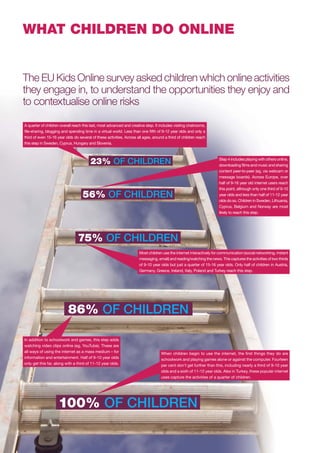
A quarter of children overall reach this last, most advanced and creative step. It includes visiting chatrooms,
file-sharing, blogging and spending time in a virtual world. Less than one fifth of 9-12 year olds and only a
third of even 15-16 year olds do several of these activities. Across all ages, around a third of children reach
this step in Sweden, Cyprus, Hungary and Slovenia.

23% OF CHILDREN

56% OF CHILDREN

Step 4 includes playing with others online,
downloading films and music and sharing
content peer-to-peer (eg, via webcam or
message boards). Across Europe, over
half of 9-16 year old internet users reach
this point, although only one third of 9-10
year olds and less than half of 11-12 year
olds do so. Children in Sweden, Lithuania,
Cyprus, Belgium and Norway are most
likely to reach this step.

75% OF CHILDREN
Most children use the internet interactively for communication (social networking, instant
messaging, email) and reading/watching the news. This captures the activities of two thirds
of 9-10 year olds but just a quarter of 15-16 year olds. Only half of children in Austria,
Germany, Greece, Ireland, Italy, Poland and Turkey reach this step.

86% OF CHILDREN
In addition to schoolwork and games, this step adds
watching video clips online (eg, YouTube). These are
all ways of using the internet as a mass medium – for
information and entertainment. Half of 9-10 year olds
only get this far, along with a third of 11-12 year olds.

When children begin to use the internet, the first things they do are
schoolwork and playing games alone or against the computer. Fourteen
per cent don’t get further than this, including nearly a third of 9-10 year
olds and a sixth of 11-12 year olds. Also in Turkey, these popular internet
uses capture the activities of a quarter of children.

100% OF CHILDREN
While this ladder of opportunities is schematic – since children vary in which activities they take up earliest and they
vary in the combination of activities they practise – it captures the general trend across all children. How can children
be enabled to climb further up the ladder of opportunities? One way is to provide more own-language, age-appropriate
positive content – whether creative, educational, expressive, participatory or just fun!

Enabling a “ladder of opportunities”

• Younger children are much less satisfied than older children.
Only 34 per cent of 9-10 year olds say there are lots of good
things for children of their age to do online, while 55 per cent
of teenagers say this – probably because they more easily
share in wider public provision.

•

In some countries there is more for children to do online
that they enjoy – often because of differential investment
and/or because national markets vary in size, wealth and
investment in or prioritisation of the internet.

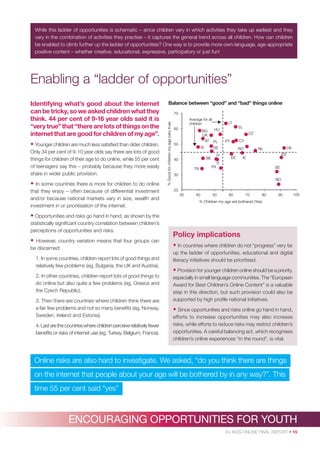
Balance between “good” and “bad” things online
70
% Good for children my age (very true)

Identifying what’s good about the internet
can be tricky, so we asked children what they
think. 44 per cent of 9-16 year olds said it is
“very true” that “there are lots of things on the
internet that are good for children of my age”.

Average for all
children

60

BG
UK
AT

50

SI

LT
CZ
PL

CY

PT

DE
FI

BE

40

EL

HU

RO
EE

DK

NL
ES

IE

IT
FR

TR

SE

30
NO
20
30

40

50

60

70

80

90

100

% Children my age are bothered (Yes)

• Opportunities and risks go hand in hand, as shown by the
statistically significant country correlation between children’s
perceptions of opportunities and risks.

•

However, country variation means that four groups can
be discerned:
1. In some countries, children report lots of good things and
relatively few problems (eg, Bulgaria, the UK and Austria).
2. In other countries, children report lots of good things to
do online but also quite a few problems (eg, Greece and
the Czech Republic).
3. Then there are countries where children think there are
a fair few problems and not so many benefits (eg, Norway,
Sweden, Ireland and Estonia).
4. Last are the countries where children perceive relatively fewer
benefits or risks of internet use (eg, Turkey, Belgium, France).

Policy implications
• In countries where children do not “progress” very far
up the ladder of opportunities, educational and digital
literacy initiatives should be prioritised.

• Provision for younger children online should be a priority,
especially in small language communities. The “European
Award for Best Children’s Online Content” is a valuable
step in this direction, but such provision could also be
supported by high profile national initiatives.

• Since opportunities and risks online go hand in hand,
efforts to increase opportunities may also increase
risks, while efforts to reduce risks may restrict children’s
opportunities. A careful balancing act, which recognises
children’s online experiences “in the round”, is vital.

Online risks are also hard to investigate. We asked, “do you think there are things
on the internet that people about your age will be bothered by in any way?”. This
time 55 per cent said “yes”

ENCOURAGING OPPORTUNITIES FOR YOUTH
EU KIDS ONLINE FINAL REPORT • 15
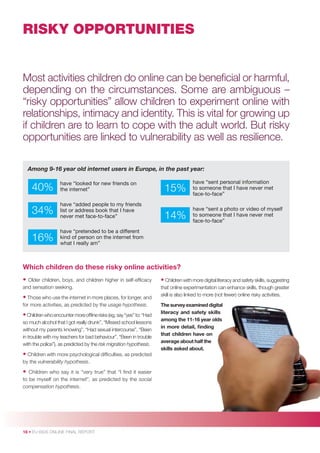
RISKY OPPORTUNITIES

Most activities children do online can be beneficial or harmful,
depending on the circumstances. Some are ambiguous –
“risky opportunities” allow children to experiment online with
relationships, intimacy and identity. This is vital for growing up
if children are to learn to cope with the adult world. But risky
opportunities are linked to vulnerability as well as resilience.
Among 9-16 year old internet users in Europe, in the past year:

40%

have “looked for new friends on
the internet”

34%

have “added people to my friends
list or address book that I have
never met face-to-face”

16%

15%

have “sent personal information
to someone that I have never met
face-to-face”

14%

have “sent a photo or video of myself
to someone that I have never met
face-to-face”

have “pretended to be a different
kind of person on the internet from
what I really am”

Which children do these risky online activities?
•

Older children, boys, and children higher in self-efficacy
and sensation seeking.
• Those who use the internet in more places, for longer, and
for more activities, as predicted by the usage hypothesis.

• Children who encounter more offline risks (eg, say “yes” to: “Had
so much alcohol that I got really drunk”, “Missed school lessons
without my parents knowing”, “Had sexual intercourse”, “Been
in trouble with my teachers for bad behaviour”, “Been in trouble
with the police”), as predicted by the risk migration hypothesis.

• Children with more psychological difficulties, as predicted
by the vulnerability hypothesis.
•

Children who say it is “very true” that “I find it easier
to be myself on the internet”, as predicted by the social
compensation hypothesis.

16 • EU KIDS ONLINE FINAL REPORT

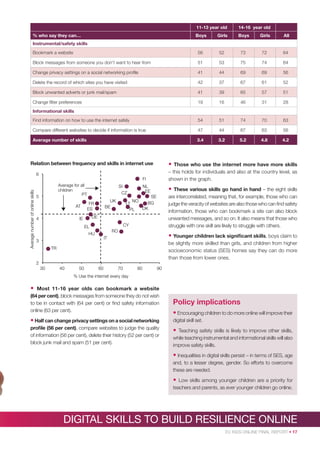
• Children with more digital literacy and safety skills, suggesting
that online experimentation can enhance skills, though greater
skill is also linked to more (not fewer) online risky activities.
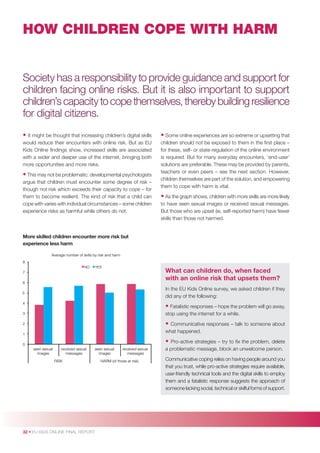
The survey examined digital
literacy and safety skills
among the 11-16 year olds
in more detail, finding
that children have on
average about half the
skills asked about.
11-13 year old

14-16 year old

Boys

Girls

Boys

Girls

All

Bookmark a website

56

52

73

72

64

Block messages from someone you don’t want to hear from

51

53

75

74

64

Change privacy settings on a social networking profile

41

44

69

69

56

Delete the record of which sites you have visited

42

37

67

61

52

Block unwanted adverts or junk mail/spam

41

39

65

57

51

Change filter preferences

19

16

46

31

28

Find information on how to use the internet safely

54

51

74

70

63

Compare different websites to decide if information is true

47

44

67

63

56

Average number of skills

3.4

3.2

5.2

4.8

4.2

% who say they can…
Instrumental/safety skills

Informational skills

Relation between frequency and skills in internet use

•

FI

Those who use the internet more have more skills
– this holds for individuals and also at the country level, as
shown in the graph.

NL
EE

•

Average number of online skills

6
Average for all
children
PT

5

AT

SI
CZ

DE

IE

4

SE
NO
BG
LT
DK
PL

UK
BE

FR
ES

These various skills go hand in hand – the eight skills
are intercorrelated, meaning that, for example, those who can
judge the veracity of websites are also those who can find safety
information, those who can bookmark a site can also block
unwanted messages, and so on. It also means that those who
struggle with one skill are likely to struggle with others.

CY

EL
RO

HU

• Younger children lack significant skills, boys claim to
be slightly more skilled than girls, and children from higher
socioeconomic status (SES) homes say they can do more
than those from lower ones.

IT

3
TR
2
30

40

50

60

70

80

90

% Use the internet every day

•

Most 11-16 year olds can bookmark a website
(64 per cent), block messages from someone they do not wish
to be in contact with (64 per cent) or find safety information
online (63 per cent).

Policy implications
• Encouraging children to do more online will improve their

• Half can change privacy settings on a social networking

digital skill set.

profile (56 per cent), compare websites to judge the quality
of information (56 per cent), delete their history (52 per cent) or
block junk mail and spam (51 per cent).

•

Teaching safety skills is likely to improve other skills,
while teaching instrumental and informational skills will also
improve safety skills.

• Inequalities in digital skills persist – in terms of SES, age
and, to a lesser degree, gender. So efforts to overcome
these are needed.

•

Low skills among younger children are a priority for
teachers and parents, as ever younger children go online.

DIGITAL SKILLS TO BUILD RESILIENCE ONLINE
EU KIDS ONLINE FINAL REPORT • 17
SOCIAL NETWORKING

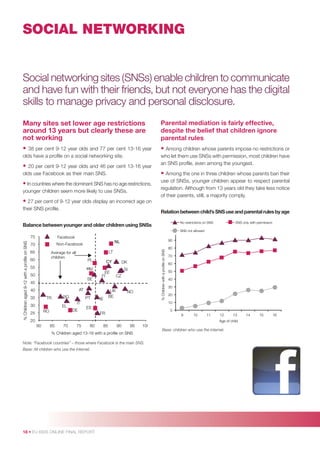
Social networking sites (SNSs) enable children to communicate
and have fun with their friends, but not everyone has the digital
skills to manage privacy and personal disclosure.
Many sites set lower age restrictions
around 13 years but clearly these are
not working

Parental mediation is fairly effective,
despite the belief that children ignore
parental rules

•

• Among children whose parents impose no restrictions or

38 per cent 9-12 year olds and 77 per cent 13-16 year
olds have a profile on a social networking site.

•

20 per cent 9-12 year olds and 46 per cent 13-16 year
olds use Facebook as their main SNS.

• In countries where the dominant SNS has no age restrictions,
younger children seem more likely to use SNSs.

• 27 per cent of 9-12 year olds display an incorrect age on
their SNS profile.

who let them use SNSs with permission, most children have
an SNS profile, even among the youngest.

• Among the one in three children whose parents ban their
use of SNSs, younger children appear to respect parental
regulation. Although from 13 years old they take less notice
of their parents, still, a majority comply.
Relation between child’s SNS use and parental rules by age
No restrictions on SNS

Balance between younger and older children using SNSs
100

Facebook

70

Non-Facebook

65

LT

Average for all
children

60

PL

55

HU

50
SE

45

CY
EE
FI

AT

40
35

TR

30

BG
EL

IE

SI
CZ

NO

80
70
60
50
40
30
20
10

IT
DE

RO

25

PT

DK

UK
BE

SNS not allowed

90

NL

% Children with a profile on SNS xx

% Children aged 9-12 with a profile on SNS

75

SNS only with permission

ES

0

FR

9

20

10

11

12

13

Age of child

60

65

70

75

80

85

90

95

100

% Children aged 13-16 with a profile on SNS
Note: “Facebook countries” – those where Facebook is the main SNS.
Base: All children who use the internet.

18 • EU KIDS ONLINE FINAL REPORT

Base: children who use the internet.

14

15

16
Does it matter if young children
use SNSs?

• Compared with those who do not use SNSs, SNS users
are significantly more likely to report seeing sexual images,
receiving sexual or bullying messages or meeting online
contacts offline – though for each risk, the overall incidence
is fairly low.

Children surely have the right to use services where many social
activities – for governmental, artistic, citizen groups, news,
educational offerings and more – take place. But to enable
these opportunities, some risks should be further mitigated.

Aren’t children internet-savvy enough
to manage their SNS settings?

• 29 per cent of 9-12 year olds and 27 per cent of 13-16 year
olds have their profile “public”, though this varies according
to the country and the SNS used.

• Features designed to protect children from other users if
needed are not easily understood by everyone, especially
by younger children.

• A quarter of SNS users communicate online with people
unconnected to their daily lives, including one fifth of 9-12
year olds.

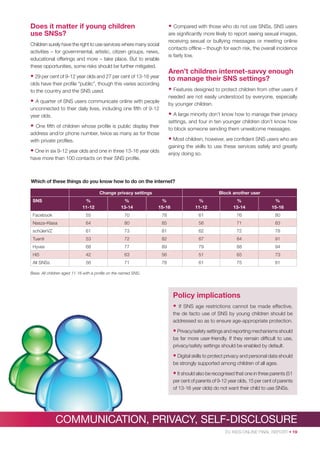
• A large minority don’t know how to manage their privacy
settings, and four in ten younger children don’t know how
to block someone sending them unwelcome messages.

•

One fifth of children whose profile is public display their
address and/or phone number, twice as many as for those
with private profiles.

• Most children, however, are confident SNS users who are

• One in six 9-12 year olds and one in three 13-16 year olds

gaining the skills to use these services safely and greatly
enjoy doing so.

have more than 100 contacts on their SNS profile.

Which of these things do you know how to do on the internet?
Change privacy settings
SNS

Block another user

%
11-12

%
13-14

%
15-16

%
11-12

%
13-14

%
15-16

Facebook

55

70

78

61

76

80

Nasza-Klasa

64

80

85

56

71

83

schülerVZ

61

73

81

62

72

78

Tuenti

53

72

82

67

84

91

Hyves

68

77

89

79

88

94

Hi5

42

63

56

51

65

73

All SNSs

56

71

78

61

75

81

Base: All children aged 11-16 with a profile on the named SNS.

Policy implications
•

If SNS age restrictions cannot be made effective,
the de facto use of SNS by young children should be
addressed so as to ensure age-appropriate protection.

• Privacy/safety settings and reporting mechanisms should
be far more user-friendly. If they remain difficult to use,
privacy/safety settings should be enabled by default.

• Digital skills to protect privacy and personal data should
be strongly supported among children of all ages.

• It should also be recognised that one in three parents (51
per cent of parents of 9-12 year olds, 15 per cent of parents
of 13-16 year olds) do not want their child to use SNSs.

COMMUNICATION, PRIVACY, SELF-DISCLOSURE
EU KIDS ONLINE FINAL REPORT • 19
WHAT UPSETS CHILDREN ONLINE

We asked children to tell us in their own words, “what things
on the internet would bother people about your age?”.
A note on method
It is not easy to ask children about sensitive issues associated
with online risks. Our approach was to interview children
at home, face-to-face, so the child would be relaxed and
the interviewer could check the child’s understanding of
questions asked. For the sensitive questions, children
completed the survey in privacy – either answering on
a computer screen turned to face them, or by pen and
paper before putting their answers in a sealed envelope.
We defined terms carefully and neutrally, avoiding emotive
or value-laden terms (eg, “bully”, “stranger”). The focus
was on children’s reports of what had actually happened
to them within a set time period rather than on general
opinions. Cognitive testing ensured children understood
the questionnaire, and we took great care in translating this
into 26 languages. For example, to ask children about the
possible harms associated with specific risks (and instead
of assuming that harm was inevitable), we asked children if
a particular experience had “bothered” them, defining this as
something that “made you feel uncomfortable, upset, or feel
that you shouldn’t have seen it.” We asked this first, before
mentioning any kinds of risk at all, to see children’s own views.
A leaflet of helpful advice and sources of further support and
guidance was provided for every child who participated in
the survey, and we thank Insafe for compiling this – in
25 country versions!

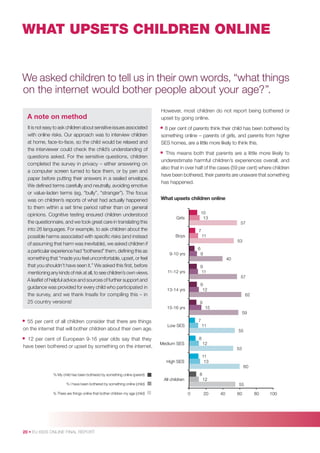
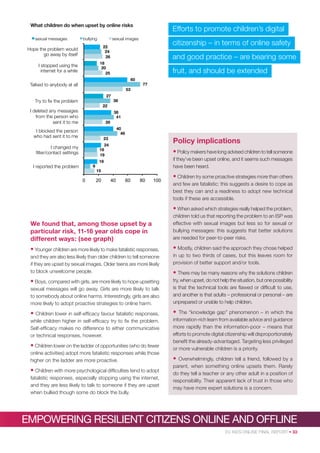
However, most children do not report being bothered or
upset by going online.

• 8 per cent of parents think their child has been bothered by
something online – parents of girls, and parents from higher
SES homes, are a little more likely to think this.

•

This means both that parents are a little more likely to
underestimate harmful children’s experiences overall, and
also that in over half of the cases (59 per cent) where children
have been bothered, their parents are unaware that something
has happened.

What upsets children online
10
13

Girls

57
7
11

Boys

53
6
9

9-10 yrs

40
11-12 yrs

9
11

13-14 yrs

9
12

57

62
9
15

15-16 yrs

59

•

55 per cent of all children consider that there are things
on the internet that will bother children about their own age.

7
11

Low SES

55

•

12 per cent of European 9-16 year olds say that they
have been bothered or upset by something on the internet.

8
12

Medium SES

53
11
13

High SES

60
8

% My child has been bothered by something online (parent)

12

All children
% I have been bothered by something online (child)
% There are things online that bother children my age (child)

20 • EU KIDS ONLINE FINAL REPORT

55
0

20

40

60

80

100
“When I am playing games
with my older sister on the
internet, naked people
pop up and it is very bad”
(girl, 15, Turkey)

“Lies that are being spread.
Cyberpesting, it happens more
and more” (girl, 14, Belgium)

“If someone says that someone
will do something on the internet
like ruin your character that you
have in a game” (boy, 10, Sweden)

“When human beings are killed;
when human beings are hurt
while other people are watching”
(girl, 10, Germany)

“Hacker; spying; cheating; strangers
who contact you online and you do
not really know what they want from
you” (boy, 11, Austria)

“If people put your secrets on the
internet. If people take pictures
or videos of you and put them on
the internet when you don’t want
them to” (girl, 9, Ireland)
“To tell something nasty about
a girl friend and then tell it to
everyone” (girl, 12, France)
“All kinds of bullies, who can
hurt person with words”
(girl, 14, Estonia)
“Obscene scenes with naked people,
men with men or men with women,
saying rude words, hitting, whipping”
(boy, 12, France)

Po
Policy implications
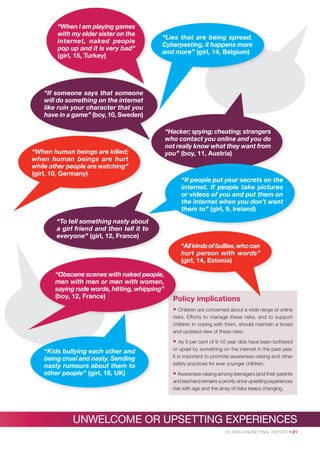
• Children are concerned about a wide range of online
C
risk
risks. Efforts to manage these risks, and to support
children in coping with them, should maintain a broad
and updated view of these risks.

• As 9 per cent of 9-10 year olds have been bothered
“Kids bullying each other and
being cruel and nasty. Sending
nasty rumours about them to
other people” (girl, 16, UK)

or upset by something on the internet in the past year.
it is important to promote awareness-raising and other
safety practices for ever younger children.

• Awareness-raising among teenagers (and their parents
and teachers) remains a priority since upsetting experiences
rise with age and the array of risks keeps changing.
UNWELCOME OR UPSETTING EXPERIENCES
EU KIDS ONLINE FINAL REPORT • 21
SEXUAL CONTENT

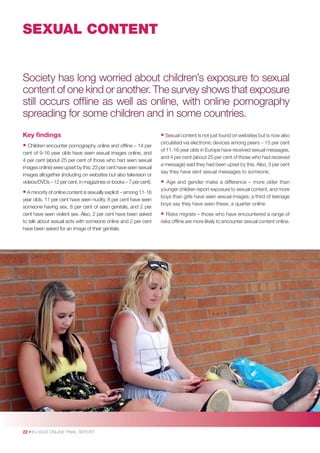
Society has long worried about children’s exposure to sexual
content of one kind or another. The survey shows that exposure
still occurs offline as well as online, with online pornography
spreading for some children and in some countries.
Key findings

• Sexual content is not just found on websites but is now also

• Children encounter pornography online and offline – 14 per

circulated via electronic devices among peers – 15 per cent
of 11-16 year olds in Europe have received sexual messages,
and 4 per cent (about 25 per cent of those who had received
a message) said they had been upset by this. Also, 3 per cent
say they have sent sexual messages to someone.

cent of 9-16 year olds have seen sexual images online, and
4 per cent (about 25 per cent of those who had seen sexual
images online) were upset by this; 23 per cent have seen sexual
images altogether (including on websites but also television or
videos/DVDs – 12 per cent, in magazines or books – 7 per cent).

• A minority of online content is sexually explicit – among 11-16
year olds, 11 per cent have seen nudity, 8 per cent have seen
someone having sex, 8 per cent of seen genitals, and 2 per
cent have seen violent sex. Also, 2 per cent have been asked
to talk about sexual acts with someone online and 2 per cent
have been asked for an image of their genitals.

22 • EU KIDS ONLINE FINAL REPORT

•

Age and gender make a difference – more older than
younger children report exposure to sexual content, and more
boys than girls have seen sexual images; a third of teenage
boys say they have seen these, a quarter online.

•

Risks migrate – those who have encountered a range of
risks offline are more likely to encounter sexual content online.
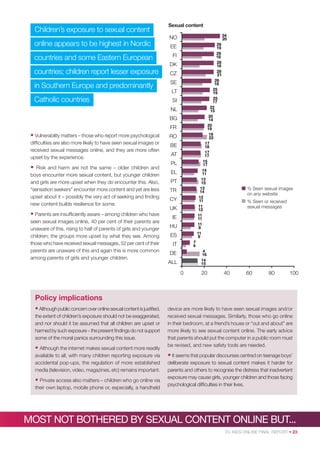
Children’s exposure to sexual content

Sexual content
34
20

NO

online appears to be highest in Nordic
countries and some Eastern European

29
19
29
18
28
16
28
21
26
18
25
19
25
17
22
15
20
14
20
19
19
22
17
18
17
17
15
17
14
11
13
15
13
14
12
11
11
12
11
11
11
8
11
9

EE
FI
DK

countries; children report lesser exposure
in Southern Europe and predominantly
Catholic countries

CZ
SE
LT
SI
NL
BG
FR

• Vulnerability matters – those who report more psychological

RO

difficulties are also more likely to have seen sexual images or
received sexual messages online, and they are more often
upset by the experience.

BE

•

Risk and harm are not the same – older children and
boys encounter more sexual content, but younger children
and girls are more upset when they do encounter this. Also,
“sensation seekers” encounter more content and yet are less
upset about it – possibly the very act of seeking and finding
new content builds resilience for some.

• Parents are insufficiently aware – among children who have
seen sexual images online, 40 per cent of their parents are
unaware of this, rising to half of parents of girls and younger
children; the groups more upset by what they see. Among
those who have received sexual messages, 52 per cent of their
parents are unaware of this and again this is more common
among parents of girls and younger children.

AT
PL
EL
PT
TR
CY
UK
IE
HU
ES

% Seen sexual images
on any website
% Seen or received
sexual messages

7
4

IT

4
16
14
15

DE
ALL
0

20

40

60

80

100

Policy implications
• Although public concern over online sexual content is justified,
the extent of children’s exposure should not be exaggerated,
and nor should it be assumed that all children are upset or
harmed by such exposure – the present findings do not support
some of the moral panics surrounding this issue.

• Although the internet makes sexual content more readily
available to all, with many children reporting exposure via
accidental pop-ups, the regulation of more established
media (television, video, magazines, etc) remains important.

• Private access also matters – children who go online via
their own laptop, mobile phone or, especially, a handheld

device are more likely to have seen sexual images and/or
received sexual messages. Similarly, those who go online
in their bedroom, at a friend’s house or “out and about” are
more likely to see sexual content online. The early advice
that parents should put the computer in a public room must
be revised, and new safety tools are needed.

• It seems that popular discourses centred on teenage boys’
deliberate exposure to sexual content makes it harder for
parents and others to recognise the distress that inadvertent
exposure may cause girls, younger children and those facing
psychological difficulties in their lives.

MOST NOT BOTHERED BY SEXUAL CONTENT ONLINE BUT...
EU KIDS ONLINE FINAL REPORT • 23
ONLINE BULLYING

We asked children if they had been treated, or had treated other
people, in a hurtful or nasty way on the internet, whether as a
single, repeated or persistent occurrence.
• Across Europe, 6 per cent of 9 to 16-year-old internet users
report having been bullied online, and 3 per cent confess to
having bullied others.

•

Far more have been bullied offline, however, with 19 per
cent saying they have been bullied at all – and 12 per cent
have bullied someone else. In some countries, bullying is
much more common than in others.

Online bullying has rightly attracted a lot of policy
attention. But it is not a wholly new problem. And nor
are the children who do it simply “bad”. What does the
EU Kids Online survey tell us?

•

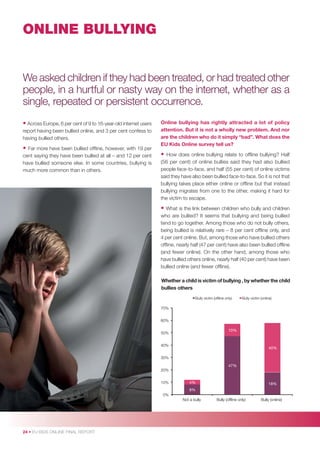
How does online bullying relate to offline bullying? Half
(56 per cent) of online bullies said they had also bullied
people face-to-face, and half (55 per cent) of online victims
said they have also been bullied face-to-face. So it is not that
bullying takes place either online or offline but that instead
bullying migrates from one to the other, making it hard for
the victim to escape.

• What is the link between children who bully and children
who are bullied? It seems that bullying and being bullied
tend to go together. Among those who do not bully others,
being bullied is relatively rare – 8 per cent offline only, and
4 per cent online. But, among those who have bullied others
offline, nearly half (47 per cent) have also been bullied offline
(and fewer online). On the other hand, among those who
have bullied others online, nearly half (40 per cent) have been
bullied online (and fewer offline).
Whether a child is victim of bullying , by whether the child
bullies others
Bully victim (offline only)

Bully victim (online)

70%
60%
10%

50%
40%

40%

30%
47%
20%
10%

4%

18%

8%
0%
Not a bully

24 • EU KIDS ONLINE FINAL REPORT

Bully (offline only)

Bully (online)
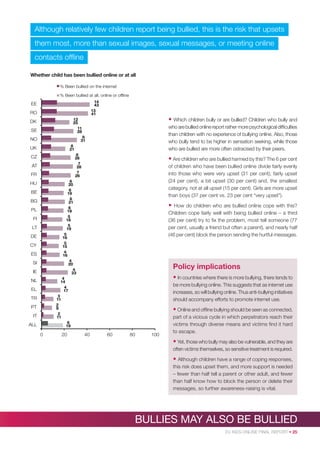
Although relatively few children report being bullied, this is the risk that upsets
them most, more than sexual images, sexual messages, or meeting online
contacts offline
Whether child has been bullied online or at all
% Been bullied on the internet
% Been bullied at all, online or offline
14
43
13
41

EE
RO

• Which children bully or are bullied? Children who bully and

12
25
11
28

DK
SE

who are bullied online report rather more psychological difficulties
than children with no experience of bullying online. Also, those
who bully tend to be higher in sensation seeking, while those
who are bullied are more often ostracised by their peers.

8
31

NO
8
21

UK

8
26
7
28
7
26

CZ
AT
FR

• Are children who are bullied harmed by this? The 6 per cent
of children who have been bullied online divide fairly evenly
into those who were very upset (31 per cent), fairly upset
(24 per cent), a bit upset (30 per cent) and, the smallest
category, not at all upset (15 per cent). Girls are more upset
than boys (37 per cent vs. 23 per cent “very upset”).

6
20
6
19
6
21
6
19
5
18
5
19
5
16
5
15
4
16
4
20
4
23
4
14
4
17

HU
BE
BG
PL
FI
LT
DE
CY
ES
SI
IE
NL
EL

• How do children who are bullied online cope with this?
Children cope fairly well with being bullied online – a third
(36 per cent) try to fix the problem, most tell someone (77
per cent, usually a friend but often a parent), and nearly half
(46 per cent) block the person sending the hurtful messages.

Policy implications
• In countries where there is more bullying, there tends to
be more bullying online. This suggests that as internet use
increases, so will bullying online. Thus anti-bullying initiatives
should accompany efforts to promote internet use.

3
11
2
9
2
11

TR
PT
IT

• Online and offline bullying should be seen as connected,
6
19

ALL
0

20

40

60

80

100

part of a vicious cycle in which perpetrators reach their
victims through diverse means and victims find it hard
to escape.

• Yet, those who bully may also be vulnerable, and they are
often victims themselves, so sensitive treatment is required.

• Although children have a range of coping responses,
this risk does upset them, and more support is needed
– fewer than half tell a parent or other adult, and fewer
than half know how to block the person or delete their
messages, so further awareness-raising is vital.

BULLIES MAY ALSO BE BULLIED
EU KIDS ONLINE FINAL REPORT • 25
MEETING NEW CONTACTS ONLINE

50 per cent of children 11-16 say “I find it easier to be myself on
the internet than when I am with people face-to-face”.
Communicating, making new friends, developing intimacy – all
this is fraught with difficulties and embarrassment for young
people. The internet, it seems, offers a space for privacy,
control over communication and experimentation. It also lets
children easily get to know many new people, whether they
are like them or quite different.
Traditionally, it has been clear who children are in touch with
because, first, the child can see who they are talking to, also the
parent can oversee who the child is talking to and, last, because
the child’s own identity is not in doubt. But on the internet, none
of this can be assumed. Online, no-one knows, famously, if you
yourself are a dog – or a child. It is not clear if you are talking to
a child or an adult, including an adult pretending to be a child.
Nor can parents oversee their children’s friends – they are no
longer present in the house or street, only on the computer, often
inaccessible even to curious or concerned parents.
Nowhere has the public anxiety been greater than over the tension
between “meeting strangers” (as many adults see it) and “making
new friends” (as children may see it). Meeting strangers is a risk.
Making new friends is an opportunity. Distinguishing between the
two may depend on the child and the circumstances. Avoiding
the emotive terms “stranger” and “friend”, we asked children in
the survey about the people they are in touch with online and
whether they also know them offline.

• 87 per cent of 11-16 year olds say that online they are in touch
with people they first met face-to-face. But 39 per cent are in
touch with people they met on the internet who are friends or
family of people they know. And 25 per cent are in touch with
people they met online who have no connection with their
existing social circle.

26 • EU KIDS ONLINE FINAL REPORT

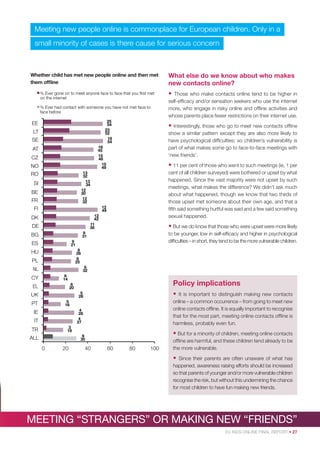
• 30 per cent of European 9-16 year olds have had contact
online with someone they haven’t met face to face, but only 9
per cent have gone to an offline meeting with such a person.
On a country level, there is no obvious relation between making
contacts online and meeting them offline.

• Among those who have met online contacts offline, half have
met one or two people in the past year, half have met more.
Also, 57 per cent met a friend of a friend (someone in their
social circle) while 48 per cent met someone unconnected
with their life before meeting them online.

• Among those children who did meet an online contact offline,
61 per cent of their parents were not aware of this, rising to 68 per
cent among the younger children. Parents were least aware
of such meetings in Ireland, the
UK, Cyprus and Portugal.
Meeting new people online is commonplace for European children. Only in a
small minority of cases is there cause for serious concern

Whether child has met new people online and then met
them offline
% Ever gone on to meet anyone face to face that you first met
on the internet
% Ever had contact with someone you have not met face to
face before
25
54
23
52
18
54

EE
LT
SE
CZ
NO
SI
BE
FR

• 11 per cent of those who went to such meetings (ie, 1 per
cent of all children surveyed) were bothered or upset by what
happened. Since the vast majority were not upset by such
meetings, what makes the difference? We didn’t ask much
about what happened, though we know that two thirds of
those upset met someone about their own age, and that a
fifth said something hurtful was said and a few said something
sexual happened.

12
49

FI
12
42
11
38

DK
DE

• But we do know that those who were upset were more likely

9
31

BG

to be younger, low in self-efficacy and higher in psychological
difficulties – in short, they tend to be the more vulnerable children.

9
21

ES

Those who make contacts online tend to be higher in
self-efficacy and/or sensation seekers who use the internet
more, who engage in risky online and offline activities and
whose parents place fewer restrictions on their internet use.
Interestingly, those who go to meet new contacts offline
show a similar pattern except they are also more likely to
have psychological difficulties; so children’s vulnerability is
part of what makes some go to face-to-face meetings with
‘new friends’.

13
32
13
34
12
30
12
32

RO

•

•

16
45
15
46
15
49

AT

What else do we know about who makes
new contacts online?

8
26
8
25

HU
PL

6
32

NL
6
14

CY

Policy implications

6
20

EL

•

5
28

UK

It is important to distinguish making new contacts
online – a common occurrence – from going to meet new
online contacts offline. It is equally important to recognise
that for the most part, meeting online contacts offline is
harmless, probably even fun.

5
16

PT

4
28
4
27

IE
IT
3
18

TR

• But for a minority of children, meeting online contacts

9
30

ALL
0

20

40

60

80

100

offline are harmful, and these children tend already to be
the more vulnerable.

•

Since their parents are often unaware of what has
happened, awareness raising efforts should be increased
so that parents of younger and/or more vulnerable children
recognise the risk, but without this undermining the chance
for most children to have fun making new friends.

MEETING “STRANGERS” OR MAKING NEW “FRIENDS”
EU KIDS ONLINE FINAL REPORT • 27
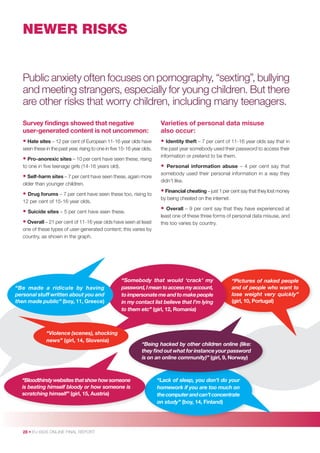
NEWER RISKS

Public anxiety often focuses on pornography, “sexting”, bullying
and meeting strangers, especially for young children. But there
are other risks that worry children, including many teenagers.
Survey findings showed that negative
user-generated content is not uncommon:

Varieties of personal data misuse
also occur:

• Hate sites – 12 per cent of European 11-16 year olds have

• Identity theft – 7 per cent of 11-16 year olds say that in

seen these in the past year, rising to one in five 15-16 year olds.

the past year somebody used their password to access their
information or pretend to be them.

• Pro-anorexic sites – 10 per cent have seen these, rising

•

to one in five teenage girls (14-16 years old).

• Self-harm sites – 7 per cent have seen these, again more
older than younger children.

• Drug forums – 7 per cent have seen these too, rising to
12 per cent of 15-16 year olds.

Personal information abuse – 4 per cent say that
somebody used their personal information in a way they
didn’t like.

• Financial cheating – just 1 per cent say that they lost money
by being cheated on the internet.

•

• Suicide sites – 5 per cent have seen these.
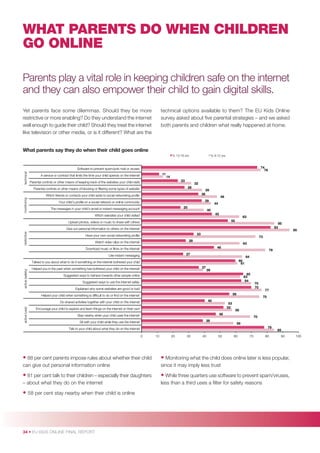
• Overall – 21 per cent of 11-16 year olds have seen at least

Overall – 9 per cent say that they have experienced at
least one of these three forms of personal data misuse, and
this too varies by country.

one of these types of user-generated content; this varies by
country, as shown in the graph.

“Be made a ridicule by having
personal stuff written about you and
then made public” (boy, 11, Greece)

“Somebody that would ‘crack’ my
password, I mean to access my account,
to impersonate me and to make people
in my contact list believe that I’m lying
to them etc” (girl, 12, Romania)

“Violence (scenes), shocking
news” (girl, 14, Slovenia)

“Bloodthirsty websites that show how someone
is beating himself bloody or how someone is
scratching himself” (girl, 15, Austria)

28 • EU KIDS ONLINE FINAL REPORT

“Pictures of naked people
and of people who want to
lose weight very quickly”
(girl, 10, Portugal)

“Being hacked by other children online (like:
they find out what for instance your password
is on an online community)” (girl, 9, Norway)

“Lack of sleep, you don’t do your
homework if you are too much on
the computer and can’t concentrate
on study” (boy, 14, Finland)
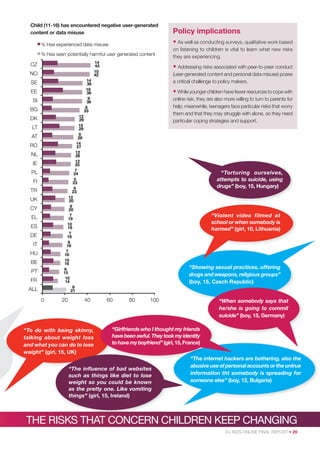
Child (11-16) has encountered negative user-generated
content or data misuse

• As well as conducting surveys, qualitative work based

% Has experienced data misuse
% Has seen potentially harmful user generated content
14
43
10
42

CZ
NO
EE
SI
BG

(user-generated content and personal data misuse) poses
a critical challenge to policy makers.

• While younger children have fewer resources to cope with
online risk, they are also more willing to turn to parents for
help; meanwhile, teenagers face particular risks that worry
them and that they may struggle with alone, so they need
particular coping strategies and support.

12
29
15
29
9
28
14
27
12
26
12
25
7
24
5
23
9
23
12
20
8
20
7
19
10
19
7
18
6
18
7
16
10
16
6
15
10
14
9
21

DK
LT
AT
RO
NL
IE
PL
FI
TR
UK
CY
EL
ES
DE
IT
HU
BE
PT
FR
ALL
0

20

on listening to children is vital to learn what new risks
they are experiencing.
• Addressing risks associated with peer-to-peer conduct

14
36
18
36
9
36
8
33

SE

Policy implications

“Torturing ourselves,
attempts to suicide, using
drugs” (boy, 15, Hungary)

“Violent video filmed at
school or when somebody is
harmed” (girl, 10, Lithuania)

“Showing sexual practices, offering
drugs and weapons, religious groups”
(boy, 15, Czech Republic)

40

“To do with being skinny,
talking about weight loss
and what you can do to lose
weight” (girl, 15, UK)
l,

60

80

100

“When somebody says that
he/she is going to commit
suicide” (boy, 15, Germany)

“Girlfriends who I thought my friends
have been awful. They took my identity
to have my boyfriend” (girl, 15, France)

“The influence of bad websites
such as things like diet to lose
weight so you could be known
as the pretty one. Like vomiting
things” (girl, 15, Ireland)

“The internet hackers are bothering, also the
intern
abusive use of personal accounts or the untrue
information tht somebody is spreading for
someone else” (boy, 12, Bulgaria)

THE RISKS THAT CONCERN CHILDREN KEEP CHANGING
EU KIDS ONLINE FINAL REPORT • 29
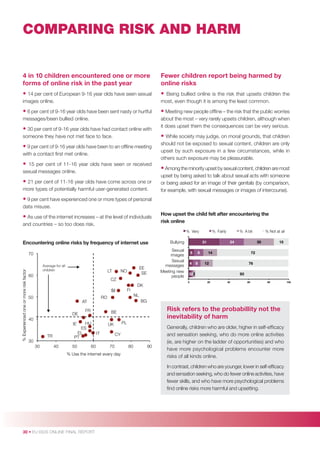
COMPARING RISK AND HARM

4 in 10 children encountered one or more
forms of online risk in the past year

Fewer children report being harmed by
online risks

• 14 per cent of European 9-16 year olds have seen sexual

•

images online.

Being bullied online is the risk that upsets children the
most, even though it is among the least common.

• 6 per cent of 9-16 year olds have been sent nasty or hurtful

• Meeting new people offline – the risk that the public worries

messages/been bullied online.

about the most – very rarely upsets children, although when
it does upset them the consequences can be very serious.

• 30 per cent of 9-16 year olds have had contact online with
someone they have not met face to face.

• 9 per cent of 9-16 year olds have been to an offline meeting
with a contact first met online.

•

15 per cent of 11-16 year olds have seen or received
sexual messages online.

• 21 per cent of 11-16 year olds have come across one or
more types of potentially harmful user-generated content.

• While society may judge, on moral grounds, that children
should not be exposed to sexual content, children are only
upset by such exposure in a few circumstances, while in
others such exposure may be pleasurable.
• Among the minority upset by sexual content, children are most
upset by being asked to talk about sexual acts with someone
or being asked for an image of their genitals (by comparison,
for example, with sexual messages or images of intercourse).

• 9 per cent have experienced one or more types of personal
data misuse.

• As use of the internet increases – at the level of individuals
and countries – so too does risk.

How upset the child felt after encountering the
risk online
% Very

Encountering online risks by frequency of internet use

Sexual
images
Sexual
messages
Meeting new
people

% Experienced one or more risk factor

70
Average for all
children

LT

60

EE
SE

NO

Bullying

CZ

% Fairly

4

9
8

15

72

14

76

12
93

322
0

% Not at all
30

24

31
5

% A bit

20

40

60

80

DK
SI

FI
NL

RO

50

BG

AT
DE

FR

40
HU
ES
EL
PT

IE
TR

Risk refers to the probabillity not the
inevitability of harm

BE
PL

UK
IT

CY

30
30

40

50

60

70

% Use the internet every day

80

90

Generally, children who are older, higher in self-efficacy
and sensation seeking, who do more online activities
(ie, are higher on the ladder of opportunities) and who
have more psychological problems encounter more
risks of all kinds online.
In contrast, children who are younger, lower in self-efficacy
and sensation seeking, who do fewer online activities, have
fewer skills, and who have more psychological problems
find online risks more harmful and upsetting.
30 • EU KIDS ONLINE FINAL REPORT

100
In some countries, a similar level of risk
is less upsetting than in others
•

Broadly, in countries where more children encounter
online risk, children also report more bothering or upsetting
experiences – and vice versa.
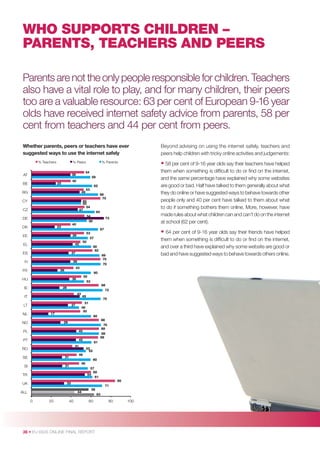
• But some country comparisons are thought-provoking. For
example, children in Finland and Denmark report similar levels
of risk, but Danish children are more often upset. At a lower
level of risk, the same holds for Spanish and Italian children.

• Since risk increases as use increases, it might seem
simple to call for restrictions on children’s use of the
internet. But online opportunities and digital literacy also
increase with use, so there is no simple solution. Rather,
ways must be found to manage risk without unduly
restricting opportunities.

Encountering online risks by whether bothered or
upset by internet use
70

% Experienced one or more risk factor

Policy implications

•
Average for all
children

LT

EE
NO

CZ

60

SE

FI
SI

AT

50

BE

FR
DE
IT
PT

30
0

RO

NL

BG

40

DK

PL
IE

UK

CY HU
EL

•

ES
TR

10

As with riding a bike or crossing the road, everyday
activities online carry a risk of harm, but this harm is far
from inevitable – indeed, it is fairly rare. The EU Kids Online
survey provides clear empirical support for policy efforts
both to manage children’s encounters online so as to reduce
harm (though not necessarily to reduce risk). This should
be achieved both by designing the online environment to
build in safety considerations and to increase children’s
digital skills, coping and resilience.

20

30

In some countries, the need for such efforts is already
pressing. In others, it may be anticipated that as use rises, so
to will the need for greater policy efforts regarding children’s
safety, empowerment and well-being.

% Bothered by something on the internet

RISK IS NOT EQUAL TO HARM
EU KIDS ONLINE FINAL REPORT • 31
HOW CHILDREN COPE WITH HARM

Society has a responsibility to provide guidance and support for
children facing online risks. But it is also important to support
children’s capacity to cope themselves, thereby building resilience
for digital citizens.
• It might be thought that increasing children’s digital skills

• Some online experiences are so extreme or upsetting that

would reduce their encounters with online risk. But as EU
Kids Online findings show, increased skills are associated
with a wider and deeper use of the internet, bringing both
more opportunities and more risks.

children should not be exposed to them in the first place –
for these, self- or state-regulation of the online environment
is required. But for many everyday encounters, ‘end-user’
solutions are preferable. These may be provided by parents,
teachers or even peers – see the next section. However,
children themselves are part of the solution, and empowering
them to cope with harm is vital.

• This may not be problematic: developmental psychologists
argue that children must encounter some degree of risk –
though not risk which exceeds their capacity to cope – for
them to become resilient. The kind of risk that a child can
cope with varies with individual circumstances – some children
experience risks as harmful while others do not.

• As the graph shows, children with more skills are more likely
to have seen sexual images or received sexual messages.
But those who are upset (ie, self-reported harm) have fewer
skills than those not harmed.

More skilled children encounter more risk but
experience less harm
Average number of skills by risk and harm
8
NO

YES

What can children do, when faced
with an online risk that upsets them?

7
6

In the EU Kids Online survey, we asked children if they
did any of the following:

5
4
3

• Fatalistic responses – hope the problem will go away,
stop using the internet for a while.

2

•

Communicative responses – talk to someone about
what happened.

1
0
seen sexual
images

received sexual
messages

seen sexual
images

RISK

32 • EU KIDS ONLINE FINAL REPORT

received sexual
messages

HARM (of those at risk)

• Pro-active strategies – try to fix the problem, delete
a problematic message, block an unwelcome person.
Communicative coping relies on having people around you
that you trust, while pro-active strategies require available,
user-friendly technical tools and the digital skills to employ
them and a fatalistic response suggests the approach of
someone lacking social, technical or skilful forms of support.
What children do when upset by online risks
sexual messages

bullying

Efforts to promote children’s digital

sexual images

Hope the problem would
go away by itself
I stopped using the
internet for a while

citizenship – in terms of online safety

22
24
26
18
20
25

and good practice – are bearing some
fruit, and should be extended
60
77

Talked to anybody at all
53
27
36

Try to fix the problem
22

I deleted any messages
from the person who
sent it to me

38
41
26
40
46

I blocked the person
who had sent it to me

23

Policy implications

24

I changed my
filter/contact settings

18
19

• Policy makers have long advised children to tell someone
if they’ve been upset online, and it seems such messages
have been heard.

18
9

I reported the problem

15

0

20

40

60

80

100

• Children try some proactive strategies more than others
and few are fatalistic: this suggests a desire to cope as
best they can and a readiness to adopt new technical
tools if these are accessible.

• When asked which strategies really helped the problem,
We found that, among those upset by a
particular risk, 11-16 year olds cope in
different ways: (see graph)

children told us that reporting the problem to an ISP was
effective with sexual images but less so for sexual or
bullying messages: this suggests that better solutions
are needed for peer-to-peer risks.

• Younger children are more likely to make fatalistic responses,

• Mostly, children said the approach they chose helped

and they are also less likely than older children to tell someone
if they are upset by sexual images. Older teens are more likely
to block unwelcome people.

in up to two thirds of cases, but this leaves room for
provision of better support and/or tools.

• Boys, compared with girls, are more likely to hope upsetting
sexual messages will go away. Girls are more likely to talk
to somebody about online harms. Interestingly, girls are also
more likely to adopt proactive strategies to online harm.

try, when upset, do not help the situation, but one possibility
is that the technical tools are flawed or difficult to use,
and another is that adults – professional or personal – are
unprepared or unable to help children.

• Children lower in self-efficacy favour fatalistic responses,

•

while children higher in self-efficacy try to fix the problem.
Self-efficacy makes no difference to either communicative
or technical responses, however.

• Children lower on the ladder of opportunities (who do fewer
online activities) adopt more fatalistic responses while those
higher on the ladder are more proactive.

• Children with more psychological difficulties tend to adopt
fatalistic responses, especially stopping using the internet,
and they are less likely to talk to someone if they are upset
when bullied though some do block the bully.

• There may be many reasons why the solutions children

The “knowledge gap” phenomenon – in which the
information-rich learn from available advice and guidance
more rapidly than the information-poor – means that
efforts to promote digital citizenship will disproportionately
benefit the already-advantaged. Targeting less privileged
or more vulnerable children is a priority.

•

Overwhelmingly, children tell a friend, followed by a
parent, when something online upsets them. Rarely
do they tell a teacher or any other adult in a position of
responsibility. Their apparent lack of trust in those who
may have more expert solutions is a concern.

EMPOWERING RESILIENT CITIZENS ONLINE AND OFFLINE
EU KIDS ONLINE FINAL REPORT • 33
WHAT PARENTS DO WHEN CHILDREN
GO ONLINE
Parents play a vital role in keeping children safe on the internet
and they can also empower their child to gain digital skills.
Yet parents face some dilemmas. Should they be more
restrictive or more enabling? Do they understand the internet
well enough to guide their child? Should they treat the internet
like television or other media, or is it different? What are the

technical options available to them? The EU Kids Online
survey asked about five parental strategies – and we asked
both parents and children what really happened at home.

What parents say they do when their child goes online
% 13-16 yrs

% 9-12 yrs

74
76

technical

Software to prevent spam/junk mail or viruses
11

A service or contract that limits the time your child spends on the internet

14
23

Parental controls or other means of keeping track of the websites your child visits

32
28

Parental controls or other means of blocking or filtering some types of website
monitoring

Which friends or contacts your child adds to social networking profile

39
36

Your child’s profile on a social network or online community

39
25

The messages in your child’s email or instant messaging account

48
44

40
45

Which websites your child visited

63
55

Upload photos, videos or music to share with others

85
83

restrictive

Give out personal information to others on the internet
33

Have your own social networking profile
28

Watch video clips on the internet

63
46

Download music or films on the internet

79

27

Use instant messaging

64
60
61

active (safety)

Talked to you about what to do if something on the internet bothered your child
37

Helped you in the past when something has bothered your child on the internet

39
65
63
64

Suggested ways to behave towards other people online
Suggested ways to use the internet safely
Explained why some websites are good or bad

40

Do shared activities together with your child on the internet
active (use)

70
70

56

Helped your child when something is difficult to do or find on the internet
53
52

Encourage your child to explore and learn things on the internet on their own

39

Sit with your child while they use the internet

77
75

58

48

Stay nearby when your child uses the internet

70
59
79

Talk to your child about what they do on the internet
0

10

20

30

40

50

60

70

80

85
90

• 88 per cent parents impose rules about whether their child

• Monitoring what the child does online later is less popular,

can give out personal information online

since it may imply less trust

• 81 per cent talk to their children – especially their daughters

• While three quarters use software to prevent spam/viruses,

– about what they do on the internet

less than a third uses a filter for safety reasons

• 58 per cent stay nearby when their child is online

34 • EU KIDS ONLINE FINAL REPORT

95

73

100
Most parents have got the message

What do children say about this?
• Children report similar levels of parental activity to parents,

that it is worthwhile engaging with
their child’s internet use – but a few
could do more

though they underestimate parental levels of monitoring
and filtering.

• They are generally positive about their parents’ actions –
over two thirds say it is helpful (27 per cent “very”, 43 per cent
“a bit”) – teens largely agree with younger children about this.

•

Contrary to the view that parents know little of what their
children do online, two thirds of children say their parents know
a lot (32 per cent) or quite a lot (36 per cent) about what they do.

• Around one in ten parents does few or none of the forms

• However, nearly half think what their parents do limits their

of mediation we asked about.

online activities (11 per cent “a lot”, 33 per cent “a little”), and
9-10 year olds feel the most restricted.

•

Parents reduce their amount of mediation – especially
restrictions – as children get older, though interestingly they
are equally likely to advise on safety whatever the child’s age.

• Parents from higher vs. lower SES homes do more active/safety
mediation though no more restrictive or technical mediation.

•

Parents who are internet users do more of all forms of
mediation than parents who are not.

•

And, as often suspected, a third of children say they
sometimes ignore what their parents say about using the
internet (7 per cent “a lot”, 29 per cent “a little”).

•

Some would like their parents to take “a lot” (5 per cent)
or “a little” (10 per cent) more interest in what they do online,
especially among the 9-12 year olds; most would not, though.

• Interestingly, only 15 per cent of parents say they have changed
their approach to internet safety because of something that upset
their child online, although one in five parents say this in Estonia,
Bulgaria and Romania where, possibly, they are undergoing a
process of rapid adjustment to widespread internet access.

• Overall, four fifths of parents (especially those with younger

Policy implications

children) are confident that they can help their child deal with
anything online that bothers them, and they are also fairly
confident in their child’s ability to cope.

• Parents employ a wide range of strategies, depending

• Still, one quarter of parents think it is “fairly” (23 per cent) or
“very” (5 per cent) likely that their child will experience problems
online in the next six months, and half think they should take
more interest in their child’s online activities.

partly on the age of the child. But there are some parents
who do not do very much, even for young children, and
there are some children would like their parents to take
more interest. Targeting these parents with awareness
raising messages and resources is thus a priority.

•

children who encounter fewer risks and also less harm
– but also fewer online opportunities (these children do
fewer online activities, and have fewer digital skills).

Cynicism that what parents do is not valued, or that
children will evade parental guidance, is ungrounded: the
evidence reveals a more positive picture in which children
welcome parental interest and mediating activities while
parents express confidence in their children’s abilities. It is
important to maintain this situation as the internet becomes
more complex and more embedded in everyday life.

•

• Parental restrictions carry a significant cost in terms of

• Parents who practise more restrictive regulation have

Parents who practise more active safety mediation or
monitoring have children who encounter more risks (especially
younger children) and more harm (especially teenagers) –
probably, parental mediation is a response to, rather than
a condition for, problematic online experiences (and these
children do more online activities and have more skills).

children’s online opportunities and skills, but they may be
appropriate if children are vulnerable to harm. Parental
efforts to empower children online seem to enhance their
opportunities and skills, though there is little evidence that
they reduce risk or harm. There are no easy answers,
therefore, so parents should be supported in judging
what best suits their child.

EMPOWERING, SHARING, RESTRICTING, FILTERING
EU KIDS ONLINE FINAL REPORT • 35
WHO SUPPORTS CHILDREN –
PARENTS, TEACHERS AND PEERS
Parents are not the only people responsible for children. Teachers
also have a vital role to play, and for many children, their peers
too are a valuable resource: 63 per cent of European 9-16 year
olds have received internet safety advice from parents, 58 per
cent from teachers and 44 per cent from peers.
Whether parents, peers or teachers have ever
suggested ways to use the internet safely
% Teachers

% Peers

62
49

BG
CY

53
68
70

50
50
54
47

CZ

64

54
56

DE

73

40

23

DK

67

42

EL

37

ES

69
70
70

39

FI

43

26

60
50
53

38

HU

68
72

28

IE

43

IT

49

70

51
48
50

37

LT
17

NL

60
68
70
68
68
68

29

NO

• 64 per cent of 9-16 year olds say their friends have helped
them when something is difficult to do or find on the internet,
and over a third have explained why some website are good or
bad and have suggested ways to behave towards others online.

53
57
50
60
62

39

EE

FR

them when something is difficult to do or find on the internet,
and the same percentage have explained why some websites
are good or bad. Half have talked to them generally about what
they do online or have suggested ways to behave towards other
people only and 40 per cent have talked to them about what
to do if something bothers them online. More, however, have
made rules about what children can and can’t do on the internet
at school (62 per cent).

59

40

25

BE

• 58 per cent of 9-16 year olds say their teachers have helped

% Parents

54

39

AT

45

PL

45

PT
41

RO

61
53
55

46

SE

31

SI

31

60
48
57
60
61

54

TR

85

33

UK

71
44

ALL
0

20

40

58
63

60

36 • EU KIDS ONLINE FINAL REPORT

Beyond advising on using the internet safely, teachers and
peers help children with tricky online activities and judgements:

80

100
When something bothered them online, 36 per cent said a parent helped them,
28 per cent a friend and 24 per cent a teacher. Ideally, every child would have at
least one person to turn to
• Three quarters of 15-16 year olds have received safety advice
from friends, compared with two thirds of 9-10 year olds. It is
also more common among children from lower SES homes.

• Fewer children – especially among the 9-10 year olds – say
they have suggested to their friends how to use the internet
safely, but still over one third say they have done this.

• The more teachers and friends mediate children’s internet use,
the greater the children’s digital literacy and safety skills – this
association is stronger the younger the child. Or, since we cannot
determine the direction of causality, it may be that more skilled
children are able more effectively to gain the help of teachers
and peers (supporting the knowledge gap hypothesis).

Policy implications
•

Levels of teacher mediation are high but could be
higher, as a large minority of children are not reached by
teacher guidance. Since schools have the resources to
reach all children, they should take the biggest share of
the task of reaching the “hard to reach”.

•

The youngest children (9-10 years) report the least
mediation from teachers: as this age group now uses the
internet widely, primary schools should increase critical
and safety guidance for pupils.

•

The benefits of supporting peer mediation are easily
neglected but could be constructively harnessed, especially
as children are most likely to tell a friend if something bothers
them online. Peer mentioning schemes have a valuable
role to play.

• When something has bothered them on the internet,
36 per cent of children said a parent helped them, 28
per cent a friend and 24 per cent a teacher. Ideally, every
child would have at least one person to turn to, but, as
noted already in relation to coping, a minority of children
has no-one to tell when something upsets them.

SUPPORTING CHILDREN’S ONLINE SAFETY
EU KIDS ONLINE FINAL REPORT • 37
INEQUALITIES IN RISK AND
RESOURCES TO COPE
Some minority groupings, among all internet-using children
in Europe, face particular challenges online. Children may be
disadvantaged by lack of economic or cultural capital or they may
be disadvantaged through social or psychological vulnerability.
We used several proxy measures to identify these groups. The
differences below are generally small yet indicative.
Economic or cultural capital
27 per cent of children have parents
with lower secondary education or less
These children report fewer online risks than the European
average, but are more upset when they encounter risk.
They also claim fewer digital literacy and safety skills than
the average. This relatively inexperienced group in terms of
internet risks has parents who feel less confident in supporting
their children online, who receive less safety information from
a range of sources, and who are less likely to wish for more
such information than the average.

25 per cent of children have parents
who do not use the internet
These children also report fewer online risks than the European
average and they are also more upset when they encounter
risk. Their digital skills are even lower than the above group,
probably because fewer have the internet at home. Their
parents are less confident also that they can support their
child online, though they think they should do more. These
parents are less likely than most to get safety information from
their friends or family, and they especially wish their child’s
school would provide more such information.

7 per cent of children use the internet
less than once per week
These children also report fewer online risks than the European
average and they are also more upset when they encounter
risk. Their digital skills are very low – they have only two of the
eight skills we asked about. Although their parents do not
consider their children well prepared to cope with the

38 • EU KIDS ONLINE FINAL REPORT

internet, they do not plan to do more themselves than the average
parent, nor do they desire more safety information than others.

Social or psychological vulnerability
41 per cent of children have parents
who say they are very worried about
their safety online
Interestingly, these children are no more likely than average to
have encountered online risks, nor are they more upset by them
and their digital skills are average. However, their parents are a
little less confident that their child can cope with online risks,
and they think they should do more
to support their child online.
Greater efforts are needed to focus safety resources on specific minority groups

They are also in receipt of slightly more safety information than the
average, and they wish to receive more still, from most sources.

4 per cent of children speak a minority
language at home

34 per cent of children reported more
psychological difficulties than most

Risks encountered by these children are about average though
they report being more upset from bullying and ‘sexting’. Their
digital skills are average, but their parents lack confidence in
their children’s ability to cope, and they think they should do
more to support their child online. They receive less safety
information from all sources than the average. Though they
mostly prefer to receive such information from the child’s
school, from TV or friends and family, they wish for less not
more than does the average parent.

These children report more online risks than the average,
and they are more upset when they occur. Their digital skills
are just below average and their parents lack confidence in
their ability to help their child online, though they are more
likely to have adjusted their approach after something upset
their child online. These parents neither receive nor wish for
more safety information than the average parent.

12 per cent of children have experienced
something upsetting on the internet
These children report many more risk and harm experiences
than the average, as often recognised also by their parents.
Their digital skills are above average, suggesting a readiness
to learn to manage the internet better after an upsetting
experience. Their parents, too, have changed their approach
after their child was upset online, and they are fairly confident
in both their and their child’s ability to cope in future, compared
with the average. Among those parents aware of their child’s
experience, there is a desire for more safety information from
all sources.

6 per cent of children have a mental,
physical or other disability
These children report raised risk levels, especially in relation
to contact risks. They find these more upsetting in relation to
meeting new online contacts offline, though not otherwise.
Their digital skills are also a little higher than average, though
their parents are less confident that their child can cope with
what they find online. These parents receive slightly more
safety information and, particularly, would like to receive more
from ISPs and websites than would most.

4 per cent of children belong to a
discriminated-against group
These children report more online risk, though only slightly more
harm from these risks. Their digital skills are above average,
though their parents tend to lack confidence in their ability
to support and their children’s ability in terms of coping with
online problems, and they are more likely to have adjusted their
approach in response to such problems. They are more likely to
be aware of safety information from the government, and would
like yet more, but get less support from their friends and family.

Policy implications
• For children whose parents lack economic or cultural/
educational resources, the challenge is to build digital
skills and resilience given a relative lack of experience
of the internet at home. It is important to increase the
confidence of these parents, and to raise awareness that
more safety knowledge would be beneficial. The child’s
school has a key role here as a trusted source.

•

For children with social, familial or psychological
vulnerabilities, the challenge is rather different. These
children may already be experiencing more risk of harm
from internet use, though parental worries are a poor
indicator of such experiences. Some vulnerable children
have increased digital skills already, so the policy priority
is less to raise their skills further than to consider other
ways of reducing harm. This could include helping those
parents who think they should do more to support their
child, providing “just in time” guidance for those coping
with an upsetting experience, and ensuring a wider range
of sources of safety information (eg, online sources for
parents of disabled children, government sources for
parents of discriminated-against children.

ONLINE RISK COMPOUNDS OFFLINE DISADVANTAGE
EU KIDS ONLINE FINAL REPORT • 39
SIMILARITIES AND DIFFERENCES IN
ONLINE EXPERIENCES
Comparing children’s experiences in 25 countries is like
comparing apples and oranges – there are many variables
to consider, most of them difficult to measure.
Differences are easily overstated, so our first task was to
note how European children’s experiences of the internet are
similar wherever they live. Our second task was to recognise
differences among children depending on their country and,
if possible, to explain these differences.

In general, the more children do one kind of activity online, the
more they do of another – this applies for opportunities and
risks. So we grouped the children in the survey according to
how they use the internet, and found six “user types”, with
different relations to online risk.

Children are not all the same

rnin
Low use /lea

g oriented

n, and averages
younger childre
includes many
tle, focusing
This group
ternet rather lit
They use the in
ing/
11.4 years old.
o clips and read
k, watching vide
olwor
profile and they
mainly on scho
have an SNS
e news. Few
encounter
watching th
Although they
line activities.
set.
do few risky on
tend to be up
they do, they
e risks, when
few onlin

Diverse opp

ortunities

Low use /soc
ia
site oriented l networking

and risks
Averaging 13.4
years old, thes
e children spen
two hours a
d almost
day online an
d do the wid
activities, includ
est range of
ing some mor
e advanced an
activities on th
d creative
e ladder of op
portunities. Th
more risky on
ey also do
line activities.
Although not
group, they en
the oldest
counter the m
ost risk online
least likely to be
but are the
upset.

High use/entertainment oriented
These children are older (average 14 years) and more
often boys. They are online for most minutes per day
(201 minutes on average) and do a fairly wide range of
activities. They like playing games against the computer
and watching video clips, and they do relatively little
schoolwork, news or creative activities. Their exposure to
risk is quite high, and some use the internet excessively.

40 • EU KIDS ONLINE FINAL REPORT

Also relatively
young (average
11.5 years), th
is less likely to
is group
use the intern
et for schoolw
and more likely
ork or news
to use SNSs. Th
ey also encoun
risks though th
ter online
ey tend not to
find these upse
tting.

Moderate use
A bit older than the first two groups at 13.1 years
on average, these children spend more time online
and have a much wider range of activities. They are,
too, more likely to encounter online risks.

Focused
so

cial

web use
This is the
oldest gro
up (averag
more girls
e 14.2 ye
than boys
ars), with
, and they
longer, do
use the in
ing more a
ternet for
ctivities, th
are unlikely
an the ave
to play gam
rage. They
es online, b
to use SN
ut are the m
Ss. They a
ost likely
lso read/w
messagin
atch news
g, post ph
, use insta
otos or m
nt
Their onlin
usic and
e risk enco
write blog
unters are
s.
and five bu
similar to g
t they repo
roups four
rt slightly h
igher levels
of upset.
Countries can be characterised as
“lower use, lower risk”, “lower use,
some risk”, “higher use, some risk”
Country classification based on children’s online use
and risk (from EU Kids Online survey)

and “higher use, higher risk”

FI
SE
NO

EE

DK

EI

LT
UK

NL

PL
BE

DE

CZ

FR

AT

HU
SI

PT

RO

Policy implications

IT
ES
BG

•
TR
EL

CY

Although in reality countries are subtly graded in terms of
amounts and types of use and risk, we here group them for
ease into four categories. Overall, it is striking that high internet
use is rarely associated with low risk; and high risk is rarely
associated with low use. Rather, the more use, the more risk
though high use is not necessarily associated with high risk.
“Lower use, lower risk” countries – here children make the
lowest use of the internet, and they are below average on all
risks apart from meeting online contacts – online and offline; still,
it may be expected that as levels of use rise in these countries,
so too will risk.
“Lower use, some risk” countries have the lowest internet
usage, although there is some excessive use of the internet and
some problems with user-generated content.
“Higher use, some risk” countries make high use of the
internet but are high only on some risks, possibly because of
effective awareness-raising campaigns, regulatory strategies
or strategies of parental mediation of children’s internet use.
“Higher use, higher risk” countries include both wealthy
Nordic countries and Eastern European countries (better called,
“New use, new risk”).
A country’s socio-economic stratification, regulatory
framework, technological infrastructure and educational
system all shape children’s online risks.

Children in wealthier countries (measured by GDP)
encounter more online risk but, arguably, these countries
are also well placed to provide more accessible and
user-friendly safety resources for children and parents.
Also, countries with more press freedom, such as Nordic
and Baltic countries, are more likely to have children who
encounter online risk – this may be because of lower
internet regulation and strategies that ensure safety
without introducing censorship are thus needed.

• At the country level, there is no systematic relation between
level of parental filtering in a country and children’s risk
experiences, although there is a small relationship at the
individual level – children whose parents use a filter are less
likely to have encountered sexual content, suggesting filters
can play a useful role.

• Degree of broadband penetration, and length of time
in which most people have had internet access, are
associated with greater online risks, but not greater
online activities among children – this suggests that, while
children are motivated to use the internet everywhere
in Europe, higher quality access is bringing more risks
than are adequately dealt with by policymakers (whether
industry, state or education).

•

In countries with 15+ years of schooling on average,
children are more likely to have better digital skills, as are
children from countries where more schools use computers
in the classroom. Education clearly has a positive role to
play in supporting digital skills, literacies and citizenship,
and should be supported across all countries.

COMPARISONS WITHIN AND ACROSS COUNTRIES
EU KIDS ONLINE FINAL REPORT • 41
TOP 10 MYTHS ABOUT
CHILDREN’S ONLINE RISKS

1

Digital natives know it all

2

Everyone is creating their
own content now

3

Under 13s can’t use social
networking sites so no worries

Children knowing more than their parents has been
exaggerated – only 36 per cent of 9-16-year olds
say it is very true that “I know more about the internet than my
parents” – 31 per cent say “a bit true”, and two in three 9-10
year olds say “not true”. Talk of digital natives obscures children’s
need for support in developing digital skills.

In the past month, only one in five used a file-sharing
site or created a pet/avatar and half that number wrote a blog.
Creative activities are rarest among younger children. While social
networking makes it easier to upload content, most children use
the internet for ready-made, mass produced content.

With 38 per cent 9-12 year olds having an SNS
profile, it is clear that age limits don’t work. Since many “underage” users registered with a false age, even if the provider did
tailor privacy and safety settings to suit young children, they
couldn’t identify them. Some young social networkers have
public profiles which display personal information, and some
contact people they haven’t met. Should providers strengthen
their protections? Or get rid of age limits altogether?

4

Everyone is watching
porn online

Estimates for exposure to pornography online are
lower than many anticipated – a quarter saw sexual images
in the past year online or offline, and one in seven saw them
online, rising to a quarter of older teens. Even assuming some
under-reporting, it seems that media hype over pornography
is based on unrepresentative samples or just supposition.

42 • EU KIDS ONLINE FINAL REPORT

5

Bullies are baddies

6

People you meet on the
internet are strangers

7

Offline risks migrate online

Most (60 per cent) of those who bully – online or
offline – have themselves been bullied by others,
and 40 per cent of those who bully online have been bullied
online. Both those who bully and who are bullied online tend
to be more psychologically vulnerable, suggesting a vicious
cycle of behaviour that damages both victim and perpetrator.

Most (87 per cent) 11-16 year olds are in touch
online with people they know face-to-face. Four in ten have
online contacts that they met online but who are connected
with their friends or family. A quarter are in touch with people
unconnected with their social circle, and 9 per cent met offline
someone they first met online. Few went unaccompanied
or met someone older and only 1 per cent had a negative
experience. The challenge is to protect children from rare
but harmful occurrences without limiting the opportunities
of the majority.

Well, in part, the evidence supports this and it is
important – children who report more offline risks
of various kinds are more likely to report more risk encounters
online and, significantly, more likely to report harm from online
experiences. But, offline risk does not predict all online risk
encounters, so it should not be assumed that children not
already identified as at risk offline are not at risk online. We still
don’t know all the factors that account for online harm, and
it is important to see both online and offline risks in context.
Myths about internet safety tend to exaggerate or over simplify, and they are
often out of date

8

Putting the PC in the living
room will help

53 per cent go online at a friends’ house, 49 per
cent go online in their bedroom and 33 per cent go online
via a mobile phone or handheld device. So this advice is out
of date. It would be better to advise parents to talk to their
child about the internet or share an online activity with them.

9

Teaching digital skills will
reduce online risk

More skills are associated with more, not less,
risk – because more use leads to more skills, more skills lead
to more opportunities, and opportunities are linked to risk.
One reason that opportunities and risks are linked is because
children must explore and encounter some risk to learn and

gain resilience. Another is that exploring for information or fun
leads to unexpected risks because the online environment
is not designed with children’s interests in mind (too many
pop-ups, for instance). But more skills could reduce the harm
that some children experience from online risk.

10

Children can get around
safety software

In fact, only 28 per cent of 11-16 year olds
say they can change filter preferences. And most say what
their parents do in relation to their internet use is helpful (27
per cent a lot, 43 per cent a little). However, it is true that
nearly half think their parents’ actions limit their online activities
while a third say they ignore their parents (7 per cent a lot,
29 per cent a little).

CONTRIBUTING TOWARDS WISER POLICY MAKING
EU KIDS ONLINE FINAL REPORT • 43
RECOMMENDATIONS

ent
Governm

cess,
adband ac
venient bro
does
k con
exclusion
n who lac
• For childre hould ensure that digital
nts s
.
governme
l exclusion
und socia
from public
ot compo
n
ld benefit
ile all shou
nsure
h
made to e
ant that w
• It is import urces, special efforts are on-poor.
n reso
informati
informatio
ntaged or
e disadva
ss’ far
h th
not ‘progre
these reac
children do
here
ective
countries w
support eff
• Especially in opportunities, initiatives to y are vital.
erac
er of
nd digital lit
up the ladd
ging use a
ad-ran
of children
access, bro
t the needs
n is to mee
ment
o
m govern
elf-regulati
• If industry s requires a firm steer fro ccountable.
es, it
tive and a
and famili
sive, effec
t it is inclu
tha
s are to
to ensure
re service
hild welfa
and
d c
guidance
, youth an
ation and
If schools
•
ide inform
ire strong
ness, prov
, they requ
raise aware
and parents
ren
ecially in
upport child
nition, esp
effectively s
and recog
urces
ment, reso
encourage
holder
tries.
e that stake
some coun
ady evidenc
and
is alre
to maintain
ntries, there
• In many cou g fruit; the imperative now is es.
ng
earin
future challe
efforts are b
to address
h efforts
extend suc

Awarene
s s-

• It is vital to

raising

keep listen
ing to child
the chang
ren to reco
ing array o
gnise
f risks they
children’s
face, to ad
own worrie
dress
s and to s
ability to c
upport ch
ope, whe
ildren’s
ther this in
resolving o
volves avo
r reporting
iding,
problems.
• Messages s
hould be m
atched to d
teens may
ifferent grou
worry abou
ps –
t pro-anore
children ca
xia content,
n be upse
young
t by porno
bully may
graphy, tho
also be bu
se who
llied. Reac
reach’, while
hing the ‘h
difficult, is a
ard to
priority give
children are
n that vulne
particularly
rable
susceptible
to online h
• There is
arm.
little warr
ant for e
panicky fe
xaggerate
ars about
d or
children’s
what’s imp
safety on
ortant is to
line –
empower
addressing
all children
the needs
while
of the mino
risk of harm
rity at sign
ificant

44 • EU KIDS ONLINE FINAL REPORT

Industr y
• To reduce user co
nfusion and impr
actical skill
burdens, privacy
settings, parental
controls, safety
tools and reporti
ng mechanisms
should be ageappropriate if fo
r children and fa
r more usable
(whether for child
ren or parents) th
an at present
and/or enabled by
default.
• To increase user tru
st, the managemen
t of safety,
identity and priva
cy underpinning se
rvices used by
children should be
transparent, acco
untable and
independently evalu
ated; while ‘safety
(or privacy) by
design’ may obvia
te the need for us
er-friendly tools,
it makes the need
for transparency an
d redress even
more pressing.
• As children gain int
ernet access (and
, it seems,
increased access
to sexual/inappro
priate content)
via more diverse
and personal plat
forms, ensuring
consistent and ea
sy-to-use safety m
echanisms on
all devices is vital.
• Especially in “new use,
new risk” countries,
children are
exposed to pornog
raphy or other inapp
ropriate content
and contact by accid
ent (eg, popups, ina
dequate online
search processes or
weak safety measu
res) – protection
for children needs
strengthening.

esy,
s of court
ical code
,
sp the eth
on offline
l interacti
nerally gra
the
ildren ge
uide socia
• Ch
t – about
are that g
be taugh
tion and c
ered
onsidera
arn – or to
c
to le
g empow
becomin
ave more
;
h
t
es online
but they
importan
reasingly
such cod
life.
will be inc
rtance of
s
iimpo
d into daily
ital citizen
embedde
nsible dig
nd respo
ver more
a
mes e
ginative
rnet beco
l and ima
as the inte
perimenta
ex
others)
creative,
achers,
n can be
rents, te
’s
ults (pa
• Childre
children
s that ad
ition for
use
e in way
r recogn
onlin
tication in
e – wide
ntly valu
re sophis
insufficie
pport mo
ld su
.
ces wou
generally
experien
cy more
ish to be
elf-effica
s
do not w
and build
children
f,
ptions
ular belie
rnative o
ry to pop
cient alte
• Contra , but often lack suffi
eir leisure
tion – in th
r explora
ys online
ed.
on o
alwa
d resourc
l, interacti
abled an
lay, trave
n
– for p
ould be e
e too, sh
urs; thes
ho

Child r e

n
Parents

ng
d/or mobile, putti
asingly private an
rather,
ernet use is incre
e;
• As int
longer inappropriat
public room is no
eir child about
the computer in a
s, talk to th
t online themselve
parents should ge
with them.
an online activity
t and even share
the interne
ho
cessarily those w
r risk are not ne
e who encounte
aged to
• Thos
should be encour
harm, so parents
possible
experience more
the latter, where
t the former than
worry less abou
ed or managed.
at harms are avoid
their children so th
guiding
ld
ildren, parents shou
rents’ trust in their ch
out undermining pa
tructively to
• With
to respond cons
d more empowered
experiences
be more aware of an
metimes upsetting
g teens’) rare but so
children’s (includin
of harm.

the array
make more use of
be encouraged to
• Parents should
eater availability
this will require gr
al controls, though
of parent
fordable tools.
refully tailored, af
of easy-to-use, ca

Educators
• Since schools are uniquely positioned to reach all
children, in a calm learning environment, with up to
date technology and resources, they should take a
major responsibility for supporting children and their
parents in gaining digital literacy and safety skills.
• Such efforts should become established as a core
dimension of the curriculum, and initiatives developed
at secondary school level should now be extended
to primary and even nursery schools.

• Encouraging children to a wider diversity of online
activities while teaching critical literacy and safety
skills enhances online benefits, digital citizenship and
resilience to harm, and so should be encouraged;
particular efforts are needed for less privileged and
younger children.

•

Child welfare
•

Now that the int
ernet has entere
d into the array
established source
of longs of risk in childho
od (including othe
risks in the home
r media,
or community), on
line risk should be
in risk assessmen
included
t processes, reco
gnising that incre
online and offline
asingly
are intertwined in
a potentially viciou
s circle.
• Children who are vulne
rable offline are espe
cially vulnerable on
as EU Kids Online ev
line,
idence shows; for so
me children, psycho
difficulties or socia
logical
l problems may re
sult in the migration
from offline to onlin
of risk
e settings; this shou
ld be recognised by
welfare professiona
child
ls, youth workers,
law enforcement,
etc, and these may
clinicians
require specialist tra
ining.
• However, offline vu
lnerabilities do no
t fully explain on
experiences of ha
line
rm, and thus child
welfare professions
be alert to new ris
should
ks of harm online
that cannot be pr
from what is alrea
edicted
dy known of parti
cular children offl
ine.

Since children tell a friend followed by a parent
but rarely a teacher or other responsible adult when
something online upsets them, teachers’ relations
with children should enable more trust, and they
could also harness the potential of peer mentoring.

Civil society

quality)
imulating, high
eat (diverse, st
• Much more gr
cially for young
is needed, espe
ntent of all kinds
es; while
online co
ge communiti
in small langua
es are
children and
sion programm
films and televi
s,
ss attention
children’s book
pported, far le
lebrated and su
are, too
publicly ce
r children who
line provision fo
is given to on
selves.
content for them
often, left to find
uding
portunities, incl
ildren’s online op
e
• Promoting ch
ed to take som
ate and their ne
ricting
ht to communic
st
their rig
plistic calls for re
nt to counter sim
t be, instead,
risks is importa
bition mus
et use. The am
children’s intern
ren as well as
defined by child
ise benefits (as
cessarily
to maxim
(which is not ne
reducing harm
adults) while
ducing risk).
the same as re
amining
ained when ex
should be sust
• A critical lens
accountability
porting, industry
xieties, media re
re that these
public an
pments to ensu
nological develo
, critical
or new tech
terests. Further
ine children’s in
do not underm
l developments
d technologica
of regulatory an
at parents
analysis
ers are adults, th
sume that all us
n,
should not as
needs’ of childre
eet the ‘special
d will always m
hetical to
can an
somehow antit
s interests are
or that children’
st.
the public intere

STAKEHOLDERS SHARE RESPONSIBILITY FOR SAFETY
EU KIDS ONLINE FINAL REPORT • 45
THE SURVEY

EU Kids Online findings are based on unique and detailed
survey conducted in home, face to face, with 9-16 year olds
children from 25 countries.
Design features
• High standards applied throughout the design, conduct
and analysis of the research process and findings.
“Ipsos MORI was delighted to work alongside the LSE on
this ground-breaking pan-European study. Conducting
25,000 in-home interviews with parents and children
on sensitive topics is a methodological challenge and
the outcome is very rewarding with a rich and robust
evidence base for Europe’s policy-makers.”
Andrew Johnson, Director, Ipsos Europe

• Random stratified survey sampling of 1000 children
(9-16 years old) per country who use the internet.

• Survey administration to children at home, face to face,
with a self-completion section for sensitive questions.

• Careful consideration given to the ethical issues involved
in the research process.

• Equivalent

questions asked of each type of risk to
compare across risks.

• Matched questions to compare online with offline risks,
to put online risks in proportion.

• Measures of mediating factors – psychological vulnerability,
social support and safety practices.

• Follow up questions to pursue how children respond
to or cope with online risk.

• Matched questions asked to the parent most involved
in the child’s internet use.

46 • EU KIDS ONLINE FINAL REPORT
25,142 children interviewed during Spring and Summer 2010

Survey administration
The survey was commissioned through a public tender process. It
was conducted by Ipsos MORI, working with national agencies in
each country. The EU Kids Online team designed the sample and
questionnaire, and worked closely with Ipsos MORI throughout
pre-testing (cognitive testing, piloting), translation, interviewer
briefings, and the fieldwork process.

The design allows comparisons of
children’s online experiences...
• Across locations and devices.
• By child’s age, gender and SES.
• Of pornography, bullying, sexual messaging,
meeting strangers.

Technical report and questionnaires
These can be freely downloaded from the project website.
Researchers may use the questionnaires, provided they inform
the Coordinator (LSE), and acknowledge the project as follows:
“This [article/chapter/report/presentation/project] draws on the
work of the ‘EU Kids Online’ network funded by the EC (DG
Information Society) Safer Internet Programme (project code
SIP-KEP-321803); see www.eukidsonline.net”

• In terms of children’s roles as ‘victim’ and ‘perpetrator’.
• Of encounters with risk versus perceptions of harm.
• Of online and offline risks.
• Of risk and safety as reported by children and by
their parents.

• Across 25 countries.

The dataset
All coding and analysis of the dataset has been conducted by
the EU Kids Online network. Crosstabulations of key findings
are available at www.eukidsonline.net. The full dataset
(SPSS raw file, with data dictionary and all technical materials)
is being deposited in the UK Data Archive for public use.
www.data-archive.ac.uk/

RIGOROUS METHODS UNDERPIN OUR RESEARCH
EU KIDS ONLINE FINAL REPORT • 47
PARTNERS IN RUSSIA
AND AUSTRALIA
Our partner projects followed our methodology, enabling direct
comparisons with the 25 country averages for EU Kids Online.

•

Seeing sexual images online is also more common in
Russia – a bit more common via television/film/DVD and over
twice as common on the internet. Most of this exposure is
via accidental pop-ups.

RUSSIA
1025 children aged 9-16, and a parent for each, were
surveyed in home interviews across seven federal
districts of the Russian Federation.

Going online
• Over four fifths use the internet in private (in their bedroom
and/or via a mobile phone). However, one third go online at
school, half the European number. Parental use of the internet
varies hugely by region (from one fifth to over four fifths).

•

Meeting online contacts offline is also more common in
Russia – around one in five children, compared with half that
number in Europe.

• Parents tend to be aware of their child’s exposure to sexual
images, since they are also affected by pop-ups, but they
understimate both bullying and meetings.
As rather few parents use filtering software, check sites
visited or discuss internet use with their children, there is
much work to be done to promote awareness-raising and
other forms of protection and empowerment for Russian
children and parents.

•

Four in five use the internet for education and social
networking sites (SNSs), and two thirds for downloading
music and films. On SNSs, one third have their profile public
and most provide personal information online.

Russian School Children: Challenges
and Risks of Online Socialisation
Galina Soldatova, PhD, Professor

Risk and harm

Moscow State University

• Russian children report being bullied (online and offline) at

Foundation for Internet Development

a similar rate to other Europeans – around one in five. But
they report being bullied online more often than in Europe –
indeed, they receive nasty or hurtful messages as often online
as offline. Distinctively too, these messages are especially
received on SNSs. Twice as many Russian (one quarter) as
European children report bullying others, online or offline.

48 • EU KIDS ONLINE FINAL REPORT
• In relation to online bullying, 29 per cent of AU children (19
per cent across Europe) say they have been bullied, and 13
per cent say this occurred on the internet. This is more than
the average for the 25 other nations (6 per cent).

AUSTRALIA
400 children aged 9-16, and a parent for each, were
surveyed in home interviews across Australia.

• Three quarters go online daily.
• Twice as many as in Europe (one in three) say they have
been bothered by something online.

• More than four in ten have seen sexual images, online or

It would seem that in spite of considerable efforts put into
raising awareness and improving safety online for Australian
children in recent years, a comparatively high proportion
are bothered by some things they experience online,
predominantly related to online bullying and seeing sexual
images. Australian children experience a high degree of
access and use, but also a high degree of risk. AU parents
are very active in pursuing positive mediation strategies,
however, as are Australian teachers.

Australian Kids Online
Lelia Green, Catharine Lumby, John Hartley,
Danielle Brady
Centre of Excellence for Creative Industries
and Innovation (CCI)

offline, and twice as many as in Europe have seen these
online (nearly a quarter).

EXTENDING TO OTHER PARTS OF THE WORLD
EU KIDS ONLINE FINAL REPORT • 49
THE NETWORK

The coordinating team

The international advisory panel

At the Department of Media and Communications, the London
School of Economics and Political Science, Professor Sonia
Livingstone directs the network, together with Dr Leslie
Haddon, senior research fellow, and Dr Anke Görzig, survey
research officer. Daniel Kardefelt-Winther is our research assistant,
and Kjartan Ólafsson from our International Advisory Panel
has visited on several occasions to lend his valuable expertise in
survey management.

We have benefited considerably from the generous guidance
received from:

The coordinating team led on the first four work packages, working
with the management group, international advisory panel, and
the wider EU Kids Online network – comprising research teams,
in contact with national stakeholders, in each of the 25 countries.

• Ellen Helsper, Department of Media and Communications, LSE

• María José Cantarino, Corporate Responsibility Manager,
Telefónica

• David Finkelhor and Janis Wolak, Crimes against Children
Research Center, University of New Hampshire, USA

• Will Gardner, Chief Executive Officer of Childnet International
• Amanda Lenhart, Pew Internet and American Life Project
• Eileen Munro, Department of Social Policy, LSE
• Annie Mullins, Global Head of Content Standards, Vodafone

The management group
This includes the coordinating team, and Professor Dr Uwe
Hasebrink, Hans Bredow Institute for Media Research in
Hamburg, Dr Bojana Lobe, University of Ljubljana, Dr Brian
O’Neill, Dublin Institute of Technology, and Professor Cristina
Ponte, New University of Lisbon – who are responsible for work
packages 5-8 respectively.

Project management
WP1: Project management and evaluation: ensure effective
conduct and evaluation of work packages.
WP2: Project design: design a robust survey instrument and
sampling frame for children and parents.
WP3: Data collection: tender, select and work with the
subcontractor appointed to conduct the fieldwork.
WP4: Data reporting: cross-tabulation, presentation and
report of core findings.
WP5: Statistical analysis of hypotheses: analysis and hypothesis
testing of relations among variables.
WP6: Cross-national comparisons: interpretation of similarities
and differences across countries.
WP7: Recommendations: guide awareness and safety initiatives
and future projects in this field.
WP8: Dissemination of project results: dissemination to
diverse stakeholders and the wider public.

50 • EU KIDS ONLINE FINAL REPORT

• Kjartan Ólafsson, University of Akureyri, Iceland
• Janice Richardson, European Schoolnet and Insafe
• Kuno Sørensen, Save the Children Denmark, European
NGO Alliance on Child Safety Online

• Agnieszka Wrzesie, Project Coordinator, Polish Safer Internet
Node, Nobody’s Children Foundation
A MULTINATIONAL RESEARCH COLLABORATION
EU KIDS ONLINE FINAL REPORT • 51
Network members

Austria
Ingrid Paus-Hasebrink; Andrea Dürager, University of Salzburg
Belgium
Leen d’Haenens; Verónica Donoso; Sofie Vandoninck;
Katholieke Universiteit Leuven; Joke Bauwens; Katia Segers,
Vrije Universiteit Brussel
Bulgaria
Jivka Marinova; Diana Boteva, GERT
Cyprus
Yiannis Laouris; Tatjana Taraszow; Elena Aristodemou
Melis Eroglu; Georgina Siitta-Achilleos
Cyprus Neuroscience and Technology Inst.
Czech Republic
David Smahel; Štepán Konec
ˇný; Václav Šte
ˇtka; Lukáš
Blinka; Anna Ševcíková; Petra Vondrác
ˇ
ˇková; Hana
ˇ
Machácková; Alena Cerná, Masaryk University
ˇ
Denmark
Gitte Stald, IT University of Copenhagen
Estonia
Veronika Kalmus; Pille Pruulmann-Vengerfeldt; Pille Runnel
Andra Siibak; Kadri Ugur; Lennart Komp; Kersti Karu,
University of Tartu
Finland
Reijo Kupiainen; Aalto University; Kaarina Nikunen;
Annikka Suoninen; Riitta Kauppinen, University of Tampere
Mari Laiho, Save the Children Finland
Annikka Suoninen, University of Jyväskylä
France
Dominique Pasquier; Sylvie Octobre; Elodie Kredens;
Pauline Rebou, ENST
Germany
Uwe Hasebrink; Claudia Lampert, The Hans Bredow Institute
Greece
Liza Tsaliki; Despina Chronaki; Eleni-Revekka Staiou; Kalpaki
Kornilia; Konstantina Michalopoulou’ University of Athens
Hungary
Anna Galácz; Bence Ságvári, ITHAKA
Ireland
Brian O’Neill; Nóirín Hayes; Sharon McLaughlin; Simon
Grehan, Dublin Institute of Technology, Nat. Centre for
Technology in Education

52 • EU KIDS ONLINE FINAL REPORT

Italy
Fausto Colombo; Piermarco Aroldi; Barbara Scifo;
Giovanna Mascheroni; Maria Francesca Murru, Università
Cattolica del S. Cuore
Lithuania
Alfredas Laurinavicius; Laura Ustinaviciute; Rita
Zukauskiene, Mykolas Romeris University
Netherlands
Jos de Haan; Patti M. Valkenburg; Marion Duimel; Linda
Adrichem; Jochen Peter; Maria Koutamanis; Nathalie Sonck;
Els Kuiper, Netherlands Institute for Social Research, U.
Amsterdam, Erasmus U. Rotterdam
Norway
Elisabeth Staksrud; Ingunn Hagen; Jørgen Kirksæther,
University of Oslo, NTNU
Poland
Lucyna Kirwil; Aldona Zdrowska, Warsaw School of
Social Psychology
Portugal
Cristina Ponte; José Alberto Simões; Daniel Cardoso;
Ana Jorge, New University of Lisbon
Romania
Monica Barbovschi; Delia Cristina Balaban; Maria
Diaconescu; Eva Laszlo; George Roman; Valentina
Marinescu; Anca Velicu, Babes-Bolyai University
Slovenia
Bojana Lobe; Sandra Muha; Hana Vodeb, University
of Ljubljana
Spain
Carmelo Garitaonandia; Maialen Garmendia; Gemma
Martínez Fernández; Miguel Angel Casado, Universidad
del País Vasco
Sweden
Cecilia von Feilitzen; Elza Dunkels ; University of
Gothenburg; Olle Findahl, World Internet Institute
Turkey
Kursat Cagiltay; Engin Kursun; Turkan Karakus; Duygu
Nazire Kasikci; Middle East Technical University; Christine
Ogan, City University of Hong Kong
United Kingdom
Sonia Livingstone; Leslie Haddon; Anke Görzig; Daniel
Kardefelt-Winther, the London School of Economics and
Political Science
For a closer look at our recent findings and reports, see:
• O’Neill, B, Livingstone, S and McLaughlin, S (2011). Final Recommendations. Policy
olicy
Implications, Methodological Lessons and Further Research Recommendations.
ons.

• Livingstone, S, Haddon, L, Görzig, A and Ólafsson, K (2011) Risks and safety
ety
on the internet: The perspective of European children. Full findings.

• Hasebrink, U, Görzig, A, Haddon, L, Kalmus, V and Livingstone, S (2011)
)
Patterns of risk and safety online. In-depth analyses from the EU Kids Online
survey of 9-16 year olds and their parents in 25 countries.
•

Lobe, B, Livingstone, S, Ólafsson, K and Vodeb, H (2011) Cross-national
al
comparison of risks and safety on the internet: Initial analysis from the EU Kids Online
s
survey of European children.

•

Görzig, A (2011) Who bullies and who is bullied online? A study of 9-16 year old
internet users in 25 European countries.

• Garmendia, M, Garitaonandia, C, Martínez, G and Casado, M A (2011) Riesgos y
seguridad en internet. The Spanish report.
• Livingstone, S, Ólafsson, K and Staksrud, E (2011) Social networking, age and privacy.
• Sonck, N, Livingstone, S, Kuiper, E and de Haan, J (2011) Digital literacy and
safety skills.

• Livingstone, S and Ólafsson, K (2011) Risky communication online.
• O’Neill, B, Grehan, S and Ólafsson, K (2011) Risks and safety on the internet: The
Ireland report.

• Livingstone, S, Haddon, L, Görzig, A and Ólafsson, K (2011) Risks and safety on
the internet: The UK report.
• O’Neill, B and McLaughlin, S (2010). Recommendations on safety initiatives.
• de Haan, J and Livingstone, S (2009) Policy and research recommendations.
• Hasebrink, U, Livingstone, S, Haddon, L and Ólafsson, K (eds) (2009) Comparing
children’s online opportunities and risks across Europe: Cross-national comparisons
for EU Kids Online (2nd edn).
• Lobe, B, Livingstone, S and Haddon, L with others (2007) Researching children’s
experiences online across countries: Issues and problems in methodology.

• Lobe, B, Livingstone, S, Ólafsson, K and Simões, J A (eds) (2008) Best practice
research guide: How to research children and online technologies in comparative
perspective.

• Staksrud, E, Livingstone, S, Haddon, L and Ólafsson, K (2009) What do we know
about children’s use of online technologies? A report on data availability and research
gaps in Europe (2nd edn).

• Stald, G and Haddon, L (eds) (2008) Cross-cultural contexts of research: Factors
Stald
influencing the study of children and the internet in Europe (national reports also
uen
availa
available at www.eukidsonline.net).

All can be freely downloaded from www.eukidsonline.net
Se
See also our recent book: Livingstone, S and Haddon, L (eds) (2009) Kids online:
O
Opportunities and risks for children, Bristol: The Policy Press. This will be followed
b
by our forthcoming book: Livingstone, S, Haddon, L, and Görzig, A (in press),
Children, risk and safety online, Bristol: The Policy Press.
Contact details
Professor Sonia Livingstone and Dr Leslie Haddon
Department of Media and Communications
The London School of Economics and Political Science
Houghton Street, London WC2A 2AE, UK
f +44 (0) 20 7955 7248
s.livingstone@lse.ac.uk/leshaddon@aol.com
Final Report, EU Kids Online II
Deliverable 8.3 for the EC Safer Internet Programme
ISSN 2045-256X

The EU Kids Online network has received funding from the European Community’s
Safer Internet Programme. The authors are solely responsible for the contents of this
report. It does not represent the opinion of the Community and nor is the Community
responsible for any use that might be made of information contained in it.

Co-funded by the European Union

www.eukidsonline.net

EU kids online report

  • 1.
    So ni a EU d KLiv Ki jar ing ds ta s O n Ó ton nl e in laf , L s e e N son sli et e w , w Ha or it h dd k m on em , be Ank rs e of Gö th rz ig e an
  • 2.
    EU Kids Onlineaims to enhance knowledge of the experiences and practices of European children and parents regarding risky and safer use of the internet and new online technologies, in order to inform the promotion of a safer online environment for children. CONTENTS Knowledge enhancement 1 Newer risks 28 Executive summary 2 Comparing risk and harm 30 Project director’s introduction 4 How children cope with harm 32 The European Commission’s safer internet programme 6 What parents do when children go online 34 EU Kids Online news 8 Who supports children– parents, teachers and peers 36 Europe and beyond 10 Inequalities in risk and resources to cope 38 How children go online 12 Similarities and differences in online experiences 40 What children do online 14 Top 10 myths about children’s online risks 42 Risky opportunities 16 Recommendations 44 Social networking 18 The survey 46 What upsets children online 20 Partners in Russia and Australia 48 Sexual content 22 The network 50 Online bullying 24 Network members 52 Meeting new contacts online 26
  • 3.
    KNOWLEDGE ENHANCEMENT From 2009-11we designed a detailed survey to interview 25,000 European children and their parents in 25 countries. Building on our 2006-09 review of existing methods and findings, this past year has brought a focus on survey analysis and dissemination. From 2011-14, we will extend our work with researchers and stakeholders to maximise the value of and insights from the available evidence. EU KIDS OPPORTUNITIES RISKS ONLINE RIGOROUS METHODS UNDERPIN OUR RESEARCH EU KIDS ONLINE FINAL REPORT • 1
  • 4.
    EXECUTIVE SUMMARY survey Kids Online TheEU a unique, s conducted ha ar nline network with 9-16 ye rvey in homes ildren -to-face su ch detailed, face tries; 25,142 om 25 coun g 2010. rnet users fr old inte rviewed durin nts were inte nd their pare a ce base orous eviden to provide a rig ise as • The purpose w lders in their efforts to maxim akeho risk of harm to support st inimising the ities while m rtun online oppo se. ith internet u associated w • The EU Kids O Going onlin e is thorou ghly embedded in children’s lives • Internet use is increasingly individualised and mobile: , privatised 9-16 year o ld internet u minutes per sers spend day online, 88 on average. • 49 per cent g o online in th eir bedroom go online vi , 33 per cen a a mobile t phone or h and most use andheld de the internet vice, at home (87 school (63 p per cent) an er cent). d Opportunities and risks online go hand in hand • Efforts to increase opportunities may also increase risks, while efforts to reduce risks may restrict children’s opportunities. A careful balancing act, which recognises children’s online experiences “in the round”, is vital. • Risky opportunities allow children to experiment o online with relationships, intimacy and identity. This is vital for growing up if children are to learn to cope w with the adult world. • But risky opportunities are linked to vulnerability as well as resilience, depending on both the design of the online a environment, and on the child and their circumstances. e • Social networking sites (SNSs) enable children to c communicate and have fun with their friends, but not e everyone has the digital skills to manage privacy and p personal disclosure and many 9-12 year olds use S SNSs underage, including 20 per cent on Facebook a and 38 per cent using SNSs overall. e benefits ll gain all th Not a earliest and they take up ities in which activ y practise, activities the bination of quarter, the com which only a they vary in portunities in ladder of op vanced and resulting in a h the most ad children, reac nger and few you . creative step ’ that ‘there y it is ‘very true 6 year olds sa 9-1 for children at are good • 44 per cent of e internet th with ings on th less satisfied are lots of th children are gh younger say this. s ou 9-10 year old of my age’, th 4 per cent of vision: only 3 e online pro s of SES, ag persist in term rcome digital skills efforts to ove • Inequalities in e, gender, so proved lesser degre lies in the im and, to a f the solution ded; part o these are nee rfaces. tools and inte of end-user design • Children vary 2 • EU KIDS ONLINE FINAL REPORT Parental m ediation c an help • Pa rents recog nise that it is valuable for with their c them to en hild’s intern gage et use, and range of str they emplo ategies, de y a wide pending pa child. But s rtly on the ome paren age of the ts do not d young child o very muc ren, and th h, even for ere are so not want th me childre eir parents n who do to take mo re interest. • Children are generally p ositive abo actions, alt ut their pa hough a th rents’ ird says th what their ey sometim parents s es ignore ay about Parents w using the ho practis internet. e more re have child strictive re ren who e gulation ncounter harm – bu fewer risk t also few s and less er online o pportunitie s.
  • 5.
    Children en counter ar ange of on • 12 per cent o line risks f European 9 -16 year o been bothered or up lds say that they have set by somet • 50 per cent o hing on the in children do n ternet – but m ot report bein f 11-16 year ost the inte olds “find it ea g bothered o rnet”, helpin r upset by go sier to be mys • Exposure to se g to explain ing online. o elf on why 30 per ce xual images nline with so occurs offline nt have conta meone they for some ch as well as onl ct haven’t met ildren and in ine, but 9 per cent have m face-to-face. some countr more childre et an online But only ies it is spread n who go on contact offlin ing online; found this a pro line via a per e, and very blematic exp sexual images sonal device few erience. or received se have seen • P xual messag ublic anxiety es. often focuses • Half of online on pornograp and meeting bullies say th hy, “sexting”, strangers, es ey have also to-face, and bullying pecially for yo bullied peop half of online ung children le face- are other risks that w bullying victim . But there orry children face-to-face; s have been , including m also, among bullied especially those associ any teenager those who ha nearly half hav ated with use s, ve bullied oth e themselves r-generated ers online, content. been bullied online. Countries can be grouped into four categories • “Lower use, lower risk” countries (Austria, Belgium, France, Germany, Greece, Italy, Hungary). • “Lower use, some risk” countries (Ireland, Portugal, Sp Spain, Turkey). ed tinguish st be dis Risk mu m cy and self-effica from har higher in (ie, r, ities olde line activ who are • Children king, who do more on ies) and who unit see of opport sensation r more e ladder th encounte higher on problems are ological re psych have mo nline. fficacy ll kinds o er in self-e risks of a nger, low ou ities, who are y nline activ t children o fewer o d • Bu ological king, who ore psych ation see o have m and sens wh setting. skills, and ful and up ore harm ve fewer ha risks m o acity to find online ren’s cap problems o for port child up ce rtant to s g resilien • It is impo lves, thereby buildin nd, followed a frie mse often tell cope the them, Children e upsets ens. igital citiz thing onlin n d line, me tegies on when so ctive stra a parent, by d of pro-a hildren c e nd some try a rang . ys work a and they nline harm on’t alwa se d s to o ough the response th in their fatalistic are more • “Higher use, some risk” countries (Cyprus, Finland, th the Netherlands, Poland, Slovenia, the UK). • “Higher use, higher risk” countries (Bulgaria, the Cz Czech Republic, Denmark, Estonia, Lithuania, Norway, Ro Romania, Sweden), where the Eastern European co countries are better called, “New use, new risk”. • A country’s socio-economic stratification, regulatory fra framework, technological infrastructure and ed educational system all shape children’s online risks. • High internet use in a country is rarely associated with low risk; and high risk is rarely associated with low use; ra rather, across countries, the more use, the more risk. ather, Conclusion s • The report co ncludes by debunking th of children a e top 10 myt nd online ris hs k. • It then offers a series of evid ence-based to governmen recommend ts, industry, ations parents, edu raisers, civil so cators, awar ciety bodies, enesschild welfare children them organisation selves. s and More information EU Kids Online reports, all questionnaires and technical survey information, and the dataset nd dataset t bl from www.eukidsonline.net kid li t (cross-tabulations, raw data files) are available f KEY FINDINGS AND CONCLUSIONS EU KIDS ONLINE FINAL REPORT • 3
  • 6.
    PROJECT DIRECTOR’S INTRODUCTION Families livecomplex and diverse lives. The EU Kids Online model includes multiple factors that, together, shape children’s experience of the internet. Context Demographic • The rapidity with which children and young people are gaining access to online, convergent, mobile and networked media is unprecedented in the history of technological innovation. Psychological • Parents, teachers and children are acquiring, learning to use and finding a purpose for the internet in their daily lives. • Stakeholders – governments, schools, industry, child welfare, civil society and families – aim to maximise online opportunities while minimising the risk of harm associated with internet use. INDIVIDUAL USER • To inform this effort, a rigorous evidence base is vital. SOCIAL MEDIATION The EU Kids Online model Socio-economic stratification • Our approach is comparative, child-centred and contextualised. • It recognises that, since not all children encounter risk, and since not all risks result in harm, research must identify the protective factors (eg, coping) which reduce the probability of harm and the risk factors which increase it. • Our research traces the path of children’s online experiences from internet use (amount, devices, location) through online activities (opportunities, skills, risky practices) to the risks encountered online and then the outcomes experienced (whether harmful or not, how children cope). 4 • EU KIDS ONLINE FINAL REPORT At the social level, parents, school and peers all play a role in mediating children’s internet risk and safety
  • 7.
    We recognise themany opportunities the internet affords children even when examining the risks We focus on four main risks: seeing sexual images, receiving sexual messages, being bullied, meeting online contacts offline As individuals, children vary in age, gender, socio-economic status and according to their psychological strengths and vulnerabilities Harm is assessed by the child’s self-report of how bothered or upset they felt, and coping is assessed by asking the child what they did, on encountering a particular risk Some activites are beneficial and some are harmful but often it depends on the child and his/her context Usage Activities Parents Harm or coping Risk factors School Peers Child as unit of analysis Regulatory framework Technological infrastructure Education system Cultural values Country as unit of analysis At the country level, children’s online experiences are shaped by a range of factors, and each contributes to interpreting the comparison of findings across 25 countries Professor Sonia Livingstone The London School of Economics and Political Science BUILDING AN EVIDENCE BASE FOR POLICY EU KIDS ONLINE FINAL REPORT • 5
  • 8.
    THE EUROPEAN COMMISSION’S SAFERINTERNET PROGRAMME “The European Commission is strongly committed to making the Internet a place where children of all ages can exploit all the opportunities the technologies offer – safely. Through the Safer Internet Programme, for example, we fund Safer Internet Centres in 30 countries, support the annual Safer Internet Day and Safer Internet Forum and bring together stakeholders like NGOs, industry and law enforcement. We also recognise that actions to support the empowerment of children and develop a safe online environment depend on robust knowledge about children and how they use online services. EU Kids Online has over the past years provided the European Commission and the Safer Internet Programme with information that gives essential insights into new trends in the use of online technologies and their consequences for children’s lives. The knowledge we gain from the research y p g g carried out by EU Kids Online and other p j projects is critical for discussions on upcoming challenges and new initiatives.” on Pat Manson t, Head of Unit, EC Safer Internet Programme The EC Safer Internet Programme was the core funder for the project. Additionally, Finnish participation was funded by the Finnish Ministries of Education and Culture and of Transport and Communications, and several national teams received additional funding from a range of sources. 6 • EU KIDS ONLINE FINAL REPORT
  • 9.
    The European Commissionis strongly committed to making the Internet a place where children of all ages can exploit all the opportunities the technologies offer – safely EU Kids Online has been delighted to work with many other partners, colleagues and stakeholders around Europe and beyond. We thank the several hundred stakeholders who responded to our consultations during the EU Kids Online project, guiding its design and the use of its findings. “Awareness-raising is a complex process, dependent on the quality of research data available. For this reason, the Insafe network of safer internet awareness raising centres works closely with the EU Kids Online project. Their survey findings have refined our knowledge of what young people are doing online, their parents’ perception of this, and the skills they lack in dealing with the risks they encounter. Through the project we have gained insight into the cultural differences between the countries we are dealing with, and how these impact on online risk-handling. Without a project such as EU Kids Online, the awareness raisers in the Insafe network could not target their audience as accurately or measure the potential impact of their campaigns. EU Kids Online has proven an invaluable partner over the past years, a partnership we hope will continue for the years to come.” Janice Richardson Insafe and European Schoolnet EMPOWERING AND PROTECTING CHILDREN ONLINE EU KIDS ONLINE FINAL REPORT • 7
  • 10.
    EU KIDS ONLINENEWS Before we take a closer look at our project findings, here’s some recent highlights from the network. 01 Our research cited by the EC Vice President “Research shows that children are going online younger and younger, and that age restrictions on social networking sites are often ignored. Younger children may not be aware of the risks they face, nor of how they can change their privacy settings,” said Neelie Kroes, Vice President of the European Commission and European Digital Agenda Commissioner, in her keynote to the 2011 Digital Agenda Assembly. Given this, she argued for industry self-regulation as part of a comprehensive framework “to empower children and parents with tools… that are simple, universally recognisable and effective”. 8 • EU KIDS ONLINE FINAL REPORT 02 Internet Governance Forum In “A grand coalition on child internet safety”, a pre-meeting organised by the European NGO Alliance for Child Safety Online, eNACSO, at the IGF 2010 Forum in Vilnius, Sonia Livingstone chaired a lively discussion about the evidence base to support international efforts to further child internet safety. At the 2011 Forum in Nairobi, Brian O’Neill and Gitte Stald from EU Kids Online will present in the panel, “Challenging myths about young people and the internet”, with the Dynamic Youth Coalition on Internet Governance.
  • 11.
    All our reports,materials and data are online at www.eukidsonline.net 03 European Award for Best Children’s Online Content Increasing online opportunities is a great way to minimise encounters with risk, EU Kids Online has argued, especially in countries where there is little dedicated positive content for children. Thus we were delighted when Sonia Livingstone was invited to chair the European Jury for this award. She announced the prizes at the 2011 Digital Agenda Assembly in Brussels, which were presented by Commissioner Neelie Kroes on 17 June. 05 04 Contacts, presentations and media coverage In the past two years, the EU Kids Online network has made 142 public/stakeholder presentations, 218 research presentations and has published 138 articles and chapters. Our mailing list includes some 1,545 people from many countries worldwide. We’ve had 42,688 unique website visitors in the past year. And our research has been mentioned in 740 media reports so far. International conference Over 40 papers will be presented by researchers from 20+ countries at the September 2011 EU Kids Online conference held at the London School of Economics and Political Science. Entitled “Children, risk and safety online: Research and policy challenges in comparative perspective”, the conference materials are posted at www.eukidsonline.net 06 New book: Children, risk and safety online The EU Kids Online network is collaborating on a new book, edited by Sonia Livingstone, Leslie Haddon and Anke Görzig, to be published by Policy Press (Bristol) in summer 2012. With a discussion of all the findings and lots of new analysis, it is intended for researchers and policy makers. INFORMING, NETWORKING, ENGAGING NGAGING EU KIDS ONLINE FINAL REPORT • 9
  • 12.
    EUROPE AND BEYOND The“Europe” of EU Kids Online is not the EU27. The map shows our 25 participating countries, encompassing Europe’s diversity. In the next phase of work we will include Croatia, Iceland, Latvia, Luxembourg, Malta, Russia, Slovakia and Switzerland. To gain a wider perspective, and to see Europe from the outside as well as from within, we collaborate with researchers from: USA We work with The Pew Research Center’s Internet and American Life Project and The Crimes Against Children Research Center, University of New Hampshire to keep in touch with their parallel projects. “The Pew Research Center has looked to the EU Kids Online safety work for rigorously tested questions for us to repeat in our surveys to assess the American experience. We look forward to comparing the trends in the US and European contexts in online safety experiences and behaviors. EU Kids Online is an enormously valuable resource, to its European constituents and to those of us concerned with rigorously researching kids safety in other countries as well.” Russia The EU Kids Online survey has been applied by colleagues from the Moscow State University; see page 48 for findings. Australia The EU Kids Online survey has been applied by colleagues from the Centre of Excellence for Creative Industries and Innovation; see page 48 for findings. Brazil We are working with the Brazilian Network Information Center to pilot the possibility of conducting the EU Kids Online survey. Amanda Lenhart Senior Research Specialist, Pew “The EU Kids Online study is an impressive example of cross-national comparative research, conducted in a very collaborative but methodologically sound and sophisticated way. It will serve as a model for future social science. The fruits of this effort are only just beginning to be harvested, and there will be much more coming out of it in the future.” Professor David Finkelhor Crimes against Children Research Center, University of New Hampshire 10 • EU KIDS ONLINE FINAL REPORT In comparative research, it is important to recognise similarities across countries as well as differences within countries
  • 13.
    Years since 50per cent internet use = 6+ Years since 50 per cent internet use = 3-5 Years since 50 per cent internet use = 0-2 FI I SE 79% 74% NO 78% EE E 62% 76% IE IE DK K LT 54% K UK 50% 69% NL BE BE 77 77% 7% 63% 51% PL E DE 65% CZ R FR 58% AT T HU 57% 56% 49% SI I 51% RO 24% PT 46% IT 39% ES 26% BG 51% 26% TR EL L 33% 47% GDP per capita per year: Low Medium High CY 54% % households using broadband connection COMMONALITY AND DIVERSITY WITHIN EUROPE EU KIDS ONLINE FINAL REPORT • 11
  • 14.
    HOW CHILDREN GOONLINE Going online is now thoroughly embedded in children’s daily lives. Going online is increasingly privatised. The graph below shows the percentage of children who access the internet either via a mobile or handheld device or via access in the child’s bedroom. Depending on country circumstances, different contexts for privatised use are found across Europe. the average minutes online per day for 9-16 year olds. 15-16 year olds spend 118 minutes online per day, twice as long as 9-10 year olds (58 minutes). Almost as many parents as children in a country use the internet daily (see graph opposite), suggesting they are gaining online experience along with their children; the more this happens, the more effectively parents can mediate their children’s internet use. the average age of first internet use in Denmark and Sweden, rising to eight in other Northern European countries and nine for Europe overall. • 60 per cent of 9-16 year old internet users in Europe go online daily, and a further 33 per cent go online at least weekly. • Fewer parents use the internet daily – 49 per cent – and 24 per cent don’t use it at all. the percentage who go online in their bedroom. • In countries where parents are more likely to use the internet daily, children are also more likely to do so – and vice versa. 33 per cent go online via a mobile phone or handheld device, and most use the internet at home (87 per cent) then at school (63 per cent). • Usage is highest in the Nordic countries, and lowest in Southern Europe. • The more a parent uses the internet, the more likely is their child to use it often, thus gaining the digital skills and benefits associated with going online. The rise of private/mobile internet use % Mobile phone or a handheld device 80 EL 70 Average for all children UK 60 CY DE AT IE 50 LT 40 EE BE 30 NO SI NL FR BG SE Parents are (almost) keeping PL FI CZ DK pace with their children. The PT more they go online, the more HU 20 RO TR effectively parents can mediate 10 30 40 50 60 % Own bedroom at home 12 • EU KIDS ONLINE FINAL REPORT 70 80 their children’s internet use
  • 15.
    30 per centof 11-16 year olds – especially those with some psychological problems – report one or more experiences linked to excessive internet use “fairly” or “very often” (eg, neglecting friends, schoolwork or sleep to go online) The relation between children’s and parent’s daily internet use 100 Countries in which more children than parents go online daily 90 BG % Child uses daily 80 RO CY EE PL LT EL 60 PT 50 IT HU ES AT SE NO UK SI 70 DK CZ NL FI BE DE FR IE 40 TR 30 Countries in which more parents than children go online daily 20 10 10 20 30 40 50 60 70 80 90 100 % Parent (of internet using child) uses daily Policy implications • As frequent internet use has become commonplace for many children in Europe, the policy priorities are changed. For children who still lack access, efforts are vital to ensure digital exclusion does not compound social exclusion. For children with access, efforts are required to ensure their quality and breadth of use is sufficient and fair. • As internet use becomes increasingly privatised – used in a bedroom, other private rooms or via a mobile device, it is unrealistic to expect parents to watch over their child’s shoulder to keep them safe. Instead, conversation and/ or shared activities between child and parent must take priority. This will be aided if the remaining parents who do not use the internet are encouraged to go online. • The growth in excessive internet use among some children poses a new challenge to stakeholders. While parents can seek to restrict the time children spend online, it may be more effective to support the diversity of alternative leisure activities available to children at home and outside. INDIVIDUALISED, PRIVATISED, MOBILE EU KIDS ONLINE FINAL REPORT • 13
  • 16.
    WHAT CHILDREN DOONLINE The EU Kids Online survey asked children which online activities they engage in, to understand the opportunities they enjoy and to contextualise online risks A quarter of children overall reach this last, most advanced and creative step. It includes visiting chatrooms, file-sharing, blogging and spending time in a virtual world. Less than one fifth of 9-12 year olds and only a third of even 15-16 year olds do several of these activities. Across all ages, around a third of children reach this step in Sweden, Cyprus, Hungary and Slovenia. 23% OF CHILDREN 56% OF CHILDREN Step 4 includes playing with others online, downloading films and music and sharing content peer-to-peer (eg, via webcam or message boards). Across Europe, over half of 9-16 year old internet users reach this point, although only one third of 9-10 year olds and less than half of 11-12 year olds do so. Children in Sweden, Lithuania, Cyprus, Belgium and Norway are most likely to reach this step. 75% OF CHILDREN Most children use the internet interactively for communication (social networking, instant messaging, email) and reading/watching the news. This captures the activities of two thirds of 9-10 year olds but just a quarter of 15-16 year olds. Only half of children in Austria, Germany, Greece, Ireland, Italy, Poland and Turkey reach this step. 86% OF CHILDREN In addition to schoolwork and games, this step adds watching video clips online (eg, YouTube). These are all ways of using the internet as a mass medium – for information and entertainment. Half of 9-10 year olds only get this far, along with a third of 11-12 year olds. When children begin to use the internet, the first things they do are schoolwork and playing games alone or against the computer. Fourteen per cent don’t get further than this, including nearly a third of 9-10 year olds and a sixth of 11-12 year olds. Also in Turkey, these popular internet uses capture the activities of a quarter of children. 100% OF CHILDREN
  • 17.
    While this ladderof opportunities is schematic – since children vary in which activities they take up earliest and they vary in the combination of activities they practise – it captures the general trend across all children. How can children be enabled to climb further up the ladder of opportunities? One way is to provide more own-language, age-appropriate positive content – whether creative, educational, expressive, participatory or just fun! Enabling a “ladder of opportunities” • Younger children are much less satisfied than older children. Only 34 per cent of 9-10 year olds say there are lots of good things for children of their age to do online, while 55 per cent of teenagers say this – probably because they more easily share in wider public provision. • In some countries there is more for children to do online that they enjoy – often because of differential investment and/or because national markets vary in size, wealth and investment in or prioritisation of the internet. Balance between “good” and “bad” things online 70 % Good for children my age (very true) Identifying what’s good about the internet can be tricky, so we asked children what they think. 44 per cent of 9-16 year olds said it is “very true” that “there are lots of things on the internet that are good for children of my age”. Average for all children 60 BG UK AT 50 SI LT CZ PL CY PT DE FI BE 40 EL HU RO EE DK NL ES IE IT FR TR SE 30 NO 20 30 40 50 60 70 80 90 100 % Children my age are bothered (Yes) • Opportunities and risks go hand in hand, as shown by the statistically significant country correlation between children’s perceptions of opportunities and risks. • However, country variation means that four groups can be discerned: 1. In some countries, children report lots of good things and relatively few problems (eg, Bulgaria, the UK and Austria). 2. In other countries, children report lots of good things to do online but also quite a few problems (eg, Greece and the Czech Republic). 3. Then there are countries where children think there are a fair few problems and not so many benefits (eg, Norway, Sweden, Ireland and Estonia). 4. Last are the countries where children perceive relatively fewer benefits or risks of internet use (eg, Turkey, Belgium, France). Policy implications • In countries where children do not “progress” very far up the ladder of opportunities, educational and digital literacy initiatives should be prioritised. • Provision for younger children online should be a priority, especially in small language communities. The “European Award for Best Children’s Online Content” is a valuable step in this direction, but such provision could also be supported by high profile national initiatives. • Since opportunities and risks online go hand in hand, efforts to increase opportunities may also increase risks, while efforts to reduce risks may restrict children’s opportunities. A careful balancing act, which recognises children’s online experiences “in the round”, is vital. Online risks are also hard to investigate. We asked, “do you think there are things on the internet that people about your age will be bothered by in any way?”. This time 55 per cent said “yes” ENCOURAGING OPPORTUNITIES FOR YOUTH EU KIDS ONLINE FINAL REPORT • 15
  • 18.
    RISKY OPPORTUNITIES Most activitieschildren do online can be beneficial or harmful, depending on the circumstances. Some are ambiguous – “risky opportunities” allow children to experiment online with relationships, intimacy and identity. This is vital for growing up if children are to learn to cope with the adult world. But risky opportunities are linked to vulnerability as well as resilience. Among 9-16 year old internet users in Europe, in the past year: 40% have “looked for new friends on the internet” 34% have “added people to my friends list or address book that I have never met face-to-face” 16% 15% have “sent personal information to someone that I have never met face-to-face” 14% have “sent a photo or video of myself to someone that I have never met face-to-face” have “pretended to be a different kind of person on the internet from what I really am” Which children do these risky online activities? • Older children, boys, and children higher in self-efficacy and sensation seeking. • Those who use the internet in more places, for longer, and for more activities, as predicted by the usage hypothesis. • Children who encounter more offline risks (eg, say “yes” to: “Had so much alcohol that I got really drunk”, “Missed school lessons without my parents knowing”, “Had sexual intercourse”, “Been in trouble with my teachers for bad behaviour”, “Been in trouble with the police”), as predicted by the risk migration hypothesis. • Children with more psychological difficulties, as predicted by the vulnerability hypothesis. • Children who say it is “very true” that “I find it easier to be myself on the internet”, as predicted by the social compensation hypothesis. 16 • EU KIDS ONLINE FINAL REPORT • Children with more digital literacy and safety skills, suggesting that online experimentation can enhance skills, though greater skill is also linked to more (not fewer) online risky activities. The survey examined digital literacy and safety skills among the 11-16 year olds in more detail, finding that children have on average about half the skills asked about.
  • 19.
    11-13 year old 14-16year old Boys Girls Boys Girls All Bookmark a website 56 52 73 72 64 Block messages from someone you don’t want to hear from 51 53 75 74 64 Change privacy settings on a social networking profile 41 44 69 69 56 Delete the record of which sites you have visited 42 37 67 61 52 Block unwanted adverts or junk mail/spam 41 39 65 57 51 Change filter preferences 19 16 46 31 28 Find information on how to use the internet safely 54 51 74 70 63 Compare different websites to decide if information is true 47 44 67 63 56 Average number of skills 3.4 3.2 5.2 4.8 4.2 % who say they can… Instrumental/safety skills Informational skills Relation between frequency and skills in internet use • FI Those who use the internet more have more skills – this holds for individuals and also at the country level, as shown in the graph. NL EE • Average number of online skills 6 Average for all children PT 5 AT SI CZ DE IE 4 SE NO BG LT DK PL UK BE FR ES These various skills go hand in hand – the eight skills are intercorrelated, meaning that, for example, those who can judge the veracity of websites are also those who can find safety information, those who can bookmark a site can also block unwanted messages, and so on. It also means that those who struggle with one skill are likely to struggle with others. CY EL RO HU • Younger children lack significant skills, boys claim to be slightly more skilled than girls, and children from higher socioeconomic status (SES) homes say they can do more than those from lower ones. IT 3 TR 2 30 40 50 60 70 80 90 % Use the internet every day • Most 11-16 year olds can bookmark a website (64 per cent), block messages from someone they do not wish to be in contact with (64 per cent) or find safety information online (63 per cent). Policy implications • Encouraging children to do more online will improve their • Half can change privacy settings on a social networking digital skill set. profile (56 per cent), compare websites to judge the quality of information (56 per cent), delete their history (52 per cent) or block junk mail and spam (51 per cent). • Teaching safety skills is likely to improve other skills, while teaching instrumental and informational skills will also improve safety skills. • Inequalities in digital skills persist – in terms of SES, age and, to a lesser degree, gender. So efforts to overcome these are needed. • Low skills among younger children are a priority for teachers and parents, as ever younger children go online. DIGITAL SKILLS TO BUILD RESILIENCE ONLINE EU KIDS ONLINE FINAL REPORT • 17
  • 20.
    SOCIAL NETWORKING Social networkingsites (SNSs) enable children to communicate and have fun with their friends, but not everyone has the digital skills to manage privacy and personal disclosure. Many sites set lower age restrictions around 13 years but clearly these are not working Parental mediation is fairly effective, despite the belief that children ignore parental rules • • Among children whose parents impose no restrictions or 38 per cent 9-12 year olds and 77 per cent 13-16 year olds have a profile on a social networking site. • 20 per cent 9-12 year olds and 46 per cent 13-16 year olds use Facebook as their main SNS. • In countries where the dominant SNS has no age restrictions, younger children seem more likely to use SNSs. • 27 per cent of 9-12 year olds display an incorrect age on their SNS profile. who let them use SNSs with permission, most children have an SNS profile, even among the youngest. • Among the one in three children whose parents ban their use of SNSs, younger children appear to respect parental regulation. Although from 13 years old they take less notice of their parents, still, a majority comply. Relation between child’s SNS use and parental rules by age No restrictions on SNS Balance between younger and older children using SNSs 100 Facebook 70 Non-Facebook 65 LT Average for all children 60 PL 55 HU 50 SE 45 CY EE FI AT 40 35 TR 30 BG EL IE SI CZ NO 80 70 60 50 40 30 20 10 IT DE RO 25 PT DK UK BE SNS not allowed 90 NL % Children with a profile on SNS xx % Children aged 9-12 with a profile on SNS 75 SNS only with permission ES 0 FR 9 20 10 11 12 13 Age of child 60 65 70 75 80 85 90 95 100 % Children aged 13-16 with a profile on SNS Note: “Facebook countries” – those where Facebook is the main SNS. Base: All children who use the internet. 18 • EU KIDS ONLINE FINAL REPORT Base: children who use the internet. 14 15 16
  • 21.
    Does it matterif young children use SNSs? • Compared with those who do not use SNSs, SNS users are significantly more likely to report seeing sexual images, receiving sexual or bullying messages or meeting online contacts offline – though for each risk, the overall incidence is fairly low. Children surely have the right to use services where many social activities – for governmental, artistic, citizen groups, news, educational offerings and more – take place. But to enable these opportunities, some risks should be further mitigated. Aren’t children internet-savvy enough to manage their SNS settings? • 29 per cent of 9-12 year olds and 27 per cent of 13-16 year olds have their profile “public”, though this varies according to the country and the SNS used. • Features designed to protect children from other users if needed are not easily understood by everyone, especially by younger children. • A quarter of SNS users communicate online with people unconnected to their daily lives, including one fifth of 9-12 year olds. • A large minority don’t know how to manage their privacy settings, and four in ten younger children don’t know how to block someone sending them unwelcome messages. • One fifth of children whose profile is public display their address and/or phone number, twice as many as for those with private profiles. • Most children, however, are confident SNS users who are • One in six 9-12 year olds and one in three 13-16 year olds gaining the skills to use these services safely and greatly enjoy doing so. have more than 100 contacts on their SNS profile. Which of these things do you know how to do on the internet? Change privacy settings SNS Block another user % 11-12 % 13-14 % 15-16 % 11-12 % 13-14 % 15-16 Facebook 55 70 78 61 76 80 Nasza-Klasa 64 80 85 56 71 83 schülerVZ 61 73 81 62 72 78 Tuenti 53 72 82 67 84 91 Hyves 68 77 89 79 88 94 Hi5 42 63 56 51 65 73 All SNSs 56 71 78 61 75 81 Base: All children aged 11-16 with a profile on the named SNS. Policy implications • If SNS age restrictions cannot be made effective, the de facto use of SNS by young children should be addressed so as to ensure age-appropriate protection. • Privacy/safety settings and reporting mechanisms should be far more user-friendly. If they remain difficult to use, privacy/safety settings should be enabled by default. • Digital skills to protect privacy and personal data should be strongly supported among children of all ages. • It should also be recognised that one in three parents (51 per cent of parents of 9-12 year olds, 15 per cent of parents of 13-16 year olds) do not want their child to use SNSs. COMMUNICATION, PRIVACY, SELF-DISCLOSURE EU KIDS ONLINE FINAL REPORT • 19
  • 22.
    WHAT UPSETS CHILDRENONLINE We asked children to tell us in their own words, “what things on the internet would bother people about your age?”. A note on method It is not easy to ask children about sensitive issues associated with online risks. Our approach was to interview children at home, face-to-face, so the child would be relaxed and the interviewer could check the child’s understanding of questions asked. For the sensitive questions, children completed the survey in privacy – either answering on a computer screen turned to face them, or by pen and paper before putting their answers in a sealed envelope. We defined terms carefully and neutrally, avoiding emotive or value-laden terms (eg, “bully”, “stranger”). The focus was on children’s reports of what had actually happened to them within a set time period rather than on general opinions. Cognitive testing ensured children understood the questionnaire, and we took great care in translating this into 26 languages. For example, to ask children about the possible harms associated with specific risks (and instead of assuming that harm was inevitable), we asked children if a particular experience had “bothered” them, defining this as something that “made you feel uncomfortable, upset, or feel that you shouldn’t have seen it.” We asked this first, before mentioning any kinds of risk at all, to see children’s own views. A leaflet of helpful advice and sources of further support and guidance was provided for every child who participated in the survey, and we thank Insafe for compiling this – in 25 country versions! However, most children do not report being bothered or upset by going online. • 8 per cent of parents think their child has been bothered by something online – parents of girls, and parents from higher SES homes, are a little more likely to think this. • This means both that parents are a little more likely to underestimate harmful children’s experiences overall, and also that in over half of the cases (59 per cent) where children have been bothered, their parents are unaware that something has happened. What upsets children online 10 13 Girls 57 7 11 Boys 53 6 9 9-10 yrs 40 11-12 yrs 9 11 13-14 yrs 9 12 57 62 9 15 15-16 yrs 59 • 55 per cent of all children consider that there are things on the internet that will bother children about their own age. 7 11 Low SES 55 • 12 per cent of European 9-16 year olds say that they have been bothered or upset by something on the internet. 8 12 Medium SES 53 11 13 High SES 60 8 % My child has been bothered by something online (parent) 12 All children % I have been bothered by something online (child) % There are things online that bother children my age (child) 20 • EU KIDS ONLINE FINAL REPORT 55 0 20 40 60 80 100
  • 23.
    “When I amplaying games with my older sister on the internet, naked people pop up and it is very bad” (girl, 15, Turkey) “Lies that are being spread. Cyberpesting, it happens more and more” (girl, 14, Belgium) “If someone says that someone will do something on the internet like ruin your character that you have in a game” (boy, 10, Sweden) “When human beings are killed; when human beings are hurt while other people are watching” (girl, 10, Germany) “Hacker; spying; cheating; strangers who contact you online and you do not really know what they want from you” (boy, 11, Austria) “If people put your secrets on the internet. If people take pictures or videos of you and put them on the internet when you don’t want them to” (girl, 9, Ireland) “To tell something nasty about a girl friend and then tell it to everyone” (girl, 12, France) “All kinds of bullies, who can hurt person with words” (girl, 14, Estonia) “Obscene scenes with naked people, men with men or men with women, saying rude words, hitting, whipping” (boy, 12, France) Po Policy implications • Children are concerned about a wide range of online C risk risks. Efforts to manage these risks, and to support children in coping with them, should maintain a broad and updated view of these risks. • As 9 per cent of 9-10 year olds have been bothered “Kids bullying each other and being cruel and nasty. Sending nasty rumours about them to other people” (girl, 16, UK) or upset by something on the internet in the past year. it is important to promote awareness-raising and other safety practices for ever younger children. • Awareness-raising among teenagers (and their parents and teachers) remains a priority since upsetting experiences rise with age and the array of risks keeps changing. UNWELCOME OR UPSETTING EXPERIENCES EU KIDS ONLINE FINAL REPORT • 21
  • 24.
    SEXUAL CONTENT Society haslong worried about children’s exposure to sexual content of one kind or another. The survey shows that exposure still occurs offline as well as online, with online pornography spreading for some children and in some countries. Key findings • Sexual content is not just found on websites but is now also • Children encounter pornography online and offline – 14 per circulated via electronic devices among peers – 15 per cent of 11-16 year olds in Europe have received sexual messages, and 4 per cent (about 25 per cent of those who had received a message) said they had been upset by this. Also, 3 per cent say they have sent sexual messages to someone. cent of 9-16 year olds have seen sexual images online, and 4 per cent (about 25 per cent of those who had seen sexual images online) were upset by this; 23 per cent have seen sexual images altogether (including on websites but also television or videos/DVDs – 12 per cent, in magazines or books – 7 per cent). • A minority of online content is sexually explicit – among 11-16 year olds, 11 per cent have seen nudity, 8 per cent have seen someone having sex, 8 per cent of seen genitals, and 2 per cent have seen violent sex. Also, 2 per cent have been asked to talk about sexual acts with someone online and 2 per cent have been asked for an image of their genitals. 22 • EU KIDS ONLINE FINAL REPORT • Age and gender make a difference – more older than younger children report exposure to sexual content, and more boys than girls have seen sexual images; a third of teenage boys say they have seen these, a quarter online. • Risks migrate – those who have encountered a range of risks offline are more likely to encounter sexual content online.
  • 25.
    Children’s exposure tosexual content Sexual content 34 20 NO online appears to be highest in Nordic countries and some Eastern European 29 19 29 18 28 16 28 21 26 18 25 19 25 17 22 15 20 14 20 19 19 22 17 18 17 17 15 17 14 11 13 15 13 14 12 11 11 12 11 11 11 8 11 9 EE FI DK countries; children report lesser exposure in Southern Europe and predominantly Catholic countries CZ SE LT SI NL BG FR • Vulnerability matters – those who report more psychological RO difficulties are also more likely to have seen sexual images or received sexual messages online, and they are more often upset by the experience. BE • Risk and harm are not the same – older children and boys encounter more sexual content, but younger children and girls are more upset when they do encounter this. Also, “sensation seekers” encounter more content and yet are less upset about it – possibly the very act of seeking and finding new content builds resilience for some. • Parents are insufficiently aware – among children who have seen sexual images online, 40 per cent of their parents are unaware of this, rising to half of parents of girls and younger children; the groups more upset by what they see. Among those who have received sexual messages, 52 per cent of their parents are unaware of this and again this is more common among parents of girls and younger children. AT PL EL PT TR CY UK IE HU ES % Seen sexual images on any website % Seen or received sexual messages 7 4 IT 4 16 14 15 DE ALL 0 20 40 60 80 100 Policy implications • Although public concern over online sexual content is justified, the extent of children’s exposure should not be exaggerated, and nor should it be assumed that all children are upset or harmed by such exposure – the present findings do not support some of the moral panics surrounding this issue. • Although the internet makes sexual content more readily available to all, with many children reporting exposure via accidental pop-ups, the regulation of more established media (television, video, magazines, etc) remains important. • Private access also matters – children who go online via their own laptop, mobile phone or, especially, a handheld device are more likely to have seen sexual images and/or received sexual messages. Similarly, those who go online in their bedroom, at a friend’s house or “out and about” are more likely to see sexual content online. The early advice that parents should put the computer in a public room must be revised, and new safety tools are needed. • It seems that popular discourses centred on teenage boys’ deliberate exposure to sexual content makes it harder for parents and others to recognise the distress that inadvertent exposure may cause girls, younger children and those facing psychological difficulties in their lives. MOST NOT BOTHERED BY SEXUAL CONTENT ONLINE BUT... EU KIDS ONLINE FINAL REPORT • 23
  • 26.
    ONLINE BULLYING We askedchildren if they had been treated, or had treated other people, in a hurtful or nasty way on the internet, whether as a single, repeated or persistent occurrence. • Across Europe, 6 per cent of 9 to 16-year-old internet users report having been bullied online, and 3 per cent confess to having bullied others. • Far more have been bullied offline, however, with 19 per cent saying they have been bullied at all – and 12 per cent have bullied someone else. In some countries, bullying is much more common than in others. Online bullying has rightly attracted a lot of policy attention. But it is not a wholly new problem. And nor are the children who do it simply “bad”. What does the EU Kids Online survey tell us? • How does online bullying relate to offline bullying? Half (56 per cent) of online bullies said they had also bullied people face-to-face, and half (55 per cent) of online victims said they have also been bullied face-to-face. So it is not that bullying takes place either online or offline but that instead bullying migrates from one to the other, making it hard for the victim to escape. • What is the link between children who bully and children who are bullied? It seems that bullying and being bullied tend to go together. Among those who do not bully others, being bullied is relatively rare – 8 per cent offline only, and 4 per cent online. But, among those who have bullied others offline, nearly half (47 per cent) have also been bullied offline (and fewer online). On the other hand, among those who have bullied others online, nearly half (40 per cent) have been bullied online (and fewer offline). Whether a child is victim of bullying , by whether the child bullies others Bully victim (offline only) Bully victim (online) 70% 60% 10% 50% 40% 40% 30% 47% 20% 10% 4% 18% 8% 0% Not a bully 24 • EU KIDS ONLINE FINAL REPORT Bully (offline only) Bully (online)
  • 27.
    Although relatively fewchildren report being bullied, this is the risk that upsets them most, more than sexual images, sexual messages, or meeting online contacts offline Whether child has been bullied online or at all % Been bullied on the internet % Been bullied at all, online or offline 14 43 13 41 EE RO • Which children bully or are bullied? Children who bully and 12 25 11 28 DK SE who are bullied online report rather more psychological difficulties than children with no experience of bullying online. Also, those who bully tend to be higher in sensation seeking, while those who are bullied are more often ostracised by their peers. 8 31 NO 8 21 UK 8 26 7 28 7 26 CZ AT FR • Are children who are bullied harmed by this? The 6 per cent of children who have been bullied online divide fairly evenly into those who were very upset (31 per cent), fairly upset (24 per cent), a bit upset (30 per cent) and, the smallest category, not at all upset (15 per cent). Girls are more upset than boys (37 per cent vs. 23 per cent “very upset”). 6 20 6 19 6 21 6 19 5 18 5 19 5 16 5 15 4 16 4 20 4 23 4 14 4 17 HU BE BG PL FI LT DE CY ES SI IE NL EL • How do children who are bullied online cope with this? Children cope fairly well with being bullied online – a third (36 per cent) try to fix the problem, most tell someone (77 per cent, usually a friend but often a parent), and nearly half (46 per cent) block the person sending the hurtful messages. Policy implications • In countries where there is more bullying, there tends to be more bullying online. This suggests that as internet use increases, so will bullying online. Thus anti-bullying initiatives should accompany efforts to promote internet use. 3 11 2 9 2 11 TR PT IT • Online and offline bullying should be seen as connected, 6 19 ALL 0 20 40 60 80 100 part of a vicious cycle in which perpetrators reach their victims through diverse means and victims find it hard to escape. • Yet, those who bully may also be vulnerable, and they are often victims themselves, so sensitive treatment is required. • Although children have a range of coping responses, this risk does upset them, and more support is needed – fewer than half tell a parent or other adult, and fewer than half know how to block the person or delete their messages, so further awareness-raising is vital. BULLIES MAY ALSO BE BULLIED EU KIDS ONLINE FINAL REPORT • 25
  • 28.
    MEETING NEW CONTACTSONLINE 50 per cent of children 11-16 say “I find it easier to be myself on the internet than when I am with people face-to-face”. Communicating, making new friends, developing intimacy – all this is fraught with difficulties and embarrassment for young people. The internet, it seems, offers a space for privacy, control over communication and experimentation. It also lets children easily get to know many new people, whether they are like them or quite different. Traditionally, it has been clear who children are in touch with because, first, the child can see who they are talking to, also the parent can oversee who the child is talking to and, last, because the child’s own identity is not in doubt. But on the internet, none of this can be assumed. Online, no-one knows, famously, if you yourself are a dog – or a child. It is not clear if you are talking to a child or an adult, including an adult pretending to be a child. Nor can parents oversee their children’s friends – they are no longer present in the house or street, only on the computer, often inaccessible even to curious or concerned parents. Nowhere has the public anxiety been greater than over the tension between “meeting strangers” (as many adults see it) and “making new friends” (as children may see it). Meeting strangers is a risk. Making new friends is an opportunity. Distinguishing between the two may depend on the child and the circumstances. Avoiding the emotive terms “stranger” and “friend”, we asked children in the survey about the people they are in touch with online and whether they also know them offline. • 87 per cent of 11-16 year olds say that online they are in touch with people they first met face-to-face. But 39 per cent are in touch with people they met on the internet who are friends or family of people they know. And 25 per cent are in touch with people they met online who have no connection with their existing social circle. 26 • EU KIDS ONLINE FINAL REPORT • 30 per cent of European 9-16 year olds have had contact online with someone they haven’t met face to face, but only 9 per cent have gone to an offline meeting with such a person. On a country level, there is no obvious relation between making contacts online and meeting them offline. • Among those who have met online contacts offline, half have met one or two people in the past year, half have met more. Also, 57 per cent met a friend of a friend (someone in their social circle) while 48 per cent met someone unconnected with their life before meeting them online. • Among those children who did meet an online contact offline, 61 per cent of their parents were not aware of this, rising to 68 per cent among the younger children. Parents were least aware of such meetings in Ireland, the UK, Cyprus and Portugal.
  • 29.
    Meeting new peopleonline is commonplace for European children. Only in a small minority of cases is there cause for serious concern Whether child has met new people online and then met them offline % Ever gone on to meet anyone face to face that you first met on the internet % Ever had contact with someone you have not met face to face before 25 54 23 52 18 54 EE LT SE CZ NO SI BE FR • 11 per cent of those who went to such meetings (ie, 1 per cent of all children surveyed) were bothered or upset by what happened. Since the vast majority were not upset by such meetings, what makes the difference? We didn’t ask much about what happened, though we know that two thirds of those upset met someone about their own age, and that a fifth said something hurtful was said and a few said something sexual happened. 12 49 FI 12 42 11 38 DK DE • But we do know that those who were upset were more likely 9 31 BG to be younger, low in self-efficacy and higher in psychological difficulties – in short, they tend to be the more vulnerable children. 9 21 ES Those who make contacts online tend to be higher in self-efficacy and/or sensation seekers who use the internet more, who engage in risky online and offline activities and whose parents place fewer restrictions on their internet use. Interestingly, those who go to meet new contacts offline show a similar pattern except they are also more likely to have psychological difficulties; so children’s vulnerability is part of what makes some go to face-to-face meetings with ‘new friends’. 13 32 13 34 12 30 12 32 RO • • 16 45 15 46 15 49 AT What else do we know about who makes new contacts online? 8 26 8 25 HU PL 6 32 NL 6 14 CY Policy implications 6 20 EL • 5 28 UK It is important to distinguish making new contacts online – a common occurrence – from going to meet new online contacts offline. It is equally important to recognise that for the most part, meeting online contacts offline is harmless, probably even fun. 5 16 PT 4 28 4 27 IE IT 3 18 TR • But for a minority of children, meeting online contacts 9 30 ALL 0 20 40 60 80 100 offline are harmful, and these children tend already to be the more vulnerable. • Since their parents are often unaware of what has happened, awareness raising efforts should be increased so that parents of younger and/or more vulnerable children recognise the risk, but without this undermining the chance for most children to have fun making new friends. MEETING “STRANGERS” OR MAKING NEW “FRIENDS” EU KIDS ONLINE FINAL REPORT • 27
  • 30.
    NEWER RISKS Public anxietyoften focuses on pornography, “sexting”, bullying and meeting strangers, especially for young children. But there are other risks that worry children, including many teenagers. Survey findings showed that negative user-generated content is not uncommon: Varieties of personal data misuse also occur: • Hate sites – 12 per cent of European 11-16 year olds have • Identity theft – 7 per cent of 11-16 year olds say that in seen these in the past year, rising to one in five 15-16 year olds. the past year somebody used their password to access their information or pretend to be them. • Pro-anorexic sites – 10 per cent have seen these, rising • to one in five teenage girls (14-16 years old). • Self-harm sites – 7 per cent have seen these, again more older than younger children. • Drug forums – 7 per cent have seen these too, rising to 12 per cent of 15-16 year olds. Personal information abuse – 4 per cent say that somebody used their personal information in a way they didn’t like. • Financial cheating – just 1 per cent say that they lost money by being cheated on the internet. • • Suicide sites – 5 per cent have seen these. • Overall – 21 per cent of 11-16 year olds have seen at least Overall – 9 per cent say that they have experienced at least one of these three forms of personal data misuse, and this too varies by country. one of these types of user-generated content; this varies by country, as shown in the graph. “Be made a ridicule by having personal stuff written about you and then made public” (boy, 11, Greece) “Somebody that would ‘crack’ my password, I mean to access my account, to impersonate me and to make people in my contact list believe that I’m lying to them etc” (girl, 12, Romania) “Violence (scenes), shocking news” (girl, 14, Slovenia) “Bloodthirsty websites that show how someone is beating himself bloody or how someone is scratching himself” (girl, 15, Austria) 28 • EU KIDS ONLINE FINAL REPORT “Pictures of naked people and of people who want to lose weight very quickly” (girl, 10, Portugal) “Being hacked by other children online (like: they find out what for instance your password is on an online community)” (girl, 9, Norway) “Lack of sleep, you don’t do your homework if you are too much on the computer and can’t concentrate on study” (boy, 14, Finland)
  • 31.
    Child (11-16) hasencountered negative user-generated content or data misuse • As well as conducting surveys, qualitative work based % Has experienced data misuse % Has seen potentially harmful user generated content 14 43 10 42 CZ NO EE SI BG (user-generated content and personal data misuse) poses a critical challenge to policy makers. • While younger children have fewer resources to cope with online risk, they are also more willing to turn to parents for help; meanwhile, teenagers face particular risks that worry them and that they may struggle with alone, so they need particular coping strategies and support. 12 29 15 29 9 28 14 27 12 26 12 25 7 24 5 23 9 23 12 20 8 20 7 19 10 19 7 18 6 18 7 16 10 16 6 15 10 14 9 21 DK LT AT RO NL IE PL FI TR UK CY EL ES DE IT HU BE PT FR ALL 0 20 on listening to children is vital to learn what new risks they are experiencing. • Addressing risks associated with peer-to-peer conduct 14 36 18 36 9 36 8 33 SE Policy implications “Torturing ourselves, attempts to suicide, using drugs” (boy, 15, Hungary) “Violent video filmed at school or when somebody is harmed” (girl, 10, Lithuania) “Showing sexual practices, offering drugs and weapons, religious groups” (boy, 15, Czech Republic) 40 “To do with being skinny, talking about weight loss and what you can do to lose weight” (girl, 15, UK) l, 60 80 100 “When somebody says that he/she is going to commit suicide” (boy, 15, Germany) “Girlfriends who I thought my friends have been awful. They took my identity to have my boyfriend” (girl, 15, France) “The influence of bad websites such as things like diet to lose weight so you could be known as the pretty one. Like vomiting things” (girl, 15, Ireland) “The internet hackers are bothering, also the intern abusive use of personal accounts or the untrue information tht somebody is spreading for someone else” (boy, 12, Bulgaria) THE RISKS THAT CONCERN CHILDREN KEEP CHANGING EU KIDS ONLINE FINAL REPORT • 29
  • 32.
    COMPARING RISK ANDHARM 4 in 10 children encountered one or more forms of online risk in the past year Fewer children report being harmed by online risks • 14 per cent of European 9-16 year olds have seen sexual • images online. Being bullied online is the risk that upsets children the most, even though it is among the least common. • 6 per cent of 9-16 year olds have been sent nasty or hurtful • Meeting new people offline – the risk that the public worries messages/been bullied online. about the most – very rarely upsets children, although when it does upset them the consequences can be very serious. • 30 per cent of 9-16 year olds have had contact online with someone they have not met face to face. • 9 per cent of 9-16 year olds have been to an offline meeting with a contact first met online. • 15 per cent of 11-16 year olds have seen or received sexual messages online. • 21 per cent of 11-16 year olds have come across one or more types of potentially harmful user-generated content. • While society may judge, on moral grounds, that children should not be exposed to sexual content, children are only upset by such exposure in a few circumstances, while in others such exposure may be pleasurable. • Among the minority upset by sexual content, children are most upset by being asked to talk about sexual acts with someone or being asked for an image of their genitals (by comparison, for example, with sexual messages or images of intercourse). • 9 per cent have experienced one or more types of personal data misuse. • As use of the internet increases – at the level of individuals and countries – so too does risk. How upset the child felt after encountering the risk online % Very Encountering online risks by frequency of internet use Sexual images Sexual messages Meeting new people % Experienced one or more risk factor 70 Average for all children LT 60 EE SE NO Bullying CZ % Fairly 4 9 8 15 72 14 76 12 93 322 0 % Not at all 30 24 31 5 % A bit 20 40 60 80 DK SI FI NL RO 50 BG AT DE FR 40 HU ES EL PT IE TR Risk refers to the probabillity not the inevitability of harm BE PL UK IT CY 30 30 40 50 60 70 % Use the internet every day 80 90 Generally, children who are older, higher in self-efficacy and sensation seeking, who do more online activities (ie, are higher on the ladder of opportunities) and who have more psychological problems encounter more risks of all kinds online. In contrast, children who are younger, lower in self-efficacy and sensation seeking, who do fewer online activities, have fewer skills, and who have more psychological problems find online risks more harmful and upsetting. 30 • EU KIDS ONLINE FINAL REPORT 100
  • 33.
    In some countries,a similar level of risk is less upsetting than in others • Broadly, in countries where more children encounter online risk, children also report more bothering or upsetting experiences – and vice versa. • But some country comparisons are thought-provoking. For example, children in Finland and Denmark report similar levels of risk, but Danish children are more often upset. At a lower level of risk, the same holds for Spanish and Italian children. • Since risk increases as use increases, it might seem simple to call for restrictions on children’s use of the internet. But online opportunities and digital literacy also increase with use, so there is no simple solution. Rather, ways must be found to manage risk without unduly restricting opportunities. Encountering online risks by whether bothered or upset by internet use 70 % Experienced one or more risk factor Policy implications • Average for all children LT EE NO CZ 60 SE FI SI AT 50 BE FR DE IT PT 30 0 RO NL BG 40 DK PL IE UK CY HU EL • ES TR 10 As with riding a bike or crossing the road, everyday activities online carry a risk of harm, but this harm is far from inevitable – indeed, it is fairly rare. The EU Kids Online survey provides clear empirical support for policy efforts both to manage children’s encounters online so as to reduce harm (though not necessarily to reduce risk). This should be achieved both by designing the online environment to build in safety considerations and to increase children’s digital skills, coping and resilience. 20 30 In some countries, the need for such efforts is already pressing. In others, it may be anticipated that as use rises, so to will the need for greater policy efforts regarding children’s safety, empowerment and well-being. % Bothered by something on the internet RISK IS NOT EQUAL TO HARM EU KIDS ONLINE FINAL REPORT • 31
  • 34.
    HOW CHILDREN COPEWITH HARM Society has a responsibility to provide guidance and support for children facing online risks. But it is also important to support children’s capacity to cope themselves, thereby building resilience for digital citizens. • It might be thought that increasing children’s digital skills • Some online experiences are so extreme or upsetting that would reduce their encounters with online risk. But as EU Kids Online findings show, increased skills are associated with a wider and deeper use of the internet, bringing both more opportunities and more risks. children should not be exposed to them in the first place – for these, self- or state-regulation of the online environment is required. But for many everyday encounters, ‘end-user’ solutions are preferable. These may be provided by parents, teachers or even peers – see the next section. However, children themselves are part of the solution, and empowering them to cope with harm is vital. • This may not be problematic: developmental psychologists argue that children must encounter some degree of risk – though not risk which exceeds their capacity to cope – for them to become resilient. The kind of risk that a child can cope with varies with individual circumstances – some children experience risks as harmful while others do not. • As the graph shows, children with more skills are more likely to have seen sexual images or received sexual messages. But those who are upset (ie, self-reported harm) have fewer skills than those not harmed. More skilled children encounter more risk but experience less harm Average number of skills by risk and harm 8 NO YES What can children do, when faced with an online risk that upsets them? 7 6 In the EU Kids Online survey, we asked children if they did any of the following: 5 4 3 • Fatalistic responses – hope the problem will go away, stop using the internet for a while. 2 • Communicative responses – talk to someone about what happened. 1 0 seen sexual images received sexual messages seen sexual images RISK 32 • EU KIDS ONLINE FINAL REPORT received sexual messages HARM (of those at risk) • Pro-active strategies – try to fix the problem, delete a problematic message, block an unwelcome person. Communicative coping relies on having people around you that you trust, while pro-active strategies require available, user-friendly technical tools and the digital skills to employ them and a fatalistic response suggests the approach of someone lacking social, technical or skilful forms of support.
  • 35.
    What children dowhen upset by online risks sexual messages bullying Efforts to promote children’s digital sexual images Hope the problem would go away by itself I stopped using the internet for a while citizenship – in terms of online safety 22 24 26 18 20 25 and good practice – are bearing some fruit, and should be extended 60 77 Talked to anybody at all 53 27 36 Try to fix the problem 22 I deleted any messages from the person who sent it to me 38 41 26 40 46 I blocked the person who had sent it to me 23 Policy implications 24 I changed my filter/contact settings 18 19 • Policy makers have long advised children to tell someone if they’ve been upset online, and it seems such messages have been heard. 18 9 I reported the problem 15 0 20 40 60 80 100 • Children try some proactive strategies more than others and few are fatalistic: this suggests a desire to cope as best they can and a readiness to adopt new technical tools if these are accessible. • When asked which strategies really helped the problem, We found that, among those upset by a particular risk, 11-16 year olds cope in different ways: (see graph) children told us that reporting the problem to an ISP was effective with sexual images but less so for sexual or bullying messages: this suggests that better solutions are needed for peer-to-peer risks. • Younger children are more likely to make fatalistic responses, • Mostly, children said the approach they chose helped and they are also less likely than older children to tell someone if they are upset by sexual images. Older teens are more likely to block unwelcome people. in up to two thirds of cases, but this leaves room for provision of better support and/or tools. • Boys, compared with girls, are more likely to hope upsetting sexual messages will go away. Girls are more likely to talk to somebody about online harms. Interestingly, girls are also more likely to adopt proactive strategies to online harm. try, when upset, do not help the situation, but one possibility is that the technical tools are flawed or difficult to use, and another is that adults – professional or personal – are unprepared or unable to help children. • Children lower in self-efficacy favour fatalistic responses, • while children higher in self-efficacy try to fix the problem. Self-efficacy makes no difference to either communicative or technical responses, however. • Children lower on the ladder of opportunities (who do fewer online activities) adopt more fatalistic responses while those higher on the ladder are more proactive. • Children with more psychological difficulties tend to adopt fatalistic responses, especially stopping using the internet, and they are less likely to talk to someone if they are upset when bullied though some do block the bully. • There may be many reasons why the solutions children The “knowledge gap” phenomenon – in which the information-rich learn from available advice and guidance more rapidly than the information-poor – means that efforts to promote digital citizenship will disproportionately benefit the already-advantaged. Targeting less privileged or more vulnerable children is a priority. • Overwhelmingly, children tell a friend, followed by a parent, when something online upsets them. Rarely do they tell a teacher or any other adult in a position of responsibility. Their apparent lack of trust in those who may have more expert solutions is a concern. EMPOWERING RESILIENT CITIZENS ONLINE AND OFFLINE EU KIDS ONLINE FINAL REPORT • 33
  • 36.
    WHAT PARENTS DOWHEN CHILDREN GO ONLINE Parents play a vital role in keeping children safe on the internet and they can also empower their child to gain digital skills. Yet parents face some dilemmas. Should they be more restrictive or more enabling? Do they understand the internet well enough to guide their child? Should they treat the internet like television or other media, or is it different? What are the technical options available to them? The EU Kids Online survey asked about five parental strategies – and we asked both parents and children what really happened at home. What parents say they do when their child goes online % 13-16 yrs % 9-12 yrs 74 76 technical Software to prevent spam/junk mail or viruses 11 A service or contract that limits the time your child spends on the internet 14 23 Parental controls or other means of keeping track of the websites your child visits 32 28 Parental controls or other means of blocking or filtering some types of website monitoring Which friends or contacts your child adds to social networking profile 39 36 Your child’s profile on a social network or online community 39 25 The messages in your child’s email or instant messaging account 48 44 40 45 Which websites your child visited 63 55 Upload photos, videos or music to share with others 85 83 restrictive Give out personal information to others on the internet 33 Have your own social networking profile 28 Watch video clips on the internet 63 46 Download music or films on the internet 79 27 Use instant messaging 64 60 61 active (safety) Talked to you about what to do if something on the internet bothered your child 37 Helped you in the past when something has bothered your child on the internet 39 65 63 64 Suggested ways to behave towards other people online Suggested ways to use the internet safely Explained why some websites are good or bad 40 Do shared activities together with your child on the internet active (use) 70 70 56 Helped your child when something is difficult to do or find on the internet 53 52 Encourage your child to explore and learn things on the internet on their own 39 Sit with your child while they use the internet 77 75 58 48 Stay nearby when your child uses the internet 70 59 79 Talk to your child about what they do on the internet 0 10 20 30 40 50 60 70 80 85 90 • 88 per cent parents impose rules about whether their child • Monitoring what the child does online later is less popular, can give out personal information online since it may imply less trust • 81 per cent talk to their children – especially their daughters • While three quarters use software to prevent spam/viruses, – about what they do on the internet less than a third uses a filter for safety reasons • 58 per cent stay nearby when their child is online 34 • EU KIDS ONLINE FINAL REPORT 95 73 100
  • 37.
    Most parents havegot the message What do children say about this? • Children report similar levels of parental activity to parents, that it is worthwhile engaging with their child’s internet use – but a few could do more though they underestimate parental levels of monitoring and filtering. • They are generally positive about their parents’ actions – over two thirds say it is helpful (27 per cent “very”, 43 per cent “a bit”) – teens largely agree with younger children about this. • Contrary to the view that parents know little of what their children do online, two thirds of children say their parents know a lot (32 per cent) or quite a lot (36 per cent) about what they do. • Around one in ten parents does few or none of the forms • However, nearly half think what their parents do limits their of mediation we asked about. online activities (11 per cent “a lot”, 33 per cent “a little”), and 9-10 year olds feel the most restricted. • Parents reduce their amount of mediation – especially restrictions – as children get older, though interestingly they are equally likely to advise on safety whatever the child’s age. • Parents from higher vs. lower SES homes do more active/safety mediation though no more restrictive or technical mediation. • Parents who are internet users do more of all forms of mediation than parents who are not. • And, as often suspected, a third of children say they sometimes ignore what their parents say about using the internet (7 per cent “a lot”, 29 per cent “a little”). • Some would like their parents to take “a lot” (5 per cent) or “a little” (10 per cent) more interest in what they do online, especially among the 9-12 year olds; most would not, though. • Interestingly, only 15 per cent of parents say they have changed their approach to internet safety because of something that upset their child online, although one in five parents say this in Estonia, Bulgaria and Romania where, possibly, they are undergoing a process of rapid adjustment to widespread internet access. • Overall, four fifths of parents (especially those with younger Policy implications children) are confident that they can help their child deal with anything online that bothers them, and they are also fairly confident in their child’s ability to cope. • Parents employ a wide range of strategies, depending • Still, one quarter of parents think it is “fairly” (23 per cent) or “very” (5 per cent) likely that their child will experience problems online in the next six months, and half think they should take more interest in their child’s online activities. partly on the age of the child. But there are some parents who do not do very much, even for young children, and there are some children would like their parents to take more interest. Targeting these parents with awareness raising messages and resources is thus a priority. • children who encounter fewer risks and also less harm – but also fewer online opportunities (these children do fewer online activities, and have fewer digital skills). Cynicism that what parents do is not valued, or that children will evade parental guidance, is ungrounded: the evidence reveals a more positive picture in which children welcome parental interest and mediating activities while parents express confidence in their children’s abilities. It is important to maintain this situation as the internet becomes more complex and more embedded in everyday life. • • Parental restrictions carry a significant cost in terms of • Parents who practise more restrictive regulation have Parents who practise more active safety mediation or monitoring have children who encounter more risks (especially younger children) and more harm (especially teenagers) – probably, parental mediation is a response to, rather than a condition for, problematic online experiences (and these children do more online activities and have more skills). children’s online opportunities and skills, but they may be appropriate if children are vulnerable to harm. Parental efforts to empower children online seem to enhance their opportunities and skills, though there is little evidence that they reduce risk or harm. There are no easy answers, therefore, so parents should be supported in judging what best suits their child. EMPOWERING, SHARING, RESTRICTING, FILTERING EU KIDS ONLINE FINAL REPORT • 35
  • 38.
    WHO SUPPORTS CHILDREN– PARENTS, TEACHERS AND PEERS Parents are not the only people responsible for children. Teachers also have a vital role to play, and for many children, their peers too are a valuable resource: 63 per cent of European 9-16 year olds have received internet safety advice from parents, 58 per cent from teachers and 44 per cent from peers. Whether parents, peers or teachers have ever suggested ways to use the internet safely % Teachers % Peers 62 49 BG CY 53 68 70 50 50 54 47 CZ 64 54 56 DE 73 40 23 DK 67 42 EL 37 ES 69 70 70 39 FI 43 26 60 50 53 38 HU 68 72 28 IE 43 IT 49 70 51 48 50 37 LT 17 NL 60 68 70 68 68 68 29 NO • 64 per cent of 9-16 year olds say their friends have helped them when something is difficult to do or find on the internet, and over a third have explained why some website are good or bad and have suggested ways to behave towards others online. 53 57 50 60 62 39 EE FR them when something is difficult to do or find on the internet, and the same percentage have explained why some websites are good or bad. Half have talked to them generally about what they do online or have suggested ways to behave towards other people only and 40 per cent have talked to them about what to do if something bothers them online. More, however, have made rules about what children can and can’t do on the internet at school (62 per cent). 59 40 25 BE • 58 per cent of 9-16 year olds say their teachers have helped % Parents 54 39 AT 45 PL 45 PT 41 RO 61 53 55 46 SE 31 SI 31 60 48 57 60 61 54 TR 85 33 UK 71 44 ALL 0 20 40 58 63 60 36 • EU KIDS ONLINE FINAL REPORT Beyond advising on using the internet safely, teachers and peers help children with tricky online activities and judgements: 80 100
  • 39.
    When something botheredthem online, 36 per cent said a parent helped them, 28 per cent a friend and 24 per cent a teacher. Ideally, every child would have at least one person to turn to • Three quarters of 15-16 year olds have received safety advice from friends, compared with two thirds of 9-10 year olds. It is also more common among children from lower SES homes. • Fewer children – especially among the 9-10 year olds – say they have suggested to their friends how to use the internet safely, but still over one third say they have done this. • The more teachers and friends mediate children’s internet use, the greater the children’s digital literacy and safety skills – this association is stronger the younger the child. Or, since we cannot determine the direction of causality, it may be that more skilled children are able more effectively to gain the help of teachers and peers (supporting the knowledge gap hypothesis). Policy implications • Levels of teacher mediation are high but could be higher, as a large minority of children are not reached by teacher guidance. Since schools have the resources to reach all children, they should take the biggest share of the task of reaching the “hard to reach”. • The youngest children (9-10 years) report the least mediation from teachers: as this age group now uses the internet widely, primary schools should increase critical and safety guidance for pupils. • The benefits of supporting peer mediation are easily neglected but could be constructively harnessed, especially as children are most likely to tell a friend if something bothers them online. Peer mentioning schemes have a valuable role to play. • When something has bothered them on the internet, 36 per cent of children said a parent helped them, 28 per cent a friend and 24 per cent a teacher. Ideally, every child would have at least one person to turn to, but, as noted already in relation to coping, a minority of children has no-one to tell when something upsets them. SUPPORTING CHILDREN’S ONLINE SAFETY EU KIDS ONLINE FINAL REPORT • 37
  • 40.
    INEQUALITIES IN RISKAND RESOURCES TO COPE Some minority groupings, among all internet-using children in Europe, face particular challenges online. Children may be disadvantaged by lack of economic or cultural capital or they may be disadvantaged through social or psychological vulnerability. We used several proxy measures to identify these groups. The differences below are generally small yet indicative. Economic or cultural capital 27 per cent of children have parents with lower secondary education or less These children report fewer online risks than the European average, but are more upset when they encounter risk. They also claim fewer digital literacy and safety skills than the average. This relatively inexperienced group in terms of internet risks has parents who feel less confident in supporting their children online, who receive less safety information from a range of sources, and who are less likely to wish for more such information than the average. 25 per cent of children have parents who do not use the internet These children also report fewer online risks than the European average and they are also more upset when they encounter risk. Their digital skills are even lower than the above group, probably because fewer have the internet at home. Their parents are less confident also that they can support their child online, though they think they should do more. These parents are less likely than most to get safety information from their friends or family, and they especially wish their child’s school would provide more such information. 7 per cent of children use the internet less than once per week These children also report fewer online risks than the European average and they are also more upset when they encounter risk. Their digital skills are very low – they have only two of the eight skills we asked about. Although their parents do not consider their children well prepared to cope with the 38 • EU KIDS ONLINE FINAL REPORT internet, they do not plan to do more themselves than the average parent, nor do they desire more safety information than others. Social or psychological vulnerability 41 per cent of children have parents who say they are very worried about their safety online Interestingly, these children are no more likely than average to have encountered online risks, nor are they more upset by them and their digital skills are average. However, their parents are a little less confident that their child can cope with online risks, and they think they should do more to support their child online.
  • 41.
    Greater efforts areneeded to focus safety resources on specific minority groups They are also in receipt of slightly more safety information than the average, and they wish to receive more still, from most sources. 4 per cent of children speak a minority language at home 34 per cent of children reported more psychological difficulties than most Risks encountered by these children are about average though they report being more upset from bullying and ‘sexting’. Their digital skills are average, but their parents lack confidence in their children’s ability to cope, and they think they should do more to support their child online. They receive less safety information from all sources than the average. Though they mostly prefer to receive such information from the child’s school, from TV or friends and family, they wish for less not more than does the average parent. These children report more online risks than the average, and they are more upset when they occur. Their digital skills are just below average and their parents lack confidence in their ability to help their child online, though they are more likely to have adjusted their approach after something upset their child online. These parents neither receive nor wish for more safety information than the average parent. 12 per cent of children have experienced something upsetting on the internet These children report many more risk and harm experiences than the average, as often recognised also by their parents. Their digital skills are above average, suggesting a readiness to learn to manage the internet better after an upsetting experience. Their parents, too, have changed their approach after their child was upset online, and they are fairly confident in both their and their child’s ability to cope in future, compared with the average. Among those parents aware of their child’s experience, there is a desire for more safety information from all sources. 6 per cent of children have a mental, physical or other disability These children report raised risk levels, especially in relation to contact risks. They find these more upsetting in relation to meeting new online contacts offline, though not otherwise. Their digital skills are also a little higher than average, though their parents are less confident that their child can cope with what they find online. These parents receive slightly more safety information and, particularly, would like to receive more from ISPs and websites than would most. 4 per cent of children belong to a discriminated-against group These children report more online risk, though only slightly more harm from these risks. Their digital skills are above average, though their parents tend to lack confidence in their ability to support and their children’s ability in terms of coping with online problems, and they are more likely to have adjusted their approach in response to such problems. They are more likely to be aware of safety information from the government, and would like yet more, but get less support from their friends and family. Policy implications • For children whose parents lack economic or cultural/ educational resources, the challenge is to build digital skills and resilience given a relative lack of experience of the internet at home. It is important to increase the confidence of these parents, and to raise awareness that more safety knowledge would be beneficial. The child’s school has a key role here as a trusted source. • For children with social, familial or psychological vulnerabilities, the challenge is rather different. These children may already be experiencing more risk of harm from internet use, though parental worries are a poor indicator of such experiences. Some vulnerable children have increased digital skills already, so the policy priority is less to raise their skills further than to consider other ways of reducing harm. This could include helping those parents who think they should do more to support their child, providing “just in time” guidance for those coping with an upsetting experience, and ensuring a wider range of sources of safety information (eg, online sources for parents of disabled children, government sources for parents of discriminated-against children. ONLINE RISK COMPOUNDS OFFLINE DISADVANTAGE EU KIDS ONLINE FINAL REPORT • 39
  • 42.
    SIMILARITIES AND DIFFERENCESIN ONLINE EXPERIENCES Comparing children’s experiences in 25 countries is like comparing apples and oranges – there are many variables to consider, most of them difficult to measure. Differences are easily overstated, so our first task was to note how European children’s experiences of the internet are similar wherever they live. Our second task was to recognise differences among children depending on their country and, if possible, to explain these differences. In general, the more children do one kind of activity online, the more they do of another – this applies for opportunities and risks. So we grouped the children in the survey according to how they use the internet, and found six “user types”, with different relations to online risk. Children are not all the same rnin Low use /lea g oriented n, and averages younger childre includes many tle, focusing This group ternet rather lit They use the in ing/ 11.4 years old. o clips and read k, watching vide olwor profile and they mainly on scho have an SNS e news. Few encounter watching th Although they line activities. set. do few risky on tend to be up they do, they e risks, when few onlin Diverse opp ortunities Low use /soc ia site oriented l networking and risks Averaging 13.4 years old, thes e children spen two hours a d almost day online an d do the wid activities, includ est range of ing some mor e advanced an activities on th d creative e ladder of op portunities. Th more risky on ey also do line activities. Although not group, they en the oldest counter the m ost risk online least likely to be but are the upset. High use/entertainment oriented These children are older (average 14 years) and more often boys. They are online for most minutes per day (201 minutes on average) and do a fairly wide range of activities. They like playing games against the computer and watching video clips, and they do relatively little schoolwork, news or creative activities. Their exposure to risk is quite high, and some use the internet excessively. 40 • EU KIDS ONLINE FINAL REPORT Also relatively young (average 11.5 years), th is less likely to is group use the intern et for schoolw and more likely ork or news to use SNSs. Th ey also encoun risks though th ter online ey tend not to find these upse tting. Moderate use A bit older than the first two groups at 13.1 years on average, these children spend more time online and have a much wider range of activities. They are, too, more likely to encounter online risks. Focused so cial web use This is the oldest gro up (averag more girls e 14.2 ye than boys ars), with , and they longer, do use the in ing more a ternet for ctivities, th are unlikely an the ave to play gam rage. They es online, b to use SN ut are the m Ss. They a ost likely lso read/w messagin atch news g, post ph , use insta otos or m nt Their onlin usic and e risk enco write blog unters are s. and five bu similar to g t they repo roups four rt slightly h igher levels of upset.
  • 43.
    Countries can becharacterised as “lower use, lower risk”, “lower use, some risk”, “higher use, some risk” Country classification based on children’s online use and risk (from EU Kids Online survey) and “higher use, higher risk” FI SE NO EE DK EI LT UK NL PL BE DE CZ FR AT HU SI PT RO Policy implications IT ES BG • TR EL CY Although in reality countries are subtly graded in terms of amounts and types of use and risk, we here group them for ease into four categories. Overall, it is striking that high internet use is rarely associated with low risk; and high risk is rarely associated with low use. Rather, the more use, the more risk though high use is not necessarily associated with high risk. “Lower use, lower risk” countries – here children make the lowest use of the internet, and they are below average on all risks apart from meeting online contacts – online and offline; still, it may be expected that as levels of use rise in these countries, so too will risk. “Lower use, some risk” countries have the lowest internet usage, although there is some excessive use of the internet and some problems with user-generated content. “Higher use, some risk” countries make high use of the internet but are high only on some risks, possibly because of effective awareness-raising campaigns, regulatory strategies or strategies of parental mediation of children’s internet use. “Higher use, higher risk” countries include both wealthy Nordic countries and Eastern European countries (better called, “New use, new risk”). A country’s socio-economic stratification, regulatory framework, technological infrastructure and educational system all shape children’s online risks. Children in wealthier countries (measured by GDP) encounter more online risk but, arguably, these countries are also well placed to provide more accessible and user-friendly safety resources for children and parents. Also, countries with more press freedom, such as Nordic and Baltic countries, are more likely to have children who encounter online risk – this may be because of lower internet regulation and strategies that ensure safety without introducing censorship are thus needed. • At the country level, there is no systematic relation between level of parental filtering in a country and children’s risk experiences, although there is a small relationship at the individual level – children whose parents use a filter are less likely to have encountered sexual content, suggesting filters can play a useful role. • Degree of broadband penetration, and length of time in which most people have had internet access, are associated with greater online risks, but not greater online activities among children – this suggests that, while children are motivated to use the internet everywhere in Europe, higher quality access is bringing more risks than are adequately dealt with by policymakers (whether industry, state or education). • In countries with 15+ years of schooling on average, children are more likely to have better digital skills, as are children from countries where more schools use computers in the classroom. Education clearly has a positive role to play in supporting digital skills, literacies and citizenship, and should be supported across all countries. COMPARISONS WITHIN AND ACROSS COUNTRIES EU KIDS ONLINE FINAL REPORT • 41
  • 44.
    TOP 10 MYTHSABOUT CHILDREN’S ONLINE RISKS 1 Digital natives know it all 2 Everyone is creating their own content now 3 Under 13s can’t use social networking sites so no worries Children knowing more than their parents has been exaggerated – only 36 per cent of 9-16-year olds say it is very true that “I know more about the internet than my parents” – 31 per cent say “a bit true”, and two in three 9-10 year olds say “not true”. Talk of digital natives obscures children’s need for support in developing digital skills. In the past month, only one in five used a file-sharing site or created a pet/avatar and half that number wrote a blog. Creative activities are rarest among younger children. While social networking makes it easier to upload content, most children use the internet for ready-made, mass produced content. With 38 per cent 9-12 year olds having an SNS profile, it is clear that age limits don’t work. Since many “underage” users registered with a false age, even if the provider did tailor privacy and safety settings to suit young children, they couldn’t identify them. Some young social networkers have public profiles which display personal information, and some contact people they haven’t met. Should providers strengthen their protections? Or get rid of age limits altogether? 4 Everyone is watching porn online Estimates for exposure to pornography online are lower than many anticipated – a quarter saw sexual images in the past year online or offline, and one in seven saw them online, rising to a quarter of older teens. Even assuming some under-reporting, it seems that media hype over pornography is based on unrepresentative samples or just supposition. 42 • EU KIDS ONLINE FINAL REPORT 5 Bullies are baddies 6 People you meet on the internet are strangers 7 Offline risks migrate online Most (60 per cent) of those who bully – online or offline – have themselves been bullied by others, and 40 per cent of those who bully online have been bullied online. Both those who bully and who are bullied online tend to be more psychologically vulnerable, suggesting a vicious cycle of behaviour that damages both victim and perpetrator. Most (87 per cent) 11-16 year olds are in touch online with people they know face-to-face. Four in ten have online contacts that they met online but who are connected with their friends or family. A quarter are in touch with people unconnected with their social circle, and 9 per cent met offline someone they first met online. Few went unaccompanied or met someone older and only 1 per cent had a negative experience. The challenge is to protect children from rare but harmful occurrences without limiting the opportunities of the majority. Well, in part, the evidence supports this and it is important – children who report more offline risks of various kinds are more likely to report more risk encounters online and, significantly, more likely to report harm from online experiences. But, offline risk does not predict all online risk encounters, so it should not be assumed that children not already identified as at risk offline are not at risk online. We still don’t know all the factors that account for online harm, and it is important to see both online and offline risks in context.
  • 45.
    Myths about internetsafety tend to exaggerate or over simplify, and they are often out of date 8 Putting the PC in the living room will help 53 per cent go online at a friends’ house, 49 per cent go online in their bedroom and 33 per cent go online via a mobile phone or handheld device. So this advice is out of date. It would be better to advise parents to talk to their child about the internet or share an online activity with them. 9 Teaching digital skills will reduce online risk More skills are associated with more, not less, risk – because more use leads to more skills, more skills lead to more opportunities, and opportunities are linked to risk. One reason that opportunities and risks are linked is because children must explore and encounter some risk to learn and gain resilience. Another is that exploring for information or fun leads to unexpected risks because the online environment is not designed with children’s interests in mind (too many pop-ups, for instance). But more skills could reduce the harm that some children experience from online risk. 10 Children can get around safety software In fact, only 28 per cent of 11-16 year olds say they can change filter preferences. And most say what their parents do in relation to their internet use is helpful (27 per cent a lot, 43 per cent a little). However, it is true that nearly half think their parents’ actions limit their online activities while a third say they ignore their parents (7 per cent a lot, 29 per cent a little). CONTRIBUTING TOWARDS WISER POLICY MAKING EU KIDS ONLINE FINAL REPORT • 43
  • 46.
    RECOMMENDATIONS ent Governm cess, adband ac venient bro does kcon exclusion n who lac • For childre hould ensure that digital nts s . governme l exclusion und socia from public ot compo n ld benefit ile all shou nsure h made to e ant that w • It is import urces, special efforts are on-poor. n reso informati informatio ntaged or e disadva ss’ far h th not ‘progre these reac children do here ective countries w support eff • Especially in opportunities, initiatives to y are vital. erac er of nd digital lit up the ladd ging use a ad-ran of children access, bro t the needs n is to mee ment o m govern elf-regulati • If industry s requires a firm steer fro ccountable. es, it tive and a and famili sive, effec t it is inclu tha s are to to ensure re service hild welfa and d c guidance , youth an ation and If schools • ide inform ire strong ness, prov , they requ raise aware and parents ren ecially in upport child nition, esp effectively s and recog urces ment, reso encourage holder tries. e that stake some coun ady evidenc and is alre to maintain ntries, there • In many cou g fruit; the imperative now is es. ng earin future challe efforts are b to address h efforts extend suc Awarene s s- • It is vital to raising keep listen ing to child the chang ren to reco ing array o gnise f risks they children’s face, to ad own worrie dress s and to s ability to c upport ch ope, whe ildren’s ther this in resolving o volves avo r reporting iding, problems. • Messages s hould be m atched to d teens may ifferent grou worry abou ps – t pro-anore children ca xia content, n be upse young t by porno bully may graphy, tho also be bu se who llied. Reac reach’, while hing the ‘h difficult, is a ard to priority give children are n that vulne particularly rable susceptible to online h • There is arm. little warr ant for e panicky fe xaggerate ars about d or children’s what’s imp safety on ortant is to line – empower addressing all children the needs while of the mino risk of harm rity at sign ificant 44 • EU KIDS ONLINE FINAL REPORT Industr y • To reduce user co nfusion and impr actical skill burdens, privacy settings, parental controls, safety tools and reporti ng mechanisms should be ageappropriate if fo r children and fa r more usable (whether for child ren or parents) th an at present and/or enabled by default. • To increase user tru st, the managemen t of safety, identity and priva cy underpinning se rvices used by children should be transparent, acco untable and independently evalu ated; while ‘safety (or privacy) by design’ may obvia te the need for us er-friendly tools, it makes the need for transparency an d redress even more pressing. • As children gain int ernet access (and , it seems, increased access to sexual/inappro priate content) via more diverse and personal plat forms, ensuring consistent and ea sy-to-use safety m echanisms on all devices is vital. • Especially in “new use, new risk” countries, children are exposed to pornog raphy or other inapp ropriate content and contact by accid ent (eg, popups, ina dequate online search processes or weak safety measu res) – protection for children needs strengthening. esy, s of court ical code , sp the eth on offline l interacti nerally gra the ildren ge uide socia • Ch t – about are that g be taugh tion and c ered onsidera arn – or to c to le g empow becomin ave more ; h t es online but they importan reasingly such cod life. will be inc rtance of s iimpo d into daily ital citizen embedde nsible dig nd respo ver more a mes e ginative rnet beco l and ima as the inte perimenta ex others) creative, achers, n can be rents, te ’s ults (pa • Childre children s that ad ition for use e in way r recogn onlin tication in e – wide ntly valu re sophis insufficie pport mo ld su . ces wou generally experien cy more ish to be elf-effica s do not w and build children f, ptions ular belie rnative o ry to pop cient alte • Contra , but often lack suffi eir leisure tion – in th r explora ys online ed. on o alwa d resourc l, interacti abled an lay, trave n – for p ould be e e too, sh urs; thes ho Child r e n
  • 47.
    Parents ng d/or mobile, putti asinglyprivate an rather, ernet use is incre e; • As int longer inappropriat public room is no eir child about the computer in a s, talk to th t online themselve parents should ge with them. an online activity t and even share the interne ho cessarily those w r risk are not ne e who encounte aged to • Thos should be encour harm, so parents possible experience more the latter, where t the former than worry less abou ed or managed. at harms are avoid their children so th guiding ld ildren, parents shou rents’ trust in their ch out undermining pa tructively to • With to respond cons d more empowered experiences be more aware of an metimes upsetting g teens’) rare but so children’s (includin of harm. the array make more use of be encouraged to • Parents should eater availability this will require gr al controls, though of parent fordable tools. refully tailored, af of easy-to-use, ca Educators • Since schools are uniquely positioned to reach all children, in a calm learning environment, with up to date technology and resources, they should take a major responsibility for supporting children and their parents in gaining digital literacy and safety skills. • Such efforts should become established as a core dimension of the curriculum, and initiatives developed at secondary school level should now be extended to primary and even nursery schools. • Encouraging children to a wider diversity of online activities while teaching critical literacy and safety skills enhances online benefits, digital citizenship and resilience to harm, and so should be encouraged; particular efforts are needed for less privileged and younger children. • Child welfare • Now that the int ernet has entere d into the array established source of longs of risk in childho od (including othe risks in the home r media, or community), on line risk should be in risk assessmen included t processes, reco gnising that incre online and offline asingly are intertwined in a potentially viciou s circle. • Children who are vulne rable offline are espe cially vulnerable on as EU Kids Online ev line, idence shows; for so me children, psycho difficulties or socia logical l problems may re sult in the migration from offline to onlin of risk e settings; this shou ld be recognised by welfare professiona child ls, youth workers, law enforcement, etc, and these may clinicians require specialist tra ining. • However, offline vu lnerabilities do no t fully explain on experiences of ha line rm, and thus child welfare professions be alert to new ris should ks of harm online that cannot be pr from what is alrea edicted dy known of parti cular children offl ine. Since children tell a friend followed by a parent but rarely a teacher or other responsible adult when something online upsets them, teachers’ relations with children should enable more trust, and they could also harness the potential of peer mentoring. Civil society quality) imulating, high eat (diverse, st • Much more gr cially for young is needed, espe ntent of all kinds es; while online co ge communiti in small langua es are children and sion programm films and televi s, ss attention children’s book pported, far le lebrated and su are, too publicly ce r children who line provision fo is given to on selves. content for them often, left to find uding portunities, incl ildren’s online op e • Promoting ch ed to take som ate and their ne ricting ht to communic st their rig plistic calls for re nt to counter sim t be, instead, risks is importa bition mus et use. The am children’s intern ren as well as defined by child ise benefits (as cessarily to maxim (which is not ne reducing harm adults) while ducing risk). the same as re amining ained when ex should be sust • A critical lens accountability porting, industry xieties, media re re that these public an pments to ensu nological develo , critical or new tech terests. Further ine children’s in do not underm l developments d technologica of regulatory an at parents analysis ers are adults, th sume that all us n, should not as needs’ of childre eet the ‘special d will always m hetical to can an somehow antit s interests are or that children’ st. the public intere STAKEHOLDERS SHARE RESPONSIBILITY FOR SAFETY EU KIDS ONLINE FINAL REPORT • 45
  • 48.
    THE SURVEY EU KidsOnline findings are based on unique and detailed survey conducted in home, face to face, with 9-16 year olds children from 25 countries. Design features • High standards applied throughout the design, conduct and analysis of the research process and findings. “Ipsos MORI was delighted to work alongside the LSE on this ground-breaking pan-European study. Conducting 25,000 in-home interviews with parents and children on sensitive topics is a methodological challenge and the outcome is very rewarding with a rich and robust evidence base for Europe’s policy-makers.” Andrew Johnson, Director, Ipsos Europe • Random stratified survey sampling of 1000 children (9-16 years old) per country who use the internet. • Survey administration to children at home, face to face, with a self-completion section for sensitive questions. • Careful consideration given to the ethical issues involved in the research process. • Equivalent questions asked of each type of risk to compare across risks. • Matched questions to compare online with offline risks, to put online risks in proportion. • Measures of mediating factors – psychological vulnerability, social support and safety practices. • Follow up questions to pursue how children respond to or cope with online risk. • Matched questions asked to the parent most involved in the child’s internet use. 46 • EU KIDS ONLINE FINAL REPORT
  • 49.
    25,142 children interviewedduring Spring and Summer 2010 Survey administration The survey was commissioned through a public tender process. It was conducted by Ipsos MORI, working with national agencies in each country. The EU Kids Online team designed the sample and questionnaire, and worked closely with Ipsos MORI throughout pre-testing (cognitive testing, piloting), translation, interviewer briefings, and the fieldwork process. The design allows comparisons of children’s online experiences... • Across locations and devices. • By child’s age, gender and SES. • Of pornography, bullying, sexual messaging, meeting strangers. Technical report and questionnaires These can be freely downloaded from the project website. Researchers may use the questionnaires, provided they inform the Coordinator (LSE), and acknowledge the project as follows: “This [article/chapter/report/presentation/project] draws on the work of the ‘EU Kids Online’ network funded by the EC (DG Information Society) Safer Internet Programme (project code SIP-KEP-321803); see www.eukidsonline.net” • In terms of children’s roles as ‘victim’ and ‘perpetrator’. • Of encounters with risk versus perceptions of harm. • Of online and offline risks. • Of risk and safety as reported by children and by their parents. • Across 25 countries. The dataset All coding and analysis of the dataset has been conducted by the EU Kids Online network. Crosstabulations of key findings are available at www.eukidsonline.net. The full dataset (SPSS raw file, with data dictionary and all technical materials) is being deposited in the UK Data Archive for public use. www.data-archive.ac.uk/ RIGOROUS METHODS UNDERPIN OUR RESEARCH EU KIDS ONLINE FINAL REPORT • 47
  • 50.
    PARTNERS IN RUSSIA ANDAUSTRALIA Our partner projects followed our methodology, enabling direct comparisons with the 25 country averages for EU Kids Online. • Seeing sexual images online is also more common in Russia – a bit more common via television/film/DVD and over twice as common on the internet. Most of this exposure is via accidental pop-ups. RUSSIA 1025 children aged 9-16, and a parent for each, were surveyed in home interviews across seven federal districts of the Russian Federation. Going online • Over four fifths use the internet in private (in their bedroom and/or via a mobile phone). However, one third go online at school, half the European number. Parental use of the internet varies hugely by region (from one fifth to over four fifths). • Meeting online contacts offline is also more common in Russia – around one in five children, compared with half that number in Europe. • Parents tend to be aware of their child’s exposure to sexual images, since they are also affected by pop-ups, but they understimate both bullying and meetings. As rather few parents use filtering software, check sites visited or discuss internet use with their children, there is much work to be done to promote awareness-raising and other forms of protection and empowerment for Russian children and parents. • Four in five use the internet for education and social networking sites (SNSs), and two thirds for downloading music and films. On SNSs, one third have their profile public and most provide personal information online. Russian School Children: Challenges and Risks of Online Socialisation Galina Soldatova, PhD, Professor Risk and harm Moscow State University • Russian children report being bullied (online and offline) at Foundation for Internet Development a similar rate to other Europeans – around one in five. But they report being bullied online more often than in Europe – indeed, they receive nasty or hurtful messages as often online as offline. Distinctively too, these messages are especially received on SNSs. Twice as many Russian (one quarter) as European children report bullying others, online or offline. 48 • EU KIDS ONLINE FINAL REPORT
  • 51.
    • In relationto online bullying, 29 per cent of AU children (19 per cent across Europe) say they have been bullied, and 13 per cent say this occurred on the internet. This is more than the average for the 25 other nations (6 per cent). AUSTRALIA 400 children aged 9-16, and a parent for each, were surveyed in home interviews across Australia. • Three quarters go online daily. • Twice as many as in Europe (one in three) say they have been bothered by something online. • More than four in ten have seen sexual images, online or It would seem that in spite of considerable efforts put into raising awareness and improving safety online for Australian children in recent years, a comparatively high proportion are bothered by some things they experience online, predominantly related to online bullying and seeing sexual images. Australian children experience a high degree of access and use, but also a high degree of risk. AU parents are very active in pursuing positive mediation strategies, however, as are Australian teachers. Australian Kids Online Lelia Green, Catharine Lumby, John Hartley, Danielle Brady Centre of Excellence for Creative Industries and Innovation (CCI) offline, and twice as many as in Europe have seen these online (nearly a quarter). EXTENDING TO OTHER PARTS OF THE WORLD EU KIDS ONLINE FINAL REPORT • 49
  • 52.
    THE NETWORK The coordinatingteam The international advisory panel At the Department of Media and Communications, the London School of Economics and Political Science, Professor Sonia Livingstone directs the network, together with Dr Leslie Haddon, senior research fellow, and Dr Anke Görzig, survey research officer. Daniel Kardefelt-Winther is our research assistant, and Kjartan Ólafsson from our International Advisory Panel has visited on several occasions to lend his valuable expertise in survey management. We have benefited considerably from the generous guidance received from: The coordinating team led on the first four work packages, working with the management group, international advisory panel, and the wider EU Kids Online network – comprising research teams, in contact with national stakeholders, in each of the 25 countries. • Ellen Helsper, Department of Media and Communications, LSE • María José Cantarino, Corporate Responsibility Manager, Telefónica • David Finkelhor and Janis Wolak, Crimes against Children Research Center, University of New Hampshire, USA • Will Gardner, Chief Executive Officer of Childnet International • Amanda Lenhart, Pew Internet and American Life Project • Eileen Munro, Department of Social Policy, LSE • Annie Mullins, Global Head of Content Standards, Vodafone The management group This includes the coordinating team, and Professor Dr Uwe Hasebrink, Hans Bredow Institute for Media Research in Hamburg, Dr Bojana Lobe, University of Ljubljana, Dr Brian O’Neill, Dublin Institute of Technology, and Professor Cristina Ponte, New University of Lisbon – who are responsible for work packages 5-8 respectively. Project management WP1: Project management and evaluation: ensure effective conduct and evaluation of work packages. WP2: Project design: design a robust survey instrument and sampling frame for children and parents. WP3: Data collection: tender, select and work with the subcontractor appointed to conduct the fieldwork. WP4: Data reporting: cross-tabulation, presentation and report of core findings. WP5: Statistical analysis of hypotheses: analysis and hypothesis testing of relations among variables. WP6: Cross-national comparisons: interpretation of similarities and differences across countries. WP7: Recommendations: guide awareness and safety initiatives and future projects in this field. WP8: Dissemination of project results: dissemination to diverse stakeholders and the wider public. 50 • EU KIDS ONLINE FINAL REPORT • Kjartan Ólafsson, University of Akureyri, Iceland • Janice Richardson, European Schoolnet and Insafe • Kuno Sørensen, Save the Children Denmark, European NGO Alliance on Child Safety Online • Agnieszka Wrzesie, Project Coordinator, Polish Safer Internet Node, Nobody’s Children Foundation
  • 53.
    A MULTINATIONAL RESEARCHCOLLABORATION EU KIDS ONLINE FINAL REPORT • 51
  • 54.
    Network members Austria Ingrid Paus-Hasebrink;Andrea Dürager, University of Salzburg Belgium Leen d’Haenens; Verónica Donoso; Sofie Vandoninck; Katholieke Universiteit Leuven; Joke Bauwens; Katia Segers, Vrije Universiteit Brussel Bulgaria Jivka Marinova; Diana Boteva, GERT Cyprus Yiannis Laouris; Tatjana Taraszow; Elena Aristodemou Melis Eroglu; Georgina Siitta-Achilleos Cyprus Neuroscience and Technology Inst. Czech Republic David Smahel; Štepán Konec ˇný; Václav Šte ˇtka; Lukáš Blinka; Anna Ševcíková; Petra Vondrác ˇ ˇková; Hana ˇ Machácková; Alena Cerná, Masaryk University ˇ Denmark Gitte Stald, IT University of Copenhagen Estonia Veronika Kalmus; Pille Pruulmann-Vengerfeldt; Pille Runnel Andra Siibak; Kadri Ugur; Lennart Komp; Kersti Karu, University of Tartu Finland Reijo Kupiainen; Aalto University; Kaarina Nikunen; Annikka Suoninen; Riitta Kauppinen, University of Tampere Mari Laiho, Save the Children Finland Annikka Suoninen, University of Jyväskylä France Dominique Pasquier; Sylvie Octobre; Elodie Kredens; Pauline Rebou, ENST Germany Uwe Hasebrink; Claudia Lampert, The Hans Bredow Institute Greece Liza Tsaliki; Despina Chronaki; Eleni-Revekka Staiou; Kalpaki Kornilia; Konstantina Michalopoulou’ University of Athens Hungary Anna Galácz; Bence Ságvári, ITHAKA Ireland Brian O’Neill; Nóirín Hayes; Sharon McLaughlin; Simon Grehan, Dublin Institute of Technology, Nat. Centre for Technology in Education 52 • EU KIDS ONLINE FINAL REPORT Italy Fausto Colombo; Piermarco Aroldi; Barbara Scifo; Giovanna Mascheroni; Maria Francesca Murru, Università Cattolica del S. Cuore Lithuania Alfredas Laurinavicius; Laura Ustinaviciute; Rita Zukauskiene, Mykolas Romeris University Netherlands Jos de Haan; Patti M. Valkenburg; Marion Duimel; Linda Adrichem; Jochen Peter; Maria Koutamanis; Nathalie Sonck; Els Kuiper, Netherlands Institute for Social Research, U. Amsterdam, Erasmus U. Rotterdam Norway Elisabeth Staksrud; Ingunn Hagen; Jørgen Kirksæther, University of Oslo, NTNU Poland Lucyna Kirwil; Aldona Zdrowska, Warsaw School of Social Psychology Portugal Cristina Ponte; José Alberto Simões; Daniel Cardoso; Ana Jorge, New University of Lisbon Romania Monica Barbovschi; Delia Cristina Balaban; Maria Diaconescu; Eva Laszlo; George Roman; Valentina Marinescu; Anca Velicu, Babes-Bolyai University Slovenia Bojana Lobe; Sandra Muha; Hana Vodeb, University of Ljubljana Spain Carmelo Garitaonandia; Maialen Garmendia; Gemma Martínez Fernández; Miguel Angel Casado, Universidad del País Vasco Sweden Cecilia von Feilitzen; Elza Dunkels ; University of Gothenburg; Olle Findahl, World Internet Institute Turkey Kursat Cagiltay; Engin Kursun; Turkan Karakus; Duygu Nazire Kasikci; Middle East Technical University; Christine Ogan, City University of Hong Kong United Kingdom Sonia Livingstone; Leslie Haddon; Anke Görzig; Daniel Kardefelt-Winther, the London School of Economics and Political Science
  • 55.
    For a closerlook at our recent findings and reports, see: • O’Neill, B, Livingstone, S and McLaughlin, S (2011). Final Recommendations. Policy olicy Implications, Methodological Lessons and Further Research Recommendations. ons. • Livingstone, S, Haddon, L, Görzig, A and Ólafsson, K (2011) Risks and safety ety on the internet: The perspective of European children. Full findings. • Hasebrink, U, Görzig, A, Haddon, L, Kalmus, V and Livingstone, S (2011) ) Patterns of risk and safety online. In-depth analyses from the EU Kids Online survey of 9-16 year olds and their parents in 25 countries. • Lobe, B, Livingstone, S, Ólafsson, K and Vodeb, H (2011) Cross-national al comparison of risks and safety on the internet: Initial analysis from the EU Kids Online s survey of European children. • Görzig, A (2011) Who bullies and who is bullied online? A study of 9-16 year old internet users in 25 European countries. • Garmendia, M, Garitaonandia, C, Martínez, G and Casado, M A (2011) Riesgos y seguridad en internet. The Spanish report. • Livingstone, S, Ólafsson, K and Staksrud, E (2011) Social networking, age and privacy. • Sonck, N, Livingstone, S, Kuiper, E and de Haan, J (2011) Digital literacy and safety skills. • Livingstone, S and Ólafsson, K (2011) Risky communication online. • O’Neill, B, Grehan, S and Ólafsson, K (2011) Risks and safety on the internet: The Ireland report. • Livingstone, S, Haddon, L, Görzig, A and Ólafsson, K (2011) Risks and safety on the internet: The UK report. • O’Neill, B and McLaughlin, S (2010). Recommendations on safety initiatives. • de Haan, J and Livingstone, S (2009) Policy and research recommendations. • Hasebrink, U, Livingstone, S, Haddon, L and Ólafsson, K (eds) (2009) Comparing children’s online opportunities and risks across Europe: Cross-national comparisons for EU Kids Online (2nd edn). • Lobe, B, Livingstone, S and Haddon, L with others (2007) Researching children’s experiences online across countries: Issues and problems in methodology. • Lobe, B, Livingstone, S, Ólafsson, K and Simões, J A (eds) (2008) Best practice research guide: How to research children and online technologies in comparative perspective. • Staksrud, E, Livingstone, S, Haddon, L and Ólafsson, K (2009) What do we know about children’s use of online technologies? A report on data availability and research gaps in Europe (2nd edn). • Stald, G and Haddon, L (eds) (2008) Cross-cultural contexts of research: Factors Stald influencing the study of children and the internet in Europe (national reports also uen availa available at www.eukidsonline.net). All can be freely downloaded from www.eukidsonline.net Se See also our recent book: Livingstone, S and Haddon, L (eds) (2009) Kids online: O Opportunities and risks for children, Bristol: The Policy Press. This will be followed b by our forthcoming book: Livingstone, S, Haddon, L, and Görzig, A (in press), Children, risk and safety online, Bristol: The Policy Press.
  • 56.
    Contact details Professor SoniaLivingstone and Dr Leslie Haddon Department of Media and Communications The London School of Economics and Political Science Houghton Street, London WC2A 2AE, UK f +44 (0) 20 7955 7248 s.livingstone@lse.ac.uk/leshaddon@aol.com Final Report, EU Kids Online II Deliverable 8.3 for the EC Safer Internet Programme ISSN 2045-256X The EU Kids Online network has received funding from the European Community’s Safer Internet Programme. The authors are solely responsible for the contents of this report. It does not represent the opinion of the Community and nor is the Community responsible for any use that might be made of information contained in it. Co-funded by the European Union www.eukidsonline.net