eTwinning 2.0 - from projects to community Anne Gilleran  Pedagogical Manager  eTwinning Central Support Service Professional Development Workshop Villasimius – Sardinia May 2010
 
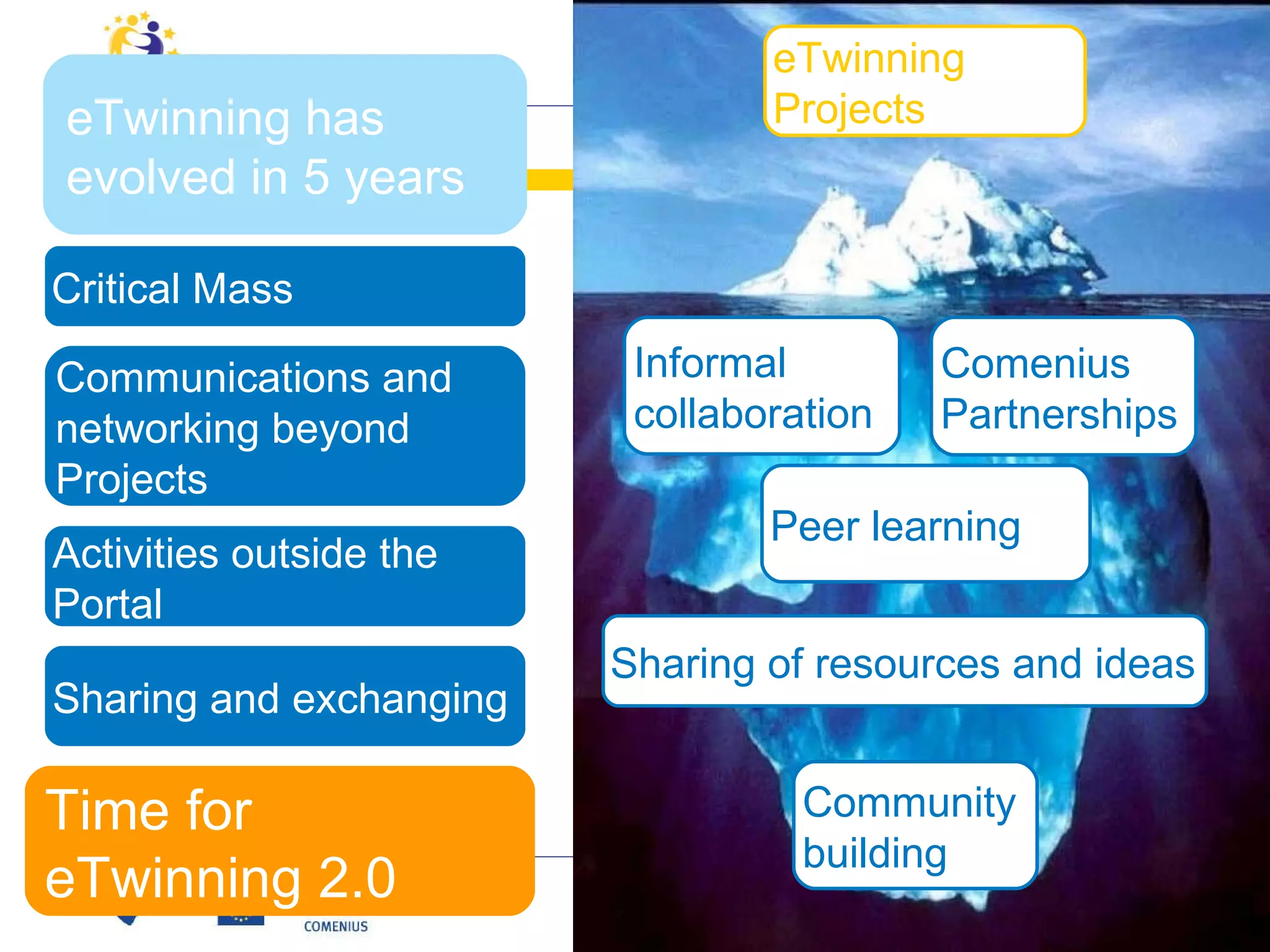
Informal  collaboration Comenius  Partnerships Peer learning Sharing of resources and ideas Community building eTwinning Projects eTwinning has evolved in 5 years Time for eTwinning 2.0 Critical Mass Communications and networking beyond Projects Activities outside the Portal Sharing and exchanging
eTwinning 2.0
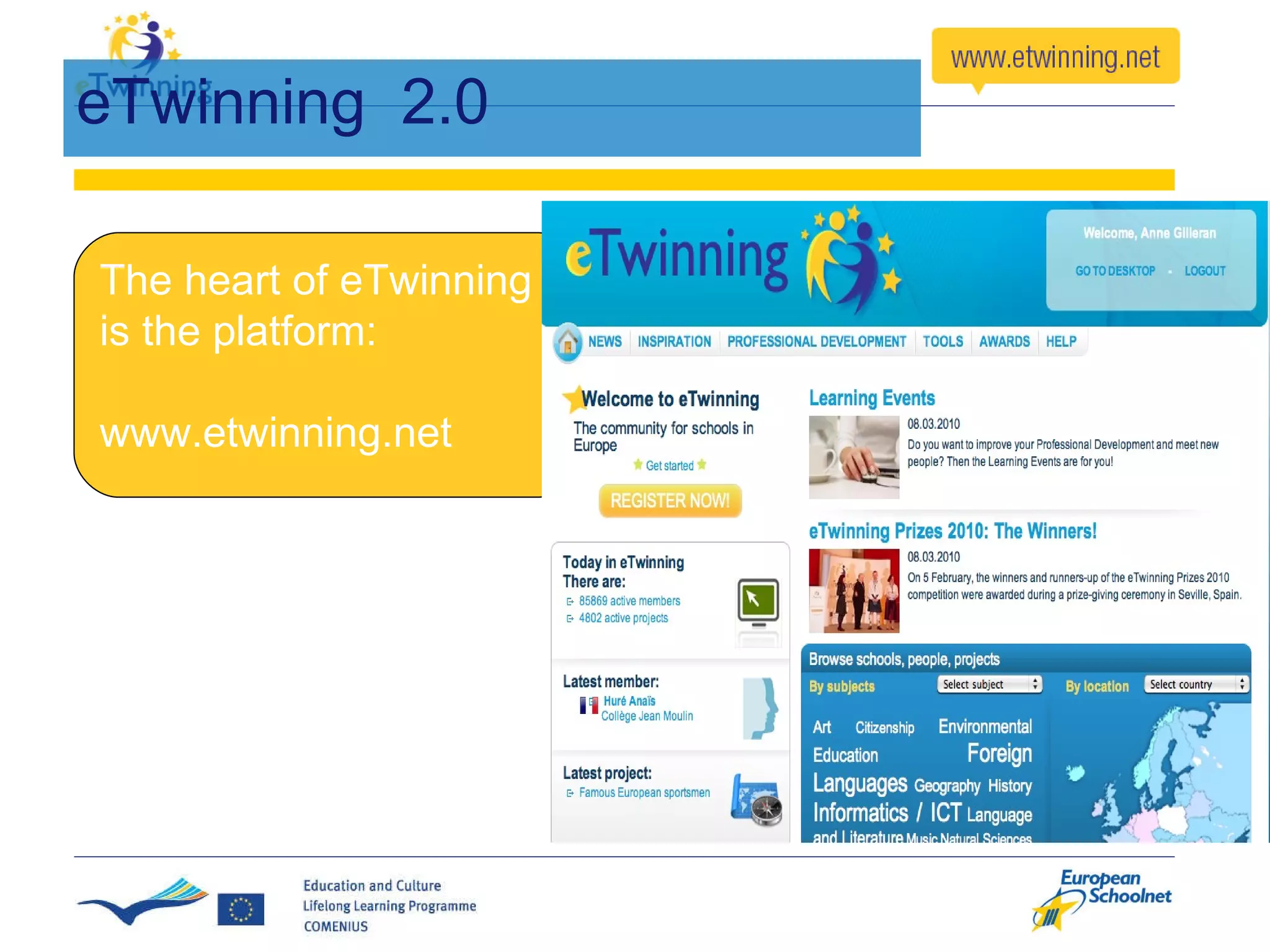
eTwinning  2.0 The heart of eTwinning is the platform: www.etwinning.net
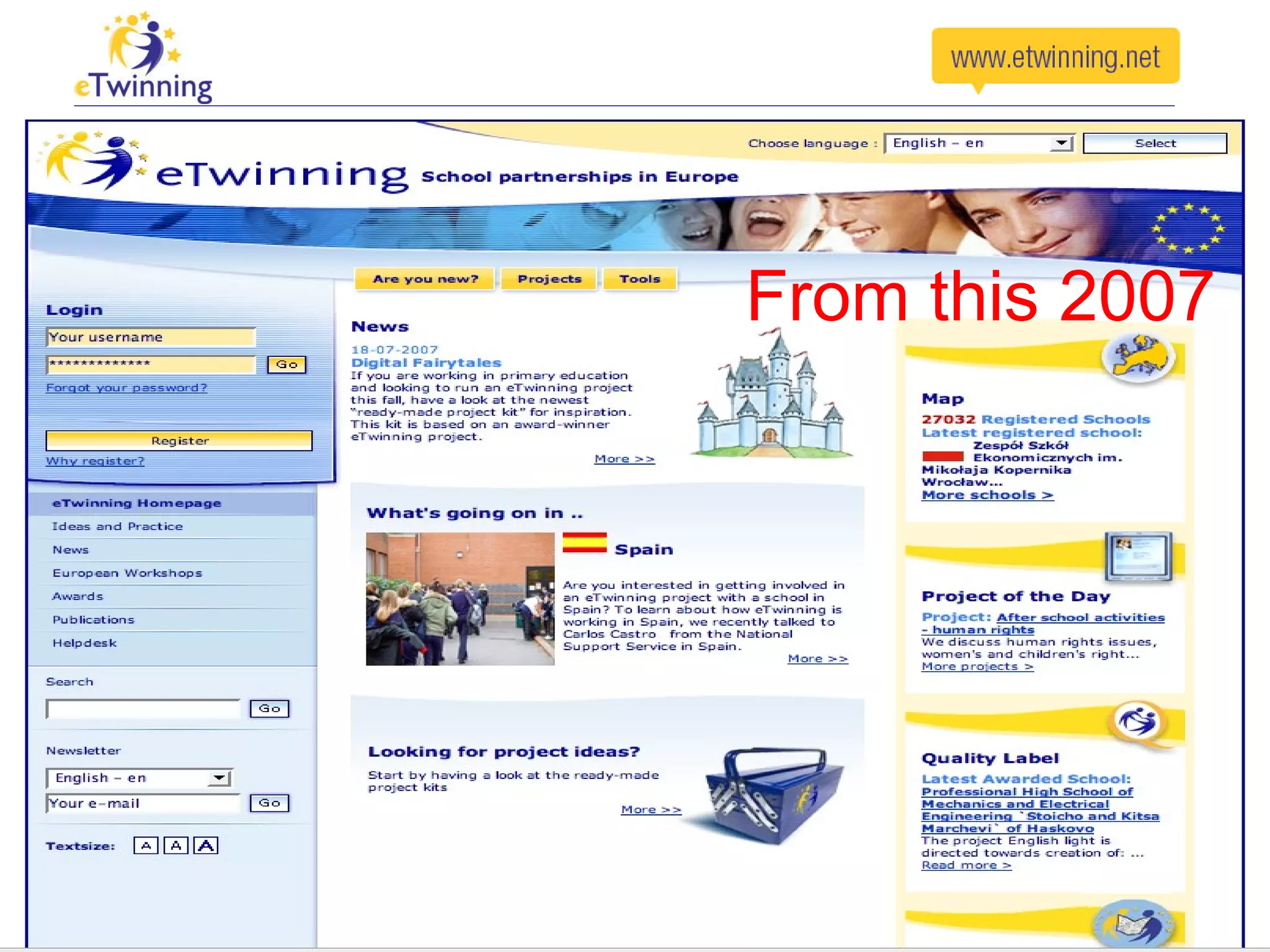
eTwinning Portal 2007 From this 2007
 
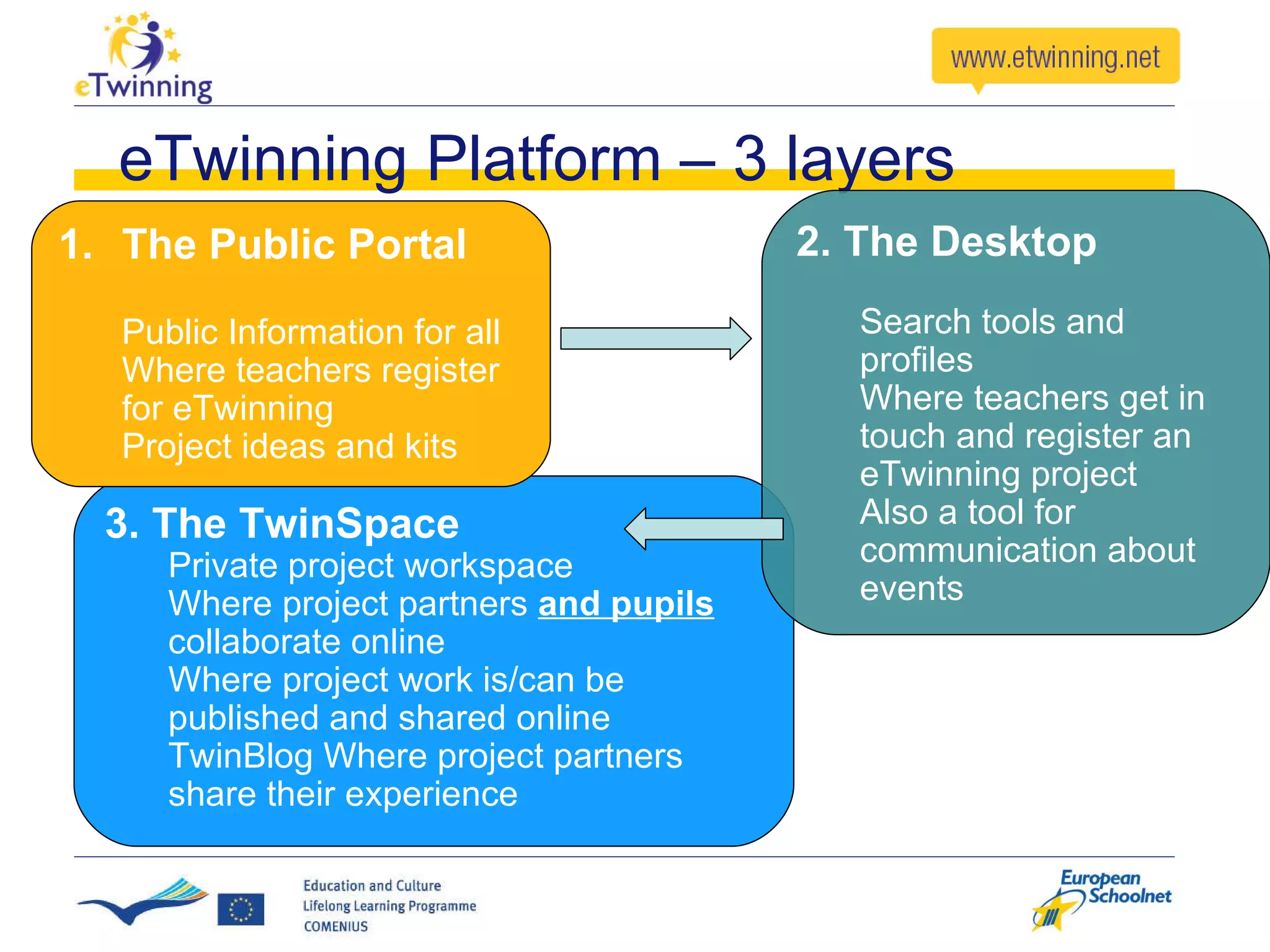
eTwinning Platform – 3 layers 3. The TwinSpace Private project workspace Where project partners  and pupils  collaborate online Where project work is/can be published and shared online TwinBlog Where project partners share their experience 2. The Desktop Search tools and profiles Where teachers get in touch and register an eTwinning project Also a tool for communication about events The Public Portal Public Information for all Where teachers register for eTwinning Project ideas and kits
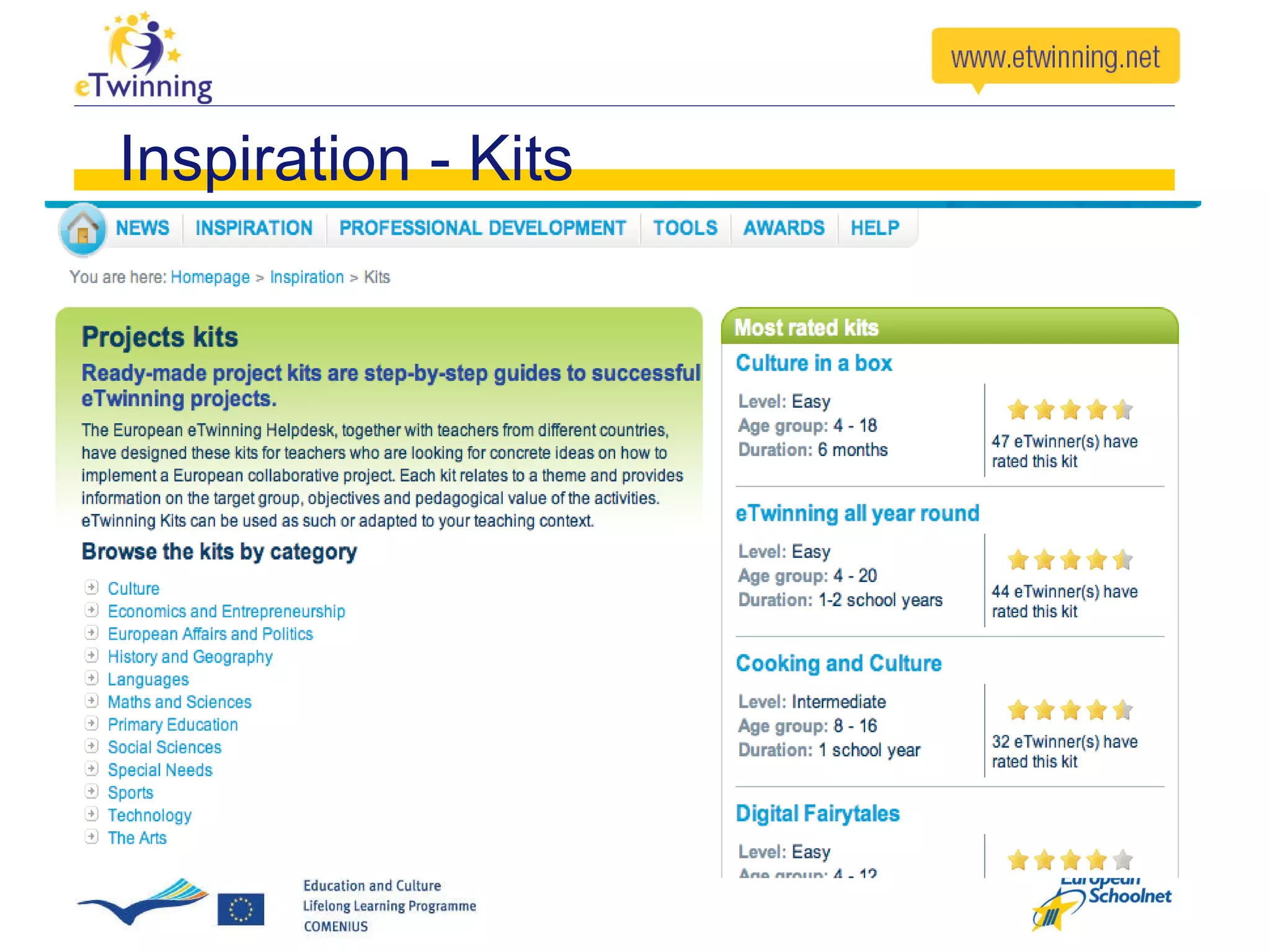
Inspiration - Kits
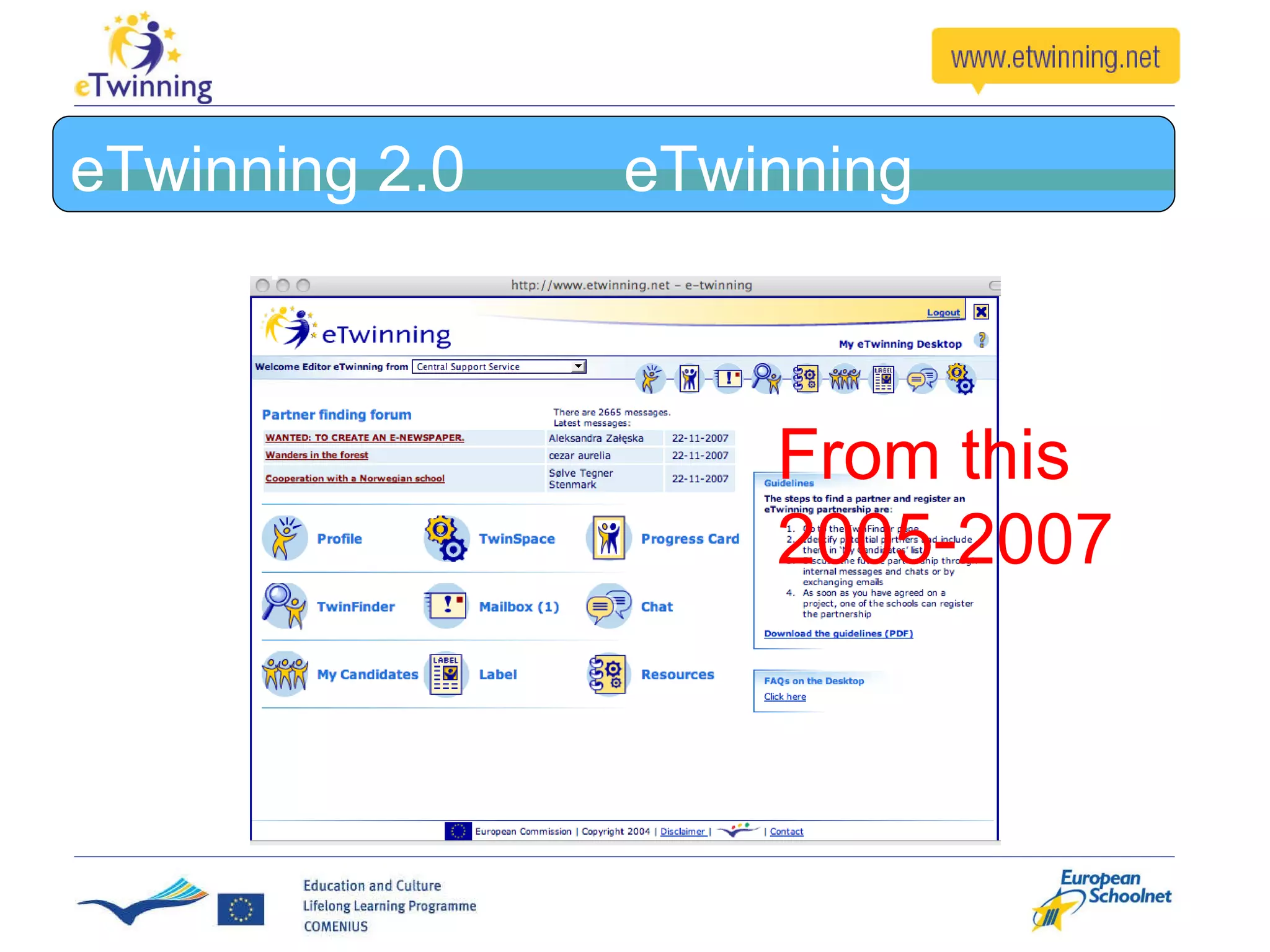
eTwinning 2.0  eTwinning Desktop From this  2005-2007
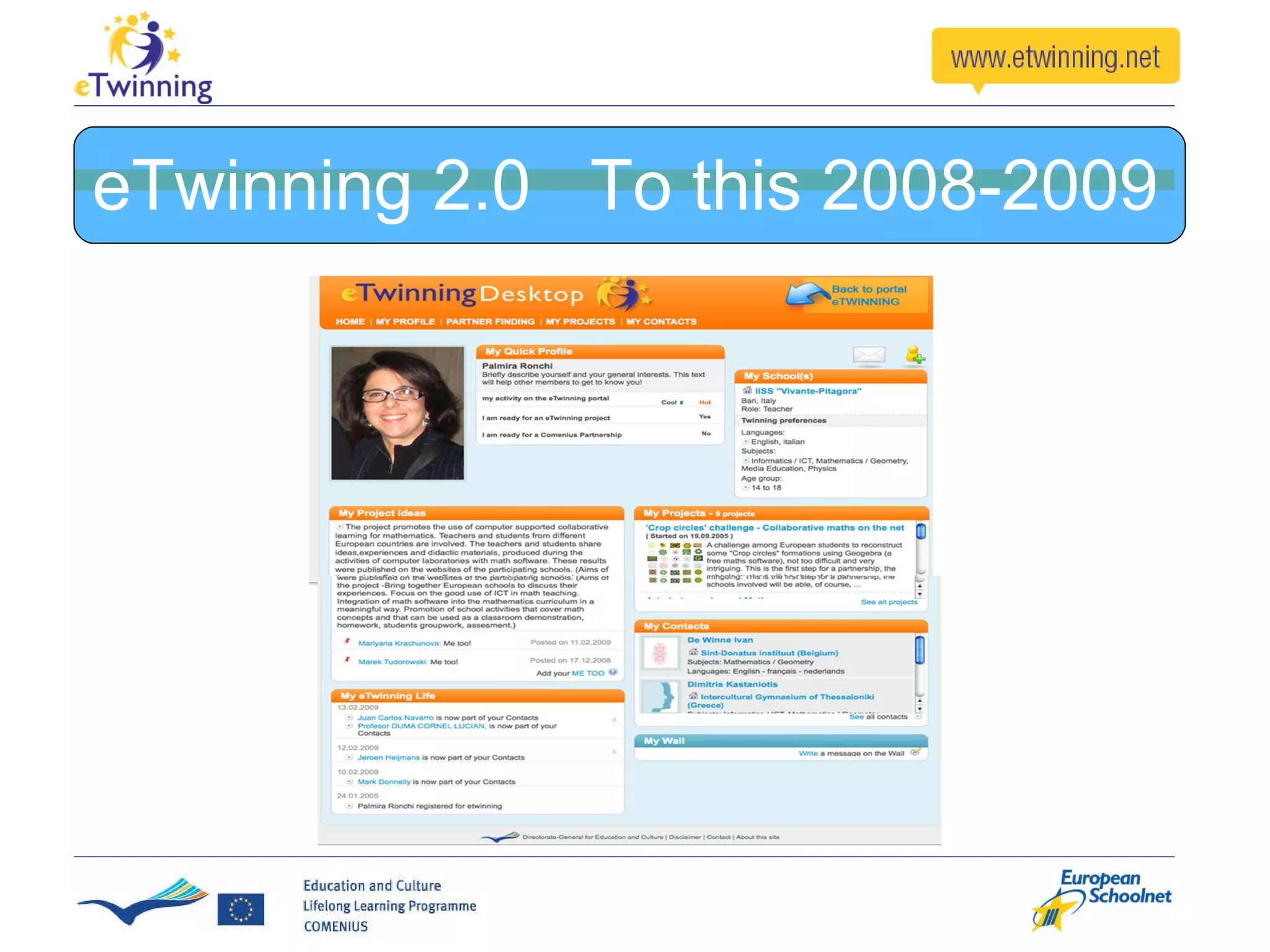
eTwinning 2.0  To this 2008-2009
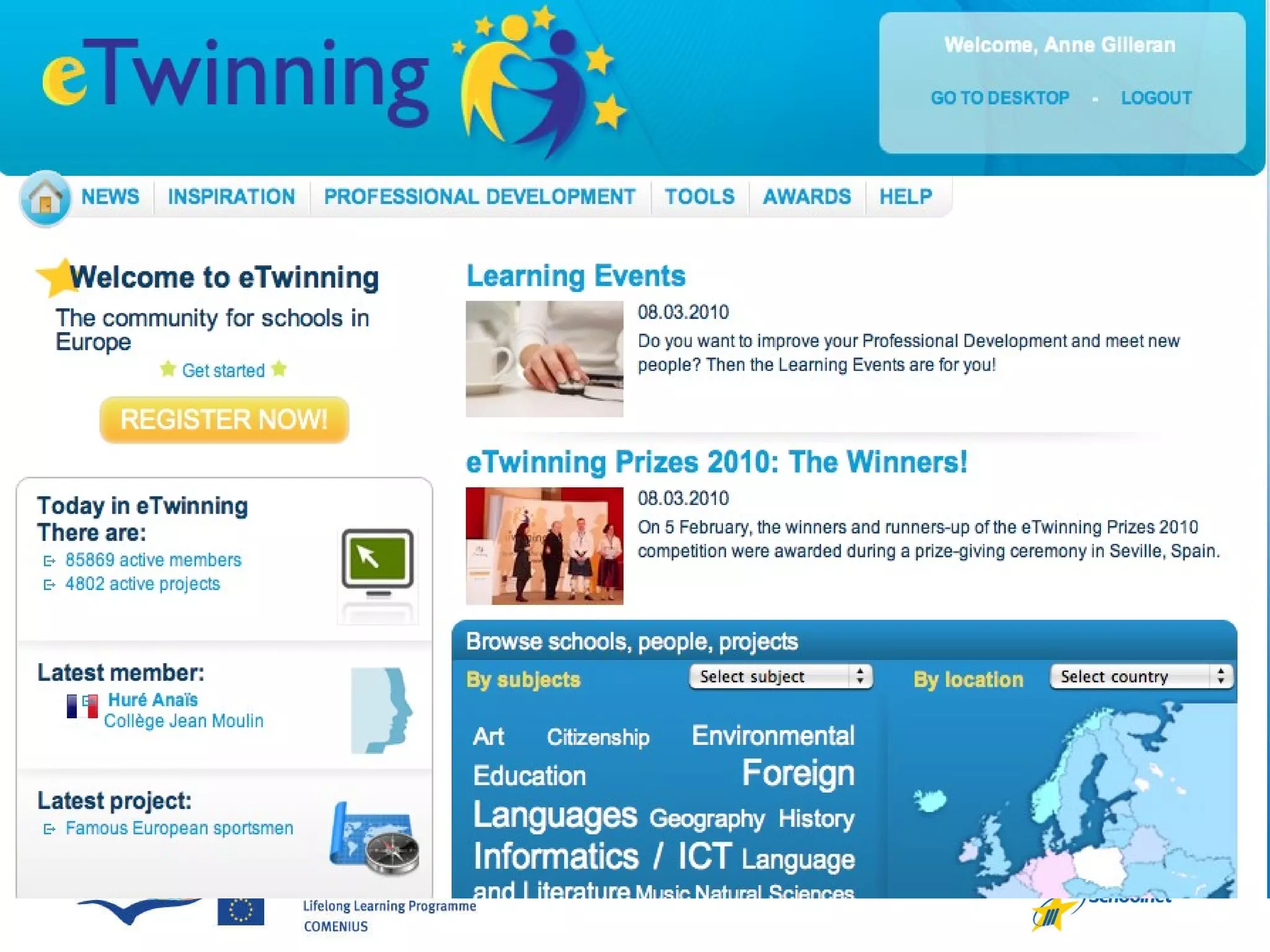
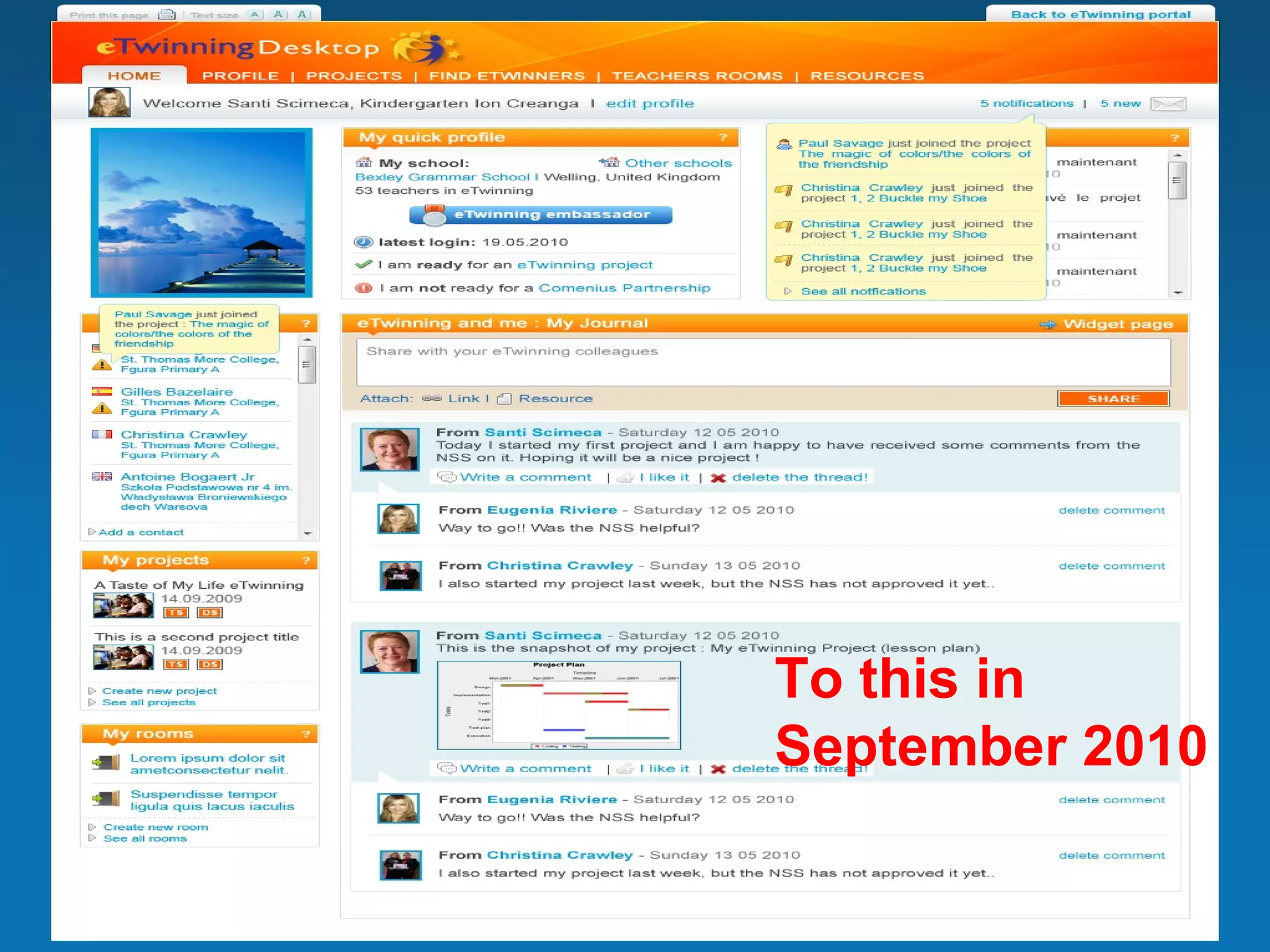
To this in September 2010
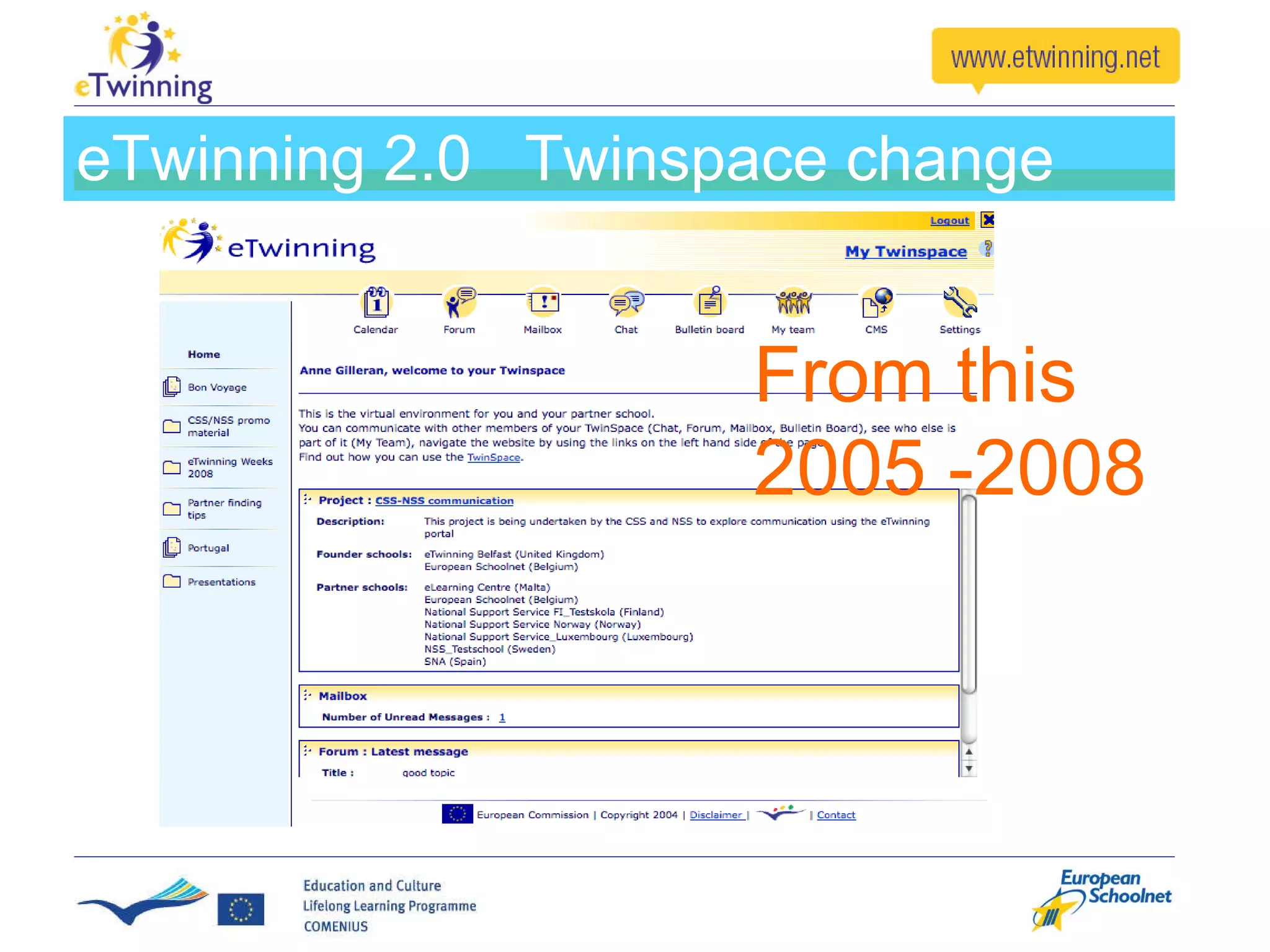
eTwinning 2.0  Twinspace change From this 2005 -2008
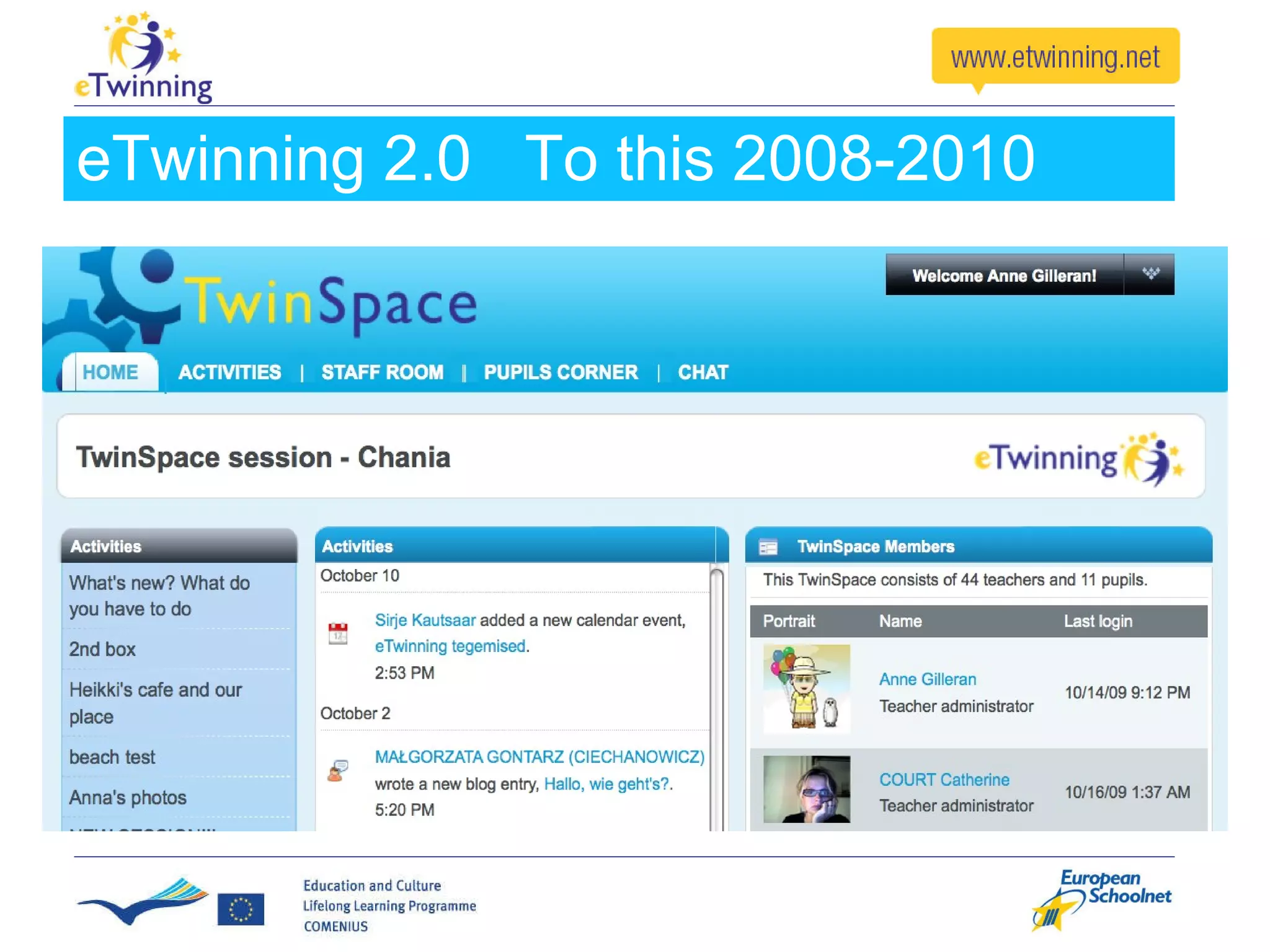
eTwinning 2.0  To this 2008-2010
The evolution of eTwinning 2.0 (2010)
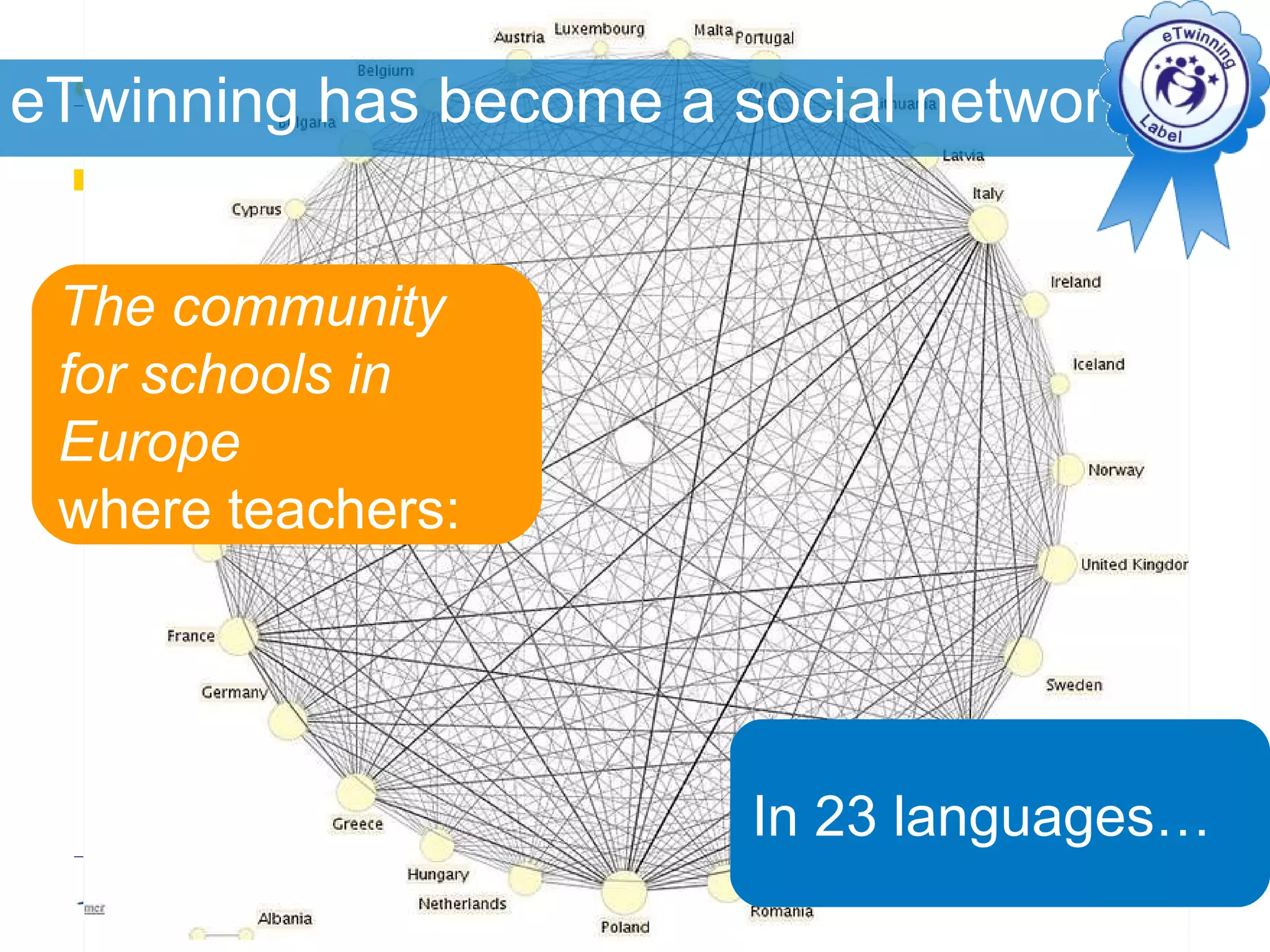
eTwinning has become a social network Find each other  and get in touch Set up & run projects with their pupils Are engaged in  informal learning Share practice  and ideas The community for schools in  Europe  where teachers: In 23 languages…
eTwinning has also become…….  Informal exchange & reflection  eTwinning Learning Events eTwinning Groups European Professional Development Workshops Bi- Lateral workshops A network providing opportunities for formal & informal  Continuing Professional Development (CDP) 21,000 teachers were involved in the formal aspects of CDP through eTwinning in 2009
Possible features of an online community: people who  interact socially  while striving to  satisfy their own needs ; shared purpose  (an interest, need, information exchange, or service) that provides a reason for the community to exist; policies in the form of  tacit assumptions , rituals, protocols, rules, and laws that guide people’s interactions;  And  computer systems  that support and mediate social interactions and facilitate a sense of togetherness. Preece (2000) cited in Ala-Mutka (p.25, 2008)  Online Learning Communities
Brian’s Conclusions eTwinning  is  now an online community of teachers. The community aspect is being reinforced through Learning Events and eTwinning Groups  http://www.slideshare.net/holmebn/e-twinning-pdw-28-5-10
 
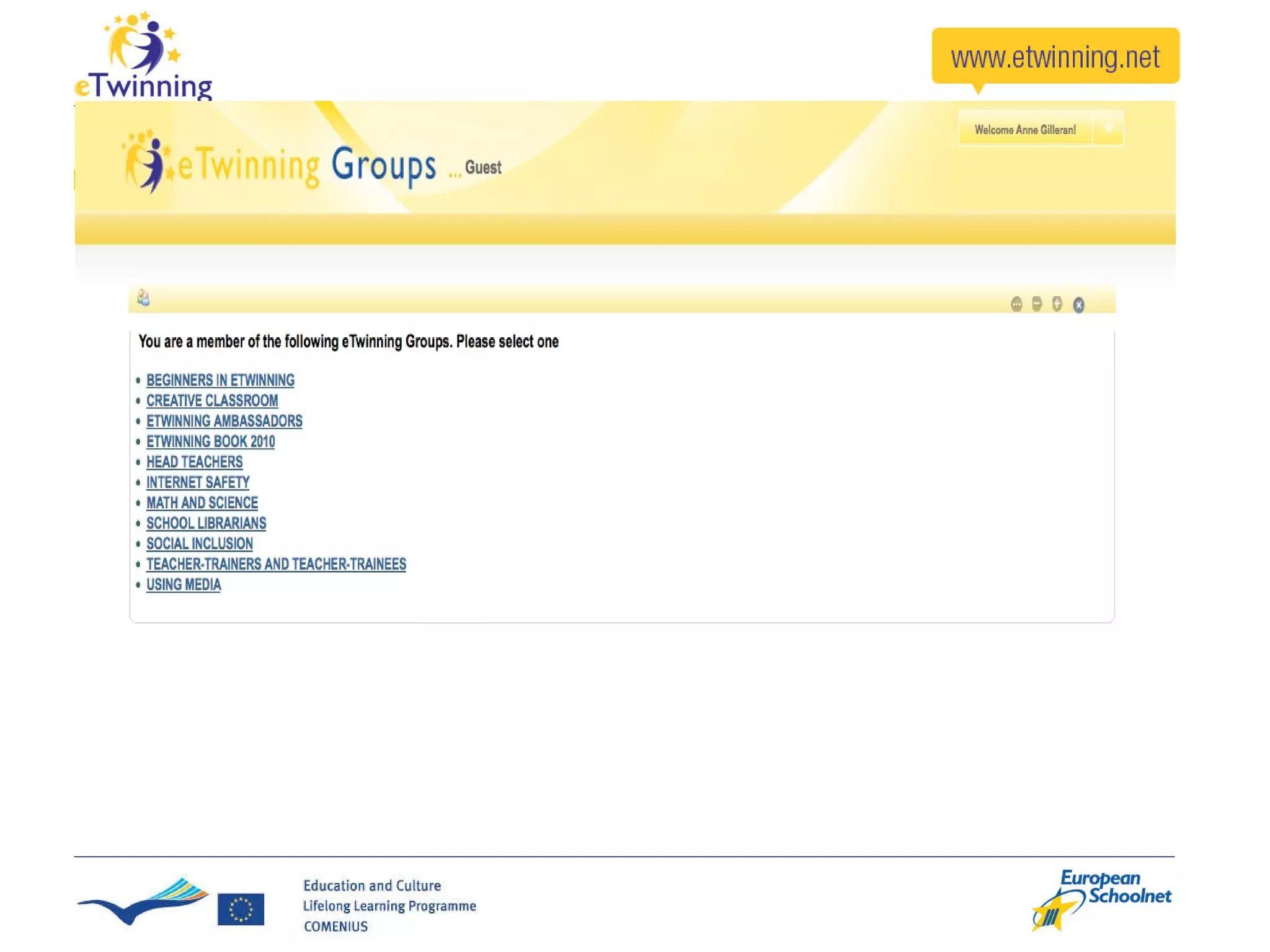
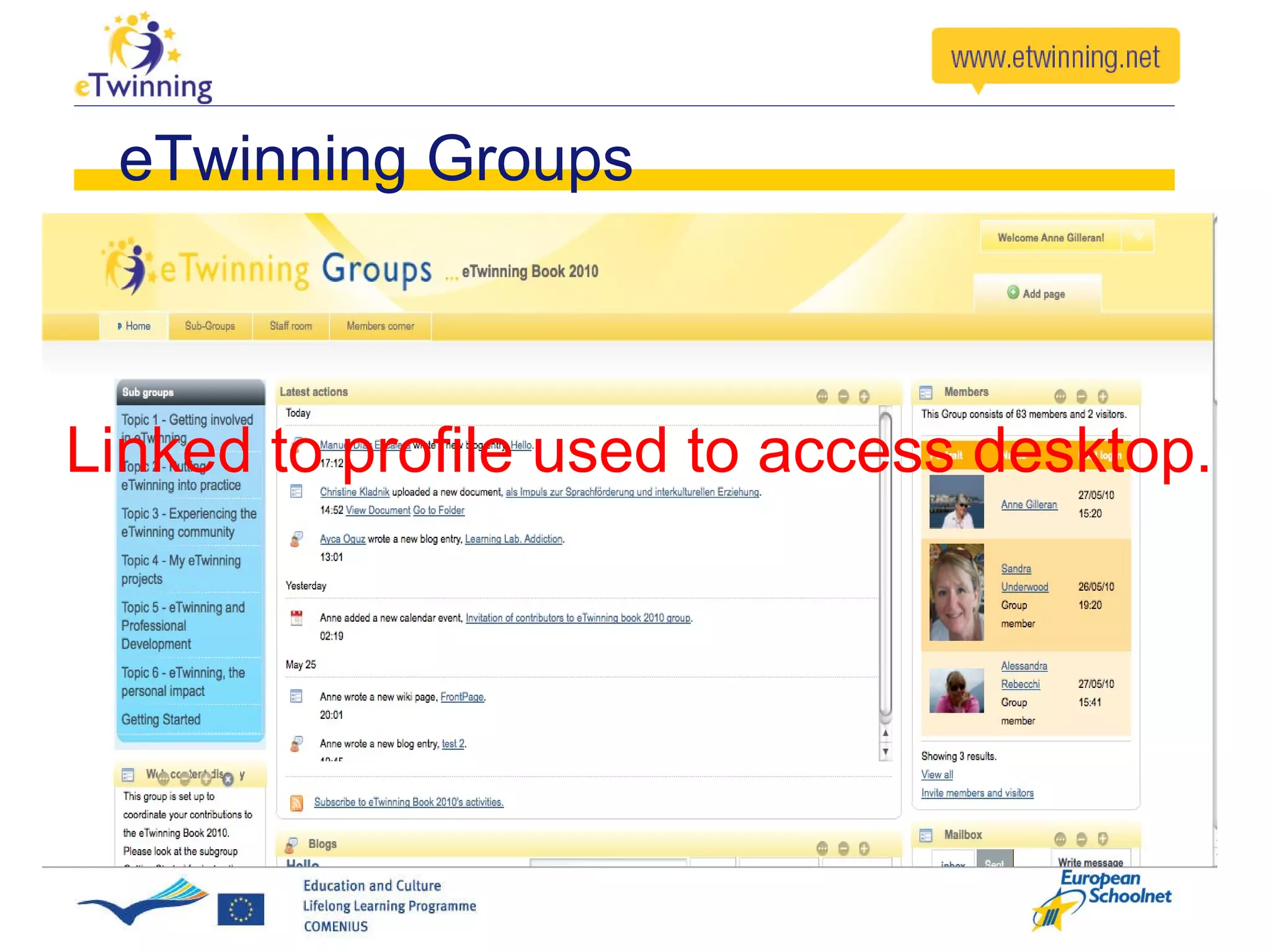
eTwinning Groups Linked to profile used to access desktop.
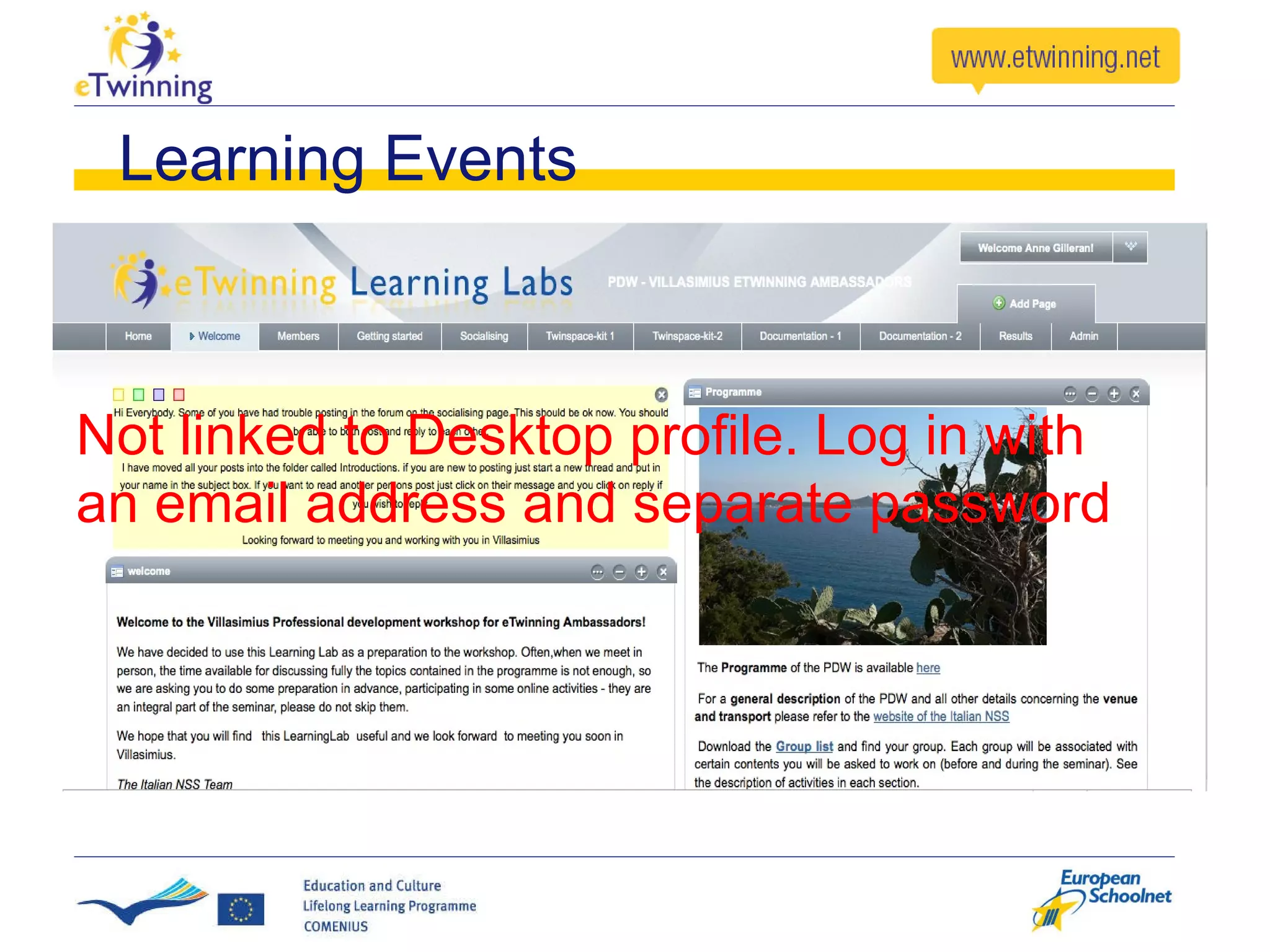
Learning Events Not linked to Desktop profile. Log in with an email address and separate password
Educational Considerations  in relation to  eTwinning 2.0
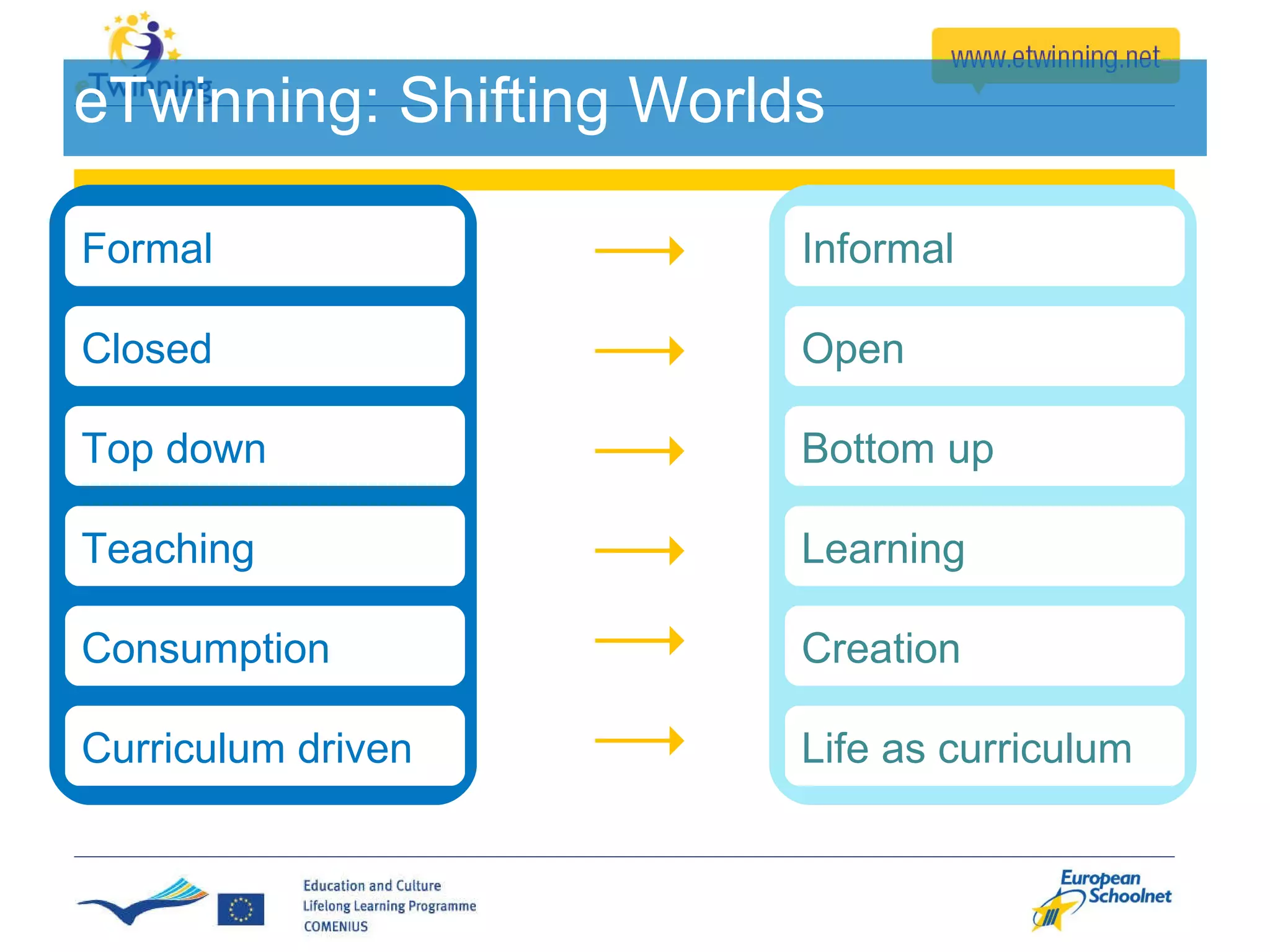
eTwinning: Shifting Worlds Formal Closed Top down Teaching Consumption Curriculum driven Informal Open Bottom up Learning Creation Life as curriculum
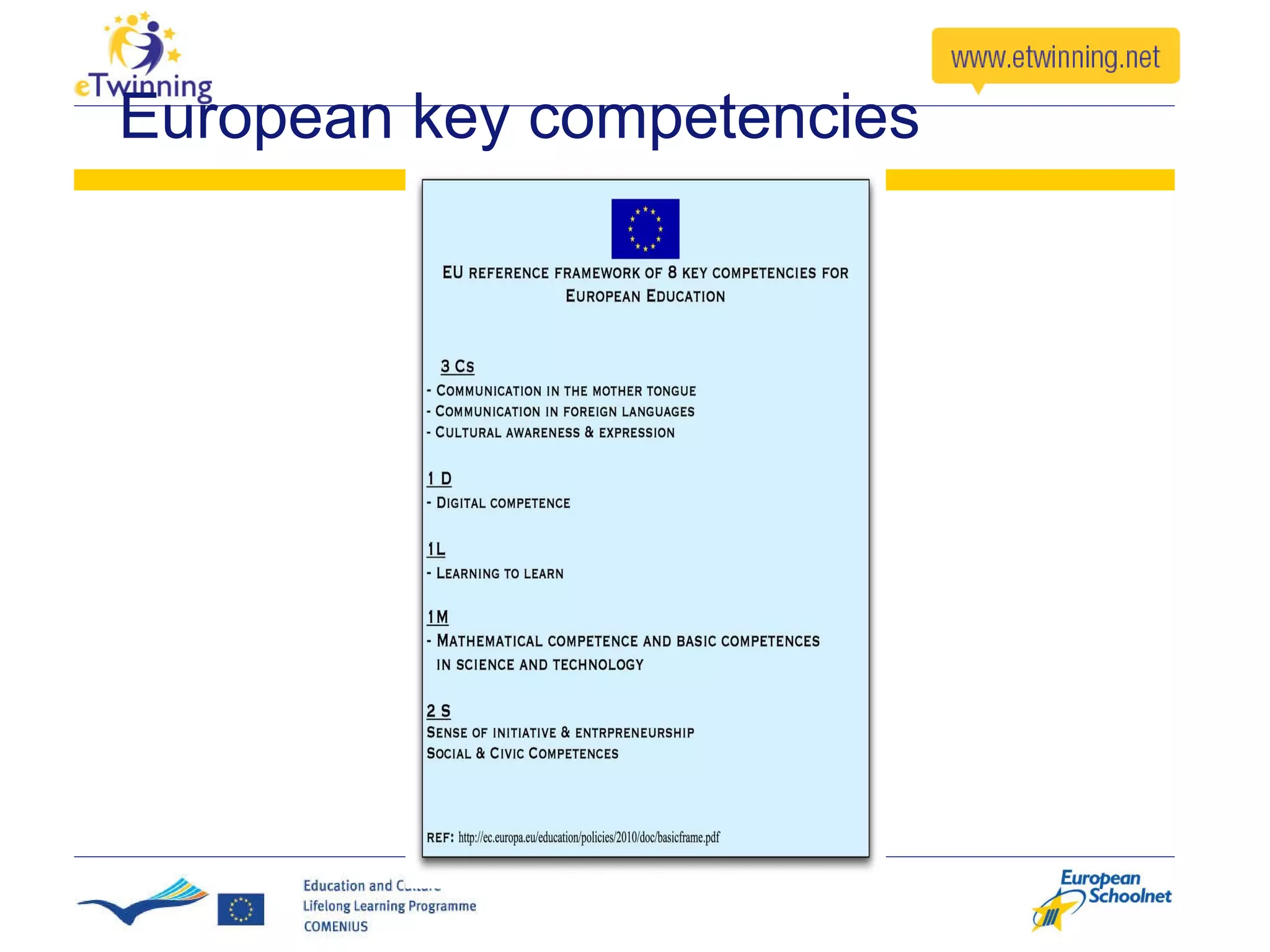
European key competencies
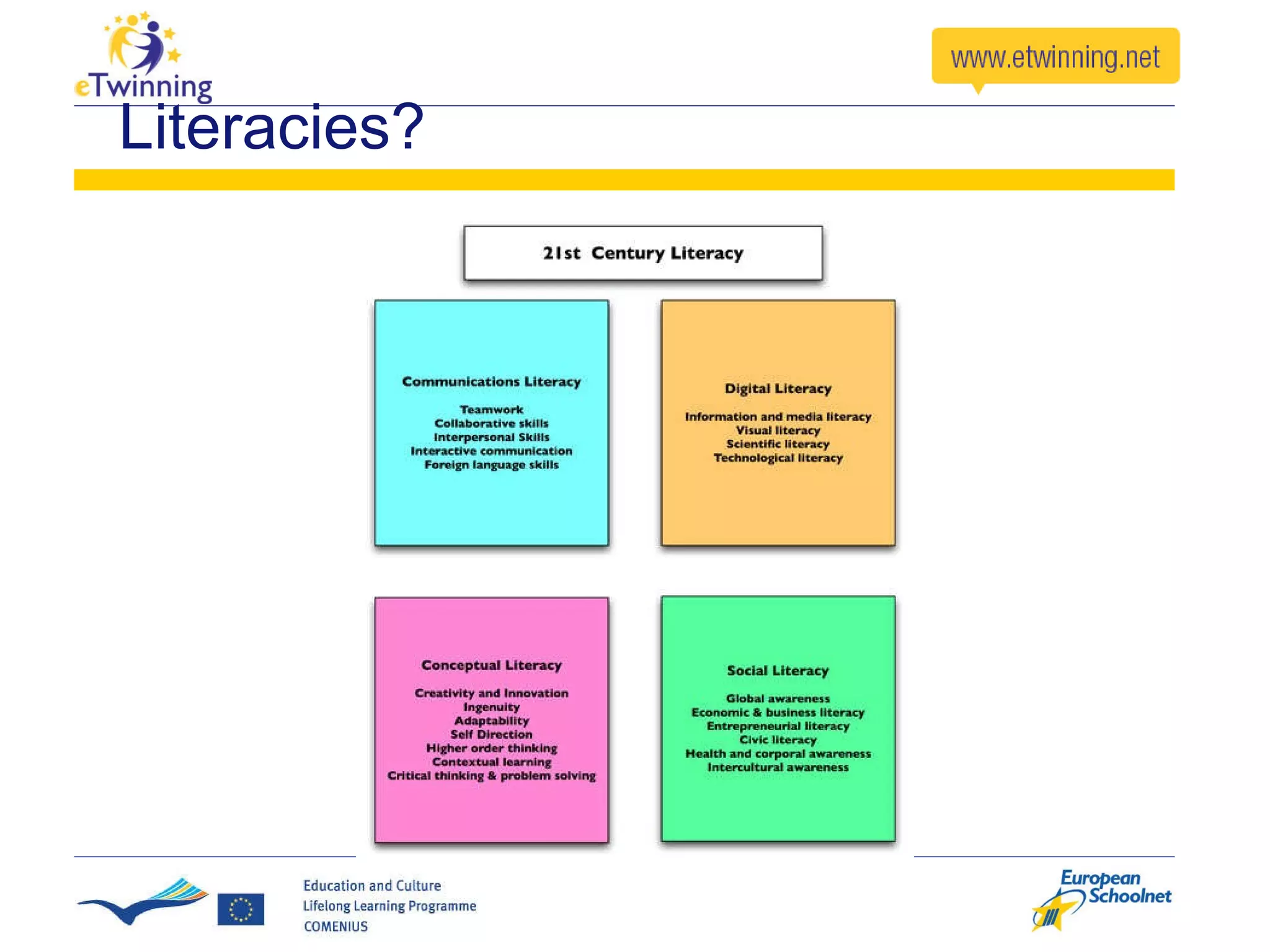
21 Century Literacy
Literacies?
eTwinning helps: To address the challenges of bringing 21 Century skills into your school Utilises Web 2.0 technology to assist the educational process in a safe environment
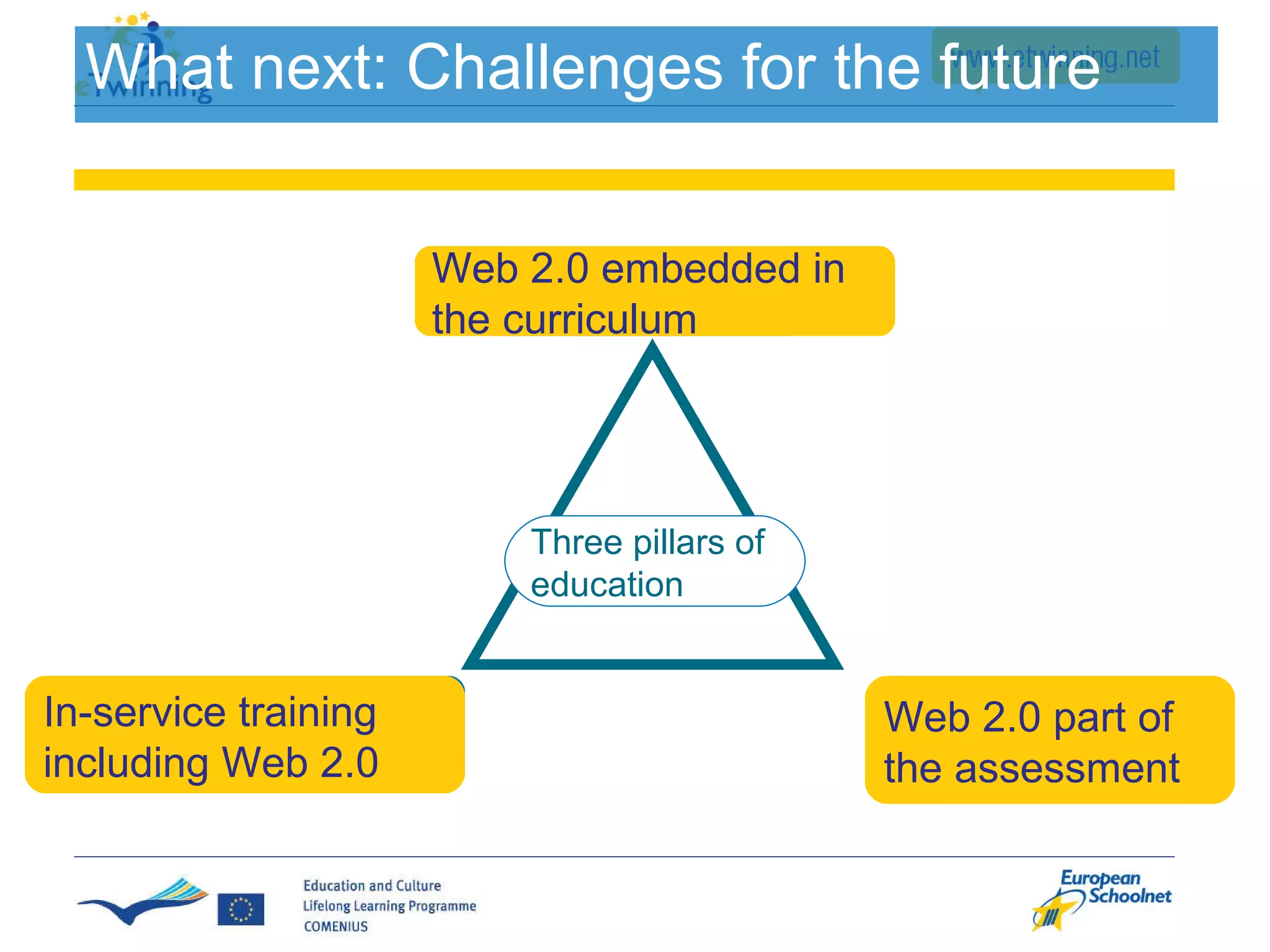
What next: Challenges for the future Curriculum Teaching process Assessment Web 2.0 embedded in the curriculum Web 2.0 part of the assessment In - service training including Web 2.0 Three pillars of education
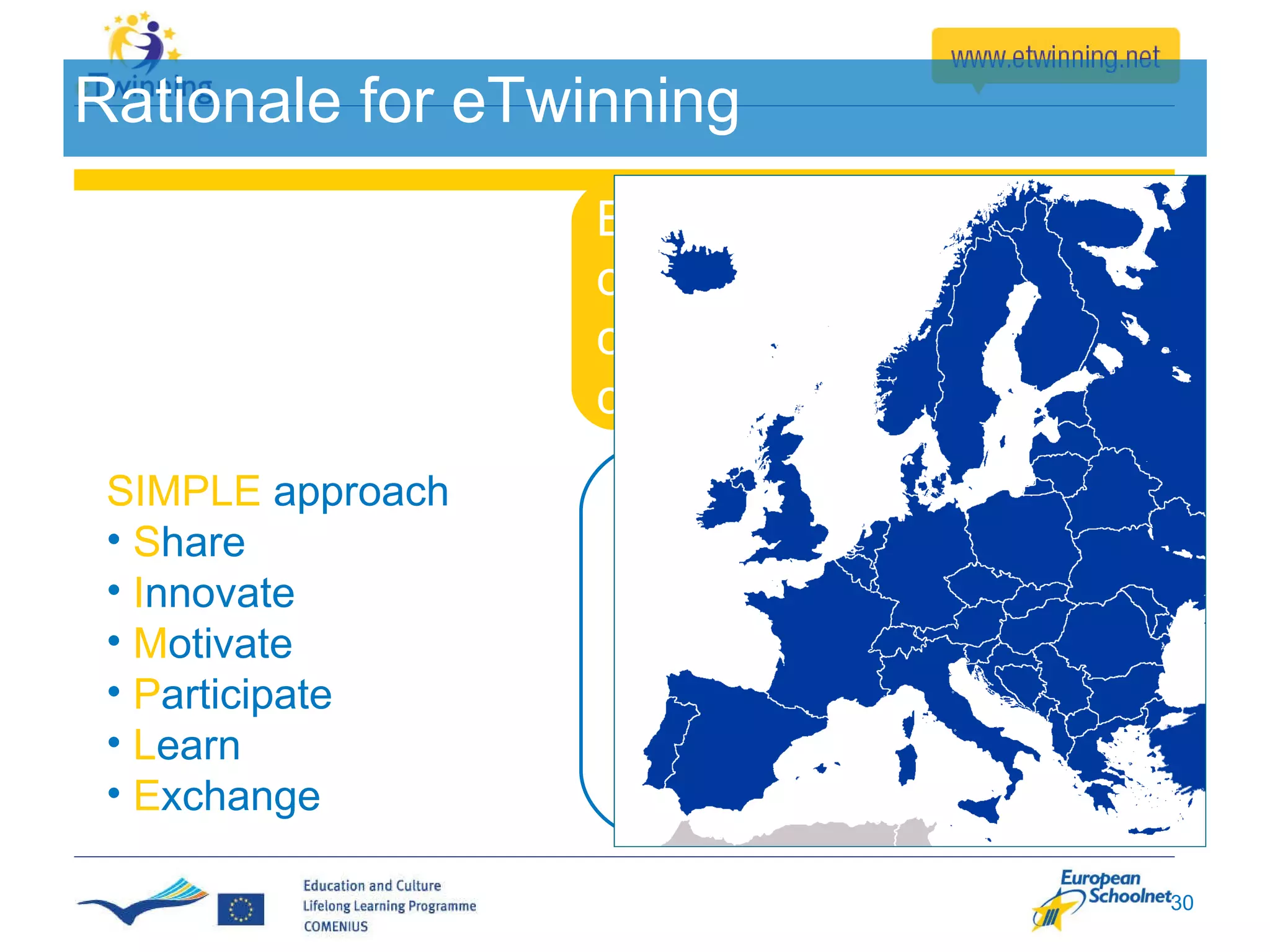
Rationale for eTwinning Based on the twin concepts of cooperation and collaboration SIMPLE  approach S hare I nnovate M otivate P articipate L earn E xchange
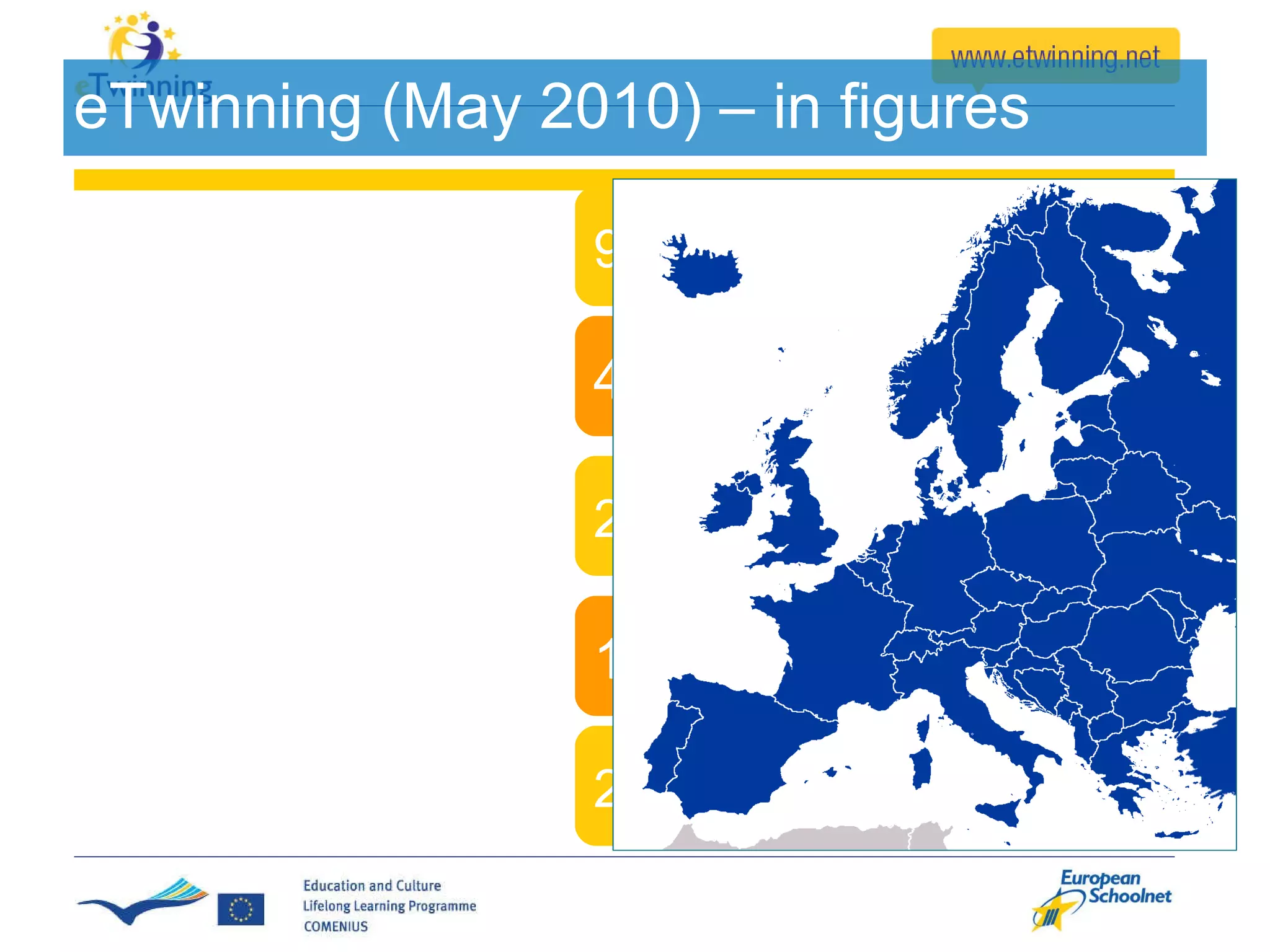
94,000 users 1000000 messages 20,000+ users/day 2,35000 pupils 41,000 projects eTwinning (May 2010)  – in figures
Why are you here?
5 objectives for 2010 Building the eTwinning community More pupil involvement in eTwinning Professional Development Involving new teachers and schools Strengthening the relationship between NSS/CSS
You have helped to do all this! You are the people who help to make eTwinning what it is.
In education today the roles of pupils and teachers are blurring.  Final reflections - The 21 century challenges us all to grasp, understand and control the forces of technology. Technology is only as good as the use we make of it
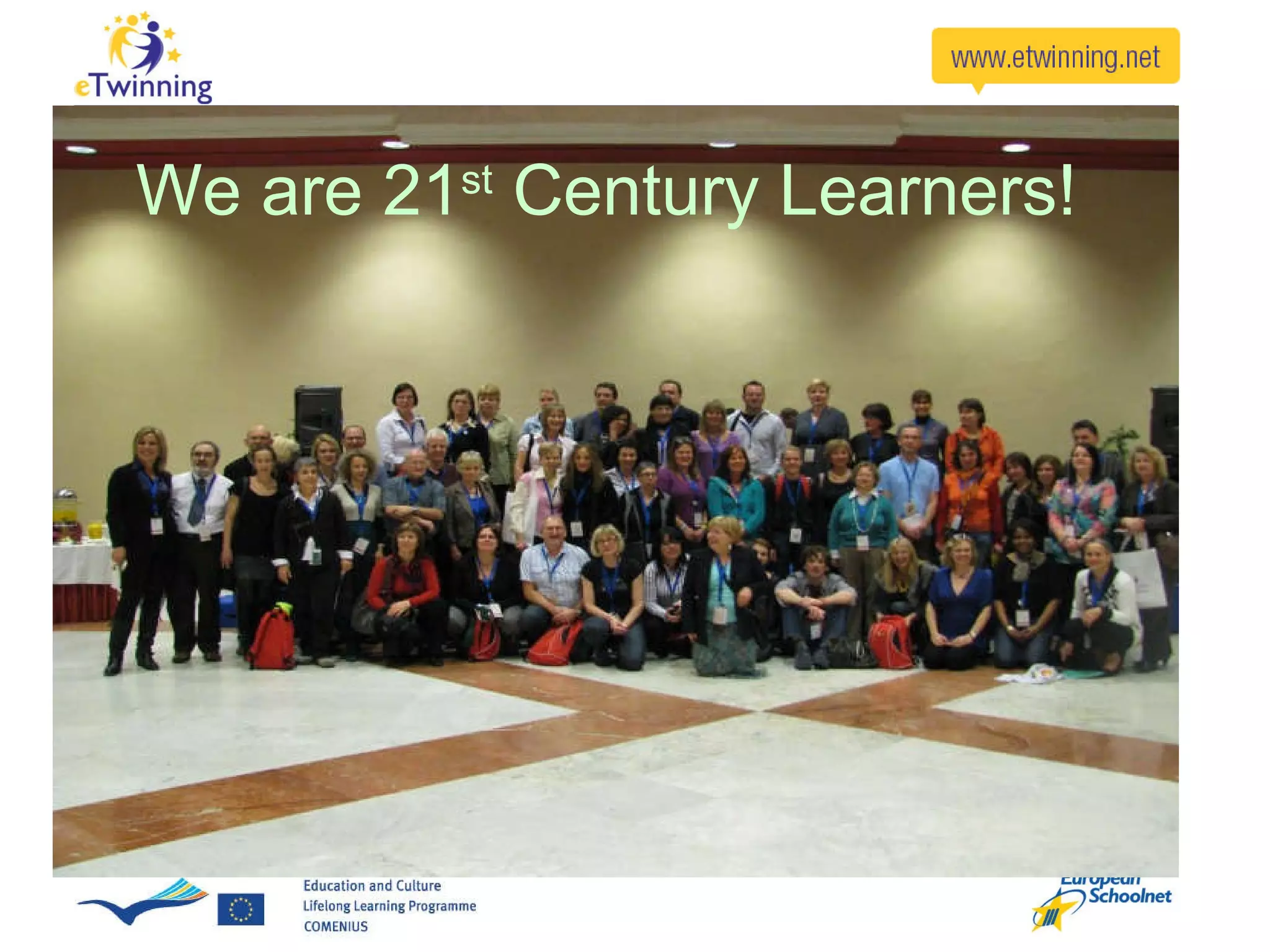
I am 21 st  Century Learner  ! We are 21 st  Century Learners!
Thank you for your attention! eTwinning portal: www.etwinning.net Contacts: [email_address]

eTwinning 2.0 from prjects to community

  • 1.
    eTwinning 2.0 -from projects to community Anne Gilleran Pedagogical Manager eTwinning Central Support Service Professional Development Workshop Villasimius – Sardinia May 2010
  • 2.
  • 3.
    Informal collaborationComenius Partnerships Peer learning Sharing of resources and ideas Community building eTwinning Projects eTwinning has evolved in 5 years Time for eTwinning 2.0 Critical Mass Communications and networking beyond Projects Activities outside the Portal Sharing and exchanging
  • 4.
  • 5.
    eTwinning 2.0The heart of eTwinning is the platform: www.etwinning.net
  • 6.
    eTwinning Portal 2007From this 2007
  • 7.
  • 8.
    eTwinning Platform –3 layers 3. The TwinSpace Private project workspace Where project partners and pupils collaborate online Where project work is/can be published and shared online TwinBlog Where project partners share their experience 2. The Desktop Search tools and profiles Where teachers get in touch and register an eTwinning project Also a tool for communication about events The Public Portal Public Information for all Where teachers register for eTwinning Project ideas and kits
  • 9.
  • 10.
    eTwinning 2.0 eTwinning Desktop From this 2005-2007
  • 11.
    eTwinning 2.0 To this 2008-2009
  • 12.
    To this inSeptember 2010
  • 13.
    eTwinning 2.0 Twinspace change From this 2005 -2008
  • 14.
    eTwinning 2.0 To this 2008-2010
  • 15.
    The evolution ofeTwinning 2.0 (2010)
  • 16.
    eTwinning has becomea social network Find each other and get in touch Set up & run projects with their pupils Are engaged in informal learning Share practice and ideas The community for schools in Europe where teachers: In 23 languages…
  • 17.
    eTwinning has alsobecome……. Informal exchange & reflection eTwinning Learning Events eTwinning Groups European Professional Development Workshops Bi- Lateral workshops A network providing opportunities for formal & informal Continuing Professional Development (CDP) 21,000 teachers were involved in the formal aspects of CDP through eTwinning in 2009
  • 18.
    Possible features ofan online community: people who interact socially while striving to satisfy their own needs ; shared purpose (an interest, need, information exchange, or service) that provides a reason for the community to exist; policies in the form of tacit assumptions , rituals, protocols, rules, and laws that guide people’s interactions; And computer systems that support and mediate social interactions and facilitate a sense of togetherness. Preece (2000) cited in Ala-Mutka (p.25, 2008) Online Learning Communities
  • 19.
    Brian’s Conclusions eTwinning is now an online community of teachers. The community aspect is being reinforced through Learning Events and eTwinning Groups http://www.slideshare.net/holmebn/e-twinning-pdw-28-5-10
  • 20.
  • 21.
    eTwinning Groups Linkedto profile used to access desktop.
  • 22.
    Learning Events Notlinked to Desktop profile. Log in with an email address and separate password
  • 23.
    Educational Considerations in relation to eTwinning 2.0
  • 24.
    eTwinning: Shifting WorldsFormal Closed Top down Teaching Consumption Curriculum driven Informal Open Bottom up Learning Creation Life as curriculum
  • 25.
  • 26.
  • 27.
  • 28.
    eTwinning helps: Toaddress the challenges of bringing 21 Century skills into your school Utilises Web 2.0 technology to assist the educational process in a safe environment
  • 29.
    What next: Challengesfor the future Curriculum Teaching process Assessment Web 2.0 embedded in the curriculum Web 2.0 part of the assessment In - service training including Web 2.0 Three pillars of education
  • 30.
    Rationale for eTwinningBased on the twin concepts of cooperation and collaboration SIMPLE approach S hare I nnovate M otivate P articipate L earn E xchange
  • 31.
    94,000 users 1000000messages 20,000+ users/day 2,35000 pupils 41,000 projects eTwinning (May 2010) – in figures
  • 32.
  • 33.
    5 objectives for2010 Building the eTwinning community More pupil involvement in eTwinning Professional Development Involving new teachers and schools Strengthening the relationship between NSS/CSS
  • 34.
    You have helpedto do all this! You are the people who help to make eTwinning what it is.
  • 35.
    In education todaythe roles of pupils and teachers are blurring. Final reflections - The 21 century challenges us all to grasp, understand and control the forces of technology. Technology is only as good as the use we make of it
  • 36.
    I am 21st Century Learner ! We are 21 st Century Learners!
  • 37.
    Thank you foryour attention! eTwinning portal: www.etwinning.net Contacts: [email_address]