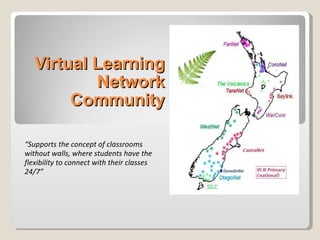
Virtual Learning Network Community “ Supports the concept of classrooms without walls, where students have the flexibility to connect with their classes 24/7”
A shared history' - Key Events Early 1990s The Correspondence School begins trialling telecommunications technology 1994 – Cantatech – audiographics classes 2000 - KAWM 2001 – OtagoNet, developing relationships with Tertiary & 3rd party educational organisations 2002 – initiation of Project Probe 2002 – establishment of VLN (within TCS) 2002 - MOE funding for VC bridge 2003 – eLearning schools clusters mushroom nationally 2004 – VLN moves to the MOE  2006 – further clusters join the VLN 2007 – further budget allocation for Cluster Leadership funding 2008 – Primary schools participate in the VLN 2010 - establishment of the 'VLN Community' greater focus on blended learning, widening & diverse partnerships 2011/16 - UFB rollout /  managed national network ??
 
VLN   Community – Organisation
Common Characteristics of eLearning  Clusters 'Self- organising' nature of development, driven from the 'grass roots', Ad hoc funding has come from unsustainable sources  (small &  emerging clusters more vulnerable), Community Trusts ICTPD Collaborative Innovations Funding EHSAS (Extending High Standards Across Schools) eLCLF (eLearning Cluster Leadership Funding), Staffing – most follow contributed staffing 'reciprocal' model, Similar goals & issues, National support from the MoE VLN services.
VLN Secondary Schools 2002 12 schools sharing classes VLN Statistics   2010 Schools:268  Teachers:170  Classes:258  Enrolments:1526  (inl.Primary ) VLN Enrolments - A pattern of Growth
VLN – Key Statistics March 2011 Video Conferencing: 16234 sessions, 5463 hours Adobe Web Conferencing: 163 meeting rooms, 73 hours. Asynchronous access: 20 MoE hosted Moodle sites  total 5145 unique visitors approx 6000 hours total WestNet 800; EduCo 2783; WelCom 3,800 registered users OtagoNet 2000+ Google Apps users  
4 P’s of Learning Online P articipation  in: P rojects (Virtual fieldtrips, collaborative learning, connecting with authors) P rogrammes   (NCEA, tertiary courses, Y 7 & 8 Languages, expert tuition) P rofessional Learning (online PD, working with experts)
Projects  Digital conversations Connecting with experts Virtual field trips Scholarship Mentoring
Cluster based National collaborations VPLD Professional Learning Opportunities
Participating in an online learning community requires commitment to a common vision and understanding: Moving away from traditional timetable based approach, 24/7 learning, Completion of work rather than attendance, Flexibility to suit different learning styles, Willingness to share resources (people and $). Significant Shift in Thinking Cluster or Group of Schools
97% of Schools to Access UFB by 2016 Opportunity for schools to connect and collaborate via online learning communities. What does this mean for – Teaching in (and outside) the classroom? Professional learning? School administration? Home school relationships? Student-led learning?
Benefits of Online Learning Communities Maximises   teaching resource and expertise, Wider choice of curriculum subjects, Flexibility - can personalise learning to suit individual learning styles and interests, Greater access to subject matter experts, More opportunity for learning outside the classroom and practical experiences eg virtual field trips, More opportunity for peer to peer mentoring and collaboration, Increased access to relevant and current learning resources, Greater professional learning opportunities for staff, Specialist staff retention.
Students: Multiple entry points How to work together  ‘ Blended’ learning (teacher-led) The expert   Teacher or teachers Availability How to facilitate Whānau and  community  Learning collection Tertiary organisations Other organisations Te Papa Crown Ag research
‘ Blended’ learning - student-led Students create their own learning environment Invite the expert Invite other students “ I am in control of my learning” Invite whānau Invite the teacher Learning collection
VLNS Collaborative Learning Tools Video/audio conferencing ‘ course’ booking/scheduling system Elgg group collaboration Elgg Teacher and student led learning  Moodle (a learning management system or LMS),  Mahara (ePortfolio service)  LAMS Tandberg Content Server (video streaming) Adobe Connect web conferencing.
VLN site 1. VLN Communities:  Supports online Communities of Practice (closed or open ) More than 141 groups currently active.  To register :  www.vln.school.nz/pg/groups/world/
VLN site 2. Learning Exchange http://pol.vln.school.nz/search   Coordinates all programmes and projects offered over VLN.  Around 300 programmes offered each year including NCEA, primary languages, Te Papa, Tertiary etc
LAMS Kura Project
LAMS Kura Project
http://www.v7.breezeserver.co.nz/p13736586/   LAMS Kura Project
ELLINZ   ELLINZ (ESOL) pilot demonstrates how students can help other students develop English language skills in a virtual environment.
ELLINZ Supporting environments
VLN – Primary http://tiny.cc/vlnprimary  
Adobe Connect
Virtual Professional Learning Development http://vpd.vln.school.nz/
LCO handbook Resource for schools in online learning communities to enable effective online collaboration for teaching and learning Based on ten years of knowledge and experience of VLN cluster schools  A work in progress Available online at: http ://www.vln.school.nz/lcohandbook/
Challenges Technical barriers including bandwidth Changing work patterns for eTeachers (career pathways) Shared staffing and resources Need for onsite student support Sustainability, growth & development (scalability & costs) Changing models of education - doing things differently!
Future Focus What is our future focus as an organisation? Where do we see ourselves in 5 years time? Articulating a vision for student outcomes? How do we work in partnership with the MoE to achieve that? Joint co-ordinated policy and planning?

Final vlnc elearningapril_2011 (1)

  • 1.
    Virtual Learning NetworkCommunity “ Supports the concept of classrooms without walls, where students have the flexibility to connect with their classes 24/7”
  • 2.
    A shared history'- Key Events Early 1990s The Correspondence School begins trialling telecommunications technology 1994 – Cantatech – audiographics classes 2000 - KAWM 2001 – OtagoNet, developing relationships with Tertiary & 3rd party educational organisations 2002 – initiation of Project Probe 2002 – establishment of VLN (within TCS) 2002 - MOE funding for VC bridge 2003 – eLearning schools clusters mushroom nationally 2004 – VLN moves to the MOE 2006 – further clusters join the VLN 2007 – further budget allocation for Cluster Leadership funding 2008 – Primary schools participate in the VLN 2010 - establishment of the 'VLN Community' greater focus on blended learning, widening & diverse partnerships 2011/16 - UFB rollout / managed national network ??
  • 3.
  • 4.
    VLN Community – Organisation
  • 5.
    Common Characteristics ofeLearning  Clusters 'Self- organising' nature of development, driven from the 'grass roots', Ad hoc funding has come from unsustainable sources (small &  emerging clusters more vulnerable), Community Trusts ICTPD Collaborative Innovations Funding EHSAS (Extending High Standards Across Schools) eLCLF (eLearning Cluster Leadership Funding), Staffing – most follow contributed staffing 'reciprocal' model, Similar goals & issues, National support from the MoE VLN services.
  • 6.
    VLN Secondary Schools2002 12 schools sharing classes VLN Statistics   2010 Schools:268 Teachers:170 Classes:258 Enrolments:1526 (inl.Primary ) VLN Enrolments - A pattern of Growth
  • 7.
    VLN – KeyStatistics March 2011 Video Conferencing: 16234 sessions, 5463 hours Adobe Web Conferencing: 163 meeting rooms, 73 hours. Asynchronous access: 20 MoE hosted Moodle sites total 5145 unique visitors approx 6000 hours total WestNet 800; EduCo 2783; WelCom 3,800 registered users OtagoNet 2000+ Google Apps users  
  • 8.
    4 P’s ofLearning Online P articipation in: P rojects (Virtual fieldtrips, collaborative learning, connecting with authors) P rogrammes (NCEA, tertiary courses, Y 7 & 8 Languages, expert tuition) P rofessional Learning (online PD, working with experts)
  • 9.
    Projects Digitalconversations Connecting with experts Virtual field trips Scholarship Mentoring
  • 10.
    Cluster based Nationalcollaborations VPLD Professional Learning Opportunities
  • 11.
    Participating in anonline learning community requires commitment to a common vision and understanding: Moving away from traditional timetable based approach, 24/7 learning, Completion of work rather than attendance, Flexibility to suit different learning styles, Willingness to share resources (people and $). Significant Shift in Thinking Cluster or Group of Schools
  • 12.
    97% of Schoolsto Access UFB by 2016 Opportunity for schools to connect and collaborate via online learning communities. What does this mean for – Teaching in (and outside) the classroom? Professional learning? School administration? Home school relationships? Student-led learning?
  • 13.
    Benefits of OnlineLearning Communities Maximises teaching resource and expertise, Wider choice of curriculum subjects, Flexibility - can personalise learning to suit individual learning styles and interests, Greater access to subject matter experts, More opportunity for learning outside the classroom and practical experiences eg virtual field trips, More opportunity for peer to peer mentoring and collaboration, Increased access to relevant and current learning resources, Greater professional learning opportunities for staff, Specialist staff retention.
  • 14.
    Students: Multiple entrypoints How to work together ‘ Blended’ learning (teacher-led) The expert Teacher or teachers Availability How to facilitate Whānau and community Learning collection Tertiary organisations Other organisations Te Papa Crown Ag research
  • 15.
    ‘ Blended’ learning- student-led Students create their own learning environment Invite the expert Invite other students “ I am in control of my learning” Invite whānau Invite the teacher Learning collection
  • 16.
    VLNS Collaborative LearningTools Video/audio conferencing ‘ course’ booking/scheduling system Elgg group collaboration Elgg Teacher and student led learning Moodle (a learning management system or LMS), Mahara (ePortfolio service) LAMS Tandberg Content Server (video streaming) Adobe Connect web conferencing.
  • 17.
    VLN site 1.VLN Communities: Supports online Communities of Practice (closed or open ) More than 141 groups currently active. To register : www.vln.school.nz/pg/groups/world/
  • 18.
    VLN site 2.Learning Exchange http://pol.vln.school.nz/search Coordinates all programmes and projects offered over VLN. Around 300 programmes offered each year including NCEA, primary languages, Te Papa, Tertiary etc
  • 19.
  • 20.
  • 21.
  • 22.
    ELLINZ ELLINZ (ESOL) pilot demonstrates how students can help other students develop English language skills in a virtual environment.
  • 23.
  • 24.
    VLN – Primaryhttp://tiny.cc/vlnprimary  
  • 25.
  • 26.
    Virtual Professional LearningDevelopment http://vpd.vln.school.nz/
  • 27.
    LCO handbook Resourcefor schools in online learning communities to enable effective online collaboration for teaching and learning Based on ten years of knowledge and experience of VLN cluster schools A work in progress Available online at: http ://www.vln.school.nz/lcohandbook/
  • 28.
    Challenges Technical barriersincluding bandwidth Changing work patterns for eTeachers (career pathways) Shared staffing and resources Need for onsite student support Sustainability, growth & development (scalability & costs) Changing models of education - doing things differently!
  • 29.
    Future Focus Whatis our future focus as an organisation? Where do we see ourselves in 5 years time? Articulating a vision for student outcomes? How do we work in partnership with the MoE to achieve that? Joint co-ordinated policy and planning?

Editor's Notes

  • #2 Rachel: The Virtual Learning Network Community (VLNC) is a network of school clusters and educational institutions who collaborate to provide  access to a broad range of curriculum and learning opportunities for students through online learning. 
  • #3 Rachel: Key facts here - Project probe followed by a proliferation of participation in the VLN - new clusters. Predict this will be the case with UFBiS
  • #4 Rachel: Represents the distinction between VLN Community as an organisation and the partnership with the VLN MoE services. Eddie: The VLN is a developing framework that is focused on networked schools. The VLNs has formed partnerships with the VLNC over the last 9+ years The VLNs has formed other partnerships through contracts and eLearning initiatives for example the ELLINZ pilot and the Kura LAMS pilot The VLNs framework consists of three components that have been mutually developed and enhanced with the eLearning communities : These are: Learning exchange/groups area A set of applications that allow the development of blended environments A number of Pilots/projects/contracts that are developed collaboratively and are focused on using technologies that have a focus on using technology to bring about greater outcomes for students and to solve real time problems for schools The development of networked schools and the construction of blended learning environments focused on co construction, co development and co teaching are corner stones of all the VLN communities and will allow the deeper and richer use of technologies and willl have an impact on student choice and outcome Targeted at the communities needs in consultation and collaboration.
  • #5 ‘ Identity ’ ( purpose and meaning ) diagram Ken - you have two minutes only!! Speak to the purpose & the values (removed next slides put here for notes) facilitate national level educational activities; provide national level ‘voice'/advocacy; address issues of the immediate and longer term sustainability; assume joint ownership and responsibility of on going development of the Virtual Learning Network sites and services; foster a culture of innovation and knowledge building which enhances and enriches learning; facilitate national and regional level collaboration and flow of ideas; facilitate/provide professional growth and mentoring; provide guidance and support. Values stuff here Also refer charter (should be printed copies)
  • #6 Ken speak to this - 30 seconds
  • #7 Rachel - enrolment figures in timetabled online classes, though just a part of the overall VLN participation, show huge growth over the last decade.  30 secs
  • #8 Eddie speak to this (30 secs) VLN statistics represent the synchronous & asynchronous environment.  Both are key to a blended learning environment.  Synchronous environment quite often structured and timetabled but also can be on demand. Asynchronous available 24/7, finding that that environment is often being accessed after school hours. Real time learning sessions are just the tip of the iceberg for participation in the VLN - there is a lot more activity within the blended learning environments.
  • #9 Rachel These figures we've discussed are part of the programmes of learning. Activities around the VLN are based on the 4 ps, as highlighted in the LCO handbook. 1 min (includes the next two slides)
  • #10 rachel
  • #11 rachel
  • #12 Eddie (1 minute) The ability to explore new options, to address issues that could not be solved in the present system but can be addressed differently using technology. Real problems being addressed by technology Example: groups of schools addressing staffing, lack of curriculum choice schools working together 7 schools example
  • #13 Eddie (30 seconds) The UFBis roll out and the SNUP project will open up increased opportunities and equity of access for all learners that we have never had or seen before. UFBis will allow teaching and learning to easily go beyond physical boundaries and allow us to collaborate with each other and other educational organisations not just regionally but also nationally and internationally It will open doors that we have not even dreamt of yet. Are there any opportunities that you can think of?
  • #14 What are the benefits? Darren? - Otherwise Ken (1 minute)
  • #15 Eddie (1 minute) The blended learning environment is a key concept to be understood.
  • #16 Eddie (1 minute)
  • #17 Eddie - refer back to slide 3 pic the 3 main components - Range of tools vLN website - groups/learning exchange Pilots and projects. Significant amount of schools don't know which tools to use, so in partnership with VLN community, Moe has been developing and supporting these tools on behalf of the community & recommended by the community. So when new clusters come onboard, they have choice of using their own environment  or the MoEs for a period of two years. (1 minute)
  • #18 Eddie - next two slides (1 minute) - invite them to spend more time looking at this - come back with any questions
  • #22 Eddie - next 3 slides (1 minute)
  • #23 Eddie - good example of working with other business units across the MoE
  • #25 Rachel Supported by MoE 2010/2011. Aimed at further developing eLearning collaboration in the VLN with the Primary School Sector.
  • #27 The  Virtual Professional Learning and Development (VPLD) programme is funded and supported by the Ministry of Education and facilitated by Core Education as part of the Te Toi Tupu Consortium Professional Learning and Development programme. The VPLD programme is based around an online ‘Community of Practice’ which provides professional learning that is contextualized within a participant’s teaching practice, with opportunities for collaboration and a strong base of mentoring and support. The VPLD programme aims to raise participants’ professional knowledge and skills  and accelerate outcomes for students through quality flexible PLD.
  • #28 Eddie - 30 seconds Note the links - what we have shown are the links between the MoE VLNs services - applications, projects & pilots, 4 Ps Derek speak to - 2 minutes
  • #29 Ken - speak to this (1 minute)
  • #30 Ken - speak to this - then invite discussion. First for Karen to speak