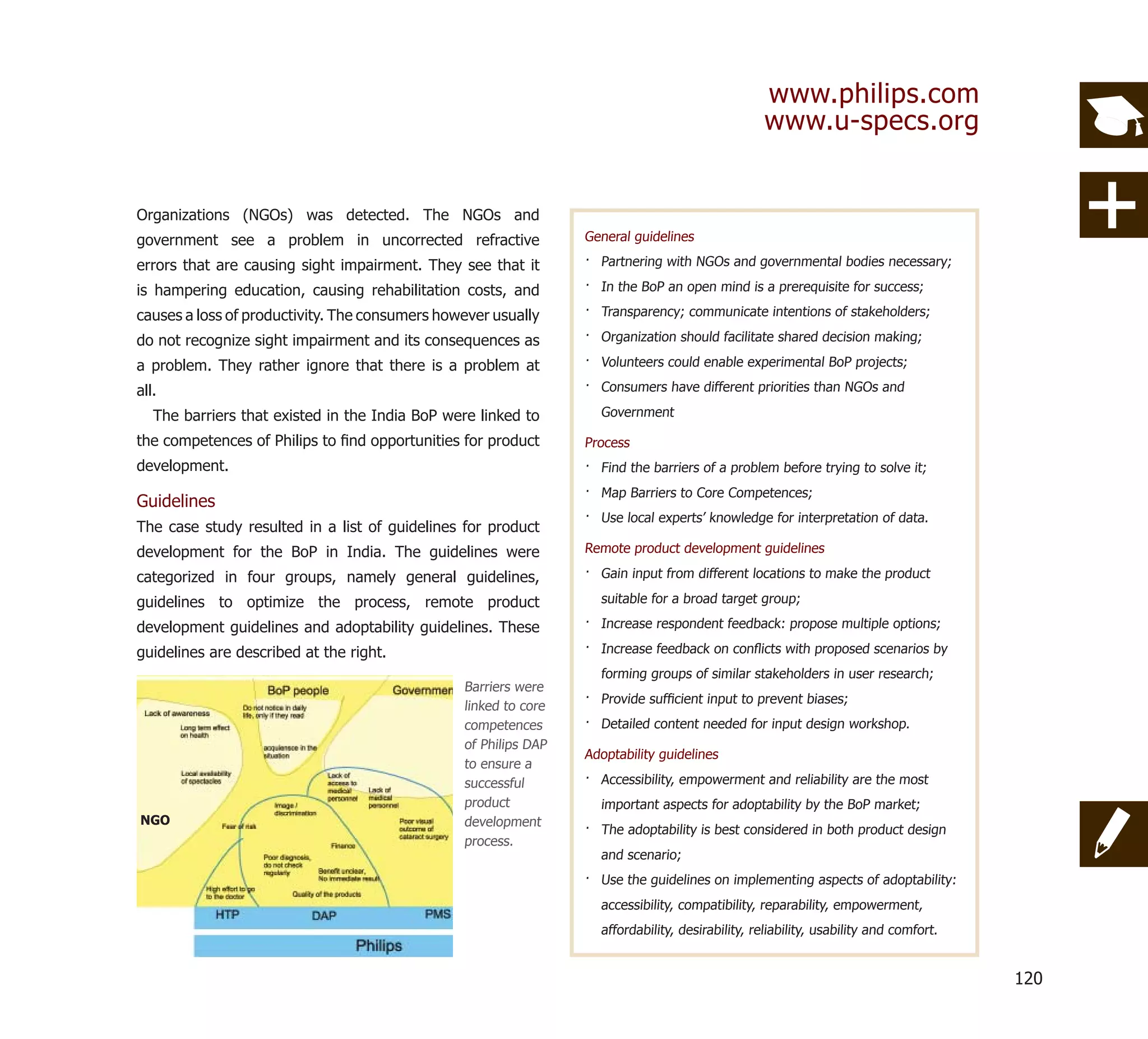
Designing for
                                Emerging Markets


                                Design of Products and Services
Industrial Design Engineering
Designing for
                   Emerging Markets


                   Design of Products and Services


Edited by

Prabhu Kandachar
Ilona de Jongh
Jan Carel Diehl
Colophon


           Printed on recycled paper

           Editors: Prabhu Kandachar, Ilona de Jongh and Jan Carel Diehl
           Cover design: Ilona de Jongh

           Designing for Emerging Markets, Design of Products and Services
           IDE Master’s Projects - 3
           Edition   March 2009
           ISBN      978-90-5155-052-8

           © 2009 Delft University of Technology
           All rights reserved. No part of this book may be reproduced
           or transmitted in any form or by any means, electronically or
           mechanical, including photocopying, recording or by any other
           information storage and retrieval system without explicit written
           permission from the authors.

           Delft University of Technology
           Faculty of Industrial Design Engineering
           Landbergstraat 15
           2628 CE DELFT

           www.io.tudelft.nl/BoP
           Phone    +31 (0) 15 278 3034
           Fax      +31 (0) 15 278 1839
           E-mail   p.v.kandachar@tudelft.nl
                    j.c.diehl@tudelft.nl
                    i.k.dejongh@tudelft.nl
                    bop-io@tudelft.nl

      3
Project Focus                                                                                                                                                                                                                                                                                                Education
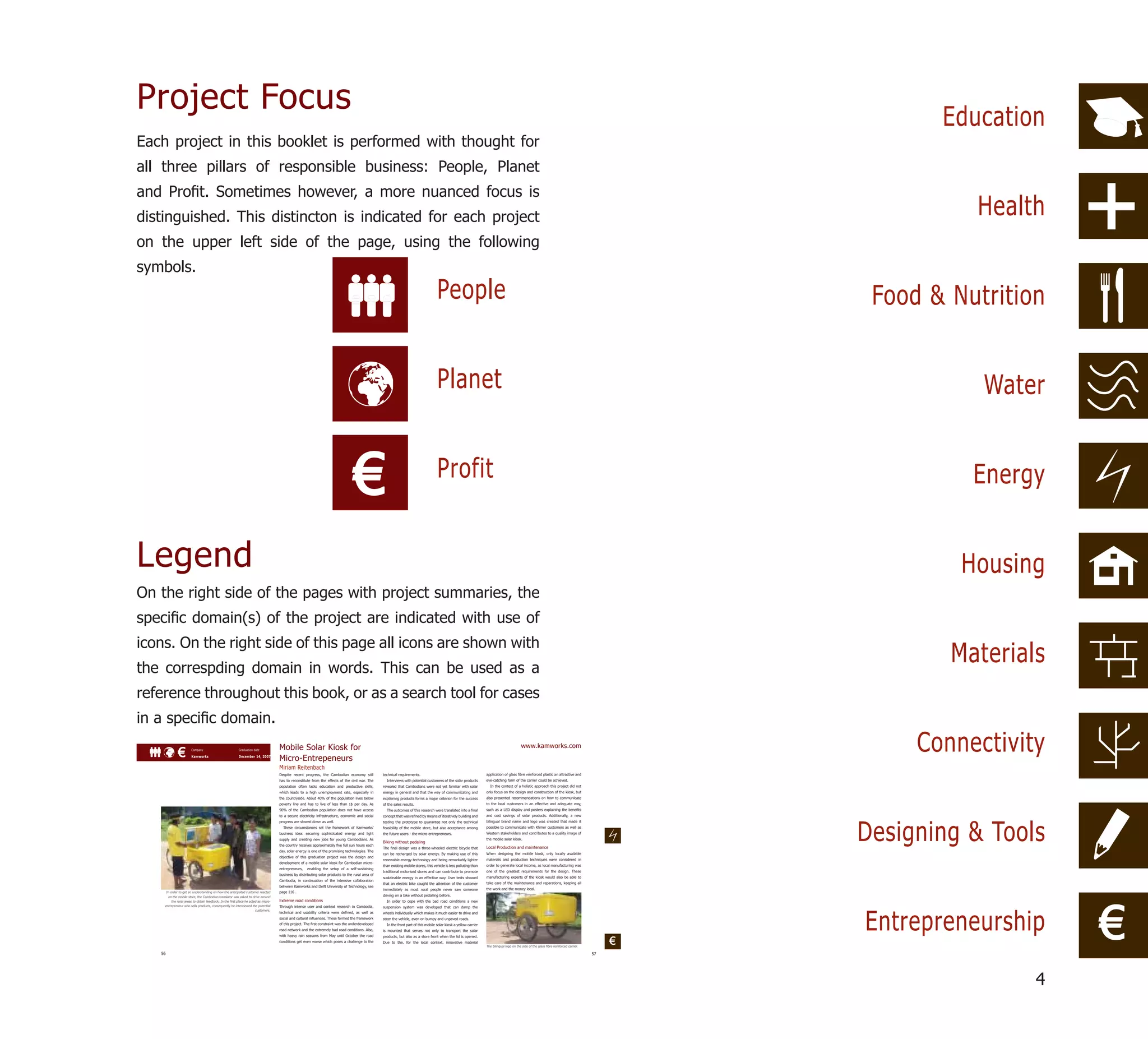
Each project in this booklet is performed with thought for
all three pillars of responsible business: People, Planet
and Profit. Sometimes however, a more nuanced focus is
distinguished. This distincton is indicated for each project                                                                                                                                                                                                                                                    Health
on the upper left side of the page, using the following
symbols.
                                                                                                                                                                                       People                                                                                                          Food & Nutrition


                                                                                                                                                                                       Planet                                                                                                                    Water


                                                                                                                                   €                                                   Profit                                                                                                                   Energy


Legend                                                                                                                                                                                                                                                                                                         Housing
On the right side of the pages with project summaries, the
specific domain(s) of the project are indicated with use of
icons. On the right side of this page all icons are shown with
the correspding domain in words. This can be used as a
                                                                                                                                                                                                                                                                                                              Materials
reference throughout this book, or as a search tool for cases
in a specific domain.

             €         Company

                       Kamworks
                                                         Graduation date

                                                         December 14, 2007
                                                                                    Mobile Solar Kiosk for
                                                                                    Micro-Entrepeneurs
                                                                                                                                                                                                                                               www.kamworks.com
                                                                                                                                                                                                                                                                                                           Connectivity
                                                                                    Miriam Reitenbach
                                                                                    Despite recent progress, the Cambodian economy still           technical requirements.                                            application of glass fibre reinforced plastic an attractive and
                                                                                    has to reconstitute from the effects of the civil war. The       Interviews with potential customers of the solar products        eye-catching form of the carrier could be achieved.
                                                                                    population often lacks education and productive skills,        revealed that Cambodians were not yet familiar with solar            In the context of a holistic approach this project did not
                                                                                    which leads to a high unemployment rate, especially in         energy in general and that the way of communicating and            only focus on the design and construction of the kiosk, but
                                                                                    the countryside. About 40% of the population lives below       explaining products forms a major criterion for the success        also presented recommendations on how to communicate
                                                                                    poverty line and has to live of less than 1$ per day. As       of the sales results.                                              to the local customers in an effective and adequate way,
                                                                                    90% of the Cambodian population does not have access             The outcomes of this research were translated into a final        such as a LED display and posters explaining the benefits
                                                                                    to a secure electricity infrastructure, economic and social    concept that was refined by means of iteratively building and       and cost savings of solar products. Additionally, a new


                                                                                                                                                                                                                                                                                                      Designing & Tools
                                                                                    progress are slowed down as well.                              testing the prototype to guarantee not only the technical          bilingual brand name and logo was created that made it
                                                                                      These circumstances set the framework of Kamworks’           feasibility of the mobile store, but also acceptance among         possible to communicate with Khmer customers as well as
                                                                                    business idea: securing sophisticated energy and light         the future users - the micro-entrepreneurs.                        Western stakeholders and contributes to a quality image of
                                                                                    supply and creating new jobs for young Cambodians. As                                                                             the mobile solar kiosk.
                                                                                                                                                   Biking without pedaling
                                                                                    the country receives approximately five full sun hours each
                                                                                                                                                   The final design was a three-wheeled electric bicycle that          Local Production and maintenance
                                                                                    day, solar energy is one of the promising technologies. The
                                                                                                                                                   can be recharged by solar energy. By making use of this            When designing the mobile kiosk, only locally available
                                                                                    objective of this graduation project was the design and
                                                                                                                                                   renewable energy technology and being remarkably lighter           materials and production techniques were considered in
                                                                                    development of a mobile solar kiosk for Cambodian micro-
                                                                                                                                                   than existing mobile stores, this vehicle is less polluting than   order to generate local income, as local manufacturing was
                                                                                    entrepreneurs,   enabling the setup of a self-sustaining
                                                                                                                                                   traditional motorised stores and can contribute to promote         one of the greatest requirements for the design. These
                                                                                    business by distributing solar products to the rural area of
                                                                                                                                                   sustainable energy in an effective way. User tests showed          manufacturing experts of the kiosk would also be able to
                                                                                    Cambodia, in continuation of the intensive collaboration
                                                                                                                                                   that an electric bike caught the attention of the customer         take care of the maintenance and reparations, keeping all
                                                                                    between Kamworks and Delft University of Technology, see
                                                                                                                                                   immediately as most rural people never saw someone                 the work and the money local.
     In order to get an understanding on how the anticipated customer reacted       page 116 .


                                                                                                                                                                                                                                                                                                                          €
      on the mobile store, the Cambodian translator was asked to drive around                                                                      driving on a bike without pedalling before.
         the rural areas to obtain feedback. In the first place he acted as micro-   Extreme road conditions                                          In order to cope with the bad road conditions a new


                                                                                                                                                                                                                                                                                                      Entrepreneurship
    entrepreneur who sells products, consequently he interviewed the potential      Through intense user and context research in Cambodia,         suspension system was developed that can damp the
                                                                      customers.
                                                                                    technical and usability criteria were defined, as well as       wheels individually which makes it much easier to drive and
                                                                                    social and cultural influences. These formed the framework      steer the vehicle, even on bumpy and unpaved roads.
                                                                                    of this project. The first constraint was the underdeveloped      In the front part of this mobile solar kiosk a yellow carrier
                                                                                    road network and the extremely bad road conditions. Also,      is mounted that serves not only to transport the solar
                                                                                    with heavy rain seasons from May until October the road

                                                                                                                                                                                                                                                                                                  €
                                                                                                                                                   products, but also as a store front when the lid is opened.
                                                                                    conditions get even worse which poses a challenge to the       Due to the, for the local context, innovative material
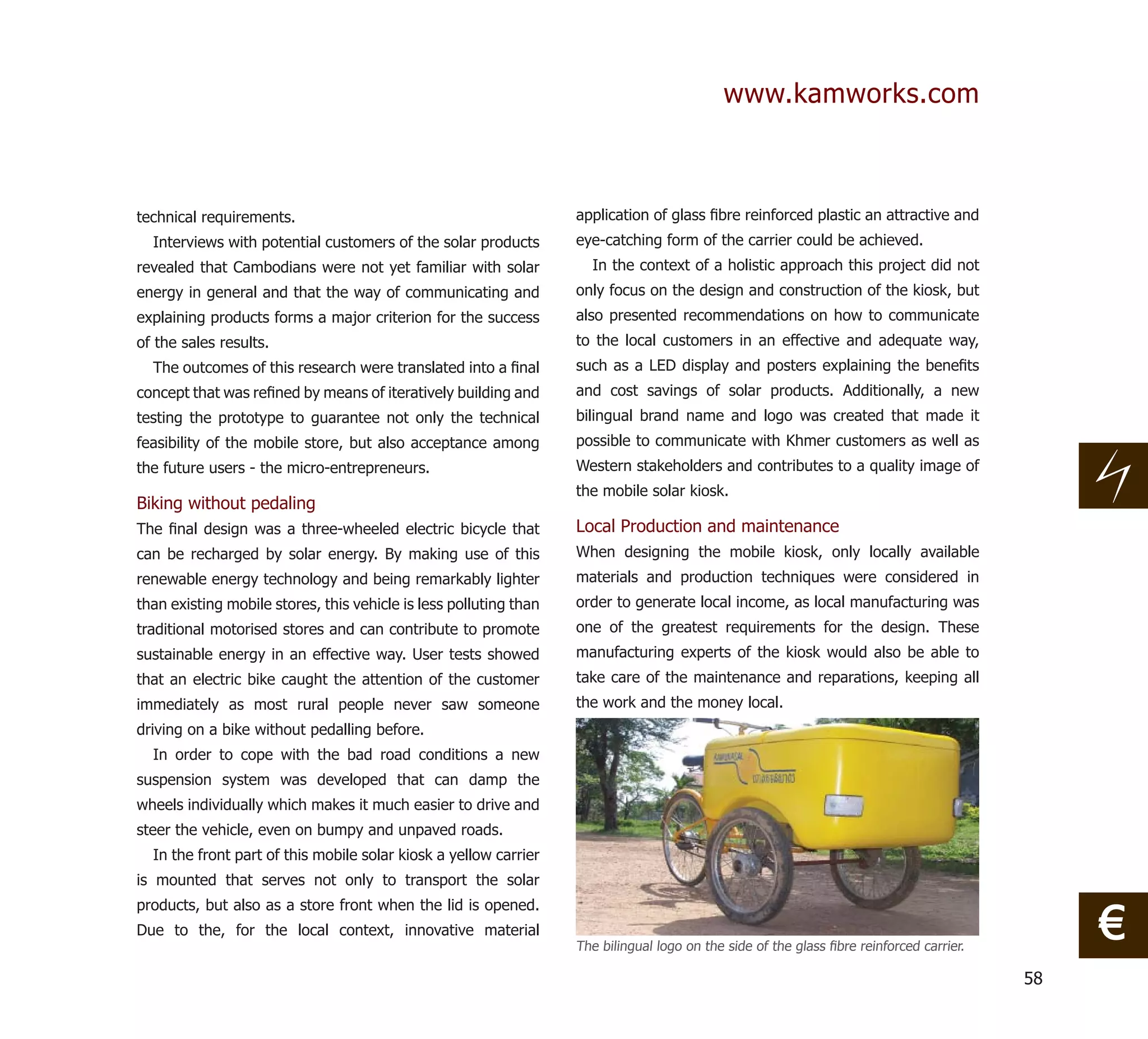
                                                                                                                                                                                                                      The bilingual logo on the side of the glass fibre reinforced carrier.

   56                                                                                                                                                                                                                                                                                        57


                                                                                                                                                                                                                                                                                                                      4
Photo: Jimmy Ho

5
Rice Fields
near Culik
Bali, Indonesia


                  6
The number of student projects at the Faculty of Industrial
Preface                                                                               Design Engineering relevant to the Base of the Pyramid
                                                                                      (BoP) has increased enormously since 2002, when the
                                                                                      course “Advanced Products” for Master’s students started
                                                                                      a small experiment with projects focused on developing
                                                                                      countires was started. The increase of projects is due to
                                                                                      several reasons.
                                                                                        Firstly, students of our Faculty have shown great interest
                                                                                      and enthusiasm to design products and services to meet
                                                                                      the needs of the citizens of the BoP. Secondly, the concept
                                                                                      of BoP has attracted the attention of many Dutch and
                                                                                      European entrepreneurs, leading to several assignments for
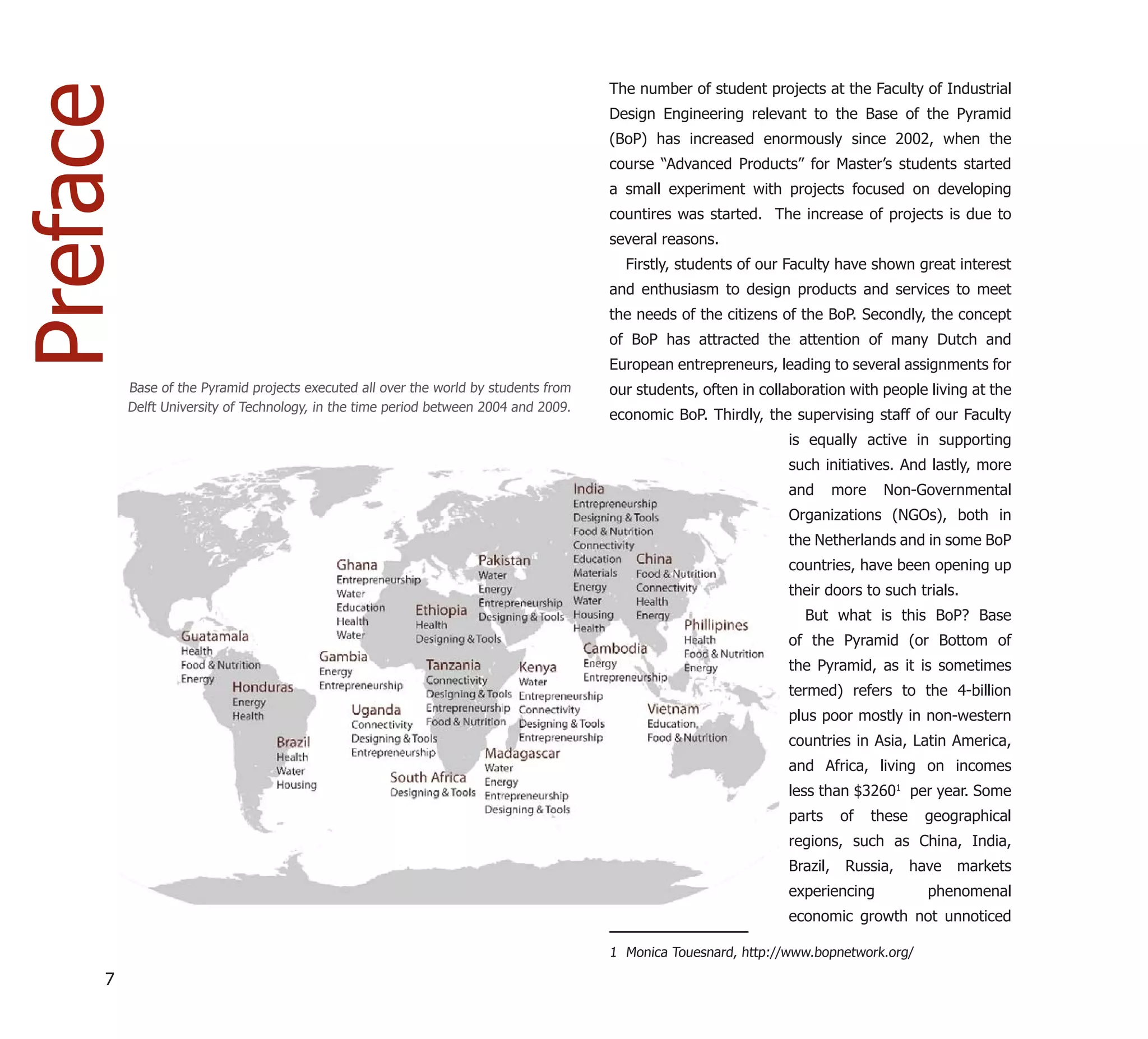
          Base of the Pyramid projects executed all over the world by students from   our students, often in collaboration with people living at the
          Delft University of Technology, in the time period between 2004 and 2009.
                                                                                      economic BoP. Thirdly, the supervising staff of our Faculty
                                                                                                                 is equally active in supporting
                                                                                                                 such initiatives. And lastly, more
                                                                                                                 and       more    Non-Governmental
                                                                                                                 Organizations (NGOs), both in
                                                                                                                 the Netherlands and in some BoP
                                                                                                                 countries, have been opening up
                                                                                                                 their doors to such trials.
                                                                                                                    But what is this BoP? Base
                                                                                                                 of the Pyramid (or Bottom of
                                                                                                                 the Pyramid, as it is sometimes
                                                                                                                 termed) refers to the 4-billion
                                                                                                                 plus poor mostly in non-western
                                                                                                                 countries in Asia, Latin America,
                                                                                                                 and Africa, living on incomes
                                                                                                                 less than $32601 per year. Some
                                                                                                                 parts      of    these    geographical
                                                                                                                 regions, such as China, India,
                                                                                                                 Brazil,    Russia,       have   markets
                                                                                                                 experiencing               phenomenal
                                                                                                                 economic growth not unnoticed

                                                                                      1 Monica Touesnard, http://www.bopnetwork.org/

     7
by the affluent west.                                              Millennium Development Goals


                                                                                                                                    Preface
  Although the BoP strategy to serve the underserved,             The extensive response to these ideas is likely due to the
namely the poor in developing countries, has attracted the        limited success of developmental assistance to alleviate
attention of scientists and entrepreneurs worldwide, the          poverty in the past 50 years. For more than 50 years, the
scientific publications in this area until now are often from      World Bank, donor nations, various aid agencies, national
management sciences, often extending the concepts of              governments, and civil society organizations have all fought
corporate social responsibility, sustainability, etc.             the good fight, but have not been able to eradicate poverty
  The uniqueness of our Faculty of Industrial Design              yet. The adoption of the Millennium Development Goals
Engineering lies in its human centered approach. Needs are        (MDG) by the United Nations only underscores that reality.
the central driving force uniting technology and business.        Poverty has remained one of the world’s most daunting
By tradition our Faculty has propagated the practice of           problems even as we enter the 21st Century. Prahalad
designing products and services to meet the human needs.          advocates an alternative approach to help the poor.
The BoP strategy has stimulated us to look also at the needs
                                                                  Science Spread over the World
of the underserved, which represent a huge market and
                                                                  The projects described in this book are a result of several
was hitherto unattended.
                                                                  students, entrepreneurs and academic staff stimulated by
  The foundation for the BoP strategy was laid by Prahalad
                                                                  this strategy. The BoP concept is spreading to all parts of the
& Hart2, in their publication published in the first quarter
                                                                  world, both within the rich and in the poor countries. This
of 2002, promising fortune for entrepreneurs and at the
                                                                  is also reflected by the geographical spread of the projects
same time offering perspectives to the poor world majority
                                                                  executed at our Faculty, as can be seen in the picture on
to escape from the poverty. This caught public attention
                                                                  the opposite page.
and unleashed an extensive response from academics,
                                                                    It can also be observed that the projects cover very
businesses, NGOs and others. Prahalad’s book3 delves in
                                                                  diverse needs, from Water to Energy, from Healthcare to
depth by proposing a framework for the active engagement
                                                                  Education, and more. These projects could not have been
of the private sector and suggesting a basis for a profitable
                                                                  executed without the involvement of students, companies,
win-win engagement. This vision of untapped great wealth
                                                                  NGOs, and professors. Together they have set up a base
in the world waiting to be explored & exploited by human
                                                                  to develop a new knowledge domain full of challenges and
ingenuity, by designing products and services to meet the
                                                                  opportunities. Thank you all!
needs of the world’s poor, and then efficiently manufacturing
& distributing by the capabilities of the modern corporation,
Prahalad contends, needs innovations.

2 The Fortune at the Bottom of the Pyramid, Strategy+business,
                                                                                                       Prabhu Kandachar
  issue 26, First quarter 2002, p. 1- 14 (Booz Allen Hamiliton)
                                                                                 Faculty of Industrial Design Engineering
3 The Fortune at the Bottom of the Pyramid: Eradicating Poverty
                                                                                           Delft University of Technology
  Through Profits, ISBN-10: 0-13-146750-6; ISBN-13: 978-0-13-
  146750-7 (Published 2004) Pages: 432.
                                                                                                              March 2009
                                                                                                                                    8
Project Focus                                                                                    2
Table of Contents   Preface                                                                                          6


                    Introduction           Prabhu Kandachar    Challenges for Industrial Designers                   10


                    Student Projects
                    Inge van de Wouw              Dec 8, 08    Lamp with insect repellent                            26
                    Aparna Bhasker                2009         India Moves: Economic Empowerment of Rural Disabled   28
                    Ambika Samabasivan            Oct 30, 08   Global Opportunities in Renewable Lighting            30
                    Lieke Pijpers                 Oct 24, 08   PRO-PORTION Affordable milk for kids                  32
                    Sierk Hennes                  Sep 23, 08   Design a PSS for drinking water                       34
                    Kirsten Rijke                 Aug 26, 08   Solar shop in rural Cambodia                          38
                    Tom van Diessen               Aug 22, 08   Solar Home System for rural Cambodia                  40
                    Linda Schnieders              Jul 28, 08   Redesign of a Smoke free Batana Extractor             42
                    Lumen                         Jun, 08      LUMEN light solution                                  44
                    Judith Goor                   Apr 04, 08   A battery charging system for youngsters              46
                    Jan Willem Findlater          Feb 8, 08    Culturally appropriate coffins for Botswana            50
                    Water4Kenya                   Feb, 08      Water4Kenya                                           52
                    Alexander van der Kleij       Feb 1, 08    Comparing Contexts; Solar Dew Technology              54
                    Miriam Reitenbach             Dec 14, 07   Mobile Solar Kiosk for Micro-Entrepeneurs             56
                    Koos Munneke                  Oct 24, 07   Better Brace Project                                  58
                    Bernard Hulshof               Oct 19, 07   Affordable Solar Lighting for rural Madagascar        62
                    Rutger Bonsel                 Oct 12, 07   Holy Cow or Cash Cow                                  64
                    Hoi-Kee Wong                  Aug 8, 07    Cooking in rural China                                66
                    Fire4India                    May, 07      Fire4India                                            68
                    Yu-Kuan Chang                 Nov 27, 06   Knowledge Gaps in Product Development                 70


                    Culture & Design Annemiek van Boeijen      Design & culture in the BoP Domain                    74


                    Annemarie Mink                Nov 10, 06   Reeling Machine for Silk Yarn Producers               78
                    Marion de Groot               Sep 21, 06   Support Tool for the Chinese Village Doctor           80
                    Cathelijne Huis in ‘t Veld    Aug 31, 06   Design of a Malaria Diagnostics Device                82
                    Roelie Bottema                Aug 4, 06    Personal Water Purifier                                84
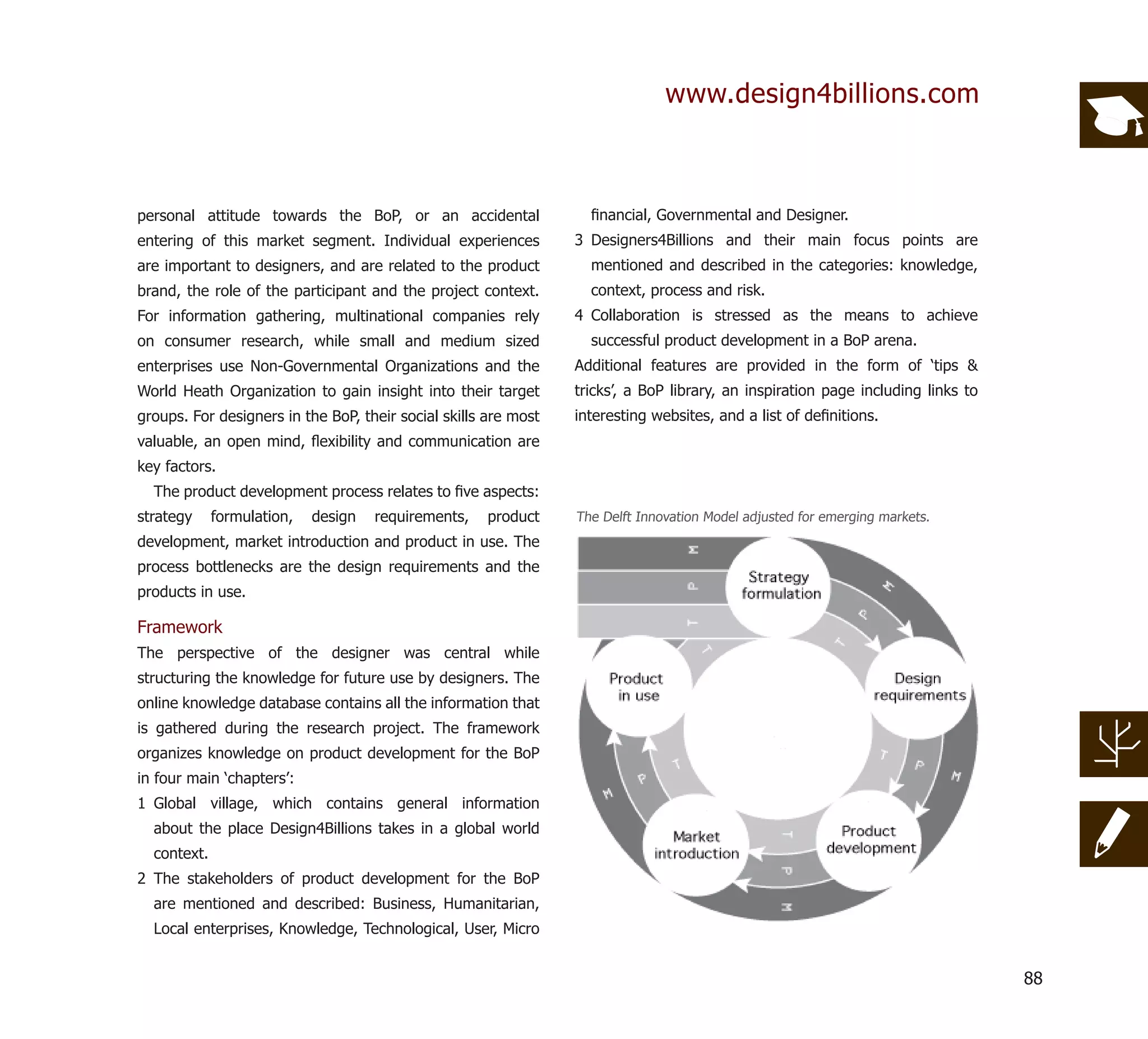
                    Mijntje de Caluwé             Jul 29, 06   Knowledge Framework: Design4Billions                  86

              9
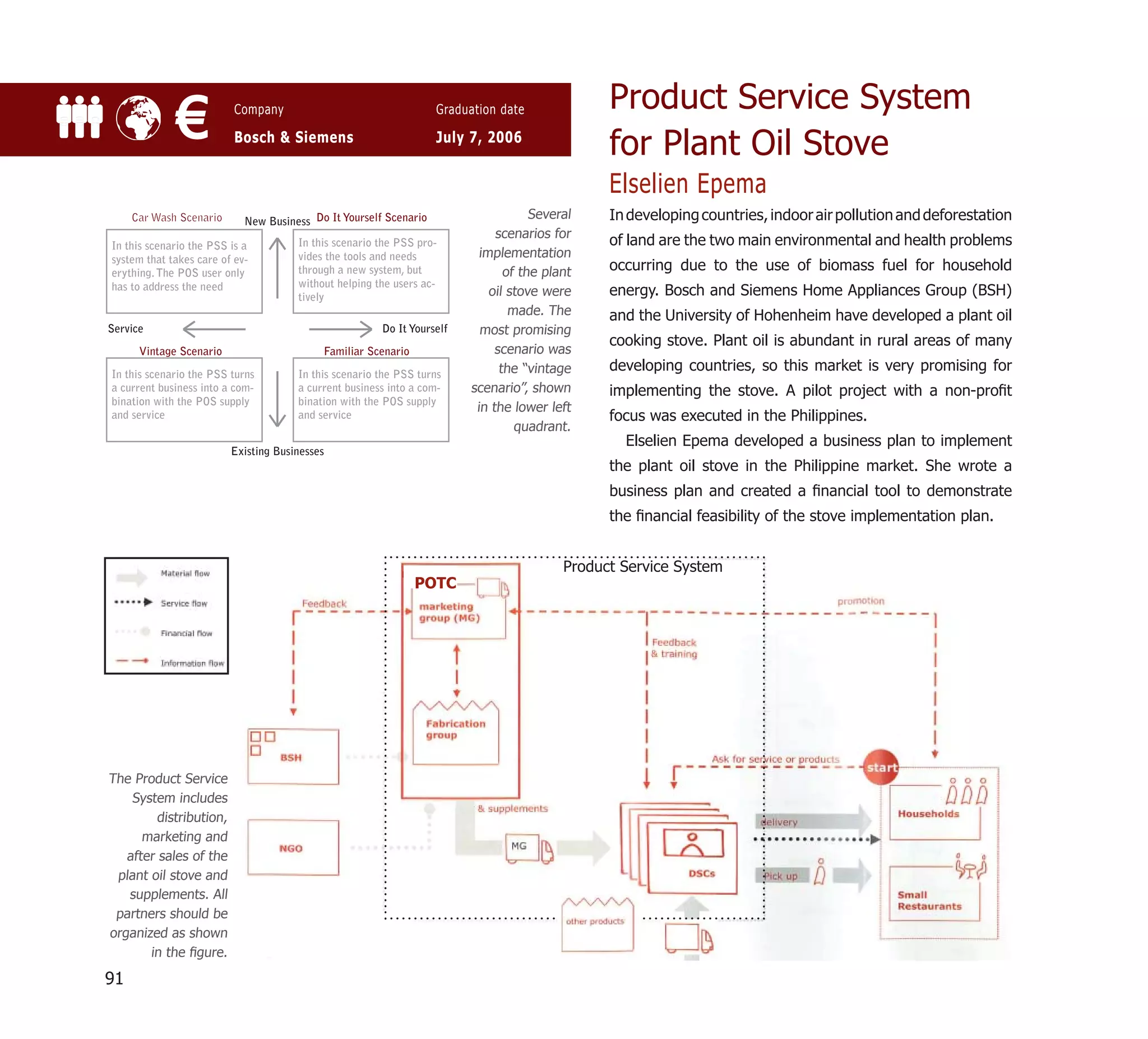
Elselien Epema                 Jul 7, 06          Product Service System for Plant Oil Stove            90


                                                                                                                Table of Contents
GhanaMoves                     Jul-06             Tricycle for Disabled Entrepreneurs                   92
Willem Glasbergen              Jun 21, 06         Human Powered Bamboo Splitting Tool                   94
Marike Bijtelaar               Jun 16, 06         Improving the Climate of Cooking Areas                96
Maria Nguyen                   Apr 28, 06         Safe Drinking Water                                   98
Leonie Ideler                  Apr 4, 06          Adoptable Woodstove                                   102
Fernando Del Caro Secomandi Apr, 06               Water Supply in Slums:P.I.P.A. System                 104
Jon Rodriguez                  Feb 3, 06          Contextualizing Products                              106
Cale Thompson                  Sep 14, 06         Online Microfinance: into(context)                     108
Jonathan Stranders             Dec 23, 05         Creating Market Insight for Designers                 110
Suzanne Hendrikse              Nov 11, 05         Device for Early Oral Cancer Detection                114
Stephen Boom                   Oct 28, 05         Solar Lighting                                        116
Roseliek van der Velden        Oct 21, 05         Adoptability of the U-Specs                           118
Joan Boekhoven                 Oct 18, 05         Natural Fibres in Doors and Windows                   120
H.S. Smallenbroek              2004               Small scale cassava starch processing                 122


Epilogue                       J.C.Diehl          The first learning experiences of Design for the BoP   126


Acknowledgements                                                                                        130


About the Editors                                                                                       131


Photos
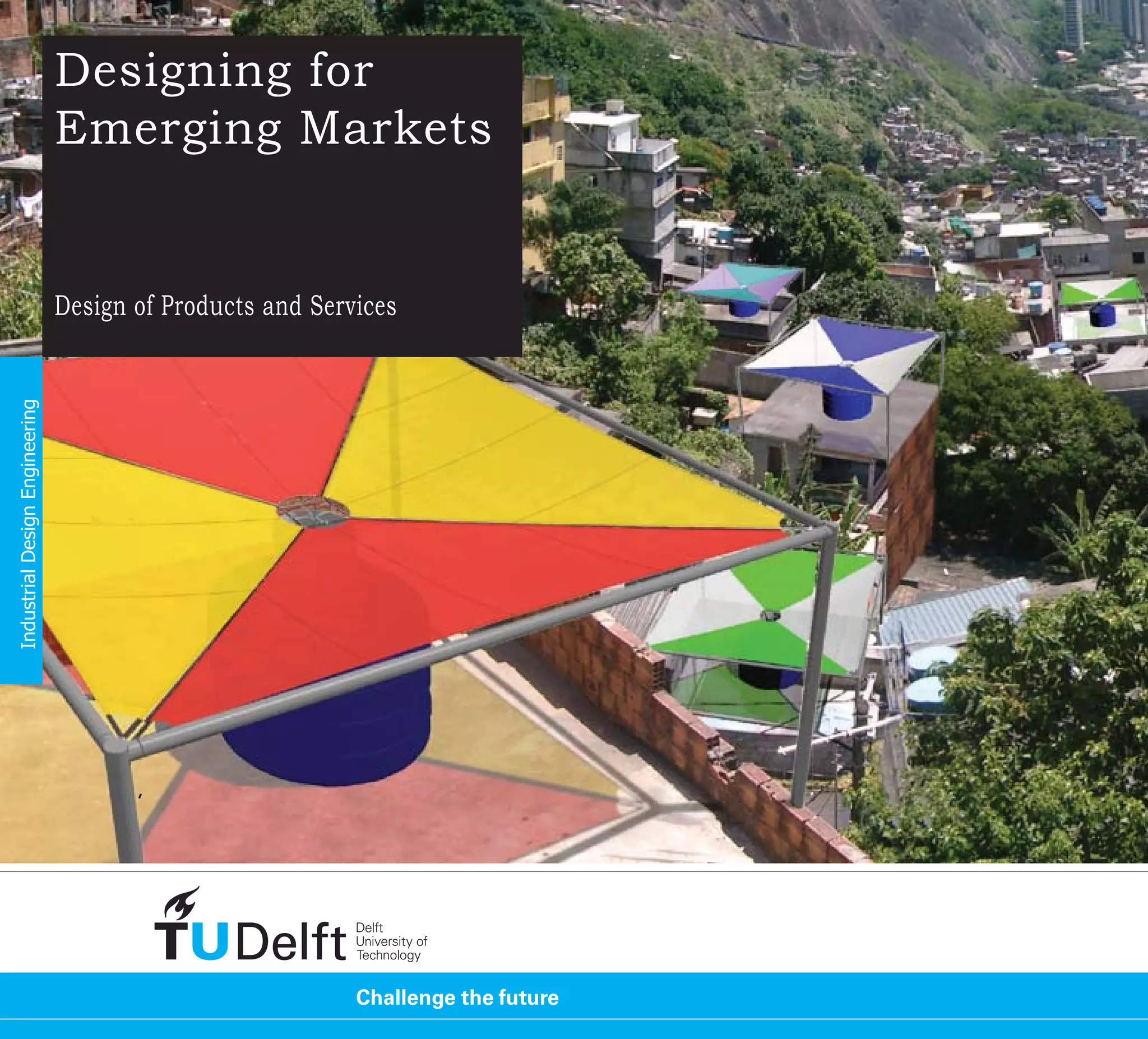
P.I.P.A. system                Brazil             Fernando Del Caro Secomandi                           Cover
Rice Fiels near Culik          Bali, Indonesia    Jimmy Ho                                              4
Kids swimming and playing      Jakarta, Indonesia Ilona de Jongh                                        24
Girl                           Java, Indonesia    Mirjam Lindgreen                                      36
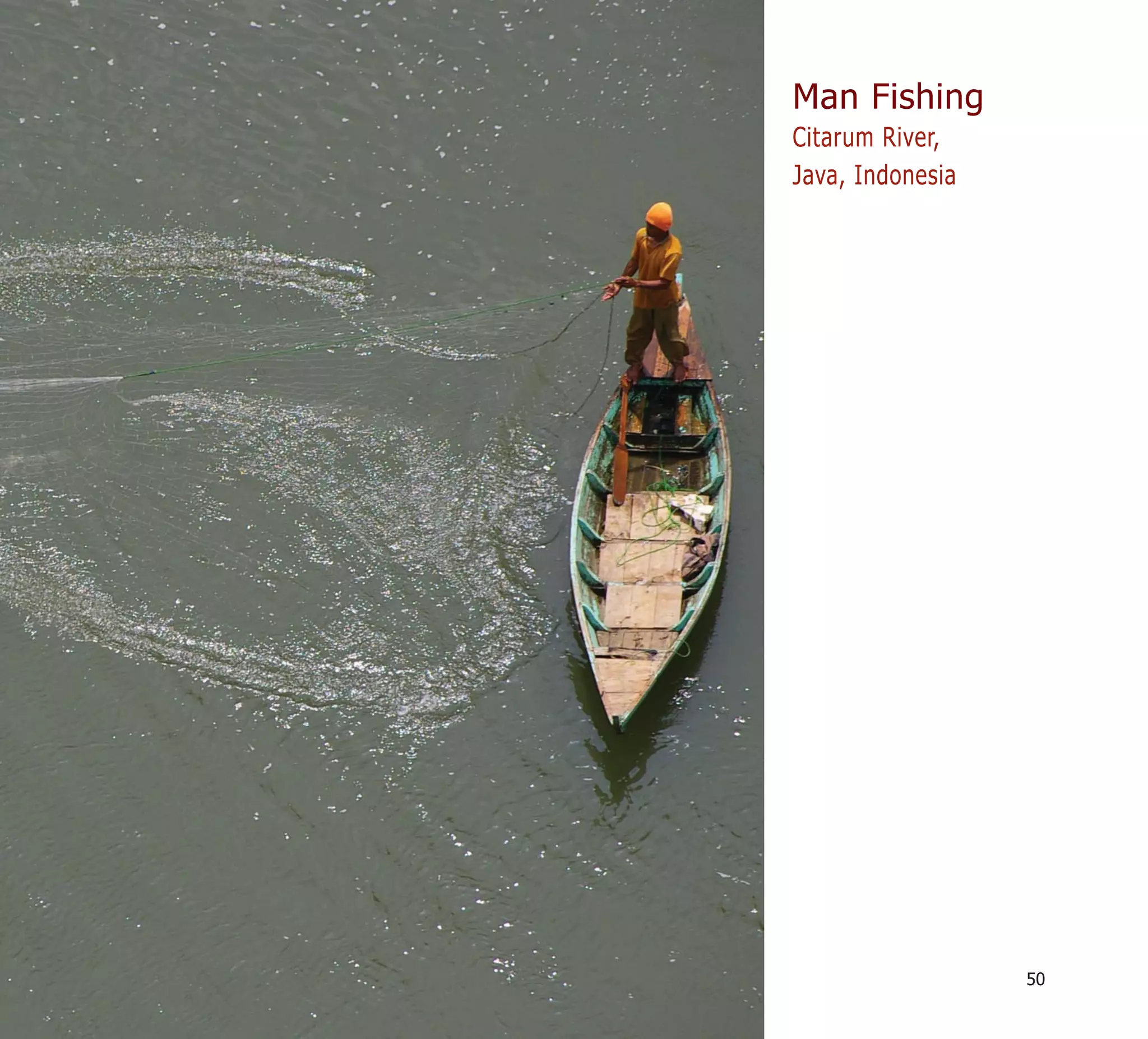
Man Fishing on Citarum River Java, Indonesia      Kees van Gastel                                       48
Man and horse at work          Java, Indonesia    Mirjam Lindgreen                                      60
Market for Holi Colours        India              Prabhu Kandachar                                      72
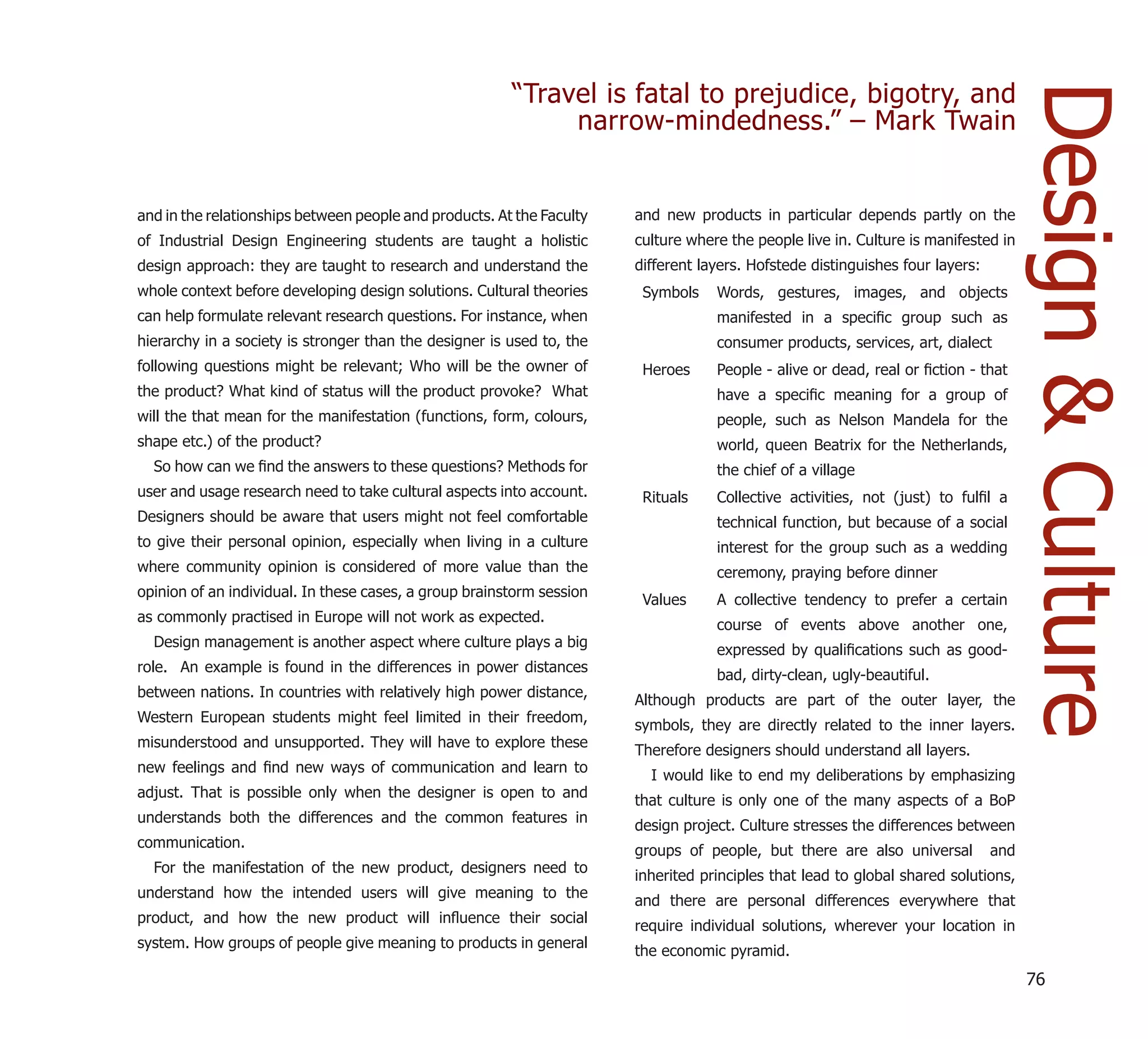
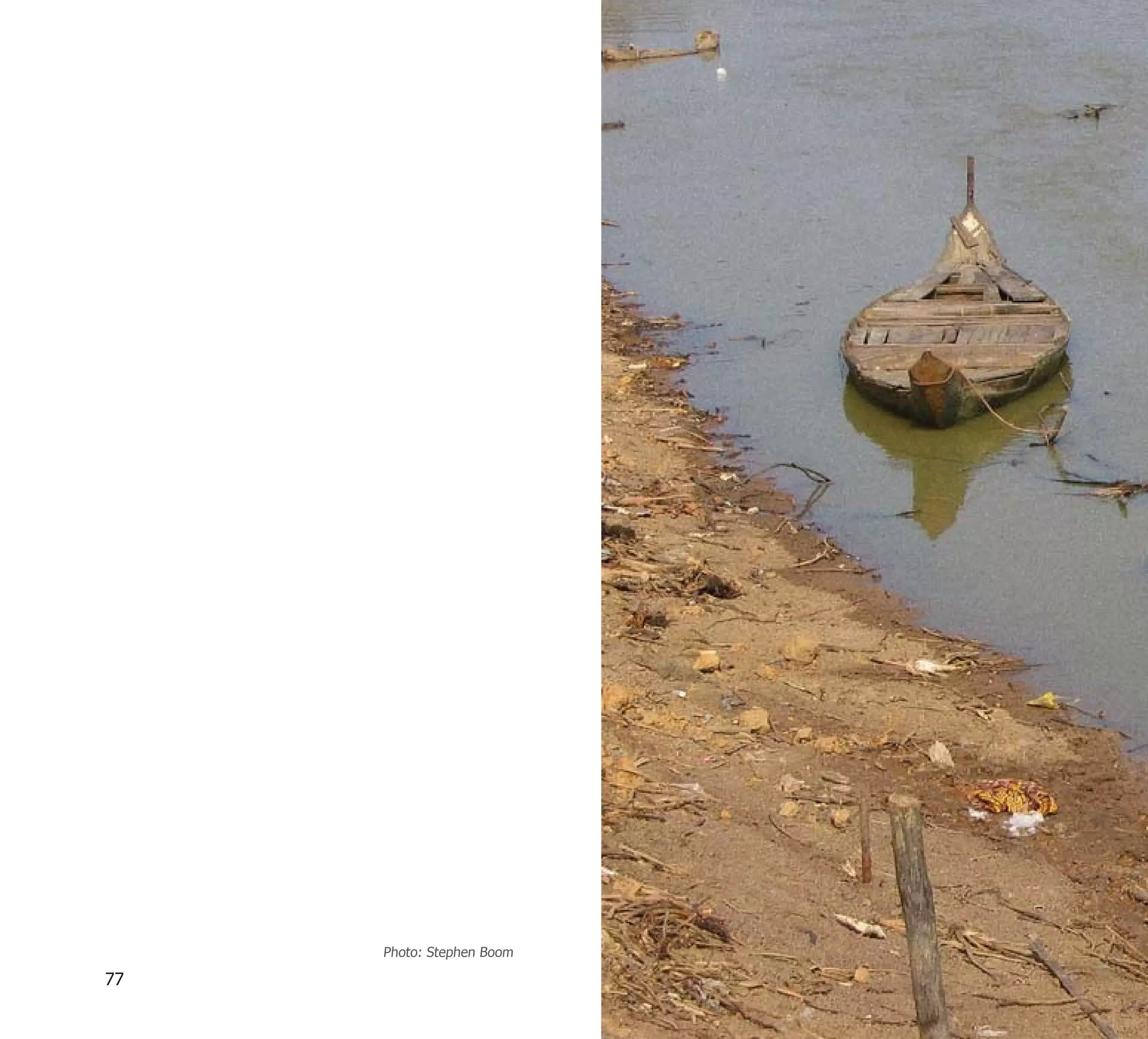
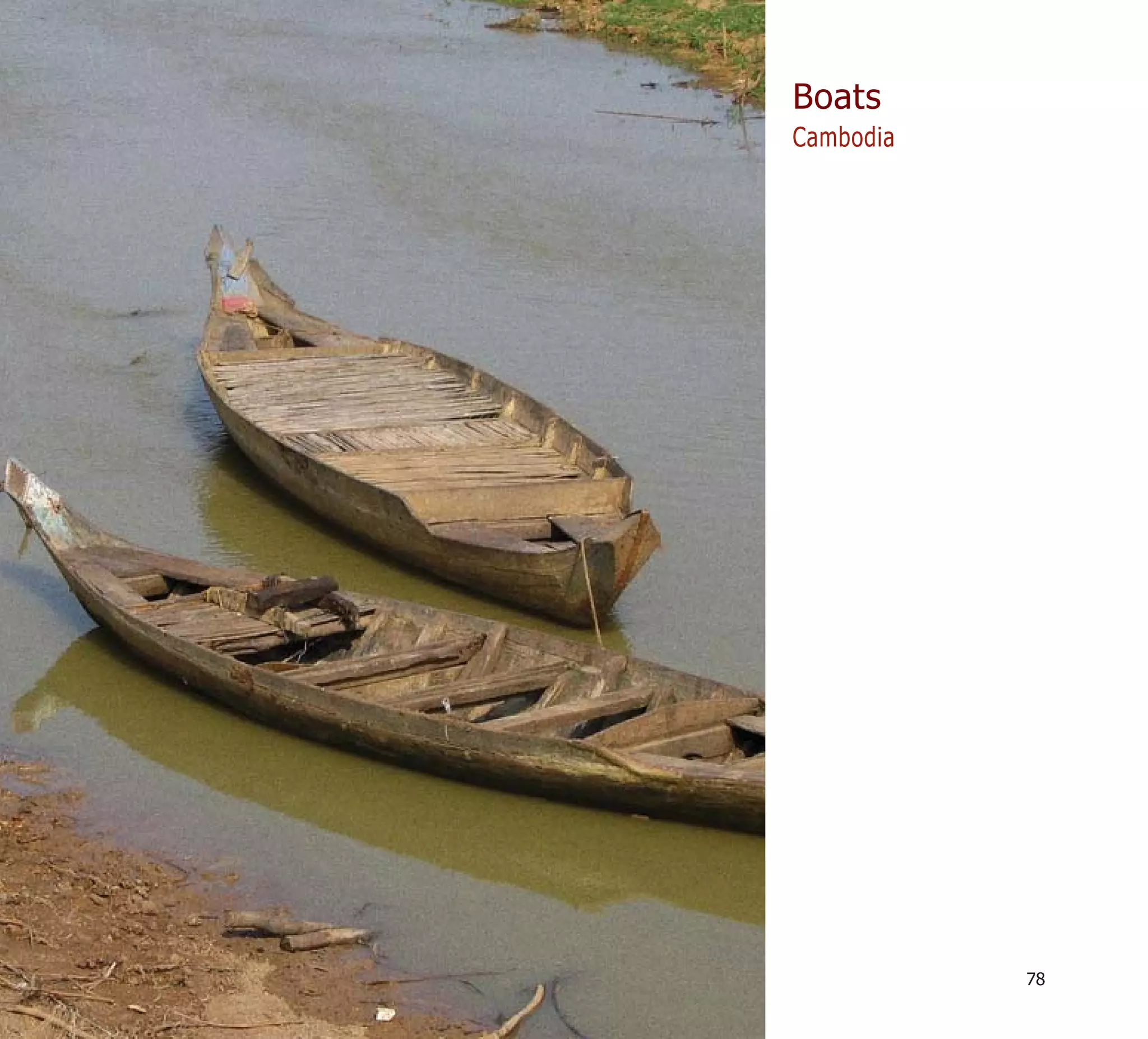
Boats                          Cambodia           Stephen Boom                                          76
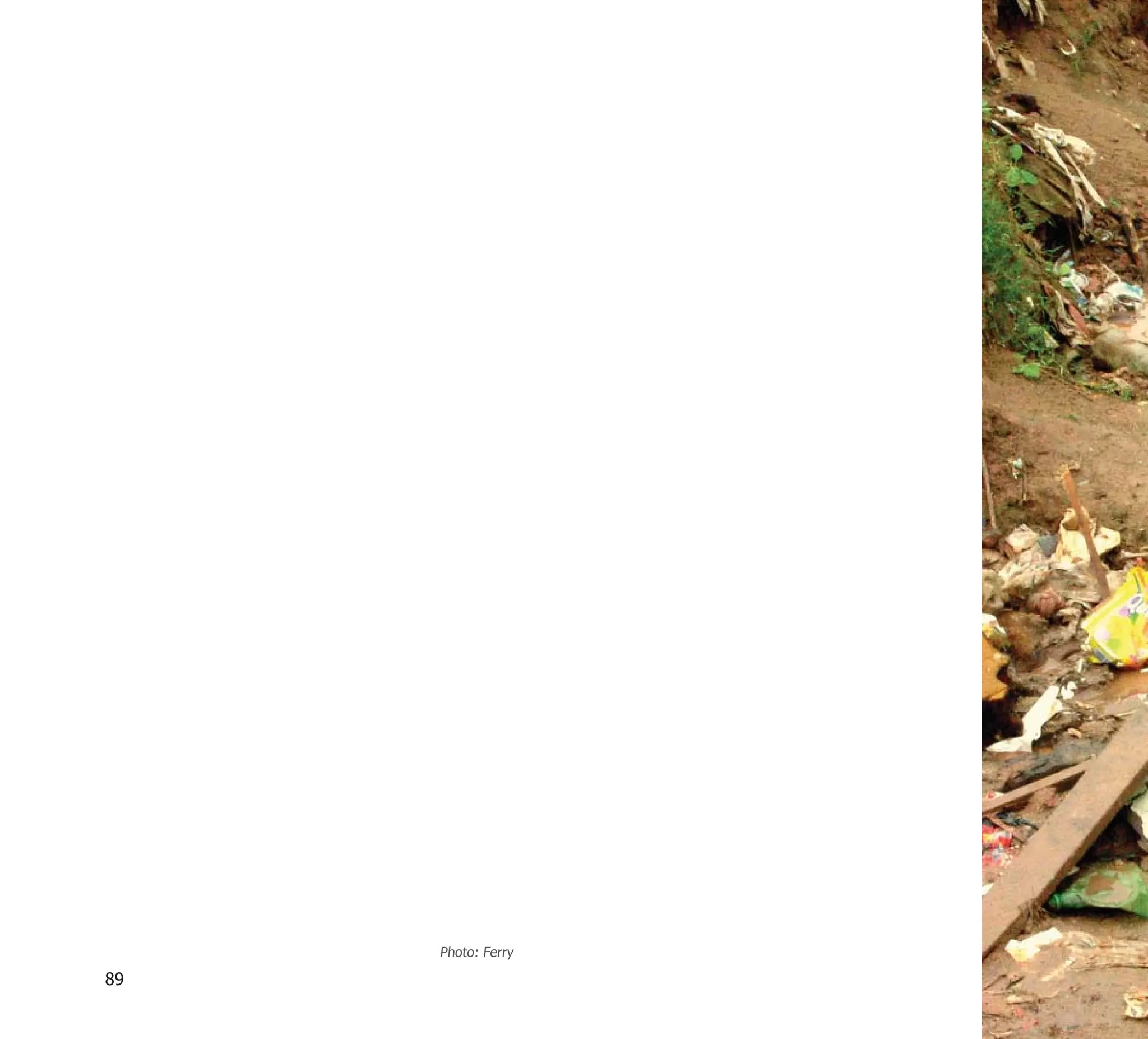
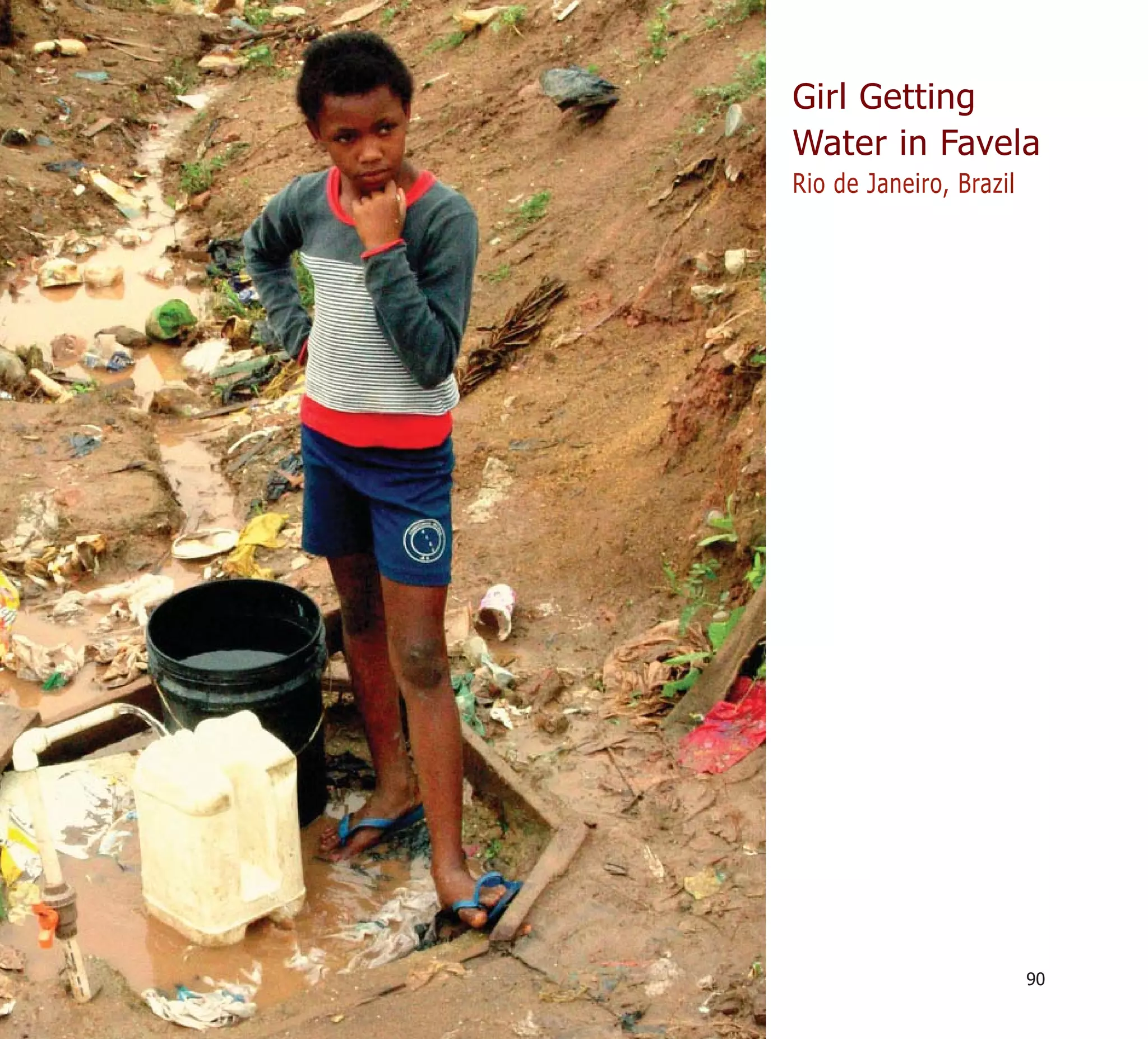
Girl Getting Water in Favela   Rio de Janeiro     Ferry                                                 88
Girls in Favelas               Rio de Janeiro     Linda Schnieders                                      100
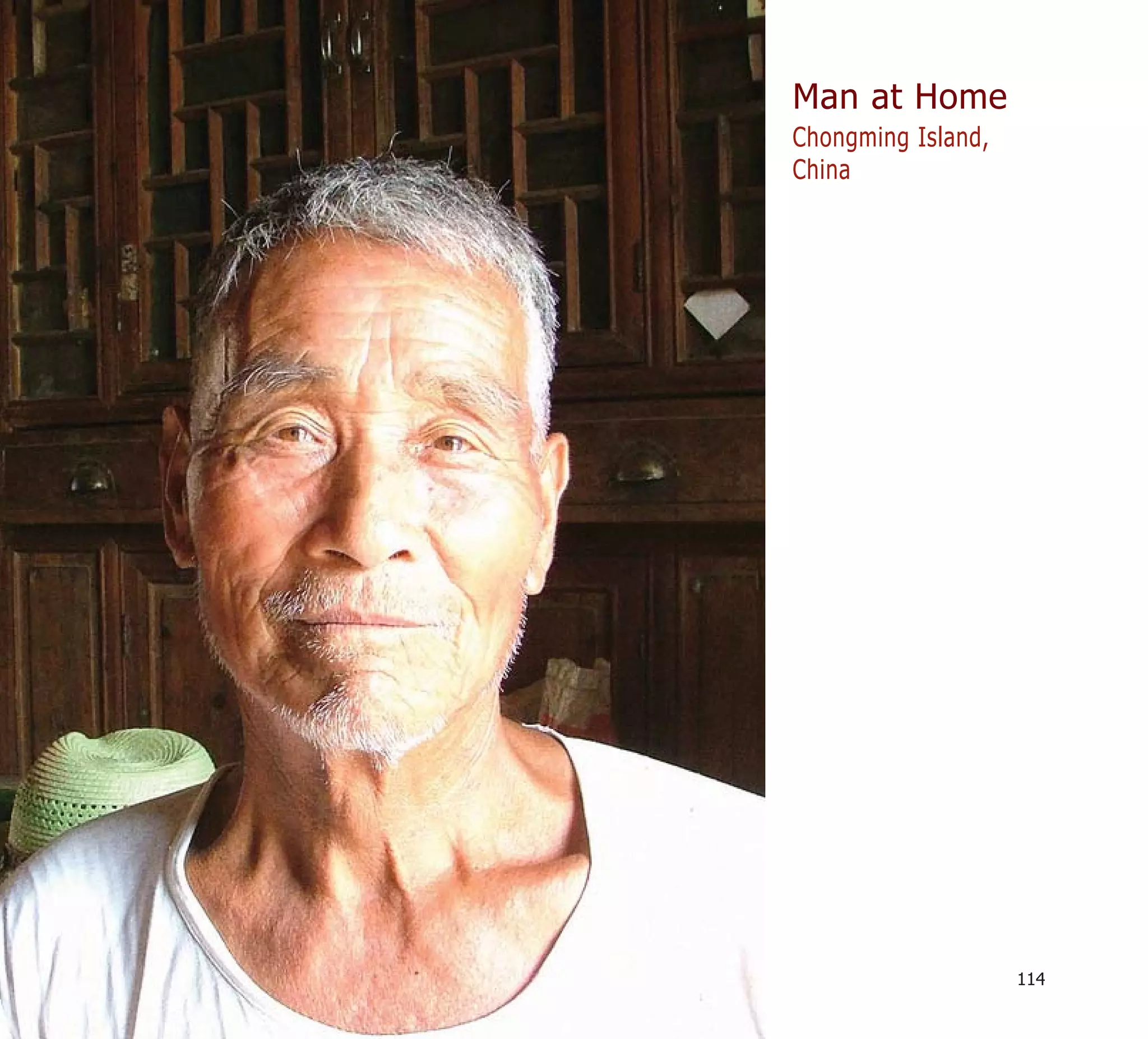
Man at Home                    Chongming Island   Jaap Daalhuizen                                       112
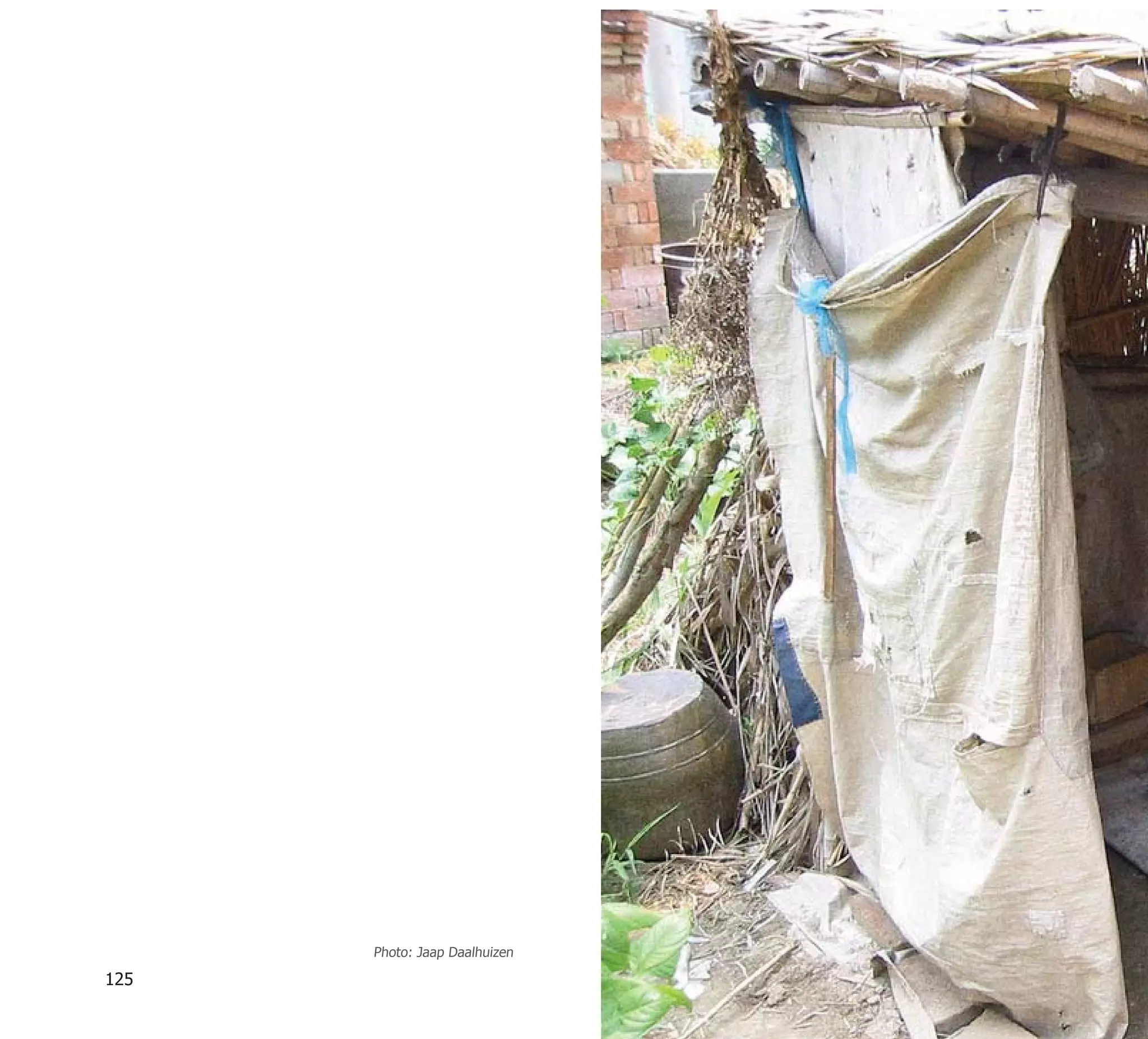
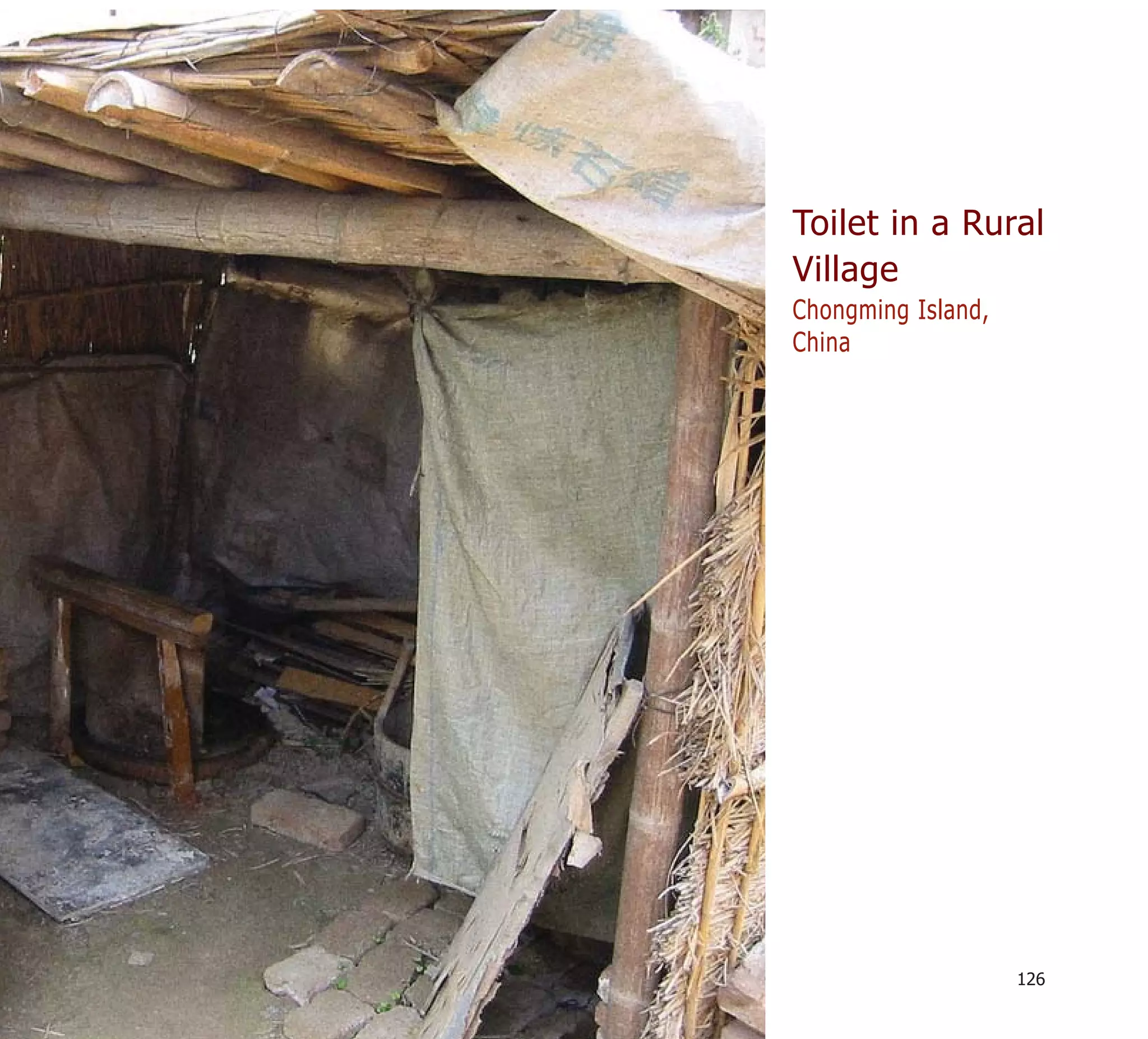
Toilet in a Rural Village      Chongming Island   Jaap Daalhuizen                                       124

                                                                                                                10
Introduction                                                                 Challenges for Industrial
                                                                             Design Engineers
                                                                             Prabhu Kandachar
                                                                             About two thirds of the world’s population of 6 billion people
                                                                             spend their lives searching for food and shelter, fighting for
                                                                             physical survival, and fearing for the future. These are the
                                                                             individuals who earn less than three dollars per day: the
                                                                             people living at the economical Base of the Pyramid (BoP).
                                                                             This does not go unnoticed. Global poverty, its extent and
                                                                             distribution, is of daily news screaming for the attention of
                                                                             all world citizens. The challenge at world level is enormous.
                                                                             In Africa alone, poverty and hunger, unemployment,
                                                                             disease, malnutrition, lack of shelter, gender inequity
                                                                             and environmental deterioration are some of the main
                                                                             challenges in addressing poverty.

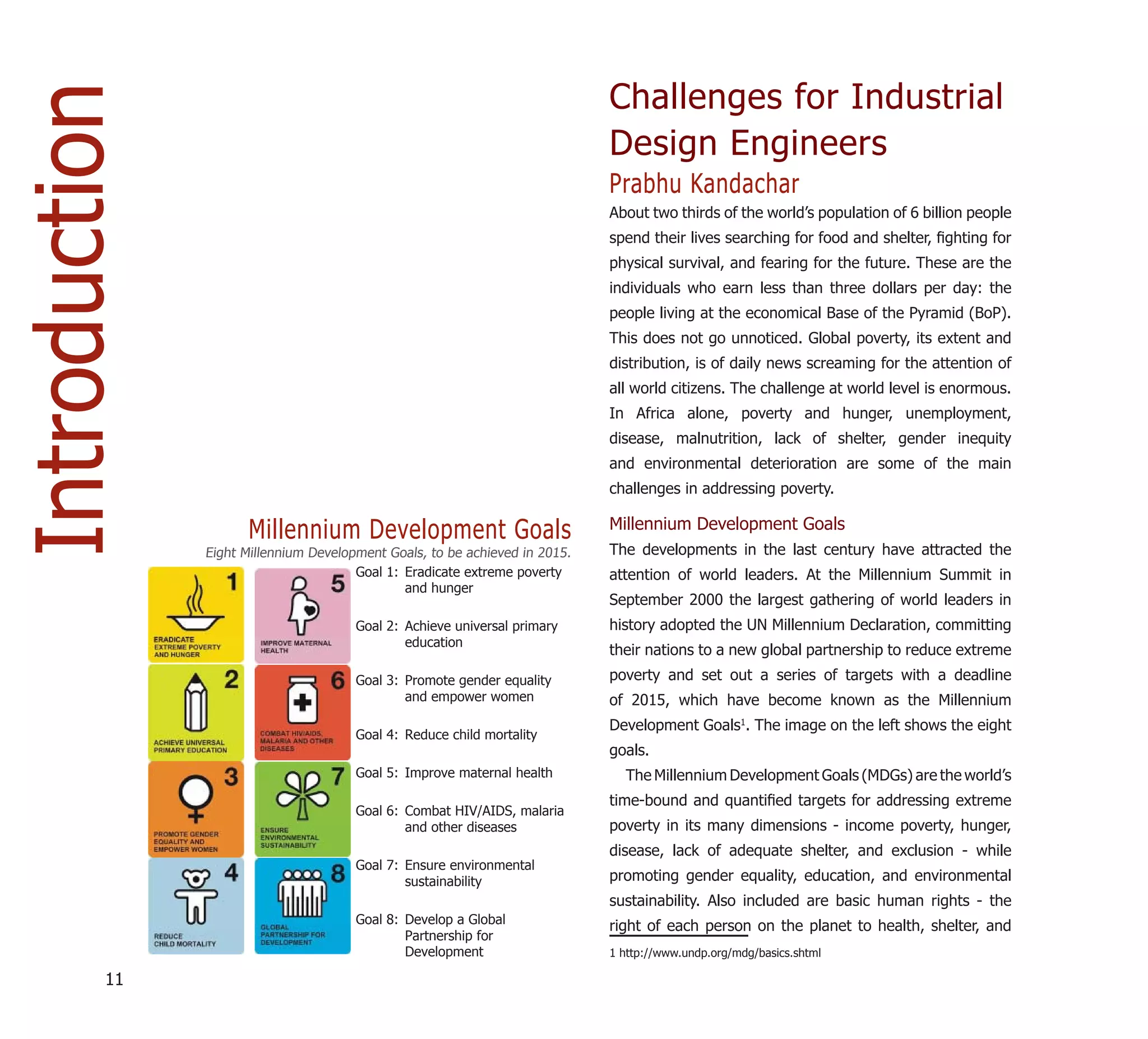
                     Millennium Development Goals                            Millennium Development Goals
               Eight Millennium Development Goals, to be achieved in 2015.   The developments in the last century have attracted the
                                       Goal 1: Eradicate extreme poverty     attention of world leaders. At the Millennium Summit in
                                               and hunger
                                                                             September 2000 the largest gathering of world leaders in
                                       Goal 2: Achieve universal primary     history adopted the UN Millennium Declaration, committing
                                               education
                                                                             their nations to a new global partnership to reduce extreme
                                       Goal 3: Promote gender equality       poverty and set out a series of targets with a deadline
                                               and empower women             of 2015, which have become known as the Millennium
                                                                             Development Goals1. The image on the left shows the eight
                                       Goal 4: Reduce child mortality
                                                                             goals.
                                       Goal 5: Improve maternal health         The Millennium Development Goals (MDGs) are the world’s
                                                                             time-bound and quantified targets for addressing extreme
                                       Goal 6: Combat HIV/AIDS, malaria
                                               and other diseases            poverty in its many dimensions - income poverty, hunger,
                                                                             disease, lack of adequate shelter, and exclusion - while
                                       Goal 7: Ensure environmental
                                               sustainability                promoting gender equality, education, and environmental
                                                                             sustainability. Also included are basic human rights - the
                                       Goal 8: Develop a Global
                                                                             right of each person on the planet to health, shelter, and
                                               Partnership for
                                               Development                   1 http://www.undp.org/mdg/basics.shtml

          11
Introduction
security and there are specific aims at combating child         beyond the immediate horizon and opportunities, and for
mortality, AIDS, Malaria and other diseases.                   having a voice in public decision making. A sustainable
  The MDGs are an agreed set of goals that can only be         end to world poverty as we know it, as well as the path to
achieved if all actors work together and do their part. Poor   peace and security, requires that citizens in every country
countries have pledged to govern better, and invest in their   are empowered to make positive choices and provide for
people through health care and education. Rich countries       themselves and their families. This can only be achieved
have pledged to support them, through aid, debt relief, and    if everyone is given a chance to learn in a high-quality
fairer trade.                                                  schooling environment at least through primary school.
  As an institution which is an expert in designing products     At a country level, education is considered to be an
and services to meet human needs, it could be that some        important determinant of economic growth and is frequently
of the needs of the population at the Base of the Pyramid      hailed as one of the primary contributing factors to the

are addressable by the expertise available at the Faculty      dramatic economic growth in East Asia. Individuals with a

of Industrial Design Engineering, Delft University of          strong educational attainment also have good earnings. A

Technology. Most problems can be grouped in the domains        greater access to good quality education is a key poverty-

of education, healthcare, food & nutrition, water, energy,     reduction strategy advocated throughout the developing
                                                               world.
housing, materials, connectivity, designing & tools, and
                                                                 More and more children, youth and adults have a
entrepreneurship. Each of these domains will be discussed,
                                                               chance to learn and the number of children in school
giving an overview of the needs and problems. The rest
                                                               continues to grow. Today 680 million children are enrolled
of the book presents student projects that aim at solving
                                                               in primary schools around the world. Yet, a lot more still
problems within one or more of these domains, with
                                                               needs to be done. More than 100 million children, over
two different chapters: on page 74, an insight is giving
                                                               half of them girls, never get a chance to see the inside
on “design and culture at the BoP”, and the epilogue on
                                                               of a classroom. Furthermore, the poor quality of education
page 126 reflects on the student projects and draws some
                                                               provided, resulting from irrelevant and obsolete curricula,
preliminary conclusions about the lessons learned.
                                                               overcrowded classrooms, untrained teachers, etc., causes
Education                                                      high incompletion rates.
An essential ingredient for the full realization of human        Literacy empowers and nurtures inclusive societies and
capacity, education is considered to provide everyone the      contributes to the fair implementation of human rights. In
opportunity to make a better life for themselves. Education    the case of mothers, literacy leads to an enhanced quality
provides the basis for making informed choices, for seeing     of life for their families and improved education outcomes
                                                                                                                             12
for their children. Parents’ education, and particularly
                                                                                mothers’ education, is seen to result in lower fertility, lower
                                                                                maternal mortality, and better child health and nutrition
                                                                                status. It is also suggested that individuals with at least
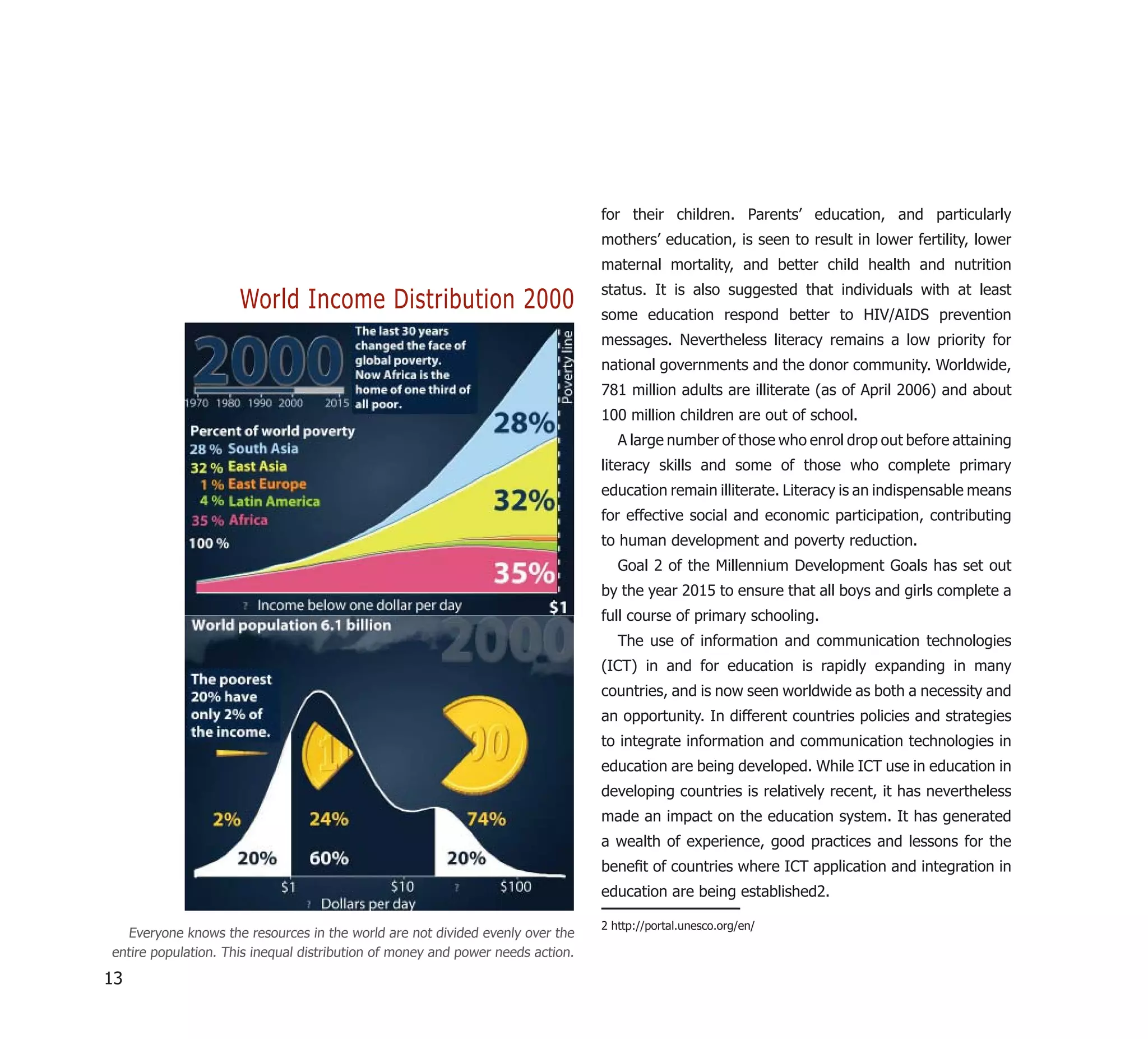
                     World Income Distribution 2000                             some education respond better to HIV/AIDS prevention
                                                                                messages. Nevertheless literacy remains a low priority for
                                                                                national governments and the donor community. Worldwide,
                                                                                781 million adults are illiterate (as of April 2006) and about
                                                                                100 million children are out of school.
                                                                                   A large number of those who enrol drop out before attaining
                                                                                literacy skills and some of those who complete primary
                                                                                education remain illiterate. Literacy is an indispensable means
                                                                                for effective social and economic participation, contributing
                                                                                to human development and poverty reduction.
                                                                                   Goal 2 of the Millennium Development Goals has set out
                                                                                by the year 2015 to ensure that all boys and girls complete a
                                                                                full course of primary schooling.
                                                                                   The use of information and communication technologies
                                                                                (ICT) in and for education is rapidly expanding in many
                                                                                countries, and is now seen worldwide as both a necessity and
                                                                                an opportunity. In different countries policies and strategies
                                                                                to integrate information and communication technologies in
                                                                                education are being developed. While ICT use in education in
                                                                                developing countries is relatively recent, it has nevertheless
                                                                                made an impact on the education system. It has generated
                                                                                a wealth of experience, good practices and lessons for the
                                                                                benefit of countries where ICT application and integration in
                                                                                education are being established2.

                                                                                2 http://portal.unesco.org/en/
  Everyone knows the resources in the world are not divided evenly over the
entire population. This inequal distribution of money and power needs action.

13
Healthcare                                                       the challenge of providing access to sustainable healthcare
  Differences in health standards between rich & poor            in developing countries. Money is the single biggest barrier
countries are very high. Life expectancy varies between          to improving healthcare in the developing world. In many
36 and 85 years. A child born in a rich country receives         countries people do not have enough food or access to a
vaccinations, adequate nutrition and good schooling. When        clean water supply, no hospital or clinic in which to receive
a girl becomes a mother she will benefit from high-quality        treatment and few healthcare professionals to care for them.
maternity care. Growing older, she may eventually develop        Often the governments of these countries simply do not
chronic diseases, but excellent treatment and rehabilitation     have the resources needed to address the healthcare needs
services will be available. On the other hand, a child born in   of their people. The World Bank estimates that an annual
a poor country has little chance of receiving immunizations      healthcare expenditure of $14 per person is the minimum
and a high probability of being underweight throughout           needed to provide the most fundamental services. Yet the
childhood. She will probably marry early and give birth          average expenditure in sub-Saharan Africa, for example, is
to many children without the assistance of a trained birth       currently only $63.
attendant. One or more of her babies will die in infancy, and    Food and Nutrition
she herself will be at high risk of death during childbirth.     Food security and insecurity are terms used to describe
If she survives middle age she, too, will develop chronic        people’s access to sufficient quality and quantity of food.
diseases but, without access to adequate treatment, she will     They are affected by factors such as poverty, health, food
die prematurely.                                                 production, political stability, infrastructure, access to markets,
  This illustrates what medicine and public health can           and natural hazards. Improved food security is important for
achieve, and shows unmet needs in a world of vast and            global reduction of hunger and poverty, and for economic
growing health inequalities. The key task of the global          development. One aim of the Millennium Development
health community is therefore to close the gap between           Goals (MDG) is to eradicate poverty and hunger, including
such contrasting lives. Real progress in health depends          “to reduce by half the proportion of people who suffer from
vitally on stronger health systems based on primary health       hunger” between 1990 and 2015. However, by 2003 the
care. Attention is needed across all levels of the health care   proportion of world population that was undernourished
system to integrate health promotion and disease prevention      had only decreased from 20% to 17% (823 to 820 million
on the one hand and treatment for acute illness and chronic      people). It is predicted that many regions will not reach
care on the other.                                               their MDG targets, particularly sub-Saharan Africa where
  Experiences from past decades, fighting against diseases        a third of the population is food insecure and there is an
across the world, show that there are no easy solutions to       3 The World Health Report 2006, http://www.who.int/

                                                                                                                                       14
actual increase (through population growth) in the number
                                                                                   of hungry people. Southern Asia is also not expected to meet
                                                                                   its goal, with increasing numbers of undernourished people
                                                                                   in countries such as Bangladesh and Nepal.
                                                                                     The factors affecting this problem include: (1) availability
                                                                                   of food, or the amount of food that actually exists (local
                                                                                   production and other sources) (2) people’s physical, economic
                                                                                   and social access to food (3) the quality or nutritional
                                                                                   adequacy of that food; and (4) people’s ability to utilize
                                                                                   this food, including the patterns of control over who eats
                                                                                   what and the physical ability to absorb nutrients (affected by
                                                                                   health status factors such as intestinal parasites).
                                                                                     Malnutrition, a widespread problem, is caused by
                                                                                   deficiencies or imbalances in energy, protein and/or other
                                                                                   nutrients.   Signs   include   wasting   (thinness),   stunting
             Shortage of Health Service Providers                                  (shortness), or being underweight (low weight for age due
                                                                                   to wasting/stunting). Protein-energy deficiency is a leading
                                                                                   cause of child death in developing countries. Deficiencies
                                                                                   in micro nutrients (vitamins and minerals) can also affect
                                                                                   mental and physical health.
                                                                                     Micronutrient malnutrition is a major global public health
                                                                                   problem affecting more than a third of the world population.
                                                                                   Consequences of this malnutrition are widespread and severe.
                                                                                   For example iron deficiency anaemia remains a major health
                                                                                   problem and can negatively impact on health, life expectancy,
                                                                                   work productivity and economies. It has been estimated that
                                                                                   iron deficiency impairs the mental development of 40 to 60%
                                                                                   of children in developing countries. Also, vitamin A deficiency
 Countries with a critical shortage of health service providers (doctors, nurses
 and midwives) are coloured dark. [World Health Organization, Global Atlas of      affects 40% of children, and is a factor in 1 million child
            the Health Workforcehttp://www.who.int/globalatlas/default.asp]        deaths per year. Thirdly, iodine deficiency during pregnancy
15
causes mental impairment in 18 million babies born every
                                                                                         Households (%) That Lack
year. Several strategies have been proposed to address
                                                                                         In-House            Improved
these problems. They include food fortification, dietary                                  Connection to       Drinking            Improved
diversification, dietary supplementation, nutrition education,                            Water               Water               Sanitation
and public health measures to control intestinal parasites             China             41                  23                  56
and other infectious diseases. Also, when people do have               Russia            19                  4                   13
access to food, more efficient and healthy food preparation             Mexico            11                  9                   23
methods and tools can address the problem of unhealthy                 Colombia          15                  8                   14
preparation.
                                                                       Peru              28                  19                  28

Water
                                                                       In China two-fifth of the households lack an in-house connection to water,
The most common substance on earth is water. Ninety-                   almost a quarter lacks improved drinking water and more than half of all
seven percent of it is seawater, unfit for human use. Of                Chinese lack improved sanitation [United Nations Habitat].
the remaining 3%, two-thirds is locked up in glaciers or ice
and snow around the poles. Only 1% of the entire world’s
water is available for human consumption. Even this small
percentage should be enough for all, water being infinitely
renewable. However, water is not distributed evenly. Canada,           The Global Water Challenge
Austria and Ireland, have more water than they can possibly
use; Australia, northern China and the Middle East, have too
little. In India and Bangladesh, rainfall is highly seasonal:
almost all the year's supply may arrive within a few months.
Water is also heavy, which makes it costly to transport over
long distances. In many countries, millions of poor people
(usually women) must walk for several hours a day to get
water; or they pay exorbitant prices to private water vendors.
And often water quality is poor. Inadequate sanitation makes
matters worse. As much as 60% of the world's illness is
water-related. Water shortage is expected all over the world
                                                                       In developing countries, less than 10% of the naturally available water
in the coming 20 years as shown in the figure on the right4.            is withdrawn [Adapted from Grey and Sadoff, 2006, The Global Water
4 Water Scenarios in 2025, WBCSD, August 2006, http://www.wbcsd.org/   Challenge].

                                                                                                                                                   16
One of the millennium targets requires that an additional 1.5
                                                                                 billion people gain access to some form of improved water
                                                                                 supply by 2015, which is 100 million people each year (or
                                                                                 274,000 people each day).

                                                                                 Energy
                                                                                 Energy is required for most of the human activities. In 2003,
                                                                                 no less than 80% of the world's energy consumption came
                                                                                 from fossil fuels. The extensive use of energy technologies,
                                                                                 especially when utilizing fossil energy resources, has also
                                                                                 generated undesirable by-products, wastes and pollution

                      Worldwide Energy Consumption                               that threaten human health, climate and ecosystems. The
                                                                                 extraction, conversion to useful energy (such as electricity
                                                                                 for a home or gasoline for a car), and combustion of
                                                                                 fuels like oil, coal, natural gas, etc, releases into the
                                                                                 atmosphere approximately 80% of human-induced (termed
                                                                                 anthropogenic) greenhouse gas emissions. The environmental
                                                                                 consequences are causing concern firstly from the reliance on
                                                                                 natural resources, and secondly from the damage to global,
                                                                                 regional, and local environments from emissions.
                                                                                   The global requirements for energy are increasing rapidly
                                                                                 as the global population increases and the under-developed
                                                                                 nations become more advanced. Nearly two billion people in
                                                                                 our world of rapidly approaching six billion people currently
                                                                                 do not have access to commercial energy services.
                                                                                   Understanding and assisting in putting to use the laws of
                                                                                 nature for the transition towards a sustainable energy system
                                                                                 is the fundamental challenge of today’s and tomorrow’s
                                                                                 scientists & engineers. One of the greatest challenges ahead
  Prognosis after 2000 assumes a global economic growth of 3% and a global
population of 9 billion people by 2050 [Deutsche Shell, http://www.spiegel.de/   is to connect the 1.6 billion people in developing countries
               international/spiegel/0,1518,grossbild-685811-429968,00.html].    currently without access to modern energy services in an
17
environmentally benign manner. Other challenges include the            Housing and Urbanization
ongoing urbanization throughout the world creating higher              Some 1.2 billion people worldwide live on the equivalent
and higher energy demand densities, increasing demand for              of less than one dollar per day. The United Nations Centre
mobility, especially in developing countries, and additional           for Human Settlements (UNCHS) has estimated that 1.1
energy needs for new processes such as desalination.                   billion people are living in inadequate housing conditions in
Clearly, meeting such a challenge requires a proactive & a             urban areas alone, and that figure is expected to double by
co-operative contribution from all involved.                           2030. UNCHS has also estimated that some approximately
   In Africa, for instance, overcoming energy poverty is one of        35 million new housing units are required each year in
the main challenges. The majority of Africans currently have           developing countries to accommodate growth in the number
no access to modern energy services and technologies.                  of households during the period between 2000 and 2010
   This    has     wide-ranging         social   and   environmental   period. The bulk of these, some 21 million units, are required
consequences. Lack of access to electricity means no                   to cater for the needs of the increasing number of households.
refrigeration for medicines or food, limits on what type of            The rest is needed to meet the requirements of people who
businesses can be developed, as well as no effective lighting.         are currently homeless or living in inadequate housing. In
As a result, children cannot easily study in the evenings.             other words, some 95,000 new urban housing units have to
Most Africans, even in urban areas, still use firewood, crop            be constructed each day in developing countries to improve
residues or charcoal for cooking and cook on inefficient                housing conditions to acceptable levels. Some 14 million
stoves, resulting in a high incidence of respiratory diseases          additional units would be required each year for the next
because of smoke. Many women and girls have to spend                   20 years if the current housing deficit were to be replaced
hours collecting firewood, and cutting trees contributes to             by 2020. Among an estimated 100 million homeless people
deforestation.                                                         around the world, available data suggest that increasing
   There are also opportunities. A recent study5, by the               proportions are women and children.
German Aerospace Center and Ecofys in The Netherlands,                   But the main event of the demographic change is in the
commissioned by Greenpeace and Europe's Renewable                      cities of the developing world — and most of it in squatter
Energy Council. claims that half of the world's energy needs           cities, the teeming slums of the uninvited. A billion people
in 2050 could be met by renewable energy and by improved               live in squatter cities now. Two billion more are expected by
efficiency. According to this study, alternative energy sources,        2050. Squatters are nearly one-sixth of all humans now, one-
such as wind and solar, could provide nearly 70% of the                fourth to one-third in the nearby future.
global electricity demand and 65% of global heat demand.                 Historically, cities have been the driving force in economic
                                                                       and social development. At present approximately 307 million
5 Report: Energy Revolution, Jan 2007

                                                                                                                                        18
Indians (31% of the population) live in nearly 3700 towns
     and cities spread across the country. This is in sharp contrast
     to only 60 million (15%) who lived in urban areas in 1947
     when the country became independent. During the last fifty
     years the population of India has grown two and half times,
     but Urban India has grown by nearly five times. In numerical
     terms, India's urban population is second largest in the world
     after China, and is higher than the total urban population of
     all countries put together barring China, USA and Russia.
       Facilities in houses are also of big challenge. Less than
     20% of households in Africa are connected to piped water,
     and only 40% have piped water within 200 meters of their
     home. In the developing world, 29% of cities have areas
     considered as "inaccessible" or "dangerous" to the police. In
     Latin America and the Caribbean, this figure is 48%. Less than
     35% of cities in the developing world have their wastewater
     treated. In countries with economies in transition, 75% of
     solid wastes are disposed of in open dumps.
       Housing problems have far-reaching consequences. The
     high cost of housing leaves low-income families little money
     for other basic necessities like food, clothing or health care.
     Substandard housing can endanger the health and safety of
     its occupants, erode their hope and self-worth, and impair
     their children's ability to succeed in school.

     Materials and Resources
     Developing    countries   are   concerned        with   promoting
     technological advancement as a means of economic
     development, which in turn contributes to social development.
     Raw materials and local resources provide basic building
     blocks for such developments. Developed countries are much
19
further in application of material and resources by means       contribute significantly to the income and food security
of industrial production wherein energy and raw materials       of poor farmers and workers in fibre industries. For some
are fed continuously into the production process, resulting     developing countries natural fibres are of major economic
in useful products as well as waste or other by-products.       importance, for example, cotton in some West African
Increasing concern worldwide for environmental protection       countries, jute in Bangladesh and sisal in Tanzania. In other
and growing economical constraints have led to development      cases these fibres are of less significance at the national level
and utilization of new materials based on renewable             but are of major local importance, as in the case of jute in
resources such as natural fibres and plant materials, as well    West Bengal (India) and sisal in northeast Brazil.
as recycling of industrial by-products.                           Challenges in this area include attaining economic growth
  Developing countries have often abundant local renewable      by designing and commercializing products based on such
materials and basic expertise. For instance natural fibres       local renewable natural resources without raising the
produced from animals or plants are plentifully available in    ecological pressure on the planet.
developing countries. Animal fibres are derived from sources     Connectivity
such as sheep, goats and rabbits, and the cocoon of the         Communications in the richer part of the world by means
silkworm. Vegetable fibres are derived from the stem, leaf or    of newspapers, radio, TV, telephones are self-evident. The
seed of various plants. Close to 30 million tonnes of natural   latest technology, mobile phones, has become indispensable
fibres are produced annually in the world, of which cotton is    in the rich world. But they are even more useful in the
dominant with 20 million tonnes, wool and jute each around      developing world, where the availability of other forms
2 to 3 million tonnes followed by a number of others.           of communication—roads, postal systems or fixed-line
  Natural fibres form an important component of clothing,        phones—is often limited. Even though there is a substantial
upholstery and other textiles for consumers, and many of        subscriber growth in much of the developing world, only
them also have industrial uses in packaging, papermaking        a small proportion of people (affordability is the “biggest
and in composite materials with many uses, including            obstacle” to broader adoption) —around 5% in both India
automobiles.                                                    and sub-Saharan Africa—have their own mobile phones.
Apart from their importance to the consumer and in their        Using cell phones, fishermen and farmers check prices in
various industrial uses, natural fibres are an important         different markets before selling produce. Cell phones also
source of income for the farmers who produce them. In           help people to find work, allow quick and easy transfers
some cases they are produced on large farms in developed        of funds and boost entrepreneurship. A village can share
countries, but in many developing and least developed           phones and prepaid calling plans reduce the need for a bank
countries proceeds from the sale and export of natural fibres    account or credit check.
                                                                                                                                  20
Grameen Bank, a pioneer in the practice of micro-credit
                                                                                   lending, has created a cell phone company to bring cell
                                                                                   phones into the villages of Bangladesh. The bank gave loans
                                                                                   to the borrowers to buy a cell phone and start selling phone
                                                                                   services. It became a growing business, especially with
                                                                                   women entrepreneurs. They never saw a telephone in their
                                                                                   life before, but they have accepted it as a business idea, and
                                                                                   more than 100,000 telephone ladies all over Bangladesh are
                                                                                   doing good business while connecting Bangladesh with the
                                                                                   rest of the world.
                                                                                     A recent study has shown that, in a typical developing
                                                                                   country, a rise of ten mobile phones per 100 people boosts
                                                                                   GDP growth by 0.6 percentage points. Mobile phones are,
            Number of People Without Electricity                                   in short, a classic example of technology that helps people
                                                      1979-2030, by region         help themselves.
                                                                                     Nevertheless, the absorption of digital technologies
                                                                                   throughout the world has not been uniform, such that the
                                                                                   concept of digital divide has emerged. The digital divide is
                                                                                   the gap between those with regular, effective access to digital
                                                                                   technologies and those who do not have that option. Also,
                                                                                   the divide refers to those who can benefit from those digital
                                                                                   technologies and those who do not. Countries with a wide
                                                                                   availability of internet access can advance the economics of
                                                                                   that country on a local and global scale. In today's society,
                                                                                   internet is becoming increasingly important influencing
                                                                                   jobs and education. In countries where the internet and
                                                                                   other technologies are not accessible, education is getting
                                                                                   affected, and uneducated people cannot compete in our

     In the sub-saharian Africa and South Asia, it is projected that people are    global economy. The digital divide is also a term used to
                            increasingly living without electricity [IEA 2002b].   refer to the gap between people who have access to the
21
internet (the information haves) and those that do not (the       Entrepreneurship
information have-nots). It can also refer to the skills people    Entrepreneurs are regarded as bearers of risk, agents that
have – the gap between people who are at ease using digital       bring together the factors of production, or organizers of
technology to access and analyse information and those who        innovation. Entrepreneurship is essential in developing
are not.                                                          countries, as it has played an important role in economic
  The digital divide is just as much a gap in understanding as    growth, innovation, and competitiveness, and it may also
it is a gap in connectivity. There are often clear fundamental    play a role over time in poverty alleviation.
differences between what is proposed by technology                  Over 400 million individuals in developing countries

visionaries, many of whom have never even seen a village,         are owners or managers of new firms. Of these, over 200

and what is actually needed by end-users, many of whom            million are found in China and India alone, compared with
                                                                  just 18 million entrepreneurs in the United States. Yet, in
have never used a telephone or a computer.
                                                                  one of the best general books on the state of research on
  A number of ICT initiatives offer a promise of closing the
                                                                  entrepreneurship, China is mentioned on two pages and
gap that separates the some four billion people living in rural
                                                                  India is not mentioned at all6.
communities from a future with greater literacy, productivity,
                                                                    Entrepreneurs in developing countries face a different
and quality of life. While the end goal is clear – broadband
                                                                  set of circumstances than their counterparts in developed
connectivity everywhere – many ICT initiatives have faltered
                                                                  economies. These differences are rooted in the underlying
due to a lack of a well-adapted, step-by-step approach that
                                                                  economies in which they operate. Emerging markets lack a
considers social factors and the staging of capital investments
                                                                  stable or mature market and the consistency that such markets
as well as technology.
                                                                  offer. Consequently, the opportunity for entrepreneurship in
  Wireless technology has not only revolutionized the way
                                                                  emerging markets is pervasive. While Western entrepreneurs
the developed world communicated; it also offers developing
                                                                  operate at the fringes of the economy, emerging market
countries an opportunity to “leap-frog” over wire line            entrepreneurs operate closer to the core – the needs and
infrastructures to the forefront of communications. However,      opportunities are more widespread. Another difference lies in
since many different types of wireless technologies exist, it     the access to financial resources. Internal finance comprises
is important to choose the technology that best matches the       the majority of financing for small and medium enterprises
needs of these new markets. While some wireless techniques        in most developing countries. Another major difference lies
have been very successful in urban areas, the rural ICT market    in the access to technological advances which are largely
has its own set of unique requirements, including: low-cost,      6 Amar Bhidé, The Origin and Evolution of New Businesses, New York: Oxford

low-power, scalability, robustness, and ease of use.              University, 2000, ISBN-13: 978-0195131444

                                                                                                                                               22
developed and held by developed countries.
                                                                        Entrepreneurs are a crucial link in implementing designs
                                                                      of products and services developed specifically to meet the
                                                                      needs of the BoP markets. They are the motors of economic
                                                                      growth and poverty reduction. Small, micro and medium-
                                                                      sized enterprises (SMMEs) are often the backbone of the
                                                                      private sector in the developing world, creating jobs and
                                                                      providing a tax base for local government. And frequently
                                                                      SMMEs offer the only employment available to millions of
     Focus of Base of the Pyramid Research                            poor people.
                      Faculty of Industrial Design Engineering
                                                                      Design and Research
                                 Delft University of Technology
                                                                      Back in 2002, an experiment was conducted to design a
           A model for design processes for the Base of the Pyramid   product to serve rural healthcare needs of China, specifically
                                     [Prabhu Kandachar, Jan 2008].
                                                                                         diabetes mellitus. In this project, students
                                                                                         and staff of the Faculty of Industrial
                                                                                         Design Engineering collaborated with
                                                                                         staff from a Multinational Corporation.
                                                                                         Almost at the same time the first paper
                                                                                         expounding the Base of the Pyramid
                                                                                         strategy by Prahalad & Hart appeared,
                                                                                         promising fortune for entrepreneurs and
                                                                                         at the same time offering perspectives
                                                                                         for the poor world7 majority to escape
                                                                                         from poverty.
                                                                                            Needs of human beings are the
                                                                                         central driving force uniting technology
                                                                                         and business, resulting in products
                                                                                         and services. By tradition Delft has
                                                                                         7 Strategy + Business, Issue 26, digitaldividend.org/
                                                                                         pdf/bottompyramid.pdf, first quarter 2002.

23
propagated the practise of designing products and services
to meet human needs.
  Even though it is set up in an engineering environment,
such an activity needs an integrative approach from several
sciences: technical, social, management sciences, and
working together with entrepreneurs. Although several earlier
activities at Delft had been carried out in poor countries,
they were almost always within the context of developmental
assistance. The Base of the Pyramid strategy has stimulated
this Faculty to look also at the needs of the underserved,
which represent a huge market and was hitherto unattended.
It provides an opportunity to apply the well tried out model
at Delft (see figure at the left) for poor countries, but this
time within the context of alleviating poverty by means of
business endeavours.


                                                                24
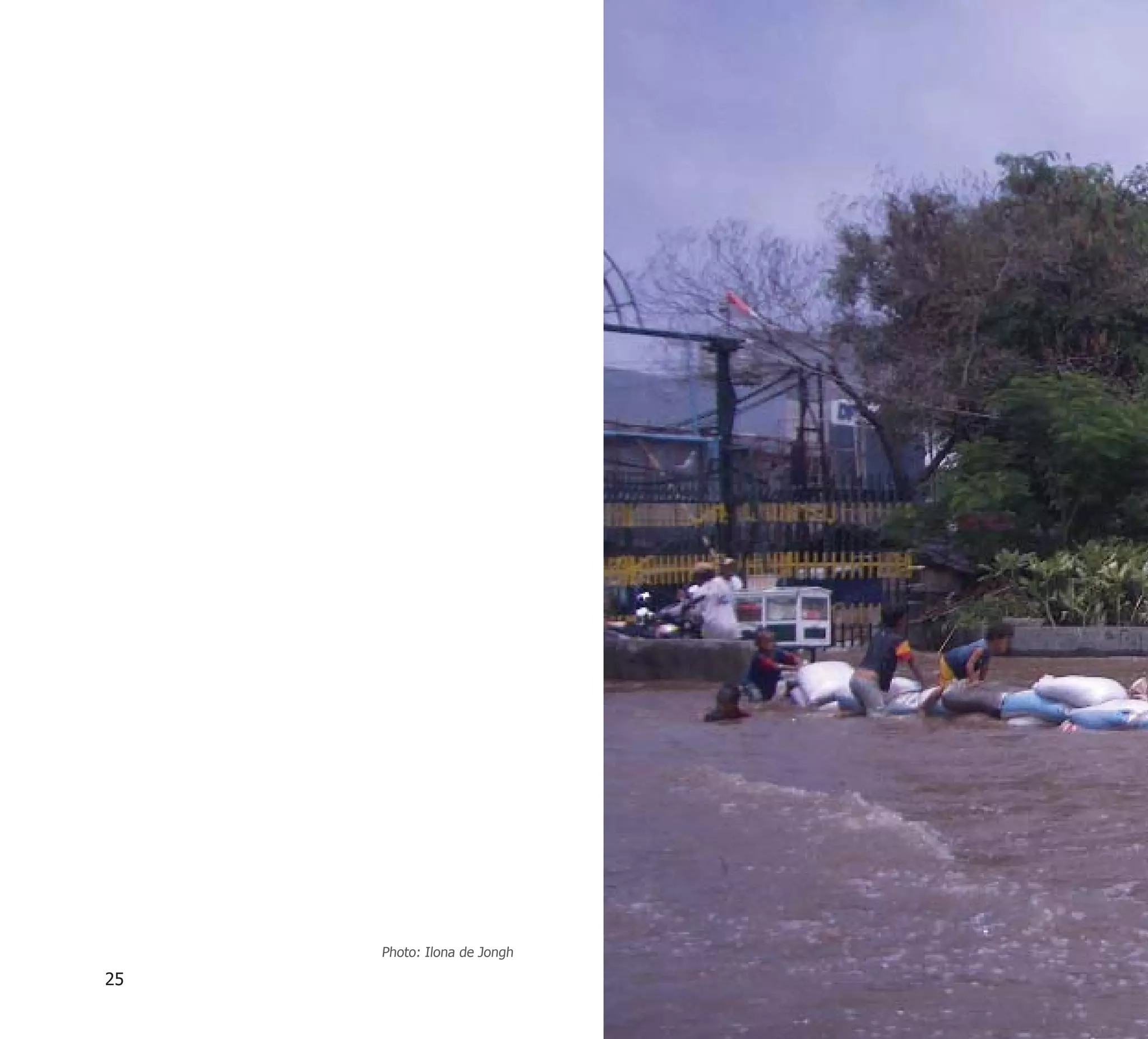
Photo: Ilona de Jongh

25
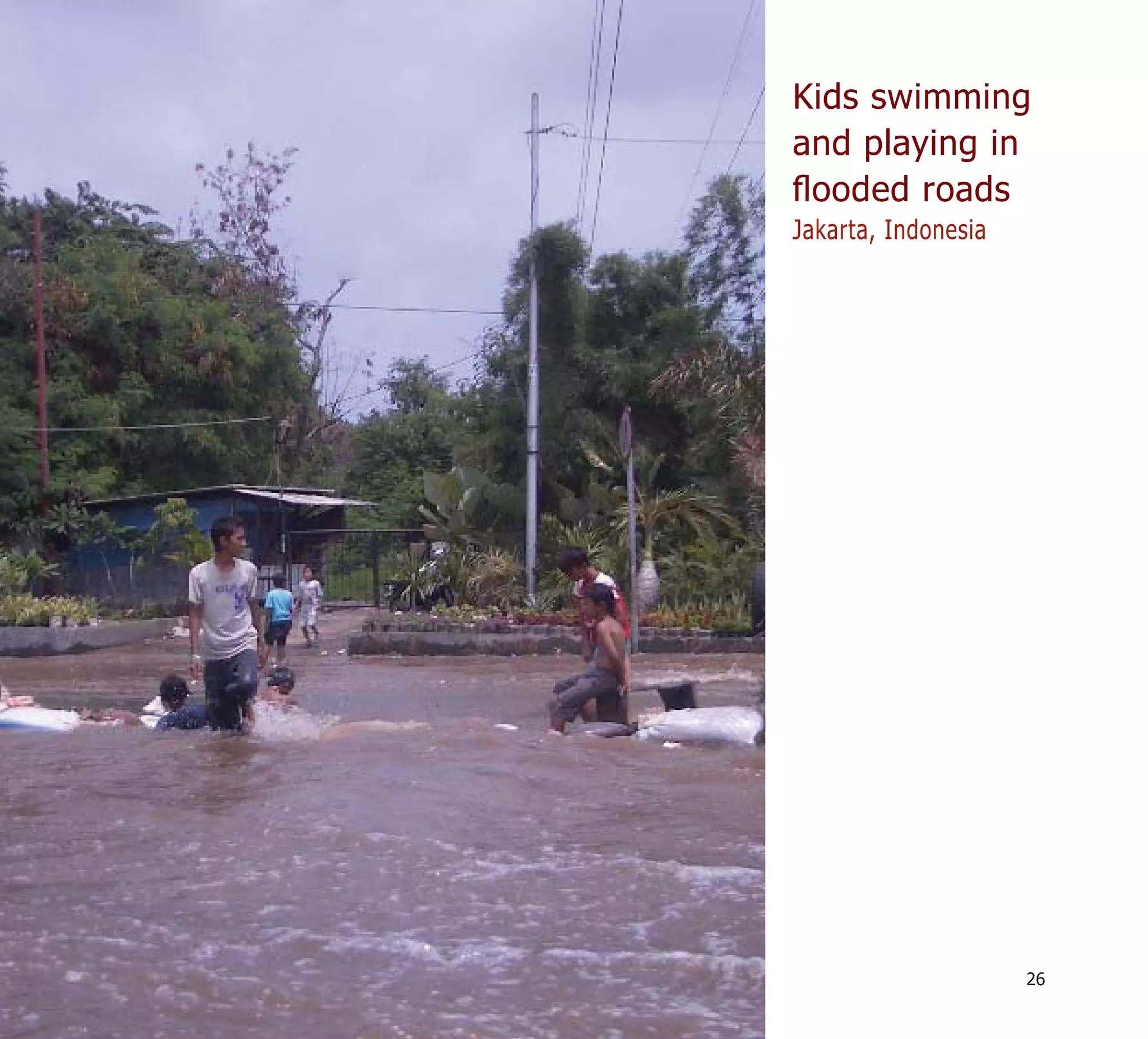
Kids swimming
and playing in
flooded roads
Jakarta, Indonesia


                     26
Insect Repellent Lamp
           €        Company

                    Philips Consumer Lifestyle
                                                      Graduation date

                                                      December 8, 2008
                                                                                for the Indian Market
                                                                                Inge van de Wouw
                                                                                Insect bites are an unpleasant fact of life in most parts of
                                                                                the world. In addition to severe nuisance, mosquitoes can
                                                                                also spread diseases such as Malaria, Dengue, Filariasis,
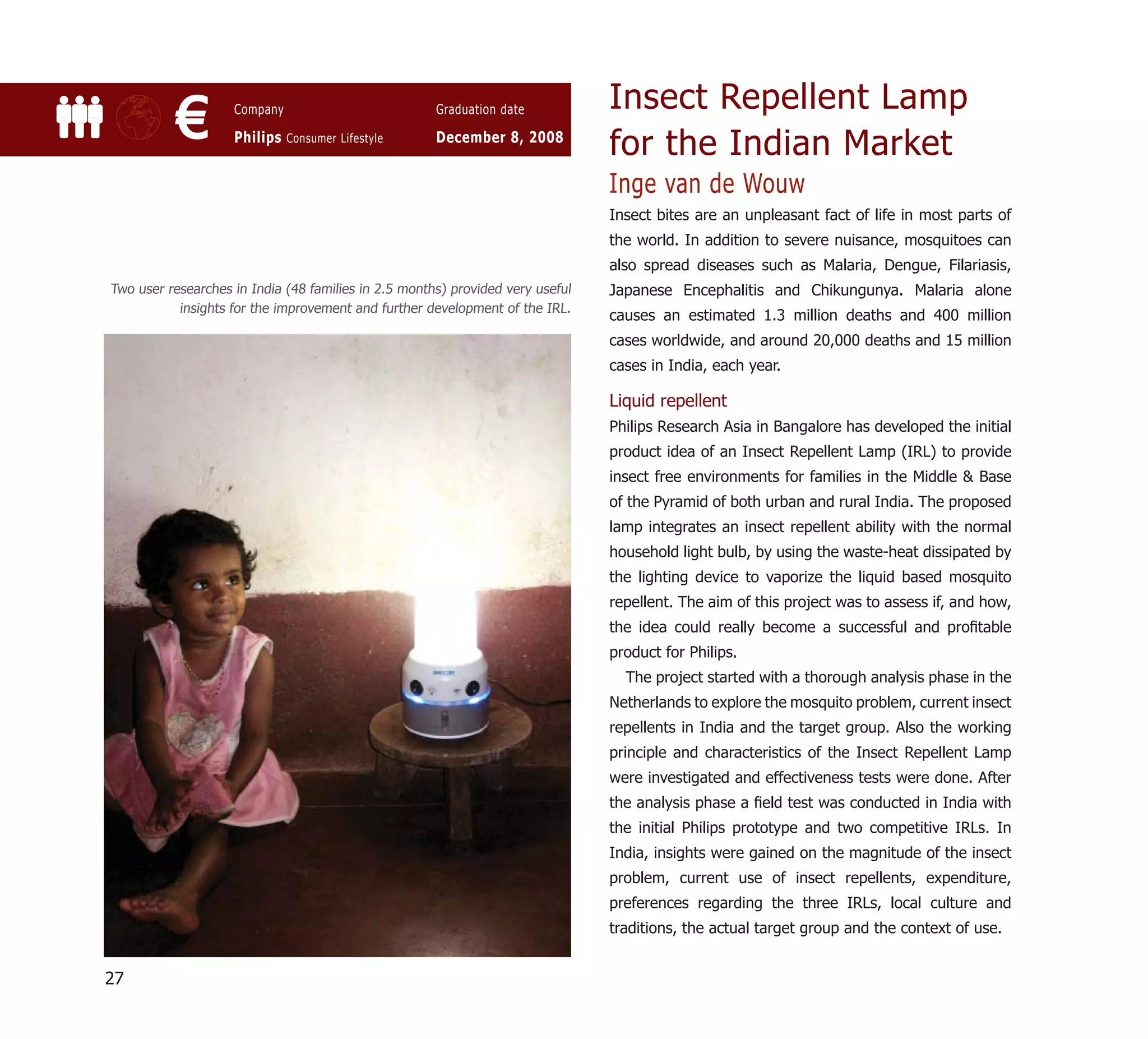
Two user researches in India (48 families in 2.5 months) provided very useful   Japanese Encephalitis and Chikungunya. Malaria alone
           insights for the improvement and further development of the IRL.
                                                                                causes an estimated 1.3 million deaths and 400 million
                                                                                cases worldwide, and around 20,000 deaths and 15 million
                                                                                cases in India, each year.

                                                                                Liquid repellent
                                                                                Philips Research Asia in Bangalore has developed the initial
                                                                                product idea of an Insect Repellent Lamp (IRL) to provide
                                                                                insect free environments for families in the Middle & Base
                                                                                of the Pyramid of both urban and rural India. The proposed
                                                                                lamp integrates an insect repellent ability with the normal
                                                                                household light bulb, by using the waste-heat dissipated by
                                                                                the lighting device to vaporize the liquid based mosquito
                                                                                repellent. The aim of this project was to assess if, and how,
                                                                                the idea could really become a successful and profitable
                                                                                product for Philips.
                                                                                  The project started with a thorough analysis phase in the
                                                                                Netherlands to explore the mosquito problem, current insect
                                                                                repellents in India and the target group. Also the working
                                                                                principle and characteristics of the Insect Repellent Lamp
                                                                                were investigated and effectiveness tests were done. After
                                                                                the analysis phase a field test was conducted in India with
                                                                                the initial Philips prototype and two competitive IRLs. In
                                                                                India, insights were gained on the magnitude of the insect
                                                                                problem, current use of insect repellents, expenditure,
                                                                                preferences regarding the three IRLs, local culture and
                                                                                traditions, the actual target group and the context of use.


27
www.philips.com


CFL & portability
With the obtained information, several suggestions for
improvements were given. First of all, a compact fluorescent
lamp (CFL) should be used as light source instead of a light
bulb. Regarding the repellent, it should be vaporized at the
correct temperature of the wick and bottled liquids should
be used. The lamp itself should provide more flexibility; the
hanging type of lamp should be changed into a portable
lamp. Lastly, instead of only in the evening, people should
also be able to use the repellent at night together with a
night light.
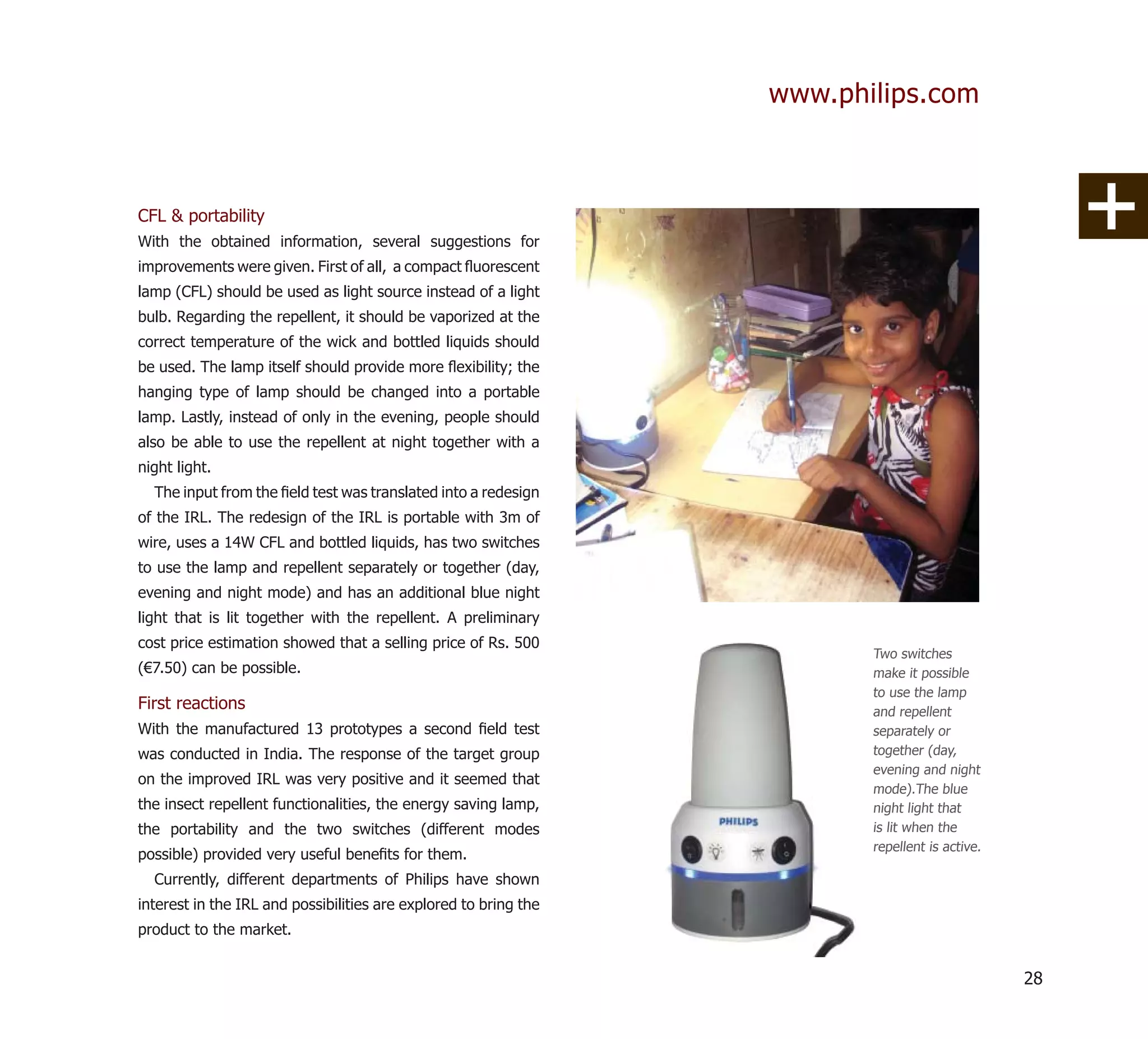
  The input from the field test was translated into a redesign
of the IRL. The redesign of the IRL is portable with 3m of
wire, uses a 14W CFL and bottled liquids, has two switches
to use the lamp and repellent separately or together (day,
evening and night mode) and has an additional blue night
light that is lit together with the repellent. A preliminary
cost price estimation showed that a selling price of Rs. 500
                                                                         Two switches
(€7.50) can be possible.                                                 make it possible
                                                                         to use the lamp
First reactions                                                          and repellent
With the manufactured 13 prototypes a second field test                   separately or
was conducted in India. The response of the target group                 together (day,
                                                                         evening and night
on the improved IRL was very positive and it seemed that
                                                                         mode).The blue
the insect repellent functionalities, the energy saving lamp,            night light that
the portability and the two switches (different modes                    is lit when the
                                                                         repellent is active.
possible) provided very useful benefits for them.
  Currently, different departments of Philips have shown
interest in the IRL and possibilities are explored to bring the
product to the market.


                                                                                                28
IndiaMoves; exploratory
           €         Company
                     Movendi Foundation
                                                       Graduation date
                                                       2009
                                                                                 research study
                                                                                 Aparna Bhaskar
                                                                                 Movendi foundation strives to improve the quality of life for
 Cooka et al: A product-service system (PSS), also known as a function-
                                                                                 physically disabled people. The foundation’s primary focus
 oriented business model, is a business model, developed in academia,
                                                                                 is on developing countries and communities with a great
 that is aimed at providing sustainability of both consumption and
                                                                                 need for expertise in the field of movement technology and
 production1.
                                                                                 physical therapy. The goals are achieved through start-ups
 1. M.B. Cooka, T.A. Bhamrab and M. Lemonc (2006). “The transfer and             and coaching projects using local knowledge and skills to
 application of Product Service Systems: from academia to UK manu-               arrive at creative solutions for different problems faced by
 facturing firms”. Journal of Cleaner Production (Elsevier Ltd) 14 (17):          the physically disabled. Movendi is also involved in setting
 1455–1465. doi:10.1016/j.jclepro.2006.01.018.                                   up rehabilitation workshops and training of local therapists
                                                                                 and technicians.

                                                                                 GhanaMoves
                                                                                 Movendi has previously worked in a business development
                                                                                 project for disabled people in Ghana. The project aimed to
                                                                                 improve the lives of the disabled by providing them with a
                                                                                 means to support themselves, see page 92. Four students
                                                                                 investigated the business opportunities for the disabled
                                                                                 and they came up with a hand-driven tricycle with which
                                                                                 the disabled could sell ice-cream on the streets of Madina-
                                                                                 Accra. The tricycles were manufactured at a local workshop,
                                                                                 MAK-D, which profited as well from the business by selling
                                                                                 tricycles, the ice-cream was supplied by Fanmilk, Ghana’s
                                                                                 largest dairy producer and the disabled were able to obtain
                                                                                 a small credit (micro-credit) from a local bank at a very
                                                                                 reasonable interest rate. For more detailed information a
                                                                                 summary of the project is enclosed. Taking GhanaMoves as
                                                                                 a starting point and as an inspiration, seeing the benefits it
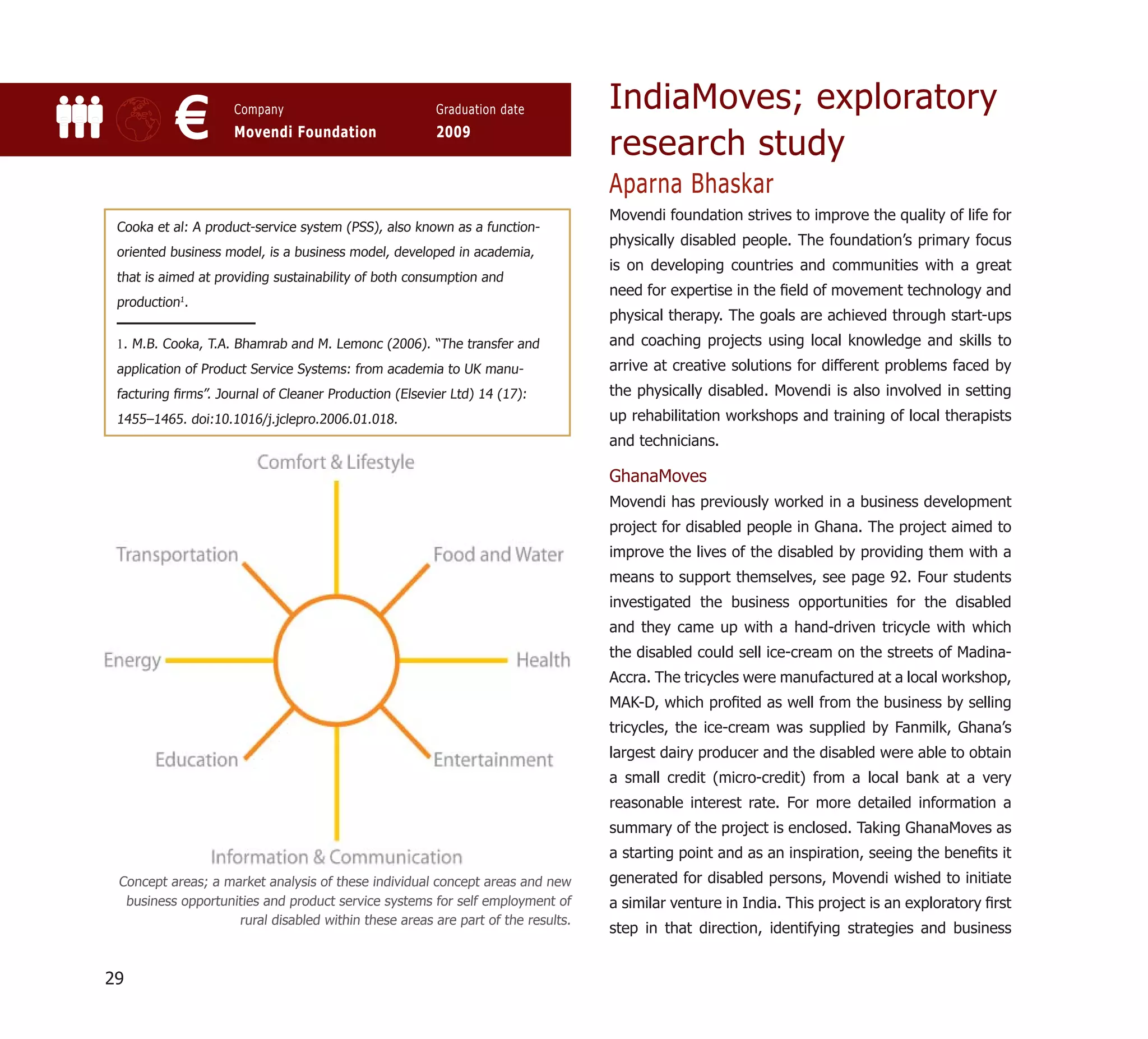
 Concept areas; a market analysis of these individual concept areas and new      generated for disabled persons, Movendi wished to initiate
  business opportunities and product service systems for self employment of      a similar venture in India. This project is an exploratory first
                    rural disabled within these areas are part of the results.
                                                                                 step in that direction, identifying strategies and business


29
www.movendifoundation.org


opportunities.                                                   entrepreneur are presented.The second part of the project
                                                                 focused on generating self employment opportunities
Entrepreneurial businesses
                                                                 suitable for locomotor disabled persons. In order to do so,
In a country like India, the poor face numerous challenges
                                                                 it was imperative to analyse the Indian market situation.
and poverty in itself is a handicap. The less fortunate
                                                                 This included study of the consumer markets, with special
often have to deal with illiteracy, hunger and daily battle
                                                                 attention to rural India, and an overview of lives of the poor
for basic necessities, barely managing to make ends meet.
                                                                 in rural India. On the basis of this research, seven product-
In addition to being born poor, if one has a disability, he/
                                                                 service-systems (PSS, see box on the left page) that can be
she is confronted with an uphill battle at all stages of life.
                                                                 operated by rural disabled persons were developed.
The disabled poor are one of the most neglected and
marginalized communities with limited access to resources        Strategies & PSSs
and employment opportunities. These issues are magnified          Ideas for product-service-systems are elaborated to levels
many times over when it comes to rural India. This strategic     of market potential, consumer segmentation and role of
design project focuses on identifying and developing             different stakeholders in the enterprise system. Ideas are
business opportunities that would empower the disabled           provided for enterprise alliances with private, governmental
poor in rural India, by creating entrepreneurial businesses.     and non-profit sector.
The first step is research.                                         The project was initiated by the Movendi team and the
                                                                 results are primarily intended for use by Movendi. The
Disability at the BoP India
                                                                 report and its content are meant to support future initiatives
In order to      develop business opportunities, a thorough
                                                                 by Movendi in India. The report provides a comprehensive
analysis of disability at the BoP in India was performed; an
                                                                 overview to disabled persons and disability sector in India,
in-depth understanding of the disability sector and disabled
                                                                 and would be of value to future Movendi project teams in
persons in rural India. The need for employment amongst
                                                                 India. However the content of report is of value to other
rural disabled was confirmed and the target group was
                                                                 reader groups as well: Disability Institutions, Rehabilitation
defined clearly. It answers questions such as; who amongst
                                                                 organization and NGO’s in India: The report highlights new
the rural disabled or what sections of the disabled population
                                                                 possibilities and approaches for the betterment of locomotor
require additional support in terms of employment? Who
                                                                 disabled in India. Organizations working in disability sector
amongst locomotor disabled are capable/ not capable of
                                                                 are ideally placed with appropriate resources and prior
taking up responsibility of entrepreneurship? Additionaly,
                                                                 experience.
symbiotic business opportunities with benefits for Hindustan
Unilever Limited and Project India Moves & the disabled                                                                                €
                                                                                                                                  30
Energy as a consumer
            €         Company

                      Philips Light
                                                       Graduation date

                                                       October 30, 2008
                                                                                 product
                                                                                 Ambika Samabasivan
                                                                                 In recent years, the poor are slowly being recognized as
                                                                                 consumers in their own right and therefore as potential
                                                                                 markets for business. Philips is one of the few global
                                                                                 companies committed to developing such markets. The
                                                                                 BoP, represented by the 4 billion poorest people around the
                                                                                 world, are becoming both a strategic focus for long-term
                                                                                 growth and critical for promoting social equity in line with
                                                                                 the company’s sustainability policy.
                                                                                   Energy represents one such growing market. This
                                                                                 project focuses itself to electricity access. Electricity has
                                                                                 traditionally remained in the realm of public infrastructure.
                                                                                 However, from various insights, it is abundantly clear that
                                                                                 the conventional grid is not the answer to the electricity
                                                                                 problem of the poor. Only about 56% of the BoP is
                                                                                 connected to the grid. A large number of poor households
                                                                                 cope with candles, kerosene, generators or rechargeable car
                                                                                 batteries. These energy sources are unsafe, inefficient and
                                                                                 expensive in the long-run. Despite this, end-use patterns
                                                                                 are changing dramatically. Households are investing in
                                                                                 comfort and entertainment. Changes in consumption are
                                                                                 driven by changes in preferences, by big declines in prices
                                                                                 for consumer electronic goods, and by the increasing
                                                                                 energy efficiency of these goods. Studies indicate that BoP
                                                                                 customers are ‘tired of waiting’ for governments to act
                                                                                 and feel empowered by the choice offered to them in the
                                                                                 market.

                                                                                 ‘Buy and Play’
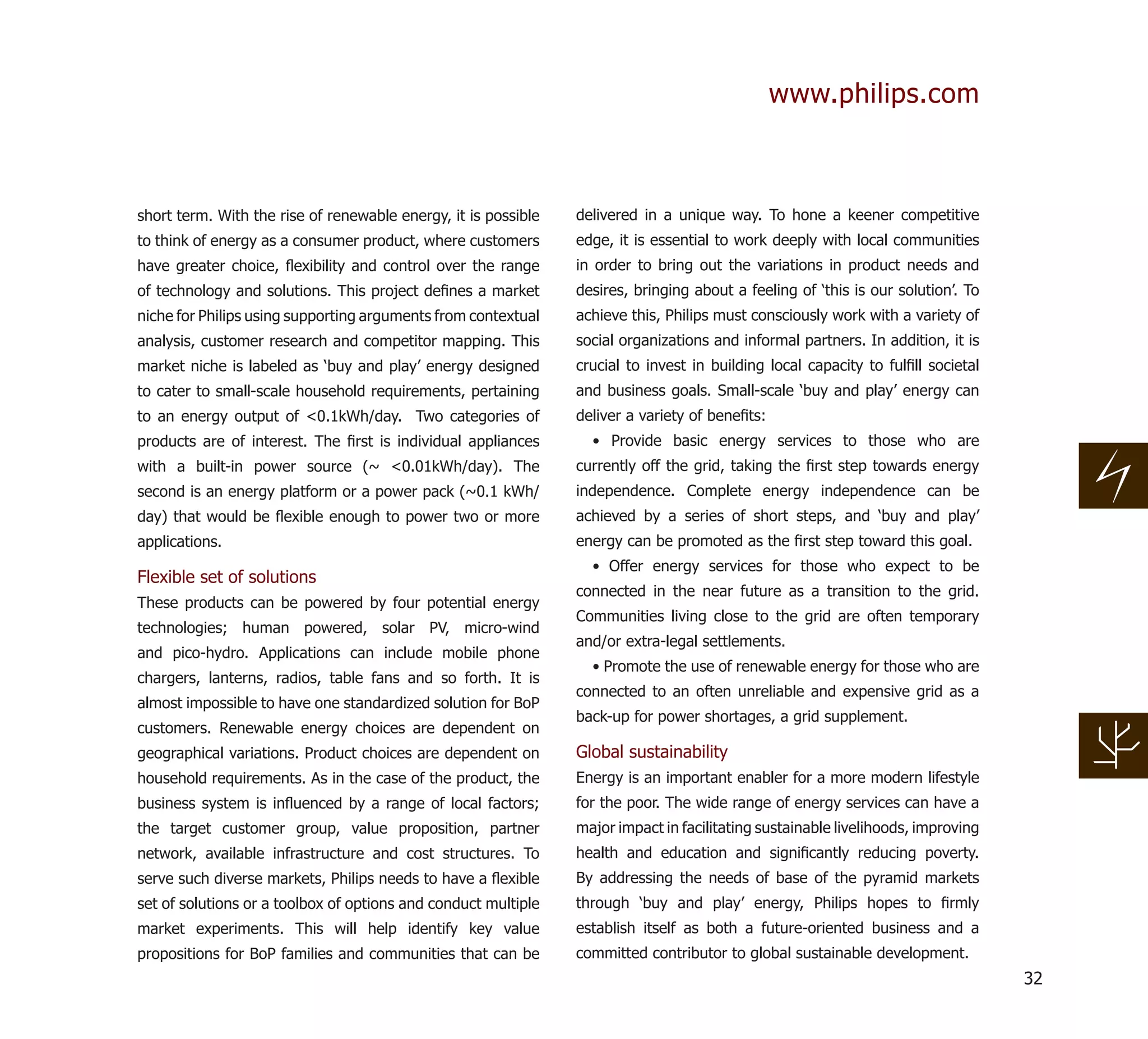
     Opportunities in Base of the Pyramid markets: Powered by the four global
      energy providers, consumer electronic applications could include mobile    There is a need for clean, safe and affordable energy
                        phone chargers, lanterns, radios, table fans and more.   solutions that can be available to BoP customers on the


31
www.philips.com


short term. With the rise of renewable energy, it is possible   delivered in a unique way. To hone a keener competitive
to think of energy as a consumer product, where customers       edge, it is essential to work deeply with local communities
have greater choice, flexibility and control over the range      in order to bring out the variations in product needs and
of technology and solutions. This project defines a market       desires, bringing about a feeling of ‘this is our solution’. To
niche for Philips using supporting arguments from contextual    achieve this, Philips must consciously work with a variety of
analysis, customer research and competitor mapping. This        social organizations and informal partners. In addition, it is
market niche is labeled as ‘buy and play’ energy designed       crucial to invest in building local capacity to fulfill societal
to cater to small-scale household requirements, pertaining      and business goals. Small-scale ‘buy and play’ energy can
to an energy output of <0.1kWh/day. Two categories of           deliver a variety of benefits:
products are of interest. The first is individual appliances       • Provide basic energy services to those who are
with a built-in power source (~ <0.01kWh/day). The              currently off the grid, taking the first step towards energy
second is an energy platform or a power pack (~0.1 kWh/         independence. Complete energy independence can be
day) that would be flexible enough to power two or more          achieved by a series of short steps, and ‘buy and play’
applications.                                                   energy can be promoted as the first step toward this goal.
                                                                  • Offer energy services for those who expect to be
Flexible set of solutions
                                                                connected in the near future as a transition to the grid.
These products can be powered by four potential energy
                                                                Communities living close to the grid are often temporary
technologies; human powered, solar PV, micro-wind
                                                                and/or extra-legal settlements.
and pico-hydro. Applications can include mobile phone
                                                                  • Promote the use of renewable energy for those who are
chargers, lanterns, radios, table fans and so forth. It is
                                                                connected to an often unreliable and expensive grid as a
almost impossible to have one standardized solution for BoP
                                                                back-up for power shortages, a grid supplement.
customers. Renewable energy choices are dependent on
geographical variations. Product choices are dependent on       Global sustainability
household requirements. As in the case of the product, the      Energy is an important enabler for a more modern lifestyle
business system is influenced by a range of local factors;       for the poor. The wide range of energy services can have a
the target customer group, value proposition, partner           major impact in facilitating sustainable livelihoods, improving
network, available infrastructure and cost structures. To       health and education and significantly reducing poverty.
serve such diverse markets, Philips needs to have a flexible     By addressing the needs of base of the pyramid markets
set of solutions or a toolbox of options and conduct multiple   through ‘buy and play’ energy, Philips hopes to firmly
market experiments. This will help identify key value           establish itself as both a future-oriented business and a
propositions for BoP families and communities that can be       committed contributor to global sustainable development.
                                                                                                                                  32
PRO-PORTION
           €        Company

                    Friesland Foods & reggs
                                                       Graduation date

                                                       October 24, 2008
                                                                                 Affordable milk for kids
                                                                                 Lieke Pijpers
                                                                                 Friesland Foods, a dairy multinational, conducted a deep-
                                                                                 listening project in 2006 among consumers at the BoP,
                                                                                 called ‘Reach’. This research was conducted in several
                                                                                 developing countries, where they measured an enormous
                                                                                 lack of nutrition amongst the BoP population.

                                                                                 Alternative protein sources
                                                                                 Milk is currently not affordable for the Vietnamese at
                                                                                 the Base of the economic Pyramid, as the dairy prices
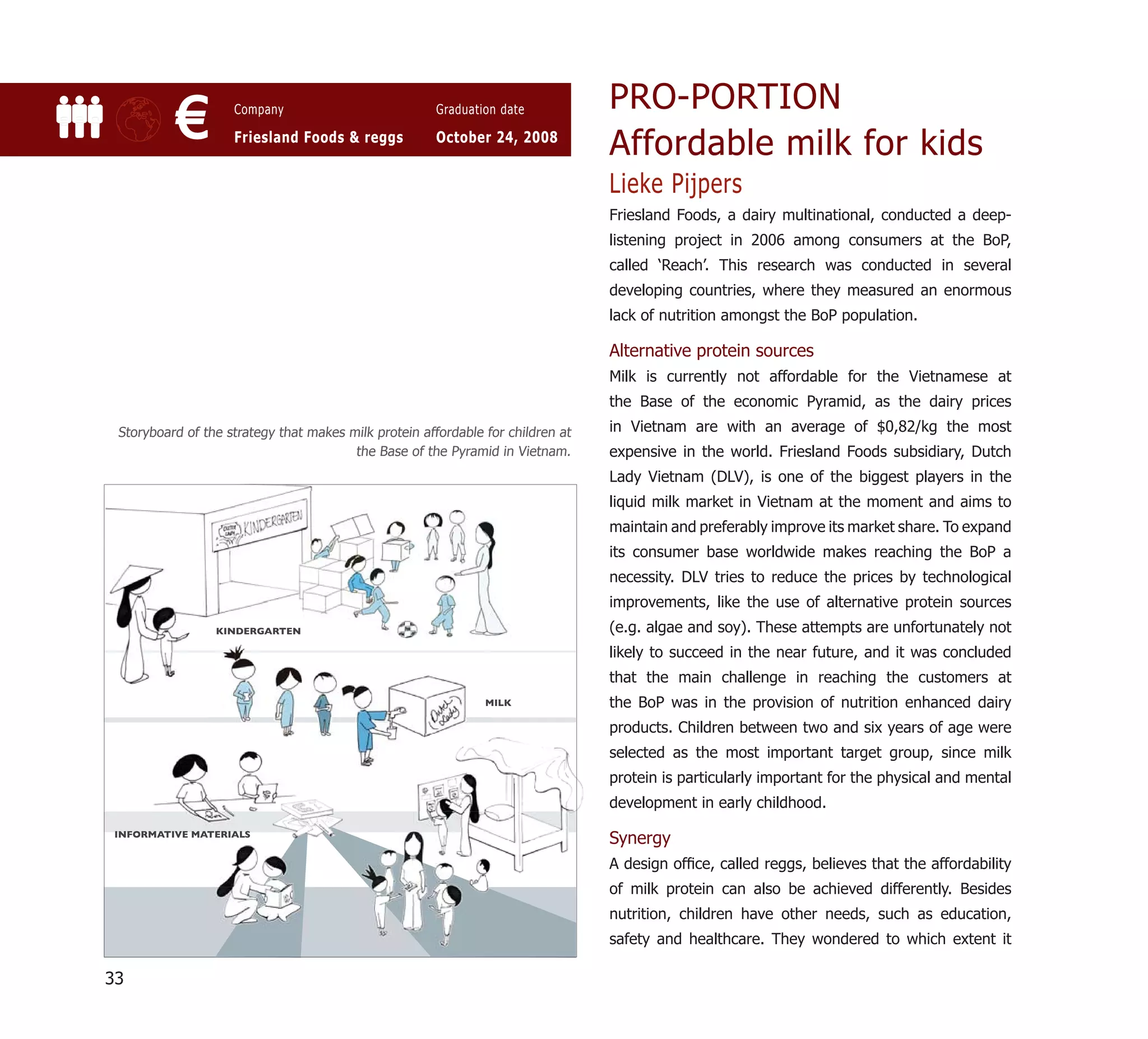
 Storyboard of the strategy that makes milk protein affordable for children at   in Vietnam are with an average of $0,82/kg the most
                                        the Base of the Pyramid in Vietnam.      expensive in the world. Friesland Foods subsidiary, Dutch
                                                                                 Lady Vietnam (DLV), is one of the biggest players in the
                                                                                 liquid milk market in Vietnam at the moment and aims to
                                                                                 maintain and preferably improve its market share. To expand
                                                                                 its consumer base worldwide makes reaching the BoP a
                                                                                 necessity. DLV tries to reduce the prices by technological
                                                                                 improvements, like the use of alternative protein sources
                 KINDERGARTEN                                                    (e.g. algae and soy). These attempts are unfortunately not
                                                                                 likely to succeed in the near future, and it was concluded
                                                                                 that the main challenge in reaching the customers at
                                                               MILK
                                                               M                 the BoP was in the provision of nutrition enhanced dairy
                                                                                 products. Children between two and six years of age were
                                                                                 selected as the most important target group, since milk
                                                                                 protein is particularly important for the physical and mental
                                                                                 development in early childhood.
 INFORMATIVE MATERIALS
                                                                                 Synergy
                                                                                 A design office, called reggs, believes that the affordability
                                                                                 of milk protein can also be achieved differently. Besides
                                                                                 nutrition, children have other needs, such as education,
                                                                                 safety and healthcare. They wondered to which extent it

33
www.frieslandfoods.com
                                                                                         www.reggs.nl


was possible to combine these necessities (portions) and        be embodied by a cartoon character, which teaches the
initiated the ‘pro-portion’ strategy. This approach proposes    children about important lessons in life in an attractive
that by combining the strengths of different organizations      way. Altogether this concept increases the accessibility and
such as local entrepreneurs, NGOs and multinationals, an        quality of preschool education and the children’s future
innovative business model could be achieved that creates a      chances of success (health and academic performance).
win-win situation. On the one hand the needs of the BoP are       The government benefits from the higher enrolment
better fulfilled, while on the other hand operations become      of kindergartens and the increased mental and physical
more cost-effective. The developed pro-portion strategy will    development of children. This contributes to the national
eventually increase the affordability of milk for the poor as   goals on education and development. Organizations like
well as the profitability for the stakeholders. A field study     UNICEF and Unilever could benefit from the opportunity
in Vietnam revealed that the most effective place to reach      to communicate with young children. This allows them
young children is the kindergarten.                             to educate children on their rights or on the importance
                                                                of personal hygiene. Creating awareness among children
Multi-stakeholder business model
                                                                supports the strategic objectives of those commercial and
The proposed concept aims to provide the BoP children in
                                                                social organizations. Local communities clearly benefit, as
kindergarten with milk and informative materials. Three
                                                                it helps their children to develop themselves. It stimulates
times a week, the children are given a cup of milk, for
                                                                parents to send their children to kindergarten, which in turn
which their parents pay a contribution that is based on their
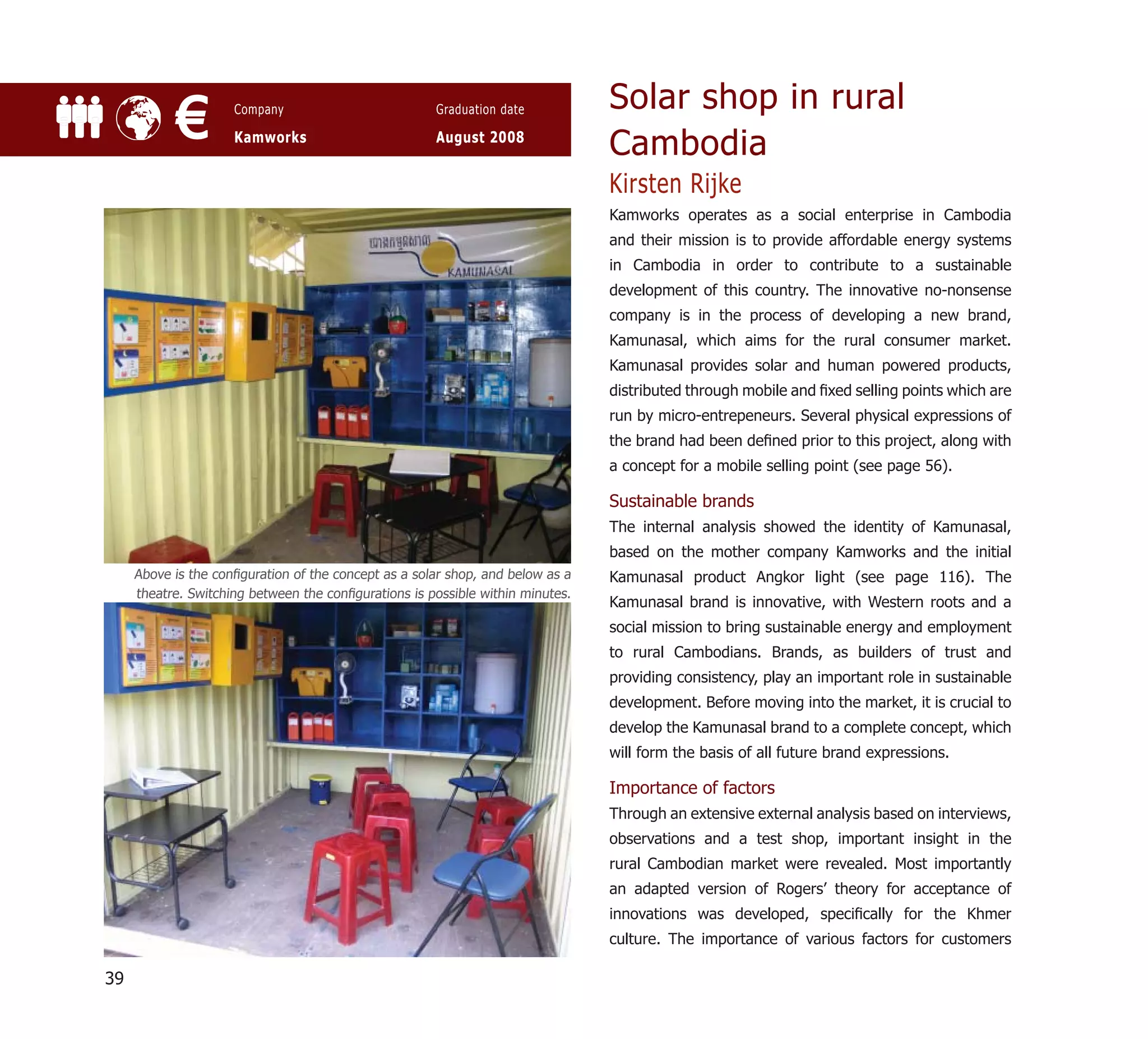
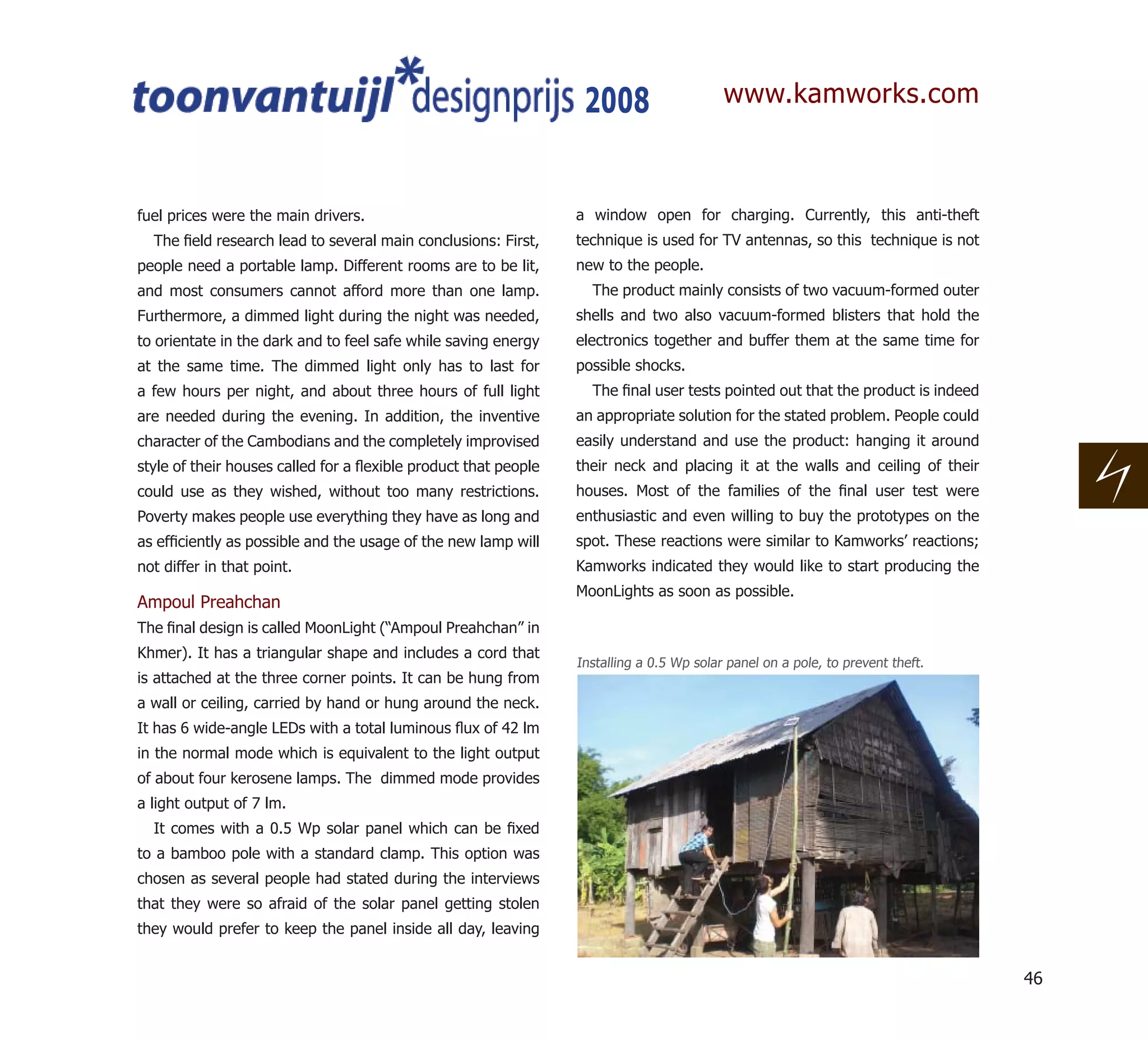
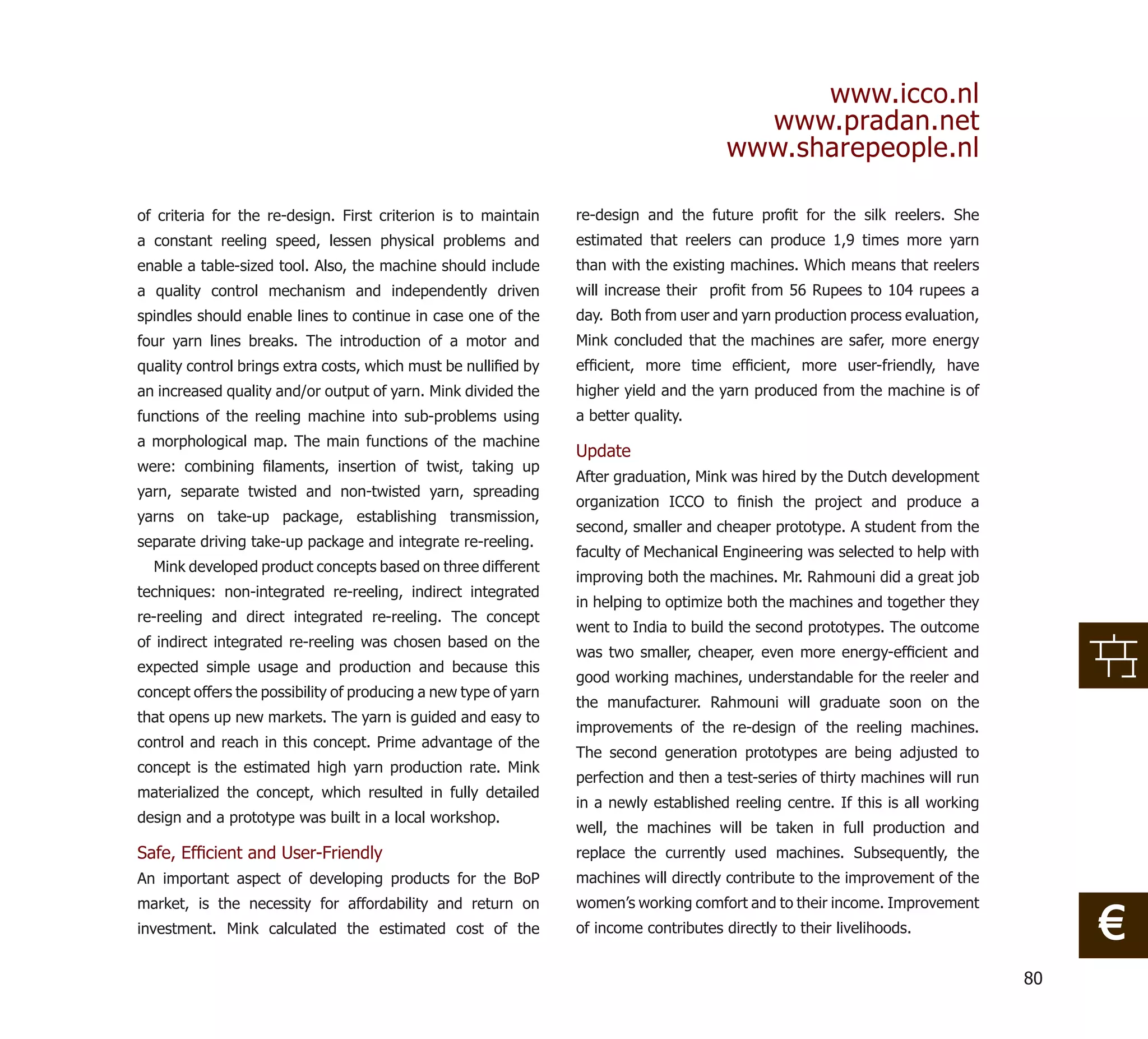
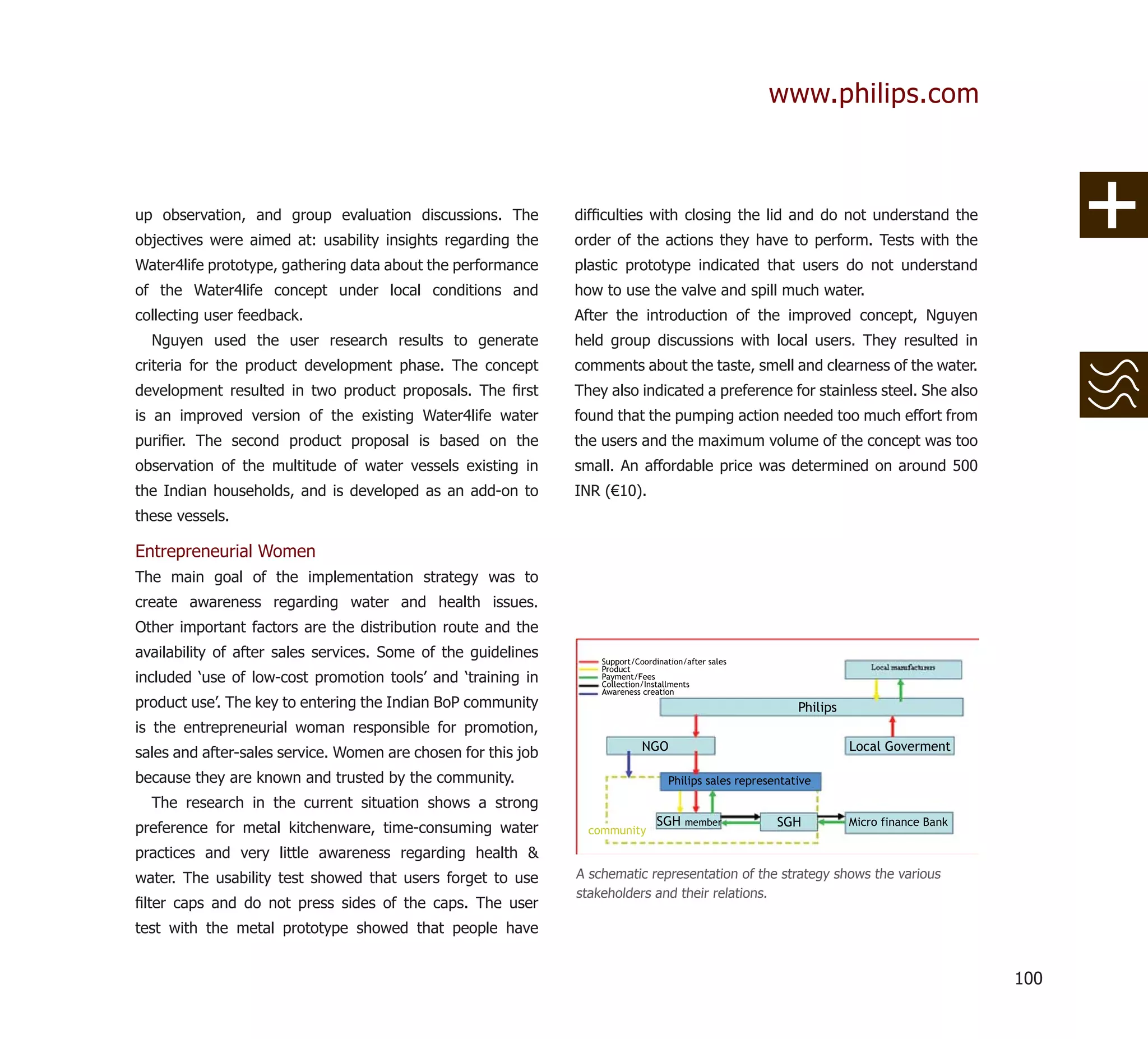
                                                                enables them to work. On top of this, it creates teaching jobs
average level of purchasing power. Together with the milk,
                                                                for the community. Teachers will earn some extra income in
educational material is provided to kindergartens, which
                                                                exchange for distributing the milk in the classroom.
improves the quality of education and increases awareness
                                                                  Last but not least, Friesland Foods can now serve poor
among the children on different topics. Every month will
                                                                children they could not reach before. Although at cost price,
have a different, important theme. The children that
                                                                it supports their strategic goal of serving 1 billion customers
structurally attended kindergarten during the course of one
                                                                in 2015 globally. On a local level it increases their market
theme receive a reward, which increases their motivation to
                                                                share in Vietnam and makes them market leader. In the long
participate. Additionally, the information will be bundled in
                                                                run, Friesland Foods can benefit from the created customer
educative comics, on which the kindergartens get a monthly
                                                                loyalty among poor families. As soon as a poor family gains
subscription and could start a library with. These comics
                                                                purchasing power, they will be more inclined to purchase
could be borrowed by the children and brought home to
                                                                Friesland Foods products.
read together with their family. The whole campaign will


                                                                                                                                  34
BushProof Safe Water
           €         y
                     Company

                     BushProof
                                                       Graduation date

                                                       Sept. 23, 2008
                                                                                  Subscription
                                                                                  Sierk Hennes
                                                                                  BushProof is a social enterprise that supplies drinking
                                                                                  water and renewable energy products in Madagascar. The
                                                                                  company is convinced that a commercial/business approach
                                                                                  to poverty reduction is more sustainable than one based on
                                                                                  aid. BushProof’s wish is to offer their products to the people
                                                                                  in the countries rural areas, however their current clients
                                                                                  are mostly non-profit organizations (NGOs) and changing
                                                                                  local rural people into customers requires a complete
                                                                                  different strategy.

                                                                                  PSS for the BoP
                                                                                  The aim of this project is to develop a new product strategy
                                                                                  for BushProof’s drinking water products that enables the
                                                                                  Malagasy poor to purchase products from BushProof
                                                                                  without the financial help of NGOs or foreign aid. During the
                                                                                  analysis of BushProof and its context it becomes clear that
                                                                                  their main product - the Canzee pump - is suitable for this
                                                                                  purpose. As a starting point of the strategy development
                                                                                  the two theoretical concepts of the “Base of the Pyramid”
                                                                                  (BoP) and “Product Service Systems” (PSS) are used.
                                                                                    The first discusses the possibility and opportunities of
                                                                                  doing business with the world poor, which are seldom been
                                                                                  considered as profitable customers. The theory stresses out
                                                                                  that companies are able to create important market growth
                                                                                  in low- income countries and earn the same revenues by
                                                                                  earning small profits from many poor customers as when
                                                                                  they sell products with high profits to relatively few high-
                                                                                  income customers.
        The Canzee Pump in use. This pump has already proved to be a very           The concept of PSS is based on the insight people do
appropriate product for the circumstances in Madagascar and is an affordable
                                                                                  not necessarily need to own products in order to fulfill their
                                     and reliable solution for water provision.

35
www.bushproof.biosandfilter.org


needs. Substituting product components into services create         and quality checks creating the opportunity to build user
possibilities to better anticipate on customer requirements,        relationships and collect user feedback useful for further
reduce resources and stimulate customer relationships.              product development.
  In order to serve the Madagascar poor with their                    People have to form user-groups with their neighbours
Canzee hand pump, BushProof has to overcome different               that are willing to share one subscription. User groups pay a
problems companies in low–income countries face. People             monthly contribution. As people share one subscription and
are little aware of the positive effects of having access to        do not have to buy the pump, the system will be affordable
reliable drinking water, the current system of community            for most people in Madagascar.
management does not result in lasting solutions and local             The financial analysis shows that if 25 families use one
people have too little knowledge to execute difficult repairs.       subscription, a monthly contribution of €0,63 per family
Finally, people have little possibilities to save for major         is needed to maintain the pumps. Because revenues are
expenditures needed to purchase and maintain expensive              reinvested in creating new pumps and subscriptions, the
products while the risk exists that pumps preliminary break         system is able to triple the amount of pumps within eight
down due the hostile environment of Madagascar.                     years. A start-up investment of €90.000 will result in about
                                                                    500 pumps serving approximately 75.000 people and still
Shared subscription, no maintenance responsibility
                                                                    realize an average yearly return of more than 10% (in 10
A subscription that guarantees access to safe drinking
                                                                    years).
water is proposed as the most suitable
solution for these problems. Offering access
to safe drinking water changes the focus of
selling pumps into supplying people with that
what people try to achieve by buying these
pumps; having easy access to an unlimited
amount of safe drinking water. Since pumps
will not be sold, the solution causes a change
in ownership. BushProof is responsible for
properly working pumps and the quality of the
water it supplies, resulting in limited financial
risk for the users. BushProof will regularly
visit the villages for periodical servicing


                                                                                                                             36
Photo: Mirjam Lindgreen

37
Girl
Java, Indonesia


                  38
Solar shop in rural
            €        Company

                     Kamworks
                                                      Graduation date

                                                      August 2008
                                                                                Cambodia
                                                                                Kirsten Rijke
                                                                                Kamworks operates as a social enterprise in Cambodia
                                                                                and their mission is to provide affordable energy systems
                                                                                in Cambodia in order to contribute to a sustainable
                                                                                development of this country. The innovative no-nonsense
                                                                                company is in the process of developing a new brand,
                                                                                Kamunasal, which aims for the rural consumer market.
                                                                                Kamunasal provides solar and human powered products,
                                                                                distributed through mobile and fixed selling points which are
                                                                                run by micro-entrepeneurs. Several physical expressions of
                                                                                the brand had been defined prior to this project, along with
                                                                                a concept for a mobile selling point (see page 56).

                                                                                Sustainable brands
                                                                                The internal analysis showed the identity of Kamunasal,
                                                                                based on the mother company Kamworks and the initial
     Above is the configuration of the concept as a solar shop, and below as a   Kamunasal product Angkor light (see page 116). The
     theatre. Switching between the configurations is possible within minutes.
                                                                                Kamunasal brand is innovative, with Western roots and a
                                                                                social mission to bring sustainable energy and employment
                                                                                to rural Cambodians. Brands, as builders of trust and
                                                                                providing consistency, play an important role in sustainable
                                                                                development. Before moving into the market, it is crucial to
                                                                                develop the Kamunasal brand to a complete concept, which
                                                                                will form the basis of all future brand expressions.

                                                                                Importance of factors
                                                                                Through an extensive external analysis based on interviews,
                                                                                observations and a test shop, important insight in the
                                                                                rural Cambodian market were revealed. Most importantly
                                                                                an adapted version of Rogers’ theory for acceptance of
                                                                                innovations was developed, specifically for the Khmer
                                                                                culture. The importance of various factors for customers

39
www.kamworks.com


and micro-entrepeneurs were determined separately, but         the rural areas of Cambodia.”
the models turned out to be rather similar. The decision
                                                               Visible stock
model is a rational one, where many factors play a role. The
                                                               Through an ideation and conceptualization phase, a fitting
three most important factors were found to be price, quality
                                                               concept is developed and further elaborated, resulting in a
and the fulfilment of needs.
                                                               Kamunasal solar shop; an adapted and furnished shipping
     The results of the internal and external analysis
                                                               container. Inside the shop a displaying cabinet contains a
determined the course of the project. The results of the
                                                               show and try-out model for each item. As rural customers
project can be categorized in two distinctive parts:
                                                               and micro-entrepreneurs in Cambodia prefer to have stock
 •         A definition of the Kamunasal proposition “light
                                                               placed visibly (which also helps keep a clear overview for
           and energy for a happy family” in the form of a
                                                               the micro-entrepreneur) each product type is placed in a
           strategy.
                                                               separate compartment, along with additional stock, see
 •         A complete concept for fixed selling points based    images on the left.
           on the Kamunasal proposition.                         A working solar home system is demonstrated and
For a happy family                                             explained through an educational display. The solar system
The strategy points out that the distinction between the       also provides the power for a number of battery charging
Kamunasal and Kamworks businesses should be more clear,        services offered in the shop.
also within the company. The strategy further describes        A shop and a theatre
how Kamunasal can use the methods of MicroFranchising,         The Kamunasal solar shop can be transformed from a
by first setting up a business and finding the right formula.    shop into a small theatre. The theatre offers educational
The next step is replicating this successful business with     video   entertainment      and   testimonials   from   other
other micro-entrepreneurs by supporting them with the          satisfied Kamunasal customers. The flexible and inviting
Kamunasal formula. Finally the complete strategy for           shop provides a culturally appropriate, friendly familiar
Kamunasal results in a market proposition that describes       environment for both consumer and micro-entrepreneur.
the brands attitude in terms of a five-P model; product,        Adding a brand expression in the form of the Kamunasal
price, place, promotion, people. A design vision was           solar shop, with the right balance between informational
then formulated, in order to design the solar shop as an       and sales aspects, supports the brand Kamunasal and its
expression of the Kamunasal proposition: “Design a concept     high quality appearance.

                                                                                                                                   €
for a fixed selling and service point for home lighting and
energy supply products and services of Kamunasal within

                                                                                                                              40
Solar Home System for
            €         Company

                      Kamworks
                                                          Graduation date

                                                          August 2008
                                                                                     rural Cambodia
                                                                                     Tom van Diessen
                                                                                     Cambodia has one of the lowest electrification rates in Asia.
                                                                                     Therefore many households make good use of rechargeable
                                                                                     car batteries for lighting and television. This is however a
                                                                                     far from ideal situation as the heavy batteries have to be
                                                                                     charged several times a week, in a small shop where a
                                                                                     throbbing generator is present. Due to this charging abuse
                                                                                     and its poor use, the batteries are entitled to a short life,
                                                                                     bringing unnecessary high costs and a low energy efficiency.
                                                                                     With oil prices rising and economy improving, people are
                                                                                     in need of better power solutions. This forms the motive
                                                                                     for this graduation project; to design an innovative user-
                                                                                     friendly Solar Home System (SHS) for rural Cambodia.

                                                                                     Previous experience
                                                                                     The idea of a SHS came from an elaborate analysis of the
                                                                                     local contexts. Many Cambodian families were visited to map
                                                                                     their energy needs, desires and living situations. Before this
                                                                                     project, a number of pilot SHSs were developed. Prototypes
                                                                                     were made on the basis of a preliminary design, to evaluate
                                                                                     the technical functioning of the system and practically test
                                                                                     the system in operation. The experiences of installation and
                                                                                     production of a SHS could therefore already be taken into
                                                                                     consideration early in the design process. Three systems
                                                                                     were evaluated in the field by test families. The product use,
      The family Chum Voung consist of 3 people and belongs to social class of
                                                                                     performance and appreciation was monitored technically by
      the rural poor. Miss Toch Komh runs a small store under the house and is
    home all day, her son goes to school and her husband is hardly ever home         data logging and practically by a series of surveys. Based
    being a construction worker. The house is build traditionally, small but well    on this extensive design research the pilot SHS was further
  maintained and is located on the corner of a road next to a battery charging
                                                                                     elaborated to a final product design, ready for production.
station. Making it an ideal location for Kamworks to test the SHS, since its in a
visible location next to the one thing it should substitute. The SHS will entirely   Functional and aesthetic value
 replace their current use of a car battery and kerosene and is initialy installed
                                      under a renting construction for 3 months.
                                                                                     The result of this project was the design of three types of

41
www.kamworks.com


Solar Home Systems as one product family and one complete
product. The SHS has become a true modern powerhouse
for rural Cambodia. A distinctive desirable product of superb
quality that matches with the Khmers culture, styling, way of
living, energy consumption and house situation. The system
is easy to install, durable, strong and can be produced locally
at Kamworks. The solar panel can be mounted securely to
the house with the use of a new composite support. The
technical components are enclosed in the Dragon box, a
user friendly connection station with a highly aesthetic
value in terms of creating product desire, a commercial
value in terms of being distinctive and a functional value
by protecting the system components. A charge regulator
furthermore guarantees a safe use, an extended battery life
and provides the users with the desired energy feedback.
All this makes the Kamworks Solar Home Systems a secure
energy source, for an affordable prize.
  Kamworks had the desire to bring the SHS on the
market soon, the outcome of this project enabled them to
do so. Currently four systems have already been sold and
installed according to the final designs. Many customers are
already eagerly waiting for what could be seen as the new
generation of Solar Home Systems in Cambodia.


                                                                                     42
Redesign of a Smoke
           €         Company

                     ICCO and MOPAWI
                                                       Graduation date

                                                       July 28, 2008
                                                                                 free Batana Extractor
                                                                                 Linda Schnieders
                                                                                 Extracting Batana oil is the main way of making a living
                                                                                 for the Miskito women in La Mosquitia, a difficult to
                                                                                 reach tropical wetland in the northeast of Honduras. The
                                                                                 production process of the special oil released from the
                                                                                 kernels of the Palma Americana has remained the same
                                                                                 for years, but is subject to changes at the moment. Health
                                                                                 problems related to the production of Batana constitute a
                                                                                 major constraint to the development of the people. The
                                                                                 extraction process generates very hazardous smoke which
                                                                                 causes respiratory diseases among the women involved in
                                                                                 this activity. Additionally, the amounts of firewood needed
                                                                                 in the traditional process causes extreme deforestation.
                                                                                 These negative aspects of the Batana production render
                                                                                 this activity unsustainable.
                                                                                   The Non Government Organization (NGO) MOPAWI
     MOPAWI initiated the Ecofogon project in 2005 and since then has taken      is assisting the Miskito in selling Batana. Moreover, this
                 several steps in implementing the Ecofogon in La Mosquitia.     organization aims to improve the current production process
                                                                                 such that related health problems will be addressed and
                                                                                 environmental sustainability improved.
                                                                                   In the recent past various attempts have been made
                                                                                 to address both the health problems and environmental
                                                                                 damages associated to the Batana production. To date
                                                                                 however, no definite solution has been found. In this project
                                                                                 these attempts have been assessed and analyzed and the
                                                                                 outcome of this reserach was used as a basis for a redesign
                                                                                 process of the stove used for extraction of the oil, the so
                                                                                 called Ecofogon.

                                                                                 Multi-stakeholder redesign
                                                                                 This redesign process has been done with participation of
      The cooker hood is placed close to the pan during frying of the kernels.

43
www.icco.nl/en
                                                                                                www.mopawi.org


various local stakeholders, accounting for cultural values       plan is included on how to build capacities among the future
and traditions, local infrastructure and local resources. This   constructors of the improved Ecofogon. The implementation
has resulted in a new concept with a number of essential         plan also includes the construction of a prototype and ways
improvements compared to the existing stove. One of the          to involve the end users and other stakeholders in further
main adaptations has been the provision of a vertically          shaping of the final product.
placed chimney connected to a cooker hood in combination           In view of the potential health and environmental
with correctly applying the so called rocket principle. Other    benefits MOPAWI, a local NGO, is recommended to follow
improvements include the use of a pan and a sieve to             up on the new concept by executing the implementation
separate the oil from the kernels, without the user being        plan. Financing sources need to be found for this purpose
in contact with the stove or the hot oil. Furthermore, the       and financing partners are recommended to embark on
dimensions of the entrance and the combustion chamber            this project. It is expected that by doing so this project
are optimised to ensure a more efficient combustion. The          contributes to the sustainable social economic development
new concept also provides arrangements for significant            and resilience of the minority tribe of the Miskito and
savings of fire wood, which means enhanced environmental          particularly their most vulnerable community members.
sustainability. As a result of these improvements, the
                                                                  Use of the pan and sieve. Before removing the pan the skirt needs
women are not directly exposed to the hazardous smoke                   to be adjusted, N.B. In the right picture the irritating smoke
anymore, resulting in less health threats. Moreover, because                            coming from the oil has not been visualized.
of a more efficient use of
fire wood, environmental
degradation will be partly
addressed. Besides a new
design concept, a plan
for implementation of the
Ecofogon was developed
during this project.

Implementation
Instructions for end users
as well as constructors
are listed. Also a training


                                                                                                                                         44
LUMEN light solution
     €     Company

           Kamworks
                                             Graduation date

                                             June, 2008                 Integral Design Project
                                                                        Executed by Ana Maria Alvarez, Loucas Papantoniou,
                                                                        Stephanie Wirth and Doortje van de Wouw.
                                                                        Kamworks is a young company specialized in the supply and
                                                                        manufacturing of affordable solar energy solutions for rural
                                                                        communities and people who do not have access to reliable
                                                                        electricity in Cambodia.
                                                                          Currently the company’s core business is the installation
                                                                        and distribution of Solar Home Systems. One of Kamworks
                                                                        previous projects, the ‘Angkor Light’, is a quality lamp in the
                                                                        price range of $60-75 (see page 116). In order to reach the
                                                                        rural population, Kamworks concluded insight was needed
                                                                        into possibilities for a more affordable lighting solution in
                                                                        the range of $10-20.
                     An exploded view of the design; the Moonlight.
                                                                        No running costs
                                                                        From the product portfolio of Kamworks it became clear
                                                                        that there was a lack of an affordable ambient lighting
                                                                        products. The main outcome of the technical analysis was
                                                                        to use white LEDs due to their energy efficiency and price
                                                                        range compatibility of the product that could easily be
                                                                        tailored around the basic needs of the target group. For the
                                                                        energy supply of the system, two options were possible:
                                                                        a battery charging system with low initial costs but higher
                                                                        running costs or a totally independent system with higher
                                                                        initial costs but no running costs.

                                                                        Rural households
                                                                        House visits and interviews in the rural areas of Cambodia
                                                                        gave better insight into the context, living standards and
                                                                        wishes of the target group: The new lamp should completely
                                                                        substitute the kerosene lamp, which use is widely spread
                                                                        in the rural households. The poor quality of the light, the
         Most of the families of the final user test were enthusiastic
                                                                        flammability and health hazards as well as the highly volatile
                and even willing to buy the prototypes on the spot.

45
2008                    www.kamworks.com


fuel prices were the main drivers.                               a window open for charging. Currently, this anti-theft
  The field research lead to several main conclusions: First,     technique is used for TV antennas, so this technique is not
people need a portable lamp. Different rooms are to be lit,      new to the people.
and most consumers cannot afford more than one lamp.               The product mainly consists of two vacuum-formed outer
Furthermore, a dimmed light during the night was needed,         shells and two also vacuum-formed blisters that hold the
to orientate in the dark and to feel safe while saving energy    electronics together and buffer them at the same time for
at the same time. The dimmed light only has to last for          possible shocks.
a few hours per night, and about three hours of full light         The final user tests pointed out that the product is indeed
are needed during the evening. In addition, the inventive        an appropriate solution for the stated problem. People could
character of the Cambodians and the completely improvised        easily understand and use the product: hanging it around
style of their houses called for a flexible product that people   their neck and placing it at the walls and ceiling of their
could use as they wished, without too many restrictions.         houses. Most of the families of the final user test were
Poverty makes people use everything they have as long and        enthusiastic and even willing to buy the prototypes on the
as efficiently as possible and the usage of the new lamp will     spot. These reactions were similar to Kamworks’ reactions;
not differ in that point.                                        Kamworks indicated they would like to start producing the
                                                                 MoonLights as soon as possible.
Ampoul Preahchan
The final design is called MoonLight (“Ampoul Preahchan” in
Khmer). It has a triangular shape and includes a cord that
                                                                 Installing a 0.5 Wp solar panel on a pole, to prevent theft.
is attached at the three corner points. It can be hung from
a wall or ceiling, carried by hand or hung around the neck.
It has 6 wide-angle LEDs with a total luminous flux of 42 lm
in the normal mode which is equivalent to the light output
of about four kerosene lamps. The dimmed mode provides
a light output of 7 lm.
  It comes with a 0.5 Wp solar panel which can be fixed
to a bamboo pole with a standard clamp. This option was
chosen as several people had stated during the interviews
that they were so afraid of the solar panel getting stolen
they would prefer to keep the panel inside all day, leaving


                                                                                                                                46
A battery charging
           €         Company

                     NICE
                                                        Graduation date

                                                        April 4, 2008
                                                                                   system for youngsters
                                                                                   Judith Goor
                                                                                   Energy    has       a   strong   link   with   poverty   reduction;
                                                                                   unfortunately about one third of the world’s population does
                                                                                   not have access to electricity and deals with expensive,
                                                                                   alternative energy sources. As a reaction on the high
                                                                                   need for affordable energy, NICE is set up as a network
                                                                                   of multidisciplinary shops offering low prices and high
                                                                                   quality. The solar powered shops offer internet, education
                                                                                   and a mini-cinema, and are set up in The Gambia, where
                                                                                   about 70% of the population does not have access to the
                                                                                   electricity grid.

 A rendering of the design; the left side is for AA batteries and the right side   Batteries
                                                              for AAA batteries.   Standardized batteries form a low investment for instant
                                                                                   energy. Batteries are available worldwide, are cost-efficient
                                                                                   and fit into many products, which makes them an interesting
                                                                                   energy source. However, the disposable batteries that are
                                                                                   currently used in The Gambia are of very poor quality and
                                                                                   leak hazardous, toxic chemicals. This causes ground water
                                                                                   pollution and health problems. Offering a battery charging
                                                                                   service with rechargeable AA- and AAA- sized batteries,
                                                                                   would provide a low cost, sustainable solution.

                                                                                   Youngsters and NICE
                                                                                   Through literature studies and explorative research towards
                                                                                   the potential users and their context, the framework for
                                                                                   the design of a battery charging system was set up. The
                                                                                   biggest group of potential users are youngsters (10 – 25
                                                                                   years old). With a growing population of nearly 2.8% per
                                                                                   year, this group forms a rapidly growing market segment.
                                                                                   Furthermore, the current customer base of NICE is mainly
                                                                                   formed by youngsters, which makes them an approachable

47
www.nice-gambia.com


group. Youngsters are very trend sensitive and care              -     Dispenser for full AAA- batteries
much about their image. NICE batteries can add to their
                                                                 -     Quality check to assure quality of the batteries
appearance as being a high quality and popular product.
                                                                 -     Energy tester to test if the battery is fully charged
Membership                                                      The systems are placed on the wall behind the NICE
In The Gambia, registration is unwanted by costumers. To        reception desk. In this way the system is visible and triggers
avoid the need of registration a different setup is needed;     the customers by the bright colors, shiny appearance and
new customers will pay a start-up fee to join the system,       blinking led lights. The employee can operate it from behind
and whenever NICE batteries get empty, they can be              his desk and keep a good overview.
switched for full ones in exchange for a small charging fee.         A functional prototype of the system was built and was
A NICE battery is the evidence of being a member of the         ready to be tested in the NICE shop to continue with further
system. Customers receive different batteries every time        development of the product.
they exchange. In order to assure them a good quality, the      The prototype in use. The lights visualize the charging.
batteries will go through a quality check that filters out bad
batteries.
     The system assures users a cost advantage within 1.5
months, because the charging fee is 30% lower than the
cheapest batteries available in The Gambia. It is projected
that profit is generated for NICE within a year.

Battery Testers
With respect to the NICE context it became clear that
the most important requirement is an obvious, structured
system that is easy controllable by the management team.
The design proposal consists of the following different
components:
 -     Charger with 16 AA(A)-battery cells
 -     Intake for empty AA- batteries
 -     Intake for empty AAA- batteries
 -     Dispenser for full AA- batteries
                                                                                                                                      €
                                                                                                                                 48
Photo: Kees van Gastel

49
Man Fishing
Citarum River,
Java, Indonesia


                  50
Culturally appropriate
             €         Company

                       Everbody Company
                                                         Graduation date

                                                         Feb 8, 2008
                                                                                    coffins for Botswana
                                                                                    Jan Willem Findlater
                                                                                    Funerals play a central role in Batswana culture. High death
                                                                                    rates, increasing expectations and funeral costs impoverish
                                                                                    citizens as they struggle to provide a dignified burial for
                                                                                    their loved ones. The Everybody Company had identified
                                                                                    this social need and had set about providing access to
                                                                                    affordable coffins throughout Southern Africa and developed
                                                                                    a pre-cut click-to-construct coffin. The Everybody Coffins
                                                                                    struggled to gain a foothold in the market due to material
                                                                                    costs, availability and consumer acceptance of their product
                                                                                    line. The aim of the project was to investigate the practical
                                                                                    and emotive implications of the Everybody Coffin.
                                                                                      An in depth analysis of lengthy and extravagant burial
     The product and company name is ‘branded’ into the lid of the coffin with
     a hot iron. In South Africa this would include the ‘Working for Water’ logo.   rituals highlighted why the Everybody Coffin is not widely
      People will know that they are buying a product that is supported by the      accepted; functional, aesthetic and emotive aspects of the
       government. The lining can be custom made or modified in the villages.
                                                                                    Everybody Coffin design make it inappropriate for product
                                                                                    placement within this consumer market.

                                                                                    The Coffin Industry
                                                                                    The market can be split up into two categories; state funerals
                                                                                    and consumer funerals. If a coffin manufacturer opts for
                                                                                    government tenders they must compete on price with other
                                                                                    manufacturers. The advantage for the manufacturer is that
                                                                                    the consumer has no choice between coffins, and for the
                                                                                    consumer the advantage is in costs: these services are
                                                                                    provided for free. In the commercial coffin industry price
                                                                                    is not the most important factor in coffin design. Status,
                                                                                    protection and style (aesthetics) are key product values.
                                                                                    The funeral parlour network is currently responsible for
                            These children, Elvis & Kabo, expressed an interest
                               in constructing the coffins as a job. The elders in   distributing and selling coffins as part of funeral service
                              the village approved the full sized prototypes and    packages. Although selling direct to the market appears as
                             agreed to cooperate in the interests of the village.

51
www.everybodycoffins.com


an attractive alternative, doing so is a logistical challenge.   available waste wood. This necessitated a re-design of the
The infrastructure does not exist (or permit) coffin sales        construction. The final design may be considered as less
without distribution through the funeral parlour network.        efficient, heavier, more labour intensive and requires a
It is therefore a challenge for product designers and            longer production time. On the other hand it is desirable in
manufacturers to effectively provide access to affordable        the consumer market, adds value to the materials, reduces
coffins.                                                          toxification of the ground water and is creates more jobs
  Investigation of coffin purchasing behaviour in Botswana        in the rural areas. Product acceptance by funeral parlours
showed, alongside the aforementioned product values of           also improved. They identified more with new aspects of the
status, protection and aesthetics, that culture orientated       design, primarily the ability to hold more stock, attractive
coffin design provided new product values which were              pricing and reductions in transportation costs.
independent of costs. This finding is an opportunity to             During the process of this project new product values
reduce spiraling coffin costs whilst improving the emotional      were identified. Using these product values for coffin design
experience when choosing a coffin. Flat, prefabricated            may help to positively change purchasing behaviour in
coffins are most suited for rural communities across              Botswana. This study indicates that a culturally appropriate
Botswana. This is currently the key product value of the         coffin can be highly desirable and need not to be expensive.
Everybody Coffin. Re-designs of the Everybody Coffin were          Designers can play an essential role in helping societies
evaluated within rural communities. Unexpectedly, these          to change towards more financially and environmentally
communities appreciated the re-designs differently. The          sustainable practices. It is their duty to help societies and
design could be used to create jobs in the rural areas, which    governments achieve their long term goals.
is a big need for rural communities. The design criteria           Unexpectedly, this study unveiled a great opportunity to
changed during the design process to reflect the local            stimulate entrepreneurship in the rural areas. Cooperation
context. Continuous feedback during the re-design phases         with Chiefs, tribes, Burial Societies and Church groups play
noted improvements in aesthetic appeal, product function         an essential role when implementing Everybody Coffins. For
and cultural orientation.                                        the coffin to realise its potential as a culturally appropriate
                                                                 coffin it requires the involvement of local craftsmen to
The new Everybody Coffin
                                                                 personalise each coffin. This must be done commercially.
Based on the feedback throughout the design process it
                                                                 Government and NGO ‘hand outs’ can have a detrimenal
can be concluded that the design has improved in terms
                                                                 effect on proactive entrepreneurship in the rural areas.
of product acceptance. Regarding material selection, Bosa
                                                                 Coffin assembly can be seen as an ideal first step to
(the final design proposal of this project) utilises regionally
                                                                 economic empowerment.

                                                                                                                                  52
Water4Kenya
         €         Company

                   Dutch Water Limited
                                                      Graduation date

                                                      February, 2008             Integral Design Project
                                                                                 Executed by Elly Doek, Merijn Janssen , Regine van
                                                                                 Limmeren, Charl Smit and Stefan Versluis.
                                                                                 The mission of Dutch Water Limited is to provide clean
                                                                                 and affordable drinking water for everybody in developing
                                                                                 countries. This goal is very clear, but highly ambitious and
                                                                                 not feasible to reach at once. Therefore, a group of students
                                                                                 from Delft University of Technology had been asked to
                                                                                 research the current situation and develop a Product
                                                                                 Service System (PSS) to distribute the clean water that DWL
                                                                                 is capable of producing. Keeping in mind on the one hand
                                                                                 the desire to become a financially sustainable company and
                                                                                 on the other hand the desire to help the people in need, the
                                                                                 initial advice was to target people in the near surroundings
                                                                                 of the water factory in Mtwapa. These people are not the
                                                                                 very poorest, but still drink unclean drinking water and are
                                                                                 therefore in need of DWL water. Transportation costs are
     A prototype of the Strolley: unlike the current competition, the Strolley
                                          complies with ergonomic demands.       minimal and little profit can be made on the water. This way
                                                                                 DWL could start establishing the company by creating a
                                                                                 solid financial background and gaining experience for water
                                                                                 “processing” (manufacturing and distribution) in a non-
                                                                                 western context.

                                                                                 Governmental Water
                                                                                 Currently, almost all drinking water for the people in
                                                                                 Mtwapa, Kenya, comes from one governmental tap point,
                                                                                 located in the outskirt of Mtwapa. The people in Mtwapa
                                                                                 buy this unclean governmental water from the so-called
                                                                                 mikokoteni (handcarts), which deliver the water at home.
                                                                                 The system works pretty well and supplies most people with
                                                                                 drinking water on a regular and frequent basis when there
                                                                                 is water available. However, in times of scarcity this way of
                                                                                 water supply is less reliable and prices increase rapidly, up


53
www.dwlwater.com


to 200% of the original price. Scarcity occurs several times                                                       amount of regular clients. In addition, the subscription
a year.                                                                                                            allows for the possibility to pay off the deposit for the jerry
                                                                                                                   can in terms.
The proposed Product Service System
                                                                                                                       Three different stakeholders were determined for the PSS,
Some boundary conditions were kept in mind. First of
                                                                                                                   and solutions were offered for each of these stakeholders.
all, DWL is a start-up company, with little investment
                                                                                                                   For customers; by offering clean, affordable and reliable
power. Furthermore sustainability was very important: the
                                                                                                                   drinking water, customers are served with advantages
PSS should be economically, ecologically, politically and
                                                                                                                   for health, living standards and financial benefits. For
socially sustainable. The proposed PSS enables DWL to
                                                                                                                   employees; Several new employees are to be hired in order
provide the people of Mtwapa with clean, affordable and
                                                                                                                   to make the PSS function properly. Being employed at
reliable drinking water by selling the water at the gate and
                                                                                                                   DWL comes with advantages concerning health (unlike the
distributing it to the houses of the customer by means of
                                                                                                                   current mikokoteni, the Strolley complies with ergonomic
human powered vehicles. The PSS provides the customer
                                                                                                                   demands), and are offered a fixed salary. For DWL; The
with several additional advantages like fixed prices, fixed
                                                                                                                   PSS enables DWL to reach its vision by providing water to
quality and constant supply. In addition, the water is sold
                                                                                                                   people with a need for clean water, creating employment
in a special, sealed package which decreases the chance
                                                                                                                   and meanwhile establishing a solid financial base.
of the water getting contaminated. The PSS consists of
the   following     product
elements:    the     water,                                                                4
                                                                                                                          5
the vehicles, and the                DWL cycle                                                                                                                 Consumer cycle
packaging. The service                                                                                                                                                                                    No treatment
                                                                                     Sealing package

elements in the PSS are
                                       1
                                                                                                                                                                                                          8
                                                                                                                                                            Full
                                                                                                                              Sales channels                package

selling at the gate and
                                                                                The jerry can is closed by a cap
                                                                                with integrated tap and sealed                                      6
                              DWL source                      3                 to prevent the package to be

delivery at home.
                                                                                tampered with.


                                                                                       Coast Special is
  A subscription service is
                                                                                                                                                                                          7 Use
                                                              Filling package          both sold at the gate as well as
                                 2                                                     distributed to the houses of                            Selling and
                                                                                       the customer.                                           returning package
offered for water delivery,
                                                                                                                                                                                                                 Drinking


which ensures customers
                                                                                                                                                               Empty
                                                                                                                                                               package
                              Processing water


of water delivery, also
                                                                                                    9


                               DWL processes the water from
in times of scarcity, and
                                                                                                                                                                                                                                 €
                                                                                                                                                           A er use the package is returned to
                               the source into high quality                                                                                                the factory to be cleaned for reuse.    Coast Special is safe
                               drinking water.                                                                                                             The empty jerry can is exchanged with   to drink directly from
                                                                                                    Cleaning package                                       a new one when new water is being
ensures DWL of a certain
                                                                                                                                                                                                   the jerry can; it does
                                                                                                                                                           bought. No new deposit needs to be      not need to be
                                                                                                                                                           paid if the seal is unbroken.           treated before use.


                                                                                                                                                                                                                            54
Comparing Contexts;
           €        Company

                    Solardew & ICCO
                                                      Graduation date

                                                      Feb 1, 2008
                                                                                Solar Dew Technology
                                                                                Alexander van der Kleij
                                                                                One of the most important global problems is that of
                                                                                poverty. Apart from the obvious humanitarian justification,
                                                                                finding improved ways to alleviate poverty will become an
                                                                                intricate part of creating a sustainable future. Although
                                                                                many will argue, and rightfully so, that the present
                                                                                industrialized nations are mainly responsible for many of
                                                                                the current environmental problems, it is in the developing
                                                                                world with its rapidly growing population and rise in living
                                                                                standards where the problems of the future will be found.
                                                                                It is therefore important to find sustainable solutions in the
                                                                                present for problems of the future.
                                                                                  The Base of the Pyramid (BoP) theory does not explicitly
                                                                                exclude any countries, yet the focus of most BoP projects
                                                                                has been on relatively large countries which are developing
                                                                                rapidly, such as India, China, Brazil, Mexico, etc. On the
In coastal areas the sea provides people with an unlimited source of brackish
                                                                                other hand many smaller countries which are not developing
    water, which in combination with the Solar Dew technology can provide a
                                       steady source of clean drinking water.   as rapidly also contain a large portion of the population
                                                                                making up the BoP. They too have an interest in improving
                                                                                their quality of life and may form a worthwhile opportunity
                                                                                for companies to invest in. The main problem however is
                                                                                market size; often these markets are not large enough on
                                                                                their own to warrant investment.

                                                                                Different contexts
                                                                                Considering many of the problems facing the BoP are
                                                                                similar across a wide variety of developing countries, it may
                                                                                be possible to design a single solution for these different
                                                                                markets. In that case, these smaller markets could be
                                                                                combined to create a larger market which may be of interest
                       The working principles of the Solar Dew Technology .
                                                                                to companies looking to develop BoP products.


55
www.solardew.com


The question is therefore to determine whether it is            drinking water problem. The purpose of this research was
possible to cluster these different markets. The first step to   to develop insight for the further development of a product
answering this question is to determine if it is possible to    around a technological solution created by Solar Dew
design for multiple markets, each with a different context.     International.
Therefore this project provided an insight into:                The final design of the product is based around the insight
 -   What is context                                            that people at the BoP are unable to make large investments
 -   Requirements for research in a BoP environment             and in general are not concerned with the health benefits of

 -   How to structurally translate research results into a      clean drinking water. The product has been designed based

     product/business vision                                    on this understanding of the context, such that it can provide
                                                                a solution for both the Malagasy and the Pakistani context.
 -   How to compare, evaluate and design for different
                                                                The product has taken on the form of a water station, run
     contexts
                                                                by a local entrepreneur from which he sells water to the
This was done by researching both Pakistan and Madagascar,
                                                                people of the village. This allows the local entrepreneur to
and developing a concept that is suitable for both.
                                                                earn a living, whilst the consumers can focus on their own
The technology                                                  economic activities without the daily concerns of fetching
Solar Dew technology consists of two chambers separated         drink water. Although the design is still conceptual it gives a
by a membrane. The contaminated feed water in the upper         clear indication of what the future may hold for both water
chamber is absorbed by the membrane. As the feed water          purification solutions in general, and specifically for the
is heated by the sun it can only evaporate downwards into       Solar Dew Technology.
the lower chamber, which increases the humidity inside the
chamber, where it eventually condenses on the condensation
plate. Thus, leaving the contaminants on the upper side of
the membrane and distilled water on the other.

Water Station
The purpose of this project was not only to describe this
process in theory but also apply it to practice, in the form
of a case study. As a result, with the help of ICCO and
their partners, research has been conducted along the
South-West coast of Madagascar and in the Thar Desert
of Pakistan, with regard to the context surrounding the         The water station, designed for local entrepeneurs.
                                                                                                                                       €
                                                                                                                                  56
Mobile Solar Kiosk for
          €         Company

                    Kamworks
                                                      Graduation date

                                                      December 14, 2007
                                                                                 Micro-Entrepeneurs
                                                                                 Miriam Reitenbach
                                                                                 Despite recent progress, the Cambodian economy still
                                                                                 has to reconstitute from the effects of the civil war. The
                                                                                 population often lacks education and productive skills,
                                                                                 which leads to a high unemployment rate, especially in
                                                                                 the countryside. About 40% of the population lives below
                                                                                 poverty line and has to live of less than 1$ per day. As
                                                                                 90% of the Cambodian population does not have access
                                                                                 to a secure electricity infrastructure, economic and social
                                                                                 progress are slowed down as well.
                                                                                   These circumstances set the framework of Kamworks’
                                                                                 business idea: securing sophisticated energy and light
                                                                                 supply and creating new jobs for young Cambodians. As
                                                                                 the country receives approximately five full sun hours each
                                                                                 day, solar energy is one of the promising technologies. The
                                                                                 objective of this graduation project was the design and
                                                                                 development of a mobile solar kiosk for Cambodian micro-
                                                                                 entrepreneurs,   enabling the setup of a self-sustaining
                                                                                 business by distributing solar products to the rural area of
                                                                                 Cambodia, in continuation of the intensive collaboration
                                                                                 between Kamworks and Delft University of Technology, see
  In order to get an understanding on how the anticipated customer reacted       page 116 .
   on the mobile store, the Cambodian translator was asked to drive around
      the rural areas to obtain feedback. In the first place he acted as micro-   Extreme road conditions
 entrepreneur who sells products, consequently he interviewed the potential      Through intense user and context research in Cambodia,
                                                                   customers.
                                                                                 technical and usability criteria were defined, as well as
                                                                                 social and cultural influences. These formed the framework
                                                                                 of this project. The first constraint was the underdeveloped
                                                                                 road network and the extremely bad road conditions. Also,
                                                                                 with heavy rain seasons from May until October the road
                                                                                 conditions get even worse which poses a challenge to the


57
www.kamworks.com


technical requirements.                                            application of glass fibre reinforced plastic an attractive and
  Interviews with potential customers of the solar products        eye-catching form of the carrier could be achieved.
revealed that Cambodians were not yet familiar with solar            In the context of a holistic approach this project did not
energy in general and that the way of communicating and            only focus on the design and construction of the kiosk, but
explaining products forms a major criterion for the success        also presented recommendations on how to communicate
of the sales results.                                              to the local customers in an effective and adequate way,
  The outcomes of this research were translated into a final        such as a LED display and posters explaining the benefits
concept that was refined by means of iteratively building and       and cost savings of solar products. Additionally, a new
testing the prototype to guarantee not only the technical          bilingual brand name and logo was created that made it
feasibility of the mobile store, but also acceptance among         possible to communicate with Khmer customers as well as
the future users - the micro-entrepreneurs.                        Western stakeholders and contributes to a quality image of
                                                                   the mobile solar kiosk.
Biking without pedaling
The final design was a three-wheeled electric bicycle that          Local Production and maintenance
can be recharged by solar energy. By making use of this            When designing the mobile kiosk, only locally available
renewable energy technology and being remarkably lighter           materials and production techniques were considered in
than existing mobile stores, this vehicle is less polluting than   order to generate local income, as local manufacturing was
traditional motorised stores and can contribute to promote         one of the greatest requirements for the design. These
sustainable energy in an effective way. User tests showed          manufacturing experts of the kiosk would also be able to
that an electric bike caught the attention of the customer         take care of the maintenance and reparations, keeping all
immediately as most rural people never saw someone                 the work and the money local.
driving on a bike without pedalling before.
  In order to cope with the bad road conditions a new
suspension system was developed that can damp the
wheels individually which makes it much easier to drive and
steer the vehicle, even on bumpy and unpaved roads.
  In the front part of this mobile solar kiosk a yellow carrier
is mounted that serves not only to transport the solar


                                                                                                                                               €
products, but also as a store front when the lid is opened.
Due to the, for the local context, innovative material
                                                                   The bilingual logo on the side of the glass fibre reinforced carrier.

                                                                                                                                          58
Better Brace Project
     €   Company

         The Three Aid Foundation:
                                          Graduation date

                                          October 24, 2007          Koos Munneke

                                                                    Grarbet Tehadeso Mahber (GTM), an Ethiopian non
                                                                    governmental organisation (NGO), offers healthcare to
                                                                    the inhabitants of the rural area around Butajira, Ethiopia.
                                                                    Due to a lack of funds in the last decade, the capacity
                                                                    and quality of the delivered services of the department
                                                                    of physiotherapy and orthotics is lagging in development.
                                                                    Together with The Three Aid Foundation (TTAF), a Dutch
                                                                    NGO, this project was conducted. The goal of the project
                                                                    was to develop a comfortable and durable knee-ankle-foot
                                                                    orthosis for young polio victims in Ethiopia using appropriate
                                                                    production technology.

                                                                    Current KAFOs
                                                                    A lot of children with polio have been complaining about
                                                                    the comfort of their knee-ankle-foot orthoses (KAFOs, or
                                                                    also long leg braces); these braces are often found to be
                                                                    heavy, clumsy to use and awkward to put on and take off.
                                                                    Moreover, pressure excesses, detrimental to skin tissue,
                                                                    frequently occur. A lot of orthoses fail prematurely, and
                                                                    since there is no communication between the patient and
                                                                    the clinic, this is a great problem. Furthermore, as the
                                                                    children grow the orthoses have to be adjusted to ensure a
                                                                    good fit. Right now this happens by cutting and welding; a
                                                                    way which weakens the construction.

                                                                    Customization and adjustability
                                                                    In order to create solutions to these problems, an analysis
                                                                    was done of the current issues, and requirements were
           Overview of the features of a knee-ankle-foot orthosis   formulated. It was clear that the future orthosis technology
                             built with the proposed technology.
                                                                    must offer custom support and correction; each orthosis is
                                                                    to be tailored to the specific needs and dimensions of each

59
www.ttaf.org


patient. Also, the future orthoses should offer more comfort       technology was employed; the prototypes were produced
than the current orthoses. Improving the construction              in the workshop of GTM using affordable materials from
should increase the durability of the orthoses and to ensure       the local market. In user tests it became clear that the level
a good fit over time, the orthosis should be adjustable. The        of comfort has increased. Future observations will have to
technology must be appropriate for the context of GTM;             prove if the durability and adjustability has increased also,
utilising locally available and affordable materials and locally   but as it seems now, the product is a success.
maintainable machines.

ApproTech
The proposed solution consists of several changes in
the design of the product as well is the production of
the product. The flat tubular profile used for the upright
construction is strong yet lightweight. The combination
of the steel flat bar brazed (i.e. copper welded) in the
flat tube provides a durable option for adjustability. The
perforated thin sheet steel of the thigh and calf bands and
the plastic correction shells distribute the pressure over a
larger area of the limb and follow the contours of the limb
better - thus decreasing pressure and improving comfort.
The construction of the ankle hinges and the connection
to the shoe is strengthened; increasing the longevity of the
orthosis. The proposed technology makes use of locally
available and materials and locally maintainable machines
and tools. The technology is affordable as well, concerning
the start up costs as well as the running costs.
  Several prototypes were built during the project,
materials and tools have been purchased, and the orthotic
technicians were trained. In produceability tests it became
clear that the proposed technology offers all options for
custom support and correction. Furthermore appropriate             Fitting of the new brace; user tests for comfort and durability.


                                                                                                                                      60
Photo: Mirjam Lindgreen

61
Man and horse
at work
Java, Indonesia


                  62
Affordable Solar Lighting
            €         Company

                      BushΔProof
                                                        Graduation date

                                                        October 19, 2007
                                                                                  for rural Madagascar
                                                                                  Bernard Hulshof
                                                                                  In Madagascar, only three percent of the population in rural
                                                                                  areas is connected to the electricity network. In order to
                                                                                  fulfill their lighting needs, people have to rely on kerosene
                                                                                  based lighting and candles. Not only in Madagascar but also
                                                                                  in the rest of the world, kerosene based lighting is still an
                                                                                  important way of indoor lighting; one fourth of the world
                                                                                  population has to rely on it every day.

                                                                                  Unhealthy and dangerous
                                                                                  Kerosene based lighting has many disadvantages. Firstly, it
                                                                                  is a very unhealthy and even dangerous way of lighting. The
                                                                                  smoke of the lamps causes health problems and is a major
                                                                                  cause of death among children below the age of five years
     A prototype of the BALL, developed as an alternative to kerosene lighting.   old. Besides this, the lamps often cause fires in rural homes.
                                                                                  Secondly, this way of lighting is unreliable and inefficient;
                                                                                  lamps are easily blown out, do not provide sufficient light
                                                                                  and cannot provide light in a downward direction. Finally,
                                                                                  kerosene based lighting is relatively expensive and bad for
                                                                                  the environment. In Madagascar, people spend about one
                                                                                  fifth of their income on kerosene for lighting. The use of
                                                                                  kerosene lamps results in an average annual CO2 production
                                                                                  of 130 kg per household.

                                                                                  Alternative to kerosene
                                                                                  Since LED lighting and solar cells are becoming less
                                                                                  expensive and more efficient, they can become the basis
                                                                                  of a possible alternative for kerosene based lighting.
                                                                                  Exploratory research in Madagascar and further market
                                                                                  research have demonstrated that a solar powered lighting
                                                                                  product with a maximum retail price of 10 Euro could be a
                                                                                  realistic alternative for the current lighting solutions.

63
www.bushproof.biosandfilter.org


     The possibility to dim the light is an important opportunity
to save energy during the night. Many people use light
to keep evil spirits away from their babies. They spend
over one third of their lighting budget during the night,
since kerosene lamps and candles cannot be dimmed.
The investment in a solar powered lighting product that
can be dimmed during the night could be earned back in
approximately three months.

Design criteria
The most important criteria stated by BushΔProof were:              An exploded view of the BALL and the panel.
 -     The product should be affordable                             BALL from top to bottom: non transparent housing part, power
                                                                    connector, electronics, rubber ring, transparent housing part.
 -     The product should be desirable
                                                                    Panel from top to bottom: transparent housing part, solar panel
 -     The product should be “BushΔProof”                           and non transparent housing part.
“BushΔProof” stands for Simple (people who have no
knowledge about solar energy should easily understand the
product), Tough (the product can resist the environment in
which it is used), Durable (the product has a long lifetime)
and the product aims at high value at low cost.

Affordable light
Hulshof designed a new solar powered lighting product for
BushΔProof: the BALL (BushΔProof Affordable Life Light).
The BALL is a combination of a small solar panel and a
lamp. The separate solar panel can be mounted on a roof
to charge three AA 600 mAh batteries. These batteries
power four wide angle WLED’s of 3 lumen each, providing
12 lumen in total; enough to illuminate a room of 4 by 4
meter. A micro controller is used to dim the light at night to
                                                                    Rendering of the ball in detail.
1,2 lumen without losing efficiency and saving the lifetime
of the batteries.

                                                                                                                                      64
Holy Cow or Cash Cow
            €         Company

                      DSM
                                                        Graduation date

                                                        October 12, 2007          Rutger Bonsel

                                                                                  This project was executed for DSM Innovation Center,
                                                                                  a corporate body within Royal DSM N.V. responsible for
                                                                                  accelerating and stimulating innovation throughout the
                                                                                  whole company. This division had identified an opportunity
                                                                                  at the Base of the Pyramid and intends to use DSM’s
                                                                                  capabilities for addressing needs within the Indian diary
                                                                                  and cattle sector.
                                                                                    The objective of this project was to identify a strategic
                                                                                  direction for a business opportunity in the Indian cattle
                                                                                  and dairy industry, taking into consideration consumer
                                                                                  needs, stakeholders’ interests and trends in the contextual
                                                                                  environment, resulting in a financially viable business case,
     A farmer milking her cow. Note that eighty percent of the farmers in India
                                                                                  including business model and related product concept.
                                                     have less than 3 animals.
                                                                                  Successful Strategies
                                                                                  The preliminary research question in this project was;
                                                                                  what are successful strategic methods for an entry in the
                                                                                  Base of the Pyramid? This question was addressed with a
                                                                                  literature research, resulting in a list of strategic elements
                                                                                  serving as an input for the project. Two elements had a
                                                                                  fundamental impact on the process: Firstly, the involvement
                                                                                  of unconventional stakeholders and secondly, the need for
                                                                                  integral development of product and the accompanying
                                                                                  business model.

                                                                                  Method
                                                                                  To reach the objective, three phases were executed; a
                                                                                  strategic analysis, the definition of the strategic direction
                                                                                  and the development of the product and business case.
                                                                                    An internal analysis into the strategic position of the focal
                                                                                  DSM business unit Animal Nutrition & Health (producer of

65
www.dsm.com


animal feed) in India revealed that the ruminant sector         since it can monitor the actual use of the feed premixes
currently is neglected, due to its unorganized and scattered    and can show the farmer instantly the effect of feeding on
character. DSM faces tough competition from local feed          fertility. Use of the system results in a benefit for farmers
manufactures and has no direct leads to the farmers. Its        of €0,05 per animal per day, in terms of decreased health
vitamins are from a higher quality than competitive products,   costs and increased milk yield. To reach the BoP customers
but are also more expensive. DSM’s major strengths are its      it is essential to cooperate with local partners, who have
technical knowledge and one of DSM’s diagnostic tools; the      direct contact and are trusted by the farmers.
iCheck, currently the only available tool measuring instantly
                                                                Building trust
animal health at farm-level.
                                                                A pilot project is essential for showing the farmers the
  The external analysis showed the diversity within Indian
                                                                advantages of the system, for building trust and for proving
dairy farming; India is the worlds’ largest dairy producer,
                                                                the actual benefits of the feed premix, since trust appeared
but 80 % of the farmers have less than 3 animals. A focus
                                                                to be a very important element for the BoP consumers.
group discussion revealed that these farmers do not have
                                                                  Concluded, there is an actual business opportunity for
the knowledge of the function of vitamins in premix feed.
                                                                DSM at the Base of the Pyramid. The Indian small-scale
Furthermore, their actual need is education and training on
                                                                dairy farm sector is a largely untapped market for the cattle
all kind of aspects concerning dairy farming; animal health,
                                                                feed industry. A pro-active approach is required to reach
feeding and dairying practices. Finally, some farmers lack
                                                                the farmers and to support the professionalization of the
the appropriate infrastructure for dairy procurement and
                                                                currently unorganized dairy sector.
have financial difficulties, due to their bounding to local
middlemen.

Animal Feed to Animal Health
Pivotal element in the strategic direction was the transition
from selling animal feed to delivering animal health. A
Product Service System model satisfies this demand by
offering a full package of education, training, micro-credit
and insurance, on top of the animal feed. Through this DSM
can address a broad range of needs of the farmers, which


                                                                                                                                      €
also justifies a higher selling price with respect to other
feed products in the market. The iCheck plays herein a role,    Participants of the focus group, held to gather user insights.


                                                                                                                                 66
Cooking in rural China
            €         Company                            Graduation date

                      Philips Consumer Lifestyle August 8, 2007                     Isabella Hoi-Kee Wong

                                                                                    In China, every 90 seconds a life is lost due to indoor air
                                                                                    pollution. Philips DAP aims to bring sustainable solutions
  On page 102 another graduation project is presented on the Philips
                                                                                    to the BoP regarding the reduction of respiratory problems
  woodstove, by Leonie Ideler. After her graduation project the woodstove
                                                                                    due to indoor air pollution. Consumer tests have been
  has been developed further, and Philips expects to launch the woodstove
                                                                                    conducted in India with prototypes of a smokeless and
  in India in the first half of 2009. Recently a commercial pilot was completed
                                                                                    efficient woodstove developed by Philips Research. The
  in India, from which a great deal was learned, and this was a study to find
                                                                                    consumer tests have generated useful insight in the context,
  out how the woodstove was applicable to rural china. Philips realizes that
                                                                                    in the benefits for the consumer, and in the required
  a new market is about to be entered and that their approach to marketing
                                                                                    product improvements. In parallel they are investigating
  and distribution needs to be modified; Philips is currently optimizing their
                                                                                    opportunities to introduce the solutions in the Chinese Base
  business case and their go-to market strategy.
                                                                                    of the Pyramid.

                                                                                    Similar usability issues
       The product proposal of the Philips Bio stove is an integration of all the
                                                                                    The first field research in six provinces resulted in the
improvement areas, increasing the likelyhood of the product to be adopted by
  rural Chinese households. However, the implementation plan of this product        definition of the Chinese rural BoP and the target market.
  proposal is the other half of the successful adoption of the Philips Bio stove.   It also provides knowledge into the renewable energy
                                                                                    development and the market of high efficient low emission
                                                                                    biomass stoves in China. In the second field research,
                                                                                    twelve Philips woodstoves had been tested in two different
                                                                                    provinces beneath the Yangtze river. The findings show
                                                                                    similar usability problems but different needs and wishes
                                                                                    between the provinces. Two personas, which are one of the
                                                                                    outcomes of this extensive research are used as the starting
                                                                                    point of the concept development.

                                                                                    Adoptable proposition for the Chinese rural BoP
                                                                                    The Philips Bio stove is a highly efficient low emission biomass
                                                                                    stove electronically controlled with a smart user interface.
                                                                                    It is a replacement for the open fire, built in firewood stove
                                                                                    (with chimney) and coal briquette stove. It enables the user
                                                                                    to cook meals without smoke in their kitchen or coming out

67
of the chimney, without electricity consumption and with
lower consumption of wood or other biomass fuels. The
user interface enables carefree cooking, because it informs
you when to add fuel. The product is surrounded by other
services to decrease the risk for the Chinese rural BoP to
purchase the Philips Bio stove, such as government funding,
alternative payments options, guarantee arrangements and
after sales service & support.
  Research in India in rural China has shown differences
and similarities in usability problems, wishes and needs.
The stoves can provide a solution for many people in other                  Twelve woodstoves were used by a variety of rural inhabitants of
countries in South East Asia, as long as the differences                    China living in two different provinces in China. The results were
                                                                            used for the new concept.
and   similarities   are   properly   addressed     in   product
functionalities.


 The ashes from the Philips      First the flame regulator is set to the      The desired       The red pilot light is blinking      Both pilot lights are on
 Bio stove is removed by         lowest level and then little pieces         heating           and a short beep sound occurs        continously; ready for
 lifting up the ash handle at    of paper and little twigs are used to       value is set      to inform you to add/refill fuel.     stir frying
 the back of the stove.          ignite the fire. Subsequently the ON         by turning        The user decide to turn the fl
                                 button is pressed, both pilot lights        the flame          ame regulator to the highest
                                 start to blink. Fuel is added as desired    regulator.        heating value, which is suitable
                                 to increase the fire.                                          for stir frying.


                                                                                                                                                        68
Company                           ate
                                                       Graduation date   Fire4India
                     Servals Automation                May, 2007         Integral Design Project
                                                                         Executed by Veronie Croes, Bjørn-Evert van Eck Ras-
                                                                         mussen, Swie Oei and Susan Oudshoorn.
                                                                         Nowadays fuels such as wood are getting scarcer due
                                                                         to depletion of natural resources such as deforestation.
                                                                         Therefore the trend is to develop more sustainable
                                                                         solutions, also in the cooking field. The goal of Servals is
                                                                         to manufacture products that contribute to better living
                                                                         circumstances for the poor people in India. Their vision
                                                                         is “Bringing appropriate technology to the ‘base of the
                                                                         pyramid’ to enhance their quality of life”. Their mission is to
                                                                         develop a scaleable and sustainable business model using
                                                                         native and rural technologies and manufacture socially
                                                                         relevant and environment friendly systems. Servals wants to
                                                                         create a sustainable business organization that contributes
                                                                         to poverty alleviation in the areas of energy conservation
                                                                         and water management.”

                                                                         Eliminate kerosene
                                                                         The way people cook in the current situation contributes
   A future user testing the prototype. The picture on the top shows
the pumping. On the bottom the working stove is shown with a pan.        to health problems and the green house effect. Servals has
                                                                         been working on the development of a stove which only
                                                                         needs plant oil to burn, yet kerosene was needed to support
                                                                         the burning. Fire4India was hired to improve this burner and
                                                                         eliminate the need of kerosene, as well as to design a stove
                                                                         especially for the BoP target group. Servals wants to be
                                                                         successful in the burner market as well as the stove market
                                                                         and wants to achieve a higher penetration. An innovative
                                                                         burner based on plant oil can create a strong position in
                                                                         the market for Servals as there are only a small number of
                                                                         direct competitors in a large and expanding market.

                                                                         Urban vs Rural
                                                                         Differences between urban and rural people in cooking

69
www.servalsgroup.blogspot.com


patterns and the use of cooking stoves were discovered in          handles of the sliding mechanism are in the lower (most
the user study, as well as differences in living circumstances,    left) position. In this situation the handle of the flame plate
the shops they visit etc. This indicates that these two groups     is freely accessible, without the obstruction of the sliding
have to be serviced and reached in different ways. Although        handles.
the stove satisfies the needs of both rural and urban poor,
                                                                   Green prototype
on the short term only the urban poor will be targeted, as
                                                                   The design of the stove has obvious similarities with the
rural people cook on wood they collect themselves, which is
                                                                   existing kerosene wickstove. This makes the Wicket instantly
a lot cheaper than plant oil. Wood is not a competitive fuel
                                                                   recognizable as a stove. It is important that the stove forms
for urban people. Also, urban poor can be reached through
                                                                   a unity. Therefore the tank is placed below the burner
the distribution channels Servals is most familiar with.
                                                                   and follows the same cylindrical shape as the frame. To
     The rural poor are still an important target group for the
                                                                   make clear that the stove operates on a different fuel than
plant oil stove, and should be targeted in a later stadium. By
                                                                   existing stoves, the stove has a distinguishing green color.
first targeting urban poor, a critical user quantity is created
                                                                   The handles are made in an eye-catching different color, so
that is necessary to:
                                                                   it is instantly recognizable which parts can be touched. The
 -     Increase the amount of plant oil manufacturers
                                                                   stove is mostly made out of recycled mild steel; a strong
 -     Prove the worth of stove to the rest of India’s poor        and cheap material, largely available on the local market.
 -     Prove the worth of the plant oil as a fuel

The Wicket
Fire4India developed an innovative cooking stove which
burns on 100% crude plant oil and is able to burn on all
different kinds of plant oil. The stove, specially designed
for the Indian BoP market, creates more independence by
giving the possibility of extracting plant oil by the BoP people
themselves. The stove is designed in such a way that even
wrong usage can not lead to dangerous situations. The
pumping and poking movements are known to the users.
The handles to slide the caps up and down are positioned
in such a way that it is easy to make the rotating movement
with both hands. The flame plate is operated when the
                                                                   The team and the working prototype.

                                                                                                                                    70
Knowledge Gaps in
           €        Company

                    Delft University of Tech.
                                                       Graduation date

                                                       Nov 27, 2006
                                                                             Product Development
                                                                             Yu-Kuan Chang
                                                                             Multinational Corporations (MNCs) increasingly develop
                                                                             new business models, products, and services to satisfy the
                                                                             needs in new markets. From urban to rural areas, emerging
                                                                             markets have extremely diverse groups of consumers with
                                                                             different needs. In this project, the strategies of seven
                                                                             multinational companies were analyzed in a case study
                                                                             research. The companies included were Philips, VIA, Haier,
                                                                             Motorola, Intel, Microsoft, and BenQ.
                                                                               The objective of the project was to learn how MNCs
                                                                             identify their roles and opportunities in emerging markets,
                                                                             and how they develop new products and strategies for these
                                                                             markets. Within the project, there was a particular focus
                                                                             on how MNCs develop new products for people who earn
 Yu-Kuan Chang took seven MNCs as case studies to gather their experience
                                                                             less than three dollars per day. This segment represents the
        and knowledge to learn for future product development for the BoP.
                                                                             majority of the population in emerging markets.

                                                                             Interviews with Managers
                                                                             The data was gathered through interviews with MNC
                                                                             managers who are influential to the company’s emerging
                                                                             market strategies and innovation processes. Twelve
 VIA: Bridging the Digital Divide                                            interviews with participants from seven MNCs were
 VIA seeks to develop a sustainable bridge over the digital divide of the    conducted to collect knowledge and practical experiences.
 80% of the world population that do not have access to the internet.        Wihin each case, aspects of motivation, strategy, innovation
 Therewith, the company makes vast information, education and                process, difference, difficulty, challenge, etc were analyzed
 commercial resources available and thus empowers many people in the         and reported on. Some examples of the results for three
 BoP. Their approach to emerging markets is based on four objectives:        case studies are described in the boxes spread over these
 · New markets: beyond ownership to access;                                  pages.
 · New environments: beyond city comfort to rural remoteness;                  The results reveal that similar motivations to enter the
 · New usage models: from “one-to-one” to “one-to-many”;                     BoP market can lead to various product strategies and
 · New products: from PCs to PHD appliances.                                 development processes. The motivation on corporate social


71
responsibility is required to support the projects which aim
                                                                             Intel: Breaking the Vicious Cycle
at the Base of Pyramid (BoP). These types of projects cannot
                                                                             Intel identified a vicious circle in emerging markets. The cycle
only be evaluated by short-term return on investment, but
                                                                             of less access to technology leading to less productivity and
need to be sustained by long-term visions on social return
                                                                             knowledge; this in turn leads to less personal and business
on investment as well.
                                                                             wealth. Intel believes that by investing in technology, this
Challenges in Innovation for the BoP                                         cycle can be broken, and the emerging markets can be
The major challenges within innovation process include                       opened up to sustainable growth.
the opportunity identification, front-end research, product
                                                                           The vicious cycle of lacking technology is broken by Intel’s
introduction and delivery. Most challenges arise because
                                                                           approach to invest in technology to increase wealth in the BoP.
of the unfamiliarity with the local context and the distinct
infrastructure in emerging markets. Although MNCs have
strong global resources and networks, a sustainable local
enterprise network is necessary for MNCs to interact with
local the communities. Non-Governmental Organizations
play a vital role in the process in which they intend to
approach consumers at the BoP.
  This project aimed to gather the best practises of all the
MNCs. However, a general strategy for emerging markets
could not be identified. This knowledge can be shared for
learning and future activities in the BoP.


  Microsoft Research: Pay-As-You-Go Concepts
  The ‘flexGo’ is a flexible alternative to traditional PC financing. It is a new concept
  to make PC’s affordable for medium to low income communities by providing financing
  options for buying a PC. By doing ethnographic research to understand the local context,
  Microsoft research is able to develop ICT technology for the BoP. They believe this single
  method can work in most emerging markets. Therefore they encourage their researchers
  to work at BoP communities. The high level of uncertainty increases the importance of
  several prototyping and user testing cycles before marketing the cheap PC.


                                                                                                                                               72
Photo: Prabhu Kandachar

73
Market for
Holi Colours
India


               74
Design & Culture                                                                 Design & culture in the
                                                                                 BoP Domain
                                                                                 Annemiek van Boeijen
                                                                                 Travelling is very common these days, at least for those who
                                                                                 can afford to. People are travelling all around the world,
                                                                                 looking for opportunities to make a fortune, escaping from
                                                                                 existing life, and looking for adventure. Travellers learn from
                                                                                 what is different and common, always comparing that what
                                                                                 they come across on their travels to what they know.
                                                                                   The students featured in this book have all travelled
                                                                                 to the country their project was focused on. The many
                                                                                 constraints (finance, resources, skills, legislation…) students
                                                                                 face in BoP projects are challenging; students really feel
                                                                                 they are provoked to be more creative, enterprising and
                                      Onion model of Geert Hofstede              focused. An aspect that motivates me to support these
                                                                                 students is that through BoP projects students will learn
                   1. Hofstede G. (2005), Cultures and organizations,
                                                                                 more about themselves. They get the chance to develop an
                        software of the mind. New York: McGraw-Hill
                                                                                 open mind and they can position their own truths into other
                                                                                 perspectives. I believe that experience abroad teaches the
                                                                                 students to be more effective, respectful of other cultures,
                                                                                 and to better understand their own culture and values. As a
                                                                                 student said ‘it is a life long experience’.
                                                                                   One of the main differences encountered by students
                                                                                 in BoP projects is the difference in culture. The cultural
                                                                                 anthropologist Geert Hofstede1 defined culture as the
                                                                                 system of shared beliefs, values, customs, behaviours and
                                                                                 artefacts that the members of a society use to cope with
                                                                                 their world and with one another (2005). The people that
                                                                                 we consider as the BoP live in cultures that differ greatly
                                                                                 from the cultures we live in. Our students have to put in
                                                                                 effort to understand the differences as well as what they
                                          …..local habits, shared by a group….
                                                               photo: Toon Fey   have in common with the people they design for.
                                                                                   Culture plays a role in the relationships between people

             75
“Travel is fatal to prejudice, bigotry, and


                                                                                                                                     Design & Culture
                                                             narrow-mindedness.” – Mark Twain


and in the relationships between people and products. At the Faculty   and new products in particular depends partly on the
of Industrial Design Engineering students are taught a holistic        culture where the people live in. Culture is manifested in
design approach: they are taught to research and understand the        different layers. Hofstede distinguishes four layers:
whole context before developing design solutions. Cultural theories     Symbols    Words, gestures, images, and objects
can help formulate relevant research questions. For instance, when                 manifested in a specific group such as
hierarchy in a society is stronger than the designer is used to, the               consumer products, services, art, dialect
following questions might be relevant; Who will be the owner of         Heroes     People - alive or dead, real or fiction - that
the product? What kind of status will the product provoke? What                    have a specific meaning for a group of
will the that mean for the manifestation (functions, form, colours,                people, such as Nelson Mandela for the
shape etc.) of the product?                                                        world, queen Beatrix for the Netherlands,
  So how can we find the answers to these questions? Methods for                    the chief of a village
user and usage research need to take cultural aspects into account.     Rituals    Collective activities, not (just) to fulfil a
Designers should be aware that users might not feel comfortable                    technical function, but because of a social
to give their personal opinion, especially when living in a culture                interest for the group such as a wedding
where community opinion is considered of more value than the                       ceremony, praying before dinner
opinion of an individual. In these cases, a group brainstorm session
                                                                        Values     A collective tendency to prefer a certain
as commonly practised in Europe will not work as expected.
                                                                                   course of events above another one,
  Design management is another aspect where culture plays a big
                                                                                   expressed by qualifications such as good-
role. An example is found in the differences in power distances
                                                                                   bad, dirty-clean, ugly-beautiful.
between nations. In countries with relatively high power distance,
                                                                       Although products are part of the outer layer, the
Western European students might feel limited in their freedom,
                                                                       symbols, they are directly related to the inner layers.
misunderstood and unsupported. They will have to explore these
                                                                       Therefore designers should understand all layers.
new feelings and find new ways of communication and learn to
                                                                         I would like to end my deliberations by emphasizing
adjust. That is possible only when the designer is open to and
                                                                       that culture is only one of the many aspects of a BoP
understands both the differences and the common features in
                                                                       design project. Culture stresses the differences between
communication.
                                                                       groups of people, but there are also universal          and
  For the manifestation of the new product, designers need to
                                                                       inherited principles that lead to global shared solutions,
understand how the intended users will give meaning to the
                                                                       and there are personal differences everywhere that
product, and how the new product will influence their social
                                                                       require individual solutions, wherever your location in
system. How groups of people give meaning to products in general
                                                                       the economic pyramid.
                                                                                                                                     76
Photo: Stephen Boom

77
Boats
Cambodia


           78
Reeling Machine for Silk
            €         Company

                      Sharepeople (EYE) , Pradan
                                                        Graduation date

                                                        November 10, 2006
                                                                                  Yarn Producers
                                                                                  Annemarie Mink
                                                                                  PRADAN, an Indian NGO, attempts to reduce the vulnerability
                                                                                  of socio-economically disadvantaged communities. They
                                                                                  organize poor women into savings and credit groups,
                                                                                  and develop locally suitable sectoral activities to expand
                                                                                  economic opportunities in the hands of poor families.
                                                                                    One of their activities introduced in the villages of
                                                                                  Jharkhand and Bihar is the Tasar Silk reeling project. Being
                                                                                  a unique silk that grows in the wild, Tasar silk currently
                                                                                  lacks an own identity, as opposed to traditional cultivated
                                                                                  ‘Mulberry silk’. Also, traditional technology, inefficient
                                                                                  production processes and exploitation by traders and money
                                                                                  lenders have crippled the activity of Tasar silk production.
                                                                                  Reeling is done by using a ‘reeling-cum-twisting’ machine
                                                                                  which produces coarse yarn and a re-reeling machine, which
                                                                                  takes care of re-reeling the yarn onto a standardized re-reel
     3D models of the reeling machine (left) and the re-reeling machine (right)   drum. Mink aimed to develop a re-design of the existing
                                                                                  ‘reeling-cum-twisting’ machines. Lack of quality control,
                                                                                  safety and proper ergonomics are the barriers.

                                                                                  Re-design of the Reeling Machine
                                                                                  The main problem of the existing machine is lack of quality
                                                                                  control. Thickness, twist and colour vary widely, which
                                                                                  makes it difficult to establish a good quality standard for
                                                                                  the produced yarn. Therefore, entrepreneurs struggle to
                                                                                  get a good price for their yarn. Also, the machine has a
                                                                                  lot of unprotected moving parts, which cause concerns for
                                                                                  the safety of the workers. The machine is driven by human
                                                                                  powered pedalling, is noisy and has a fixed height, which all
                                                                                  cause ergonomics problems. The costs of the machine are
                                                                                  high in relation to its yarn production.
                  Second prototype of the reeling machine during user testing       Together with PRADAN, Mink developed a number
79
www.icco.nl
                                                                                          www.pradan.net
                                                                                        www.sharepeople.nl

of criteria for the re-design. First criterion is to maintain    re-design and the future profit for the silk reelers. She
a constant reeling speed, lessen physical problems and           estimated that reelers can produce 1,9 times more yarn
enable a table-sized tool. Also, the machine should include      than with the existing machines. Which means that reelers
a quality control mechanism and independently driven             will increase their profit from 56 Rupees to 104 rupees a
spindles should enable lines to continue in case one of the      day. Both from user and yarn production process evaluation,
four yarn lines breaks. The introduction of a motor and          Mink concluded that the machines are safer, more energy
quality control brings extra costs, which must be nullified by    efficient, more time efficient, more user-friendly, have
an increased quality and/or output of yarn. Mink divided the     higher yield and the yarn produced from the machine is of
functions of the reeling machine into sub-problems using         a better quality.
a morphological map. The main functions of the machine
                                                                 Update
were: combining filaments, insertion of twist, taking up
                                                                 After graduation, Mink was hired by the Dutch development
yarn, separate twisted and non-twisted yarn, spreading
                                                                 organization ICCO to finish the project and produce a
yarns on take-up package, establishing transmission,
                                                                 second, smaller and cheaper prototype. A student from the
separate driving take-up package and integrate re-reeling.
                                                                 faculty of Mechanical Engineering was selected to help with
  Mink developed product concepts based on three different
                                                                 improving both the machines. Mr. Rahmouni did a great job
techniques: non-integrated re-reeling, indirect integrated
                                                                 in helping to optimize both the machines and together they
re-reeling and direct integrated re-reeling. The concept
                                                                 went to India to build the second prototypes. The outcome
of indirect integrated re-reeling was chosen based on the
                                                                 was two smaller, cheaper, even more energy-efficient and
expected simple usage and production and because this
                                                                 good working machines, understandable for the reeler and
concept offers the possibility of producing a new type of yarn
                                                                 the manufacturer. Rahmouni will graduate soon on the
that opens up new markets. The yarn is guided and easy to
                                                                 improvements of the re-design of the reeling machines.
control and reach in this concept. Prime advantage of the
                                                                 The second generation prototypes are being adjusted to
concept is the estimated high yarn production rate. Mink
                                                                 perfection and then a test-series of thirty machines will run
materialized the concept, which resulted in fully detailed
                                                                 in a newly established reeling centre. If this is all working
design and a prototype was built in a local workshop.
                                                                 well, the machines will be taken in full production and
Safe, Efficient and User-Friendly                                 replace the currently used machines. Subsequently, the
An important aspect of developing products for the BoP           machines will directly contribute to the improvement of the
                                                                 women’s working comfort and to their income. Improvement
                                                                                                                                      €
market, is the necessity for affordability and return on
investment. Mink calculated the estimated cost of the            of income contributes directly to their livelihoods.


                                                                                                                                 80
Support Tool for the
              €        Company

                       Impact
                                                         Graduation date

                                                         Sept 21, 2006
                                                                                  Chinese Village Doctor
                                                                                  Marion de Groot
                                                                                  Every Chinese village has a village doctor. These are low
                                                                                  educated villagers that have received a basic medical
                                                                                  course, but function as a general practitioner. While they
          This current doctor set                                                 know their patients well, they have very little contact
           does not include more                                                  with more educated doctors, and no access to up-to-date
      sophisticated tools. Next to
                                                                                  medical information resources.
      that, village doctors do not
        have appropriate medical                                                    This project aimed at developing a support tool to provide
     knowledge, nor contact with                                                  the village doctors access to medical information, guide
                          experts.
                                                                                  them with medical decisions and link them to the national
                                                                                  medical network.

                                                                                  Barefoot Doctors
                                                                                  The Chinese healthcare system is built up of tiers: 3rd tier
                                                                                  (1000 beds, 2300 doctors), 2nd tier (650 beds, 600 doctors)
                                                                                  and 1st tier hospitals (50 beds, 100 doctors) and the rural
                               The LifeBox network involves information sharing   Community Healthcare Points (CHP). The CHPs are manned
                                        and distribution througout the network.
                                                                                  by an average of two village doctors, or ‘barefoot doctors’.
                                                                                  In 2004, 95% of the Chinese villages had a village clinic,
                                                                                  counting up to an average of one doctor per thousand
                                                                                  rural inhabitants. However, they often have received only
                                                                                  basic medical training and have little contact with the urban
                                                                                  hospitals and up-to-date medical information. The main
                                                                                  problems De Groot focussed on are a lack of (quality) tools,
                                                                                  appropriate medical knowledge, counter-effective behavior
                                                                                  of rural population and the small budgets rural hospitals
                                                                                  receive. The goal of De Groot’s project is to improve the
                                                                                  quality of this village doctor by developing a support tool.
                                                                                    The company Impact in Breda developed a self-monitoring
                                                                                  system for diabetics in the Netherlands: the set-top box.
                                                                                  The company saw potential in developing this system for


81
the village doctors in China. The Lifebox, as the support         diagnoses. The reasons to use the box are the availability
tool is called, provided the starting point for the product       of a TV in almost every community healthcare point and
development process. The design problem consisted out of          the familiarity of the doctors with using a remote control.
understanding the context of healthcare in Chinese villages       Lifeboxes are connected to (local) servers and hospitals via
and developing a dedicated interaction and implementation         the phone network. This enables the sharing and updating
strategy.                                                         of information throughout the network of medical facilities.
                                                                  The software of the LifeBox has three sections: a patient
Product Guidelines
                                                                  guide, supporting the doctor with diagnosing patients, an
During the development, De Groot focused on trust between
                                                                  education section providing course material from the higher
doctor, patient and product. She developed guidelines for
                                                                  level hospitals or the district and an email box. The e-mail
the product based on context research and interviews from
                                                                  box can contain messages from all the parties involved in
general practitioners.
                                                                  the network, keeping the doctor up-to-date.
  Based on context research she formulated guidelines
such as ‘the introduction of a new tool can be compared
to other tools the doctor uses. Since these are trusted, the
tool will be trusted as well’ and ‘the doctor should be able to
operate independently of the product’.
  General practitioners were interviewed to gain insight
in how the village doctors could be supported with useful
information. These interviews resulted in a number of
guidelines for the product such as ‘information should be
organized around symptoms of diseases, to enable under-
educated doctors to find the right information quickly’ and
‘the product should end up with differential diagnosis and
indicate the probability of each possible diagnosis’.

The LifeBox
The product supports access to medical information,
communication with educated doctors and inclusion in the
national healthcare network. The LifeBox can store patients’      With the LifeBox village doctors have access to medical information,
health history and help the doctor navigate through the           contact with educated doctors and inclusion in the national
                                                                  healthcare network.

                                                                                                                                         82
Design of a Malaria
          €         Company

                    Philips Research
                                                    Graduation date

                                                    August 31, 2006
                                                                             Diagnostics Device
                                                                             Cathelijne Huis in ‘t Veld
                                                                             Worldwide, up to 500 million clinical cases of malaria occur
                                                                             every year, causing up to 2 million deaths. Amongst these
                                                                             deaths are mainly young children. Currently, the gold
                                                                             standard for diagnosis of malaria is microscopic research
                                                                             (the best method available). This is a reliable method,
                                                                             but trained microscopists are needed. Other methods that
                                                                             are easier to perform are less reliable, cannot identify all
                                                                             species, are more expensive or the tropical climates easily
                                                                             influence their reliability.
                                                                               Researchers     at   Philips   Research,   Care   &   Health
                                                                             applications develop techniques that can make the diagnosis
                                                                             as reliable as microscopic research, independent of the
                                                                             skills of the operator and climatic conditions and are either
                                                                             portable or non-invasive. To develop a successful product,
                                                                             more knowledge must be gained to better understand the
                                                                             context of malaria diagnosis. Consequently, Cathelijne Huis
                                                                             in ‘t Veld aimed to develop a concept for a malaria diagnosis
     Rendering of the computer model made of the malaria diagnosis device.   device for the Indian context, in cooperation with Manipal
                                                                             University. Next to the context research and design of a
                                                                             concept, she also evaluated the BoP protocol of Stuart Hart
                                                                             with respect to usage by students and Philips employees.

                                                                             Alternative Medicins for Malaria
                                                                             After the kick-off in the Netherlands, Huis in ‘t Veld
                                                                             continued her literature and context research in India. The
                                                                             healthcare service in India can be divided in three levels
                                                                             (see graduation project of Jon Rodriguez).
                                                                               In India there are many more types of healthcare
                                                                             than allopathic healthcare. Ayurvedic medicine as well
                                                                             as homeopathic medicine plays an important role in the


83
www.philips.com


medical market in India. For malaria this means that            Quick Malaria Diagnosis
allopathic medicine comes across most initial cases. When       During her stay in India, Huis in ‘t Veld developed design
the disease is in the second or third stage and the patient     solutions. The malaria diagnosis device should work
suffers from repetitive fever attacks, some people approach     according to the technique of the automated microscope.
ayurvedic or homeopathic medicine. Allopathic medicine          Integration in malaria control programs is needed to reach
generally makes most use of electronic equipment for both       as many people as possible. This meant that the main users
diagnostic as well as treatment purposes. Doctors rely a        are Auxiliary Nurse Midwifes (ANM) and mass screening
great deal on electronic devices. In the case of ayurvedic      teams.
healthcare almost the same methods are being used for             The main function of the device was to “enable a
diagnosis as allopathic medicine. It is mainly the treatment    minimally instructed user in India to quickly state the
that differs. Instead of generating large and concentrated      diagnosis of malaria, independent of any other facilities”.
doses of the effective drug, the complete natural form is       After the analysis Huis in ‘t Veld proceeded with concept
being given to the patient. In this way the drugs are less      development and optimization in the Netherlands. The
toxic but the healing process takes longer.                     concept had to conform to criteria of technology (the
  There are approximately 156 different species of              automated      microscope),      construction,   safety,   data
Plasmodium. Four are known to affect humans. Malaria            communication, comfort, aesthetics and costs. During the
is treated in 5 phases. Since both allophatic and traditional   development stage, potential users were involved to ensure
medicine have a common way of diagnosing malaria, the           relevance and usability of the final product. This resulted in
project focussed on this part of the malaria care process.      a portable device that can be transported and used by the
                                                                ANMs and in mass screening activities.


                                                                Five phases of malaria medical care.


                                                                                                                                  84
Personal Water Purifier
            €         Company

                      Vestergaard Fransen
                                                         Graduation date

                                                         August 4, 2006              Roelie Bottema

                                                                                     For 1.1 billion people, access to safe drinking water is
                                                                                     limited. Poor people suffer most, because they cannot
                                                                                     afford to buy drinking water. This results in more illnesses
                                                                                     and more pressure on women to transport the water. The
                                                                                     Danish company Vestergaard Frandsen (VF) has developed
                                                                                     LifeStraw, a product that purifies surface water for personal
                                                                                     use with filters. People can carry the mobile LifeStraw
                                                                                     anywhere, which is complemented by another water
                                                                                     purifying product at home. For Ghana, LifeStraw could be
                                                                                     lifesaving since 38% of the people do not have access to
                                                                                     safe drinking water and the majority of the people live in
         Lifestraw Child is a smaller and slightly adapted version of the current
LifeStraw. The child can drink by sucking, squeezing or tumbling the bottle, or      rural areas.
                                                         a combination of these.       Roelie Bottema investigated several aspects of the
                                                                                     implementation of LifeStraw, focused on children under
                                                                                     the age of five. Also, she developed instruction manuals
                                                                                     and posters. In this way health workers can instruct people
                                                                                     better and more complete about the use and other issues
                                                                                     concerning the LifeStraw.

                                                                                     Drinking
                                                                                     Her user research demonstrated that people are not used
                                                                                     to pay for their water or treat their drinking water. Water is
                                                                                     rare and often polluted and women have to walk far to get
                                                                                     the water, especially in the dry season. Even though people
                                                                                     are aware of that, they do not have a choice rather than

                                                               The problem with
                                                                                     using this water.
                                                           drinking 'dirty' water      Regarding LifeStraw, users did notice they need it:
                                                              is visualized. Also,   ‘everyone should have one’ and ‘I do not have diarrhoea
                                                           the actions for using
                                                                                     any more’. Also, the appearance appealed to them and they
                                                            and maintaining the
                                                         products are explained      associated status to the product user. When asked about
                                                                    step by step.

85
www.vestergaard-frandsen.com


what LifeStraw actually did, people mentioned ‘It retracts         named LifeStraw Child, a flexible bottle and a special
diseases from the water’ and ‘it stops dirt’. Participants often   mouthpiece. The bottle has a one-way valve that lets air
talked of LifeStraw being a good product, but not everyone         in but not out. On the transparent bottle, a volume scale
could afford it ($2.50). Also, they were afraid that the           was added to give feedback to the mothers and a writable
product would be stolen.                                           area included to personalize it or write the expiry date as
  From this part of the research, Bottema recommended to           reminder. Using a smaller LifeStraw makes the product
take care of disposal and replacement aspects. The existing        easier to handle for children. In LifeStraw Child a valve is
LifeStraw could be improved by enabling personalization            added which prevents the water to flow out of LifeStraw
and giving feedback on the level of sucking power and              Child after sucking it up to a certain height. When pressure
effect of cleaning.                                                is put on the valve, it does let air through, an aspect that
                                                                   makes the product easier to clean by blowing.
Vulnerable Children
In her research, Bottema observed that children younger            Instructions to Health Workers
than three years could not handle LifeStraw by themselves.         In addition to developing LifeStraw Child, Bottema created
They do not understand how to suck the water. The child            instruction material for usage of both LifeStraw and
does not understand why it does not get water in its mouth         LifeStraw Child. She first concluded from the user research
immediately after sucking. Also, maneuvering the cup and           which elements should be included. Focus should be on
LifeStraw at the same time is complicated for them. Because        the relation of clean drinking water and health, what the
small children are most vulnerable for waterborne diseases         LifeStraw product line does, and how to use and maintain
and LifeStraw is unsuitable, Bottema concluded that a child        the products. Expiration and personal use are also aspects
version of the LifeStraw should be developed suitable for          that should be stressed. She developed a manual for health
the children.                                                                                               workers           and
  Ideas were generated in brainstorm sessions, with                                                         a   large   poster
Vestergaard Frandsen employees in Ghana and also with                                                       for usage while
students at the Faculty of Industrial Design Engineering,                                                   instructing people
Delft. Bottema elaborated on the ideas and made
compromises on price, feasibility and other requirements.                                                   An instruction
Two concepts were developed based on working principles                                                     manual for both
                                                                                                            health workers
and production of the existing LifeStraw.
                                                                                                            as users of the
  The final proposal consists of a slightly modified LifeStraw,                                               LifeStraw was
                                                                                                            designed.

                                                                                                                                    86
Knowledge Framework:
             €        Company

                      Delft University of Tech.
                                                       Graduation date

                                                       July 29, 2006
                                                                                Design4Billions
                                                                                Mijntje de Caluwé
                                                                                The strategy and business development for emerging markets
                                                                                is growing; starting with the theory of Prahalad, while the
                                                                                development of knowledge on product development for the
                                                                                Base of the Pyramid is still lagging behind. Enterprises and
                                                                                universities have difficulties in developing products for the
                                                                                emerging markets: a lack of structured or systematically
                                                                                ordered information inhibits efficient and effective product
                                                                                development, also referred to as Design4Billions in this
                                                                                project. Design4Billions aims at a market of approximately
                                                                                4 billion people who earn less than four dollars a day.
                                                                                  The goal of the project of Mijntje de Caluwé was to
                                                                                develop a knowledge framework for product development
                                                                                for emerging markets. It should provide a knowledge source
                                                                                for projects at the Faculty of Industrial Design Engineering.
                                                                                Knowledge from experts was gathered on three topics:
                                                                                knowledge, product development process and contextual
     Screenshot of the online knowledge framework on the ‘stakeholders’ page.
                                                                                aspects. A fourth was added after the interviews: risk
                                                                                factor.
                                                                                  Product development for the BoP is carried out by a
                                                                                number of companies. Yet little public knowledge exists
                                                                                on how to deal with design related problems for emerging
                                                                                markets. Through a series of explorative interviews with
                                                                                eight experts, De Caluwé gathered knowledge and insights.
                                                                                These were integrated in an online knowledge portal
                                                                                (www.design4billions.com).

                                                                                Designer Related Knowledge
                                                                                Specific design related knowledge was subdivided in four
                                                                                aspects: attitude, experience, information and skills. The
                                                                                two main perspectives of designers were either an engaged,


87
www.design4billions.com


personal attitude towards the BoP, or an accidental                financial, Governmental and Designer.
entering of this market segment. Individual experiences          3 Designers4Billions and their main focus points are
are important to designers, and are related to the product         mentioned and described in the categories: knowledge,
brand, the role of the participant and the project context.        context, process and risk.
For information gathering, multinational companies rely          4 Collaboration is stressed as the means to achieve
on consumer research, while small and medium sized                 successful product development in a BoP arena.
enterprises use Non-Governmental Organizations and the           Additional features are provided in the form of ‘tips &
World Heath Organization to gain insight into their target       tricks’, a BoP library, an inspiration page including links to
groups. For designers in the BoP, their social skills are most   interesting websites, and a list of definitions.
valuable, an open mind, flexibility and communication are
key factors.
  The product development process relates to five aspects:
strategy     formulation,   design   requirements,    product    The Delft Innovation Model adjusted for emerging markets.
development, market introduction and product in use. The
process bottlenecks are the design requirements and the
products in use.

Framework
The perspective of the designer was central while
structuring the knowledge for future use by designers. The
online knowledge database contains all the information that
is gathered during the research project. The framework
organizes knowledge on product development for the BoP
in four main ‘chapters’:
1 Global village, which contains general information
  about the place Design4Billions takes in a global world
  context.
2 The stakeholders of product development for the BoP
  are mentioned and described: Business, Humanitarian,
  Local enterprises, Knowledge, Technological, User, Micro


                                                                                                                                  88
Photo: Ferry

89
Girl Getting
Water in Favela
Rio de Janeiro, Brazil


                         90
Product Service System
             €            Company

                          Bosch & Siemens
                                                                   Graduation date

                                                                   July 7, 2006
                                                                                               for Plant Oil Stove
                                                                                               Elselien Epema
     Car Wash Scenario      New Business Do It Yourself Scenario
                                                                                    Several    In developing countries, indoor air pollution and deforestation
                                                                             scenarios for
In this scenario the PSS is a         In this scenario the PSS pro-                            of land are the two main environmental and health problems
system that takes care of ev-         vides the tools and needs           implementation
erything. The POS user only           through a new system, but                of the plant    occurring due to the use of biomass fuel for household
                                      without helping the users ac-
has to address the need
                                      tively                                oil stove were     energy. Bosch and Siemens Home Appliances Group (BSH)
                                                                                made. The      and the University of Hohenheim have developed a plant oil
Service                                                Do It Yourself     most promising
                                                                                               cooking stove. Plant oil is abundant in rural areas of many
      Vintage Scenario                     Familiar Scenario                 scenario was
In this scenario the PSS turns        In this scenario the PSS turns          the “vintage     developing countries, so this market is very promising for
a current business into a com-        a current business into a com-    scenario”, shown       implementing the stove. A pilot project with a non-profit
bination with the POS supply          bination with the POS supply
                                                                         in the lower left
and service                           and service                                              focus was executed in the Philippines.
                                                                                 quadrant.
                                                                                                 Elselien Epema developed a business plan to implement
                         Existing Businesses
                                                                                               the plant oil stove in the Philippine market. She wrote a
                                                                                               business plan and created a financial tool to demonstrate
                                                                                               the financial feasibility of the stove implementation plan.


                                                                                         Product Service System
                                                               POTC


The Product Service
    System includes
         distribution,
      marketing and
   after sales of the
 plant oil stove and
   supplements. All
 partners should be
organized as shown
       in the figure.

91
www.bsh-group.com


Safety, Time and Convenience                                     oil stoves could be seen as a product service system. Both
Several households in the Philippines have been using            products, including the stove and fuels, and service, such
prototypes of the plant oil stove. After a year, research        as training and maintenance, should be delivered. To show
concluded that the advantages of the stove for the users are     potential systems, Epema made several scenarios, each
safety, time, convenience and the package-size fuel. Also the    consisting of goals and ideas for implementation.
uniqueness and use of new technology makes it interesting          The most promising scenario was the ‘vintage scenario’,
for Philippines to use the stove. A plan to market the stove     where a current business is modified into a combination of
successfully should focus on these points, according to          stove supplier and service provider. By using an existing
Epema. However, affordability is always the first priority.       business, the implementation would be easier and more
  In her research, she focused on understanding the              effective towards end users.
target group needs and possibilities. The target group             The chain included three parties: the plant oil technology
is not aware of all predefined benefits such as improved           centre, distribution and service centres and a cooperative.
health and environmentally friendly. She also surveyed           The centres are responsible for marketing the stoves and
potential business partners or competitors and the current       service and are set up by local entrepreneurs. Each selling
local market. Switching from wood and charcoal to plant          point of the cooperative has a plant oil tank with a tap
oil would raise initial costs for both restaurants and           system. Consumers bring their containers and fill these
households; however, switching from LPG to plant oil would       with oil. No packaging is needed and the consumer can buy
be more profitable, because of reducing energy costs and          exactly the amount he prefers.
initial investment.
                                                                 Finance
  Epema also extracted important business model factors
                                                                 Product prices needs to be adjusted to the user’s financial
from literature. For business partners it is important to
                                                                 possibilities by subsidizing by BSH. Also, users can pay in
organize clear local communication, take care of the
                                                                 instalments. The financial model predicts that entrepreneurs
relationships and look for partners close to the local people.
                                                                 can earn twice the minimum monthly income for a fulltime
All products should be affordable to the target group,
                                                                 employee.
promotion, location and opening hours adjusted to local
                                                                   The financial model is translated into a financial tool, to
conditions. High quality after-sale service would improve
                                                                 visualize the influence of decisions and the sensitivity of
the use of the stove as well.
                                                                 variables. Also, the subsidy and selling prices are defined.
Product and Service                                              Epema recommended a lowering of material costs, local
The system for the distribution and service centre of plant      production of the stove burner and an increased lifespan of
                                                                 replaceable parts.
                                                                                                                                92
Tricycle for Disabled
     €    Company

          Movendi FDN and MAK-D
                                            Graduation date

                                            July, 2006
                                                                      Entrepreneurs
                                                                      Integral Design Project - GhanaMoves
                                                                      Executed by Rutger Bonsel, Sietse Cieraad, Stéph-
                                                                      anie Reintjens and Imke Schepers
                                                                      The Movendi Foundation, a Dutch Non-Governmental
                                                                      Organization (NGO), aimed at helping physically disabled
                                                                      in emerging markets, has projects in Kakinada, India.
                                                                      The NGO also has founded several workshops in mobility
                                                                      equipment, which are owned by local people. A team of the
                                                                      second year Master course Integral Design Project searched
     The two concepts, hip-spot and high-spot, were developed in
                                                                      for new product-market opportunities for one of the local
      cooperation with the local metal workshop Mak-D in Ghana.
                                                                      metal workshops in Ghana, called MAK-D.
                                                                        MAK-D Metal Works is a small metal workshop in Madina-
                                                                      Accra and has one owner and seven employees. They focus
                                                                      on the production of fences, furniture, vendor carriers and
                                                                      tricycles for disabled. Due to a lack of financial support, the
                                                                      company is not able to produce tricycles anymore. The aim
                                                                      of this project was to support MAK-D in growing its business
                                                                      in a sustainable manner. They approached the problem by
                                                                      developing a new product that integrates the interests of
                                                                      the company, the customers, the users of the product and
                                                                      society.

                                                                      Employing Disabled People
                                                                      The team did market research in the medical sector, as well
                                                                      as in several other sectors. They investigated the situation
                                                                      of disabled children in Ghana, they visited rehabilitation
                                                                      centres in Kumasi and Accra and interviewed local people
                                                                      of Ghana.
                                                                        From this explorative research they drew conclusions
                                                                      that directed their process:
              Prototypes of the concept were developed to enable
                                                                      • The situation of young disabled children in Ghana is
                       user testing in the context of intended use.

93
www.movendifoundation.org


  quite good, due to efforts of Liliane Funds and Nsawam            donate the vendor carriers as an act of charity. In this
  Orthopedic Centre.                                                scenario, the disables people would become owner
• The Ghanaian society is annoyed by disabled who are               of the vendor carrier and can become independent
  begging on the street.                                            entrepreneurs.
• Only a small portion of the disabled is actually begging,
                                                                    High-Spot Tricycle
  the major part of the disabled population is willing to
                                                                    Two concepts were developed in cooperation with MAK-D:
  work but cannot find employment.
                                                                    The ‘Hip-spot’ and the ‘High-spot’. Both concepts were made
The team also identified that there is severe competition
                                                                    into prototypes using the means available in the workshop.
in the metalwork sector, especially in fences and furniture.
                                                                    The prototypes were tested by end-users, after which the
The sector is characterized by copy and imitation. And there
                                                                    team choose the ‘high-spot concept’.
are no other producers of vendor carriers and tricycles in
                                                                      The trade-tricycle ‘High-Spot’ enables disabled people in
Madina. From this the team concluded that:
                                                                    Ghana to involve in street-trade, the sector that provides
• MAK-D is the only producer of mechanical products with
                                                                    employment to the major part of the population of
  wheels in its competitive environment.
                                                                    Ghana. Before they were not able to do so, however more
• The trade sector is a lively sector; a major part of the
                                                                    organizations are stimulating participation of disabled. The
  Ghana economy is based on trading, where vendor
                                                                    implementation of the product also had to attract attention
  carriers are common.
                                                                    for all MAK-D’s activities and gave a boost to the overall
From the external research a strategic product-market
                                                                    business of MAK-D.
opportunity was formulated for MAK-D: Design of equipment
                                                                      The team developed a step-wise marketing plan for
that enables the disabled to participate in trade business.
                                                                    successfully launching the High-Spot. The implementation
Selling or Donating?                                                plan is divided into five parts: the marketing strategy,
From a search for potential customers two possible scenarios        product strategy, price strategy and financial issues, channel
and target groups emerged. The first scenario was to find             management and communication strategy.
companies that sell provisions and are willing to sell their          Furthermore, the team attracted the company Fanmilk
products trough disabled people using the MAK-D vendor              to be seriously interested in supporting the disabled to get
carrier. In this case, the disabled will act as vendors that sell   employment. Consequently, a pilot test was intiated with
the companies goods, and are thus indirectly employed by            three vendor carriers to sell their products. This pilot was


                                                                                                                                         €
the company.                                                        done in cooperation with the Ghana Society of Physically
  The second scenario was to search for other companies,            Disabled and Hope for Life and was enthusiastically received
NGOs or service clubs, rotaries etc. These parties would            by the local stakeholders
                                                                                                                                    94
Human Powered
        €       Company

                Inbar
                                             Graduation date

                                             June 21, 2006
                                                                         Bamboo Splitting Tool
                                                                         Willem Glasbergen
                                                                         Bamboo grows in many parts of the world. Many of these
                                       Compared to other natural         areas have in common that a large part of the inhabitants
        Strength/Mass per Volume          materials, bamboo has          live in poverty. This project was part of the objectives of
                                          a very high strength to
                                                   stiffness ratio.
                                                                         INBAR, International Organization for Bamboo and Rattan,
        Stifness/Mass per Volume
                                                                         which aims to develop rural livelihoods, environments and
                                                                         businesses worldwide through bamboo and rattan. One of
                                                                         the possible applications of bamboo is in the production
                                                                         of matchsticks. INBAR developed a patented chemical
                                                                         process for producing the burning heads, yet the sticks are
                                                                         still produced manually and inefficiently. Willem Glasbergen
                                                                         aimed to develop a more efficient way to produce the sticks
                                                                         from bamboo in the local context and with local means.

                                                                         Bamboo Splitting
     Concrete       Steel          Wood           Bamboo                 Glasbergen analysed the results of a previous project at the
                                                                         faculty of Industrial Design Engineering, and performed a
                                                                         number of tests to gain more insight into bamboo splitting.
                                                                         Bamboo is a tall grass that belongs to the tribe called
                                                                         ‘Bambusae’. Compared to other natural materials, bamboo
                                                                         has a very high strength to stiffness ratio. This makes it
                                                                         useful for a multitude of applications, from construction
                                                                         of large buildings to incense sticks and especially suited
                                                                         for matchsticks. Currently, the splitting of bamboo into
                                                                         matchsticks is done by hand using a knife, called the ‘dao’
                                                                         (see figure on the left). This process is labour intensive
                                                                         and inefficient compared to the efficiency of the patented
                                        The Bamboo Splitter is very
                                    efficient for local production of     process of attaching the burning heads to the sticks.
                                    matchsticks. First a slice tool is     The goal of the tool was to produce good quality
                                     used to produce long slices of
                                                                         matchsticks, produce them more efficiently, adjusted to the
                                   bamboo. After that, this manual
                                      tool is used to produce sticks     local context and produced locally.
                                                from the long slices.

95
www.inbar.int


The focus was on the relation between the tool and the
user, the production and transportation of the tool and           Using the Bamboo Splitting Tool for Matchsticks

the economics of producing such a tool on a larger scale.         1 Bamboo is inserted into a feeder. The feeder has a spring

Therefore, a second analysis phase was done in India                 that pushes the bamboo into the machine, and in front of

(Andhra Pradesh) to understand the local context of rural            the rotating blade.

India. The initial concept was redesigned and resulted in         2 A crank rotates the tool. This direct human powered

three concepts. One of the concepts was chosen and a                 rotation can also be replaced by bicycle power.

prototype was built by a local workshop. The prototype was        3 The slices are inserted into the machine, in a queue, which

also tested in India after which the results of the project          is pushed towards the blade using gravitation as a force.

were documented in the Netherlands.                               4 Sticks are produced with the same process as described in
                                                                     step 3.
Agarbathi Production
The concept chosen is based on the principle of a blade
mounted on a large steel fly-wheel. The wheel rotates in a
case and has two openings for feeding the bamboo material.
Both bamboo halves and slices can enter the machine at
the same time. The slices and matchsticks will be collected     The prototype of the human powered bamboo matchstick splitter
inside the wheel. The production of sticks is done in several   demonstrated the potential for local production. On the left the
                                                                feeder mechanisms are visible; on the right the rotation crank is
steps, shown in the box on the right.
                                                                shown. The Bamboo Splitter is very efficient for local production
  The process of building the machine in India resulted in      of matchsticks. First a slice tool is used to produce long slices of
very useful information with regard to the local production     bamboo. Next, people can use this manual tool to produce sticks
facilities. One of the most important conclusions of the        from the slices.

project is to use a machine for producing slices and a
smaller manual tool to produce sticks. This will enable the
production of low cost matchsticks and meanwhile will
generate additional employment opportunities. For example,
the agarbathi (incense sticks) production in India is similar
to the production of matchsticks and can be improved as


                                                                                                                                            €
well.


                                                                                                                                       96
Improving the Climate of
            €         Company

                      Helps International
                                                        Graduation date

                                                        June 16, 2006
                                                                                  Cooking Areas
                                                                                  Marike Bijtelaar
                                                                                  The traditional use of firewood as energy source for cooking
 The ONIL
                                                                                  is popular among poor Guatemalans. However, the open fire
 Stove has an
                                                                                  results in burns, eye problems and respiratory problems.
 insulated ceramic
                                                                                  Helps International, a US Non-Profit Organization, developed
 combustion
                                                                                  several wood combustion cooking stoves, resulting in a final
 chamber that
                                                                                  concept with a chimney: the ONIL stove.
 makes the fire
                                                                                    During the last five years of implementation of the stove,
 burn hot enough
                                                                                  Helps evaluated the improved stoves. According to users
 to consume the oil
                                                                                  the main benefit is saving firewood: 50-67% less than when
 vapour, and thus
                                                                                  using open fires. However, 28% of the users still use open
 uses all potential
                                                                                  fires for heating their homes and on special occasions.
 wood energy.
                                                                                  Marike Bijtelaar traced the reasons for this and developed
                                In order to make the idea of the tabletop work,   features for the ONIL stove to improve the usage.
                                  the use of the current amount of radiation of
                                           the ONIL stove had to be optimized.    Using Open Fire
                                                                                  From user research, Bijtelaar formulated main reasons of
                                                                                  using the open fire: it provides heat and drives off humidity.
                                                                                  The social aspects of family gatherings and cooking large
                                                                                  meals are also important. In some regions, people use
                                                                                  the fire as a source of light. Other comments on the stove
                                                                                  were the relatively small working and cooking space and
                                                                                  continuous fire maintenance required. In the second part
                                                                                  of the user research, she investigated the awareness of
                                                                                  the people concerning the health problems. She concluded
                                                                                  that the interviewed women are aware of the problems and
                                                                                  disadvantages of open fires, but do not know an alternative
                                                                                  solution. Bijtelaar concluded that solutions to improve
                                                                                  the climate should be fixed, not influencing the cooking
                                                                                  activities, not produce any smoke, offer the possibility to
       Heating by radiation: The smoke gases are lead through a metal sheet
     radiator with a large surface area. When no space heating is needed, the     gather around and decrease the use of firewood as energy
                                               normal chimney outlet is used.

97
www.helpsintl.org


source.                                                          made a prototype of the heater with a flat back surface and
                                                                 tested this on a small scale.
Less Energy Demand
                                                                 The second solution, a tabletop, can easily be placed around
Bijtelaar approached the problem with the ‘Trias Energetica’
                                                                 the stove and creates a social meeting, working, sitting and
approach, starting with diminishing the energy demand.
                                                                 eating place close to the stove. When people gather close
The second step is providing in the energy demand as much
                                                                 to the stove, the relatively small amount of radiative heat
as possible with sustainable energy sources. The third step
                                                                 produced by the stove is optimally used. She designed two
is using fossil fuels for the remaining energy demand.
                                                                 concepts, with the distinction based on the construction
  She summarized important aspects in a scoring card and
                                                                 on the stove: stacking or clamping. Both concepts were
analysed the energy demand for heating the cooking area.
                                                                 prototyped and tested with women of the target group.
The scoring card lead to practical solutions, but Bijtelaar
                                                                   The tests proved that the tabletop indeed invites people
concluded that a demand for space heating remained, even
                                                                                                   to sit closer to the stove.
with applying the solutions.
                                                                                                   The chimney heater can
  After generating ideas, she categorized them and
                                                                                                   produce space heating
selected two directions: optimally using the radiative heat
                                                                                                   at the cooking area and
of the stove by gathering around it and using the heat of
                                                                                                   Guatemalan               women
the smoke in the chimney. Main arguments: they do not
                                                                                                   were      able    to     control
require extra fuel, cooking performance is maintained and
                                                                                                   the valve system that
the stove body elements do not need adjustment. Both
                                                                                                   produced         heat.     Also,
ideas were elaborated further, with detailing alternatives for
                                                                                                   from the test results,
every sub solution.
                                                                                                   Bijtelaar    recommended
Chimney Heater and Tabletop                                                                        further          development
The chimney heater can be placed on the stove instead of                                           of both features, and
the standard chimney. The heater uses the waste heat of                                            suggested              material,
the chimney gases for space heating and can be switched                                            construction and shape
on and off by a valve system. The chimney pipe enters and                                          improvements.
leaves the heater at the bottom and the top of the heater,
so the exhaust gases contact the complete surface of the                                           With a prototype the
chimney heater. Users could operate the heater by a valve                                          functioning of the chimney
placed inside the heater that controls the gas flow. Bijtelaar                                      heater to heat the cooking
                                                                                                   area was tested.

                                                                                                                                      98
Safe Drinking Water
            €         Company                            Graduation date

                      Philips Domestic Appliances April 28, 2006                    Maria Nguyen

                                                                                    Worldwide, 6000 children die every day due to water-related
                                                                                    diseases. The average distance women in Asia and Africa
                                                                                    have to walk for water is 6 kilometres. These two aspects
                                                                                    are examples of typical problems that occur within the Base
                                                                                    of the Pyramid (BoP). People at the BoP have to cope with
                                                                                    these problems daily, while safe, sufficient, affordable,
                                                                                    accessible and acceptable drinking water is a basic human
                                                                                    right. The goal of this project was to make a sustainable
                                                                                    design proposal for a safe drinking-water system that is
                                                                                    adoptable by the BoP in India, fitting within the mission and
                                                                                    scope of the new sustainable business initiatives of Philips
The redesign of the Water4Life concept included improvements on the closing         Domestic Appliances.
   of the lid, the ease of cleaning and the installation and maintenance of the       The Water4life filter concept has been developed by
                 filter. Details of the proposed solutions are shown at the right.
                                                                                    DSM. This multinational company develops amongst others
                                                                                    industrial chemicals and performance materials. They
                                                                                    developed the filter membrane for the Water4life concept.
                                                                                    This was incorporated into a product and tested in user
                                                                                    research to obtain user insights. The product proposition for
                                                                                    this project was based on the outcomes of this user research.
                                                                                    Furthermore, for a successful adoption of the product by the
                                                                                    target group, a well worked out implementation strategy
                                                                                    was developed.

                                                                                    Water Filtering
                                                                                    Potential users in India evaluated the Water4life concept.
                                                                                    The research was carried out in cooperation with three
                                                                                    Non-Governmental Organizations during twelve weeks
                                                                                    in Pune and Madurai (villages and slums) in India with
                                                                                    twenty participants. The research consisted of four parts:
                            The add-on concept for existing water vessels was       observation of current situation, usability tests, follow-
                                developed to fit on any water vessel available.

99
www.philips.com


up observation, and group evaluation discussions. The          difficulties with closing the lid and do not understand the
objectives were aimed at: usability insights regarding the     order of the actions they have to perform. Tests with the
Water4life prototype, gathering data about the performance     plastic prototype indicated that users do not understand
of the Water4life concept under local conditions and           how to use the valve and spill much water.
collecting user feedback.                                      After the introduction of the improved concept, Nguyen
  Nguyen used the user research results to generate            held group discussions with local users. They resulted in
criteria for the product development phase. The concept        comments about the taste, smell and clearness of the water.
development resulted in two product proposals. The first        They also indicated a preference for stainless steel. She also
is an improved version of the existing Water4life water        found that the pumping action needed too much effort from
purifier. The second product proposal is based on the           the users and the maximum volume of the concept was too
observation of the multitude of water vessels existing in      small. An affordable price was determined on around 500
the Indian households, and is developed as an add-on to        INR (€10).
these vessels.

Entrepreneurial Women
The main goal of the implementation strategy was to
create awareness regarding water and health issues.
Other important factors are the distribution route and the
availability of after sales services. Some of the guidelines
included ‘use of low-cost promotion tools’ and ‘training in
product use’. The key to entering the Indian BoP community
is the entrepreneurial woman responsible for promotion,
sales and after-sales service. Women are chosen for this job
because they are known and trusted by the community.
  The research in the current situation shows a strong
preference for metal kitchenware, time-consuming water
practices and very little awareness regarding health &
water. The usability test showed that users forget to use      A schematic representation of the strategy shows the various
                                                               stakeholders and their relations.
filter caps and do not press sides of the caps. The user
test with the metal prototype showed that people have


                                                                                                                                100
Photo: Linda Schnieders

101
Girls in Favelas
Rio de Janeiro, Brazil


                         102
Adoptable Woodstove
           €         Company

                     Philips Consumer Lifestyle
                                                       Graduation date

                                                       April 4, 2006              Leonie Ideler

       By using the Philips wood stove indoor air pollution could substantially   At the Base of the Pyramid (BoP) in India, cooking is one
         decrease, therefore related health problems could decrease as well.
                                                                                  of the most time-consuming activities during the day.
                                                                                  People at the BoP usually cook with solid fuels on simple,
                                                                                  inefficient stoves that fill their houses with smoke. Philips
                                                                                  has developed a woodstove which decreases the amount
                                                                                  of health-damaging pollutants in solid fuel emissions. Ideler
                                                                                  developed this idea towards a product proposal and an
                                                                                  implementation strategy to increase the adoption chance
                                                                                  of this product by the rural BoP in India. Also, she defined
                                                                                  guidelines for conducting user research and designing
                                                                                  products for the BoP.
                                                                                    Analysing the Philips stove, it was found that fast cooking
                                                                                  and less fuel consumption are achieved by the product’s high
                                                                                  efficiency. A fan blowing heated air through the fire and the
   PROMOTION ROUTE                                AWARENESS ROUTE
                                                                                  low mass are the main reasons for this high combustion-
                                 Philips
                                                            All aspects for       and heat transfer efficiency. From previous projects and
                                                            implementing
      training                                                                    encountered barriers she formulated requirements for the
                                       awareness                 the Philips
                 consumer              teaching                 Powerstove        product and implementation plan.
              insights                                     are covered in
                                                          the four routes         Stove Saves Money and Time
     NGO                    State government
                                                            of awareness,         To gain more insight into the current way of cooking and
                                                                promotion,        the interaction with the Philips prototype, she conducted
               promotion               funding            production and
                                                           finance. Every
                                                                                  user research in India. Twenty-four households tested the
consumer
 satisfaction                                                 route has its       prototype for at least eight cooking sessions (four days).
   and problems            Anganwadi centres                  specific tools       Although the response was very positive, it was concluded
                                                                to reach its
                                                                                  that some aspects of the product could still be improved.
                                                              goal. Goal of
                                                           the awareness          She also used consumer insights in the promotion strategy:
                  > convince men       > convince women
                                                               routes is to       the smokeless stove does not darken the walls and ceiling
                                                             communicate
                                                                                  and eyes will not tear or get irritated. Also, less fuel
                            Community                         the negative
                                                                                  consumption results in saving money.
                                                        long term health
                                                        effects of smoke.         The problems encountered in the user research were divided
103
www.philips.com


into categories concerning safety, preparation of Indian           attention to the Philips woodstove and its benefits. Both the
bread and comfort of use. In solving these subproblems,            production and financial routes include local partnerships to
the focus was more on the urgent issues, leaving the more          simplify purchasing a Philips woodstove.
complex and less urgent for later on in the development              Tools to reach the goals are for example instalments,
process. Great attention was paid to user comfort, for             product demonstrations and leaflets, wall paintings and
example by improving the user interface of the stove.              posters. One of the most important tools in each route
                                                                   is working with partnerships. By explaining the four Ps,
Implementation of the Powerstove
                                                                   namely product, price, place (distribution) and promotion,
There are no successfully adopted products on the market to
                                                                   Ideler illustrated possible routes to plan the implementation
fill the gap between the traditional cook stove and the ‘clean’
                                                                   in rural India.
and efficient LPG stove, which is too expensive for the target
group. Also, fuel availability is very unreliable, especially in   Update
rural areas. The implementation strategy should be well-           After Ideler’s graduation project the woodstove has been
designed to create a successful and sustainable business           developed further. Philips expects to launch the woodstove
around the new Philips Powerstove. The theory of Prahalad          in India in the first half of 2009. Recently a commercial pilot
was a dopted, by paying extra attention to distribution to         was completed in India, from which a great deal was learned.
reach the target group.                                            Unfortunately there were some delays in the project due to
  Potential stakeholders located in India were identified to        a technical lifetime issue. This has recently been solved
help get information, products and services to the majority        and local production is currently being prepared for. Philips
of the target group. The most effective way for reaching the       realizes that a new market is about to be entered and that
target group is by using Anganwadi centres, who provide            their approach to marketing and distribution needs to be
service at the doorsteps of the community by trained health        modifyied; Philips is    currently optimizing their business
personnel and can be seen as the Indian government’s               case and their go-to market strategy. As the initial focus
doorway into a village for its welfare programmes.                 is on successfully launching the product in India, plans for
  Covering all aspects of implementation, four routes were         introduction in other countries have not been defined yet.
defined; awareness, promotion, production and financial
routes include the various stakeholders involved and their                  The visual feedback and interface was also improved.
actions needed to get the Powerstove to the consumer. The
awareness route should focus on the negative effects of
smoke caused by a traditional stove. Promotion should pay


                                                                                                                                    104
Water Supply in
             €           Company

                         Delft University of Tech.
                                                         Graduation date

                                                         April, 2006
                                                                                   Slums:P.I.P.A. System
                                                                                   Fernando Del Caro Secomandi
  Local users and other                                                            Water supply in the city of Rio de Janeiro, Brazil, is in
        stakeholders are
                                                                                   critical condition, especially for the poor. Even though
      mapped, including
   both proponents and                                                             approximately 90% of the population living in the city’s 752
    opponents. Del Caro                                                            slums (a.k.a. favelas) manage to be connected to the main
Secomandi noticed that                                                             water distribution infrastructure, the situation is far from
     most of the favelas
                                                                                   sustainable. An alarming 10% of those living in the slum
        are controlled by
  drug dealers or other                                                            lack access to an improved source of water.
  armed militias, which                                                              The water supplier uses a purification process including
  influences the parties
                                                                                   tons of chemicals and produces waste that is thrown back
willing to be part of the
                 system.                                                           in the river afterwards. The pumps that distribute the water
                                                                                   through the city use enormous amounts of energy. Constant
                                                                                   leakage and illegal connections consume about 50% of
                          Uphill
                       water
                                                                                   the clean water. The water supply company Cedae, looses
                     source                                                        profit because they are not able to install water meters and
                                                              Hybrid system
                                                                                   consumers are not always able to pay.

                                                                                   P.I.P.A. System Provides Safe Water
                                                                                   The P.I.P.A. System is an alternative for providing safe water.
                                                                                   It converts rainwater into drinking water without using extra
      Floor level installation                                                     energy or chemicals. The system is fully independent from
      Setup of the P.I.P.A. system has many options, so each user can choose       other sources or expensive infrastructure and untrained
                 the most appropiate and effcient way of gathering rainwater.      users can operate it.
                                                                                     The design is user-oriented and fits into the daily life of
                 Rapid granular filter                    Porous ceramic filter      people seamlessly. Local culture, in particular the common
                                                                                   kite playing of children, inspired the form. The collection
                                                                                   surface can be rolled up, so people can still use the rooftop
                                                                                   for normal activities. Also, the frame structure provides the
                                                                                   opportunities for the addition of other products, such as
                                                                                   security fences and clothes dryers.
                                                                                     The operation is based on free and clean water from the
      System operation includes multi-stage filtration, storage and distribution.

105
sky. Total costs are kept to a minimum by simple construction,   a country to economic growth, improve current physical
inexpensive technology and material use, small installation      and immaterial infrastructure, and innovation at the Base
costs and it rarely needs maintenance. It can be partially       of the Pyramid can be profitable and transferable to other
or even entirely produced within the community, utilizing        countries.
local labour and technologies, as well as readily available      It was concluded that PSS research should to a greater
materials.                                                       extent focus on the opportunities that are present in the
  The stakeholders of the system were mapped, both               developing countries’ context, rather than trying to directly
proponents and opponents. It was noticed that most               transfer literature knowledge.
of the favelas are controlled by drug dealers or other
armed militias. Violence is a major issue to consider when
developing products or services for use in favelas.
  He    assessed     alternative    business    models     on
environmental, socio-cultural and economic criteria. After
a SWOT analysis he concluded a mixed-model of two
proposals would be best. A local cooperative is formed
with investments of Favela-Bairro, a major government
program running with money from the Inter-American
                                                                 The collection surface can be rolled up to use the rooftop in
Development Bank, including the community association
                                                                 another functionality. Additions to the structural frame are possible
and a Non-Governmental Organization. After installing all        to enhance this, such as fences and clothes dryers.
P.I.P.A. systems, the cooperative will provide maintenance
and additional accessories and services.

Literature Conclusions
After analyzing the literature available on PSS and the
design, a number of relevant issues dealing with the
relationship between PSS and developing countries’ context
were presented. These issues were categorized under
drivers, benefits or opportunities. The opportunities that
were found were: scanning the PSS context, anticipation
of unsustainable technology application in the search of


                                                                                                                                         106
Contextualizing Products
           €         Company

                     Philips Design
                                                        Graduation date

                                                        February 2, 2006           Jon Rodriguez

                                                                                   Sustainable business helps provide better healthcare
                                                                                   solutions for the world’s poorest people. Creating products
                                                                                   requires understanding of the context and the people.
                                                                                   Philips had done research into this subject and has
                                                                                   gathered a large amount of data through both professional
                                                                                   and student projects. However, this data did not fit the
                                                                                   specific designer’s informational needs during the product
                                                                                   development process. Jon Rodriguez aimed to develop a
                                                                                   design toolbox that provides insight into the healthcare
                                                                                   context in rural India.
                                                                                     First the boundaries of the project were explored.
                                                                                   The tool should be used at the beginning of product
             The developed tools combine both descriptive and experimental         development to identify opportunities. Also, it should build
                   information which have been identitied as fundamental for
                                                                                   on existing knowledge within Philips. Target audiences are
             getting insight into contexts that designers are not familiar with.
                                                                                   design students and professionals as well as managers
                                                                                   and technical developers. To visualize the different users,
                                                                                   Rodriguez created personas, resulting in usage scenarios
                                                                                   of the toolbox.
Three different personas have been developed for the test of the toolbox, one
                                                                                     From a first exploratory workshop, it was concluded that
   patient and two healthcare providers. The scenarios explain the interaction
        between the personas and put some of the problems in their context.        professional designers as well as students need experiential
                                                                                   information to design for an unfamiliar context. Secondly,
                                                                                   getting insight in a context is a process, in which one
                                                                                   receives experiential information and interacts with other
                                                                                   people. The workshop gave hints to some interesting ideas
                                                                                   to develop.
                                                                                     The content and characteristics of the tools are visualized
                                                                                   in a pyramid (see figure on the left). All personas use
                                                                                   the descriptive parts, such as the introductory overview.
                                                                                   Experiential information should trigger idea generation. The
                                                                                   professional designer would use information in a workshop.
107
www.philips.com


Students, who eveluated this model, even wanted to             participants received the booklet with more information and
experience the complexities of the Indian rural healthcare     the login for the website.
situation by going to India.                                     At the first day of the workshop, each participant took one
                                                               persona, read the scenario corresponding to the persona
Tools
                                                               and was asked to role-play this persona. After developing
The final toolbox consists of several tools. The summary tool
                                                               scenarios themselves, the second day they created solutions
was an introductory presentation to Indian rural healthcare.
                                                               and mock-ups to play this scenario. The students showed
Facts and figures are shown about India, and photographs
                                                               their solutions to the health problem in an informance or
of medical environments and service users provide insight
                                                               informative performance to a multidisciplinary audience:
in a global overview. A booklet was made to structure more
                                                               experts from Philips design, Philips research and Philips
profound information on the context. More background
                                                               Medical Systems.
of this information was presented at a secured website,
                                                                 The main contributions were that the experience
including papers on the topics.
                                                               workshop gave insight into Indian rural healthcare; it could
  To experience the context, several tools were developed.
                                                               be used to prepare designers to work in the context and
Three video personas were developed; a patient, a nurse
                                                               helped focusing on the relevant topics. In short the role-
and a doctor. Then these the problems were put in their
                                                               play made the (lack) of knowledge participants had about
context by creating scenarios for several diseases, seen
                                                               the context explicit. The bodystorming created an embodied
from the different points of view of the personas.
                                                               and common understanding of the ideas and concepts
  Finally, perhaps the most important tool was developed,
                                                               that were generated. The presentation of the ideas to the
based on learning gained about how to use role-play in
                                                               audience of experts allowed for communicating the ideas
design. A combination of the tools mentioned before was
                                                               and concepts in their context.
used and was combined with role-play in order to increase
                                                                 It was concluded that putting designers in the shoes of
the engagement with the context and a role-play guidebook
                                                               the people they are designing for does increase the insight
was written. Red health issue cards and green solution cards
                                                               in people’s needs and engagement and understanding of
help designers to generate ideas and encourage creativity.
                                                               the context.
Workshop with Students
Rodriguez tested the toolbox in a two-day workshop, with
a group of tool users: students. The test followed the same
order as the toolbox sequence, starting with an introduction
with the summary tool a week in advance. Afterwards the

                                                                                                                              108
Online Microfinance:
           €         Company

                     Microsoft & KIVA & DUT
                                                       Graduation date

                                                       Sept 14, 2006
                                                                                  into(context)
                                                                                  Cale Thompson
                                                                                  Microfinance has proven to be able to stimulate economical
                                                                                  and social development in developing countries around
                                                                                  the world. The young African organization KIVA started an
                                                                                  initiative in early 2005 to enable individual people all over
                                                                                  world to lend money to entrepreneurs in the developing
                                                                                  world. For example African entrepreneurs post their business
                                                                                  plans on the KIVA site to attract capital for micro loans from
                                                                                  people all over the (developed) world. Through the use of
                                                                                  ICT KIVA is delivering new opportunities to access capital
                                                                                  for micro loans by partnering with existing Micro Finance
                                                                                  Institutions (MFI). KIVA has thus created a channel through
                                                                                  which those MFI’s can market their borrower’s stories via
      In all stages, local people helped and cooperated in understanding the
                                                                                  the Internet to access inexpensive capital from individual
problem and the design of solutions. This people-driven approach results in a
 context sensitive understanding of the problem. The solution is again tested     lenders.
                                     in the actual context of the intended use.
                                                                                  Borrower’s Information Online
                                                                                  Microsoft Research began the digital inclusion programme
                                                                                  to try to develop solutions to overcome the barriers that
                                                                                  face the developing world in gaining access to the resources
                                                                                  that are necessary for sectors like education, agriculture,
                                                                                  finance, governance and health. The Microsoft Digital
                                                                                  Inclusion Initiative (DII) programme supports projects that
                                                                                  try to overcome the digital divide between developed and
                                                                                  developing world and that investigate the role of ICT in this
                                                                                  context. The problem KIVA addresses fits the goal of DII.
                                                                                    The KIVA concept had problems getting the borrowers’
                                                                                  stories online. Remarkably, interest and capital flowing
                                                                                  from online lenders was not the limiting factor; instead
                                                                                  the bottleneck was the ability of the partners to post the
      Testing the MiMoSo in the field. After taking a photograph with a mobile     borrower’s information on the web. The users, or borrowers,
                                    phone it is uploaded to the KIVA website.

109
www.KIVA.org


must have access to the Internet and become familiar             values and behaviours within the system. During this two-
with web navigation and content management. However              month period Thompson identified bottlenecks regarding
many environmental factors can limit their ability to do so      both the system and available technologies. Concepts and
easily. The goal of this multidisciplinary project led by Cale   prototypes were generated to solve the bottleneck problems
Thompson was to do research on appropriate technology            in the third phase. The prototypes were tested in the field
interaction forms for MFI working in Uganda, Kenya and           and evaluated qualitatively by users and quantitatively
Tanzania.                                                        against the existing micro-lending system.

into(context)                                                    Miracle Mobile Solution
The main goal of the project into(context) was to do             The project ended up with the development of the Miracle
research and improve the interface between the technology        Mobile Solution (MiMoSo). This is a piece of software that
and the MFI’s. The project consisted of five main stages          allows Multi Media Service (MMS) messages to be sent from
including research preparation, context research, concept        a mobile phone to an individual KIVA email address. Via the
generation, prototype testing and dissemination.                 email address, the text and image are parsed and uploaded
  Driven by a people-centred design approach, the project        to the KIVA website where they can be seen by lenders.
started with asking questions in Africa rather than arriving       Ultimately, the MiMoSo was tested in its intended context
with an answer. This approach reflected the fact that the         in Africa and has been implemented by KIVA. The project
technology should eventually fit the people and not the           demonstrated the strength of a people-centred approach
other way around.                                                through the successful context-fit solution that was
  The   research    started   with   benchmarking    existing    developed. It also showed that the cell phone is a legitimate
practices for facilitating microfinance through technology. A     technology platform to facilitate web-based activities.
stakeholder mapping of the context of microfinance system
provided a clear picture of individual stakeholder goals,

                                                                                                           Entrepreneurs can
                                                                                                           upload their business
                                                                                                           plans to the KIVA
                                                                                                           website via their
                                                                                                           mobile phones.
                                                                                                           Lenders can access
                                                                                                           the KIVA website and
                                                                                                           provide microloans to
                                                                                                           the entrepeneurs.
                                                                                                                                         €
                                                                                                                                   110
Creating Market Insight
            €         Company

                      Philips Medical Systems
                                                       Graduation date

                                                       Dec 23, 2005
                                                                                 for Designers
                                                                                 Jonathan Stranders
                                                                                 Philips Medical Systems (PMS), a large manufacturer of
                                                                                 medical diagnostic and treatment equipment, is currently
                                                                                 involved in creating business opportunities to serve the
                                                                                 rural healthcare market of India. The healthcare market
                                                                                 of rural India has many contrasting aspects compared to
                                                                                 the western healthcare market. This concerns the type of
                                                                                 patients, diseases, healthcare infrastructure and healthcare
                                                                                 approaches. Jonathan Stranders focused on the widespread
                                                                                 market of tobacco users in rural India, because of the high
                                                                                 prevalence of one of the most common cancers in India,
       Especially the Indian youth increasingly uses tobacco. Tobacco industry
                                                                                 oral cancer, is enhanced by tobacco use.
      nowadays aggressively markets (filtered) cigarettes instead of smokeless
                         tobacco products (chewing tobacco and spit tobacco).      To develop solutions that successfully meet the healthcare
                                                                                 needs of the rural population, product designers must
                                                                                 first get a good insight in the market to really understand
                                                                                 the rural patient in relation to the involved stakeholders.
                                                                                 However, thorough market research is time-consuming and
                                                                                 expensive. Moreover, gathered information and experience
                                                                                 are often lost because of its nature. Information like this is
                                                                                 hard to communicate and transfer to other designers and
                                                                                 succeeding projects. Stranders has developed a supporting
                                                                                 software tool to create insight during the market analysis
                                                                                 phase in product development.

                                                                                 Web-Based Database
                                                                                 The Market Insight Tool (MarkIT) meets the designer’s
                                                                                 information needs on three aspects. Using a persona-
                                                                                 scenario approach designers can empathize with the target
                                                                                 group. To benchmark this information, the scenarios are
                                                                                 enriched with experts who give their opinion on various
 A tool can help to bridge the gap from an undetermined and vague Western
   mindset of the rural healthcare context in India towards a more specified,     issues. Also, the tool includes a glossary to give background
                                       unambiguous and defined awareness.

111
www.philips.com


information on unclear topics and words.                         zoom into the market situation on micro-level: individual
The tool is web-based in order to be accessed by Philips         persons. That helps both strategic and practical designers
designers all over the world. The database structure enables     to get more insight in the needs, but strategic designers
other employees, such as market researchers, to insert new       demand more statistics next to personas. Designers
information effectively. In this way, the tool functions as an   evaluated the tool during other stages of the development
interactive communication platform.                              process as a useful support and source of inspiration.
                                                                   Because of the visual orientation of designers, Stranders
Insight in Market Context
                                                                 concluded that the prototyped tool had too much text
The tool was prototyped and tested with a group of
                                                                 instead of pictures and movies. Hence the content of the final
product designers. Stranders asked what they thought of
                                                                 version should have a better balance between textual and
the web-based database structure and the contents. The
                                                                 visual information. Also, the tool should be validated using
tests showed that MarkIT succeeds in communicating the
                                                                 real experts. The MarkIT tool does succeed in structuring
healthcare market to product designers in a structured way
                                                                 the information on the market and enhances the individual
and that it saves time during the first phases of a product
                                                                 insight of designers in the specific situation.
development project. Using personas helped designers to


                                                                                          MarkIT meets
                                                                                          the designer’s
                                                                                          information needs
                                                                                          by making use of
                                                                                          the persona-scenario
                                                                                          approach in order
                                                                                          to empathize with a
                                                                                          rural person.


                                                                                                                                 112
Photo: Jaap Daalhuizen

113
Man at Home
Chongming Island,
China


                    114
Device for Early Oral
           €          Company

                      Philips Medical Systems
                                                          Graduation date

                                                          Nov 11, 2005
                                                                                     Cancer Detection
                                                                                     Suzanne Hendrikse
                                                                                     Oral cancer is a major health problem in the rural areas
                                                                                     of India, 50 to 70% of the cancer cases are oral cancer.
                                                                                     Early detection in the pre-malignant state of oral cancer
                                                                                     can prevent surgical intervention. Philips aimed, via a
                                                                                     partnership with Manipal University of higher education in
                                                                                     India, to develop a portable device for early detection of
                                                                                     oral cancer. The product is meant for use in the rural areas
                                                                                     by local medical staff and in local facilities. Furthermore,
                                                                                     the detection should be done using the Light Inducing
                                                                                     Fluorescence (LIF) technique. The project fits the Philips
                                                                                     social responsibility programme.

                                                                                     Oral Cancer Detection
       In rural India, limited medical facilities and staff are available. Chewing
                                                                                     Oral cancer has a long process of developing from a pre-
      tobacco is a popular practise, but it is also a major cause of oral cancer.    cancerous, non-malignant state into lethal oral cancer.
          In addition to low oral hygiene in addition, oral cancer occurs often.     Early detection and a corresponding change in life-style of
                                                                                     the patients can eliminate the risk factors that cause the
                                                                                     cancer. This should prevent the necessity to remove the
                                                                                     lesions surgically in a later stage. Factors that complicate
                                                                                     the detection and treatment of cancer are stigma on cancer
                                                                                     and low awareness of the disease.
                                                                                       The social factor of developing a cancer detection device
                                                                                     is an important aspect of the design problem. Chewing
                                                                                     tobacco is a mayor cause of oral cancer and a popular
                                                                                     product in India. The oral hygiene of people in rural India
                                                                                     is also low, and limited medical facilities and staff are
                                                                                     available. These social aspects have been major factors that
                                                                                     determined the design of the detection device.

                        The demonstration model of the oral cancer detection         Light Induced Fluorescence
                              device showed advantages such as three colour          When oral tissue is exposed to high-energy light, it emits
                             diagnosis, simple interface and precise handling.

115
www.philips.com


a diffuse, low energy light. The resulting spectrum can be      medical staff from urban areas to rural areas on the short
analysed and gives insight into the health of the tissue.       term. On the long term, community health workers should
This method is called Light Induced Fluerescence (LIF)          be trained to detect cancer at an early stage and handle the
technique. By using LIF, oral cancer can be detected even       detection device.
before it becomes visible to the eye. The advantages of
LIF detection are its speed, the fact that one can avoid
unnecessary biopsies and a painless procedure.
  The development of the device started with understanding
the problem of early cancer detection in the context of rural
India. A multidisciplinary approach was used to understand
the problem from eight different perspectives. This resulted
in a list of design guidelines that was context sensitive.
Insights from for example physicists, patients, dentists,
etc lead to the rich basis on which the product was further
developed. Sub problems were solved individually and
integrated into a demonstration model. This was optimized
and developed into a final product design.

Early Cancer Detection Device
The design phase started with designing and making a
demonstration model to show relevant strong points: three
colour diagnosis, simple interface and precise handling.
The limitations that surfaced from feedback were low
safety of the probe, low portability, unfriendly appearance
and unsatisfactory housing compartments. The final
design featured improved functionality on the portability,
measurement, interface and manufacturability.
  The implementation of the product asks for an active
approach of early cancer detection, which the current staff
does not yet have. Hendrikse recommends transferring


                                                                                                                               116
Solar Lighting
      €     Company

            Ecofys / Kamworks
                                              Graduation date

                                              October 28, 2005          Stephen Boom

                                                                        About 90% of the Cambodian households have no access
                                         The lighting resembled the
                                           form of the Angkor Wat,      to a secure and reliable electricity infrastructure for lighting.
                                        which is a traditional temple   They mostly (55%) use car batteries as electricity storage
                                          Cambodians are proud of.
                                                                        to power television and lighting. Providing these people with
                                                                        safe and reliable electric lighting is a small, but important
                                                                        step to overcome their impoverished situation. Kamworks,
                                                                        a start-up solar company considered Cambodia’s problems
                                                                        and solar resources as an opportunity for local production of
                                                                        solar lighting products. The lights should fit to the purchase
                                                                        power of rural households. The company started a project
                                                                        in cooperation with Ecofys, in which Boom researched the
                                                                        market and designed the solar lighting product.

                                                                        Translating Needs
                                                                        Prior to the product development phase of the project,
                                                                        field research was conducted in Cambodia; visiting and
                                                                        researchgin people in rural areas. Both qualitative and
                                                                        quantitative aspects of the lighting needs of the target group
                                                                        were reserached. A translator translated the questions
                                                                        and answers for the research, but sometimes informed
                                                                        the respondents too much, or when they talked for half
                                                                        an hour, he simply translated it with a short ‘yes’. Boom
                                                                        showed people pictures of available lighting solutions and
                                                                        confronted them with a solar lantern. This survey resulted in
                                                                        understanding the requirements that a new solar powered
                                                                        product should fulfill.
                                                                          They mentioned the product should be affordable and of
                                                                        high quality. The plastic look of the lantern was associated
                                                                        with modern, high quality and status (instead of for example
                                                                        bamboo). Generally, people thought that solar energy was
      Angkor Light can be placed on a table or hung from the ceiling.

117
www.ecofys.com
                                                                                      www.kamworks.com


expensive and would not provide enough energy during            Angkor Light
the rainy season. Apparently, creation of awareness of the      The final design was a vacuum-formed quality lantern
advantages of solar energy would be an important sales          called Angkor Light. The design appealed to Cambodia's
issue.                                                          national symbol, the temples of Angkor, which Cambodians
  Boom also investigated the local distribution and             are very proud of. Vacuum forming is an appropriate
production possibilities for solar lanterns. A questionnaire    technology for a start-up company like Kamworks. It
about solar lanterns among retailers concluded that more        combined the advantages of low investments and simple
than half of them were interested in selling solar lanterns,    processes. The technology was applicable for relatively low
with a maximum price of $50 and a profit of 10%. The             production volumes (up to 10,000 per year). The moulds
product should be easy to understand, because the retailers     could be produced locally and were cheap in comparison
did not want to be responsible for the consequences for         with injection moulding. The Angkor Light used replaceable
malfunctioning. Quality and availability of spare parts was     quality electrical components. The product would fit to an
an important issue for them.                                    international standard (“PV-GAP”) to encourage quality
                                                                solar products for the global market.
Vacuum Forming and Reflector Combined
                                                                  Boom finally built a second prototype, which would be
Field research resulted in three product-market combinations
                                                                used for a more profound market evaluation of the product
(PMC) of affordable lighting for rural people. The first was
                                                                in Cambodia.
extending the lifetime of car batteries, the next combination
was a solar powered headlight. The third PMC, a mobile          Awarded
solar lantern, has been selected for further elaboration.       The World Bank 2006 Development Marketplace awarded
  In a technical analysis Boom selected the light source,       Kamworks with $174,000 for developing an innovative
battery type and solar cells. Next, he generated several        distribution model. The model aims at training young
product sketches. Boom detailed a combination of two            Cambodians     to   become    micro-entrepreneurs    in   a
solution clusters, vacuum forming and using a reflector.         project called “Rural electrification through solar micro-
Several concepts were generated using the reflector in           entrepreneurship       in
different ways. He chose a lamp with a separate reflector        Cambodia”. It is also
that could be placed on top of the lamp and built a             starting up assembly of
prototype. Fifteen potential end-users living in the rural      its own solar products,
areas of Cambodia evaluated the product's functionality,        to start with the ‘Angkor
robustness and appearance as positive.                          Light’.


                                                                                                                              118
Adoptability of the
           €         Company

                     Philips Domestic Appliances
                                                       Graduation date

                                                       October 21, 2005
                                                                                  U-Specs
                                                                                  Roseliek van de Velden
                                                                                  Philips has been operating worldwide for many years,
                                                                                  yet they have mainly targeted at the top segment of the
                                                                                  markets. Philips is now entering the largest segment of the
                                                                                  market in India, the Base of the Pyramid (BoP), and needs
                                                                                  suited approaches and business models to reach the people
                                                                                  that live from an income beneath the poverty line. The
                                                                                  theory of Prahalad provides a business model to deal with
                                                                                  the circumstances in the BoP, yet very little is known about
                                                                                  actual product development for the BoP.
                                                                                    In this graduation project guidelines were developed
                                                                                  for product development for the BoP in India, based on a
                                                                                  case study on U-Specs. U-Specs is a concept for affordable
                                                                                  spectacles that can be adjusted to compensate for refractive
                                                                                  error by the user.
Participatory research resulted in useful local knowledge to develop solutions.
                                                                                  Cultural Context
                                                                                  Product development for the BoP involves designers (and
                                                                                  a company) that develop products for a different cultural
                                                                                  context. In this project participatory techniques were used
                                                                                  to do consumer research and understand the needs of the
                                                                                  people in the BoP, to understand how users would adopt
                                                                                  the U-Specs and to check the scenario that described the
                                                                                  implementation of the product in the Indian BoP context.
                                                                                  Users were involved to give insight into, for example, how
                                                                                  the problems concerning sight impairment were interpreted.
                                                                                  This showed that instead of being viewed as a health
                                                                                  problem, sight impairment is seen by the consumers as a
                                                                                  well-being problem.
            The analysis was started with the definition of search fields, after
                                                                                    First a difference between the needs of the consumers
           which the u-specs were analyzed. An idea generation and scenario
             development phase followed. Finally guidelines were defined for       and the ones of the government and Non-Governmental
                             future product development for the Indian BoP.

119
www.philips.com
                                                                                                  www.u-specs.org


Organizations (NGOs) was detected. The NGOs and
government see a problem in uncorrected refractive               General guidelines

errors that are causing sight impairment. They see that it       · Partnering with NGOs and governmental bodies necessary;

is hampering education, causing rehabilitation costs, and        · In the BoP an open mind is a prerequisite for success;

causes a loss of productivity. The consumers however usually     · Transparency; communicate intentions of stakeholders;

do not recognize sight impairment and its consequences as        · Organization should facilitate shared decision making;

a problem. They rather ignore that there is a problem at         · Volunteers could enable experimental BoP projects;

all.                                                             · Consumers have different priorities than NGOs and

   The barriers that existed in the India BoP were linked to       Government

the competences of Philips to find opportunities for product      Process
development.                                                     · Find the barriers of a problem before trying to solve it;
                                                                 · Map Barriers to Core Competences;
Guidelines
                                                                 · Use local experts’ knowledge for interpretation of data.
The case study resulted in a list of guidelines for product
development for the BoP in India. The guidelines were            Remote product development guidelines

categorized in four groups, namely general guidelines,           · Gain input from different locations to make the product

guidelines to optimize the process, remote product                 suitable for a broad target group;

development guidelines and adoptability guidelines. These        · Increase respondent feedback: propose multiple options;

guidelines are described at the right.                           · Increase feedback on conflicts with proposed scenarios by
                                                                   forming groups of similar stakeholders in user research;
                                                Barriers were
                                                                 · Provide sufficient input to prevent biases;
                                                linked to core
                                                competences      · Detailed content needed for input design workshop.
                                                of Philips DAP
                                                                 Adoptability guidelines
                                                to ensure a
                                                successful       · Accessibility, empowerment and reliability are the most
                                                product            important aspects for adoptability by the BoP market;
NGO                                             development
                                                                 · The adoptability is best considered in both product design
                                                process.
                                                                   and scenario;
                                                                 · Use the guidelines on implementing aspects of adoptability:
                                                                   accessibility, compatibility, reparability, empowerment,
                                                                   affordability, desirability, reliability, usability and comfort.


                                                                                                                                      120
Natural Fibres in Doors
            €        Company
                     NPSP Composieten BV
                                           Graduation date

                                           November 18, 2005
                                                                    and Windows
                                                                    Joan Boekhoven
                                                                    NPSP Composites BV produces composites based on natural
                                                                    and conventional fibres. The company intends to promote
                                                                    usage of natural materials like flax- and jute-reinforced
                                                                    composites. They have developed an innovative production
                                                                    method that could be used in combination with natural
                                                                    fibres. The labour intensive manufacturing process made
                                                                    production in low wage countries sound profitable. The
                                                                    company chose for India for expanding their production
      Boekhoven based her final
                                                                    process for three reasons. First, India is rich in natural
    design on the 'thick' concept,
      that replaced conventional                                    fibres. Second, India has low wages for labour. Third, NPSP
         materials like wood and                                    wanted to provide for some of the profound needs of the
reinforced carbon-carbon (RCC).
                                                                    very poor, such as housing. In this project the possibilities
                                                                    of manufacturing fibre-composite products in India were
                                                                    explored.

                                                                    Rising Costs in Building Sector
                                                                    After an internal analysis of NPSP, an overview of the
Coir fibre   Wood       Polyurethane
                               foam                                 strengths and weaknesses of the company was created.
                                                                    Local potential business partners could increase their own
                                                    Mould
                                                                    production capacity and benefit from the knowledge transfer
                               Details
                                                    Coir fibre mat   of NPSP. In this way, NPSP could give the composite sector
                                                                    the opportunity to specialize. The most promising partners
                                                    Polyurethane    for a joint venture with NPSP were the companies Festel
                                                    foam
                                                                    Doors and Water Tanks, and Technocraft.
  Woven fibre coir mats are                                            From an external analysis, Boekhoven concluded that
                                                    Wooden
   placed in a metal mould,
                                                    frame           specific knowledge on composites is not commonly available.
   covered by polyurethane
     foam and another mat.                                          Also, the building sector is dealing with rising costs of
   The mould is closed and                          Coir fibre mat
                                                                    conventional materials such as wood, cement, concrete and
 the polyester resin sucked
                                                                    steel, because of its increasing scarcity.
                     inside.                        Mould
  After an hour the product                                           Using the formulated strengths and weaknesses with
         can be discharged.

121
www.npsp.nl


the found opportunities and threats,        three product-     in a choice for the thick concept, which was elaborated
market combinations were formulated. The first included         further.
developing a product to lower the rural housing costs. Also,
                                                               Low Costs and Weight
in the field of hygiene, a product to improve more people’s
                                                               The final design proposal could meet all criteria. Its purchase
bathing and sanitary conditions could be developed.
                                                               costs would be 28% lower than its wooden alternative. It
Another product would provide easier access to water. For
                                                               was found that highly decorated and arched designs would
all three combinations, the design problems were identified
                                                               appeal to Indians. Moreover, the environmental sound
and product ideas were generated. After selection, by using
                                                               material is maintenance free; it is corrosion resistant, no
nine weighted criteria, it was decided to elaborate within
                                                               painting or pesticides are needed and it will not swell like
the house & construction field.
                                                               wood does.
Thick Window and Door Frames                                      It would be manufactured using the vacuum assisted-
The goal was to consider procedures of building houses in      resin transfer moulding process in which NPSP is specialized
urban as well as in rural areas. The costs of a basic house    (see figure on the left page). A prototype (scale of 4 on 1)
were calculated and the elements that might be replaced by     was manufactured to show details and possible decoration.
natural fibre reinforced composite products were identified.       To conclude the project, a marketing strategy for the final
These were window frames and shutters, doorframes and          product was developed. This included xtensive discussions
shutters, sometimes even entire roofs. Based on a number       on the four aspects of the marketing mix: product, price,
of reasons, it was decided to develop windows and doors,       place and promotion.
but mainly since these parts contribute most to the total
costs of a house (23% of the total costs). However, the
prices of existing alternatives could hardly be met, so to                                        The fringes were created
                                                                                                  with clay and some
have a product with an edge over the competition, an arch
                                                                                                  creativity. Alongside the
or decoration was added.                                                                          door shutter its clay
  There were two design concepts, the major difference                                            details can be seen. It
                                                                                                  was chosen to decorate
laid in the thickness of the frames.. Within the thick
                                                                                                  this door with Lord
concept conventional materials like wood and RCC could                                            Ganesh who is supposed
be replaced; the thin concept replaced materials like steel                                       to bring luck and
and coir. Evaluating the advantages and disadvantages on                                          prosperity.

production, costs and appearance of both concepts resulted


                                                                                                                                122
Small scale cassava
          €         Company

                    Intermech Engineering Ltd 2004
                                                       Graduation date


                                                                                  starch processing
                                                                                  Dirk Smallenbroek
                                                                                  All over the world the demand for starch is rapidly growing.
                                                                                  Traditional starch sources (potato) in the western world have
                                                                                  reached their limits in growing capacity. At this moment
                                                                                  in Tanzania all starch is being imported, although the
                                                                                  agricultural industry supplies sufficient amounts of starch
                                                                                  containing crops and is capable of increasing production.
                                                                                  Cassava, a tropical tuber, is one of these starch containing
                                                                                  crops. Now the main part of the cassava production is used
                                                                                  for human consumption. The cassava is processed. Grated,
                                                                                  dried and milled to flour, which is the base for various
                                                                                  meals.
                                                                                    Intermech is a Tanzanian company designing and
                                                                                  manufacturing cassava graters, at this moment used for local
                                                                                  small scale processing of cassava for human consumption.
                                                                                  This grater is also suited for the first step of the winning
                                                                                  of starch from cassava. For the next steps of this process
                                                                                  a machine line was to be designed, fitting on to the grater
                                                                                  qua philosophy and capacity, manufactured by Intermech
                                                                                  and capable of supplying high quality cassava starch for the
                                                                                  Tanzanian industry.

                                                                                  Promoting Cassava
                                                                                  For Tanzania it is now important to take the step towards
                                                                                  producing big scale amounts of cassava, in order to provide
                                                                                  starch to the world market. This can be achieved by promoting
                                                                                  the planting of cassava amongst the small farmers all over
                                                                                  Tanzania. The goal is that with the development of this
                                                                                  machine and giving the people an opportunity to increase
                                                                                  the value of their harvested cassava, we can contribute to
                                                                                  the scale up of the amount of cassava grown in Tanzania.
      In Tanzania the cassava starch winning is still done the traditional way.
                                                                                  The possibility for local farmers to process their harvested
123
www.intermech.biz


crops into agricultural products which are better to store and     For Tanzania it is now important to take the step of
to transport will result in a decrease in post harvest losses.   growing cassava on a larger scale so it can become an
Additionally, the processing of cassava offers the farmers an    important supplier of starch to the world market. With this
opportunity to add value to their harvested crops, creating      project a small step is set towards a more sustainable and
the possibility of investing in their own farming company.       better economic developed future for Tanzanian cassava
This way the first step to further mechanize the cultivation      farmers.
and irrigation of the land and thus increasing the efficiency.
This will be resulting in the important growth of the national
agriculture output. Furthermore, this way of processing
offers a change of cooperation between local farmers and
local industry, reducing the distance in supply chain and
stimulating the local agriculture.

Local demands and needs
Within this project it has been demonstrated that a small
group of people can give the start to tackle a large national
problem (how to promote cassava, so the agricultural
production and security of the national food demand is
increased) when the problem is approached from the
bottom up. It has also shown that small production
companies in less developed countries do not necessary
need to copy the designs of existing machines of (inter)
national competition. With the implementation of the basics
of the design process these companies can come up with
unique innovative products that are designed to fulfil the
specific (local) needs. Since these products and machines
are designed and manufactured in Tanzania, they meet the
local circumstances (for example no running water) and
demanded scale much better. Besides this, the repair and         The University team & the Intermech team with the prototype.

maintenance of the machines can be executed locally.                                                                                  €
                                                                                                                                124
Photo: Jaap Daalhuizen

125
Toilet in a Rural
Village
Chongming Island,
China


                    126
Epilogue                                                                     The first learning experiences
                                                                             of Design for the BoP
                                                                                   J.C. Diehl
                                                                                   After browsing through all these Base of the Pyramid
                                                                                   (BoP) graduation and IDP projects, one can state that a
                                                                                   huge challenge for the design world lies ahead. Large as
                                                                                   well as medium sized enterprises are becoming more and
                                                                                   more interested in exploring the BoP to alleviate poverty
                                                                                   and other sustainability problems as well as to exploit new
                                                                                   consumer markets. The Base of the Pyramid is becoming
                                                                                   both a strategic focus for long-term growth and critical for
                                                                                   promoting social equity in line of the global companies’
                                                                                   sustainable policies. However, these markets remain
                                                                                   poorly understood and success stories are far and few in-
                                                                                   between.
                                                                                     For a company or designer to be successful in these
                                                                                   emerging and developing markets, it takes a lot more than
      Table 1: Summary of the identified differences in the Product Innovation      just making minor modifications to existing products. They
      Process (Chang 2006).                                                        will have to develop new business and product innovation
                                                                                   practices, capable of establishing a mutual value creation
                                                                                   process between themselves and local stakeholders, as well
        Process          Differences in the Product Innovation Process
                                                                                   as to have a deep understanding of these new contexts,
                         Motivation on CSR, new business model creation,           and the issues and the opportunities related to the targeted
        Strategy
                         local and NGO partnerships, Greenfield opportu-
        Formulation                                                                areas (Simanis and Hart 2006).
                         nities, influences from government policy

        Design Brief
                         Ethnographic research, NGO partnerships,                  Eco-Efficiency and Socio-Cultural Preferences
                         local university collaboration, study local life,
        Formulation                                                                The challenge lies in the creation of accessible and
                         live with the poor, listening deeply
                                                                                   affordable solutions to fit the local economical and socio-
        Product          NGO partnerships, local university                        cultural preferences, without expanding the current use
        Development      collaboration (on pilot testing)
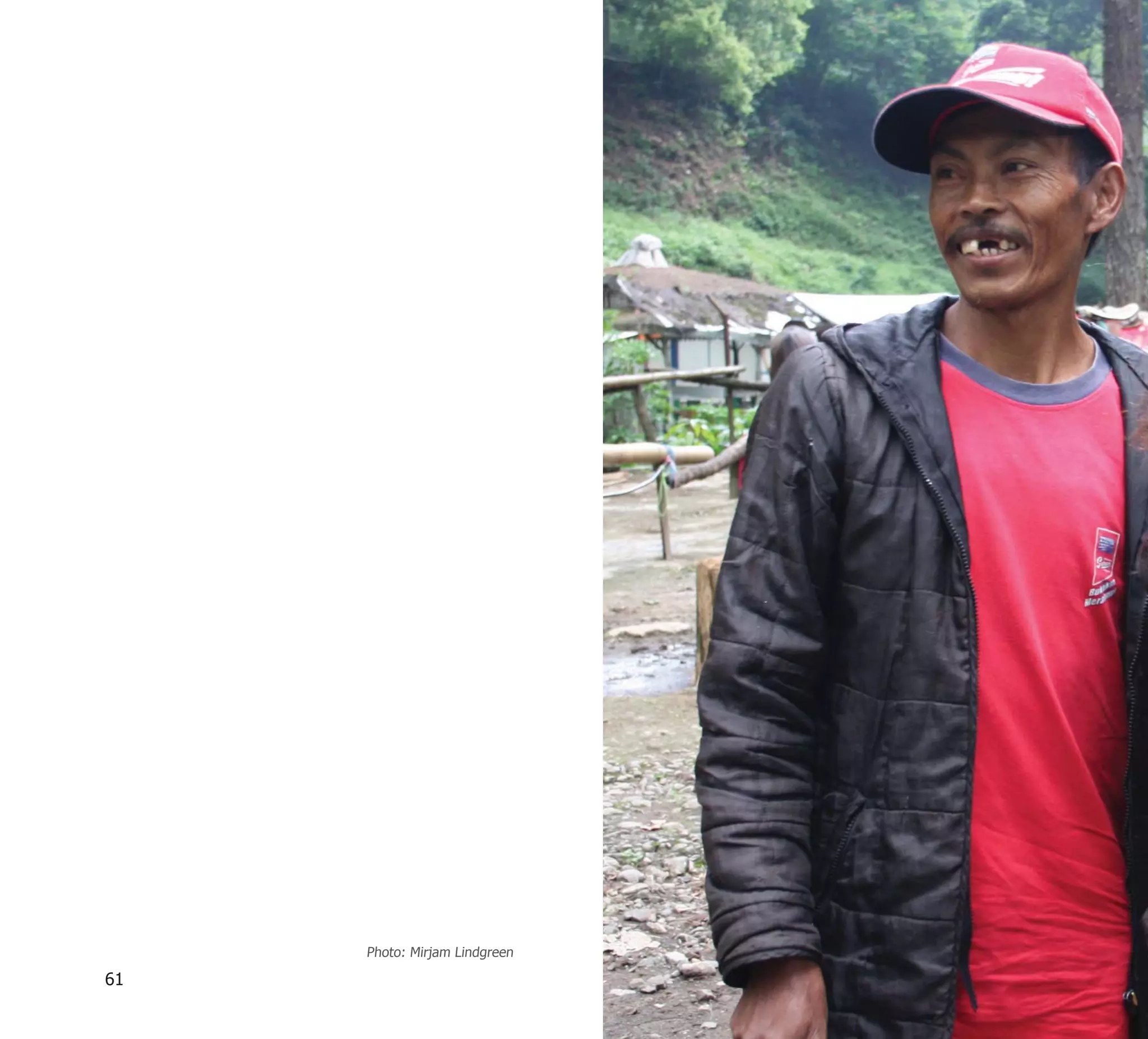
                                                                                   of environmental resources (Rocchi 2006). The target

                         NGO Partnerships (training, distribution,                 here is not only the poverty of the people in the BoP, but
        Product
                         collect feedback), new channels, new busi-                also the context in which they live, which tends to lack
        Launch
                         ness models, local ecosystem setup
                                                                                   traditional utilities, such as electricity, water, and gas (i.e.
                                                                                   in rural Africa less than 2% of the population is connected

      127
Epilogue
to the electricity grid). In addition ICT and transportation       important is the willingness to listen deeply to the local
infrastructures are also often very weak. The outcomes             people and local stakeholders, and understand what they
of the Intocontext project demonstrate that sometimes              need, not what product innovators think they need.
alternative solutions (mobile phone instead of internet via          For example the demand for renewable electricity based
PC) are available but not used (see page 108). Most BoP            light is a ‘derived demand’: no one wants electricial light
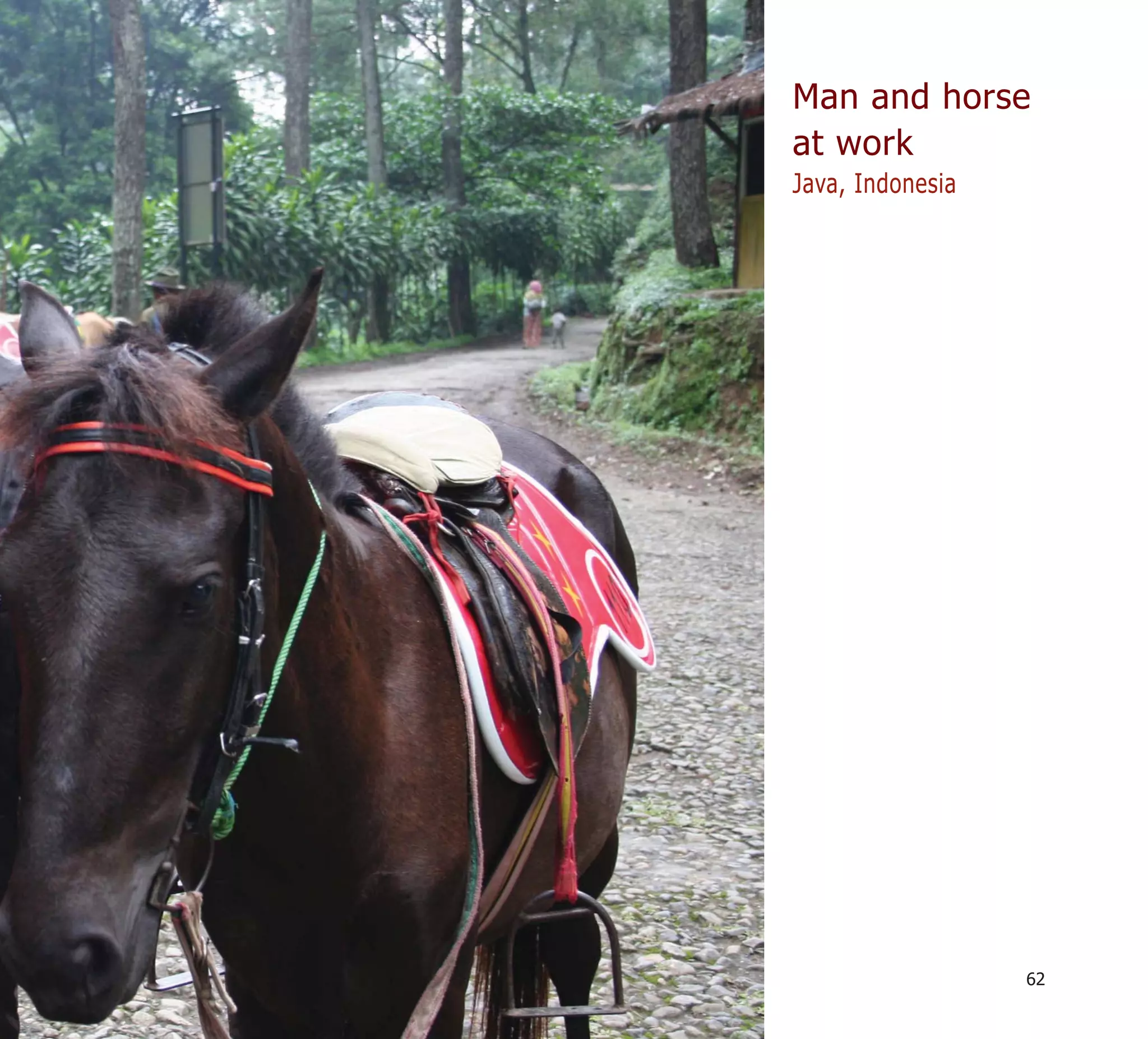
communities are fragile ecologically, so new products and          in itself but rather for the services it can provide (ESMAP
services need to be very eco-efficient (Sethia 2005). In that       2000). The biggest unmet need is not for better illumination
perspective the Kamworks projects (see page 38, 40, 56             but for safety from fire, savings, and greater independence.
and 116, on replacing kerosene lights solar powered lights)        There should be added value in the products, which can be
and the Philips Woodstove project (see page 102, on a              recognized by consumers at the BoP. Second, markets in
dramatic increase of efficiency and avoidance of negative           developing countries are not well developed, so it is necessary
health impacts) are convincing examples what Designing             to develop basic channels and business models and value
for the BoP can mean.                                              chains in order to bring the products to the customers. The
                                                                   observed differences in the product innovation process are
Critical Phases in Designing Products
                                                                   summarized in Table 1.
From our experiences, we have learned that most
                                                                     Consequently, a basic starting point for successful product
companies active in the BoP state the front end research
                                                                   innovation for the BoP is to understand people’s needs
(Design Brief Formulation) and Product Delivery (Product
                                                                   and to interact with the material, economical and socio-
Launch) as the two most critical phases in developing
                                                                   cultural world. Therefore, both researchers and designers
products for the BoP market (See table on the right) (Chang
                                                                   should engage with the cultures directly. A unique set of
2006). First, it’s critical to adapt products so that the fit the
                                                                   design and business tools and practices adapted from social
context and resources of the target group. Most challenges
                                                                   anthropology, ethnography and Participatory Rural Appraisal
derive from the unfamiliarity with the local context and the
                                                                   (PRA) is being developed, applied and evaluated (Hart
distinct infrastructure in emerging markets. Although some
                                                                   2004; Diehl and Kuipers 2008; Simanis and Hart 2008) for
companies do have strong global resources and networks,
                                                                   designers and entrepreneurs.
a sustainable local enterprise network is necessary for them
to interact with the local community. Non-Governmental             Design Tools
Organizations (NGOs) play in this context a vital role in          At the moment, various design tools (such as personas,
the innovation process of several companies, especially            cultural probes, scenarios and user profiles in context-of-
when they intend to approach consumers at the BoP. Most            use) are available to capture insights related users’ needs,


                                                                                                                                     128
aspirations and behaviour in their original contexts (Leonard
      and Rayport 1997; Sanders 2000; Rodríguez, Diehl et al.
      2006). These new context and participatory techniques can
      introduce the end-user into the design process by co-design
      and get deeper information than the common focus groups
      or observational research methods (Sanders 2000; Gaver,
      Boucher et al. 2005).
        However most of them only have been applied in the
      ‘Developed Markets’. Currently we, at Delft University of
      Technology, are testing and evaluating these kind of context
      tools in emerging and developing markets in practice
      (Rodriguez, Diehl et al. 2006; Rodrigues, Thompson et al.
      2007). In that perspective we can say that there is still a lot
      to learn with regard to which design tools and approaches
      fit the best in the context of designing new product (service)
      solutions for the BoP.......

      We are looking forward to go through this learning
      process together with you!


        Chang, Y.-K. (2006). Innovation for the Next Billions:
      Case Study of 7 Multinationals that Develop Products for
      Emerging Markets. Industrial Design Engineering. Delft,
      Delft University of Technology. MSc.
        Diehl, J. C. and H. Kuipers (2008). Design for the Base of
      the Pyramid: Student Field Projects ub Cambodia. DesignED,
      Hong Kong.
        ESMAP (2000). Energy Services for the World’s Poor.


129
Washington, WorldBank.
  Gaver, W., A. Boucher, et al. (2005). “Cultural probes and
the values of uncertainty.” Interaction 11(5): 53-56.
  Hart, S. (2004). Base of the Pyramid Protocol, Cornell
University.
  Leonard, D. and J. Rayport (1997). “Sparking innovation
through empathic design.” Harvard Business Review 75(6):
102-113.
  Rocchi, S. (2006). Unlocking new markets. P. Design.
Eindhoven, Philips Design.
  Rodrigues, J., C. Thompson, et al. (2007). Multistakeholder
approach for people centered solutions: Welcome to East
Africa. Include 2007: Designing with People. Royal College
of Art, London.
  Rodriguez, J., J. C. Diehl, et al. (2006). Design toolbox
for contextualizing users in emerging markets. IEA2006,
Maastricht, Elsevier.
  Rodríguez, J., J. C. Diehl, et al. (2006). “Gaining insight
into unfamiliar contexts: A design toolbox as input for using
role-play techniques.” Interacting with computers 18 (5):
956-976.
  Sanders, E. B. (2000). Generative tools for codesigning:
Collaborative Design. London, Springer Verlag.
  Sethia, N. (2005). “At the Bottom of the Pyramid:
Responsible Design for Responsible Business.” Design
Management Review 16(Summer 2005).
  Simanis, E. and S. Hart (2006). “Expanding Possibilities at
the Base of the Pyramid.” Innovations 1(1): 43-51.
  Simanis, E. and S. Hart (2008). BoP Protocol: Towards
Next Generation BoP Strategy.

                                                                130
We would like to say thanks, for these interesting projects,
Acknowledgements   inspired & inspiring students and enthusiastic colleagues.
                   Without the help and effort of all these people, this book
                   would not have been as it is now.


                   Thanks to Ana Maria Alvarez, Loucas Papantoniou, Stephanie
                   Wirth and Doortje van de Wouw, Elly Doek, Merijn Janssen,
                   Regine van Limmeren, Charl Smit, Stefan Versluis, Veronie
                   Croes, Bjørn-Evert van Eck Rasmussen, Swie Oei, Susan
                   Oudshoorn, Rutger Bonsel, Sietse Cieraad, Stéphanie,
                   Reintjens and Imke Schepers, Aparna      Bhasker,      Inge
                   van de Wouw, Ambika Samabasivan, Lieke Pijpers, Sierk
                   Hennes, Kirsten Rijke, Tom van Diessen, Linda Schnieders,
                   Judith Goor, Jan Willem Findlater, Alexander van der Kleij,
                   Miriam Reitenbach, Koos Munneke, Bernard Hulshof, Rutger
                   Bonsel, Hoi-Kee Wong, Yu-Kuan Chang, Annemarie Mink,
                   Marion de Groot, Cathelijne Huis in ‘t Veld, Roelie Bottema,
                   Mijntje de Caluwé, Elselien Epema, Willem Glasbergen,
                   Marike Bijtelaar, Maria Nguyen, Leonie Ideler, Fernando Del
                   Caro Secomandi, Jon Rodriguez, Cale Thompson, Jonathan
                   Stranders, Suzanne Hendrikse, Stephen Boom, Roseliek van
                   der Velden, Joan Boekhovenand H.S. Smallenbroek.


                   We also would like to thank the following academic staff,
                   who supported students in their projects: Petra Badke-
                   Schaub, Annemiek van Boeijen, Casper Boks, Han Brezet,
                   Jan Buijs, Henri Christiaans, Katrijn Coninx, Marcel Crul,
                   Richard Goossens, Erik Jan Hultink, Remco van der Lugt,
                   Heimrich Kanis, D. Keskin, Henk Kuipers, Johan Molenbroek,
                   Kaj Morel, Sylvia Mooij, Ingo Oldenkamp, Joost Prins, Jan
                   Schoormans, S. Silvester, Dirk Snelders and K.S.S. Talke.


                   Thanks everyone! And we hope you will all keep working
                   towards achieving those millenium development goals, we
                   will certainly keep doing our best!

             131
About the Editors
                     Prabhu Kandachar                                                     Jan Carel Diehl
                     Currently Professor of Industrial Design                             After finishing his study in Industrial
                     Engineering (IDE) and Chairman of the                                Design     Engineering    he    worked
                     Department of Design Engineering, he                                 several years as a consultant in
                     received a B.E. degree in Mechanical                                 ecodesign. In his present position he
                     Engineering at the Mysore University                                 is assistant professor for the Design
                     and his M.E. and Ph.D. in Mechanical            for Sustainability (DfS) program at the Faculty of Industrial
Engineering at the Indian Institute of Science, Bangalore, India.    Design Engineering at the Delft University of Technology in
After a stint of 5 years at the Materials Science and Technology     The Netherlands. Within the DfS program he is managing
department at Delft, he worked at Fokker for 15 years, in            the international projects on sustainable product innovation
various technical & management positions. His teaching and           especially in emerging markets. The main focus of his
research interests at IDE are focused on materializing design        research is the know-how transfer and implementation
ideas, addressing manufacturing technology related to product        of sustainable product innovation into an international
design and materials; technology and materials selection in          context. He is has been working with companies and
design; and more. He is currently directing research work            universities in about 40 countries world-wide. Next to his
on development of products & services for healthcare in              position at the TU Delft he is consultant for UNIDO and
developing countries and is involved in research on ethical          UNEP and invited lecturer at universities in amongst others
aspects of product development for the BoP. He has given             Portugal, Colombia, Turkey, Japan and Austria. He is co-
several keynote lectures on this topic and has about 100             author of the UNEP Design for Sustainability manual for
publications on his work.                                            Developing Economies (D4S DE).


                         Ilona de Jongh
                         Born on Curaçao, a tiny island in the Caribbean, she received her Masters degree in Integrated Product
                         Design - specialized in design for health care - at the faculty of IDE in 2008. She believes that design
                         and design-thinking can cause social change, can improve life and can help towards a sustainable living
                         for everybody on this planet, and is working with several organizations and companies all over the
                         world to prove this. She currently runs the solution development firm Sprout Design, is chapter head of
                         Project H Design New York, and works with Delft University of Technology on several projects in Design
                         for Emerging Markets.

                                                                                                                                     132
Designing for Emerging Markets
The Base of the Pyramid strategy is to serve the underserved.
Both scientists and entrepreneurs are exploring this strategy,
economically and socially motivated. The key to success is
focusing on the needs of people in their own environment.
The strength and uniqueness of Industrial Design Engineering
lies in its human centred approach to design.


This book describes projects concerning products and services    Faculty of Industrial Design Engineering
for the Base of the Pyramid. This is the third publication in


                                                                                                            IDE Master Projects - 3
the series of graduation and other Masters’ program projects     Landbergstraat 15
at the Faculty of Industrial Design Engineering, specifically    2628 CE Delft, The Netherlands
aimed at product, service and system design for the Base of
the Pyramid.                                                     www.io.tudelft.nl/bop
                                                                 BoP-IO@tudelft.nl
                                                                 +31 (0) 15 278 3034

Bo p project_book_online

  • 1.
    Designing for Emerging Markets Design of Products and Services Industrial Design Engineering
  • 2.
    Designing for Emerging Markets Design of Products and Services Edited by Prabhu Kandachar Ilona de Jongh Jan Carel Diehl
  • 3.
    Colophon Printed on recycled paper Editors: Prabhu Kandachar, Ilona de Jongh and Jan Carel Diehl Cover design: Ilona de Jongh Designing for Emerging Markets, Design of Products and Services IDE Master’s Projects - 3 Edition March 2009 ISBN 978-90-5155-052-8 © 2009 Delft University of Technology All rights reserved. No part of this book may be reproduced or transmitted in any form or by any means, electronically or mechanical, including photocopying, recording or by any other information storage and retrieval system without explicit written permission from the authors. Delft University of Technology Faculty of Industrial Design Engineering Landbergstraat 15 2628 CE DELFT www.io.tudelft.nl/BoP Phone +31 (0) 15 278 3034 Fax +31 (0) 15 278 1839 E-mail p.v.kandachar@tudelft.nl j.c.diehl@tudelft.nl i.k.dejongh@tudelft.nl bop-io@tudelft.nl 3
  • 4.
    Project Focus Education Each project in this booklet is performed with thought for all three pillars of responsible business: People, Planet and Profit. Sometimes however, a more nuanced focus is distinguished. This distincton is indicated for each project Health on the upper left side of the page, using the following symbols. People Food & Nutrition Planet Water € Profit Energy Legend Housing On the right side of the pages with project summaries, the specific domain(s) of the project are indicated with use of icons. On the right side of this page all icons are shown with the correspding domain in words. This can be used as a Materials reference throughout this book, or as a search tool for cases in a specific domain. € Company Kamworks Graduation date December 14, 2007 Mobile Solar Kiosk for Micro-Entrepeneurs www.kamworks.com Connectivity Miriam Reitenbach Despite recent progress, the Cambodian economy still technical requirements. application of glass fibre reinforced plastic an attractive and has to reconstitute from the effects of the civil war. The Interviews with potential customers of the solar products eye-catching form of the carrier could be achieved. population often lacks education and productive skills, revealed that Cambodians were not yet familiar with solar In the context of a holistic approach this project did not which leads to a high unemployment rate, especially in energy in general and that the way of communicating and only focus on the design and construction of the kiosk, but the countryside. About 40% of the population lives below explaining products forms a major criterion for the success also presented recommendations on how to communicate poverty line and has to live of less than 1$ per day. As of the sales results. to the local customers in an effective and adequate way, 90% of the Cambodian population does not have access The outcomes of this research were translated into a final such as a LED display and posters explaining the benefits to a secure electricity infrastructure, economic and social concept that was refined by means of iteratively building and and cost savings of solar products. Additionally, a new Designing & Tools progress are slowed down as well. testing the prototype to guarantee not only the technical bilingual brand name and logo was created that made it These circumstances set the framework of Kamworks’ feasibility of the mobile store, but also acceptance among possible to communicate with Khmer customers as well as business idea: securing sophisticated energy and light the future users - the micro-entrepreneurs. Western stakeholders and contributes to a quality image of supply and creating new jobs for young Cambodians. As the mobile solar kiosk. Biking without pedaling the country receives approximately five full sun hours each The final design was a three-wheeled electric bicycle that Local Production and maintenance day, solar energy is one of the promising technologies. The can be recharged by solar energy. By making use of this When designing the mobile kiosk, only locally available objective of this graduation project was the design and renewable energy technology and being remarkably lighter materials and production techniques were considered in development of a mobile solar kiosk for Cambodian micro- than existing mobile stores, this vehicle is less polluting than order to generate local income, as local manufacturing was entrepreneurs, enabling the setup of a self-sustaining traditional motorised stores and can contribute to promote one of the greatest requirements for the design. These business by distributing solar products to the rural area of sustainable energy in an effective way. User tests showed manufacturing experts of the kiosk would also be able to Cambodia, in continuation of the intensive collaboration that an electric bike caught the attention of the customer take care of the maintenance and reparations, keeping all between Kamworks and Delft University of Technology, see immediately as most rural people never saw someone the work and the money local. In order to get an understanding on how the anticipated customer reacted page 116 . € on the mobile store, the Cambodian translator was asked to drive around driving on a bike without pedalling before. the rural areas to obtain feedback. In the first place he acted as micro- Extreme road conditions In order to cope with the bad road conditions a new Entrepreneurship entrepreneur who sells products, consequently he interviewed the potential Through intense user and context research in Cambodia, suspension system was developed that can damp the customers. technical and usability criteria were defined, as well as wheels individually which makes it much easier to drive and social and cultural influences. These formed the framework steer the vehicle, even on bumpy and unpaved roads. of this project. The first constraint was the underdeveloped In the front part of this mobile solar kiosk a yellow carrier road network and the extremely bad road conditions. Also, is mounted that serves not only to transport the solar with heavy rain seasons from May until October the road € products, but also as a store front when the lid is opened. conditions get even worse which poses a challenge to the Due to the, for the local context, innovative material The bilingual logo on the side of the glass fibre reinforced carrier. 56 57 4
  • 5.
  • 6.
  • 7.
    The number ofstudent projects at the Faculty of Industrial Preface Design Engineering relevant to the Base of the Pyramid (BoP) has increased enormously since 2002, when the course “Advanced Products” for Master’s students started a small experiment with projects focused on developing countires was started. The increase of projects is due to several reasons. Firstly, students of our Faculty have shown great interest and enthusiasm to design products and services to meet the needs of the citizens of the BoP. Secondly, the concept of BoP has attracted the attention of many Dutch and European entrepreneurs, leading to several assignments for Base of the Pyramid projects executed all over the world by students from our students, often in collaboration with people living at the Delft University of Technology, in the time period between 2004 and 2009. economic BoP. Thirdly, the supervising staff of our Faculty is equally active in supporting such initiatives. And lastly, more and more Non-Governmental Organizations (NGOs), both in the Netherlands and in some BoP countries, have been opening up their doors to such trials. But what is this BoP? Base of the Pyramid (or Bottom of the Pyramid, as it is sometimes termed) refers to the 4-billion plus poor mostly in non-western countries in Asia, Latin America, and Africa, living on incomes less than $32601 per year. Some parts of these geographical regions, such as China, India, Brazil, Russia, have markets experiencing phenomenal economic growth not unnoticed 1 Monica Touesnard, http://www.bopnetwork.org/ 7
  • 8.
    by the affluentwest. Millennium Development Goals Preface Although the BoP strategy to serve the underserved, The extensive response to these ideas is likely due to the namely the poor in developing countries, has attracted the limited success of developmental assistance to alleviate attention of scientists and entrepreneurs worldwide, the poverty in the past 50 years. For more than 50 years, the scientific publications in this area until now are often from World Bank, donor nations, various aid agencies, national management sciences, often extending the concepts of governments, and civil society organizations have all fought corporate social responsibility, sustainability, etc. the good fight, but have not been able to eradicate poverty The uniqueness of our Faculty of Industrial Design yet. The adoption of the Millennium Development Goals Engineering lies in its human centered approach. Needs are (MDG) by the United Nations only underscores that reality. the central driving force uniting technology and business. Poverty has remained one of the world’s most daunting By tradition our Faculty has propagated the practice of problems even as we enter the 21st Century. Prahalad designing products and services to meet the human needs. advocates an alternative approach to help the poor. The BoP strategy has stimulated us to look also at the needs Science Spread over the World of the underserved, which represent a huge market and The projects described in this book are a result of several was hitherto unattended. students, entrepreneurs and academic staff stimulated by The foundation for the BoP strategy was laid by Prahalad this strategy. The BoP concept is spreading to all parts of the & Hart2, in their publication published in the first quarter world, both within the rich and in the poor countries. This of 2002, promising fortune for entrepreneurs and at the is also reflected by the geographical spread of the projects same time offering perspectives to the poor world majority executed at our Faculty, as can be seen in the picture on to escape from the poverty. This caught public attention the opposite page. and unleashed an extensive response from academics, It can also be observed that the projects cover very businesses, NGOs and others. Prahalad’s book3 delves in diverse needs, from Water to Energy, from Healthcare to depth by proposing a framework for the active engagement Education, and more. These projects could not have been of the private sector and suggesting a basis for a profitable executed without the involvement of students, companies, win-win engagement. This vision of untapped great wealth NGOs, and professors. Together they have set up a base in the world waiting to be explored & exploited by human to develop a new knowledge domain full of challenges and ingenuity, by designing products and services to meet the opportunities. Thank you all! needs of the world’s poor, and then efficiently manufacturing & distributing by the capabilities of the modern corporation, Prahalad contends, needs innovations. 2 The Fortune at the Bottom of the Pyramid, Strategy+business, Prabhu Kandachar issue 26, First quarter 2002, p. 1- 14 (Booz Allen Hamiliton) Faculty of Industrial Design Engineering 3 The Fortune at the Bottom of the Pyramid: Eradicating Poverty Delft University of Technology Through Profits, ISBN-10: 0-13-146750-6; ISBN-13: 978-0-13- 146750-7 (Published 2004) Pages: 432. March 2009 8
  • 9.
    Project Focus 2 Table of Contents Preface 6 Introduction Prabhu Kandachar Challenges for Industrial Designers 10 Student Projects Inge van de Wouw Dec 8, 08 Lamp with insect repellent 26 Aparna Bhasker 2009 India Moves: Economic Empowerment of Rural Disabled 28 Ambika Samabasivan Oct 30, 08 Global Opportunities in Renewable Lighting 30 Lieke Pijpers Oct 24, 08 PRO-PORTION Affordable milk for kids 32 Sierk Hennes Sep 23, 08 Design a PSS for drinking water 34 Kirsten Rijke Aug 26, 08 Solar shop in rural Cambodia 38 Tom van Diessen Aug 22, 08 Solar Home System for rural Cambodia 40 Linda Schnieders Jul 28, 08 Redesign of a Smoke free Batana Extractor 42 Lumen Jun, 08 LUMEN light solution 44 Judith Goor Apr 04, 08 A battery charging system for youngsters 46 Jan Willem Findlater Feb 8, 08 Culturally appropriate coffins for Botswana 50 Water4Kenya Feb, 08 Water4Kenya 52 Alexander van der Kleij Feb 1, 08 Comparing Contexts; Solar Dew Technology 54 Miriam Reitenbach Dec 14, 07 Mobile Solar Kiosk for Micro-Entrepeneurs 56 Koos Munneke Oct 24, 07 Better Brace Project 58 Bernard Hulshof Oct 19, 07 Affordable Solar Lighting for rural Madagascar 62 Rutger Bonsel Oct 12, 07 Holy Cow or Cash Cow 64 Hoi-Kee Wong Aug 8, 07 Cooking in rural China 66 Fire4India May, 07 Fire4India 68 Yu-Kuan Chang Nov 27, 06 Knowledge Gaps in Product Development 70 Culture & Design Annemiek van Boeijen Design & culture in the BoP Domain 74 Annemarie Mink Nov 10, 06 Reeling Machine for Silk Yarn Producers 78 Marion de Groot Sep 21, 06 Support Tool for the Chinese Village Doctor 80 Cathelijne Huis in ‘t Veld Aug 31, 06 Design of a Malaria Diagnostics Device 82 Roelie Bottema Aug 4, 06 Personal Water Purifier 84 Mijntje de Caluwé Jul 29, 06 Knowledge Framework: Design4Billions 86 9
  • 10.
    Elselien Epema Jul 7, 06 Product Service System for Plant Oil Stove 90 Table of Contents GhanaMoves Jul-06 Tricycle for Disabled Entrepreneurs 92 Willem Glasbergen Jun 21, 06 Human Powered Bamboo Splitting Tool 94 Marike Bijtelaar Jun 16, 06 Improving the Climate of Cooking Areas 96 Maria Nguyen Apr 28, 06 Safe Drinking Water 98 Leonie Ideler Apr 4, 06 Adoptable Woodstove 102 Fernando Del Caro Secomandi Apr, 06 Water Supply in Slums:P.I.P.A. System 104 Jon Rodriguez Feb 3, 06 Contextualizing Products 106 Cale Thompson Sep 14, 06 Online Microfinance: into(context) 108 Jonathan Stranders Dec 23, 05 Creating Market Insight for Designers 110 Suzanne Hendrikse Nov 11, 05 Device for Early Oral Cancer Detection 114 Stephen Boom Oct 28, 05 Solar Lighting 116 Roseliek van der Velden Oct 21, 05 Adoptability of the U-Specs 118 Joan Boekhoven Oct 18, 05 Natural Fibres in Doors and Windows 120 H.S. Smallenbroek 2004 Small scale cassava starch processing 122 Epilogue J.C.Diehl The first learning experiences of Design for the BoP 126 Acknowledgements 130 About the Editors 131 Photos P.I.P.A. system Brazil Fernando Del Caro Secomandi Cover Rice Fiels near Culik Bali, Indonesia Jimmy Ho 4 Kids swimming and playing Jakarta, Indonesia Ilona de Jongh 24 Girl Java, Indonesia Mirjam Lindgreen 36 Man Fishing on Citarum River Java, Indonesia Kees van Gastel 48 Man and horse at work Java, Indonesia Mirjam Lindgreen 60 Market for Holi Colours India Prabhu Kandachar 72 Boats Cambodia Stephen Boom 76 Girl Getting Water in Favela Rio de Janeiro Ferry 88 Girls in Favelas Rio de Janeiro Linda Schnieders 100 Man at Home Chongming Island Jaap Daalhuizen 112 Toilet in a Rural Village Chongming Island Jaap Daalhuizen 124 10
  • 11.
    Introduction Challenges for Industrial Design Engineers Prabhu Kandachar About two thirds of the world’s population of 6 billion people spend their lives searching for food and shelter, fighting for physical survival, and fearing for the future. These are the individuals who earn less than three dollars per day: the people living at the economical Base of the Pyramid (BoP). This does not go unnoticed. Global poverty, its extent and distribution, is of daily news screaming for the attention of all world citizens. The challenge at world level is enormous. In Africa alone, poverty and hunger, unemployment, disease, malnutrition, lack of shelter, gender inequity and environmental deterioration are some of the main challenges in addressing poverty. Millennium Development Goals Millennium Development Goals Eight Millennium Development Goals, to be achieved in 2015. The developments in the last century have attracted the Goal 1: Eradicate extreme poverty attention of world leaders. At the Millennium Summit in and hunger September 2000 the largest gathering of world leaders in Goal 2: Achieve universal primary history adopted the UN Millennium Declaration, committing education their nations to a new global partnership to reduce extreme Goal 3: Promote gender equality poverty and set out a series of targets with a deadline and empower women of 2015, which have become known as the Millennium Development Goals1. The image on the left shows the eight Goal 4: Reduce child mortality goals. Goal 5: Improve maternal health The Millennium Development Goals (MDGs) are the world’s time-bound and quantified targets for addressing extreme Goal 6: Combat HIV/AIDS, malaria and other diseases poverty in its many dimensions - income poverty, hunger, disease, lack of adequate shelter, and exclusion - while Goal 7: Ensure environmental sustainability promoting gender equality, education, and environmental sustainability. Also included are basic human rights - the Goal 8: Develop a Global right of each person on the planet to health, shelter, and Partnership for Development 1 http://www.undp.org/mdg/basics.shtml 11
  • 12.
    Introduction security and thereare specific aims at combating child beyond the immediate horizon and opportunities, and for mortality, AIDS, Malaria and other diseases. having a voice in public decision making. A sustainable The MDGs are an agreed set of goals that can only be end to world poverty as we know it, as well as the path to achieved if all actors work together and do their part. Poor peace and security, requires that citizens in every country countries have pledged to govern better, and invest in their are empowered to make positive choices and provide for people through health care and education. Rich countries themselves and their families. This can only be achieved have pledged to support them, through aid, debt relief, and if everyone is given a chance to learn in a high-quality fairer trade. schooling environment at least through primary school. As an institution which is an expert in designing products At a country level, education is considered to be an and services to meet human needs, it could be that some important determinant of economic growth and is frequently of the needs of the population at the Base of the Pyramid hailed as one of the primary contributing factors to the are addressable by the expertise available at the Faculty dramatic economic growth in East Asia. Individuals with a of Industrial Design Engineering, Delft University of strong educational attainment also have good earnings. A Technology. Most problems can be grouped in the domains greater access to good quality education is a key poverty- of education, healthcare, food & nutrition, water, energy, reduction strategy advocated throughout the developing world. housing, materials, connectivity, designing & tools, and More and more children, youth and adults have a entrepreneurship. Each of these domains will be discussed, chance to learn and the number of children in school giving an overview of the needs and problems. The rest continues to grow. Today 680 million children are enrolled of the book presents student projects that aim at solving in primary schools around the world. Yet, a lot more still problems within one or more of these domains, with needs to be done. More than 100 million children, over two different chapters: on page 74, an insight is giving half of them girls, never get a chance to see the inside on “design and culture at the BoP”, and the epilogue on of a classroom. Furthermore, the poor quality of education page 126 reflects on the student projects and draws some provided, resulting from irrelevant and obsolete curricula, preliminary conclusions about the lessons learned. overcrowded classrooms, untrained teachers, etc., causes Education high incompletion rates. An essential ingredient for the full realization of human Literacy empowers and nurtures inclusive societies and capacity, education is considered to provide everyone the contributes to the fair implementation of human rights. In opportunity to make a better life for themselves. Education the case of mothers, literacy leads to an enhanced quality provides the basis for making informed choices, for seeing of life for their families and improved education outcomes 12
  • 13.
    for their children.Parents’ education, and particularly mothers’ education, is seen to result in lower fertility, lower maternal mortality, and better child health and nutrition status. It is also suggested that individuals with at least World Income Distribution 2000 some education respond better to HIV/AIDS prevention messages. Nevertheless literacy remains a low priority for national governments and the donor community. Worldwide, 781 million adults are illiterate (as of April 2006) and about 100 million children are out of school. A large number of those who enrol drop out before attaining literacy skills and some of those who complete primary education remain illiterate. Literacy is an indispensable means for effective social and economic participation, contributing to human development and poverty reduction. Goal 2 of the Millennium Development Goals has set out by the year 2015 to ensure that all boys and girls complete a full course of primary schooling. The use of information and communication technologies (ICT) in and for education is rapidly expanding in many countries, and is now seen worldwide as both a necessity and an opportunity. In different countries policies and strategies to integrate information and communication technologies in education are being developed. While ICT use in education in developing countries is relatively recent, it has nevertheless made an impact on the education system. It has generated a wealth of experience, good practices and lessons for the benefit of countries where ICT application and integration in education are being established2. 2 http://portal.unesco.org/en/ Everyone knows the resources in the world are not divided evenly over the entire population. This inequal distribution of money and power needs action. 13
  • 14.
    Healthcare the challenge of providing access to sustainable healthcare Differences in health standards between rich & poor in developing countries. Money is the single biggest barrier countries are very high. Life expectancy varies between to improving healthcare in the developing world. In many 36 and 85 years. A child born in a rich country receives countries people do not have enough food or access to a vaccinations, adequate nutrition and good schooling. When clean water supply, no hospital or clinic in which to receive a girl becomes a mother she will benefit from high-quality treatment and few healthcare professionals to care for them. maternity care. Growing older, she may eventually develop Often the governments of these countries simply do not chronic diseases, but excellent treatment and rehabilitation have the resources needed to address the healthcare needs services will be available. On the other hand, a child born in of their people. The World Bank estimates that an annual a poor country has little chance of receiving immunizations healthcare expenditure of $14 per person is the minimum and a high probability of being underweight throughout needed to provide the most fundamental services. Yet the childhood. She will probably marry early and give birth average expenditure in sub-Saharan Africa, for example, is to many children without the assistance of a trained birth currently only $63. attendant. One or more of her babies will die in infancy, and Food and Nutrition she herself will be at high risk of death during childbirth. Food security and insecurity are terms used to describe If she survives middle age she, too, will develop chronic people’s access to sufficient quality and quantity of food. diseases but, without access to adequate treatment, she will They are affected by factors such as poverty, health, food die prematurely. production, political stability, infrastructure, access to markets, This illustrates what medicine and public health can and natural hazards. Improved food security is important for achieve, and shows unmet needs in a world of vast and global reduction of hunger and poverty, and for economic growing health inequalities. The key task of the global development. One aim of the Millennium Development health community is therefore to close the gap between Goals (MDG) is to eradicate poverty and hunger, including such contrasting lives. Real progress in health depends “to reduce by half the proportion of people who suffer from vitally on stronger health systems based on primary health hunger” between 1990 and 2015. However, by 2003 the care. Attention is needed across all levels of the health care proportion of world population that was undernourished system to integrate health promotion and disease prevention had only decreased from 20% to 17% (823 to 820 million on the one hand and treatment for acute illness and chronic people). It is predicted that many regions will not reach care on the other. their MDG targets, particularly sub-Saharan Africa where Experiences from past decades, fighting against diseases a third of the population is food insecure and there is an across the world, show that there are no easy solutions to 3 The World Health Report 2006, http://www.who.int/ 14
  • 15.
    actual increase (throughpopulation growth) in the number of hungry people. Southern Asia is also not expected to meet its goal, with increasing numbers of undernourished people in countries such as Bangladesh and Nepal. The factors affecting this problem include: (1) availability of food, or the amount of food that actually exists (local production and other sources) (2) people’s physical, economic and social access to food (3) the quality or nutritional adequacy of that food; and (4) people’s ability to utilize this food, including the patterns of control over who eats what and the physical ability to absorb nutrients (affected by health status factors such as intestinal parasites). Malnutrition, a widespread problem, is caused by deficiencies or imbalances in energy, protein and/or other nutrients. Signs include wasting (thinness), stunting Shortage of Health Service Providers (shortness), or being underweight (low weight for age due to wasting/stunting). Protein-energy deficiency is a leading cause of child death in developing countries. Deficiencies in micro nutrients (vitamins and minerals) can also affect mental and physical health. Micronutrient malnutrition is a major global public health problem affecting more than a third of the world population. Consequences of this malnutrition are widespread and severe. For example iron deficiency anaemia remains a major health problem and can negatively impact on health, life expectancy, work productivity and economies. It has been estimated that iron deficiency impairs the mental development of 40 to 60% of children in developing countries. Also, vitamin A deficiency Countries with a critical shortage of health service providers (doctors, nurses and midwives) are coloured dark. [World Health Organization, Global Atlas of affects 40% of children, and is a factor in 1 million child the Health Workforcehttp://www.who.int/globalatlas/default.asp] deaths per year. Thirdly, iodine deficiency during pregnancy 15
  • 16.
    causes mental impairmentin 18 million babies born every Households (%) That Lack year. Several strategies have been proposed to address In-House Improved these problems. They include food fortification, dietary Connection to Drinking Improved diversification, dietary supplementation, nutrition education, Water Water Sanitation and public health measures to control intestinal parasites China 41 23 56 and other infectious diseases. Also, when people do have Russia 19 4 13 access to food, more efficient and healthy food preparation Mexico 11 9 23 methods and tools can address the problem of unhealthy Colombia 15 8 14 preparation. Peru 28 19 28 Water In China two-fifth of the households lack an in-house connection to water, The most common substance on earth is water. Ninety- almost a quarter lacks improved drinking water and more than half of all seven percent of it is seawater, unfit for human use. Of Chinese lack improved sanitation [United Nations Habitat]. the remaining 3%, two-thirds is locked up in glaciers or ice and snow around the poles. Only 1% of the entire world’s water is available for human consumption. Even this small percentage should be enough for all, water being infinitely renewable. However, water is not distributed evenly. Canada, The Global Water Challenge Austria and Ireland, have more water than they can possibly use; Australia, northern China and the Middle East, have too little. In India and Bangladesh, rainfall is highly seasonal: almost all the year's supply may arrive within a few months. Water is also heavy, which makes it costly to transport over long distances. In many countries, millions of poor people (usually women) must walk for several hours a day to get water; or they pay exorbitant prices to private water vendors. And often water quality is poor. Inadequate sanitation makes matters worse. As much as 60% of the world's illness is water-related. Water shortage is expected all over the world In developing countries, less than 10% of the naturally available water in the coming 20 years as shown in the figure on the right4. is withdrawn [Adapted from Grey and Sadoff, 2006, The Global Water 4 Water Scenarios in 2025, WBCSD, August 2006, http://www.wbcsd.org/ Challenge]. 16
  • 17.
    One of themillennium targets requires that an additional 1.5 billion people gain access to some form of improved water supply by 2015, which is 100 million people each year (or 274,000 people each day). Energy Energy is required for most of the human activities. In 2003, no less than 80% of the world's energy consumption came from fossil fuels. The extensive use of energy technologies, especially when utilizing fossil energy resources, has also generated undesirable by-products, wastes and pollution Worldwide Energy Consumption that threaten human health, climate and ecosystems. The extraction, conversion to useful energy (such as electricity for a home or gasoline for a car), and combustion of fuels like oil, coal, natural gas, etc, releases into the atmosphere approximately 80% of human-induced (termed anthropogenic) greenhouse gas emissions. The environmental consequences are causing concern firstly from the reliance on natural resources, and secondly from the damage to global, regional, and local environments from emissions. The global requirements for energy are increasing rapidly as the global population increases and the under-developed nations become more advanced. Nearly two billion people in our world of rapidly approaching six billion people currently do not have access to commercial energy services. Understanding and assisting in putting to use the laws of nature for the transition towards a sustainable energy system is the fundamental challenge of today’s and tomorrow’s scientists & engineers. One of the greatest challenges ahead Prognosis after 2000 assumes a global economic growth of 3% and a global population of 9 billion people by 2050 [Deutsche Shell, http://www.spiegel.de/ is to connect the 1.6 billion people in developing countries international/spiegel/0,1518,grossbild-685811-429968,00.html]. currently without access to modern energy services in an 17
  • 18.
    environmentally benign manner.Other challenges include the Housing and Urbanization ongoing urbanization throughout the world creating higher Some 1.2 billion people worldwide live on the equivalent and higher energy demand densities, increasing demand for of less than one dollar per day. The United Nations Centre mobility, especially in developing countries, and additional for Human Settlements (UNCHS) has estimated that 1.1 energy needs for new processes such as desalination. billion people are living in inadequate housing conditions in Clearly, meeting such a challenge requires a proactive & a urban areas alone, and that figure is expected to double by co-operative contribution from all involved. 2030. UNCHS has also estimated that some approximately In Africa, for instance, overcoming energy poverty is one of 35 million new housing units are required each year in the main challenges. The majority of Africans currently have developing countries to accommodate growth in the number no access to modern energy services and technologies. of households during the period between 2000 and 2010 This has wide-ranging social and environmental period. The bulk of these, some 21 million units, are required consequences. Lack of access to electricity means no to cater for the needs of the increasing number of households. refrigeration for medicines or food, limits on what type of The rest is needed to meet the requirements of people who businesses can be developed, as well as no effective lighting. are currently homeless or living in inadequate housing. In As a result, children cannot easily study in the evenings. other words, some 95,000 new urban housing units have to Most Africans, even in urban areas, still use firewood, crop be constructed each day in developing countries to improve residues or charcoal for cooking and cook on inefficient housing conditions to acceptable levels. Some 14 million stoves, resulting in a high incidence of respiratory diseases additional units would be required each year for the next because of smoke. Many women and girls have to spend 20 years if the current housing deficit were to be replaced hours collecting firewood, and cutting trees contributes to by 2020. Among an estimated 100 million homeless people deforestation. around the world, available data suggest that increasing There are also opportunities. A recent study5, by the proportions are women and children. German Aerospace Center and Ecofys in The Netherlands, But the main event of the demographic change is in the commissioned by Greenpeace and Europe's Renewable cities of the developing world — and most of it in squatter Energy Council. claims that half of the world's energy needs cities, the teeming slums of the uninvited. A billion people in 2050 could be met by renewable energy and by improved live in squatter cities now. Two billion more are expected by efficiency. According to this study, alternative energy sources, 2050. Squatters are nearly one-sixth of all humans now, one- such as wind and solar, could provide nearly 70% of the fourth to one-third in the nearby future. global electricity demand and 65% of global heat demand. Historically, cities have been the driving force in economic and social development. At present approximately 307 million 5 Report: Energy Revolution, Jan 2007 18
  • 19.
    Indians (31% ofthe population) live in nearly 3700 towns and cities spread across the country. This is in sharp contrast to only 60 million (15%) who lived in urban areas in 1947 when the country became independent. During the last fifty years the population of India has grown two and half times, but Urban India has grown by nearly five times. In numerical terms, India's urban population is second largest in the world after China, and is higher than the total urban population of all countries put together barring China, USA and Russia. Facilities in houses are also of big challenge. Less than 20% of households in Africa are connected to piped water, and only 40% have piped water within 200 meters of their home. In the developing world, 29% of cities have areas considered as "inaccessible" or "dangerous" to the police. In Latin America and the Caribbean, this figure is 48%. Less than 35% of cities in the developing world have their wastewater treated. In countries with economies in transition, 75% of solid wastes are disposed of in open dumps. Housing problems have far-reaching consequences. The high cost of housing leaves low-income families little money for other basic necessities like food, clothing or health care. Substandard housing can endanger the health and safety of its occupants, erode their hope and self-worth, and impair their children's ability to succeed in school. Materials and Resources Developing countries are concerned with promoting technological advancement as a means of economic development, which in turn contributes to social development. Raw materials and local resources provide basic building blocks for such developments. Developed countries are much 19
  • 20.
    further in applicationof material and resources by means contribute significantly to the income and food security of industrial production wherein energy and raw materials of poor farmers and workers in fibre industries. For some are fed continuously into the production process, resulting developing countries natural fibres are of major economic in useful products as well as waste or other by-products. importance, for example, cotton in some West African Increasing concern worldwide for environmental protection countries, jute in Bangladesh and sisal in Tanzania. In other and growing economical constraints have led to development cases these fibres are of less significance at the national level and utilization of new materials based on renewable but are of major local importance, as in the case of jute in resources such as natural fibres and plant materials, as well West Bengal (India) and sisal in northeast Brazil. as recycling of industrial by-products. Challenges in this area include attaining economic growth Developing countries have often abundant local renewable by designing and commercializing products based on such materials and basic expertise. For instance natural fibres local renewable natural resources without raising the produced from animals or plants are plentifully available in ecological pressure on the planet. developing countries. Animal fibres are derived from sources Connectivity such as sheep, goats and rabbits, and the cocoon of the Communications in the richer part of the world by means silkworm. Vegetable fibres are derived from the stem, leaf or of newspapers, radio, TV, telephones are self-evident. The seed of various plants. Close to 30 million tonnes of natural latest technology, mobile phones, has become indispensable fibres are produced annually in the world, of which cotton is in the rich world. But they are even more useful in the dominant with 20 million tonnes, wool and jute each around developing world, where the availability of other forms 2 to 3 million tonnes followed by a number of others. of communication—roads, postal systems or fixed-line Natural fibres form an important component of clothing, phones—is often limited. Even though there is a substantial upholstery and other textiles for consumers, and many of subscriber growth in much of the developing world, only them also have industrial uses in packaging, papermaking a small proportion of people (affordability is the “biggest and in composite materials with many uses, including obstacle” to broader adoption) —around 5% in both India automobiles. and sub-Saharan Africa—have their own mobile phones. Apart from their importance to the consumer and in their Using cell phones, fishermen and farmers check prices in various industrial uses, natural fibres are an important different markets before selling produce. Cell phones also source of income for the farmers who produce them. In help people to find work, allow quick and easy transfers some cases they are produced on large farms in developed of funds and boost entrepreneurship. A village can share countries, but in many developing and least developed phones and prepaid calling plans reduce the need for a bank countries proceeds from the sale and export of natural fibres account or credit check. 20
  • 21.
    Grameen Bank, apioneer in the practice of micro-credit lending, has created a cell phone company to bring cell phones into the villages of Bangladesh. The bank gave loans to the borrowers to buy a cell phone and start selling phone services. It became a growing business, especially with women entrepreneurs. They never saw a telephone in their life before, but they have accepted it as a business idea, and more than 100,000 telephone ladies all over Bangladesh are doing good business while connecting Bangladesh with the rest of the world. A recent study has shown that, in a typical developing country, a rise of ten mobile phones per 100 people boosts GDP growth by 0.6 percentage points. Mobile phones are, Number of People Without Electricity in short, a classic example of technology that helps people 1979-2030, by region help themselves. Nevertheless, the absorption of digital technologies throughout the world has not been uniform, such that the concept of digital divide has emerged. The digital divide is the gap between those with regular, effective access to digital technologies and those who do not have that option. Also, the divide refers to those who can benefit from those digital technologies and those who do not. Countries with a wide availability of internet access can advance the economics of that country on a local and global scale. In today's society, internet is becoming increasingly important influencing jobs and education. In countries where the internet and other technologies are not accessible, education is getting affected, and uneducated people cannot compete in our In the sub-saharian Africa and South Asia, it is projected that people are global economy. The digital divide is also a term used to increasingly living without electricity [IEA 2002b]. refer to the gap between people who have access to the 21
  • 22.
    internet (the informationhaves) and those that do not (the Entrepreneurship information have-nots). It can also refer to the skills people Entrepreneurs are regarded as bearers of risk, agents that have – the gap between people who are at ease using digital bring together the factors of production, or organizers of technology to access and analyse information and those who innovation. Entrepreneurship is essential in developing are not. countries, as it has played an important role in economic The digital divide is just as much a gap in understanding as growth, innovation, and competitiveness, and it may also it is a gap in connectivity. There are often clear fundamental play a role over time in poverty alleviation. differences between what is proposed by technology Over 400 million individuals in developing countries visionaries, many of whom have never even seen a village, are owners or managers of new firms. Of these, over 200 and what is actually needed by end-users, many of whom million are found in China and India alone, compared with just 18 million entrepreneurs in the United States. Yet, in have never used a telephone or a computer. one of the best general books on the state of research on A number of ICT initiatives offer a promise of closing the entrepreneurship, China is mentioned on two pages and gap that separates the some four billion people living in rural India is not mentioned at all6. communities from a future with greater literacy, productivity, Entrepreneurs in developing countries face a different and quality of life. While the end goal is clear – broadband set of circumstances than their counterparts in developed connectivity everywhere – many ICT initiatives have faltered economies. These differences are rooted in the underlying due to a lack of a well-adapted, step-by-step approach that economies in which they operate. Emerging markets lack a considers social factors and the staging of capital investments stable or mature market and the consistency that such markets as well as technology. offer. Consequently, the opportunity for entrepreneurship in Wireless technology has not only revolutionized the way emerging markets is pervasive. While Western entrepreneurs the developed world communicated; it also offers developing operate at the fringes of the economy, emerging market countries an opportunity to “leap-frog” over wire line entrepreneurs operate closer to the core – the needs and infrastructures to the forefront of communications. However, opportunities are more widespread. Another difference lies in since many different types of wireless technologies exist, it the access to financial resources. Internal finance comprises is important to choose the technology that best matches the the majority of financing for small and medium enterprises needs of these new markets. While some wireless techniques in most developing countries. Another major difference lies have been very successful in urban areas, the rural ICT market in the access to technological advances which are largely has its own set of unique requirements, including: low-cost, 6 Amar Bhidé, The Origin and Evolution of New Businesses, New York: Oxford low-power, scalability, robustness, and ease of use. University, 2000, ISBN-13: 978-0195131444 22
  • 23.
    developed and heldby developed countries. Entrepreneurs are a crucial link in implementing designs of products and services developed specifically to meet the needs of the BoP markets. They are the motors of economic growth and poverty reduction. Small, micro and medium- sized enterprises (SMMEs) are often the backbone of the private sector in the developing world, creating jobs and providing a tax base for local government. And frequently SMMEs offer the only employment available to millions of Focus of Base of the Pyramid Research poor people. Faculty of Industrial Design Engineering Design and Research Delft University of Technology Back in 2002, an experiment was conducted to design a A model for design processes for the Base of the Pyramid product to serve rural healthcare needs of China, specifically [Prabhu Kandachar, Jan 2008]. diabetes mellitus. In this project, students and staff of the Faculty of Industrial Design Engineering collaborated with staff from a Multinational Corporation. Almost at the same time the first paper expounding the Base of the Pyramid strategy by Prahalad & Hart appeared, promising fortune for entrepreneurs and at the same time offering perspectives for the poor world7 majority to escape from poverty. Needs of human beings are the central driving force uniting technology and business, resulting in products and services. By tradition Delft has 7 Strategy + Business, Issue 26, digitaldividend.org/ pdf/bottompyramid.pdf, first quarter 2002. 23
  • 24.
    propagated the practiseof designing products and services to meet human needs. Even though it is set up in an engineering environment, such an activity needs an integrative approach from several sciences: technical, social, management sciences, and working together with entrepreneurs. Although several earlier activities at Delft had been carried out in poor countries, they were almost always within the context of developmental assistance. The Base of the Pyramid strategy has stimulated this Faculty to look also at the needs of the underserved, which represent a huge market and was hitherto unattended. It provides an opportunity to apply the well tried out model at Delft (see figure at the left) for poor countries, but this time within the context of alleviating poverty by means of business endeavours. 24
  • 25.
  • 26.
    Kids swimming and playingin flooded roads Jakarta, Indonesia 26
  • 27.
    Insect Repellent Lamp € Company Philips Consumer Lifestyle Graduation date December 8, 2008 for the Indian Market Inge van de Wouw Insect bites are an unpleasant fact of life in most parts of the world. In addition to severe nuisance, mosquitoes can also spread diseases such as Malaria, Dengue, Filariasis, Two user researches in India (48 families in 2.5 months) provided very useful Japanese Encephalitis and Chikungunya. Malaria alone insights for the improvement and further development of the IRL. causes an estimated 1.3 million deaths and 400 million cases worldwide, and around 20,000 deaths and 15 million cases in India, each year. Liquid repellent Philips Research Asia in Bangalore has developed the initial product idea of an Insect Repellent Lamp (IRL) to provide insect free environments for families in the Middle & Base of the Pyramid of both urban and rural India. The proposed lamp integrates an insect repellent ability with the normal household light bulb, by using the waste-heat dissipated by the lighting device to vaporize the liquid based mosquito repellent. The aim of this project was to assess if, and how, the idea could really become a successful and profitable product for Philips. The project started with a thorough analysis phase in the Netherlands to explore the mosquito problem, current insect repellents in India and the target group. Also the working principle and characteristics of the Insect Repellent Lamp were investigated and effectiveness tests were done. After the analysis phase a field test was conducted in India with the initial Philips prototype and two competitive IRLs. In India, insights were gained on the magnitude of the insect problem, current use of insect repellents, expenditure, preferences regarding the three IRLs, local culture and traditions, the actual target group and the context of use. 27
  • 28.
    www.philips.com CFL & portability Withthe obtained information, several suggestions for improvements were given. First of all, a compact fluorescent lamp (CFL) should be used as light source instead of a light bulb. Regarding the repellent, it should be vaporized at the correct temperature of the wick and bottled liquids should be used. The lamp itself should provide more flexibility; the hanging type of lamp should be changed into a portable lamp. Lastly, instead of only in the evening, people should also be able to use the repellent at night together with a night light. The input from the field test was translated into a redesign of the IRL. The redesign of the IRL is portable with 3m of wire, uses a 14W CFL and bottled liquids, has two switches to use the lamp and repellent separately or together (day, evening and night mode) and has an additional blue night light that is lit together with the repellent. A preliminary cost price estimation showed that a selling price of Rs. 500 Two switches (€7.50) can be possible. make it possible to use the lamp First reactions and repellent With the manufactured 13 prototypes a second field test separately or was conducted in India. The response of the target group together (day, evening and night on the improved IRL was very positive and it seemed that mode).The blue the insect repellent functionalities, the energy saving lamp, night light that the portability and the two switches (different modes is lit when the repellent is active. possible) provided very useful benefits for them. Currently, different departments of Philips have shown interest in the IRL and possibilities are explored to bring the product to the market. 28
  • 29.
    IndiaMoves; exploratory € Company Movendi Foundation Graduation date 2009 research study Aparna Bhaskar Movendi foundation strives to improve the quality of life for Cooka et al: A product-service system (PSS), also known as a function- physically disabled people. The foundation’s primary focus oriented business model, is a business model, developed in academia, is on developing countries and communities with a great that is aimed at providing sustainability of both consumption and need for expertise in the field of movement technology and production1. physical therapy. The goals are achieved through start-ups 1. M.B. Cooka, T.A. Bhamrab and M. Lemonc (2006). “The transfer and and coaching projects using local knowledge and skills to application of Product Service Systems: from academia to UK manu- arrive at creative solutions for different problems faced by facturing firms”. Journal of Cleaner Production (Elsevier Ltd) 14 (17): the physically disabled. Movendi is also involved in setting 1455–1465. doi:10.1016/j.jclepro.2006.01.018. up rehabilitation workshops and training of local therapists and technicians. GhanaMoves Movendi has previously worked in a business development project for disabled people in Ghana. The project aimed to improve the lives of the disabled by providing them with a means to support themselves, see page 92. Four students investigated the business opportunities for the disabled and they came up with a hand-driven tricycle with which the disabled could sell ice-cream on the streets of Madina- Accra. The tricycles were manufactured at a local workshop, MAK-D, which profited as well from the business by selling tricycles, the ice-cream was supplied by Fanmilk, Ghana’s largest dairy producer and the disabled were able to obtain a small credit (micro-credit) from a local bank at a very reasonable interest rate. For more detailed information a summary of the project is enclosed. Taking GhanaMoves as a starting point and as an inspiration, seeing the benefits it Concept areas; a market analysis of these individual concept areas and new generated for disabled persons, Movendi wished to initiate business opportunities and product service systems for self employment of a similar venture in India. This project is an exploratory first rural disabled within these areas are part of the results. step in that direction, identifying strategies and business 29
  • 30.
    www.movendifoundation.org opportunities. entrepreneur are presented.The second part of the project focused on generating self employment opportunities Entrepreneurial businesses suitable for locomotor disabled persons. In order to do so, In a country like India, the poor face numerous challenges it was imperative to analyse the Indian market situation. and poverty in itself is a handicap. The less fortunate This included study of the consumer markets, with special often have to deal with illiteracy, hunger and daily battle attention to rural India, and an overview of lives of the poor for basic necessities, barely managing to make ends meet. in rural India. On the basis of this research, seven product- In addition to being born poor, if one has a disability, he/ service-systems (PSS, see box on the left page) that can be she is confronted with an uphill battle at all stages of life. operated by rural disabled persons were developed. The disabled poor are one of the most neglected and marginalized communities with limited access to resources Strategies & PSSs and employment opportunities. These issues are magnified Ideas for product-service-systems are elaborated to levels many times over when it comes to rural India. This strategic of market potential, consumer segmentation and role of design project focuses on identifying and developing different stakeholders in the enterprise system. Ideas are business opportunities that would empower the disabled provided for enterprise alliances with private, governmental poor in rural India, by creating entrepreneurial businesses. and non-profit sector. The first step is research. The project was initiated by the Movendi team and the results are primarily intended for use by Movendi. The Disability at the BoP India report and its content are meant to support future initiatives In order to develop business opportunities, a thorough by Movendi in India. The report provides a comprehensive analysis of disability at the BoP in India was performed; an overview to disabled persons and disability sector in India, in-depth understanding of the disability sector and disabled and would be of value to future Movendi project teams in persons in rural India. The need for employment amongst India. However the content of report is of value to other rural disabled was confirmed and the target group was reader groups as well: Disability Institutions, Rehabilitation defined clearly. It answers questions such as; who amongst organization and NGO’s in India: The report highlights new the rural disabled or what sections of the disabled population possibilities and approaches for the betterment of locomotor require additional support in terms of employment? Who disabled in India. Organizations working in disability sector amongst locomotor disabled are capable/ not capable of are ideally placed with appropriate resources and prior taking up responsibility of entrepreneurship? Additionaly, experience. symbiotic business opportunities with benefits for Hindustan Unilever Limited and Project India Moves & the disabled € 30
  • 31.
    Energy as aconsumer € Company Philips Light Graduation date October 30, 2008 product Ambika Samabasivan In recent years, the poor are slowly being recognized as consumers in their own right and therefore as potential markets for business. Philips is one of the few global companies committed to developing such markets. The BoP, represented by the 4 billion poorest people around the world, are becoming both a strategic focus for long-term growth and critical for promoting social equity in line with the company’s sustainability policy. Energy represents one such growing market. This project focuses itself to electricity access. Electricity has traditionally remained in the realm of public infrastructure. However, from various insights, it is abundantly clear that the conventional grid is not the answer to the electricity problem of the poor. Only about 56% of the BoP is connected to the grid. A large number of poor households cope with candles, kerosene, generators or rechargeable car batteries. These energy sources are unsafe, inefficient and expensive in the long-run. Despite this, end-use patterns are changing dramatically. Households are investing in comfort and entertainment. Changes in consumption are driven by changes in preferences, by big declines in prices for consumer electronic goods, and by the increasing energy efficiency of these goods. Studies indicate that BoP customers are ‘tired of waiting’ for governments to act and feel empowered by the choice offered to them in the market. ‘Buy and Play’ Opportunities in Base of the Pyramid markets: Powered by the four global energy providers, consumer electronic applications could include mobile There is a need for clean, safe and affordable energy phone chargers, lanterns, radios, table fans and more. solutions that can be available to BoP customers on the 31
  • 32.
    www.philips.com short term. Withthe rise of renewable energy, it is possible delivered in a unique way. To hone a keener competitive to think of energy as a consumer product, where customers edge, it is essential to work deeply with local communities have greater choice, flexibility and control over the range in order to bring out the variations in product needs and of technology and solutions. This project defines a market desires, bringing about a feeling of ‘this is our solution’. To niche for Philips using supporting arguments from contextual achieve this, Philips must consciously work with a variety of analysis, customer research and competitor mapping. This social organizations and informal partners. In addition, it is market niche is labeled as ‘buy and play’ energy designed crucial to invest in building local capacity to fulfill societal to cater to small-scale household requirements, pertaining and business goals. Small-scale ‘buy and play’ energy can to an energy output of <0.1kWh/day. Two categories of deliver a variety of benefits: products are of interest. The first is individual appliances • Provide basic energy services to those who are with a built-in power source (~ <0.01kWh/day). The currently off the grid, taking the first step towards energy second is an energy platform or a power pack (~0.1 kWh/ independence. Complete energy independence can be day) that would be flexible enough to power two or more achieved by a series of short steps, and ‘buy and play’ applications. energy can be promoted as the first step toward this goal. • Offer energy services for those who expect to be Flexible set of solutions connected in the near future as a transition to the grid. These products can be powered by four potential energy Communities living close to the grid are often temporary technologies; human powered, solar PV, micro-wind and/or extra-legal settlements. and pico-hydro. Applications can include mobile phone • Promote the use of renewable energy for those who are chargers, lanterns, radios, table fans and so forth. It is connected to an often unreliable and expensive grid as a almost impossible to have one standardized solution for BoP back-up for power shortages, a grid supplement. customers. Renewable energy choices are dependent on geographical variations. Product choices are dependent on Global sustainability household requirements. As in the case of the product, the Energy is an important enabler for a more modern lifestyle business system is influenced by a range of local factors; for the poor. The wide range of energy services can have a the target customer group, value proposition, partner major impact in facilitating sustainable livelihoods, improving network, available infrastructure and cost structures. To health and education and significantly reducing poverty. serve such diverse markets, Philips needs to have a flexible By addressing the needs of base of the pyramid markets set of solutions or a toolbox of options and conduct multiple through ‘buy and play’ energy, Philips hopes to firmly market experiments. This will help identify key value establish itself as both a future-oriented business and a propositions for BoP families and communities that can be committed contributor to global sustainable development. 32
  • 33.
    PRO-PORTION € Company Friesland Foods & reggs Graduation date October 24, 2008 Affordable milk for kids Lieke Pijpers Friesland Foods, a dairy multinational, conducted a deep- listening project in 2006 among consumers at the BoP, called ‘Reach’. This research was conducted in several developing countries, where they measured an enormous lack of nutrition amongst the BoP population. Alternative protein sources Milk is currently not affordable for the Vietnamese at the Base of the economic Pyramid, as the dairy prices Storyboard of the strategy that makes milk protein affordable for children at in Vietnam are with an average of $0,82/kg the most the Base of the Pyramid in Vietnam. expensive in the world. Friesland Foods subsidiary, Dutch Lady Vietnam (DLV), is one of the biggest players in the liquid milk market in Vietnam at the moment and aims to maintain and preferably improve its market share. To expand its consumer base worldwide makes reaching the BoP a necessity. DLV tries to reduce the prices by technological improvements, like the use of alternative protein sources KINDERGARTEN (e.g. algae and soy). These attempts are unfortunately not likely to succeed in the near future, and it was concluded that the main challenge in reaching the customers at MILK M the BoP was in the provision of nutrition enhanced dairy products. Children between two and six years of age were selected as the most important target group, since milk protein is particularly important for the physical and mental development in early childhood. INFORMATIVE MATERIALS Synergy A design office, called reggs, believes that the affordability of milk protein can also be achieved differently. Besides nutrition, children have other needs, such as education, safety and healthcare. They wondered to which extent it 33
  • 34.
    www.frieslandfoods.com www.reggs.nl was possible to combine these necessities (portions) and be embodied by a cartoon character, which teaches the initiated the ‘pro-portion’ strategy. This approach proposes children about important lessons in life in an attractive that by combining the strengths of different organizations way. Altogether this concept increases the accessibility and such as local entrepreneurs, NGOs and multinationals, an quality of preschool education and the children’s future innovative business model could be achieved that creates a chances of success (health and academic performance). win-win situation. On the one hand the needs of the BoP are The government benefits from the higher enrolment better fulfilled, while on the other hand operations become of kindergartens and the increased mental and physical more cost-effective. The developed pro-portion strategy will development of children. This contributes to the national eventually increase the affordability of milk for the poor as goals on education and development. Organizations like well as the profitability for the stakeholders. A field study UNICEF and Unilever could benefit from the opportunity in Vietnam revealed that the most effective place to reach to communicate with young children. This allows them young children is the kindergarten. to educate children on their rights or on the importance of personal hygiene. Creating awareness among children Multi-stakeholder business model supports the strategic objectives of those commercial and The proposed concept aims to provide the BoP children in social organizations. Local communities clearly benefit, as kindergarten with milk and informative materials. Three it helps their children to develop themselves. It stimulates times a week, the children are given a cup of milk, for parents to send their children to kindergarten, which in turn which their parents pay a contribution that is based on their enables them to work. On top of this, it creates teaching jobs average level of purchasing power. Together with the milk, for the community. Teachers will earn some extra income in educational material is provided to kindergartens, which exchange for distributing the milk in the classroom. improves the quality of education and increases awareness Last but not least, Friesland Foods can now serve poor among the children on different topics. Every month will children they could not reach before. Although at cost price, have a different, important theme. The children that it supports their strategic goal of serving 1 billion customers structurally attended kindergarten during the course of one in 2015 globally. On a local level it increases their market theme receive a reward, which increases their motivation to share in Vietnam and makes them market leader. In the long participate. Additionally, the information will be bundled in run, Friesland Foods can benefit from the created customer educative comics, on which the kindergartens get a monthly loyalty among poor families. As soon as a poor family gains subscription and could start a library with. These comics purchasing power, they will be more inclined to purchase could be borrowed by the children and brought home to Friesland Foods products. read together with their family. The whole campaign will 34
  • 35.
    BushProof Safe Water € y Company BushProof Graduation date Sept. 23, 2008 Subscription Sierk Hennes BushProof is a social enterprise that supplies drinking water and renewable energy products in Madagascar. The company is convinced that a commercial/business approach to poverty reduction is more sustainable than one based on aid. BushProof’s wish is to offer their products to the people in the countries rural areas, however their current clients are mostly non-profit organizations (NGOs) and changing local rural people into customers requires a complete different strategy. PSS for the BoP The aim of this project is to develop a new product strategy for BushProof’s drinking water products that enables the Malagasy poor to purchase products from BushProof without the financial help of NGOs or foreign aid. During the analysis of BushProof and its context it becomes clear that their main product - the Canzee pump - is suitable for this purpose. As a starting point of the strategy development the two theoretical concepts of the “Base of the Pyramid” (BoP) and “Product Service Systems” (PSS) are used. The first discusses the possibility and opportunities of doing business with the world poor, which are seldom been considered as profitable customers. The theory stresses out that companies are able to create important market growth in low- income countries and earn the same revenues by earning small profits from many poor customers as when they sell products with high profits to relatively few high- income customers. The Canzee Pump in use. This pump has already proved to be a very The concept of PSS is based on the insight people do appropriate product for the circumstances in Madagascar and is an affordable not necessarily need to own products in order to fulfill their and reliable solution for water provision. 35
  • 36.
    www.bushproof.biosandfilter.org needs. Substituting productcomponents into services create and quality checks creating the opportunity to build user possibilities to better anticipate on customer requirements, relationships and collect user feedback useful for further reduce resources and stimulate customer relationships. product development. In order to serve the Madagascar poor with their People have to form user-groups with their neighbours Canzee hand pump, BushProof has to overcome different that are willing to share one subscription. User groups pay a problems companies in low–income countries face. People monthly contribution. As people share one subscription and are little aware of the positive effects of having access to do not have to buy the pump, the system will be affordable reliable drinking water, the current system of community for most people in Madagascar. management does not result in lasting solutions and local The financial analysis shows that if 25 families use one people have too little knowledge to execute difficult repairs. subscription, a monthly contribution of €0,63 per family Finally, people have little possibilities to save for major is needed to maintain the pumps. Because revenues are expenditures needed to purchase and maintain expensive reinvested in creating new pumps and subscriptions, the products while the risk exists that pumps preliminary break system is able to triple the amount of pumps within eight down due the hostile environment of Madagascar. years. A start-up investment of €90.000 will result in about 500 pumps serving approximately 75.000 people and still Shared subscription, no maintenance responsibility realize an average yearly return of more than 10% (in 10 A subscription that guarantees access to safe drinking years). water is proposed as the most suitable solution for these problems. Offering access to safe drinking water changes the focus of selling pumps into supplying people with that what people try to achieve by buying these pumps; having easy access to an unlimited amount of safe drinking water. Since pumps will not be sold, the solution causes a change in ownership. BushProof is responsible for properly working pumps and the quality of the water it supplies, resulting in limited financial risk for the users. BushProof will regularly visit the villages for periodical servicing 36
  • 37.
  • 38.
  • 39.
    Solar shop inrural € Company Kamworks Graduation date August 2008 Cambodia Kirsten Rijke Kamworks operates as a social enterprise in Cambodia and their mission is to provide affordable energy systems in Cambodia in order to contribute to a sustainable development of this country. The innovative no-nonsense company is in the process of developing a new brand, Kamunasal, which aims for the rural consumer market. Kamunasal provides solar and human powered products, distributed through mobile and fixed selling points which are run by micro-entrepeneurs. Several physical expressions of the brand had been defined prior to this project, along with a concept for a mobile selling point (see page 56). Sustainable brands The internal analysis showed the identity of Kamunasal, based on the mother company Kamworks and the initial Above is the configuration of the concept as a solar shop, and below as a Kamunasal product Angkor light (see page 116). The theatre. Switching between the configurations is possible within minutes. Kamunasal brand is innovative, with Western roots and a social mission to bring sustainable energy and employment to rural Cambodians. Brands, as builders of trust and providing consistency, play an important role in sustainable development. Before moving into the market, it is crucial to develop the Kamunasal brand to a complete concept, which will form the basis of all future brand expressions. Importance of factors Through an extensive external analysis based on interviews, observations and a test shop, important insight in the rural Cambodian market were revealed. Most importantly an adapted version of Rogers’ theory for acceptance of innovations was developed, specifically for the Khmer culture. The importance of various factors for customers 39
  • 40.
    www.kamworks.com and micro-entrepeneurs weredetermined separately, but the rural areas of Cambodia.” the models turned out to be rather similar. The decision Visible stock model is a rational one, where many factors play a role. The Through an ideation and conceptualization phase, a fitting three most important factors were found to be price, quality concept is developed and further elaborated, resulting in a and the fulfilment of needs. Kamunasal solar shop; an adapted and furnished shipping The results of the internal and external analysis container. Inside the shop a displaying cabinet contains a determined the course of the project. The results of the show and try-out model for each item. As rural customers project can be categorized in two distinctive parts: and micro-entrepreneurs in Cambodia prefer to have stock • A definition of the Kamunasal proposition “light placed visibly (which also helps keep a clear overview for and energy for a happy family” in the form of a the micro-entrepreneur) each product type is placed in a strategy. separate compartment, along with additional stock, see • A complete concept for fixed selling points based images on the left. on the Kamunasal proposition. A working solar home system is demonstrated and For a happy family explained through an educational display. The solar system The strategy points out that the distinction between the also provides the power for a number of battery charging Kamunasal and Kamworks businesses should be more clear, services offered in the shop. also within the company. The strategy further describes A shop and a theatre how Kamunasal can use the methods of MicroFranchising, The Kamunasal solar shop can be transformed from a by first setting up a business and finding the right formula. shop into a small theatre. The theatre offers educational The next step is replicating this successful business with video entertainment and testimonials from other other micro-entrepreneurs by supporting them with the satisfied Kamunasal customers. The flexible and inviting Kamunasal formula. Finally the complete strategy for shop provides a culturally appropriate, friendly familiar Kamunasal results in a market proposition that describes environment for both consumer and micro-entrepreneur. the brands attitude in terms of a five-P model; product, Adding a brand expression in the form of the Kamunasal price, place, promotion, people. A design vision was solar shop, with the right balance between informational then formulated, in order to design the solar shop as an and sales aspects, supports the brand Kamunasal and its expression of the Kamunasal proposition: “Design a concept high quality appearance. € for a fixed selling and service point for home lighting and energy supply products and services of Kamunasal within 40
  • 41.
    Solar Home Systemfor € Company Kamworks Graduation date August 2008 rural Cambodia Tom van Diessen Cambodia has one of the lowest electrification rates in Asia. Therefore many households make good use of rechargeable car batteries for lighting and television. This is however a far from ideal situation as the heavy batteries have to be charged several times a week, in a small shop where a throbbing generator is present. Due to this charging abuse and its poor use, the batteries are entitled to a short life, bringing unnecessary high costs and a low energy efficiency. With oil prices rising and economy improving, people are in need of better power solutions. This forms the motive for this graduation project; to design an innovative user- friendly Solar Home System (SHS) for rural Cambodia. Previous experience The idea of a SHS came from an elaborate analysis of the local contexts. Many Cambodian families were visited to map their energy needs, desires and living situations. Before this project, a number of pilot SHSs were developed. Prototypes were made on the basis of a preliminary design, to evaluate the technical functioning of the system and practically test the system in operation. The experiences of installation and production of a SHS could therefore already be taken into consideration early in the design process. Three systems were evaluated in the field by test families. The product use, The family Chum Voung consist of 3 people and belongs to social class of performance and appreciation was monitored technically by the rural poor. Miss Toch Komh runs a small store under the house and is home all day, her son goes to school and her husband is hardly ever home data logging and practically by a series of surveys. Based being a construction worker. The house is build traditionally, small but well on this extensive design research the pilot SHS was further maintained and is located on the corner of a road next to a battery charging elaborated to a final product design, ready for production. station. Making it an ideal location for Kamworks to test the SHS, since its in a visible location next to the one thing it should substitute. The SHS will entirely Functional and aesthetic value replace their current use of a car battery and kerosene and is initialy installed under a renting construction for 3 months. The result of this project was the design of three types of 41
  • 42.
    www.kamworks.com Solar Home Systemsas one product family and one complete product. The SHS has become a true modern powerhouse for rural Cambodia. A distinctive desirable product of superb quality that matches with the Khmers culture, styling, way of living, energy consumption and house situation. The system is easy to install, durable, strong and can be produced locally at Kamworks. The solar panel can be mounted securely to the house with the use of a new composite support. The technical components are enclosed in the Dragon box, a user friendly connection station with a highly aesthetic value in terms of creating product desire, a commercial value in terms of being distinctive and a functional value by protecting the system components. A charge regulator furthermore guarantees a safe use, an extended battery life and provides the users with the desired energy feedback. All this makes the Kamworks Solar Home Systems a secure energy source, for an affordable prize. Kamworks had the desire to bring the SHS on the market soon, the outcome of this project enabled them to do so. Currently four systems have already been sold and installed according to the final designs. Many customers are already eagerly waiting for what could be seen as the new generation of Solar Home Systems in Cambodia. 42
  • 43.
    Redesign of aSmoke € Company ICCO and MOPAWI Graduation date July 28, 2008 free Batana Extractor Linda Schnieders Extracting Batana oil is the main way of making a living for the Miskito women in La Mosquitia, a difficult to reach tropical wetland in the northeast of Honduras. The production process of the special oil released from the kernels of the Palma Americana has remained the same for years, but is subject to changes at the moment. Health problems related to the production of Batana constitute a major constraint to the development of the people. The extraction process generates very hazardous smoke which causes respiratory diseases among the women involved in this activity. Additionally, the amounts of firewood needed in the traditional process causes extreme deforestation. These negative aspects of the Batana production render this activity unsustainable. The Non Government Organization (NGO) MOPAWI MOPAWI initiated the Ecofogon project in 2005 and since then has taken is assisting the Miskito in selling Batana. Moreover, this several steps in implementing the Ecofogon in La Mosquitia. organization aims to improve the current production process such that related health problems will be addressed and environmental sustainability improved. In the recent past various attempts have been made to address both the health problems and environmental damages associated to the Batana production. To date however, no definite solution has been found. In this project these attempts have been assessed and analyzed and the outcome of this reserach was used as a basis for a redesign process of the stove used for extraction of the oil, the so called Ecofogon. Multi-stakeholder redesign This redesign process has been done with participation of The cooker hood is placed close to the pan during frying of the kernels. 43
  • 44.
    www.icco.nl/en www.mopawi.org various local stakeholders, accounting for cultural values plan is included on how to build capacities among the future and traditions, local infrastructure and local resources. This constructors of the improved Ecofogon. The implementation has resulted in a new concept with a number of essential plan also includes the construction of a prototype and ways improvements compared to the existing stove. One of the to involve the end users and other stakeholders in further main adaptations has been the provision of a vertically shaping of the final product. placed chimney connected to a cooker hood in combination In view of the potential health and environmental with correctly applying the so called rocket principle. Other benefits MOPAWI, a local NGO, is recommended to follow improvements include the use of a pan and a sieve to up on the new concept by executing the implementation separate the oil from the kernels, without the user being plan. Financing sources need to be found for this purpose in contact with the stove or the hot oil. Furthermore, the and financing partners are recommended to embark on dimensions of the entrance and the combustion chamber this project. It is expected that by doing so this project are optimised to ensure a more efficient combustion. The contributes to the sustainable social economic development new concept also provides arrangements for significant and resilience of the minority tribe of the Miskito and savings of fire wood, which means enhanced environmental particularly their most vulnerable community members. sustainability. As a result of these improvements, the Use of the pan and sieve. Before removing the pan the skirt needs women are not directly exposed to the hazardous smoke to be adjusted, N.B. In the right picture the irritating smoke anymore, resulting in less health threats. Moreover, because coming from the oil has not been visualized. of a more efficient use of fire wood, environmental degradation will be partly addressed. Besides a new design concept, a plan for implementation of the Ecofogon was developed during this project. Implementation Instructions for end users as well as constructors are listed. Also a training 44
  • 45.
    LUMEN light solution € Company Kamworks Graduation date June, 2008 Integral Design Project Executed by Ana Maria Alvarez, Loucas Papantoniou, Stephanie Wirth and Doortje van de Wouw. Kamworks is a young company specialized in the supply and manufacturing of affordable solar energy solutions for rural communities and people who do not have access to reliable electricity in Cambodia. Currently the company’s core business is the installation and distribution of Solar Home Systems. One of Kamworks previous projects, the ‘Angkor Light’, is a quality lamp in the price range of $60-75 (see page 116). In order to reach the rural population, Kamworks concluded insight was needed into possibilities for a more affordable lighting solution in the range of $10-20. An exploded view of the design; the Moonlight. No running costs From the product portfolio of Kamworks it became clear that there was a lack of an affordable ambient lighting products. The main outcome of the technical analysis was to use white LEDs due to their energy efficiency and price range compatibility of the product that could easily be tailored around the basic needs of the target group. For the energy supply of the system, two options were possible: a battery charging system with low initial costs but higher running costs or a totally independent system with higher initial costs but no running costs. Rural households House visits and interviews in the rural areas of Cambodia gave better insight into the context, living standards and wishes of the target group: The new lamp should completely substitute the kerosene lamp, which use is widely spread in the rural households. The poor quality of the light, the Most of the families of the final user test were enthusiastic flammability and health hazards as well as the highly volatile and even willing to buy the prototypes on the spot. 45
  • 46.
    2008 www.kamworks.com fuel prices were the main drivers. a window open for charging. Currently, this anti-theft The field research lead to several main conclusions: First, technique is used for TV antennas, so this technique is not people need a portable lamp. Different rooms are to be lit, new to the people. and most consumers cannot afford more than one lamp. The product mainly consists of two vacuum-formed outer Furthermore, a dimmed light during the night was needed, shells and two also vacuum-formed blisters that hold the to orientate in the dark and to feel safe while saving energy electronics together and buffer them at the same time for at the same time. The dimmed light only has to last for possible shocks. a few hours per night, and about three hours of full light The final user tests pointed out that the product is indeed are needed during the evening. In addition, the inventive an appropriate solution for the stated problem. People could character of the Cambodians and the completely improvised easily understand and use the product: hanging it around style of their houses called for a flexible product that people their neck and placing it at the walls and ceiling of their could use as they wished, without too many restrictions. houses. Most of the families of the final user test were Poverty makes people use everything they have as long and enthusiastic and even willing to buy the prototypes on the as efficiently as possible and the usage of the new lamp will spot. These reactions were similar to Kamworks’ reactions; not differ in that point. Kamworks indicated they would like to start producing the MoonLights as soon as possible. Ampoul Preahchan The final design is called MoonLight (“Ampoul Preahchan” in Khmer). It has a triangular shape and includes a cord that Installing a 0.5 Wp solar panel on a pole, to prevent theft. is attached at the three corner points. It can be hung from a wall or ceiling, carried by hand or hung around the neck. It has 6 wide-angle LEDs with a total luminous flux of 42 lm in the normal mode which is equivalent to the light output of about four kerosene lamps. The dimmed mode provides a light output of 7 lm. It comes with a 0.5 Wp solar panel which can be fixed to a bamboo pole with a standard clamp. This option was chosen as several people had stated during the interviews that they were so afraid of the solar panel getting stolen they would prefer to keep the panel inside all day, leaving 46
  • 47.
    A battery charging € Company NICE Graduation date April 4, 2008 system for youngsters Judith Goor Energy has a strong link with poverty reduction; unfortunately about one third of the world’s population does not have access to electricity and deals with expensive, alternative energy sources. As a reaction on the high need for affordable energy, NICE is set up as a network of multidisciplinary shops offering low prices and high quality. The solar powered shops offer internet, education and a mini-cinema, and are set up in The Gambia, where about 70% of the population does not have access to the electricity grid. A rendering of the design; the left side is for AA batteries and the right side Batteries for AAA batteries. Standardized batteries form a low investment for instant energy. Batteries are available worldwide, are cost-efficient and fit into many products, which makes them an interesting energy source. However, the disposable batteries that are currently used in The Gambia are of very poor quality and leak hazardous, toxic chemicals. This causes ground water pollution and health problems. Offering a battery charging service with rechargeable AA- and AAA- sized batteries, would provide a low cost, sustainable solution. Youngsters and NICE Through literature studies and explorative research towards the potential users and their context, the framework for the design of a battery charging system was set up. The biggest group of potential users are youngsters (10 – 25 years old). With a growing population of nearly 2.8% per year, this group forms a rapidly growing market segment. Furthermore, the current customer base of NICE is mainly formed by youngsters, which makes them an approachable 47
  • 48.
    www.nice-gambia.com group. Youngsters arevery trend sensitive and care - Dispenser for full AAA- batteries much about their image. NICE batteries can add to their - Quality check to assure quality of the batteries appearance as being a high quality and popular product. - Energy tester to test if the battery is fully charged Membership The systems are placed on the wall behind the NICE In The Gambia, registration is unwanted by costumers. To reception desk. In this way the system is visible and triggers avoid the need of registration a different setup is needed; the customers by the bright colors, shiny appearance and new customers will pay a start-up fee to join the system, blinking led lights. The employee can operate it from behind and whenever NICE batteries get empty, they can be his desk and keep a good overview. switched for full ones in exchange for a small charging fee. A functional prototype of the system was built and was A NICE battery is the evidence of being a member of the ready to be tested in the NICE shop to continue with further system. Customers receive different batteries every time development of the product. they exchange. In order to assure them a good quality, the The prototype in use. The lights visualize the charging. batteries will go through a quality check that filters out bad batteries. The system assures users a cost advantage within 1.5 months, because the charging fee is 30% lower than the cheapest batteries available in The Gambia. It is projected that profit is generated for NICE within a year. Battery Testers With respect to the NICE context it became clear that the most important requirement is an obvious, structured system that is easy controllable by the management team. The design proposal consists of the following different components: - Charger with 16 AA(A)-battery cells - Intake for empty AA- batteries - Intake for empty AAA- batteries - Dispenser for full AA- batteries € 48
  • 49.
    Photo: Kees vanGastel 49
  • 50.
  • 51.
    Culturally appropriate € Company Everbody Company Graduation date Feb 8, 2008 coffins for Botswana Jan Willem Findlater Funerals play a central role in Batswana culture. High death rates, increasing expectations and funeral costs impoverish citizens as they struggle to provide a dignified burial for their loved ones. The Everybody Company had identified this social need and had set about providing access to affordable coffins throughout Southern Africa and developed a pre-cut click-to-construct coffin. The Everybody Coffins struggled to gain a foothold in the market due to material costs, availability and consumer acceptance of their product line. The aim of the project was to investigate the practical and emotive implications of the Everybody Coffin. An in depth analysis of lengthy and extravagant burial The product and company name is ‘branded’ into the lid of the coffin with a hot iron. In South Africa this would include the ‘Working for Water’ logo. rituals highlighted why the Everybody Coffin is not widely People will know that they are buying a product that is supported by the accepted; functional, aesthetic and emotive aspects of the government. The lining can be custom made or modified in the villages. Everybody Coffin design make it inappropriate for product placement within this consumer market. The Coffin Industry The market can be split up into two categories; state funerals and consumer funerals. If a coffin manufacturer opts for government tenders they must compete on price with other manufacturers. The advantage for the manufacturer is that the consumer has no choice between coffins, and for the consumer the advantage is in costs: these services are provided for free. In the commercial coffin industry price is not the most important factor in coffin design. Status, protection and style (aesthetics) are key product values. The funeral parlour network is currently responsible for These children, Elvis & Kabo, expressed an interest in constructing the coffins as a job. The elders in distributing and selling coffins as part of funeral service the village approved the full sized prototypes and packages. Although selling direct to the market appears as agreed to cooperate in the interests of the village. 51
  • 52.
    www.everybodycoffins.com an attractive alternative,doing so is a logistical challenge. available waste wood. This necessitated a re-design of the The infrastructure does not exist (or permit) coffin sales construction. The final design may be considered as less without distribution through the funeral parlour network. efficient, heavier, more labour intensive and requires a It is therefore a challenge for product designers and longer production time. On the other hand it is desirable in manufacturers to effectively provide access to affordable the consumer market, adds value to the materials, reduces coffins. toxification of the ground water and is creates more jobs Investigation of coffin purchasing behaviour in Botswana in the rural areas. Product acceptance by funeral parlours showed, alongside the aforementioned product values of also improved. They identified more with new aspects of the status, protection and aesthetics, that culture orientated design, primarily the ability to hold more stock, attractive coffin design provided new product values which were pricing and reductions in transportation costs. independent of costs. This finding is an opportunity to During the process of this project new product values reduce spiraling coffin costs whilst improving the emotional were identified. Using these product values for coffin design experience when choosing a coffin. Flat, prefabricated may help to positively change purchasing behaviour in coffins are most suited for rural communities across Botswana. This study indicates that a culturally appropriate Botswana. This is currently the key product value of the coffin can be highly desirable and need not to be expensive. Everybody Coffin. Re-designs of the Everybody Coffin were Designers can play an essential role in helping societies evaluated within rural communities. Unexpectedly, these to change towards more financially and environmentally communities appreciated the re-designs differently. The sustainable practices. It is their duty to help societies and design could be used to create jobs in the rural areas, which governments achieve their long term goals. is a big need for rural communities. The design criteria Unexpectedly, this study unveiled a great opportunity to changed during the design process to reflect the local stimulate entrepreneurship in the rural areas. Cooperation context. Continuous feedback during the re-design phases with Chiefs, tribes, Burial Societies and Church groups play noted improvements in aesthetic appeal, product function an essential role when implementing Everybody Coffins. For and cultural orientation. the coffin to realise its potential as a culturally appropriate coffin it requires the involvement of local craftsmen to The new Everybody Coffin personalise each coffin. This must be done commercially. Based on the feedback throughout the design process it Government and NGO ‘hand outs’ can have a detrimenal can be concluded that the design has improved in terms effect on proactive entrepreneurship in the rural areas. of product acceptance. Regarding material selection, Bosa Coffin assembly can be seen as an ideal first step to (the final design proposal of this project) utilises regionally economic empowerment. 52
  • 53.
    Water4Kenya € Company Dutch Water Limited Graduation date February, 2008 Integral Design Project Executed by Elly Doek, Merijn Janssen , Regine van Limmeren, Charl Smit and Stefan Versluis. The mission of Dutch Water Limited is to provide clean and affordable drinking water for everybody in developing countries. This goal is very clear, but highly ambitious and not feasible to reach at once. Therefore, a group of students from Delft University of Technology had been asked to research the current situation and develop a Product Service System (PSS) to distribute the clean water that DWL is capable of producing. Keeping in mind on the one hand the desire to become a financially sustainable company and on the other hand the desire to help the people in need, the initial advice was to target people in the near surroundings of the water factory in Mtwapa. These people are not the very poorest, but still drink unclean drinking water and are therefore in need of DWL water. Transportation costs are A prototype of the Strolley: unlike the current competition, the Strolley complies with ergonomic demands. minimal and little profit can be made on the water. This way DWL could start establishing the company by creating a solid financial background and gaining experience for water “processing” (manufacturing and distribution) in a non- western context. Governmental Water Currently, almost all drinking water for the people in Mtwapa, Kenya, comes from one governmental tap point, located in the outskirt of Mtwapa. The people in Mtwapa buy this unclean governmental water from the so-called mikokoteni (handcarts), which deliver the water at home. The system works pretty well and supplies most people with drinking water on a regular and frequent basis when there is water available. However, in times of scarcity this way of water supply is less reliable and prices increase rapidly, up 53
  • 54.
    www.dwlwater.com to 200% ofthe original price. Scarcity occurs several times amount of regular clients. In addition, the subscription a year. allows for the possibility to pay off the deposit for the jerry can in terms. The proposed Product Service System Three different stakeholders were determined for the PSS, Some boundary conditions were kept in mind. First of and solutions were offered for each of these stakeholders. all, DWL is a start-up company, with little investment For customers; by offering clean, affordable and reliable power. Furthermore sustainability was very important: the drinking water, customers are served with advantages PSS should be economically, ecologically, politically and for health, living standards and financial benefits. For socially sustainable. The proposed PSS enables DWL to employees; Several new employees are to be hired in order provide the people of Mtwapa with clean, affordable and to make the PSS function properly. Being employed at reliable drinking water by selling the water at the gate and DWL comes with advantages concerning health (unlike the distributing it to the houses of the customer by means of current mikokoteni, the Strolley complies with ergonomic human powered vehicles. The PSS provides the customer demands), and are offered a fixed salary. For DWL; The with several additional advantages like fixed prices, fixed PSS enables DWL to reach its vision by providing water to quality and constant supply. In addition, the water is sold people with a need for clean water, creating employment in a special, sealed package which decreases the chance and meanwhile establishing a solid financial base. of the water getting contaminated. The PSS consists of the following product elements: the water, 4 5 the vehicles, and the DWL cycle Consumer cycle packaging. The service No treatment Sealing package elements in the PSS are 1 8 Full Sales channels package selling at the gate and The jerry can is closed by a cap with integrated tap and sealed 6 DWL source 3 to prevent the package to be delivery at home. tampered with. Coast Special is A subscription service is 7 Use Filling package both sold at the gate as well as 2 distributed to the houses of Selling and the customer. returning package offered for water delivery, Drinking which ensures customers Empty package Processing water of water delivery, also 9 DWL processes the water from in times of scarcity, and € A er use the package is returned to the source into high quality the factory to be cleaned for reuse. Coast Special is safe drinking water. The empty jerry can is exchanged with to drink directly from Cleaning package a new one when new water is being ensures DWL of a certain the jerry can; it does bought. No new deposit needs to be not need to be paid if the seal is unbroken. treated before use. 54
  • 55.
    Comparing Contexts; € Company Solardew & ICCO Graduation date Feb 1, 2008 Solar Dew Technology Alexander van der Kleij One of the most important global problems is that of poverty. Apart from the obvious humanitarian justification, finding improved ways to alleviate poverty will become an intricate part of creating a sustainable future. Although many will argue, and rightfully so, that the present industrialized nations are mainly responsible for many of the current environmental problems, it is in the developing world with its rapidly growing population and rise in living standards where the problems of the future will be found. It is therefore important to find sustainable solutions in the present for problems of the future. The Base of the Pyramid (BoP) theory does not explicitly exclude any countries, yet the focus of most BoP projects has been on relatively large countries which are developing rapidly, such as India, China, Brazil, Mexico, etc. On the In coastal areas the sea provides people with an unlimited source of brackish other hand many smaller countries which are not developing water, which in combination with the Solar Dew technology can provide a steady source of clean drinking water. as rapidly also contain a large portion of the population making up the BoP. They too have an interest in improving their quality of life and may form a worthwhile opportunity for companies to invest in. The main problem however is market size; often these markets are not large enough on their own to warrant investment. Different contexts Considering many of the problems facing the BoP are similar across a wide variety of developing countries, it may be possible to design a single solution for these different markets. In that case, these smaller markets could be combined to create a larger market which may be of interest The working principles of the Solar Dew Technology . to companies looking to develop BoP products. 55
  • 56.
    www.solardew.com The question istherefore to determine whether it is drinking water problem. The purpose of this research was possible to cluster these different markets. The first step to to develop insight for the further development of a product answering this question is to determine if it is possible to around a technological solution created by Solar Dew design for multiple markets, each with a different context. International. Therefore this project provided an insight into: The final design of the product is based around the insight - What is context that people at the BoP are unable to make large investments - Requirements for research in a BoP environment and in general are not concerned with the health benefits of - How to structurally translate research results into a clean drinking water. The product has been designed based product/business vision on this understanding of the context, such that it can provide a solution for both the Malagasy and the Pakistani context. - How to compare, evaluate and design for different The product has taken on the form of a water station, run contexts by a local entrepreneur from which he sells water to the This was done by researching both Pakistan and Madagascar, people of the village. This allows the local entrepreneur to and developing a concept that is suitable for both. earn a living, whilst the consumers can focus on their own The technology economic activities without the daily concerns of fetching Solar Dew technology consists of two chambers separated drink water. Although the design is still conceptual it gives a by a membrane. The contaminated feed water in the upper clear indication of what the future may hold for both water chamber is absorbed by the membrane. As the feed water purification solutions in general, and specifically for the is heated by the sun it can only evaporate downwards into Solar Dew Technology. the lower chamber, which increases the humidity inside the chamber, where it eventually condenses on the condensation plate. Thus, leaving the contaminants on the upper side of the membrane and distilled water on the other. Water Station The purpose of this project was not only to describe this process in theory but also apply it to practice, in the form of a case study. As a result, with the help of ICCO and their partners, research has been conducted along the South-West coast of Madagascar and in the Thar Desert of Pakistan, with regard to the context surrounding the The water station, designed for local entrepeneurs. € 56
  • 57.
    Mobile Solar Kioskfor € Company Kamworks Graduation date December 14, 2007 Micro-Entrepeneurs Miriam Reitenbach Despite recent progress, the Cambodian economy still has to reconstitute from the effects of the civil war. The population often lacks education and productive skills, which leads to a high unemployment rate, especially in the countryside. About 40% of the population lives below poverty line and has to live of less than 1$ per day. As 90% of the Cambodian population does not have access to a secure electricity infrastructure, economic and social progress are slowed down as well. These circumstances set the framework of Kamworks’ business idea: securing sophisticated energy and light supply and creating new jobs for young Cambodians. As the country receives approximately five full sun hours each day, solar energy is one of the promising technologies. The objective of this graduation project was the design and development of a mobile solar kiosk for Cambodian micro- entrepreneurs, enabling the setup of a self-sustaining business by distributing solar products to the rural area of Cambodia, in continuation of the intensive collaboration between Kamworks and Delft University of Technology, see In order to get an understanding on how the anticipated customer reacted page 116 . on the mobile store, the Cambodian translator was asked to drive around the rural areas to obtain feedback. In the first place he acted as micro- Extreme road conditions entrepreneur who sells products, consequently he interviewed the potential Through intense user and context research in Cambodia, customers. technical and usability criteria were defined, as well as social and cultural influences. These formed the framework of this project. The first constraint was the underdeveloped road network and the extremely bad road conditions. Also, with heavy rain seasons from May until October the road conditions get even worse which poses a challenge to the 57
  • 58.
    www.kamworks.com technical requirements. application of glass fibre reinforced plastic an attractive and Interviews with potential customers of the solar products eye-catching form of the carrier could be achieved. revealed that Cambodians were not yet familiar with solar In the context of a holistic approach this project did not energy in general and that the way of communicating and only focus on the design and construction of the kiosk, but explaining products forms a major criterion for the success also presented recommendations on how to communicate of the sales results. to the local customers in an effective and adequate way, The outcomes of this research were translated into a final such as a LED display and posters explaining the benefits concept that was refined by means of iteratively building and and cost savings of solar products. Additionally, a new testing the prototype to guarantee not only the technical bilingual brand name and logo was created that made it feasibility of the mobile store, but also acceptance among possible to communicate with Khmer customers as well as the future users - the micro-entrepreneurs. Western stakeholders and contributes to a quality image of the mobile solar kiosk. Biking without pedaling The final design was a three-wheeled electric bicycle that Local Production and maintenance can be recharged by solar energy. By making use of this When designing the mobile kiosk, only locally available renewable energy technology and being remarkably lighter materials and production techniques were considered in than existing mobile stores, this vehicle is less polluting than order to generate local income, as local manufacturing was traditional motorised stores and can contribute to promote one of the greatest requirements for the design. These sustainable energy in an effective way. User tests showed manufacturing experts of the kiosk would also be able to that an electric bike caught the attention of the customer take care of the maintenance and reparations, keeping all immediately as most rural people never saw someone the work and the money local. driving on a bike without pedalling before. In order to cope with the bad road conditions a new suspension system was developed that can damp the wheels individually which makes it much easier to drive and steer the vehicle, even on bumpy and unpaved roads. In the front part of this mobile solar kiosk a yellow carrier is mounted that serves not only to transport the solar € products, but also as a store front when the lid is opened. Due to the, for the local context, innovative material The bilingual logo on the side of the glass fibre reinforced carrier. 58
  • 59.
    Better Brace Project € Company The Three Aid Foundation: Graduation date October 24, 2007 Koos Munneke Grarbet Tehadeso Mahber (GTM), an Ethiopian non governmental organisation (NGO), offers healthcare to the inhabitants of the rural area around Butajira, Ethiopia. Due to a lack of funds in the last decade, the capacity and quality of the delivered services of the department of physiotherapy and orthotics is lagging in development. Together with The Three Aid Foundation (TTAF), a Dutch NGO, this project was conducted. The goal of the project was to develop a comfortable and durable knee-ankle-foot orthosis for young polio victims in Ethiopia using appropriate production technology. Current KAFOs A lot of children with polio have been complaining about the comfort of their knee-ankle-foot orthoses (KAFOs, or also long leg braces); these braces are often found to be heavy, clumsy to use and awkward to put on and take off. Moreover, pressure excesses, detrimental to skin tissue, frequently occur. A lot of orthoses fail prematurely, and since there is no communication between the patient and the clinic, this is a great problem. Furthermore, as the children grow the orthoses have to be adjusted to ensure a good fit. Right now this happens by cutting and welding; a way which weakens the construction. Customization and adjustability In order to create solutions to these problems, an analysis was done of the current issues, and requirements were Overview of the features of a knee-ankle-foot orthosis formulated. It was clear that the future orthosis technology built with the proposed technology. must offer custom support and correction; each orthosis is to be tailored to the specific needs and dimensions of each 59
  • 60.
    www.ttaf.org patient. Also, thefuture orthoses should offer more comfort technology was employed; the prototypes were produced than the current orthoses. Improving the construction in the workshop of GTM using affordable materials from should increase the durability of the orthoses and to ensure the local market. In user tests it became clear that the level a good fit over time, the orthosis should be adjustable. The of comfort has increased. Future observations will have to technology must be appropriate for the context of GTM; prove if the durability and adjustability has increased also, utilising locally available and affordable materials and locally but as it seems now, the product is a success. maintainable machines. ApproTech The proposed solution consists of several changes in the design of the product as well is the production of the product. The flat tubular profile used for the upright construction is strong yet lightweight. The combination of the steel flat bar brazed (i.e. copper welded) in the flat tube provides a durable option for adjustability. The perforated thin sheet steel of the thigh and calf bands and the plastic correction shells distribute the pressure over a larger area of the limb and follow the contours of the limb better - thus decreasing pressure and improving comfort. The construction of the ankle hinges and the connection to the shoe is strengthened; increasing the longevity of the orthosis. The proposed technology makes use of locally available and materials and locally maintainable machines and tools. The technology is affordable as well, concerning the start up costs as well as the running costs. Several prototypes were built during the project, materials and tools have been purchased, and the orthotic technicians were trained. In produceability tests it became clear that the proposed technology offers all options for custom support and correction. Furthermore appropriate Fitting of the new brace; user tests for comfort and durability. 60
  • 61.
  • 62.
    Man and horse atwork Java, Indonesia 62
  • 63.
    Affordable Solar Lighting € Company BushΔProof Graduation date October 19, 2007 for rural Madagascar Bernard Hulshof In Madagascar, only three percent of the population in rural areas is connected to the electricity network. In order to fulfill their lighting needs, people have to rely on kerosene based lighting and candles. Not only in Madagascar but also in the rest of the world, kerosene based lighting is still an important way of indoor lighting; one fourth of the world population has to rely on it every day. Unhealthy and dangerous Kerosene based lighting has many disadvantages. Firstly, it is a very unhealthy and even dangerous way of lighting. The smoke of the lamps causes health problems and is a major cause of death among children below the age of five years A prototype of the BALL, developed as an alternative to kerosene lighting. old. Besides this, the lamps often cause fires in rural homes. Secondly, this way of lighting is unreliable and inefficient; lamps are easily blown out, do not provide sufficient light and cannot provide light in a downward direction. Finally, kerosene based lighting is relatively expensive and bad for the environment. In Madagascar, people spend about one fifth of their income on kerosene for lighting. The use of kerosene lamps results in an average annual CO2 production of 130 kg per household. Alternative to kerosene Since LED lighting and solar cells are becoming less expensive and more efficient, they can become the basis of a possible alternative for kerosene based lighting. Exploratory research in Madagascar and further market research have demonstrated that a solar powered lighting product with a maximum retail price of 10 Euro could be a realistic alternative for the current lighting solutions. 63
  • 64.
    www.bushproof.biosandfilter.org The possibility to dim the light is an important opportunity to save energy during the night. Many people use light to keep evil spirits away from their babies. They spend over one third of their lighting budget during the night, since kerosene lamps and candles cannot be dimmed. The investment in a solar powered lighting product that can be dimmed during the night could be earned back in approximately three months. Design criteria The most important criteria stated by BushΔProof were: An exploded view of the BALL and the panel. - The product should be affordable BALL from top to bottom: non transparent housing part, power connector, electronics, rubber ring, transparent housing part. - The product should be desirable Panel from top to bottom: transparent housing part, solar panel - The product should be “BushΔProof” and non transparent housing part. “BushΔProof” stands for Simple (people who have no knowledge about solar energy should easily understand the product), Tough (the product can resist the environment in which it is used), Durable (the product has a long lifetime) and the product aims at high value at low cost. Affordable light Hulshof designed a new solar powered lighting product for BushΔProof: the BALL (BushΔProof Affordable Life Light). The BALL is a combination of a small solar panel and a lamp. The separate solar panel can be mounted on a roof to charge three AA 600 mAh batteries. These batteries power four wide angle WLED’s of 3 lumen each, providing 12 lumen in total; enough to illuminate a room of 4 by 4 meter. A micro controller is used to dim the light at night to Rendering of the ball in detail. 1,2 lumen without losing efficiency and saving the lifetime of the batteries. 64
  • 65.
    Holy Cow orCash Cow € Company DSM Graduation date October 12, 2007 Rutger Bonsel This project was executed for DSM Innovation Center, a corporate body within Royal DSM N.V. responsible for accelerating and stimulating innovation throughout the whole company. This division had identified an opportunity at the Base of the Pyramid and intends to use DSM’s capabilities for addressing needs within the Indian diary and cattle sector. The objective of this project was to identify a strategic direction for a business opportunity in the Indian cattle and dairy industry, taking into consideration consumer needs, stakeholders’ interests and trends in the contextual environment, resulting in a financially viable business case, A farmer milking her cow. Note that eighty percent of the farmers in India including business model and related product concept. have less than 3 animals. Successful Strategies The preliminary research question in this project was; what are successful strategic methods for an entry in the Base of the Pyramid? This question was addressed with a literature research, resulting in a list of strategic elements serving as an input for the project. Two elements had a fundamental impact on the process: Firstly, the involvement of unconventional stakeholders and secondly, the need for integral development of product and the accompanying business model. Method To reach the objective, three phases were executed; a strategic analysis, the definition of the strategic direction and the development of the product and business case. An internal analysis into the strategic position of the focal DSM business unit Animal Nutrition & Health (producer of 65
  • 66.
    www.dsm.com animal feed) inIndia revealed that the ruminant sector since it can monitor the actual use of the feed premixes currently is neglected, due to its unorganized and scattered and can show the farmer instantly the effect of feeding on character. DSM faces tough competition from local feed fertility. Use of the system results in a benefit for farmers manufactures and has no direct leads to the farmers. Its of €0,05 per animal per day, in terms of decreased health vitamins are from a higher quality than competitive products, costs and increased milk yield. To reach the BoP customers but are also more expensive. DSM’s major strengths are its it is essential to cooperate with local partners, who have technical knowledge and one of DSM’s diagnostic tools; the direct contact and are trusted by the farmers. iCheck, currently the only available tool measuring instantly Building trust animal health at farm-level. A pilot project is essential for showing the farmers the The external analysis showed the diversity within Indian advantages of the system, for building trust and for proving dairy farming; India is the worlds’ largest dairy producer, the actual benefits of the feed premix, since trust appeared but 80 % of the farmers have less than 3 animals. A focus to be a very important element for the BoP consumers. group discussion revealed that these farmers do not have Concluded, there is an actual business opportunity for the knowledge of the function of vitamins in premix feed. DSM at the Base of the Pyramid. The Indian small-scale Furthermore, their actual need is education and training on dairy farm sector is a largely untapped market for the cattle all kind of aspects concerning dairy farming; animal health, feed industry. A pro-active approach is required to reach feeding and dairying practices. Finally, some farmers lack the farmers and to support the professionalization of the the appropriate infrastructure for dairy procurement and currently unorganized dairy sector. have financial difficulties, due to their bounding to local middlemen. Animal Feed to Animal Health Pivotal element in the strategic direction was the transition from selling animal feed to delivering animal health. A Product Service System model satisfies this demand by offering a full package of education, training, micro-credit and insurance, on top of the animal feed. Through this DSM can address a broad range of needs of the farmers, which € also justifies a higher selling price with respect to other feed products in the market. The iCheck plays herein a role, Participants of the focus group, held to gather user insights. 66
  • 67.
    Cooking in ruralChina € Company Graduation date Philips Consumer Lifestyle August 8, 2007 Isabella Hoi-Kee Wong In China, every 90 seconds a life is lost due to indoor air pollution. Philips DAP aims to bring sustainable solutions On page 102 another graduation project is presented on the Philips to the BoP regarding the reduction of respiratory problems woodstove, by Leonie Ideler. After her graduation project the woodstove due to indoor air pollution. Consumer tests have been has been developed further, and Philips expects to launch the woodstove conducted in India with prototypes of a smokeless and in India in the first half of 2009. Recently a commercial pilot was completed efficient woodstove developed by Philips Research. The in India, from which a great deal was learned, and this was a study to find consumer tests have generated useful insight in the context, out how the woodstove was applicable to rural china. Philips realizes that in the benefits for the consumer, and in the required a new market is about to be entered and that their approach to marketing product improvements. In parallel they are investigating and distribution needs to be modified; Philips is currently optimizing their opportunities to introduce the solutions in the Chinese Base business case and their go-to market strategy. of the Pyramid. Similar usability issues The product proposal of the Philips Bio stove is an integration of all the The first field research in six provinces resulted in the improvement areas, increasing the likelyhood of the product to be adopted by rural Chinese households. However, the implementation plan of this product definition of the Chinese rural BoP and the target market. proposal is the other half of the successful adoption of the Philips Bio stove. It also provides knowledge into the renewable energy development and the market of high efficient low emission biomass stoves in China. In the second field research, twelve Philips woodstoves had been tested in two different provinces beneath the Yangtze river. The findings show similar usability problems but different needs and wishes between the provinces. Two personas, which are one of the outcomes of this extensive research are used as the starting point of the concept development. Adoptable proposition for the Chinese rural BoP The Philips Bio stove is a highly efficient low emission biomass stove electronically controlled with a smart user interface. It is a replacement for the open fire, built in firewood stove (with chimney) and coal briquette stove. It enables the user to cook meals without smoke in their kitchen or coming out 67
  • 68.
    of the chimney,without electricity consumption and with lower consumption of wood or other biomass fuels. The user interface enables carefree cooking, because it informs you when to add fuel. The product is surrounded by other services to decrease the risk for the Chinese rural BoP to purchase the Philips Bio stove, such as government funding, alternative payments options, guarantee arrangements and after sales service & support. Research in India in rural China has shown differences and similarities in usability problems, wishes and needs. The stoves can provide a solution for many people in other Twelve woodstoves were used by a variety of rural inhabitants of countries in South East Asia, as long as the differences China living in two different provinces in China. The results were used for the new concept. and similarities are properly addressed in product functionalities. The ashes from the Philips First the flame regulator is set to the The desired The red pilot light is blinking Both pilot lights are on Bio stove is removed by lowest level and then little pieces heating and a short beep sound occurs continously; ready for lifting up the ash handle at of paper and little twigs are used to value is set to inform you to add/refill fuel. stir frying the back of the stove. ignite the fire. Subsequently the ON by turning The user decide to turn the fl button is pressed, both pilot lights the flame ame regulator to the highest start to blink. Fuel is added as desired regulator. heating value, which is suitable to increase the fire. for stir frying. 68
  • 69.
    Company ate Graduation date Fire4India Servals Automation May, 2007 Integral Design Project Executed by Veronie Croes, Bjørn-Evert van Eck Ras- mussen, Swie Oei and Susan Oudshoorn. Nowadays fuels such as wood are getting scarcer due to depletion of natural resources such as deforestation. Therefore the trend is to develop more sustainable solutions, also in the cooking field. The goal of Servals is to manufacture products that contribute to better living circumstances for the poor people in India. Their vision is “Bringing appropriate technology to the ‘base of the pyramid’ to enhance their quality of life”. Their mission is to develop a scaleable and sustainable business model using native and rural technologies and manufacture socially relevant and environment friendly systems. Servals wants to create a sustainable business organization that contributes to poverty alleviation in the areas of energy conservation and water management.” Eliminate kerosene The way people cook in the current situation contributes A future user testing the prototype. The picture on the top shows the pumping. On the bottom the working stove is shown with a pan. to health problems and the green house effect. Servals has been working on the development of a stove which only needs plant oil to burn, yet kerosene was needed to support the burning. Fire4India was hired to improve this burner and eliminate the need of kerosene, as well as to design a stove especially for the BoP target group. Servals wants to be successful in the burner market as well as the stove market and wants to achieve a higher penetration. An innovative burner based on plant oil can create a strong position in the market for Servals as there are only a small number of direct competitors in a large and expanding market. Urban vs Rural Differences between urban and rural people in cooking 69
  • 70.
    www.servalsgroup.blogspot.com patterns and theuse of cooking stoves were discovered in handles of the sliding mechanism are in the lower (most the user study, as well as differences in living circumstances, left) position. In this situation the handle of the flame plate the shops they visit etc. This indicates that these two groups is freely accessible, without the obstruction of the sliding have to be serviced and reached in different ways. Although handles. the stove satisfies the needs of both rural and urban poor, Green prototype on the short term only the urban poor will be targeted, as The design of the stove has obvious similarities with the rural people cook on wood they collect themselves, which is existing kerosene wickstove. This makes the Wicket instantly a lot cheaper than plant oil. Wood is not a competitive fuel recognizable as a stove. It is important that the stove forms for urban people. Also, urban poor can be reached through a unity. Therefore the tank is placed below the burner the distribution channels Servals is most familiar with. and follows the same cylindrical shape as the frame. To The rural poor are still an important target group for the make clear that the stove operates on a different fuel than plant oil stove, and should be targeted in a later stadium. By existing stoves, the stove has a distinguishing green color. first targeting urban poor, a critical user quantity is created The handles are made in an eye-catching different color, so that is necessary to: it is instantly recognizable which parts can be touched. The - Increase the amount of plant oil manufacturers stove is mostly made out of recycled mild steel; a strong - Prove the worth of stove to the rest of India’s poor and cheap material, largely available on the local market. - Prove the worth of the plant oil as a fuel The Wicket Fire4India developed an innovative cooking stove which burns on 100% crude plant oil and is able to burn on all different kinds of plant oil. The stove, specially designed for the Indian BoP market, creates more independence by giving the possibility of extracting plant oil by the BoP people themselves. The stove is designed in such a way that even wrong usage can not lead to dangerous situations. The pumping and poking movements are known to the users. The handles to slide the caps up and down are positioned in such a way that it is easy to make the rotating movement with both hands. The flame plate is operated when the The team and the working prototype. 70
  • 71.
    Knowledge Gaps in € Company Delft University of Tech. Graduation date Nov 27, 2006 Product Development Yu-Kuan Chang Multinational Corporations (MNCs) increasingly develop new business models, products, and services to satisfy the needs in new markets. From urban to rural areas, emerging markets have extremely diverse groups of consumers with different needs. In this project, the strategies of seven multinational companies were analyzed in a case study research. The companies included were Philips, VIA, Haier, Motorola, Intel, Microsoft, and BenQ. The objective of the project was to learn how MNCs identify their roles and opportunities in emerging markets, and how they develop new products and strategies for these markets. Within the project, there was a particular focus on how MNCs develop new products for people who earn Yu-Kuan Chang took seven MNCs as case studies to gather their experience less than three dollars per day. This segment represents the and knowledge to learn for future product development for the BoP. majority of the population in emerging markets. Interviews with Managers The data was gathered through interviews with MNC managers who are influential to the company’s emerging market strategies and innovation processes. Twelve VIA: Bridging the Digital Divide interviews with participants from seven MNCs were VIA seeks to develop a sustainable bridge over the digital divide of the conducted to collect knowledge and practical experiences. 80% of the world population that do not have access to the internet. Wihin each case, aspects of motivation, strategy, innovation Therewith, the company makes vast information, education and process, difference, difficulty, challenge, etc were analyzed commercial resources available and thus empowers many people in the and reported on. Some examples of the results for three BoP. Their approach to emerging markets is based on four objectives: case studies are described in the boxes spread over these · New markets: beyond ownership to access; pages. · New environments: beyond city comfort to rural remoteness; The results reveal that similar motivations to enter the · New usage models: from “one-to-one” to “one-to-many”; BoP market can lead to various product strategies and · New products: from PCs to PHD appliances. development processes. The motivation on corporate social 71
  • 72.
    responsibility is requiredto support the projects which aim Intel: Breaking the Vicious Cycle at the Base of Pyramid (BoP). These types of projects cannot Intel identified a vicious circle in emerging markets. The cycle only be evaluated by short-term return on investment, but of less access to technology leading to less productivity and need to be sustained by long-term visions on social return knowledge; this in turn leads to less personal and business on investment as well. wealth. Intel believes that by investing in technology, this Challenges in Innovation for the BoP cycle can be broken, and the emerging markets can be The major challenges within innovation process include opened up to sustainable growth. the opportunity identification, front-end research, product The vicious cycle of lacking technology is broken by Intel’s introduction and delivery. Most challenges arise because approach to invest in technology to increase wealth in the BoP. of the unfamiliarity with the local context and the distinct infrastructure in emerging markets. Although MNCs have strong global resources and networks, a sustainable local enterprise network is necessary for MNCs to interact with local the communities. Non-Governmental Organizations play a vital role in the process in which they intend to approach consumers at the BoP. This project aimed to gather the best practises of all the MNCs. However, a general strategy for emerging markets could not be identified. This knowledge can be shared for learning and future activities in the BoP. Microsoft Research: Pay-As-You-Go Concepts The ‘flexGo’ is a flexible alternative to traditional PC financing. It is a new concept to make PC’s affordable for medium to low income communities by providing financing options for buying a PC. By doing ethnographic research to understand the local context, Microsoft research is able to develop ICT technology for the BoP. They believe this single method can work in most emerging markets. Therefore they encourage their researchers to work at BoP communities. The high level of uncertainty increases the importance of several prototyping and user testing cycles before marketing the cheap PC. 72
  • 73.
  • 74.
  • 75.
    Design & Culture Design & culture in the BoP Domain Annemiek van Boeijen Travelling is very common these days, at least for those who can afford to. People are travelling all around the world, looking for opportunities to make a fortune, escaping from existing life, and looking for adventure. Travellers learn from what is different and common, always comparing that what they come across on their travels to what they know. The students featured in this book have all travelled to the country their project was focused on. The many constraints (finance, resources, skills, legislation…) students face in BoP projects are challenging; students really feel they are provoked to be more creative, enterprising and Onion model of Geert Hofstede focused. An aspect that motivates me to support these students is that through BoP projects students will learn 1. Hofstede G. (2005), Cultures and organizations, more about themselves. They get the chance to develop an software of the mind. New York: McGraw-Hill open mind and they can position their own truths into other perspectives. I believe that experience abroad teaches the students to be more effective, respectful of other cultures, and to better understand their own culture and values. As a student said ‘it is a life long experience’. One of the main differences encountered by students in BoP projects is the difference in culture. The cultural anthropologist Geert Hofstede1 defined culture as the system of shared beliefs, values, customs, behaviours and artefacts that the members of a society use to cope with their world and with one another (2005). The people that we consider as the BoP live in cultures that differ greatly from the cultures we live in. Our students have to put in effort to understand the differences as well as what they …..local habits, shared by a group…. photo: Toon Fey have in common with the people they design for. Culture plays a role in the relationships between people 75
  • 76.
    “Travel is fatalto prejudice, bigotry, and Design & Culture narrow-mindedness.” – Mark Twain and in the relationships between people and products. At the Faculty and new products in particular depends partly on the of Industrial Design Engineering students are taught a holistic culture where the people live in. Culture is manifested in design approach: they are taught to research and understand the different layers. Hofstede distinguishes four layers: whole context before developing design solutions. Cultural theories Symbols Words, gestures, images, and objects can help formulate relevant research questions. For instance, when manifested in a specific group such as hierarchy in a society is stronger than the designer is used to, the consumer products, services, art, dialect following questions might be relevant; Who will be the owner of Heroes People - alive or dead, real or fiction - that the product? What kind of status will the product provoke? What have a specific meaning for a group of will the that mean for the manifestation (functions, form, colours, people, such as Nelson Mandela for the shape etc.) of the product? world, queen Beatrix for the Netherlands, So how can we find the answers to these questions? Methods for the chief of a village user and usage research need to take cultural aspects into account. Rituals Collective activities, not (just) to fulfil a Designers should be aware that users might not feel comfortable technical function, but because of a social to give their personal opinion, especially when living in a culture interest for the group such as a wedding where community opinion is considered of more value than the ceremony, praying before dinner opinion of an individual. In these cases, a group brainstorm session Values A collective tendency to prefer a certain as commonly practised in Europe will not work as expected. course of events above another one, Design management is another aspect where culture plays a big expressed by qualifications such as good- role. An example is found in the differences in power distances bad, dirty-clean, ugly-beautiful. between nations. In countries with relatively high power distance, Although products are part of the outer layer, the Western European students might feel limited in their freedom, symbols, they are directly related to the inner layers. misunderstood and unsupported. They will have to explore these Therefore designers should understand all layers. new feelings and find new ways of communication and learn to I would like to end my deliberations by emphasizing adjust. That is possible only when the designer is open to and that culture is only one of the many aspects of a BoP understands both the differences and the common features in design project. Culture stresses the differences between communication. groups of people, but there are also universal and For the manifestation of the new product, designers need to inherited principles that lead to global shared solutions, understand how the intended users will give meaning to the and there are personal differences everywhere that product, and how the new product will influence their social require individual solutions, wherever your location in system. How groups of people give meaning to products in general the economic pyramid. 76
  • 77.
  • 78.
  • 79.
    Reeling Machine forSilk € Company Sharepeople (EYE) , Pradan Graduation date November 10, 2006 Yarn Producers Annemarie Mink PRADAN, an Indian NGO, attempts to reduce the vulnerability of socio-economically disadvantaged communities. They organize poor women into savings and credit groups, and develop locally suitable sectoral activities to expand economic opportunities in the hands of poor families. One of their activities introduced in the villages of Jharkhand and Bihar is the Tasar Silk reeling project. Being a unique silk that grows in the wild, Tasar silk currently lacks an own identity, as opposed to traditional cultivated ‘Mulberry silk’. Also, traditional technology, inefficient production processes and exploitation by traders and money lenders have crippled the activity of Tasar silk production. Reeling is done by using a ‘reeling-cum-twisting’ machine which produces coarse yarn and a re-reeling machine, which takes care of re-reeling the yarn onto a standardized re-reel 3D models of the reeling machine (left) and the re-reeling machine (right) drum. Mink aimed to develop a re-design of the existing ‘reeling-cum-twisting’ machines. Lack of quality control, safety and proper ergonomics are the barriers. Re-design of the Reeling Machine The main problem of the existing machine is lack of quality control. Thickness, twist and colour vary widely, which makes it difficult to establish a good quality standard for the produced yarn. Therefore, entrepreneurs struggle to get a good price for their yarn. Also, the machine has a lot of unprotected moving parts, which cause concerns for the safety of the workers. The machine is driven by human powered pedalling, is noisy and has a fixed height, which all cause ergonomics problems. The costs of the machine are high in relation to its yarn production. Second prototype of the reeling machine during user testing Together with PRADAN, Mink developed a number 79
  • 80.
    www.icco.nl www.pradan.net www.sharepeople.nl of criteria for the re-design. First criterion is to maintain re-design and the future profit for the silk reelers. She a constant reeling speed, lessen physical problems and estimated that reelers can produce 1,9 times more yarn enable a table-sized tool. Also, the machine should include than with the existing machines. Which means that reelers a quality control mechanism and independently driven will increase their profit from 56 Rupees to 104 rupees a spindles should enable lines to continue in case one of the day. Both from user and yarn production process evaluation, four yarn lines breaks. The introduction of a motor and Mink concluded that the machines are safer, more energy quality control brings extra costs, which must be nullified by efficient, more time efficient, more user-friendly, have an increased quality and/or output of yarn. Mink divided the higher yield and the yarn produced from the machine is of functions of the reeling machine into sub-problems using a better quality. a morphological map. The main functions of the machine Update were: combining filaments, insertion of twist, taking up After graduation, Mink was hired by the Dutch development yarn, separate twisted and non-twisted yarn, spreading organization ICCO to finish the project and produce a yarns on take-up package, establishing transmission, second, smaller and cheaper prototype. A student from the separate driving take-up package and integrate re-reeling. faculty of Mechanical Engineering was selected to help with Mink developed product concepts based on three different improving both the machines. Mr. Rahmouni did a great job techniques: non-integrated re-reeling, indirect integrated in helping to optimize both the machines and together they re-reeling and direct integrated re-reeling. The concept went to India to build the second prototypes. The outcome of indirect integrated re-reeling was chosen based on the was two smaller, cheaper, even more energy-efficient and expected simple usage and production and because this good working machines, understandable for the reeler and concept offers the possibility of producing a new type of yarn the manufacturer. Rahmouni will graduate soon on the that opens up new markets. The yarn is guided and easy to improvements of the re-design of the reeling machines. control and reach in this concept. Prime advantage of the The second generation prototypes are being adjusted to concept is the estimated high yarn production rate. Mink perfection and then a test-series of thirty machines will run materialized the concept, which resulted in fully detailed in a newly established reeling centre. If this is all working design and a prototype was built in a local workshop. well, the machines will be taken in full production and Safe, Efficient and User-Friendly replace the currently used machines. Subsequently, the An important aspect of developing products for the BoP machines will directly contribute to the improvement of the women’s working comfort and to their income. Improvement € market, is the necessity for affordability and return on investment. Mink calculated the estimated cost of the of income contributes directly to their livelihoods. 80
  • 81.
    Support Tool forthe € Company Impact Graduation date Sept 21, 2006 Chinese Village Doctor Marion de Groot Every Chinese village has a village doctor. These are low educated villagers that have received a basic medical course, but function as a general practitioner. While they This current doctor set know their patients well, they have very little contact does not include more with more educated doctors, and no access to up-to-date sophisticated tools. Next to medical information resources. that, village doctors do not have appropriate medical This project aimed at developing a support tool to provide knowledge, nor contact with the village doctors access to medical information, guide experts. them with medical decisions and link them to the national medical network. Barefoot Doctors The Chinese healthcare system is built up of tiers: 3rd tier (1000 beds, 2300 doctors), 2nd tier (650 beds, 600 doctors) and 1st tier hospitals (50 beds, 100 doctors) and the rural The LifeBox network involves information sharing Community Healthcare Points (CHP). The CHPs are manned and distribution througout the network. by an average of two village doctors, or ‘barefoot doctors’. In 2004, 95% of the Chinese villages had a village clinic, counting up to an average of one doctor per thousand rural inhabitants. However, they often have received only basic medical training and have little contact with the urban hospitals and up-to-date medical information. The main problems De Groot focussed on are a lack of (quality) tools, appropriate medical knowledge, counter-effective behavior of rural population and the small budgets rural hospitals receive. The goal of De Groot’s project is to improve the quality of this village doctor by developing a support tool. The company Impact in Breda developed a self-monitoring system for diabetics in the Netherlands: the set-top box. The company saw potential in developing this system for 81
  • 82.
    the village doctorsin China. The Lifebox, as the support diagnoses. The reasons to use the box are the availability tool is called, provided the starting point for the product of a TV in almost every community healthcare point and development process. The design problem consisted out of the familiarity of the doctors with using a remote control. understanding the context of healthcare in Chinese villages Lifeboxes are connected to (local) servers and hospitals via and developing a dedicated interaction and implementation the phone network. This enables the sharing and updating strategy. of information throughout the network of medical facilities. The software of the LifeBox has three sections: a patient Product Guidelines guide, supporting the doctor with diagnosing patients, an During the development, De Groot focused on trust between education section providing course material from the higher doctor, patient and product. She developed guidelines for level hospitals or the district and an email box. The e-mail the product based on context research and interviews from box can contain messages from all the parties involved in general practitioners. the network, keeping the doctor up-to-date. Based on context research she formulated guidelines such as ‘the introduction of a new tool can be compared to other tools the doctor uses. Since these are trusted, the tool will be trusted as well’ and ‘the doctor should be able to operate independently of the product’. General practitioners were interviewed to gain insight in how the village doctors could be supported with useful information. These interviews resulted in a number of guidelines for the product such as ‘information should be organized around symptoms of diseases, to enable under- educated doctors to find the right information quickly’ and ‘the product should end up with differential diagnosis and indicate the probability of each possible diagnosis’. The LifeBox The product supports access to medical information, communication with educated doctors and inclusion in the national healthcare network. The LifeBox can store patients’ With the LifeBox village doctors have access to medical information, health history and help the doctor navigate through the contact with educated doctors and inclusion in the national healthcare network. 82
  • 83.
    Design of aMalaria € Company Philips Research Graduation date August 31, 2006 Diagnostics Device Cathelijne Huis in ‘t Veld Worldwide, up to 500 million clinical cases of malaria occur every year, causing up to 2 million deaths. Amongst these deaths are mainly young children. Currently, the gold standard for diagnosis of malaria is microscopic research (the best method available). This is a reliable method, but trained microscopists are needed. Other methods that are easier to perform are less reliable, cannot identify all species, are more expensive or the tropical climates easily influence their reliability. Researchers at Philips Research, Care & Health applications develop techniques that can make the diagnosis as reliable as microscopic research, independent of the skills of the operator and climatic conditions and are either portable or non-invasive. To develop a successful product, more knowledge must be gained to better understand the context of malaria diagnosis. Consequently, Cathelijne Huis in ‘t Veld aimed to develop a concept for a malaria diagnosis Rendering of the computer model made of the malaria diagnosis device. device for the Indian context, in cooperation with Manipal University. Next to the context research and design of a concept, she also evaluated the BoP protocol of Stuart Hart with respect to usage by students and Philips employees. Alternative Medicins for Malaria After the kick-off in the Netherlands, Huis in ‘t Veld continued her literature and context research in India. The healthcare service in India can be divided in three levels (see graduation project of Jon Rodriguez). In India there are many more types of healthcare than allopathic healthcare. Ayurvedic medicine as well as homeopathic medicine plays an important role in the 83
  • 84.
    www.philips.com medical market inIndia. For malaria this means that Quick Malaria Diagnosis allopathic medicine comes across most initial cases. When During her stay in India, Huis in ‘t Veld developed design the disease is in the second or third stage and the patient solutions. The malaria diagnosis device should work suffers from repetitive fever attacks, some people approach according to the technique of the automated microscope. ayurvedic or homeopathic medicine. Allopathic medicine Integration in malaria control programs is needed to reach generally makes most use of electronic equipment for both as many people as possible. This meant that the main users diagnostic as well as treatment purposes. Doctors rely a are Auxiliary Nurse Midwifes (ANM) and mass screening great deal on electronic devices. In the case of ayurvedic teams. healthcare almost the same methods are being used for The main function of the device was to “enable a diagnosis as allopathic medicine. It is mainly the treatment minimally instructed user in India to quickly state the that differs. Instead of generating large and concentrated diagnosis of malaria, independent of any other facilities”. doses of the effective drug, the complete natural form is After the analysis Huis in ‘t Veld proceeded with concept being given to the patient. In this way the drugs are less development and optimization in the Netherlands. The toxic but the healing process takes longer. concept had to conform to criteria of technology (the There are approximately 156 different species of automated microscope), construction, safety, data Plasmodium. Four are known to affect humans. Malaria communication, comfort, aesthetics and costs. During the is treated in 5 phases. Since both allophatic and traditional development stage, potential users were involved to ensure medicine have a common way of diagnosing malaria, the relevance and usability of the final product. This resulted in project focussed on this part of the malaria care process. a portable device that can be transported and used by the ANMs and in mass screening activities. Five phases of malaria medical care. 84
  • 85.
    Personal Water Purifier € Company Vestergaard Fransen Graduation date August 4, 2006 Roelie Bottema For 1.1 billion people, access to safe drinking water is limited. Poor people suffer most, because they cannot afford to buy drinking water. This results in more illnesses and more pressure on women to transport the water. The Danish company Vestergaard Frandsen (VF) has developed LifeStraw, a product that purifies surface water for personal use with filters. People can carry the mobile LifeStraw anywhere, which is complemented by another water purifying product at home. For Ghana, LifeStraw could be lifesaving since 38% of the people do not have access to safe drinking water and the majority of the people live in Lifestraw Child is a smaller and slightly adapted version of the current LifeStraw. The child can drink by sucking, squeezing or tumbling the bottle, or rural areas. a combination of these. Roelie Bottema investigated several aspects of the implementation of LifeStraw, focused on children under the age of five. Also, she developed instruction manuals and posters. In this way health workers can instruct people better and more complete about the use and other issues concerning the LifeStraw. Drinking Her user research demonstrated that people are not used to pay for their water or treat their drinking water. Water is rare and often polluted and women have to walk far to get the water, especially in the dry season. Even though people are aware of that, they do not have a choice rather than The problem with using this water. drinking 'dirty' water Regarding LifeStraw, users did notice they need it: is visualized. Also, ‘everyone should have one’ and ‘I do not have diarrhoea the actions for using any more’. Also, the appearance appealed to them and they and maintaining the products are explained associated status to the product user. When asked about step by step. 85
  • 86.
    www.vestergaard-frandsen.com what LifeStraw actuallydid, people mentioned ‘It retracts named LifeStraw Child, a flexible bottle and a special diseases from the water’ and ‘it stops dirt’. Participants often mouthpiece. The bottle has a one-way valve that lets air talked of LifeStraw being a good product, but not everyone in but not out. On the transparent bottle, a volume scale could afford it ($2.50). Also, they were afraid that the was added to give feedback to the mothers and a writable product would be stolen. area included to personalize it or write the expiry date as From this part of the research, Bottema recommended to reminder. Using a smaller LifeStraw makes the product take care of disposal and replacement aspects. The existing easier to handle for children. In LifeStraw Child a valve is LifeStraw could be improved by enabling personalization added which prevents the water to flow out of LifeStraw and giving feedback on the level of sucking power and Child after sucking it up to a certain height. When pressure effect of cleaning. is put on the valve, it does let air through, an aspect that makes the product easier to clean by blowing. Vulnerable Children In her research, Bottema observed that children younger Instructions to Health Workers than three years could not handle LifeStraw by themselves. In addition to developing LifeStraw Child, Bottema created They do not understand how to suck the water. The child instruction material for usage of both LifeStraw and does not understand why it does not get water in its mouth LifeStraw Child. She first concluded from the user research immediately after sucking. Also, maneuvering the cup and which elements should be included. Focus should be on LifeStraw at the same time is complicated for them. Because the relation of clean drinking water and health, what the small children are most vulnerable for waterborne diseases LifeStraw product line does, and how to use and maintain and LifeStraw is unsuitable, Bottema concluded that a child the products. Expiration and personal use are also aspects version of the LifeStraw should be developed suitable for that should be stressed. She developed a manual for health the children. workers and Ideas were generated in brainstorm sessions, with a large poster Vestergaard Frandsen employees in Ghana and also with for usage while students at the Faculty of Industrial Design Engineering, instructing people Delft. Bottema elaborated on the ideas and made compromises on price, feasibility and other requirements. An instruction Two concepts were developed based on working principles manual for both health workers and production of the existing LifeStraw. as users of the The final proposal consists of a slightly modified LifeStraw, LifeStraw was designed. 86
  • 87.
    Knowledge Framework: € Company Delft University of Tech. Graduation date July 29, 2006 Design4Billions Mijntje de Caluwé The strategy and business development for emerging markets is growing; starting with the theory of Prahalad, while the development of knowledge on product development for the Base of the Pyramid is still lagging behind. Enterprises and universities have difficulties in developing products for the emerging markets: a lack of structured or systematically ordered information inhibits efficient and effective product development, also referred to as Design4Billions in this project. Design4Billions aims at a market of approximately 4 billion people who earn less than four dollars a day. The goal of the project of Mijntje de Caluwé was to develop a knowledge framework for product development for emerging markets. It should provide a knowledge source for projects at the Faculty of Industrial Design Engineering. Knowledge from experts was gathered on three topics: knowledge, product development process and contextual Screenshot of the online knowledge framework on the ‘stakeholders’ page. aspects. A fourth was added after the interviews: risk factor. Product development for the BoP is carried out by a number of companies. Yet little public knowledge exists on how to deal with design related problems for emerging markets. Through a series of explorative interviews with eight experts, De Caluwé gathered knowledge and insights. These were integrated in an online knowledge portal (www.design4billions.com). Designer Related Knowledge Specific design related knowledge was subdivided in four aspects: attitude, experience, information and skills. The two main perspectives of designers were either an engaged, 87
  • 88.
    www.design4billions.com personal attitude towardsthe BoP, or an accidental financial, Governmental and Designer. entering of this market segment. Individual experiences 3 Designers4Billions and their main focus points are are important to designers, and are related to the product mentioned and described in the categories: knowledge, brand, the role of the participant and the project context. context, process and risk. For information gathering, multinational companies rely 4 Collaboration is stressed as the means to achieve on consumer research, while small and medium sized successful product development in a BoP arena. enterprises use Non-Governmental Organizations and the Additional features are provided in the form of ‘tips & World Heath Organization to gain insight into their target tricks’, a BoP library, an inspiration page including links to groups. For designers in the BoP, their social skills are most interesting websites, and a list of definitions. valuable, an open mind, flexibility and communication are key factors. The product development process relates to five aspects: strategy formulation, design requirements, product The Delft Innovation Model adjusted for emerging markets. development, market introduction and product in use. The process bottlenecks are the design requirements and the products in use. Framework The perspective of the designer was central while structuring the knowledge for future use by designers. The online knowledge database contains all the information that is gathered during the research project. The framework organizes knowledge on product development for the BoP in four main ‘chapters’: 1 Global village, which contains general information about the place Design4Billions takes in a global world context. 2 The stakeholders of product development for the BoP are mentioned and described: Business, Humanitarian, Local enterprises, Knowledge, Technological, User, Micro 88
  • 89.
  • 90.
    Girl Getting Water inFavela Rio de Janeiro, Brazil 90
  • 91.
    Product Service System € Company Bosch & Siemens Graduation date July 7, 2006 for Plant Oil Stove Elselien Epema Car Wash Scenario New Business Do It Yourself Scenario Several In developing countries, indoor air pollution and deforestation scenarios for In this scenario the PSS is a In this scenario the PSS pro- of land are the two main environmental and health problems system that takes care of ev- vides the tools and needs implementation erything. The POS user only through a new system, but of the plant occurring due to the use of biomass fuel for household without helping the users ac- has to address the need tively oil stove were energy. Bosch and Siemens Home Appliances Group (BSH) made. The and the University of Hohenheim have developed a plant oil Service Do It Yourself most promising cooking stove. Plant oil is abundant in rural areas of many Vintage Scenario Familiar Scenario scenario was In this scenario the PSS turns In this scenario the PSS turns the “vintage developing countries, so this market is very promising for a current business into a com- a current business into a com- scenario”, shown implementing the stove. A pilot project with a non-profit bination with the POS supply bination with the POS supply in the lower left and service and service focus was executed in the Philippines. quadrant. Elselien Epema developed a business plan to implement Existing Businesses the plant oil stove in the Philippine market. She wrote a business plan and created a financial tool to demonstrate the financial feasibility of the stove implementation plan. Product Service System POTC The Product Service System includes distribution, marketing and after sales of the plant oil stove and supplements. All partners should be organized as shown in the figure. 91
  • 92.
    www.bsh-group.com Safety, Time andConvenience oil stoves could be seen as a product service system. Both Several households in the Philippines have been using products, including the stove and fuels, and service, such prototypes of the plant oil stove. After a year, research as training and maintenance, should be delivered. To show concluded that the advantages of the stove for the users are potential systems, Epema made several scenarios, each safety, time, convenience and the package-size fuel. Also the consisting of goals and ideas for implementation. uniqueness and use of new technology makes it interesting The most promising scenario was the ‘vintage scenario’, for Philippines to use the stove. A plan to market the stove where a current business is modified into a combination of successfully should focus on these points, according to stove supplier and service provider. By using an existing Epema. However, affordability is always the first priority. business, the implementation would be easier and more In her research, she focused on understanding the effective towards end users. target group needs and possibilities. The target group The chain included three parties: the plant oil technology is not aware of all predefined benefits such as improved centre, distribution and service centres and a cooperative. health and environmentally friendly. She also surveyed The centres are responsible for marketing the stoves and potential business partners or competitors and the current service and are set up by local entrepreneurs. Each selling local market. Switching from wood and charcoal to plant point of the cooperative has a plant oil tank with a tap oil would raise initial costs for both restaurants and system. Consumers bring their containers and fill these households; however, switching from LPG to plant oil would with oil. No packaging is needed and the consumer can buy be more profitable, because of reducing energy costs and exactly the amount he prefers. initial investment. Finance Epema also extracted important business model factors Product prices needs to be adjusted to the user’s financial from literature. For business partners it is important to possibilities by subsidizing by BSH. Also, users can pay in organize clear local communication, take care of the instalments. The financial model predicts that entrepreneurs relationships and look for partners close to the local people. can earn twice the minimum monthly income for a fulltime All products should be affordable to the target group, employee. promotion, location and opening hours adjusted to local The financial model is translated into a financial tool, to conditions. High quality after-sale service would improve visualize the influence of decisions and the sensitivity of the use of the stove as well. variables. Also, the subsidy and selling prices are defined. Product and Service Epema recommended a lowering of material costs, local The system for the distribution and service centre of plant production of the stove burner and an increased lifespan of replaceable parts. 92
  • 93.
    Tricycle for Disabled € Company Movendi FDN and MAK-D Graduation date July, 2006 Entrepreneurs Integral Design Project - GhanaMoves Executed by Rutger Bonsel, Sietse Cieraad, Stéph- anie Reintjens and Imke Schepers The Movendi Foundation, a Dutch Non-Governmental Organization (NGO), aimed at helping physically disabled in emerging markets, has projects in Kakinada, India. The NGO also has founded several workshops in mobility equipment, which are owned by local people. A team of the second year Master course Integral Design Project searched The two concepts, hip-spot and high-spot, were developed in for new product-market opportunities for one of the local cooperation with the local metal workshop Mak-D in Ghana. metal workshops in Ghana, called MAK-D. MAK-D Metal Works is a small metal workshop in Madina- Accra and has one owner and seven employees. They focus on the production of fences, furniture, vendor carriers and tricycles for disabled. Due to a lack of financial support, the company is not able to produce tricycles anymore. The aim of this project was to support MAK-D in growing its business in a sustainable manner. They approached the problem by developing a new product that integrates the interests of the company, the customers, the users of the product and society. Employing Disabled People The team did market research in the medical sector, as well as in several other sectors. They investigated the situation of disabled children in Ghana, they visited rehabilitation centres in Kumasi and Accra and interviewed local people of Ghana. From this explorative research they drew conclusions that directed their process: Prototypes of the concept were developed to enable • The situation of young disabled children in Ghana is user testing in the context of intended use. 93
  • 94.
    www.movendifoundation.org quitegood, due to efforts of Liliane Funds and Nsawam donate the vendor carriers as an act of charity. In this Orthopedic Centre. scenario, the disables people would become owner • The Ghanaian society is annoyed by disabled who are of the vendor carrier and can become independent begging on the street. entrepreneurs. • Only a small portion of the disabled is actually begging, High-Spot Tricycle the major part of the disabled population is willing to Two concepts were developed in cooperation with MAK-D: work but cannot find employment. The ‘Hip-spot’ and the ‘High-spot’. Both concepts were made The team also identified that there is severe competition into prototypes using the means available in the workshop. in the metalwork sector, especially in fences and furniture. The prototypes were tested by end-users, after which the The sector is characterized by copy and imitation. And there team choose the ‘high-spot concept’. are no other producers of vendor carriers and tricycles in The trade-tricycle ‘High-Spot’ enables disabled people in Madina. From this the team concluded that: Ghana to involve in street-trade, the sector that provides • MAK-D is the only producer of mechanical products with employment to the major part of the population of wheels in its competitive environment. Ghana. Before they were not able to do so, however more • The trade sector is a lively sector; a major part of the organizations are stimulating participation of disabled. The Ghana economy is based on trading, where vendor implementation of the product also had to attract attention carriers are common. for all MAK-D’s activities and gave a boost to the overall From the external research a strategic product-market business of MAK-D. opportunity was formulated for MAK-D: Design of equipment The team developed a step-wise marketing plan for that enables the disabled to participate in trade business. successfully launching the High-Spot. The implementation Selling or Donating? plan is divided into five parts: the marketing strategy, From a search for potential customers two possible scenarios product strategy, price strategy and financial issues, channel and target groups emerged. The first scenario was to find management and communication strategy. companies that sell provisions and are willing to sell their Furthermore, the team attracted the company Fanmilk products trough disabled people using the MAK-D vendor to be seriously interested in supporting the disabled to get carrier. In this case, the disabled will act as vendors that sell employment. Consequently, a pilot test was intiated with the companies goods, and are thus indirectly employed by three vendor carriers to sell their products. This pilot was € the company. done in cooperation with the Ghana Society of Physically The second scenario was to search for other companies, Disabled and Hope for Life and was enthusiastically received NGOs or service clubs, rotaries etc. These parties would by the local stakeholders 94
  • 95.
    Human Powered € Company Inbar Graduation date June 21, 2006 Bamboo Splitting Tool Willem Glasbergen Bamboo grows in many parts of the world. Many of these Compared to other natural areas have in common that a large part of the inhabitants Strength/Mass per Volume materials, bamboo has live in poverty. This project was part of the objectives of a very high strength to stiffness ratio. INBAR, International Organization for Bamboo and Rattan, Stifness/Mass per Volume which aims to develop rural livelihoods, environments and businesses worldwide through bamboo and rattan. One of the possible applications of bamboo is in the production of matchsticks. INBAR developed a patented chemical process for producing the burning heads, yet the sticks are still produced manually and inefficiently. Willem Glasbergen aimed to develop a more efficient way to produce the sticks from bamboo in the local context and with local means. Bamboo Splitting Concrete Steel Wood Bamboo Glasbergen analysed the results of a previous project at the faculty of Industrial Design Engineering, and performed a number of tests to gain more insight into bamboo splitting. Bamboo is a tall grass that belongs to the tribe called ‘Bambusae’. Compared to other natural materials, bamboo has a very high strength to stiffness ratio. This makes it useful for a multitude of applications, from construction of large buildings to incense sticks and especially suited for matchsticks. Currently, the splitting of bamboo into matchsticks is done by hand using a knife, called the ‘dao’ (see figure on the left). This process is labour intensive and inefficient compared to the efficiency of the patented The Bamboo Splitter is very efficient for local production of process of attaching the burning heads to the sticks. matchsticks. First a slice tool is The goal of the tool was to produce good quality used to produce long slices of matchsticks, produce them more efficiently, adjusted to the bamboo. After that, this manual tool is used to produce sticks local context and produced locally. from the long slices. 95
  • 96.
    www.inbar.int The focus wason the relation between the tool and the user, the production and transportation of the tool and Using the Bamboo Splitting Tool for Matchsticks the economics of producing such a tool on a larger scale. 1 Bamboo is inserted into a feeder. The feeder has a spring Therefore, a second analysis phase was done in India that pushes the bamboo into the machine, and in front of (Andhra Pradesh) to understand the local context of rural the rotating blade. India. The initial concept was redesigned and resulted in 2 A crank rotates the tool. This direct human powered three concepts. One of the concepts was chosen and a rotation can also be replaced by bicycle power. prototype was built by a local workshop. The prototype was 3 The slices are inserted into the machine, in a queue, which also tested in India after which the results of the project is pushed towards the blade using gravitation as a force. were documented in the Netherlands. 4 Sticks are produced with the same process as described in step 3. Agarbathi Production The concept chosen is based on the principle of a blade mounted on a large steel fly-wheel. The wheel rotates in a case and has two openings for feeding the bamboo material. Both bamboo halves and slices can enter the machine at the same time. The slices and matchsticks will be collected The prototype of the human powered bamboo matchstick splitter inside the wheel. The production of sticks is done in several demonstrated the potential for local production. On the left the feeder mechanisms are visible; on the right the rotation crank is steps, shown in the box on the right. shown. The Bamboo Splitter is very efficient for local production The process of building the machine in India resulted in of matchsticks. First a slice tool is used to produce long slices of very useful information with regard to the local production bamboo. Next, people can use this manual tool to produce sticks facilities. One of the most important conclusions of the from the slices. project is to use a machine for producing slices and a smaller manual tool to produce sticks. This will enable the production of low cost matchsticks and meanwhile will generate additional employment opportunities. For example, the agarbathi (incense sticks) production in India is similar to the production of matchsticks and can be improved as € well. 96
  • 97.
    Improving the Climateof € Company Helps International Graduation date June 16, 2006 Cooking Areas Marike Bijtelaar The traditional use of firewood as energy source for cooking The ONIL is popular among poor Guatemalans. However, the open fire Stove has an results in burns, eye problems and respiratory problems. insulated ceramic Helps International, a US Non-Profit Organization, developed combustion several wood combustion cooking stoves, resulting in a final chamber that concept with a chimney: the ONIL stove. makes the fire During the last five years of implementation of the stove, burn hot enough Helps evaluated the improved stoves. According to users to consume the oil the main benefit is saving firewood: 50-67% less than when vapour, and thus using open fires. However, 28% of the users still use open uses all potential fires for heating their homes and on special occasions. wood energy. Marike Bijtelaar traced the reasons for this and developed In order to make the idea of the tabletop work, features for the ONIL stove to improve the usage. the use of the current amount of radiation of the ONIL stove had to be optimized. Using Open Fire From user research, Bijtelaar formulated main reasons of using the open fire: it provides heat and drives off humidity. The social aspects of family gatherings and cooking large meals are also important. In some regions, people use the fire as a source of light. Other comments on the stove were the relatively small working and cooking space and continuous fire maintenance required. In the second part of the user research, she investigated the awareness of the people concerning the health problems. She concluded that the interviewed women are aware of the problems and disadvantages of open fires, but do not know an alternative solution. Bijtelaar concluded that solutions to improve the climate should be fixed, not influencing the cooking activities, not produce any smoke, offer the possibility to Heating by radiation: The smoke gases are lead through a metal sheet radiator with a large surface area. When no space heating is needed, the gather around and decrease the use of firewood as energy normal chimney outlet is used. 97
  • 98.
    www.helpsintl.org source. made a prototype of the heater with a flat back surface and tested this on a small scale. Less Energy Demand The second solution, a tabletop, can easily be placed around Bijtelaar approached the problem with the ‘Trias Energetica’ the stove and creates a social meeting, working, sitting and approach, starting with diminishing the energy demand. eating place close to the stove. When people gather close The second step is providing in the energy demand as much to the stove, the relatively small amount of radiative heat as possible with sustainable energy sources. The third step produced by the stove is optimally used. She designed two is using fossil fuels for the remaining energy demand. concepts, with the distinction based on the construction She summarized important aspects in a scoring card and on the stove: stacking or clamping. Both concepts were analysed the energy demand for heating the cooking area. prototyped and tested with women of the target group. The scoring card lead to practical solutions, but Bijtelaar The tests proved that the tabletop indeed invites people concluded that a demand for space heating remained, even to sit closer to the stove. with applying the solutions. The chimney heater can After generating ideas, she categorized them and produce space heating selected two directions: optimally using the radiative heat at the cooking area and of the stove by gathering around it and using the heat of Guatemalan women the smoke in the chimney. Main arguments: they do not were able to control require extra fuel, cooking performance is maintained and the valve system that the stove body elements do not need adjustment. Both produced heat. Also, ideas were elaborated further, with detailing alternatives for from the test results, every sub solution. Bijtelaar recommended Chimney Heater and Tabletop further development The chimney heater can be placed on the stove instead of of both features, and the standard chimney. The heater uses the waste heat of suggested material, the chimney gases for space heating and can be switched construction and shape on and off by a valve system. The chimney pipe enters and improvements. leaves the heater at the bottom and the top of the heater, so the exhaust gases contact the complete surface of the With a prototype the chimney heater. Users could operate the heater by a valve functioning of the chimney placed inside the heater that controls the gas flow. Bijtelaar heater to heat the cooking area was tested. 98
  • 99.
    Safe Drinking Water € Company Graduation date Philips Domestic Appliances April 28, 2006 Maria Nguyen Worldwide, 6000 children die every day due to water-related diseases. The average distance women in Asia and Africa have to walk for water is 6 kilometres. These two aspects are examples of typical problems that occur within the Base of the Pyramid (BoP). People at the BoP have to cope with these problems daily, while safe, sufficient, affordable, accessible and acceptable drinking water is a basic human right. The goal of this project was to make a sustainable design proposal for a safe drinking-water system that is adoptable by the BoP in India, fitting within the mission and scope of the new sustainable business initiatives of Philips The redesign of the Water4Life concept included improvements on the closing Domestic Appliances. of the lid, the ease of cleaning and the installation and maintenance of the The Water4life filter concept has been developed by filter. Details of the proposed solutions are shown at the right. DSM. This multinational company develops amongst others industrial chemicals and performance materials. They developed the filter membrane for the Water4life concept. This was incorporated into a product and tested in user research to obtain user insights. The product proposition for this project was based on the outcomes of this user research. Furthermore, for a successful adoption of the product by the target group, a well worked out implementation strategy was developed. Water Filtering Potential users in India evaluated the Water4life concept. The research was carried out in cooperation with three Non-Governmental Organizations during twelve weeks in Pune and Madurai (villages and slums) in India with twenty participants. The research consisted of four parts: The add-on concept for existing water vessels was observation of current situation, usability tests, follow- developed to fit on any water vessel available. 99
  • 100.
    www.philips.com up observation, andgroup evaluation discussions. The difficulties with closing the lid and do not understand the objectives were aimed at: usability insights regarding the order of the actions they have to perform. Tests with the Water4life prototype, gathering data about the performance plastic prototype indicated that users do not understand of the Water4life concept under local conditions and how to use the valve and spill much water. collecting user feedback. After the introduction of the improved concept, Nguyen Nguyen used the user research results to generate held group discussions with local users. They resulted in criteria for the product development phase. The concept comments about the taste, smell and clearness of the water. development resulted in two product proposals. The first They also indicated a preference for stainless steel. She also is an improved version of the existing Water4life water found that the pumping action needed too much effort from purifier. The second product proposal is based on the the users and the maximum volume of the concept was too observation of the multitude of water vessels existing in small. An affordable price was determined on around 500 the Indian households, and is developed as an add-on to INR (€10). these vessels. Entrepreneurial Women The main goal of the implementation strategy was to create awareness regarding water and health issues. Other important factors are the distribution route and the availability of after sales services. Some of the guidelines included ‘use of low-cost promotion tools’ and ‘training in product use’. The key to entering the Indian BoP community is the entrepreneurial woman responsible for promotion, sales and after-sales service. Women are chosen for this job because they are known and trusted by the community. The research in the current situation shows a strong preference for metal kitchenware, time-consuming water practices and very little awareness regarding health & water. The usability test showed that users forget to use A schematic representation of the strategy shows the various stakeholders and their relations. filter caps and do not press sides of the caps. The user test with the metal prototype showed that people have 100
  • 101.
  • 102.
    Girls in Favelas Riode Janeiro, Brazil 102
  • 103.
    Adoptable Woodstove € Company Philips Consumer Lifestyle Graduation date April 4, 2006 Leonie Ideler By using the Philips wood stove indoor air pollution could substantially At the Base of the Pyramid (BoP) in India, cooking is one decrease, therefore related health problems could decrease as well. of the most time-consuming activities during the day. People at the BoP usually cook with solid fuels on simple, inefficient stoves that fill their houses with smoke. Philips has developed a woodstove which decreases the amount of health-damaging pollutants in solid fuel emissions. Ideler developed this idea towards a product proposal and an implementation strategy to increase the adoption chance of this product by the rural BoP in India. Also, she defined guidelines for conducting user research and designing products for the BoP. Analysing the Philips stove, it was found that fast cooking and less fuel consumption are achieved by the product’s high efficiency. A fan blowing heated air through the fire and the PROMOTION ROUTE AWARENESS ROUTE low mass are the main reasons for this high combustion- Philips All aspects for and heat transfer efficiency. From previous projects and implementing training encountered barriers she formulated requirements for the awareness the Philips consumer teaching Powerstove product and implementation plan. insights are covered in the four routes Stove Saves Money and Time NGO State government of awareness, To gain more insight into the current way of cooking and promotion, the interaction with the Philips prototype, she conducted promotion funding production and finance. Every user research in India. Twenty-four households tested the consumer satisfaction route has its prototype for at least eight cooking sessions (four days). and problems Anganwadi centres specific tools Although the response was very positive, it was concluded to reach its that some aspects of the product could still be improved. goal. Goal of the awareness She also used consumer insights in the promotion strategy: > convince men > convince women routes is to the smokeless stove does not darken the walls and ceiling communicate and eyes will not tear or get irritated. Also, less fuel Community the negative consumption results in saving money. long term health effects of smoke. The problems encountered in the user research were divided 103
  • 104.
    www.philips.com into categories concerningsafety, preparation of Indian attention to the Philips woodstove and its benefits. Both the bread and comfort of use. In solving these subproblems, production and financial routes include local partnerships to the focus was more on the urgent issues, leaving the more simplify purchasing a Philips woodstove. complex and less urgent for later on in the development Tools to reach the goals are for example instalments, process. Great attention was paid to user comfort, for product demonstrations and leaflets, wall paintings and example by improving the user interface of the stove. posters. One of the most important tools in each route is working with partnerships. By explaining the four Ps, Implementation of the Powerstove namely product, price, place (distribution) and promotion, There are no successfully adopted products on the market to Ideler illustrated possible routes to plan the implementation fill the gap between the traditional cook stove and the ‘clean’ in rural India. and efficient LPG stove, which is too expensive for the target group. Also, fuel availability is very unreliable, especially in Update rural areas. The implementation strategy should be well- After Ideler’s graduation project the woodstove has been designed to create a successful and sustainable business developed further. Philips expects to launch the woodstove around the new Philips Powerstove. The theory of Prahalad in India in the first half of 2009. Recently a commercial pilot was a dopted, by paying extra attention to distribution to was completed in India, from which a great deal was learned. reach the target group. Unfortunately there were some delays in the project due to Potential stakeholders located in India were identified to a technical lifetime issue. This has recently been solved help get information, products and services to the majority and local production is currently being prepared for. Philips of the target group. The most effective way for reaching the realizes that a new market is about to be entered and that target group is by using Anganwadi centres, who provide their approach to marketing and distribution needs to be service at the doorsteps of the community by trained health modifyied; Philips is currently optimizing their business personnel and can be seen as the Indian government’s case and their go-to market strategy. As the initial focus doorway into a village for its welfare programmes. is on successfully launching the product in India, plans for Covering all aspects of implementation, four routes were introduction in other countries have not been defined yet. defined; awareness, promotion, production and financial routes include the various stakeholders involved and their The visual feedback and interface was also improved. actions needed to get the Powerstove to the consumer. The awareness route should focus on the negative effects of smoke caused by a traditional stove. Promotion should pay 104
  • 105.
    Water Supply in € Company Delft University of Tech. Graduation date April, 2006 Slums:P.I.P.A. System Fernando Del Caro Secomandi Local users and other Water supply in the city of Rio de Janeiro, Brazil, is in stakeholders are critical condition, especially for the poor. Even though mapped, including both proponents and approximately 90% of the population living in the city’s 752 opponents. Del Caro slums (a.k.a. favelas) manage to be connected to the main Secomandi noticed that water distribution infrastructure, the situation is far from most of the favelas sustainable. An alarming 10% of those living in the slum are controlled by drug dealers or other lack access to an improved source of water. armed militias, which The water supplier uses a purification process including influences the parties tons of chemicals and produces waste that is thrown back willing to be part of the system. in the river afterwards. The pumps that distribute the water through the city use enormous amounts of energy. Constant leakage and illegal connections consume about 50% of Uphill water the clean water. The water supply company Cedae, looses source profit because they are not able to install water meters and Hybrid system consumers are not always able to pay. P.I.P.A. System Provides Safe Water The P.I.P.A. System is an alternative for providing safe water. It converts rainwater into drinking water without using extra Floor level installation energy or chemicals. The system is fully independent from Setup of the P.I.P.A. system has many options, so each user can choose other sources or expensive infrastructure and untrained the most appropiate and effcient way of gathering rainwater. users can operate it. The design is user-oriented and fits into the daily life of Rapid granular filter Porous ceramic filter people seamlessly. Local culture, in particular the common kite playing of children, inspired the form. The collection surface can be rolled up, so people can still use the rooftop for normal activities. Also, the frame structure provides the opportunities for the addition of other products, such as security fences and clothes dryers. The operation is based on free and clean water from the System operation includes multi-stage filtration, storage and distribution. 105
  • 106.
    sky. Total costsare kept to a minimum by simple construction, a country to economic growth, improve current physical inexpensive technology and material use, small installation and immaterial infrastructure, and innovation at the Base costs and it rarely needs maintenance. It can be partially of the Pyramid can be profitable and transferable to other or even entirely produced within the community, utilizing countries. local labour and technologies, as well as readily available It was concluded that PSS research should to a greater materials. extent focus on the opportunities that are present in the The stakeholders of the system were mapped, both developing countries’ context, rather than trying to directly proponents and opponents. It was noticed that most transfer literature knowledge. of the favelas are controlled by drug dealers or other armed militias. Violence is a major issue to consider when developing products or services for use in favelas. He assessed alternative business models on environmental, socio-cultural and economic criteria. After a SWOT analysis he concluded a mixed-model of two proposals would be best. A local cooperative is formed with investments of Favela-Bairro, a major government program running with money from the Inter-American The collection surface can be rolled up to use the rooftop in Development Bank, including the community association another functionality. Additions to the structural frame are possible and a Non-Governmental Organization. After installing all to enhance this, such as fences and clothes dryers. P.I.P.A. systems, the cooperative will provide maintenance and additional accessories and services. Literature Conclusions After analyzing the literature available on PSS and the design, a number of relevant issues dealing with the relationship between PSS and developing countries’ context were presented. These issues were categorized under drivers, benefits or opportunities. The opportunities that were found were: scanning the PSS context, anticipation of unsustainable technology application in the search of 106
  • 107.
    Contextualizing Products € Company Philips Design Graduation date February 2, 2006 Jon Rodriguez Sustainable business helps provide better healthcare solutions for the world’s poorest people. Creating products requires understanding of the context and the people. Philips had done research into this subject and has gathered a large amount of data through both professional and student projects. However, this data did not fit the specific designer’s informational needs during the product development process. Jon Rodriguez aimed to develop a design toolbox that provides insight into the healthcare context in rural India. First the boundaries of the project were explored. The tool should be used at the beginning of product The developed tools combine both descriptive and experimental development to identify opportunities. Also, it should build information which have been identitied as fundamental for on existing knowledge within Philips. Target audiences are getting insight into contexts that designers are not familiar with. design students and professionals as well as managers and technical developers. To visualize the different users, Rodriguez created personas, resulting in usage scenarios of the toolbox. Three different personas have been developed for the test of the toolbox, one From a first exploratory workshop, it was concluded that patient and two healthcare providers. The scenarios explain the interaction between the personas and put some of the problems in their context. professional designers as well as students need experiential information to design for an unfamiliar context. Secondly, getting insight in a context is a process, in which one receives experiential information and interacts with other people. The workshop gave hints to some interesting ideas to develop. The content and characteristics of the tools are visualized in a pyramid (see figure on the left). All personas use the descriptive parts, such as the introductory overview. Experiential information should trigger idea generation. The professional designer would use information in a workshop. 107
  • 108.
    www.philips.com Students, who eveluatedthis model, even wanted to participants received the booklet with more information and experience the complexities of the Indian rural healthcare the login for the website. situation by going to India. At the first day of the workshop, each participant took one persona, read the scenario corresponding to the persona Tools and was asked to role-play this persona. After developing The final toolbox consists of several tools. The summary tool scenarios themselves, the second day they created solutions was an introductory presentation to Indian rural healthcare. and mock-ups to play this scenario. The students showed Facts and figures are shown about India, and photographs their solutions to the health problem in an informance or of medical environments and service users provide insight informative performance to a multidisciplinary audience: in a global overview. A booklet was made to structure more experts from Philips design, Philips research and Philips profound information on the context. More background Medical Systems. of this information was presented at a secured website, The main contributions were that the experience including papers on the topics. workshop gave insight into Indian rural healthcare; it could To experience the context, several tools were developed. be used to prepare designers to work in the context and Three video personas were developed; a patient, a nurse helped focusing on the relevant topics. In short the role- and a doctor. Then these the problems were put in their play made the (lack) of knowledge participants had about context by creating scenarios for several diseases, seen the context explicit. The bodystorming created an embodied from the different points of view of the personas. and common understanding of the ideas and concepts Finally, perhaps the most important tool was developed, that were generated. The presentation of the ideas to the based on learning gained about how to use role-play in audience of experts allowed for communicating the ideas design. A combination of the tools mentioned before was and concepts in their context. used and was combined with role-play in order to increase It was concluded that putting designers in the shoes of the engagement with the context and a role-play guidebook the people they are designing for does increase the insight was written. Red health issue cards and green solution cards in people’s needs and engagement and understanding of help designers to generate ideas and encourage creativity. the context. Workshop with Students Rodriguez tested the toolbox in a two-day workshop, with a group of tool users: students. The test followed the same order as the toolbox sequence, starting with an introduction with the summary tool a week in advance. Afterwards the 108
  • 109.
    Online Microfinance: € Company Microsoft & KIVA & DUT Graduation date Sept 14, 2006 into(context) Cale Thompson Microfinance has proven to be able to stimulate economical and social development in developing countries around the world. The young African organization KIVA started an initiative in early 2005 to enable individual people all over world to lend money to entrepreneurs in the developing world. For example African entrepreneurs post their business plans on the KIVA site to attract capital for micro loans from people all over the (developed) world. Through the use of ICT KIVA is delivering new opportunities to access capital for micro loans by partnering with existing Micro Finance Institutions (MFI). KIVA has thus created a channel through which those MFI’s can market their borrower’s stories via In all stages, local people helped and cooperated in understanding the the Internet to access inexpensive capital from individual problem and the design of solutions. This people-driven approach results in a context sensitive understanding of the problem. The solution is again tested lenders. in the actual context of the intended use. Borrower’s Information Online Microsoft Research began the digital inclusion programme to try to develop solutions to overcome the barriers that face the developing world in gaining access to the resources that are necessary for sectors like education, agriculture, finance, governance and health. The Microsoft Digital Inclusion Initiative (DII) programme supports projects that try to overcome the digital divide between developed and developing world and that investigate the role of ICT in this context. The problem KIVA addresses fits the goal of DII. The KIVA concept had problems getting the borrowers’ stories online. Remarkably, interest and capital flowing from online lenders was not the limiting factor; instead the bottleneck was the ability of the partners to post the Testing the MiMoSo in the field. After taking a photograph with a mobile borrower’s information on the web. The users, or borrowers, phone it is uploaded to the KIVA website. 109
  • 110.
    www.KIVA.org must have accessto the Internet and become familiar values and behaviours within the system. During this two- with web navigation and content management. However month period Thompson identified bottlenecks regarding many environmental factors can limit their ability to do so both the system and available technologies. Concepts and easily. The goal of this multidisciplinary project led by Cale prototypes were generated to solve the bottleneck problems Thompson was to do research on appropriate technology in the third phase. The prototypes were tested in the field interaction forms for MFI working in Uganda, Kenya and and evaluated qualitatively by users and quantitatively Tanzania. against the existing micro-lending system. into(context) Miracle Mobile Solution The main goal of the project into(context) was to do The project ended up with the development of the Miracle research and improve the interface between the technology Mobile Solution (MiMoSo). This is a piece of software that and the MFI’s. The project consisted of five main stages allows Multi Media Service (MMS) messages to be sent from including research preparation, context research, concept a mobile phone to an individual KIVA email address. Via the generation, prototype testing and dissemination. email address, the text and image are parsed and uploaded Driven by a people-centred design approach, the project to the KIVA website where they can be seen by lenders. started with asking questions in Africa rather than arriving Ultimately, the MiMoSo was tested in its intended context with an answer. This approach reflected the fact that the in Africa and has been implemented by KIVA. The project technology should eventually fit the people and not the demonstrated the strength of a people-centred approach other way around. through the successful context-fit solution that was The research started with benchmarking existing developed. It also showed that the cell phone is a legitimate practices for facilitating microfinance through technology. A technology platform to facilitate web-based activities. stakeholder mapping of the context of microfinance system provided a clear picture of individual stakeholder goals, Entrepreneurs can upload their business plans to the KIVA website via their mobile phones. Lenders can access the KIVA website and provide microloans to the entrepeneurs. € 110
  • 111.
    Creating Market Insight € Company Philips Medical Systems Graduation date Dec 23, 2005 for Designers Jonathan Stranders Philips Medical Systems (PMS), a large manufacturer of medical diagnostic and treatment equipment, is currently involved in creating business opportunities to serve the rural healthcare market of India. The healthcare market of rural India has many contrasting aspects compared to the western healthcare market. This concerns the type of patients, diseases, healthcare infrastructure and healthcare approaches. Jonathan Stranders focused on the widespread market of tobacco users in rural India, because of the high prevalence of one of the most common cancers in India, Especially the Indian youth increasingly uses tobacco. Tobacco industry oral cancer, is enhanced by tobacco use. nowadays aggressively markets (filtered) cigarettes instead of smokeless tobacco products (chewing tobacco and spit tobacco). To develop solutions that successfully meet the healthcare needs of the rural population, product designers must first get a good insight in the market to really understand the rural patient in relation to the involved stakeholders. However, thorough market research is time-consuming and expensive. Moreover, gathered information and experience are often lost because of its nature. Information like this is hard to communicate and transfer to other designers and succeeding projects. Stranders has developed a supporting software tool to create insight during the market analysis phase in product development. Web-Based Database The Market Insight Tool (MarkIT) meets the designer’s information needs on three aspects. Using a persona- scenario approach designers can empathize with the target group. To benchmark this information, the scenarios are enriched with experts who give their opinion on various A tool can help to bridge the gap from an undetermined and vague Western mindset of the rural healthcare context in India towards a more specified, issues. Also, the tool includes a glossary to give background unambiguous and defined awareness. 111
  • 112.
    www.philips.com information on uncleartopics and words. zoom into the market situation on micro-level: individual The tool is web-based in order to be accessed by Philips persons. That helps both strategic and practical designers designers all over the world. The database structure enables to get more insight in the needs, but strategic designers other employees, such as market researchers, to insert new demand more statistics next to personas. Designers information effectively. In this way, the tool functions as an evaluated the tool during other stages of the development interactive communication platform. process as a useful support and source of inspiration. Because of the visual orientation of designers, Stranders Insight in Market Context concluded that the prototyped tool had too much text The tool was prototyped and tested with a group of instead of pictures and movies. Hence the content of the final product designers. Stranders asked what they thought of version should have a better balance between textual and the web-based database structure and the contents. The visual information. Also, the tool should be validated using tests showed that MarkIT succeeds in communicating the real experts. The MarkIT tool does succeed in structuring healthcare market to product designers in a structured way the information on the market and enhances the individual and that it saves time during the first phases of a product insight of designers in the specific situation. development project. Using personas helped designers to MarkIT meets the designer’s information needs by making use of the persona-scenario approach in order to empathize with a rural person. 112
  • 113.
  • 114.
    Man at Home ChongmingIsland, China 114
  • 115.
    Device for EarlyOral € Company Philips Medical Systems Graduation date Nov 11, 2005 Cancer Detection Suzanne Hendrikse Oral cancer is a major health problem in the rural areas of India, 50 to 70% of the cancer cases are oral cancer. Early detection in the pre-malignant state of oral cancer can prevent surgical intervention. Philips aimed, via a partnership with Manipal University of higher education in India, to develop a portable device for early detection of oral cancer. The product is meant for use in the rural areas by local medical staff and in local facilities. Furthermore, the detection should be done using the Light Inducing Fluorescence (LIF) technique. The project fits the Philips social responsibility programme. Oral Cancer Detection In rural India, limited medical facilities and staff are available. Chewing Oral cancer has a long process of developing from a pre- tobacco is a popular practise, but it is also a major cause of oral cancer. cancerous, non-malignant state into lethal oral cancer. In addition to low oral hygiene in addition, oral cancer occurs often. Early detection and a corresponding change in life-style of the patients can eliminate the risk factors that cause the cancer. This should prevent the necessity to remove the lesions surgically in a later stage. Factors that complicate the detection and treatment of cancer are stigma on cancer and low awareness of the disease. The social factor of developing a cancer detection device is an important aspect of the design problem. Chewing tobacco is a mayor cause of oral cancer and a popular product in India. The oral hygiene of people in rural India is also low, and limited medical facilities and staff are available. These social aspects have been major factors that determined the design of the detection device. The demonstration model of the oral cancer detection Light Induced Fluorescence device showed advantages such as three colour When oral tissue is exposed to high-energy light, it emits diagnosis, simple interface and precise handling. 115
  • 116.
    www.philips.com a diffuse, lowenergy light. The resulting spectrum can be medical staff from urban areas to rural areas on the short analysed and gives insight into the health of the tissue. term. On the long term, community health workers should This method is called Light Induced Fluerescence (LIF) be trained to detect cancer at an early stage and handle the technique. By using LIF, oral cancer can be detected even detection device. before it becomes visible to the eye. The advantages of LIF detection are its speed, the fact that one can avoid unnecessary biopsies and a painless procedure. The development of the device started with understanding the problem of early cancer detection in the context of rural India. A multidisciplinary approach was used to understand the problem from eight different perspectives. This resulted in a list of design guidelines that was context sensitive. Insights from for example physicists, patients, dentists, etc lead to the rich basis on which the product was further developed. Sub problems were solved individually and integrated into a demonstration model. This was optimized and developed into a final product design. Early Cancer Detection Device The design phase started with designing and making a demonstration model to show relevant strong points: three colour diagnosis, simple interface and precise handling. The limitations that surfaced from feedback were low safety of the probe, low portability, unfriendly appearance and unsatisfactory housing compartments. The final design featured improved functionality on the portability, measurement, interface and manufacturability. The implementation of the product asks for an active approach of early cancer detection, which the current staff does not yet have. Hendrikse recommends transferring 116
  • 117.
    Solar Lighting € Company Ecofys / Kamworks Graduation date October 28, 2005 Stephen Boom About 90% of the Cambodian households have no access The lighting resembled the form of the Angkor Wat, to a secure and reliable electricity infrastructure for lighting. which is a traditional temple They mostly (55%) use car batteries as electricity storage Cambodians are proud of. to power television and lighting. Providing these people with safe and reliable electric lighting is a small, but important step to overcome their impoverished situation. Kamworks, a start-up solar company considered Cambodia’s problems and solar resources as an opportunity for local production of solar lighting products. The lights should fit to the purchase power of rural households. The company started a project in cooperation with Ecofys, in which Boom researched the market and designed the solar lighting product. Translating Needs Prior to the product development phase of the project, field research was conducted in Cambodia; visiting and researchgin people in rural areas. Both qualitative and quantitative aspects of the lighting needs of the target group were reserached. A translator translated the questions and answers for the research, but sometimes informed the respondents too much, or when they talked for half an hour, he simply translated it with a short ‘yes’. Boom showed people pictures of available lighting solutions and confronted them with a solar lantern. This survey resulted in understanding the requirements that a new solar powered product should fulfill. They mentioned the product should be affordable and of high quality. The plastic look of the lantern was associated with modern, high quality and status (instead of for example bamboo). Generally, people thought that solar energy was Angkor Light can be placed on a table or hung from the ceiling. 117
  • 118.
    www.ecofys.com www.kamworks.com expensive and would not provide enough energy during Angkor Light the rainy season. Apparently, creation of awareness of the The final design was a vacuum-formed quality lantern advantages of solar energy would be an important sales called Angkor Light. The design appealed to Cambodia's issue. national symbol, the temples of Angkor, which Cambodians Boom also investigated the local distribution and are very proud of. Vacuum forming is an appropriate production possibilities for solar lanterns. A questionnaire technology for a start-up company like Kamworks. It about solar lanterns among retailers concluded that more combined the advantages of low investments and simple than half of them were interested in selling solar lanterns, processes. The technology was applicable for relatively low with a maximum price of $50 and a profit of 10%. The production volumes (up to 10,000 per year). The moulds product should be easy to understand, because the retailers could be produced locally and were cheap in comparison did not want to be responsible for the consequences for with injection moulding. The Angkor Light used replaceable malfunctioning. Quality and availability of spare parts was quality electrical components. The product would fit to an an important issue for them. international standard (“PV-GAP”) to encourage quality solar products for the global market. Vacuum Forming and Reflector Combined Boom finally built a second prototype, which would be Field research resulted in three product-market combinations used for a more profound market evaluation of the product (PMC) of affordable lighting for rural people. The first was in Cambodia. extending the lifetime of car batteries, the next combination was a solar powered headlight. The third PMC, a mobile Awarded solar lantern, has been selected for further elaboration. The World Bank 2006 Development Marketplace awarded In a technical analysis Boom selected the light source, Kamworks with $174,000 for developing an innovative battery type and solar cells. Next, he generated several distribution model. The model aims at training young product sketches. Boom detailed a combination of two Cambodians to become micro-entrepreneurs in a solution clusters, vacuum forming and using a reflector. project called “Rural electrification through solar micro- Several concepts were generated using the reflector in entrepreneurship in different ways. He chose a lamp with a separate reflector Cambodia”. It is also that could be placed on top of the lamp and built a starting up assembly of prototype. Fifteen potential end-users living in the rural its own solar products, areas of Cambodia evaluated the product's functionality, to start with the ‘Angkor robustness and appearance as positive. Light’. 118
  • 119.
    Adoptability of the € Company Philips Domestic Appliances Graduation date October 21, 2005 U-Specs Roseliek van de Velden Philips has been operating worldwide for many years, yet they have mainly targeted at the top segment of the markets. Philips is now entering the largest segment of the market in India, the Base of the Pyramid (BoP), and needs suited approaches and business models to reach the people that live from an income beneath the poverty line. The theory of Prahalad provides a business model to deal with the circumstances in the BoP, yet very little is known about actual product development for the BoP. In this graduation project guidelines were developed for product development for the BoP in India, based on a case study on U-Specs. U-Specs is a concept for affordable spectacles that can be adjusted to compensate for refractive error by the user. Participatory research resulted in useful local knowledge to develop solutions. Cultural Context Product development for the BoP involves designers (and a company) that develop products for a different cultural context. In this project participatory techniques were used to do consumer research and understand the needs of the people in the BoP, to understand how users would adopt the U-Specs and to check the scenario that described the implementation of the product in the Indian BoP context. Users were involved to give insight into, for example, how the problems concerning sight impairment were interpreted. This showed that instead of being viewed as a health problem, sight impairment is seen by the consumers as a well-being problem. The analysis was started with the definition of search fields, after First a difference between the needs of the consumers which the u-specs were analyzed. An idea generation and scenario development phase followed. Finally guidelines were defined for and the ones of the government and Non-Governmental future product development for the Indian BoP. 119
  • 120.
    www.philips.com www.u-specs.org Organizations (NGOs) was detected. The NGOs and government see a problem in uncorrected refractive General guidelines errors that are causing sight impairment. They see that it · Partnering with NGOs and governmental bodies necessary; is hampering education, causing rehabilitation costs, and · In the BoP an open mind is a prerequisite for success; causes a loss of productivity. The consumers however usually · Transparency; communicate intentions of stakeholders; do not recognize sight impairment and its consequences as · Organization should facilitate shared decision making; a problem. They rather ignore that there is a problem at · Volunteers could enable experimental BoP projects; all. · Consumers have different priorities than NGOs and The barriers that existed in the India BoP were linked to Government the competences of Philips to find opportunities for product Process development. · Find the barriers of a problem before trying to solve it; · Map Barriers to Core Competences; Guidelines · Use local experts’ knowledge for interpretation of data. The case study resulted in a list of guidelines for product development for the BoP in India. The guidelines were Remote product development guidelines categorized in four groups, namely general guidelines, · Gain input from different locations to make the product guidelines to optimize the process, remote product suitable for a broad target group; development guidelines and adoptability guidelines. These · Increase respondent feedback: propose multiple options; guidelines are described at the right. · Increase feedback on conflicts with proposed scenarios by forming groups of similar stakeholders in user research; Barriers were · Provide sufficient input to prevent biases; linked to core competences · Detailed content needed for input design workshop. of Philips DAP Adoptability guidelines to ensure a successful · Accessibility, empowerment and reliability are the most product important aspects for adoptability by the BoP market; NGO development · The adoptability is best considered in both product design process. and scenario; · Use the guidelines on implementing aspects of adoptability: accessibility, compatibility, reparability, empowerment, affordability, desirability, reliability, usability and comfort. 120
  • 121.
    Natural Fibres inDoors € Company NPSP Composieten BV Graduation date November 18, 2005 and Windows Joan Boekhoven NPSP Composites BV produces composites based on natural and conventional fibres. The company intends to promote usage of natural materials like flax- and jute-reinforced composites. They have developed an innovative production method that could be used in combination with natural fibres. The labour intensive manufacturing process made production in low wage countries sound profitable. The company chose for India for expanding their production Boekhoven based her final process for three reasons. First, India is rich in natural design on the 'thick' concept, that replaced conventional fibres. Second, India has low wages for labour. Third, NPSP materials like wood and wanted to provide for some of the profound needs of the reinforced carbon-carbon (RCC). very poor, such as housing. In this project the possibilities of manufacturing fibre-composite products in India were explored. Rising Costs in Building Sector After an internal analysis of NPSP, an overview of the Coir fibre Wood Polyurethane foam strengths and weaknesses of the company was created. Local potential business partners could increase their own Mould production capacity and benefit from the knowledge transfer Details Coir fibre mat of NPSP. In this way, NPSP could give the composite sector the opportunity to specialize. The most promising partners Polyurethane for a joint venture with NPSP were the companies Festel foam Doors and Water Tanks, and Technocraft. Woven fibre coir mats are From an external analysis, Boekhoven concluded that Wooden placed in a metal mould, frame specific knowledge on composites is not commonly available. covered by polyurethane foam and another mat. Also, the building sector is dealing with rising costs of The mould is closed and Coir fibre mat conventional materials such as wood, cement, concrete and the polyester resin sucked steel, because of its increasing scarcity. inside. Mould After an hour the product Using the formulated strengths and weaknesses with can be discharged. 121
  • 122.
    www.npsp.nl the found opportunitiesand threats, three product- in a choice for the thick concept, which was elaborated market combinations were formulated. The first included further. developing a product to lower the rural housing costs. Also, Low Costs and Weight in the field of hygiene, a product to improve more people’s The final design proposal could meet all criteria. Its purchase bathing and sanitary conditions could be developed. costs would be 28% lower than its wooden alternative. It Another product would provide easier access to water. For was found that highly decorated and arched designs would all three combinations, the design problems were identified appeal to Indians. Moreover, the environmental sound and product ideas were generated. After selection, by using material is maintenance free; it is corrosion resistant, no nine weighted criteria, it was decided to elaborate within painting or pesticides are needed and it will not swell like the house & construction field. wood does. Thick Window and Door Frames It would be manufactured using the vacuum assisted- The goal was to consider procedures of building houses in resin transfer moulding process in which NPSP is specialized urban as well as in rural areas. The costs of a basic house (see figure on the left page). A prototype (scale of 4 on 1) were calculated and the elements that might be replaced by was manufactured to show details and possible decoration. natural fibre reinforced composite products were identified. To conclude the project, a marketing strategy for the final These were window frames and shutters, doorframes and product was developed. This included xtensive discussions shutters, sometimes even entire roofs. Based on a number on the four aspects of the marketing mix: product, price, of reasons, it was decided to develop windows and doors, place and promotion. but mainly since these parts contribute most to the total costs of a house (23% of the total costs). However, the prices of existing alternatives could hardly be met, so to The fringes were created with clay and some have a product with an edge over the competition, an arch creativity. Alongside the or decoration was added. door shutter its clay There were two design concepts, the major difference details can be seen. It was chosen to decorate laid in the thickness of the frames.. Within the thick this door with Lord concept conventional materials like wood and RCC could Ganesh who is supposed be replaced; the thin concept replaced materials like steel to bring luck and and coir. Evaluating the advantages and disadvantages on prosperity. production, costs and appearance of both concepts resulted 122
  • 123.
    Small scale cassava € Company Intermech Engineering Ltd 2004 Graduation date starch processing Dirk Smallenbroek All over the world the demand for starch is rapidly growing. Traditional starch sources (potato) in the western world have reached their limits in growing capacity. At this moment in Tanzania all starch is being imported, although the agricultural industry supplies sufficient amounts of starch containing crops and is capable of increasing production. Cassava, a tropical tuber, is one of these starch containing crops. Now the main part of the cassava production is used for human consumption. The cassava is processed. Grated, dried and milled to flour, which is the base for various meals. Intermech is a Tanzanian company designing and manufacturing cassava graters, at this moment used for local small scale processing of cassava for human consumption. This grater is also suited for the first step of the winning of starch from cassava. For the next steps of this process a machine line was to be designed, fitting on to the grater qua philosophy and capacity, manufactured by Intermech and capable of supplying high quality cassava starch for the Tanzanian industry. Promoting Cassava For Tanzania it is now important to take the step towards producing big scale amounts of cassava, in order to provide starch to the world market. This can be achieved by promoting the planting of cassava amongst the small farmers all over Tanzania. The goal is that with the development of this machine and giving the people an opportunity to increase the value of their harvested cassava, we can contribute to the scale up of the amount of cassava grown in Tanzania. In Tanzania the cassava starch winning is still done the traditional way. The possibility for local farmers to process their harvested 123
  • 124.
    www.intermech.biz crops into agriculturalproducts which are better to store and For Tanzania it is now important to take the step of to transport will result in a decrease in post harvest losses. growing cassava on a larger scale so it can become an Additionally, the processing of cassava offers the farmers an important supplier of starch to the world market. With this opportunity to add value to their harvested crops, creating project a small step is set towards a more sustainable and the possibility of investing in their own farming company. better economic developed future for Tanzanian cassava This way the first step to further mechanize the cultivation farmers. and irrigation of the land and thus increasing the efficiency. This will be resulting in the important growth of the national agriculture output. Furthermore, this way of processing offers a change of cooperation between local farmers and local industry, reducing the distance in supply chain and stimulating the local agriculture. Local demands and needs Within this project it has been demonstrated that a small group of people can give the start to tackle a large national problem (how to promote cassava, so the agricultural production and security of the national food demand is increased) when the problem is approached from the bottom up. It has also shown that small production companies in less developed countries do not necessary need to copy the designs of existing machines of (inter) national competition. With the implementation of the basics of the design process these companies can come up with unique innovative products that are designed to fulfil the specific (local) needs. Since these products and machines are designed and manufactured in Tanzania, they meet the local circumstances (for example no running water) and demanded scale much better. Besides this, the repair and The University team & the Intermech team with the prototype. maintenance of the machines can be executed locally. € 124
  • 125.
  • 126.
    Toilet in aRural Village Chongming Island, China 126
  • 127.
    Epilogue The first learning experiences of Design for the BoP J.C. Diehl After browsing through all these Base of the Pyramid (BoP) graduation and IDP projects, one can state that a huge challenge for the design world lies ahead. Large as well as medium sized enterprises are becoming more and more interested in exploring the BoP to alleviate poverty and other sustainability problems as well as to exploit new consumer markets. The Base of the Pyramid is becoming both a strategic focus for long-term growth and critical for promoting social equity in line of the global companies’ sustainable policies. However, these markets remain poorly understood and success stories are far and few in- between. For a company or designer to be successful in these emerging and developing markets, it takes a lot more than Table 1: Summary of the identified differences in the Product Innovation just making minor modifications to existing products. They Process (Chang 2006). will have to develop new business and product innovation practices, capable of establishing a mutual value creation process between themselves and local stakeholders, as well Process Differences in the Product Innovation Process as to have a deep understanding of these new contexts, Motivation on CSR, new business model creation, and the issues and the opportunities related to the targeted Strategy local and NGO partnerships, Greenfield opportu- Formulation areas (Simanis and Hart 2006). nities, influences from government policy Design Brief Ethnographic research, NGO partnerships, Eco-Efficiency and Socio-Cultural Preferences local university collaboration, study local life, Formulation The challenge lies in the creation of accessible and live with the poor, listening deeply affordable solutions to fit the local economical and socio- Product NGO partnerships, local university cultural preferences, without expanding the current use Development collaboration (on pilot testing) of environmental resources (Rocchi 2006). The target NGO Partnerships (training, distribution, here is not only the poverty of the people in the BoP, but Product collect feedback), new channels, new busi- also the context in which they live, which tends to lack Launch ness models, local ecosystem setup traditional utilities, such as electricity, water, and gas (i.e. in rural Africa less than 2% of the population is connected 127
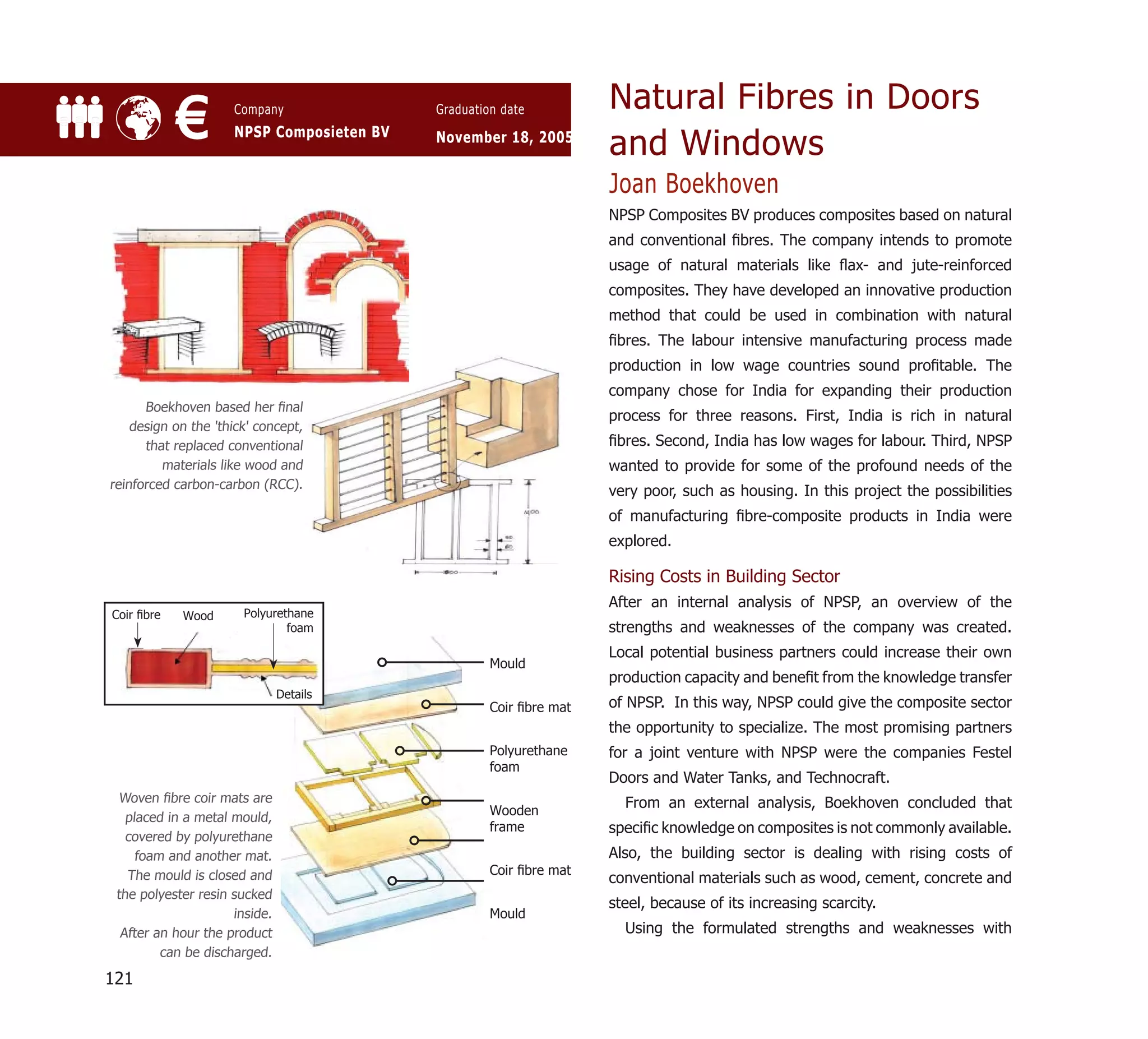
  • 128.
    Epilogue to the electricitygrid). In addition ICT and transportation important is the willingness to listen deeply to the local infrastructures are also often very weak. The outcomes people and local stakeholders, and understand what they of the Intocontext project demonstrate that sometimes need, not what product innovators think they need. alternative solutions (mobile phone instead of internet via For example the demand for renewable electricity based PC) are available but not used (see page 108). Most BoP light is a ‘derived demand’: no one wants electricial light communities are fragile ecologically, so new products and in itself but rather for the services it can provide (ESMAP services need to be very eco-efficient (Sethia 2005). In that 2000). The biggest unmet need is not for better illumination perspective the Kamworks projects (see page 38, 40, 56 but for safety from fire, savings, and greater independence. and 116, on replacing kerosene lights solar powered lights) There should be added value in the products, which can be and the Philips Woodstove project (see page 102, on a recognized by consumers at the BoP. Second, markets in dramatic increase of efficiency and avoidance of negative developing countries are not well developed, so it is necessary health impacts) are convincing examples what Designing to develop basic channels and business models and value for the BoP can mean. chains in order to bring the products to the customers. The observed differences in the product innovation process are Critical Phases in Designing Products summarized in Table 1. From our experiences, we have learned that most Consequently, a basic starting point for successful product companies active in the BoP state the front end research innovation for the BoP is to understand people’s needs (Design Brief Formulation) and Product Delivery (Product and to interact with the material, economical and socio- Launch) as the two most critical phases in developing cultural world. Therefore, both researchers and designers products for the BoP market (See table on the right) (Chang should engage with the cultures directly. A unique set of 2006). First, it’s critical to adapt products so that the fit the design and business tools and practices adapted from social context and resources of the target group. Most challenges anthropology, ethnography and Participatory Rural Appraisal derive from the unfamiliarity with the local context and the (PRA) is being developed, applied and evaluated (Hart distinct infrastructure in emerging markets. Although some 2004; Diehl and Kuipers 2008; Simanis and Hart 2008) for companies do have strong global resources and networks, designers and entrepreneurs. a sustainable local enterprise network is necessary for them to interact with the local community. Non-Governmental Design Tools Organizations (NGOs) play in this context a vital role in At the moment, various design tools (such as personas, the innovation process of several companies, especially cultural probes, scenarios and user profiles in context-of- when they intend to approach consumers at the BoP. Most use) are available to capture insights related users’ needs, 128
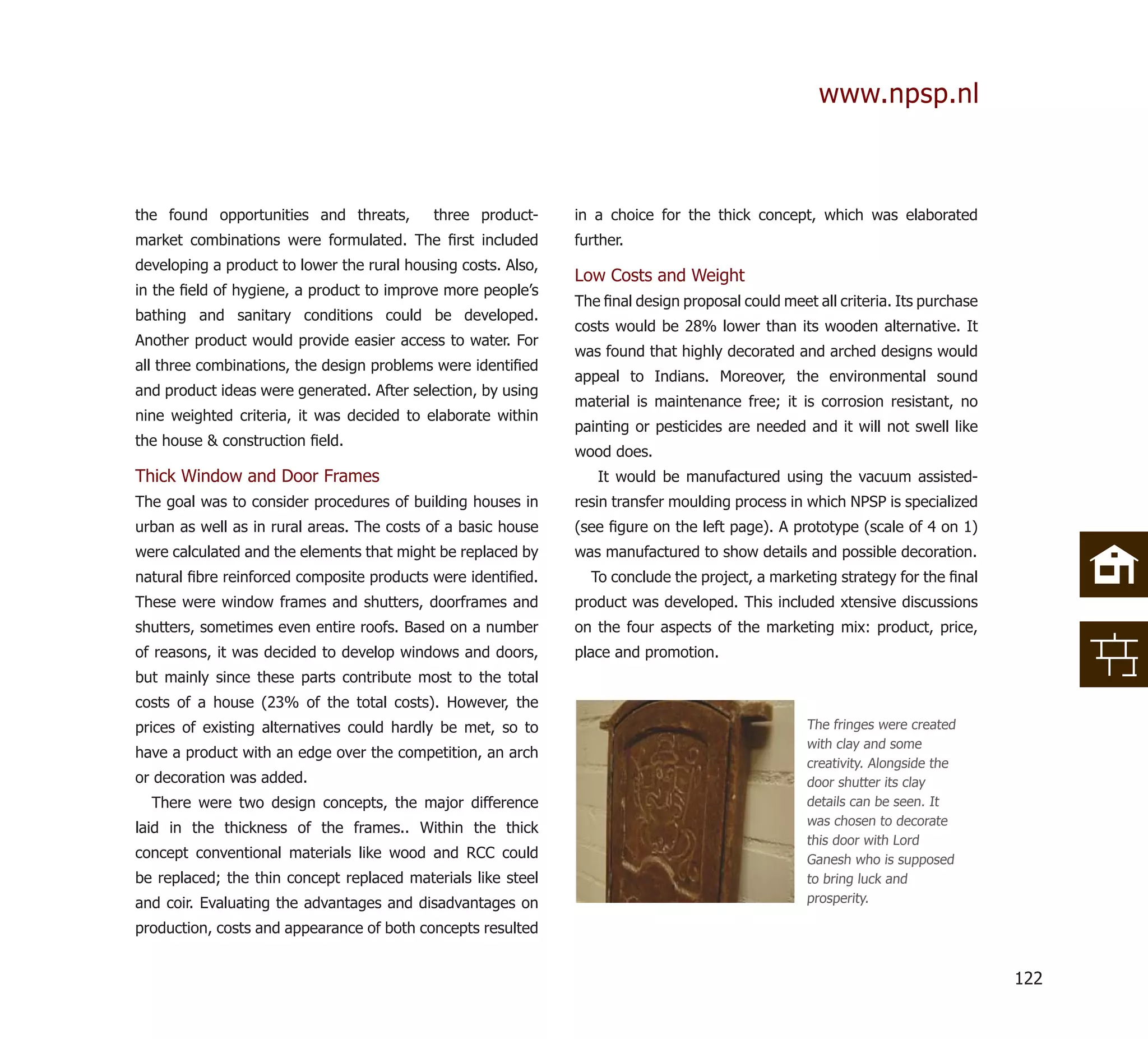
  • 129.
    aspirations and behaviourin their original contexts (Leonard and Rayport 1997; Sanders 2000; Rodríguez, Diehl et al. 2006). These new context and participatory techniques can introduce the end-user into the design process by co-design and get deeper information than the common focus groups or observational research methods (Sanders 2000; Gaver, Boucher et al. 2005). However most of them only have been applied in the ‘Developed Markets’. Currently we, at Delft University of Technology, are testing and evaluating these kind of context tools in emerging and developing markets in practice (Rodriguez, Diehl et al. 2006; Rodrigues, Thompson et al. 2007). In that perspective we can say that there is still a lot to learn with regard to which design tools and approaches fit the best in the context of designing new product (service) solutions for the BoP....... We are looking forward to go through this learning process together with you! Chang, Y.-K. (2006). Innovation for the Next Billions: Case Study of 7 Multinationals that Develop Products for Emerging Markets. Industrial Design Engineering. Delft, Delft University of Technology. MSc. Diehl, J. C. and H. Kuipers (2008). Design for the Base of the Pyramid: Student Field Projects ub Cambodia. DesignED, Hong Kong. ESMAP (2000). Energy Services for the World’s Poor. 129
  • 130.
    Washington, WorldBank. Gaver, W., A. Boucher, et al. (2005). “Cultural probes and the values of uncertainty.” Interaction 11(5): 53-56. Hart, S. (2004). Base of the Pyramid Protocol, Cornell University. Leonard, D. and J. Rayport (1997). “Sparking innovation through empathic design.” Harvard Business Review 75(6): 102-113. Rocchi, S. (2006). Unlocking new markets. P. Design. Eindhoven, Philips Design. Rodrigues, J., C. Thompson, et al. (2007). Multistakeholder approach for people centered solutions: Welcome to East Africa. Include 2007: Designing with People. Royal College of Art, London. Rodriguez, J., J. C. Diehl, et al. (2006). Design toolbox for contextualizing users in emerging markets. IEA2006, Maastricht, Elsevier. Rodríguez, J., J. C. Diehl, et al. (2006). “Gaining insight into unfamiliar contexts: A design toolbox as input for using role-play techniques.” Interacting with computers 18 (5): 956-976. Sanders, E. B. (2000). Generative tools for codesigning: Collaborative Design. London, Springer Verlag. Sethia, N. (2005). “At the Bottom of the Pyramid: Responsible Design for Responsible Business.” Design Management Review 16(Summer 2005). Simanis, E. and S. Hart (2006). “Expanding Possibilities at the Base of the Pyramid.” Innovations 1(1): 43-51. Simanis, E. and S. Hart (2008). BoP Protocol: Towards Next Generation BoP Strategy. 130
  • 131.
    We would liketo say thanks, for these interesting projects, Acknowledgements inspired & inspiring students and enthusiastic colleagues. Without the help and effort of all these people, this book would not have been as it is now. Thanks to Ana Maria Alvarez, Loucas Papantoniou, Stephanie Wirth and Doortje van de Wouw, Elly Doek, Merijn Janssen, Regine van Limmeren, Charl Smit, Stefan Versluis, Veronie Croes, Bjørn-Evert van Eck Rasmussen, Swie Oei, Susan Oudshoorn, Rutger Bonsel, Sietse Cieraad, Stéphanie, Reintjens and Imke Schepers, Aparna Bhasker, Inge van de Wouw, Ambika Samabasivan, Lieke Pijpers, Sierk Hennes, Kirsten Rijke, Tom van Diessen, Linda Schnieders, Judith Goor, Jan Willem Findlater, Alexander van der Kleij, Miriam Reitenbach, Koos Munneke, Bernard Hulshof, Rutger Bonsel, Hoi-Kee Wong, Yu-Kuan Chang, Annemarie Mink, Marion de Groot, Cathelijne Huis in ‘t Veld, Roelie Bottema, Mijntje de Caluwé, Elselien Epema, Willem Glasbergen, Marike Bijtelaar, Maria Nguyen, Leonie Ideler, Fernando Del Caro Secomandi, Jon Rodriguez, Cale Thompson, Jonathan Stranders, Suzanne Hendrikse, Stephen Boom, Roseliek van der Velden, Joan Boekhovenand H.S. Smallenbroek. We also would like to thank the following academic staff, who supported students in their projects: Petra Badke- Schaub, Annemiek van Boeijen, Casper Boks, Han Brezet, Jan Buijs, Henri Christiaans, Katrijn Coninx, Marcel Crul, Richard Goossens, Erik Jan Hultink, Remco van der Lugt, Heimrich Kanis, D. Keskin, Henk Kuipers, Johan Molenbroek, Kaj Morel, Sylvia Mooij, Ingo Oldenkamp, Joost Prins, Jan Schoormans, S. Silvester, Dirk Snelders and K.S.S. Talke. Thanks everyone! And we hope you will all keep working towards achieving those millenium development goals, we will certainly keep doing our best! 131
  • 132.
    About the Editors Prabhu Kandachar Jan Carel Diehl Currently Professor of Industrial Design After finishing his study in Industrial Engineering (IDE) and Chairman of the Design Engineering he worked Department of Design Engineering, he several years as a consultant in received a B.E. degree in Mechanical ecodesign. In his present position he Engineering at the Mysore University is assistant professor for the Design and his M.E. and Ph.D. in Mechanical for Sustainability (DfS) program at the Faculty of Industrial Engineering at the Indian Institute of Science, Bangalore, India. Design Engineering at the Delft University of Technology in After a stint of 5 years at the Materials Science and Technology The Netherlands. Within the DfS program he is managing department at Delft, he worked at Fokker for 15 years, in the international projects on sustainable product innovation various technical & management positions. His teaching and especially in emerging markets. The main focus of his research interests at IDE are focused on materializing design research is the know-how transfer and implementation ideas, addressing manufacturing technology related to product of sustainable product innovation into an international design and materials; technology and materials selection in context. He is has been working with companies and design; and more. He is currently directing research work universities in about 40 countries world-wide. Next to his on development of products & services for healthcare in position at the TU Delft he is consultant for UNIDO and developing countries and is involved in research on ethical UNEP and invited lecturer at universities in amongst others aspects of product development for the BoP. He has given Portugal, Colombia, Turkey, Japan and Austria. He is co- several keynote lectures on this topic and has about 100 author of the UNEP Design for Sustainability manual for publications on his work. Developing Economies (D4S DE). Ilona de Jongh Born on Curaçao, a tiny island in the Caribbean, she received her Masters degree in Integrated Product Design - specialized in design for health care - at the faculty of IDE in 2008. She believes that design and design-thinking can cause social change, can improve life and can help towards a sustainable living for everybody on this planet, and is working with several organizations and companies all over the world to prove this. She currently runs the solution development firm Sprout Design, is chapter head of Project H Design New York, and works with Delft University of Technology on several projects in Design for Emerging Markets. 132
  • 133.
    Designing for EmergingMarkets The Base of the Pyramid strategy is to serve the underserved. Both scientists and entrepreneurs are exploring this strategy, economically and socially motivated. The key to success is focusing on the needs of people in their own environment. The strength and uniqueness of Industrial Design Engineering lies in its human centred approach to design. This book describes projects concerning products and services Faculty of Industrial Design Engineering for the Base of the Pyramid. This is the third publication in IDE Master Projects - 3 the series of graduation and other Masters’ program projects Landbergstraat 15 at the Faculty of Industrial Design Engineering, specifically 2628 CE Delft, The Netherlands aimed at product, service and system design for the Base of the Pyramid. www.io.tudelft.nl/bop BoP-IO@tudelft.nl +31 (0) 15 278 3034