















EveryTraineeMattersKick – Off MeetingPrague 2nd – 3rd December 2010Raftopoulos DimitrisProject Coordinator
Topics✓Project PartnersConcept of the Project1Scope of the Project2Project Management3Project Results & Outcomes4Action Plan5Dissemination Plan6Identification of indicators to evaluate projectCommunication Plan  7891011Drafting of a learning needs assessments questionnaireDrafting of an evaluation questionnaire
Project Partners1Expert Ones SA2International  TEFL Certificate3GIP – FCIP DE BOURGOGNE4InstitutoEuropeoLenguasModernas5Future - NGO6CVT - SVIE7SPOLECZNA WYZSZA SZKOLA PRZEDSIEBIORCZOSCI I ZARZADZANIA W ŁODZI
Concept of the Project
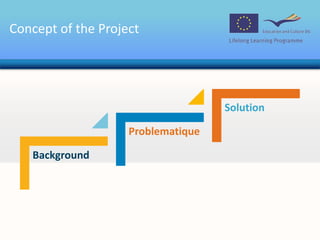
Concept of the Project 1/3BackgroundOne of the main objectives stipulated by the Copenhagen Process and the Helsinki Communiqué of December 2006Increasing the attractiveness and quality of vocational education and training (VET)  Can be achieved through a common quality system used by all LLL Institutions But the quality of vocational education and training is based on the services provided by trainers, teachers, mentors, coaches. Focal point trainee-trainer interface Actors at beginning of the process to actors attained excellenceNew Skills/ New JobsConstant changePredict the competencies needed Through dynamic educational quality systems generating added valueQuality in education should be based at exchanges of "good practices", as well as the creation of tools, procedures and testing  them
The lack of educational content of the training programsThe limited economic and time resourcesFamily problemsLow motivationOrganizational culture Demographic Bomb Issue resulting in the promotion of a culture "of routine“Increase of resistance to change Explain the failure of training programs They can be improved through training adjustment and exchange of good practices The culture of the organizations should integrate values, principles, practice patterns of thought and training that are consistent with the requirements of a democratic society and market economy requirements. Concept of the Project 2/3Problematique
Constant Development of knowledge and professional skills So to meet the new requirements of the economy and the labour marketProject provides concrete responses to these new needs Trainer quality is the most important within-education factor affecting learners performance This network focussed on the changing role of European trainers from static “all knowing”  trainers to dynamic “lifelong learners” It is very important to develop guidance material, organize meetings, seminars and courses which help professionals to acquire new knowledge and skills“Every trainee matters” aims at providing for both individual and organizational training needs by developing the competencies required by the professional activities  The training programme designed within the project will use trainee-centered, active learning methods and motivation boost strategiesConcept of the Project 3/3Solution
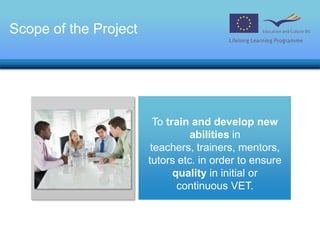
Scope of the ProjectTo train and develop new abilities in teachers, trainers, mentors, tutors etc. in order to ensure quality in initial or continuous VET.
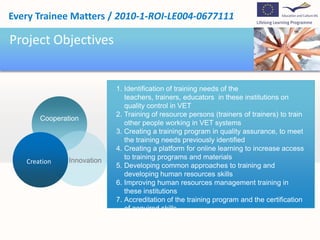
Project ObjectivesIdentification of training needs of the teachers, trainers, educators  in these institutions on  quality control in VETTraining of resource persons (trainers of trainers) to train other people working in VET systemsCreating a training program in quality assurance, to meet the training needs previously identifiedCreating a platform for online learning to increase access to training programs and materialsDeveloping common approaches to training and developing human resources skillsImproving human resources management training in these institutions Accreditation of the training program and the certification of acquired skills
Project Management Issues
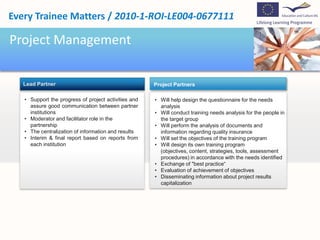
Project ManagementProject PartnersLead PartnerSupport the progress of project activities and assure good communication between partner institutions
Moderator and facilitator role in the partnership
The centralization of information and results
Interim & final report based on reports from each institution
Will help design the questionnaire for the needs analysis
Will conduct training needs analysis for the people in the target group
Will perform the analysis of documents and information regarding quality insurance
Will set the objectives of the training program
Will design its own training program (objectives, content, strategies, tools, assessment procedures) in accordance with the needs identified
Exchange of "best practice“
Evaluation of achievement of objectives
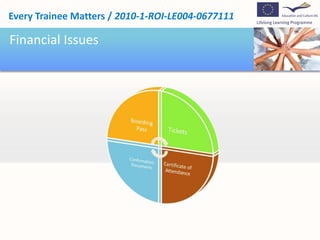
Disseminating information about project results capitalization Financial Issues
The project progress evaluation – evaluation of the goal achievement – will be carried out in various moments of the project – meetings, reports, final reports The staff of the institutions will be involved in internal evaluation, together with the training beneficiaries The partner institutions will be involved in external evaluation, this being the case of the institutions that deal with teacher or trainer training and quality control, this way evaluating short term and long term effects:At the target group levelAt the staff levelAt the institutional levelAt the local community levelEvaluation
Project Results & Outcomes
Expected ResultsIdentificationTo identify the training needs of the target group of the institutions involved (teachers, trainers, educators)1TrainingTo train the target audience in order to address the identified needs2Motivation3To increase motivation for lifelong learningDevelopmentTo develop common approaches to training and developing human resources skills4ImprovementTo improve human resources management training in the institutions involved5Design6To design the accreditation of the training program and the certification of acquired skillsYour own footer
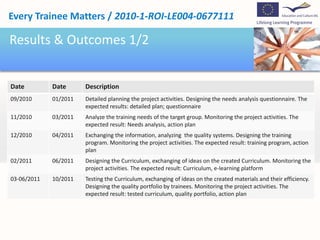
Results & Outcomes 1/2
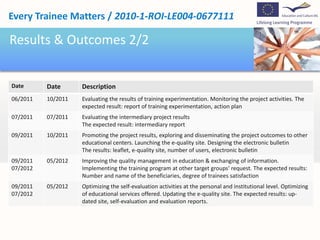
Results & Outcomes 2/2
Project OutcomesA needs analysis questionnaire  & reportAn e-learning training program in quality assuranceThe “Quality portfolio”, which includes  tools and procedures for self-evaluation, for implement of quality in VETA platform for online learning to increase access to training programs and materials
Action Plan
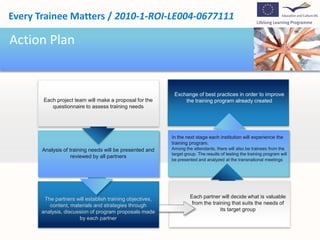
Action PlanExchange of best practices in order to improve the training program already created Each project team will make a proposal for the questionnaire to assess training needs In the next stage each institution will experience the training program. Among the attendants, there will also be trainees from the target group. The results of testing the training program will be presented and analyzed at the transnational meetingsAnalysis of training needs will be presented and reviewed by all partnersEach partner will decide what is valuable from the training that suits the needs of its target groupThe partners will establish training objectives, content, materials and strategies through analysis, discussion of program proposals made by each partner
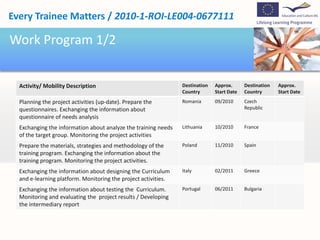
Work Program 1/2
Work Program 2/2
Dissemination Plan

ETM kick off

  • 1.
    EveryTraineeMattersKick – OffMeetingPrague 2nd – 3rd December 2010Raftopoulos DimitrisProject Coordinator
  • 2.
    Topics✓Project PartnersConcept ofthe Project1Scope of the Project2Project Management3Project Results & Outcomes4Action Plan5Dissemination Plan6Identification of indicators to evaluate projectCommunication Plan 7891011Drafting of a learning needs assessments questionnaireDrafting of an evaluation questionnaire
  • 3.
    Project Partners1Expert OnesSA2International TEFL Certificate3GIP – FCIP DE BOURGOGNE4InstitutoEuropeoLenguasModernas5Future - NGO6CVT - SVIE7SPOLECZNA WYZSZA SZKOLA PRZEDSIEBIORCZOSCI I ZARZADZANIA W ŁODZI
  • 4.
  • 5.
    Concept of theProject 1/3BackgroundOne of the main objectives stipulated by the Copenhagen Process and the Helsinki Communiqué of December 2006Increasing the attractiveness and quality of vocational education and training (VET) Can be achieved through a common quality system used by all LLL Institutions But the quality of vocational education and training is based on the services provided by trainers, teachers, mentors, coaches. Focal point trainee-trainer interface Actors at beginning of the process to actors attained excellenceNew Skills/ New JobsConstant changePredict the competencies needed Through dynamic educational quality systems generating added valueQuality in education should be based at exchanges of "good practices", as well as the creation of tools, procedures and testing them
  • 6.
    The lack ofeducational content of the training programsThe limited economic and time resourcesFamily problemsLow motivationOrganizational culture Demographic Bomb Issue resulting in the promotion of a culture "of routine“Increase of resistance to change Explain the failure of training programs They can be improved through training adjustment and exchange of good practices The culture of the organizations should integrate values, principles, practice patterns of thought and training that are consistent with the requirements of a democratic society and market economy requirements. Concept of the Project 2/3Problematique
  • 7.
    Constant Development ofknowledge and professional skills So to meet the new requirements of the economy and the labour marketProject provides concrete responses to these new needs Trainer quality is the most important within-education factor affecting learners performance This network focussed on the changing role of European trainers from static “all knowing” trainers to dynamic “lifelong learners” It is very important to develop guidance material, organize meetings, seminars and courses which help professionals to acquire new knowledge and skills“Every trainee matters” aims at providing for both individual and organizational training needs by developing the competencies required by the professional activities The training programme designed within the project will use trainee-centered, active learning methods and motivation boost strategiesConcept of the Project 3/3Solution
  • 8.
    Scope of theProjectTo train and develop new abilities in teachers, trainers, mentors, tutors etc. in order to ensure quality in initial or continuous VET.
  • 9.
    Project ObjectivesIdentification oftraining needs of the teachers, trainers, educators in these institutions on quality control in VETTraining of resource persons (trainers of trainers) to train other people working in VET systemsCreating a training program in quality assurance, to meet the training needs previously identifiedCreating a platform for online learning to increase access to training programs and materialsDeveloping common approaches to training and developing human resources skillsImproving human resources management training in these institutions Accreditation of the training program and the certification of acquired skills
  • 10.
  • 11.
    Project ManagementProject PartnersLeadPartnerSupport the progress of project activities and assure good communication between partner institutions
  • 12.
    Moderator and facilitatorrole in the partnership
  • 13.
    The centralization ofinformation and results
  • 14.
    Interim & finalreport based on reports from each institution
  • 15.
    Will help designthe questionnaire for the needs analysis
  • 16.
    Will conduct trainingneeds analysis for the people in the target group
  • 17.
    Will perform theanalysis of documents and information regarding quality insurance
  • 18.
    Will set theobjectives of the training program
  • 19.
    Will design itsown training program (objectives, content, strategies, tools, assessment procedures) in accordance with the needs identified
  • 20.
  • 21.
  • 22.
    Disseminating information aboutproject results capitalization Financial Issues
  • 23.
    The project progressevaluation – evaluation of the goal achievement – will be carried out in various moments of the project – meetings, reports, final reports The staff of the institutions will be involved in internal evaluation, together with the training beneficiaries The partner institutions will be involved in external evaluation, this being the case of the institutions that deal with teacher or trainer training and quality control, this way evaluating short term and long term effects:At the target group levelAt the staff levelAt the institutional levelAt the local community levelEvaluation
  • 24.
  • 25.
    Expected ResultsIdentificationTo identifythe training needs of the target group of the institutions involved (teachers, trainers, educators)1TrainingTo train the target audience in order to address the identified needs2Motivation3To increase motivation for lifelong learningDevelopmentTo develop common approaches to training and developing human resources skills4ImprovementTo improve human resources management training in the institutions involved5Design6To design the accreditation of the training program and the certification of acquired skillsYour own footer
  • 26.
  • 27.
  • 28.
    Project OutcomesA needsanalysis questionnaire & reportAn e-learning training program in quality assuranceThe “Quality portfolio”, which includes tools and procedures for self-evaluation, for implement of quality in VETA platform for online learning to increase access to training programs and materials
  • 29.
  • 30.
    Action PlanExchange ofbest practices in order to improve the training program already created Each project team will make a proposal for the questionnaire to assess training needs In the next stage each institution will experience the training program. Among the attendants, there will also be trainees from the target group. The results of testing the training program will be presented and analyzed at the transnational meetingsAnalysis of training needs will be presented and reviewed by all partnersEach partner will decide what is valuable from the training that suits the needs of its target groupThe partners will establish training objectives, content, materials and strategies through analysis, discussion of program proposals made by each partner
  • 31.
  • 32.
  • 33.