Every Trainee Matters / 2010-1-ROI-LE004-0677111


               Every Trainee Matters

                 eQuality Portfolio

          Prague, 21th – 22th June 2012
            Leonardo Da Vinci - Partnership


George Stefas
        Strategic Management
Every Trainee Matters / 2010-1-ROI-LE004-0677111

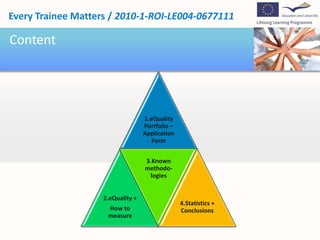
Content


                                   1.eQuality
                                   Portfolio –
                                   Application
                                      Form


                                   3.Known
                                   methodo-
                                    logies


                    2.eQuality +
                                                 4.Statistics +
                     How to                      Conclusions
                     measure
Every Trainee Matters / 2010-1-ROI-LE004-0677111

eQuality Portfolio
According to the stated in the Application Form


  • Development of an eQuality Portfolio:
         “Includes tools & procedures for self-evaluation, for implementing
         quality in VET”
           Evaluate:
           • Quality of the Portfolio
           • Degree of satisfaction of the beneficiaries
Every Trainee Matters / 2010-1-ROI-LE004-0677111

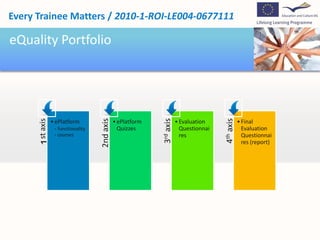
eQuality Portfolio


                                 2nd axis


                                                          3rd axis


                                                                                     4th axis
      1st axis


             • ePlatform                    • ePlatform              • Evaluation               • Final
               - functionality                Quizzes                  Questionnai                Evaluation
                 - courses                                             res                        Questionnai
                                                                                                  res (report)
Every Trainee Matters / 2010-1-ROI-LE004-0677111

eQuality
Definition


  • “the totality of features and characteristics of a product or
    service that bears its ability to satisfy stated or implied
    needs”*

  • Another dimension of quality emanates from the teacher’s
    expectations of course quality as the alignment of teaching
    tasks, learning activities, and assessment as well as reported
    levels of student satisfaction

     * ISO 8402-1986 standard
Every Trainee Matters / 2010-1-ROI-LE004-0677111

eQuality
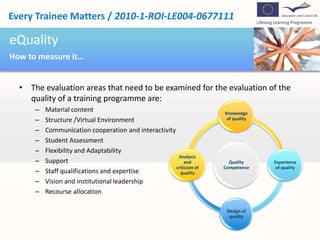
How to measure it…


  • The evaluation areas that need to be examined for the evaluation of the
    quality of a training programme are:
      –   Material content                                           Knowledge
      –   Structure /Virtual Environment                              of quality

      –   Communication cooperation and interactivity
      –   Student Assessment
      –   Flexibility and Adaptability
                                                       Analysis
      –   Support                                         and          Quality     Experience
                                                      criticism of   Competence     of quality
      –   Staff qualifications and expertise            quality
      –   Vision and institutional leadership
      –   Recourse allocation

                                                                      Design of
                                                                       quality
Every Trainee Matters / 2010-1-ROI-LE004-0677111

Model + Methodology


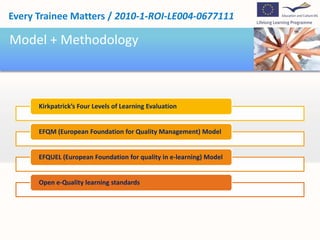
      Kirkpatrick’s Four Levels of Learning Evaluation


      EFQM (European Foundation for Quality Management) Model


      EFQUEL (European Foundation for quality in e-learning) Model


      Open e-Quality learning standards
Every Trainee Matters / 2010-1-ROI-LE004-0677111

Kirkpatrick’s Four Levels of Learning
Evaluation

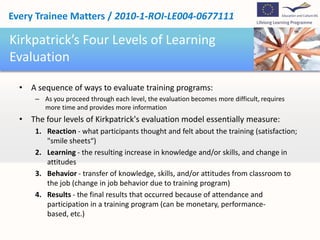
  • A sequence of ways to evaluate training programs:
      – As you proceed through each level, the evaluation becomes more difficult, requires
        more time and provides more information
  • The four levels of Kirkpatrick's evaluation model essentially measure:
      1. Reaction - what participants thought and felt about the training (satisfaction;
         "smile sheets“)
      2. Learning - the resulting increase in knowledge and/or skills, and change in
         attitudes
      3. Behavior - transfer of knowledge, skills, and/or attitudes from classroom to
         the job (change in job behavior due to training program)
      4. Results - the final results that occurred because of attendance and
         participation in a training program (can be monetary, performance-
         based, etc.)
Every Trainee Matters / 2010-1-ROI-LE004-0677111

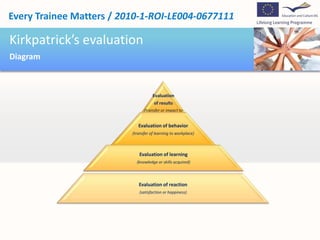
Kirkpatrick’s evaluation
Diagram


                                     Evaluation
                                      of results
                                (transfer or impact to
                                       society)

                             Evaluation of behavior
                          (transfer of learning to workplace)


                             Evaluation of learning
                            (knowledge or skills acquired)


                             Evaluation of reaction
                              (satisfaction or happiness)
Every Trainee Matters / 2010-1-ROI-LE004-0677111

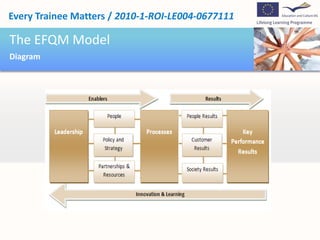
EFQM Model
(European Foundation for Quality Management)


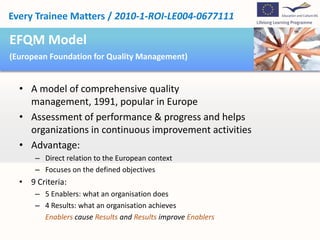
  • A model of comprehensive quality
    management, 1991, popular in Europe
  • Assessment of performance & progress and helps
    organizations in continuous improvement activities
  • Advantage:
      – Direct relation to the European context
      – Focuses on the defined objectives
  • 9 Criteria:
      – 5 Enablers: what an organisation does
      – 4 Results: what an organisation achieves
        Enablers cause Results and Results improve Enablers
Every Trainee Matters / 2010-1-ROI-LE004-0677111

The EFQM Model
Diagram
Every Trainee Matters / 2010-1-ROI-LE004-0677111

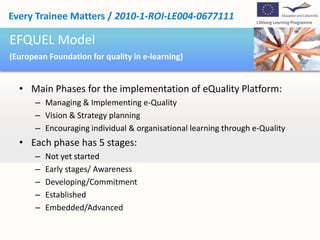
EFQUEL Model
(European Foundation for quality in e-learning)


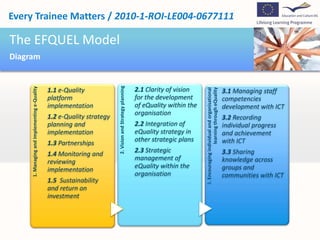
  • Main Phases for the implementation of eQuality Platform:
      – Managing & Implementing e-Quality
      – Vision & Strategy planning
      – Encouraging individual & organisational learning through e-Quality
  • Each phase has 5 stages:
      –   Not yet started
      –   Early stages/ Awareness
      –   Developing/Commitment
      –   Established
      –   Embedded/Advanced
Every Trainee Matters / 2010-1-ROI-LE004-0677111

The EFQUEL Model
Diagram


                                                                       2. Vision and Strategy planning
     1. Managing and Implementing e-Quality


                                              1.1 e-Quality                                              2.1 Clarity of vision


                                                                                                                                                    learning through eQuality
                                                                                                                                  3. Encouraging individual and organisational
                                                                                                                                                                                 3.1 Managing staff
                                              platform                                                   for the development                                                     competencies
                                              implementation                                             of eQuality within the                                                  development with ICT
                                                                                                         organisation
                                              1.2 e-Quality strategy                                                                                                             3.2 Recording
                                              planning and                                               2.2 Integration of                                                      individual progress
                                              implementation                                             eQuality strategy in                                                    and achievement
                                                                                                         other strategic plans                                                   with ICT
                                              1.3 Partnerships
                                                                                                         2.3 Strategic                                                           3.3 Sharing
                                              1.4 Monitoring and
                                                                                                         management of                                                           knowledge across
                                              reviewing
                                                                                                         eQuality within the                                                     groups and
                                              implementation
                                                                                                         organisation                                                            communities with ICT
                                              1.5 Sustainability
                                              and return on
                                              investment
Every Trainee Matters / 2010-1-ROI-LE004-0677111

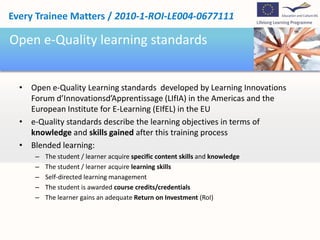
Open e-Quality learning standards


  • Open e-Quality Learning standards developed by Learning Innovations
    Forum d’Innovationsd’Apprentissage (LIfIA) in the Americas and the
    European Institute for E-Learning (EIfEL) in the EU
  • e-Quality standards describe the learning objectives in terms of
    knowledge and skills gained after this training process
  • Blended learning:
      –   The student / learner acquire specific content skills and knowledge
      –   The student / learner acquire learning skills
      –   Self-directed learning management
      –   The student is awarded course credits/credentials
      –   The learner gains an adequate Return on Investment (RoI)
Every Trainee Matters / 2010-1-ROI-LE004-0677111


  •   Measureable intended learning outcomes
  •   Accurate curriculum content
  •   Adaptable teaching / learning material for learners needs
  •   Clear product / service information for potential students
  •   Use of appropriate Learning technologies
Every Trainee Matters / 2010-1-ROI-LE004-0677111

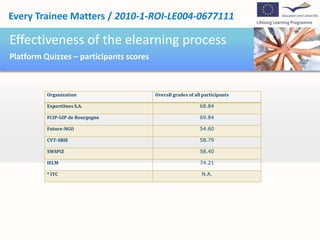
Effectiveness of the elearning process
Platform Quizzes – participants scores


          Organization                   Overall grades of all participants

          ExpertOnes S.A.                                    68.84

          FCIP-GIP de Bourgogne                              69.84

          Future-NGO                                         54.60

          CVT-SBIE                                           58.79

          SWSPiZ                                             58.40

          IELM                                               74.21

          * ITC                                               N.A.
Every Trainee Matters / 2010-1-ROI-LE004-0677111

Evaluation of the training process
Evaluation Questionnaires – participants view of the training process


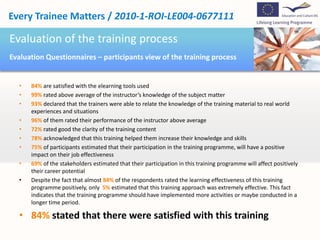
  •   84% are satisfied with the elearning tools used
  •   99% rated above average of the instructor’s knowledge of the subject matter
  •   93% declared that the trainers were able to relate the knowledge of the training material to real world
      experiences and situations
  •   96% of them rated their performance of the instructor above average
  •   72% rated good the clarity of the training content
  •   78% acknowledged that this training helped them increase their knowledge and skills
  •   75% of participants estimated that their participation in the training programme, will have a positive
      impact on their job effectiveness
  •   69% of the stakeholders estimated that their participation in this training programme will affect positively
      their career potential
  •   Despite the fact that almost 84% of the respondents rated the learning effectiveness of this training
      programme positively, only 5% estimated that this training approach was extremely effective. This fact
      indicates that the training programme should have implemented more activities or maybe conducted in a
      longer time period.

  • 84% stated that there were satisfied with this training
Every Trainee Matters / 2010-1-ROI-LE004-0677111

Conclusions


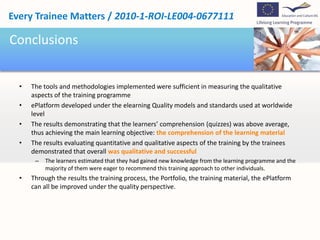
  •   The tools and methodologies implemented were sufficient in measuring the qualitative
      aspects of the training programme
  •   ePlatform developed under the elearning Quality models and standards used at worldwide
      level
  •   The results demonstrating that the learners’ comprehension (quizzes) was above average,
      thus achieving the main learning objective: the comprehension of the learning material
  •   The results evaluating quantitative and qualitative aspects of the training by the trainees
      demonstrated that overall was qualitative and successful
       –   The learners estimated that they had gained new knowledge from the learning programme and the
           majority of them were eager to recommend this training approach to other individuals.
  •   Through the results the training process, the Portfolio, the training material, the ePlatform
      can all be improved under the quality perspective.

E Quality Portfolio

  • 1.
    Every Trainee Matters/ 2010-1-ROI-LE004-0677111 Every Trainee Matters eQuality Portfolio Prague, 21th – 22th June 2012 Leonardo Da Vinci - Partnership George Stefas Strategic Management
  • 2.
    Every Trainee Matters/ 2010-1-ROI-LE004-0677111 Content 1.eQuality Portfolio – Application Form 3.Known methodo- logies 2.eQuality + 4.Statistics + How to Conclusions measure
  • 3.
    Every Trainee Matters/ 2010-1-ROI-LE004-0677111 eQuality Portfolio According to the stated in the Application Form • Development of an eQuality Portfolio: “Includes tools & procedures for self-evaluation, for implementing quality in VET” Evaluate: • Quality of the Portfolio • Degree of satisfaction of the beneficiaries
  • 4.
    Every Trainee Matters/ 2010-1-ROI-LE004-0677111 eQuality Portfolio 2nd axis 3rd axis 4th axis 1st axis • ePlatform • ePlatform • Evaluation • Final - functionality Quizzes Questionnai Evaluation - courses res Questionnai res (report)
  • 5.
    Every Trainee Matters/ 2010-1-ROI-LE004-0677111 eQuality Definition • “the totality of features and characteristics of a product or service that bears its ability to satisfy stated or implied needs”* • Another dimension of quality emanates from the teacher’s expectations of course quality as the alignment of teaching tasks, learning activities, and assessment as well as reported levels of student satisfaction * ISO 8402-1986 standard
  • 6.
    Every Trainee Matters/ 2010-1-ROI-LE004-0677111 eQuality How to measure it… • The evaluation areas that need to be examined for the evaluation of the quality of a training programme are: – Material content Knowledge – Structure /Virtual Environment of quality – Communication cooperation and interactivity – Student Assessment – Flexibility and Adaptability Analysis – Support and Quality Experience criticism of Competence of quality – Staff qualifications and expertise quality – Vision and institutional leadership – Recourse allocation Design of quality
  • 7.
    Every Trainee Matters/ 2010-1-ROI-LE004-0677111 Model + Methodology Kirkpatrick’s Four Levels of Learning Evaluation EFQM (European Foundation for Quality Management) Model EFQUEL (European Foundation for quality in e-learning) Model Open e-Quality learning standards
  • 8.
    Every Trainee Matters/ 2010-1-ROI-LE004-0677111 Kirkpatrick’s Four Levels of Learning Evaluation • A sequence of ways to evaluate training programs: – As you proceed through each level, the evaluation becomes more difficult, requires more time and provides more information • The four levels of Kirkpatrick's evaluation model essentially measure: 1. Reaction - what participants thought and felt about the training (satisfaction; "smile sheets“) 2. Learning - the resulting increase in knowledge and/or skills, and change in attitudes 3. Behavior - transfer of knowledge, skills, and/or attitudes from classroom to the job (change in job behavior due to training program) 4. Results - the final results that occurred because of attendance and participation in a training program (can be monetary, performance- based, etc.)
  • 9.
    Every Trainee Matters/ 2010-1-ROI-LE004-0677111 Kirkpatrick’s evaluation Diagram Evaluation of results (transfer or impact to society) Evaluation of behavior (transfer of learning to workplace) Evaluation of learning (knowledge or skills acquired) Evaluation of reaction (satisfaction or happiness)
  • 10.
    Every Trainee Matters/ 2010-1-ROI-LE004-0677111 EFQM Model (European Foundation for Quality Management) • A model of comprehensive quality management, 1991, popular in Europe • Assessment of performance & progress and helps organizations in continuous improvement activities • Advantage: – Direct relation to the European context – Focuses on the defined objectives • 9 Criteria: – 5 Enablers: what an organisation does – 4 Results: what an organisation achieves Enablers cause Results and Results improve Enablers
  • 11.
    Every Trainee Matters/ 2010-1-ROI-LE004-0677111 The EFQM Model Diagram
  • 12.
    Every Trainee Matters/ 2010-1-ROI-LE004-0677111 EFQUEL Model (European Foundation for quality in e-learning) • Main Phases for the implementation of eQuality Platform: – Managing & Implementing e-Quality – Vision & Strategy planning – Encouraging individual & organisational learning through e-Quality • Each phase has 5 stages: – Not yet started – Early stages/ Awareness – Developing/Commitment – Established – Embedded/Advanced
  • 13.
    Every Trainee Matters/ 2010-1-ROI-LE004-0677111 The EFQUEL Model Diagram 2. Vision and Strategy planning 1. Managing and Implementing e-Quality 1.1 e-Quality 2.1 Clarity of vision learning through eQuality 3. Encouraging individual and organisational 3.1 Managing staff platform for the development competencies implementation of eQuality within the development with ICT organisation 1.2 e-Quality strategy 3.2 Recording planning and 2.2 Integration of individual progress implementation eQuality strategy in and achievement other strategic plans with ICT 1.3 Partnerships 2.3 Strategic 3.3 Sharing 1.4 Monitoring and management of knowledge across reviewing eQuality within the groups and implementation organisation communities with ICT 1.5 Sustainability and return on investment
  • 14.
    Every Trainee Matters/ 2010-1-ROI-LE004-0677111 Open e-Quality learning standards • Open e-Quality Learning standards developed by Learning Innovations Forum d’Innovationsd’Apprentissage (LIfIA) in the Americas and the European Institute for E-Learning (EIfEL) in the EU • e-Quality standards describe the learning objectives in terms of knowledge and skills gained after this training process • Blended learning: – The student / learner acquire specific content skills and knowledge – The student / learner acquire learning skills – Self-directed learning management – The student is awarded course credits/credentials – The learner gains an adequate Return on Investment (RoI)
  • 15.
    Every Trainee Matters/ 2010-1-ROI-LE004-0677111 • Measureable intended learning outcomes • Accurate curriculum content • Adaptable teaching / learning material for learners needs • Clear product / service information for potential students • Use of appropriate Learning technologies
  • 16.
    Every Trainee Matters/ 2010-1-ROI-LE004-0677111 Effectiveness of the elearning process Platform Quizzes – participants scores Organization Overall grades of all participants ExpertOnes S.A. 68.84 FCIP-GIP de Bourgogne 69.84 Future-NGO 54.60 CVT-SBIE 58.79 SWSPiZ 58.40 IELM 74.21 * ITC N.A.
  • 17.
    Every Trainee Matters/ 2010-1-ROI-LE004-0677111 Evaluation of the training process Evaluation Questionnaires – participants view of the training process • 84% are satisfied with the elearning tools used • 99% rated above average of the instructor’s knowledge of the subject matter • 93% declared that the trainers were able to relate the knowledge of the training material to real world experiences and situations • 96% of them rated their performance of the instructor above average • 72% rated good the clarity of the training content • 78% acknowledged that this training helped them increase their knowledge and skills • 75% of participants estimated that their participation in the training programme, will have a positive impact on their job effectiveness • 69% of the stakeholders estimated that their participation in this training programme will affect positively their career potential • Despite the fact that almost 84% of the respondents rated the learning effectiveness of this training programme positively, only 5% estimated that this training approach was extremely effective. This fact indicates that the training programme should have implemented more activities or maybe conducted in a longer time period. • 84% stated that there were satisfied with this training
  • 18.
    Every Trainee Matters/ 2010-1-ROI-LE004-0677111 Conclusions • The tools and methodologies implemented were sufficient in measuring the qualitative aspects of the training programme • ePlatform developed under the elearning Quality models and standards used at worldwide level • The results demonstrating that the learners’ comprehension (quizzes) was above average, thus achieving the main learning objective: the comprehension of the learning material • The results evaluating quantitative and qualitative aspects of the training by the trainees demonstrated that overall was qualitative and successful – The learners estimated that they had gained new knowledge from the learning programme and the majority of them were eager to recommend this training approach to other individuals. • Through the results the training process, the Portfolio, the training material, the ePlatform can all be improved under the quality perspective.