Kick off Meeting 29-30 November 2011, Amsterdam
ADEPTT project eligibility period and budget : 1 Oct. 2011  - 3 0 Sept. 2013 Budget:  389,145.00  EUR Grant:  272 , 010.72  EUR
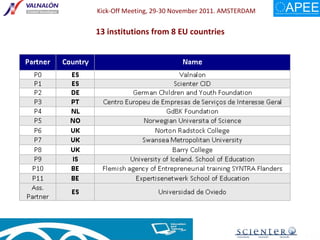
13 institutions from 8 EU countries
ET 2020, the new strategic framework for European cooperation in education and training points out the  need to foster entrepreneurship , along with creativity and innovation, in all forms of learning irrespective of education level. This is the last of a large number of policies, recommendations and papers advocating for the inclusion of enterprise in education, and there is a  pressing need to go beyond the theoretical talk and provide concrete examples of how to implement enterprise in the classroom  (Ruskovaara, Ikävalko, 2007).  ->  ADEPTT,  Acknowledging and Developing Entrepreneurial Practice in Teacher Training  aims to CREATE A STRATEGIC EU MODEL TO PROMOTE TEACHER TRAINING IN ENTREPRENEURSHIP as a means to develop entrepreneurial mindsets in European young people and thus, socio-economic and local/regional development.  BACKGROUND
ADEPTT aims at:  Increasing the level of attention on the  role of teachers as key stakeholders  with the potential to generate awareness, commitment and enthusiasm of EU students regarding entrepreneurial issues; Promoting mutual understanding towards  joint strategies  among the key EU stakeholders working in teacher training to foster entrepreneurship; Identifying, adapting and validating a  teacher training model  establishing a community of key stakeholders to support the current policy agenda. PROJECT AIMS
PROJECT SPECIFIC OBJECTIVES To identify  existing good practices  in the field; To  design a training model  for EU teachers to train EU students - including a set of ready-to-use tools and techniques for entrepreneurial learning that teachers can directly apply in their classroom; To design  sound self-assessment  of teaching practice, paving the way for a change in the teacher’s mindset and confidence; To improve the skills of EU teachers by  testing  a specific training model in the countries involved; To design and develop specific activities (thematic workshops in key events) intended to  consolidate the model , raise awareness, create a sense of belonging between all stakeholders involved and sustain the project activities; To  exploit  the project activities promoting through the dissemination of the approach and model proposed; To put in place all the necessary measures to ensure  effective project management and  the necessary internal and external  evaluation  measures.
The transfer of innovation will be mainly  geographical,  from the materials selected in the frame of WP2. We start from the results from one partner, GdBK Foundation   (Enschede, the Netherlands), but these materials will be enriched with the materials from other partners participating in ADEPTT as many partners have experience in implementing teacher training courses on entrepreneurship.  The training model will be piloted in ES (Asturias), PT (Porto), UK (Wales), DE (Berlin), NO (Trondheim), Iceland and BE (Brussels-Leuven area). FOCUS - TRANSFER OF INNOVATION
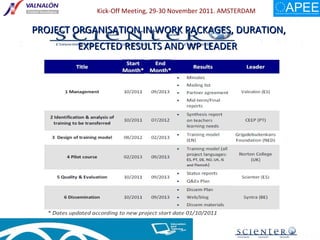
PROJECT ORGANISATION IN WORK PACKAGES, DURATION, EXPECTED RESULTS AND WP LEADER
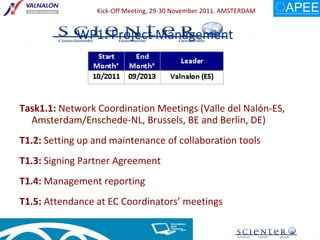
Task1.1:  Network Coordination Meetings (Valle del Nalón-ES, Amsterdam/Enschede-NL, Brussels, BE and Berlin, DE)   T1.2:  Setting up and maintenance of collaboration tools T1.3:  Signing Partner Agreement T1.4:  Management reporting T1.5:  Attendance at EC Coordinators’ meetings WP1: Project Management
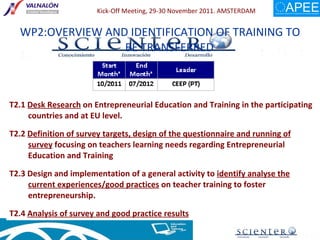
T2.1  Desk Research  on Entrepreneurial Education and Training in the participating countries and at EU level. T2.2  Definition of survey targets, design of the questionnaire and running of survey  focusing on teachers learning needs regarding Entrepreneurial Education and Training T2.3 Design and implementation of a general activity to  identify analyse the current experiences/good practices  on teacher training to foster entrepreneurship.  T2.4  Analysis of survey and good practice results WP2: OVERVIEW AND IDENTIFICATION OF TRAINING TO BE TRANSFERRED
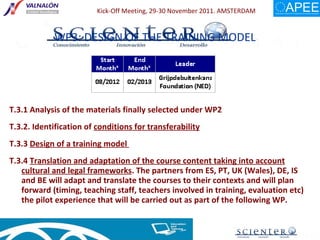
T.3.1 Analysis of the materials finally selected under WP2 T.3.2. Identification of  conditions for transferability T.3.3  Design of a training model  T.3.4  Translation and adaptation of the course content taking into account cultural and legal frameworks . The partners from ES, PT, UK (Wales), DE, IS and BE will adapt and translate the courses to their contexts and will plan forward (timing, teaching staff, teachers involved in training, evaluation etc) the pilot experience that will be carried out as part of the following WP. WP3:  DESIGN OF THE TRAINING MODEL
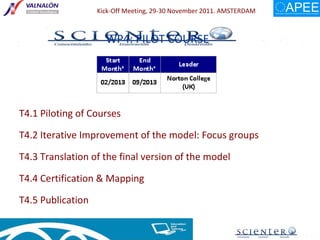
T4.1 Piloting of Courses T4.2 Iterative Improvement of the model: Focus groups T4.3 Translation of the final version of the model T4.4 Certification & Mapping T4.5 Publication  WP4:  PILOT COURSE
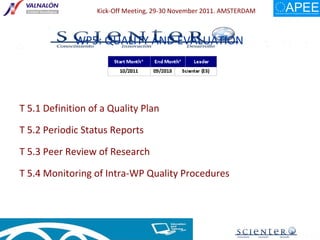
T 5.1 Definition of a Quality Plan T 5.2 Periodic Status Reports T 5.3 Peer Review of Research T 5.4 Monitoring of Intra-WP Quality Procedures WP5:  QUALITY AND EVALUATION
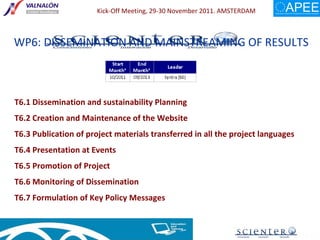
T6.1 Dissemination and sustainability Planning T6.2 Creation and Maintenance of the Website T6.3 Publication of project materials transferred in all the project languages T6.4 Presentation at Events T6.5 Promotion of Project T6.6 Monitoring of Dissemination T6.7 Formulation of Key Policy Messages WP6:  DISSEMINATION AND MAINSTREAMING OF RESULTS
TIPS FOR MANAGEMENT AND REPORTING We are using  as tool for exchange of files and update project information. There you will also find, under WP1 MANAGEMENT, the WorkPlan, this presentation and the OAPEE reporting templates:
Your turn:

Adeptt kick off amsdam

  • 1.
    Kick off Meeting29-30 November 2011, Amsterdam
  • 2.
    ADEPTT project eligibilityperiod and budget : 1 Oct. 2011 - 3 0 Sept. 2013 Budget: 389,145.00 EUR Grant: 272 , 010.72 EUR
  • 3.
    13 institutions from8 EU countries
  • 4.
    ET 2020, thenew strategic framework for European cooperation in education and training points out the need to foster entrepreneurship , along with creativity and innovation, in all forms of learning irrespective of education level. This is the last of a large number of policies, recommendations and papers advocating for the inclusion of enterprise in education, and there is a pressing need to go beyond the theoretical talk and provide concrete examples of how to implement enterprise in the classroom (Ruskovaara, Ikävalko, 2007). -> ADEPTT, Acknowledging and Developing Entrepreneurial Practice in Teacher Training aims to CREATE A STRATEGIC EU MODEL TO PROMOTE TEACHER TRAINING IN ENTREPRENEURSHIP as a means to develop entrepreneurial mindsets in European young people and thus, socio-economic and local/regional development. BACKGROUND
  • 5.
    ADEPTT aims at: Increasing the level of attention on the role of teachers as key stakeholders with the potential to generate awareness, commitment and enthusiasm of EU students regarding entrepreneurial issues; Promoting mutual understanding towards joint strategies among the key EU stakeholders working in teacher training to foster entrepreneurship; Identifying, adapting and validating a teacher training model establishing a community of key stakeholders to support the current policy agenda. PROJECT AIMS
  • 6.
    PROJECT SPECIFIC OBJECTIVESTo identify existing good practices in the field; To design a training model for EU teachers to train EU students - including a set of ready-to-use tools and techniques for entrepreneurial learning that teachers can directly apply in their classroom; To design sound self-assessment of teaching practice, paving the way for a change in the teacher’s mindset and confidence; To improve the skills of EU teachers by testing a specific training model in the countries involved; To design and develop specific activities (thematic workshops in key events) intended to consolidate the model , raise awareness, create a sense of belonging between all stakeholders involved and sustain the project activities; To exploit the project activities promoting through the dissemination of the approach and model proposed; To put in place all the necessary measures to ensure effective project management and the necessary internal and external evaluation measures.
  • 7.
    The transfer ofinnovation will be mainly geographical, from the materials selected in the frame of WP2. We start from the results from one partner, GdBK Foundation (Enschede, the Netherlands), but these materials will be enriched with the materials from other partners participating in ADEPTT as many partners have experience in implementing teacher training courses on entrepreneurship. The training model will be piloted in ES (Asturias), PT (Porto), UK (Wales), DE (Berlin), NO (Trondheim), Iceland and BE (Brussels-Leuven area). FOCUS - TRANSFER OF INNOVATION
  • 8.
    PROJECT ORGANISATION INWORK PACKAGES, DURATION, EXPECTED RESULTS AND WP LEADER
  • 9.
    Task1.1: NetworkCoordination Meetings (Valle del Nalón-ES, Amsterdam/Enschede-NL, Brussels, BE and Berlin, DE) T1.2: Setting up and maintenance of collaboration tools T1.3: Signing Partner Agreement T1.4: Management reporting T1.5: Attendance at EC Coordinators’ meetings WP1: Project Management
  • 10.
    T2.1 DeskResearch on Entrepreneurial Education and Training in the participating countries and at EU level. T2.2 Definition of survey targets, design of the questionnaire and running of survey focusing on teachers learning needs regarding Entrepreneurial Education and Training T2.3 Design and implementation of a general activity to identify analyse the current experiences/good practices on teacher training to foster entrepreneurship. T2.4 Analysis of survey and good practice results WP2: OVERVIEW AND IDENTIFICATION OF TRAINING TO BE TRANSFERRED
  • 11.
    T.3.1 Analysis ofthe materials finally selected under WP2 T.3.2. Identification of conditions for transferability T.3.3 Design of a training model T.3.4 Translation and adaptation of the course content taking into account cultural and legal frameworks . The partners from ES, PT, UK (Wales), DE, IS and BE will adapt and translate the courses to their contexts and will plan forward (timing, teaching staff, teachers involved in training, evaluation etc) the pilot experience that will be carried out as part of the following WP. WP3: DESIGN OF THE TRAINING MODEL
  • 12.
    T4.1 Piloting ofCourses T4.2 Iterative Improvement of the model: Focus groups T4.3 Translation of the final version of the model T4.4 Certification & Mapping T4.5 Publication WP4: PILOT COURSE
  • 13.
    T 5.1 Definitionof a Quality Plan T 5.2 Periodic Status Reports T 5.3 Peer Review of Research T 5.4 Monitoring of Intra-WP Quality Procedures WP5: QUALITY AND EVALUATION
  • 14.
    T6.1 Dissemination andsustainability Planning T6.2 Creation and Maintenance of the Website T6.3 Publication of project materials transferred in all the project languages T6.4 Presentation at Events T6.5 Promotion of Project T6.6 Monitoring of Dissemination T6.7 Formulation of Key Policy Messages WP6: DISSEMINATION AND MAINSTREAMING OF RESULTS
  • 15.
    TIPS FOR MANAGEMENTAND REPORTING We are using as tool for exchange of files and update project information. There you will also find, under WP1 MANAGEMENT, the WorkPlan, this presentation and the OAPEE reporting templates:
  • 16.