Chapter 1
Introduction to
Software Engineering
Introduction to Softw. Engineering
• Getting started with software engineering
Objectives
• To introduce software engineering and to explain
its importance
• To set out the answers to key questions about
software engineering
• To introduce ethical and professional issues and
to explain why they are of concern to software
engineers
• The economies of all developed nations are
dependent on software
• More and more systems are software-controlled
• Software engineering is concerned with theories,
methods, and tools for professional software
development
• Software-engineering expenditure represents a
significant part of GNP in all developed countries
Software engineering
• Software costs often dominate system costs.
The costs of software on a PC are often greater
than the hardware cost
• Software costs more to maintain than to develop.
For systems with a long life, maintenance costs
may be several times the development costs
• Software engineering is concerned with the cost-
effective production of large-scale software
systems
Software costs
What is software?
• Computer programs and associated
documentation
• Software products may be developed for a
particular customer or may be developed for a
general market
• Software products may be
– Generic  developed to be sold to a range
of different customers
– Bespoke (custom)  developed for a single
customer according to their specification
What is software engineering?
• Software engineering is an engineering
discipline which is concerned with all aspects of
software production
• Software engineers should adopt a systematic
and organised approach to their work and use
appropriate tools and techniques depending on
the problem to be solved, the development
constraints, and the resources available
What is the difference between software
engineering and computer science?
• Computer science is concerned with the theory
and fundamentals of computing while software
engineering is concerned with the practicalities
of developing and delivering useful software
• Computer science theories are currently
insufficient to act as a complete underpinning for
software engineering
What is the difference between software
engineering and system engineering?
• System engineering is concerned with all
aspects of developing computer-based systems
including hardware, software, and process
engineering. Software engineering is part of this
• System engineers are involved in system
specification, architectural system design,
integration, and deployment
What is a software process?
• A set of activities whose goal is the production or
evolution of a software system
• Generic activities in all software processes are
– Specification  what the system should do
and its development constraints
– Development  design and implementation
of the software system
– Validation  checking that the software is
what the customer wants
– Evolution  changing the software in
response to changing demands
What is a software process model?
• A generalised representation of a software
process, presented from a specific perspective
• Examples of process perspectives
– Work flow  what is done when?
– Data flow  which information flows where?
– Role / action  who does what?
• Examples of generic process models
– “Waterfall”, formal transformations
– Evolutionary development
– Integration from reusable components
What are the costs of software
engineering?
• Roughly 60% of costs are development costs,
40% are testing costs. For custom software,
evolution costs often exceed development costs
• Costs vary depending on the type of system
being developed and the requirements of
system attributes such as performance and
system reliability
• Distribution of costs depends on the
development model that is used
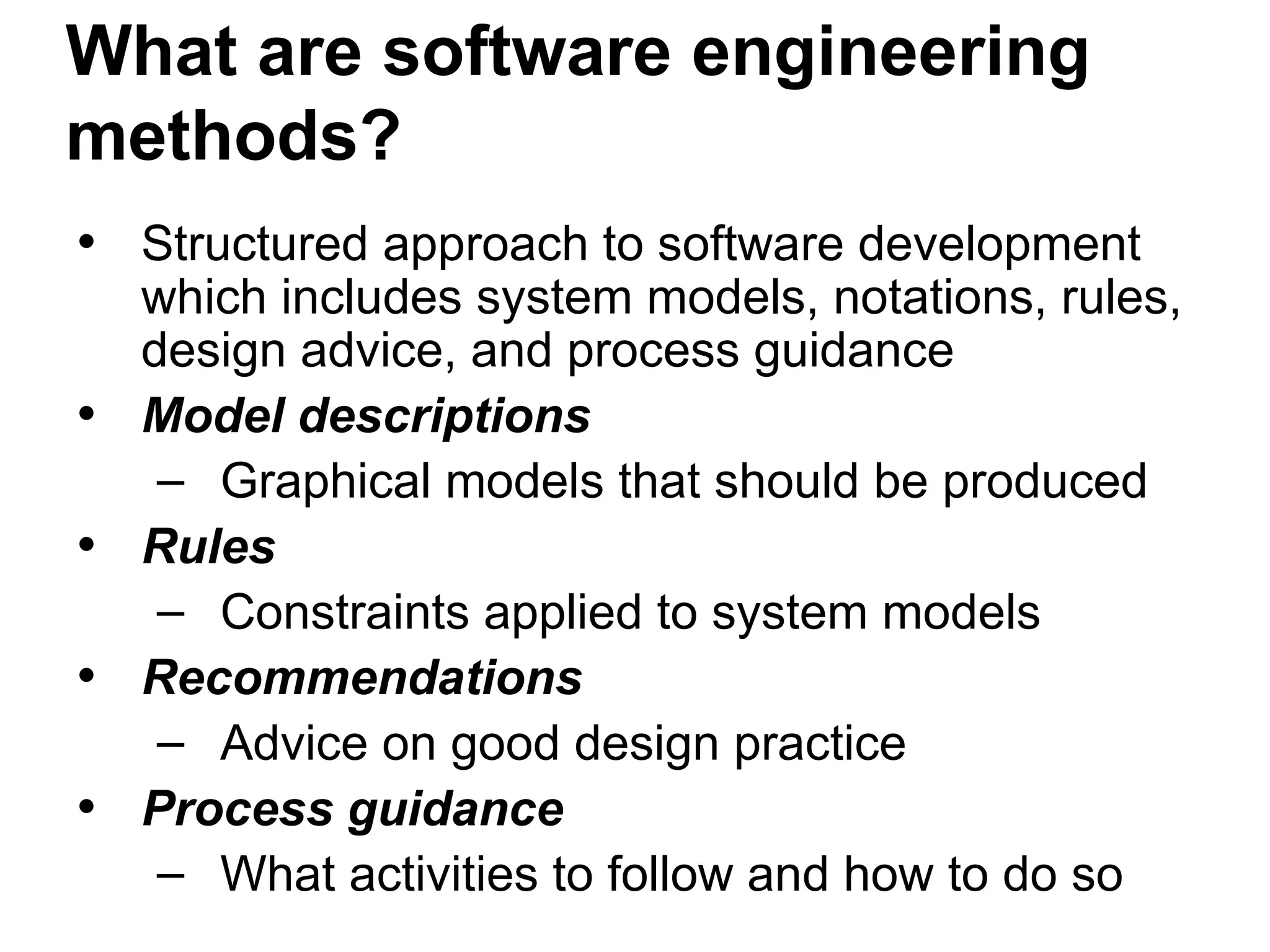
What are software engineering
methods?
• Structured approach to software development
which includes system models, notations, rules,
design advice, and process guidance
• Model descriptions
– Graphical models that should be produced
• Rules
– Constraints applied to system models
• Recommendations
– Advice on good design practice
• Process guidance
– What activities to follow and how to do so
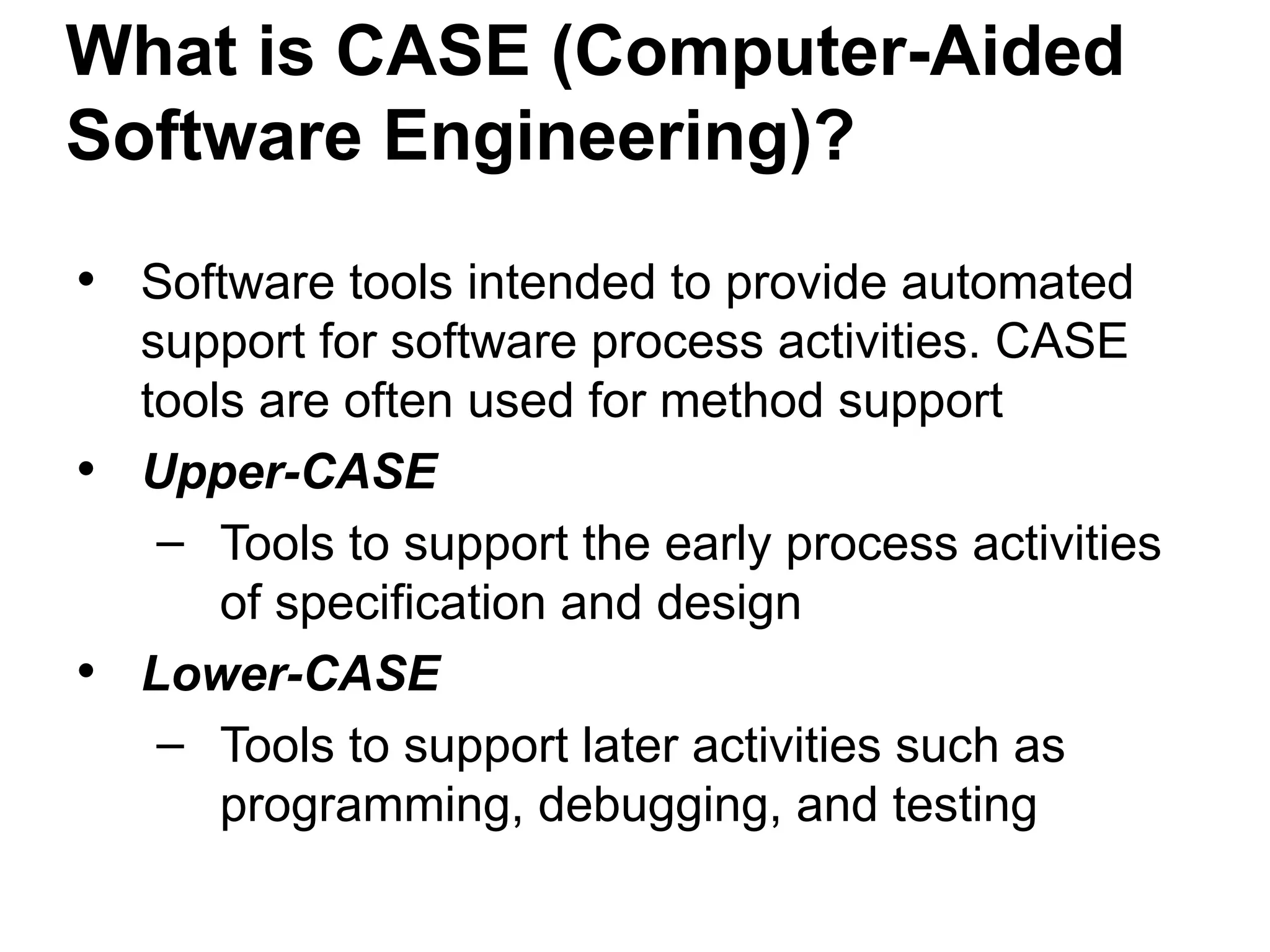
What is CASE (Computer-Aided
Software Engineering)?
• Software tools intended to provide automated
support for software process activities. CASE
tools are often used for method support
• Upper-CASE
– Tools to support the early process activities
of specification and design
• Lower-CASE
– Tools to support later activities such as
programming, debugging, and testing
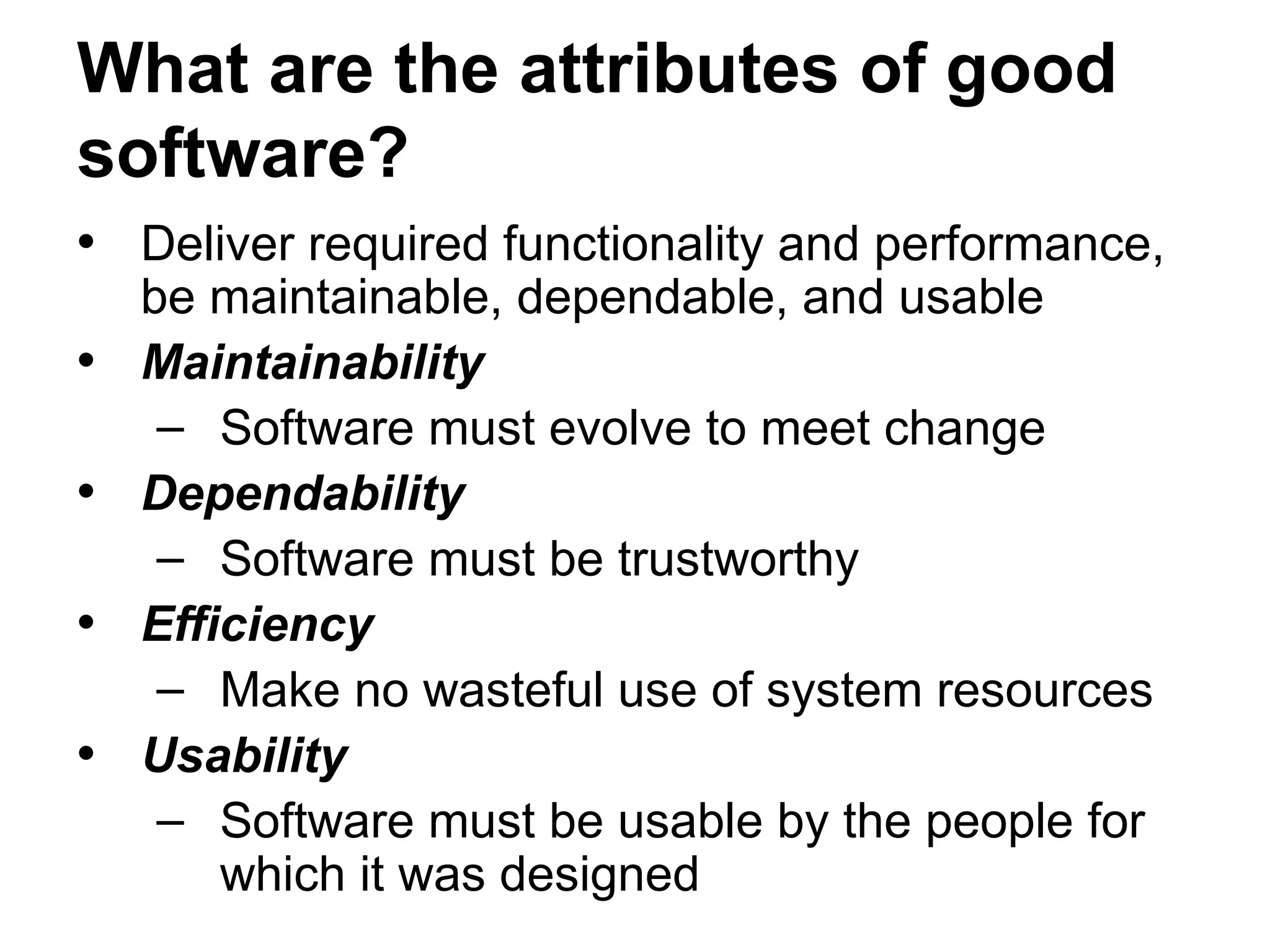
What are the attributes of good
software?
• Deliver required functionality and performance,
be maintainable, dependable, and usable
• Maintainability
– Software must evolve to meet change
• Dependability
– Software must be trustworthy
• Efficiency
– Make no wasteful use of system resources
• Usability
– Software must be usable by the people for
which it was designed
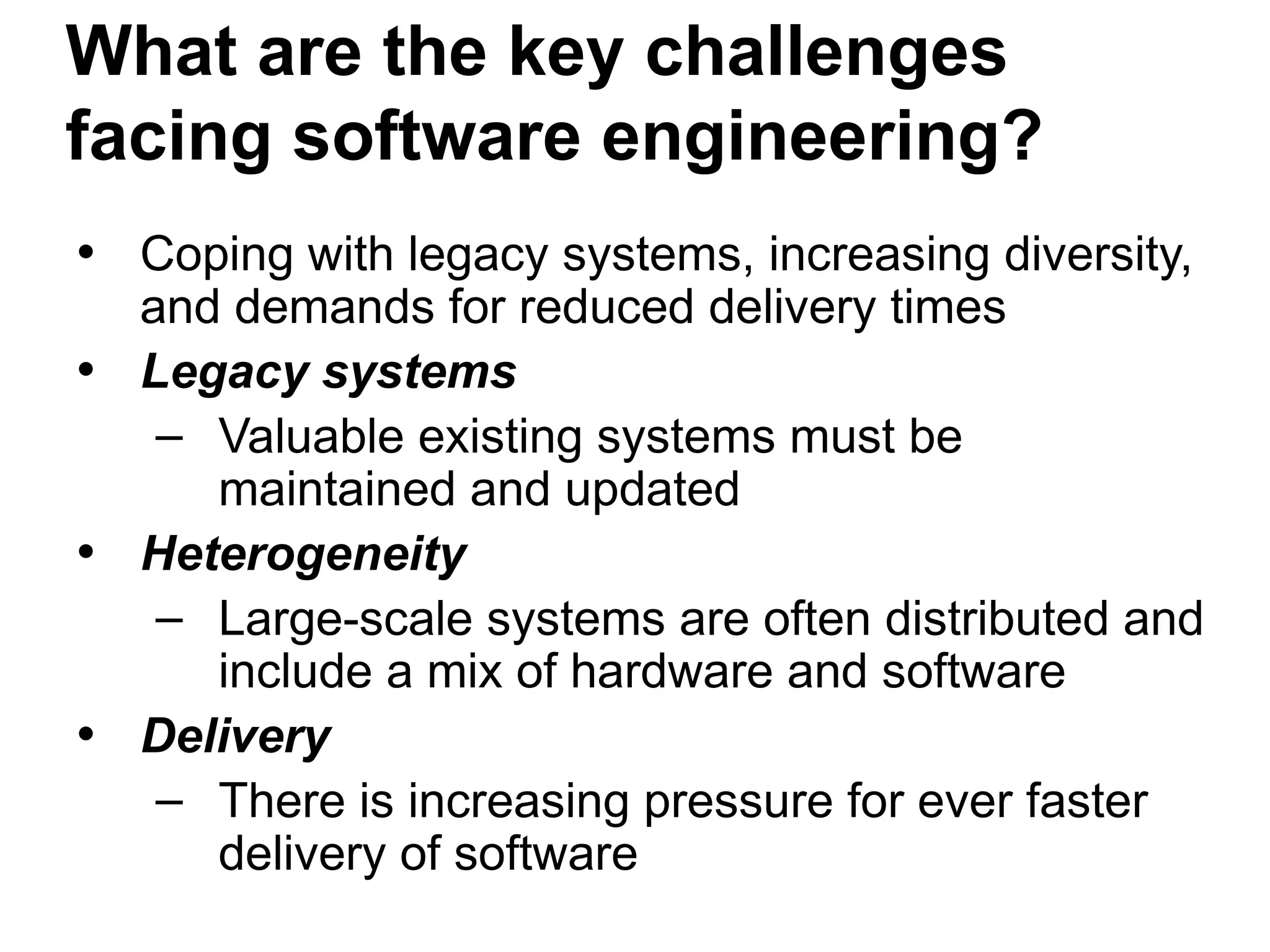
What are the key challenges
facing software engineering?
• Coping with legacy systems, increasing diversity,
and demands for reduced delivery times
• Legacy systems
– Valuable existing systems must be
maintained and updated
• Heterogeneity
– Large-scale systems are often distributed and
include a mix of hardware and software
• Delivery
– There is increasing pressure for ever faster
delivery of software
Professional and ethical
responsibility
• Software engineering involves wider
responsibilities than simply the application of
technical skills
• Software engineers must behave in an honest
and ethically responsible way if they are to be
respected as professionals
• Ethical behaviour is more than simply upholding
the law
Issues of professional
responsibility (I)
• Confidentiality
– Engineers should normally respect the
confidentiality of their employers or clients
irrespective of whether or not a formal
confidentiality agreement has been signed
• Competence
– Engineers should not misrepresent their level
of competence. They should not knowingly
accept work which is beyond their
competence
• Intellectual property rights
– Engineers should be aware of local laws
governing the use of intellectual property
such as patents, copyright, etc. They need to
ensure that the intellectual property of clients
and employers is protected
• Computer misuse
– Engineers should not misuse other people’s
computers which ranges from relatively trivial
(game playing on an employer’s machine) to
extremely serious (dissemination of viruses)
Issues of professionsal
responsibility (II)
ACM / IEEE Code of Ethics
• The professional societies in the US have
cooperated to produce a code of ethical practice
• Members of these organisations sign up to the
code of ethical practice when they join
• The Code contains eight principles related to the
behaviour of and decisions made by professional
software engineers, including practitioners,
educators, managers, supervisors, and policy
makers, as well as trainees and students of the
profession
Code of ethics -- preamble (I)
• The short version of the code summarizes
aspirations at a high level of the abstraction; the
clauses that are included in the full version give
examples and details of how these aspirations
change the way we act as software engineering
professionals. Without the aspirations, the
details can become legalistic and tedious;
without the details, the aspirations can become
high sounding but empty; together, the
aspirations and the details form a cohesive code
Code of ethics -- preamble (II)
• Software engineers shall commit themselves
to making the analysis, specification, design,
development, testing and maintenance of
software a beneficial and respected
profession. In accordance with their
commitment to the health, safety and welfare
of the public, software engineers shall
adhere to the following eight principles
Code of ethics -- principles (I)
• PUBLIC – Software engineers shall act
consistently with the public interest
• CLIENT AND EMPLOYER – Software engineers
shall act in a manner that is in the best interests
of their client and employer consistent with the
public interest
• PRODUCT – Software engineers shall ensure
that their products and related modifications meet
the highest professional standards possible
Code of ethics -- principles (II)
• JUDGEMENT – Software engineers shall
maintain integrity and independence in their
professional judgement
• MANAGEMENT – Software engineering
managers and leaders shall subscribe to and
promote an ethical approach to the management
of software development and maintenance
• PROFESSION – Software engineers shall
advance the integrity and reputation of the
profession consistent with the public interest
Code of ethics -- principles (III)
• COLLEAGUES – Software engineers shall be
fair to and supportive of their colleagues
• SELF – Software engineers shall participate in
lifelong learning regarding the practice of their
profession and shall promote an ethical
approach to the practice of the profession
Ethical dilemmas
• Disagreement in principle with the policies of
senior management
• Your employer acts in an unethical way and
releases a safety-critical system without finishing
the testing of the system
• Participation in the development of military
weapons systems or nuclear systems
Key points (I)
• Software engineering is an engineering discipline
which is concerned with all aspects of software
production
• Software products consist of developed programs
and associated documentation. Essential product
attributes are maintainability, dependability,
efficiency and usability
• The software process consists of activities which
are involved in developing software products.
Basic activities are software specification,
development, validation and evolution
Key points (II)
• Methods are organised ways of producing
software. They include suggestions for the
process to be followed, the notations to be used,
rules governing the system descriptions which
are produced and design guidelines
• CASE tools are software systems designed to
support routine activities in the software process
such as editing design diagrams, checking
diagram consistency and keeping track of
program tests which have been run
Key points (III)
• Software engineers have responsibilities to the
engineering profession and society. They should
not simply be concerned with technical issues
• Professional societies publish codes of conduct
which set out the standards of behaviour
expected of their members

Software engineering Releasing, monitoring, and updating software.

  • 1.
  • 2.
    Introduction to Softw.Engineering • Getting started with software engineering
  • 3.
    Objectives • To introducesoftware engineering and to explain its importance • To set out the answers to key questions about software engineering • To introduce ethical and professional issues and to explain why they are of concern to software engineers
  • 4.
    • The economiesof all developed nations are dependent on software • More and more systems are software-controlled • Software engineering is concerned with theories, methods, and tools for professional software development • Software-engineering expenditure represents a significant part of GNP in all developed countries Software engineering
  • 5.
    • Software costsoften dominate system costs. The costs of software on a PC are often greater than the hardware cost • Software costs more to maintain than to develop. For systems with a long life, maintenance costs may be several times the development costs • Software engineering is concerned with the cost- effective production of large-scale software systems Software costs
  • 6.
    What is software? •Computer programs and associated documentation • Software products may be developed for a particular customer or may be developed for a general market • Software products may be – Generic  developed to be sold to a range of different customers – Bespoke (custom)  developed for a single customer according to their specification
  • 7.
    What is softwareengineering? • Software engineering is an engineering discipline which is concerned with all aspects of software production • Software engineers should adopt a systematic and organised approach to their work and use appropriate tools and techniques depending on the problem to be solved, the development constraints, and the resources available
  • 8.
    What is thedifference between software engineering and computer science? • Computer science is concerned with the theory and fundamentals of computing while software engineering is concerned with the practicalities of developing and delivering useful software • Computer science theories are currently insufficient to act as a complete underpinning for software engineering
  • 9.
    What is thedifference between software engineering and system engineering? • System engineering is concerned with all aspects of developing computer-based systems including hardware, software, and process engineering. Software engineering is part of this • System engineers are involved in system specification, architectural system design, integration, and deployment
  • 10.
    What is asoftware process? • A set of activities whose goal is the production or evolution of a software system • Generic activities in all software processes are – Specification  what the system should do and its development constraints – Development  design and implementation of the software system – Validation  checking that the software is what the customer wants – Evolution  changing the software in response to changing demands
  • 11.
    What is asoftware process model? • A generalised representation of a software process, presented from a specific perspective • Examples of process perspectives – Work flow  what is done when? – Data flow  which information flows where? – Role / action  who does what? • Examples of generic process models – “Waterfall”, formal transformations – Evolutionary development – Integration from reusable components
  • 12.
    What are thecosts of software engineering? • Roughly 60% of costs are development costs, 40% are testing costs. For custom software, evolution costs often exceed development costs • Costs vary depending on the type of system being developed and the requirements of system attributes such as performance and system reliability • Distribution of costs depends on the development model that is used
  • 13.
    What are softwareengineering methods? • Structured approach to software development which includes system models, notations, rules, design advice, and process guidance • Model descriptions – Graphical models that should be produced • Rules – Constraints applied to system models • Recommendations – Advice on good design practice • Process guidance – What activities to follow and how to do so
  • 14.
    What is CASE(Computer-Aided Software Engineering)? • Software tools intended to provide automated support for software process activities. CASE tools are often used for method support • Upper-CASE – Tools to support the early process activities of specification and design • Lower-CASE – Tools to support later activities such as programming, debugging, and testing
  • 15.
    What are theattributes of good software? • Deliver required functionality and performance, be maintainable, dependable, and usable • Maintainability – Software must evolve to meet change • Dependability – Software must be trustworthy • Efficiency – Make no wasteful use of system resources • Usability – Software must be usable by the people for which it was designed
  • 16.
    What are thekey challenges facing software engineering? • Coping with legacy systems, increasing diversity, and demands for reduced delivery times • Legacy systems – Valuable existing systems must be maintained and updated • Heterogeneity – Large-scale systems are often distributed and include a mix of hardware and software • Delivery – There is increasing pressure for ever faster delivery of software
  • 17.
    Professional and ethical responsibility •Software engineering involves wider responsibilities than simply the application of technical skills • Software engineers must behave in an honest and ethically responsible way if they are to be respected as professionals • Ethical behaviour is more than simply upholding the law
  • 18.
    Issues of professional responsibility(I) • Confidentiality – Engineers should normally respect the confidentiality of their employers or clients irrespective of whether or not a formal confidentiality agreement has been signed • Competence – Engineers should not misrepresent their level of competence. They should not knowingly accept work which is beyond their competence
  • 19.
    • Intellectual propertyrights – Engineers should be aware of local laws governing the use of intellectual property such as patents, copyright, etc. They need to ensure that the intellectual property of clients and employers is protected • Computer misuse – Engineers should not misuse other people’s computers which ranges from relatively trivial (game playing on an employer’s machine) to extremely serious (dissemination of viruses) Issues of professionsal responsibility (II)
  • 20.
    ACM / IEEECode of Ethics • The professional societies in the US have cooperated to produce a code of ethical practice • Members of these organisations sign up to the code of ethical practice when they join • The Code contains eight principles related to the behaviour of and decisions made by professional software engineers, including practitioners, educators, managers, supervisors, and policy makers, as well as trainees and students of the profession
  • 21.
    Code of ethics-- preamble (I) • The short version of the code summarizes aspirations at a high level of the abstraction; the clauses that are included in the full version give examples and details of how these aspirations change the way we act as software engineering professionals. Without the aspirations, the details can become legalistic and tedious; without the details, the aspirations can become high sounding but empty; together, the aspirations and the details form a cohesive code
  • 22.
    Code of ethics-- preamble (II) • Software engineers shall commit themselves to making the analysis, specification, design, development, testing and maintenance of software a beneficial and respected profession. In accordance with their commitment to the health, safety and welfare of the public, software engineers shall adhere to the following eight principles
  • 23.
    Code of ethics-- principles (I) • PUBLIC – Software engineers shall act consistently with the public interest • CLIENT AND EMPLOYER – Software engineers shall act in a manner that is in the best interests of their client and employer consistent with the public interest • PRODUCT – Software engineers shall ensure that their products and related modifications meet the highest professional standards possible
  • 24.
    Code of ethics-- principles (II) • JUDGEMENT – Software engineers shall maintain integrity and independence in their professional judgement • MANAGEMENT – Software engineering managers and leaders shall subscribe to and promote an ethical approach to the management of software development and maintenance • PROFESSION – Software engineers shall advance the integrity and reputation of the profession consistent with the public interest
  • 25.
    Code of ethics-- principles (III) • COLLEAGUES – Software engineers shall be fair to and supportive of their colleagues • SELF – Software engineers shall participate in lifelong learning regarding the practice of their profession and shall promote an ethical approach to the practice of the profession
  • 26.
    Ethical dilemmas • Disagreementin principle with the policies of senior management • Your employer acts in an unethical way and releases a safety-critical system without finishing the testing of the system • Participation in the development of military weapons systems or nuclear systems
  • 27.
    Key points (I) •Software engineering is an engineering discipline which is concerned with all aspects of software production • Software products consist of developed programs and associated documentation. Essential product attributes are maintainability, dependability, efficiency and usability • The software process consists of activities which are involved in developing software products. Basic activities are software specification, development, validation and evolution
  • 28.
    Key points (II) •Methods are organised ways of producing software. They include suggestions for the process to be followed, the notations to be used, rules governing the system descriptions which are produced and design guidelines • CASE tools are software systems designed to support routine activities in the software process such as editing design diagrams, checking diagram consistency and keeping track of program tests which have been run
  • 29.
    Key points (III) •Software engineers have responsibilities to the engineering profession and society. They should not simply be concerned with technical issues • Professional societies publish codes of conduct which set out the standards of behaviour expected of their members