
Ethics in a Global Economy
Ashley Nickole Andrews • MGT 462
The Cost of Corruption
 Bribery is found worldwide, and it increases the cost of business.
o Bribe taking is more likely in countries with low per capita
income, low salaries for government officials, and less
variation in income distribution.
o In Russia, bribes paid to government officials is roughly
equal to the nation’s entire revenues—about $240 billion
annually.
The Cost of Corruption
 Combatting bribery is essential to long-term economic
growth, but laws are not effective.
o Laws and ethics both describe and guide proper behavior,
but ethics are more complex.
o An integrated approach to reduce bribery through gradual
cultural adjustments, enhanced economic development,
and legalistic tactics is recommended.
Costs of Corruption
 White collar crime is also costly and should be combatted.
o The FBI estimates white-collar crimes, or illegal acts such as fraud,
insider trading, embezzlement, or computer crime, account for more
than 330,000 arrests and $300 billion in losses each year.
o Corporate crimes like faulty goods, monopolistic practices and other
law violations cost American consumers $174-231 billion annually.
The Cost of Corruption
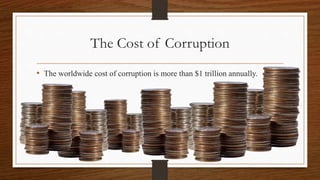
• The worldwide cost of corruption is more than $1 trillion annually.
Combating Corruption
 Unethical acts in business are fought globally
and nationally.
 In the U.S., the Foreign Corrupt Practices Act
prohibits bribes, but companies do not always
comply.
Crime Does Not Pay
o Caught and punished:
 To win contracts, York International paid bribes to Iraqi
government officials, Baker Hughes
bribed Kazakhstan officials, and
Halliburton paid bribes in Nigeria.
 These firmed were fined.
Or Does It?
o Caught and rewarded:
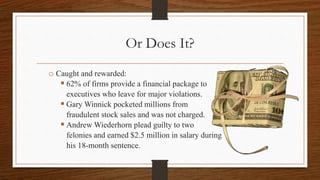
 62% of firms provide a financial package to
executives who leave for major violations.
 Gary Winnick pocketed millions from
fraudulent stock sales and was not charged.
 Andrew Wiederhorn plead guilty to two
felonies and earned $2.5 million in salary during
his 18-month sentence.
Combatting Corruption
 Firms combat corruption through voluntary standards, values-based
company culture, and ethics and compliance programs.
o Alcoa CEO Paul O’Neil said, “It is imperative that
there be no misperceptions about our values…
Full compliance with both the letter—and the
spirit—of our policies is imperative. Anything
less is unacceptable.”
Source:
Lawrence, A., & Weaber, J. (2011). Organizational Ethics and the Law.
In Business and society: Stakeholders, ethics, public policy (Thirteenth
ed., pp. 113-121). New York: McGraw-Hill Irwin.

Ethics in a Global Economy

  • 1.
    Ethics in aGlobal Economy Ashley Nickole Andrews • MGT 462
  • 2.
    The Cost ofCorruption  Bribery is found worldwide, and it increases the cost of business. o Bribe taking is more likely in countries with low per capita income, low salaries for government officials, and less variation in income distribution. o In Russia, bribes paid to government officials is roughly equal to the nation’s entire revenues—about $240 billion annually.
  • 3.
    The Cost ofCorruption  Combatting bribery is essential to long-term economic growth, but laws are not effective. o Laws and ethics both describe and guide proper behavior, but ethics are more complex. o An integrated approach to reduce bribery through gradual cultural adjustments, enhanced economic development, and legalistic tactics is recommended.
  • 4.
    Costs of Corruption White collar crime is also costly and should be combatted. o The FBI estimates white-collar crimes, or illegal acts such as fraud, insider trading, embezzlement, or computer crime, account for more than 330,000 arrests and $300 billion in losses each year. o Corporate crimes like faulty goods, monopolistic practices and other law violations cost American consumers $174-231 billion annually.
  • 5.
    The Cost ofCorruption • The worldwide cost of corruption is more than $1 trillion annually.
  • 6.
    Combating Corruption  Unethicalacts in business are fought globally and nationally.  In the U.S., the Foreign Corrupt Practices Act prohibits bribes, but companies do not always comply.
  • 7.
    Crime Does NotPay o Caught and punished:  To win contracts, York International paid bribes to Iraqi government officials, Baker Hughes bribed Kazakhstan officials, and Halliburton paid bribes in Nigeria.  These firmed were fined.
  • 8.
    Or Does It? oCaught and rewarded:  62% of firms provide a financial package to executives who leave for major violations.  Gary Winnick pocketed millions from fraudulent stock sales and was not charged.  Andrew Wiederhorn plead guilty to two felonies and earned $2.5 million in salary during his 18-month sentence.
  • 9.
    Combatting Corruption  Firmscombat corruption through voluntary standards, values-based company culture, and ethics and compliance programs. o Alcoa CEO Paul O’Neil said, “It is imperative that there be no misperceptions about our values… Full compliance with both the letter—and the spirit—of our policies is imperative. Anything less is unacceptable.”
  • 10.
    Source: Lawrence, A., &Weaber, J. (2011). Organizational Ethics and the Law. In Business and society: Stakeholders, ethics, public policy (Thirteenth ed., pp. 113-121). New York: McGraw-Hill Irwin.