Corruption
Christian Ethics for Social Development
What is corruption?
• Corruption can mean many things for many people. In short,
corruption means the practice of obtaining power, influence,
or other personal gains through illegitimate means, often at
others' expense. The more widespread and acceptable
corrupt methods are in a given society, the more corrupt that
society is said to be.
• Generally speaking as “the abuse of entrusted power for
private gain”. Corruption can be classified as grand, petty and
political, depending on the amounts of money lost and the
sector where it occurs (Transparency International).
Why is Corruption a problem
• Corruption has resulted to crises in many parts of the world, and
those on top have used it to take advantage of others.
• If the proper channels to power and influence (working hard, not
breaking the law, doing well on university exams, running a
persuasive political campaign, etc.) are closed off, only those with
money and connections will be able to succeed.
• Those who can neither afford bribes nor know who to call to get jobs
for their children are out of luck. In short, corruption only benefits
those who already have power, money, and influence.
Types of Corruption
• Grand corruption consists of acts committed at a high level of
government that distort policies or the central functioning of the
state, enabling leaders to benefit at the expense of the public
good.
• Petty corruption refers to everyday abuse of entrusted power by
low- and mid-level public officials in their interactions with
ordinary citizens, who often are trying to access basic goods or
services in places like hospitals, schools, police departments and
other agencies.
• Political corruption is a manipulation of policies, institutions and
rules of procedure in the allocation of resources and financing by
political decision makers, who abuse their position to sustain their
power, status and wealth
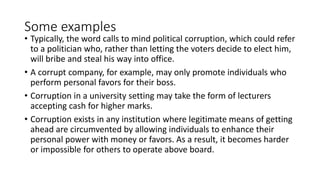
Some examples
• Typically, the word calls to mind political corruption, which could refer
to a politician who, rather than letting the voters decide to elect him,
will bribe and steal his way into office.
• A corrupt company, for example, may only promote individuals who
perform personal favors for their boss.
• Corruption in a university setting may take the form of lecturers
accepting cash for higher marks.
• Corruption exists in any institution where legitimate means of getting
ahead are circumvented by allowing individuals to enhance their
personal power with money or favors. As a result, it becomes harder
or impossible for others to operate above board.
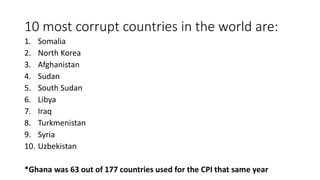
10 most corrupt countries in the world are:
1. Somalia
2. North Korea
3. Afghanistan
4. Sudan
5. South Sudan
6. Libya
7. Iraq
8. Turkmenistan
9. Syria
10. Uzbekistan
*Ghana was 63 out of 177 countries used for the CPI that same year
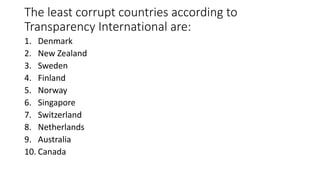
The least corrupt countries according to
Transparency International are:
1. Denmark
2. New Zealand
3. Sweden
4. Finland
5. Norway
6. Singapore
7. Switzerland
8. Netherlands
9. Australia
10. Canada
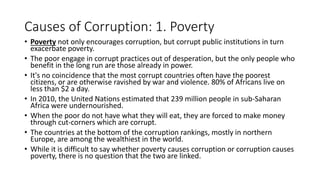
Causes of Corruption: 1. Poverty
• Poverty not only encourages corruption, but corrupt public institutions in turn
exacerbate poverty.
• The poor engage in corrupt practices out of desperation, but the only people who
benefit in the long run are those already in power.
• It's no coincidence that the most corrupt countries often have the poorest
citizens, or are otherwise ravished by war and violence. 80% of Africans live on
less than $2 a day.
• In 2010, the United Nations estimated that 239 million people in sub-Saharan
Africa were undernourished.
• When the poor do not have what they will eat, they are forced to make money
through cut-corners which are corrupt.
• The countries at the bottom of the corruption rankings, mostly in northern
Europe, are among the wealthiest in the world.
• While it is difficult to say whether poverty causes corruption or corruption causes
poverty, there is no question that the two are linked.
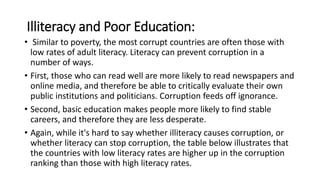
Illiteracy and Poor Education:
• Similar to poverty, the most corrupt countries are often those with
low rates of adult literacy. Literacy can prevent corruption in a
number of ways.
• First, those who can read well are more likely to read newspapers and
online media, and therefore be able to critically evaluate their own
public institutions and politicians. Corruption feeds off ignorance.
• Second, basic education makes people more likely to find stable
careers, and therefore they are less desperate.
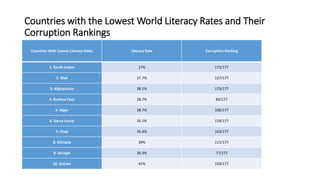
• Again, while it's hard to say whether illiteracy causes corruption, or
whether literacy can stop corruption, the table below illustrates that
the countries with low literacy rates are higher up in the corruption
ranking than those with high literacy rates.
Countries with the Lowest World Literacy Rates and Their
Corruption Rankings
Countries With Lowest Literacy Rates Literacy Rate Corruption Ranking
1. South Sudan 27% 173/177
2. Mali 27.7% 127/177
3. Afghanistan 28.1% 175/177
4. Burkina Faso 28.7% 83/177
5. Niger 28.7% 106/177
6. Sierra Leone 35.1% 119/177
7. Chad 35.4% 163/177
8. Ethiopia 39% 111/177
9. Senegal 39.3% 77/177
10. Guinea 41% 150/177
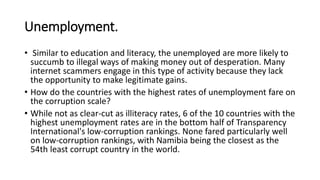
Unemployment.
• Similar to education and literacy, the unemployed are more likely to
succumb to illegal ways of making money out of desperation. Many
internet scammers engage in this type of activity because they lack
the opportunity to make legitimate gains.
• How do the countries with the highest rates of unemployment fare on
the corruption scale?
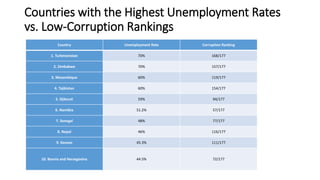
• While not as clear-cut as illiteracy rates, 6 of the 10 countries with the
highest unemployment rates are in the bottom half of Transparency
International's low-corruption rankings. None fared particularly well
on low-corruption rankings, with Namibia being the closest as the
54th least corrupt country in the world.
Countries with the Highest Unemployment Rates
vs. Low-Corruption Rankings
Country Unemployment Rate Corruption Ranking
1. Turkmenistan 70% 168/177
2. Zimbabwe 70% 157/177
3. Mozambique 60% 119/177
4. Tajikistan 60% 154/177
5. Djibouti 59% 94/177
6. Namibia 51.2% 57/177
7. Senegal 48% 77/177
8. Nepal 46% 116/177
9. Kosovo 45.3% 111/177
10. Bosnia and Herzegovina 44.5% 72/177
Greed:
• Greediness is impossible to tabulate, but it is undoubtedly an
important cause of corruption.
• Corruption continues to exist because the people with the most in a
society are not content with what they have.
• The more they have, the more they want to acquire.
• In corrupt societies, politics is an avenue for greed as leaders use their
positions to embezzle vast amounts of public funds meant for the
public good.
Weak Governments:
• In corrupt societies, governments are unable or unwilling to stop
corruption.
• They lack strong-willed or impartial anti-corruption agencies, and such
agencies can easily be swallowed into corruption themselves.
• When such agencies are honest, their work is slow. In the worst cases,
leaders staff anti-corruption agencies with their friends.
• The impotence of governments in the face of corruption is mimicked
in the private sector.
• Corrupt business practices continue because executives are often the
beneficiaries of those practices.
• A government which is weak cannot fight corruption because he will
not in any way be propelled to take good action.
Drug Trafficking:
• Drug use is often practiced by disaffected youth, who in turn create
demand for a drug market that fuels corruption.
• In countries like the United States, hard drugs are commonly
associated with crime among delinquent youths.
• The country's demand for drugs has allowed cartels in Mexico and
Central America to flourish.
• The Mexican government is frequently held hostage by the will of
powerful drug gangs running supplies into the United States and
elsewhere.
WHAT ARE THE COSTS OF CORRUPTION?
• Corruption impacts societies in a multitude of ways. In the worst cases,
it costs lives. Short of this, it costs people their freedom, health or
money. The cost of corruption can be divided into four main categories:
political, economic, social and environmental.
• On the political front, corruption is a major obstacle to democracy and
the rule of law. In a democratic system, offices and institutions lose their
legitimacy when they’re misused for private advantage. This is harmful
in established democracies, but even more so in newly emerging ones. It
is extremely challenging to develop accountable political leadership in a
corrupt climate.
WHAT ARE THE COSTS OF CORRUPTION?
• Economically, corruption depletes national wealth. Corrupt politicians invest
scarce public resources in projects that will line their pockets rather than benefit
communities, and priorities high-profile projects such as dams, power plants,
pipelines and refineries over less spectacular but more urgent infrastructure
projects such as schools, hospitals and roads. Corruption also hinders the
development of fair market structures and distorts competition, which in turn
deters investment.
• Corruption corrodes the social fabric of society. It undermines people's trust in
the political system, in its institutions and its leadership. A distrustful or apathetic
public can then become yet another hurdle to challenging corruption.
• Environmental degradation is another consequence of corrupt systems. The lack
of, or non-enforcement of, environmental regulations and legislation means that
precious natural resources are carelessly exploited, and entire ecological systems
are ravaged. From mining, to logging, to carbon offsets, companies across the
globe continue to pay bribes in return for unrestricted destruction.
How to Stop or Reduce Corruption:
Employment Creation:
• The government and powerful individuals should work together to create
jobs for the masses.
• Those countries that lack technological development should invite other
countries and private companies to help them build their technological
infrastructure.
• When the masses make money and learn skills as employees of those
companies, they can start their own businesses. This will, in turn, create
more jobs for the citizens of the country.
• Governments should encourage skill-acquisition programs and
employment seminars.
• The people that gain those skills will develop their own businesses with
time and start employing others.
• Within companies, mentorship programs can ensure that skills and
knowledge are passed on to younger employees
Pay Public Employees a Living Wage:
• It may seem counter intuitive to pay corrupt employees more, but if
police officers and low-level bureaucrats make enough money by
working, they won't feel the need to take bribes.
• In Nigeria, policemen are considered to be the most corrupt
institution in the country, according to the 2003 Nigeria Corruption
Survey Study.
• In eight of the nine most corrupt nations in 2013, more than 80% of
residents considered the police to be corrupt.
• Public employees should also undergo anti-corruption training and
education, emphasizing the negative effects of corruption.
Surveillance:
• Electronic monitors, computer programs, and other technologies can
monitor corruption in government and businesses.
• In corrupt countries, the use of technology can be preferable to
relying on anti-corruption agencies staffed with friends of corrupt
governments.
• The installation of these technologies should be done secretly,
without the companies’ awareness, or in a way that makes them
impossible to be tampered with.
Anti-Corruption Bodies:
• Each country should have anti-corruption initiatives. At the same
time, there should be an international body monitoring corruption
around the world without the need to answer to the rich and
powerful within corrupt societies.
• The problem with some anti-corruption bodies is that many of them
do not carry out their functions well.
• Many of them are too weak. Any country with strong anti-corruption
body will win the war against corruption, and international
cooperation can enhance domestic efforts.
Curbing Drug Intake:
• Reducing the corruption that results from the drug trade involves the
efforts of both the government and its people.
• The drug trade relies on the demand for hard drugs. Seminars should
be held on a regular basis where people will be taught the negative
impact of hard drugs.
• Governments should also sponsor television programs where doctors
who have good teaching skills will highlight the disadvantages of hard
drugs.
• In institutions of higher learning, a course on drug use should be
integrated into the curriculum. This will help reduce corrupt practices
to some extent.
Thank you and stay
blessed

Corruption.pptx

  • 1.
  • 2.
    What is corruption? •Corruption can mean many things for many people. In short, corruption means the practice of obtaining power, influence, or other personal gains through illegitimate means, often at others' expense. The more widespread and acceptable corrupt methods are in a given society, the more corrupt that society is said to be. • Generally speaking as “the abuse of entrusted power for private gain”. Corruption can be classified as grand, petty and political, depending on the amounts of money lost and the sector where it occurs (Transparency International).
  • 3.
    Why is Corruptiona problem • Corruption has resulted to crises in many parts of the world, and those on top have used it to take advantage of others. • If the proper channels to power and influence (working hard, not breaking the law, doing well on university exams, running a persuasive political campaign, etc.) are closed off, only those with money and connections will be able to succeed. • Those who can neither afford bribes nor know who to call to get jobs for their children are out of luck. In short, corruption only benefits those who already have power, money, and influence.
  • 4.
    Types of Corruption •Grand corruption consists of acts committed at a high level of government that distort policies or the central functioning of the state, enabling leaders to benefit at the expense of the public good. • Petty corruption refers to everyday abuse of entrusted power by low- and mid-level public officials in their interactions with ordinary citizens, who often are trying to access basic goods or services in places like hospitals, schools, police departments and other agencies. • Political corruption is a manipulation of policies, institutions and rules of procedure in the allocation of resources and financing by political decision makers, who abuse their position to sustain their power, status and wealth
  • 5.
    Some examples • Typically,the word calls to mind political corruption, which could refer to a politician who, rather than letting the voters decide to elect him, will bribe and steal his way into office. • A corrupt company, for example, may only promote individuals who perform personal favors for their boss. • Corruption in a university setting may take the form of lecturers accepting cash for higher marks. • Corruption exists in any institution where legitimate means of getting ahead are circumvented by allowing individuals to enhance their personal power with money or favors. As a result, it becomes harder or impossible for others to operate above board.
  • 6.
    10 most corruptcountries in the world are: 1. Somalia 2. North Korea 3. Afghanistan 4. Sudan 5. South Sudan 6. Libya 7. Iraq 8. Turkmenistan 9. Syria 10. Uzbekistan *Ghana was 63 out of 177 countries used for the CPI that same year
  • 7.
    The least corruptcountries according to Transparency International are: 1. Denmark 2. New Zealand 3. Sweden 4. Finland 5. Norway 6. Singapore 7. Switzerland 8. Netherlands 9. Australia 10. Canada
  • 8.
    Causes of Corruption:1. Poverty • Poverty not only encourages corruption, but corrupt public institutions in turn exacerbate poverty. • The poor engage in corrupt practices out of desperation, but the only people who benefit in the long run are those already in power. • It's no coincidence that the most corrupt countries often have the poorest citizens, or are otherwise ravished by war and violence. 80% of Africans live on less than $2 a day. • In 2010, the United Nations estimated that 239 million people in sub-Saharan Africa were undernourished. • When the poor do not have what they will eat, they are forced to make money through cut-corners which are corrupt. • The countries at the bottom of the corruption rankings, mostly in northern Europe, are among the wealthiest in the world. • While it is difficult to say whether poverty causes corruption or corruption causes poverty, there is no question that the two are linked.
  • 9.
    Illiteracy and PoorEducation: • Similar to poverty, the most corrupt countries are often those with low rates of adult literacy. Literacy can prevent corruption in a number of ways. • First, those who can read well are more likely to read newspapers and online media, and therefore be able to critically evaluate their own public institutions and politicians. Corruption feeds off ignorance. • Second, basic education makes people more likely to find stable careers, and therefore they are less desperate. • Again, while it's hard to say whether illiteracy causes corruption, or whether literacy can stop corruption, the table below illustrates that the countries with low literacy rates are higher up in the corruption ranking than those with high literacy rates.
  • 10.
    Countries with theLowest World Literacy Rates and Their Corruption Rankings Countries With Lowest Literacy Rates Literacy Rate Corruption Ranking 1. South Sudan 27% 173/177 2. Mali 27.7% 127/177 3. Afghanistan 28.1% 175/177 4. Burkina Faso 28.7% 83/177 5. Niger 28.7% 106/177 6. Sierra Leone 35.1% 119/177 7. Chad 35.4% 163/177 8. Ethiopia 39% 111/177 9. Senegal 39.3% 77/177 10. Guinea 41% 150/177
  • 11.
    Unemployment. • Similar toeducation and literacy, the unemployed are more likely to succumb to illegal ways of making money out of desperation. Many internet scammers engage in this type of activity because they lack the opportunity to make legitimate gains. • How do the countries with the highest rates of unemployment fare on the corruption scale? • While not as clear-cut as illiteracy rates, 6 of the 10 countries with the highest unemployment rates are in the bottom half of Transparency International's low-corruption rankings. None fared particularly well on low-corruption rankings, with Namibia being the closest as the 54th least corrupt country in the world.
  • 12.
    Countries with theHighest Unemployment Rates vs. Low-Corruption Rankings Country Unemployment Rate Corruption Ranking 1. Turkmenistan 70% 168/177 2. Zimbabwe 70% 157/177 3. Mozambique 60% 119/177 4. Tajikistan 60% 154/177 5. Djibouti 59% 94/177 6. Namibia 51.2% 57/177 7. Senegal 48% 77/177 8. Nepal 46% 116/177 9. Kosovo 45.3% 111/177 10. Bosnia and Herzegovina 44.5% 72/177
  • 13.
    Greed: • Greediness isimpossible to tabulate, but it is undoubtedly an important cause of corruption. • Corruption continues to exist because the people with the most in a society are not content with what they have. • The more they have, the more they want to acquire. • In corrupt societies, politics is an avenue for greed as leaders use their positions to embezzle vast amounts of public funds meant for the public good.
  • 14.
    Weak Governments: • Incorrupt societies, governments are unable or unwilling to stop corruption. • They lack strong-willed or impartial anti-corruption agencies, and such agencies can easily be swallowed into corruption themselves. • When such agencies are honest, their work is slow. In the worst cases, leaders staff anti-corruption agencies with their friends. • The impotence of governments in the face of corruption is mimicked in the private sector. • Corrupt business practices continue because executives are often the beneficiaries of those practices. • A government which is weak cannot fight corruption because he will not in any way be propelled to take good action.
  • 15.
    Drug Trafficking: • Druguse is often practiced by disaffected youth, who in turn create demand for a drug market that fuels corruption. • In countries like the United States, hard drugs are commonly associated with crime among delinquent youths. • The country's demand for drugs has allowed cartels in Mexico and Central America to flourish. • The Mexican government is frequently held hostage by the will of powerful drug gangs running supplies into the United States and elsewhere.
  • 16.
    WHAT ARE THECOSTS OF CORRUPTION? • Corruption impacts societies in a multitude of ways. In the worst cases, it costs lives. Short of this, it costs people their freedom, health or money. The cost of corruption can be divided into four main categories: political, economic, social and environmental. • On the political front, corruption is a major obstacle to democracy and the rule of law. In a democratic system, offices and institutions lose their legitimacy when they’re misused for private advantage. This is harmful in established democracies, but even more so in newly emerging ones. It is extremely challenging to develop accountable political leadership in a corrupt climate.
  • 17.
    WHAT ARE THECOSTS OF CORRUPTION? • Economically, corruption depletes national wealth. Corrupt politicians invest scarce public resources in projects that will line their pockets rather than benefit communities, and priorities high-profile projects such as dams, power plants, pipelines and refineries over less spectacular but more urgent infrastructure projects such as schools, hospitals and roads. Corruption also hinders the development of fair market structures and distorts competition, which in turn deters investment. • Corruption corrodes the social fabric of society. It undermines people's trust in the political system, in its institutions and its leadership. A distrustful or apathetic public can then become yet another hurdle to challenging corruption. • Environmental degradation is another consequence of corrupt systems. The lack of, or non-enforcement of, environmental regulations and legislation means that precious natural resources are carelessly exploited, and entire ecological systems are ravaged. From mining, to logging, to carbon offsets, companies across the globe continue to pay bribes in return for unrestricted destruction.
  • 18.
    How to Stopor Reduce Corruption: Employment Creation: • The government and powerful individuals should work together to create jobs for the masses. • Those countries that lack technological development should invite other countries and private companies to help them build their technological infrastructure. • When the masses make money and learn skills as employees of those companies, they can start their own businesses. This will, in turn, create more jobs for the citizens of the country. • Governments should encourage skill-acquisition programs and employment seminars. • The people that gain those skills will develop their own businesses with time and start employing others. • Within companies, mentorship programs can ensure that skills and knowledge are passed on to younger employees
  • 19.
    Pay Public Employeesa Living Wage: • It may seem counter intuitive to pay corrupt employees more, but if police officers and low-level bureaucrats make enough money by working, they won't feel the need to take bribes. • In Nigeria, policemen are considered to be the most corrupt institution in the country, according to the 2003 Nigeria Corruption Survey Study. • In eight of the nine most corrupt nations in 2013, more than 80% of residents considered the police to be corrupt. • Public employees should also undergo anti-corruption training and education, emphasizing the negative effects of corruption.
  • 20.
    Surveillance: • Electronic monitors,computer programs, and other technologies can monitor corruption in government and businesses. • In corrupt countries, the use of technology can be preferable to relying on anti-corruption agencies staffed with friends of corrupt governments. • The installation of these technologies should be done secretly, without the companies’ awareness, or in a way that makes them impossible to be tampered with.
  • 21.
    Anti-Corruption Bodies: • Eachcountry should have anti-corruption initiatives. At the same time, there should be an international body monitoring corruption around the world without the need to answer to the rich and powerful within corrupt societies. • The problem with some anti-corruption bodies is that many of them do not carry out their functions well. • Many of them are too weak. Any country with strong anti-corruption body will win the war against corruption, and international cooperation can enhance domestic efforts.
  • 22.
    Curbing Drug Intake: •Reducing the corruption that results from the drug trade involves the efforts of both the government and its people. • The drug trade relies on the demand for hard drugs. Seminars should be held on a regular basis where people will be taught the negative impact of hard drugs. • Governments should also sponsor television programs where doctors who have good teaching skills will highlight the disadvantages of hard drugs. • In institutions of higher learning, a course on drug use should be integrated into the curriculum. This will help reduce corrupt practices to some extent.
  • 23.
    Thank you andstay blessed

Editor's Notes

  • #11 Source: CIA World Factbook. As the table above illustrates, 8 of the 10 countries with the lowest literacy rates are in the bottom half of the world's low-corruption rankings, and 4 of them are in the bottom quarter.