Principles of Medical
Ethics
DR. ODWEE AMBROSE
Outline
• Introduction
• History of medical ethics
• Purpose of medical ethics
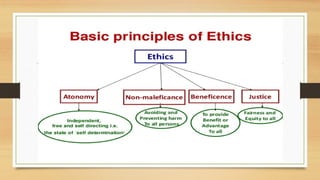
• Basic principles of medical ethics
• Autonomy-
• Beneficence and Non-maleficence
• Justice
• Case studies
Introduction
• Medical ethics- system of moral principles that apply values and judgments to
the practice of medicine.
• Derived from the word “Ethos” which means custom or habit.
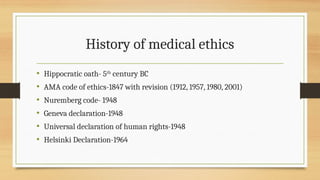
History of medical ethics
• Hippocratic oath- 5th
century BC
• AMA code of ethics-1847 with revision (1912, 1957, 1980, 2001)
• Nuremberg code- 1948
• Geneva declaration-1948
• Universal declaration of human rights-1948
• Helsinki Declaration-1964
Purpose of Code of Ethics
• Provides direct guidance for practice
• Protects the public
• Protects the profession
• Protects the practitioners against lawsuits.
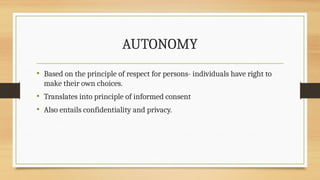
AUTONOMY
• Based on the principle of respect for persons- individuals have right to
make their own choices.
• Translates into principle of informed consent
• Also entails confidentiality and privacy.
Requirements for informed consent
• Patient/surrogate
• Be competent
• Be free from coercion
• Health care provider
• Provide understandable necessary information
• How do you know patient understands the information?
• Must recommend the optimal option (may persuade but without pressuring)
What is required for a person to be
competent?
• Adults are presumed to be competent.
• Interact with patient
• Factors to consider
• patient is oriented in time, place and person.
• Patient should be able to understand relevant information.
• Patient should be able to understand consequences of options.
• Patient should be able to voluntary express preference.
What should one do in case a patient is
incompetent?
• First consult patient’s living will
• Then consult surrogate- guardian, spouse, children of legal age, other
relatives, caregiver
Steps of informed consent
How much disclosure is sufficient during
informed consent?
• Patient should know
• Diagnosis
• Nature and purpose of treatment
• Known risks and consequences of treatment
• Ideally include doctor’s/hospital success or failure rates.
• Benefits of proposed treatment
• Alternative treatments
• Prognosis if no treatment is given
• Cost and burden of treatment
Exceptions to informed consent
• Therapeutic privilege?
• Doctrine of emergency
• Doctrine of therapeutic procedure- explaining complex procedures
• Court order and criminal code.
Confidentiality and privacy
• Privacy
• Patient has a right to be protected from unauthorized observation or intrusion.
• Confidentiality
• Protecting any medical information in regards to the patient from unauthorized
disclosure.
BENEFICENCE AND NON-MALEFICENCE
• Principle of Beneficence- requires us that, other things being equal, to
do good, or what will further the patient’s interest.
• The principle of non-maleficence- requires us, other things being equal,
to avoid harm to the patient. Primum non nocere
• Both principles rest on fundamental importance of what is in the
patient’s interest.
• Non-maleficence
• Do not kill
• Do not cause needless pain
• Do not incapacitate others
(important point is that these can be met by doing nothing)
• Beneficence
• Prevent infliction of needless pain
• Prevent killing
• Prevent incapacitating others
JUSTICE
• It is the principle that requires health care providers and society in
general to distribute medical goods and services fairly and equally.
• Two patients with same medical needs ought to be treated equally.
• Thus the first thing is to determine the medical needs of the patient.
How do you determine medical need?
• Use the following medical criteria in determining need
• Likely benefit to the patient
• Urgency of need
• Change in quality of life
• Duration of benefit
• Do NOT use non-medical criteria to determine need.
• Ability to pay
• Social worth
• Patient contribution to illness
• There are three different levels in which questions of social justice are
raised, determined and prioritized
• National level
• Institutional level
• Individual level
Prioritizing at national level
• Determine medical need of citizens
• Consider costs of basic goods when dealing with scarce resources
• Understand that no society can provide everything that everyone needs
(let alone what everyone wants).
• Economic considerations must be acknowledged to prevent economic
downfall.
• Strive as much as a minimum to provide basic health needs to all.
Prioritizing at institutional level
• Allocation conceived on model of medical triage.
• The good of the group given precedence over good of the individual.
• Government hospitals should be open to all and should consider
economically disadvantaged patients.
• Academic medical centers may give preference to cases which increase
knowledge in the field.
Interaction of principles
• When there is a conflict between non-maleficence and beneficence,
which one generally overrides the other?
• When there is a conflict between beneficence and autonomy, which one
generally overrides the other?
Case study 1
You have a very sick patient with stage 4 breast cancer and metastasis to
brain; condition worsens and at one point patient requires resuscitation;
resuscitation will most-likely be a futile attempt. Patient has no prior
expressed wishes (no DNR).
Using the principles of ethics as your framework for decision making,
what do you do?
Case study 2
John is a healthy 45 yr old teacher on follow-up after fundoplication for
Gastro-esophageal reflux disease, and now has no symptomatology. He
read in the newspaper about a new expensive test (PET/CT cardiac
imaging) that is excellent for diagnosing heart disease. John is not
concerned that the test is expensive because his insurance can cover it.
He has no symptoms or risk factor for heart disease. He wants you to
order the test.
Using the principles of ethics, explain how you will proceed.
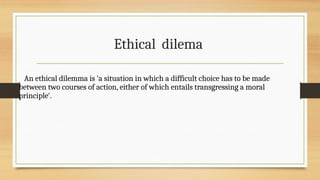
Ethical dilema
An ethical dilemma is 'a situation in which a difficult choice has to be made
between two courses of action, either of which entails transgressing a moral
principle'.
Introduction continued
• Understanding ethical practice--how to do good and avoid doing harm--
involves recognizing the complexity of the patient care environment, which
requires workers to respond and adapt to changing conditions as a normal
part of work”.
• Ethical issues happen when choices need to be made, the answers may not
be clear and the options are not ideal.
Ethical challenges
• Honesty vs. withholding information
• Science vs. spirituality
• Autonomy vs. beneficence
• Healthcare needs vs. resource allocation
• Managing pediatric and geriatric patients who may not have decision-making
capacity.
• Addressing moral distress about providing care with minimal benefit.
Ethical challenges continued
General methods for ethical problem-solving
 Hospitals should have an “ethics committee” .
 Ongoing education and open discussion.
 Blending a formal ethics policy and support mechanisms with a culture
that allows people to discuss some of the gray areas of their practice can
prepare clinicians to tackle many of these problems in stride.
In summary
• Knowing the right thing to do but not being allowed or able to do it can result into a
decline in the quality of patient care; problematic clinical relationships; and moral
distress.
• Ethical dilemmas are common, and need to be fully understood and managed for
better continuity in safe patient care.
• The duty to plan, and to make plans that can work in practice, is an ethical obligation.
Reference List
• Tom L. Beauchamp and James F. Childress, Principles of Biomedical
Ethics, Sixth edition (New York: Oxford University Press, 2009).
• Tung T, Organ CH. Ethics in Surgery: Historical Perspective. Arch
Surg. 2000;135(1):10–13. doi:10.1001/archsurg.135.1.10

GENERAL ETHICS PRINCIPLES.INTERESTINGpptx

  • 1.
  • 2.
    Outline • Introduction • Historyof medical ethics • Purpose of medical ethics • Basic principles of medical ethics • Autonomy- • Beneficence and Non-maleficence • Justice • Case studies
  • 3.
    Introduction • Medical ethics-system of moral principles that apply values and judgments to the practice of medicine. • Derived from the word “Ethos” which means custom or habit.
  • 4.
    History of medicalethics • Hippocratic oath- 5th century BC • AMA code of ethics-1847 with revision (1912, 1957, 1980, 2001) • Nuremberg code- 1948 • Geneva declaration-1948 • Universal declaration of human rights-1948 • Helsinki Declaration-1964
  • 5.
    Purpose of Codeof Ethics • Provides direct guidance for practice • Protects the public • Protects the profession • Protects the practitioners against lawsuits.
  • 7.
    AUTONOMY • Based onthe principle of respect for persons- individuals have right to make their own choices. • Translates into principle of informed consent • Also entails confidentiality and privacy.
  • 8.
    Requirements for informedconsent • Patient/surrogate • Be competent • Be free from coercion • Health care provider • Provide understandable necessary information • How do you know patient understands the information? • Must recommend the optimal option (may persuade but without pressuring)
  • 9.
    What is requiredfor a person to be competent? • Adults are presumed to be competent. • Interact with patient • Factors to consider • patient is oriented in time, place and person. • Patient should be able to understand relevant information. • Patient should be able to understand consequences of options. • Patient should be able to voluntary express preference.
  • 10.
    What should onedo in case a patient is incompetent? • First consult patient’s living will • Then consult surrogate- guardian, spouse, children of legal age, other relatives, caregiver
  • 11.
  • 12.
    How much disclosureis sufficient during informed consent? • Patient should know • Diagnosis • Nature and purpose of treatment • Known risks and consequences of treatment • Ideally include doctor’s/hospital success or failure rates. • Benefits of proposed treatment • Alternative treatments • Prognosis if no treatment is given • Cost and burden of treatment
  • 13.
    Exceptions to informedconsent • Therapeutic privilege? • Doctrine of emergency • Doctrine of therapeutic procedure- explaining complex procedures • Court order and criminal code.
  • 14.
  • 15.
    • Privacy • Patienthas a right to be protected from unauthorized observation or intrusion. • Confidentiality • Protecting any medical information in regards to the patient from unauthorized disclosure.
  • 16.
    BENEFICENCE AND NON-MALEFICENCE •Principle of Beneficence- requires us that, other things being equal, to do good, or what will further the patient’s interest. • The principle of non-maleficence- requires us, other things being equal, to avoid harm to the patient. Primum non nocere • Both principles rest on fundamental importance of what is in the patient’s interest.
  • 17.
    • Non-maleficence • Donot kill • Do not cause needless pain • Do not incapacitate others (important point is that these can be met by doing nothing) • Beneficence • Prevent infliction of needless pain • Prevent killing • Prevent incapacitating others
  • 18.
    JUSTICE • It isthe principle that requires health care providers and society in general to distribute medical goods and services fairly and equally. • Two patients with same medical needs ought to be treated equally. • Thus the first thing is to determine the medical needs of the patient.
  • 19.
    How do youdetermine medical need? • Use the following medical criteria in determining need • Likely benefit to the patient • Urgency of need • Change in quality of life • Duration of benefit • Do NOT use non-medical criteria to determine need. • Ability to pay • Social worth • Patient contribution to illness
  • 20.
    • There arethree different levels in which questions of social justice are raised, determined and prioritized • National level • Institutional level • Individual level
  • 21.
    Prioritizing at nationallevel • Determine medical need of citizens • Consider costs of basic goods when dealing with scarce resources • Understand that no society can provide everything that everyone needs (let alone what everyone wants). • Economic considerations must be acknowledged to prevent economic downfall. • Strive as much as a minimum to provide basic health needs to all.
  • 22.
    Prioritizing at institutionallevel • Allocation conceived on model of medical triage. • The good of the group given precedence over good of the individual. • Government hospitals should be open to all and should consider economically disadvantaged patients. • Academic medical centers may give preference to cases which increase knowledge in the field.
  • 23.
    Interaction of principles •When there is a conflict between non-maleficence and beneficence, which one generally overrides the other? • When there is a conflict between beneficence and autonomy, which one generally overrides the other?
  • 24.
    Case study 1 Youhave a very sick patient with stage 4 breast cancer and metastasis to brain; condition worsens and at one point patient requires resuscitation; resuscitation will most-likely be a futile attempt. Patient has no prior expressed wishes (no DNR). Using the principles of ethics as your framework for decision making, what do you do?
  • 25.
    Case study 2 Johnis a healthy 45 yr old teacher on follow-up after fundoplication for Gastro-esophageal reflux disease, and now has no symptomatology. He read in the newspaper about a new expensive test (PET/CT cardiac imaging) that is excellent for diagnosing heart disease. John is not concerned that the test is expensive because his insurance can cover it. He has no symptoms or risk factor for heart disease. He wants you to order the test. Using the principles of ethics, explain how you will proceed.
  • 26.
    Ethical dilema An ethicaldilemma is 'a situation in which a difficult choice has to be made between two courses of action, either of which entails transgressing a moral principle'.
  • 27.
    Introduction continued • Understandingethical practice--how to do good and avoid doing harm-- involves recognizing the complexity of the patient care environment, which requires workers to respond and adapt to changing conditions as a normal part of work”. • Ethical issues happen when choices need to be made, the answers may not be clear and the options are not ideal.
  • 28.
    Ethical challenges • Honestyvs. withholding information • Science vs. spirituality • Autonomy vs. beneficence • Healthcare needs vs. resource allocation • Managing pediatric and geriatric patients who may not have decision-making capacity. • Addressing moral distress about providing care with minimal benefit.
  • 29.
  • 31.
  • 33.
    General methods forethical problem-solving  Hospitals should have an “ethics committee” .  Ongoing education and open discussion.  Blending a formal ethics policy and support mechanisms with a culture that allows people to discuss some of the gray areas of their practice can prepare clinicians to tackle many of these problems in stride.
  • 34.
    In summary • Knowingthe right thing to do but not being allowed or able to do it can result into a decline in the quality of patient care; problematic clinical relationships; and moral distress. • Ethical dilemmas are common, and need to be fully understood and managed for better continuity in safe patient care. • The duty to plan, and to make plans that can work in practice, is an ethical obligation.
  • 35.
    Reference List • TomL. Beauchamp and James F. Childress, Principles of Biomedical Ethics, Sixth edition (New York: Oxford University Press, 2009). • Tung T, Organ CH. Ethics in Surgery: Historical Perspective. Arch Surg. 2000;135(1):10–13. doi:10.1001/archsurg.135.1.10

Editor's Notes

  • #9 Competence- ability of the patient to make decisions regarding his/her treatment
  • #12 Known risks and consequences of treatment excluding consequences that are too remote or improbable. Prudent person rule
  • #13 Therapeutic privilege- if there is reason to believe information given to patient will result in adverse effect on the patient’s condition.
  • #16 (furthering patient’s interest and refraining from doing what damages patient’s interest)
  • #17 A person undergoing an unnecessary procedure by a colleague as I watch. I satisfy the principle of non-maleficence but violate principle of beneficence by not preventing pain.
  • #23 Chemotherapy in a very ill patient will cause more harm. Thus non-maleficence trumps beneficence. It is legitimate to consider questions of quality of life when making treatment decisions such as in the above patient.
  • #25 Beneficence- the physician is obliged to benefit the patient, thus refusing to order a test that will not benefit the patient. Maleficence- primum no nocere- physician refuses the test as it would expose the patient to unnecessary radiation.