Healthcare Administration and Management Summary on Medical Ethics
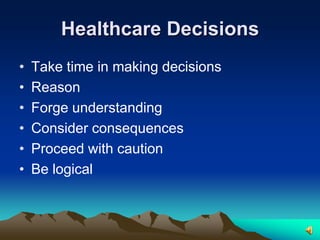
Healthcare DecisionsTake time in making decisionsReasonForge understandingConsider consequencesProceed with cautionBe logical
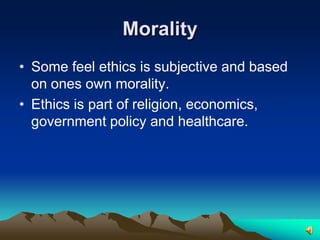
Morality Some feel ethics is subjective and based on ones own morality.Ethics is part of religion, economics, government policy and healthcare.
Medical Ethicsis derived from:LawInstitutions policies and practicesProfessional organizationsProfessional standards of care and obligation
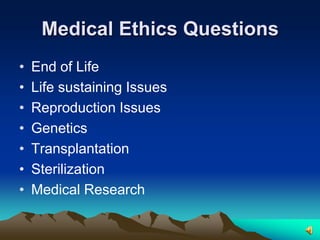
Medical Ethics QuestionsEnd of LifeLife sustaining IssuesReproduction IssuesGeneticsTransplantationSterilizationMedical Research
Principles of EthicsMoral Guideline and Continuity for Decision MakingAutonomyBeneficenceNonmaleficenceJustice
AutonomyThis is a person’s ability to make their own choice.The capacity to say, think, decide and act freely and independently.
AutonomyAutonomy includes informed consent, confidentiality, truth telling and self-determination.  It is based on the patient’s own goals and desires. Competency and capacity must be established.Minors – legal decision age.Surrogates
BeneficenceSeek to provide.Being kind, charitable or beneficial.Acting with compassion and respect.Keeping patient wishes in care provided.Bringing good to another.
NonmaleficenceDo no harm. Avoid and prevent harm.No violence towards another.
JusticeTreat with fairness.Provide equal treatment to all.Non-discrimination.Protecting the rights of others.
RiskInability to balance the principles.Oversimplify the principles.Using one over another.Rush into decision making.
Decision MakingLook at the medical problem and prognosis. Is the condition reversible?What are goals of treatment?What is the cost-benefit of the decision   emotional, physical, financial?What does the patient want? AD?? LW??Is the patient competent to decide?
Ethical AnalysisAnalysis patient’s perspective.Analysis family’s perspective.Look at social impact of decision.Look at legal aspect of decision.Look at financial impact of decision.Look at provider impact of decision.Look at religious impact of decision.
Personal ValuesThe patient decision may come into conflict with your personal values but the patient has the right for self-determination when competency is not in question.You will face challenges in balancing the mission of your organization with the cost of providing care and advances in technology while respecting your patient wishes.
DecisionsUse ethical principles as a basis.Take your time to decide.Utilize your ethics committee whenever necessary.Know your code of ethics for your profession.Review the consequences of your decision before your make it.Act responsibly, morally and ethically.Perform an ethical analysis.

Hcam summary on medical ethics

  • 1.
    Healthcare Administration andManagement Summary on Medical Ethics
  • 2.
    Healthcare DecisionsTake timein making decisionsReasonForge understandingConsider consequencesProceed with cautionBe logical
  • 3.
    Morality Some feelethics is subjective and based on ones own morality.Ethics is part of religion, economics, government policy and healthcare.
  • 4.
    Medical Ethicsis derivedfrom:LawInstitutions policies and practicesProfessional organizationsProfessional standards of care and obligation
  • 5.
    Medical Ethics QuestionsEndof LifeLife sustaining IssuesReproduction IssuesGeneticsTransplantationSterilizationMedical Research
  • 6.
    Principles of EthicsMoralGuideline and Continuity for Decision MakingAutonomyBeneficenceNonmaleficenceJustice
  • 7.
    AutonomyThis is aperson’s ability to make their own choice.The capacity to say, think, decide and act freely and independently.
  • 8.
    AutonomyAutonomy includes informedconsent, confidentiality, truth telling and self-determination. It is based on the patient’s own goals and desires. Competency and capacity must be established.Minors – legal decision age.Surrogates
  • 9.
    BeneficenceSeek to provide.Beingkind, charitable or beneficial.Acting with compassion and respect.Keeping patient wishes in care provided.Bringing good to another.
  • 10.
    NonmaleficenceDo no harm.Avoid and prevent harm.No violence towards another.
  • 11.
    JusticeTreat with fairness.Provideequal treatment to all.Non-discrimination.Protecting the rights of others.
  • 12.
    RiskInability to balancethe principles.Oversimplify the principles.Using one over another.Rush into decision making.
  • 13.
    Decision MakingLook atthe medical problem and prognosis. Is the condition reversible?What are goals of treatment?What is the cost-benefit of the decision emotional, physical, financial?What does the patient want? AD?? LW??Is the patient competent to decide?
  • 14.
    Ethical AnalysisAnalysis patient’sperspective.Analysis family’s perspective.Look at social impact of decision.Look at legal aspect of decision.Look at financial impact of decision.Look at provider impact of decision.Look at religious impact of decision.
  • 15.
    Personal ValuesThe patientdecision may come into conflict with your personal values but the patient has the right for self-determination when competency is not in question.You will face challenges in balancing the mission of your organization with the cost of providing care and advances in technology while respecting your patient wishes.
  • 16.
    DecisionsUse ethical principlesas a basis.Take your time to decide.Utilize your ethics committee whenever necessary.Know your code of ethics for your profession.Review the consequences of your decision before your make it.Act responsibly, morally and ethically.Perform an ethical analysis.