Ethics 
Principle of respect for autonomy
Aim 
Introduce the principle of respect for autonomy. 
Learning Objectives 
• Define autonomy 
• Define competence 
• Discuss how the principle of respect for 
autonomy relates to health care.
Definition 
What does autonomy mean? 
From the Greek: autos (self) Nomos (rule of law), broadly meaning ‘self-determination, 
self-rule, being your own person, self governing
Activity 
Individually take 5 minutes to consider the 
following questions: 
What decisions do you make about your life? 
What decisions do you make about other 
people’s lives? 
How do you justify the decisions you make? 
How would you feel if I took away your ability 
to make decisions?
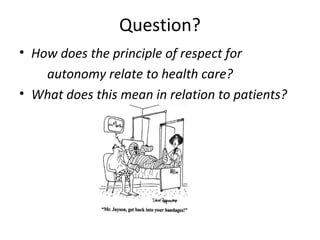
Question? 
• How does the principle of respect for 
autonomy relate to health care? 
• What does this mean in relation to patients?
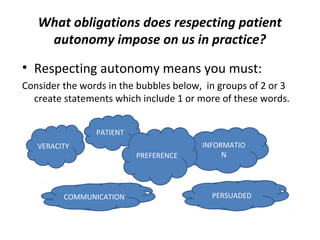
What obligations does respecting patient 
autonomy impose on us in practice? 
• Respecting autonomy means you must: 
Consider the words in the bubbles below, in groups of 2 or 3 
create statements which include 1 or more of these words. 
PATIENT 
VERACITY INFORMATIO 
N 
PREFERENCE 
COMMUNICATION PERSUADED
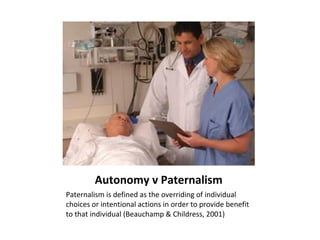
Autonomy v Paternalism 
Paternalism is defined as the overriding of individual 
choices or intentional actions in order to provide benefit 
to that individual (Beauchamp & Childress, 2001)
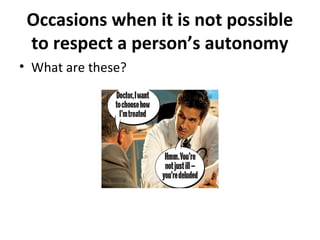
Occasions when it is not possible 
to respect a person’s autonomy 
• What are these?
Autonomy & Competence
Pause for thought! 
• When you were getting ready this morning 
were you autonomous and competent today? 
• Did you decide what to wear, bring with you, 
how to get here? 
• BUT: would you be competent to deliver a 
lecture on bio science??
• Autonomy refers to a general capacity of an 
individual 
• Competence refers to more specific abilities, 
such as those involved in the performance of a 
specific task.
Factors which may affect 
competence 
• Physical 
• Psychological 
• In many moral problems the question of the 
competence of the patient is absolutely 
crucial.
Learning Objectives 
• Define autonomy 
• Define competence 
• Discuss how the principle of respect for 
autonomy relates to health care
Conclusion 
Principle of respect 
for autonomy and 
competence are 
crucial in moral 
decision making in 
nursing ethics, and 
require a great 
deal of thought.

Autonomy powerpoint

  • 1.
    Ethics Principle ofrespect for autonomy
  • 2.
    Aim Introduce theprinciple of respect for autonomy. Learning Objectives • Define autonomy • Define competence • Discuss how the principle of respect for autonomy relates to health care.
  • 3.
    Definition What doesautonomy mean? From the Greek: autos (self) Nomos (rule of law), broadly meaning ‘self-determination, self-rule, being your own person, self governing
  • 4.
    Activity Individually take5 minutes to consider the following questions: What decisions do you make about your life? What decisions do you make about other people’s lives? How do you justify the decisions you make? How would you feel if I took away your ability to make decisions?
  • 5.
    Question? • Howdoes the principle of respect for autonomy relate to health care? • What does this mean in relation to patients?
  • 6.
    What obligations doesrespecting patient autonomy impose on us in practice? • Respecting autonomy means you must: Consider the words in the bubbles below, in groups of 2 or 3 create statements which include 1 or more of these words. PATIENT VERACITY INFORMATIO N PREFERENCE COMMUNICATION PERSUADED
  • 7.
    Autonomy v Paternalism Paternalism is defined as the overriding of individual choices or intentional actions in order to provide benefit to that individual (Beauchamp & Childress, 2001)
  • 8.
    Occasions when itis not possible to respect a person’s autonomy • What are these?
  • 9.
  • 10.
    Pause for thought! • When you were getting ready this morning were you autonomous and competent today? • Did you decide what to wear, bring with you, how to get here? • BUT: would you be competent to deliver a lecture on bio science??
  • 11.
    • Autonomy refersto a general capacity of an individual • Competence refers to more specific abilities, such as those involved in the performance of a specific task.
  • 12.
    Factors which mayaffect competence • Physical • Psychological • In many moral problems the question of the competence of the patient is absolutely crucial.
  • 13.
    Learning Objectives •Define autonomy • Define competence • Discuss how the principle of respect for autonomy relates to health care
  • 14.
    Conclusion Principle ofrespect for autonomy and competence are crucial in moral decision making in nursing ethics, and require a great deal of thought.

Editor's Notes

  • #2 Welcome Gapped handouts & format of the lesson
  • #4 Comes from the Greek: autos (self) Nomos (Rule or law Broadly defined as’ self determination, self rule, being your own person, self governing. Means you have the capacity to make reasoned decisions, i.e. , the ability to think for one’ self and to act on the basis of such thought. The key here is that the person has the capacity to reason and make decisions.
  • #5 Points to raise It is clear that autonomy is regarded as something of value at least in Western Cultures, perhaps also in other cultures. We value independence and find that it is both desirable and healthy to be autonomous. Key points The principle of respect for autonomy implies that people have the freedom to decide how to run their lives. Being autonomous means having the ability to a) determine your personal goals, b) understand available options and their consequences, c) decide on a plan of action and d) act on choices.
  • #6 Key question Open question: Pose, pause and pounce! In health care context- the principle of respect for autonomy is the most fundamental of moral principles and health care workers should employ this principle when dealing with patients and clients. It means treating patients as persons with rights and not as objects of care Discussing proposed treatment or care with patients in an open and honest way, allowing them to make their own decisions about what should happen to their bodies and if they are competent, accepting their choices.
  • #7 Effectively communicate with patients (listening, gaining cooperation & compliance etc. ) Respecting cultural differences. Be truthful (Veracity) Enable patients to make decisions freely not be forced or manipulated, persuaded. Provide appropriate information Accept your patients preferences, i.e. the right to decide whether to undergo health care intervention or not whatever the outcome. Accordingly you must respect a competent adults refusal of treatment.
  • #8 It can be difficult sometimes to apply the principle of autonomy in some health care situations, when respecting that patients choice may not be in the best interests of the patient. Whilst paternalism is seldom justified in patient care, some situations justify overriding patient autonomy when the benefits to be realised are great and the harms to be avoided are significant.
  • #9 For example: Very severe learning disability Acute phase of a mental health problem Under the effects of drugs Advanced stages of senile dementia In a coma etc (It relates to patients capacity to make reasoned decisions) When can a persons autonomy be overridden? It may be justifiable to override the principle of respect for autonomy: E.g.: when a person exercises autonomy in a way that will harm others perhaps assaulting them.
  • #10 Recap- What is autonomy? Autonomy is taken to mean self rule However the fact that one is autonomous and thus self governing does not follow that one is necessarily competent.
  • #11 Ask for response to questions above
  • #12 Therefore being autonomous is not a sufficient condition for being competent, but it does seem that it is a necessary condition. In many moral problems the question of the competence of the patient is absolutely crucial. For example, It would be easier to justify preventing a patient from leaving the ward if they are NOT able to make a competent decision to leave. Alternatively, it is much more difficult to justify standing in the way of a patient wising to leave the ward if their decision to leave is a competent one.
  • #13 Physical Drug intoxication and neuronal damage A person who has consumed large amounts of drugs which affect the nervous system e.g. alcohol or tranquillizers. It may be that at the time the person is not able to exercise that capacity due to the effects of the drugs or neuronal damage. Psychological Anxiety, coercion, lack of information. If a person is extremely anxious, his capacity to make competent decisions is likely to be impaired. Consider nurses role as patients advocate, e.g. informed consent, how much information is the patient really given?
  • #14 Question in relation to learning objectives Also bring in case study of Mohammed ( fidelity session) & link to autonomy.