Confidential Customized for Lorem Ipsum LLC Version 1.0
Ethics &
Personal Data
Daniele Miorandi
Confidential Customized for Lorem Ipsum LLC Version 1.0
Ethics can be understood as the task of
answering "What should I do?".
Ethics includes both thought and practice,
an organized and intentional reflection on
morality and the effort to live in ways that
are good, just, and/or right.
Emanuelle Burton, Judy Goldsmith, Nicholas Mattei
,
Communications of the ACM, August 2018, Vol. 61 No. 8,
Pages 54-64
2
Why relevant for you?
3
4
Why relevant for you?
"Computing professionals’ actions change the
world. To act responsibly, they should reflect upon
the wider impacts of their work, consistently
supporting the public good. "
5
7 ethical
principles
A computing professional should ….
6
#1 Contribute to society and to human
well-being, acknowledging that all
people are stakeholders in computing.
7
Confidential Customized for Lorem Ipsum LLC Version 1.0
#2 Avoid harm
8
#3 Be honest and trustworthy.
9
#4 Be fair and take action not to discriminate.
10
Confidential Customized for Lorem Ipsum LLC Version 1.0
#5 Respect the work required to produce new
ideas, inventions, creative works, and computing
artifacts.
11
#6 Respect privacy
12
#7 Honor confidentiality
13
What to do in practice
1 Consider all stakeholders
impacted by your research
2 Analyse the impact of your
research on all of them
3 See if you can minimise
(avoid) possible negative
impacts to any of them
4 If in doubt, consult an
Ethical Review Board
14
"So an ethical board can stop my
research?"
15
Relevant in particular when doing experiments
involving people
16
Let's play a bit
17
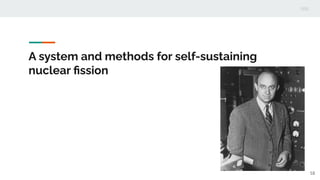
A system and methods for self-sustaining
nuclear fission
18
A quantum computer able to break any
encryption scheme
19
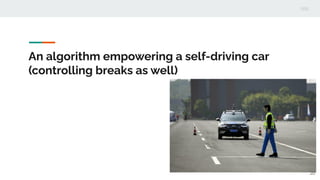
An algorithm empowering a self-driving car
(controlling breaks as well)
20
21
22
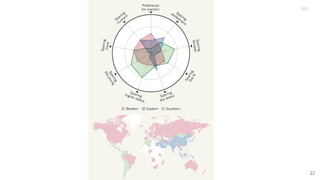
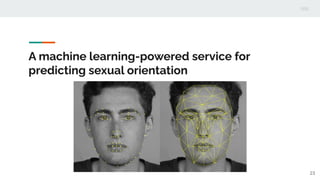
A machine learning-powered service for
predicting sexual orientation
23
An ICT platform allowing anybody to share
rides
24
An ICT platform allowing anybody to give rides
to anybody
25
An ICT platform allowing anybody to rent out
their flat
26
Here & Now
http:/
/www.kasmamagazine.com/here-and-now.cfm
27
“It is no good to try to stop
knowledge from going forward.
Ignorance is never better than
knowledge”
28
Responsible
Research and
Innovation
29
Research and innovation process should be
1 Diverse and inclusive
2 Anticipative and reflective
3 Open & transparent
4 Responsive and adaptive
to change
30
So what should go under
ethical scrutiny?
Let's look at H2020
31
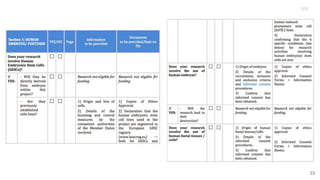
Ethical issues checklist
1. Human embryos & foetuses
Covers research on human embryos and foetuses (mainly human embryonic stem cells (hESC)).
32
33
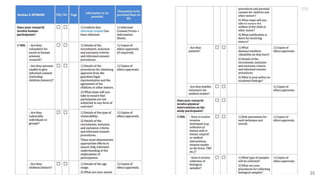
Ethical issues checklist
2. Human beings
Refers to any research involving work with humans beings (‘research or study participants’), regardless of
its nature or topic
34
35
Ethical issues checklist
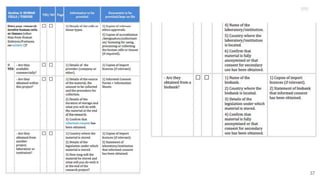
3. Human cells or tissues
Refers to research using, producing or collecting human cells or tissues.
36
37
Ethical issues checklist
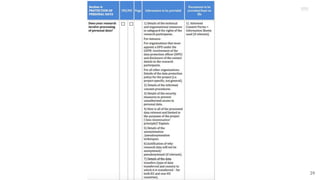
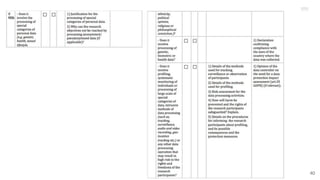
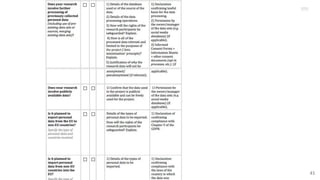
4. Personal data
Concerns research which involves processing of personal data, regardless of the method used (e.g.
interviews, questionnaires, direct online retrieval etc.).
38
39
40
41
Ethical issues checklist
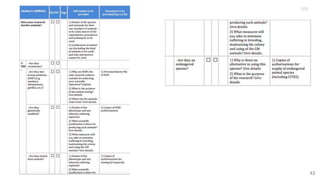
5. Animals
Concerns research involving animals
42
43
Ethical issues checklist
6. Non-EU countries
Concerns research involving non-EU countries
(details skipped)
44
Ethical issues checklist
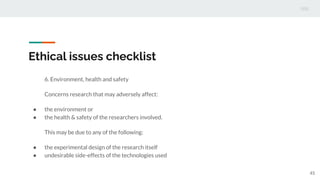
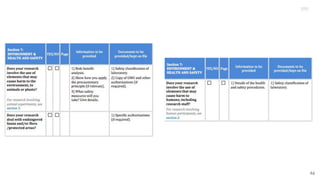
6. Environment, health and safety
Concerns research that may adversely affect:
● the environment or
● the health & safety of the researchers involved.
This may be due to any of the following:
● the experimental design of the research itself
● undesirable side-effects of the technologies used
45
46
GDPR
47
Regulation (EU) 2016/6791, the European
Union’s new General Data Protection
Regulation (‘GDPR’), regulates the
processing by an individual, a company
or an organisation of personal data
relating to individuals in the EU.
48
Personal data is any information that
relates to an identified or identifiable
living individual. Different pieces of
information, which collected together can lead
to the identification of a particular person, also
constitute personal data.
49
Personal data that has been
de-identified, encrypted or
pseudonymised but can be
used to re-identify a person
remains personal data and falls
within the scope of the law.
50
Personal data that has been rendered
anonymous in such a way that the
individual is not or no longer
identifiable is no longer considered
personal data. For data to be truly
anonymised, the anonymisation must
be irreversible.
51
The law protects personal data regardless of
the technology used for processing that data –
it’s technology neutral and applies to both
automated and manual processing(..) It also
doesn’t matter how the data is stored – in an IT
system, through video surveillance, or on
paper; in all cases, personal data is subject to
the protection requirements set out in the
GDPR.
52
Examples of personal data
● a name and surname;
● a home address;
● an email address such as name.surname@company.com;
● an identification card number;
● location data (for example the location data function on a mobile phone);
● an Internet Protocol (IP) address;
● a cookie ID;
● the advertising identifier of your phone;
● data held by a hospital or doctor, which could be a symbol that uniquely identifies a person.
53
Processing covers a wide range of operations
performed on personal data, including by manual or
automated means. It includes the collection, recording,
organisation, structuring, storage, adaptation or
alteration, retrieval, consultation, use, disclosure by
transmission, dissemination or otherwise making
available, alignment or combination, restriction, erasure
or destruction of personal data.
54
Example of processing
● staff management and payroll administration;
● access to/consultation of a contacts database containing personal data;
● sending promotional emails;
● shredding documents containing personal data;
● posting/putting a photo of a person on a website;
● storing IP addresses or MAC addresses;
● video recording (CCTV).
55
56
57
58
59
60
61
62
63
64
65
66
67
68
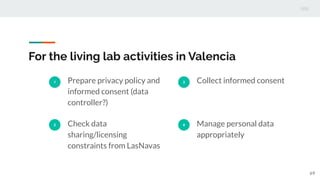
For the living lab activities in Valencia
1 Prepare privacy policy and
informed consent (data
controller?)
2 Check data
sharing/licensing
constraints from LasNavas
3 Collect informed consent
4 Manage personal data
appropriately
69
Thank you.
70
This training material is part of the FogGuru project that has received funding from the European Union’s Horizon
2020 research and innovation programme under the Marie Skłodowska-Curie grant agreement No 765452. The
information and views set out in this material are those of the author(s) and do not necessarily reflect the official
opinion of the European Union. Neither the European Union institutions and bodies nor any person acting on their
behalf may be held responsible for the use which may be made of the information contained therein.

Ethics and Personal Data

  • 1.
    Confidential Customized forLorem Ipsum LLC Version 1.0 Ethics & Personal Data Daniele Miorandi
  • 2.
    Confidential Customized forLorem Ipsum LLC Version 1.0 Ethics can be understood as the task of answering "What should I do?". Ethics includes both thought and practice, an organized and intentional reflection on morality and the effort to live in ways that are good, just, and/or right. Emanuelle Burton, Judy Goldsmith, Nicholas Mattei , Communications of the ACM, August 2018, Vol. 61 No. 8, Pages 54-64 2
  • 3.
  • 4.
  • 5.
    Why relevant foryou? "Computing professionals’ actions change the world. To act responsibly, they should reflect upon the wider impacts of their work, consistently supporting the public good. " 5
  • 6.
    7 ethical principles A computingprofessional should …. 6
  • 7.
    #1 Contribute tosociety and to human well-being, acknowledging that all people are stakeholders in computing. 7
  • 8.
    Confidential Customized forLorem Ipsum LLC Version 1.0 #2 Avoid harm 8
  • 9.
    #3 Be honestand trustworthy. 9
  • 10.
    #4 Be fairand take action not to discriminate. 10
  • 11.
    Confidential Customized forLorem Ipsum LLC Version 1.0 #5 Respect the work required to produce new ideas, inventions, creative works, and computing artifacts. 11
  • 12.
  • 13.
  • 14.
    What to doin practice 1 Consider all stakeholders impacted by your research 2 Analyse the impact of your research on all of them 3 See if you can minimise (avoid) possible negative impacts to any of them 4 If in doubt, consult an Ethical Review Board 14
  • 15.
    "So an ethicalboard can stop my research?" 15
  • 16.
    Relevant in particularwhen doing experiments involving people 16
  • 17.
  • 18.
    A system andmethods for self-sustaining nuclear fission 18
  • 19.
    A quantum computerable to break any encryption scheme 19
  • 20.
    An algorithm empoweringa self-driving car (controlling breaks as well) 20
  • 21.
  • 22.
  • 23.
    A machine learning-poweredservice for predicting sexual orientation 23
  • 24.
    An ICT platformallowing anybody to share rides 24
  • 25.
    An ICT platformallowing anybody to give rides to anybody 25
  • 26.
    An ICT platformallowing anybody to rent out their flat 26
  • 27.
  • 28.
    “It is nogood to try to stop knowledge from going forward. Ignorance is never better than knowledge” 28
  • 29.
  • 30.
    Research and innovationprocess should be 1 Diverse and inclusive 2 Anticipative and reflective 3 Open & transparent 4 Responsive and adaptive to change 30
  • 31.
    So what shouldgo under ethical scrutiny? Let's look at H2020 31
  • 32.
    Ethical issues checklist 1.Human embryos & foetuses Covers research on human embryos and foetuses (mainly human embryonic stem cells (hESC)). 32
  • 33.
  • 34.
    Ethical issues checklist 2.Human beings Refers to any research involving work with humans beings (‘research or study participants’), regardless of its nature or topic 34
  • 35.
  • 36.
    Ethical issues checklist 3.Human cells or tissues Refers to research using, producing or collecting human cells or tissues. 36
  • 37.
  • 38.
    Ethical issues checklist 4.Personal data Concerns research which involves processing of personal data, regardless of the method used (e.g. interviews, questionnaires, direct online retrieval etc.). 38
  • 39.
  • 40.
  • 41.
  • 42.
    Ethical issues checklist 5.Animals Concerns research involving animals 42
  • 43.
  • 44.
    Ethical issues checklist 6.Non-EU countries Concerns research involving non-EU countries (details skipped) 44
  • 45.
    Ethical issues checklist 6.Environment, health and safety Concerns research that may adversely affect: ● the environment or ● the health & safety of the researchers involved. This may be due to any of the following: ● the experimental design of the research itself ● undesirable side-effects of the technologies used 45
  • 46.
  • 47.
  • 48.
    Regulation (EU) 2016/6791,the European Union’s new General Data Protection Regulation (‘GDPR’), regulates the processing by an individual, a company or an organisation of personal data relating to individuals in the EU. 48
  • 49.
    Personal data isany information that relates to an identified or identifiable living individual. Different pieces of information, which collected together can lead to the identification of a particular person, also constitute personal data. 49
  • 50.
    Personal data thathas been de-identified, encrypted or pseudonymised but can be used to re-identify a person remains personal data and falls within the scope of the law. 50
  • 51.
    Personal data thathas been rendered anonymous in such a way that the individual is not or no longer identifiable is no longer considered personal data. For data to be truly anonymised, the anonymisation must be irreversible. 51
  • 52.
    The law protectspersonal data regardless of the technology used for processing that data – it’s technology neutral and applies to both automated and manual processing(..) It also doesn’t matter how the data is stored – in an IT system, through video surveillance, or on paper; in all cases, personal data is subject to the protection requirements set out in the GDPR. 52
  • 53.
    Examples of personaldata ● a name and surname; ● a home address; ● an email address such as name.surname@company.com; ● an identification card number; ● location data (for example the location data function on a mobile phone); ● an Internet Protocol (IP) address; ● a cookie ID; ● the advertising identifier of your phone; ● data held by a hospital or doctor, which could be a symbol that uniquely identifies a person. 53
  • 54.
    Processing covers awide range of operations performed on personal data, including by manual or automated means. It includes the collection, recording, organisation, structuring, storage, adaptation or alteration, retrieval, consultation, use, disclosure by transmission, dissemination or otherwise making available, alignment or combination, restriction, erasure or destruction of personal data. 54
  • 55.
    Example of processing ●staff management and payroll administration; ● access to/consultation of a contacts database containing personal data; ● sending promotional emails; ● shredding documents containing personal data; ● posting/putting a photo of a person on a website; ● storing IP addresses or MAC addresses; ● video recording (CCTV). 55
  • 56.
  • 57.
  • 58.
  • 59.
  • 60.
  • 61.
  • 62.
  • 63.
  • 64.
  • 65.
  • 66.
  • 67.
  • 68.
  • 69.
    For the livinglab activities in Valencia 1 Prepare privacy policy and informed consent (data controller?) 2 Check data sharing/licensing constraints from LasNavas 3 Collect informed consent 4 Manage personal data appropriately 69
  • 70.
  • 71.
    This training materialis part of the FogGuru project that has received funding from the European Union’s Horizon 2020 research and innovation programme under the Marie Skłodowska-Curie grant agreement No 765452. The information and views set out in this material are those of the author(s) and do not necessarily reflect the official opinion of the European Union. Neither the European Union institutions and bodies nor any person acting on their behalf may be held responsible for the use which may be made of the information contained therein.