

Digital Business & GDPR
		Jacques	Folon	
Partner		
Edge	Consulting	
Maître	de	conférences		
Université	de	Liège		
Professeur	
ICHEC	
Professeur	invité		
Université	de	Lorraine	(Metz)	
Visiting	professor	
ESC	Rennes	School	of	Business
https://gdprfolder.eu
© 2018 GDPRFOLDER.EU SPRL All Rights Reserved.
Every company & self employed is concerned
SM
E
Self employed
Non profit
Private sector
Public
sector
https://gdprfolder.eu
© 2018 GDPRFOLDER.EU SPRL All Rights Reserved.
employees Prospects
ContactsUsers & clients
Which Data ?
http://www.jerichotechnology.com/wp-content/uploads/2012/05/SocialMediaisChangingtheWorld.jpg
privacy ?????
6
http://www.fieldhousemedia.net/wp-content/uploads/2013/03/fb-privacy.jpg
Average number of Facebook
« friends » in France: 177 in 2018
30
PRIVACYVS SOCIAL
NETWORKS
https://encrypted-tbn2.gstatic.com/images?q=tbn:ANd9GcQgeY4ij8U4o1eCuVJ8Hh3NlI3RAgL9LjongyCJFshI5nLRZQZ5Bg
4
By giving people the power to share, we're
making the world more transparent.
The question isn't, 'What do we want to
know about people?', It's, 'What do
people want to tell about themselves?'
Data privacy is outdated !
Mark Zuckerberg
If you have something that you don’t want
anyone to know, maybe you shouldn’t be
doing it in the first place.
Eric Schmidt
1
14SOURCE: http://mattmckeon.com/facebook-privacy/
15
16
17
18
19
20
21
IN 2018
1
Privacy statement confusion
• 53% of consumers consider that a privacy statement
means that data will never be sell or give
• 43% only have read a privacy statement
• 45% only use different email addresses
• 33% changed passwords regularly
• 71% decide not to register or purchase due to a
request of unneeded information
• 41% provide fake info
112
Source: TRUSTe survey
24
http://1.bp.blogspot.com/-NqwjuQRm3Co/UCauELKozrI/AAAAAAAACuQ/MoBpRZVrZj4/s1600/Party-Raccoon-Get-Friends-Drunk-Upload-Facebook.jpg
The person who took the photo
is a real friend
25
http://cdn.motinetwork.net/motifake.com/image/demotivational-poster/1202/reality-drunk-reality-fail-drunkchicks-partyfail-demotivational-posters-1330113345.jpg
privacy and graph search ?
27
28
29
30
From Big Brother to Big Other
http://fr.slideshare.net/bodyspacesociety/casilli-privacyehess-2012def
Antonio Casili
• Importance of T&C
• Everybody speaks
• mutual surveillance
• Lateral surveillance
geolocalisation
http://upload.wikimedia.org/wikipedia/commons/thumb/9/99/Geolocalisation_GPS_SAT.png/267px-Geolocalisation_GPS_SAT.png
data collection
1
39
Interactions controlled by citizens in the Information Society
http://ipts.jrc.ec.europa.eu/home/report/english/articles/vol79/ICT1E796.htm
Interactions NOT controlled by citizens in the Information Society
http://ipts.jrc.ec.europa.eu/home/report/english/articles/vol79/ICT1E796.htm
GDPR
Codes of conducts and certifications
!44
May	25,	2018	GDPR	!!!
!54
A.CONTEXT
B.SOME DEFINITIONS
C.THE PRINCIPLES
D.GDPR CONSEQUENCES
E.METHODOLOGY
A : CONTEXT
!55
IN 3 WORDS
!56
• GDPR IS A "REGULATION" ><
"DIRECTIVE"
• WORLDWIDE INFLUENCE
• CONSEQUENCES FOR COMPANIES
AND PUBLIC SECTOR
!57
MAY 2018
ENTRY INTO FORCE MAY
25,2018
DISCUSSED SINCE 2014
VOTED IN 2016
RISKS
PENALTIES
4% ANNUAL TO
20 M €
COMPENSATION IN COURT
REPUTATION
IMPACT
CONTRACT
PROCESSES
MARKETING
ORGANISATION
B : SOME DEFINITIONS…
!58
PERSONAL DATA
!59
‘personal data’ means any information relating to an
identified or identifiable natural person (‘data
subject’); an identifiable natural person is one who can
be identified, directly or indirectly, in particular by
reference to an identifier such as a name, an
identification number, location data, an online
identifier or to one or more factors specific to the
physical, physiological, genetic, mental, economic,
cultural or social identity of that natural person;
PROCESSING
!60
‘processing’ means any operation or set of
operations which is performed on personal data or
on sets of personal data, whether or not by
automated means, such as collection, recording,
organisation, structuring, storage, adaptation or
alteration, retrieval, consultation, use, disclosure by
transmission, dissemination or otherwise making
available, alignment or combination, restriction,
erasure or destruction;
CONTROLLER
!61
controller’ means the natural or legal person, public
authority, agency or other body which, alone or
jointly with others, determines the purposes and
means of the processing of personal data; where the
purposes and means of such processing are
determined by Union or Member State law, the
controller or the specific criteria for its nomination
may be provided for by Union or Member State
law;
processor or sub-contractor
!62
processor means a natural or legal
person, public authority, agency or other
body which processes personal data on
behalf of the controller
Sub-contractor
129
The Member States shall provide that the controller must, where
processing is carried out on his behalf, choose a processor
providing sufficient guarantees in respect of the technical security
measures and organizational measures governing the processing
to be carried out, and must ensure compliance with those
measures
64
The carrying out of processing by way of a processor must be
governed by a contract or legal act binding the processor to the
controller and stipulating in particular that:
- the processor shall act only on instructions from the controller,
- the obligations as defined by the law of the Member State in
which the processor is established, shall also be incumbent on the
processor
data breach
!65
personal data breach’ means a breach of
security leading to the accidental or
unlawful destruction, loss, alteration,
unauthorised disclosure of, or access to,
personal data transmitted, stored or
otherwise processed
C : 12 MAIN PRINCIPLES OF GDPR
!66
1. Accountability		
2. Consumer	/	citizen	rights	
3. Privacy	by	design	
4. Information	security	
5. Data	breach	
6. Penalties	
7. identity	access	management	
8. lawfulness	for	processing	
9. Register		
10.Risk	analysis	and	PIA	
11.Training	
12.Data	privacy	officer
1/ ACCOUNTABILITY
!67
DO-CU-MEN-TA-TION
PRIVACY POLICY OR REGULATION OR …
2/ Consumer/citizen's right
!72
TRANSPARENCY
SENSITIVE INFORMATIONS
INFORMATION COLLECTED
RIGHT OF ACCESS
RIGHT TO RECTIFICATION
RIGHT TO ERASE
RIGHT OF PROCESSING LIMITATION
PORTABILITY
RIGHT OF OPPOSITION TO PROFILING
RIGHT TO ACCESS
right to be forgotten ?
Right to be forgotten
• On 13.05.2014 the European Union Court of
Justice backed a ruling called “the right to be
forgotten,” which allows individuals to control
their data and ask search engines, such as Google,
to remove inadequate personal results from the
Internet.
• However, the decision cannot be interpreted as a
“victory” for the protection of the personal data
of Europeans, according to privacy experts.
• In 2010 a Spanish citizen lodged a complaint against a Spanish
newspaper with the national Data Protection Agency and
against Google Spain and Google Inc.
• The citizen complained that an auction notice of his
repossessed home on Google’s search results infringed his
privacy rights because the proceedings concerning him had
been fully resolved for a number of years and hence the
reference to these was entirely irrelevant.
• He requested, first, that the newspaper be required either to
remove or alter the pages in question so that the personal
data relating to him no longer appeared;
• and second, that Google Spain or Google Inc. be required to
remove the personal data
• In its ruling of 13 May 2014 the EU Court said :
• a)On the territoriality of EU rules: Even if the physical server of a
company processing data islocated outside Europe, EU rules apply
to search engine operators if they have a branch or a sub sidiary in
a Member State which promotes the selling of advertising space
offered by the search engine;
• b)On the applicability of EU data protection rules to a search
engine : Search engines are controllers of personal data. Google can
therefore not escape its responsibilities before European lawwhen
handling personal data by saying it is a search engine. EU data
protection law applies and so does the right to be forgotten.
• c) On the “Right to be Forgotten” : Individuals have the right -
under certain conditions - to ask search engines to remove links
with personal information about them.This applies where the
information is inaccurate, inadequate, irrelevant or excessive for the
purposes of the data
• At the same time, the Court explicitly clarified
that the right to be forgotten is not absolute but
will always need to be balanced against other
fundamental rights, such as the freedom of
expression and of the media
• Right to erasure (future rules?)
• 1.The data subject shall have the right to obtain from the
controller the erasure of personal data relating to them and the
abstention from further dissemination of such data, and to
obtain from third parties the erasure of any links to, or copy or
replication of that data, where one of the following grounds
applies:
• (a) the data are no longer necessary in relation to the purposes
for which they were collected or otherwise processed
• (b) the data subject withdraws consent on which the processing
is based according
• (c) when the storage period consented to has expired and
where there is no other legal ground for the processing of the
data
3/ PRIVACY BY DESIGN
!80
INFORMATION LIFECYCLE
Look at the entire data lifecycle
1.CREATE
OR
BALANCE TEST NEEDED
PRIVACY POLICY OR REGULATION OR …
CONSENT & EVIDENCES
SENSITIVE DATA
IF THENOR
2.STORE
• SECURITY
• ENCRYPTION
• AUTHENTICATION
• AVAILABILITY
• CONFIDENTIALITY
• IAM
3. USE
4. SHARE
4. SHARE
5.ARCHIVE
6. DESTROY
4/INFORMATION SECURITY
!94
The weakest link
SECURITY
SOURCE DE L’IMAGE: http://www.techzim.co.zw/2010/05/why-organisations-should-worry-about-
security-2/
Source : https://www.britestream.com/difference.html.
Threats
Who knows … now?
certifications
Control by the employer
161SOURCE DE L’IMAGE: http://blog.loadingdata.nl/2011/05/chinese-privacy-protection-to-top-american/
What your boss thinks...
Employees share (too) many
information and also with third parties
Where do one steal data?
•Banks
•Hospitals
•Ministries
•Police
•Newspapers
•Telecoms
•...
Which devices are stolen?
•USB
•Laptops
•Hard disks
•Papers
•Binders
•Cars
63
RESTITUTIONS
DATA PRIVACY & THE EMPLOYER
45http://i.telegraph.co.uk/multimedia/archive/02183/computer-cctv_2183286b.jpg
SO CALLED HIDDEN COSTS
46
http://www.theatlantic.com/technology/archive/2011/09/estimating-the-damage-to-the-us-economy-caused-by-angry-birds/244972/
May the employer control everything?
Who controls what?
Could my employer
open my emails?
169
IAM
114
CODE OF CONDUCTS
TELEWORKING
Employer’s control
177
http://fr.slideshare.net/olivier/identitenumeriquereseauxsociaux
121
48
86
SECURITY IS A LEGAL OBLIGATION
5/ DATA BREACH
!124
Data breaches
Disastrous data breaches
So it is a real threat !
6/ PENALTIES
!128
7/ IDENTITY ACCESS MANAGEMENT
!129
8/ LAWFULNESS OF PROCESSING
!130
CONSENT MUST BE EXPLICIT
131
'the data subject's consent' shall
mean any freely given specific
and informed indication of his
wishes by which the data subject
signifies his agreement to
personal data relating to him
being processed
132
OPT IN
134
Member States shall provide that personal data must be:
(a) processed fairly and lawfully;
(b) collected for specified, explicit and legitimate purposes and not
further processed in a way incompatible with those purposes. Further
processing of data for historical, statistical or scientific purposes shall
not be considered as incompatible provided that Member States
provide appropriate safeguards;
(c) adequate, relevant and not excessive in relation to the purposes
for which they are collected and/or further processed;
(d) accurate and, where necessary, kept up to date; every reasonable
step must be taken to ensure that data which are inaccurate or
incomplete, having regard to the purposes for which they were
collected or for which they are further processed, are erased or
rectified;
(e) kept in a form which permits identification of data subjects for no
longer than is necessary for the purposes for which the data were
collected or for which they are further processed. Member States
shall lay down appropriate safeguards for personal data stored for
longer periods for historical, statistical or scientific use.
135
Member States shall provide that personal data may be processed
only if:
(a) the data subject has unambiguously given his consent; or
(b) processing is necessary for the performance of a contract to
which the data subject is party or in order to take steps at the
request of the data subject prior to entering into a contract; or
(c) processing is necessary for compliance with a legal obligation
to which the controller is subject; or
(d) processing is necessary in order to protect the vital interests of
the data subject; or
(e) processing is necessary for the performance of a task carried
out in the public interest or in the exercise of official authority
vested in the controller or in a third party to whom the data are
disclosed
136
Member States shall prohibit the processing of
personal data revealing racial or ethnic origin,
political opinions, religious or philosophical beliefs,
trade-union membership, and the processing of data
concerning health or sex life
125
Member States shall provide that the controller or his representative must
provide a data subject from whom data relating to himself are collected
with at least the following information, except where he already has it:
(a) the identity of the controller and of his representative, if any;
(b) the purposes of the processing for which the data are intended;
(c) any further information such as
- the recipients or categories of recipients of the data,
- whether replies to the questions are obligatory or voluntary, as well as the
possible consequences of failure to reply,
- the existence of the right of access to and the right to rectify the data
concerning him
in so far as such further information is necessary, having regard to the
specific circumstances in which the data are collected, to guarantee fair
processing in respect of the data subject
Cookies
9/ RECORD OF PROCESSING ACTIVITIES
!142
RECORD
10/ RISK ANALYSIS AND PIA
!143
11/ TRAINING
!144
INTERNAL TRAININGS
12/ DATA PRIVACY OFFICER
!146
D : CONSEQUENCES
!147
E : METHODOLOGY
!148
METHODOLOGY
!149
1. PRELIMINARY AUDIT
2. RISK ANALYSIS
3. LIST OF SERVICES
4. RECORD OF PROCESSING ACTIVITIES
5. ACTION PLAN
6. SERACH FOR COMPLIANCE
7. SOLUTION FOR NON COMPLIANCE
8. CONTINUOUS PROCESSES
9. TRAINING
Préparation
Implémentation
Pérennisation
154
Source de l’image : http://ediscoverytimes.com/?p=46
RISKS
SOURCE DE L’IMAGE : http://www.tunisie-news.com/artpublic/auteurs/auteur_4_jaouanebrahim.html
Source: The Risks of Social Networking IT Security Roundtable Harvard Townsend

Chief Information Security Officer Kansas State University
The new head of MI6 has been left
exposed by a major personal security
breach after his wife published
intimate photographs and family
details on the Facebook website.
Sir John Sawers is due to take over
as chief of the Secret Intelligence
Service in November, putting him in
charge of all Britain's spying
operations abroad.
But his wife's entries on the social
networking site have exposed
potentially compromising details
about where they live and work, who
their friends are and where they
spend their holidays.
http://www.dailymail.co.uk
Social Media Spam
Compromised Facebook
account. Victim is now
promoting a shady
pharmaceutical
Source: Social Media: Manage the Security to Manage Your Experience;
Ross C. Hughes, U.S. Department of Education
Social Media Phishing
To: T V V I T T E R.com
Now they will have
your username and
password
Source: Social Media: Manage the Security to Manage Your Experience;
Ross C. Hughes, U.S. Department of Education
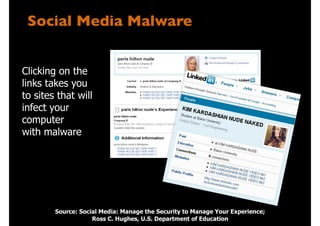
Social Media Malware
Clicking on the
links takes you
to sites that will
infect your
computer
with malware
Source: Social Media: Manage the Security to Manage Your Experience;
Ross C. Hughes, U.S. Department of Education
Phishing
Sources/ Luc Pooters, Triforensic, 2011
DATA
THEFT
Social engineering
Sources/ Luc Pooters, Triforensic, 2011
Take my stuff,
please!
Source: The Risks of Social Networking IT Security Roundtable Harvard Townsend

Chief Information Security Officer Kansas State University
3rd Party
Applications
•Games,	quizzes,	cutesie	stuff	
•Untested	by	Facebook	–	anyone	
can	write	one	
•No	Terms	and	CondiVons	–	you	
either	allow	or	you	don’t	
•InstallaVon	gives	the	developers	
rights	to	look	at	your	profile	and	
overrides	your	privacy	seYngs!
Source: The Risks of Social Networking IT Security Roundtable Harvard Townsend

Chief Information Security Officer Kansas State University
Big data
182
Biometry
186
facial recognition
187
RFID & internet of things
188
http://www.ibmbigdatahub.com/sites/default/files/public_images/IoT.jpg
SECURITY ???
87
“It is not the strongest of the species that survives,
nor the most intelligent that survives.
It is the one that is the most adaptable to change.”
C. Darwin
ANY QUESTIONS ?
Ichec dig strat gdpr

Ichec dig strat gdpr

  • 1.
    Digital Business &GDPR Jacques Folon Partner Edge Consulting Maître de conférences Université de Liège Professeur ICHEC Professeur invité Université de Lorraine (Metz) Visiting professor ESC Rennes School of Business
  • 2.
    https://gdprfolder.eu © 2018 GDPRFOLDER.EUSPRL All Rights Reserved. Every company & self employed is concerned SM E Self employed Non profit Private sector Public sector
  • 3.
    https://gdprfolder.eu © 2018 GDPRFOLDER.EUSPRL All Rights Reserved. employees Prospects ContactsUsers & clients Which Data ?
  • 5.
  • 6.
  • 7.
    Average number ofFacebook « friends » in France: 177 in 2018 30
  • 8.
  • 9.
    4 By giving peoplethe power to share, we're making the world more transparent. The question isn't, 'What do we want to know about people?', It's, 'What do people want to tell about themselves?' Data privacy is outdated ! Mark Zuckerberg If you have something that you don’t want anyone to know, maybe you shouldn’t be doing it in the first place. Eric Schmidt
  • 10.
  • 14.
  • 15.
  • 16.
  • 17.
  • 18.
  • 19.
  • 20.
  • 21.
  • 23.
    1 Privacy statement confusion •53% of consumers consider that a privacy statement means that data will never be sell or give • 43% only have read a privacy statement • 45% only use different email addresses • 33% changed passwords regularly • 71% decide not to register or purchase due to a request of unneeded information • 41% provide fake info 112 Source: TRUSTe survey
  • 24.
  • 25.
    The person whotook the photo is a real friend 25 http://cdn.motinetwork.net/motifake.com/image/demotivational-poster/1202/reality-drunk-reality-fail-drunkchicks-partyfail-demotivational-posters-1330113345.jpg
  • 26.
  • 27.
  • 28.
  • 29.
  • 30.
  • 35.
    From Big Brotherto Big Other
  • 36.
    http://fr.slideshare.net/bodyspacesociety/casilli-privacyehess-2012def Antonio Casili • Importanceof T&C • Everybody speaks • mutual surveillance • Lateral surveillance
  • 37.
  • 38.
  • 39.
  • 40.
    Interactions controlled bycitizens in the Information Society http://ipts.jrc.ec.europa.eu/home/report/english/articles/vol79/ICT1E796.htm
  • 41.
    Interactions NOT controlledby citizens in the Information Society http://ipts.jrc.ec.europa.eu/home/report/english/articles/vol79/ICT1E796.htm
  • 42.
  • 44.
    Codes of conductsand certifications !44
  • 53.
  • 54.
  • 55.
  • 56.
    IN 3 WORDS !56 •GDPR IS A "REGULATION" >< "DIRECTIVE" • WORLDWIDE INFLUENCE • CONSEQUENCES FOR COMPANIES AND PUBLIC SECTOR
  • 57.
    !57 MAY 2018 ENTRY INTOFORCE MAY 25,2018 DISCUSSED SINCE 2014 VOTED IN 2016 RISKS PENALTIES 4% ANNUAL TO 20 M € COMPENSATION IN COURT REPUTATION IMPACT CONTRACT PROCESSES MARKETING ORGANISATION
  • 58.
    B : SOMEDEFINITIONS… !58
  • 59.
    PERSONAL DATA !59 ‘personal data’means any information relating to an identified or identifiable natural person (‘data subject’); an identifiable natural person is one who can be identified, directly or indirectly, in particular by reference to an identifier such as a name, an identification number, location data, an online identifier or to one or more factors specific to the physical, physiological, genetic, mental, economic, cultural or social identity of that natural person;
  • 60.
    PROCESSING !60 ‘processing’ means anyoperation or set of operations which is performed on personal data or on sets of personal data, whether or not by automated means, such as collection, recording, organisation, structuring, storage, adaptation or alteration, retrieval, consultation, use, disclosure by transmission, dissemination or otherwise making available, alignment or combination, restriction, erasure or destruction;
  • 61.
    CONTROLLER !61 controller’ means thenatural or legal person, public authority, agency or other body which, alone or jointly with others, determines the purposes and means of the processing of personal data; where the purposes and means of such processing are determined by Union or Member State law, the controller or the specific criteria for its nomination may be provided for by Union or Member State law;
  • 62.
    processor or sub-contractor !62 processormeans a natural or legal person, public authority, agency or other body which processes personal data on behalf of the controller
  • 63.
    Sub-contractor 129 The Member Statesshall provide that the controller must, where processing is carried out on his behalf, choose a processor providing sufficient guarantees in respect of the technical security measures and organizational measures governing the processing to be carried out, and must ensure compliance with those measures
  • 64.
    64 The carrying outof processing by way of a processor must be governed by a contract or legal act binding the processor to the controller and stipulating in particular that: - the processor shall act only on instructions from the controller, - the obligations as defined by the law of the Member State in which the processor is established, shall also be incumbent on the processor
  • 65.
    data breach !65 personal databreach’ means a breach of security leading to the accidental or unlawful destruction, loss, alteration, unauthorised disclosure of, or access to, personal data transmitted, stored or otherwise processed
  • 66.
    C : 12MAIN PRINCIPLES OF GDPR !66 1. Accountability 2. Consumer / citizen rights 3. Privacy by design 4. Information security 5. Data breach 6. Penalties 7. identity access management 8. lawfulness for processing 9. Register 10.Risk analysis and PIA 11.Training 12.Data privacy officer
  • 67.
  • 68.
  • 71.
    PRIVACY POLICY ORREGULATION OR …
  • 72.
    2/ Consumer/citizen's right !72 TRANSPARENCY SENSITIVEINFORMATIONS INFORMATION COLLECTED RIGHT OF ACCESS RIGHT TO RECTIFICATION RIGHT TO ERASE RIGHT OF PROCESSING LIMITATION PORTABILITY RIGHT OF OPPOSITION TO PROFILING
  • 73.
  • 74.
    right to beforgotten ?
  • 75.
    Right to beforgotten • On 13.05.2014 the European Union Court of Justice backed a ruling called “the right to be forgotten,” which allows individuals to control their data and ask search engines, such as Google, to remove inadequate personal results from the Internet. • However, the decision cannot be interpreted as a “victory” for the protection of the personal data of Europeans, according to privacy experts.
  • 76.
    • In 2010a Spanish citizen lodged a complaint against a Spanish newspaper with the national Data Protection Agency and against Google Spain and Google Inc. • The citizen complained that an auction notice of his repossessed home on Google’s search results infringed his privacy rights because the proceedings concerning him had been fully resolved for a number of years and hence the reference to these was entirely irrelevant. • He requested, first, that the newspaper be required either to remove or alter the pages in question so that the personal data relating to him no longer appeared; • and second, that Google Spain or Google Inc. be required to remove the personal data
  • 77.
    • In itsruling of 13 May 2014 the EU Court said : • a)On the territoriality of EU rules: Even if the physical server of a company processing data islocated outside Europe, EU rules apply to search engine operators if they have a branch or a sub sidiary in a Member State which promotes the selling of advertising space offered by the search engine; • b)On the applicability of EU data protection rules to a search engine : Search engines are controllers of personal data. Google can therefore not escape its responsibilities before European lawwhen handling personal data by saying it is a search engine. EU data protection law applies and so does the right to be forgotten. • c) On the “Right to be Forgotten” : Individuals have the right - under certain conditions - to ask search engines to remove links with personal information about them.This applies where the information is inaccurate, inadequate, irrelevant or excessive for the purposes of the data
  • 78.
    • At thesame time, the Court explicitly clarified that the right to be forgotten is not absolute but will always need to be balanced against other fundamental rights, such as the freedom of expression and of the media
  • 79.
    • Right toerasure (future rules?) • 1.The data subject shall have the right to obtain from the controller the erasure of personal data relating to them and the abstention from further dissemination of such data, and to obtain from third parties the erasure of any links to, or copy or replication of that data, where one of the following grounds applies: • (a) the data are no longer necessary in relation to the purposes for which they were collected or otherwise processed • (b) the data subject withdraws consent on which the processing is based according • (c) when the storage period consented to has expired and where there is no other legal ground for the processing of the data
  • 80.
    3/ PRIVACY BYDESIGN !80
  • 81.
  • 82.
    Look at theentire data lifecycle
  • 83.
  • 84.
  • 85.
    PRIVACY POLICY ORREGULATION OR …
  • 86.
  • 87.
  • 88.
    2.STORE • SECURITY • ENCRYPTION •AUTHENTICATION • AVAILABILITY • CONFIDENTIALITY • IAM
  • 89.
  • 90.
  • 91.
  • 92.
  • 93.
  • 94.
  • 96.
  • 98.
    SECURITY SOURCE DE L’IMAGE:http://www.techzim.co.zw/2010/05/why-organisations-should-worry-about- security-2/
  • 99.
  • 100.
  • 101.
  • 102.
  • 103.
    Control by theemployer 161SOURCE DE L’IMAGE: http://blog.loadingdata.nl/2011/05/chinese-privacy-protection-to-top-american/
  • 104.
    What your bossthinks...
  • 105.
    Employees share (too)many information and also with third parties
  • 106.
    Where do onesteal data? •Banks •Hospitals •Ministries •Police •Newspapers •Telecoms •... Which devices are stolen? •USB •Laptops •Hard disks •Papers •Binders •Cars
  • 107.
  • 108.
    DATA PRIVACY &THE EMPLOYER 45http://i.telegraph.co.uk/multimedia/archive/02183/computer-cctv_2183286b.jpg
  • 109.
    SO CALLED HIDDENCOSTS 46 http://www.theatlantic.com/technology/archive/2011/09/estimating-the-damage-to-the-us-economy-caused-by-angry-birds/244972/
  • 110.
    May the employercontrol everything?
  • 111.
  • 112.
    Could my employer openmy emails? 169
  • 113.
  • 114.
  • 118.
  • 119.
  • 121.
  • 122.
  • 123.
    86 SECURITY IS ALEGAL OBLIGATION
  • 124.
  • 125.
  • 126.
  • 127.
    So it isa real threat !
  • 128.
  • 129.
    7/ IDENTITY ACCESSMANAGEMENT !129
  • 130.
    8/ LAWFULNESS OFPROCESSING !130 CONSENT MUST BE EXPLICIT
  • 131.
    131 'the data subject'sconsent' shall mean any freely given specific and informed indication of his wishes by which the data subject signifies his agreement to personal data relating to him being processed
  • 132.
  • 133.
  • 134.
    134 Member States shallprovide that personal data must be: (a) processed fairly and lawfully; (b) collected for specified, explicit and legitimate purposes and not further processed in a way incompatible with those purposes. Further processing of data for historical, statistical or scientific purposes shall not be considered as incompatible provided that Member States provide appropriate safeguards; (c) adequate, relevant and not excessive in relation to the purposes for which they are collected and/or further processed; (d) accurate and, where necessary, kept up to date; every reasonable step must be taken to ensure that data which are inaccurate or incomplete, having regard to the purposes for which they were collected or for which they are further processed, are erased or rectified; (e) kept in a form which permits identification of data subjects for no longer than is necessary for the purposes for which the data were collected or for which they are further processed. Member States shall lay down appropriate safeguards for personal data stored for longer periods for historical, statistical or scientific use.
  • 135.
    135 Member States shallprovide that personal data may be processed only if: (a) the data subject has unambiguously given his consent; or (b) processing is necessary for the performance of a contract to which the data subject is party or in order to take steps at the request of the data subject prior to entering into a contract; or (c) processing is necessary for compliance with a legal obligation to which the controller is subject; or (d) processing is necessary in order to protect the vital interests of the data subject; or (e) processing is necessary for the performance of a task carried out in the public interest or in the exercise of official authority vested in the controller or in a third party to whom the data are disclosed
  • 136.
    136 Member States shallprohibit the processing of personal data revealing racial or ethnic origin, political opinions, religious or philosophical beliefs, trade-union membership, and the processing of data concerning health or sex life
  • 137.
    125 Member States shallprovide that the controller or his representative must provide a data subject from whom data relating to himself are collected with at least the following information, except where he already has it: (a) the identity of the controller and of his representative, if any; (b) the purposes of the processing for which the data are intended; (c) any further information such as - the recipients or categories of recipients of the data, - whether replies to the questions are obligatory or voluntary, as well as the possible consequences of failure to reply, - the existence of the right of access to and the right to rectify the data concerning him in so far as such further information is necessary, having regard to the specific circumstances in which the data are collected, to guarantee fair processing in respect of the data subject
  • 138.
  • 142.
    9/ RECORD OFPROCESSING ACTIVITIES !142 RECORD
  • 143.
    10/ RISK ANALYSISAND PIA !143
  • 144.
  • 145.
  • 146.
    12/ DATA PRIVACYOFFICER !146
  • 147.
  • 148.
  • 149.
    METHODOLOGY !149 1. PRELIMINARY AUDIT 2.RISK ANALYSIS 3. LIST OF SERVICES 4. RECORD OF PROCESSING ACTIVITIES 5. ACTION PLAN 6. SERACH FOR COMPLIANCE 7. SOLUTION FOR NON COMPLIANCE 8. CONTINUOUS PROCESSES 9. TRAINING Préparation Implémentation Pérennisation
  • 151.
    154 Source de l’image: http://ediscoverytimes.com/?p=46
  • 153.
    RISKS SOURCE DE L’IMAGE: http://www.tunisie-news.com/artpublic/auteurs/auteur_4_jaouanebrahim.html
  • 154.
    Source: The Risksof Social Networking IT Security Roundtable Harvard Townsend
 Chief Information Security Officer Kansas State University
  • 155.
    The new headof MI6 has been left exposed by a major personal security breach after his wife published intimate photographs and family details on the Facebook website. Sir John Sawers is due to take over as chief of the Secret Intelligence Service in November, putting him in charge of all Britain's spying operations abroad. But his wife's entries on the social networking site have exposed potentially compromising details about where they live and work, who their friends are and where they spend their holidays. http://www.dailymail.co.uk
  • 156.
    Social Media Spam CompromisedFacebook account. Victim is now promoting a shady pharmaceutical Source: Social Media: Manage the Security to Manage Your Experience; Ross C. Hughes, U.S. Department of Education
  • 157.
    Social Media Phishing To:T V V I T T E R.com Now they will have your username and password Source: Social Media: Manage the Security to Manage Your Experience; Ross C. Hughes, U.S. Department of Education
  • 158.
    Social Media Malware Clickingon the links takes you to sites that will infect your computer with malware Source: Social Media: Manage the Security to Manage Your Experience; Ross C. Hughes, U.S. Department of Education
  • 159.
  • 160.
  • 161.
    Social engineering Sources/ LucPooters, Triforensic, 2011
  • 162.
    Take my stuff, please! Source:The Risks of Social Networking IT Security Roundtable Harvard Townsend
 Chief Information Security Officer Kansas State University
  • 163.
  • 164.
  • 165.
  • 166.
  • 167.
    RFID & internetof things 188 http://www.ibmbigdatahub.com/sites/default/files/public_images/IoT.jpg
  • 168.
  • 169.
    87 “It is notthe strongest of the species that survives, nor the most intelligent that survives. It is the one that is the most adaptable to change.” C. Darwin
  • 171.