Creating Competitive Advantage:
Resource and Capabilities
Dr. Laura Sabbado da Rosa
IGR IAE Rennes
University of Rennes 1
The firm internal abilities:
the resources and the capabilities
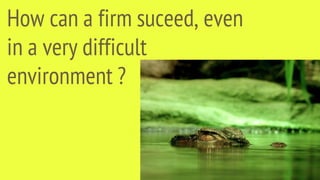
How can a firm suceed, even
in a very difficult
environment ?
The resource based view
Resources
● All assets, capabilities,
organizational processes,
firm attributes,
information, knowledge,
and so on, controlled by
a firm that enable the
firm to conceive of and
implement strategies that
improve its efficiency and
effectiveness
Tangible and
Intangible
Resources
● Physical resources
● Financial resources
● Human resources
● Intangible resources
Capabilities
● Operating capabilities
● Dynamic capabilities
Operating Capabilities
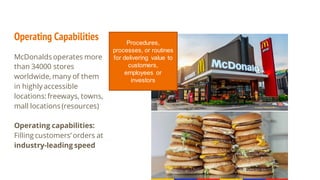
McDonalds operates more
than 34000 stores
worldwide, many of them
in highly accessible
locations:freeways, towns,
mall locations (resources)
Operating capabilities:
Filling customers’ orders at
industry-leading speed
Procedures,
processes, or routines
for delivering value to
customers,
employees or
investors
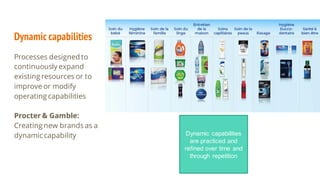
Dynamic capabilities
Processes designed to
continuously expand
existing resources or to
improve or modify
operating capabilities
Procter & Gamble:
Creating new brands as a
dynamic capability Dynamic capabilities
are practiced and
refined over time and
through repetition
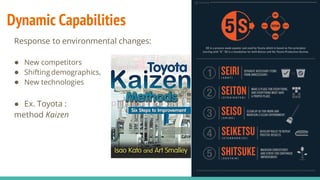
Dynamic Capabilities
Response to environmental changes:
● New competitors
● Shifting demographics,
● New technologies
● Ex. Toyota :
method Kaizen
Dynamic Capabilities
Reinforcing competitive advantage:
● Complex connections and coordination among different internal units within the firm
● Take time to develop and require significantlearning
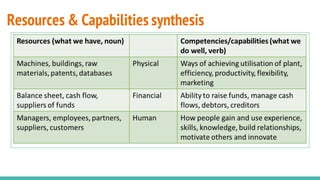
Resources & Capabilities synthesis
Priorities
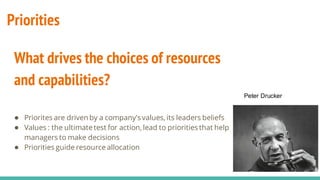
What drives the choices of resources
and capabilities?
● Priorites are driven by a company’s values, its leaders beliefs
● Values : the ultimatetest for action, lead to priorities that help
managers to make decisions
● Priorities guide resource allocation
Peter Drucker
Values &
Priorities at
Pixar
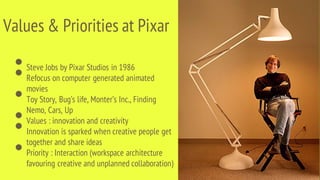
Values & Priorities at Pixar
•Steve Jobs by Pixar Studios in 1986
•Refocus on computer generated animated
movies
•Toy Story, Bug’s life, Monter’s Inc., Finding
Nemo, Cars, Up
•Values : innovation and creativity
•Innovation is sparked when creative people get
together and share ideas
•Priority : Interaction (workspace architecture
favouring creative and unplanned collaboration)
Values & Priorities at Pixar
Promoting interaction for
innovation and creativity
John
Lasseter –
Chief Creative
Officer
Creating a Sustainable Competitive Advantage :
The VRIO Model of Sustainability (Barney, 1991)
Competitive advantage arises when R&C have two attributes:
● Value: worth or utility
● Rarity: to be uncommon, or not availableto other competitors
Sustainability arises when R&C have the following attributes:
● Inimitability: difficultya competitor would face in copying, imitatingthe value of the
resource
● Organisation to exploit profits
Creating a Sustainable Competitive Advantage :
The VRIO Model of Sustainability
Don’t mess
with the
mouse!
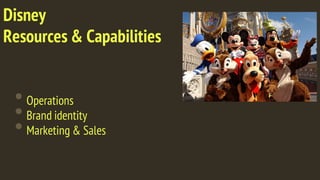
Disney
Resources & Capabilities
•Operations
•Brand identity
•Marketing & Sales
VRIO Model
Value:
Denotes worth for customers
For example:
pleasure, satisfactionor happiness to
the end user
VRIO Model
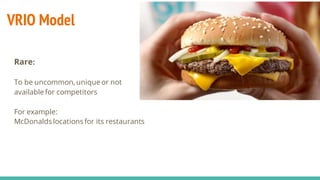
Rare:
To be uncommon, uniqueor not
available for competitors
For example:
McDonalds locations for its restaurants
VRIO Model
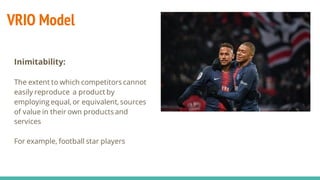
Inimitability:
The extent to which competitors cannot
easily reproduce a product by
employing equal, or equivalent, sources
of value in their own products and
services
For example, football star players
VRIO Model
Factors driving inimitability:
Path dependence
Tacit knowledge
Causal ambiguity
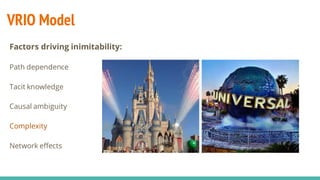
Complexity
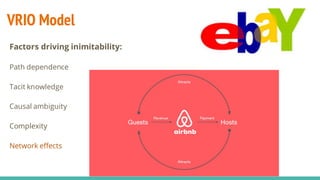
Network effects
VRIO Model
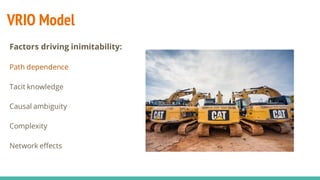
Factors driving inimitability:
Path dependence
Tacit knowledge
Causal ambiguity
Complexity
Network effects
VRIO Model
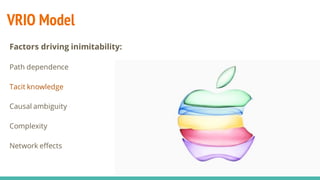
Factors driving inimitability:
Path dependence
Tacit knowledge
Causal ambiguity
Complexity
Network effects
VRIO Model
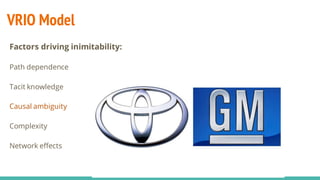
Factors driving inimitability:
Path dependence
Tacit knowledge
Causal ambiguity
Complexity
Network effects
VRIO Model
Factors driving inimitability:
Path dependence
Tacit knowledge
Causal ambiguity
Complexity
Network effects
VRIO Model
Factors driving inimitability:
Path dependence
Tacit knowledge
Causal ambiguity
Complexity
Network effects
VRIO Model
Organized to exploit
The degree to which the legal,
administrative,and operating structure
of the firm allows it to capture the rents
generated by resources
Assessing Competitive Advantage
response to a
competitive threat
Assessing Competitive Advantage
Resources and Competitive Advantage
● Competitive failure: when firms that can’t create value for their stakeholdersdon’t
survive
● Competitive parity: when a company survives but has no real competitiveadvantage
over rivals
● Sustainedcompetitiveadvantage:when firms combine the legal elements,
intellectual property rights, administrativeelements, and cultural elements allowing
them to capturehigh profits that come from their valuable,rare and imitable
resources or capabilities
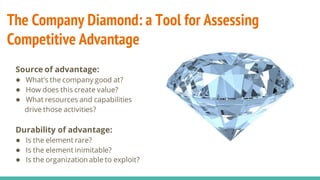
The Company Diamond: a Tool for Assessing
Competitive Advantage
Source of advantage:
● What’s the company good at?
● How does this create value?
● What resources and capabilities
drive those activities?
Durability of advantage:
● Is the element rare?
● Is the element inimitable?
● Is the organization able to exploit?
Gathering Data for Company Diamond Analysis
1. Archival data: written or numeric information in the library or on the Internet
(Bloomberg, Businessweek, Fortune, Wall Street Journal, etc.)
2. Observation: Your own experiences, such as visits or use of productsor services
3. Interviews: personal questions, surveys
Be very careful to balance your data sources. Don’t rely exclusivelyon data providedby
the company or solely data that come from the company’s detractors.
The more attentionyou pay to gathering, verifying and comparing the data, the
reacher, more robust, and more insightfulyour finished product will be.
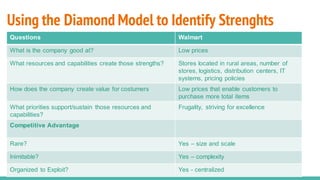
Using the Diamond Model to Identify Strenghts
Questions Walmart
What is the company good at? Low prices
What resources and capabilities create those strengths? Stores located in rural areas, number of
stores, logistics, distribution centers, IT
systems, pricing policies
How does the company create value for costumers Low prices that enable customers to
purchase more total items
What priorities support/sustain those resources and
capabilities?
Frugality, striving for excellence
Competitive Advantage
Rare? Yes – size and scale
Inimitable? Yes – complexity
Organized to Exploit? Yes - centralized
Analyzing a firm’s internal resources and
capabilities
● Include multiple types of data
● Go beyond data and information provided by the firm
● Use multiplesources within each type
● Make a motion picture, don’t just take a snapshot
● Use different data sources for private companies
Measures of resources and capabilities
● Physical resources:
○ Productive capacity: annual revenues/number of employees, annual revenues/production square metres
○ Investment service: capital expenditures
○ Location: number of locations versus competitors, ease of access for customers/suppliers versus
competitors
● Financial resources:
○ Borrowing capacity: debt ratio versus industry average; debt-equity ratio versus industry average, net
cash flow to total invested capital
○ Liquidity: current ration, credit rating, gross cash flow
○ Sustainable growth rate: ROE
Measures of resources and capabilities
● Human resources:
○ Education: Sum of employees’ years of education
○ Training: training hours/year per employee
○ Employee commitment: percent of absentee days versus industry average, total amount of sick leave
taken
○ Trust: number of complaints
● Intangible resources:
○ Organizational knowledge: average employee tenure, employee turnover versus industry average
○ Reputation/brand: customer satisfaction score, percent of revenue from repeat customers, average
length of customer relationship, brand equity measures
○ Patents and intellectual property: Total number of patents, trademarks, and copyrights
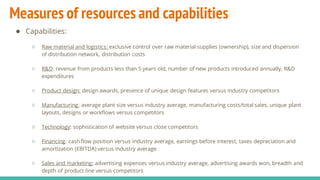
Measures of resources and capabilities
● Capabilities:
○ Raw material and logistics: exclusive control over raw material supplies (ownership), size and dispersion
of distribution network, distribution costs
○ R&D: revenue from products less than 5 years old, number of new products introduced annually, R&D
expenditures
○ Product design: design awards, presence of unique design features versus industry competitors
○ Manufacturing: average plant size versus industry average, manufacturing costs/total sales, unique plant
layouts, designs or workflows versus competitors
○ Technology: sophistication of website versus close competitors
○ Financing: cash flow position versus industry average, earnings before interest, taxes depreciation and
amortization (EBITDA) versus industry average
○ Sales and marketing: advertising expenses versus industry average, advertising awards won, breadth and
depth of product line versus competitors
Contact
Laura Sabbado da Rosa
lsabbado@univ-rennes1.fr
This training material is part of the FogGuru project that has received funding from the European Union’s
Horizon 2020 research and innovation programme under the Marie Skłodowska-Curie grant agreement No
765452. The information and views set out in this material are those of the author(s) and do not necessarily
reflect the official opinion of the European Union. Neither the European Union institutions and bodies nor any
person acting on their behalf may be held responsible for the use which may be made of the information
contained therein.

Creating Competitive Advantage: Resource and Capabilities

  • 1.
    Creating Competitive Advantage: Resourceand Capabilities Dr. Laura Sabbado da Rosa IGR IAE Rennes University of Rennes 1
  • 2.
    The firm internalabilities: the resources and the capabilities
  • 3.
    How can afirm suceed, even in a very difficult environment ?
  • 4.
  • 5.
    Resources ● All assets,capabilities, organizational processes, firm attributes, information, knowledge, and so on, controlled by a firm that enable the firm to conceive of and implement strategies that improve its efficiency and effectiveness
  • 6.
    Tangible and Intangible Resources ● Physicalresources ● Financial resources ● Human resources ● Intangible resources
  • 7.
  • 8.
    Operating Capabilities McDonalds operatesmore than 34000 stores worldwide, many of them in highly accessible locations:freeways, towns, mall locations (resources) Operating capabilities: Filling customers’ orders at industry-leading speed Procedures, processes, or routines for delivering value to customers, employees or investors
  • 9.
    Dynamic capabilities Processes designedto continuously expand existing resources or to improve or modify operating capabilities Procter & Gamble: Creating new brands as a dynamic capability Dynamic capabilities are practiced and refined over time and through repetition
  • 10.
    Dynamic Capabilities Response toenvironmental changes: ● New competitors ● Shifting demographics, ● New technologies ● Ex. Toyota : method Kaizen
  • 11.
    Dynamic Capabilities Reinforcing competitiveadvantage: ● Complex connections and coordination among different internal units within the firm ● Take time to develop and require significantlearning
  • 12.
  • 13.
    Priorities What drives thechoices of resources and capabilities? ● Priorites are driven by a company’s values, its leaders beliefs ● Values : the ultimatetest for action, lead to priorities that help managers to make decisions ● Priorities guide resource allocation Peter Drucker
  • 14.
  • 15.
    Values & Prioritiesat Pixar •Steve Jobs by Pixar Studios in 1986 •Refocus on computer generated animated movies •Toy Story, Bug’s life, Monter’s Inc., Finding Nemo, Cars, Up •Values : innovation and creativity •Innovation is sparked when creative people get together and share ideas •Priority : Interaction (workspace architecture favouring creative and unplanned collaboration)
  • 16.
    Values & Prioritiesat Pixar Promoting interaction for innovation and creativity John Lasseter – Chief Creative Officer
  • 17.
    Creating a SustainableCompetitive Advantage : The VRIO Model of Sustainability (Barney, 1991) Competitive advantage arises when R&C have two attributes: ● Value: worth or utility ● Rarity: to be uncommon, or not availableto other competitors Sustainability arises when R&C have the following attributes: ● Inimitability: difficultya competitor would face in copying, imitatingthe value of the resource ● Organisation to exploit profits
  • 18.
    Creating a SustainableCompetitive Advantage : The VRIO Model of Sustainability Don’t mess with the mouse!
  • 19.
  • 20.
    VRIO Model Value: Denotes worthfor customers For example: pleasure, satisfactionor happiness to the end user
  • 21.
    VRIO Model Rare: To beuncommon, uniqueor not available for competitors For example: McDonalds locations for its restaurants
  • 22.
    VRIO Model Inimitability: The extentto which competitors cannot easily reproduce a product by employing equal, or equivalent, sources of value in their own products and services For example, football star players
  • 23.
    VRIO Model Factors drivinginimitability: Path dependence Tacit knowledge Causal ambiguity Complexity Network effects
  • 24.
    VRIO Model Factors drivinginimitability: Path dependence Tacit knowledge Causal ambiguity Complexity Network effects
  • 25.
    VRIO Model Factors drivinginimitability: Path dependence Tacit knowledge Causal ambiguity Complexity Network effects
  • 26.
    VRIO Model Factors drivinginimitability: Path dependence Tacit knowledge Causal ambiguity Complexity Network effects
  • 27.
    VRIO Model Factors drivinginimitability: Path dependence Tacit knowledge Causal ambiguity Complexity Network effects
  • 28.
    VRIO Model Factors drivinginimitability: Path dependence Tacit knowledge Causal ambiguity Complexity Network effects
  • 29.
    VRIO Model Organized toexploit The degree to which the legal, administrative,and operating structure of the firm allows it to capture the rents generated by resources
  • 30.
  • 31.
    Assessing Competitive Advantage Resourcesand Competitive Advantage ● Competitive failure: when firms that can’t create value for their stakeholdersdon’t survive ● Competitive parity: when a company survives but has no real competitiveadvantage over rivals ● Sustainedcompetitiveadvantage:when firms combine the legal elements, intellectual property rights, administrativeelements, and cultural elements allowing them to capturehigh profits that come from their valuable,rare and imitable resources or capabilities
  • 32.
    The Company Diamond:a Tool for Assessing Competitive Advantage Source of advantage: ● What’s the company good at? ● How does this create value? ● What resources and capabilities drive those activities? Durability of advantage: ● Is the element rare? ● Is the element inimitable? ● Is the organization able to exploit?
  • 33.
    Gathering Data forCompany Diamond Analysis 1. Archival data: written or numeric information in the library or on the Internet (Bloomberg, Businessweek, Fortune, Wall Street Journal, etc.) 2. Observation: Your own experiences, such as visits or use of productsor services 3. Interviews: personal questions, surveys Be very careful to balance your data sources. Don’t rely exclusivelyon data providedby the company or solely data that come from the company’s detractors. The more attentionyou pay to gathering, verifying and comparing the data, the reacher, more robust, and more insightfulyour finished product will be.
  • 34.
    Using the DiamondModel to Identify Strenghts Questions Walmart What is the company good at? Low prices What resources and capabilities create those strengths? Stores located in rural areas, number of stores, logistics, distribution centers, IT systems, pricing policies How does the company create value for costumers Low prices that enable customers to purchase more total items What priorities support/sustain those resources and capabilities? Frugality, striving for excellence Competitive Advantage Rare? Yes – size and scale Inimitable? Yes – complexity Organized to Exploit? Yes - centralized
  • 35.
    Analyzing a firm’sinternal resources and capabilities ● Include multiple types of data ● Go beyond data and information provided by the firm ● Use multiplesources within each type ● Make a motion picture, don’t just take a snapshot ● Use different data sources for private companies
  • 36.
    Measures of resourcesand capabilities ● Physical resources: ○ Productive capacity: annual revenues/number of employees, annual revenues/production square metres ○ Investment service: capital expenditures ○ Location: number of locations versus competitors, ease of access for customers/suppliers versus competitors ● Financial resources: ○ Borrowing capacity: debt ratio versus industry average; debt-equity ratio versus industry average, net cash flow to total invested capital ○ Liquidity: current ration, credit rating, gross cash flow ○ Sustainable growth rate: ROE
  • 37.
    Measures of resourcesand capabilities ● Human resources: ○ Education: Sum of employees’ years of education ○ Training: training hours/year per employee ○ Employee commitment: percent of absentee days versus industry average, total amount of sick leave taken ○ Trust: number of complaints ● Intangible resources: ○ Organizational knowledge: average employee tenure, employee turnover versus industry average ○ Reputation/brand: customer satisfaction score, percent of revenue from repeat customers, average length of customer relationship, brand equity measures ○ Patents and intellectual property: Total number of patents, trademarks, and copyrights
  • 38.
    Measures of resourcesand capabilities ● Capabilities: ○ Raw material and logistics: exclusive control over raw material supplies (ownership), size and dispersion of distribution network, distribution costs ○ R&D: revenue from products less than 5 years old, number of new products introduced annually, R&D expenditures ○ Product design: design awards, presence of unique design features versus industry competitors ○ Manufacturing: average plant size versus industry average, manufacturing costs/total sales, unique plant layouts, designs or workflows versus competitors ○ Technology: sophistication of website versus close competitors ○ Financing: cash flow position versus industry average, earnings before interest, taxes depreciation and amortization (EBITDA) versus industry average ○ Sales and marketing: advertising expenses versus industry average, advertising awards won, breadth and depth of product line versus competitors
  • 39.
    Contact Laura Sabbado daRosa lsabbado@univ-rennes1.fr
  • 40.
    This training materialis part of the FogGuru project that has received funding from the European Union’s Horizon 2020 research and innovation programme under the Marie Skłodowska-Curie grant agreement No 765452. The information and views set out in this material are those of the author(s) and do not necessarily reflect the official opinion of the European Union. Neither the European Union institutions and bodies nor any person acting on their behalf may be held responsible for the use which may be made of the information contained therein.