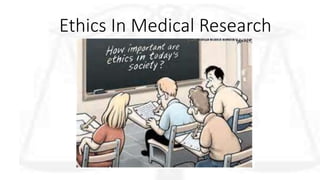
Ethics In Medical Research
Overview
• Importance of medical research
• Evolution of ethics
• Chief principles of ethics
• Ethics committee
• Conflict of interest
• Informed consent
• Informed consent in vulnerable population
• Ethics in animal research
• Euthanasia
Clinical scenario
• Dr. R, a general practitioner in a small rural town, is approached to participate in a
clinical trial of a NSAID for osteoarthritis. She is offered a sum of money for each
patient that she enrols in the trial. She is assured that the trial has received all the
necessary approvals, including one from an ethics review committee. Dr. R has never
participated in a trial before and is pleased to have this opportunity, especially with
the extra money.
Importance of medical research
• Medicine is not an exact science
• Every patient is different and what is an effective treatment for 90% of the
population may not work for the other 10%
• Seeking a better understanding of human physiology, medical research
investigates a wide variety of other factors in human health, including patterns of
disease (epidemiology), the organization, funding and delivery of healthcare
(health systems research), social and cultural aspects of health (medical sociology
and anthropology), law (legal medicine) and ethics (medical ethics).
Morality and ethics
Morality
Ethics
The science of human duty; the rules of
human conduct.
Ethics are standards of conduct (or social
norms) that prescribe behaviour
• Standards of conduct that apply to people
who occupy a professional occupation or
role
Professional
ethics
• Special subtype of professional ethics
pertaining to medical practiceMedical ethics
• Defined as study of ethical issues and
decision-making associated with the use of
living organisms ( also includes animal ethics)
Bioethics
• Provides a structured approach for
identifying ,analyzing, and resolving ethical
issues in clinical medicine
Clinical ethics
Physician or researcher??
The physician’s primary
responsibility is the health
and well-being of the
patient, whereas the
researcher’s primary
responsibility is the
generation of knowledge,
which may or may not
contribute to the research
subject’s health and
wellbeing
Need for ethics
• Many prominent medical researchers in the 19th and 20th centuries conducted
experiments on patients without their consent and with little if any concern for the
patients well-being
• Following World War II, some of these physicians were tried and convicted by a special
tribunal at Nuremberg, Germany.
• The basis of the judgment is known as the Nuremberg Code, which has served as one
of the foundational documents of modern research ethics.
• Among the ten principles of this Code is the requirement of voluntary consent if a
patient is to serve as a research subject.
History
• Western Medical Ethics : Can be traced to Hippocratic oath
• Thomas Perciva : coined medical ethics and medical
jurisprudence
• 1847, the American Medical Association adopted its first
code of ethics
Emergence of ethics code
• Nuremberg Code-1947
• Specific to medical experiments
• Emerged from Nazi war crimes
• Experiments conducted on prisoners in
concentration camps (relevant?)
Key Principles of Nuremberg Code
• Voluntary
• Protects subject against even remote possibility of harm
• Avoid unnecessary suffering
• Subjects should be at liberty to discontinue experiment
• For good of society
• Should be based on animal experiments
• Risk commensurate with benefits
• Do not conduct if death and debility likely
• Conducted only by qualified persons
• Terminate if becomes apparent that death or debility will occur
Belmont report
Belmont report
Basic Ethical Principles:
Respect for Persons
• Individual autonomy
• Protection of individuals with reduced autonomy
Beneficence
• Maximize benefits and minimize harms
Justice
• Equitable distribution of research costs and benefits
Declaration of Helsinki
• Declaration was originally adopted on June 1964 in Helsinki,
Finland, and has since undergone seven revisions (the most
recent at the General Assembly in October 2013
• Declaration of Helsinki is a set of ethical principles regarding
human experimentation developed for the medical
community by the World Medical Association (WMA).
• It is widely regarded as the cornerstone document on human
research ethics
• Respect for the individual
• Right to make informed decisions regarding participation in research
• Research should be based on a thorough knowledge of the scientific background
• Careful assessment of risks and benefits
• Conducted by suitably trained investigators using approved protocols,
• Subject to independent ethical review
• Information regarding the study should be publicly available
• Experimental investigations should always be compared against the best methods, but
under certain circumstances a placebo or no treatment group may be utilised
Present status
On April 28, 2008 a final rule was passed replacing the
Declaration of Helsinki with Good Clinical Practice effective
October 2008
Values in medical ethics
“Four principles" approach postulated by Tom
Beauchamp and James Childress
• Respect for autonomy - the patient has the right to
refuse or choose their treatment.
• Beneficence - a practitioner should act in the best
interest of the patient.
• Non-maleficence - "first, do no harm"
• Justice - fairness and equality.
● Recognizes the rights of individuals
● A general indicator of health.
● Indicator for both personal well-
being, and for the well-being of the
profession
● “First, do no harm," or the
Latin, primum nocere
● Enthusiastic practitioners are
prone to using treatments that they
believe will do good
● Actions that promote the well
being of others
● Serve the best interests of patients
● Endeavors like euthanasia??
● Two types of consequences that
may be produced by a single action
ETHICS
AUTONOMY
BENEFECIENCE
NON-MALEFICENCE
DOUBLE EFFECT
ICMR
• In 1911- Indian research Fund Association was set up with the
objective of sponsoring and coordinating medical research in india
• Re-designated in 1949 as ICMR
ICMR Code:
• Statement of General Principles on Research using human
participants in Biomedical Research
• Statement of Specific Principles on Research using human participants
in specific areas of Biomedical Research
General Statement
PURPOSE
CONDUCTED
EVALUATION
Principle of research
Essentiality
Voluntary
and
informed
consent
Non
exploitation
Privacy and
confidential
Risk
Minimisation
Professional
Competence
Trans
parency
Public
Interest
Institutional
Agreement
Compliance
Public
Domain
Totality of
Responsibility
Ethics
Committee
Members of the ethics committee
• Chairperson
• Member Secretary
• 1-2 persons from basic medical science area
• 1-2 clinicians
• 1 legal expert or a retired judge
• 1 social scientist/ member of non-government organization
• 1philosopher/ethicist/theologian
• 1 lay person from the community
What is the IRB evaluating?
• Is study design consistent with sound scientific
principles and ethical norms?
• Does the protocol meet project assurance criteria
for approval?
• Have the necessary elements of informed consent
been fulfilled?
• Are additional appropriate safeguards provided if
potentially vulnerable subjects are to be studied?
Purpose of ethics committee
• Promote the rights of patients;
• Promote shared decision making between patients (or their surrogates if
decisionally incapacitated) and their clinicians;
• Promote fair policies and procedures that maximize the likelihood of achieving
good, patient-centered outcomes
• Enhance the ethical environment for health care professionals in health care
institutions
Ethic committee review and submission
• All submissions are reviewed by at least one appropriate evaluator who takes
his/her comments to the next consecutive meeting of the IEC.
• At this meeting, the evaluator’s comments are discussed, and the agreed upon
queries are then compiled by the secretariat and sent by fax to the applicant.
Review Procedures
Member secretary or secretariat to screen the proposals for their completeness
and categorise them based on the risk involved into:
• Exemption from review
• Expedited review
• Full review
Proposal which present with less than minimal risk
No more than minimal risk
Minor deviations from original research
Revised proposal
Research already approved except when studying a
particular interaction
Human research
• How do you define human research???
Research that involves volunteers, such that data is derived from:
• Living individual
• Biological material from living individuals
• Interaction or Intervention with a living individual
• Use of a non FDA approved drug, device or biological tool
Confidentiality
• Applied to conversations between doctors and patients
• Known as patient-physician privilege.
• Legal protections prevent physicians from revealing their discussions
• Physicians to report gunshot wounds to the police
• Impaired drivers to the Department of Motor Vehicles.
• Diagnosis of a sexually transmitted disease in a patient who refuses to reveal the
diagnosis to a spouse
• Termination of a pregnancy in an underage patient, without the knowledge of
the patient's parents
Conflict
Of
Interest
Conflict of Interest
• Conflict of interest (COI) is a situation in which a person or organization is involved in
multiple interests (financial, emotional, or otherwise), one of which could possibly
corrupt the motivation of the individual or organization.
• Primary interest refers to the principal goals of the profession.
• Secondary interest includes not only financial gain but also such motives as the desire
for professional advancement and the wish to do favours for family and friends.
Types of conflicts of interest
Conflicts of Interest
Conflicts between
the patients
interest and the
physicians interest
Conflicts that divide
a physicians loyalty
between a patient
and a third party
Conflicts of
interest
Referral
Fee
splitting
Vendor
relation
ships
Family
member
Sexual
Relation
ships
Publication
Incentives to Increase services
• Fee for service practice
• Kickbacks for referrals
• Income for dispensing drugs, medical
products
• Hospital purchase of physician practices
• Payment made by hospitals to recruit and
bond physicians
• Gifts to physicians by medical suppliers
6 Ps that can determine COI
• Public duty vs Private interest
• Potentialities
• Perception
• Proportionality
• Presence of mind
• Promises and publication
Factors that undermine the confidence of
public in medicine
• Not publishing negative results from industry-sponsored clinical trials or delaying
publication after trial completion;
• Physicians and researchers failing to disclose substantial payments from
pharmaceutical companies
• Settlements between federal prosecutors and medical device and pharmaceutical
companies related to alleged illegal payments or gifts to physicians
Informed consent
Informed consent" is a technical term first used in a medical
malpractice United States court case in 1957
• a patient agrees to a health intervention based on an
understanding of it
• the patient has multiple choices and is not compelled to choose
a particular one
• the consent includes giving permission
What does the consent imply ?
• A subject’s voluntary confirmation of willingness to participate in a particular trial and
the documentation thereof
• Both oral and written information should be provided to the subject in a simple and
understandable language
• Participation is voluntary
• Should not be forced to participate
• Information should be kept confidential
• Subject should have knowledge about insurance, compensation, and treatment
Elements of informed consent
• Description of the study
• Description of inclusion and exclusion criteria
• Nature of treatment and alternatives
• Number of subjects
• Anticipated risks
• Anticipated benefits
• Information about the study sponsor
• Rights as a research subject
• Who to contact
• Financial information
Fresh or re-consent
• Availability of new information resulting in deviation from protocol
• When a long term follow up is planned later
• When there is change in treatment modality or procedure
• When the participant becomes mentally competent to understand the
study
• Before publication, if there is a chance of disclosure of identity
Waiver of consent
• Research on publicly available information, documents, records
• When study involves minimal risk
• When the researcher does not come in contact with the
participant
• In emergency condition when no surrogate consent can be
taken
• Research on anonymised biological samples from deceased
individuals, cell lines
• Hela or hela cell, is a cell type in an immortal cell line used in
scientific research.
• It is the oldest and most commonly used human cell line.
• The line was derived from cervical cancer cells taken on
February 8, 1951,from Henrietta Lacks, a patient who
eventually died of her cancer on October 4, 1951
Informed consent in vulnerable population
• Vulnerable persons are those who are relatively or
absolutely incapable of protecting their own interest. They
may have insufficient power , intelligence, resources,
strength or other needed attributes to protect their own
rights
• Vulnerability can be intrinsic or circumstantial
Causes of Vulnerability
• Serious Health Conditions: Subject is not in a
condition to understand the procedure or
give consent due to unconsciousness or
trauma
• Inability to make decision: Not able to make
decision due to cognitive disability or lack of
communicative inability
• Economic: Patients who do not have proper
resources to get proper care
• Investigator: evaluate the
degree of vulnerability,
obtain informed consent
• IRB: additional protective
measures to safeguard the
interest of the vulnerable
population; keep a check on
compensation measures
• Informed consent: surrogate
informed consent to be
obtained
Mentally disabled
• Research should be particularly to obtain knowledge relevant to the
particular needs of persons with mental or behavioural disorders
• Permission to be obtained from a family member or a legal guardian
• The persons consent should be respected unless the person is totally
incapable: a personal representative empowered by law gives consent
or a qualified medical health practitioner considers it absolutely
necessary in order to prevent further harm
• All treatment should be mentioned in the record indicating whether its
voluntary or involuntary
Children
• Children: persons who have not attained the legal age for consent
• Assent: an affirmative agreement to participate
• Permission: agreement of parent or guardian to the participation of
their child in research
• Guardian: an individual who is authorised under applicable state or
local law to consent on behalf of a child to general medical care
Parents or legally authorised representatives (proxies) give permission (agreement for the
participation of their child) and children give assent ( affirmative agreement to participate)
Assent should include
• Help the patient achieve a developmentally appropriate awareness of
the nature of his condition
• Telling the patient what he or she can expect with the treatment and
tests
• Making a clinical assessment of the patients understanding of the
situation and the factors involving how he or she is responding
• an expression of the patients willingness to accept the proposed care
Pregnant women
• preclinical studies on pregnant animals have been carried out to evaluate the risk to
pregnant women and foetus
• Risk is caused by the intervention that causes a direct benefit
• If the purpose of benefit is to the pregnant women and foetus
• If no benefits to the foetus then consent from woman and father
• No coercion to terminate pregnancy
• Individuals in research will have no part in any decision of the timing method or
procedure used to terminate pregnancy
Placebo
Is the use of a
placebo
ethical???
• Case 1
• A 45 year old man suffering for many years from diabetes and
hypertension underwent a second leg amputation. Severe pain following
the surgery was treated with injections of intramuscular pethidine, an
opioid analgesic. His pain virtually unabated, the patient demanded
additional therapy. The staff decided to administer, in addition to
pethidine, intramuscular saline. They explained to the patient that
injectible saline had been used as an effective painkiller, and that they
anticipated that it would help his pain as well. The treatment produced
an impressive analgesic effect, to everyone’s satisfaction
Case 2
• During a house call many years ago, one of us (PL) easily diagnosed a 40 year old
male complaining of diarrhoea and abdominal cramps for several hours as
suffering from gastroenteritis. After the physician explained the nature of the
disturbance and offered reassurance that the malady would quickly pass, the
man’s wife, apparently the dominant force in the house, who had been nodding
in seeming understanding and agreement, said: “that’s great, now give him a shot
of penicillin in the butt, that’s what always helps him”. She was adamant, and her
husband was not inclined to express dissent.
• Case 3
• A 32 year old mother of three is being treated for an agitated depression by means of
hypnotherapy. In the course of one of the hypnosis sessions, the client envisions a
bloody scene whose meaning is uncertain but which alarms her terribly. Refusing to
continue with the therapy, she demands medication. The treating psychiatrist, seeing no
alternative, prescribes imipramine at a starting dose of 25 mg, explaining to the patient
that effectiveness generally requires two to four weeks at a dose of 200–300 mg. The
day after taking her first 25 mg dose, she reports that a remarkable improvement has
taken place and virtually all symptoms have subsided. She continues, diffidently, her
psychotherapy. Attempts to discontinue the medication meet with immediate failure.
Practical guidelines to the use of Placebo
• The intentions of the physician must be benevolent
• The placebo, when offered, must be given in the spirit of abating the patient’s suffering
• When proven ineffective the placebo should be immediately withdrawn.
• The placebo cannot be given in place of another medication that the physician reasonably
expects to be more effective
• The physician should not hesitate to respond honestly when asked about the nature and
anticipated effects of the placebo treatment he is offering.
• If the patient is helped by the placebo, discontinuing the placebo, in absence of a more
effective treatment, would be unethical.
“I would like to offer you a pill which I believe
can help lessen your suffering. I do not know
exactly how it works. I have other pills to offer
whose mechanism is clearer, but I am not sure
that they will work better for you, and they may
also entail more serious side effects
Ethics in vaccine research
• Why is it controversial??
• Participate with the knowledge that they are exposed to the risk for the benefit
of the of public heath at large and individual benefit is only provisional
• Ethical questions arise when placebo receiving individuals develop infections
Rotavirus withdrawn from the US market due to a higher incidence of
intussesception
However the large trials in developing countries were considered appropriate
where incidence of child deaths due to rotavirus was high
Ethics in organ transplant
• Time period: for which they have been waiting for
the organ
• Age: younger ones are given more priority
• Cadaver transplant: give consent during lifetime
or opting in( person lawful possession of the
body)
• Presumed consent: has already given permission
unless proved otherwise
Medical ethics in an online world
• medical researchers are researching activities in online
environments
• Disclosure of information
• Some researchers have employed various methods of
"heavy disguise, including discussing a different condition
from that under study, or even setting up bogus sites
(called 'Maryut sites') to ensure that the researched site is
not discovered
Euthanasia
Euthanasia
• practice of intentionally ending a life in order to
relieve pain and suffering
• Netherlands, euthanasia is understood as
"termination of life by a doctor at the request
of a patient
Dr. Jack Kevorkian, who was
convicted of second-degree
homicide in Michigan in 1998
after demonstrating active
euthanasia on the TV news
show 60 Minutes.
Favour
• that people have a right to self
determination, and thus should be
allowed to choose their own fate
• assisting a subject to die might be a
better choice than requiring that they
continue to suffer
• the distinction between passive
euthanasia, which is often permitted,
and active euthanasia, which is not
substantive
• permitting euthanasia will not
necessarily lead to unacceptable
consequences.
Against
• Not all deaths are painful
• Alternatives, such as cessation of
active treatment, combined with the
use of effective pain relief, are
available
• the distinction between active and
passive euthanasia is morally
significant
• legalising euthanasia will place
society on a slippery slope which will
lead to unacceptable consequences
Each animal has the right to life and humans should
not take such a right away from them
Use of Animals In Research
Ethics and animals
Importance of animals in research
• Use of animals is not permitted where there is an
alternative available
• Number of animals required should be reduced
to the minimum required to get the result
• 5 animals per group needed
Points to be kept in mind
Replacement
ReductionRefinement
Ministry of Environment and Forests
CPCSEA
IAEC IBSC/IBC
CPCSEA Guidelines
• Good Laboratory Practices for animals : assure quality maintenance and safety of
animals in lab
• Goal : promote humane care of animals used in biomedical and behavioural research
• Advancement of new discovery in experimental animals to improve well being of society
• Minimise animal use
• Minimise pain and discomfort
IAEC
• A Biological scientist
• 2 scientist
• Veterinarian
• Scientist in charge of
animals
• Scientist from outside
institute
• Non scientific socially
aware member or a
member of CPCSEA
IBSC
• Head of institution or his
nominee
• 3 or more scientists
engaged in DNA work
• Member with medical
qualification- Biosafety
officer
• One member opted by
Department of
Biotechnology
References
• Shapiro AK, Shapiro E. The powerful placebo: from ancient priest to
modern physician. Baltimore and London: Johns Hopkins University
Press, 1997.
• Emanuel EJ, Miller FG. The ethics of placebo controlled trials: a
middle ground. N Engl J Med2001;345:915–19
• Ross JS, Lackner JE, Lurie P, Gross CP, Wolfe S, Krumholz HM (2007).
"Pharmaceutical company payments to physicians: early experiences
with disclosure laws in Vermont and Minnesota". JAMA 297 (11):
1216–23
• Kimmelman, J.; Weijer, C; Meslin, E (2009). "Helsinki discords: FDA,
ethics, and international drug trials". The Lancet 373 (9657): 13–4
Ethics

Ethics

  • 1.
  • 2.
    Overview • Importance ofmedical research • Evolution of ethics • Chief principles of ethics • Ethics committee • Conflict of interest • Informed consent • Informed consent in vulnerable population • Ethics in animal research • Euthanasia
  • 4.
    Clinical scenario • Dr.R, a general practitioner in a small rural town, is approached to participate in a clinical trial of a NSAID for osteoarthritis. She is offered a sum of money for each patient that she enrols in the trial. She is assured that the trial has received all the necessary approvals, including one from an ethics review committee. Dr. R has never participated in a trial before and is pleased to have this opportunity, especially with the extra money.
  • 5.
    Importance of medicalresearch • Medicine is not an exact science • Every patient is different and what is an effective treatment for 90% of the population may not work for the other 10% • Seeking a better understanding of human physiology, medical research investigates a wide variety of other factors in human health, including patterns of disease (epidemiology), the organization, funding and delivery of healthcare (health systems research), social and cultural aspects of health (medical sociology and anthropology), law (legal medicine) and ethics (medical ethics).
  • 6.
    Morality and ethics Morality Ethics Thescience of human duty; the rules of human conduct. Ethics are standards of conduct (or social norms) that prescribe behaviour
  • 7.
    • Standards ofconduct that apply to people who occupy a professional occupation or role Professional ethics • Special subtype of professional ethics pertaining to medical practiceMedical ethics • Defined as study of ethical issues and decision-making associated with the use of living organisms ( also includes animal ethics) Bioethics • Provides a structured approach for identifying ,analyzing, and resolving ethical issues in clinical medicine Clinical ethics
  • 8.
    Physician or researcher?? Thephysician’s primary responsibility is the health and well-being of the patient, whereas the researcher’s primary responsibility is the generation of knowledge, which may or may not contribute to the research subject’s health and wellbeing
  • 9.
    Need for ethics •Many prominent medical researchers in the 19th and 20th centuries conducted experiments on patients without their consent and with little if any concern for the patients well-being • Following World War II, some of these physicians were tried and convicted by a special tribunal at Nuremberg, Germany. • The basis of the judgment is known as the Nuremberg Code, which has served as one of the foundational documents of modern research ethics. • Among the ten principles of this Code is the requirement of voluntary consent if a patient is to serve as a research subject.
  • 10.
    History • Western MedicalEthics : Can be traced to Hippocratic oath • Thomas Perciva : coined medical ethics and medical jurisprudence • 1847, the American Medical Association adopted its first code of ethics
  • 13.
    Emergence of ethicscode • Nuremberg Code-1947 • Specific to medical experiments • Emerged from Nazi war crimes • Experiments conducted on prisoners in concentration camps (relevant?)
  • 14.
    Key Principles ofNuremberg Code • Voluntary • Protects subject against even remote possibility of harm • Avoid unnecessary suffering • Subjects should be at liberty to discontinue experiment • For good of society • Should be based on animal experiments • Risk commensurate with benefits • Do not conduct if death and debility likely • Conducted only by qualified persons • Terminate if becomes apparent that death or debility will occur
  • 15.
  • 16.
    Belmont report Basic EthicalPrinciples: Respect for Persons • Individual autonomy • Protection of individuals with reduced autonomy Beneficence • Maximize benefits and minimize harms Justice • Equitable distribution of research costs and benefits
  • 18.
    Declaration of Helsinki •Declaration was originally adopted on June 1964 in Helsinki, Finland, and has since undergone seven revisions (the most recent at the General Assembly in October 2013 • Declaration of Helsinki is a set of ethical principles regarding human experimentation developed for the medical community by the World Medical Association (WMA). • It is widely regarded as the cornerstone document on human research ethics
  • 19.
    • Respect forthe individual • Right to make informed decisions regarding participation in research • Research should be based on a thorough knowledge of the scientific background • Careful assessment of risks and benefits • Conducted by suitably trained investigators using approved protocols, • Subject to independent ethical review • Information regarding the study should be publicly available • Experimental investigations should always be compared against the best methods, but under certain circumstances a placebo or no treatment group may be utilised
  • 20.
    Present status On April28, 2008 a final rule was passed replacing the Declaration of Helsinki with Good Clinical Practice effective October 2008
  • 21.
    Values in medicalethics “Four principles" approach postulated by Tom Beauchamp and James Childress • Respect for autonomy - the patient has the right to refuse or choose their treatment. • Beneficence - a practitioner should act in the best interest of the patient. • Non-maleficence - "first, do no harm" • Justice - fairness and equality.
  • 22.
    ● Recognizes therights of individuals ● A general indicator of health. ● Indicator for both personal well- being, and for the well-being of the profession ● “First, do no harm," or the Latin, primum nocere ● Enthusiastic practitioners are prone to using treatments that they believe will do good ● Actions that promote the well being of others ● Serve the best interests of patients ● Endeavors like euthanasia?? ● Two types of consequences that may be produced by a single action ETHICS AUTONOMY BENEFECIENCE NON-MALEFICENCE DOUBLE EFFECT
  • 23.
    ICMR • In 1911-Indian research Fund Association was set up with the objective of sponsoring and coordinating medical research in india • Re-designated in 1949 as ICMR ICMR Code: • Statement of General Principles on Research using human participants in Biomedical Research • Statement of Specific Principles on Research using human participants in specific areas of Biomedical Research
  • 24.
  • 25.
    Principle of research Essentiality Voluntary and informed consent Non exploitation Privacyand confidential Risk Minimisation Professional Competence Trans parency Public Interest Institutional Agreement Compliance Public Domain Totality of Responsibility
  • 26.
  • 27.
    Members of theethics committee • Chairperson • Member Secretary • 1-2 persons from basic medical science area • 1-2 clinicians • 1 legal expert or a retired judge • 1 social scientist/ member of non-government organization • 1philosopher/ethicist/theologian • 1 lay person from the community
  • 28.
    What is theIRB evaluating? • Is study design consistent with sound scientific principles and ethical norms? • Does the protocol meet project assurance criteria for approval? • Have the necessary elements of informed consent been fulfilled? • Are additional appropriate safeguards provided if potentially vulnerable subjects are to be studied?
  • 29.
    Purpose of ethicscommittee • Promote the rights of patients; • Promote shared decision making between patients (or their surrogates if decisionally incapacitated) and their clinicians; • Promote fair policies and procedures that maximize the likelihood of achieving good, patient-centered outcomes • Enhance the ethical environment for health care professionals in health care institutions
  • 30.
    Ethic committee reviewand submission • All submissions are reviewed by at least one appropriate evaluator who takes his/her comments to the next consecutive meeting of the IEC. • At this meeting, the evaluator’s comments are discussed, and the agreed upon queries are then compiled by the secretariat and sent by fax to the applicant.
  • 32.
    Review Procedures Member secretaryor secretariat to screen the proposals for their completeness and categorise them based on the risk involved into: • Exemption from review • Expedited review • Full review Proposal which present with less than minimal risk No more than minimal risk Minor deviations from original research Revised proposal Research already approved except when studying a particular interaction
  • 33.
    Human research • Howdo you define human research??? Research that involves volunteers, such that data is derived from: • Living individual • Biological material from living individuals • Interaction or Intervention with a living individual • Use of a non FDA approved drug, device or biological tool
  • 34.
    Confidentiality • Applied toconversations between doctors and patients • Known as patient-physician privilege. • Legal protections prevent physicians from revealing their discussions • Physicians to report gunshot wounds to the police • Impaired drivers to the Department of Motor Vehicles. • Diagnosis of a sexually transmitted disease in a patient who refuses to reveal the diagnosis to a spouse • Termination of a pregnancy in an underage patient, without the knowledge of the patient's parents
  • 35.
  • 36.
    Conflict of Interest •Conflict of interest (COI) is a situation in which a person or organization is involved in multiple interests (financial, emotional, or otherwise), one of which could possibly corrupt the motivation of the individual or organization. • Primary interest refers to the principal goals of the profession. • Secondary interest includes not only financial gain but also such motives as the desire for professional advancement and the wish to do favours for family and friends.
  • 37.
    Types of conflictsof interest Conflicts of Interest Conflicts between the patients interest and the physicians interest Conflicts that divide a physicians loyalty between a patient and a third party
  • 38.
  • 39.
    Incentives to Increaseservices • Fee for service practice • Kickbacks for referrals • Income for dispensing drugs, medical products • Hospital purchase of physician practices • Payment made by hospitals to recruit and bond physicians • Gifts to physicians by medical suppliers
  • 40.
    6 Ps thatcan determine COI • Public duty vs Private interest • Potentialities • Perception • Proportionality • Presence of mind • Promises and publication
  • 41.
    Factors that underminethe confidence of public in medicine • Not publishing negative results from industry-sponsored clinical trials or delaying publication after trial completion; • Physicians and researchers failing to disclose substantial payments from pharmaceutical companies • Settlements between federal prosecutors and medical device and pharmaceutical companies related to alleged illegal payments or gifts to physicians
  • 42.
    Informed consent Informed consent"is a technical term first used in a medical malpractice United States court case in 1957 • a patient agrees to a health intervention based on an understanding of it • the patient has multiple choices and is not compelled to choose a particular one • the consent includes giving permission
  • 44.
    What does theconsent imply ? • A subject’s voluntary confirmation of willingness to participate in a particular trial and the documentation thereof • Both oral and written information should be provided to the subject in a simple and understandable language • Participation is voluntary • Should not be forced to participate • Information should be kept confidential • Subject should have knowledge about insurance, compensation, and treatment
  • 45.
    Elements of informedconsent • Description of the study • Description of inclusion and exclusion criteria • Nature of treatment and alternatives • Number of subjects • Anticipated risks • Anticipated benefits • Information about the study sponsor • Rights as a research subject • Who to contact • Financial information
  • 46.
    Fresh or re-consent •Availability of new information resulting in deviation from protocol • When a long term follow up is planned later • When there is change in treatment modality or procedure • When the participant becomes mentally competent to understand the study • Before publication, if there is a chance of disclosure of identity
  • 47.
    Waiver of consent •Research on publicly available information, documents, records • When study involves minimal risk • When the researcher does not come in contact with the participant • In emergency condition when no surrogate consent can be taken • Research on anonymised biological samples from deceased individuals, cell lines • Hela or hela cell, is a cell type in an immortal cell line used in scientific research. • It is the oldest and most commonly used human cell line. • The line was derived from cervical cancer cells taken on February 8, 1951,from Henrietta Lacks, a patient who eventually died of her cancer on October 4, 1951
  • 48.
    Informed consent invulnerable population • Vulnerable persons are those who are relatively or absolutely incapable of protecting their own interest. They may have insufficient power , intelligence, resources, strength or other needed attributes to protect their own rights • Vulnerability can be intrinsic or circumstantial
  • 49.
    Causes of Vulnerability •Serious Health Conditions: Subject is not in a condition to understand the procedure or give consent due to unconsciousness or trauma • Inability to make decision: Not able to make decision due to cognitive disability or lack of communicative inability • Economic: Patients who do not have proper resources to get proper care • Investigator: evaluate the degree of vulnerability, obtain informed consent • IRB: additional protective measures to safeguard the interest of the vulnerable population; keep a check on compensation measures • Informed consent: surrogate informed consent to be obtained
  • 50.
    Mentally disabled • Researchshould be particularly to obtain knowledge relevant to the particular needs of persons with mental or behavioural disorders • Permission to be obtained from a family member or a legal guardian • The persons consent should be respected unless the person is totally incapable: a personal representative empowered by law gives consent or a qualified medical health practitioner considers it absolutely necessary in order to prevent further harm • All treatment should be mentioned in the record indicating whether its voluntary or involuntary
  • 51.
    Children • Children: personswho have not attained the legal age for consent • Assent: an affirmative agreement to participate • Permission: agreement of parent or guardian to the participation of their child in research • Guardian: an individual who is authorised under applicable state or local law to consent on behalf of a child to general medical care Parents or legally authorised representatives (proxies) give permission (agreement for the participation of their child) and children give assent ( affirmative agreement to participate)
  • 52.
    Assent should include •Help the patient achieve a developmentally appropriate awareness of the nature of his condition • Telling the patient what he or she can expect with the treatment and tests • Making a clinical assessment of the patients understanding of the situation and the factors involving how he or she is responding • an expression of the patients willingness to accept the proposed care
  • 53.
    Pregnant women • preclinicalstudies on pregnant animals have been carried out to evaluate the risk to pregnant women and foetus • Risk is caused by the intervention that causes a direct benefit • If the purpose of benefit is to the pregnant women and foetus • If no benefits to the foetus then consent from woman and father • No coercion to terminate pregnancy • Individuals in research will have no part in any decision of the timing method or procedure used to terminate pregnancy
  • 54.
    Placebo Is the useof a placebo ethical???
  • 55.
    • Case 1 •A 45 year old man suffering for many years from diabetes and hypertension underwent a second leg amputation. Severe pain following the surgery was treated with injections of intramuscular pethidine, an opioid analgesic. His pain virtually unabated, the patient demanded additional therapy. The staff decided to administer, in addition to pethidine, intramuscular saline. They explained to the patient that injectible saline had been used as an effective painkiller, and that they anticipated that it would help his pain as well. The treatment produced an impressive analgesic effect, to everyone’s satisfaction
  • 57.
    Case 2 • Duringa house call many years ago, one of us (PL) easily diagnosed a 40 year old male complaining of diarrhoea and abdominal cramps for several hours as suffering from gastroenteritis. After the physician explained the nature of the disturbance and offered reassurance that the malady would quickly pass, the man’s wife, apparently the dominant force in the house, who had been nodding in seeming understanding and agreement, said: “that’s great, now give him a shot of penicillin in the butt, that’s what always helps him”. She was adamant, and her husband was not inclined to express dissent.
  • 58.
    • Case 3 •A 32 year old mother of three is being treated for an agitated depression by means of hypnotherapy. In the course of one of the hypnosis sessions, the client envisions a bloody scene whose meaning is uncertain but which alarms her terribly. Refusing to continue with the therapy, she demands medication. The treating psychiatrist, seeing no alternative, prescribes imipramine at a starting dose of 25 mg, explaining to the patient that effectiveness generally requires two to four weeks at a dose of 200–300 mg. The day after taking her first 25 mg dose, she reports that a remarkable improvement has taken place and virtually all symptoms have subsided. She continues, diffidently, her psychotherapy. Attempts to discontinue the medication meet with immediate failure.
  • 59.
    Practical guidelines tothe use of Placebo • The intentions of the physician must be benevolent • The placebo, when offered, must be given in the spirit of abating the patient’s suffering • When proven ineffective the placebo should be immediately withdrawn. • The placebo cannot be given in place of another medication that the physician reasonably expects to be more effective • The physician should not hesitate to respond honestly when asked about the nature and anticipated effects of the placebo treatment he is offering. • If the patient is helped by the placebo, discontinuing the placebo, in absence of a more effective treatment, would be unethical.
  • 60.
    “I would liketo offer you a pill which I believe can help lessen your suffering. I do not know exactly how it works. I have other pills to offer whose mechanism is clearer, but I am not sure that they will work better for you, and they may also entail more serious side effects
  • 61.
    Ethics in vaccineresearch • Why is it controversial?? • Participate with the knowledge that they are exposed to the risk for the benefit of the of public heath at large and individual benefit is only provisional • Ethical questions arise when placebo receiving individuals develop infections Rotavirus withdrawn from the US market due to a higher incidence of intussesception However the large trials in developing countries were considered appropriate where incidence of child deaths due to rotavirus was high
  • 62.
    Ethics in organtransplant • Time period: for which they have been waiting for the organ • Age: younger ones are given more priority • Cadaver transplant: give consent during lifetime or opting in( person lawful possession of the body) • Presumed consent: has already given permission unless proved otherwise
  • 63.
    Medical ethics inan online world • medical researchers are researching activities in online environments • Disclosure of information • Some researchers have employed various methods of "heavy disguise, including discussing a different condition from that under study, or even setting up bogus sites (called 'Maryut sites') to ensure that the researched site is not discovered
  • 64.
  • 65.
    Euthanasia • practice ofintentionally ending a life in order to relieve pain and suffering • Netherlands, euthanasia is understood as "termination of life by a doctor at the request of a patient Dr. Jack Kevorkian, who was convicted of second-degree homicide in Michigan in 1998 after demonstrating active euthanasia on the TV news show 60 Minutes.
  • 66.
    Favour • that peoplehave a right to self determination, and thus should be allowed to choose their own fate • assisting a subject to die might be a better choice than requiring that they continue to suffer • the distinction between passive euthanasia, which is often permitted, and active euthanasia, which is not substantive • permitting euthanasia will not necessarily lead to unacceptable consequences. Against • Not all deaths are painful • Alternatives, such as cessation of active treatment, combined with the use of effective pain relief, are available • the distinction between active and passive euthanasia is morally significant • legalising euthanasia will place society on a slippery slope which will lead to unacceptable consequences
  • 67.
    Each animal hasthe right to life and humans should not take such a right away from them Use of Animals In Research
  • 68.
    Ethics and animals Importanceof animals in research • Use of animals is not permitted where there is an alternative available • Number of animals required should be reduced to the minimum required to get the result • 5 animals per group needed
  • 69.
    Points to bekept in mind Replacement ReductionRefinement
  • 70.
    Ministry of Environmentand Forests CPCSEA IAEC IBSC/IBC
  • 71.
    CPCSEA Guidelines • GoodLaboratory Practices for animals : assure quality maintenance and safety of animals in lab • Goal : promote humane care of animals used in biomedical and behavioural research • Advancement of new discovery in experimental animals to improve well being of society • Minimise animal use • Minimise pain and discomfort
  • 72.
    IAEC • A Biologicalscientist • 2 scientist • Veterinarian • Scientist in charge of animals • Scientist from outside institute • Non scientific socially aware member or a member of CPCSEA IBSC • Head of institution or his nominee • 3 or more scientists engaged in DNA work • Member with medical qualification- Biosafety officer • One member opted by Department of Biotechnology
  • 74.
    References • Shapiro AK,Shapiro E. The powerful placebo: from ancient priest to modern physician. Baltimore and London: Johns Hopkins University Press, 1997. • Emanuel EJ, Miller FG. The ethics of placebo controlled trials: a middle ground. N Engl J Med2001;345:915–19 • Ross JS, Lackner JE, Lurie P, Gross CP, Wolfe S, Krumholz HM (2007). "Pharmaceutical company payments to physicians: early experiences with disclosure laws in Vermont and Minnesota". JAMA 297 (11): 1216–23 • Kimmelman, J.; Weijer, C; Meslin, E (2009). "Helsinki discords: FDA, ethics, and international drug trials". The Lancet 373 (9657): 13–4

Editor's Notes

  • #6 There r no defined set of rules that we can aboide to
  • #7 Morality consists of a society’s most general standards. These standards apply to all people in society regardless of their professional or institutional roles
  • #8 The expressions “professional ethics” and “medical ethics” were coined by Thomas Percival
  • #10 Medical ethics is a system of moral principles that apply values and judgments to the practice of medicine.
  • #11 In 18th and 19th : He drew up a pamphlet with the code in 1794 and wrote an expanded version in 1803, in which he coined the expressions "medical ethics" and "medical jurisprudence , the patient is silent and dutifully obedient to the beneficent and trusted physician 3 main events : Nuremburg code, Belmont report and declaration of helsinki
  • #12 , the patient is silent and dutifully obedient to the beneficent and trusted physician
  • #14 Nuremberg Code is a set of research ethics principles for human experimentation set as a result of the Subsequent Nuremberg Trials at the end of the Second World War. German doctors were charged with crimes against humanity for “performing medical experiments upon concentration camp inmates and other living human subjects, without their consent, in the course of which experiments the defendants committed the murders, brutalities, cruelties, tortures, atrocities, and other inhuman acts.” On August 20, 1947,[1] the judges delivered their verdict in the "Doctors' Trial" against Karl Brandt and 22 others.[1] These trials focused on doctors involved in the human experiments in concentration camps.[2] The suspects were involved in over 3,500,000 sterilizations of German citizens.
  • #15 he voluntary consent of the human subject is absolutely essential. This means that the person involved should have legal capacity to give consent; should be so situated as to be able to exercise free power of choice, without the intervention of any element of force, fraud, deceit, duress, over-reaching, or other ulterior form of constraint or coercion; and should have sufficient knowledge and comprehension of the elements of the subject matter involved as to enable him/her to make an understanding and enlightened decision. The experiment should be such as to yield fruitful results for the good of society, unprocurable by other methods or means of study, and not random and unnecessary in nature. The experiment should be so designed and based on the results of animal experimentation and a knowledge of the natural history of the disease or other problem under study that the anticipated results will justify the performance of the experiment. The experiment should be so conducted as to avoid all unnecessary physical and mental suffering and injury. No experiment should be conducted where there is a prior reason to believe that death or disabling injury will occur; except, perhaps, in those experiments where the experimental physicians also serve as subjects. The degree of risk to be taken should never exceed that determined by the humanitarian importance of the problem to be solved by the experiment. Proper preparations should be made and adequate facilities provided to protect the experimental subject against even remote possibilities of injury, disability, or death. The experiment should be conducted only by scientifically qualified persons. The highest degree of skill and care should be required through all stages of the experiment of those who conduct or engage in the experiment. During the course of the experiment the human subject should be at liberty to bring the experiment to an end if he has reached the physical or mental state where continuation of the experiment seems to him to be impossible. During the course of the experiment the scientist in charge must be prepared to terminate the experiment at any stage, if he has probable cause to believe, in the exercise of the good faith, superior skill and careful judgment required of him that a continuation of the experiment is likely to result in injury, disability, or death to the experimental subject.
  • #16 Issued in 1978 Came into being after Tuskegee syphilis experiment e Tuskegee Institute in 1932. Investigators enrolled in the study a total of 600 impoverished sharecroppers from Macon County, Alabama. 399 of those men had previously contracted syphilis before the study began, and 201[2] did not have the disease. The men were given free medical care, meals, and free burial insurance, for participating in the study. They were never told they had syphilis, nor were they ever treated for it. According to the Centers for Disease Control, the men were told they were being treated for "bad blood", a local term for various illnesses that include syphilis, anemia, and fatigue.
  • #20 he subject's welfare must always take precedence over the interests of science and society (Article 5), and ethical considerations must always take precedence over laws and regulation.  is recognised that when the research participant is incompetent, physically or mentally incapable of giving consent, or is a minor (Articles 23, 24), then allowance should be considered for surrogate consent by an individual acting in the subjects best interest. In which case their consent should still be obtained if at all possible (Article 25).
  • #22 A common framework used in the analysis of medical ethics is the "four principles" approach postulated by Tom Beauchamp and James Childress Other values that are sometimes discussed include: Respect for autonomy - the patient has the right to refuse or choose their treatment. (Voluntas aegroti suprema lex.) Beneficence - a practitioner should act in the best interest of the patient. (Salus aegroti suprema lex.) Non-maleficence - "first, do no harm" (primum non nocere). Justice - concerns the distribution of scarce health resources, and the decision of who gets what treatment (fairness and equality). Other values that are sometimes discussed include: Respect for persons - the patient (and the person treating the patient) have the right to be treated with dignity. Truthfulness and honesty
  • #23 A commonly cited example of this phenomenon is the use of morphine or other analgesic in the dying patient. Such use of morphine can have the beneficial effect of easing the pain and suffering of the patient while simultaneously having the maleficent effect of shortening the life of the patient through suppression of the respiratory system. the treatment was a success, but the patient died
  • #24 Indian council of med research :Apex body in India for formulation, coordination an promotion of biomedical research
  • #25 Purpose: Should be directed towards the increase of knowledge about human condition and fr the betterment of society Conducted: in a manner that is condusive and consistent with the dignity of the participants evaluation: study shud be subjected to evaluation at all stages of proposal
  • #26 Any research involveing human beings as participants ESSENTIALITY-Human participation is absolutely essential and necessary for advancement of knowledge and benefit of all members of human species Non exploitation: kept fully apprised of danger, renumerated for their involvement, in built mechanism of compensation Volunatriness & Informed consent: fullwy agree to theparticipation,rite to abstain from further participation, ethics committee approves the onsent form Privacy: records to be kept confidential..cannot be disclosed without consent Risk minimisation: care at all stages Professional competence: conducted at all tymes by competent and qualified persons Accountability & transparency: fair honest ansd impartial transparent manner Maximisation of public interest Institutional agreement; prcedures comply with all inst agreemenrts Public domain: results are brought to public domain so that the results are available for further research Professional and moral responsibility of cponducting research lies on the researchers and all those who are involved in the research
  • #28 Cahairperson->outside the institution to maintrain independence of the committee Member secretary  from the same institution to coduct business of the committee Min 5 max 10-12\ As per the schedule Y of drugs and cosmetic act 1940 amendment in 2005 the 3 circled r minmum required dfor approving drug trials Person from basic medical science area shud preferably be a pharmacologist
  • #33 Less than minimal risk: research in educational practices such as nstructional strategy, comparison between curriculum, classroom management methods Exception: interview involving direct approach to private papers or can identify the participants
  • #34 Research question shud have sufficient value to justify risl of humam exposure Study design shud be valid to answer the question Research protocol shud be adhered to Results shud be accurately reported
  • #35 Legal protections prevent physicians from revealing their discussions with patients, even under oath in court
  • #37 Primary interest refers to the principal goals of the profession or activity, such as the protection of clients, the health of patients, the integrity of research, and the duties of public office. Secondary interest includes not only financial gain but also such motives as the desire for professional advancement and the wish to do favours for family and friends, but conflict of interest rules usually focus on financial relationships because they are relatively more objective, fungible, and quantifiable When a secondary interest distorts or has the potential to distort primary interst
  • #39 For example, doctors who receive income from referring patients for medical tests have been shown to refer more patients for medical tests. This practice is proscribed by the American College of Physicians Ethics Manual Fee splitting and the payments of commissions to attract referrals of patients is considered unethical and unacceptable in most parts of the world. Vendor relatnshp :Studies show that doctors can be influenced by drug company inducements, including gifts and food.[30] Industry-sponsored Continuing Medical Education (CME) programs influence prescribing patterns Treatment of family members :Many doctors treat their family members. Sexual relationships: Sexual relationships between doctors and patients can create ethical conflicts, since sexual consent may conflict with the fiduciary responsibility of the physician.
  • #41 Does the drug company have anny personal or financial gain Potentiality: could there be a financial benefit? Perception:wud ther ebe ny bias? Whats d study design?>any coi tht can be perceived pertaining to sponsor organistaion etc? Does my sor my sponsors involvement appear to be fair and reasonable Presenc eof mind: what will happen if I disclose a conflict of interest? Can I give a reasonable answer?
  • #43 . In tracing its history, some scholars have suggested tracing the history of checking for any of these practices:
  • #46 Nature and purpose and duration and procedures n iinvestigations..alternatives..compensation Contact details of chairman of IEC for appeal in case of violation of rights. Copy of pt info sheet given along with the informed consent Audio visual methods can be used
  • #48 George Otto Gey shortly before Lacks died of her cancer in 1951. This was the first human cell line to prove successful in vitro, which was a scientific achievement with profound future benefit to medical research. Gey freely donated these cells, along with the tools and processes his lab developed, to any scientist requesting them simply for the benefit of science. Neither Lacks nor her family gave Lacks's physician permission to harvest the cells, but, at that time, permission was neither required nor customarily sought.[11] The cells were later commercialized, although never patented in their original form
  • #50 Special justification needs to be given for inviting vulnerable populations into the study to serve as subjects Protection of rights
  • #51 It should be determined whthr the persons cognitive impairment or intellectual disability or mental illness increases some form of discomfort and evaluate the persons capacity to to receive and comprehend information to consent or participate in research. If a person is admitted in a clinical trial thn only with the approval of a competent independent review body specially constituted forthis purpose If the condition id temporary then the consent shud be obtained whn the person is capable of consenting
  • #52 < 18yrs-prxy consent Age 7 is the minimum age for involving child in some sort of assent Since they cannot completely understand: they are asked to give assent or dissent and the parents are then supposed to give an informed permission( not proxy consent”)
  • #53 Assentnot required: if the child is totally incapable If it holds out a direct benefit that is important fr the well being of the child
  • #54 Fathers consent not required if its due to rape or incest or unavailability Research related to prenatal dagnostics techniques shud be limited to detect fetal abnormalities
  • #56  Engel’s biopsychosocial model,8 it accepts that intervention at one level of the mind/body continuum exerts an effect at another level. In the case of the placebo, this effect transpires in a top down direction, from a level of greater to lesser complexity, from the level of the person to that of the organ system, organ or cell. In contrast, a medical treatment works in a bottom up direction, from lesser to greater complexity—for example, when the manipulation of a neurotransmitter system affects cognitive function or the person’s wellbeing.
  • #59 tricyclic antidepressant, is a medication with established efficacy, it was used here as a placebo. Certainly, it was not the established noradrenergic action of the medication which, after one day and at a minuscule dose, brought about the clinical improvement. To quote our earlier discussion of the placebo, this treatment was being offered “as an alternative to … a standard, proven therapy [that is, a full therapeutic dose of imipramine] when the effect, if any, of that pill is expected to be mediated by psychophysiological mechanisms, such as expectation, relaxation, or conditioned respons
  • #60 : her only concern the wellbeing of the patient. No economical, professional, or emotional interest should interfere with her decision. not merely mollifying him, silencing him, or otherwise failing to address his distress
  • #62 It shud be able to provide such benefits that can justify the exposure of individuals to risk and inconvenienc knowledge about the prevelanc e and the burden of the disease Initially vaccine trials were done on vunerable subjects such as prisoners..now it shud b carried out in a pop who will be at max benefit with such an intervention. Sample size shud be large enuf
  • #63 Social worthiness: person develops organ damage due to lifestyle choices such as smiking or alcohol..less worthy If a person has a greater chance of the transplane being mor e successful: measured in terms of life years gained: number of years the person will live with a successful organ transplant that they wud not have lived otherwise Organ retrieval from prisoners as presumed consent>
  • #64  medical researchers are researching activities in online environments such as discussion boards and bulletin boards, and there is concern that the requirements of informed consent and privacy are not as stringently applied as they should be  disclosure of information. While researchers wish to quote from the original source in order to argue a point, this can have repercussions.
  • #66 eu; "well" or "gothanatos; "death")  Voluntary euthanasia is legal in some countries, U.S. states, and Canadian Provinces. Non-voluntary euthanasia is illegal in all countries. Involuntary euthanasia is usually considered murde Voluntary, involuntary, non voluntary, passive and active euthanasia Dysthanasia occurs when a person who is dying has their biological life extended through technological means without regard to the person's quality of life.[3] Technologies such as an implantable cardioverter defibrillator,[4] artificial ventilation, ventricular assist devices, and extracorporeal membrane oxygenation can extend the dying process.
  • #69 Animal research is impto understand fundamental aspcts of molecular researchat cellular level. Cotroversy whether
  • #70 Replacement: replace the need of animals Refine: minimise the pain suffering n distress Reduction :minimise the animal use
  • #71 iNSTitutional animal ethics board Inst Biosafety committee Committee for the purpose and control and supervision of expt animals
  • #72 Testing with the basic aim of enhancing animal well being, quality in the persuit of advancement of biological knowledge that is relevant to humns and animals Veterinary care Committee for the purpose and control and supervision of expt animals controlled by the ministry of envt anfd forests
  • #73 2 scientist from different biological disciplines
  • #75 The ethical problem most frequently raised regarding the administration of the placebo is that the doctor is deceiving the patient. The patient wants effective treatment; instead he receives a placebo. On these grounds, some have maintained that placebo treatment will always be unethical, a violation of the patient’s right to be honestly and fully informed about treatment. The way that the physician reports the nature of the placebo she is offering is important here, as she tries to maximise the therapeutic effect without being dishonest with the patient. A possible statement might take the form of: “I would like to offer you a pill which I believe can help lessen your suffering. I do not know exactly how it works. I have other pills to offer whose mechanism is clearer, but I am not sure that they will work better for you, and they may also entail more serious side effects.