Medical ethics
Dr Ankur Sharma
MD Internal Medicine
Assistant Professor, Department of Medicine
L.N. Medical College and research Centre.
Content of this lecture
 Ethics - bio(medical) ethics - medical ethics.
 Principles in medical ethics
 Oaths and code of conduct
 Role of WMA
 Approach to decision making?
 Physician relationships
 Informed consent?
 Confidentiality and trust
 Ethical issues at beginning of life
 Ethical issues at end of life
 Resource allocation or Justice
 Ethics and medical research
Ethics - bio(medical) ethics - medical ethics.
What do you mean by ethics - it origin from the word “ethhikos”
which deals with all aspects of human behavior and decision
making.
Bio-ethics - related to development of the biological sciences.
Medical ethics - deals with moral issues in medical practice
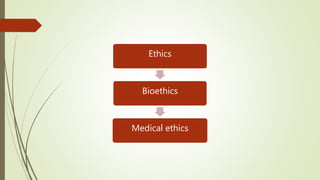
Ethics
Bioethics
Medical ethics
Why are we studying this ?
There will be scenarios when there will be a
disagreement about what is right or wrong.
To prepare for these difficult situations as to deal with
them in a rational and principled manner.
To interact among themselves, society and in
medical research.
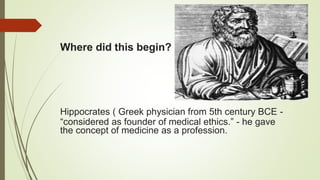
Where did this begin?
Hippocrates ( Greek physician from 5th century BCE -
“considered as founder of medical ethics.” - he gave
the concept of medicine as a profession.
Medical ethics
Same across National
boundaries
Law
Different across National
boundaries
Which is superior - ethics must supersede law that means you
should be ethically right although you may be wrong in the eyes
of law.
The three principles in medical ethics
 Compassion - understanding and concern for another
person’s distress.
 Competence - knowledge and skills - continual process.
 Autonomy/ self determination - i.e. decision making. Initially it
was physician autonomy, but gradually it has now changed to
patient autonomy.
Oaths and code of conduct.
 Physicians have to take an oath and should abide by the
codes of conduct.
 “Hippocrates oath” it was the founding principle in medical
ethics, on which, WMA gave the Declaration of Geneva in
1948. This declaration has been revised multiple times, the
most recent being in 2006.
 What does this Declaration of Geneva say - it states that “the
benefit of the patient should be the top most guiding
principle above everything else”.
 Now next question is - who decides what is ethical ?
Depends on the types of society - Liberal vs Traditional.
 What about medical ethics?
World Medical Association has set a broad range of ethical
statements that specify the behavior required of physicians no
matter where they live and practice.
Role of WMA
WMA gives code of conduct for ethical issues.
Annually there is a general assembly conducted by
WMA, they discuss about ethical issues. These
discussions are not a one time thing, it may take
years to come to an ethical conclusion.
If more than 75% acceptance is reached for a
particular issue than that ethical statement is
accepted.
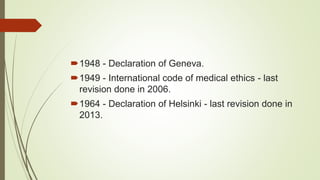
1948 - Declaration of Geneva.
1949 - International code of medical ethics - last
revision done in 2006.
1964 - Declaration of Helsinki - last revision done in
2013.
How you as an individual will decide
what is right or wrong?
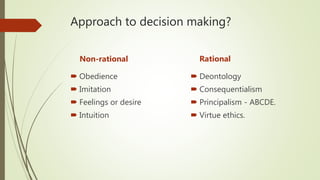
Approach to decision making?
Non-rational
 Obedience
 Imitation
 Feelings or desire
 Intuition
Rational
 Deontology
 Consequentialism
 Principalism - ABCDE.
 Virtue ethics.
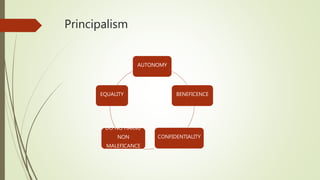
Principalism
AUTONOMY
BENEFICENCE
CONFIDENTIALITY
DO NO HARM/
NON
MALEFICANCE
EQUALITY
Physician relationships
Patients.
Society.
Colleagues.
Patient physician relationship.
Initially, It was paternalistic but now it’s guided
by patient autonomy.
Dec 10, 1948 UN gave World Human Rights - “Right to respect and
equal treatment” problems arise when a VIP is admitted.
Therapeutic relationship ?
When can you end it ?
 If you move out from your place of practice.
 If your patient is not compliant to your treatment.
 If you do not have required skills for treatment.
 If there is dislike among patient-physician due to personality
issues or patients inability to pay the fees.
“What will you do if a patient relative is abusing
your staff and other healthcare providers
involved in patient care”?
You should try to maintain a balance by knowing what the problem is, and
counselling, aimed to provide best possible treatment to your patient but if
it’s not possible you should find an alternative arrangement.
 Should physicians treat their relatives?
 What should you do if your relative comes to you for a
medical certificate?
 What would you do if a patient reveals that he/she is sexually
attracted to you?
 What would you do if your subordinate refuses to draw blood
for an HIV positive patient?
Informed consent?
 What is this consent?
 Who gives this consent?
 Who takes this consent?
 What are the types of consent?
 Exceptions?
What is this consent?
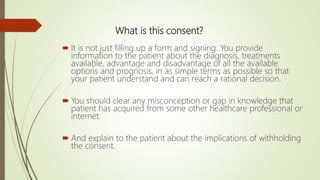
 It is not just filling up a form and signing. You provide
information to the patient about the diagnosis, treatments
available, advantage and disadvantage of all the available
options and prognosis, in as simple terms as possible so that
your patient understand and can reach a rational decision.
 You should clear any misconception or gap in knowledge that
patient has acquired from some other healthcare professional or
internet.
 And explain to the patient about the implications of withholding
the consent.
Who takes this consent?
 A qualified medical professional should take a consent.
 Can you people, as medical students, take informed consent?
Who gives this consent?
Competent vs incompetent patient?
 Competent patient has the right to refuse to treatment even
it means disability or loss to life.
 Who makes decision in case of incompetent patient?
Substitute decision maker
Physician
When it’s not necessary to take informed
consent?
 If patient has voluntarily given decision making authority to
the treating physician. Still it’s the physician responsibility to
give adequate information to the patient at least 1 time.
 Therapeutic privilege - when withholding some information
is in the best interest of patient such as any terminal illness.
 What will you do if a father asked not to tell son about his
illness?
 How would you deal with a patient who demands of futile or
non beneficial request ?
Confidentiality and trust - when is it
breached ?
 In common practices - medical students presenting cases,
interpreter is used, and in cases of incompetent patient.
 Legal issues - epilepsy patient continuing his occupation as a
driver, child abuse, notifiable diseases.
Physician has to breach the patient trust for the interests of
others but he has to inform the patient about this breach as the
earliest.
 What would you do if a seropositive husband continues to
have sexual relationship with spouse without telling her?
 What should a psychiatrist do if a patient tells him that he is
going to kill someone?
 What should you do if you have a patient of gunshot wound?
Ethical issues at beginning of life.
What do you think of embryo ?
a. Is it a human being
b. is it not a human being at present but will gradually transform into
a human being
c. it does matter.
 Contraception
 Assisted reproduction - spare embryos - use in stem cell research.
 Abortion - WMA has given declaration of Oslo.
Ethical issues at end of life.
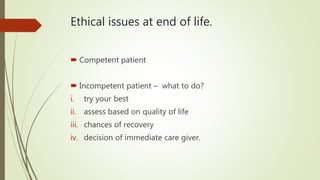
 Competent patient
 Incompetent patient – what to do?
i. try your best
ii. assess based on quality of life
iii. chances of recovery
iv. decision of immediate care giver.
“Euthanasia vs Assisted suicide”
Euthanasia
 Agent carries out the act.
 Competent patient only.
 Out of compassion and not for
any personal gain.
Assisted suicide
 Agent provides means or
knowledge.
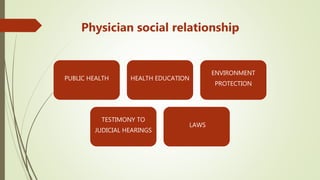
Physician social relationship
PUBLIC HEALTH HEALTH EDUCATION
ENVIRONMENT
PROTECTION
TESTIMONY TO
JUDICIAL HEARINGS
LAWS
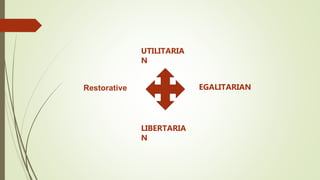
Resource allocation or Justice
Levels - macro, meso, micro.
UTILITARIA
N
EGALITARIAN
LIBERTARIA
N
Restorative
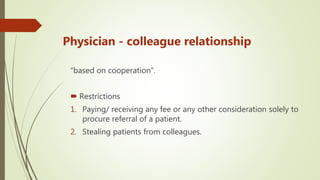
Physician - colleague relationship
“based on cooperation”.
 Restrictions
1. Paying/ receiving any fee or any other consideration solely to
procure referral of a patient.
2. Stealing patients from colleagues.
What should you do if you find a colleague
incompetent or involved in unethical practice ?
Ethics and medical research.
“4 phases of research”.
Steps involved in research study
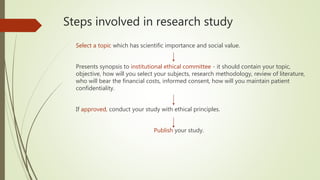
Select a topic which has scientific importance and social value.
Presents synopsis to institutional ethical committee - it should contain your topic,
objective, how will you select your subjects, research methodology, review of literature,
who will bear the financial costs, informed consent, how will you maintain patient
confidentiality.
If approved, conduct your study with ethical principles.
Publish your study.
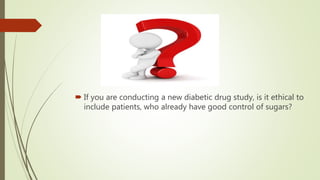
 If you are conducting a new diabetic drug study, is it ethical to
include patients, who already have good control of sugars?
“Responsibility to self.”
Physical as well as mental stress, long duty hours, no vacations.
Take care of yourself, take some time out for family, friends, do
exercise, eat well. Because ours is a never ending journey.
Medical ethics

Medical ethics

  • 1.
    Medical ethics Dr AnkurSharma MD Internal Medicine Assistant Professor, Department of Medicine L.N. Medical College and research Centre.
  • 2.
    Content of thislecture  Ethics - bio(medical) ethics - medical ethics.  Principles in medical ethics  Oaths and code of conduct  Role of WMA  Approach to decision making?  Physician relationships  Informed consent?  Confidentiality and trust  Ethical issues at beginning of life  Ethical issues at end of life  Resource allocation or Justice  Ethics and medical research
  • 3.
    Ethics - bio(medical)ethics - medical ethics. What do you mean by ethics - it origin from the word “ethhikos” which deals with all aspects of human behavior and decision making. Bio-ethics - related to development of the biological sciences. Medical ethics - deals with moral issues in medical practice
  • 4.
  • 5.
    Why are westudying this ? There will be scenarios when there will be a disagreement about what is right or wrong. To prepare for these difficult situations as to deal with them in a rational and principled manner. To interact among themselves, society and in medical research.
  • 6.
    Where did thisbegin? Hippocrates ( Greek physician from 5th century BCE - “considered as founder of medical ethics.” - he gave the concept of medicine as a profession.
  • 7.
    Medical ethics Same acrossNational boundaries Law Different across National boundaries Which is superior - ethics must supersede law that means you should be ethically right although you may be wrong in the eyes of law.
  • 8.
    The three principlesin medical ethics  Compassion - understanding and concern for another person’s distress.  Competence - knowledge and skills - continual process.  Autonomy/ self determination - i.e. decision making. Initially it was physician autonomy, but gradually it has now changed to patient autonomy.
  • 9.
    Oaths and codeof conduct.  Physicians have to take an oath and should abide by the codes of conduct.  “Hippocrates oath” it was the founding principle in medical ethics, on which, WMA gave the Declaration of Geneva in 1948. This declaration has been revised multiple times, the most recent being in 2006.  What does this Declaration of Geneva say - it states that “the benefit of the patient should be the top most guiding principle above everything else”.
  • 10.
     Now nextquestion is - who decides what is ethical ? Depends on the types of society - Liberal vs Traditional.  What about medical ethics? World Medical Association has set a broad range of ethical statements that specify the behavior required of physicians no matter where they live and practice.
  • 11.
    Role of WMA WMAgives code of conduct for ethical issues. Annually there is a general assembly conducted by WMA, they discuss about ethical issues. These discussions are not a one time thing, it may take years to come to an ethical conclusion. If more than 75% acceptance is reached for a particular issue than that ethical statement is accepted.
  • 12.
    1948 - Declarationof Geneva. 1949 - International code of medical ethics - last revision done in 2006. 1964 - Declaration of Helsinki - last revision done in 2013.
  • 13.
    How you asan individual will decide what is right or wrong?
  • 14.
    Approach to decisionmaking? Non-rational  Obedience  Imitation  Feelings or desire  Intuition Rational  Deontology  Consequentialism  Principalism - ABCDE.  Virtue ethics.
  • 15.
  • 16.
  • 17.
    Patient physician relationship. Initially,It was paternalistic but now it’s guided by patient autonomy. Dec 10, 1948 UN gave World Human Rights - “Right to respect and equal treatment” problems arise when a VIP is admitted.
  • 18.
    Therapeutic relationship ? Whencan you end it ?  If you move out from your place of practice.  If your patient is not compliant to your treatment.  If you do not have required skills for treatment.  If there is dislike among patient-physician due to personality issues or patients inability to pay the fees.
  • 19.
    “What will youdo if a patient relative is abusing your staff and other healthcare providers involved in patient care”? You should try to maintain a balance by knowing what the problem is, and counselling, aimed to provide best possible treatment to your patient but if it’s not possible you should find an alternative arrangement.
  • 20.
     Should physicianstreat their relatives?  What should you do if your relative comes to you for a medical certificate?  What would you do if a patient reveals that he/she is sexually attracted to you?  What would you do if your subordinate refuses to draw blood for an HIV positive patient?
  • 21.
    Informed consent?  Whatis this consent?  Who gives this consent?  Who takes this consent?  What are the types of consent?  Exceptions?
  • 22.
    What is thisconsent?  It is not just filling up a form and signing. You provide information to the patient about the diagnosis, treatments available, advantage and disadvantage of all the available options and prognosis, in as simple terms as possible so that your patient understand and can reach a rational decision.  You should clear any misconception or gap in knowledge that patient has acquired from some other healthcare professional or internet.  And explain to the patient about the implications of withholding the consent.
  • 23.
    Who takes thisconsent?  A qualified medical professional should take a consent.  Can you people, as medical students, take informed consent?
  • 24.
    Who gives thisconsent? Competent vs incompetent patient?  Competent patient has the right to refuse to treatment even it means disability or loss to life.  Who makes decision in case of incompetent patient? Substitute decision maker Physician
  • 25.
    When it’s notnecessary to take informed consent?  If patient has voluntarily given decision making authority to the treating physician. Still it’s the physician responsibility to give adequate information to the patient at least 1 time.  Therapeutic privilege - when withholding some information is in the best interest of patient such as any terminal illness.
  • 26.
     What willyou do if a father asked not to tell son about his illness?  How would you deal with a patient who demands of futile or non beneficial request ?
  • 27.
    Confidentiality and trust- when is it breached ?
  • 28.
     In commonpractices - medical students presenting cases, interpreter is used, and in cases of incompetent patient.  Legal issues - epilepsy patient continuing his occupation as a driver, child abuse, notifiable diseases. Physician has to breach the patient trust for the interests of others but he has to inform the patient about this breach as the earliest.
  • 29.
     What wouldyou do if a seropositive husband continues to have sexual relationship with spouse without telling her?  What should a psychiatrist do if a patient tells him that he is going to kill someone?  What should you do if you have a patient of gunshot wound?
  • 30.
    Ethical issues atbeginning of life. What do you think of embryo ? a. Is it a human being b. is it not a human being at present but will gradually transform into a human being c. it does matter.  Contraception  Assisted reproduction - spare embryos - use in stem cell research.  Abortion - WMA has given declaration of Oslo.
  • 31.
    Ethical issues atend of life.  Competent patient  Incompetent patient – what to do? i. try your best ii. assess based on quality of life iii. chances of recovery iv. decision of immediate care giver.
  • 32.
    “Euthanasia vs Assistedsuicide” Euthanasia  Agent carries out the act.  Competent patient only.  Out of compassion and not for any personal gain. Assisted suicide  Agent provides means or knowledge.
  • 33.
    Physician social relationship PUBLICHEALTH HEALTH EDUCATION ENVIRONMENT PROTECTION TESTIMONY TO JUDICIAL HEARINGS LAWS
  • 34.
    Resource allocation orJustice Levels - macro, meso, micro.
  • 35.
  • 36.
    Physician - colleaguerelationship “based on cooperation”.  Restrictions 1. Paying/ receiving any fee or any other consideration solely to procure referral of a patient. 2. Stealing patients from colleagues.
  • 37.
    What should youdo if you find a colleague incompetent or involved in unethical practice ?
  • 38.
    Ethics and medicalresearch. “4 phases of research”.
  • 39.
    Steps involved inresearch study Select a topic which has scientific importance and social value. Presents synopsis to institutional ethical committee - it should contain your topic, objective, how will you select your subjects, research methodology, review of literature, who will bear the financial costs, informed consent, how will you maintain patient confidentiality. If approved, conduct your study with ethical principles. Publish your study.
  • 40.
     If youare conducting a new diabetic drug study, is it ethical to include patients, who already have good control of sugars?
  • 41.
  • 42.
    Physical as wellas mental stress, long duty hours, no vacations. Take care of yourself, take some time out for family, friends, do exercise, eat well. Because ours is a never ending journey.