Objectives
 Definition
 Procedure
 Ethical issues
 DNAR
 Criteria for not starting CPR
 Conclusion
 Case
Definition
 Cardiopulmonary resuscitation (CPR) consists of the use of chest compressions and
artificial ventilation to maintain circulatory flow and oxygenation during cardiac
arrest
How to administer
 1st step: check the airways if there is any obstruction
2nd STEP
Delivery of chest compressions. Note the overlapping hands placed on the center of the sternum, with the rescuer's arms extended. Chest
compressions are to be delivered at a rate of at least 100 compressions per minute
3rd step
Delivery of mouth-to-mouth ventilation
Cardiopulmonary Resuscitation: Ethical
Issues
1. To initiate resuscitation.
2. NOT to initiate resuscitation.
3. To terminate resuscitation
4. To withdraw life support system
Do Not Attempt Resuscitation
Order(DNAR)
 DNAR order means that in the event of cardiopulmonary arrest, CPR should not be
attempted at all.
 Other treatment should be continued, such as; pain relief, sedation on required
basis in terminal illness
Criteria for not starting CPR
 A valid DNAR is presented
 A person with obvious clinical signs of irreversible death(e.g. rigor mortis,
dependent lividity, decapitation, decomposition)
 Attempts to perform would place the rescuer at risk of danger and physical injuries
 Futility; no physiological benefit expected
Decision making in CPR can be very complex due to the diversity of the cases
It may be made in matters of seconds!
If in doubt, always err on the patient’s benefit.
CASE
A patient, who had a history of pulmonary disease, lived at a nursing home but was
found intoxicated and unconscious on the street and brought to Jackson Memorial.
He arrived with no identification, no family or friends, and no way to tell doctors
whether he wanted to live or die.
The man had an infection that led to septic shock, which causes organ failure and
extremely low blood pressure.
When his blood pressure started to drop, emergency room doctors called a doctor,
who specializes in pulmonary disease — and they first agreed not to honor the tattoo,
“invoking the principle of not choosing an irreversible path when faced with
uncertainty.”

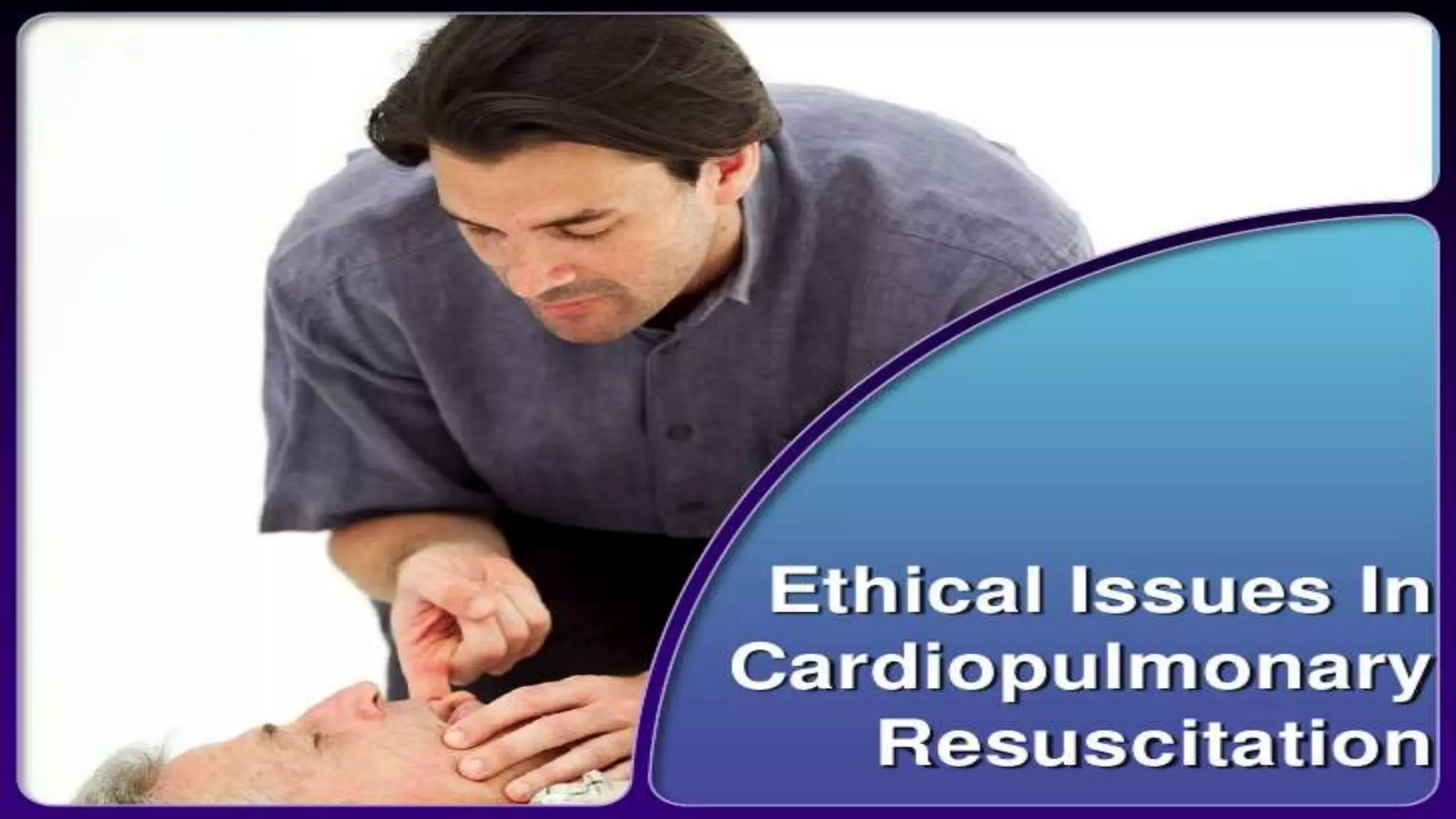
Ethical Issues Cardiopulmonary Resuscitation

  • 2.
    Objectives  Definition  Procedure Ethical issues  DNAR  Criteria for not starting CPR  Conclusion  Case
  • 3.
    Definition  Cardiopulmonary resuscitation(CPR) consists of the use of chest compressions and artificial ventilation to maintain circulatory flow and oxygenation during cardiac arrest
  • 4.
    How to administer 1st step: check the airways if there is any obstruction
  • 5.
    2nd STEP Delivery ofchest compressions. Note the overlapping hands placed on the center of the sternum, with the rescuer's arms extended. Chest compressions are to be delivered at a rate of at least 100 compressions per minute
  • 6.
    3rd step Delivery ofmouth-to-mouth ventilation
  • 7.
    Cardiopulmonary Resuscitation: Ethical Issues 1.To initiate resuscitation. 2. NOT to initiate resuscitation. 3. To terminate resuscitation 4. To withdraw life support system
  • 8.
    Do Not AttemptResuscitation Order(DNAR)  DNAR order means that in the event of cardiopulmonary arrest, CPR should not be attempted at all.  Other treatment should be continued, such as; pain relief, sedation on required basis in terminal illness
  • 9.
    Criteria for notstarting CPR  A valid DNAR is presented  A person with obvious clinical signs of irreversible death(e.g. rigor mortis, dependent lividity, decapitation, decomposition)  Attempts to perform would place the rescuer at risk of danger and physical injuries  Futility; no physiological benefit expected
  • 10.
    Decision making inCPR can be very complex due to the diversity of the cases It may be made in matters of seconds! If in doubt, always err on the patient’s benefit.
  • 12.
    CASE A patient, whohad a history of pulmonary disease, lived at a nursing home but was found intoxicated and unconscious on the street and brought to Jackson Memorial. He arrived with no identification, no family or friends, and no way to tell doctors whether he wanted to live or die. The man had an infection that led to septic shock, which causes organ failure and extremely low blood pressure. When his blood pressure started to drop, emergency room doctors called a doctor, who specializes in pulmonary disease — and they first agreed not to honor the tattoo, “invoking the principle of not choosing an irreversible path when faced with uncertainty.”