MWEBAZA VICTOR
and WONIALA DENIS
Ugandans
MBchB 5th year students
Kampala International University
Western campus
Jinja site light @Jinja Regional
referral hospital jinja Uganda
Presenting
Cardiopulmonary resuscitation
Via Zoom @ medical students in
5th year at K.I.U/WC jinja site
Supervisor:- Dr Muwema Emma
(Dept of Anaesthesia)
Cardiopulmonary resuscitation,
commonly known as CPR,is an emergency
procedure that combines chest compression
often with artificial ventilation in an effort to
manually preserve intact brain function until
further measures are taken to restore
spontaneous blood circulation and breathing in a
person who is in cardiac arrest.
MWEBAZA VICTOR and WONIALA DENIS
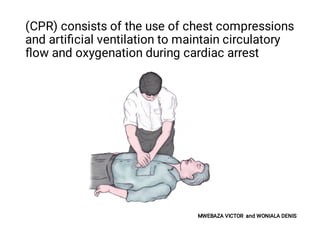
(CPR) consists of the use of chest compressions
and artificial ventilation to maintain circulatory
flow and oxygenation during cardiac arrest
MWEBAZA VICTOR and WONIALA DENIS
According to the International Liaison
Committee on Resuscitation guidelines, CPR
involves chest compressions for adults
between 5 cm (2.0 in) and 6 cm (2.4 in) deep
and at a rate of at least 100 to 120 per minute.
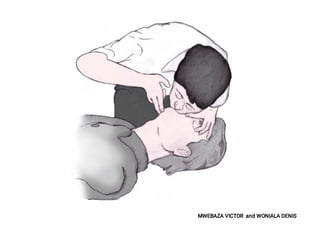
The rescuer may also provide artificial
ventilation by either exhaling air into the
subject's mouth or nose (mouth-to-mouth
resuscitation) or using a device that pushes air
into the subject's lungs (mechanical ventilation).
MWEBAZA VICTOR and WONIALA DENIS
Administration of an electric shock to the
subject's heart, termed defibrillation, is
usually needed in order to restore a
viable or "perfusing" heart rhythm.
Defibrillation is effective only for certain
heart rhythms, namely ventricular
fibrillation or pulseless ventricular
tachycardia, rather than asystole or
pulseless electrical activity.
MWEBAZA VICTOR and WONIALA DENIS
Purpose of CPR
1.
2.
3.
4.
5.
6.
7.
ABC-Life Support and CAB
To maintain an open and clear airway.
To maintain breathing by external ventilation.
To maintain blood circulation by external cardiac
massage.
CAB~ (Chest compression, airway and breathing)
, with an exception of the newborns.
To save the life of the patient
To provide basic life support till medical and
advanced life support arrives.
MWEBAZA VICTOR and WONIALA DENIS
Types of CPR
1.
2.
BLS (Basic Life Support)-Level of medical
care which is used for life threatening illness
or injuries until the patient can be given full
medical care at the hospital which is
provided by emergency medical technicians,
paramedics or non professionals
ALS (Advanced Life Support)- consists of life
saving protocols and skills that extend BLS to
further support the circulation and provide an
open airway and adequate ventilation
MWEBAZA VICTOR and WONIALA DENIS
The Principle of CPR
1.
2.
To restore effective circulation and
ventilation.
To prevent irreversible cerebral damage due
to anoxia. When the heart fails to maintain
the cerebral circulation for approximately 4
min, the brain may suffer irreversible damage.
MWEBAZA VICTOR and WONIALA DENIS
Indications
CPR should be performed immediately on
any person who has become unconscious
and is found to be pulseless (cardiac
arrest/ cardiopulmonary arrest)
Loss of effective cardiac activity is
generally due to the spontaneous initiation
of a nonperfusing arrhythmia, sometimes
referred to as a malignant arrhythmia.
The most common nonperfusing
arrhythmias include the following:
1.
2.
3.
4.
5.
Cardiac Arrest indications for CPR
Ventricular fibrillation (VF)
Pulseless ventricular tachycardia (VT)
Pulseless electrical activity (PEA)
Asystole
Pulseless bradycardia
CPR should be started before the rhythm is identified and
should be continued while the defibrillator is being applied
and charged. Additionally, CPR should be resumed
immediately after a defibrillatory shock until a pulsatile
state is established
1.
2.
3.
4.
5.
6.
7.
8.
Respiratory Arrest indication for CPR
Drowning
Stroke
Foreign body in the throat
Smoke inhalation
Suffocation
Trauma
Coma
Epiglottis paralysis
MWEBAZA VICTOR and WONIALA DENIS
Contraindications
The only absolute contraindication to
CPR is a do-not-resuscitate (DNR)
MWEBAZA VICTOR and WONIALA DENIS
Technique
1.
2.
3.
In its full, standard form, CPR comprises the
following 3 steps, performed in order:
Chest compressions
Airway
Breathing
For lay rescuers, compression-only CPR (COCPR)
is recommended.
MWEBAZA VICTOR and WONIALA DENIS
30 Chest compressions
1.
2.
3.
4.
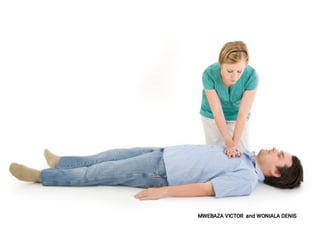
Place the heel of one hand in the center of the
chest.
Place the other hand on top
Interlock the fingers
Compress the chest at;
~ Rate 100/min
~ Depth 4-5cm
~ Equal compression: relaxation
~ When possible, change CPR operator every 2min
MWEBAZA VICTOR and WONIALA DENIS
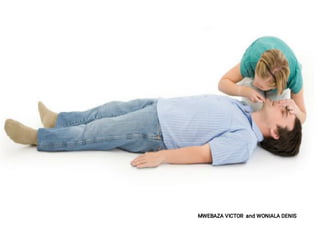
2 Rescue breaths
1.
2.
3.
4.
5.
6.
7.
Pinch the nose
Take a normal breath
Place lips over mouth
Blow until the chest rises
Take about 1sec
Allow chest to fall
repeat
MWEBAZA VICTOR and WONIALA DENIS
Positioning for CPR is as
follows:
CPR is most easily and effectively performed by
laying the patient supine on a relatively hard
surface, which allows effective compression of
the sternum
Delivery of CPR on a mattress or other soft
material is generally less effective
MWEBAZA VICTOR and WONIALA DENIS
The person giving compressions should be
positioned high enough above the patient to
achieve sufficient leverage, so that he or she can
use body weight to adequately compress the
chest
MWEBAZA VICTOR and WONIALA DENIS
For an unconscious adult, CPR
is initiated as follows:
Give 30 chest compressions Perform the head-
tilt chin-lift maneuver to open the airway and
determine if the patient is breathing
Before beginning ventilations, look in the
patient’s mouth for a foreign body blocking the
airway
MWEBAZA VICTOR and WONIALA DENIS
Chest compression
The provider should do the
following:
Place the heel of one hand on the patient’s
sternum and the other hand on top of the first,
fingers interlaced
Extend the elbows and the provider leans directly
over the patient
Press down, compressing the chest at least 2 in
MWEBAZA VICTOR and WONIALA DENIS
Release the chest and allow it to recoil
completely
The compression depth for adults should be at
least 2 inches (instead of up to 2 inches, as in
the past)
The compression rate should be at least 100/
min
The key phrase for chest compression is, “Push
hard and fast”
MWEBAZA VICTOR and WONIALA DENIS
Untrained bystanders should perform chest
compression–only CPR (COCPR)
After 30 compressions, 2 breaths are given;
however, an intubated patient should receive
continuous compressions while ventilations are
given 8-10 times per minute
MWEBAZA VICTOR and WONIALA DENIS
This entire process is repeated until a pulse
returns or the patient is transferred to definitive
care
To prevent provider fatigue or injury, new
providers should intervene every 2-3 minutes (ie,
providers should swap out, giving the chest
compressor a rest while another rescuer
continues CPR
MWEBAZA VICTOR and WONIALA DENIS
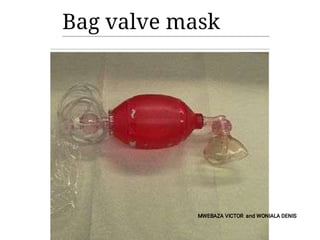
Ventilation
If the patient is not breathing, 2 ventilations are
given via the provider’s mouth or a bag-valve-
mask (BVM). If available, a barrier device
(pocket mask or face shield) should be used.
MWEBAZA VICTOR and WONIALA DENIS
To perform the BVM or invasive
airway technique, the provider
does the following:
1.
2.
Ensure a tight seal between the mask and the
patient’s face
Squeeze the bag with one hand for
approximately 1 second, forcing at least 500
mL of air into the patient’s lungs
MWEBAZA VICTOR and WONIALA DENIS
To perform the mouth-to-mouth technique,
the provider does the following
1.
2.
3.
4.
5.
6.
Pinch the patient’s nostrils closed to assist with
an airtight seal
Put the mouth completely over the patient’s
mouth
After 30 chest compression, give 2 breaths (the
30:2 cycle of CPR)
Give each breath for approximately 1 second
with enough force to make the patient’s chest
rise
Failure to observe chest rise indicates an
inadequate mouth seal or airway occlusion
After giving the 2 breaths, resume the CPR cycle
Complications
1.
2.
Fractures of ribs or the sternum from
chest compression (widely considered
uncommon)
Gastric insufflation from artificial
respiration using noninvasive ventilation
methods (eg, mouth-to-mouth, BVM);
this can lead to vomiting, with further
airway compromise or aspiration;
insertion of an invasive airway (eg,
endotracheal tube) prevents this problem
MWEBAZA VICTOR and WONIALA DENIS
ACLS
Advanced cardiac life support:- often
referred to by its acronym, "ACLS", refers to
a set of clinical guidelines for the urgent
and emergent treatment of life-threatening
cardiovascular conditions that will cause or
have caused cardiac arrest, using advanced
medical procedures, medications, and
techniques.
MWEBAZA VICTOR and WONIALA DENIS
1.
2.
3.
4.
In the in-hospital setting or when a paramedic or
other advanced provider is present, ACLS guidelines
call for a more robust approach to treatment of
cardiac arrest, including the following:
Drug interventions
ECG monitoring
Defibrillation
Invasive airway procedures
MWEBAZA VICTOR and WONIALA DENIS
Emergency cardiac treatments no
longer recommended include the
following:
1.
2.
3.
Routine atropine for pulseless electrical
activity (PEA)/asystole
Cricoid pressure (with CPR)
Airway suctioning for all newborns (except
those with obvious obstruction)
MWEBAZA VICTOR and WONIALA DENIS
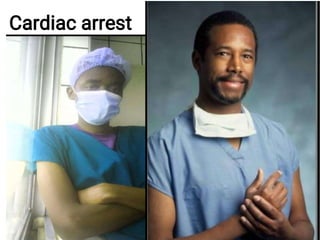
Cardiac arrest
Cardiac arrest®
Cardiac arrest, also known as
cardiopulmonary arrest or circulatory
arrest, is a sudden stop in effective
blood circulation due to the failure of
the heart to contract effectively or at
all.
MWEBAZA VICTOR and WONIALA DENIS
Cardiac arrest is a medical emergency is
also called sudden cardiac death (SCD).
The treatment for cardiac arrest is
immediate defibrillation if a "shockable"
rhythm is present, while cardiopulmonary
resuscitation (CPR) is used to provide
circulatory support and/or to induce a "
shockable" rhythm.
MWEBAZA VICTOR and WONIALA DENIS
Defibrillation



Defibrillation; is the administration of electric
shocks to the heart in order to reset normal
heart rhythm in patients who are experiencing
cardiac arrest or severe arrhythmia.
This is achieved by the use of an AED
(Automated External Defibrillator). It is life
saving as it gives the heart an electric chock
when there is cardiac arrest.
Defibrillation creates a current across the
myocardium & depolarizes a critical mass of
cardiac muscle, simultaneously enabling the
natural pacemaker tissue to resume control
Medical management
1.
2.
3.
4.
Adrenaline
adrenaline is the main drug used during
resuscitation from cardiac arrest.
Atropine , Atropine as a single dose of 3mg is
sufficient to block vagal tone completely and
should be used once in cases of asystole. It
is also indicated for symptomatic
bradycardia in a dose of 0.5mg-1mg
Amiodarone ,it is an antiarrhythmic drug.
MWEBAZA VICTOR and WONIALA DENIS
1.
2.
3.
4.
5.
6.
Mnemonic for causes
"Hs and Ts" is the name for a mnemonic used to aid in
remembering the possible treatable or reversible
causes of cardiac arrest.
Hs
Hypovolemia - A lack of blood volume
Hypoxia - A lack of oxygen
Hydrogen ions (Acidosis) - An abnormal pH in the
body
Hyperkalemia or Hypokalemia - Both excess and
inadequate potassium can be life-threatening.
Hypothermia - A low core body temperature
Hypoglycemia or Hyperglycemia - Low or high
blood glucose
MWEBAZA VICTOR and WONIALA DENIS
1.
2.
3.
4.
5.
6.
Ts
Tablets or Toxins
Cardiac Tamponade - Fluid building around
the heart
Tension pneumothorax - A collapsed lung
Thrombosis (Myocardial infarction) - Heart
attack
Thromboembolism (Pulmonary embolism) -
A blood clot in the lung
Traumatic cardiac arrest
MWEBAZA VICTOR and WONIALA DENIS
Causes
1.
2.
3.
Coronary artery disease
Non-ischemic heart disease
Non-cardiac causes
Risk factors
The risk factors for SCD are similar to those of coronary
artery disease and include smoking, lack of physical
exercise, obesity, and diabetes, as well as family history.
MWEBAZA VICTOR and WONIALA DENIS
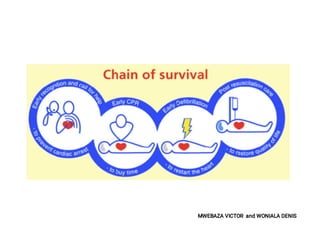
Chain of survival
1.
2.
3.
4.
The chain of survival refers to a series of actions
that, when put into motion, reduce the mortality
associated with cardiac arrest.
The four interdependent links in the chain of survival
are
Early access and Call for help
Early CPR,
Early defibrillation, and
Early advanced cardiac life support
MWEBAZA VICTOR and WONIALA DENIS
reference


Lick CJ, Aufderheide TP, Niskanen RA, et al. Take
Heart America: A comprehensive, community-wide,
systems-based approach to the treatment of
cardiac arrest. Crit Care Med. 2011 Jan. 39(1):
26-33
Ogawa T, Akahane M, Koike S, et al. Outcomes of
chest compression only CPR versus conventional
CPR conducted by lay people in patients with out
of hospital cardiopulmonary arrest witnessed by
bystanders: nationwide population based
observational study. BMJ. 2011 Jan 27. 342:c7106
MWEBAZA VICTOR and WONIALA DENIS




Rea TD, Fahrenbruch C, Culley L, et al. CPR
with Chest Compression Alone or with Rescue
Breathing. N Engl J Med. 2010. 363:423-433.
Bobrow BJ, Spaite DW, Berg RA, et al. Chest
compression-only CPR by lay rescuers and
survival from out-of-hospital cardiac arrest.
JAMA. 2010 Oct 6. 304(13):1447-54.
Hupfl M, Selig HF, Nagele P. Chest-
compression-only versus standard
cardiopulmonary resuscitation: a meta-analysis.
Lancet. 2010 Nov 6. 376(9752):1552-7.
Eisenberg MS, Mengert TJ. Cardiac
resuscitation. N Engl J Med. 2001 Apr 26.
344(17):1304-13.
MWEBAZA VICTOR and WONIALA DENIS

C.P.R by Mwebaza victor .pdf

  • 1.
    MWEBAZA VICTOR and WONIALADENIS Ugandans MBchB 5th year students Kampala International University Western campus Jinja site light @Jinja Regional referral hospital jinja Uganda Presenting Cardiopulmonary resuscitation Via Zoom @ medical students in 5th year at K.I.U/WC jinja site Supervisor:- Dr Muwema Emma (Dept of Anaesthesia)
  • 2.
    Cardiopulmonary resuscitation, commonly knownas CPR,is an emergency procedure that combines chest compression often with artificial ventilation in an effort to manually preserve intact brain function until further measures are taken to restore spontaneous blood circulation and breathing in a person who is in cardiac arrest. MWEBAZA VICTOR and WONIALA DENIS
  • 3.
    (CPR) consists ofthe use of chest compressions and artificial ventilation to maintain circulatory flow and oxygenation during cardiac arrest MWEBAZA VICTOR and WONIALA DENIS
  • 4.
    According to theInternational Liaison Committee on Resuscitation guidelines, CPR involves chest compressions for adults between 5 cm (2.0 in) and 6 cm (2.4 in) deep and at a rate of at least 100 to 120 per minute. The rescuer may also provide artificial ventilation by either exhaling air into the subject's mouth or nose (mouth-to-mouth resuscitation) or using a device that pushes air into the subject's lungs (mechanical ventilation). MWEBAZA VICTOR and WONIALA DENIS
  • 5.
    MWEBAZA VICTOR andWONIALA DENIS
  • 6.
    Administration of anelectric shock to the subject's heart, termed defibrillation, is usually needed in order to restore a viable or "perfusing" heart rhythm. Defibrillation is effective only for certain heart rhythms, namely ventricular fibrillation or pulseless ventricular tachycardia, rather than asystole or pulseless electrical activity. MWEBAZA VICTOR and WONIALA DENIS
  • 7.
    Purpose of CPR 1. 2. 3. 4. 5. 6. 7. ABC-LifeSupport and CAB To maintain an open and clear airway. To maintain breathing by external ventilation. To maintain blood circulation by external cardiac massage. CAB~ (Chest compression, airway and breathing) , with an exception of the newborns. To save the life of the patient To provide basic life support till medical and advanced life support arrives. MWEBAZA VICTOR and WONIALA DENIS
  • 8.
    Types of CPR 1. 2. BLS(Basic Life Support)-Level of medical care which is used for life threatening illness or injuries until the patient can be given full medical care at the hospital which is provided by emergency medical technicians, paramedics or non professionals ALS (Advanced Life Support)- consists of life saving protocols and skills that extend BLS to further support the circulation and provide an open airway and adequate ventilation MWEBAZA VICTOR and WONIALA DENIS
  • 9.
    The Principle ofCPR 1. 2. To restore effective circulation and ventilation. To prevent irreversible cerebral damage due to anoxia. When the heart fails to maintain the cerebral circulation for approximately 4 min, the brain may suffer irreversible damage. MWEBAZA VICTOR and WONIALA DENIS
  • 10.
    Indications CPR should beperformed immediately on any person who has become unconscious and is found to be pulseless (cardiac arrest/ cardiopulmonary arrest) Loss of effective cardiac activity is generally due to the spontaneous initiation of a nonperfusing arrhythmia, sometimes referred to as a malignant arrhythmia. The most common nonperfusing arrhythmias include the following:
  • 11.
    1. 2. 3. 4. 5. Cardiac Arrest indicationsfor CPR Ventricular fibrillation (VF) Pulseless ventricular tachycardia (VT) Pulseless electrical activity (PEA) Asystole Pulseless bradycardia CPR should be started before the rhythm is identified and should be continued while the defibrillator is being applied and charged. Additionally, CPR should be resumed immediately after a defibrillatory shock until a pulsatile state is established
  • 12.
    1. 2. 3. 4. 5. 6. 7. 8. Respiratory Arrest indicationfor CPR Drowning Stroke Foreign body in the throat Smoke inhalation Suffocation Trauma Coma Epiglottis paralysis MWEBAZA VICTOR and WONIALA DENIS
  • 13.
    Contraindications The only absolutecontraindication to CPR is a do-not-resuscitate (DNR) MWEBAZA VICTOR and WONIALA DENIS
  • 14.
    Technique 1. 2. 3. In its full,standard form, CPR comprises the following 3 steps, performed in order: Chest compressions Airway Breathing For lay rescuers, compression-only CPR (COCPR) is recommended. MWEBAZA VICTOR and WONIALA DENIS
  • 15.
    30 Chest compressions 1. 2. 3. 4. Placethe heel of one hand in the center of the chest. Place the other hand on top Interlock the fingers Compress the chest at; ~ Rate 100/min ~ Depth 4-5cm ~ Equal compression: relaxation ~ When possible, change CPR operator every 2min MWEBAZA VICTOR and WONIALA DENIS
  • 16.
    MWEBAZA VICTOR andWONIALA DENIS
  • 17.
    2 Rescue breaths 1. 2. 3. 4. 5. 6. 7. Pinchthe nose Take a normal breath Place lips over mouth Blow until the chest rises Take about 1sec Allow chest to fall repeat MWEBAZA VICTOR and WONIALA DENIS
  • 18.
    MWEBAZA VICTOR andWONIALA DENIS
  • 19.
    Positioning for CPRis as follows: CPR is most easily and effectively performed by laying the patient supine on a relatively hard surface, which allows effective compression of the sternum Delivery of CPR on a mattress or other soft material is generally less effective MWEBAZA VICTOR and WONIALA DENIS
  • 20.
    The person givingcompressions should be positioned high enough above the patient to achieve sufficient leverage, so that he or she can use body weight to adequately compress the chest MWEBAZA VICTOR and WONIALA DENIS
  • 21.
    For an unconsciousadult, CPR is initiated as follows: Give 30 chest compressions Perform the head- tilt chin-lift maneuver to open the airway and determine if the patient is breathing Before beginning ventilations, look in the patient’s mouth for a foreign body blocking the airway MWEBAZA VICTOR and WONIALA DENIS
  • 22.
    Chest compression The providershould do the following: Place the heel of one hand on the patient’s sternum and the other hand on top of the first, fingers interlaced Extend the elbows and the provider leans directly over the patient Press down, compressing the chest at least 2 in MWEBAZA VICTOR and WONIALA DENIS
  • 23.
    Release the chestand allow it to recoil completely The compression depth for adults should be at least 2 inches (instead of up to 2 inches, as in the past) The compression rate should be at least 100/ min The key phrase for chest compression is, “Push hard and fast” MWEBAZA VICTOR and WONIALA DENIS
  • 24.
    Untrained bystanders shouldperform chest compression–only CPR (COCPR) After 30 compressions, 2 breaths are given; however, an intubated patient should receive continuous compressions while ventilations are given 8-10 times per minute MWEBAZA VICTOR and WONIALA DENIS
  • 25.
    This entire processis repeated until a pulse returns or the patient is transferred to definitive care To prevent provider fatigue or injury, new providers should intervene every 2-3 minutes (ie, providers should swap out, giving the chest compressor a rest while another rescuer continues CPR MWEBAZA VICTOR and WONIALA DENIS
  • 26.
    Ventilation If the patientis not breathing, 2 ventilations are given via the provider’s mouth or a bag-valve- mask (BVM). If available, a barrier device (pocket mask or face shield) should be used. MWEBAZA VICTOR and WONIALA DENIS
  • 27.
    To perform theBVM or invasive airway technique, the provider does the following: 1. 2. Ensure a tight seal between the mask and the patient’s face Squeeze the bag with one hand for approximately 1 second, forcing at least 500 mL of air into the patient’s lungs MWEBAZA VICTOR and WONIALA DENIS
  • 28.
    MWEBAZA VICTOR andWONIALA DENIS
  • 29.
    To perform themouth-to-mouth technique, the provider does the following 1. 2. 3. 4. 5. 6. Pinch the patient’s nostrils closed to assist with an airtight seal Put the mouth completely over the patient’s mouth After 30 chest compression, give 2 breaths (the 30:2 cycle of CPR) Give each breath for approximately 1 second with enough force to make the patient’s chest rise Failure to observe chest rise indicates an inadequate mouth seal or airway occlusion After giving the 2 breaths, resume the CPR cycle
  • 30.
    Complications 1. 2. Fractures of ribsor the sternum from chest compression (widely considered uncommon) Gastric insufflation from artificial respiration using noninvasive ventilation methods (eg, mouth-to-mouth, BVM); this can lead to vomiting, with further airway compromise or aspiration; insertion of an invasive airway (eg, endotracheal tube) prevents this problem MWEBAZA VICTOR and WONIALA DENIS
  • 31.
    ACLS Advanced cardiac lifesupport:- often referred to by its acronym, "ACLS", refers to a set of clinical guidelines for the urgent and emergent treatment of life-threatening cardiovascular conditions that will cause or have caused cardiac arrest, using advanced medical procedures, medications, and techniques. MWEBAZA VICTOR and WONIALA DENIS
  • 32.
    1. 2. 3. 4. In the in-hospitalsetting or when a paramedic or other advanced provider is present, ACLS guidelines call for a more robust approach to treatment of cardiac arrest, including the following: Drug interventions ECG monitoring Defibrillation Invasive airway procedures MWEBAZA VICTOR and WONIALA DENIS
  • 33.
    Emergency cardiac treatmentsno longer recommended include the following: 1. 2. 3. Routine atropine for pulseless electrical activity (PEA)/asystole Cricoid pressure (with CPR) Airway suctioning for all newborns (except those with obvious obstruction) MWEBAZA VICTOR and WONIALA DENIS
  • 34.
  • 35.
    Cardiac arrest® Cardiac arrest,also known as cardiopulmonary arrest or circulatory arrest, is a sudden stop in effective blood circulation due to the failure of the heart to contract effectively or at all. MWEBAZA VICTOR and WONIALA DENIS
  • 36.
    Cardiac arrest isa medical emergency is also called sudden cardiac death (SCD). The treatment for cardiac arrest is immediate defibrillation if a "shockable" rhythm is present, while cardiopulmonary resuscitation (CPR) is used to provide circulatory support and/or to induce a " shockable" rhythm. MWEBAZA VICTOR and WONIALA DENIS
  • 37.
    Defibrillation    Defibrillation; is theadministration of electric shocks to the heart in order to reset normal heart rhythm in patients who are experiencing cardiac arrest or severe arrhythmia. This is achieved by the use of an AED (Automated External Defibrillator). It is life saving as it gives the heart an electric chock when there is cardiac arrest. Defibrillation creates a current across the myocardium & depolarizes a critical mass of cardiac muscle, simultaneously enabling the natural pacemaker tissue to resume control
  • 38.
    Medical management 1. 2. 3. 4. Adrenaline adrenaline isthe main drug used during resuscitation from cardiac arrest. Atropine , Atropine as a single dose of 3mg is sufficient to block vagal tone completely and should be used once in cases of asystole. It is also indicated for symptomatic bradycardia in a dose of 0.5mg-1mg Amiodarone ,it is an antiarrhythmic drug. MWEBAZA VICTOR and WONIALA DENIS
  • 39.
    1. 2. 3. 4. 5. 6. Mnemonic for causes "Hsand Ts" is the name for a mnemonic used to aid in remembering the possible treatable or reversible causes of cardiac arrest. Hs Hypovolemia - A lack of blood volume Hypoxia - A lack of oxygen Hydrogen ions (Acidosis) - An abnormal pH in the body Hyperkalemia or Hypokalemia - Both excess and inadequate potassium can be life-threatening. Hypothermia - A low core body temperature Hypoglycemia or Hyperglycemia - Low or high blood glucose MWEBAZA VICTOR and WONIALA DENIS
  • 40.
    1. 2. 3. 4. 5. 6. Ts Tablets or Toxins CardiacTamponade - Fluid building around the heart Tension pneumothorax - A collapsed lung Thrombosis (Myocardial infarction) - Heart attack Thromboembolism (Pulmonary embolism) - A blood clot in the lung Traumatic cardiac arrest MWEBAZA VICTOR and WONIALA DENIS
  • 41.
    Causes 1. 2. 3. Coronary artery disease Non-ischemicheart disease Non-cardiac causes Risk factors The risk factors for SCD are similar to those of coronary artery disease and include smoking, lack of physical exercise, obesity, and diabetes, as well as family history. MWEBAZA VICTOR and WONIALA DENIS
  • 42.
    Chain of survival 1. 2. 3. 4. Thechain of survival refers to a series of actions that, when put into motion, reduce the mortality associated with cardiac arrest. The four interdependent links in the chain of survival are Early access and Call for help Early CPR, Early defibrillation, and Early advanced cardiac life support MWEBAZA VICTOR and WONIALA DENIS
  • 43.
    MWEBAZA VICTOR andWONIALA DENIS
  • 44.
    reference   Lick CJ, AufderheideTP, Niskanen RA, et al. Take Heart America: A comprehensive, community-wide, systems-based approach to the treatment of cardiac arrest. Crit Care Med. 2011 Jan. 39(1): 26-33 Ogawa T, Akahane M, Koike S, et al. Outcomes of chest compression only CPR versus conventional CPR conducted by lay people in patients with out of hospital cardiopulmonary arrest witnessed by bystanders: nationwide population based observational study. BMJ. 2011 Jan 27. 342:c7106 MWEBAZA VICTOR and WONIALA DENIS
  • 45.
        Rea TD, FahrenbruchC, Culley L, et al. CPR with Chest Compression Alone or with Rescue Breathing. N Engl J Med. 2010. 363:423-433. Bobrow BJ, Spaite DW, Berg RA, et al. Chest compression-only CPR by lay rescuers and survival from out-of-hospital cardiac arrest. JAMA. 2010 Oct 6. 304(13):1447-54. Hupfl M, Selig HF, Nagele P. Chest- compression-only versus standard cardiopulmonary resuscitation: a meta-analysis. Lancet. 2010 Nov 6. 376(9752):1552-7. Eisenberg MS, Mengert TJ. Cardiac resuscitation. N Engl J Med. 2001 Apr 26. 344(17):1304-13. MWEBAZA VICTOR and WONIALA DENIS