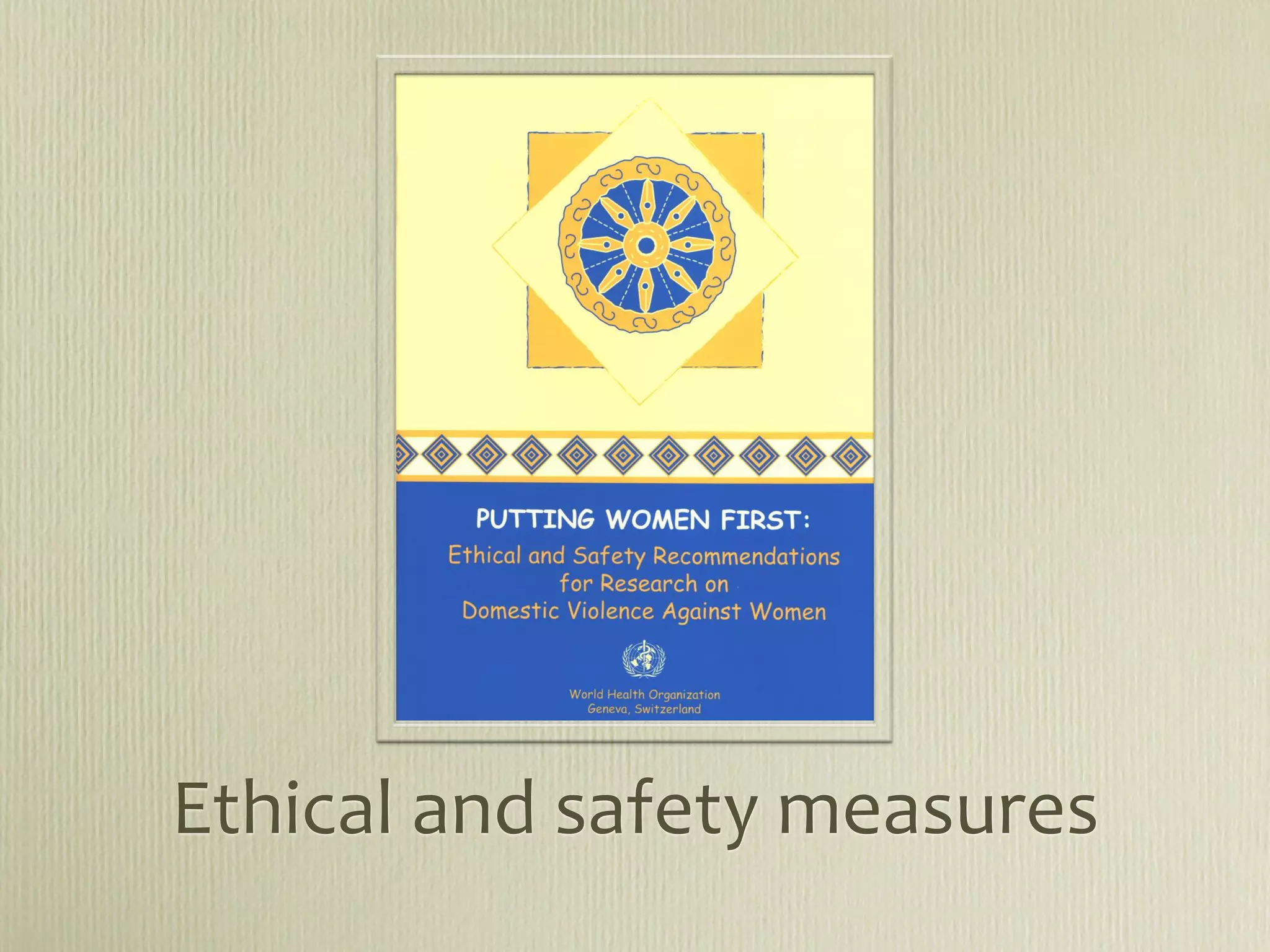
Ethical
and
safety
measures
Putting
women’s
safety
first
in
violence

             research
1. 
Safety
of
respondents
and
research
team
2.
Studies
need
to
be
methodologically
sound
3.
Confidentiality
for
safety
and
data
quality
4.
Selection
and
training
of
team
members
5.
Actions
to
reducing
distress
to
respondents
6.
Possibilities
of
referral,
support
mechanisms
7.
Proper
interpretation
and
use
of
study
results
8.
Violence
questions
in
other
surveys
1.
Safety
of
respondents
and
research
team
  •Interviews
only
in
a
private
setting,
participant

   should
feel
free
to
reschedule
or
relocate

  •Frame
the
study
not
in
terms
of
violence
(but

   further
information
should
be
give
as
part
of

   consent
procedure)
  •Only
one
woman
per
household
  •Train
interviewers
to
handle
interruptions
(e.g.

   Dummy
questions,
rescheduling)
  •Logistics
and
budget
planning
should
consider

   safety
2.
Studies
need
to
be
methodologically
sound
   •Ethically
it
is
unacceptable
to
conduct
a
poorly

    designed
study
that
cannot
address
the
aims
   •Practically
too:
too
low
estimates
can
be
used

    to
question
the
importance
of
violence

   •Avoid
loaded
terms
as
abuse,
rape,
violence
   •Give
attention
to
wording,
length
of
interview,

    multiple
opportunities
for
disclosure,
etc.
   •When
results
unexpected,
discuss
findings
with

    key
informants,
community
groups
before

    dissemination
3.
Confidentiality
for
safety
and
data
quality

  •Address
this
in
training
of
interviewers;
no

    interviewers
working
in
their
own
community
  •Confidentiality

procedures,
consent
process
  •Handling
of
names
  •Presentation
of
findings:
no
one
community
or

    individual
can
be
identified
  •Handling
of
photograph
  •Handling
of
the
press
and
publicity
Fieldwork
  
Brazil
4.
Selection
and
training
of
team
members

  •Sex,
skill,
attitude
and
training
of
interviewer
  •Training
should
include
introduction
on
gender

   and
violence

  •Training
as
opportunity
for
research
staff
to

   come
to
terms
with
own
experiences
  •Role
of
interviewers:
Not
counselling,
not

   trying
to
"save"
respondents
  •Addressing
emotional
needs
of
team
members
5.
Actions
to
reducing
distress
to
respondents


   •Ask
all
questions
in
supportive
and
non‐
     judgemental
manner
   •Train
interviewers
to
deal
with
distress
   •Train
when
and
how
to
terminate
interview
(if

     woman
does
not
want
to
continue
or
if

     continuing
would
be
detrimental)
   •All
interviews
should
end
in
a
positive
manner
“Somehow
it
made

me
feel
good,

because
it
was

something
that
I
had

never
told
anyone

before.

Now
I’ve
told

someone”
‐‐Respondent,
Brazil
6.
Possibilities
of
referral,
support

              mechanisms

•If
possible
meet
prior
to
field
work
with

 potential
providers
of
support
•Develop
information
sheet
and
offer
to
all

 respondents
–
either
small
enough
to
be

 hidden
or
include
a
range
of
other
services
•For‐warn
potential
service
providers
•Where
few
resources
exist,
consider
having
a

 trained
counsellor
or
women's
advocate

 accompany
the
teams
7.
Proper
interpretation
and
use
of
study

                 results

 •Research
findings
should
be
fed
into
ongoing

  advocacy,
policy‐making
and
intervention

  activities
 •Involve
advocacy
and
service
groups
etc
from

  the
beginning
as
part
of
research
team
or

  advisory
committee.
Also
in
use
and
advocacy
 •Researchers
need
to
be
proactive
in
ensuring

  that
research
findings
are
interpreted

  appropriately
by
public
and
media
8.
Violence
questions
in
other
surveys


•Be
aware
of
the
challenges
of
ensuring

 data
quality
and
ensuring
respondent

 safety
•It
makes
sense
only
of
research
team
is

 willing
and
able
to
address
basic
ethical

 and
methodological
guidelines.

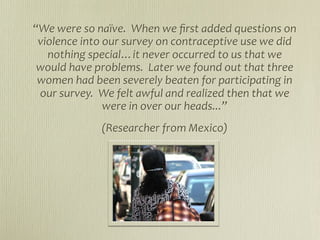
“We
were
so
naïve.

When
we
first
added
questions
on

 violence
into
our
survey
on
contraceptive
use
we
did

   nothing
special…it
never
occurred
to
us
that
we

 would
have
problems.

Later
we
found
out
that
three

 women
had
been
severely
beaten
for
participating
in

 our
survey.

We
felt
awful
and
realized
then
that
we

               were
in
over
our
heads...”
             (Researcher
from
Mexico)

Minimum
conditions
for
using
           
a
short
module


•Measures
to
protect
safety
of
respondents
and

 interviewers
•Crisis
intervention
and
referrals
to
specialized

 services
for
respondents
who
need
this

•Special
training
and
emotional
support
and

 follow‐up
for
interviewers

Ethical and safety measures

Editor's Notes